Whole-Genome Sequencing Reveals Heterogeneous Resistance Profiles and Selected Mobile Genetic Elements in Ecuadorian Clinical Enterobacter hormaechei subsp. xiangfangensis and subsp. hoffmannii

 ,
,  , , , and
Abstract
1. Introduction
2. Results
2.1. Isolate Susceptibility and Resistance Genes
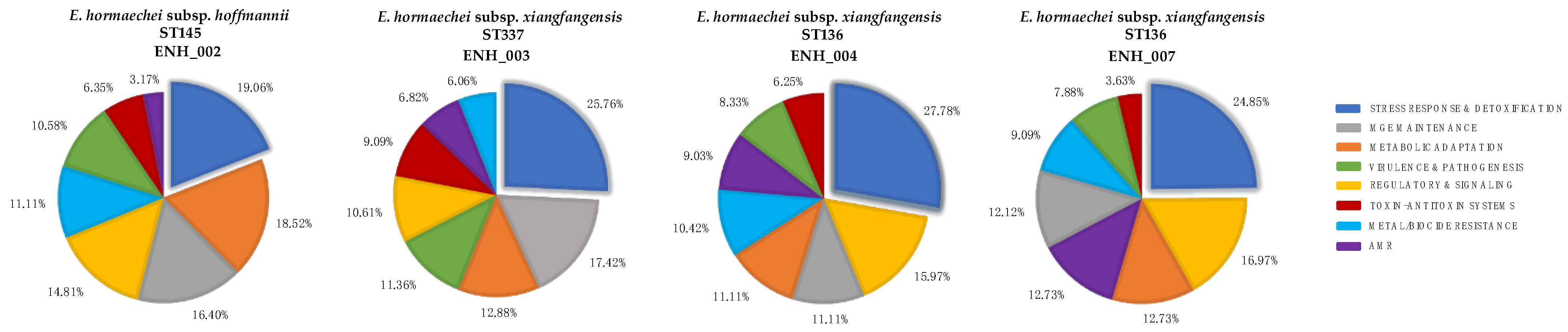
2.2. Virulence Factors and Environmental Persistence Traits
2.3. Integrons, Plasmids, and Genomic Islands
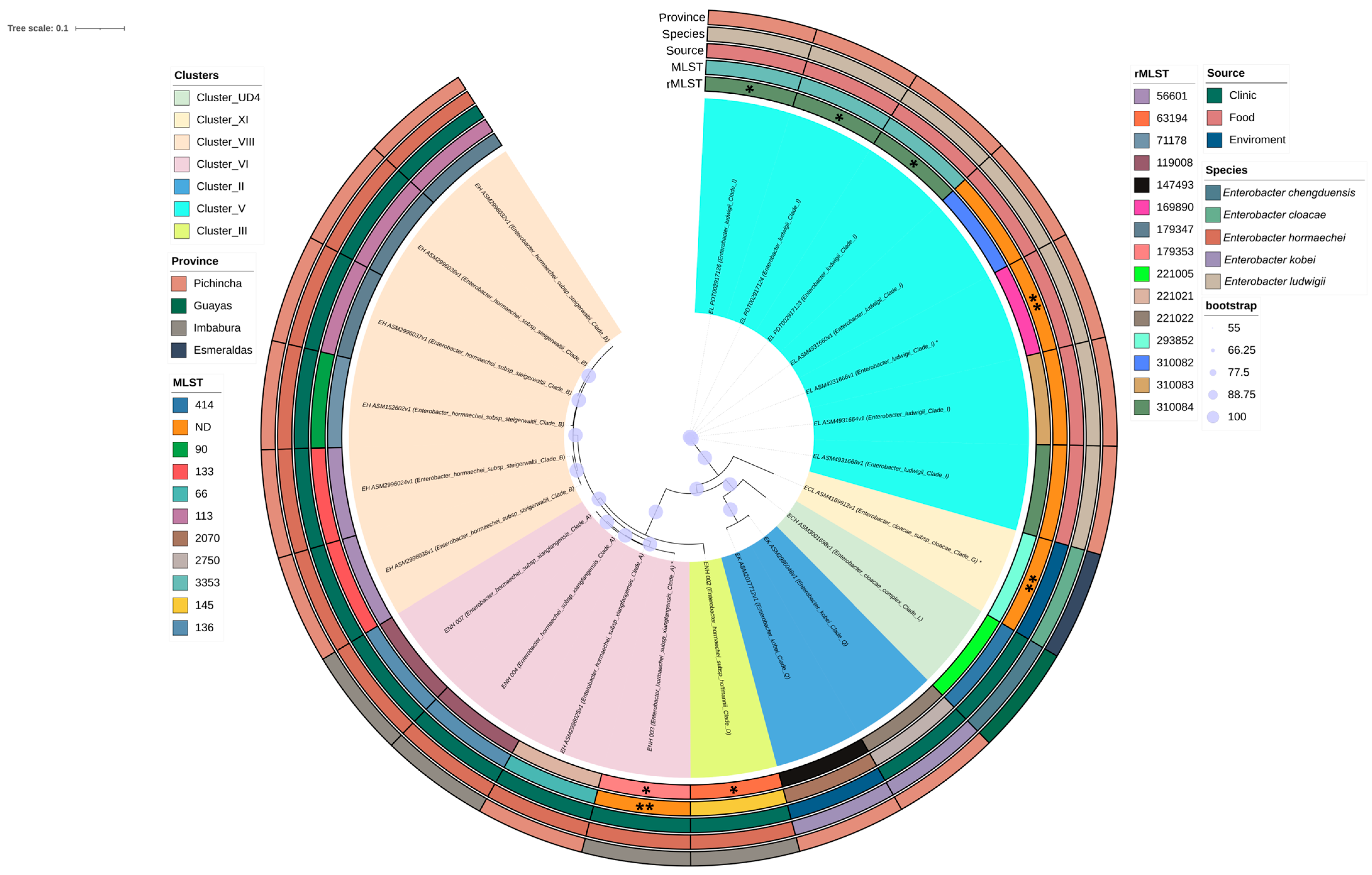
2.4. Phylogenetic Tree
3. Discussion
4. Materials and Methods
4.1. Bacterial Isolates
4.2. Antimicrobial Susceptibility Testing
4.3. Whole-Genome Sequencing (WGS)
5. Conclusions
Supplementary Materials
Author Contributions
Funding
Institutional Review Board Statement
Informed Consent Statement
Data Availability Statement
Acknowledgments
Conflicts of Interest
References
- Davin-Regli, A.; Lavigne, J.-P.; Pagès, J.-M. Enterobacter spp.: Update on taxonomy, clinical aspects, and emerging antimicrobial resistance. Clin. Microbiol. Rev. 2019, 32, e00002-19. [Google Scholar] [CrossRef]
- Mulani, M.S.; Kamble, E.E.; Kumkar, S.N.; Tawre, M.S.; Pardesi, K.R. Emerging strategies to combat ESKAPE pathogens in the era of antimicrobial resistance: A review. Front. Microbiol. 2019, 10, 539. [Google Scholar] [CrossRef]
- Mezzatesta, M.L.; Gona, F.; Stefani, S. Enterobacter cloacae complex: Clinical impact and emerging antibiotic resistance. Future Microbiol. 2012, 7, 887–902. [Google Scholar] [CrossRef]
- Peymani, A.; Naserpour Farivar, T.; Sanikhani, R.; Javadi, A.; Najafipour, R. Emergence of TEM, SHV, and CTX-M extended-spectrum β-lactamases and class 1 integron among Enterobacter cloacae isolates collected from hospitals of Tehran and Qazvin, Iran. Microb. Drug Resist. 2014, 20, 424–430. [Google Scholar] [CrossRef] [PubMed]
- Cai, S.; Quan, J.; Wang, Z.; Hu, H.; Han, X.; Jiang, Y.; Yang, Q.; Yu, Y.; Zhou, Z. High Prevalence of carbapenem-resistant Enterobacter cloacae complex in a tertiary hospital over a decade. Microbiol. Spectr. 2024, 12, e00780-24. [Google Scholar] [CrossRef]
- Pavlovic, M.; Konrad, R.; Iwobi, A.N.; Sing, A.; Busch, U.; Huber, I. A Dual Approach Employing MALDI-TOF MS and Real-Time PCR for Fast Species Identification within the Enterobacter cloacae Complex. FEMS Microbiol. Lett. 2012, 328, 46–53. [Google Scholar] [CrossRef]
- Annavajhala, M.K.; Gomez-Simmonds, A.; Uhlemann, A.C. Multidrug-resistant Enterobacter cloacae complex emerging as a global, diversifying threat. Front. Microbiol. 2019, 10, 44. [Google Scholar] [CrossRef]
- Paauw, A.; Caspers, M.P.M.; Schuren, F.H.J.; Leverstein-van Hall, M.A.; Delétoile, A.; Montijn, R.C.; Verhoef, J.; Fluit, A.C. Genomic diversity within the Enterobacter cloacae complex. PLoS ONE 2008, 3, e3018. [Google Scholar] [CrossRef] [PubMed]
- Halder, G.; Chaudhury, B.N.; Mandal, S.; Denny, P.; Sarkar, D.; Chakraborty, M.; Khan, U.R.; Sarkar, S.; Biswas, B.; Chakraborty, A.; et al. Whole genome sequence-based molecular characterization of blood isolates of carbapenem-resistant Enterobacter cloacae complex from ICU patients in Kolkata, India, during 2017–2022: Emergence of phylogenetically heterogeneous Enterobacter hormaechei subsp. xiangfangensis. Microbiol. Spectr. 2024, 12, e03529-23. [Google Scholar] [CrossRef] [PubMed]
- Yang, J.; Baek, J.Y.; Ko, J.-H.; Huh, K.; Cho, S.Y.; Chung, D.R.; Peck, K.R.; Huh, H.J.; Ko, K.S.; Kang, C.-I. Clinical and microbiological analyses of colistin-resistant strains among carbapenem-resistant Enterobacter cloacae complex clinical isolates. Microbiol. Spectr. 2025, 13, e01604-24. [Google Scholar] [CrossRef]
- Morhart, P.; Gerlach, R.G.; Kunz, C.; Held, J.; Valenza, G.; Wölfle, J.; Reutter, H.; Hanslik, G.J.; Fahlbusch, F.B. Application of next-generation sequencing to Enterobacter hormaechei subspecies analysis during a neonatal intensive care unit outbreak. Children 2023, 10, 1696. [Google Scholar] [CrossRef]
- Chen, C.-J.; Lu, P.-L.; Jian, S.-H.; Fu, H.-L.; Huang, P.-H.; Chang, C.-Y. Molecular epidemiology, risk factors and clinical outcomes of carbapenem-nonsusceptible Enterobacter cloacae complex infections in a Taiwan university hospital. Pathogens 2022, 11, 151. [Google Scholar] [CrossRef]
- Izdebski, R.; Biedrzycka, M.; Urbanowicz, P.; Papierowska-Kozdój, W.; Dominiak, M.; Żabicka, D.; Gniadkowski, M. Multiple secondary outbreaks of NDM-producing Enterobacter hormaechei in the context of endemic NDM-producing Klebsiella pneumoniae. J. Antimicrob. Chemother. 2022, 77, 1561–1569. [Google Scholar] [CrossRef]
- Li, R.; Wang, J.; Zhang, W.; Zhao, C.; Han, M.; Du, H.; Zhang, H. Co-occurrence of mcr-9 and blaNDM-5 in multidrug-resistant Enterobacter hormaechei strain isolated from a patient with bloodstream infection. Curr. Microbiol. 2025, 82, 169. [Google Scholar] [CrossRef] [PubMed]
- Ferreira, C.M.; Naveca, F.G.; Ferreira, G.M.A.; Barbosa, M.d.N.S.; de Souza, V.C.; Calheiros, F.O.; Souza, V.S.; Ferreira, W.A. Whole-genome analysis of extensively drug-resistant Enterobacter hormaechei isolated from a patient with non-Hodgkin’s lymphoma. Genes 2024, 15, 814. [Google Scholar] [CrossRef]
- Liu, H.; Wang, D.; Tang, M.; Jia, P.; Huo, Y.; Wei, E.; Xu, H.; Chi, X.; Wang, H. Genetic characterization of Enterobacter hormaechei co-harboring blaNDM-1 and mcr-9 causing upper respiratory tract infection. Infect. Drug Resist. 2022, 15, 5035–5042. [Google Scholar] [CrossRef]
- Cui, S.; Ma, W.; Peng, H.; Ye, Y.; Qing, Y.; Wei, G.; Wang, J.; Zhang, X. Genome-wide mining reveals the genetic plasticity of antibiotic resistance/virulence factor genes in Enterobacter hormaechei subsp. xiangfangensis. J. Appl. Microbiol. 2025, 136, lxaf196. [Google Scholar] [CrossRef]
- Fernández-Yáñez, V.; Ibaceta, V.; Torres, A.; Vidal, R.M.; Schneider, I.; Schilling, V.; Toro, C.; Arellano, C.; Scavone, P.; Muñoz, I.; et al. Presence and role of the type 3 fimbria in the adherence capacity of Enterobacter hormaechei subsp. hoffmannii. Microorganisms 2024, 12, 1441. [Google Scholar] [CrossRef]
- Arena, C.J.; Suleyman, G.; Kaur, J.; Veve, M.P.; Tibbetts, R.J. Whole-genome analysis of extensively drug-resistant Enterobacter hormaechei isolated from two hospitalized patients in the United States: A case series of a rare but rising threat. JAC Antimicrob. Resist. 2025, 7, dlaf202. [Google Scholar] [CrossRef] [PubMed]
- Mavroidi, A.; Gartzonika, K.; Spanakis, N.; Froukala, E.; Kittas, C.; Vrioni, G.; Tsakris, A. Comprehensive analysis of virulence determinants and genomic islands of blaNDM-1-producing Enterobacter hormaechei clinical isolates from Greece. Antibiotics 2023, 12, 1549. [Google Scholar] [CrossRef] [PubMed]
- Peirano, G.; Matsumura, Y.; Adams, M.D.; Bradford, P.; Motyl, M.; Chen, L.; Kreiswirth, B.N.; Pitout, J.D.D. Genomic epidemiology of global carbapenemase-producing Enterobacter spp., 2008–2014. Emerg. Infect. Dis. 2018, 24, 1010–1019. [Google Scholar] [CrossRef]
- Cardoso, B.; Sellera, F.P.; Sano, E.; Esposito, F.; Seabra, L.A.V.; Azedo, M.R.; Pogliani, F.C.; Lincopan, N. Phylogenomic analysis of CTX-M-15–producing Enterobacter hormaechei belonging to the high-risk ST78 from animal infection: Another successful One Health clone? J. Glob. Antimicrob. Resist. 2022, 29, 113–115. [Google Scholar] [CrossRef]
- Lumbreras-Iglesias, P.; de Toro, M.; Vázquez, X.; García-Carús, E.; Rodicio, M.R.; Fernández, J. High-risk international clones ST66, ST171 and ST78 of Enterobacter cloacae complex causing blood stream infections in Spain and carrying blaOXA-48 with or without mcr-9. J. Infect. Public Health 2023, 16, 272–279. [Google Scholar] [CrossRef]
- Emeraud, C.; Petit, C.; Gauthier, L.; Bonnin, R.A.; Naas, T.; Dortet, L. Emergence of VIM-producing Enterobacter cloacae complex in France between 2015 and 2018. J. Antimicrob. Chemother. 2022, 77, 944–951. [Google Scholar] [CrossRef] [PubMed]
- Knecht, C.A.; García Allende, N.; Álvarez, V.E.; Prack McCormick, B.; Massó, M.G.; Piekar, M.; Campos, J.; Fox, B.; Camicia, G.; Gambino, A.S.; et al. Novel insights related to the rise of KPC-producing Enterobacter cloacae complex strains within the nosocomial niche. Front. Cell. Infect. Microbiol. 2022, 12, 951049. [Google Scholar] [CrossRef] [PubMed]
- Zhou, K.; Zhou, Y.; Xue, C.-X.; Xu, T.; Chen, Y.; Shen, P.; Xiao, Y. Bloodstream infections caused by Enterobacter hormaechei ST133 in China, 2010–2022. Lancet Microbe 2023, 4, e13. [Google Scholar] [CrossRef] [PubMed]
- Luo, M.; Zhang, Y.; He, F.; Yang, Z. Enterobacter hormaechei: A global genomic and epidemiological perspective. J. Glob. Antimicrob. Resist. 2025, 44, 59–63. [Google Scholar] [CrossRef]
- Paz-Calvache, T.G.; Merchancano, S.J.; Nakazato, L.; Dutra, V. Detection and characterization of multidrug-resistant Klebsiella spp. and Enterobacter spp. isolates in colombian guinea pigs intended for human consumption. Vet. World 2025, 18, 3187. [Google Scholar] [CrossRef]
- Mondragón-Quiguanas, A.; Villaquirán-Muriel, M.Á.; Rivera, S.P.; Rosero-García, D.; Aranaga, C.; Correa, A.; Falco, A. Beta-lactam-resistant Enterobacterales isolated from landfill leachates. Pathogens 2022, 11, 1077. [Google Scholar] [CrossRef]
- Rodulfo, H.; Martínez, D.; De Donato, M. Molecular identification of multidrug resistant Enterobacter hormaechei in Venezuela. Investig. Clin. 2016, 57, 402–408. [Google Scholar]
- Cuicapuza, D.; Loyola, S.; Velásquez, J.; Fernández, N.; Llanos, C.; Ruiz, J.; Tsukayama, P.; Tamariz, J. Molecular characterization of carbapenemase-producing Enterobacterales in a tertiary hospital in Lima, Peru. Microbiol. Spectr. 2024, 12, e02503-23. [Google Scholar] [CrossRef]
- Giani, T.; Sennati, S.; Antonelli, A.; Di Pilato, V.; Di Maggio, T.; Mantella, A.; Niccolai, C.; Spinicci, M.; Monasterio, J.; Castellanos, P.; et al. High prevalence of carriage of mcr-1-positive enteric bacteria among healthy children from rural communities in the Chaco Region, Bolivia, September to October 2016. Eurosurveillance 2018, 23, 1800115. [Google Scholar] [CrossRef]
- Corrales-Martínez, J.; Jaramillo, K.; Tadesse, D.A.; Satán, C.; Villavicencio, F.X.; Sánchez-Gavilanes, L.; Rivadeneira-Cueva, B.; Balcázar, J.L.; Calero-Cáceres, W. Genomic characterization of a WHO critical priority isolate Enterobacter kobei ST2070 harboring OXA-10, KPC-2, and CTX-M-12 recovered from a water irrigation channel in Ecuador. Heliyon 2024, 10, e26379. [Google Scholar] [CrossRef]
- Cifuentes, S.G.; Graham, J.; Trueba, G.; Cádenas, P.A. Detection of mobile colistin resistance genes mcr-9.1 and mcr-10.1 in Enterobacter asburiae from Ecuadorian children. Microbiol. Resour. Announc. 2024, 13, e00313-24. [Google Scholar] [CrossRef]
- Zurita, J.; Solís, M.B.; Sevillano, G.; Herrera-Yela, A.; Zurita-Salinas, C.; Moreno, C.; Romero, J.J.; Ecuadorian Bacteremia Working Group. Clinical, microbiological and genomic characterization of carbapenem-resistant gram-negative bacteria in bloodstream infection: A multi-center study in Ecuador. J. Appl. Microbiol. 2026, 137, lxag008. [Google Scholar] [CrossRef] [PubMed]
- Bastidas-Caldes, C.; Hernández-Alomía, F.; Almeida, M.; Ormaza, M.; Boada, J.; Graham, J.; Calvopiña, M.; Castillejo, P. Molecular identification and antimicrobial resistance patterns of Enterobacterales in community urinary tract infections among Indigenous women in Ecuador: Addressing microbiological misidentification. BMC Infect. Dis. 2024, 24, 1195. [Google Scholar] [CrossRef] [PubMed]
- Pot, M.; Reynaud, Y.; Couvin, D.; Dereeper, A.; Ferdinand, S.; Bastian, S.; Foucan, T.; Pommier, J.-D.; Valette, M.; Talarmin, A.; et al. Emergence of a novel lineage and widespread of a blaCTX-M-15/IncHI2/ST1 plasmid among nosocomial Enterobacter in Guadeloupe. Antibiotics 2022, 11, 1443. [Google Scholar] [CrossRef] [PubMed]
- Hauck, S.; Maiden, M.C.J. Clonally evolving pathogenic bacteria. In Molecular Mechanisms of Microbial Evolution; Rampelotto, P., Ed.; Springer: Cham, Switzerland, 2018; pp. 303–323. [Google Scholar]
- Preska Steinberg, A.; Kussell, E. How recombination and clonal evolution shape bacterial lineages and genomes. Genetics 2025, 231, iyaf115. [Google Scholar] [CrossRef]
- Donà, V.; Nordmann, P.; Kittl, S.; Schuller, S.; Bouvier, M.; Poirel, L.; Endimiani, A.; Perreten, V. Emergence of OXA-48-producing Enterobacter hormaechei in a Swiss companion animal clinic and their genetic relationship to clinical human isolates. J. Antimicrob. Chemother. 2023, 78, 2950–2960. [Google Scholar] [CrossRef]
- Kobs, V.C.; de Medeiros, F.; Fernandes, P.P.; Deglmann, R.C.; Fontana, H.; Cardoso, B.; Sano, E.; Esposito, F.; Sellera, F.P.; Lincopan, N.; et al. Healthcare-associated NDM-1-producing Enterobacter hormaechei subsp. xiangfangensis clone ST136 emerging as a pathogen of companion animals in Brazil. J. Antimicrob. Chemother. 2023, 78, 1553–1556. [Google Scholar] [CrossRef]
- Lerminiaux, N.; Fakharuddin, K.; Longtin, Y.; McGill, E.; Mitchell, R.; Mataseje, L. Canadian Nosocomial Infection Surveillance Program. Plasmid genomic epidemiology of blaNDM carbapenemase-producing Enterobacterales in Canada from 2010 to 2023. Microb. Genom. 2025, 11, 001415. [Google Scholar] [CrossRef]
- Moussa, J.; Nassour, E.; Tahan, E.; El Chaar, M.; Jisr, T.; Tokajian, S. Carbapenem resistance determinants and their transmissibility among clinically isolated Enterobacterales in Lebanon. J. Infect. Public Health 2023, 16, 1947–1953. [Google Scholar] [CrossRef]
- Messaoudi, A.; Saras, E.; Grami, R.; Bouallègue, O.; Boujâafar, N.; Madec, J.-Y.; Mansour, W.; Haenni, M. Emergence of OXA-204 carbapenemase in Enterobacter cloacae. Int. J. Antimicrob. Agents 2019, 54, 829–830. [Google Scholar] [CrossRef] [PubMed]
- Harada, K.; Shimizu, T.; Mukai, Y.; Kuwajima, K.; Sato, T.; Kajino, A.; Usui, M.; Tamura, Y.; Kimura, Y.; Miyamoto, T.; et al. Phenotypic and molecular characterization of antimicrobial resistance in Enterobacter spp. isolates from companion animals in Japan. PLoS ONE 2017, 12, e0174178. [Google Scholar] [CrossRef] [PubMed]
- Huang, Y.; Wu, Y.; Cai, C.; Zhang, R.; Chen, G.; Dong, N. Phenotypic and genomic characterization of ST133 siderophore-encoding extensively drug-resistant Enterobacter hormaechei. Antimicrob. Agents Chemother. 2023, 67, e01737-22. [Google Scholar] [CrossRef] [PubMed]
- Xu, T.; Xue, C.-X.; Huang, J.; Wu, J.; Chen, R.; Zhou, K. Emergence of an epidemic hypervirulent clone of Enterobacter hormaechei coproducing mcr-9 and carbapenemases. Lancet Microbe 2022, 3, e474–e475. [Google Scholar] [CrossRef]
- Bonnin, R.A.; Girlich, D.; Jousset, A.B.; Emeraud, C.; Creton, E.; Gauthier, L.; Naas, T. Genomic analysis of VIM-2-producing Enterobacter hormaechei subsp. steigerwaltii. Int. J. Antimicrob. Agents 2021, 57, 106285. [Google Scholar] [CrossRef]
- Pot, M.; Reynaud, Y.; Couvin, D.; Ducat, C.; Ferdinand, S.; Gravey, F.; Gruel, G.; Guérin, F.; Malpote, E.; Breurec, S.; et al. Wide Distribution and specific resistance pattern to third-generation cephalosporins of Enterobacter cloacae complex members in humans and in the environment in Guadeloupe (French West Indies). Front. Microbiol. 2021, 12, 628058. [Google Scholar] [CrossRef]
- Haenni, M.; Châtre, P.; Drapeau, A.; Cazeau, G.; Troncy, J.; François, P.; Madec, J.-Y. Distinct molecular epidemiology of resistances to extended-spectrum cephalosporins and carbapenems in Enterobacter hormaechei in cats and dogs versus horses in France. J. Antimicrob. Chemother. 2025, 80, 567–575. [Google Scholar] [CrossRef] [PubMed]
- Pot, M.; Guyomard-Rabenirina, S.; Couvin, D.; Ducat, C.; Enouf, V.; Ferdinand, S.; Gruel, G.; Malpote, E.; Talarmin, A.; Breurec, S.; et al. Dissemination of extended-spectrum-β-lactamase-producing Enterobacter cloacae complex from a hospital to the nearby environment in Guadeloupe (French West Indies): ST114 lineage coding for a successful IncHI2/ST1 plasmid. Antimicrob. Agents Chemother. 2021, 65, e02146-20. [Google Scholar] [CrossRef]
- Schmitt, K.; Biggel, M.; Stephan, R.; Willi, B. Massive Spread of OXA-48 Carbapenemase-producing Enterobacteriaceae in the environment of a Swiss companion animal clinic. Antibiotics 2022, 11, 213. [Google Scholar] [CrossRef]
- Tetsuka, N.; Hirabayashi, A.; Matsumoto, A.; Oka, K.; Hara, Y.; Morioka, H.; Iguchi, M.; Tomita, Y.; Suzuki, M.; Shibayama, K.; et al. Molecular epidemiological analysis and risk factors for acquisition of carbapenemase-producing Enterobacter cloacae complex in a Japanese university hospital. Antimicrob. Resist. Infect. Control 2019, 8, 126. [Google Scholar] [CrossRef] [PubMed]
- Gou, J.J.; Liu, N.; Guo, L.H.; Xu, H.; Lv, T.; Yu, X.; Zheng, B.W. Carbapenem-resistant Enterobacter hormaechei ST1103 with IMP-26 carbapenemase and ESBL gene blaSHV-178. Infect. Drug Resist. 2020, 13, 597–605. [Google Scholar] [CrossRef] [PubMed]
- Sutton, G.G.; Brinkac, L.M.; Clarke, T.H.; Fouts, D.E. Enterobacter hormaechei subsp. hoffmannii subsp. nov., Enterobacter hormaechei subsp. xiangfangensis comb. nov., Enterobacter roggenkampii sp. nov., and Enterobacter muelleri is a later heterotypic synonym of Enterobacter asburiae based on computational analysis of sequenced Enterobacter genomes. F1000Research 2018, 7, 521. [Google Scholar] [CrossRef] [PubMed]
- Izdebski, R.; Biedrzycka, M.; Urbanowicz, P.; Żabicka, D.; Gniadkowski, M. Genome-based epidemiologic analysis of VIM/IMP carbapenemase-producing Enterobacter spp., Poland. Emerg. Infect. Dis. 2023, 29, 1618–1626. [Google Scholar] [CrossRef] [PubMed]
- Yeh, T.-K.; Lin, H.-J.; Liu, P.-Y.; Wang, J.-H.; Hsueh, P.-R. Antibiotic resistance in Enterobacter hormaechei. Int. J. Antimicrob. Agents 2022, 60, 106650. [Google Scholar] [CrossRef]
- Han, M.; Liu, C.; Xie, H.; Zheng, J.; Zhang, Y.; Li, C.; Shen, H.; Cao, X. Genomic and clinical characteristics of carbapenem-resistant Enterobacter cloacae complex isolates collected in a Chinese tertiary hospital during 2013–2021. Front. Microbiol. 2023, 14, 1127948. [Google Scholar] [CrossRef]
- Ndukui, J.G.; Gikunju, J.K.; Aboge, G.O.; Mwaniki, J.K.; Maina, J.N.; Mbaria, J.M. Molecular characterization of ESBLs and QnrS producers from selected Enterobacteriaceae strains isolated from commercial poultry production systems in Kiambu county, Kenya. Microbiol. Insights 2022, 15, 11786361211063619. [Google Scholar] [CrossRef]
- Wu, J.-W.; Quyen, T.L.T.; Hsieh, Y.-C.; Chen, Y.-Y.; Wu, L.-T.; Pan, Y.-J. Investigation of carbapenem-resistant Klebsiella pneumoniae in Taiwan revealed strains co-harbouring blaNDM and blaOXA-48-like and a novel plasmid co-carrying blaNDM-1 and blaOXA-181. Int. J. Antimicrob. Agents 2023, 62, 106964. [Google Scholar] [CrossRef]
- Liu, S.; Huang, N.; Zhou, C.; Lin, Y.; Zhang, Y.; Wang, L.; Zheng, X.; Zhou, T.; Wang, Z. Molecular mechanisms and epidemiology of carbapenem-resistant Enterobacter cloacae complex isolated from Chinese patients during 2004–2018. Infect. Drug Resist. 2021, 14, 3647–3658. [Google Scholar] [CrossRef]
- Black, C.A.; Benavides, R.; Bandy, S.M.; Dallas, S.D.; Gawrys, G.; So, W.; Moreira, A.G.; Aguilar, S.; Quidilla, K.; Smelter, D.F.; et al. Diverse role of blaCTX-M and porins in mediating ertapenem resistance among carbapenem-resistant Enterobacterales. Antibiotics 2024, 13, 185. [Google Scholar] [CrossRef]
- Su, Y.; Zou, G.; Huang, X.; Bi, J.; Meng, L.; Zhao, W.; Li, T. Molecular characterization and resistance mechanisms of ertapenem-non-susceptible carbapenem-resistant Klebsiella pneumoniae co-harboring ESBLs or AmpC enzymes with porin loss or efflux pump overexpression. J. Bacteriol. 2025, 207, e00148-25. [Google Scholar] [CrossRef]
- Ganbold, M.; Seo, J.; Wi, Y.M.; Kwon, K.T.; Ko, K.S. Species identification, antibiotic resistance, and virulence in Enterobacter cloacae complex clinical isolates from South Korea. Front. Microbiol. 2023, 14, 1122691. [Google Scholar] [CrossRef]
- Li, Y.; Wang, Z.; Zhang, G.; Kang, W.; Li, J.; Xu, Y.; Zhou, M. Precise species identification and whole-genome sequencing analysis of Enterobacter cloacae complex causing bloodstream infections in China. Microbiol. Spectr. 2026, 14, e02865-25. [Google Scholar] [CrossRef] [PubMed]
- De Maayer, P.; Green, T.; Jordan, S.; Smits, T.H.M.; Coutinho, T.A. Pan-genome analysis of the Enterobacter hormaechei complex highlights its genomic flexibility and pertinence as a multidrug-resistant pathogen. BMC Genom. 2025, 26, 408. [Google Scholar] [CrossRef] [PubMed]
- Qiu, X.; Ye, K.; Ma, Y.; Zhao, Q.; Wang, L.; Yang, J. Genome sequence-based species classification of Enterobacter cloacae complex: A study among clinical isolates. Microbiol. Spectr. 2024, 12, e04312-23. [Google Scholar] [CrossRef] [PubMed]
- Cao, Z.; Cui, L.; Liu, Q.; Liu, F.; Zhao, Y.; Guo, K.; Hu, T.; Zhang, F.; Sheng, X.; Wang, X.; et al. Phenotypic and genotypic characterization of multidrug-resistant Enterobacter hormaechei carrying qnrS gene isolated from chicken feed in China. Microbiol. Spectr. 2022, 10, e02518-21. [Google Scholar] [CrossRef]
- Yaikhan, T.; Singkhamanan, K.; Luenglusontigit, P.; Chukamnerd, A.; Nokchan, N.; Chintakovid, N.; Chusri, S.; Pomwised, R.; Wonglapsuwan, M.; Leetanaporn, K.; et al. Genomic analysis of Enterobacter cloacae complex from Southern Thailand reveals insights into multidrug resistance genotypes and genetic diversity. Sci. Rep. 2025, 15, 4670. [Google Scholar] [CrossRef]
- Mishra, M.; Panda, S.; Barik, S.; Sarkar, A.; Singh, D.V.; Mohapatra, H. Antibiotic resistance profile, outer membrane proteins, virulence factors and genome sequence analysis reveal clinical isolates of Enterobacter are potential pathogens compared to environmental isolates. Front. Cell. Infect. Microbiol. 2020, 10, 54. [Google Scholar] [CrossRef]
- Kathi, S. Enterobacter spp. virulence factors and biofilm components: Synthesis, structure, function, and inhibitors. In ESKAPE Pathogens: Detection, Mechanisms and Treatment Strategies; Ahmad, I., Rumbaugh, K.P., Singh, S.B., Eds.; Springer Nature: Singapore, 2024; pp. 349–365. [Google Scholar]
- Kamathewatta, K.; Bushell, R.; Rafa, F.; Browning, G.; Billman-Jacobe, H.; Marenda, M. Colonization of a hand washing sink in a veterinary hospital by an Enterobacter hormaechei strain carrying multiple resistances to high importance antimicrobials. Antimicrob. Resist. Infect. Control 2020, 9, 163. [Google Scholar] [CrossRef]
- Erler, T.; Carlsen, L.; Dengler, J.; Hammerl, J.A.; Stroehlein, A.J.; Hoffmann, M.; Knobloch, J.K.; Lübbert, C.; Papan, C.; Schwanz, T.; et al. Cefiderocol-resistant pathogens in German hospital wastewater: A reservoir for multidrug resistance. Sci. Rep. 2025, 15, 31622. [Google Scholar] [CrossRef]
- Bojer, M.S.; Struve, C.; Ingmer, H.; Hansen, D.S.; Krogfelt, K.A. Heat resistance mediated by a new plasmid encoded Clp ATPase, ClpK, as a possible novel mechanism for nosocomial persistence of Klebsiella pneumoniae. PLoS ONE 2010, 5, e15467. [Google Scholar] [CrossRef]
- Zouagui, H.; Zouagui, R.; Ibrahimi, A.; Sbabou, L. Comparative genomics uncovers adaptive and biotechnological potential of Enterobacter xiangfangensis MDMC82 isolated from desert, and highlights putative core Enterobacteriaceae functions. Sci. Rep. 2025, 15, 41234. [Google Scholar] [CrossRef] [PubMed]
- Kaushik, M.; Kumar, S.; Kapoor, R.K.; Virdi, J.S.; Gulati, P. Integrons in Enterobacteriaceae: Diversity, distribution and epidemiology. Int. J. Antimicrob. Agents 2018, 51, 167–176. [Google Scholar] [CrossRef] [PubMed]
- Dong, X.; Zhu, M.; Li, Y.; Huang, D.; Wang, L.; Yan, C.; Zhang, L.; Dong, F.; Lu, J.; Lin, X.; et al. Whole-genome sequencing-based species classification, multilocus sequence typing, and antimicrobial resistance mechanism analysis of the Enterobacter cloacae complex in Southern China. Microbiol. Spectr. 2022, 10, e02160-22. [Google Scholar] [CrossRef] [PubMed]
- Zhou, K.; Yu, W.; Cao, X.; Shen, P.; Lu, H.; Luo, Q.; Rossen, J.W.A.; Xiao, Y. Characterization of the population structure, drug resistance mechanisms and plasmids of the community-associated Enterobacter cloacae complex in China. J. Antimicrob. Chemother. 2018, 73, 66–76. [Google Scholar] [CrossRef]
- Algarni, S.; Gudeta, D.D.; Han, J.; Shetty, A.C.; Fouts, D.E.; Doi, Y.; Bonomo, R.A.; Li, G. Genotypic analyses of IncHI2 plasmids from enteric bacteria. Sci. Rep. 2024, 14, 9802. [Google Scholar] [CrossRef]
- Sadek, M.; Nariya, H.; Shimamoto, T.; Kayama, S.; Yu, L.; Hisatsune, J.; Sugai, M.; Nordmann, P.; Poirel, L.; Shimamoto, T. First genomic characterization of blaVIM-1 and mcr-9-co-harbouring Enterobacter hormaechei isolated from food of animal origin. Pathogens 2020, 9, 687. [Google Scholar] [CrossRef]
- Umeda, K.; Nakamura, H.; Fukuda, A.; Yamaguchi, T.; Matsumoto, Y.; Motooka, D.; Nakamura, S.; Kawahara, R. Molecular characterization of blaKHM-1 encoding plasmid in an Enterobacter hormaechei subsp. hoffmannii isolate from blood culture. PLoS ONE 2020, 15, e0227605. [Google Scholar] [CrossRef] [PubMed]
- Chang, C.-Y.; Huang, P.-H.; Lu, P.-L. The resistance mechanisms and clinical impact of resistance to the third generation cephalosporins in species of Enterobacter cloacae complex in Taiwan. Antibiotics 2022, 11, 1153. [Google Scholar] [CrossRef]
- Rezzoug, I.; Emeraud, C.; Rodriguez, C.; Pawlotsky, J.M.; Bonnin, R.A.; Dortet, L. Regional dissemination of NDM-1 producing Enterobacter hormaechei ST1740, with a subset of strains co-producing VIM-4 or IMP-13, France, 2019 to 2022. Eurosurveillance 2024, 29, 2300521. [Google Scholar] [CrossRef]
- Doualla-Bell, F.; Boyd, D.A.; Savard, P.; Yousfi, K.; Bernaquez, I.; Wong, S.; Usongo, V.; Mataseje, L.F.; Mulvey, M.R.; Bekal, S. Analysis of an IncR plasmid carrying blaNDM-1 linked to an azithromycin resistance region in Enterobacter hormaechei involved in an outbreak in Quebec. Microbiol. Spectr. 2021, 9, e01998-21. [Google Scholar] [CrossRef]
- Zhang, D.; Li, S.; Zhang, X.; Zheng, S.; Zhou, D.; Hou, Q.; Jiang, Y.; Han, H. Epidemiological and biological characteristics of IncR plasmids as multihost antibiotic resistance carriers. Front. Microbiol. 2025, 16, 1622352. [Google Scholar] [CrossRef]
- Munshi, I.D.; Mathuria, A.; Sharma, H.; Acharya, M.; Chaudhary, A.; Jain, K.; Ragini; Dahiya, S.; Arora, R.; Singh, V.; et al. Emerging concept of genomic islands in bacterial adaptation and pathogenicity. Res. Microbiol. 2025, 176, 104303. [Google Scholar] [CrossRef] [PubMed]
- Procop, G.W.; Church, D.L.; Hall, G.S.; Janda, W.M. Koneman’s Color Atlas and Textbook of Diagnostic Microbiology, 7th ed.; Jones & Bartlett Learning: Burlington, MA, USA, 2020; pp. 226–231. [Google Scholar]
- Clinical and Laboratory Standards Institute (CLSI). Performance Standards for Antimicrobial Susceptibility Testing, 35th ed.; CLSI Supplement M100; Clinical and Laboratory Standards Institute: Wayne, PA, USA, 2025; Available online: https://clsi.org/ (accessed on 12 December 2025).
- Bolger, A.M.; Lohse, M.; Usadel, B. Trimmomatic: A flexible trimmer for Illumina sequence data. Bioinformatics 2014, 30, 2114–2120. [Google Scholar] [CrossRef] [PubMed]
- Andrews, S. FastQC: A Quality Control Tool for High Throughput Sequence Data. 2010. Available online: http://www.bioinformatics.babraham.ac.uk/projects/fastqc/ (accessed on 20 December 2025).
- Seemann, T. Shovill: Faster SPAdes Assembly of Illumina Reads. 2017. Available online: https://github.com/tseemann/shovill (accessed on 22 December 2025).
- Gurevich, A.; Saveliev, V.; Vyahhi, N.; Tesler, G. QUAST: Quality assessment tool for genome assemblies. Bioinformatics 2013, 29, 1072–1075. [Google Scholar] [CrossRef]
- Grant, J.R.; Enns, E.; Marinier, E.; Mandal, A.; Herman, E.K.; Chen, C.-Y.; Graham, M.; Van Domselaar, G.; Stothard, P. Proksee: In-depth characterization and visualization of bacterial genomes. Nucleic Acids Res. 2023, 51, W484–W492. [Google Scholar] [CrossRef] [PubMed]
- Clausen, P.T.L.C.; Aarestrup, F.M.; Lund, O. Rapid and precise alignment of raw reads against redundant databases with KMA. BMC Bioinform. 2018, 19, 307. [Google Scholar] [CrossRef]
- Jolley, K.A.; Bray, J.E.; Maiden, M.C.J. Open-access bacterial population genomics: BIGSdb software, the PubMLST.org website and their applications. Wellcome Open Res. 2018, 3, 124. [Google Scholar] [CrossRef] [PubMed]
- Carattoli, A.; Hasman, H. PlasmidFinder and in silico pMLST: Identification and typing of plasmid replicons in whole-genome sequencing (WGS). In Horizontal Gene Transfer: Methods and Protocols; de la Cruz, F., Ed.; Methods in Molecular Biology; Humana: New York, NY, USA, 2020; Volume 2075, pp. 285–294. [Google Scholar] [CrossRef]
- Feldgarden, M.; Brover, V.; Haft, D.H.; Prasad, A.B.; Slotta, D.J.; Tolstoy, I.; Tyson, G.H.; Zhao, S.; Hsu, C.-H.; McDermott, P.F.; et al. Validating the AMRFinder tool and resistance gene database by using antimicrobial resistance genotype-phenotype correlations in a collection of isolates. Antimicrob. Agents Chemother. 2019, 63, e00483-19. [Google Scholar] [CrossRef]
- Seemann, T. ABRicate: Mass Screening of Contigs for Antimicrobial and Virulence Genes. 2017. Available online: https://github.com/tseemann/abricate (accessed on 28 December 2025).
- Bortolaia, V.; Kaas, R.S.; Ruppe, E.; Roberts, M.C.; Schwarz, S.; Cattoir, V.; Philippon, A.; Allesoe, R.L.; Rebelo, A.R.; Florensa, A.F.; et al. ResFinder 4.0 for predictions of phenotypes from genotypes. J. Antimicrob. Chemother. 2020, 75, 3491–3500. [Google Scholar] [CrossRef] [PubMed]
- Néron, B.; Littner, E.; Haudiquet, M.; Perrin, A.; Cury, J.; Rocha, E.P.C. IntegronFinder 2.0: Identification and analysis of integrons across bacteria, with a focus on antibiotic resistance in Klebsiella. Microorganisms 2022, 10, 700. [Google Scholar] [CrossRef] [PubMed]
- Liu, B.; Zheng, D.; Zhou, S.; Chen, L.; Yang, J. VFDB 2022: A general classification scheme for bacterial virulence factors. Nucleic Acids Res. 2022, 50, D912–D917. [Google Scholar] [CrossRef] [PubMed]
- Bertelli, C.; Laird, M.R.; Williams, K.P.; Lau, B.Y.; Hoad, G.; Winsor, G.L.; Brinkman, F.S.L. IslandViewer 4: Expanded prediction of genomic islands for larger-scale datasets. Nucleic Acids Res. 2017, 45, W30–W35. [Google Scholar] [CrossRef]
- Katoh, K.; Standley, D.M. MAFFT multiple sequence alignment software version 7: Improvements in performance and usability. Mol. Biol. Evol. 2013, 30, 772–780. [Google Scholar] [CrossRef]
- Sayers, E.W.; Bolton, E.E.; Brister, J.R.; Canese, K.; Chan, J.; Comeau, D.C.; Farrell, C.M.; Feldgarden, M.; Fine, A.M.; Funk, K.; et al. Database resources of the national center for biotechnology information in 2023. Nucleic Acids Res. 2023, 51, D29–D38. [Google Scholar] [CrossRef]
- Tonkin-Hill, G.; MacAlasdair, N.; Ruis, C.; Weimann, A.; Horesh, G.; Lees, J.A.; Gladstone, R.A.; Lo, S.; Beaudoin, C.; Floto, R.A.; et al. Producing polished prokaryotic pangenomes with the panaroo pipeline. Genome Biol. 2020, 21, 180. [Google Scholar] [CrossRef]
- Nguyen, L.-T.; Schmidt, H.A.; von Haeseler, A.; Minh, B.Q. IQ-TREE: A fast and effective stochastic algorithm for estimating maximum-likelihood phylogenies. Mol. Biol. Evol. 2015, 32, 268–274. [Google Scholar] [CrossRef]
- KaruBioTools. hsp60ECCtool: Enterobacter cloacae Complex hsp60 Sequence Typing Tool. Version 1.0.0. 2022. Available online: https://github.com/karubiotools/hsp60ECCtool (accessed on 14 January 2026).
- Jolley, K.A.; Bliss, C.M.; Bennett, J.S.; Bratcher, H.B.; Brehony, C.; Colles, F.M.; Wimalarathna, H.; Harrison, O.B.; Sheppard, S.K.; Cody, A.J.; et al. Ribosomal Multilocus Sequence Typing: Universal characterization of bacteria from domain to strain. Microbiology 2012, 158, 1005–1015. [Google Scholar] [CrossRef]
- Letunic, I.; Bork, P. Interactive Tree of Life (iTOL) v6: Recent updates to the phylogenetic tree display and annotation tool. Nucleic Acids Res. 2024, 52, W78–W82. [Google Scholar] [CrossRef]
- Arndt, D.; Grant, J.R.; Marcu, A.; Sajed, T.; Pon, A.; Liang, Y.; Wishart, D.S. PHASTER: A better, faster version of the PHAST phage search tool. Nucleic Acids Res. 2016, 44, W16–W21. [Google Scholar] [CrossRef] [PubMed]
- Couvin, D.; Bernheim, A.; Toffano-Nioche, C.; Touchon, M.; Michalik, J.; Néron, B.; Rocha, E.P.C.; Vergnaud, G.; Gautheret, D.; Pourcel, C. CRISPRCasFinder, an update of CRISRFinder, includes a portable version, enhanced performance and integrates search for Cas proteins. Nucleic Acids Res. 2018, 46, W246–W251. [Google Scholar] [CrossRef] [PubMed]



| Diameter of Inhibition (cm ± SD) | |||||
|---|---|---|---|---|---|
| Antibiotic Class | Antibiotic Disks | ENH_002 E. hormaechei subsp. hoffmannii | ENH_003 E. hormaechei subsp. xiangfangensis | ENH_004 E. hormaechei subsp. xiangfangensis | ENH_007 E. hormaechei subsp. xiangfangensis |
| β-lactams | Ampicillin (10 μg) | 0.73 ± 0.42 (R) | 0.63 ± 0.35 (R) | 0.57 ± 0.06 (R) | 0.67 ± 0.06 (R) |
| Amoxicillin/Clavulanate (20/10 μg) | 0.57 ± 0.12 (R) | 0.97 ± 0.25 (R) | 0.63 ± 0.06 (R) | 0.60 ± 0.17 (R) | |
| Piperacillin/Tazobactam (100/10 μg) | 1.23 ± 0.1 (R) | 1.60 ± 0.35 (R) | 2.23 ± 0.40 (I) | 1.83 ± 0.35 (R) | |
| Cefuroxime (30 μg) | 1.20 ± 0.40 (R) | 0.70 ± 0.10 (R) | 0.73 ± 0.21 (R) | 0.63 ± 0.15 (R) | |
| Cefotaxime (30 μg) | 3.60 ± 0.36 (S) | 0.83 ± 0.31 (R) | 1.03 ± 0.15 (R) | 0.63 ± 0.23 (R) | |
| Ceftazidime (30 μg) | 3.23 ± 0.23 (S) | 1.13 ± 0.15 (R) | 1.63 ± 0.25 (R) | 2.47 ± 0.49 (S) | |
| Cefepime (30 μg) | 3.83 ± 0.78 (S) | 2.57 ± 0.65 (S) | 1.30 ± 0.50 (R) | 1.83 ± 0.87 (R) | |
| Aztreonam (30 μg) | 3.43 ± 0.40 (S) | 1.57 ± 0.76 (R) | 1.07 ± 0.49 (R) | 1.13 ± 0.23 (R) | |
| Ertapenem (10 μg) | 3.10 ± 0.26 (S) | 1.60 ± 0.66 (R) | 1.13 ± 0.49 (R) | 1.57 ± 0.60 (R) | |
| Meropenem (10 μg) | 3.47 ± 0.42 (S) | 3.00 ± 0.56 (S) | 2.17 ± 0.76 (I) | 1.37 ± 0.55 (R) | |
| Imipenem (10 μg) | 3.80 ± 0.89 (S) | 2.97 ± 0.90 (S) | 2.23 ± 0.64 (I) | 2.20 ± 0.98 (I) | |
| Aminoglycosides | Tobramycin (10 μg) | 1.77 ± 0.12 (S) | 1.30 ± 0.20 (I) | 0.67 ± 0.12 (R) | 0.63 ± 0.21 (R) |
| Gentamicin (10 μg) | 1.83 ± 0.06 (S) | 1.63 ± 0.06 (I) | 0.13 ± 0.15 (R) | 0.10 ± 0.10 (R) | |
| Amikacin (30 μg) | 2.40 ± 0.82 (S) | 2.00 ± 0.10 (S) | 1.93 ± 0.60 (I) | 1.57 ± 0.12 (R) | |
| Quinolones | Ciprofloxacin (5 μg) | 2.37 ± 0.15 (S) | 3.50 ± 0.17 (S) | 0.33 ± 0.06 (R) | 0.17 ± 0.12 (R) |
| Levofloxacin (5 μg) | 2.90 ± 0.90 (S) | 2.93 ± 0.61 (S) | 1.23 ± 0.31 (R) | 2.53 ± 0.25 (S) | |
| Tetracycline | Tetracycline (30 μg) | 1.87 ± 0.06 (S) | 0.17 ± 0.15 (R) | 0.35 ± 0.07 (R) | 0.30 ± 0.10 (R) |
| Chloramphenicol | Chloramphenicol (30 μg) | 2.00 ± 0.10 (S) | 1.43 ± 0.12 (I) | 2.13 ± 0.07 (S) | 2.13 ± 0.01 (S) |
| Folate Pathway Antagonists | Co-trimoxazole (25 μg) | 2.27 ± 0.12 (S) | 2.50 ± 0.10 (S) | 0.10 ± 0.10 (R) | 0.07 ± 0.06 (R) |
| Features | Details | |||
|---|---|---|---|---|
| ENH_002 E. hormaechei subsp. hoffmannii | ENH_003 E. hormaechei subsp. xiangfangensis | ENH_004 E. hormaechei subsp. xiangfangensis | ENH_007 E. hormaechei subsp. xiangfangensis | |
| Source | Clinical (community -acquired urine) | Clinical (surgical wound) | Clinical (traumatology wound) | Clinical (respiratory sample from ICU) |
| Genome size (bp) | 4,766,956 | 4,720,818 | 4,650,111 | 4,649,924 |
| No. of CDS | 4519 | 4509 | 4345 | 4343 |
| GC content | 55.24% | 54.81% | 55.26% | 55.26% |
| tRNA | 87 | 84 | 77 | 80 |
| rRNA | 11 | 13 | 12 | 12 |
| MLST | 145 | 337 | 136 | 136 |
| ARGs | -Aminoglycosides: aadA4 -β-lactams: blaACT-14 -Folate Antagonists: sul1 -Fosfomycin: fosA | -β-lactams: blaACT-16 -Chloramphenicol: catA1 -Tetracycline: tet(B) | -Aminoglycosides: aac(3)-IIa; aac(6′)-Ib-cr; aph(3″)-Ib; aph(6)-Id -β-lactams: blaACT-16; blaCTX-M-15; blaOXA-1; blaTEM-1B -Chloramphenicol: catB3 -Tetracycline: tet(A) -Folate Antagonists: dfrA14; sul2 -Fosfomycin: fosA -Quinolones: aac(6′)-Ib-cr | -Aminoglycosides: aac(3)-IIa; aac(6′)-Ib-cr; aph(3″)-Ib; aph(6)-Id -β-lactams: blaACT-16; blaCTX-M-15; blaOXA-1; blaTEM-1B -Chloramphenicol: catB3 -Tetracycline: tet(A) -Folate Antagonists: dfrA14; sul2 -Fosfomycin: fosA -Quinolones: aac(6′)-Ib-cr |
| Virulence factors | -Nutrient Acquisition: ent (A, B, E, S); fep (G, C, A) -Regulation: rpoS, phoP, rcsB, fur -Secretion Systems: vipA/tssB -Immune Evasion: gndA; galF -Adhesion/Biofilm: cgsG -Invasion: ompA | -Nutrient Acquisition: ent (A, B, S); fep (D, G, C, A) -Regulation: rpoS, phoP, rcsB, fur -Immune Evasion: gndA; galF -Adhesion/Biofilm: cgsG -Invasion: ompA | -Nutrient Acquisition: ent (A, B, E, S); fep (D, G, C, A) -Regulation: rpoS, phoP, rcsB, fur -Secretion Systems: vipB/tssC; hcp/tssD; tssF; vipA/tssB -Immune Evasion: gndA; galF -Adhesion/Biofilm: cgsG -Invasion: ompA | -Nutrient Acquisition: ent (A, B, E, S); fep (D, G, C, A) -Regulation: rpoS, phoP, rcsB, fur -Secretion Systems: vipB/tssC; hcp/tssD; tssF; vipA -Immune Evasion: gndA; galF -Adhesion/Biofilm: cgsG -Invasion: ompA |
| SRGs | -Thermal: clpK; kefB-GI; hsp20; shsP; trxLHR; psi-GI; yfdX1/X2; hdeD-GI -Heavy metal: pcoABCDERS; silABCEFPRS; terDWZ | -Heavy metal: terDWZ; arsC | -Heavy metal: pcoABCDERS; silABCEFPRS) | -Heavy metal: pcoABCDERS; silABCEFPRS) |
| Integrons | Class 1 (att; intI; qacEΔ1) | n.d. | Class 1 (intI) | Class 1 (intI) |
| Plasmid content | IncFIA(HI1); IncFIB(pECLA); IncFII(pECLA); IncR | IncHI2; IncHI2A | n.d. | n.d. |
| Genomic Islands | 42 | 45 | 34 | 36 |
Disclaimer/Publisher’s Note: The statements, opinions and data contained in all publications are solely those of the individual author(s) and contributor(s) and not of MDPI and/or the editor(s). MDPI and/or the editor(s) disclaim responsibility for any injury to people or property resulting from any ideas, methods, instructions or products referred to in the content. |
© 2026 by the authors. Licensee MDPI, Basel, Switzerland. This article is an open access article distributed under the terms and conditions of the Creative Commons Attribution (CC BY) license.
Share and Cite
Bejarano, L.; Šefcová, M.A.; Muñoz-Mawyin, K.; Mejía Limones, I.; Larrea-Álvarez, C.M.; Andrade Mena, G.I.; Saráuz, E.; Barba, P.; Larrea-Álvarez, M. Whole-Genome Sequencing Reveals Heterogeneous Resistance Profiles and Selected Mobile Genetic Elements in Ecuadorian Clinical Enterobacter hormaechei subsp. xiangfangensis and subsp. hoffmannii. Antibiotics 2026, 15, 387. https://doi.org/10.3390/antibiotics15040387
Bejarano L, Šefcová MA, Muñoz-Mawyin K, Mejía Limones I, Larrea-Álvarez CM, Andrade Mena GI, Saráuz E, Barba P, Larrea-Álvarez M. Whole-Genome Sequencing Reveals Heterogeneous Resistance Profiles and Selected Mobile Genetic Elements in Ecuadorian Clinical Enterobacter hormaechei subsp. xiangfangensis and subsp. hoffmannii. Antibiotics. 2026; 15(4):387. https://doi.org/10.3390/antibiotics15040387
Chicago/Turabian StyleBejarano, Laura, Miroslava Anna Šefcová, Karen Muñoz-Mawyin, Isaías Mejía Limones, César Marcelo Larrea-Álvarez, Gabriela Irene Andrade Mena, Erick Saráuz, Pedro Barba, and Marco Larrea-Álvarez. 2026. "Whole-Genome Sequencing Reveals Heterogeneous Resistance Profiles and Selected Mobile Genetic Elements in Ecuadorian Clinical Enterobacter hormaechei subsp. xiangfangensis and subsp. hoffmannii" Antibiotics 15, no. 4: 387. https://doi.org/10.3390/antibiotics15040387
APA StyleBejarano, L., Šefcová, M. A., Muñoz-Mawyin, K., Mejía Limones, I., Larrea-Álvarez, C. M., Andrade Mena, G. I., Saráuz, E., Barba, P., & Larrea-Álvarez, M. (2026). Whole-Genome Sequencing Reveals Heterogeneous Resistance Profiles and Selected Mobile Genetic Elements in Ecuadorian Clinical Enterobacter hormaechei subsp. xiangfangensis and subsp. hoffmannii. Antibiotics, 15(4), 387. https://doi.org/10.3390/antibiotics15040387