Article

Whole-Genome Sequencing Reveals Heterogeneous Resistance Profiles and Selected Mobile Genetic Elements in Ecuadorian Clinical Enterobacter hormaechei subsp. xiangfangensis and subsp. hoffmannii


by
Laura Bejarano
1,
Miroslava Anna Šefcová
1,
Karen Muñoz-Mawyin
1,
Isaías Mejía Limones
1,
César Marcelo Larrea-Álvarez
2,
Gabriela Irene Andrade Mena
3,
Erick Saráuz
4,
Pedro Barba
4,* and
Marco Larrea-Álvarez
1,*
1
Carrera de Medicina, Facultad de Ciencias de la Salud, Universidad Espíritu Santo, Samborondón 092301, Ecuador
2
Department of Materials Science, E.T.S.I. Caminos, Universidad Politécnica de Madrid, C/Profesor Aranguren 3, 28040 Madrid, Spain
3
Laboratorio Clínico del Hospital General San Vicente de Paúl, Ibarra 100105, Ecuador
4
Carrera de Biotecnología, Facultad de Ingeniería en Ciencias Agropecuarias y Ambientales, Universidad Técnica del Norte, Ibarra 100105, Ecuador
*
Authors to whom correspondence should be addressed.
Antibiotics 2026, 15(4), 387; https://doi.org/10.3390/antibiotics15040387
Submission received: 5 March 2026 / Revised: 26 March 2026 / Accepted: 7 April 2026 / Published: 10 April 2026

Abstract

Background: Enterobacter hormaechei, a member of the Enterobacter cloacae complex (ECC), is increasingly recognized as a multidrug-resistant (MDR) nosocomial pathogen. However, subspecies-level genomic data from Ecuador remain limited. Methods: Four clinical E. hormaechei isolates from a hospital in northern Ecuador were analyzed using antimicrobial susceptibility testing and whole-genome sequencing (WGS). Genomic characterization included multilocus sequence typing (MLST), resistome profiling, plasmid replicon detection, integron screening, genomic island analysis, and phylogenetic comparison with publicly available Ecuadorian genomes. Results: WGS identified three isolates as subsp. xiangfangensis (ST136 and ST337) and one as subsp. hoffmannii (ST145). Two ST136 isolates exhibited extensive MDR phenotypes associated with blaCTX-M-15, blaOXA-1, blaACT-16, and additional aminoglycoside and fluoroquinolone resistance genes. ST145 showed moderate resistance, whereas ST337 remained largely susceptible despite harboring blaACT-16. Multiple genomic islands and plasmid replicons (IncF/IncR or IncHI2) were detected. Phylogenetic analysis demonstrated clustering with previously reported Ecuadorian lineages. Conclusions: This study provides subspecies-level genomic characterization of clinical E. hormaechei in Ecuador and describes heterogeneous resistance profiles and associated mobile genetic elements, contributing baseline data for regional surveillance.

1. Introduction

The genus Enterobacter occupies diverse niches as an environmental saprophyte, plant endophyte, gut commensal, and bioprocessing agent; however, specific lineages emerge as opportunistic pathogens within the ESKAPE (Enterococcus faecium, Staphylococcus aureus, Klebsiella pneumoniae, Acinetobacter baumannii, Pseudomonas aeruginosa, and Enterobacter species) group, associated with nosocomial outbreaks [1,2]. Among these, the Enterobacter cloacae complex (ECC), a diverse group comprising several species such as the epidemiologically relevant E. hormaechei, E. cloacae, E. kobei, and E. ludwigii, is most frequently encountered in clinical settings [3]. These species are recognized for their intrinsic and acquired mechanisms of antimicrobial resistance (AMR), which complicates treatment. ECC species possess intrinsic AmpC-mediated resistance [3] and are increasingly reported as nosocomial pathogens exhibiting multidrug resistance due to the acquisition of ESBLs (e.g., TEM, SHV, CTX-M) [4] and carbapenemases (e.g., KPC, NDM, IMP/VIM) [5].
Species-level identification within the complex remains challenging with conventional microbiological methods, as they cannot reliably differentiate between its constituent species [3]. Similarly, matrix-assisted laser desorption/ionization time-of-flight mass spectrometry (MALDI-TOF MS), while rapid, frequently fails to provide resolution at the subspecies level in some cases [6,7]. This limitation hinders the accurate tracking of individual subspecies, which may exhibit distinct resistance patterns and outbreak potential. Consequently, definitive identification requires molecular techniques, primarily whole-genome analysis [8]. E. hormaechei is recognized as a causative agent of various infections such as bacteremia, pneumonia, urinary tract infections (UTIs), and wound/surgical site infections [7,8]. This species comprises subspecies associated with nosocomial outbreaks, particularly in intensive care units (ICUs), including E. hormaechei subsp. hormaechei, subsp. steigerwaltii, subsp. hoffmannii, and subsp. xiangfangensis [9,10,11,12,13]. The ability of E. hormaechei to acquire and disseminate resistance traits to, for instance, broad-spectrum β-lactams and carbapenems, as well as virulence factors, has been well documented [14,15,16,17,18]. This genomic plasticity supports the evolution of these pathogens and may limit available therapeutic options.
WGS has become essential for resolving the taxonomy of the ECC, investigating hospital outbreaks, and comprehensively profiling resistance and virulence determinants in E. hormaechei [7]. Genomic profiling reveals an extensive array of horizontally acquired antimicrobial resistance genes. These include prevalent plasmid-borne β-lactamases, such as extended-spectrum variants (CTX-M, TEM, SHV), AmpC enzymes (ACT, CMY, DHA), and carbapenemases (NDM, KPC, OXA-48-like), alongside genes conferring resistance to aminoglycosides (aac, aph), fluoroquinolones (qnr), fosfomycin (fosA), sulfonamides, trimethoprim, and tetracyclines [9,11,12,13,15,16,19,20]. Pathogenesis is supported by critical virulence determinants, notably high-affinity iron-acquisition systems (enterobactin, aerobactin), a functional Type VI Secretion System (T6SS) for interbacterial competition, and adhesins involved in biofilm formation (curli fibers, cellulose) [9,15,19,20]. These adaptive traits can be disseminated by mobile genetic elements, primarily conjugative plasmids of the IncF, IncHI2, and IncX3 families [9,11,15,19,20], which are commonly associated with class 1 integrons. Furthermore, genomic islands integrate larger cassettes of genes responsible for antibiotic resistance, heavy metal resistance (ars, pco, sil), and niche-specific virulence, which collectively drive rapid adaptation and persistence in diverse settings [20].
Multilocus sequence typing (MLST) is crucial for tracking the local and international spread of successful lineages. The global spread of multidrug-resistant E. hormaechei is largely attributed to various successful lineages. Among these, the KPC-associated ST78, the NDM-disseminating ST114 (a member of CC114), the widely reported ST66 (often identified as subspecies xiangfangensis), and the European VIM-linked ST90 represent widely reported and clinically relevant sequence types [15,21,22,23]. In addition to the major epidemic clones, surveillance studies consistently report a range of other clinically significant sequence types (STs). Among these, ST145 and ST45 are frequently linked to the spread of carbapenemases. Other prevalent types highlight distinct epidemiological patterns. For instance, ST133 has been associated with bloodstream infections, while ST171 and ST93 represent emerging blaNDM-5-carrying lineages. Together, these types illustrate the international distribution, genetic diversity, and niche adaptation of multiple E. hormaechei lineages, contributing to the complex global epidemiology of this pathogen [5,18,24,25,26,27].
Strains of E. hormaechei have been documented in countries within the Andean region, including members of the Andean Community (Bolivia, Colombia, Ecuador, and Peru) and the former member state, Venezuela. In Colombia, MDR isolates from guinea pigs carried carbapenemase genes, including blaKPC and blaOXA-48 [28], while other lineages were identified in landfill leachates [29]. Similarly, a fatal clinical case in Venezuela involved an MDR E. hormaechei subsp. hormaechei strain co-harboring blaKPC and blaVIM, exhibiting resistance to nearly all antibiotic classes tested [30]. In Peru, clinical isolates of the high-risk clone ST2054 have been reported, carrying the blaNDM-1 gene [31]. Bolivia has documented clinical isolates harboring the plasmid-borne colistin resistance gene (mcr-1) on an IncI2 plasmid [32]. Finally, genomic surveillance in Ecuador has identified a diverse array of resistant Enterobacter species, including E. kobei ST2070 co-harboring blaKPC-2 and blaOXA-10 [33], E. asburiae carrying mcr genes [34], and E. cloacae A1 ST1608 [35]. However, the current genomic characterization of E. hormaechei primarily confirms its presence as a multidrug-resistant, ESBL-producing pathogen [36]. A significant limitation remains the absence of standardized MLST data, as sequence types (STs) are frequently unreported, limiting detailed clonal tracking. Therefore, determining the presence and evolutionary relationships of clonal lineages in this region requires genomic surveillance that includes circulating sequence types, detailed gene carriage, and phylogenetic analysis.
This study aimed to characterize four clinical E. hormaechei isolates from a hospital in Imbabura, Ecuador, using combined genomic and phenotypic approaches. In the Ecuadorian context, this work provides the first subspecies-level genomic resolution of E. hormaechei and identifies multiple sequence types, including ST136, ST145, and a novel ST related to ST337. It also registers mobile genetic elements (integrons, plasmids, and genomic islands) and documents heterogeneous carbapenem susceptibility phenotypes in the absence of detectable carbapenemase genes. Together, these findings provide baseline insight into the diversity and resistance architecture of this species in an understudied setting.

2. Results

Four revived clinical isolates were identified as E. hormaechei by MALDI-TOF MS. Susceptibility testing confirmed moderate to multidrug-resistant phenotypes (Table 1), while WGS distinguished the wound isolates as E. hormaechei subsp. xiangfangensis and the urinary isolate as subsp. hoffmannii, while also revealing key resistance, virulence, and mobile genetic determinants (Table 2; Supplementary Results, Raw data).

2.1. Isolate Susceptibility and Resistance Genes

ENH_002 exhibited resistance primarily to early-generation β-lactams (ampicillin, amoxicillin/clavulanate, piperacillin/tazobactam, and cefuroxime), a pattern consistent with the presence of the blaACT-14 gene encoding an AmpC-type β-lactamase. Its susceptibility to later-generation β-lactams, aminoglycosides, and quinolones aligns with the absence of additional resistance determinants. The detected aadA1 gene confers resistance only to streptomycin and spectinomycin, which were not tested. Although the sulfonamide resistance gene sul1 was identified, phenotypic resistance to co-trimoxazole was not observed, which may reflect the absence of trimethoprim resistance genes (dfr), as sul1 alone is insufficient to confer co-trimoxazole resistance. ENH_003 showed a broader β-lactam resistance pattern, including third-generation cephalosporins and aztreonam, which is consistent with the presence of the blaACT-16 AmpC variant. The isolate remained susceptible to cefepime, meropenem, and imipenem, while exhibiting resistance to ertapenem. No carbapenemase genes were detected. Analysis of OmpC revealed synonymous substitutions and several nonsynonymous mutations resulting in amino acid changes (A177P, I211L, A222D, A227M, Y228A, and N231E). In contrast, OmpF showed a reduced protein length of 352 amino acids compared with 363 amino acids in the reference sequence, accompanied by amino acid changes at positions 48, 49, and 50 (Supplementary Results, Figure S1). The functional impact of these alterations was not assessed. Resistance to tetracycline and intermediate resistance to chloramphenicol are consistent with the presence of tet(B) and catA1, respectively. Intermediate susceptibility to tobramycin and gentamicin, in the absence of aminoglycoside-modifying enzyme genes, suggests possible permeability or efflux-mediated mechanisms.
Isolates ENH_004 and ENH_007 exhibited an extensive MDR phenotype, demonstrating resistance to nearly all major antibiotic classes tested (Table 1). This broad resistance profile correlates with a complex and nearly identical set of 15 core resistance genes, consistent with close genetic relatedness between the two isolates (Table 2). Resistance to β-lactams is consistent with the presence of multiple β-lactamase genes. The ESBL gene blaCTX-M-15 is associated with resistance to extended-spectrum cephalosporins, while blaACT-16 may further contribute to reduced susceptibility. The additional β-lactamases blaTEM-1B and blaOXA-1 likely contribute to penicillin resistance. Differential susceptibility to cefepime and ceftazidime between isolates may reflect additional mechanisms not evaluated here. Non-susceptibility to ertapenem and meropenem (in ENH_007) was observed based on disk diffusion, despite the absence of carbapenemase genes; however, MIC testing would be required to more precisely define the carbapenem resistance phenotype. Both isolates exhibited OmpC coding sequence characteristics similar to those observed in ENH_003, whereas OmpF showed a marked truncation, with a reduced length of 222 amino acids compared with 363 amino acids in the reference sequence (Supplementary Results, Figure S1). The functional consequences of these alterations on porin activity or membrane permeability were not determined. The aac(3)-IIa gene correlates with resistance to tobramycin and gentamicin. The intermediate (ENH_004) or resistant (ENH_007) phenotype to amikacin may reflect the combined activity of aminoglycoside-modifying enzymes, although additional mechanisms cannot be excluded. The dual-function gene aac(6′)-Ib-cr is associated with reduced susceptibility to both aminoglycosides and fluoroquinolones. Resistance to tetracycline and co-trimoxazole is consistent with tet(A) and the dfrA14/sul2 pair, respectively. Although catB3 was detected, chloramphenicol susceptibility was observed, suggesting possible differences in gene expression or regulation. Minor phenotypic divergences between the isolates may reflect regulatory or permeability differences not assessed in this study. The fosA gene—encoding a glutathione S-transferase that inactivates fosfomycin—was identified in isolates ENH_002, ENH_004, and ENH_007 (Table 2). Phenotypic susceptibility to fosfomycin was not determined due to the lack of validated disk diffusion methods for this genus and the unavailability of MIC testing in this study. Consequently, the clinical relevance of this genetic finding remains undefined, although the presence of this gene could be considered a predictor of resistance.

2.2. Virulence Factors and Environmental Persistence Traits

All isolates shared several genes associated with host interaction, including factors involved in regulation, immune evasion, adhesion/biofilm formation, and invasion. The enterobactin-mediated iron acquisition system was present in all genomes (Table 2). Components of the Type VI Secretion System (T6SS) gene cluster were identified in isolates ENH_004 and ENH_007, whereas ENH_002 carried a single component and ENH_003 lacked detectable T6SS-associated genes. Differences were also observed in environmental resistance gene content (Table 2). ENH_002 carried the most extensive set of environmental resistance determinants, including a complete Locus of Heat Resistance (LHR) cluster containing genes such as clpK, hsp20, shsP, trxLHR, psi-GI, yfdX1/X2, and hdeD-GI, which have been associated with enhanced tolerance to elevated temperatures. This isolate also harbored complete copper (pcoABCDERS), silver (silABCEFPRS), and tellurium (terDWZ) resistance operons, linked to tolerance to heavy metal exposure. In contrast, ENH_003 possessed only tellurium resistance genes (terDWZ) and a single arsenate reductase (arsC), with no LHR-associated genes detected. Isolates ENH_004 and ENH_007 shared identical heavy metal resistance profiles, each carrying copper and silver resistance operons but lacking the LHR cluster and tellurium resistance genes identified in ENH_002.

2.3. Integrons, Plasmids, and Genomic Islands

ENH_002 carried the core structural components of a class 1 integron, including the integrase gene (intI1), the primary recombination site (attI), and the 3′ conserved segment containing the truncated qacEΔ1 gene. This configuration is consistent with a class 1 integron structure capable of capturing gene cassettes. The aadA4 and sul1 genes were identified in the same contig as these sequences and near an IncR replicon. In addition, this isolate carried multiple plasmid replicons, including IncFIA(HI1), IncFIB(pECLA), and IncFII(pECLA) (Table 2; Supplementary Results, Figure S2). In contrast, isolates ENH_004 and ENH_007 were positive only for intI, which may reflect incomplete or truncated integron structures. The dfr genes were identified in the same contig as intI in the draft assemblies; however, no plasmid replicons were detected in these isolates. While this may suggest a chromosomal location of these determinants, complete plasmid reconstruction would be required for confirmation. ENH_003 carried IncHI2 and IncHI2A replicons, and catA1 was identified near plasmid-associated sequences, although integron structures were not detected in this isolate (Table 2; Supplementary Results, Figure S2).
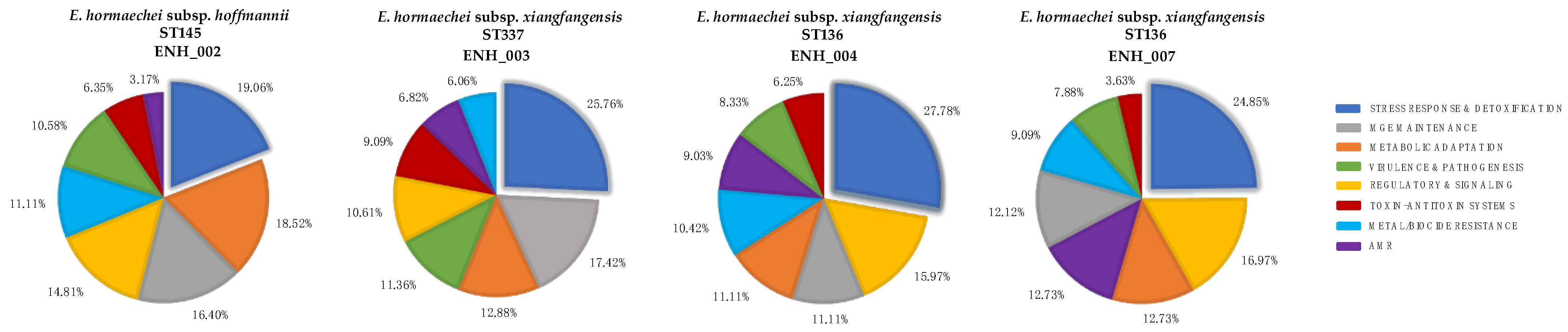
All four E. hormaechei isolates harbored multiple genomic islands (GIs), consistent with horizontal gene acquisition (Table 2). ENH_002 carried 42 GIs (198 genes), ENH_003 had 45 (132 genes), ENH_004 contained 34 (144 genes), and ENH_007 possessed 36 (165 genes). Across isolates, stress response and detoxification genes represented the most abundant functional category within GIs. Despite this shared pattern, differences in functional composition were observed. ENH_002 showed a relatively balanced GI profile, with notable representation of metabolic adaptation genes (17.7%) and metal/biocide resistance determinants (10.6%), including the copper (pco) and silver (sil) operons, as well as the virulence-associated gene ompA. ENH_003 exhibited a higher proportion of toxin–antitoxin systems (9.1%) and mobile genetic element-related functions (17.4%), and its islands included arsenic resistance (ars) and antimicrobial resistance genes (tet, cat). In contrast, ENH_004 and ENH_007 showed greater representation of regulatory and signaling functions (16% and 17%, respectively) and antimicrobial resistance genes (9% and 12.7%), including fosA, aac, blaTEM/OXA/CTX-M, tet, cat, dfr, and sul, along with the pco and sil operons (Figure 1). Putative prophage regions and CRISPR-Cas elements are provided in the Supplementary Results. Prophages and CRISPR Cas. These analyses were performed on draft genomes derived from short-read sequencing, which limits the accurate resolution of prophage boundaries, integration sites, and CRISPR array architecture. Accordingly, these outcomes should be considered preliminary and were not further validated.

2.4. Phylogenetic Tree

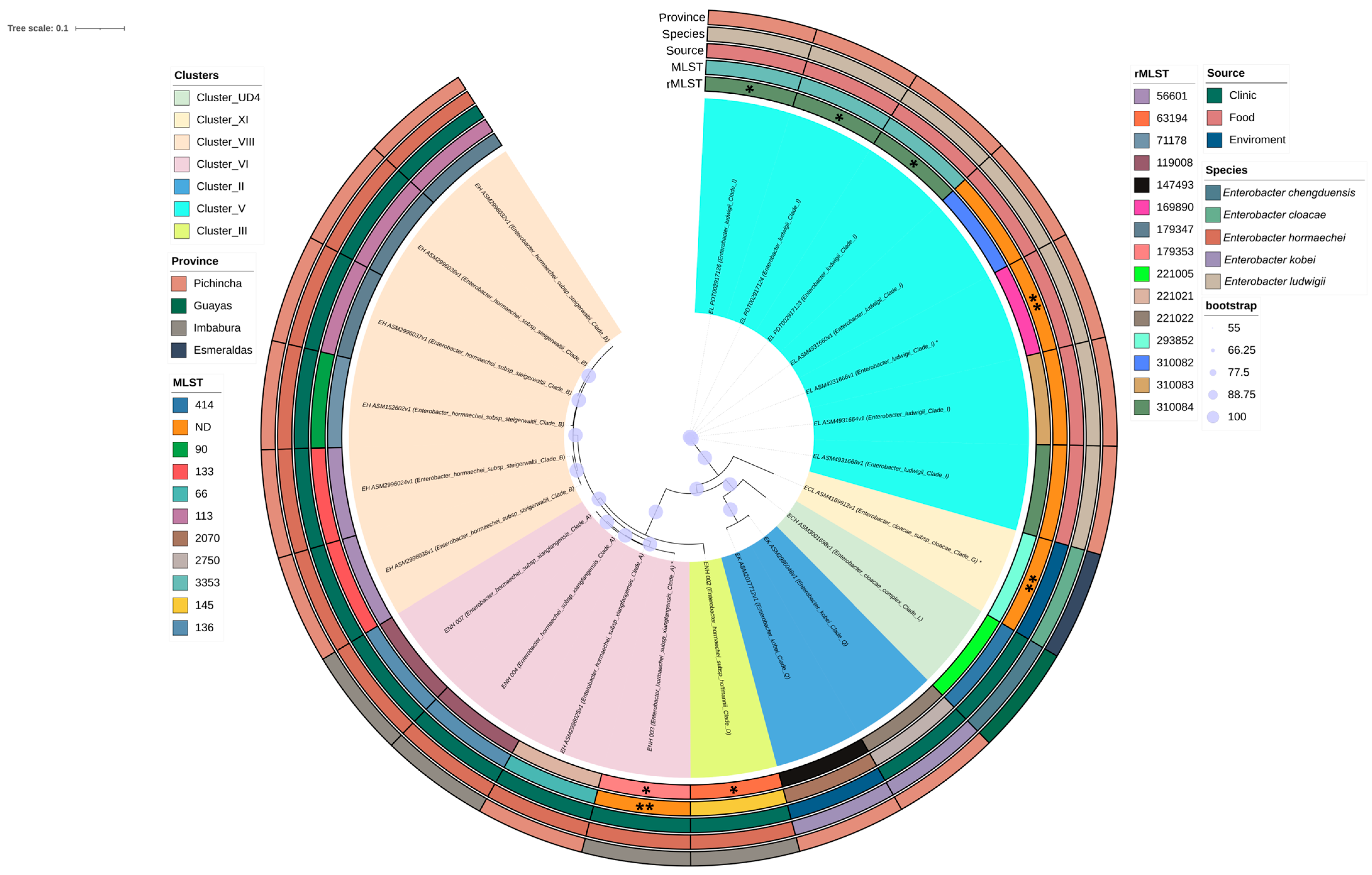
MLST-based phylogenetic analysis of 22 Enterobacter genomes (four clinical isolates from this study and 18 publicly available genomes from Ecuador) clustered the population into seven clades consistent with species and subspecies designations (Figure 2). The four isolates from this study were distributed among three clades. Three isolates (ENH_003, ENH_004, ENH_007) clustered within Clade A, corresponding to E. hormaechei subsp. xiangfangensis. Within this clade, the two ST136 isolates (ENH_004 and ENH_007) formed a monophyletic group and were phylogenetically close to a clinical ST66 isolate from Pichincha, suggesting relatedness to strains circulating in northern Ecuador. The third isolate, ENH_003, represented a novel sequence type most closely related to ST337 and branched separately within the same clade, indicating a distinct but related lineage. In contrast, the urinary isolate ENH_002 (ST145) clustered in Clade D, corresponding to E. hormaechei subsp. hoffmannii, and was phylogenetically distinct from the xiangfangensis isolates.
The remaining clades corresponded to other Enterobacter lineages and were associated with distinct ecological sources. Clade B (E. hormaechei subsp. steigerwaltii) formed a sister group to Clade A. Other clades included Enterobacter kobei (Clade Q; clinical and environmental isolates from Pichincha), Enterobacter ludwigii (Clade I; food chain-associated isolates from Pichincha), E. cloacae complex (Clade L; clinical isolates from Guayas), and E. cloacae subsp. cloacae (Clade G; environmental isolates from Esmeraldas). In general, this phylogeny indicates that Enterobacter populations in Ecuador comprise multiple genetically distinct lineages associated with diverse ecological sources. The available data suggest considerable diversity within Pichincha, although broader geographic sampling is required to fully resolve national distribution patterns.

3. Discussion

This genomic analysis provides, to our knowledge, the first subspecies-level genomic description of E. hormaechei subsp. xiangfangensis and hoffmannii from Ecuador. The isolates exhibited moderate to multidrug resistance, consistent with the presence of genes such as blaCTX-M-15 and blaOXA-1. Phylogenetic analysis placed the isolates into distinct clades. Wound-associated xiangfangensis strains clustered with a previously reported regional clinical isolate, supporting the presence of related lineages circulating locally.
E. hormaechei subsp. xiangfangensis and steigerwaltii are commonly reported among clinical isolates [9,12,13,37]. Consistent with this, MLST analysis showed that three of our four isolates clustered within subsp. xiangfangensis (Clade A), together with ST66, reported in Pichincha, indicating related lineages in the region. The two xiangfangensis ST136 isolates (ENH_004 and ENH_007) formed a monophyletic group and exhibited highly conserved core genomes, resistomes, and virulence profiles. They differed mainly in genomic island number. This pattern is consistent with clonal expansion from a common ancestor, with diversification likely driven by recombination and horizontal gene transfer rather than deep phylogenetic separation [38,39]. ST136 is rarely documented and inconsistently classified within the ECC. It has been identified in humans and companion animals as E. hormaechei subsp. xiangfangensis [40,41]. In contrast, reports from nosocomial infections in Canada, Lebanon, and Tunisia describe it only as E. hormaechei [42,43,44], and a canine isolate in Japan as E. cloacae [45]. In this study, its detection in surgical, traumatology, and ICU respiratory isolates documents its occurrence in diverse clinical contexts. ST66 is recognized as a high-risk clone of xiangfangensis, as it has been linked to multiple reports in clinical settings [23,24,40]. Moreover, ENH_003 represented a novel sequence type most closely related to ST337, highlighting additional diversity within this subspecies. The absence of this ST from the published literature suggests it may represent a rare or previously underreported lineage.
The E. hormaechei subsp. steigerwaltii isolates described from clinical samples in Pichincha formed a distinct clade (Clade B) comprising ST113, ST90, and ST133. These lineages have been documented in association with human infection, although their ecological distributions differ. ST133 and ST90 have been frequently identified in clinical infections [46,47,48,49], whereas ST113 shows a broader ecological range, including hospital-adjacent environments, human samples, and veterinary settings such as horses and animal clinics [50,51,52,53]. E. hormaechei subsp. hoffmanniii is also commonly reported from clinical settings [18,54,55]. The distinct placement of subsp. hoffmannii ST145 (ENH_002) supports subspecies-level differentiation within the phylogeny. ST145 is infrequently reported and has previously been identified in clinical isolates from France, Chile, and Poland [18,24,56]. Its detection here in a community-acquired urinary isolate documents its occurrence outside hospital-associated settings. Overall, the phylogeny indicates the presence of multiple related and less common E. hormaechei sequence types co-occurring within Ecuador, a pattern that reflects both its genetic diversity and its recognized capacity to acquire resistance to multiple antimicrobial classes [1,57].
The E. hormaechei subsp. hoffmannii ST145 isolate analyzed here exhibited a moderate resistance profile, primarily associated with the AmpC β-lactamase gene blaACT-14 and accompanied by aadA4, sul1, and fosA. This profile resembles the limited resistance reported for a clinical ST145 isolate from Chile [18]. In contrast, extensively MDR ST145 strains described in clinical and animal sources in Europe harbor broader resistance repertoires. These include carbapenemases (blaVIM), ESBLs (blaCTX-M-15, blaSHV-12), quinolone resistance determinants (qnr, aac(6′)-Ib-cr), and multiple aminoglycoside-modifying enzymes [24,50,56]. Collectively, available data suggest that ST145 encompasses a heterogeneous resistance spectrum, ranging from limited to extensive profiles across different clinical contexts.
The MDR E. hormaechei subsp. xiangfangensis ST136 isolates were characterized by the co-occurrence of ESBL and AmpC genes, together with determinants associated with resistance to aminoglycosides, quinolones, tetracycline, chloramphenicol, folate antagonists, and fosfomycin. The close agreement between resistome composition and phenotypic profiles is consistent with a shared evolutionary background. Minor differences may reflect regulatory or expression-level variation. This resistance profile is comparable to those reported for ST136, a lineage documented in hospital settings and companion animals [40,58]. Previous reports indicate that ST136 isolates share a conserved genetic core, including blaCTX-M-15, blaACT variants, and aminoglycoside-modifying enzymes [41,43]. The co-occurrence of blaCTX-M-15 and blaOXA-1, together with fosA, may restrict certain therapeutic options in Enterobacterales infections [59,60]. However, variation in the presence of high-impact carbapenemases (e.g., blaNDM, blaOXA-48) has been reported and appears to influence the overall resistance phenotype [41,43].
The ST136 isolates of subsp. xiangfangensis, carrying multiple bla genes, showed carbapenem non-susceptibility based on disk diffusion. This included resistance to ertapenem and reduced susceptibility to meropenem, with one isolate reaching full resistance. However, the absence of MIC or confirmatory phenotypic testing limits precise classification of these phenotypes, particularly for borderline susceptibility. MIC determination would be valuable to better define the resistance profile. In the absence of acquired carbapenemase genes, this phenotype may reflect the combined effect of ESBL and AmpC production. This effect may be enhanced by reduced outer membrane permeability, a mechanism commonly reported and associated with early loss of ertapenem susceptibility [61,62,63]. The OmpC and OmpF alterations observed in this study, including truncations in OmpF, may be consistent with this mechanism. However, their functional impact was not assessed and should be considered hypothetical. In contrast, the xiangfangensis ST337-related isolate, harboring only blaACT-16, exhibited an overall susceptible profile. Resistance was limited to ertapenem and preserved susceptibility to meropenem and imipenem, a pattern that may also involve limited permeability changes in addition to AmpC activity [61,62,63]. This profile is comparable to low-resistance xiangfangensis clinical isolates reported from China and South Korea, such as ST527, which harbor a limited set of resistance determinants (e.g., blaACT-16 and fosA) [64,65]. Altogether, the detection of an MDR lineage (ST136), a variably resistant lineage (ST145), and a largely susceptible lineage (ST337) illustrates the heterogeneity of resistance phenotypes within E. hormaechei, which may complicate empirical therapeutic decision-making.
All isolates in this study retained a conserved repertoire of virulence-associated genes, including determinants involved in adhesion and biofilm formation (csgG), outer membrane structure and invasion (ompA), global regulation (rpoS, phoP, rcsB, fur), and enterobactin-mediated iron acquisition (ent/fep) [20,66,67,68]. These factors are consistent with traits associated with colonization and environmental persistence [69,70]. Type VI Secretion System (T6SS) components were detected only in the MDR isolates (ST136), suggesting potential lineage-associated differences in interbacterial competition and niche adaptation [71]. Consistent with previous reports, variation in virulence gene content was observed between lineages, with subsp. hoffmannii ST145 encoding mrkA, nlpI, and terC, and the xiangfangensis ST136 clade characterized by nlpI and terC [50]. All analyzed isolates carried heavy metal resistance determinants, indicating a shared genetic capacity for environmental tolerance under selective pressures such as those encountered in healthcare settings [72,73]. Notably, E. hormaechei subsp. hoffmannii encoded additional niche-associated traits, including a complete Locus of Heat Resistance and multiple metal resistance operons, suggesting an increased potential for tolerance to thermal stress and disinfectant exposure [74]. The coexistence of these persistence-associated traits may contribute to the ecological success of E. hormaechei across clinical and environmental contexts [20,75].
A structurally complete class 1 integron was identified in E. hormaechei subsp. hoffmannii, associated with the aadA4 and sul1 genes, consistent with the capacity to acquire resistance cassettes [76]. In contrast, only the integrase gene was detected in E. hormaechei subsp. xiangfangensis isolates, which may indicate incomplete or remnant integron structures. Class 1 integrons have been reported in the xiangfangensis subspecies, with some located on conjugative plasmids [9,54,77], although no plasmid replicons were detected in ST136 in this study. In contrast, the ST337-related isolate carried IncHI2 replicons, with the catA1 gene located in the same contig; these plasmids are known to carry multiple resistance determinants in Enterobacteriaceae [78,79] and in E. hormaechei [50,66,80]. In the ST145 isolate, the proximity of the class 1 integron to the IncR replicon suggests a plasmid-associated location [81,82,83,84,85]. This isolate also harbored a multi-replicon IncF plasmid (IncFIA, IncFIB, IncFII), which is associated with an enhanced capacity for gene acquisition due to its size and composite genetic content in this subspecies [13,68]. All analyzed genomes carried numerous genomic islands enriched in stress response and detoxification functions, consistent with roles in environmental tolerance [20,72,86]. Differences in functional composition were observed between lineages: subsp. hoffmannii showed enrichment in metabolic and heavy metal/biocide resistance genes, whereas subsp. xiangfangensis exhibited a higher relative abundance of antimicrobial resistance genes.
This study has several limitations, including the small number of isolates, its single-center design, and its limited temporal coverage (March 2021), which restrict the generalizability of the findings. In addition, detailed clinical metadata were not available, as isolates were analyzed without access to patient records; therefore, information on clinical outcomes, prior antibiotic exposure, and hospitalization history could not be assessed, limiting interpretation of clinical impact. Reliance on short-read sequencing further limits complete plasmid reconstruction and detailed characterization of complex mobile genetic elements, and the absence of phenotypic validation for fosfomycin resistance and environmental stress tolerance constrains functional interpretation. Accordingly, our results should be interpreted as providing baseline genomic and phylogenetic insights rather than representing national epidemiology. Within these constraints, this analysis offers a subspecies-level genomic description of E. hormaechei subsp. xiangfangensis and hoffmannii from Ecuador and documents the coexistence of MDR and susceptible lineages in a single healthcare setting. Further studies with broader sampling and integrated clinical data will be necessary to better define resistance patterns and lineage diversity within the ECC in Ecuador.

4. Materials and Methods

4.1. Bacterial Isolates

The four isolates analyzed in this study were obtained from the bacterial culture collection of the clinical microbiology laboratory at Hospital San Vicente de Paúl, Ibarra, Ecuador, following routine diagnostic workup in March 2021. Original laboratory identifiers (AH_/AO_) were reassigned to standardized codes (ENH_) for consistency throughout the study; both designations are provided here for reference. These isolates were provided exclusively for microbiological characterization. Available information was limited to sample type and general clinical context (e.g., ICU vs. community), with no patient-identifying information, clinical outcomes, prior antibiotic exposure, or hospitalization details. No human subjects or identifiable data were involved. Isolates were cryopreserved at −80 °C for subsequent characterization. The isolates originated from distinct clinical sources: AH_003 (surgical wound), AH_004 (traumatology wound), AH_007 (respiratory sample, intensive care unit), and AO_002 (community-acquired urine). The cryopreserved isolates were revived at 37 °C for 24 h on Eosin Methylene Blue (EMB) agar (Oxoid, Basingstoke, Hampshire, UK), a medium selected for its selectivity against Gram-positive bacteria and its capacity for preliminary differentiation within the Enterobacteriaceae family. Following observation of mucoid, purple colonies on EMB agar, isolates were subjected to standard biochemical profiling. The test panel comprised triple sugar iron (TSI) agar, Simmons citrate agar, lysine iron agar (LIA) (Oxoid, Basingstoke, Hampshire, UK), motility-indole-ornithine (MIO) medium, and urea broth (Becton-Dickinson, Franklin Lakes, NJ, USA) [87]. Biochemical profiling yielded results characteristic of Enterobacter spp. All isolates were citrate-positive, urease-negative, with an acid/acid reaction and gas production on TSI agar (no H2S). LIA showed a purple butt (lysine decarboxylase-positive), and the MIO test was positive for motility and ornithine decarboxylase but negative for indole [87]. Because biochemical profiling cannot reliably differentiate species within the Enterobacter cloacae complex, definitive identification was obtained via MALDI-TOF (Bruker Daltonik GmbH, Bremen, Germany). All isolates were identified as E. hormaechei and subsequently designated as ENH_003 (AH_003; surgical wound), ENH_004 (AH_004; traumatology wound), ENH_007 (AH_007; respiratory sample from ICU), and ENH_002 (AO_002; community-acquired urine).

4.2. Antimicrobial Susceptibility Testing

All E. hormaechei isolates were tested for antimicrobial susceptibility using the disk diffusion method (Kirby–Bauer) on Mueller–Hinton agar (Oxoid, Basingstoke, Hampshire, UK) with antibiotic disks (Oxoid, Basingstoke, Hampshire, UK) of the following drugs: ampicillin (10 µg), amoxicillin/clavulanate (20/10 µg), piperacillin/tazobactam (100/10 µg), cefuroxime (30 µg), cefotaxime (30 µg), ceftazidime (30 µg), cefepime (30 µg), aztreonam (30 µg), ertapenem (10 µg), meropenem (10 µg), imipenem (10 µg), tobramycin (10 µg), gentamicin (10 µg), amikacin (30 µg), ciprofloxacin (5 µg), levofloxacin (5 µg), tetracycline (30 µg), chloramphenicol (30 µg), and co-trimoxazole (trimethoprim–sulfamethoxazole, 1.25/23.75 µg). The E. coli ATCC 25922 strain was used as quality control. Categories (resistant, intermediate, and susceptible) were interpreted according to the Clinical and Laboratory Standards Institute guidelines (CLSI M100-Ed35, 2025) [88].

4.3. Whole-Genome Sequencing (WGS)

The QIAamp UCP Pathogen Mini Kit was utilized for DNA extraction (Qiagen Sciences INC, Germantown, MD, USA). WGS of isolates was performed on an Illumina MiSeq platform (Illumina, San Diego, CA, USA). Raw reads were cleaned using Trimmomatic v0.39 [89] to remove adapters and low-quality bases, followed by quality assessment with FastQC v0.11.9 [90]. De novo genome assembly was performed using Shovill v1.1.0, which employs SPAdes as the underlying assembler.v3.14.0 [91]. The quality of each assembly was evaluated with QUAST v5.0.2 [92], which provided standard metrics (total length, N50, number of contigs, GC content). Genome annotation was done with Prokka v1.14.6 [93]. The sequences were deposited in the Sequence Reads Archive (SRA) under BioProject PRJNA1405780, with BioSample ID: 1405780.
Species identification and strain typing were performed using KmerFinder v3.0.2 [94]. Sequence types (STs) were assigned via the PubMLST database [95], based on seven consensus genes (dnaA, fusA, gyrB, leuS, pyrG, rlpB, and rpoB), and plasmid replicon types were identified with PlasmidFinder v3.0 [96]. Antimicrobial resistance (AMR) genes, along with metal/biocide resistance and stress response determinants, were identified using AMRFinderPlus v4.2.5 [97] and ABRicate v1.0.1 [98] against the ResFinder database [99]. Class 1 integrons were detected with IntegronFinder v2.0.5 [100]. The virulome was analyzed using ABRicate v1.0.1 [98] against the Virulence Factors Database (VFDB) [101]. Genomic islands (GIs) were predicted with IslandViewer 4 [102]. Genome visualization was conducted using Proksee [93] to generate circular maps depicting the distribution of the main determinants identified. The outer membrane porins OmpC and OmpF were analyzed for sequence variations. Gene sequences were extracted from Prokka v1.14.6 (.gff) annotations and aligned using MAFFT v7.525 [103], with OmpC (accession no. KY086510.1) and OmpF (accession no. KY086519.1) as reference sequences.
To establish the phylogenetic context of our clinical E. hormaechei isolates within the Ecuadorian setting, a reference dataset was compiled comprising all 18 publicly available E. hormaechei whole-genome sequences (WGS) reported from Ecuador, retrieved from the NCBI GenBank database [104] (accessed 15 December 2025). The complete list of accession numbers is provided in Supplementary Materials, Table S1. The core genome phylogeny was inferred using Panaroo v1.5.2 [105] with the moderate cleaning mode, which identified a total of 3092 core genes shared among the genomes. These core genes were used to construct a phylogenetic tree using the maximum likelihood approach implemented in IQ-TREE v3.0.1 [106]. Tree robustness was assessed with 1000 ultrafast bootstrap replicates, and tree inference was further optimized using the integrated neural network option. For subtype classification of the strains, hsp60ECCtool [107] was used, which allowed the cluster, clade, and subspecies to be determined using the method of Sutton et al. [55]. The ribosomal MLST (rMLST) [108] was determined using the PubMLST database [95]. In cases where an exact rMLST profile match was not available, isolates were assigned to the closest matching rMLST profile based on sequence similarity. ENH_002 was most closely related to rST-63194, with a loci match of 52/53; ENH_003 was related to rST-179353, with a loci match of 49/53; El_PDT002917123 was related to rST-310084, with a loci match of 47/53; EL_PDT002917124 was related to rST-310084, with a loci match of 47/53; and, finally, EL_PDT002917126 was related to rST-310084, with a loci match of 47/53. In the context of MLST, the sequence types of ENH_003, EL_ASM4931666v1, and ECL_ASM4169912v1 were identified as novel. ENH_003 was found to be most closely aligned with ST 337, EL_ASM4931666v1 was most closely related to ST 1269,692, and ECL_ASM4169912v1 showed the closest resemblance to ST 1510,1962,3295,406. The Interactive Tree of Life (iTOL) v6 web platform [109] was used to visualize the phylogenetic tree.

5. Conclusions

This study describes the subspecies-level genomic features of E. hormaechei subsp. xiangfangensis and subsp. hoffmannii isolates recovered in Ecuador. The analyzed strains showed heterogeneous antimicrobial resistance profiles, including multidrug-resistant and largely susceptible phenotypes within the same healthcare setting. An ST136 isolate carried blaCTX-M-15 and blaOXA-1 together with additional resistance determinants associated with integron and plasmid sequences. Phylogenetic reconstruction situated these isolates within established subspecies and sequence type lineages and indicated relatedness to other Ecuadorian genomes. Together, these findings expand current knowledge of the genomic diversity of E. hormaechei in Ecuador and provide a foundation for future investigations into the population structure of the ECC.

Supplementary Materials

The following supporting information can be downloaded at: https://www.mdpi.com/article/10.3390/antibiotics15040387/s1. Supplementary Results. Raw data; Supplementary Results. Figure S1: Multiple sequence alignment of the Omp reference sequences and isolates ENH_003, ENH_004, and ENH_007; Supplementary Results. Figure S2: Main genomic features of E. hormaechei isolates; Supplementary Materials. Table S1: Accession numbers of the E. hormaechei genomes used for comparative analysis; Supplementary Results. Prophages and CRISPR Cas. Table S2. Prophages and the CRISPR-Cas System among the studied isolates. References [110,111] are cited in Supplementary Materials.

Author Contributions

Conceptualization, L.B., M.A.Š., K.M.-M., I.M.L., C.M.L.-Á., G.I.A.M., E.S., P.B. and M.L.-Á.; data curation, L.B., M.A.Š., K.M.-M., I.M.L., C.M.L.-Á., G.I.A.M., E.S., P.B. and M.L.-Á.; formal analysis, I.M.L., C.M.L.-Á. and M.L.-Á.; funding acquisition, M.L.-Á.; methodology, L.B., M.A.Š., K.M.-M., I.M.L., C.M.L.-Á., G.I.A.M., E.S., P.B. and M.L.-Á.; investigation, L.B., M.A.Š., K.M.-M., I.M.L., C.M.L.-Á., G.I.A.M., E.S., P.B. and M.L.-Á.; project administration, M.L.-Á.; software, I.M.L.; supervision, M.A.Š., G.I.A.M., P.B. and M.L.-Á.; validation, M.A.Š., I.M.L. and M.L.-Á.; visualization, I.M.L., C.M.L.-Á. and M.L.-Á.; writing—original draft preparation, M.L.-Á.; writing—review and editing, L.B., M.A.Š., K.M.-M., I.M.L., C.M.L.-Á., G.I.A.M., E.S., P.B. and M.L.-Á. All authors have read and agreed to the published version of the manuscript.

Funding

This research was funded by Universidad de Especialidades Espíritu Santo, grant number UEES 2023-MED-003, and the APC was funded by Universidad de Especialidades Espíritu Santo.

Institutional Review Board Statement

Not applicable.

Informed Consent Statement

Not applicable.

Data Availability Statement

The original contributions of this study are included in the article/Supplementary Materials and Supplementary Results. The whole-genome sequencing data for E. hormaechei will be deposited in the NCBI GenBank BioProject public archive under accession number PRJNA1405780, with biosample data available under accession numbers SAMN54756035 to SAMN54756038. The sequence data have also been made available at: https://drive.google.com/drive/folders/1N72OZqUkbbyFvRBROiuX5H3RPoMlfG-C?usp=sharing (accessed on 26 February 2026).

Acknowledgments

During the preparation of this manuscript, the authors used ChatGPT-4.1 for the purposes of text editing. The authors have reviewed and edited the output and take full responsibility for the content of this publication.

Conflicts of Interest

The authors declare no conflicts of interest.

References

  1. Davin-Regli, A.; Lavigne, J.-P.; Pagès, J.-M. Enterobacter spp.: Update on taxonomy, clinical aspects, and emerging antimicrobial resistance. Clin. Microbiol. Rev. 2019, 32, e00002-19. [Google Scholar] [CrossRef]
  2. Mulani, M.S.; Kamble, E.E.; Kumkar, S.N.; Tawre, M.S.; Pardesi, K.R. Emerging strategies to combat ESKAPE pathogens in the era of antimicrobial resistance: A review. Front. Microbiol. 2019, 10, 539. [Google Scholar] [CrossRef]
  3. Mezzatesta, M.L.; Gona, F.; Stefani, S. Enterobacter cloacae complex: Clinical impact and emerging antibiotic resistance. Future Microbiol. 2012, 7, 887–902. [Google Scholar] [CrossRef]
  4. Peymani, A.; Naserpour Farivar, T.; Sanikhani, R.; Javadi, A.; Najafipour, R. Emergence of TEM, SHV, and CTX-M extended-spectrum β-lactamases and class 1 integron among Enterobacter cloacae isolates collected from hospitals of Tehran and Qazvin, Iran. Microb. Drug Resist. 2014, 20, 424–430. [Google Scholar] [CrossRef] [PubMed]
  5. Cai, S.; Quan, J.; Wang, Z.; Hu, H.; Han, X.; Jiang, Y.; Yang, Q.; Yu, Y.; Zhou, Z. High Prevalence of carbapenem-resistant Enterobacter cloacae complex in a tertiary hospital over a decade. Microbiol. Spectr. 2024, 12, e00780-24. [Google Scholar] [CrossRef]
  6. Pavlovic, M.; Konrad, R.; Iwobi, A.N.; Sing, A.; Busch, U.; Huber, I. A Dual Approach Employing MALDI-TOF MS and Real-Time PCR for Fast Species Identification within the Enterobacter cloacae Complex. FEMS Microbiol. Lett. 2012, 328, 46–53. [Google Scholar] [CrossRef]
  7. Annavajhala, M.K.; Gomez-Simmonds, A.; Uhlemann, A.C. Multidrug-resistant Enterobacter cloacae complex emerging as a global, diversifying threat. Front. Microbiol. 2019, 10, 44. [Google Scholar] [CrossRef]
  8. Paauw, A.; Caspers, M.P.M.; Schuren, F.H.J.; Leverstein-van Hall, M.A.; Delétoile, A.; Montijn, R.C.; Verhoef, J.; Fluit, A.C. Genomic diversity within the Enterobacter cloacae complex. PLoS ONE 2008, 3, e3018. [Google Scholar] [CrossRef] [PubMed]
  9. Halder, G.; Chaudhury, B.N.; Mandal, S.; Denny, P.; Sarkar, D.; Chakraborty, M.; Khan, U.R.; Sarkar, S.; Biswas, B.; Chakraborty, A.; et al. Whole genome sequence-based molecular characterization of blood isolates of carbapenem-resistant Enterobacter cloacae complex from ICU patients in Kolkata, India, during 2017–2022: Emergence of phylogenetically heterogeneous Enterobacter hormaechei subsp. xiangfangensis. Microbiol. Spectr. 2024, 12, e03529-23. [Google Scholar] [CrossRef] [PubMed]
  10. Yang, J.; Baek, J.Y.; Ko, J.-H.; Huh, K.; Cho, S.Y.; Chung, D.R.; Peck, K.R.; Huh, H.J.; Ko, K.S.; Kang, C.-I. Clinical and microbiological analyses of colistin-resistant strains among carbapenem-resistant Enterobacter cloacae complex clinical isolates. Microbiol. Spectr. 2025, 13, e01604-24. [Google Scholar] [CrossRef]
  11. Morhart, P.; Gerlach, R.G.; Kunz, C.; Held, J.; Valenza, G.; Wölfle, J.; Reutter, H.; Hanslik, G.J.; Fahlbusch, F.B. Application of next-generation sequencing to Enterobacter hormaechei subspecies analysis during a neonatal intensive care unit outbreak. Children 2023, 10, 1696. [Google Scholar] [CrossRef]
  12. Chen, C.-J.; Lu, P.-L.; Jian, S.-H.; Fu, H.-L.; Huang, P.-H.; Chang, C.-Y. Molecular epidemiology, risk factors and clinical outcomes of carbapenem-nonsusceptible Enterobacter cloacae complex infections in a Taiwan university hospital. Pathogens 2022, 11, 151. [Google Scholar] [CrossRef]
  13. Izdebski, R.; Biedrzycka, M.; Urbanowicz, P.; Papierowska-Kozdój, W.; Dominiak, M.; Żabicka, D.; Gniadkowski, M. Multiple secondary outbreaks of NDM-producing Enterobacter hormaechei in the context of endemic NDM-producing Klebsiella pneumoniae. J. Antimicrob. Chemother. 2022, 77, 1561–1569. [Google Scholar] [CrossRef]
  14. Li, R.; Wang, J.; Zhang, W.; Zhao, C.; Han, M.; Du, H.; Zhang, H. Co-occurrence of mcr-9 and blaNDM-5 in multidrug-resistant Enterobacter hormaechei strain isolated from a patient with bloodstream infection. Curr. Microbiol. 2025, 82, 169. [Google Scholar] [CrossRef] [PubMed]
  15. Ferreira, C.M.; Naveca, F.G.; Ferreira, G.M.A.; Barbosa, M.d.N.S.; de Souza, V.C.; Calheiros, F.O.; Souza, V.S.; Ferreira, W.A. Whole-genome analysis of extensively drug-resistant Enterobacter hormaechei isolated from a patient with non-Hodgkin’s lymphoma. Genes 2024, 15, 814. [Google Scholar] [CrossRef]
  16. Liu, H.; Wang, D.; Tang, M.; Jia, P.; Huo, Y.; Wei, E.; Xu, H.; Chi, X.; Wang, H. Genetic characterization of Enterobacter hormaechei co-harboring blaNDM-1 and mcr-9 causing upper respiratory tract infection. Infect. Drug Resist. 2022, 15, 5035–5042. [Google Scholar] [CrossRef]
  17. Cui, S.; Ma, W.; Peng, H.; Ye, Y.; Qing, Y.; Wei, G.; Wang, J.; Zhang, X. Genome-wide mining reveals the genetic plasticity of antibiotic resistance/virulence factor genes in Enterobacter hormaechei subsp. xiangfangensis. J. Appl. Microbiol. 2025, 136, lxaf196. [Google Scholar] [CrossRef]
  18. Fernández-Yáñez, V.; Ibaceta, V.; Torres, A.; Vidal, R.M.; Schneider, I.; Schilling, V.; Toro, C.; Arellano, C.; Scavone, P.; Muñoz, I.; et al. Presence and role of the type 3 fimbria in the adherence capacity of Enterobacter hormaechei subsp. hoffmannii. Microorganisms 2024, 12, 1441. [Google Scholar] [CrossRef]
  19. Arena, C.J.; Suleyman, G.; Kaur, J.; Veve, M.P.; Tibbetts, R.J. Whole-genome analysis of extensively drug-resistant Enterobacter hormaechei isolated from two hospitalized patients in the United States: A case series of a rare but rising threat. JAC Antimicrob. Resist. 2025, 7, dlaf202. [Google Scholar] [CrossRef] [PubMed]
  20. Mavroidi, A.; Gartzonika, K.; Spanakis, N.; Froukala, E.; Kittas, C.; Vrioni, G.; Tsakris, A. Comprehensive analysis of virulence determinants and genomic islands of blaNDM-1-producing Enterobacter hormaechei clinical isolates from Greece. Antibiotics 2023, 12, 1549. [Google Scholar] [CrossRef] [PubMed]
  21. Peirano, G.; Matsumura, Y.; Adams, M.D.; Bradford, P.; Motyl, M.; Chen, L.; Kreiswirth, B.N.; Pitout, J.D.D. Genomic epidemiology of global carbapenemase-producing Enterobacter spp., 2008–2014. Emerg. Infect. Dis. 2018, 24, 1010–1019. [Google Scholar] [CrossRef]
  22. Cardoso, B.; Sellera, F.P.; Sano, E.; Esposito, F.; Seabra, L.A.V.; Azedo, M.R.; Pogliani, F.C.; Lincopan, N. Phylogenomic analysis of CTX-M-15–producing Enterobacter hormaechei belonging to the high-risk ST78 from animal infection: Another successful One Health clone? J. Glob. Antimicrob. Resist. 2022, 29, 113–115. [Google Scholar] [CrossRef]
  23. Lumbreras-Iglesias, P.; de Toro, M.; Vázquez, X.; García-Carús, E.; Rodicio, M.R.; Fernández, J. High-risk international clones ST66, ST171 and ST78 of Enterobacter cloacae complex causing blood stream infections in Spain and carrying blaOXA-48 with or without mcr-9. J. Infect. Public Health 2023, 16, 272–279. [Google Scholar] [CrossRef]
  24. Emeraud, C.; Petit, C.; Gauthier, L.; Bonnin, R.A.; Naas, T.; Dortet, L. Emergence of VIM-producing Enterobacter cloacae complex in France between 2015 and 2018. J. Antimicrob. Chemother. 2022, 77, 944–951. [Google Scholar] [CrossRef] [PubMed]
  25. Knecht, C.A.; García Allende, N.; Álvarez, V.E.; Prack McCormick, B.; Massó, M.G.; Piekar, M.; Campos, J.; Fox, B.; Camicia, G.; Gambino, A.S.; et al. Novel insights related to the rise of KPC-producing Enterobacter cloacae complex strains within the nosocomial niche. Front. Cell. Infect. Microbiol. 2022, 12, 951049. [Google Scholar] [CrossRef] [PubMed]
  26. Zhou, K.; Zhou, Y.; Xue, C.-X.; Xu, T.; Chen, Y.; Shen, P.; Xiao, Y. Bloodstream infections caused by Enterobacter hormaechei ST133 in China, 2010–2022. Lancet Microbe 2023, 4, e13. [Google Scholar] [CrossRef] [PubMed]
  27. Luo, M.; Zhang, Y.; He, F.; Yang, Z. Enterobacter hormaechei: A global genomic and epidemiological perspective. J. Glob. Antimicrob. Resist. 2025, 44, 59–63. [Google Scholar] [CrossRef]
  28. Paz-Calvache, T.G.; Merchancano, S.J.; Nakazato, L.; Dutra, V. Detection and characterization of multidrug-resistant Klebsiella spp. and Enterobacter spp. isolates in colombian guinea pigs intended for human consumption. Vet. World 2025, 18, 3187. [Google Scholar] [CrossRef]
  29. Mondragón-Quiguanas, A.; Villaquirán-Muriel, M.Á.; Rivera, S.P.; Rosero-García, D.; Aranaga, C.; Correa, A.; Falco, A. Beta-lactam-resistant Enterobacterales isolated from landfill leachates. Pathogens 2022, 11, 1077. [Google Scholar] [CrossRef]
  30. Rodulfo, H.; Martínez, D.; De Donato, M. Molecular identification of multidrug resistant Enterobacter hormaechei in Venezuela. Investig. Clin. 2016, 57, 402–408. [Google Scholar]
  31. Cuicapuza, D.; Loyola, S.; Velásquez, J.; Fernández, N.; Llanos, C.; Ruiz, J.; Tsukayama, P.; Tamariz, J. Molecular characterization of carbapenemase-producing Enterobacterales in a tertiary hospital in Lima, Peru. Microbiol. Spectr. 2024, 12, e02503-23. [Google Scholar] [CrossRef]
  32. Giani, T.; Sennati, S.; Antonelli, A.; Di Pilato, V.; Di Maggio, T.; Mantella, A.; Niccolai, C.; Spinicci, M.; Monasterio, J.; Castellanos, P.; et al. High prevalence of carriage of mcr-1-positive enteric bacteria among healthy children from rural communities in the Chaco Region, Bolivia, September to October 2016. Eurosurveillance 2018, 23, 1800115. [Google Scholar] [CrossRef]
  33. Corrales-Martínez, J.; Jaramillo, K.; Tadesse, D.A.; Satán, C.; Villavicencio, F.X.; Sánchez-Gavilanes, L.; Rivadeneira-Cueva, B.; Balcázar, J.L.; Calero-Cáceres, W. Genomic characterization of a WHO critical priority isolate Enterobacter kobei ST2070 harboring OXA-10, KPC-2, and CTX-M-12 recovered from a water irrigation channel in Ecuador. Heliyon 2024, 10, e26379. [Google Scholar] [CrossRef]
  34. Cifuentes, S.G.; Graham, J.; Trueba, G.; Cádenas, P.A. Detection of mobile colistin resistance genes mcr-9.1 and mcr-10.1 in Enterobacter asburiae from Ecuadorian children. Microbiol. Resour. Announc. 2024, 13, e00313-24. [Google Scholar] [CrossRef]
  35. Zurita, J.; Solís, M.B.; Sevillano, G.; Herrera-Yela, A.; Zurita-Salinas, C.; Moreno, C.; Romero, J.J.; Ecuadorian Bacteremia Working Group. Clinical, microbiological and genomic characterization of carbapenem-resistant gram-negative bacteria in bloodstream infection: A multi-center study in Ecuador. J. Appl. Microbiol. 2026, 137, lxag008. [Google Scholar] [CrossRef] [PubMed]
  36. Bastidas-Caldes, C.; Hernández-Alomía, F.; Almeida, M.; Ormaza, M.; Boada, J.; Graham, J.; Calvopiña, M.; Castillejo, P. Molecular identification and antimicrobial resistance patterns of Enterobacterales in community urinary tract infections among Indigenous women in Ecuador: Addressing microbiological misidentification. BMC Infect. Dis. 2024, 24, 1195. [Google Scholar] [CrossRef] [PubMed]
  37. Pot, M.; Reynaud, Y.; Couvin, D.; Dereeper, A.; Ferdinand, S.; Bastian, S.; Foucan, T.; Pommier, J.-D.; Valette, M.; Talarmin, A.; et al. Emergence of a novel lineage and widespread of a blaCTX-M-15/IncHI2/ST1 plasmid among nosocomial Enterobacter in Guadeloupe. Antibiotics 2022, 11, 1443. [Google Scholar] [CrossRef] [PubMed]
  38. Hauck, S.; Maiden, M.C.J. Clonally evolving pathogenic bacteria. In Molecular Mechanisms of Microbial Evolution; Rampelotto, P., Ed.; Springer: Cham, Switzerland, 2018; pp. 303–323. [Google Scholar]
  39. Preska Steinberg, A.; Kussell, E. How recombination and clonal evolution shape bacterial lineages and genomes. Genetics 2025, 231, iyaf115. [Google Scholar] [CrossRef]
  40. Donà, V.; Nordmann, P.; Kittl, S.; Schuller, S.; Bouvier, M.; Poirel, L.; Endimiani, A.; Perreten, V. Emergence of OXA-48-producing Enterobacter hormaechei in a Swiss companion animal clinic and their genetic relationship to clinical human isolates. J. Antimicrob. Chemother. 2023, 78, 2950–2960. [Google Scholar] [CrossRef]
  41. Kobs, V.C.; de Medeiros, F.; Fernandes, P.P.; Deglmann, R.C.; Fontana, H.; Cardoso, B.; Sano, E.; Esposito, F.; Sellera, F.P.; Lincopan, N.; et al. Healthcare-associated NDM-1-producing Enterobacter hormaechei subsp. xiangfangensis clone ST136 emerging as a pathogen of companion animals in Brazil. J. Antimicrob. Chemother. 2023, 78, 1553–1556. [Google Scholar] [CrossRef]
  42. Lerminiaux, N.; Fakharuddin, K.; Longtin, Y.; McGill, E.; Mitchell, R.; Mataseje, L. Canadian Nosocomial Infection Surveillance Program. Plasmid genomic epidemiology of blaNDM carbapenemase-producing Enterobacterales in Canada from 2010 to 2023. Microb. Genom. 2025, 11, 001415. [Google Scholar] [CrossRef]
  43. Moussa, J.; Nassour, E.; Tahan, E.; El Chaar, M.; Jisr, T.; Tokajian, S. Carbapenem resistance determinants and their transmissibility among clinically isolated Enterobacterales in Lebanon. J. Infect. Public Health 2023, 16, 1947–1953. [Google Scholar] [CrossRef]
  44. Messaoudi, A.; Saras, E.; Grami, R.; Bouallègue, O.; Boujâafar, N.; Madec, J.-Y.; Mansour, W.; Haenni, M. Emergence of OXA-204 carbapenemase in Enterobacter cloacae. Int. J. Antimicrob. Agents 2019, 54, 829–830. [Google Scholar] [CrossRef] [PubMed]
  45. Harada, K.; Shimizu, T.; Mukai, Y.; Kuwajima, K.; Sato, T.; Kajino, A.; Usui, M.; Tamura, Y.; Kimura, Y.; Miyamoto, T.; et al. Phenotypic and molecular characterization of antimicrobial resistance in Enterobacter spp. isolates from companion animals in Japan. PLoS ONE 2017, 12, e0174178. [Google Scholar] [CrossRef] [PubMed]
  46. Huang, Y.; Wu, Y.; Cai, C.; Zhang, R.; Chen, G.; Dong, N. Phenotypic and genomic characterization of ST133 siderophore-encoding extensively drug-resistant Enterobacter hormaechei. Antimicrob. Agents Chemother. 2023, 67, e01737-22. [Google Scholar] [CrossRef] [PubMed]
  47. Xu, T.; Xue, C.-X.; Huang, J.; Wu, J.; Chen, R.; Zhou, K. Emergence of an epidemic hypervirulent clone of Enterobacter hormaechei coproducing mcr-9 and carbapenemases. Lancet Microbe 2022, 3, e474–e475. [Google Scholar] [CrossRef]
  48. Bonnin, R.A.; Girlich, D.; Jousset, A.B.; Emeraud, C.; Creton, E.; Gauthier, L.; Naas, T. Genomic analysis of VIM-2-producing Enterobacter hormaechei subsp. steigerwaltii. Int. J. Antimicrob. Agents 2021, 57, 106285. [Google Scholar] [CrossRef]
  49. Pot, M.; Reynaud, Y.; Couvin, D.; Ducat, C.; Ferdinand, S.; Gravey, F.; Gruel, G.; Guérin, F.; Malpote, E.; Breurec, S.; et al. Wide Distribution and specific resistance pattern to third-generation cephalosporins of Enterobacter cloacae complex members in humans and in the environment in Guadeloupe (French West Indies). Front. Microbiol. 2021, 12, 628058. [Google Scholar] [CrossRef]
  50. Haenni, M.; Châtre, P.; Drapeau, A.; Cazeau, G.; Troncy, J.; François, P.; Madec, J.-Y. Distinct molecular epidemiology of resistances to extended-spectrum cephalosporins and carbapenems in Enterobacter hormaechei in cats and dogs versus horses in France. J. Antimicrob. Chemother. 2025, 80, 567–575. [Google Scholar] [CrossRef] [PubMed]
  51. Pot, M.; Guyomard-Rabenirina, S.; Couvin, D.; Ducat, C.; Enouf, V.; Ferdinand, S.; Gruel, G.; Malpote, E.; Talarmin, A.; Breurec, S.; et al. Dissemination of extended-spectrum-β-lactamase-producing Enterobacter cloacae complex from a hospital to the nearby environment in Guadeloupe (French West Indies): ST114 lineage coding for a successful IncHI2/ST1 plasmid. Antimicrob. Agents Chemother. 2021, 65, e02146-20. [Google Scholar] [CrossRef]
  52. Schmitt, K.; Biggel, M.; Stephan, R.; Willi, B. Massive Spread of OXA-48 Carbapenemase-producing Enterobacteriaceae in the environment of a Swiss companion animal clinic. Antibiotics 2022, 11, 213. [Google Scholar] [CrossRef]
  53. Tetsuka, N.; Hirabayashi, A.; Matsumoto, A.; Oka, K.; Hara, Y.; Morioka, H.; Iguchi, M.; Tomita, Y.; Suzuki, M.; Shibayama, K.; et al. Molecular epidemiological analysis and risk factors for acquisition of carbapenemase-producing Enterobacter cloacae complex in a Japanese university hospital. Antimicrob. Resist. Infect. Control 2019, 8, 126. [Google Scholar] [CrossRef] [PubMed]
  54. Gou, J.J.; Liu, N.; Guo, L.H.; Xu, H.; Lv, T.; Yu, X.; Zheng, B.W. Carbapenem-resistant Enterobacter hormaechei ST1103 with IMP-26 carbapenemase and ESBL gene blaSHV-178. Infect. Drug Resist. 2020, 13, 597–605. [Google Scholar] [CrossRef] [PubMed]
  55. Sutton, G.G.; Brinkac, L.M.; Clarke, T.H.; Fouts, D.E. Enterobacter hormaechei subsp. hoffmannii subsp. nov., Enterobacter hormaechei subsp. xiangfangensis comb. nov., Enterobacter roggenkampii sp. nov., and Enterobacter muelleri is a later heterotypic synonym of Enterobacter asburiae based on computational analysis of sequenced Enterobacter genomes. F1000Research 2018, 7, 521. [Google Scholar] [CrossRef] [PubMed]
  56. Izdebski, R.; Biedrzycka, M.; Urbanowicz, P.; Żabicka, D.; Gniadkowski, M. Genome-based epidemiologic analysis of VIM/IMP carbapenemase-producing Enterobacter spp., Poland. Emerg. Infect. Dis. 2023, 29, 1618–1626. [Google Scholar] [CrossRef] [PubMed]
  57. Yeh, T.-K.; Lin, H.-J.; Liu, P.-Y.; Wang, J.-H.; Hsueh, P.-R. Antibiotic resistance in Enterobacter hormaechei. Int. J. Antimicrob. Agents 2022, 60, 106650. [Google Scholar] [CrossRef]
  58. Han, M.; Liu, C.; Xie, H.; Zheng, J.; Zhang, Y.; Li, C.; Shen, H.; Cao, X. Genomic and clinical characteristics of carbapenem-resistant Enterobacter cloacae complex isolates collected in a Chinese tertiary hospital during 2013–2021. Front. Microbiol. 2023, 14, 1127948. [Google Scholar] [CrossRef]
  59. Ndukui, J.G.; Gikunju, J.K.; Aboge, G.O.; Mwaniki, J.K.; Maina, J.N.; Mbaria, J.M. Molecular characterization of ESBLs and QnrS producers from selected Enterobacteriaceae strains isolated from commercial poultry production systems in Kiambu county, Kenya. Microbiol. Insights 2022, 15, 11786361211063619. [Google Scholar] [CrossRef]
  60. Wu, J.-W.; Quyen, T.L.T.; Hsieh, Y.-C.; Chen, Y.-Y.; Wu, L.-T.; Pan, Y.-J. Investigation of carbapenem-resistant Klebsiella pneumoniae in Taiwan revealed strains co-harbouring blaNDM and blaOXA-48-like and a novel plasmid co-carrying blaNDM-1 and blaOXA-181. Int. J. Antimicrob. Agents 2023, 62, 106964. [Google Scholar] [CrossRef]
  61. Liu, S.; Huang, N.; Zhou, C.; Lin, Y.; Zhang, Y.; Wang, L.; Zheng, X.; Zhou, T.; Wang, Z. Molecular mechanisms and epidemiology of carbapenem-resistant Enterobacter cloacae complex isolated from Chinese patients during 2004–2018. Infect. Drug Resist. 2021, 14, 3647–3658. [Google Scholar] [CrossRef]
  62. Black, C.A.; Benavides, R.; Bandy, S.M.; Dallas, S.D.; Gawrys, G.; So, W.; Moreira, A.G.; Aguilar, S.; Quidilla, K.; Smelter, D.F.; et al. Diverse role of blaCTX-M and porins in mediating ertapenem resistance among carbapenem-resistant Enterobacterales. Antibiotics 2024, 13, 185. [Google Scholar] [CrossRef]
  63. Su, Y.; Zou, G.; Huang, X.; Bi, J.; Meng, L.; Zhao, W.; Li, T. Molecular characterization and resistance mechanisms of ertapenem-non-susceptible carbapenem-resistant Klebsiella pneumoniae co-harboring ESBLs or AmpC enzymes with porin loss or efflux pump overexpression. J. Bacteriol. 2025, 207, e00148-25. [Google Scholar] [CrossRef]
  64. Ganbold, M.; Seo, J.; Wi, Y.M.; Kwon, K.T.; Ko, K.S. Species identification, antibiotic resistance, and virulence in Enterobacter cloacae complex clinical isolates from South Korea. Front. Microbiol. 2023, 14, 1122691. [Google Scholar] [CrossRef]
  65. Li, Y.; Wang, Z.; Zhang, G.; Kang, W.; Li, J.; Xu, Y.; Zhou, M. Precise species identification and whole-genome sequencing analysis of Enterobacter cloacae complex causing bloodstream infections in China. Microbiol. Spectr. 2026, 14, e02865-25. [Google Scholar] [CrossRef] [PubMed]
  66. De Maayer, P.; Green, T.; Jordan, S.; Smits, T.H.M.; Coutinho, T.A. Pan-genome analysis of the Enterobacter hormaechei complex highlights its genomic flexibility and pertinence as a multidrug-resistant pathogen. BMC Genom. 2025, 26, 408. [Google Scholar] [CrossRef] [PubMed]
  67. Qiu, X.; Ye, K.; Ma, Y.; Zhao, Q.; Wang, L.; Yang, J. Genome sequence-based species classification of Enterobacter cloacae complex: A study among clinical isolates. Microbiol. Spectr. 2024, 12, e04312-23. [Google Scholar] [CrossRef] [PubMed]
  68. Cao, Z.; Cui, L.; Liu, Q.; Liu, F.; Zhao, Y.; Guo, K.; Hu, T.; Zhang, F.; Sheng, X.; Wang, X.; et al. Phenotypic and genotypic characterization of multidrug-resistant Enterobacter hormaechei carrying qnrS gene isolated from chicken feed in China. Microbiol. Spectr. 2022, 10, e02518-21. [Google Scholar] [CrossRef]
  69. Yaikhan, T.; Singkhamanan, K.; Luenglusontigit, P.; Chukamnerd, A.; Nokchan, N.; Chintakovid, N.; Chusri, S.; Pomwised, R.; Wonglapsuwan, M.; Leetanaporn, K.; et al. Genomic analysis of Enterobacter cloacae complex from Southern Thailand reveals insights into multidrug resistance genotypes and genetic diversity. Sci. Rep. 2025, 15, 4670. [Google Scholar] [CrossRef]
  70. Mishra, M.; Panda, S.; Barik, S.; Sarkar, A.; Singh, D.V.; Mohapatra, H. Antibiotic resistance profile, outer membrane proteins, virulence factors and genome sequence analysis reveal clinical isolates of Enterobacter are potential pathogens compared to environmental isolates. Front. Cell. Infect. Microbiol. 2020, 10, 54. [Google Scholar] [CrossRef]
  71. Kathi, S. Enterobacter spp. virulence factors and biofilm components: Synthesis, structure, function, and inhibitors. In ESKAPE Pathogens: Detection, Mechanisms and Treatment Strategies; Ahmad, I., Rumbaugh, K.P., Singh, S.B., Eds.; Springer Nature: Singapore, 2024; pp. 349–365. [Google Scholar]
  72. Kamathewatta, K.; Bushell, R.; Rafa, F.; Browning, G.; Billman-Jacobe, H.; Marenda, M. Colonization of a hand washing sink in a veterinary hospital by an Enterobacter hormaechei strain carrying multiple resistances to high importance antimicrobials. Antimicrob. Resist. Infect. Control 2020, 9, 163. [Google Scholar] [CrossRef]
  73. Erler, T.; Carlsen, L.; Dengler, J.; Hammerl, J.A.; Stroehlein, A.J.; Hoffmann, M.; Knobloch, J.K.; Lübbert, C.; Papan, C.; Schwanz, T.; et al. Cefiderocol-resistant pathogens in German hospital wastewater: A reservoir for multidrug resistance. Sci. Rep. 2025, 15, 31622. [Google Scholar] [CrossRef]
  74. Bojer, M.S.; Struve, C.; Ingmer, H.; Hansen, D.S.; Krogfelt, K.A. Heat resistance mediated by a new plasmid encoded Clp ATPase, ClpK, as a possible novel mechanism for nosocomial persistence of Klebsiella pneumoniae. PLoS ONE 2010, 5, e15467. [Google Scholar] [CrossRef]
  75. Zouagui, H.; Zouagui, R.; Ibrahimi, A.; Sbabou, L. Comparative genomics uncovers adaptive and biotechnological potential of Enterobacter xiangfangensis MDMC82 isolated from desert, and highlights putative core Enterobacteriaceae functions. Sci. Rep. 2025, 15, 41234. [Google Scholar] [CrossRef] [PubMed]
  76. Kaushik, M.; Kumar, S.; Kapoor, R.K.; Virdi, J.S.; Gulati, P. Integrons in Enterobacteriaceae: Diversity, distribution and epidemiology. Int. J. Antimicrob. Agents 2018, 51, 167–176. [Google Scholar] [CrossRef] [PubMed]
  77. Dong, X.; Zhu, M.; Li, Y.; Huang, D.; Wang, L.; Yan, C.; Zhang, L.; Dong, F.; Lu, J.; Lin, X.; et al. Whole-genome sequencing-based species classification, multilocus sequence typing, and antimicrobial resistance mechanism analysis of the Enterobacter cloacae complex in Southern China. Microbiol. Spectr. 2022, 10, e02160-22. [Google Scholar] [CrossRef] [PubMed]
  78. Zhou, K.; Yu, W.; Cao, X.; Shen, P.; Lu, H.; Luo, Q.; Rossen, J.W.A.; Xiao, Y. Characterization of the population structure, drug resistance mechanisms and plasmids of the community-associated Enterobacter cloacae complex in China. J. Antimicrob. Chemother. 2018, 73, 66–76. [Google Scholar] [CrossRef]
  79. Algarni, S.; Gudeta, D.D.; Han, J.; Shetty, A.C.; Fouts, D.E.; Doi, Y.; Bonomo, R.A.; Li, G. Genotypic analyses of IncHI2 plasmids from enteric bacteria. Sci. Rep. 2024, 14, 9802. [Google Scholar] [CrossRef]
  80. Sadek, M.; Nariya, H.; Shimamoto, T.; Kayama, S.; Yu, L.; Hisatsune, J.; Sugai, M.; Nordmann, P.; Poirel, L.; Shimamoto, T. First genomic characterization of blaVIM-1 and mcr-9-co-harbouring Enterobacter hormaechei isolated from food of animal origin. Pathogens 2020, 9, 687. [Google Scholar] [CrossRef]
  81. Umeda, K.; Nakamura, H.; Fukuda, A.; Yamaguchi, T.; Matsumoto, Y.; Motooka, D.; Nakamura, S.; Kawahara, R. Molecular characterization of blaKHM-1 encoding plasmid in an Enterobacter hormaechei subsp. hoffmannii isolate from blood culture. PLoS ONE 2020, 15, e0227605. [Google Scholar] [CrossRef] [PubMed]
  82. Chang, C.-Y.; Huang, P.-H.; Lu, P.-L. The resistance mechanisms and clinical impact of resistance to the third generation cephalosporins in species of Enterobacter cloacae complex in Taiwan. Antibiotics 2022, 11, 1153. [Google Scholar] [CrossRef]
  83. Rezzoug, I.; Emeraud, C.; Rodriguez, C.; Pawlotsky, J.M.; Bonnin, R.A.; Dortet, L. Regional dissemination of NDM-1 producing Enterobacter hormaechei ST1740, with a subset of strains co-producing VIM-4 or IMP-13, France, 2019 to 2022. Eurosurveillance 2024, 29, 2300521. [Google Scholar] [CrossRef]
  84. Doualla-Bell, F.; Boyd, D.A.; Savard, P.; Yousfi, K.; Bernaquez, I.; Wong, S.; Usongo, V.; Mataseje, L.F.; Mulvey, M.R.; Bekal, S. Analysis of an IncR plasmid carrying blaNDM-1 linked to an azithromycin resistance region in Enterobacter hormaechei involved in an outbreak in Quebec. Microbiol. Spectr. 2021, 9, e01998-21. [Google Scholar] [CrossRef]
  85. Zhang, D.; Li, S.; Zhang, X.; Zheng, S.; Zhou, D.; Hou, Q.; Jiang, Y.; Han, H. Epidemiological and biological characteristics of IncR plasmids as multihost antibiotic resistance carriers. Front. Microbiol. 2025, 16, 1622352. [Google Scholar] [CrossRef]
  86. Munshi, I.D.; Mathuria, A.; Sharma, H.; Acharya, M.; Chaudhary, A.; Jain, K.; Ragini; Dahiya, S.; Arora, R.; Singh, V.; et al. Emerging concept of genomic islands in bacterial adaptation and pathogenicity. Res. Microbiol. 2025, 176, 104303. [Google Scholar] [CrossRef] [PubMed]
  87. Procop, G.W.; Church, D.L.; Hall, G.S.; Janda, W.M. Koneman’s Color Atlas and Textbook of Diagnostic Microbiology, 7th ed.; Jones & Bartlett Learning: Burlington, MA, USA, 2020; pp. 226–231. [Google Scholar]
  88. Clinical and Laboratory Standards Institute (CLSI). Performance Standards for Antimicrobial Susceptibility Testing, 35th ed.; CLSI Supplement M100; Clinical and Laboratory Standards Institute: Wayne, PA, USA, 2025; Available online: https://clsi.org/ (accessed on 12 December 2025).
  89. Bolger, A.M.; Lohse, M.; Usadel, B. Trimmomatic: A flexible trimmer for Illumina sequence data. Bioinformatics 2014, 30, 2114–2120. [Google Scholar] [CrossRef] [PubMed]
  90. Andrews, S. FastQC: A Quality Control Tool for High Throughput Sequence Data. 2010. Available online: http://www.bioinformatics.babraham.ac.uk/projects/fastqc/ (accessed on 20 December 2025).
  91. Seemann, T. Shovill: Faster SPAdes Assembly of Illumina Reads. 2017. Available online: https://github.com/tseemann/shovill (accessed on 22 December 2025).
  92. Gurevich, A.; Saveliev, V.; Vyahhi, N.; Tesler, G. QUAST: Quality assessment tool for genome assemblies. Bioinformatics 2013, 29, 1072–1075. [Google Scholar] [CrossRef]
  93. Grant, J.R.; Enns, E.; Marinier, E.; Mandal, A.; Herman, E.K.; Chen, C.-Y.; Graham, M.; Van Domselaar, G.; Stothard, P. Proksee: In-depth characterization and visualization of bacterial genomes. Nucleic Acids Res. 2023, 51, W484–W492. [Google Scholar] [CrossRef] [PubMed]
  94. Clausen, P.T.L.C.; Aarestrup, F.M.; Lund, O. Rapid and precise alignment of raw reads against redundant databases with KMA. BMC Bioinform. 2018, 19, 307. [Google Scholar] [CrossRef]
  95. Jolley, K.A.; Bray, J.E.; Maiden, M.C.J. Open-access bacterial population genomics: BIGSdb software, the PubMLST.org website and their applications. Wellcome Open Res. 2018, 3, 124. [Google Scholar] [CrossRef] [PubMed]
  96. Carattoli, A.; Hasman, H. PlasmidFinder and in silico pMLST: Identification and typing of plasmid replicons in whole-genome sequencing (WGS). In Horizontal Gene Transfer: Methods and Protocols; de la Cruz, F., Ed.; Methods in Molecular Biology; Humana: New York, NY, USA, 2020; Volume 2075, pp. 285–294. [Google Scholar] [CrossRef]
  97. Feldgarden, M.; Brover, V.; Haft, D.H.; Prasad, A.B.; Slotta, D.J.; Tolstoy, I.; Tyson, G.H.; Zhao, S.; Hsu, C.-H.; McDermott, P.F.; et al. Validating the AMRFinder tool and resistance gene database by using antimicrobial resistance genotype-phenotype correlations in a collection of isolates. Antimicrob. Agents Chemother. 2019, 63, e00483-19. [Google Scholar] [CrossRef]
  98. Seemann, T. ABRicate: Mass Screening of Contigs for Antimicrobial and Virulence Genes. 2017. Available online: https://github.com/tseemann/abricate (accessed on 28 December 2025).
  99. Bortolaia, V.; Kaas, R.S.; Ruppe, E.; Roberts, M.C.; Schwarz, S.; Cattoir, V.; Philippon, A.; Allesoe, R.L.; Rebelo, A.R.; Florensa, A.F.; et al. ResFinder 4.0 for predictions of phenotypes from genotypes. J. Antimicrob. Chemother. 2020, 75, 3491–3500. [Google Scholar] [CrossRef] [PubMed]
  100. Néron, B.; Littner, E.; Haudiquet, M.; Perrin, A.; Cury, J.; Rocha, E.P.C. IntegronFinder 2.0: Identification and analysis of integrons across bacteria, with a focus on antibiotic resistance in Klebsiella. Microorganisms 2022, 10, 700. [Google Scholar] [CrossRef] [PubMed]
  101. Liu, B.; Zheng, D.; Zhou, S.; Chen, L.; Yang, J. VFDB 2022: A general classification scheme for bacterial virulence factors. Nucleic Acids Res. 2022, 50, D912–D917. [Google Scholar] [CrossRef] [PubMed]
  102. Bertelli, C.; Laird, M.R.; Williams, K.P.; Lau, B.Y.; Hoad, G.; Winsor, G.L.; Brinkman, F.S.L. IslandViewer 4: Expanded prediction of genomic islands for larger-scale datasets. Nucleic Acids Res. 2017, 45, W30–W35. [Google Scholar] [CrossRef]
  103. Katoh, K.; Standley, D.M. MAFFT multiple sequence alignment software version 7: Improvements in performance and usability. Mol. Biol. Evol. 2013, 30, 772–780. [Google Scholar] [CrossRef]
  104. Sayers, E.W.; Bolton, E.E.; Brister, J.R.; Canese, K.; Chan, J.; Comeau, D.C.; Farrell, C.M.; Feldgarden, M.; Fine, A.M.; Funk, K.; et al. Database resources of the national center for biotechnology information in 2023. Nucleic Acids Res. 2023, 51, D29–D38. [Google Scholar] [CrossRef]
  105. Tonkin-Hill, G.; MacAlasdair, N.; Ruis, C.; Weimann, A.; Horesh, G.; Lees, J.A.; Gladstone, R.A.; Lo, S.; Beaudoin, C.; Floto, R.A.; et al. Producing polished prokaryotic pangenomes with the panaroo pipeline. Genome Biol. 2020, 21, 180. [Google Scholar] [CrossRef]
  106. Nguyen, L.-T.; Schmidt, H.A.; von Haeseler, A.; Minh, B.Q. IQ-TREE: A fast and effective stochastic algorithm for estimating maximum-likelihood phylogenies. Mol. Biol. Evol. 2015, 32, 268–274. [Google Scholar] [CrossRef]
  107. KaruBioTools. hsp60ECCtool: Enterobacter cloacae Complex hsp60 Sequence Typing Tool. Version 1.0.0. 2022. Available online: https://github.com/karubiotools/hsp60ECCtool (accessed on 14 January 2026).
  108. Jolley, K.A.; Bliss, C.M.; Bennett, J.S.; Bratcher, H.B.; Brehony, C.; Colles, F.M.; Wimalarathna, H.; Harrison, O.B.; Sheppard, S.K.; Cody, A.J.; et al. Ribosomal Multilocus Sequence Typing: Universal characterization of bacteria from domain to strain. Microbiology 2012, 158, 1005–1015. [Google Scholar] [CrossRef]
  109. Letunic, I.; Bork, P. Interactive Tree of Life (iTOL) v6: Recent updates to the phylogenetic tree display and annotation tool. Nucleic Acids Res. 2024, 52, W78–W82. [Google Scholar] [CrossRef]
  110. Arndt, D.; Grant, J.R.; Marcu, A.; Sajed, T.; Pon, A.; Liang, Y.; Wishart, D.S. PHASTER: A better, faster version of the PHAST phage search tool. Nucleic Acids Res. 2016, 44, W16–W21. [Google Scholar] [CrossRef] [PubMed]
  111. Couvin, D.; Bernheim, A.; Toffano-Nioche, C.; Touchon, M.; Michalik, J.; Néron, B.; Rocha, E.P.C.; Vergnaud, G.; Gautheret, D.; Pourcel, C. CRISPRCasFinder, an update of CRISRFinder, includes a portable version, enhanced performance and integrates search for Cas proteins. Nucleic Acids Res. 2018, 46, W246–W251. [Google Scholar] [CrossRef] [PubMed]
Figure 1. Functional distribution of genes within genomic islands across four E. hormaechei isolates. Pie charts show the relative percentage of genes assigned to each functional category. MGE: mobile genetic element; AMR: antimicrobial resistance.
Antibiotics 15 00387 g001
Figure 2. Phylogenetic tree based on core genome genes from 22 Enterobacter isolates reported in Ecuador. Branch support is indicated by inner circles representing ultrafast bootstrap values, ranging from 55 to 100. Background colors denote the genomic clusters assigned to each isolate. Clade assignments correspond to species/subspecies as follows: Clade A, E. hormaechei subsp. xiangfangensis; Clade B, E. hormaechei subsp. steigerwaltii; Clade D, E. hormaechei subsp. hoffmannii; Clade Q, Enterobacter kobei; Clade I, Enterobacter ludwigii; Clade L, E. cloacae complex; Clade G, E. cloacae subsp. cloacae. The metadata tracks show, from the inner to outer ring, ribosomal sequence type (rST), sequence type (ST), source, species, and province of origin. * Asterisks adjacent to species names denote isolates harboring novel sequence types (STs). These novel STs are additionally indicated in the ST track by double asterisks (**). In the rST track, isolates without a definitive assignment were categorized according to the closest related group and are indicated by a single asterisk (*).; ENH_003 represents a novel ST most closely related to ST337.
Antibiotics 15 00387 g002
Table 1. Antibiotic susceptibility test (Kirby–Bauer Method).
Diameter of Inhibition (cm ± SD)
Antibiotic ClassAntibiotic DisksENH_002
E. hormaechei subsp. hoffmannii
ENH_003
E. hormaechei subsp. xiangfangensis
ENH_004
E. hormaechei subsp. xiangfangensis
ENH_007
E. hormaechei subsp. xiangfangensis
β-lactamsAmpicillin (10 μg)0.73 ± 0.42 (R)0.63 ± 0.35 (R)0.57 ± 0.06 (R)0.67 ± 0.06 (R)
Amoxicillin/Clavulanate
(20/10 μg)
0.57 ± 0.12 (R)0.97 ± 0.25 (R)0.63 ± 0.06 (R)0.60 ± 0.17 (R)
Piperacillin/Tazobactam
(100/10 μg)
1.23 ± 0.1 (R)1.60 ± 0.35 (R)2.23 ± 0.40 (I)1.83 ± 0.35 (R)
Cefuroxime (30 μg)1.20 ± 0.40 (R)0.70 ± 0.10 (R)0.73 ± 0.21 (R)0.63 ± 0.15 (R)
Cefotaxime (30 μg)3.60 ± 0.36 (S)0.83 ± 0.31 (R)1.03 ± 0.15 (R)0.63 ± 0.23 (R)
Ceftazidime (30 μg)3.23 ± 0.23 (S)1.13 ± 0.15 (R)1.63 ± 0.25 (R)2.47 ± 0.49 (S)
Cefepime (30 μg)3.83 ± 0.78 (S)2.57 ± 0.65 (S)1.30 ± 0.50 (R)1.83 ± 0.87 (R)
Aztreonam (30 μg)3.43 ± 0.40 (S)1.57 ± 0.76 (R)1.07 ± 0.49 (R)1.13 ± 0.23 (R)
Ertapenem (10 μg)3.10 ± 0.26 (S)1.60 ± 0.66 (R)1.13 ± 0.49 (R)1.57 ± 0.60 (R)
Meropenem (10 μg)3.47 ± 0.42 (S)3.00 ± 0.56 (S)2.17 ± 0.76 (I)1.37 ± 0.55 (R)
Imipenem (10 μg)3.80 ± 0.89 (S)2.97 ± 0.90 (S)2.23 ± 0.64 (I)2.20 ± 0.98 (I)
AminoglycosidesTobramycin (10 μg)1.77 ± 0.12 (S)1.30 ± 0.20 (I)0.67 ± 0.12 (R)0.63 ± 0.21 (R)
Gentamicin (10 μg)1.83 ± 0.06 (S)1.63 ± 0.06 (I)0.13 ± 0.15 (R)0.10 ± 0.10 (R)
Amikacin (30 μg)2.40 ± 0.82 (S)2.00 ± 0.10 (S)1.93 ± 0.60 (I)1.57 ± 0.12 (R)
QuinolonesCiprofloxacin (5 μg)2.37 ± 0.15 (S)3.50 ± 0.17 (S)0.33 ± 0.06 (R)0.17 ± 0.12 (R)
Levofloxacin (5 μg)2.90 ± 0.90 (S)2.93 ± 0.61 (S)1.23 ± 0.31 (R)2.53 ± 0.25 (S)
TetracyclineTetracycline (30 μg)1.87 ± 0.06 (S)0.17 ± 0.15 (R)0.35 ± 0.07 (R)0.30 ± 0.10 (R)
ChloramphenicolChloramphenicol (30 μg)2.00 ± 0.10 (S)1.43 ± 0.12 (I)2.13 ± 0.07 (S)2.13 ± 0.01 (S)
Folate Pathway
Antagonists
Co-trimoxazole (25 μg)2.27 ± 0.12 (S)2.50 ± 0.10 (S)0.10 ± 0.10 (R)0.07 ± 0.06 (R)
R: Resistant; I: Intermediate; S: Susceptible.
Table 2. Genomic and epidemiological features of E. hormaechei isolates.
FeaturesDetails
ENH_002
E. hormaechei subsp.
hoffmannii
ENH_003
E. hormaechei subsp. xiangfangensis
ENH_004
E. hormaechei subsp. xiangfangensis
ENH_007
E. hormaechei subsp. xiangfangensis
SourceClinical (community
-acquired urine)
Clinical (surgical wound)Clinical (traumatology wound)Clinical (respiratory sample from ICU)
Genome size (bp)4,766,9564,720,8184,650,1114,649,924
No. of CDS4519450943454343
GC content55.24%54.81%55.26%55.26%
tRNA87847780
rRNA11131212
MLST145337136136
ARGs-Aminoglycosides: aadA4
-β-lactams: blaACT-14
-Folate Antagonists: sul1
-Fosfomycin: fosA
-β-lactams: blaACT-16
-Chloramphenicol: catA1
-Tetracycline: tet(B)
-Aminoglycosides:
aac(3)-IIa; aac(6′)-Ib-cr; aph(3″)-Ib; aph(6)-Id
-β-lactams: blaACT-16; blaCTX-M-15; blaOXA-1; blaTEM-1B
-Chloramphenicol: catB3
-Tetracycline: tet(A)
-Folate Antagonists: dfrA14; sul2
-Fosfomycin: fosA
-Quinolones:
aac(6′)-Ib-cr
-Aminoglycosides: aac(3)-IIa; aac(6′)-Ib-cr; aph(3″)-Ib; aph(6)-Id
-β-lactams: blaACT-16; blaCTX-M-15; blaOXA-1; blaTEM-1B
-Chloramphenicol: catB3
-Tetracycline: tet(A)
-Folate Antagonists: dfrA14; sul2
-Fosfomycin: fosA
-Quinolones:
aac(6′)-Ib-cr
Virulence factors-Nutrient Acquisition:
ent (A, B, E, S);
fep (G, C, A)
-Regulation:
rpoS, phoP, rcsB, fur
-Secretion Systems:
vipA/tssB
-Immune Evasion:
gndA; galF
-Adhesion/Biofilm: cgsG
-Invasion:
ompA
-Nutrient Acquisition: ent (A, B, S);
fep (D, G, C, A)
-Regulation:
rpoS, phoP, rcsB, fur
-Immune Evasion: gndA; galF
-Adhesion/Biofilm: cgsG
-Invasion:
ompA
-Nutrient Acquisition:
ent (A, B, E, S);
fep (D, G, C, A)
-Regulation:
rpoS, phoP, rcsB, fur
-Secretion Systems: vipB/tssC; hcp/tssD; tssF; vipA/tssB
-Immune Evasion:
gndA; galF
-Adhesion/Biofilm:
cgsG
-Invasion: ompA
-Nutrient Acquisition: ent (A, B, E, S);
fep (D, G, C, A)
-Regulation:
rpoS, phoP, rcsB, fur
-Secretion Systems: vipB/tssC; hcp/tssD; tssF; vipA
-Immune Evasion: gndA; galF
-Adhesion/Biofilm: cgsG
-Invasion: ompA
SRGs-Thermal:
clpK; kefB-GI; hsp20; shsP; trxLHR; psi-GI; yfdX1/X2; hdeD-GI
-Heavy metal:
pcoABCDERS;
silABCEFPRS; terDWZ
-Heavy metal: terDWZ; arsC-Heavy metal: pcoABCDERS;
silABCEFPRS)
-Heavy metal: pcoABCDERS;
silABCEFPRS)
IntegronsClass 1
(att; intI; qacEΔ1)
n.d.Class 1
(intI)
Class 1
(intI)
Plasmid contentIncFIA(HI1); IncFIB(pECLA); IncFII(pECLA);
IncR
IncHI2; IncHI2An.d.n.d.
Genomic
Islands
42453436
ICU: intensive care unit; ARGs: antimicrobial resistance genes; SRGs: stress resistance genes; n.d.: not detected.
Disclaimer/Publisher’s Note: The statements, opinions and data contained in all publications are solely those of the individual author(s) and contributor(s) and not of MDPI and/or the editor(s). MDPI and/or the editor(s) disclaim responsibility for any injury to people or property resulting from any ideas, methods, instructions or products referred to in the content.