Article

Genomic Epidemiology of NDM-1 Carbapenemase-Producing Acinetobacter spp. from Hospital Wastewater in Shenzhen, China

1
School of Public Health, Southern Medical University, Guangzhou 510515, China
2
Division of Conservation and Application of Biological Resources, Shenzhen Center for Disease Control and Prevention, Shenzhen 518055, China
3
School of Medicine, Southern University of Science and Technology, Shenzhen 518055, China
4
School of Public Health, Shenzhen University Medical School, Shenzhen University, Shenzhen 518055, China
*
Authors to whom correspondence should be addressed.
These authors contributed equally to this work.
Antibiotics 2026, 15(4), 347; https://doi.org/10.3390/antibiotics15040347
Submission received: 31 January 2026 / Revised: 19 March 2026 / Accepted: 25 March 2026 / Published: 27 March 2026

Abstract

Background: Hospital wastewater (HWW) is a critical reservoir for carbapenem-resistant Gram-negative bacteria. Methods: Between November 2024 and August 2025, sixty 24 h composite wastewater samples were collected from five tertiary hospitals. Of the 244 carbapenem-resistant isolates recovered, 34 blaNDM-1-positive Acinetobacter isolates were subjected to phenotypic, genotypic, and plasmid analyses. Results: Eleven species were identified among the 34 carbapenem-resistant Acinetobacter isolates, predominantly non-baumannii Acinetobacter (NBA). All isolates were carbapenem-resistant (34/34, 100%) with high-level MICs (meropenem MIC50/90, 32/64 mg/L; imipenem MIC50/90, >128/>128 mg/L); 21% (7/34) of isolates were resistant to colistin, and resistance to ceftazidime, cefepime, and trimethoprim-sulfamethoxazole was 100%, 94%, and 76%, respectively. Core-genome SNP analysis revealed highly similar isolates across hospitals within the same season (1-2 SNPs) or within the same hospital across seasons (19 SNPs). Genomic analysis showed that blaNDM-1 was present in all isolates (34/34, 100%), with plasmid carriage in 85.3% (29/34); blaOXA-58 co-occurred in 62.1% (18/29), mainly on Rep_3 plasmids (19/29), especially R3-T28 (15/29) that frequently carried blaOXA-58 (10/15). Two unclassified plasmids co-harboring blaNDM-1 and blaOXA-23 were detected in Acinetobacter tandoii isolates. The blaNDM-1 gene was embedded in a conserved Tn125-like structures with variable flanks. Conclusions: Overall, carbapenem-resistant Acinetobacter from hospital wastewater frequently carried Rep_3 plasmid-borne blaNDM-1, especially R3-T28 and often co-occurring with blaOXA-58, within a conserved Tn125-like core structures. These findings highlight HWW as a potential hotspot for dissemination of carbapenem resistance and support routine genomic surveillance under a One Health framework.

1. Introduction

Antimicrobial resistance (AMR) represents a major global health threat, demanding coordinated surveillance across clinical, animal, and environmental sectors under a “One Health” framework [1]. Among various environmental niches, hospital wastewater (HWW) has been identified as a critical hotspot for the selection and dissemination of antibiotic-resistant bacteria (ARB) and antibiotic resistance genes (ARGs) [2]. HWW typically contains a complex mixture of antimicrobial residues, disinfectants, and diverse microbial populations derived from clinical activities. These conditions create intense selective pressure, fostering the persistence of ARB and accelerating horizontal gene transfer (HGT) mediated by mobile genetic elements (MGEs) such as plasmids, transposons, and integrons [3]. Numerous studies have documented significantly higher abundances of clinically relevant ARGs in HWW compared to municipal wastewater, highlighting the role of hospital effluents as important reservoirs and dissemination pathways for antimicrobial resistance [3,4,5].
Carbapenems are often considered the “last-resort” antibiotics for treating severe infections caused by multidrug-resistant (MDR) Gram-negative pathogens [6]. However, the emergence and global spread of carbapenemase-producing bacteria have severely compromised the clinical utility of carbapenems and are now prioritized in international AMR surveillance [7,8]. Major carbapenemase genes are frequently associated with mobile genetic elements: blaNDM has disseminated worldwide across diverse Gram-negative hosts and is commonly linked to plasmids and transposon-rich platforms, such as Tn125/ISAba125-related structures, facilitating efficient horizontal spread [9,10]. In parallel, blaOXA carbapenemases have expanded in two major contexts—OXA-48-like enzymes are widely disseminated in Enterobacterales [11], whereas acquired OXA-type carbapenemases (notably OXA-23-like, OXA-24/40-like, and OXA-58-like) are key contributors to carbapenem resistance in Acinetobacter spp. [12]. Collectively, these trends highlight the urgency of tracking carbapenemase genes and their mobile vehicles across clinical-environment interfaces, including hospital wastewater [2].
During systematic surveillance of carbapenem-resistant bacteria in HWW, we observed a striking phenomenon: among the various bacterial genera isolated, Acinetobacter was the only genus in which all isolates carried blaNDM-1. This finding prompted us to focus on Acinetobacter as a key bacterial group potentially driving the persistence and spread of NDM-type carbapenemases in the HWW environment.
The genus Acinetobacter comprises Gram-negative, non-fermentative coccobacillary bacteria that are ubiquitous in both healthcare settings and natural ecosystems [13]. According to the List of Prokaryotic names with Standing in Nomenclature (LPSN) taxonomy database, the genus Acinetobacter comprised 90 child taxa with validly published and correct names at the time of access (20 November 2025) [14], reflecting substantial taxonomic expansion and ecological diversity. While A. baumannii is a notorious nosocomial pathogen renowned for its ability to acquire multidrug resistance [15], non-baumannii Acinetobacter (NBA) species—including A. pittii, A. nosocomialis, A. lwoffii, and A. bereziniae, among others—are increasingly recognized as opportunistic pathogens capable of harboring clinically significant resistance determinants [16]. Carbapenem-resistant Acinetobacter, including NBA species, have been repeatedly detected in HWW in multiple regions [17,18,19]. The most clinically important carbapenemases in Acinetobacter are the New Delhi metallo-β-lactamases (NDM) and the class D oxacillinases (OXA-type), particularly OXA-23 and OXA-58 [12,20]. While OXA-type enzymes often require upstream insertion sequences (e.g., ISAba1 or ISAba3) for strong expression [21,22], the blaNDM gene is usually embedded in highly mobile genetic platforms, conferring a strong dissemination potential [23].
In China, blaNDM-1 has been identified in various Acinetobacter species from clinical, environmental, and HWW sources [24,25,26,27]. Despite the growing clinical relevance of NBA species [28], research has remained heavily skewed toward clinical isolates. Systematic genomic analyses of NBA from HWW—a critical but understudied AMR reservoir—remain limited. Our study provides a comprehensive genomic characterization of Acinetobacter spp. carrying blaNDM-1 and OXA-type carbapenemase genes (e.g., blaOXA-58/blaOXA-23) isolated from wastewater from five tertiary hospitals in Shenzhen, China. Our findings reveal the species diversity, carbapenemase gene contexts, and plasmid-associated genetic platforms present in HWW, offering important insights into the environmental persistence and genomic plasticity of carbapenem-resistant Acinetobacter.

2. Results

2.1. Species Distribution and Antimicrobial Susceptibility Profiles

To maximize the diversity of carbapenem-resistant bacteria, a total of 60 hospital wastewater samples were cultured on BHI agar and on CHROMagar™ Orientation plates both supplemented with meropenem (2 µg/mL), yielding a total of 319 bacterial isolates in total from pre-disinfection hospital wastewater. Antimicrobial susceptibility testing (AST) showed that 244/319 (76.5%) isolates were resistant to meropenem. In parallel, PCR screening identified 100 blaNDM-positive isolates; the predominant groups were Acinetobacter spp. (34%), Enterobacter spp. (18%), and Klebsiella spp. (15%) (Figure S1). Notably, no carbapenem-resistant isolates were recovered from post-disinfection effluents.
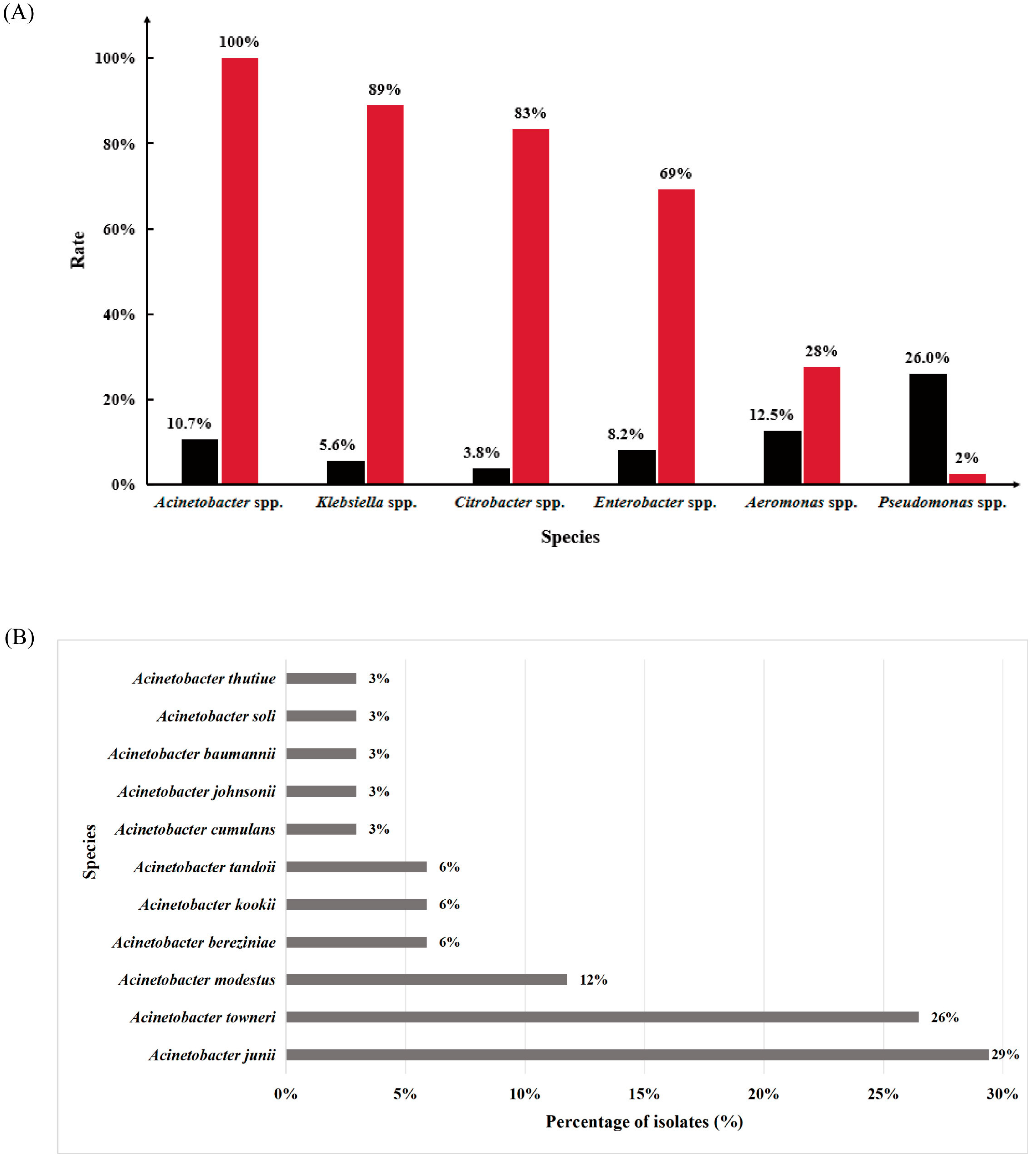
Among the blaNDM-positive isolates, 34 Acinetobacter isolates were recovered and subjected to further analyses. All 34 Acinetobacter isolates were resistant to carbapenems (34/34, 100%; Table 1) and carried blaNDM-1 (34/34, 100%; Figure 1A). Based on the visualization grouping shown in Figure 1B, these 34 carbapenem-resistant Acinetobacter isolates were distributed across 11 species-level categories. A. junii was the most prevalent group (10/34, 29%), followed by the A. towneri group (9/34, 26%). Other groups included the A. modestus group (4/34, 12%), A. bereziniae, A. kookii and A. tandoii (each 2/34, 6%), while A. cumulans, A. johnsonii, A. baumannii, A. soli, and A. thutiue were each represented by a single isolate (1/34, 3% each). Whole-genome average nucleotide identity (ANI) analysis further refined species assignments (Table S1). Species-level assignment was considered supported at ANI ≥ 95%. Under this criterion, 27/34 isolates were confidently assigned to the species level, including one isolate reassigned from Acinetobacter spp. to A. thutiue. The remaining seven isolates did not reach the ANI cutoff and were conservatively treated as unresolved at the species level.
AST demonstrated a multidrug-resistant phenotype among the blaNDM-1-positive Acinetobacter isolates (Table 1 and Table S2). Resistance rates reached 100% for meropenem, imipenem, and ceftazidime, while high resistance rates were also observed for cefepime (94%), trimethoprim-sulfamethoxazole (76%), gentamicin (68%), and ciprofloxacin (67%). In contrast, lower resistance rates were observed for tigecycline (0%), doxycycline (3%), amikacin (9%), tetracycline (47%) and piperacillin-tazobactam (53%). Tigecycline susceptibility was interpreted using FDA Enterobacterales breakpoints. Colistin MICs were determined by broth microdilution and interpreted for Acinetobacter spp., under which 21% of isolates were categorized as resistant. High minimum inhibitory concentrations (MICs) for meropenem and imipenem indicated high-level carbapenem resistance (MIC50/MIC90: 32/64 mg/L and >128/>128 mg/L, respectively).

2.2. Phylogenomic Relationships and Antimicrobial Resistance Gene Profiles

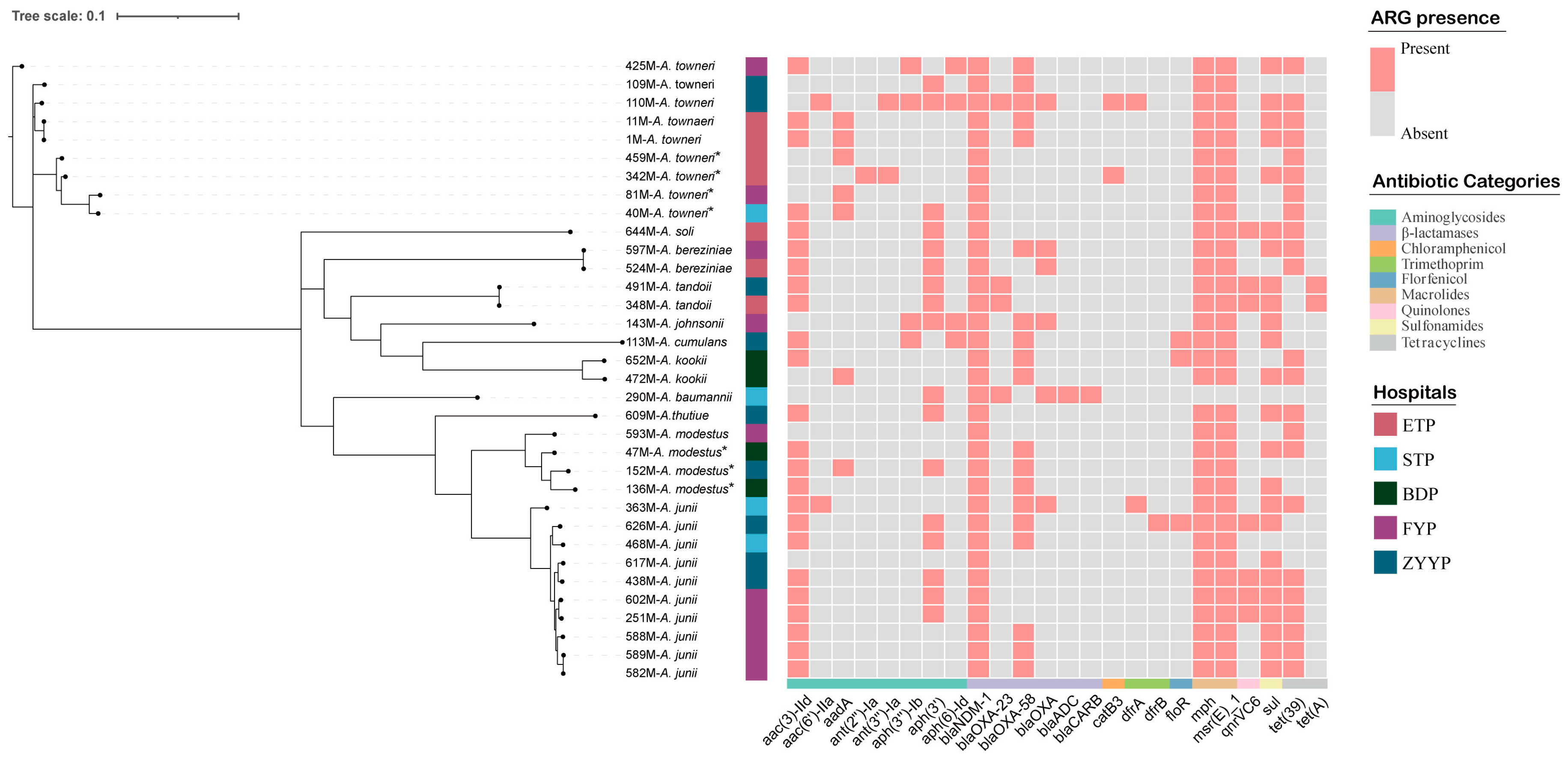
Phylogenetic tree and core-genome SNP analysis revealed several highly related isolate pairs differing by only 0–20 SNPs, including pairs recovered within the same season from the same or different hospitals: 1M vs. 11M (A. towneri, ETP, 2024.11; 0 SNP), 348M vs. 491M (A. tandoii, ETP vs. ZYYP, 2025.05; 1 SNP), and 524M vs. 597M (A. bereziniae, ETP vs. FYP, 2025.08; 2 SNPs). A closely related pair was also observed within the same hospital across seasons (251M vs. 602M, A. junii, FYP, between March and September 2025; 19 SNPs) (Figure 2; Table S3).
In the present study, the blaNDM-1 gene was detected in all isolates (n = 34), while additional carbapenemase genes were variably detected, including blaOXA-58 (n = 19) and blaOXA-23 (n = 4). Besides carbapenemases, several ARGs also showed high detection rates (≥50%), notably mph(E) (n = 33), msr(E) (n = 33), aac(3)-IId (n = 24), sul genes (n = 24), tet(39) (n = 23), and aph(3′) genes (n = 17).

2.3. Plasmid Characteristics of Carbapenem-Resistant Acinetobacter spp.

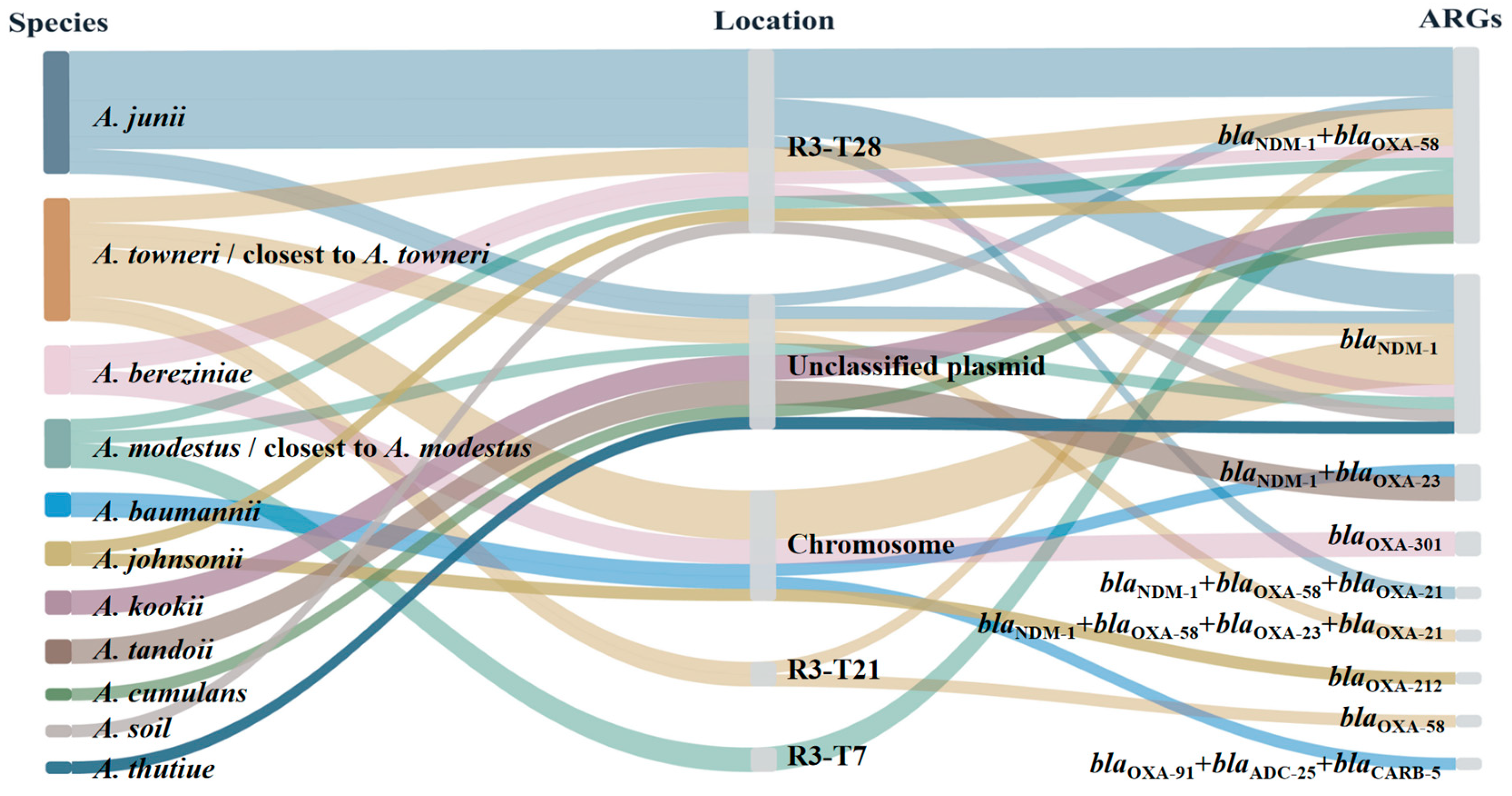
To characterize blaNDM-1 plasmid vehicles, whole-genome sequencing data were used to determine the genomic location of blaNDM-1, and plasmids were typed using the Acinetobacter Plasmid Typing (APT) scheme [29]. The co-occurrence of major carbapenemase genes on blaNDM-1-positive plasmids was summarized (Figure 3; Table S4). The blaNDM-1 gene was mainly plasmid-borne (29/34, 85.3%), whereas chromosomal blaNDM-1 was detected in a minority of isolates (5/34, 14.7%). Co-carriage of additional carbapenemase genes was frequently observed among blaNDM-1-positive plasmids, most commonly with blaOXA-58 (18/29, 62.1%).
Among the blaNDM-1-positive plasmids, 19 belonged to R3-type plasmids (R3-T28, n = 15; R3-T21, n = 2; R3-T7, n = 2), while the remaining 10 plasmids were unclassified with respect to a defined APT replicon type (Figure 3). Among the 29 plasmid-borne blaNDM-1 isolates, R3-T28 was the most frequent blaNDM-1 vehicle (15/29, 51.7%) and commonly co-carried blaOXA-58 (10/15, 66.7%). R3-T21 plasmids were detected in two isolates in the A. towneri/closest-to-A. towneri group, whereas R3-T7 plasmids were detected in two isolates in the A. modestus/closest-to-A. modestus group; blaOXA-58 co-carriage was also observed in these types. In addition, blaOXA-23 co-carriage with blaNDM-1 was observed only in two A. tandoii isolates (2/34, 5.9%) (Figure 3).
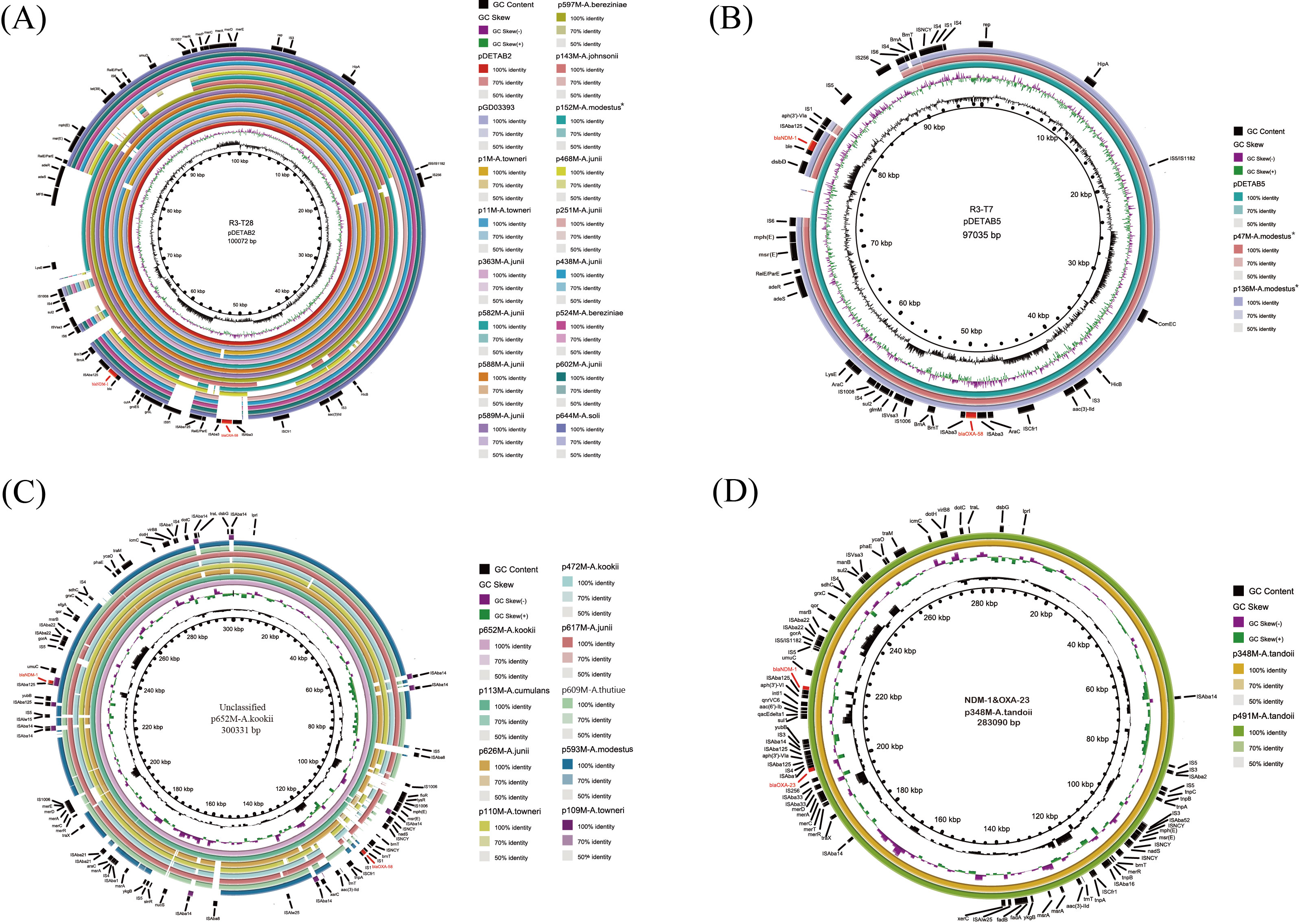
Among blaNDM-1-positive plasmids, R3-T28 was the dominant type across Acinetobacter spp., and seven R3-T28 plasmids co-harboring blaNDM-1 and blaOXA-58 showed high similarity to the reference plasmid pDETAB2 (GenBank: CP047975.1; R3-T28), recovered from a clinical A. baumannii isolate in Hangzhou, China, in 2019 and carrying the same two genes (80–99% coverage; 99.43–100% nucleotide identity). The same seven plasmids were also highly similar to the plasmid pGD03393 (GenBank: CP092086.1; R3-T25) from a clinical A. bereziniae isolate in Shenzhen, China, in 2022 (94–99% coverage; 99.44–100% nucleotide identity) (Figure 4A). The blaNDM-1 gene was also located on R3-T7 plasmids in two isolates labeled as closest to A. modestus; these plasmids were highly similar to pDETAB5 (GenBank: CP072528.1; R3-T7), which was recovered from a clinical A. baumannii isolate in Hangzhou, China, with 82–84% coverage and 99.99–100% nucleotide identity (Figure 4B). In contrast, the two R3-T21 plasmids showed only partial similarity to their respective references pGX5 and pCP038501 (both R3-T21; coverage 44–66%, identity 98.07–99.04%) and carried blaNDM-1 and/or blaOXA-58 in IS-associated regions (Figure S2). Ten unclassified blaNDM-1-carrying plasmids shared conserved backbone blocks but also displayed isolate-specific insertions/deletions across different Acinetobacter hosts (Figure 4C). Notably, the two blaNDM-1/blaOXA-23 co-harboring plasmids from A. tandoii were recovered from two different hospitals in May 2025 and displayed near-identical plasmid backbones in circular comparisons (Figure 4D).

2.4. Genetic Environments and Structural Variants of blaNDM-1

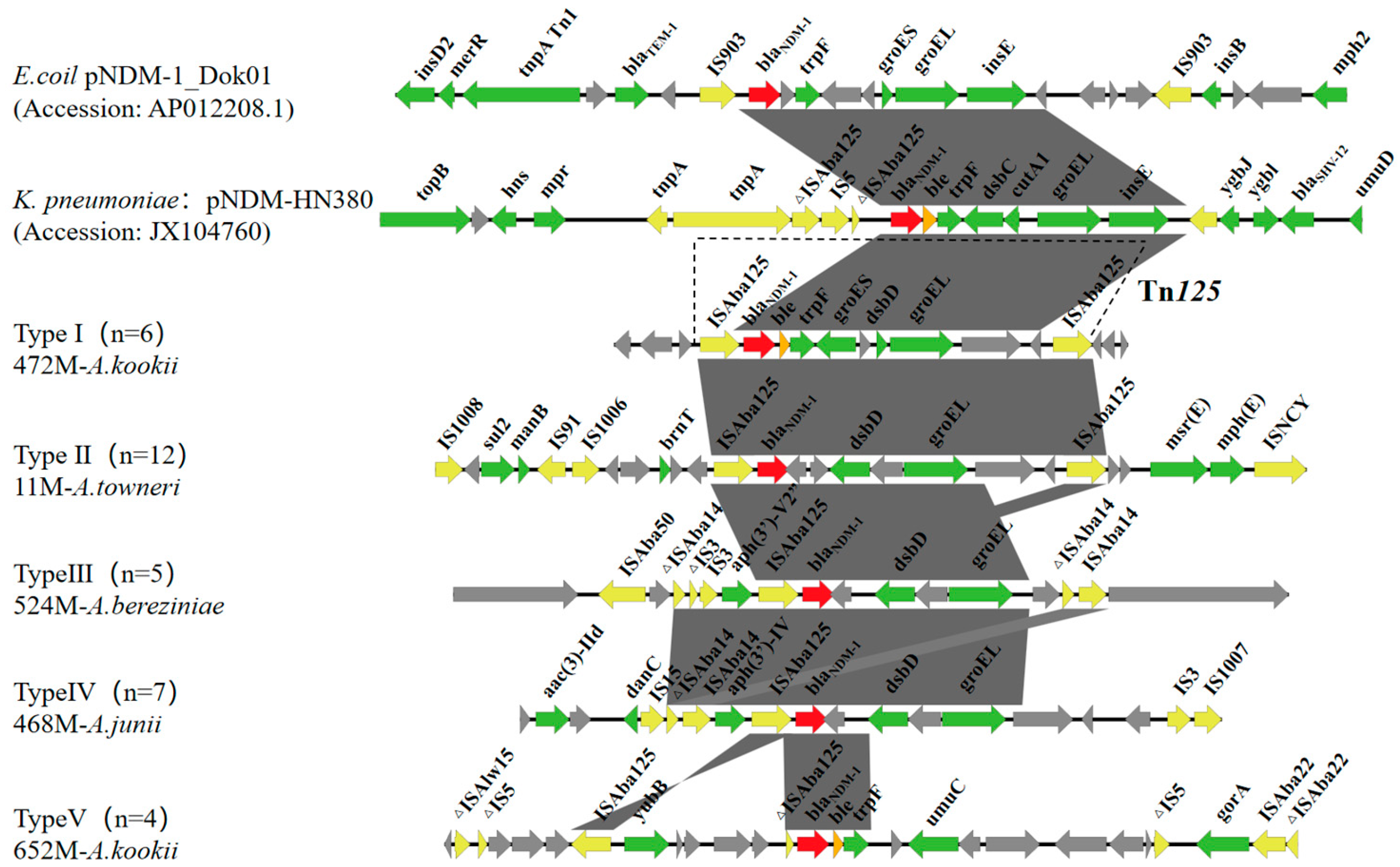
We compared the genetic environments flanking blaNDM-1 across the 34 isolates using Easyfig (Figure 5). Two Enterobacterales plasmids that commonly carry blaNDM-1 were included for contextual comparison: pNDM-1_Dok01 from a clinical Escherichia coli isolate in Japan (GenBank: AP012208.1) and pNDM-HN380 from a hospital-associated Klebsiella pneumoniae isolate in Hong Kong (GenBank: JX104760). Despite the multi-species composition of the collection and substantial diversity in the surrounding regions, blaNDM-1 was consistently embedded in an ISAba125-associated, Tn125-related core segment, with ISAba125 or truncated ISAba125 (ΔISAba125) present at the boundaries. In contrast, the upstream and downstream regions were altered to varying degrees due to additional inserted sequences (e.g., ISAba14, ISAba22, IS5, IS3, and IS1007). Genes frequently observed in proximity to blaNDM-1 included ble, trpF, and the molecular chaperonins groES/groEL. In a subset of isolates, the blaNDM-1 region was further linked to other resistance-associated loci, including msr(E)/mph(E) and aac(3)-IId. Overall, these data indicate a conserved ISAba125-linked blaNDM-1 core embedded within diverse and IS-rich genetic backgrounds in Acinetobacter.

3. Discussion

This study conducted a one-year, culture-based surveillance of hospital wastewater from five tertiary hospitals in Shenzhen, China, integrating phenotypic susceptibility testing with genomic characterization of carbapenem-resistant Acinetobacter isolates. Globally, blaNDM-1 has been reported most frequently in Enterobacterales, particularly Klebsiella spp. (52.07%) and Escherichia spp. (19.96%), while Acinetobacter spp. account for only 11.06% [30]. In contrast, within our selectively cultured blaNDM-1-positive isolate set, Acinetobacter spp. represented 34% (34/100) of the total, suggesting that hospital wastewater may serve as an important reservoir of blaNDM-1-carrying Acinetobacter under the present isolation conditions. This observation is consistent with previous reports from China documenting the prevalence of blaNDM-1 in Acinetobacter spp. across clinical, environmental, and livestock samples [31,32]. The earliest report of an NDM-producing clinical Acinetobacter isolate worldwide involved a blaNDM-1-positive A. baumannii strain identified in India [33]. In China, the first documented blaNDM-1-positive clinical isolates were likewise A. baumannii, reported from four provinces in 2010 [22]. However, in our collection, plasmid-borne blaNDM-1 was most frequently identified in A. junii (10/29) and A. towneri (6/29), rather than A. baumannii, indicating that surveillance focused solely on A. baumannii may overlook the potential contribution of NBA to the persistence and dissemination of blaNDM-1 in wastewater settings.
Notably, blaNDM-1 was detected in 100% (34/34) of the Acinetobacter isolates recovered under meropenem selection. Although blaNDM-1 prevalence in wastewater-derived Acinetobacter varies across settings (e.g., 31.2% in Nigeria and 65% in other Chinese sewage systems) [18,23], every isolate in our collection carried blaNDM-1, indicating a close association between blaNDM-1 and carbapenem resistance in this selectively cultured isolate collection. This pattern is consistent with the high regional burden of carbapenemase genes reported from eight teaching hospitals (including Shenzhen) in Guangdong (2022–2024), where carbapenemase-encoding genes were detected in 85.19% (46/54) of carbapenem-resistant Enterobacter cloacae isolates [34]. The 100% carriage observed here also exceeds the 55% blaNDM-1 positivity reported among carbapenem-resistant Enterobacteriaceae (CRE) from Indian hospital wastewater [35], further supporting the view that hospital wastewater can act as an important reservoir of blaNDM-1 under the present sampling and isolation conditions.
Another notable feature of our study was the overwhelming predominance of NBA (33/34), which contrasts with clinical surveillance patterns in which high-risk A. baumannii typically dominates hospital-associated infections. Hospital wastewater, however, may represent a broader ecological interface in which A. baumannii co-occurs with diverse NBA species [19]. Previous studies from China further suggest that the species composition of Acinetobacter in hospital sewage can vary across settings. For example, Gu et al. reported that A. baumannii was the predominant Acinetobacter species in untreated hospital wastewater from Zhejiang (32/70, 45.7%), which differs from the NBA predominance observed in our collection [19]. In contrast, other studies recovered blaNDM-1-positive non-baumannii Acinetobacter, including A. johnsonii, from hospital sewage [27]. Local evidence also indicates that NBA can be recovered in Shenzhen, including A. tandoii from a contaminated river [36]. Taken together, these findings suggest that the species composition of Acinetobacter in hospital wastewater may vary according to local epidemiology, sampling strategy, and selective culture conditions, and may not directly mirror clinical infection patterns. Against this background, the predominance of NBA in our collection may reflect the ecological diversity of Acinetobacter populations under the present sampling and meropenem-selective culture conditions. Because contemporaneous clinical isolates from the participating hospitals were not included in this study, a direct comparison between wastewater species distribution and patient infection patterns could not be performed.
In our study, all blaNDM-1-positive isolates were resistant to meropenem and exhibited a multidrug-resistant (MDR) phenotype, consistent with the increasing global trend of MDR A. baumannii infections [37]. Moreover, our isolates displayed markedly elevated carbapenem MICs (meropenem MIC50/90, 32/64 mg/L; imipenem MIC50/90, >128/> 128 mg/L), indicating high-level carbapenem resistance. This finding is consistent with CHINET 2024 surveillance, which reported high resistance rates to imipenem (64.5%) and meropenem (64.7%) among clinical Acinetobacter isolates in China [38]. Notably, our data highlight a disparity between clinical and wastewater-derived NBA: while clinical cohorts often report sporadic carbapenem resistance among NBA [39,40], our wastewater-derived NBA isolates exhibited uniformly high carbapenem MICs (>32 mg/L), in line with environmental observations that hospital-associated waters can enrich for highly resistant Acinetobacter [41]. With the increasing prevalence of carbapenem-resistant Gram-negative bacteria, colistin is increasingly relied upon as a last-resort therapy [42]. In our collection, 21% of isolates were categorized as resistant to colistin, yet no mcr genes were detected. This suggests the possible involvement of chromosomal mechanisms such as alterations in the PmrAB two-component system and/or lipid A (LPS) biosynthesis pathways [43]. Overall, these findings highlight hospital wastewater as an under-recognized reservoir of highly resistant MDR Acinetobacter, with the potential to maintain and disseminate resistance determinants.
Core-genome SNP analysis revealed several highly related isolate pairs among pre-disinfection hospital sewage samples. These included pairs from the same hospital and season (0 SNP), from different hospitals within the same season (1–2 SNPs), and from the same hospital across seasons (19 SNPs). Such patterns suggest spatio-temporal intermixing of closely related Acinetobacter lineages in this collection, potentially reflecting shared upstream inputs and/or recurrent introductions. However, published mutation-rate estimates are derived mainly from clinical A. baumannii populations and vary across lineages and analytical settings, and their direct applicability to environmental Acinetobacter isolates remains uncertain. Therefore, SNP distances in this study were interpreted conservatively as indicators of close genomic relatedness rather than as direct estimates of transmission time [44,45]. In parallel, the near-ubiquitous presence of blaNDM-1—typically in Tn125-related, ISAba125-associated contexts—and the high prevalence (97.1%) of the msr(E)/mph(E) macrolide-resistance gene pair across diverse genetic backgrounds suggest the dissemination of conserved resistance units likely associated with mobile genetic elements [10,46]. Taken together, these patterns are compatible with wastewater settings that may favor the maintenance and possible exchange of mobile resistance modules across hosts and niches [47].
The predominant plasmid carriage of blaNDM-1 (29/34, 85.3%) in our hospital wastewater collection points to a possible role of plasmid-mediated mobility in maintaining carbapenem resistance in this niche. This aligns with global genomic evidence that blaNDM is typically plasmid-borne and embedded within transposon-rich, highly recombining regions associated with potential horizontal dissemination [9]. Rep_3 plasmids were the predominant backbones, accounting for 65.5% (19/29) of blaNDM-1-positive plasmids. This finding mirrors rep-gene-based typing and comparative plasmid surveys identifying Rep_3 as one of the most common and diverse plasmid families in Acinetobacter [29,48]. This pattern is also consistent with the species composition of our isolates (33/34 NBA). A recent pan-genus plasmid analysis reported that, in Asia, R3-type AMR plasmids comprise 89.1% of resistance-encoding non-baumannii Acinetobacter plasmids, indicating a high regional representation of these plasmid backbones [49]. Within the Rep_3 family, R3-T28 was the most frequent type in our collection (15/19, 78.9%), in line with Tobin et al., who found R3-T28 to be enriched in non-baumannii Acinetobacter [49]. While R3-T28 has been reported mainly from clinical datasets, its recovery from hospital sewage here is consistent with ongoing clinical inputs into wastewater. Across species and hospitals, the R3-T28 and R3-T7 plasmids in our collection exhibited highly conserved backbones, with variability largely confined to discrete MGE-rich resistance regions. This architecture mirrors the modular evolution reported for pDETAB2/pDETAB5-related Rep_3 plasmids [50,51]. In addition, the high representation of A. junii (8/19, 42.1%) among Rep_3-plasmid carriers indicates that certain NBA lineages may act as important environmental reservoirs at the clinical–wastewater interface. The high sequence identity between our isolates and a clinical blaNDM-1-positive A. bereziniae plasmid from Shenzhen further supports local persistence of these high-risk backbones [52]. Collectively, the repeated recovery of near-identical Rep_3 plasmids across hospitals is consistent with the maintenance of clinically relevant resistance regions within environmental Acinetobacter populations in the wastewater setting, with the possibility of further genetic reorganization.
Furthermore, blaOXA-58 was detected in 18 of these 29 blaNDM-1-positive plasmids, most often on the R3-T28 backbone (10/18, 55.6%). OXA-58 is a globally distributed class D carbapenemase that has been reported across Europe, Australia, the United States, and Asia [53,54,55,56]. OXA-type carbapenemases (including OXA-58) are also widely established in clinical Acinetobacter baumannii-calcoaceticus complex collections [57]. The frequent co-carriage of blaNDM-1 and blaOXA-58 on the same plasmid in our dataset (18/29, 62.1%) is consistent with prior reports of plasmid-level co-localization [58,59]. These reports include a clinical A. pittii isolate from China and fully resolved MDR plasmids from A. baumannii and A. nosocomialis. Isolates co-carrying blaNDM-1 and blaOXA-58 have also been recovered from hospital sewage (e.g., A. towneri), supporting wastewater as an additional niche where such multi-carbapenemase platforms can persist [60]. Much of the published evidence derives from sporadic case reports, which limits inference on how frequently this linkage occurs across species and settings. In comparison, our meropenem-selected yet non-species-targeted recovery from hospital wastewater captured multiple Acinetobacter species and revealed frequent plasmid co-carriage of blaNDM-1/blaOXA-58 (18/29), thereby providing a broader snapshot beyond clinically curated datasets. Beyond the predominant R3-type plasmids, we identified an emerging pattern in A. tandoii: co-carriage of blaNDM-1 and blaOXA-23 on highly similar plasmids (Figure 4D). While co-harboring blaNDM-1 and blaOXA-23 is a hallmark of high-risk clinical A. baumannii clones, its detection in A. tandoii—typically associated with aquatic niches—suggests that this resistance configuration may also occur in an environmental NBA species [61,62]. Overall, our findings indicate frequent plasmid co-carriage of blaNDM-1 with OXA-type carbapenemases in hospital wastewater, with Rep_3/R3-T28 appearing to serve as a major scaffold for the blaNDM-1-blaOXA-58 linkage.
To further clarify the genetic contexts associated with carbapenem resistance, we analyzed the flanking regions of blaNDM-1 and observed a recurrent “conserved core-diverse context” pattern. In all 34 isolates, blaNDM-1 was immediately associated with ISAba125 or ΔISAba125, consistent with ISAba125 being a common signature upstream of blaNDM and a likely source of promoter sequences that support expression [9,20,63]. This ISAba125-linked core is consistent with Tn125/Tn125-derived structures serving as major vehicles for blaNDM-1 dissemination in Acinetobacter and potentially beyond [10,64,65]. In parallel, other carbapenemase loci showed IS-linked organization in our collection (blaOXA-58 with ISAba3; blaOXA-23 with ISAba1), and class 1 integron features were detected near blaOXA-23, suggesting the possibility of co-selection in wastewater [66,67,68,69]. Taken together, our data support the view that hospital wastewater may serve as a setting in which high-risk blaNDM-1 contexts are repeatedly detected and may undergo further local genetic rearrangement. On this basis, strengthening genomic surveillance for blaNDM-1 in China remains important, particularly at wastewater-linked One Health interfaces.

4. Materials & Methods

4.1. Sample Selection and Bacterial Isolates

Wastewater samples from five tertiary hospitals in Shenzhen, China (designated as ET, SY, BD, FY and ZYY), were collected by 24 h composite sampling using an automated sampler (Luban 1A; Shenzhen Wanwu Sensing Technology Co., Ltd., Shenzhen, China) in November 2024 and February, May, and August 2025. Pre- and post-disinfection wastewater samples (3 L each) were transported to the laboratory on ice for immediate processing. Dilutions were prepared at 1:5 and 1:25. Aliquots (100 µL) were inoculated onto Brain Heart Infusion (BHI) agar supplemented with meropenem (2 µg/mL) and vancomycin (30 µg/mL), as well as CHROMagar™ Orientation medium (CHROMagar, Paris, France). Plates were incubated at 37 °C for 18–24 h. For each hospital, 30 colonies representing distinct morphotypes were selected, purified by subculture, and stored for downstream analyses.

4.2. Species Identification and Antimicrobial Susceptibility Testing

Genomic DNA was extracted using the boiling method. Nearly full-length 16S rRNA gene fragments were amplified using primers 27F and 1492R, followed by Sanger sequencing. Species identification was performed using BLASTn searches against the NCBI 16S rRNA database [70], and the top hit was used for preliminary taxonomic assignment. To reduce clonal redundancy, all isolates were genotyped using enterobacterial repetitive intergenic consensus PCR (ERIC-PCR) as previously described [71]. MICs were determined by the broth microdilution method according to the Clinical and Laboratory Standards Institute (CLSI) guidelines (CLSI M100, 2025) [72]. Tigecycline MICs were interpreted using the U.S. Food and Drug Administration (FDA) Enterobacterales breakpoints. Colistin MICs were determined by broth microdilution and interpreted for Acinetobacter spp. as intermediate at ≤2 mg/L and resistant at ≥4 mg/L. Escherichia coli ATCC 25922 was included as the quality-control strain in broth microdilution assays. The antimicrobial panel included colistin (CST), gentamicin (GEN), amikacin (AMK), tetracycline (TET), doxycycline (DOX), meropenem (MEM), imipenem (IPM), ciprofloxacin (CIP), cefepime (FEP), ceftazidime (CAZ), tigecycline (TGC), piperacillin/tazobactam (PIP/TAZ), and trimethoprim-sulfamethoxazole (TMP-SMX).

4.3. PCR Screening for Carbapenemase Genes

Isolates recovered from meropenem-containing plates were screened by polymerase chain reaction (PCR) for blaNDM, blaKPC, and blaOXA-48-like genes using published primers [73]. PCR products were analyzed by 1.0–1.5% agarose gel electrophoresis and visualized under UV illumination. PCR screening was used as an initial detection step, whereas final confirmation of carbapenemase genes and their genetic contexts was based on whole-genome sequencing rather than amplicon sequencing.

4.4. Whole-Genome Sequencing, Assembly, Annotation, and Detection of Resistance and Mobile Elements

Genomic DNA for sequencing was extracted using the TIANGEN Wizard Genomic DNA Kit (Tiangen Biotech, Beijing, China). DNA concentration was quantified using a Qubit 3.0 fluorometer with the Qubit dsDNA HS Assay Kit (Thermo Fisher Scientific, Waltham, MA, USA). Short-read libraries were sequenced using the MGI DNBSEQ-G99 platform, and long-read sequencing was performed using the Oxford Nanopore MinION platform. After adapter trimming and quality filtering, hybrid assemblies were generated using Unicycler v0.4.6 [74]. Genome annotation was performed using Bakta v1.11 [75]. Preliminary species identification was first inferred by 16S rRNA sequencing. Whole-genome-based taxonomic identification was further supported using PubMLST [76]. In addition, ANI analysis against reference genomes was used as the explicit criterion for final species assignment. Isolates with ANI values ≥95% were considered confidently assigned at the species level, whereas isolates with ANI values below this cutoff were conservatively treated as unresolved at the species level. ARGs were detected using ResFinder v2.1, and MGEs, including insertion sequences and secretion system-related features, were annotated using VRprofile2 [77]. Plasmid replicon typing for Acinetobacter spp. was performed using the APT scheme based on replication initiation (rep) genes [29]. Web BLAST searches were performed using default parameters against the NCBI nucleotide database. Comparative plasmid analyses were conducted by aligning representative plasmids to publicly available references retrieved from NCBI GenBank, including pDETAB2 (CP047975.1), pGD03393 (CP092086.1), pDETAB5 (CP072528.1), pGX5 (CP071769.1), and Acinetobacter baumannii strain CIAT758 plasmid unnamed1 (CP038501.1). Visualization tools included Easyfig v2.2.3 [78] and BRIG v0.95 for circular plasmid comparisons [79], TBtools-II v2.376 for heatmap generation [80], and iTOL v7 for phylogenetic trees visualization [81].

5. Conclusions

This study combined a one-year, culture-based investigation of wastewater collected from five tertiary hospitals in Shenzhen with AST and whole-genome sequencing of carbapenem-resistant Acinetobacter. The blaNDM-1 gene was detected in all carbapenem-resistant Acinetobacter isolates and was predominantly plasmid-borne, with the Rep_3 family, particularly R3-T28, acting as a major vehicle that frequently co-harbored blaOXA-58. We also identified an emerging threat in A. tandoii isolates carrying blaNDM-1/blaOXA-23 plasmids, highlighting the capture of clinically relevant resistance determinants by environmental hosts. The modular organization of these Tn125-like structures further suggests that IS-driven diversification as a key force structuring the wastewater resistome. The predominance of non-baumannii Acinetobacter in this collection likely reflects the broader ecological diversity of wastewater-associated Acinetobacter under the present sampling and meropenem-selective culture conditions.
A limitation of this study is the restriction of sampling to discrete time points within a single city, which may limit inferences regarding finer temporal dynamics and broader geographic patterns. Nevertheless, our data support hospital wastewater as an important reservoir for high-risk carbapenemase determinants. These data advocate for the routine integration of hospital wastewater monitoring into “One Health” surveillance and emphasize the urgent need for targeted source-control strategies to mitigate the environmental dissemination of carbapenem resistance.

Supplementary Materials

The following supporting information can be downloaded at: https://www.mdpi.com/article/10.3390/antibiotics15040347/s1. Figure S1. Distribution of 100 bacterial strains with blaNDM-positive genes. Figure S2. Circular alignments of reference plasmid sequences with homologous contigs from carbapenem-resistant Acinetobacter spp. recovered in this study. (A) R3-T21 plasmid. (B) R3-T21 plasmid. Table S1. ANI-based species assignment of 34 Acinetobacter isolates using reference genomes. Table S2. The MIC values of 34 carbapenem-resistant Acinetobacter spp. Isolates in antimicrobial susceptibility testing. Table S3. Pairwise core-genome SNP distances among carbapenem-resistant Acinetobacter isolates. Table S4. Distribution and genetic characteristics of NDM-1-carrying carbapenem-resistant Acinetobacter isolates identified in this study.

Author Contributions

Conceptualization, X.G. and Y.F.; methodology, X.G., X.C. and H.L.; software, X.G. and Y.F.; validation, X.C., H.L. and S.H.; formal analysis, X.G. and Y.; investigation, X.G., X.C. and Y.C.; resources, Y.F., L.L. and Z.L.; data curation, X.G., Y.C. and X.C.; writing—original draft preparation, X.G.; writing—review and editing, Y.F. and Z.L.; visualization, X.G.; supervision, Y.F. and D.H.; project administration, L.L. and S.H.; funding acquisition, Y.F. and Z.L. All authors have read and agreed to the published version of the manuscript.

Funding

This research was funded by Shenzhen Science and Technology Program, grant number JCYJ20240813160807011; Shenzhen Medical Research Fund, grant number B2503010; Shenzhen Science and Technology Program, grant number JCYJ20210324124014040, and Shenzhen Key Medical Discipline Construction Fund, grant number SZXK066.

Institutional Review Board Statement

Not applicable.

Informed Consent Statement

Not applicable.

Data Availability Statement

Genome assemblies have been deposited in the China National Center for Bioinformation (CNCB) Genome Warehouse (GWH) under BioProject PRJCA052902 and are publicly released.

Acknowledgments

Thank you to the Shenzhen Science and Technology Program, the Shenzhen Medical Research Fund, the Shenzhen Natural Science Foundation and the Shenzhen Key Medical Discipline Construction Fund for their support. Generative AI (ChatGPT 5.3, OpenAI) was used to assist with English language editing and improving clarity/readability of the manuscript (e.g., grammar, wording, and sentence restructuring). All scientific content, study design, data analysis, results, and conclusions were produced by the authors. The authors reviewed and edited all AI-assisted text and take full responsibility for the final manuscript. No generative AI tools were used to create, alter, or fabricate data, results, figures, or references.

Conflicts of Interest

The authors declare no conflicts of interest.

References

  1. Murray, C.J.L.; Ikuta, K.S.; Sharara, F.; Swetschinski, L.; Robles Aguilar, G.; Gray, A.; Han, C.; Bisignano, C.; Rao, P.; Wool, E.; et al. Global burden of bacterial antimicrobial resistance in 2019: A systematic analysis. Lancet 2022, 399, 629–655. [Google Scholar] [CrossRef] [PubMed]
  2. Zhang, S.; Huang, J.; Zhao, Z.; Cao, Y.; Li, B. Hospital Wastewater as a Reservoir for Antibiotic Resistance Genes: A Meta-Analysis. Front. Public Health 2020, 8, 574968. [Google Scholar] [CrossRef] [PubMed]
  3. Mehanni, M.M.; Gadow, S.I.; Alshammari, F.A.; Modafer, Y.; Ghanem, K.Z.; El-Tahtawi, N.F.; El-Homosy, R.F.; Hesham, A.E. Antibiotic-resistant bacteria in hospital wastewater treatment plant effluent and the possible consequences of its reuse in agricultural irrigation. Front. Microbiol. 2023, 14, 1141383. [Google Scholar] [CrossRef] [PubMed]
  4. Lépesová, K.; Olejníková, P.; Mackuľak, T.; Cverenkárová, K.; Krahulcová, M.; Bírošová, L. Hospital Wastewater-Important Source of Multidrug Resistant Coliform Bacteria with ESBL-Production. Int. J. Environ. Res. Public Health 2020, 17, 7827. [Google Scholar] [CrossRef]
  5. Talat, A.; Blake, K.S.; Dantas, G.; Khan, A.U. Metagenomic Insight into Microbiome and Antibiotic Resistance Genes of High Clinical Concern in Urban and Rural Hospital Wastewater of Northern India Origin: A Major Reservoir of Antimicrobial Resistance. Microbiol. Spectr. 2023, 11, e0410222. [Google Scholar] [CrossRef]
  6. Hu, F.; Lin, M.L.; Mou, J.L.; Feng, J.H.; Huang, K.; Lao, Y.J.; Cheng, J.; Lin, J. Molecular and Clinical Characteristics of Carbapenem-Resistant Klebsiella pneumoniae Isolates at a Tertiary Hospital in Wuhan, China. Infect. Drug Resist. 2023, 16, 65–76. [Google Scholar] [CrossRef]
  7. European Centre for Disease Prevention and Control. Risk Assessment: Carbapenem-Resistant Enterobacterales—Third Update; European Centre for Disease Prevention and Control (ECDC): Stockholm, Sweden, 2025. [Google Scholar]
  8. World Health Organization. Global Antibiotic Resistance Surveillance Report 2025; World Health Organization (WHO): Geneva, Switzerland, 2025. [Google Scholar]
  9. Acman, M.; Wang, R.; van Dorp, L.; Shaw, L.P.; Wang, Q.; Luhmann, N.; Yin, Y.; Sun, S.; Chen, H.; Wang, H.; et al. Role of mobile genetic elements in the global dissemination of the carbapenem resistance gene blaNDM. Nat. Commun. 2022, 13, 1131. [Google Scholar] [CrossRef]
  10. Poirel, L.; Bonnin, R.A.; Boulanger, A.; Schrenzel, J.; Kaase, M.; Nordmann, P. Tn125-related acquisition of blaNDM-like genes in Acinetobacter baumannii. Antimicrob. Agents Chemother. 2012, 56, 1087–1089. [Google Scholar] [CrossRef]
  11. Pitout, J.D.D.; Peirano, G.; Kock, M.M.; Strydom, K.A.; Matsumura, Y. The Global Ascendency of OXA-48-Type Carbapenemases. Clin. Microbiol. Rev. 2019, 33, 10–1128. [Google Scholar] [CrossRef]
  12. Evans, B.A.; Amyes, S.G. OXA β-lactamases. Clin. Microbiol. Rev. 2014, 27, 241–263. [Google Scholar] [CrossRef]
  13. Olowo-Okere, A.; Skiebe, E.; Wilharm, G. High-quality draft genome sequences of Acinetobacter pittii strains isolated from soil in Gwagwalada, Nigeria. Microbiol. Resour. Announc. 2025, 14, e0033825. [Google Scholar] [CrossRef]
  14. LPSN—List of Prokaryotic Names with Standing in Nomenclature. Genus: Acinetobacter. Available online: https://lpsn.dsmz.de/genus/acinetobacter (accessed on 20 November 2025).
  15. Cain, A.K.; Hamidian, M. Portrait of a killer: Uncovering resistance mechanisms and global spread of Acinetobacter baumannii. PLoS Pathog. 2023, 19, e1011520. [Google Scholar] [CrossRef] [PubMed]
  16. Wong, D.; Nielsen, T.B.; Bonomo, R.A.; Pantapalangkoor, P.; Luna, B.; Spellberg, B. Clinical and Pathophysiological Overview of Acinetobacter Infections: A Century of Challenges. Clin. Microbiol. Rev. 2017, 30, 409–447. [Google Scholar] [CrossRef] [PubMed]
  17. Al Atrouni, A.; Joly-Guillou, M.L.; Hamze, M.; Kempf, M. Reservoirs of Non-baumannii Acinetobacter Species. Front. Microbiol. 2016, 7, 49. [Google Scholar] [CrossRef] [PubMed]
  18. Odih, E.E.; Sunmonu, G.T.; Okeke, I.N.; Dalsgaard, A. NDM-1- and OXA-23-producing Acinetobacter baumannii in wastewater of a Nigerian hospital. Microbiol. Spectr. 2023, 11, e0238123. [Google Scholar] [CrossRef]
  19. Gu, D.; Wu, Y.; Chen, K.; Zhang, Y.; Ju, X.; Yan, Z.; Xie, M.; Chan, E.W.C.; Chen, S.; Ruan, Z.; et al. Recovery and genetic characterization of clinically-relevant ST2 carbapenem-resistant Acinetobacter baumannii isolates from untreated hospital sewage in Zhejiang Province, China. Sci. Total Environ. 2024, 916, 170058. [Google Scholar] [CrossRef]
  20. Wu, W.; Feng, Y.; Tang, G.; Qiao, F.; McNally, A.; Zong, Z. NDM Metallo-β-Lactamases and Their Bacterial Producers in Health Care Settings. Clin. Microbiol. Rev. 2019, 32, 10–1128. [Google Scholar] [CrossRef]
  21. Turton, J.F.; Ward, M.E.; Woodford, N.; Kaufmann, M.E.; Pike, R.; Livermore, D.M.; Pitt, T.L. The role of ISAba1 in expression of OXA carbapenemase genes in Acinetobacter baumannii. FEMS Microbiol. Lett. 2006, 258, 72–77. [Google Scholar] [CrossRef]
  22. Chen, Y.; Zhou, Z.; Jiang, Y.; Yu, Y. Emergence of NDM-1-producing Acinetobacter baumannii in China. J. Antimicrob. Chemother. 2011, 66, 1255–1259. [Google Scholar] [CrossRef]
  23. Zhang, L.; Ma, X.; Luo, L.; Hu, N.; Duan, J.; Tang, Z.; Zhong, R.; Li, Y. The Prevalence and Characterization of Extended-Spectrum β-Lactamase- and Carbapenemase-Producing Bacteria from Hospital Sewage, Treated Effluents and Receiving Rivers. Int. J. Environ. Res. Public Health 2020, 17, 1183. [Google Scholar] [CrossRef]
  24. Hu, H.; Hu, Y.; Pan, Y.; Liang, H.; Wang, H.; Wang, X.; Hao, Q.; Yang, X.; Yang, X.; Xiao, X.; et al. Novel plasmid and its variant harboring both a blaNDM-1 gene and type IV secretion system in clinical isolates of Acinetobacter lwoffii. Antimicrob. Agents Chemother. 2012, 56, 1698–1702. [Google Scholar] [CrossRef] [PubMed]
  25. Fu, Y.; Du, X.; Ji, J.; Chen, Y.; Jiang, Y.; Yu, Y. Epidemiological characteristics and genetic structure of blaNDM-1 in non-baumannii Acinetobacter spp. in China. J. Antimicrob. Chemother. 2012, 67, 2114–2122. [Google Scholar] [CrossRef] [PubMed]
  26. Wang, K.; Li, P.; Li, J.; Hu, X.; Lin, Y.; Yang, L.; Qiu, S.; Ma, H.; Li, P.; Song, H. An NDM-1-Producing Acinetobacter towneri Isolate from Hospital Sewage in China. Infect. Drug Resist. 2020, 13, 1105–1110. [Google Scholar] [CrossRef] [PubMed]
  27. Zong, Z.; Zhang, X. blaNDM-1-carrying Acinetobacter johnsonii detected in hospital sewage. J. Antimicrob. Chemother. 2013, 68, 1007–1010. [Google Scholar] [CrossRef]
  28. Aguilar-Vera, A.; Bello-López, E.; Pantoja-Nuñez, G.I.; Rodríguez-López, G.M.; Morales-Erasto, V.; Castillo-Ramírez, S. Acinetobacter junii: An emerging One Health pathogen. mSphere 2024, 9, e0016224. [Google Scholar] [CrossRef]
  29. Lam, M.M.C.; Koong, J.; Holt, K.E.; Hall, R.M.; Hamidian, M. Detection and Typing of Plasmids in Acinetobacter baumannii Using rep Genes Encoding Replication Initiation Proteins. Microbiol. Spectr. 2023, 11, e0247822. [Google Scholar] [CrossRef]
  30. Yao, S.; Yu, J.; Zhang, T.; Xie, J.; Yan, C.; Ni, X.; Guo, B.; Cui, C. Comprehensive analysis of distribution characteristics and horizontal gene transfer elements of blaNDM-1-carrying bacteria. Sci. Total Environ. 2024, 946, 173907. [Google Scholar] [CrossRef]
  31. Liu, C.; Qin, S.; Xu, H.; Xu, L.; Zhao, D.; Liu, X.; Lang, S.; Feng, X.; Liu, H.M. New Delhi Metallo-β-Lactamase 1(NDM-1), the Dominant Carbapenemase Detected in Carbapenem-Resistant Enterobacter cloacae from Henan Province, China. PLoS ONE 2015, 10, e0135044. [Google Scholar] [CrossRef]
  32. Ou, W.; Cui, L.; Li, Y.; Zheng, B.; Lv, Y. Epidemiological characteristics of blaNDM-1 in Enterobacteriaceae and the Acinetobacter calcoaceticus-Acinetobacter baumannii complex in China from 2011 to 2012. PLoS ONE 2014, 9, e113852. [Google Scholar] [CrossRef]
  33. Karthikeyan, K.; Thirunarayan, M.A.; Krishnan, P. Coexistence of blaOXA-23 with blaNDM-1 and armA in clinical isolates of Acinetobacter baumannii from India. J. Antimicrob. Chemother. 2010, 65, 2253–2254. [Google Scholar] [CrossRef]
  34. Chen, G.; Yan, X.; Zhou, Y.; Feng, J.; Bai, C.; Li, R.; Cui, H.; Jiang, Y.; Chen, H.; Bu, D.; et al. Characterization and transmission dynamics of carbapenemase-encoding genes in carbapenem-resistant Enterobacter cloacae isolated from eight teaching hospitals in Guangdong province, China (2022–2024). BMC Microbiol. 2025, 25, 667. [Google Scholar] [CrossRef] [PubMed]
  35. Lamba, M.; Graham, D.W.; Ahammad, S.Z. Hospital Wastewater Releases of Carbapenem-Resistance Pathogens and Genes in Urban India. Environ. Sci. Technol. 2017, 51, 13906–13912. [Google Scholar] [CrossRef] [PubMed]
  36. Ouyang, L.; Wang, K.; Liu, X.; Wong, M.H.; Hu, Z.; Chen, H.; Yang, X.; Li, S. A study on the nitrogen removal efficacy of bacterium Acinetobacter tandoii MZ-5 from a contaminated river of Shenzhen, Guangdong Province, China. Bioresour. Technol. 2020, 315, 123888. [Google Scholar] [CrossRef] [PubMed]
  37. Nguyen, M.; Joshi, S.G. Carbapenem resistance in Acinetobacter baumannii, and their importance in hospital-acquired infections: A scientific review. J. Appl. Microbiol. 2021, 131, 2715–2738. [Google Scholar] [CrossRef]
  38. Guo, Y.; Ding, L.; Han, R.; Yin, D.; Wu, S.; Yang, Y.; Wang, F.; Zhu, D.; Hu, F. Antimicrobial resistance profile of clinical isolates from hospitals across China: CHINET 2024 surveillance report. One Health Adv. 2025, 3, 23. [Google Scholar] [CrossRef]
  39. Sheck, E.; Romanov, A.; Shapovalova, V.; Shaidullina, E.; Martinovich, A.; Ivanchik, N.; Mikotina, A.; Skleenova, E.; Oloviannikov, V.; Azizov, I.; et al. Acinetobacter Non-baumannii Species: Occurrence in Infections in Hospitalized Patients, Identification, and Antibiotic Resistance. Antibiotics 2023, 12, 1301. [Google Scholar] [CrossRef]
  40. Lasarte-Monterrubio, C.; Guijarro-Sánchez, P.; Alonso-Garcia, I.; Outeda, M.; Maceiras, R.; González-Pinto, L.; Martínez-Guitián, M.; Fernández-Lozano, C.; Vázquez-Ucha, J.C.; Bou, G.; et al. Epidemiology, resistance genomics and susceptibility of Acinetobacter species: Results from the 2020 Spanish nationwide surveillance study. Euro Surveill. Bull. Eur. Sur Les Mal. Transm. Eur. Commun. Dis. Bull. 2024, 29, 2300352. [Google Scholar] [CrossRef]
  41. Sharma, S.; Das, A.; Garg, R.; Pramanik, S.; Marndi, P.; Singh, R.; Banerjee, T.; Yadav, G.; Kumar, A. Reservoir of Carbapenem-Resistant Acinetobacter baumannii in the Hospital Environment and Colonization Pressure: A Surveillance-Based Study in Indian Intensive Care Unit. Microb. Drug Resist. 2022, 28, 1079–1086. [Google Scholar] [CrossRef]
  42. Ahmed, F.; Mahmud, M.T.; Naher, S.; Rana, M.J.; Ara, R.; Saif-Ur-Rahman, K.M. Effectiveness of Colistin in carbapenem resistant Acinetobacter baumannii—A systematic review. Health Sci. Rev. 2023, 8, 100113. [Google Scholar] [CrossRef]
  43. Beceiro, A.; Llobet, E.; Aranda, J.; Bengoechea, J.A.; Doumith, M.; Hornsey, M.; Dhanji, H.; Chart, H.; Bou, G.; Livermore, D.M.; et al. Phosphoethanolamine modification of lipid A in colistin-resistant variants of Acinetobacter baumannii mediated by the pmrAB two-component regulatory system. Antimicrob. Agents Chemother. 2011, 55, 3370–3379. [Google Scholar] [CrossRef]
  44. Naing, S.Y.; Hordijk, J.; Duim, B.; Broens, E.M.; van der Graaf-van Bloois, L.; Rossen, J.W.; Robben, J.H.; Leendertse, M.; Wagenaar, J.A.; Zomer, A.L. Genomic Investigation of Two Acinetobacter baumannii Outbreaks in a Veterinary Intensive Care Unit in The Netherlands. Pathogens 2022, 11, 123. [Google Scholar] [CrossRef]
  45. Tobin, L.A.; Jarocki, V.M.; Kenyon, J.; Drigo, B.; Donner, E.; Djordjevic, S.P.; Hamidian, M. Genomic analysis of diverse environmental Acinetobacter isolates identifies plasmids, antibiotic resistance genes, and capsular polysaccharides shared with clinical strains. Appl. Environ. Microbiol. 2024, 90, e0165423. [Google Scholar] [CrossRef] [PubMed]
  46. Blackwell, G.A.; Hall, R.M. The tet39 Determinant and the msrE-mphE Genes in Acinetobacter Plasmids Are Each Part of Discrete Modules Flanked by Inversely Oriented pdif (XerC-XerD) Sites. Antimicrob. Agents Chemother. 2017, 61, 10–1128. [Google Scholar] [CrossRef] [PubMed]
  47. Brown, C.L.; Maile-Moskowitz, A.; Lopatkin, A.J.; Xia, K.; Logan, L.K.; Davis, B.C.; Zhang, L.; Vikesland, P.J.; Pruden, A. Selection and horizontal gene transfer underlie microdiversity-level heterogeneity in resistance gene fate during wastewater treatment. Nat. Commun. 2024, 15, 5412. [Google Scholar] [CrossRef] [PubMed]
  48. Salto, I.P.; Torres Tejerizo, G.; Wibberg, D.; Pühler, A.; Schlüter, A.; Pistorio, M. Comparative genomic analysis of Acinetobacter spp. plasmids originating from clinical settings and environmental habitats. Sci. Rep. 2018, 8, 7783. [Google Scholar] [CrossRef]
  49. Tobin, L.A.; Lam, M.M.C.; Hamidian, M. Pan-genus analysis and typing of antimicrobial resistance plasmids in Acinetobacter. NPJ Antimicrob. Resist. 2025, 3, 65. [Google Scholar] [CrossRef]
  50. Liu, H.; Moran, R.A.; Chen, Y.; Doughty, E.L.; Hua, X.; Jiang, Y.; Xu, Q.; Zhang, L.; Blair, J.M.A.; McNally, A.; et al. Transferable Acinetobacter baumannii plasmid pDETAB2 encodes OXA-58 and NDM-1 and represents a new class of antibiotic resistance plasmids. J. Antimicrob. Chemother. 2021, 76, 1130–1134. [Google Scholar] [CrossRef]
  51. Moran, R.A.; Liu, H.; Doughty, E.L.; Hua, X.; Cummins, E.A.; Liveikis, T.; McNally, A.; Zhou, Z.; van Schaik, W.; Yu, Y. GR13-type plasmids in Acinetobacter potentiate the accumulation and horizontal transfer of diverse accessory genes. Microb. Genom. 2022, 8, 000840. [Google Scholar] [CrossRef]
  52. Mo, X.M.; Pan, Q.; Seifert, H.; Xing, X.W.; Yuan, J.; Zhou, Z.Y.; Luo, X.Y.; Liu, H.M.; Xie, Y.L.; Yang, L.Q.; et al. First identification of multidrug-resistant Acinetobacter bereziniae isolates harboring blaNDM-1 from hospitals in South China. Heliyon 2023, 9, e12365. [Google Scholar] [CrossRef]
  53. Marqué, S.; Poirel, L.; Héritier, C.; Brisse, S.; Blasco, M.D.; Filip, R.; Coman, G.; Naas, T.; Nordmann, P. Regional occurrence of plasmid-mediated carbapenem-hydrolyzing oxacillinase OXA-58 in Acinetobacter spp. in Europe. J. Clin. Microbiol. 2005, 43, 4885–4888. [Google Scholar] [CrossRef]
  54. Peleg, A.Y.; Franklin, C.; Walters, L.J.; Bell, J.M.; Spelman, D.W. OXA-58 and IMP-4 carbapenem-hydrolyzing beta-lactamases in an Acinetobacter junii blood culture isolate from Australia. Antimicrob. Agents Chemother. 2006, 50, 399–400. [Google Scholar] [CrossRef]
  55. Castanheira, M.; Wanger, A.; Kruzel, M.; Deshpande, L.M.; Jones, R.N. Emergence and clonal dissemination of OXA-24- and OXA-58-producing Acinetobacter baumannii strains in Houston, Texas: Report from the SENTRY Antimicrobial Surveillance Program. J. Clin. Microbiol. 2008, 46, 3179–3180. [Google Scholar] [CrossRef]
  56. Mendes, R.E.; Bell, J.M.; Turnidge, J.D.; Castanheira, M.; Jones, R.N. Emergence and widespread dissemination of OXA-23, -24/40 and -58 carbapenemases among Acinetobacter spp. in Asia-Pacific nations: Report from the SENTRY Surveillance Program. J. Antimicrob. Chemother. 2009, 63, 55–59. [Google Scholar] [CrossRef] [PubMed]
  57. Cheikh, H.B.; Domingues, S.; Silveira, E.; Kadri, Y.; Rosário, N.; Mastouri, M.; Da Silva, G.J. Molecular characterization of carbapenemases of clinical Acinetobacter baumannii-calcoaceticus complex isolates from a University Hospital in Tunisia. 3 Biotech 2018, 8, 297. [Google Scholar] [CrossRef] [PubMed]
  58. Chen, Y.; Guo, P.; Huang, H.; Huang, Y.; Wu, Z.; Liao, K. Detection of co-harboring OXA-58 and NDM-1 carbapenemase producing genes resided on a same plasmid from an Acinetobacter pittii clinical isolate in China. Iran. J. Basic Med. Sci. 2019, 22, 106–111. [Google Scholar] [CrossRef]
  59. Alattraqchi, A.G.; Mohd Rani, F.; NI, A.R.; Ismail, S.; Cleary, D.W.; Clarke, S.C.; Yeo, C.C. Complete Genome Sequencing of Acinetobacter baumannii AC1633 and Acinetobacter nosocomialis AC1530 Unveils a Large Multidrug-Resistant Plasmid Encoding the NDM-1 and OXA-58 Carbapenemases. mSphere 2021, 6, 10–1128. [Google Scholar] [CrossRef]
  60. Jiang, N.; Zhang, X.; Zhou, Y.; Zhang, Z.; Zheng, X. Whole-genome sequencing of an NDM-1- and OXA-58-producing Acinetobacter towneri isolate from hospital sewage in Sichuan Province, China. J. Glob. Antimicrob. Resist. 2019, 16, 4–5. [Google Scholar] [CrossRef]
  61. Joshi, P.R.; Acharya, M.; Kakshapati, T.; Leungtongkam, U.; Thummeepak, R.; Sitthisak, S. Co-existence of blaOXA-23 and blaNDM-1 genes of Acinetobacter baumannii isolated from Nepal: Antimicrobial resistance and clinical significance. Antimicrob. Resist. Infect. Control 2017, 6, 21. [Google Scholar] [CrossRef]
  62. Sánchez-Urtaza, S.; Ocampo-Sosa, A.; Molins-Bengoetxea, A.; Rodríguez-Grande, J.; El-Kholy, M.A.; Hernandez, M.; Abad, D.; Shawky, S.M.; Alkorta, I.; Gallego, L. Co-Existence of blaNDM-1, blaOXA-23, blaOXA-64, blaPER-7 and blaADC-57 in a Clinical Isolate of Acinetobacter baumannii from Alexandria, Egypt. Int. J. Mol. Sci. 2023, 24, 12515. [Google Scholar] [CrossRef]
  63. Poirel, L.; Bonnin, R.A.; Nordmann, P. Analysis of the resistome of a multidrug-resistant NDM-1-producing Escherichia coli strain by high-throughput genome sequencing. Antimicrob. Agents Chemother. 2011, 55, 4224–4229. [Google Scholar] [CrossRef]
  64. Toleman, M.A.; Spencer, J.; Jones, L.; Walsh, T.R. blaNDM-1 is a chimera likely constructed in Acinetobacter baumannii. Antimicrob. Agents Chemother. 2012, 56, 2773–2776. [Google Scholar] [CrossRef]
  65. Bontron, S.; Nordmann, P.; Poirel, L. Transposition of Tn125 Encoding the NDM-1 Carbapenemase in Acinetobacter baumannii. Antimicrob. Agents Chemother. 2016, 60, 7245–7251. [Google Scholar] [CrossRef] [PubMed]
  66. Mugnier, P.D.; Poirel, L.; Naas, T.; Nordmann, P. Worldwide dissemination of the blaOXA-23 carbapenemase gene of Acinetobacter baumannii. Emerg. Infect. Dis. 2010, 16, 35–40. [Google Scholar] [CrossRef] [PubMed]
  67. Chen, Y.; Gao, J.; Zhang, H.; Ying, C. Spread of the blaOXA-23-Containing Tn2008 in Carbapenem-Resistant Acinetobacter baumannii Isolates Grouped in CC92 from China. Front. Microbiol. 2017, 8, 163. [Google Scholar] [CrossRef] [PubMed]
  68. Wan, M.T.; Chou, C.C. Class 1 Integrons and the Antiseptic Resistance Gene (qacEΔ1) in Municipal and Swine Slaughterhouse Wastewater Treatment Plants and Wastewater-Associated Methicillin-Resistant Staphylococcus aureus. Int. J. Environ. Res. Public Health 2015, 12, 6249–6260. [Google Scholar] [CrossRef]
  69. Nguyen, A.T.; Pham, S.C.; Ly, A.K.; Nguyen, C.V.V.; Vu, T.T.; Ha, T.M. Overexpression of blaOXA-58 Gene Driven by ISAba3 Is Associated with Imipenem Resistance in a Clinical Acinetobacter baumannii Isolate from Vietnam. BioMed Res. Int. 2020, 2020, 7213429. [Google Scholar] [CrossRef]
  70. Son, H.; Han, S.U.; Lee, K. 2,5-Diketo-D-Gluconate Hyperproducing Gluconobacter sphaericus SJF2-1 with Reporting Multiple Genes Encoding the Membrane-Associated Flavoprotein-Cytochrome c Complexed Dehydrogenases. Microorganisms 2022, 10, 2130. [Google Scholar] [CrossRef]
  71. Sedrakyan, A.; Ktsoyan, Z.; Arakelova, K.; Gevorgyan, Z.; Zakharyan, M.; Hakobyan, S.; Hovhannisyan, A.; Arakelyan, A.; Aminov, R. Molecular Epidemiology and Virulence of Non-Typhoidal Salmonella in Armenia. Int. J. Mol. Sci. 2022, 23, 9330. [Google Scholar] [CrossRef]
  72. CLSI Supplement M100; Performance Standards for Antimicrobial Susceptibility Testing. Clinical and Laboratory Standards Institute (CLSI): Wayne, PA, USA, 2025.
  73. Li, Y.; Tang, M.; Dai, X.; Zhou, Y.; Zhang, Z.; Qiu, Y.; Li, C.; Zhang, L. Whole-Genomic Analysis of NDM-5-Producing Enterobacteriaceae Recovered from an Urban River in China. Infect. Drug Resist. 2021, 14, 4427–4440. [Google Scholar] [CrossRef]
  74. Wick, R.R.; Judd, L.M.; Gorrie, C.L.; Holt, K.E. Unicycler: Resolving bacterial genome assemblies from short and long sequencing reads. PLoS Comput. Biol. 2017, 13, e1005595. [Google Scholar] [CrossRef]
  75. Schwengers, O.; Jelonek, L.; Dieckmann, M.A.; Beyvers, S.; Blom, J.; Goesmann, A. Bakta: Rapid and standardized annotation of bacterial genomes via alignment-free sequence identification. Microb. Genom. 2021, 7, 000685. [Google Scholar] [CrossRef]
  76. Jolley, K.A.; Bray, J.E.; Maiden, M.C.J. Open-access bacterial population genomics: BIGSdb software, the PubMLST.org website and their applications. Wellcome Open Res. 2018, 3, 124. [Google Scholar] [CrossRef]
  77. Wang, M.; Goh, Y.X.; Tai, C.; Wang, H.; Deng, Z.; Ou, H.Y. VRprofile2: Detection of antibiotic resistance-associated mobilome in bacterial pathogens. Nucleic Acids Res. 2022, 50, W768–W773. [Google Scholar] [CrossRef]
  78. Sullivan, M.J.; Petty, N.K.; Beatson, S.A. Easyfig: A genome comparison visualizer. Bioinformatics 2011, 27, 1009–1010. [Google Scholar] [CrossRef]
  79. Alikhan, N.F.; Petty, N.K.; Ben Zakour, N.L.; Beatson, S.A. BLAST Ring Image Generator (BRIG): Simple prokaryote genome comparisons. BMC Genom. 2011, 12, 402. [Google Scholar] [CrossRef]
  80. Chen, C.; Chen, H.; Zhang, Y.; Thomas, H.R.; Frank, M.H.; He, Y.; Xia, R. TBtools: An Integrative Toolkit Developed for Interactive Analyses of Big Biological Data. Mol. Plant 2020, 13, 1194–1202. [Google Scholar] [CrossRef]
  81. Letunic, I.; Bork, P. Interactive Tree of Life (iTOL) v5: An online tool for phylogenetic tree display and annotation. Nucleic Acids Res. 2021, 49, W293–W296. [Google Scholar] [CrossRef]
Figure 1. (A) Comparison of blaNDM-1 detection rates among different bacterial genera. Black bars represent the proportion of each genus among the 319 isolates, while red bars indicate the percentage of blaNDM-1-positive strains within each genus. (B) Species composition and distribution of 34 carbapenem-resistant Acinetobacter isolates. Final ANI-based species assignments are summarized in Table S1. In panel (B), isolates that did not reach the 95% ANI species-level cutoff were retained within the corresponding A. towneri or A. modestus visualization groups, and their final ANI-based assignments are provided in Table S1.
Antibiotics 15 00347 g001
Figure 2. Phylogenetic relationships and ARG profiles of 34 carbapenem-resistant Acinetobacter isolates. The tree on the left shows the clustering relationships among isolates, and the heatmap on the right shows ARG distribution. Pink squares indicate presence of the corresponding ARGs, whereas gray squares indicate absence. The colored bars denote hospital source. Asterisks indicate isolates unresolved at the species level under the 95% ANI cutoff and labeled by their closest reference species.
Antibiotics 15 00347 g002
Figure 3. Sankey diagram linking species/group assignment, blaNDM-1 location, and detected β-lactamase genes in 34 carbapenem-resistant Acinetobacter isolates. The nodes “A. towneri/closest to A. towneri” and “A. modestus/closest to A. modestus” include both ANI-confirmed isolates and unresolved isolates with highest ANI similarity to the corresponding reference genomes.
Antibiotics 15 00347 g003
Figure 4. Circular comparisons of representative blaNDM-1-carrying plasmids. In each panel, a representative plasmid was selected as the reference according to plasmid type and backbone similarity, and related plasmids were aligned as concentric rings. Black and colored inner curves indicate GC content and GC skew, respectively. Ring shading indicates sequence identity (100%, 70%, and 50%) to the reference plasmid. Isolates marked with an asterisk did not reach the 95% ANI species-level cutoff. (A) R3-T28 plasmids; (B) R3-T7 plasmids; (C) Unclassified blaNDM-1-carrying plasmids; (D) Representative blaNDM-1/blaOXA-23 co-harboring plasmids from A. tandoii.
Antibiotics 15 00347 g004
Figure 5. Genetic environments of blaNDM-1 in representative Acinetobacter isolates. Arrows indicate annotated ORFs and transcriptional orientation. Arrow colors denote different ORF categories: red, carbapenemase gene (blaNDM-1); yellow, insertion sequence (IS)-related genes; green, resistance- or mobility-associated genes; gray, other flanking ORFs. Shaded blocks denote BLASTn (v2.12.0+) nucleotide similarity. The symbol Δ indicates a truncated gene or insertion sequence.
Antibiotics 15 00347 g005
Table 1. Antimicrobial resistance rates of 34 carbapenem-resistant Acinetobacter spp. isolates against 13 antimicrobial agents.
AntibioticMIC Range (mg/L)MIC 50(mg/L)MIC 90(mg/L)Resistance (%)
Cefepime0.002–128128>12894
Ceftazidime0.002–128>128>128100
Piperacillin/Tazobactam0.25/4–128/4128/4128/453
Meropenem0.002–1283264100
Imipenem0.002–128>128>128100
Amikacin0.25–1282169
Gentamicin0.006–128128>12868
Tetracycline0.25–12883247
Doxycycline0.25–1280.2523
Ciprofloxacin0.002–12886467
Colistin0.006–1282821
Tigecycline0.002–1280.2510
Trimethoprim-Sulfamethoxazole 0.002/0.04–128/243232/608>128/243276
Disclaimer/Publisher’s Note: The statements, opinions and data contained in all publications are solely those of the individual author(s) and contributor(s) and not of MDPI and/or the editor(s). MDPI and/or the editor(s) disclaim responsibility for any injury to people or property resulting from any ideas, methods, instructions or products referred to in the content.