Article

Characterizing Aeromonas spp. as a Potential Sentinel Organism for Antimicrobial Resistance Dissemination in Wastewater and Drinking Water Treatment Systems: A Case Study in the Barcelona Metropolitan Area, Spain

1
Barcelona Institute for Global Health (ISGlobal), 08028 Barcelona, Spain
2
Faculty of Pharmacy and Food Sciences, University of Barcelona (UB), 08028 Barcelona, Spain
3
Aigües de Barcelona, Empresa Metropolitana de Gestió del Cicle Integral de l’Aigua, 08028 Barcelona, Spain
4
Microbiology Department, Hospital Universitari Bellvitge, IDIBELL-UB, 08907 L’Hospitalet de Llobregat, Spain
5
Consorcio de Investigación Biomédica en Red de Enfermedades Respiratorias (CIBERES), 08950 Madrid, Spain
6
Consorcio de Investigación Biomédica en Red de Epidemiología y Salud Pública (CIBERESP), 08950 Madrid, Spain
7
Faculty of Medicine and Health Sciences, University of Barcelona (UB), 08007 Barcelona, Spain
8
CIBER Enfermedades Infecciosas (CIBERINFEC), Instituto de Salud Carlos III, 28029 Madrid, Spain
*
Author to whom correspondence should be addressed.
Antibiotics 2026, 15(3), 301; https://doi.org/10.3390/antibiotics15030301
Submission received: 23 February 2026 / Revised: 11 March 2026 / Accepted: 13 March 2026 / Published: 17 March 2026
(This article belongs to the Special Issue Antibiotic Resistance in Wastewater Treatment Plants)

Abstract

Background: Wastewater treatment plants (WWTPs) are hotspots of antimicrobial resistance (AMR) due to inputs from diverse anthropogenic sources. Aeromonas spp., ubiquitous in aquatic environments, often carry clinically relevant antibiotic resistance genes (ARGs) and can persist beyond fecal contamination indicators, making them promising sentinel organisms for AMR dissemination. The aim of this study was to assess the suitability of Aeromonas spp. in this role by characterizing resistance profiles, associated virulence factor genes (VFGs), genetic mobility, and persistence across wastewater and drinking water treatment processes in the Barcelona metropolitan area, Spain. Methods: Isolates were phenotypically characterized and screened for ARGs, VFGs, integrons, and heavy metal tolerance genes, followed by whole-genome sequencing (WGS). Biofilm formation was assessed in vitro. Conjugation assays with Escherichia coli evaluated horizontal gene transfer (HGT) potential. Results: A total of 428 antibiotic-resistant Aeromonas spp., the most abundant antibiotic-resistant bacteria isolated during the 2023 sampling campaigns from two WWTPs and one drinking water treatment plant (DWTP), were characterized. Trimethoprim/sulfamethoxazole (SXT) non-susceptibility was most frequent (72%), followed by cefoxitin resistance (65.4%). The sul1 (57.5%) and blaMOX (78.6%) genes predominated among SXT- and β-lactam-resistant isolates. The merA gene was detected in 23.6%; 97.9% harbored at least one VFG (aerA, act, fla, alt, or hlyA), and 70.3% carried intI1. Half formed biofilm. Conjugation confirmed bi-directional HGT, and WGS revealed persistent ST3458 clones across treatment stages. Conclusions: WWTPs and DWTPs act as reservoirs of antibiotic-resistant Aeromonas spp., demonstrating persistence and HGT potential. Findings support their use as sentinel organisms for AMR surveillance in aquatic environments and for assessing treatment efficacy, highlighting variability across treatment types and locations, and reinforcing their relevance for urban water reclamation monitoring.

1. Introduction

Antimicrobial resistance (AMR) has become a critical global health threat, undermining antibiotic effectiveness and posing significant risks to public health, agriculture, and ecosystems [1]. Beyond clinical settings, the environment, particularly aquatic ecosystems, plays a crucial role in the maintenance and dissemination of AMR [2,3]. The urban water cycle, encompassing wastewater treatment plants (WWTPs), drinking water treatment plants (DWTPs), and surface waters, acts as a complex interface where antibiotic-resistant bacteria (ARB) and antibiotic-resistance genes (ARGs) can circulate, persist, and spread [2,4].
WWTPs are designed to eliminate suspended solids, biodegradable compounds, and excess nutrients from sewage using a combination of physical, chemical, and biological methods before returning it to environmental ecosystems [5]. However, their capacity to remove ARB and ARGs remains insufficiently characterized [6]. When treated wastewater is subsequently reused, it can become a likely route for the dissemination of AMR [7]. The new European directive on wastewater treatment (Directive (EU) 2024/3019) [8] only requires monitoring of antibiotic resistance at the inlet of WWTPs, without any parametric value.
DWTPs are primarily designed to make water completely safe for human consumption. Depending on many factors, such as the source of the water, its availability, the size of the population to be served, etc., DWTPs may have a wide variety of treatment stages with the goal of eliminating any chemical or microbiological risks for people, meeting the quality and safety levels required by different drinking water regulations. The current European Drinking Water Directive (Directive (EU) 2020/2184) [9] does not specify limit values for ARB or ARGs, and DWTPs are not specifically designed for their removal. Their monitoring is at the operator’s discretion. If ARB and ARGs are present in the source water entering into DWTPs, this could inadvertently enhance the survival and spread of ARB and encourage horizontal gene transfer (HGT), which could pose health threats to the population, making their reduction in these systems a priority [10,11].
Among the diverse bacterial taxa found in water systems, Aeromonas spp. are of particular concern [12]. These Gram-negative, facultative anaerobic organisms are ubiquitous in aquatic environments and include both environmental and opportunistic pathogenic species [13]. Among the clinically relevant opportunistic pathogens, A. hydrophila, A. caviae, A. veronii, and A. dhakensis are capable of causing a broad spectrum of gastrointestinal, bloodstream, skin, soft tissue, abdominal, respiratory, and urogenital infections, as well as ocular diseases [14]. Other Aeromonas species are primarily environmental, with limited or no reported human infections, but can still act as reservoirs for ARGs [15]. Their detection in treated and untreated water [5,16] underscores their dual relevance as both environmental organisms and indicators of potential clinical AMR dissemination [17].
Recent studies have proposed environmental bacteria, including Aeromonas spp., as biomarkers for AMR monitoring across aquatic systems [18]. This approach becomes especially pertinent in the context of the One Health framework, which highlights the interconnectedness of human, animal, and environmental health in combating AMR [19].
Beyond ARGs, mobile genetic elements (MGEs), including integrons and plasmids, together with heavy metal tolerance genes (HMTGs) and virulence factor genes (VFGs), are valuable indicators for understanding how AMR spreads in the environment [20]. VFGs enhance pathogenicity by facilitating host colonization, immune evasion, and tissue damage and may act synergistically with ARGs, thereby increasing the clinical impact of infections [21]. Similarly, biofilm formation may enhance bacterial persistence in aquatic environments [22]. Moreover, conjugation demonstrates HGT, further reinforcing the environmental concerns linked to Aeromonas spp. [23].
Although the spread of AMR is a serious and escalating collective health issue, efforts to track its progression in environmental settings remain limited [24]. Understanding how these bacteria evolve and persist in such interconnected systems is crucial for developing early-warning tools and improving water management strategies.
The aim of this study was to characterize antibiotic-resistant Aeromonas spp. isolated across different treatment stages from two WWTPs located in Baix Llobregat and Gavà, and one DWTP located in Sant Joan Despí, with all three belonging to the metropolitan area of Barcelona, Spain. We investigated their antimicrobial susceptibility profiles, ARGs, VFGs, integrons, HMTGs, biofilm-forming ability, and conjugative capacity to assess their suitability as biomarkers of AMR in aquatic environments.

2. Results

2.1. Identification of Aeromonas spp. Isolates

In a previous study [25] conducted in our laboratory, 991 ARBs were isolated from two WWTPs and one DWTP, with Aeromonas being the most prevalent genus, accounting for 439 isolates (44.3%). Whole-genome sequencing revealed 11 genetically identical isolates, which were excluded from this investigation, resulting in a final set of 428 Aeromonas spp. (43.7%). Of these, 230 (53.7%) were collected from the Baix Llobregat WWTP, 180 (42.1%) from the Gavà-Viladecans WWTP, and 18 (4.2%) from the inlet of the Sant Joan Despí DWTP. No Aeromonas spp. isolates were detected at the outlet of the DWTP.
Species-level identification was performed for 208 isolates (48.6% of all Aeromonas) comprising the following: A. caviae (17.7%, n = 76), A. veronii (11.9%, n = 51), A. hydrophila (6.3%, n = 26), A. media (3.7%, n = 16), A. jandaei (2.1%, n = 9), A. allosaccharophila, A. rivipollensis and A. eucrenophila with five isolates each (1.2%, n = 5), A. sanarellii (0.9%, n = 4), A. bestiarum and A. sobria with three isolates each (0.7%), A. salmonicida (0.4%, n = 2), and A. encheleia, A. simiae and A. taiwanensis with one isolate each (0.2%). The remaining 220 isolates (51.4%) that could not be reliably identified at the species level were classified as Aeromonas spp., due to database limitations.

2.2. Impact of Treatment Stages on Aeromonas spp. Prevalence in WWTPs and DWTP

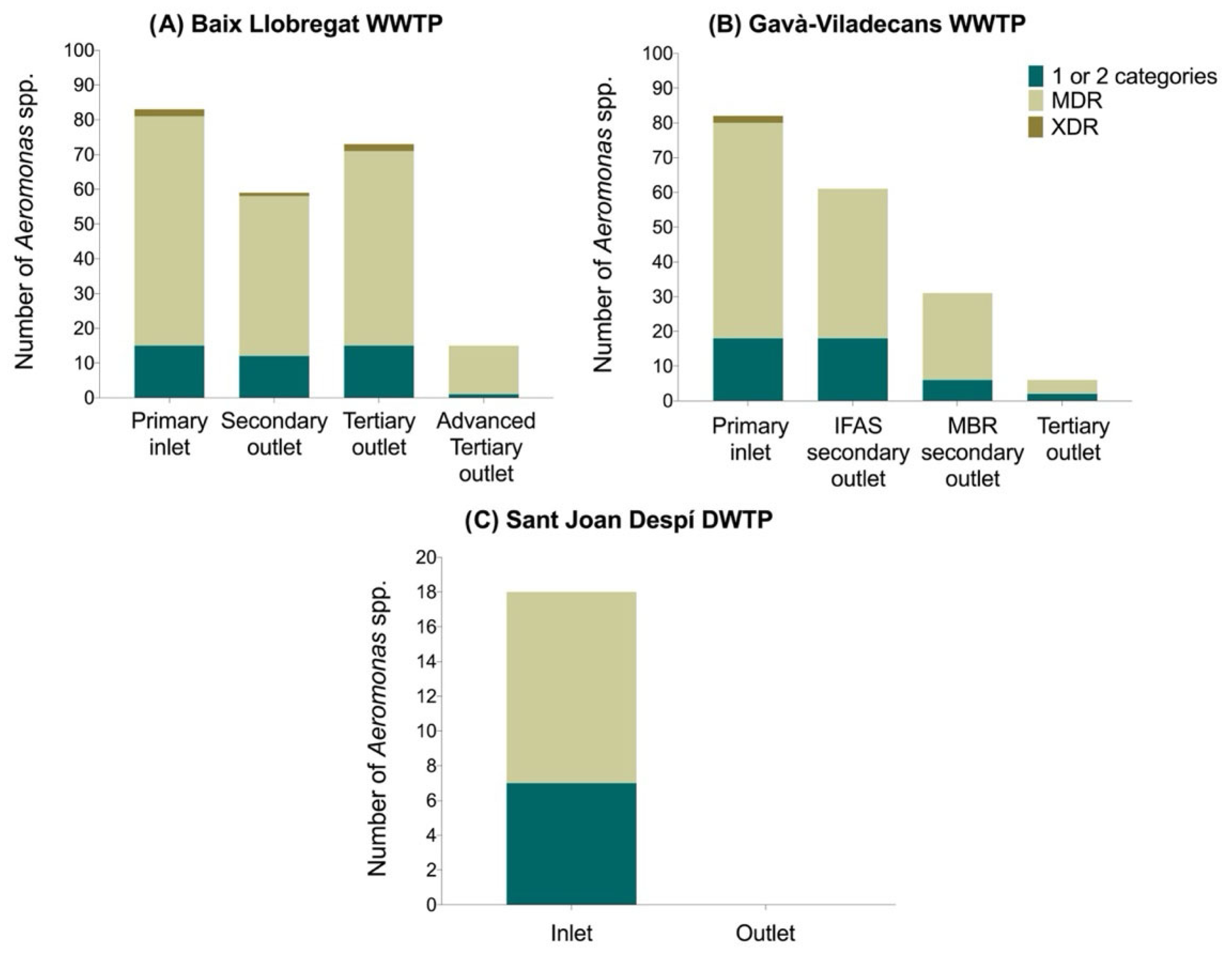
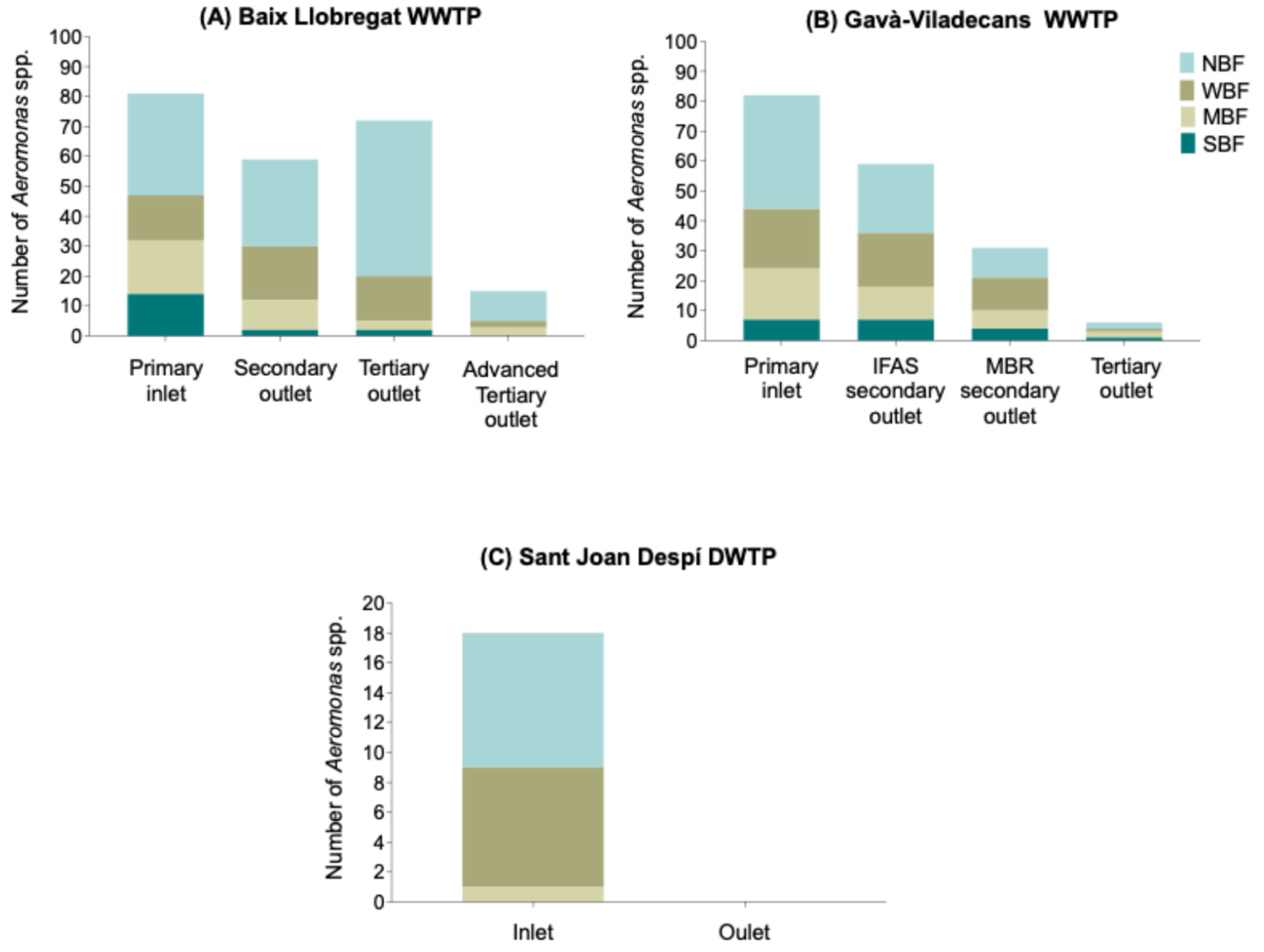
At the Baix Llobregat WWTP, the number of Aeromonas spp. decreased from 83 isolates (36%) in the primary inlet to 59 (25.7%) in the secondary outlet. However, a moderate increase was detected at the tertiary outlet, with 73 isolates (31.8%) being collected. After the advanced tertiary stage, a marked reduction occurred (n = 15, 6.5%), highlighting the effectiveness of the final treatment in bacterial removal. On the other hand, the Gavà-Viladecans WWTP showed a progressive decrease from 82 isolates (45.6%) in the primary inlet to 61 (33.8%) in the integrated fixed-film activated sludge (IFAS) secondary outlet, followed by reductions to 31 isolates (17.3%) at the advanced membrane bioreactor (MBR) secondary outlet, and six (3.3%) in the tertiary outlet. This pattern demonstrates the cumulative effect of each treatment stage in reducing the Aeromonas spp. population. Finally, the Sant Joan Despí DWTP effectively removed the 18 (100%) Aeromonas spp. detected at the inlet, resulting in their complete absence in the final drinking water.

2.3. Antimicrobial Resistance Profiles and Classification

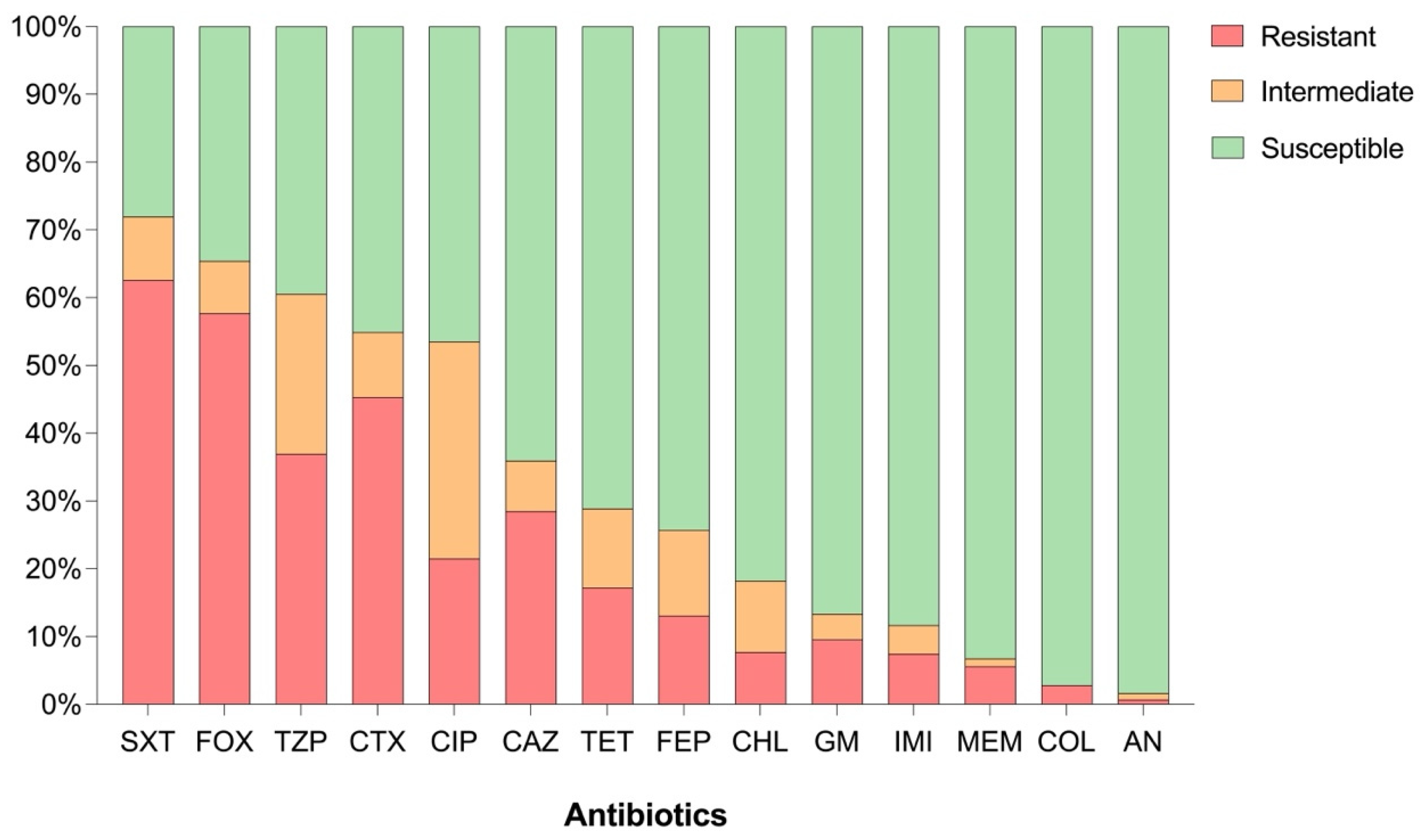
The AMR profiles of the Aeromonas spp. isolates were consistent across all three treatment plants. Over 70% of the isolates (n = 308) exhibited intermediate susceptibility or resistance to trimethoprim/sulfamethoxazole (SXT), while 65.4% were non-susceptible to cefoxitin (FOX) (n = 280), and 60.7% (n = 260) were non-susceptible to piperacillin–tazobactam (TZP). A considerable proportion of isolates also showed intermediate susceptibility or resistance to cefotaxime (CTX) and ciprofloxacin (CIP), with rates of 54.9% (n = 235) and 53.5% (n = 229), respectively. Non-susceptibility to ceftazidime (CAZ) was observed in 35.9% of the isolates (n = 154). Lower non-susceptibility rates were observed for tetracycline (TET) (28.9%, n = 124), cefepime (FEP) (25.7%, n = 110), chloramphenicol (CHL) (18.2%, n = 78), gentamicin (GM) (13.3%, n = 57), imipenem (IMI) (11.4%, n = 49), meropenem (MEM) (7%, n = 30), colistin (COL) (2.8%, n = 12), and amikacin (AN) (1.6%, n = 7) (Figure 1).
A total of 94 isolates (22%) displayed resistance to one or two antimicrobial categories, 327 isolates (76.4%) were classified as multidrug resistant (MDR), and 7 isolates (1.6%) as extensively drug-resistant (XDR). Although their numbers decreased from the initial to the final stage, MDR isolates and those non-susceptible to one or two antimicrobial classes were detected at all water treatment stages in both WWTPs (Figure 2A, B) and at the DWTP inlet (Figure 2C). XDR Aeromonas spp. isolates were detected up to the tertiary treatment stage in the Baix Llobregat WWTP (Primary inlet, n = 2; Secondary outlet, n = 1; Tertiary outlet, n = 2). In the Gavà-Viladecans WWTP, XDR isolates were present only in the primary inlet (n = 2). Notably, no XDR isolates were detected at the DWTP inlet.
It is worth noting that although these three resistance categories significantly reduced after the final treatment stage at the Baix Llobregat WWTP, an increase was observed between the secondary outlet and the tertiary outlet: isolates resistant to one or two categories rose from 12 to 15, MDR isolates from 46 to 56, and XDR isolates from one to two.

2.4. Phenotypic Characterization of Extended-Spectrum β-Lactamase (ESBL), AmpC and Carbapenemase-Producing Aeromonas spp. Isolates

Phenotypic screening for ESBL and AmpC production was conducted in 240 isolates exhibiting non-susceptibility to third-generation cephalosporins (3GC). Among these, 153 isolates were identified as ESBL producers (63.7%), with 24 harboring CTX-M group enzymes as determined by the NG-Test®/CTX-M Multi immunochromatographic assay (NG-Biotech Laboratories, Guipry, France). Additionally, 131 (54.6%) isolates were identified as AmpC producers.
Among the 54 isolates exhibiting non-susceptibility to carbapenems, the modified carbapenem inactivation method (mCIM) was performed, followed by the EDTA-carbapenem inactivation method (eCIM). Forty isolates tested positive by mCIM; of these, 29 were also positive by eCIM, indicating the presence of a metallo-β-lactamase. These 40 isolates were further analyzed using the NG-Test® DetecTool CARBA 5 (NG-Biotech Laboratories, Guipry, France), which identified 29 positive isolates: 17 as KPC producers, four as VIM producers and eight co-carrying both KPC and VIM enzymes.

2.5. Antimicrobial Resistance Genes (ARGs)

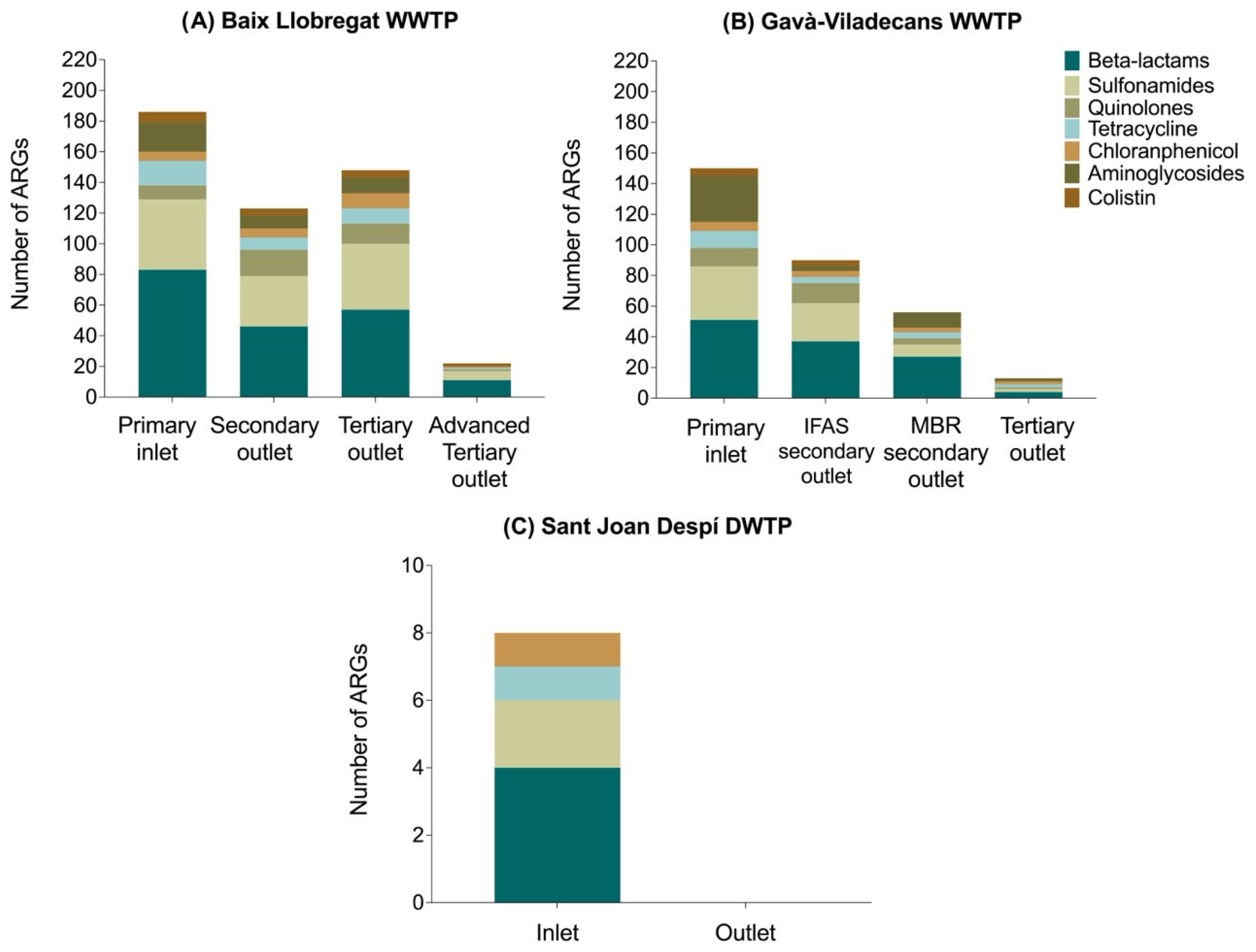
The Aeromonas spp. isolates analyzed in both WWTPs carried a wide diversity of ARGs, including genes conferring resistance to β-lactams, sulfonamides, quinolones, tetracyclines, chloramphenicol, aminoglycosides, and colistin. In contrast, the Sant Joan Despí DWTP inlet presented isolates carrying less diverse ARGs, with no detection of quinolone, aminoglycoside, or colistin genes (Figure 3).
Within the Aeromonas spp. isolates phenotypically identified as ESBL producers (n = 153), 16 isolates only carried the blaCTX-M-1 group genes, while one isolate carried a blaCTX-M-9 group gene. In addition, 30 isolates only harbored the blaVEB, 21 blaPER, 12 blaTEM, three blaSHV genes, and two blaGES genes. Four isolates simultaneously co-carried the blaPER/blaGES genes, three carried both the blaCTX-M-1/blaTEM genes, and two harbored both blaPER/blaVEB genes. Additionally, two isolates harbored the blaTEM/blaVEB genes, one was positive to both blaCTX-M-1/blaVEB genes, one carried the blaTEM/blaPER gene combination, and one isolate harboring the gene combination blaSHV/blaPER was detected. Lastly, three bacteria were simultaneously positive for the blaCTX-M-1/blaTEM/blaVEB genes.
Regarding the isolates presenting a phenotypic AmpC profile (n = 131), we detected 95 only harboring the blaMOX, 14 carrying the blaFOX, and seven carrying the blaCIT gene. Eight isolates co-harbored two or more AmpC genes: four harbored the combination of blaMOX/blaCIT genes and four both blaMOX/blaFOX genes. No blaDHA or blaEBC genes were found.
Besides the 29 carbapenemase-producing isolates detected by the NG-Test® DetecTool CARBA 5, 25 isolates carried only the blaCPHA gene, one blaKPC-positive isolate also harbored the blaCPHA gene, and another isolate simultaneously co-carried the blaKPC/blaVIM/blaCPHA genes.
The subset of isolates non-susceptible to CIP (n = 229) was tested for the qnrA, qnrB, qnrC and qnrS genes. Only the qnrS gene was detected in 70 isolates.
Among the 60 aminoglycoside-resistant or intermediate isolates, nine harbored the aac(6′)-lb-cr gene and one carried the aadA5 gene. Thirteen isolates co-carried the aph(6)-Id/aph(3”)-lb/aac(6′)-lb-cr genes, four the aph(6)-Id/aph(3”)-lb genes, three simultaneously harbored the aph(6)-Id/aadA5/aph(3”)-lb/aac(6′)-lb-cr genes, and three isolates presented the aph(3”)-lb/aac(6′)-lb-cr genes. Additionally, two isolates were positive for both aadA5/aac(6′)-lb-cr genes, one co-carried the aph(6)-Id/aadA5/aph(3”)-lb genes, and one the aph(6)-Id/aac(6′)-lb-cr genes.
Among the isolates non-susceptible to sulfonamides (n = 308), 165 harbored the sul1 gene, 11 carried the sul2 gene, and 12 isolates co-carried both genes.
In the group of Aeromonas spp. isolates phenotypically non-susceptible to CHL (n = 78), eight carried the catI gene, 26 harbored the cmlA gene, and two isolates co-carried both genes.
Detection of resistance genes in TET-non-susceptible isolates (n = 124) revealed the presence of the tetA gene in 54 isolates and the tetB gene in three isolates.
No mcr-3 genes were detected by polymerase chain reaction (PCR) among the isolates showing phenotypic resistance to COL (n = 12). However, among the sequenced isolates, the mcr-3, mcr-3.17, and mcr-3.6 genes were detected, despite the isolates not showing a resistant phenotype. These mcr-3-carrying isolates were detected as far as the tertiary treatment stage in the Baix Llobregat WWTP and up to the IFAS secondary outlet in the Gavà-Viladecans WWTP.

2.6. Integrase, Heavy Metal Tolerance and Virulence Factor Genes

2.6.1. Integrase Genes

Three hundred one isolates (70.1%) were positive for the class 1 integrase gene (intI1). Of these, one isolate from the Gavà-Viladecans WWTP IFAS secondary outlet also harbored the intI2 gene. The 301 intI1-positive isolates were distributed across all treatment stages in both WWTPs (Baix Llobregat WWTP: primary inlet, n = 64; secondary outlet, n = 43; tertiary outlet, n = 46; advanced tertiary outlet, n = 10; Gavà-Viladecans WWTP: primary inlet, n = 56; IFAS secondary outlet, n = 47; MBR secondary outlet, n = 24; tertiary outlet, n = 5), and in the DWTP inlet (n = 6).

2.6.2. Heavy Metal Tolerance Genes (HMTGs)

Regarding the four HMTGs studied (merA, silA, pcoD and arsA genes), a total of 93 isolates (21.7%) harbored the merA gene (conferring mercury resistance), and eight (1.8%) carried both merA and arsA genes (the latter conferring arsenic resistance). Additionally, none of the isolates were positive for the silA gene (conferring silver resistance) or the pcoD gene (copper resistance). As shown in Table 1, the merA gene was detected among the Aeromonas spp. isolates across all treatment stages of both WWTPs and the DWTP inlet. In contrast, the arsA gene was detected at all treatment stages except at the final effluent points. No arsA-carrying isolates were detected at the inlet of the DWTP.

2.6.3. Virulence Factor Genes (VFGs)

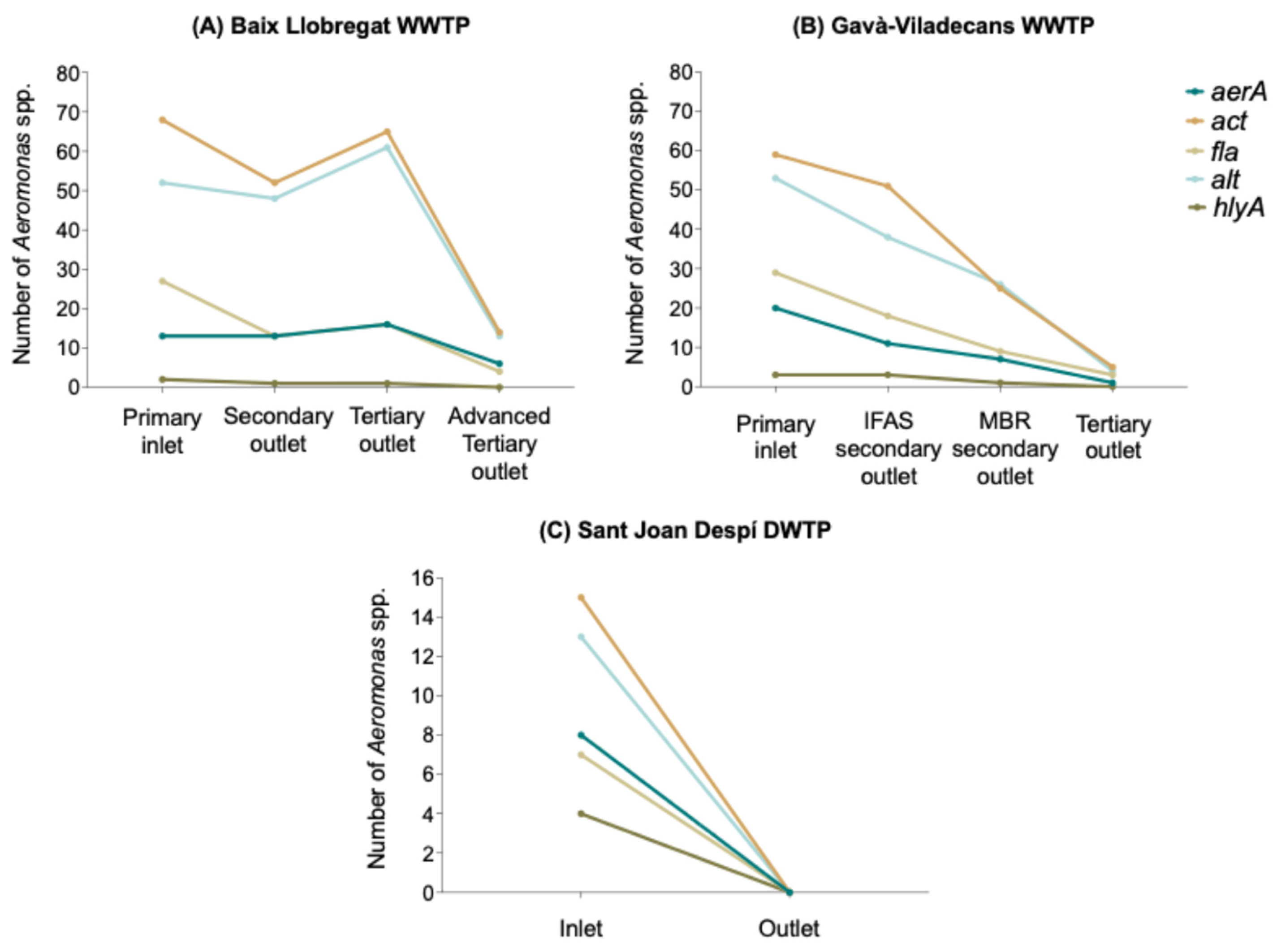
A total of 419 isolates (97.9%) carried at least one of the following VFGs: aerA (aerolysin), act (cytotoxic enterotoxin), fla (flagellin), alt (cytotonic heat-labile enterotoxin), or hlyA (hemolysin). Among these, the act and alt VFGs presented the highest prevalence, being detected in 82.7% (n = 354) and 72% (n = 308) of the isolates, respectively. In contrast, the prevalence of the remaining VFGs was notably lower, with the fla gene identified in 29.4% (n = 126), the aerA gene in 21.7% (n = 93) and the hlyA gene in only 3.5% (n = 15) of the isolates.
Aeromonas spp. carrying the aerA, act, fla, and alt genes were detected in all the treatment points of both WWTPs (Figure 4A, B) and the DWTP inlet (Figure 4C), while isolates carrying the hlyA gene were absent in the final stages of both WWTPs. All the VFGs analyzed were detected among the Aeromonas spp. isolates from the Sant Joan Despí DWTP inlet.

2.7. Biofilm-Forming Ability of the Isolates

A total of 37 isolates (8.7%) were considered strong biofilm formers (SBF) (optical density (OD) ≥ 0.817), 71 (16.8%) were classified as moderate biofilm formers (MBF) (0.408 ≤ OD ≤ 0.817), 108 (25.5%) demonstrated weak biofilm formation (0.204 ≤ OD ≤ 0.408), and 207 (49%) did not have the ability to form biofilm (OD ≤ 0.204).
Biofilm-forming isolates were more abundant than non-biofilm formers (NBF) at the primary inlet and secondary outlet of the Baix Llobregat WWTP (Figure 5A), whereas in the Gavà-Viladecans WWTP, this trend persisted across all treatment stages (Figure 5B). On the other hand, at the Sant Joan Despí DWTP inlet, both NBF and biofilm formers were detected in equal numbers (n = 9) (Figure 5C).

2.8. Horizontal Gene Transfer (HGT)

Due to the fact that Aeromonas presented ARGs typical of pathogenic bacteria, the ability to transfer these genes was studied. Firstly, the capacity of HGT from Aeromonas spp. to Escherichia coli was analyzed by conjugation experiments. The sequenced isolate A. caviae 123, carrying an IncW-type replicon and multiple genes (shown in Table 2) was used as a donor. Transconjugant analysis confirmed the transference of the blaPER, sul1, intI1 and act genes from A. caviae 123 to E. coli CV601. The estimated transfer frequency was 6 × 10⁻⁸.
To determine whether HGT could occur from E. coli to Aeromonas spp., a second conjugation experiment was conducted. E. coli 1362 strain, containing plasmid replicons FrepB, ColE, and IncU and harboring different ARGs, HMTGs and the class I integrase gene (Table 2), was used as a donor. Two types of transconjugants were detected, one carrying the FrepB replicon marker and another carrying both ColE and IncU replicon markers. PCR analysis of the transconjugants confirmed the transference of blaKPC from E. coli to A. caviae 214 with a transfer frequency of 4.67 × 10⁻⁸.
Conjugation experiments were performed in triplicate. Transconjugants were confirmed by PCR analysis of selected ARGs and plasmid replicon markers; no additional genomic confirmation was performed.

2.9. Whole-Genome Sequencing

All the isolates classified as XDR and a subset of MDR Aeromonas spp., all resistant to β-lactams, underwent short-read whole-genome sequencing (n = 84). Of these, 59 Aeromonas spp. were from the Baix Llobregat WWTP, while 24 isolates were from the Gavà-Viladecans WWTP, and one isolate was from the Sant Joan Despí DWTP.
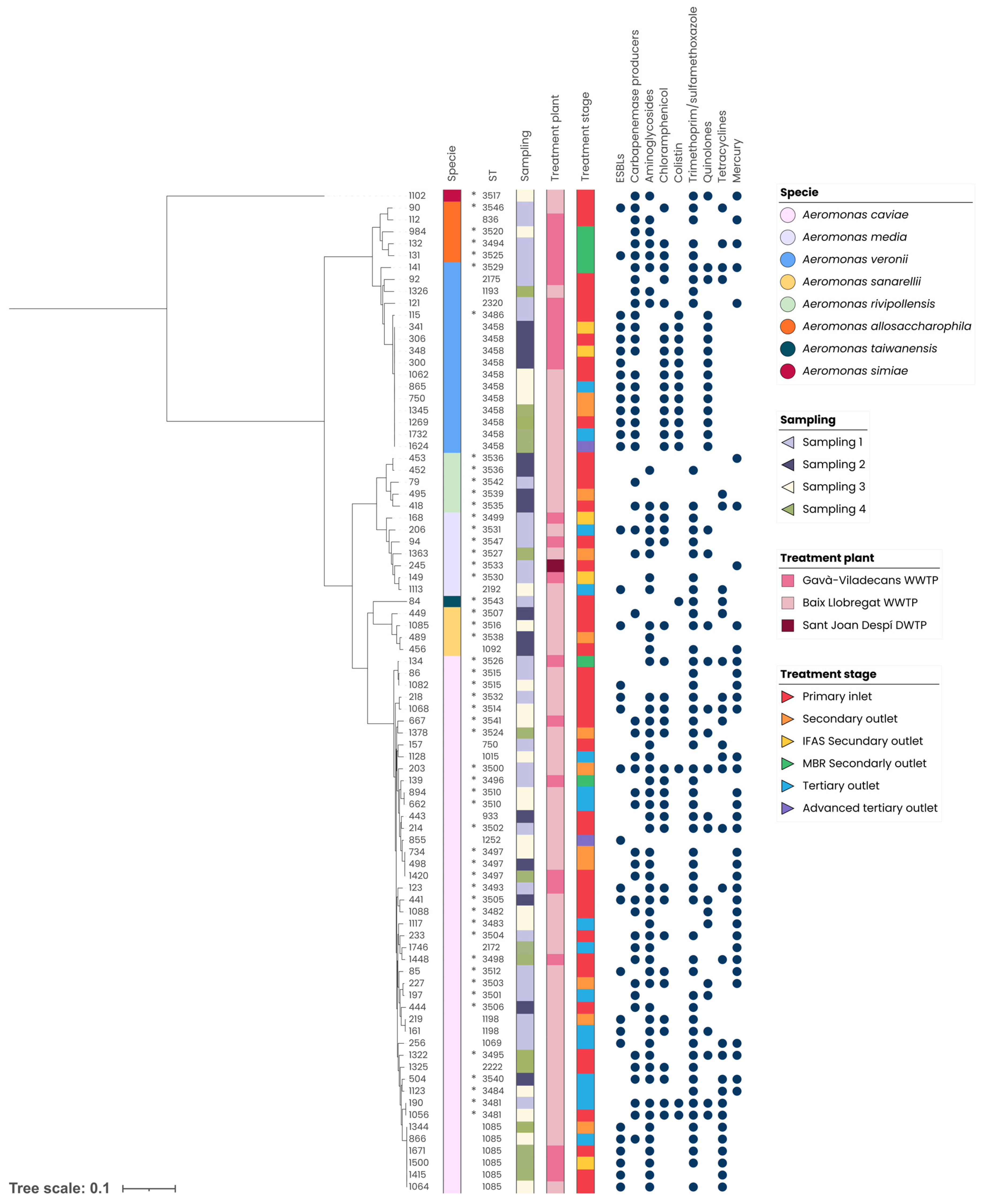
These isolates exhibited high genetic diversity based on multilocus sequence typing (MLST), with 62 sequence types (STs) identified, including 46 (74.2%) novel STs. Eight STs comprised multiple isolates: ST3458 (n = 11), ST1085 (n = 6), ST3497 (n = 3), and ST1198, ST3481, ST3510, ST3515, and ST3536 each with two isolates. The remaining STs were represented by a single isolate, as shown in Figure 6.
In addition to β-lactam resistance genes detected in all the sequenced isolates, genes associated with resistance to aminoglycosides, CHL, SXT, COL, quinolones, TET, and mercury tolerance were variably distributed across isolates. Importantly, although phenotypically susceptible, 16 isolates carried ARGs associated with COL resistance; notably, four of these isolates were collected from reclaimed water. It should be noted that an isolate from the secondary outlet of the Baix Llobregat WWTP harbored ARGs conferring resistance to all the antibiotic families analyzed, along with genes associated with mercury tolerance. However, it remained susceptible to CHL, AN, and COL. Moreover, two additional isolates from the Baix Llobregat WWTP lacked genes associated with mercury tolerance but still carried ARGs conferring resistance to all the antibiotic classes tested. Both showed an XDR profile, one showing susceptibility to GM, AN, and COL, and the other to GM and COL.
Three STs (ST3458, ST1085, and ST3497) were markedly more relevant, comprising highly related isolates that were identified across multiple sampling periods, treatment plants, and treatment stages. Although predominantly found in the summer (third sampling, n = 3; and fourth sampling, n = 4), ST3458 was also detected in the winter (second sampling, n = 4). Following a similar pattern, ST3497 was found in the winter (second sampling, n = 1) and in the summer (third sampling, n = 1; fourth sampling, n = 1), whereas ST1085 was exclusively collected during summer samplings (third sampling, n = 2; fourth sampling, n = 4).
ST3458 was observed at the primary inlet and the IFAS secondary outlet of the Gavà-Viladecans WWTP during the second sampling campaign. In the Baix Llobregat WWTP, this ST was detected at the primary inlet, secondary outlet, and tertiary outlet during the third sampling campaign. Moreover, it persisted across all treatment stages in the fourth sampling, remaining present throughout the entire treatment process. Of note was their presence in the tertiary and the advanced tertiary outlets, both intended for water reuse, and the latter likely connected to the DWTP inlet during drought periods. Interestingly, all the isolates belonging to this ST from the Baix Llobregat WWTP shared identical AMR profiles, harboring genes conferring resistance to β-lactams (blaCTX-M1, blaOXA-10, cphA), CHL (cmlA5), COL (mcr-3), and quinolones (qnrVC4). Moreover, they harbored mph(A) (macrolide resistance) and qacF genes (quaternary ammonium tolerance). To further assess the genetic relatedness of ST3458 isolates, a SNP-based phylogenetic analysis was performed using the whole-genome sequencing data. The resulting phylogenetic tree showed that all ST3458 isolates clustered tightly, displaying very short branch lengths and minimal genomic divergence. This SNP-based analysis supports the clonal relatedness of these isolates despite being recovered from different sampling campaigns, treatment stages, and treatment plants (Figure S1).
The isolates assigned to ST3497 were collected from the second and third sampling campaigns at the Baix Llobregat WWTP (both at the secondary outlet), and in the fourth sampling campaign in the Gavà-Viladecans primary inlet. Remarkably, these three isolates exhibited identical AMR profiles, containing ARGs encoding resistance to β-lactams (blaMOX-12, blaOXA-780, blaVIM-4), aminoglycosides (aph(6)-ld), sulfonamides (sul1), and also showing genes associated with tolerance to mercury (merR, merT) and quaternary ammonium (smr).
On the other hand, ST1085 was restricted to the summer, being identified at the primary inlet and the tertiary outlet of the Baix Llobregat WWTP during the third sampling campaign, and at the secondary outlet during the fourth sampling campaign. At the Gavà-Viladecans WWTP, it was detected in the primary inlet and the IFAS secondary outlet during the fourth sampling campaign. Interestingly, two isolates, one collected from the primary inlet of Gavà-Viladecans WWTP and the other from the secondary outlet of the Baix Llobregat WWTP, shared identical AMR profiles harboring genes associated with resistance to β-lactams (blaCTX-M1, blaMOX-2, blaOXA, blaTEM-1), aminoglycosides (aac(3)-lld), sulfonamides (sul1), and TET (tetE). Furthermore, they contained mph(A) (macrolide resistance).
Isolate 245 (ST3533) from the Sant Joan Despí DWTP inlet was phenotypically resistant to β-lactams, SXT, CIP and TZP, and carried blaOXA, blaMOX, and mer genes. These genetic determinants make this isolate notable due to its capacity to reach source water for potable supply, posing possible risks to water quality and human exposure.

2.10. Associations Among Genetic Determinants and Seasonal Variation

Statistical analyses were conducted to evaluate associations among ARGs, integrase genes, HMTGs, VFGs, and biofilm formation. On the other hand, a seasonal comparison analysis was performed between summer and winter Aeromonas isolates. An odds ratio (OR) greater than 1 indicated that the presence of a gene is associated with an increased likelihood of the other gene being present. Some very high OR values were based on small counts of positive observations and should be interpreted with caution, as sparse data can inflate effect estimates even when using Firth’s correction.
Regarding biofilm formation, no positive correlations were found with other genetic determinants, and intI2 only showed significant correlation (p < 0.05) with blaGES (OR = 127.91). On the other hand, intI1 showed associations with aac(6′)-lb-cr (OR = 8.04), mcr-3 (OR = 6.23), blaPER (OR = 4.29), and sul1 (OR = 4.18), and with HMTGs such as merA (OR = 2.67).
With respect to HMTGs, both merA and arsA exhibited possible associations with various ARGs and VFGs. The presence of merA was significantly associated with the presence of ARGs such as catI (OR = 9.28), blaCIT (OR = 4.15), sul2 (OR = 2.67), tetA (OR = 2.37), blaPER (OR = 2.35), and sul1 (OR = 1.74). Moreover, arsA tended to occur alongside sul2 (OR = 9.39), fla (OR = 6.48), and blaPER (OR = 5.42).
Several significant associations were identified between other VFGs and ARGs. In particular, the aerA gene was significantly associated with blaCPHA (OR = 9.74), blaFOX (OR = 4.48), blaCTX-M-1 (OR = 3.56), and blaVEB (OR = 3.01). The act gene was more likely to be present if blaMOX (OR = 6.38) or blaKPC (OR = 4.18) was present, while the fla gene was related to the presence of blaCTX-M-1 (OR = 4.86). The alt gene was significantly associated with blaKPC (OR = 6.68), blaMOX (OR = 4.06), and sul1 (OR = 1.85). Finally, the hlyA gene had significant associations with blaDHA and blaEBC (both OR = 87).
Regarding the seasonal comparison, no correlations were found between summer (n = 274) and winter isolates (n = 154).

3. Discussion

The intensive use of antibiotics in human medicine, veterinary care, and agriculture leads to their continuous release into the environment. Numerous studies have identified WWTPs as important reservoirs of AMR [26] and as critical hotspots for the emergence and dissemination of ARB and ARGs [2]. These environmental reservoirs may pose a gateway to DWTPs, particularly under drought conditions, when treated effluents from WWTPs may be used to increase water resources for the production of drinking water [27]. Bacteria capable of colonizing various water resources serve as sentinels for the dissemination of AMR [28]. Among these, the genus Aeromonas, characterized by distinct acquired AMR patterns, has emerged as a strong biomarker of environmental AMR [15].
In this study, 428 antibiotic-resistant Aeromonas spp. isolates were characterized from two WWTPs and one DWTP in the metropolitan area of Barcelona to evaluate treatment efficacy in removing ARB and ARGs.
In our previous study [25], Aeromonas spp. was the most prevalent genus, consistent with other reports [14,29,30,31,32] describing its dominance in wastewater microbial communities. Among the Aeromonas species identified, A. caviae, A. veronii, and A. hydrophila were the most prevalent, all of which are well-documented for their pathogenic potential and transmission to humans [31,33].
The Aeromonas isolates were similar in both WWTPs, being slightly higher in the Baix Llobregat WWTP. Both plants reduced bacterial loads from the primary inlet to the final outlet. However, a moderate increase in bacterial load was observed at the tertiary outlet of the Baix Llobregat WWTP, whereas the Gavà-Viladecans WWTP showed a consistent decreasing trend across all the treatment stages.
These differences can be attributed to the configuration of these treatment plants as extensively discussed by Ballén et al. [25]. In brief, the tertiary stage at the Baix Llobregat WWTP includes coagulation-flocculation, membrane microfiltration and ultraviolet (UV) disinfection [34]. Coagulation-flocculation may promote bacterial aggregation with the sediment [35], reducing UV penetration [36]. Although microfiltration removes suspended particles, its effectiveness depends on membrane type, integrity, and susceptibility to biofilm formation. UV treatment can also inactivate microorganisms, although its performance is influenced by several operational factors. Moreover, UV light is prone to photoreactivation of surviving bacteria, particularly if sublethal doses are used [37]. In addition, UV disinfection is not combined with chlorine, despite evidence that their synergistic application enhances the removal of ARB and ARGs and limits photoreactivation [38]. By contrast, tertiary treatment at the Gavà-Viladecans facility combines biological treatment with rotary ultrafiltration [39], where physical retention together with shear and friction forces inhibits biofilm formation and disrupts microbial aggregates that may entrap bacteria [40], followed by a final chlorination step. Moreover, in the case of the Baix Llobregat WWTP, an advanced tertiary treatment is implemented specifically for aquifer recharge in the lower Llobregat River basin, with the primary aim of preventing seawater intrusion due to coastal proximity. In contrast, water intended for ecological flow maintenance, agricultural use, and urban irrigation is supplied from the conventional tertiary treatment.
Despite these differences, antibiotic-resistant Aeromonas spp. persisted in effluents from both WWTPs, highlighting a possible environmental dissemination of AMR through the final reclaimed water at the WWTP outlet for its reuse.
The Aeromonas spp. isolates sequenced in this study belonged to diverse STs, some of which have been previously reported in Spanish WWTPs [5]. The repeated detection of isolates with identical AMR profiles belonging to the same ST over time, across multiple treatment plants and consecutive stages, indicates their potential for spatial dissemination and seasonal adaptation. Specifically, identical ST3458 isolates were present at both the initial and final outlet of the Baix Llobregat WWTP, demonstrating their capacity to survive water treatment processes.
The prevalence of MDR was high (76.4%), in concordance with Harnisz et al. [41], who reported that 76.6% of Aeromonas spp. isolated from the municipal wastewater system in Poland were MDR.
In our study, over 70% of the isolates were non-susceptible to SXT, a trend commonly observed in environmental Aeromonas isolates, with previous reports [21,42] documenting complete resistance among the isolates tested. Sulfonamide resistance is typically mediated by sul1 and sul2, often carried on class 1 integrons or plasmids, facilitating HGT [43]. In accordance with previous studies [44], our statistical analysis revealed positive correlations between sul1 and intI1.
The CIP resistance observed (53.5%) aligns with previous publications [45] reporting resistance rates exceeding 77% among Aeromonas spp. isolates. Notably, among the quinolone resistance genes analyzed, only the qnrS gene was consistently detected. This observation agrees with the results of Marti et al. [46], who identified that 82.3% of CIP-resistant isolates were Aeromonas spp. harboring the qnrS gene. Although we did not measure antibiotic concentrations in our water samples, Martí et al. [46] reported CIP and sulfamethoxazole concentrations ranging from 50 to 70 and 12 to 30 ng/L, respectively, in the final effluent of the Ripoll WWTP (Spain). Although these concentrations are below the minimum inhibitory concentration (MIC), they may still promote AMR by altering gene expression, inducing stress responses, and facilitating HGT, thereby influencing microbial community dynamics [47].
Aeromonas spp. are known for their intrinsic resistance to β-lactams, including ampicillin, and first- [48] and second-generation [49] cephalosporins, due to chromosomally encoded, inducible AmpC-type β-lactamases. They may also acquire plasmid-mediated β-lactamase genes that further enhance resistance, which is of critical importance to human health [32]. In our study, over 50% of isolates were non-susceptible to FOX, TZP, and CTX, comparable with previous wastewater reports [28,50]. High TZP resistance can be attributed to the aforementioned AmpC-type β-lactamases, which reduce the efficacy of inhibitors such as TZP [13]. The high non-susceptibility to FOX and CTX observed could be associated with the high prevalence of blaMOX among the β-lactam-resistant Aeromonas spp. isolates [49], consistent with the findings of Drk et al. [45] in municipal and hospital wastewater in Croatia.
In Aeromonas spp., carbapenem resistance is usually mediated by the chromosomal cphA gene or through the acquisition of clinically relevant plasmid-associated carbapenemase genes [15]. Although low non-susceptibility rates to IMI and MEM were observed, the detection of the cphA, blaKPC and blaVIM genes among the isolates studied highlights the occurrence of clinically relevant carbapenemase genes in environmental Aeromonas isolates [51].
Limited treatment options for MDR microorganisms have led to increasing use of COL. In recent decades, COL resistance has disseminated globally among bacteria from humans and animals, with plasmid-borne mcr genes reported across multiple countries. For this reason, COL use has been restricted or forbidden in food-producing animals in many regions and is now reserved as a last-resort treatment for MDR infections [52]. Although observed at low prevalence, COL resistance and the mcr genes were identified in MDR and XDR Aeromonas spp. in the present study, highlighting the concerning nature of their AMR profiles. Regarding the discrepancies observed between PCR-based detection and WGS, similar phenomena have been reported by Li et al. [53], where isolates showed phenotypic resistance to COL, but the corresponding genes were not detected by PCR. These differences may be explained by reduced gene expression, regulatory mechanisms, or gene silencing, which prevent observable resistance under laboratory conditions. In contrast, in our study, WGS allowed the detection of these silent or low-expression gene variants.
β-lactam and sulfonamide ARGs were detected throughout the WWTP treatment stages, including points at which treated water is reused and at the DWTP inlet. These data, together with previous reports [54,55], endorse sulfonamide- and β-lactamase-related genes as robust sentinels for monitoring AMR dissemination in wastewater systems.
HMTGs such as merA and arsA were widely detected. The merA and the arsA genes persisted across WWTP treatment stages, whereas only merA was present at the DWTP inlet. Our results are consistent with those of Luiza et al. [56], who found merA to be the most frequently detected HMTG, with arsA additionally observed among Aeromonas isolated from an urban estuary in Brazil. Notably, the merA gene is often located within class 1 integrons, which favors HGT [15]. In line with this, our data revealed a statistically significant correlation between merA and intI1. The study by Piotrowska et al. [15] also emphasized that co-localization of HMTGs with ARGs on a single MGE represents an important mechanism for co-selection. Our statistical analysis suggested a possible association between merA and arsA with specific ARGs, implying possible co-selection mechanisms.
Nearly 90% of isolates carried at least one VFG, highlighting the pathogenic potential of environmental Aeromonas isolates. As this genus is widely distributed in water, food, and soil [57], exposure through contaminated water or food may represent a potential route of infection [58]. For this reason, it is essential to identify pathogenic environmental Aeromonas spp. isolates that may pose a risk to human health [59]. Our results are consistent with studies on Aeromonas by Igbinosa et al. [60], who detected the aerA, fla and hlyA genes in wastewater samples from South Africa, and by Robertson et al. [61], who reported the act and alt genes in source and drinking water samples from Alabama. Our statistical analyses revealed a positive association between the aerA and blaCPHA genes, whereas Govender et al. [21] reported a correlation between the aerA and the blaOXA genes in Aeromonas. Whereas their study also found the fla gene to be significantly associated with the sul1 and sul2 genes, we found a significant association between the fla and blaCTX-M-1 genes.
In our study, biofilm-forming isolates were commonly detected in reclaimed water. Biofilms act as ecological niches that facilitate close cell-to-cell interactions and may reduce the efficiency of disinfection procedures such as chlorination [22,62]. Consequently, these isolates may survive treatment processes and re-emerge under favorable conditions.
HGT contributes significantly to the rapid dissemination of AMR, facilitating the spread of ARGs and the emergence of MDR isolates [23,63]. Antibiotic selective pressure, as reported by Martí et al. [46], promotes the horizontal acquisition of ARGs, fostering genome diversification and enhancing bacterial fitness [64]. Our conjugation experiments demonstrated horizontal transfer of resistance determinants associated with plasmid replicon types from A. caviae to E. coli and from E. coli to A. caviae, among other bacteria. Both donors were MDR, SBF, and carried the intI1 gene, confirming plausible pathways for gene circulation. Not only was the transfer of ARGs from A. caviae to E. coli demonstrated, but also the transfer of VFGs, as reported by Mangar et al. [65].
Previous studies have linked the transfer of plasmid types such as IncU [66], ColE and IncN [45] from Aeromonas spp. to E. coli, but conjugation with Aeromonas spp. as recipients remains poorly explored. Matsushita et al. [67] demonstrated the transfer of the blaIMP gene from E. coli to A. caviae via vesicle accumulation in the ciliate Tetrahymena sp., involving an IncA/C-type plasmid. Here, we demonstrated HGT from E. coli to A. caviae, including the transfer of blaKPC, detected in transconjugants carrying FrepB and ColE + IncU replicon types. Plasmid incompatibility types were identified by PCR-based replicon typing; therefore, structural linkage between specific ARGs and individual plasmid backbones was not resolved. Although transfer frequency was low (10−8), high bacterial densities and biofilm-mediated cell-to-cell proximity in WWTPs make even rare transfer events ecologically significant.
This issue is particularly relevant in the context of water reuse regulation. In Spain, Royal Decree 1085/2024 [68], in line with EU Regulation 2020/741 [69], allows reclaimed water to be applied in a wider range of municipal, industrial, and ecological applications. Within this regulatory scheme, E. coli serves as the primary microbiological indicator, while additional microbial criteria are only mandated under specific high-risk conditions. Nevertheless, E. coli is not an indigenous member of aquatic ecosystems; its detection in water bodies generally signals recent fecal contamination rather than the presence of a persistent aquatic community [70]. Therefore, in contexts where fecal indicators may be absent or limited, the inclusion of alternative microbial indicators such as Aeromonas could offer a more complete perspective on the emergence, maintenance, and environmental dissemination of AMR.
Our study has several limitations that should be considered when interpreting the findings. As it represents a case study conducted in a single metropolitan area, the results may not be directly generalizable to other geographic regions or water treatment systems with different environmental or operational conditions. In addition, the reliance on culture-based methods and MALDI-TOF identification may underestimate the diversity of Aeromonas populations present in these environments. The environmental context was not quantitatively characterized through measurements such as bacterial loads, physicochemical parameters, or antibiotic concentrations, which would have allowed a more comprehensive assessment of AMR dynamics across treatment stages. Furthermore, genomic analyses based on short-read sequencing and PCR-based plasmid typing limited the ability to fully resolve plasmid structures and determine the precise localization of resistance genes. Finally, the statistical analysis was designed to explore potential associations between genetic determinants, with results interpreted based on ORs and their confidence intervals as estimates of the strength and probability of these associations.
Future studies integrating quantitative environmental measurements, culture-independent approaches, long-read sequencing, and broader geographic sampling will be important to further elucidate the ecological role of Aeromonas spp. in AMR dissemination across urban water systems.
In conclusion, this study demonstrates that Aeromonas spp. remain detectable across multiple stages of WWTPs and DWTPs while carrying multidrug resistance, VFGs, HMTGs, and MGEs that facilitate HGT. These findings underscore their ecological and public health relevance, particularly in the context of reclaimed water reuse, and support their use as sentinel organisms for AMR monitoring and assessment of treatment efficacy, complementing traditional fecal indicators.

4. Materials and Methods

4.1. Wastewater and Drinking Water Sampling and Processing

Four sampling campaigns were carried out in the Baix Llobregat area of Barcelona, Spain, during the winter (30 January and 21 March) and summer (26 June and 25 July) of 2023. Samples were collected from the Baix Llobregat WWTP, located in the lower basin of the Llobregat River, and from the Gavà-Viladecans WWTP, which lies in the Llobregat Delta corridor. Additional samples were taken from the Sant Joan Despí, also located in the lower basin, whose intake is influenced by the reclaimed water of Baix Llobregat WWTP. The volume of collected water, preserved and processed per sampling point, as well as transport conditions such as time between sampling and processing and temperature during transport are described in the methodology outlined by Ballén et al. [25].

4.2. Isolation and Identification of Antibiotic-Resistant Aeromonas spp.

Isolation, selection and preservation were carried out as described [25]. Species identification was performed using matrix-assisted laser desorption ionization-time of flight mass spectrometry (MALDI Biotyper, Bruker Daltonics GmbH, Bremen, Germany). The database for identification was the reference MBT Compass Library DB-7854 (Bruker Daltonik GmbH, Bremen, Germany). The modified score values suggested by the manufacturer were used: A score ≥ 2.3 meant species identification; a score between 2.0 and 2.299 meant genus identification and probable species identification; a score between 1.7 and 1.9 meant probable genus identification; and a score < 1.69 meant non-reliable identification.

4.3. Antimicrobial Susceptibility Testing

The antimicrobial susceptibility profiles of the isolates were evaluated using the Kirby–Bauer disk diffusion method using Mueller–Hinton II agar (MHA) plates (Becton Dickinson (BD), Franklin Lakes, NJ, USA) and following the guidelines of the Clinical Laboratory Standards Institute (CLSI) [71]. The BD BBL™ Sensi-Disc™ (Becton Dickinson (BD), Franklin Lakes, NJ, USA) tested included CIP (5 µg), CHL (30 µg), GM (10 µg), MEM (10 µg), SXT (1.25/23.75 µg), TET (30 µg), AN (30 µg), TZP (100/10 µg), FEP (30 µg), CTX (30 µg), FOX (30 µg), CAZ (0 µg) and IMI (10 µg). E. coli ATCC 25922 was used as quality control.
To date, CLSI [72] and European Committee on Antimicrobial Susceptibility Testing guidelines (EUCAST) [73] recommend determining COL susceptibility using broth microdilution, broth elution or agar diffusion methods. However, these guidelines apply primarily to Enterobacteriaceae and Pseudomonas aeruginosa, and no epidemiological cut-off values (COWT) have been established for other Gram-negative bacilli such as Aeromonas spp. [74]. Lin et al. [75] proposed a MIC COWT of 4 µg/mL for Aeromonas spp.
In addition, bacterial isolates were classified as non-susceptible to one or two antimicrobial categories, MDR, XDR, or pandrug-resistant (PDR). Following the approach of Zhou et al. [76], we adapted the Enterobacteriaceae criteria proposed by Magiorakos et al. [77]. Although these definitions were originally developed for Enterobacteriaceae, they are widely applied in studies of non-enterobacterial Gram-negative bacteria, including Aeromonas spp., to allow standardized comparison of resistance profiles. Intrinsic resistance traits of Aeromonas were considered when interpreting the resulting classifications.
Accordingly, MDR isolates were defined as isolates non-susceptible to at least one agent in three or more antimicrobial categories, XDR isolates as non-susceptible to at least one agent in all but two or fewer antimicrobial categories, and PDR isolates as non-susceptible to all agents in all antimicrobial categories [76].

4.4. Phenotypic Identification of Extended-Spectrum β-Lactamase (ESBL) and AmpC-Producing Isolates

For the phenotypic determination of ESBL and AmpC production, isolates non-susceptible to 3GC were tested. As CLSI guidelines [72] are not available for Aeromonas spp., we interpreted the results according to the CLSI guidelines for Enterobacterales, as previously applied by Bisi-Johnson et al. [78] and Drk et al. [45], respectively.
For ESBL production, bacterial cultures were standardized to a 0.5 McFarland turbidity and evenly spread on MHA to create a uniform lawn. An antibiotic disk containing amoxicillin/clavulanic acid (AMC) (20/10 μg) was positioned at the center of the plate, while two 3GC disks (CTX and CAZ) were placed symmetrically at a distance of either 15 mm or 20 mm (center-to-center) from the AMC disk. The plates were incubated at 37 °C for 24 h in an inverted position. ESBL production was indicated by a visible distortion or enlargement of the inhibition zone extending towards the AMC disk [78]. Quality control was performed using E. coli ATCC 25922.
The isolates phenotypically identified as ESBL producers were tested for the CTX-M group enzymes using the NG-Test® CTX-M Multi (NG-Biotech Laboratories, Guipry-Messac, France). This assay detects enzymes from the five major CTX-M groups but does not differentiate the specific variant present.
The AmpC production was evaluated by placing one disk with CTX (30 µg) and another with CAZ (30 µg) at a distance of 20 mm (center to center) from a disk with phenyl boronic acid (PBA) (400 µg) and another with cloxacillin (CLX) (500 µg). An isolate was considered an AmpC producer if there was an extension of the inhibition halo of CTX or CAZ in the area near the disk with PBA or CLX [79].

4.5. Phenotypic Detection of Carbapenemase-Producing Isolates

Isolates showing non-susceptibility to MEM and IMI were further analyzed. Briefly, two 1 μL loopfuls of bacterial growth from an overnight blood agar culture were suspended in 2 mL of trypticase soy broth (TSB) (Condalab, Madrid, Spain) for the mCIM or in 2 mL of TSB containing 20 μL of 0.5 M EDTA for the EDTA-carbapenem inactivation method (eCIM). A 10 μg MEM disk (BD, Franklin Lakes, NJ, USA) was added to each suspension and incubated at 37 °C for 4 h. An MHA plate was prepared by inoculating it with a 0.5 McFarland standard suspension of E. coli ATCC 25922 as the indicator strain. After incubation, the MEM disks were removed from the TSB and TSB-EDTA suspensions and placed on the MHA plate inoculated with the ATCC strain. The plates were then incubated overnight at 37 °C. Zones of inhibition around the disks were measured. In the absence of CLSI [72] guidelines for this test in Aeromonas spp., the protocol for Enterobacterales was used as a reference, as suggested by Wang et al. [80]. Quality control was performed using E. coli ATCC 25922.
Isolates yielding a positive mCIM were further analyzed with the NG-Test® DetecTool CARBA 5 (NG-Biotech Laboratories, Guipry-Messac, France) for the detection of the five main carbapenemase enzymes: KPC, OXA-48-like, VIM, IMP, and NDM.

4.6. Detection of Antibiotic Resistance, Integrase, Heavy Metal Tolerance and Virulence Factor Genes

A colony from an overnight culture of each isolate was selected and suspended in 200 μL of Milli-Q water. The suspension underwent a 10 min boiling step, followed by centrifugation at 13,000 rpm for 10 min. The supernatant obtained was then used as the DNA template for PCR analysis. The primers used to analyze the different ARGs, integrase genes, HMTGs and VFGs are listed in Supplementary Material Table S1.

4.7. Biofilm Formation and Quantification

The assay was performed based on the protocol used by El-Hossary et al. [81] with slight modifications. Briefly, Aeromonas spp. isolates were initially grown on Columbia agar supplemented with 5% sheep blood at 37 °C for 18–24 h. The resulting colonies were inoculated into TSB and incubated at 37 °C for 24 h. Cultures were then diluted 1:100 in fresh TSB and transferred to 96-well polystyrene plates (Nunc™ Edge 2.0, VWR International, Radnor, PA, USA), followed by static incubation for 48 h at 37 °C. Control wells contained sterile TSB, without bacterial inoculation. Post-incubation, wells were carefully rinsed with phosphate-buffered saline (PBS) 1×, air-dried, and stained with 2% (v/v) crystal violet for 10 min at room temperature. The wells were rinsed with PBS 1×, and after drying, the biofilm-bound stain was dissolved in 33% glacial acetic acid. The biofilm biomass was quantified by measuring OD at 580nm with a microplate reader (EPOCH 2 microplate reader; BioTek, Winooski, VT, USA). The experiment was carried out in three technical and biological replicates. The OD results were interpreted following the criteria established by Stepanovic et al. [82]. The biofilm formation capability of Aeromonas spp. isolates was expressed as follows: NBF (OD ≤ 0.204), WBF (0.204 ≤ OD ≤ 0.408), MBF (0.408 ≤ OD ≤ 0.817), and SBF (OD ≥ 0.817). Culture medium without inoculum was used as a sterility control. Experimental readings were normalized against this negative control to determine cut-off values, ensuring methodological consistency.

4.8. Conjugation

To evaluate the capacity for HGT, two in vitro conjugation assays were conducted using a standardized protocol in our laboratory. The first assay aimed to assess the transfer of ARGs via plasmids from E. coli to Aeromonas spp.
Sixteen Aeromonas spp. isolates carrying ESBL genes were used as plasmid donors, while E. coli isolate CV601, resistant to rifampin (RIF), was used as the recipient. Donor and recipient isolates were grown overnight at 37 °C and 140 rpm in Luria Broth (LB) (Condalab, Madrid, Spain) supplemented with CTX (50 µg/mL) and RIF (50 µg/mL), respectively. OD at 600nm was measured and adjusted to 0.5 for all cultures. For each mating pair, 750 µL of donor and 750 µL of the recipient were mixed, centrifuged for 10 min at 5000 rpm, and resuspended in 100 µL of LB. The mixture was spotted onto a MF-Millipore™ membrane filter (0.45 µm pore size, 25 mm diameter; Merck Millipore, Burlington, MA, USA) for mating and incubated overnight at 37 °C. Filters were then washed in LB, and 100 µL of the mixture was spread on LB agar plates containing RIF (50 µg/mL), CTX (50 µg/mL), or both (RIF + CTX 50 µg/mL each) and incubated overnight at 37 °C.
The second conjugation assay evaluated gene transfer in the opposite direction, from Aeromonas spp. to E. coli. Four E. coli isolates from our previous study [25] carrying carbapenemase genes were used as donors, and one Aeromonas spp. isolate harboring cmlA served as the recipient. The procedure was identical to the first assay, except that the antibiotics used were MEM (4 µg/mL) for the donor and CHL (32 µg/mL) for the recipient.
Transfer frequencies were calculated as the total number of transconjugants divided by the total number of recipients [83]. Transconjugants were subjected to PCR analysis to verify the successful transfer of the targeted ARGs. To further confirm that the transconjugants retained a genetic fingerprint consistent with the recipient strain, repetitive extragenic palindromic PCR was performed, and the primers used were REP-F (5′-IIIGCGCCGICATCAGGC-3′) and REP-R (5′-ACGTCTTATCAGGCCTAC-3′) [84].

4.9. PCR-Based Replicon Typing

This technique was used to identify the replicon type of plasmids in isolates with successful conjugation. PCR amplification was carried out using DNA from donor and transconjugant isolates with the specific primer sets listed in Table S2.

4.10. Sequencing, Annotation and Phylogenomic Analysis

The DNA was extracted using the MagMAX™ DNA Multi-Sample Ultra 2.0 Kit in a KingFisher Flex (Thermo Fisher Scientific, Waltham, MA, USA) and quantified with a Qubit Flex Fluorometer (Thermo Fisher Scientific). Genomic libraries were prepared using the DNA Prep Library Preparation Kit, followed by paired-end sequencing (2 × 150) on a NextSeq platform (Illumina, San Diego, CA, USA).
Quality assessment and genome assembly were carried out using the Bactopia pipeline (https://github.com/bactopia/bactopia) (accessed on 6 November 2025) [85], which includes read quality control with FastQC (www.bioinformatics.babraham.ac.uk/projects/fastqc/) (accessed on 6 November 2025) [86], genome assembly with Shovill (https://github.com/tseemann/shovill) (accessed on 9 September 2025) [87], annotation with Prokka (https://github.com/tseemann/prokka) (accessed on 9 September 2025) [88], sequence typing using the Aeromonas spp. MLST scheme from the PubMLST (https://pubmlst.org/organisms/aeromonas-spp) (accessed on 9 September 2025) [89], and detection of acquired ARGs by AMRFinder+ (https://github.com/ncbi/amr) (accessed on 6 November 2025) [90]. Aeromonas spp. identification was conducted with rMLST (https://pubmlst.org/species-id) (accessed on September 2025) [91]. The phylogenetic tree was constructed based on a pangenome analysis with Roary (https://sanger-pathogens.github.io/Roary/) (accessed on 6 November 2025) [92] with a minimum percentage of blastp identity of 80% and without split paralogs. The 1250 genes present in all genomes were used for tree reconstruction with IQ-tree (https://iqtree.github.io/) (accessed on 6 November 2025) GTR + F+I + G4 model [93] and 1000 UFBoot replicates. Final tree and metadata were visualized with iTOL (https://itol.embl.de/) (accessed on 6 November 2025) [94]. Reads were deposited at the European Nucleotide Archive (PRJEB102387).

4.11. Statistical Analyses

Associations between ARGs, integrase genes, HMTGs, VFGs, and biofilm formation were evaluated. All variables were categorical. Bivariate associations were assessed using the Pearson’s χ2 or Fisher’s exact test when expected counts were low, with effect size quantified by Cramer’s V [95]. Univariable logistic regression models were fitted using Firth’s penalized likelihood correction to reduce bias from complete separation or sparse data [96]. Analyses were performed in Stata 19 (StataCorp, College Station, TX, USA, 2025).

Supplementary Materials

The following supporting information can be downloaded at: https://www.mdpi.com/article/10.3390/antibiotics15030301/s1, Figure S1. SNP-based phylogenetic analysis of ST3458 isolates. Table S1. Primers used for antibiotic resistance, integrase, heavy metal tolerance and virulence factor genes detection by PCR. Table S2. Specific primers and conditions used in plasmid replicon typing. References [97,98,99,100,101,102,103,104,105,106,107,108,109,110,111,112,113,114,115] are cited in the Supplementary Materials.

Author Contributions

Conceptualization, V.B., B.G., A.P.-M., C.V. and S.M.S.; Funding acquisition, S.M.S. and B.G.; Investigation, L.M., V.B., Y.G., L.C., S.M., A.G.-D., S.S. and S.M.S.; Methodology, V.B., L.M., S.S. and S.M.S.; Project administration, S.M.S.; Resources, S.M.S.; Supervision, S.M.S.; Validation, S.M.S.; Visualization, L.M.; Writing—original draft, L.M.; Writing—review and editing, V.B., B.G. and S.M.S. All authors have read and agreed to the published version of the manuscript.

Funding

This work was funded by SOCIEDAD GENERAL DE AGUAS DE BARCELONA, S.A.U. and the Instituto de Salud Carlos III (PI19/00478). ISGlobal is a CERCA center of the Generalitat of Catalunya and a Severo Ochoa Centre (Spanish Ministry of Science, Innovation, and Universities). We acknowledge support from grant CEX2023-0001290-S, funded by MCIN/AEI/10.13039/501100011033, and support from the Generalitat de Catalunya through the CERCA Program.

Institutional Review Board Statement

Not applicable.

Informed Consent Statement

Not applicable.

Data Availability Statement

The original data presented in the study are openly available in the European Nucleotide Archive (ENA) under BioProject accession number PRJEB102387.

Acknowledgments

The authors thank Pau Cardoner, Patricia Habermeyer, Beatriz Reguera and Pol Collante from the Sant Joan Despí DWTP, the Baix Llobregat and Gavà-Viladecans WWTPs for their technical support and for providing the samples analyzed in this work.

Conflicts of Interest

Authors Anna Pinar-Méndez, Carles Vilaró and Belén Galofre were employed by the company Aigües de Barcelona, Empresa Metropolitana de Gestió del Cicle Integral de l’Aigua. The remaining authors declare that the research was conducted in the absence of any commercial or financial relationships that could be construed as a potential conflict of interest.

References

  1. World Health Organization (WHO). Global Action Plan on Antimicrobial Resistance; WHO: Geneva, Switzerland, 2015. [Google Scholar]
  2. Rizzo, L.; Manaia, C.; Merlin, C.; Schwartz, T.; Dagot, C.; Ploy, M.C.; Michael, I. Urban wastewater treatment plants as hotspots for antibiotic resistant bacteria and genes spread into the environment: A review. Sci. Total Environ. 2013, 447, 345–360. [Google Scholar] [CrossRef]
  3. Berendonk, T.U.; Manaia, C.M.; Merlin, C.; Fatta-Kassinos, D.; Cytryn, E.; Walsh, F.; Burgmann, H.; Sørum, H.; Norström, M.; Pons, M.N.; et al. Tackling antibiotic resistance: The environmental framework. Nat. Rev. Microbiol. 2015, 13, 310–317. [Google Scholar] [CrossRef] [PubMed]
  4. Manaia, C.M.; Rocha, J.; Scaccia, N.; Marano, R.; Radu, E.; Biancullo, F.; Cerqueira, F.; Guimarães, B.; Lanza, V.F.; Bedmar, F.; et al. Antibiotic resistance in wastewater treatment plants: Tackling the black box. Environ. Int. 2018, 115, 312–324. [Google Scholar] [CrossRef] [PubMed]
  5. Monge-Olivares, L.; Peñalva, G.; Pulido, M.R.; Garrudo, L.; Ángel Doval, M.; Ballesta, S.; Merchante, N.; Rasero, P.; Cuberos, L.; Carpes, G.; et al. Quantitative study of ESBL and carbapenemase producers in wastewater treatment plants in Seville, Spain: A culture-based detection analysis of raw and treated water. Water Res. 2025, 281, 123706. [Google Scholar] [CrossRef] [PubMed]
  6. Oliveira, M.; Serrano, I.; Van Harten, S.; Bessa, L.J.; Bernardo, F.; da Costa, P.M. Fecal contamination of wastewater treatment plants in Portugal. Environ. Sci. Pollut. Res. 2016, 23, 14671–14675. [Google Scholar] [CrossRef]
  7. Macrì, M.; Bonetta, S.; Di Cesare, A.; Sabatino, R.; Corno, G.; Catozzo, M.; Pignata, C.; Mecarelli, E.; Medana, C.; Carraro, E.; et al. Antibiotic resistance and pathogen spreading in a wastewater treatment plant designed for wastewater reuse. Environ. Pollut. 2024, 363, 125051. [Google Scholar] [CrossRef]
  8. European Union (UE). Regulation 2024/3019 n.d. Available online: https://eur-lex.europa.eu/legal-content/ES/TXT/PDF/?uri=OJ:L_202403019 (accessed on 12 January 2026).
  9. European Union. Regulation (EU) 2020/2184 of the European Parliament and of the Council of 16 December 2020 on the Quality of Water Intended for Human Consumption; Official Journal of the European Union: Luxembourg, 2020. [Google Scholar]
  10. Zhang, T.; Lv, K.; Lu, Q.; Wang, L.; Liu, X. Removal of antibiotic-resistant genes during drinking water treatment: A review. J. Environ. Sci. 2021, 104, 415–429. [Google Scholar] [CrossRef]
  11. Sanganyado, E.; Gwenzi, W. Antibiotic resistance in drinking water systems: Occurrence, removal, and human health risks. Sci. Total Environ. 2019, 669, 785–797. [Google Scholar] [CrossRef]
  12. Milligan, E.G.; Calarco, J.; Davis, B.C.; Keenum, I.M.; Liguori, K.; Pruden, A.; Pei, R.; Singer, A.C.; Korajkic, A.; Graham, D.W.; et al. A systematic review of culture-based methods for monitoring antibiotic-resistant Acinetobacter, Aeromonas, and Pseudomonas as environmentally relevant pathogens in wastewater and surface water. Curr. Environ. Health Rep. 2023, 10, 154–171. [Google Scholar] [CrossRef]
  13. Janda, J.M.; Abbott, S.L. The genus Aeromonas: Taxonomy, pathogenicity, and infection. Clin. Microbiol. Rev. 2010, 23, 35–73. [Google Scholar] [CrossRef]
  14. Aoki, M.; Takemura, Y.; Kawakami, S.; Yoochatchaval, W.; Tran, P.T.; Tomioka, N.; Ebie, Y.; Syutsubo, K. Quantitative detection and reduction of potentially pathogenic bacterial groups of Aeromonas, Arcobacter, Klebsiella pneumoniae species complex, and Mycobacterium in wastewater treatment facilities. PLoS ONE 2023, 18, e0291742. [Google Scholar] [CrossRef]
  15. Piotrowska, M.; Popowska, M. Insight into the mobilome of Aeromonas strains. Front. Microbiol. 2015, 6, 494. [Google Scholar] [CrossRef] [PubMed]
  16. Pablos, M.; Rodríguez-Calleja, J.M.; Santos, J.A.; Otero, A.; García-López, M.L. Occurrence of motile Aeromonas in municipal drinking water and distribution of genes encoding virulence factors. Int. J. Food Microbiol. 2009, 135, 158–164. [Google Scholar] [CrossRef] [PubMed]
  17. Stratev, D.; Odeyemi, O.A. Antimicrobial resistance of Aeromonas hydrophila isolated from different food sources: A mini-review. J. Infect. Public Health 2016, 9, 535–544. [Google Scholar] [CrossRef] [PubMed]
  18. Usui, M.; Tagaki, C.; Fukuda, A.; Okubo, T.; Boonla, C.; Suzuki, S.; Seki, K.; Takada, H.; Tamura, Y. Use of Aeromonas spp. as General Indicators of Antimicrobial Susceptibility among Bacteria in Aquatic Environments in Thailand. Front. Microbiol. 2016, 7, 710. [Google Scholar] [CrossRef]
  19. Laxminarayan, R.; Duse, A.; Wattal, C.; Zaidi, A.K.M.; Wertheim, H.F.L.; Sumpradit, N.; Vlieghe, E.; Hara, G.L.; Gould, I.M.; Goossens, H.; et al. Antibiotic resistance-the need for global solutions. Lancet Infect. Dis. 2013, 13, 1057–1098. [Google Scholar] [CrossRef]
  20. Uluseker, C.; Kaster, K.M.; Thorsen, K.; Basiry, D.; Shobana, S.; Jain, M.; Zhang, L.; Smith, J.; Müller, A.; Lee, H.; et al. A review on occurrence and spread of antibiotic resistance in wastewaters and in wastewater treatment plants: Mechanisms and perspectives. Front. Microbiol. 2021, 12, 717809. [Google Scholar] [CrossRef]
  21. Govender, R.; Amoah, I.D.; Adegoke, A.A.; Singh, G.; Kumari, S.; Swalaha, F.M.; Zhang, L.; Patel, R.; Kim, J.; Hernández, M.; et al. Identification, antibiotic resistance, and virulence profiling of Aeromonas and Pseudomonas species from wastewater and surface water. Environ. Monit. Assess. 2021, 193, 294. [Google Scholar] [CrossRef]
  22. Nascimento, M.; Rodrigues, J.; Matias, R.; Jordao, L. Aeromonas spp. in freshwater bodies: Antimicrobial resistance and biofilm assembly. Antibiotics 2024, 13, 166. [Google Scholar] [CrossRef]
  23. Bello-López, J.M.; Cabrero-Martínez, O.A.; Ibáñez-Cervantes, G.; Hernández-Cortez, C.; Pelcastre-Rodríguez, L.I.; Gonzalez-Avila, L.U.; Castro-Escarpulli, G. Horizontal gene transfer and its association with antibiotic resistance in the genus Aeromonas spp. Microorganisms 2019, 7, 363. [Google Scholar] [CrossRef]
  24. Marti, E.; Variatza, E.; Balcazar, J.L. The role of aquatic ecosystems as reservoirs of antibiotic resistance. Trends Microbiol. 2014, 22, 36–41. [Google Scholar] [CrossRef]
  25. Ballén, V.; Mondéjar, L.; Gabasa, Y.; Castellsagués, L.; Alcalde-Rico, M.; Pinar-Méndez, A.; Vilaró, C.; Galofré, B.; Soto, S.M. Integrated metagenomic, culture-based, and whole genome sequencing analyses of antimicrobial resistance in wastewater and drinking water treatment plants in Barcelona, Spain. Int. J. Hyg. Environ. Health 2025, 270, 114664. [Google Scholar] [CrossRef]
  26. Gao, Y.X.; Li, X.; Fan, X.Y.; Zhao, J.R.; Zhang, Z.X. Wastewater treatment plants as reservoirs and sources for antibiotic resistance genes: A review on occurrence, transmission and removal. J. Water Process Eng. 2022, 46, 102539. [Google Scholar] [CrossRef]
  27. Munné, A.; Solà, C.; Ejarque, E.; Sanchís, J.; Serra, P.; Corbella, I.; Aceves, M.; Galofré, B.; Boleda, M.R.; Paraira, M.; et al. Indirect potable water reuse to face drought events in Barcelona city. Setting a monitoring procedure to protect aquatic ecosystems and to ensure a safe drinking water supply. Sci. Total Environ. 2023, 866, 161339. [Google Scholar] [CrossRef] [PubMed]
  28. Igbinosa, I.H.; Okoh, A.I. Antibiotic susceptibility profile of Aeromonas species isolated from wastewater treatment plant. Sci. World J. 2012, 2012, 764563. [Google Scholar] [CrossRef] [PubMed]
  29. Hu, Q.; Zhang, X.X.; Jia, S.; Huang, K.; Tang, J.; Shi, P.; Ye, L.; Ren, H. Metagenomic insights into ultraviolet disinfection effects on antibiotic resistome in biologically treated wastewater. Water Res. 2016, 101, 309–317. [Google Scholar] [CrossRef] [PubMed]
  30. Topić Popović, N.; Kazazić, S.P.; Strunjak-Perović, I.; Barišić, J.; Sauerborn Klobučar, R.; Kepec, S.; Čož-Rakovac, R. Detection and diversity of aeromonads from treated wastewater and fish inhabiting effluent and downstream waters. Ecotoxicol. Environ. Saf. 2015, 120, 235–242. [Google Scholar] [CrossRef]
  31. Skwor, T.; Stringer, S.; Haggerty, J.; Johnson, J.; Duhr, S.; Johnson, M.; Seckinger, M.; Stemme, M. Prevalence of potentially pathogenic antibiotic-resistant Aeromonas spp. in treated urban wastewater effluents versus recipient riverine populations: A 3-year comparative study. Appl. Environ. Microbiol. 2019, 86, e02053-19. [Google Scholar] [CrossRef]
  32. Piotrowska, M.; Przygodzinska, D.; Matyjewicz, K.; Popowska, M. Occurrence and variety of β-lactamase genes among Aeromonas spp. isolated from urban wastewater treatment plant. Front. Microbiol. 2017, 8, 863. [Google Scholar] [CrossRef]
  33. Khajanchi, B.K.; Fadl, A.A.; Borchardt, M.A.; Berg, R.L.; Horneman, A.J.; Stemper, M.E.; Joseph, S.W.; Moyer, N.P.; Sha, J.; Chopra, A.K.; et al. Distribution of virulence factors and molecular fingerprinting of Aeromonas species isolates from water and clinical samples: Suggestive evidence of water-to-human transmission. Appl. Environ. Microbiol. 2010, 76, 2313–2325. [Google Scholar] [CrossRef]
  34. EDAR del Prat de Llobregat—Medio Ambiente—Àrea Metropolitana de Barcelona n.d. Available online: https://www.amb.cat/es/web/medi-ambient/aigua/instalacions-i-equipaments/detall/-/equipament/edar-del-prat-de-llobregat/276285/11818 (accessed on 13 August 2025).
  35. Van Bel, N.; Van der Wielen, P.; Wullings, B.; Van Rijn, J.; Van der Mark, E.; Ketelaars, H.; Hijnen, W. Aeromonas species from non-chlorinated distribution systems and their competitive planktonic growth in drinking water. Environ. Microbiol. 2021, 87, e02867-20. [Google Scholar] [CrossRef] [PubMed]
  36. Vitzilaiou, E.; Kuria, A.M.; Siegumfeldt, H.; Rasmussen, M.A.; Knøchel, S. The impact of bacterial cell aggregation on UV inactivation kinetics. Water Res. 2021, 204, 117593. [Google Scholar] [CrossRef] [PubMed]
  37. González, Y.; Gómez, G.; Moeller-Chávez, G.E.; Vidal, G. UV disinfection systems for wastewater treatment: Emphasis on reactivation of microorganisms. Sustainability 2023, 15, 11262. [Google Scholar] [CrossRef]
  38. La Rosa, M.C.; Maugeri, A.; Favara, G.; La Mastra, C.; Magnano San Lio, R.; Barchitta, M.; Agodi, A. The impact of wastewater on antimicrobial resistance: A scoping review of transmission pathways and contributing factors. Antibiotics 2025, 14, 131. [Google Scholar] [CrossRef]
  39. EDAR de Gavà i Viladecans—Medio Ambiente—Àrea Metropolitana de Barcelona n.d. Available online: https://www.amb.cat/es/web/medi-ambient/aigua/instalacions-i-equipaments/detall/-/equipament/edar-de-gava-i-viladecans/269712/11818 (accessed on 13 August 2025).
  40. Xue, W.; Jian, M.; Lin, T.; Ma, B.; Wu, R.; Li, X. A novel strategy to alleviate ultrafiltration membrane fouling by rotating membrane module. Chemosphere 2020, 260, 127535. [Google Scholar] [CrossRef]
  41. Harnisz, M.; Korzeniewska, E. The prevalence of multidrug-resistant Aeromonas spp. in the municipal wastewater system and their dissemination in the environment. Sci. Total Environ. 2018, 626, 377–383. [Google Scholar] [CrossRef]
  42. Wu, Y.; Dong, N.; Cai, C.; Zeng, Y.; Lu, J.; Liu, C.; Wang, H.; Zhang, Y.; Huang, L.; Zhai, W.; et al. Aeromonas spp. from hospital sewage act as a reservoir of genes resistant to last-line antibiotics. Drug Resist. Updates 2023, 67, 100925. [Google Scholar] [CrossRef]
  43. Kadlec, K.; von Czapiewski, E.; Kaspar, H.; Wallmann, J.; Michael, G.B.; Steinacker, U.; Schwarz, S. Molecular basis of sulfonamide and trimethoprim resistance in fish-pathogenic Aeromonas isolates. Appl. Environ. Microbiol. 2011, 77, 7147–7150. [Google Scholar] [CrossRef]
  44. Patil, H.J.; Benet-Perelberg, A.; Naor, A.; Smirnov, M.; Ofek, T.; Nasser, A.; Minz, D.; Cytryn, E. Evidence of increased antibiotic resistance in phylogenetically-diverse Aeromonas isolates from semi-intensive fish ponds treated with antibiotics. Front. Microbiol. 2016, 7, 1875. [Google Scholar] [CrossRef]
  45. Drk, S.; Puljko, A.; Dželalija, M.; Udiković-Kolić, N. Characterization of third generation cephalosporin- and carbapenem-resistant Aeromonas isolates from municipal and hospital wastewater. Antibiotics 2023, 12, 513. [Google Scholar] [CrossRef]
  46. Marti, E.; Huerta, B.; Rodríguez-Mozaz, S.; Barceló, D.; Jofre, J.; Balcázar, J.L. Characterization of ciprofloxacin-resistant isolates from a wastewater treatment plant and its receiving river. Water Res. 2014, 61, 67–76. [Google Scholar] [CrossRef] [PubMed]
  47. Davies, J.; Spiegelman, G.B.; Yim, G. The world of subinhibitory antibiotic concentrations. Curr. Opin. Microbiol. 2006, 9, 445–453. [Google Scholar] [CrossRef] [PubMed]
  48. Fernández-Bravo, A.; Figueras, M.J. An update on the genus Aeromonas: Taxonomy, epidemiology, and pathogenicity. Microorganisms 2020, 8, 129. [Google Scholar] [CrossRef]
  49. Bertran, X.; Rubio, M.; Gómez, L.; Llovet, T.; Muñoz, C.; Navarro, F.; Miro, E. Taxonomic identification of different species of the genus aeromonas by whole-genome sequencing and use of their species-specific β-lactamases as phylogenetic markers. Antibiotics 2021, 10, 354. [Google Scholar] [CrossRef] [PubMed]
  50. Zhang, Q.; Zhang, S.; Xu, B.; Dong, L.; Zhao, Z.; Li, B. Molecular epidemiological characteristics of carbapenem resistant Aeromonas from hospital wastewater. Infect. Drug Resist. 2024, 17, 2439–2448. [Google Scholar] [CrossRef]
  51. Xu, T.; Song, J.; Liu, J.; Huang, L.; Li, Z.; Zhou, K. First report of multidrug-resistant carbapenemase-producing Aeromonas caviae co-harboring mcr-3.43 and mcr-7.2. Microbiol. Spectr. 2024, 12, 5. [Google Scholar] [CrossRef]
  52. Omar Ahmed, M.; Abouzeed, Y.M.; Ali Daw, M. Global initiatives to phase-out colistin use in food-producing animals. Open Vet. J. 2025, 15, 533–540. [Google Scholar] [CrossRef]
  53. Li, M.; Zhan, A.; Rahman, T.T.; Jiang, T.; Hou, L. From wastewater to resistance: Characterization of multidrug-resistant bacteria and assessment of natural antimicrobial compounds. Front. Microbiol. 2025, 16, 1612534. [Google Scholar] [CrossRef]
  54. Laht, M.; Karkman, A.; Voolaid, V.; Ritz, C.; Tenson, T.; Virta, M.; Kisand, V. Abundances of tetracycline, sulphonamide and beta-lactam antibiotic resistance genes in conventional wastewater treatment plants with different waste load. PLoS ONE 2014, 9, e103705. [Google Scholar] [CrossRef]
  55. Wasko, I.; Kozí Nska, A.; Kotlarska, E.; Baraniak, A. Clinically relevant β-Lactam resistance genes in wastewater treatment plants. J. Environ. Res. Public Health 2022, 19, 13829. [Google Scholar] [CrossRef]
  56. Luiza, A.; Canellas, B.; Rodrigues De Oliveira, B.F.; Laport, M.S. Hiding in plain sight: Characterization of Aeromonas species isolated from a recreational estuary reveals the carriage and putative dissemination of resistance genes. Antibiotics 2023, 12, 84. [Google Scholar] [CrossRef] [PubMed]
  57. Wu, C.-J.; Wu, J.-J.; Yan, J.-J.; Lee, H.-C.; Lee, N.-Y.; Chang, C.-M.; Shih, H.-I.; Wu, H.-M.; Wang, L.-R.; Ko, W.-C.; et al. Clinical significance and distribution of putative virulence markers of 116 consecutive clinical Aeromonas isolates in southern Taiwan. J. Infect. 2007, 54, 151–158. [Google Scholar] [CrossRef] [PubMed]
  58. Sen, K.; Rodgers, M. Distribution of six virulence factors in Aeromonas species isolated from US drinking water utilities: A PCR identification. J. Appl. Microbiol. 2004, 97, 1077–1086. [Google Scholar] [CrossRef] [PubMed]
  59. Balsalobre, L.C.; Dropa, M.; Matté, G.R.; Matté, M.H. Molecular detection of enterotoxins in environmental strains of Aeromonas hydrophila and Aeromonas jandaei. J. Water Health 2009, 7, 685–691. [Google Scholar] [CrossRef]
  60. Igbinosa, I.H.; Okoh, A.I. Detection and distribution of putative virulence associated genes in Aeromonas species from freshwater and wastewater treatment plant. J. Basic Microbiol. 2013, 53, 895–901. [Google Scholar] [CrossRef]
  61. Robertson, B.K.; Harden, C.; Selvaraju, S.B.; Pradhan, S.; Yadav, J.S. Molecular Detection, Quantification, and Toxigenicity Profiling of Aeromonas spp. in Source- and Drinking-Water. Open Microbiol. J. 2014, 8, 32–39. [Google Scholar] [CrossRef]
  62. Abe, K.; Nomura, N.; Suzuki, S. Biofilms: Hot spots of horizontal gene transfer (HGT) in aquatic environments, with a focus on a new HGT mechanism. FEMS Microbiol. Ecol. 2020, 96, fiaa031. [Google Scholar] [CrossRef]
  63. Lerminiaux, N.A.; Cameron, A.D.S. Horizontal transfer of antibiotic resistance genes in clinical environments. Can. J. Microbiol. 2019, 65, 34–44. [Google Scholar] [CrossRef]
  64. Guglielmetti, E.; Korhonen, J.M.; Heikkinen, J.; Morelli, L.; von Wright, A. Transfer of plasmid-mediated resistance to tetracycline in pathogenic bacteria from fish and aquaculture environments. FEMS Microbiol. Lett. 2009, 293, 28–34. [Google Scholar] [CrossRef]
  65. Alderliesten, J.B.; Duxbury, S.J.N.; Zwart, M.P.; De Visser, J.A.G.M.; Stegeman, A.; Fischer, E.A.J. Effect of donor-recipient relatedness on the plasmid conjugation frequency: A meta-analysis. BMC Microbiol. 2020, 20, 135. [Google Scholar] [CrossRef]
  66. Sekizuka, T.; Inamine, Y.; Segawa, T.; Hashino, M.; Yatsu, K.; Kuroda, M. Potential KPC-2 carbapenemase reservoir of environmental Aeromonas hydrophila and Aeromonas caviae isolates from the effluent of an urban wastewater treatment plant in Japan. Environ. Microbiol. Rep. 2019, 11, 589–597. [Google Scholar] [CrossRef]
  67. Matsushita, M.; Okubo, T.; Hasegawa, T.; Matsuo, J.; Watanabe, T.; Iwasaki, S.; Fukumoto, T.; Hayasaka, K.; Akizawa, K.; Shimizu, C.; et al. Tetrahymena promotes interactive transfer of carbapenemase gene encoded in plasmid between fecal Escherichia coli and environmental Aeromonas caviae. Microbiol. Immunol. 2018, 62, 720–728. [Google Scholar] [CrossRef]
  68. BOE-A-2024-21701 n.d. Available online: https://www.boe.es/buscar/act.php?id=BOE-A-2024-21701 (accessed on 29 August 2025).
  69. European Union. Regulation (EU) 2020/741 of the European Parliament and of the Council of 25 May 2020 on Minimum Requirements for Water Reuse. Official Journal of the European Union. 2020. Available online: https://eur-lex.europa.eu/eli/reg/2019/6/oj/eng (accessed on 12 January 2026).
  70. Ishii, S.; Sadowsky, M.J. Escherichia coli in the Environment: Implications for Water Quality and Human Health. Microbes Environ. 2008, 23, 101–108. [Google Scholar] [CrossRef] [PubMed]
  71. Clinical and Laboratory Standards Institute (CLSI). Methods for Antimicrobial Dilution and Disk Susceptibility Testing of Infrequently Isolated or Fastidious Bacteria: 3rd Edition CLSI Supplement M45; CLSI: Wayne, PA, USA, 2018. [Google Scholar]
  72. Clinical and Laboratory Standards Institute (CLSI). Performance Standards for Antimicrobial Susceptibility Testing: 30th Edition CLSI Supplement M100; CLSI: Wayne, PA, USA, 2023. [Google Scholar]
  73. European Committee on Antimicrobial Susceptibility Testing (EUCAST). EUCAST Clinical Breakpoints (Version 13.0); EUCAST: Växjö, Sweden, 2023. [Google Scholar]
  74. Gonzalez-Avila, L.U.; Loyola-Cruz, M.A.; Hernández-Cortez, C.; Bello-López, J.M.; Castro-Escarpulli, G. Colistin resistance in Aeromonas spp. Int. J. Mol. Sci. 2021, 22, 5974. [Google Scholar] [CrossRef] [PubMed]
  75. Lin, Y.; Yang, J.; Wu, Z.; Zhang, Q.; Wang, S.; Hao, J.; Ouyang, L.; Li, A. Establishment of epidemiological resistance cut-off values of aquatic Aeromonas to eight antimicrobial agents. Microorganisms 2022, 10, 776. [Google Scholar] [CrossRef] [PubMed]
  76. Zhou, Y.; Yu, L.; Nan, Z.; Zhang, P.; Kan, B.; Yan, D.; Su, J. Taxonomy, virulence genes and antimicrobial resistance of Aeromonas isolated from extra-intestinal and intestinal infections. BMC Infect. Dis. 2019, 19, 158. [Google Scholar] [CrossRef]
  77. Magiorakos, A.-P.; Srinivasan, A.; Carey, R.B.; Carmeli, Y.; Falagas, M.E.; Giske, C.G.; Harbarth, S.; Hindler, J.F.; Kahlmeter, G.; Olsson-Liljequist, B.; et al. Multidrug-resistant, extensively drug-resistant and pandrug-resistant bacteria: An international expert proposal for interim standard definitions for acquired resistance. Clin. Microbiol. Infect. 2012, 18, 268–281. [Google Scholar] [CrossRef]
  78. Bisi-Johnson, M.A.; Adedeji, A.A.; Sulaiman, A.A.; Adefisoye, M.A.; Okoh, A.I. Isolation and genotypic characterization of extended-spectrum beta-lactamase-producing Escherichia coli O157:H7 and Aeromonas hydrophila from selected freshwater sources in Southwest Nigeria. Sci. Rep. 2023, 13, 10746. [Google Scholar] [CrossRef]
  79. Bou Arevalo, G.; Chaves Sánchez, F.; Oliver Palomo, A.; Oteo Iglesias, J. Métodos microbiológicos para la vigilancia del estado de portador de bacterias multirresistentes. SEIMC 2015, 35, 59–60. [Google Scholar]
  80. Wang, Y.; Liu, H.; Zhang, L.; Sun, B. Application of modified carbapenem inactivation method and its derivative tests for the detection of carbapenemase-producing Aeromonas. Infect. Drug Resist. 2021, 14, 3949–3960. [Google Scholar] [CrossRef]
  81. El-Hossary, D.; Mahdy, A.; Elariny, E.Y.T.; Askora, A.; Merwad, A.M.A.; Saber, T.; Dahshan, H.; Hakami, N.Y.; Ibrahim, R.A. Antibiotic resistance, virulence gene detection, and biofilm formation in Aeromonas spp. isolated from fish and humans in Egypt. Biology 2023, 12, 421. [Google Scholar] [CrossRef] [PubMed]
  82. Stepanović, S.; Vuković, D.; Hola, V.; Di Bonaventura, G.; Djukić, S.; Ćirković, I.; Ruzicka, F. Quantification of biofilm in microtiter plates: Overview of testing conditions and practical recommendations for assessment of biofilm production by Staphylococci. APMIS 2007, 115, 891–899. [Google Scholar] [CrossRef] [PubMed]
  83. Ekhlas, D.; Soro, A.B.; Leonard, F.C.; Manzanilla, E.G.; Burgess, C.M. Examining the impact of zinc on horizontal gene transfer in Enterobacterales. Sci. Rep. 2022, 12, 20503. [Google Scholar] [CrossRef]
  84. Vila, J.; Marcos, M.A.; Jimenez De Anta, M.T. A comparative study of different PCR-based DNA fingerprinting techniques for typing of the Acinetobacter calcoaceticus-A. baumannii complex. J. Med. Microbiol. 1996, 44, 482–489. [Google Scholar] [CrossRef]
  85. Petit, R.A.; Read, T.D. Bactopia: A Flexible Pipeline for Complete Analysis of Bacterial Genomes. MSystems 2020, 5, e00190-20. [Google Scholar] [CrossRef] [PubMed]
  86. Andrews, S. FastQC: A Quality Control Tool for High Throughput Sequence Data 2010. Available online: http://www.bioinformatics.babraham.ac.uk/projects/fastqc/ (accessed on 5 March 2026).
  87. Seemann, T. Shovill: Faster SPAdes Assembly of Illumina Reads. 2017. Available online: https://github.com/tseemann/shovill (accessed on 5 March 2026).
  88. Seemann, T. Prokka: Rapid prokaryotic genome annotation. Bioinformatics 2014, 30, 2068–2069. [Google Scholar] [CrossRef]
  89. Jolley, K.A.; Bray, J.E.; Maiden, M.C.J. Open-access bacterial population genomics: BIGSdb software, the PubMLST.org website and their applications. Wellcome Open Res. 2018, 3, 124. [Google Scholar] [CrossRef]
  90. Feldgarden, M.; Brover, V.; Gonzalez Escalona, N.; Frye, J.G.; Haendiges, J.; Haft, D.H.; Hoffmann, M.; Pettengill, J.B.; Prasad, A.B.; Tillman, G.E.; et al. AMRFinderPlus and the Reference Gene Catalog facilitate examination of the genomic links among antimicrobial resistance, stress response, and virulence. Sci. Rep. 2021, 11, 12728. [Google Scholar] [CrossRef]
  91. Jolley, K.A.; Bliss, C.M.; Bennett, J.S.; Bratcher, H.B.; Brehony, C.; Colles, F.M.; Wimalarathna, H.M.; Harrison, O.B.; Sheppard, S.K.; Cody, A.J.; et al. Ribosomal multilocus sequence typing: Universal characterization of bacteria from domain to strain. Microbiology 2012, 158, 1005–1015. [Google Scholar] [CrossRef]
  92. Page, A.J.; Cummins, C.A.; Hunt, M.; Wong, V.K.; Reuter, S.; Holden, M.T.G.; Fookes, M.; Falush, D.; Keane, J.A.; Parkhill, J. Roary: Rapid large-scale prokaryote pan genome analysis. Bioinformatics 2015, 31, 3691–3693. [Google Scholar] [CrossRef]
  93. Nguyen, L.-T.; Schmidt, H.A.; von Haeseler, A.; Minh, B.Q. IQ-TREE: A Fast and Effective Stochastic Algorithm for Estimating Maximum-Likelihood Phylogenies. Mol. Biol. Evol. 2015, 32, 268–274. [Google Scholar] [CrossRef]
  94. Letunic, I.; Bork, P. Interactive Tree of Life (iTOL) v6: Recent updates to the phylogenetic tree display and annotation tool. Nucleic Acids Res. 2024, 52, W78–W82. [Google Scholar] [CrossRef]
  95. Agresti, A. Categorical Data Analysis, 2nd ed.; Wiley: Hoboken, NJ, USA, 2003. [Google Scholar] [CrossRef]
  96. Firth, D. Bias reduction of maximum likelihood estimates. Biometrika 1993, 80, 27–38. [Google Scholar] [CrossRef]
  97. Owusu, F.A.; Obeng-Nkrumah, N.; Gyinae, E.; Kodom, S.; Tagoe, R.; Tabi, B.K.A.; Dayie, N.T.K.D.; Opintan, J.A.; Egyir, B. Occurrence of Carbapenemases, Extended-Spectrum Beta-Lactamases and AmpCs among Beta-Lactamase-Producing Gram-Negative Bacteria from Clinical Sources in Accra, Ghana. Antibiotics 2023, 12, 1016. [Google Scholar] [CrossRef]
  98. Monstein, H.J.; Östholm-Balkhed, Å.; Nilsson, M.V.; Nilsson, M.; Dornbusch, K.; Nilsson, L.E. Multiplex PCR amplification assay for the detection of blaSHV, blaTEM and blaCTX-M genes in Enterobacteriaceae. APMIS 2007, 115, 1400–1408. [Google Scholar] [CrossRef] [PubMed]
  99. Dallenne, C.; da Costa, A.; Decré, D.; Favier, C.; Arlet, G. Development of a set of multiplex PCR assays for the detection of genes encoding important beta-lactamases in Enterobacteriaceae. J. Antimicrob. Chemother. 2010, 65, 490–495. [Google Scholar] [CrossRef] [PubMed]
  100. Woodford, N.; Fagan, E.J.; Ellington, M.J. Multiplex PCR for rapid detection of genes encoding CTX-M extended-spectrum (beta)-lactamases. J. Antimicrob. Chemother. 2006, 57, 154–155. [Google Scholar] [CrossRef]
  101. Benzaarate, I.; El Otmani, F.; Khazaz, A.; Timinouni, M.; Bourjilat, F.; Bogaerts, P.; Huang, T.-D.; Nayme, K. Detection of carbapenemase encoding gene and resistance to cefiderocol in Hospital and community extensive drug resistance and carbapenem-resistant Pseudomonas aeruginosa strains in Morocco. Foodborne Pathog. Dis. 2023, 20, 460–466. [Google Scholar] [CrossRef]
  102. Ramírez-Bayard, I.E.; Mejía, F.; Medina-Sánchez, J.R.; Cornejo-Reyes, H.; Castillo, M.; Querol-Audi, J.; Martínez-Torres, A.O. Prevalence of plasmid-associated tetracycline resistance genes in multidrug-resistant Escherichia coli strains isolated from environmental, animal and human samples in Panama. Antibiotics 2023, 12, 280. [Google Scholar] [CrossRef]
  103. Guerra, B.; Junker, E.; Miko, A.; Helmuth, R.; Mendoza, M.C. Characterization and localization of drug resistance determinants in multidrug-resistant, integron-carrying Salmonella enterica serotype Typhimurium strains. Microb. Drug Resist. 2004, 10, 83–91. [Google Scholar] [CrossRef]
  104. Van Overbeek, L.S.; Wellington, E.M.H.; Egan, S.; Smalla, K.; Heuer, H.; Collard, J.-M.; Guillaume, G.; Karagouni, A.D.; Nikolakopoulou, T.L.; Van Elsas, J.D. Prevalence of streptomycin-resistance genes in bacterial populations in European habitats. FEMS Microbiol. Ecol. 2002, 42, 277–288. [Google Scholar] [CrossRef] [PubMed]
  105. Miró, E.; Grünbaum, F.; Gómez, L.; Rivera, A.; Mirelis, B.; Coll, P.; Navarro, F. Characterization of aminoglycoside-modifying enzymes in Enterobacteriaceae clinical strains and characterization of the plasmids implicated in their diffusion. Microb. Drug Resist. 2013, 19, 94–99. [Google Scholar] [CrossRef] [PubMed]
  106. Liang, H.; Li, X.; Yan, H. Identification of a novel IncHI1B plasmid in MDR Klebsiella pneumoniae 200 from swine in China. Antibiotics 2022, 11, 1225. [Google Scholar] [CrossRef]
  107. Tahbaz, S.V.; Azimi, L.; Lari, A.R. Characterization of aminoglycoside resistance mechanisms in Acinetobacter baumannii isolates from burn wound colonization. Ann. Burn. Fire Disasters 2019, 32, 115–121. [Google Scholar]
  108. Torkan, S.; Bahadoranian, M.A.; Khamesipour, F.; Anyanwu, M.U. Detection of virulence and antimicrobial resistance genes in Escherichia coli isolates from diarrhoiec dogs in Iran. Arch. Med. Vet. 2016, 48, 181–190. [Google Scholar] [CrossRef]
  109. Wang, A.; Yang, Y.; Lu, Q.; Wang, Y.; Chen, Y.; Deng, L.; Ding, H.; Deng, Q.; Zhang, H.; Wang, C.; et al. Presence of qnr gene in Escherichia coli and Klebsiella pneumoniae resistant to ciprofloxacin isolated from pediatric patients in China. BMC Infect. Dis. 2008, 8, 68. [Google Scholar] [CrossRef]
  110. Xu, G.; An, W.; Wang, H.; Zhang, X. Prevalence and characteristics of extended-spectrum beta-lactamase genes in Escherichia coli isolated from piglets with post-weaning diarrhea in Heilongjiang province, China. Front. Microbiol. 2015, 6, 1103. [Google Scholar] [CrossRef]
  111. Zurfluh, K.; Abgottspon, H.; Hächler, H.; Nuësch-Inderbinen, M.; Stephan, R. Quinolone resistance mechanisms among Extended-Spectrum Beta-Lactamase (ESBL) producing Escherichia coli isolated from rivers and lakes in Switzerland. PLoS ONE 2014, 9, e95864. [Google Scholar] [CrossRef]
  112. Chalmers, G.; Rozas, K.M.; Amachawadi, R.G.; Scott, H.M.; Norman, K.N.; Nagaraja, T.G.; Tokach, M.D.; Boerlin, P. Distribution of the pco Gene Cluster and Associated Genetic Determinants among Swine Escherichia coli from a Controlled Feeding Trial. Genes 2018, 9, 504. [Google Scholar] [CrossRef]
  113. Liebert, C.A.; Wireman, J.; Smith, T.; Summers, A.O. Phylogeny of mercury resistance (mer) operons of gram-negative bacteria isolated from the fecal flora of primates. Appl. Environ. Microbiol. 1997, 63, 1066. [Google Scholar] [CrossRef]
  114. Carattoli, A.; Bertini, A.; Villa, L.; Falbo, V.; Hopkins, K.L.; Threlfall, E.J. Identification of plasmids by PCR-based replicon typing. J. Microbiol. Methods 2005, 63, 219–228. [Google Scholar] [CrossRef]
  115. García-Fernández, A.; Fortini, D.; Veldman, K.; Mevius, D.; Carattoli, A. Characterization of plasmids harbouring qnrS1, qnrB2 and qnrB19 genes in Salmonella. J. Antimicrob. Chemother. 2009, 63, 274–281. [Google Scholar] [CrossRef]
Figure 1. Percentage of Aeromonas spp. isolates classified as resistant, intermediate or susceptible to the different antibiotics. AN: amikacin, CAZ: ceftazidime, CHL: chloramphenicol, CIP: ciprofloxacin, COL: colistin, CTX: cefotaxime, FEP: cefepime, FOX: cefoxitin, GM: gentamicin, IMI: imipenem, MEM: meropenem, SXT: trimethoprim/sulfamethoxazole, TET: tetracycline, TZP: piperacillin–tazobactam.
Antibiotics 15 00301 g001
Figure 2. Distribution and AMR of Aeromonas spp. isolates across treatment stages in the treatment plants studied. (A) Baix Llobregat WWTP; (B) Gavà-Viladecans WWTP; (C) Sant Joan Despí DWTP.
Antibiotics 15 00301 g002
Figure 3. Distribution of ARGs detected in Aeromonas spp. across treatment stages in the treatment plants. (A) Baix Llobregat WWTP; (B) Gavà-Viladecans WWTP; (C) Sant Joan Despí DWTP.
Antibiotics 15 00301 g003
Figure 4. Number of antibiotic-resistant Aeromonas spp. carrying each VFG across the treatment stages in WWTPs and the DWTP. (A) Baix Llobregat WWTP; (B) Gavà-Viladecans WWTP; (C) Sant Joan Despí DWTP.
Antibiotics 15 00301 g004
Figure 5. Number of antibiotic-resistant Aeromonas spp. isolates classified by biofilm formation category across treatment stages in the treatment plants. (A) Baix Llobregat WWTP; (B) Gavà-Viladecans WWTP; (C) Sant Joan Despí DWTP.
Antibiotics 15 00301 g005
Figure 6. Phylogenetic tree and sequence-type (ST) distribution of Aeromonas spp. genomes showing their antibiotic resistance and metal tolerance genes. Species, sampling number, treatment plant and treatment stage were annotated. Blue dots represent the presence of genes conferring resistance to different antibiotic and heavy metal families. IFAS: integrated fixed-film activated sludge, MBR: membrane bioreactor, WWTP: wastewater treatment plant, DWTP: drinking water treatment plant, ESBLs: Extended-spectrum β-lactamases. *: new ST.
Antibiotics 15 00301 g006
Table 1. Number of Aeromonas spp. isolates harboring the merA and arsA genes at different treatment stages in the Baix Llobregat WWTP, the Gavà-Viladecans WWTP, and the Sant Joan Despí DWTP. DWTP: drinking water treatment plant, WWTP: wastewater treatment plant.
merAarsA
Baix Llobregat WWTPPrimary inlet202
Secondary outlet141
Tertiary outlet191
Advanced tertiary outlet40
Gavà-Viladecans WWTPPrimary inlet162
IFAS Secondary outlet121
MBR Secondary outlet111
Tertiary outlet30
Sant Joan Despí DWTPInlet20
Outlet00
Table 2. Characteristics of donors, recipients, and transconjugants: genes harbored and transferred, and plasmid incompatibility groups.
DonorDonor Plasmid
Replicons Detected
Harbored
Genes
RecipientTransconjugant Plasmid Replicons DetectedTransferred Genes
A. caviae 123IncWblaPER, blaMOX, blaOXA-1161, sul1, intI1, act, altE. coli CV601IncWblaPER, sul1, intI1, act
E. coli 1362FrepB, ColE, IncUblaKPC, blaEC, blaOXA-1, mph(A), arr-3, sul1, qnrS, aph(3′)-la, aac(6′)-lb-cr5, catB3, merA, arsA, intI1A. caviae 214(FrepB), (ColE + IncU)blaKPC
Disclaimer/Publisher’s Note: The statements, opinions and data contained in all publications are solely those of the individual author(s) and contributor(s) and not of MDPI and/or the editor(s). MDPI and/or the editor(s) disclaim responsibility for any injury to people or property resulting from any ideas, methods, instructions or products referred to in the content.