Review

Research Progress and Prospects of Modified Biochar in the Adsorption and Degradation of Sulfonamide Antibiotics

1
China-UK Agro-Environmental Pollution Prevention and Control Joint Research Centre, Agro-Environmental Protection Institute, Ministry of Agriculture and Rural Affairs, No. 31 Fukang Road, Nankai, Tianjin 300191, China
2
Hubei Provincial Department of Agriculture and Rural Affairs, Wuhan 430070, China
3
Faculty of Social Sciences, The University of Hong Kong, 11/F, The Jockey Club Tower, Pokfulam, Hong Kong 999077, China
*
Authors to whom correspondence should be addressed.
Antibiotics 2026, 15(3), 268; https://doi.org/10.3390/antibiotics15030268
Submission received: 3 February 2026 / Revised: 2 March 2026 / Accepted: 2 March 2026 / Published: 4 March 2026

Abstract

Sulfonamide antibiotics (SAs) are ubiquitous and persistent organic contaminants in aquatic and soil ecosystems due to their extensive application and high structural stability, causing rising environmental hazards. Conventional treatment approaches, generally based on physical adsorption or biological processes, remain limited in achieving efficient and stable removal as well as deep molecular modification of SAs. In recent years, modified biochar has developed as a flexible environmental functional material incorporating adsorption and reaction regulation capabilities, owing to its customizable pore structure, surface chemistry, and electronic characteristics. This study comprehensively highlights current achievements in the adsorption and degradation of sulfonamide antibiotics by modified biochar, with specific emphasis on modification techniques, structural modulation, structure–performance connections, and interfacial reaction processes. Through physical activation, heteroatom doping, defect engineering, and metal integration, biochar has developed from a traditional adsorbent into a carbon-based interfacial reactor capable of pollutant adsorption, molecular activation, and directed transformation. Surface-confined reaction interfaces, where π–π interactions, hydrogen bonding, electrostatic interactions, and metal coordination cooperatively control adsorption and transformation processes, are primarily responsible for the elimination of SAs. Moreover, the dual functions of modified biochar in driving both radical and non-radical pathways are explored, showing the vital importance of interfacial electronic structure modulation and electron-transfer mechanisms in influencing reaction efficiency and selectivity. The impact of sulfonamide molecular configurations, ambient circumstances, and concomitant chemicals on removal performance are also explored. Unlike previous reviews that mainly summarize adsorption efficiency or oxidant activation systems separately, this work integrates structural modulation, interfacial electronic regulation, and bond-selective transformation mechanisms into a unified structure–chemistry–reactivity framework. By correlating sulfonamide molecular configuration with biochar electronic structure, this review provides a mechanistic roadmap for the rational design of next-generation catalytic biochar systems. Finally, key challenges related to structural controllability, long-term stability, and engineering scalability are identified, and future research directions are proposed to support the rational design of high-performance biochar materials and the practical control of sulfonamide antibiotic pollution.

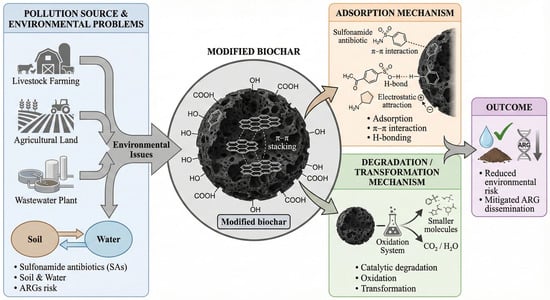
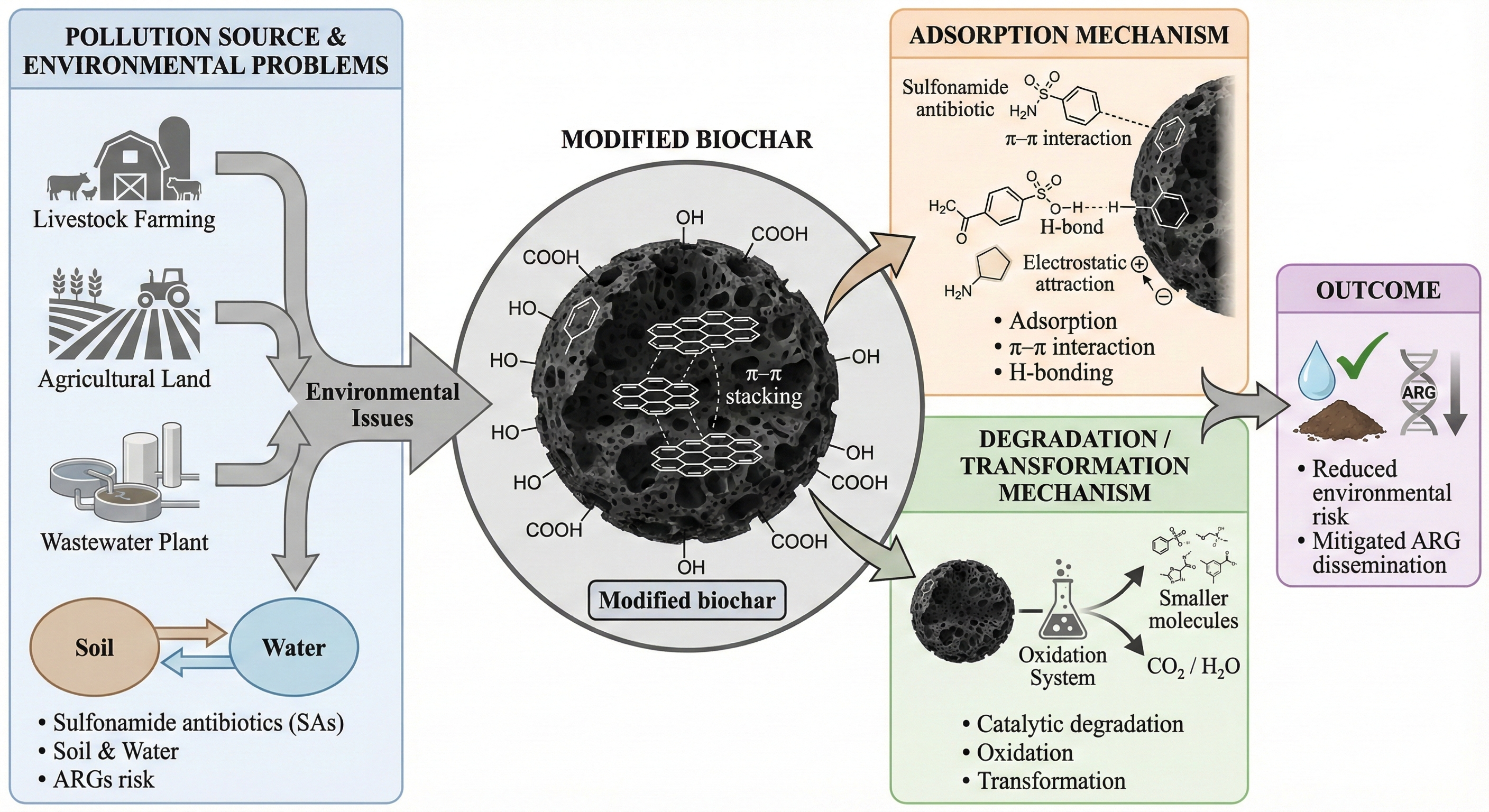
Graphical Abstract

1. Introduction

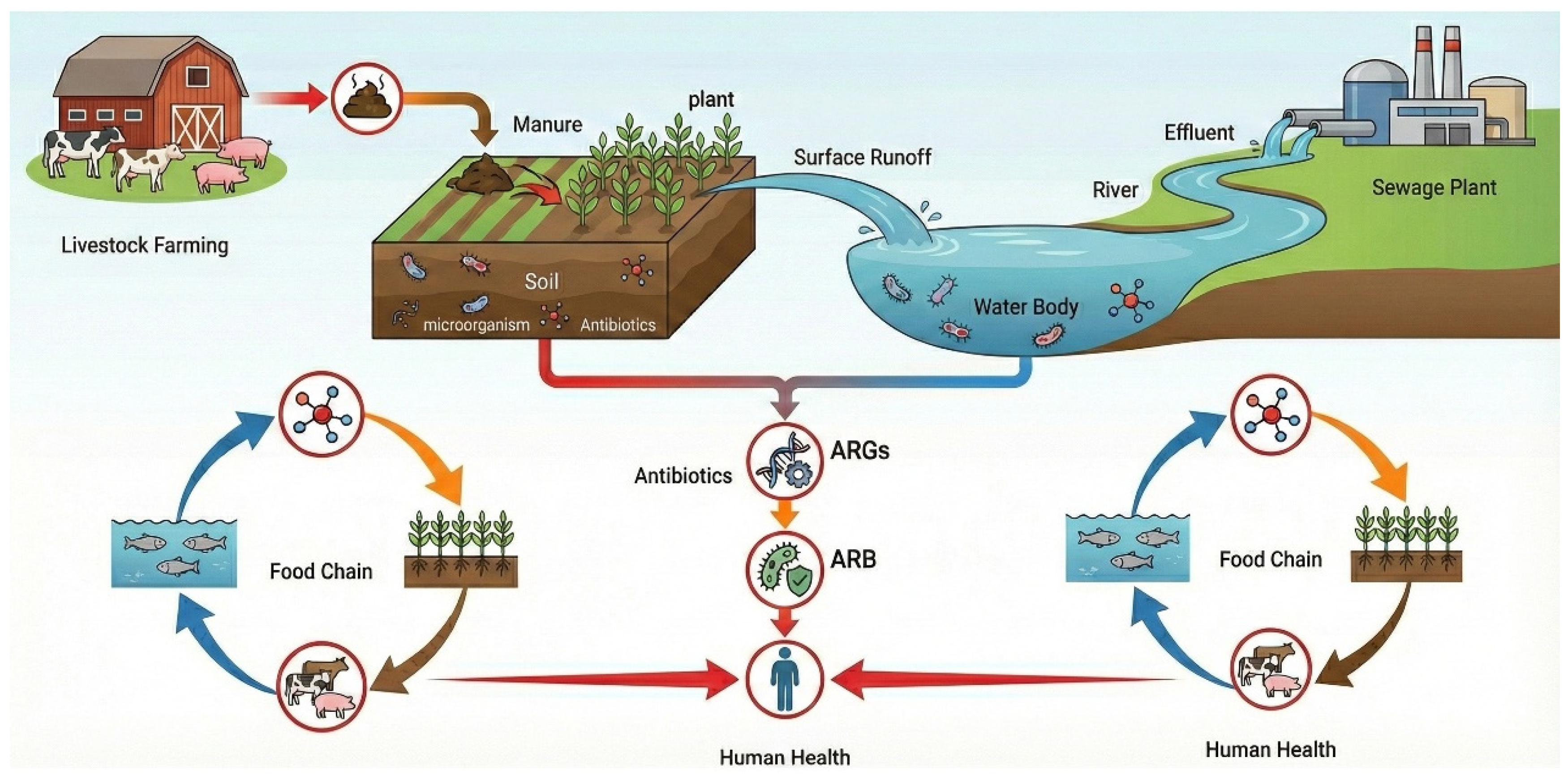
As one of the earliest synthetic antibacterial drugs to achieve large-scale applications, sulfonamide antibiotics (SAs) are widely used in human medical care, livestock and poultry breeding, aquaculture and other fields because of their broad-spectrum antibacterial properties, low cost and high structural stability. A large number of studies have shown that SAs are difficult to fully metabolize in living organisms. About 30–90% are discharged into the environmental system through feces and wastewater in the form of parent compounds and biologically active metabolites, so that they are continuously detected and accumulated in soil, water and sediments. Long-term low-dose exposure to sulfonamide antibiotics in environmental media can not only directly inhibit microbial activity and disturb microbial community structure and ecological function, but also significantly promote the production and diffusion of antibiotic resistance genes (ARGs) through selective pressure, and can be transmitted through the food chain, which contributes to ecological safety and public health. Potential long-term risks are shown in Figure 1. Although existing sewage treatment technology and soil repair technology (such as traditional biological treatment, coagulation precipitation and conventional adsorption) have achieved certain results in the removal of conventional organic pollutants, the removal of sulfonamide antibiotics with stable structure, strong water solubility and significant drug resistance risk still faces limited efficiency and environmental adaptation [1]. There remain problems such as poor selectivity and proneness to secondary pollution. In complex environmental matrices, sulfonamide antibiotics frequently coexist with natural organic matter, heavy metals, and microorganisms, thereby undermining the operational stability and sustained performance of conventional treatment technologies [2]. Therefore, the development of sulfonamide antibiotic pollution-control materials and technologies with high efficiency, sustainability and environmental compatibility has emerged as a central principle guiding the development of next-generation environmental functional materials and remediation technologies.
As a carbon-rich porous material formed by the thermal lysis of biomass under oxygen-restricted conditions, biochar has the advantages of a wide range of sources, low cost, adjustable structure and good environmental compatibility, and has broad application prospects in the removal of organic pollutants and heavy metals [3]. However, primitive BC generally has defects such as limited specific surface area, insufficient active sites and weak interface reaction ability, which limit its ability to achieve efficient removal and thorough transformation of sulfonamide antibiotics [4]. In recent years, BC has been directionally modified through strategies such as physical activation, chemical modification, biological functionalization and multiphase compounding, which can achieve precise regulation at multiple levels, such as pore structure, surface functional groups and electronic structures, thereby substantially strengthening its adsorption capability and interfacial catalytic reactivity toward sulfonamide antibiotics. More importantly, some modified BC has changed from a traditional adsorbent to an adsorption–catalytic synergistic material with the ability to enrich pollutants and become activated, which can achieve efficient degradation and risk reduction in sulfonamide antibiotics through the synergy of free radical and non-free radical pathways. At present, although research on modified BC in the removal of sulfonamide antibiotics continues to emerge, there are still a number of key scientific problems to be systematically resolved: (i) how different modification strategies can coordinate to regulate the microstructure and electronic properties of BC. (ii) How structural variations among sulfonamide antibiotics influence their adsorption behavior and transformation pathways at the modified BC interface. In complex environmental systems, the long-term stability, reaction mechanisms, and potential ecological risks of modified BC remain insufficiently understood. To a certain extent, these problems have restricted the transformation of modified BC from laboratory research to engineering applications.
To date, most existing reviews have focused on either adsorption performance or advanced oxidation systems separately, lacking a mechanistic integration between molecular structure of sulfonamides and electronic modulation of modified biochar. Moreover, bond-selective degradation pathways and the transition from radical-dominated oxidation to interfacial electron-transfer mechanisms remain insufficiently summarized. Therefore, this review aims to bridge adsorption thermodynamics, catalytic activation, and molecular transformation pathways within a unified mechanistic framework. Based on this, this paper systematically reviews the latest research progress on modified BC in the field of adsorption and degradation of sulfonamide antibiotics in recent years, focusing on the aspects of modified strategies, structural regulation, adsorption and catalytic mechanisms, and environmental application performance, and combines the molecular structure characteristics of different sulfonamide antibiotics to be discussed in depth. We discuss its interface mechanism and removal laws. On this basis, the key challenges faced by modified BC in practical applications are further analyzed, and its development directions in the coordinated control of multi-pollutants and sustainable environmental restoration are further analyzed in order to provide theoretical references for the rational design of high-performance BC materials and the optimization of sulfonamide antibiotic pollution-control technology.
To ensure a comprehensive and structured overview of recent advances in sulfonamide antibiotic (SAs) removal by modified biochar, a systematic literature survey was conducted. Relevant publications were retrieved from Web of Science Core Collection, Scopus, and ScienceDirect databases, covering the period from January 2010 to March 2026. The search was performed using combinations of keywords including “sulfonamide antibiotics”, “modified biochar”, “biochar adsorption”, “persulfate activation”, “peroxymonosulfate (PMS)”, “advanced oxidation process (AOP)”, “Fe–Nx”, “radical pathway”, and “non-radical pathway”. Only studies directly focusing on sulfonamide antibiotics and biochar-based systems were included. Publications addressing unrelated pharmaceutical compounds or non-relevant contaminants were excluded unless mechanistically informative. After screening and evaluation, representative studies were selected to construct a focused and up-to-date review framework.

2. The Fundamental Characteristics and Advantages of Modified BC

2.1. BC and Its Modification Methods

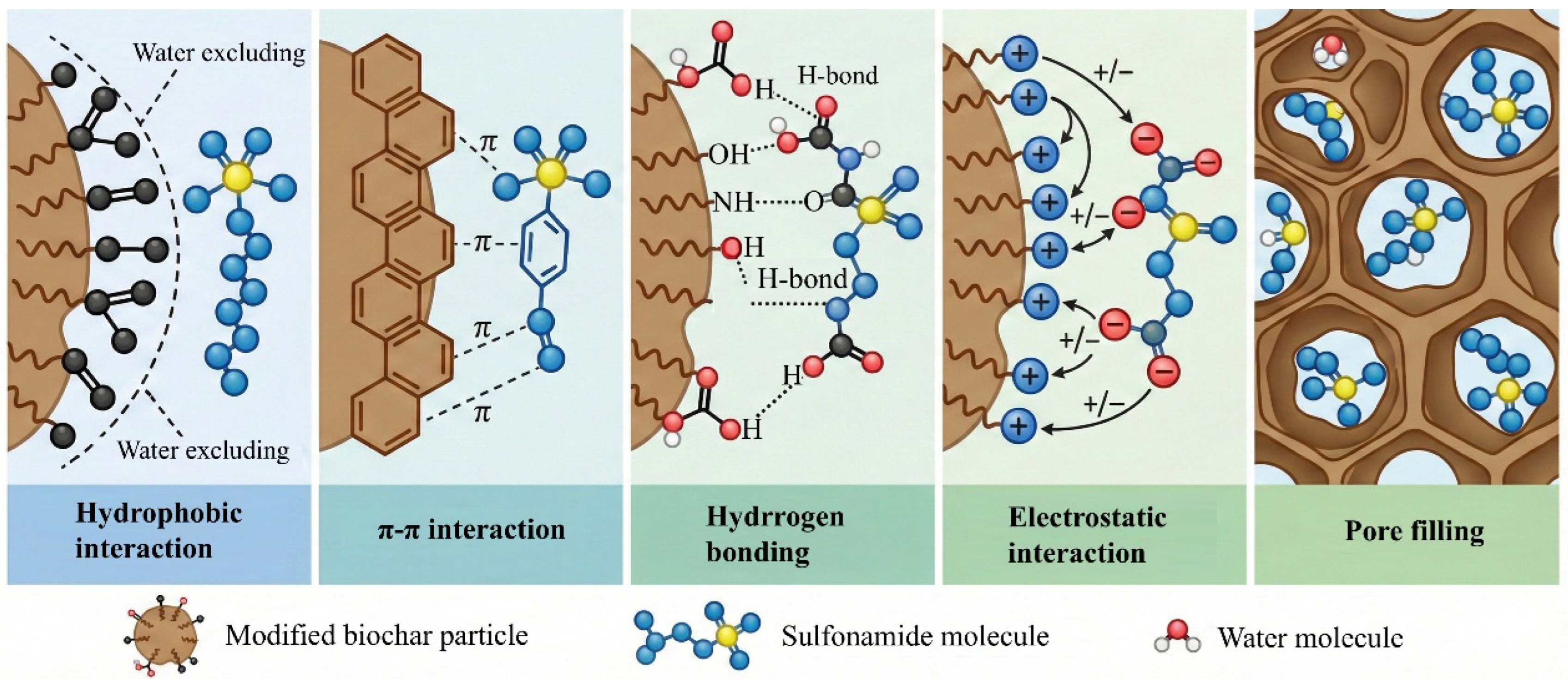
BC is a porous, carbon-rich material produced via the pyrolysis of biomass under oxygen-limited conditions. Its environmental function is mostly determined by its surface chemical characteristics and microstructure [5]. Typical biochar generally has a hierarchical pore structure, which is composed of micropores, mesopores and macropores [6]. Micropores principally contribute to the specific surface area and determine the maximum adsorption capacity of pollutants, while mesopores and macropores provide mass transfer routes for the molecular diffusion, interface contact and reaction kinetics of pollutants [7]. The hierarchical pore structure provides a physical basis for the adsorption and subsequent interfacial reactions of sulfonamide antibiotics within the pores, which enables biochar to simultaneously adsorb contaminants with diverse molecular sizes and physicochemical properties [8]. At the carbon skeleton level, BC is composed of aromatic carbon sheets and graphite-like domains, with a certain degree of a π conjugation system and structural defects [9]. The aromatic carbon network not only gives the material high structural stability, but also provides an important interaction basis for aromatic organic pollutants [10]. For sulfonamide antibiotics that generally contain benzene rings and heterocyclic structures, the aromatic domain on the surface of BC can enhance the intermolecular affinity through π–π stacking interactions and hydrophobic action, thus improving its adsorption stability and interface adsorption ability [11]. In addition to the carbon skeleton structure, the surface of BC is usually rich in oxygen-containing functional groups such as hydroxyls, carboxyl groups and carbonyl groups, which constitute the core source of their chemical reaction activity. On the one hand, polar functional groups can interact with groups such as –NH2 and –SO2NH– in sulfonamide antibiotic molecules through hydrogen bonding, electrostatic interaction and surface complexation to enhance their adsorption capacity [12]; on the other hand, these functional groups and structural defect sites can also participate in electron transfer under certain conditions [13]. The process provides a reaction basis for the subsequent redox reaction and catalytic activation process.
Biochar physicochemical properties are strongly dependent on the nature of the precursor feedstock. Based on biomass origin, biochar precursors can be broadly classified into three major categories: (i) lignocellulosic biomass (e.g., wood, crop straw), (ii) protein- and lipid-rich biomass (e.g., manure, sludge), and (iii) industrial or mixed organic residues. Each category generates biochar with distinct structural characteristics, mineral composition, ash content, surface functional groups, and surface charge properties, which collectively govern sulfonamide adsorption and transformation behavior.
The pyrolysis temperature of BC is a key parameter that regulates the removal mechanism of sulfonamide antibiotics [14]. It determines the adsorption, transformation and environmental risk evolution characteristics of antibiotics through systematic changes in pore structure, surface chemical properties and interface reaction path. Low-temperature pyrolytic BC (≤400 °C) is usually rich in oxygen-containing functional groups such as hydroxyl groups and carboxyl groups [15]. The aromatic structure development is limited, yet it has great enhanced electron transfer capacity and surface reactivity. The elimination of sulfonamide antibiotics by this sort of BC depends more on the interface chemical action and biological regulatory process [16]. Due to the restricted specific surface area and microporous structure, the capacity of low-temperature BC to fix sulfonamide antibiotics is rather weak, and there is a considerable risk of desorption [17]. In contrast, high-temperature pyrolytic BC (≥500–700 °C) shows a highly graphitized aromatic carbon skeleton and a developed microporous structure [18]. Its specific surface area and pore volume have increased significantly, making it have stronger physical adsorption and spatial domain-limiting ability for sulfonamide antibiotics, which can effectively reduce the bioavailability of pollutants and inhibit their environmental migration [19].
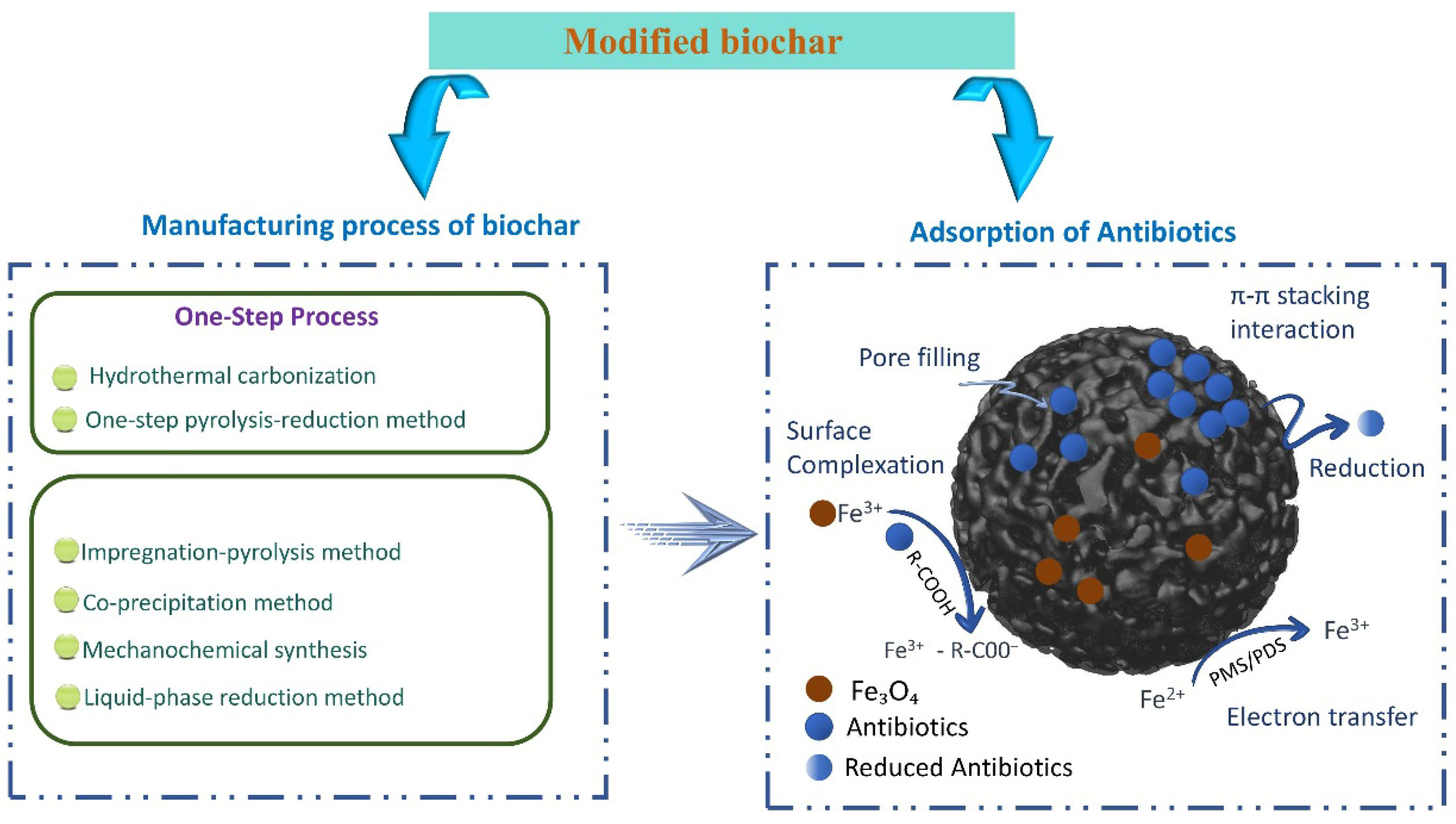
However, primitive BC still has certain limitations in the removal of sulfonamide antibiotics, such as insufficient development of specific surface area and microporous structure, limited surface-active site density and weak interface reaction ability. Its removal process is often based on physical adsorption, and it is difficult to realize sulfonamide antibiotics in complex environmental systems and to enable interfacial adsorption followed by electron-transfer-driven oxidative transformation of sulfonamide antibiotics. In order to overcome the above shortcomings, researchers modified BC in a directional way through a variety of ways such as physics, chemistry and biology to regulate its pore structure, surface function group composition and electronic properties, so as to significantly improve the adsorption performance, structural stability and catalytic efficiency [20]. Among these modification approaches, activation (including both physical and chemical activation) represents one of the most fundamental and widely adopted strategies for enhancing biochar performance. Physical activation, typically conducted under CO2 or steam at elevated temperatures, primarily develops pore structure through selective carbon gasification. Chemical activation, involving agents such as KOH, NaOH, H3PO4, or ZnCl2, promotes dehydration, bond cleavage, and micropore generation during thermal treatment. Unlike simple mechanical treatments or surface functionalization, activation fundamentally reconstructs the carbon framework, significantly increasing accessible surface area and exposing reactive sites. Therefore, activation should be distinguished as a primary structural regulation pathway that governs subsequent adsorption and catalytic behavior of sulfonamides [21]. Different modification methods and their corresponding structural regulation characteristics and performance changes have been systematically summarized in a large number of studies. The modification methods of BC are shown in Table 1. Based on these modification paths, in order to further improve the removal efficiency of BC on sulfonamide antibiotics, functional BC systems have been widely constructed in recent years, of which iron-based BC is the most representative, and its preparation generally follows the technical route of “pro-mixing-pyrolysis carbonization-post-treatment and active component introduction” [22] (Figure 2). Common methods include the impregnation-pyrolysis method (pyrolysis to form FeOX/Fe3O4 or dispersed iron site after iron salt load) [23], co-precipitation/in situ mineralization method (aqueous phase construction of iron oxide-carbon composite structure), hydrothermal-pyrolysis synergy method (first constructing rich functional group hydrothermal carbon and then loading iron species), mechanical chemical sphere grinding method (promoting the uniform dispersion of iron sources and introducing defect sites), and iron–nitrogen co-doping strategy (introducing nitrogen-containing precursors to construct Fe–Nx coordination structures) [24]. In addition, the development of pore structure, evolution of surface functional groups, formation of defects, and modulation of electronic structure all work together to enhance the adsorption capacity and catalytic activity of modified biochar for sulfonamides. These methods realize the integrated function construction of “adsorption interfacial catalytic transformation” by jointly regulating the morphology, pore structure and surface chemical properties of iron species, laying the material foundation for the application of modified BC in the adsorption and degradation of sulfonamide antibiotics.
A growing body of evidence indicates that biochar modification induces quantifiable changes in pore structure and surface chemistry, which can be directly translated into improved sulfonamide removal. Although alkaline treatment increased the specific surface area from 3.996 to 8.957 m2/g and further to 12.740 m2/g, the absolute magnitude of this increase remains relatively modest. Considering that BET measurements may exhibit experimental variability depending on degassing conditions and sample heterogeneity, such differences should be interpreted with caution. In fact, many types of high-performance biochar reported in the literature typically possess surface areas ranging from 200 to 1000 m2/g. Therefore, in this case, the observed enhancement in sulfonamide degradation cannot be solely attributed to surface area expansion. Instead, accumulating evidence suggests that catalytic improvement in low-surface-area systems is more strongly associated with changes in surface chemistry and active-site composition (e.g., C=O adsorption, defect formation, and electronic modulation) rather than simple increases in pore volume. This highlights the importance of distinguishing between quantitative surface area expansion and qualitative active-site regulation when evaluating structure–performance relationships in modified biochar systems [25]. Related studies have confirmed that sludge biochar pyrolyzed at 600 °C, after being ball-milled (500 rpm, 60 min) and hydrothermally activated with phosphoric acid, can efficiently remove sulfamethoxazole at environmental concentrations through multiple mechanisms such as pore filling, π–π conjugation, hydrogen bonding, and P-O complexation. Its maximum adsorption capacity reaches 4.61 × 10⁴ μg/g, which is 6.30 times that of the original biochar. Moreover, it has good NaOH regeneration performance and low phosphorus leaching risk [26]. Similarly, metal-doping strategies significantly regulate interfacial redox activity. In a magnetic biochar system derived from cow dung, Fe and Cu co-doping (optimal Fe/Cu ratio = 1:1) enhanced PMS activation efficiency, increasing the SMX degradation rate constant from 0.0161 min−1 (pristine biochar) to 0.0403 min−1 in the Fe–Cu co-doped system. The removal efficiency reached 91.6% under optimized conditions (0.05 g/L catalyst, 1.2 mM PMS) [27]. EPR and probe experiments confirmed the simultaneous generation of SO4, •OH, O2, and 1O2, with 1O2 being the dominant reactive species. The enhanced catalytic activity was associated with improved electron transfer between Fe and Cu sites and increased steady-state concentrations of reactive oxygen species.
Collectively, these quantitative comparisons demonstrate that modification strategies not only increase specific surface area and optimize pore architecture but also regulate active-site composition and interfacial electron-transfer pathways. The enhancement of sulfonamide removal is therefore governed by a coupled structure–chemistry–reactivity framework rather than simple surface adsorption alone.
Table 1. BC modification methods and their performance changes.
Modification MethodsSpecific MethodsPerformance ChangesLiterature Sources
Physical modificationBall millingThe particles are smaller and the specific surface area is larger. The crystal structure is altered to enhance stability.[28,29,30]
Microwave treatmentThe number of functional groups, specific surface area, and stability are significantly increased, and the adsorption capacity is enhanced.[31,32]
Thermal treatmentIncrease aromaticity and degree of carbonization, reduce polar functional groups, and enhance the adsorption capacity for hydrophobic pollutants.[33,34]
Chemical modificationAcid modificationAlter the quantity and types of functional groups such as hydroxyl groups on the BC surface. Meanwhile, enhance the BC’s adsorption capacity for organic pollutants.[35,36,37]
Alkali modificationStrong alkali can increase the hydrophilicity of the BC surface, while also increasing the surface alkaline functional groups, giving its surface a negative charge to adsorb more cationic pollutants.[36,38,39,40]
Biological modificationMicrobial actionMicrobial secretions cover the surface, increasing oxygen-containing functional groups, but may clog pores and reduce specific surface area.[41,42]
Nano-treatmentIntroducing nano-metal oxidesImprove the porous structure of BC and characteristics such as specific surface area, functional groups, and thermal stability.[43,44,45]

2.2. Progress in the Application Research of Modified BC to Sulfonamide Antibiotics

With the deepening of the understanding of the environmental behavior and removal mechanism of sulfonamide antibiotics, modified BC has become an important functional material for the control of sulfonamide pollutants because of its adjustable pore structure, surface chemical properties and reactive activity [46]. A large number of studies have shown that compared with primitive BC, modified BC constructed through strategies such as physical activation, chemical modification, heteroatomic doping and metal loading has shown significant advantages in adsorption, interface reaction and conversion efficiency of sulfonamide antibiotics. At the adsorption level, modified BC usually has a higher specific surface area and a more reasonable aperture distribution, which can effectively enhance the mass transfer and interface contact of sulfonamide antibiotics [47]. Relevant studies show that modified BCs used for different sulfonamide antibiotics (e.g., SMX, SDZ, SMZ) exhibit superior performance to traditional BC in terms of adsorption kinetics and isotherm characteristics, and are more resistant to solution pH and coexisting ions [48]. In terms of degradation, modified BC gradually changes from a single adsorption material to an “adsorption-catalytic coordination” functional material [49]. By introducing transition metals (such as Fe, Mn, Cu) or constructing an iron-nitrogen co-doped structure, the surface of BC can form an interface reaction center with redox activity, and the catalytic degradation of sulfonamide antibiotics can be realized with the participation of persulfate, peroxide or dissolved oxygen [50]. Research shows that modified BC not only acts as an adsorption carrier in the process of sulfonamide antibiotics, but also plays a key role by enhancing the biodegradation process [51]. Functionalized materials represented by NaOH modify BC; under optimized dissolved oxygen conditions, the removal process transitions from an initial rapid reduction phase to a stabilized degradation stage, indicating that its main removal mechanism gradually changes from surface adsorption to deep biodegradation [52]. In addition, the structural regulation of modified BC also considerably affects the conversion path and intermediate product evolution process of sulfonamide antibiotics. The migration of SAs in environmental media such as soil and sediment facilitates their dissemination [53]. Their migration behavior is determined by their own physicochemical features (such as adsorption characteristics, water solubility, partition coefficients, etc.) and external environmental variables (such as climate, precipitation, etc.). Compared with primitive BC, which is mainly based on physical adsorption, functionalized BC is more conducive to inducing the activation and fracture of key functional groups in sulfonamide molecules and promoting their transformation into small-molecule products, thereby reducing environmental persistence and residual risk [54].
Modified biochar systems have been evaluated under realistic water matrices, where Fe/N- or Fe/Cu-doped biochar activated PMS to achieve >90% sulfonamide removal within 20 min under optimized catalyst dosages (30–100 mg L−1) and PMS concentrations (1–2 mM), exhibiting broad pH adaptability (3–11) and degradation rate constants up to 0.37 min−1. However, matrix components such as humic substances and competing anions significantly affected reaction kinetics, and although metal leaching remained below regulatory limits and partial reusability was demonstrated, limited mineralization and long-term stability under continuous-flow conditions remain critical challenges for practical application [55]. In realistic soil–water systems, Fe/Mn-modified biochar markedly improved SMX removal, achieving up to 98% degradation within 48 h at 1 mg·L−1 and significantly shortening the environmental half-life, while increasing specific surface area (5.26 to 91.70 m2·g−1) and pore volume (0.018 to 0.20 cm3·g−1), thereby enhancing pollutant adsorption and interfacial reactivity. Quantitative analysis demonstrated that degradation (79.5–83.8%) rather than simple adsorption dominated removal, with •OH-mediated oxidation confirmed in complex matrices, underscoring the practical relevance of modified biochar for in situ antibiotic mitigation [56]. In summary, modified BC shows the significant advantage of transforming from adsorption materials to functionalized adsorption–degradation synergistic materials in the treatment of sulfonamide antibiotics, which provides important support for its application in complex environmental systems.

3. Removal Mechanisms of SAs with Different Structures

3.1. The Chemical Structure of SAs

SAs are a class of important antibacterial drugs. The core structure of SAs is an SA group (-SO2NH2), which consists of a sulfonyl group (-SO2-) and an amino group (-NH2). This structure imparts polarity to the molecule, affects their solubility and interaction with biological targets, and inhibits protein synthesis by binding to bacterial cell ribosomes. At the same time, the properties and characteristics of the drug can be significantly changed by introducing different substituents (such as alkyl substituents, aromatic cyclic substituents, heterocyclic substituents, and halogen substituents) on SA groups (-SO2NH2) (Table 2 and Figure 3).
Sulfonamides are amphoteric compounds possessing two dissociation constants (pKa1 and pKa2), corresponding to the protonation of the aniline amino group and deprotonation of the sulfonamide moiety, respectively. For representative sulfonamides, such as sulfamethoxazole (SMX), the reported values are pKa1 ≈ 1.6 and pKa2 ≈ 5.7; for sulfadiazine (SDZ), pKa1 ≈ 2.0 and pKa2 ≈ 6.5; and for sulfamethazine (SMZ), pKa1 ≈ 2.3 and pKa2 ≈ 7.4 [57]. At pH < pKa1, sulfonamides predominantly exist in cationic form; between pKa1 and pKa2, the neutral species dominates, and at pH > pKa2, deprotonated anionic species prevail. Therefore, the charge-dependent interaction with biochar is highly sensitive to solution pH relative to both the sulfonamide pKa values and the point of zero charge (pHPZC) of the material. When pH < pHPZC, the biochar surface is positively charged, favoring electrostatic attraction toward anionic sulfonamide species (pH > pKa2). Conversely, at pH > pHPZC, electrostatic repulsion may occur if both the surface and sulfonamide are negatively charged. Thus, a precise mechanistic interpretation requires correlating specific sulfonamide speciation profiles with measured biochar pHPZC values rather than relying on broad pH ranges.
Table 2. SA group substituents and their effects.
Type of SubstituentCommon SubstituentsInfluenceLiterature Sources
Alkyl substituentsMethyl (-CH3)Increase lipophilicity and improve absorption and distribution[58]
Aromatic ring substituentsPhenyl (-C6H5)Increase planarity and rigidity, and enhance binding affinity to the target[59]
Heterocyclic substituentsPyrimidine ring (Such as SD)Increase the antibacterial spectrum and activity[60]
Isoxazole ring (Such as SMZ)Enhance the inhibitory effect on specific bacteria[61]
Halogen substituentsChlorine (-Cl)Increase electron density and improve interaction with the target[62]
Amino substituentsAmino group (-NH2)Increase alkalinity and affect ionization and cell permeability[63]

3.2. The Removal Behavior of Modified BC Towards Sulfonamide Antibiotics with Different Structures

3.2.1. The Impact of Molecular Structural Differences on Interfacial Adsorption Behavior

From a molecular perspective, the interaction mechanism between sulfonamide antibiotics and BC-based materials is mainly determined by their ionization behavior, aromatic structure and functional substituents. Sulfonamide antibiotics typically contain an amino group on a benzene ring and a substituent attached to sulfur. Structural differences are mainly reflected in the position of amino groups, the type of substituents and the spatial arrangement. Different modification strategies result in distinct adsorption mechanisms for structurally diverse SAs.
Relevant studies have shown that the adsorption process of unmodified BC and acid-modified biochar (HBC) on the SAs clodazon, SMZ and SMA is divided into two stages: fast and slow. The adsorption increases with time and reaches equilibrium in about 960 min. Not only are the adsorption mechanisms of BC on SAs of different structures different, but the adsorption mechanisms of SAs in the surrounding environment are also different. In some medium and high latitudes, freeze–thaw events occur frequently. With an increase in the number of freeze–thaw cycles, the adsorption capacity of the soil to SMZ and the SA pyridine (SPY) decreases first and then increases. With an increase in the number of freeze–thaw cycles, the soil clay content, specific surface area, small pores and soluble organic matter (DOM) increased, providing more adsorption sites, finally dominating the adsorption process [64]. In a water environment, the adsorption capacity of carbon nanotubes on SAs is stronger than in a vacuum environment. The adsorption of five SAs on carbon nanotubes is predominantly governed by physical interactions. The most stable adsorption configuration is the parallel adsorption of the benzene ring of the drug molecule on the top of the carbon nanotube. By comparing the adsorption energy, the stability of the adsorption of five SAs on carbon nanotubes is: SMZ > SDZ > SMX > SAs [65]. The adsorption capacity of modified BC for SAs is better than that of traditional BC. The research results of the adsorption capacity of different modified BC types on SAs show that they all show good adsorption properties in the adsorption of SAs (Table 3). The adsorption ability of BC to SAs is affected by many factors, including the surface properties of BC, the preparation conditions and the molecular structure of SAs. Through relevant research, it has been shown that the adsorption capacity of BC for SAs (such as SMZ and SMX) can be significantly improved through modified treatment (such as the addition of phosphogypsum and ball-grinding treatment).
Table 3. Adsorption capacity of modified BC for SAs.
Type of BCType of SAsBC Dosage (g·L−1)Initial Antibiotic Concentration (mg·L−1)Equilibrium Reaction Time (h)Adsorption Capacity (mg·g−1)Literature Sources
Bagasse-modified BCSMZ0.120243.96[66]
Methylpyrimidine0.120242.84
Phosphogypsum-modified BCSDZ0.210242.98[67]
Pyrolysis-modified BCSDZ0.14824261[68]
Magnetic-modified BCSMZ0.0120012414.2[69]
SMZ0.0120012386.3
Boric acid-modified BCSMZ0.550492.35[70]
Ball-milled BCSMZ0.01102436.3[71]
Sulfapyridine0.01102441.5
HCl-modified BCSulfamethazine0.59.0241.58[72]
SA compounds with different molecular structures exhibit diverse adsorption behaviors on various adsorbents. Electrostatic interaction is an important mechanism governing the adsorption of sulfonamide antibiotics on BC surfaces. The surface charge of BC is pH-dependent and determined by its pHPZC. When the solution pH is below the pHPZC, surface protonation may render the BC positively charged, whereas at pH values above the pHPZC, deprotonation leads to negatively charged surfaces [73]. Therefore, the electrostatic interaction toward ionizable sulfonamide species is strongly environment-dependent. For SA molecules with higher hydrophobicity, a porous BC matrix with a large specific surface area facilitates their diffusion and retention through hydrophobic interactions and pore-filling effects. In contrast, SA compounds bearing specific functional groups, such as carboxyl moieties or nitro substituents, can interact more strongly with the BC surface via hydrogen bonding or π–π interactions. These structure-dependent adsorption pathways highlight the importance of both adsorbent properties and molecular characteristics in governing SA removal efficiency [66]. The adsorption of SA compounds with diverse structural features onto modified BC is governed by a dynamic equilibrium among multiple interaction mechanisms. By rationally selecting appropriate modification strategies, the surface chemistry and pore characteristics of BC can be tailored to better match the molecular properties of different SA compounds. Such targeted modification not only enhances adsorption efficiency but also improves the stability of SA retention, enabling more effective removal across structurally diverse sulfonamide pollutants [74,75].

3.2.2. Adsorption Kinetics of Sulfonamide Antibiotics on Modified BC

An essential foundation for elucidating the migration, site occupation, and interface interaction mechanism of SAs on the surface of modified BC was provided by an adsorption kinetics study [76]. Due to the aromatic heterocyclic structure and -SO2-NH- functional groups of SA molecules, along with their multiple acid–base dissociation constants (pKa1, pKa2), they can exist in cationic, neutral, or anionic forms depending on pH variations in the surrounding medium, which considerably influences their diffusion behavior and surface binding mechanisms [77]. Current research often fits the adsorption process to differentiate between several rate control steps using an intra-particle diffusion model, a pseudo-first-level dynamic model (PFO), and a pseudo-second-level dynamic model (PSO) [78]. The kinetic model fitting results generally show that the adsorption process of sulfonamide antibiotics is more in line with the pseudo-secondary kinetic model, and the equilibrium adsorption amount calculated by the model is highly consistent with the experimental value, indicating that the adsorption rate is mainly controlled by surface chemistry, rather than simply dominated by solute diffusion [79]. This feature is intimately linked to the interaction of several locations where heterocyclic nitrogen, sulfonamide groups, aromatic rings, and other functional groups in SA molecules are involved. Further intra-particle diffusion analysis usually indicates a multi-stage kinetic process constituted of “rapid surface adsorption—intra-particle diffusion—adsorption equilibrium”. In the initial stage, the boundary layer diffusion resistance is generally modest, but the succeeding stage is limited by the coordination of intra-pore diffusion and surface rearrangement [80]. In general, sulfonamide antibiotics’ rapid kinetic response on porous adsorption materials is due to the synergistic effect of pore structure advantage and strong molecule-interface interaction, which not only ensures that high adsorption capacity can be effectively utilized in a short period of time, but also in rapid adsorption, online pretreatment, and adsorption-catalytic coupling systems. The application provides a vital dynamic foundation.
Considering time scale, the adsorption behavior of SAs on modified BC usually shows the multi-stage characteristics of “rapid adsorption—slow diffusion—balanced rearrangement” [81]. In the initial stage, SA molecules in neutral or weak ionizing forms in the solution can swiftly migrate and occupy the high-energy sites in the outer surface of the BC and medium and large pores, and the adsorption rate is quite fast [82]. Therefore, when the outside surface site is gradually saturated, sulfonamide antibiotics with large molecular sizes (such as SMX and SMZ) are further shrunk, the interior diffusion of the pore structure eventually becomes a limiting step [83]. The final stage is reflected in the process of adsorption–desorption dynamic balancing and the delayed adjustment process of interface setup. The analysis of the intraparticle diffusion model generally shows that the adsorption kinetic curve does not pass the origin, indicating that the adsorption process of SAs is not controlled by a single diffusion mechanism, but is instead the result of the coordinated regulation of external diffusion, intra-pore diffusion and surface chemical action [84].
Different modification procedures have a substantial impact on the adsorption kinetics of sulfonamide antibiotics by modifying the pore structure features, surface kinetic group composition and electrochemical properties of BC. Physical or chemical activation can usually enhance the specific surface area and optimize the proportion of pores, thus minimizing the diffusion constraints caused by spatial resistance of SA molecules and greatly speeding up the initial adsorption rate [85]. However, functional groups in SA molecules, such as –SO2–NH–, amino groups, and heterocyclic nitrogen, enhance their interactions with the BC surface.The multi-position interaction on the surface makes the adsorption process more in line with the pseudo-second-order dynamic features [86]. For BC systems modified by metal or metal-N co-colocation structure, SA molecules may also form complexes with the metal center through sulfonamide groups or heterocyclic nitrogen, accompanied by the redistribution of interface electrons, so that the adsorption process shows a higher rate constant in appearance dynamics, and may be associated with the subsequent oxidative degradation process. Form adsorption-reaction coupling behavior [87].
In addition, the regulating effect of environmental variables on the adsorption kinetics of sulfonamide antibiotics is very relevant. The solution pH directly affects the electrostatic action and diffusion behavior by affecting the ionization morphology of SAs and the surface charge state of BC [88]. Under the circumstance of the zero charge point of BC (pHPZC) being approached, the fraction of neutral form SAs increases and the electrostatic rejection effect is lessened, which is more conducive to its migration into the hole and the creation of stable absorption [89]. Attachment, so as to display a faster adsorption rate. In contrast, in solutions with high ionic strength or rich in natural organic matter, competing adsorption and pore blocking effects may impede the efficient diffusion of SA molecules and reduce their surface kinetic rate constant [90]. Reported pseudo-second-order rate constants (k2) for antibiotic adsorption on modified biochar generally fall within the 10−3–10−4 g·mg−1·min−1 range and vary with molecular size and surface functionality. For example, phosphate-ligand engineered biochar exhibited k2 values following the order SAs > ERY > β-Ls > TCs ≈ QNs, indicating that smaller and electrostatically favorable molecules tend to adsorb more rapidly [11]. Thus, comparative evaluation of k values provides clearer insight into structure–kinetics relationships than model fitting alone.
In general, the adsorption kinetics of sulfonamide antibiotics on modified BC is a multi-mechanism collaborative process determined by its molecular structural features, ionization behavior and BC interface qualities. It enhances the rationale of the SA removal method by combining kinetic studies with pore structure, surface chemistry, and molecular structural features. This allows us to solve and build the theoretical framework for the design of the adsorption-catalytic synergy system.

3.3. Exploration of Molecular Mechanisms

3.3.1. Surface-Confined Adsorption and Electronic Coupling of Sulfonamides

Modified BC removal of sulfonamide antibiotics is a surface-limited domain transformation process driven by interface microenvironment development, electronic structure management, and molecular bond activation rather than a straightforward physical adsorption or a conventional advanced oxidation approach [91]. Through the incorporation of heteroatomic doping, defect engineering and metal species, BC has evolved from an adsorbent material to a carbon-based interfacial reactor with reaction regulating ability [92]. The degradation of sulfonamide antibiotics first occurs at the boundary reaction interface constructed on the surface of modified BC. Sulfonamide molecules usually contain aromatic skeletons and -SO2NH- functional groups, which achieve high-efficiency adsorption and orientation configuration on the surface of modified BC through multiple actions [93]. π–π electron interactions establish a fundamental interfacial coupling framework between modified BC and sulfonamide antibiotics. The modified BC’s defect adsorption zone and highly graphitized aromatic carbon domain have a continuous π conjugate system that may have a notable π-Sulfonamide antibiotic molecules are directionally adsorbed on the carbon-based surface in a quasi-parallel configuration due to the π accumulation effect with the benzene ring and heterocyclic structure [94]. This non-covalent coupling not only enables the efficient adsorption of sulfonamide molecules, but also produces a tight electron coupling channel at the molecular orbital level, which greatly shortens the electron migration distance and stabilizes the interface reaction configuration [95]. Studies have shown that π–π stacking interactions can induce electric load distribution and electron out-domain between carbon-based materials and aromatic molecules, thus promoting interface electron transfer and active species generation, and providing structural and electron prerequisites for the subsequent directional activation of S-N bonds and aromatic skeletons. Consequently, π-π electron action is a crucial chemical mechanism that propels sulfonamide antibiotics from the “solution-free state” to the “interfacial reaction state” in the modified BC system rather than a straightforward physical adsorption force [96]. Oxygen-containing/nitrogen-containing functional groups such as –OH, –COOH and –NH2 enriched on the surface of modified BC can form a multi-site hydrogen bond network with the –NH2 and –SO2– groups in sulfonamide antibiotic molecules, so that sulfonamide molecules can achieve directional anchoring and configuration limitation at the carbon base interface. Molecular kinetics research shows that hydrogen bonds not only help to stabilize the adsorption configuration but also can be dynamically reconstructed during the reaction process and stabilize the reaction intermediate and transition state together, thus significantly reducing the energy barrier of key bond fracture and accelerating the transformation process. At the same time, the matching of the surface charge state of BC under the management of the pH of the solution and the dissolving shape of sulfonamide molecules can further improve electrostatic attraction and interface affinity, and amplify the stability effect of the hydrogen bond network. The above “hydrogen bond-electrostatic coupling” mechanism transforms sulfonamide molecules from the free diffusion state of the solution to the highly restricted interface reaction state, which provides an important structural and thermodynamic basis for subsequent electron transfer and molecular bond activation [97]. The central position anchoring in the metal constructs the most direct interface reaction starting point for sulfonamide antibiotics. Transition metal sites such as iron and manganese introduced into the modified BC, especially the Fe-Nx single-atomic coordination structure, can form a stable internal coordinating complexion with the N atoms in sulfonamide antibiotic molecules and the O atoms in the sulfonyl group, so that the sulfonamide molecules change from the physical adsorption state to the chemical anchoring state [98]. The alignment process significantly shortens the spatial distance between the sulfonamide molecule and the metal active center, directly introduces them into the radius of the reaction, and induces the reconstruction of its electron cloud distribution, thus weakening the stability of the S-N bond and aromatic skeleton [99]. Theoretical calculations and in situ spectroscopy results show that the central position of the metal not only improves the selective adsorption ability of sulfonamide at the interface, but also significantly reduces the energy barrier of interfacial electron transfer and oxidation activation, so that sulfonamide molecules give priority to directional activation and initial bond breaking reaction at metal sites. Therefore, metal coordination anchoring constitutes the “first reaction site” and key structural basis for the efficient degradation of sulfonamide antibiotics driven by modified BC [21].

3.3.2. Regulation of Electronic Structure

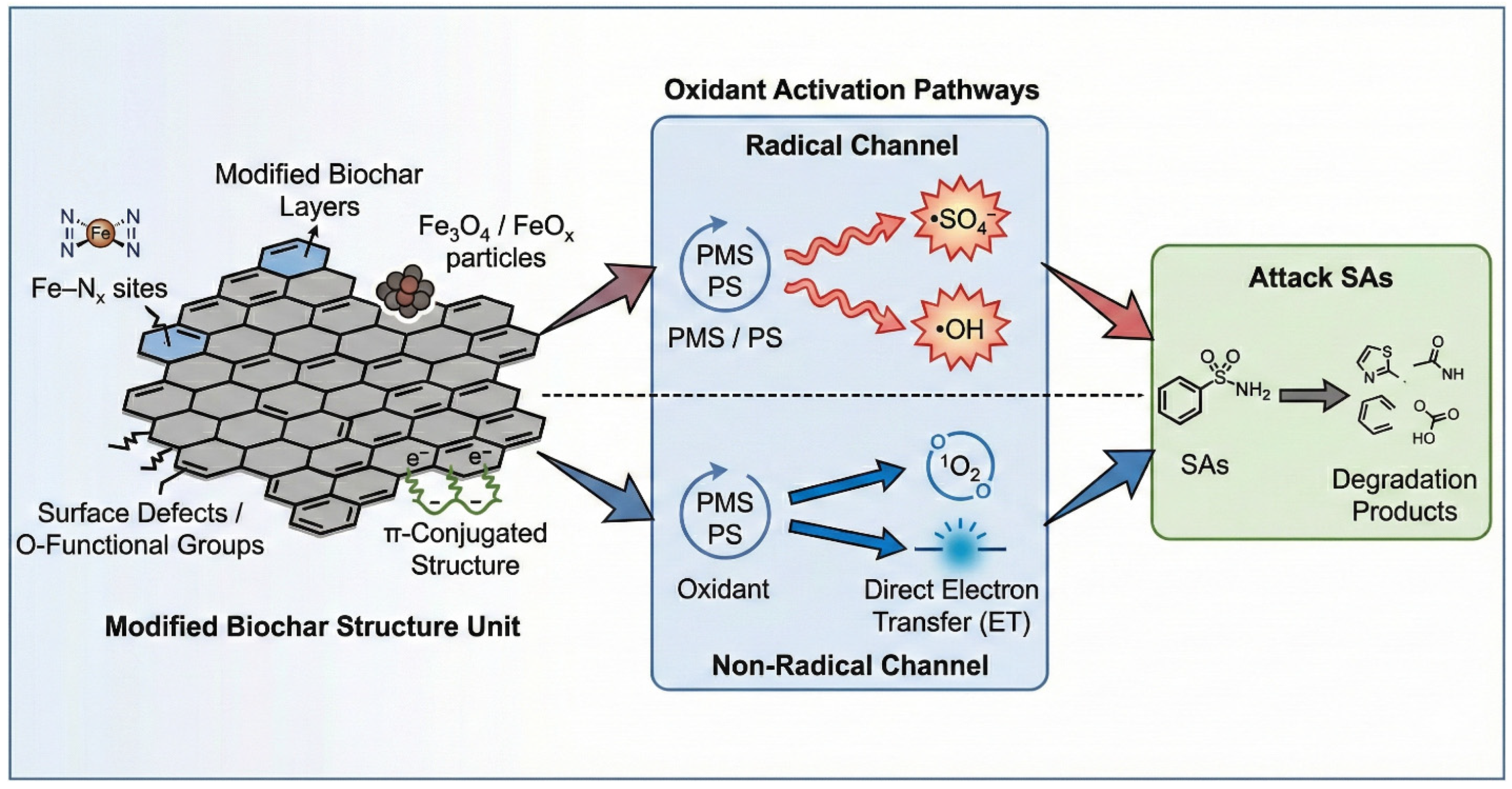
In the advanced oxidation system in which modified BC participates, the free radical path is still one of the major dominant pathways for the degradation of sulfonamide antibiotics. Take metal-loaded BC as an example; Cu(I)/BC may efficiently activate peroxyacetic acid (PAA) and form a range of highly active oxygen species in situ at the interface, including •OH, alkane free radicals (R–O•), superoxide free radicals (O2) and single-line oxygen (1O2) [100]. EPR and sudden extinction experiments together show that it is not a single free radical acting in the system, but a multi-free radical parallel oxidation system dominated by •OH and organic free radicals and coordinated by O2 and 1O2. The above active species can produce strong non-selective oxidative attacks on sulfonamide antibiotic molecules, preferentially targeting sulfonamide bridges (–SO2–NH–), aniline structures, and heterocyclic sites, thereby triggering reactions such as C–N bond cleavage, hydroxylation, deamination, and aromatic ring opening. These processes gradually convert macromolecular sulfonamides into smaller intermediates, which are ultimately mineralized into CO2 and H2O [101]. The free radical drive path emphasizes the core amplification effect of modified BC in the process of “continuous generation of active oxygen—interface adsorption attack—multi-site fracture transformation”, which is the basis of the key mechanism for the current BC-AOP system to achieve efficient degradation of sulfonamide antibiotics [102]. Research shows that BC after loading Fe, Mn and other transition metals not only introduces recyclable metal active centers but also significantly enriches surface persistent free radicals (PFRs), thus constructing multi-source synergistic active oxygen. Systematic [103]. The metal site can trigger the Fenton-like reaction to produce highly reactive hydroxyl radicals (•OH) by continuously activated H2O2 in situ in the continuous activation environment through the redox cycle of Fe(III)/Fe(II) and Mn(IV/III)/Mn(II) [104]. At the same time, the carbon oxide core PFRs enriched on the BC carbon-based skeleton can operate as an electronic mediator to increase the activation of O2 and H2O2 and directly contribute in the formation of •OH. Furthermore, intermediate free radicals such as •HO2− and •O2− create an electron-transfer chain in the system to sustain regeneration of the reduced metal center, thereby enabling the continuous production of •OH. The generated •OH preferentially attacks aromatic rings, heterocycles, and key functional groups such as –SO2– and –NH– in sulfonamide molecules, inducing hydroxylation, ring opening, and bond cleavage reactions. These processes progressively convert sulfonamide antibiotics into smaller intermediates. Through metal–carbon synergistic activation of the free radical system, modified BC not only functions as a pollutant adsorption carrier but also promotes deep oxidative transformation of sulfonamides, thereby reducing their environmental risk. Through metal-carbon synergistic activation of free radical systems, this method demonstrates that modified BC not only functions as a pollutant adsorption carrier but also achieves interface depth oxidation and reduces the risk of sulfonamide antibiotics [56].
In recent years, the advanced oxidation system has been changing from “free radical-dominated” to “interface electronic regulation”. For modified BC, its introduction of single-atom site, defective carbon and quinone-type structure is not only the active site, but also reshapes the interface electron structure, so that the removal of SAs changes from somatic phase free radical attack to a non-free radical transformation path characterized by surface electron transfer [105]. In this mode, pollutants are directionally activated through interface charge extraction and electron rearranging, and are accompanied by 1O2 or surface-bound reactive oxygen generation to achieve selective degradation of sulfonamide molecules [106]. More and more research demonstrates that the Fe–NX single atom site is not only the activation point of PMS, but also the major relay node of interface electron transport. Under the regulation of the defective carbon domain and high-coordination environment, the Fe-NX site can significantly enhance the electron supply ability to PMS and induce its non-free radical activation process, that is, weaken the O-O bond of PMS through interface electron transfer and selectively generate 1O2 or surface-bound reactive oxygen species. In this method, contaminants undergo directional oxidation transformation through surface electron extraction and electric load composition rather than being primarily non-selectively targeted by •OH or SO4. Higher selectivity and anti-matric interference capabilities are demonstrated by this type of non-free radical electron transfer channel, making it particularly appropriate for the effective elimination of electron-rich contaminants like sulfonamide antibiotics in intricate environmental systems [107]. The defect-enriched carbon domain and the surface quinone/phenol structure together form an interface electronic relay system, which can directly induce electron extraction and electric load structure of sulfonamide molecules on the surface of the material. The process does not rely on the generation and diffusion of solid phase free radicals, but instead activates the molecular structure through interface single electron transfer, and further participates in the follow-up reaction with the formation of 1O2 or surface-bound active oxygen. Since the reaction is mainly controlled by the electronic structure on the surface of the material, the non-free radical path shows high reaction selectivity and anti-matric interference ability, which is considered to be an important mechanism for the directional transformation and stable removal of sulfonamide antibiotics in complex water environments [77].
Modified BC breakdown of sulfonamide antibiotics can be achieved through both free radical and non-free radical routes at the same time. The free radical pathway is dominated by active species such as •OH, and non-selective strong oxidation of sulfonamide molecules is carried out to promote their rapid bond breakage and deep transformation; the non-free radical pathway relies on Fe-NX single atomic site, defective carbon domain and quinone/phenol structure to build an interface electron transfer channel to induce the occurrence of sulfonamide molecules. Electric charge redistribution and directional electron extraction activate sulfonamide molecules at the catalyst surface, accompanied by the participation of 1O2 or surface-bound reactive oxygen species. The modified BC has the advantages of high efficiency and selectivity in breaking down sulfonamides in complex environmental systems due to the synergy of the two routes (Figure 4).
According to the aforementioned research, the interface coupling effect between the control of material structure and the molecular properties of pollutants is mostly responsible for the variation in modified BC’s performance in the sulfonamide antibiotic process. From the influence of pore structure and surface chemical properties on adsorption behavior to the regulation of the degradation path of the active site and electron transfer process, relevant research gradually reveals the inherent logic of sulfonamide antibiotics from interface adsorption to reaction transformation evolution in modified BC systems. These mechanical understandings lay the groundwork to further condense the main scientific issues surrounding modified BC in the treatment of sulfonamide antibiotics, in addition to offering a theoretical foundation for explaining the variations in various modification strategies and removal behaviors under environmental conditions.

3.3.3. Structural Transformation Pathways of Sulfonamide Antibiotics Induced by Metal-Modified BC

In metal-modified BC systems, the incorporation of transition metal cations (e.g., Fe, Mn, Cu) or their oxides significantly alters the degradation pathway of sulfonamide antibiotics. Metal active sites can facilitate the activation of oxidants such as PMS, peroxydisulfate (PDS), or dissolved oxygen, leading to the generation of reactive oxygen species (ROS), including •OH, SO4, and 1O2 [108]. These reactive species preferentially attack electron-rich moieties of sulfonamide molecules, particularly the sulfonamide bridge (–SO2–NH–), aniline groups, and heterocyclic rings [109]. The degradation process typically involves hydroxylation, S–N bond cleavage, deamination, and aromatic ring-opening reactions, ultimately leading to the formation of smaller intermediates and partial mineralization. Representative studies have identified characteristic intermediates during SMX degradation, including 3-amino-5-methylisoxazole (3A5MI), hydroxylated SMX derivatives, and sulfanilic-type products formed via isoxazole ring cleavage, S–N bond scission, and subsequent aromatic hydroxylation. Further oxidation processes may generate small phenolic compounds (e.g., polyhydroxylated benzene derivatives) through progressive fragmentation and rearrangement of the sulfonamide structure [110]. Similar transformation behavior has been reported for SDZ and SMZ, where dominant pathways involve S–N bond cleavage, heterocyclic substituent removal, and oxidative modification of the aniline moiety, indicating that sulfonamide degradation generally proceeds through destabilization of the –SO2–NH– linkage followed by stepwise aromatic oxidation rather than immediate mineralization [111]. In addition, metal–Nx coordination structures can induce electron-transfer-mediated non-radical pathways, in which the sulfonamide molecule undergoes surface-confined electron extraction and selective oxidative transformation [112]. Therefore, metal incorporation not only enhances adsorption but also fundamentally modifies the decomposition mechanism of sulfonamide antibiotics.
Sulfonamide degradation is governed by bond-selective ROS attack rather than indiscriminate oxidation. Under 222 nm irradiation, •OH and O2 preferentially target electron-rich nitrogen centers and the sulfonamide bridge (–SO2–NH–) [113]. In five-membered heterocycles, S–N or O–N cleavage dominates, whereas six-membered derivatives favor SO2 extrusion. O2 exhibits higher selectivity toward deprotonated species with stronger electron-donating N1-substituents, while •OH drives aromatic hydroxylation and subsequent destabilization. Complementary biodegradation studies reveal that electrophilic monooxygenase-catalyzed ipso-hydroxylation similarly initiates S–N/S–C bond cleavage [114]. Thus, regardless of oxidative or enzymatic conditions, transformation converges on disruption of the –SO2–NH– linkage and release of aminated heterocycles. These findings confirm that ROS attack is electronically directed, with N1-substituent-controlled charge distribution dictating regioselectivity and degradation kinetics. This integrated perspective highlights that sulfonamide removal is not merely governed by surface area expansion but by electronically directed bond activation at engineered interfacial sites. Such understanding redefines modified biochar from a passive adsorbent to a controllable interfacial reaction platform.

4. Conclusions and Future

Modified biochar has evolved from a conventional adsorbent into a tunable carbon-based interfacial reactor capable of coupling pollutant adsorption with bond-selective oxidation of sulfonamides. Through pore engineering, heteroatom doping, and metal–NX coordination design, both radical and non-radical pathways can be regulated to drive structural degradation rather than simple surface accumulation. These advances highlight the potential of modified biochar systems for efficient sulfonamide mitigation in complex environments. However, high removal efficiency alone does not ensure environmental safety or practical viability. Regeneration stability remains insufficiently evaluated, as repeated operation may induce pore blockage, active-site reconstruction, surface oxidation, or metal leaching, potentially reducing long-term performance. Most studies report only short-term batch recycling tests, which are inadequate to assess structural durability under realistic environmental conditions. Moreover, degradation does not necessarily equate to risk elimination. Bond-selective oxidation of the –SO2–NH– linkage often produces hydroxylated, desulphonated, or ring-opened intermediates, and incomplete mineralization may result in transformation products with altered toxicity, enhanced mobility, or distinct resistance-selection potential. Parent-compound disappearance frequently exceeds total organic carbon removal, underscoring the need to shift from removal-oriented evaluation toward risk-based assessment integrating molecular identification, mineralization monitoring, ecotoxicity testing, and antibiotic resistance gene response analysis. Equally important, most reported systems remain confined to laboratory-scale batch experiments. In real-world matrices, mass transfer limitations, natural organic matter interference, competing ions, catalyst fouling, and cost-intensive multi-step modification strategies may significantly constrain performance and scalability. Bridging laboratory performance and field applicability requires pilot-scale validation, techno-economic assessment, and life-cycle analysis. Distinct from conventional removal-oriented evaluations, this review emphasizes bond-selective oxidation, interfacial electron-transfer pathways, and molecular-structure-dependent reactivity as the core determinants of sulfonamide transformation. By integrating adsorption thermodynamics, electronic structure modulation, and degradation selectivity, this work provides a mechanistic roadmap for designing next-generation biochar-based catalytic systems.
Future research should therefore prioritize structurally stable, regenerable, and economically realistic systems with verified environmental safety. Only through integrated evaluation of durability, transformation risk, and engineering feasibility can modified biochar transition from a high-efficiency laboratory material to a reliable and sustainable technology for sulfonamide control.

Author Contributions

J.W.: Writing—review and editing, writing—original draft, validation, supervision, software, resources, project administration, methodology, formal analysis, data curation and conceptualization. Y.H.: Validation, supervision and conceptualization. X.L.: Validation, supervision and conceptualization. R.Z.: Supervision and conceptualization. X.M.: Supervision and conceptualization. Y.L.: Supervision and conceptualization. C.H.: Supervision and conceptualization. F.F.: Conceptualization and writing—review and editing. F.Y.: Conceptualization, funding acquisition, project administration and supervision. All authors have read and agreed to the published version of the manuscript.

Funding

This research work was supported by Tianjin Municipal Natural Science Foundation (23JCYBJC00250), and the Science and Technology Innovation Program of the Chinese Academy of Agricultural Sciences.

Institutional Review Board Statement

This article does not contain any studies with human participants or animals performed by any of the authors.

Informed Consent Statement

Not applicable.

Data Availability Statement

No new data were created or analyzed in this study. Data sharing is not applicable to this article.

Conflicts of Interest

The authors declare no conflict of interest.

References

  1. Kolecka, K.; Gajewska, M.; Stepnowski, P.; Caban, M. Spatial distribution of pharmaceuticals in conventional wastewater treatment plant with Sludge Treatment Reed Beds technology. Sci. Total. Environ. 2019, 647, 149–157. [Google Scholar] [CrossRef]
  2. Lian, X.; Yao, K.; Chen, G.; Cai, S.; Chen, Z.; Huang, M.; Feng, Y. Efficiency and mechanism of modified carbon nitride for the co-adsorption of copper and tetracycline from water. J. Water Process Eng. 2024, 65, 105739. [Google Scholar] [CrossRef]
  3. Murtaza, G.; Ahmed, Z.; Usman, M.; Iqbal, R.; Zulfiqar, F.; Tariq, A.; Ditta, A. Physicochemical properties and performance of non-woody derived biochars for the sustainable removal of aquatic pollutants: A systematic review. Chemosphere 2024, 359, 142368. [Google Scholar] [CrossRef]
  4. Chu, G.; Zhao, J.; Huang, Y.; Zhou, D.; Liu, Y.; Wu, M.; Peng, H.; Zhao, Q.; Pan, B.; Steinberg, C.E.W. Phosphoric acid pretreatment enhances the specific surface areas of biochars by generation of micropores. Environ. Pollut. 2018, 240, 1–9. [Google Scholar] [CrossRef]
  5. Yang, Z.; Charoenkal, K.; Wang, Z.; Xu, Y.; Li, T.; Xu, T.; Li, Q.; Sun, X.; Lin, S.; Cao, H. Ammonium recovery from wastewater by biochar with different N/O-doped groups and hierarchical pores: Synergistic enhancement mechanisms for strong negative electrostatic potential and micropore filling. J. Environ. Manag. 2025, 386, 125776. [Google Scholar] [CrossRef]
  6. Li, L.; Lv, Y.; Wang, J.; Jia, C.; Zhan, Z.; Dong, Z.; Liu, L.; Zhu, X. Enhance pore structure of cyanobacteria-based porous carbon by polypropylene to improve adsorption capacity of methylene blue. Bioresour. Technol. 2022, 343, 126101. [Google Scholar] [CrossRef]
  7. Wang, G.; Yong, X.; Luo, L.; Yan, S.; Wong, J.W.C.; Zhou, J. Structure-performance correlation of high surface area and hierarchical porous biochars as chloramphenicol adsorbents. Sep. Purif. Technol. 2022, 296, 121374. [Google Scholar] [CrossRef]
  8. Zhi, F.; Wang, Y.; Wang, J.; Zhang, B.; Qu, J.; Hou, X.; Zhao, Y.; Hu, Q. Advanced biochar for accelerated and efficient pollutant removal in complex water systems. Sep. Purif. Technol. 2025, 363, 132133. [Google Scholar] [CrossRef]
  9. Ischia, G.; Yoko, A.; Wahyudiono; Fiori, L.; Adschiri, T. Valorization of lignin into carbon spheres, carbon dots, and graphene-like layers via hydrothermal conversion. Int. J. Biol. Macromol. 2025, 330, 147997. [Google Scholar] [CrossRef] [PubMed]
  10. Hu, H.; Chang, M.; Zhang, M.; Wang, X.; Chen, D. A new insight into PAM/graphene-based adsorption of water-soluble aromatic pollutants. J. Mater. Sci. 2017, 52, 8650–8664. [Google Scholar] [CrossRef]
  11. Xu, X.; Dong, H.; Liu, J.; Zhuang, J.; Huang, T.; Gan, Y.; Wu, B. Phosphate-ligand engineered biochar with electron-donor and nanoconfinement effects for selective antibiotic adsorption. Chem. Eng. J. 2025, 522, 167713. [Google Scholar] [CrossRef]
  12. Li, Y.; Cheng, Z.; Shang, H.; Chen, Y.; Li, S.; Wei, X.; Wang, T.; Zhou, W.; Yu, Y. Design of functional groups on biochar for sulfamethoxazole adsorption from adsorption efficiency and adsorption mechanism. J. Environ. Chem. Eng. 2025, 13, 116874. [Google Scholar] [CrossRef]
  13. Kim, J.; Kim, S.; Choi, G.; Lee, G.S.; Kim, D.; Choi, J.; Ihee, H.; Hong, S.H. Synthesis of N-aryl amines enabled by photocatalytic dehydrogenation. Chem. Sci. 2020, 12, 1915–1923. [Google Scholar] [CrossRef] [PubMed]
  14. Qi, Y.; Xu, Y.; Afzal, S.; Zhang, S.; Xu, L.; Zhang, M.; Zhang, D. Unlocking Fe C synergistic catalysis in sludge-derived biochar for accelerated removal of sulfamethoxazole via percarbonate activation. Sep. Purif. Technol. 2026, 383, 136246. [Google Scholar] [CrossRef]
  15. Hu, M.; Ye, Z.; Zhang, Q.; Xue, Q.; Li, Z.; Wang, J.; Pan, Z. Towards understanding the chemical reactions between KOH and oxygen-containing groups during KOH-catalyzed pyrolysis of biomass. Energy 2022, 245, 123286. [Google Scholar] [CrossRef]
  16. Gaballah, M.S.; Chand, H.; Guo, J.; Zhang, C. Mixed veterinary antibiotics removal and effects on anaerobic digestion of animal wastes: Current practices and future perspectives. Chem. Eng. J. 2024, 483, 149131. [Google Scholar] [CrossRef]
  17. Gao, Y.Y.; Wu, Y.X.; Chu, W.C.; Lai, L.; Sun, J.H.; Zhuang, L.L.; Liu, F.F. Biochar-amended constructed wetlands enhance sulfadiazine removal and reduce resistance genes accumulation in treatment of mariculture wastewater. Environ. Res. 2025, 273, 121161. [Google Scholar] [CrossRef]
  18. Yan, Y.; Meng, Y.; Zhao, H.; Lester, E.; Wu, T.; Pang, C.H. Miscanthus as a carbon precursor for graphene oxide: A possibility influenced by pyrolysis temperature. Bioresour. Technol. 2021, 331, 124934. [Google Scholar] [CrossRef]
  19. Chen, H.; Chen, X.; Qin, Y.; Wei, J.; Liu, H. Effect of torrefaction on the properties of rice straw high temperature pyrolysis char: Pore structure, aromaticity and gasification activity. Bioresour. Technol. 2017, 228, 241–249. [Google Scholar] [CrossRef]
  20. Meng, Z.; Wang, L.; Mo, R.; Zheng, K.; Li, W.; Lu, Y.; Qin, C. Nitrogen doped magnetic porous carbon derived from starch of oatmeal for efficient activation peroxymonosulfate to degradation sulfadiazine. Int. J. Biol. Macromol. 2023, 245, 125579. [Google Scholar] [CrossRef]
  21. Liu, Y.; Zhang, G.; He, T.; Zhao, E.; Zhao, S.; Yang, S.; Niu, J. Planar-axial synergistic modulation of FeSA-O/P-NC single-atom catalyst for high-efficiency PMS activation in sulfonamides degradation. Appl. Catal. B Environ. Energy 2026, 382, 125967. [Google Scholar] [CrossRef]
  22. Li, X.; Li, L.; Wang, J.; Guo, H.; Sun, Y.; Zhang, Z.; Yang, F.; Ding, Y. Synergy of Fe Nx sites and oxygen vacancies enables radical and nonradical pathways in peroxymonosulfate activation. Chem. Eng. J. 2025, 526, 171318. [Google Scholar] [CrossRef]
  23. Lu, G.; Shen, Z.; Schwiderowski, P.; Böttger, J.; Herrendorf, T.; Kleist, W.; Li, X.; Zhao, G.; Peng, B.; Huang, X.; et al. Comparing direct pyrolysis and post-impregnation in the synthesis of atomic Fe active sites for solvent-free aerobic coupling of benzylamine. J. Mater. Chem. A 2024, 12, 31312–31322. [Google Scholar] [CrossRef]
  24. Li, X.; Li, L.; Zhang, Z.; Ma, Y.; Smith, R.L.; Guo, H.; Zhao, R.; Liu, Y.; Yang, F.; Ding, Y. Insights into the mechanism of mechanically treated Fe/Mn-N doped seed meal hydrochar for efficient adsorption and degradation of tetracycline. Biochar 2025, 7, 48. [Google Scholar] [CrossRef]
  25. Dai, H.; Li, N.; Cui, Y.; Gao, W.; Peng, X.; Peng, W.; Si, H.; Mu, L.; Shi, Y.; Cheng, Z.; et al. Indispensable Synergy between C═C and C═O Sites in Biochar for Peroxomonosulfate Activation and Sulfamethoxazole Degradation. ACS EST Eng. 2024, 4, 2888–2897. [Google Scholar] [CrossRef]
  26. Ma, Y.; Yao, Y.; Deng, Z.; Tang, J.; Liu, Y.; Ma, J.; Zhang, Z. Ball milling and phosphoric acid hydrothermally co-functionalized sludge biochar for efficiently adsorptive removal of environmental concentration sulfamethoxazole: Experimental, characterization and DFT study. Sep. Purif. Technol. 2024, 328, 125051. [Google Scholar] [CrossRef]
  27. Wang, C.; Dai, H.; Liang, L.; Li, N.; Cui, X.; Yan, B.; Chen, G. Enhanced mechanism of copper doping in magnetic biochar for peroxymonosulfate activation and sulfamethoxazole degradation. J. Hazard. Mater. 2023, 458, 132002. [Google Scholar] [CrossRef] [PubMed]
  28. Amusat, S.O.; Kebede, T.G.; Dube, S.; Nindi, M.M. Ball-milling synthesis of biochar and biochar–based nanocomposites and prospects for removal of emerging contaminants: A review. J. Water Process Eng. 2021, 41, 101993. [Google Scholar] [CrossRef]
  29. Wei, Z.; Li, H.; Jia, M.; Lin, T. NaOH–ball-milled co-modified magnetic biochar and its oil adsorption properties. Particuology 2023, 83, 40–49. [Google Scholar] [CrossRef]
  30. Wang, J.; Tan, Y.; Yang, H.; Zhan, L.; Sun, G.; Luo, L. On the adsorption characteristics and mechanism of methylene blue by ball mill modified biochar. Sci. Rep. 2023, 13, 21174. [Google Scholar] [CrossRef]
  31. Zhang, W.-M.; Xiu, L.-Q.; Wu, D.; Sun, Y.-Y.; Gu, W.-Q.; Zhang, H.-G.; Meng, J.; Chen, W.-F. Review of biochar structure and physicochemical properties. Acta Agron. Sin. 2020, 47, 1–18. [Google Scholar] [CrossRef]
  32. Jaiswal, A.K.; Elad, Y.; Cytryn, E.; Graber, E.R.; Frenkel, O. Activating biochar by manipulating the bacterial and fungal microbiome through pre-conditioning. New Phytol. 2018, 219, 363–377. [Google Scholar] [CrossRef] [PubMed]
  33. Sun, J.C.; Zhou, D..; Wang, W.; Qian, K.; Liu, Y.; Zhang, J. Progress in the study of biochar modification and its adsorption and degradation behaviour of pollutants. Environ. Chem. 2021, 40, 1503–1513. [Google Scholar] [CrossRef]
  34. Li, B.; Tang, J.; Huang, H.; Xie, X.; Lin, D.; Zhang, S.; Huang, Y.; Liu, D.; Xu, Z.; Chen, D. Biocoke production from heat treatment of bio-oil: Effect of temperature. J. Anal. Appl. Pyrolysis 2022, 161, 105401. [Google Scholar] [CrossRef]
  35. Haider, M.I.S.; Liu, G.; Yousaf, B.; Arif, M.; Aziz, K.; Sattar, B.; Gulzar, M.Z.; Chand, H.; Liu, R. Synergistic photo-assisted AOPs using acid-modified biochar: Enhanced micropollutant levofloxacin degradation in industrial wastewater. Desalination 2026, 624, 119900. [Google Scholar] [CrossRef]
  36. Lu, F.; Xu, Y.; Jiang, X.; Sun, D.; Li, Q. Biosynthesized Gold/Activated Carbon Catalyst for Aerobic Glucose Oxidation: Influence of Acid Treatment on Activated Carbon. Chin. J. Chem. 2017, 35, 681–686. [Google Scholar] [CrossRef]
  37. Liu, Y.; Li, F.; Deng, J.; Wu, Z.; Lei, T.; Tan, M.; Wu, Z.; Qin, X.; Li, H. Mechanism of sulfamic acid modified biochar for highly efficient removal of tetracycline. J. Anal. Appl. Pyrolysis 2021, 158, 105247. [Google Scholar] [CrossRef]
  38. Zhao, J.H.; Yu, H.; Zhang, X.; Li, Q.; Yang, W. Effect of acid-base modification on the adsorption performance of Cr(VI) on biochar. Environ. Eng. 2020, 38, 28–34. [Google Scholar]
  39. Yang, P.; Xu, H.; Yu, M.; Yamsomphong, K.; Setyawan, M.I.B.; Takahashi, F. Enhancing water retention performance of biochar modified by alkali-treated coal fly ash: Pyrolysis behavior, field simulation, and metal leaching assessment. Environ. Technol. Innov. 2025, 39, 104306. [Google Scholar] [CrossRef]
  40. Wei, P.; Xu, H.; Cong, Y.; Wang, M.; Zhang, Q.; Hu, Z.; Xu, X. Ultrasonic-assisted NaOH treatment followed by chitosan modified rice husk biochar for urea adsorption. Mater. Today Commun. 2025, 48, 113636. [Google Scholar] [CrossRef]
  41. Lin, M.; Li, F.; Li, X.; Rong, X.; Oh, K. Biochar-clay, biochar-microorganism and biochar-enzyme composites for environmental remediation: A review. Environ. Chem. Lett. 2023, 21, 1837–1862. [Google Scholar] [CrossRef]
  42. Su, Y.; Qu, F.; Meng, Y.; Xu, W.; Zhu, X.; Zhang, C.; Tsang, D.C.W. Microbial-induced carbonate precipitation (MICP) modified biochar for low-carbon cementitious materials. Constr. Build. Mater. 2024, 451, 138644. [Google Scholar] [CrossRef]
  43. Xing, Y.; Shen, X.; Niu, Q.; Duan, H.; Tang, C.; Tao, B.; Chen, S.; Shangguan, Q.; Feng, B.; Yu, H.; et al. Thermally and chemically stable Fe/Mg-layered double oxides-biochar for enhanced polystyrene nanoplastic adsorption and sustainable recycling. Chem. Eng. J. 2025, 508, 160918. [Google Scholar] [CrossRef]
  44. Qu, J.; Che, N.; Niu, G.; Liu, L.; Li, C.; Liu, Y. Iron/manganese binary metal oxide-biochar nano-composites with high adsorption capacities of Cd2+: Preparation and adsorption mechanisms. J. Water Process Eng. 2023, 51, 103332. [Google Scholar] [CrossRef]
  45. Jasem-Feisal, A.; Amiripour, F.; Ghasemi, S. MOF-derived Co-Al layered double hydroxide modified rice husk biochar nanohybrid for efficient removal of Cu (II) from wastewater. J. Water Process Eng. 2024, 64, 105612. [Google Scholar] [CrossRef]
  46. Jin, R.; Zhao, C.; Song, Y.; Qiu, X.; Li, C.; Zhao, Y. Competitive adsorption of sulfamethoxazole and bisphenol A on magnetic biochar: Mechanism and site energy distribution. Environ. Pollut. 2023, 329, 121662. [Google Scholar] [CrossRef] [PubMed]
  47. Dou, S.; Ke, X.X.; Shao, Z.D.; Zhong, L.B.; Zhao, Q.B.; Zheng, Y.M. Fish scale-based biochar with defined pore size and ultrahigh specific surface area for highly efficient adsorption of ciprofloxacin. Chemosphere 2022, 287, 131962. [Google Scholar] [CrossRef]
  48. Maharathi, P.; Lo, S.-L. Facile synthesis of 2D “GO”-TiO2 @biochar hybrid nanocomposites for synergistic adsorption and photocatalytic elimination of veterinary antibiotics from livestock effluents. Chem. Eng. J. 2025, 521, 166205. [Google Scholar] [CrossRef]
  49. Zhang, Z.; Ding, H.; Li, Y.; Yu, J.; Ding, L.; Kong, Y.; Ma, J. Nitrogen-doped biochar encapsulated Fe/Mn nanoparticles as cost-effective catalysts for heterogeneous activation of peroxymonosulfate towards the degradation of bisphenol-A: Mechanism insight and performance assessment. Sep. Purif. Technol. 2022, 283, 120136. [Google Scholar] [CrossRef]
  50. Guo, L.; Zhao, L.; Tang, Y.; Zhou, J.; Shi, B. Chrome shaving-derived biochar as efficient persulfate activator: Ti-induced charge distribution modulation for (1)O(2) dominated nonradical process. Sci. Total Environ. 2023, 862, 160838. [Google Scholar] [CrossRef] [PubMed]
  51. Chabilan, A.; Ledesma, D.G.B.; Horn, H.; Borowska, E. Mesocosm experiment to determine the contribution of adsorption, biodegradation, hydrolysis and photodegradation in the attenuation of antibiotics at the water sediment interface. Sci. Total Environ. 2023, 866, 161385. [Google Scholar] [CrossRef]
  52. Zhou, Z.; Xu, J.; Zou, L.; Wang, X.; Chen, Y.; Sun, P.; Zhu, X.; Sheng, L.; Lu, N. Removal of sulfonamide antibiotics by constructed wetland substrate with NaOH-modified corn straw biochar under different operating conditions. Bioresour. Technol. 2024, 410, 131274. [Google Scholar] [CrossRef] [PubMed]
  53. Qiao, L.K.; He, L.Y.; Gao, F.Z.; Huang, Z.; Bai, H.; Wang, Y.C.; Shi, Y.J.; Liu, Y.S.; Zhao, J.L.; Ying, G.G. Deciphering key traits and dissemination of antibiotic resistance genes and degradation genes in pharmaceutical wastewater receiving environments. Water Res. 2025, 275, 123241. [Google Scholar] [CrossRef] [PubMed]
  54. Wang, H.; Wang, Z.; Zhang, Q.; Chen, G.; Wu, Y.; Xiao, J.; Ji, H.; Xue, G.; Fu, B. In situ ligand-modulated iron sites on biochar into peroxymonosulfate activation for sulfonamides degradation: The key role of complexed tannic acid-Fe species. Appl. Catal. B Environ. Energy 2026, 387, 126469. [Google Scholar] [CrossRef]
  55. Hu, J.; Chen, L.; He, Y.; Wang, J.; Hong, Y.; Chen, W. Upcycling heating pad waste into Fe/N-biochar for PMS activation and sulfadiazine degradation: Mechanistic insights and environmental application. Sep. Purif. Technol. 2026, 387, 136702. [Google Scholar] [CrossRef]
  56. Wang, Y.; Lyu, H.; Du, Y.; Cheng, Q.; Liu, Y.; Ma, J.; Yang, S.; Lin, H. Unraveling how Fe-Mn modified biochar mitigates sulfamonomethoxine in soil water: The activated biodegradation and hydroxyl radicals formation. J. Hazard. Mater. 2024, 465, 133490. [Google Scholar] [CrossRef] [PubMed]
  57. Peng, T.; Song, B.; Wang, Y.; Yuan, J.; Yang, Z.; Tang, L. Trophic transfer of sulfonamide antibiotics in aquatic food chains: A comprehensive review with a focus on environmental health risks. Environ. Pollut. 2025, 369, 125823. [Google Scholar] [CrossRef]
  58. Fier, P.S.; Maloney, K.M. NHC-Catalyzed Deamination of Primary Sulfonamides: A Platform for Late-Stage Functionalization. J. Am. Chem. Soc. 2019, 141, 1441–1445. [Google Scholar] [CrossRef]
  59. Mondal, S.; Malakar, S. Synthesis of sulfonamide and their synthetic and therapeutic applications: Recent advances. Tetrahedron 2020, 76, 131662. [Google Scholar] [CrossRef]
  60. Lefebvre, C.A.; Forcellini, E.; Boutin, S.; Cote, M.F.; Gaudreault, R.C.; Mathieu, P.; Lague, P.; Paquin, J.F. Synthesis of novel substituted pyrimidine derivatives bearing a sulfamide group and their in vitro cancer growth inhibition activity. Bioorg Med. Chem. Lett. 2017, 27, 299–302. [Google Scholar] [CrossRef]
  61. Uhlemann, T.; Seidel, S.; Muller, C.W. Site-specific binding of a water molecule to the sulfa drugs sulfamethoxazole and sulfisoxazole: A laser-desorption isomer-specific UV and IR study. Phys. Chem. Chem. Phys. 2018, 20, 6891–6904. [Google Scholar] [CrossRef]
  62. Debbabi, K.F.; Al-Harbi, S.A.; Al-Saidi, H.M.; Aljuhani, E.H.; Felaly, R.N.; Abd El-Gilil, S.M.; Bashandy, M.S.; Jannet, H.b. Synthesis, anticancer, antimicrobial, anti-tuberculosis and molecular docking of heterocyclic N-ethyl-N-methylbenzenesulfonamide derivatives. J. Mol. Struct. 2020, 1203, 127423. [Google Scholar] [CrossRef]
  63. Varna, D.; Geromichalou, E.; Hatzidimitriou, A.G.; Papi, R.; Psomas, G.; Dalezis, P.; Aslanidis, P.; Choli-Papadopoulou, T.; Trafalis, D.T.; Angaridis, P.A. Silver(I) complexes bearing heterocyclic thioamide ligands with NH2 and CF3 substituents: Effect of ligand group substitution on antibacterial and anticancer properties. Dalton Trans. 2022, 51, 9412–9431. [Google Scholar] [CrossRef]
  64. Sun, S.; Yu, S.; Du, R.; Wang, Y.; Kang, C. Freeze-thaw effect on adsorption and transport of two sulfonamides in soil: Batch and column studies. J. Contam. Hydrol. 2025, 269, 104509. [Google Scholar] [CrossRef]
  65. Wu, Y.; Liu, S.S.; Huang, K.Y.; Yang, Q.H.; Zheng, Y.; Li, L.C. Adsorption characteristics of sulfonamide antibiotic molecules on carbon nanotube and the effects of environment. J. Mol. Model. 2023, 29, 150. [Google Scholar] [CrossRef]
  66. Qin, P.; Huang, D.; Tang, R.; Gan, F.; Guan, Y.; Lv, X. Enhanced adsorption of sulfonamide antibiotics in water by modified biochar derived from bagasse. Open Chem. 2019, 17, 1309–1316. [Google Scholar] [CrossRef]
  67. Jiang, Z.; Chen, M.; Lee, X.; Feng, Q.; Cheng, N.; Zhang, X.; Wang, S.; Wang, B. Enhanced removal of sulfonamide antibiotics from water by phosphogypsum modified biochar composite. J. Environ. Sci. 2023, 130, 174–186. [Google Scholar] [CrossRef] [PubMed]
  68. Li, C.; Zhu, X.; He, H.; Fang, Y.; Dong, H.; Lü, J.; Li, J.; Li, Y. Adsorption of two antibiotics on biochar prepared in air-containing atmosphere: Influence of biochar porosity and molecular size of antibiotics. J. Mol. Liq. 2019, 274, 353–361. [Google Scholar] [CrossRef]
  69. Hu, W.; Niu, Y.; Shen, T.; Dong, K.; Wang, D. Magnetic biochar prepared by a dry process for the removal of sulfonamides antibiotics from aqueous solution. J. Mol. Liq. 2024, 400, 124576. [Google Scholar] [CrossRef]
  70. Zhang, X.; Gang, D.D.; Zhang, J.; Lei, X.; Lian, Q.; Holmes, W.E.; Zappi, M.E.; Yao, H. Insight into the activation mechanisms of biochar by boric acid and its application for the removal of sulfamethoxazole. J. Hazard. Mater. 2022, 424, 127333. [Google Scholar] [CrossRef]
  71. Huang, J.; Zimmerman, A.R.; Chen, H.; Gao, B. Ball milled biochar effectively removes sulfamethoxazole and sulfapyridine antibiotics from water and wastewater. Environ. Pollut. 2020, 258, 113809. [Google Scholar] [CrossRef]
  72. Jiang, B.; Lin, Y.; Mbog, J.C. Biochar derived from swine manure digestate and applied on the removals of heavy metals and antibiotics. Bioresour. Technol. 2018, 270, 603–611. [Google Scholar] [CrossRef]
  73. Haider, M.I.S.; Liu, G.; Yousaf, B.; Arif, M.; Aziz, K.; Ashraf, A.; Safeer, R.; Ijaz, S.; Pikon, K. Synergistic interactions and reaction mechanisms of biochar surface functionalities in antibiotics removal from industrial wastewater. Environ. Pollut. 2024, 356, 124365. [Google Scholar] [CrossRef] [PubMed]
  74. Chen, L.; Wang, X.; Yuan, M.; Ni, B.-J.; Xia, S.; Zhao, J. Insights into the removal of sulfamethazine and sulfonamide-resistant bacteria from wastewater by Fe-Mn spinel oxide modified cow manure biochar activated peroxymonosulfate: A nonradical pathway regulated by enhanced adsorption and 3d orbital electron reconstruction. Appl. Catal. B Environ. Energy 2025, 361, 124652. [Google Scholar] [CrossRef]
  75. Cheng, D.; Ngo, H.H.; Guo, W.; Chang, S.W.; Nguyen, D.D.; Nguyen, Q.A.; Zhang, J.; Liang, S. Improving sulfonamide antibiotics removal from swine wastewater by supplying a new pomelo peel derived biochar in an anaerobic membrane bioreactor. Bioresour. Technol. 2021, 319, 124160. [Google Scholar] [CrossRef] [PubMed]
  76. Ren, D.; Zhu, B.; Xiong, J.; Huang, K.; Cai, M.; Liu, C.; Bai, X.; Liu, T.; Zhang, X.; Zou, B. A novel design of copper selenide/zinc selenide/Nitrogen-doped carbon derived from MOF for sulfadiazine adsorption: Performance and mechanism. J. Colloid. Interface Sci. 2024, 669, 804–815. [Google Scholar] [CrossRef] [PubMed]
  77. Bai, S.; Zhou, Y.; Qian, M.; Xia, J.; Sun, Z.; Wang, Y.; Huang, X.; Zhu, S. Mechanistic insights to sorptive removal of four sulfonamide antibiotics from water using magnetite-functionalized biochar. Biochar 2023, 5, 80. [Google Scholar] [CrossRef]
  78. Liu, H.; Gong, B.; Zhou, Y.; Sun, Z.; Wang, X.; Zhao, S. Preparation of high-capacity magnetic polystyrene sulfonate sodium material based on SI-ATRP method and its adsorption property research for sulfonamide antibiotics. BMC Chem. 2020, 14, 3. [Google Scholar] [CrossRef]
  79. Liu, J.; Guo, W.; Tao, H.; Asakura, Y.; Shuai, Q.; Kim, J.; Huang, L.; Yamauchi, Y. Hierarchical magnetic nitrogen-doped porous carbon derived from a covalent organic framework (COF) for the highly efficient removal of sulfamerazine. Chem. Eng. J. 2023, 471, 144544. [Google Scholar] [CrossRef]
  80. Luo, Z.; Zhang, J.; Liu, Z.; Tang, K.; Zhang, D.; Hou, Y.; Li, H.; Han, Y. Performance and mechanism of manganese-modified activated alumina for cost-effective removal of fluorine from water. Mater. Today Commun. 2025, 48, 113555. [Google Scholar] [CrossRef]
  81. Xing, J.; Zhou, S.; Ge, M.; Sun, Z.; Cai, S.; Li, Y.; Xu, M. Interfacial electron transfer facilitated the bioreduction of biochar-sorbed organic pollutants: Division-of-labor roles of electroactive structures. Water Res. 2026, 291, 125170. [Google Scholar] [CrossRef]
  82. Zhai, M.; Fu, B.; Wu, Z.; Wang, J.; Wang, W.; Wang, H. Data-driven machine learning improves prediction of sulfonamide antibiotic adsorption by biochar in aqueous phase. Bioresour. Technol. 2025, 434, 132773. [Google Scholar] [CrossRef]
  83. Xiong, W.; Zeng, Y.; Bin, L.; Chen, W.; Chen, X.; Wen, S.; Huang, S.; Li, P.; Tang, B. Metagenomics-metabolomics integration reveals the impacts and action mechanisms of sulfamethoxazole in a continuous-flow aerobic granular sludge membrane bioreactor: System performance and microbial functional shifts. Chem. Eng. J. 2025, 522, 168034. [Google Scholar] [CrossRef]
  84. Yang, H.; Xu, W.; Xie, L.; Wang, H.; Fang, X.; Qi, J.; Wang, J.; Hu, P.; Zhan, S.; Ma, S.; et al. Efficient adsorption of trimethoprim on carboxymethyl lignin-based three-dimensional porous sponges: Qualitative and quantitative analysis of multiple interactions. Chem. Eng. J. 2025, 526, 171113. [Google Scholar] [CrossRef]
  85. Wang, J.; Wang, Z.; Cheng, Y.; Cao, L.; Bai, F.; Yue, S.; Xie, P.; Ma, J. Molybdenum disulfide (MoS2): A novel activator of peracetic acid for the degradation of sulfonamide antibiotics. Water Res. 2021, 201, 117291. [Google Scholar] [CrossRef] [PubMed]
  86. Kim, M.; Obertone, C.E.; Kelly, C.B.; Reiher, C.A.; Grosanu, C.; Robertson, J.C.; Levin, M.D. Accessing sulfonamides via formal SO2 insertion into C-N bonds. Nat. Chem. 2025, 17, 1247–1255. [Google Scholar] [CrossRef] [PubMed]
  87. Song, Y.; Zhang, S.; Liu, C.; Zhao, Z.; Qin, W.; Jiang, J.; Ma, J. New insights into the role of biochar and Cu-biochar in enhanced degradation of sulfonamides by ferrate: Involvements of electron transfer and hydroxyl radical oxidation pathways. J. Hazard. Mater. 2026, 501, 140837. [Google Scholar] [CrossRef]
  88. Liu, S.; Wang, N.; Li, Y.; Liang, D.; He, W.; Lin, N.; Li, J.; Feng, Y. Magnetic biochar-mediated iron reduction synergizes with microbial co-metabolism for enhanced adsorption and in-situ degradation of sulfamethoxazole. Chem. Eng. J. 2025, 523, 168620. [Google Scholar] [CrossRef]
  89. Jha, D.K. Unveiling sulfonamide adsorption on biochar using explainable machine learning. Bioresour. Technol. 2026, 443, 133867. [Google Scholar] [CrossRef]
  90. Zhang, H.; Liu, X.; Liu, B.; Sun, F.; Jing, L.; Shao, L.; Cui, Y.; Yao, Q.; Wang, M.; Meng, C.; et al. Synergistic degradation of Azure B and sulfanilamide antibiotics by the white-rot fungus Trametes versicolor with an activated ligninolytic enzyme system. J. Hazard. Mater. 2023, 458, 131939. [Google Scholar] [CrossRef] [PubMed]
  91. Ni, Z.; Zhou, L.; Lin, Z.; Kuang, B.; Zhu, G.; Jia, J.; Wang, T. Iron-modified biochar boosts anaerobic digestion of sulfamethoxazole pharmaceutical wastewater: Performance and microbial mechanism. J. Hazard. Mater. 2023, 452, 131314. [Google Scholar] [CrossRef]
  92. Liang, X.; Zhao, Y.; Li, J.; Liu, B.; Cui, Y.; Hou, W.; Xie, D.; Liu, H.; Wang, H.; Geng, P.; et al. Phosphorus doping-induced electron transfer promotes cobalt-iron biochar activation of peracetic acid: Selective reactive substance generation for pesticide degradation. Chem. Eng. J. 2025, 509, 161468. [Google Scholar] [CrossRef]
  93. Xue, Y.; Kamali, M.; Aminabhavi, T.M.; Appels, L.; Dewil, R. Tailoring the surface functional groups of biochar for enhanced adsorption and degradation of pharmaceutically active compounds. Chem. Eng. J. 2024, 491, 152037. [Google Scholar] [CrossRef]
  94. Liu, Q.; Zhou, L.; Zeng, Y.; Fang, Q.; Deng, X.; Zhong, W.; Mao, L. Nitrogen-doped porous biochar with p-π conjugated structure for efficient visible-light photocatalytic amine oxidation integrated with CO2 reduction. Appl. Catal. B Environ. Energy 2025, 378, 125587. [Google Scholar] [CrossRef]
  95. Chi, T.; Liu, Z.; Zhang, B.; Zhu, L.; Dong, C.; Li, H.; Jin, Y.; Zhu, L.; Hu, B. Fluoranthene slow down sulfamethazine migration in soil via pi-pi interaction to increase the abundance of antibiotic resistance genes. Environ. Pollut. 2024, 358, 124532. [Google Scholar] [CrossRef]
  96. Zhang, L.-Y.; Cui, C.-H.; Yang, S.-S.; Li, Y.; Sun, H.-J.; Ren, N.-Q.; Ding, J. Advanced photocatalytic degradation of highly chlorinated organic wastewater using anthraquinone-modified carbon nitride: Driven by superoxide and dichloride radicals. Chem. Eng. J. 2025, 505, 159409. [Google Scholar] [CrossRef]
  97. Xu, T.; He, Y.; Lan, Y.; Xie, H.; Ma, F.; Su, L.; Cui, J.; Xia, D.; Chen, J. Prediction of hydrolysis pathways and kinetics of sulfamethoxazole: A machine-learning-based molecular dynamics and experimental study. J. Hazard. Mater. 2025, 494, 138429. [Google Scholar] [CrossRef] [PubMed]
  98. Lu, J.; Ding, A.; Wang, L.; Zhao, W.; Zhang, K.; Liu, M.; Liu, X.; Li, Y.; Li, Z.; Wu, D. Spin States of Fe-N4 Sites Regulates PMS Activation Pathways for Ultrafast Sulfamethoxazole Degradation. Small 2026, e14930. [Google Scholar] [CrossRef] [PubMed]
  99. Xiong, W.; Zhao, R.-R.; Wang, H.-S.; Lu, L.-Q.; Gao, K.; Xiao, W.-J. Asymmetric [3 + 2] Annulation of N-Sulfonyl Ketimines and Alkynes via Synergistic Photoredox/Cobalt Catalysis. CCS Chem. 2025, 7, 3616–3626. [Google Scholar] [CrossRef]
  100. Gao, S.-Y.; Tang, C.-C.; Zhou, A.-J.; Chen, Z.; Liu, W.; Ren, Y.-X.; Li, Z.-H.; He, Z.-W. Biochar-activated peracetic acid for the degradation of emerging contaminants. J. Environ. Chem. Eng. 2025, 13, 117508. [Google Scholar] [CrossRef]
  101. Chen, J.; Ke, Y.; Zhu, Y.; Chen, X.; Xie, S. Deciphering of sulfonamide biodegradation mechanism in wetland sediments: From microbial community and individual populations to pathway and functional genes. Water Res. 2023, 240, 120132. [Google Scholar] [CrossRef] [PubMed]
  102. Zeng, C.; Ding, A.; Chen, X.; Ma, Y.; Lin, H.; Ding, H.; Xie, F.; Zang, L.; Cui, S.; Li, P.; et al. Biochar loaded with Cu(I) to activate peroxyacetic acid for sulfamethoxazole removal: Effect of electron transfer and free radicals. Sep. Purif. Technol. 2026, 386, 136538. [Google Scholar] [CrossRef]
  103. Xiao, H.; Wang, Y.; Lv, K.; Zhu, C.; Guan, X.; Xie, B.; Zou, X.; Luo, X.; Zhou, Y. N-doped biochar-Fe/Mn as a superior peroxymonosulfate activator for enhanced bisphenol a degradation. Water Res. 2025, 278, 123399. [Google Scholar] [CrossRef]
  104. Dong, Z.Y.; Lin, Y.L.; Zhang, T.Y.; Hu, C.Y.; Pan, Y.; Pan, R.; Tang, Y.L.; Xu, B.; Gao, N.Y. Enhanced coagulation and oxidation by the Mn(VII)-Fe(III)/peroxymonosulfate process: Performance and mechanisms. Water Res. 2022, 226, 119200. [Google Scholar] [CrossRef]
  105. Zhang, J.-Y.; Zhai, L.-F.; Tang, S.-N.; Hao, L.; Hu, Z.-F.; Sun, M. Selective catalytic oxidation of sulfonamides for targeted hydroxybenzene sulfonate production via modulating surface complexes on Mn-doped Co3O4. Appl. Catal. B: Environ. Energy 2026, 380, 125750. [Google Scholar] [CrossRef]
  106. Yu, X.; Wang, Z.; Kim, S.; Dong, X.; Lou, Y.; Zhang, J.; Pan, C.; Xu, J. Boosted H2O2 synthesis performance of supramolecular porphyrin homojunction catalyst for efficient photo-self-Fenton elimination of sulfonamide antibiotics, resistant bacteria and resistance genes. Appl. Catal. B Environ. Energy 2025, 371, 125209. [Google Scholar] [CrossRef]
  107. Jin, S.; Tan, W.; Huang, Y.; Wang, Y.; He, Z.; Zhang, H.; Song, S.; Cai, Y.; Zeng, T. Remote tuning of single-atom Fe-N5 sites via high-coordination defects for enhanced Fenton-like water decontamination. Nat. Commun. 2025, 16, 10455. [Google Scholar] [CrossRef]
  108. Hou, J.; He, X.; Zhang, S.; Yu, J.; Feng, M.; Li, X. Recent advances in cobalt-activated sulfate radical-based advanced oxidation processes for water remediation: A review. Sci. Total Environ. 2021, 770, 145311. [Google Scholar] [CrossRef] [PubMed]
  109. Hu, J.; Li, X.; Liu, F.; Fu, W.; Lin, L.; Li, B. Comparison of chemical and biological degradation of sulfonamides: Solving the mystery of sulfonamide transformation. J. Hazard. Mater. 2022, 424, 127661. [Google Scholar] [CrossRef]
  110. Liu, J.; Yang, X.; Gao, T.; Zhang, Y.; Pan, D.; He, J.; Wu, X. Revealing the anaerobic biodegradation pathway and mechanism of sulfamethoxazole by a novel Cupidesulfovibrio sp. strain SA-9. Water Res. 2026, 290, 125118. [Google Scholar] [CrossRef]
  111. Dai, Y.; Cao, H.; Qi, C.; Zhao, Y.; Wen, Y.; Xu, C.; Zhong, Q.; Sun, D.; Zhou, S.; Yang, B.; et al. L-cysteine boosted Fe(III)-activated peracetic acid system for sulfamethoxazole degradation: Role of L-cysteine and mechanism. Chem. Eng. J. 2023, 451, 138588. [Google Scholar] [CrossRef]
  112. Liu, B.; Guo, W.; Jia, W.; Wang, H.; Si, Q.; Zhao, Q.; Luo, H.; Jiang, J.; Ren, N. Novel Nonradical Oxidation of Sulfonamide Antibiotics with Co(II)-Doped g-C(3)N(4)-Activated Peracetic Acid: Role of High-Valent Cobalt-Oxo Species. Environ. Sci. Technol. 2021, 55, 12640–12651. [Google Scholar] [CrossRef]
  113. Li, H.; Jia, H.; Fan, R.; Sun, W.; Feng, Y.; Li, Z.; Ao, X. Dual Pathways in 222 nm Far-UVC Photodegradation of Sulfonamides: Direct Photolysis and Radical-Mediated Self-Sensitized Oxidation. Environ. Sci. Technol. 2026, 60, 2790–2800. [Google Scholar] [CrossRef] [PubMed]
  114. Hu, J.; Li, R.; Zhang, J.; Cao, L.; Lei, H.; Zhao, R.; Lin, L.; Li, X.Y.; Zhang, W.; Li, B. Deciphering the N1-substituent effects on biodegradation of sulfonamides: Novel insights revealed from molecular biology and computational chemistry approaches. Water Res. 2025, 274, 123037. [Google Scholar] [CrossRef] [PubMed]
Figure 1. Schematic diagram of the sources–environmental fate–ecological and health risks of Sas. ARB denotes antibiotic-resistant bacteria, and ARGs denote antibiotic resistance genes. Different colored arrows indicate different transport and transformation pathways in the environment: red arrows represent ARG dissemination pathways, blue arrows indicate water-mediated transport, orange arrows represent antibiotic transfer, and brown arrows denote agricultural recycling processes.
Antibiotics 15 00268 g001
Figure 2. Schematic diagram of modified BC preparation and antibiotic adsorption mechanism. Different arrows represent the process flow and interaction pathways between modified biochar and antibiotics.
Antibiotics 15 00268 g002
Figure 3. Schematic illustration of the electrostatic interactions between sulfonamide antibiotics (SAs) and BC surface. The surface charge of BC is dependent on pH and surface functionalization. Under acidic conditions (pH < pHPZC) or after cationic modification, the BC surface may exhibit a positive charge, facilitating electrostatic attraction toward anionic SA species.
Antibiotics 15 00268 g003
Figure 4. Comprehensive mechanism of SA degradation via modified BC-mediated AOPs4.
Antibiotics 15 00268 g004
Disclaimer/Publisher’s Note: The statements, opinions and data contained in all publications are solely those of the individual author(s) and contributor(s) and not of MDPI and/or the editor(s). MDPI and/or the editor(s) disclaim responsibility for any injury to people or property resulting from any ideas, methods, instructions or products referred to in the content.