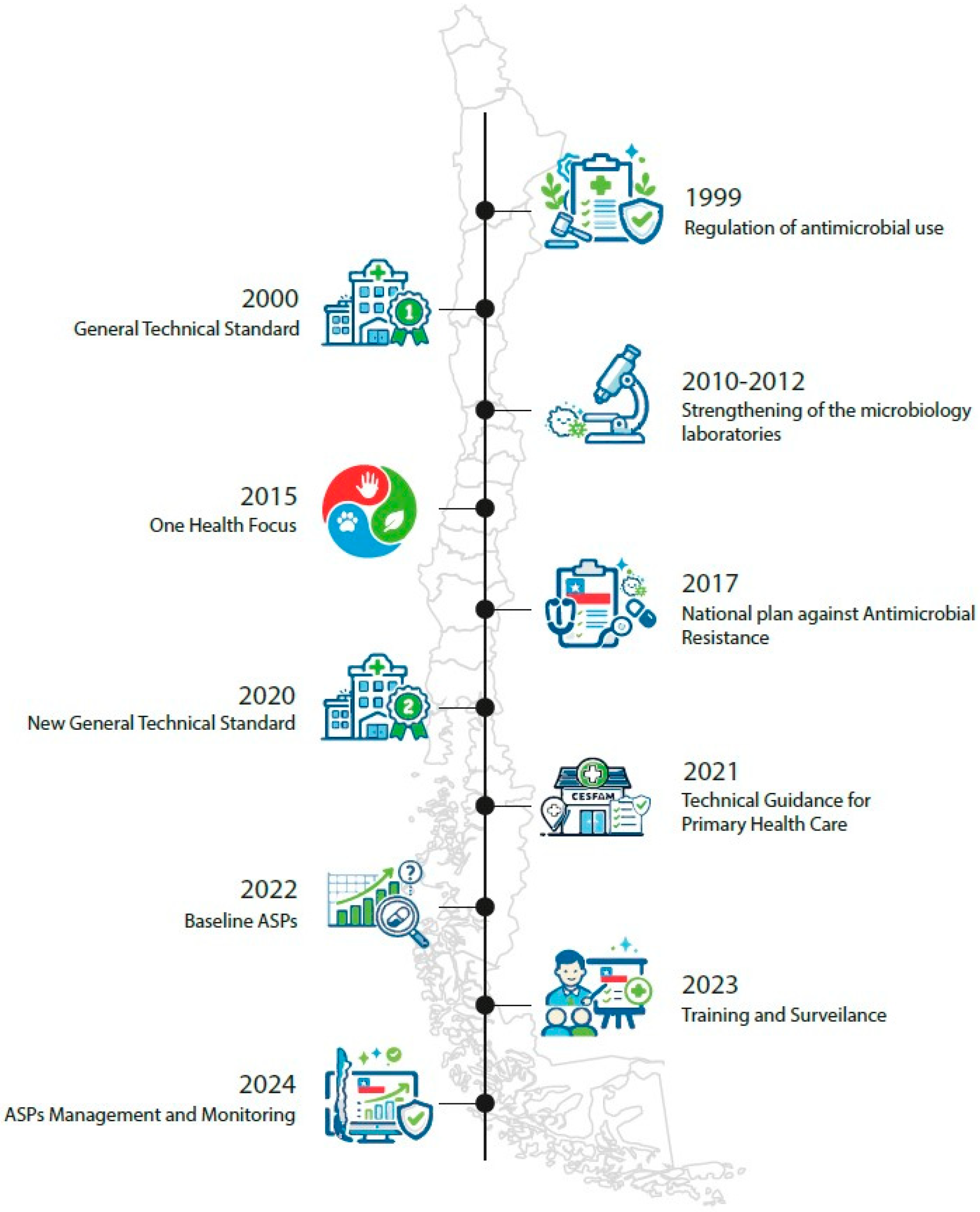


Antimicrobial Stewardship Programs in Chile: A Historical Overview



Abstract
1. Introduction
2. Results
2.1. Community Level
2.2. The One Health
- Livestock: The Agricultural and Livestock Service (SAG) is the authority responsible for regulating the use of veterinary medicines in livestock farming. Regulations have been established that restrict the use of certain antimicrobials, including the prohibition of those considered critically important for human health by the WHO, such as some third- and fourth-generation cephalosporins and quinolones. Through its regulatory framework and responsible use programs, it actively promotes the reduction in antimicrobial use, discouraging widespread and unjustified prophylactic antimicrobial use. The focus is on therapeutic and metaphylactic use based on veterinary diagnosis, limiting administration to healthy animals only to exceptional and highly justified circumstances, and always under veterinary prescription and with the obligation to declare such use. The primary objective is to preserve the efficacy of antimicrobials for human and animal health [19].
- Electronic Prescribing: A key measure is the creation of the Electronic Prescribing System for Veterinary Antimicrobials, which aims to monitor and control the use of these products, making it mandatory for veterinarians to declare usage and biomass [20].
- Aquaculture: In Chile, the National Fisheries and Aquaculture Service (SERNAPESCA) and the Undersecretariat of Fisheries and Aquaculture (SUBPESCA) are the main agencies responsible for regulating the use of antimicrobials in the aquaculture sector, with a special focus on the salmon farming industry. The regulations aim to ensure animal welfare and control the emergence of AMR. There is a “General Health Program for the Use of Antimicrobials in Salmon Farming and Other Farmed Fish,” which establishes guidelines for the use of these drugs. This program prohibits the use of antimicrobials for fattening, growth, or preventative purposes, with the exception of metaphylaxis when there is a high risk of disease spread [21]. There is also a Program for the Optimization of Antimicrobial Use [22], this program consists of a voluntary certification awarded by SERNAPESCA to salmon farms that optimize antimicrobial use within established limits or eliminate their use entirely throughout the production cycle. Production cycles certified under PROA-Salmon have demonstrated significantly lower antimicrobial consumption than the industry average.
- Small animals: According to data from the World Organization for Animal Health, small animals, such as cats and dogs, consume almost 30% of the antimicrobials prescribed for animals. For this reason, in 2019, the first intersectoral working group was established to address bacterial resistance in small animals, with participants from scientific and technical organizations related to small animal health and infectious diseases (FAVET, SOCHINF, ISP, SAG, COLMEVET), and veterinarians from various universities. This work resulted in the 2021 publication of the Manual of Good Practices in the Use of Antimicrobials in Small Animals [23,24].
2.3. Hospital Level
2.4. Training
2.5. Pharmacist
2.6. Laboratory
3. Discussion
4. Materials and Methods
5. Conclusions
Author Contributions
Funding
Institutional Review Board Statement
Informed Consent Statement
Data Availability Statement
Acknowledgments
Conflicts of Interest
Abbreviations
| ASP | Antimicrobial Stewardship Program |
| AMR | Antimicrobial resistance |
| WHO | World Health Organization |
| MINSAL | Ministry of Health |
| SOCHINF | Chilean Society of Infectious Diseases |
| SERNAC | National Consumer Service |
| SAG | Agricultural and Livestock Service |
| SERNAPESCA | National Fisheries and Aquaculture Service |
| SUBPESCA | Undersecretariat of Fisheries and Aquaculture |
| COMGES | Management Commitments |
| PAHO | Pan American Health Organization |
References
- European Centre for Disease Prevention and Control (ECDC); European Food Safety Authority (EFSA); European Medicines Agency (EMA). Antimicrobial consumption and resistance in bacteria from humans and food-producing animals. EFSA J. 2024, 22, 1–172. [Google Scholar]
- Dellit, T.H. Summary of the Infectious Diseases Society of America and the Society for Healthcare Epidemiology of America guidelines for developing an institutional program to enhance antimicrobial stewardship. Infect. Dis. Clin. Pract. 2007, 15, 263. [Google Scholar] [CrossRef]
- Fishman, N.; Patterson, J.; Saiman, L.; Srinivasan, A.; Trivedi, K.K.; van Schooneveld, T.; Lynfield, R.; Gerding, D.; Septimus, E.; Schwartz, D.; et al. Policy statement on antimicrobial stewardship by the Society for Healthcare Epidemiology of America (SHEA), the Infectious Diseases Society of America (IDSA), and the Pediatric Infectious Diseases Society (PIDS). Infect. Control Hosp. Epidemiol. 2012, 33, 322–327. [Google Scholar] [CrossRef]
- Barlam, T.F.; Cosgrove, S.E.; Abbo, L.M.; Macdougall, C.; Schuetz, A.N.; Septimus, E.J.; Srinivasan, A.; Dellit, T.H.; Falck-Ytter, Y.T.; Fishman, N.O.; et al. Implementing an antibiotic stewardship program: Guidelines by the Infectious Diseases Society of America and the Society for Healthcare Epidemiology of America. Clin. Infect. Dis. 2016, 62, e51–77. [Google Scholar] [CrossRef]
- World Health Organization. Antimicrobial Stewardship Programmes in Health-Care Facilities in Low-and Middle-Income Countries: A WHO Practical Toolkit; World Health Organization: Geneva, Switzerland, 2019; Available online: https://iris.who.int/server/api/core/bitstreams/e2e59ce4-c373-4066-9ff7-a0cce3e6ccdd/content (accessed on 25 October 2025).
- Bavestrello, L.; Cuéllar, L.; Esparza, G.; García, P.; Guzmán, M.; Levy, G.; Durand, C.G.; Quirós, R.; Villegas, M.V.; Zurita, J. Guía para la Implementación de un Programa de Optimización de Antimicrobianos (PROA) a Nivel Hospitalario. 2016. Available online: https://apiinfectologia.org/wp-content/uploads/2023/11/manual-PROA_2016.pdf (accessed on 26 October 2025).
- Abbo, L.; Bavestrello, L.; Castro, J.L.; Chinn, R.; Cedillos, R.; Dreser, A.; Esparza, G.; Forde, C.; Guzmán, M.; Hinrichsen, S.; et al. Recommendations for Implementing Antimicrobial Stewardship Programs in Latin America and the Caribbean: Manual for Public Health Decision-Makers; Pan American Health Organization: Washington, DC, USA; Florida International University: Washington, DC, USA, 2018; Available online: https://iris.paho.org/handle/10665.2/49645 (accessed on 25 October 2025)ISBN 978-92-75-12040-8.
- Pollack, L.A.; Srinivasan, A. Core elements of hospital antibiotic stewardship programs from the Centers for Disease Control and Prevention. Clin. Infect. Dis. 2014, 59, S97–S100. [Google Scholar] [CrossRef] [PubMed] [PubMed Central]
- Allel, K.; Peters, A.; Haghparast-Bidgoli, A.; Spencer-Sandino, M.; Conejeros, J.; Garcia, P.; Pouwels, K.B.; Yako, L.; Munita, J.M.; Undurragad, E.A. Excess burden of antibiotic-resistant bloodstream infections: Evidence from a multicentre retrospective cohort study in Chile, 2018–2022. Lancet Reg. Health Am. 2024, 40, 100943. [Google Scholar] [CrossRef] [PubMed] [PubMed Central]
- Antimicrobial Resistance Collaborators. The burden of antimicrobial resistance in the Americas in 2019: A cross-country systematic analysis. Lancet Reg. Health Am. 2023, 25, 100561, Erratum in Lancet Reg. Health Am. 2023, 28, 100632. https://doi.org/10.1016/j.lana.2023.100632. [Google Scholar] [CrossRef] [PubMed] [PubMed Central]
- Bavestrello, L.; Cabello, A. Impacto de un programa de control de uso de antimicrobianos. Rev. Chil. infectol. 2002, 19, 220–225. [Google Scholar] [CrossRef]
- Norma General Técnica No 43 Sobre Racionalización del Uso de Antimicrobianos en Atención Clínica. 2000. Available online: https://www.bcn.cl/leychile/navegar?i=153434 (accessed on 25 October 2025).
- Bavestrello, L.; Cabello, A. Community antibiotic consumption in Chile, 2000–2008. Rev. Chil. Infectol. 2011, 28, 107–112. [Google Scholar] [CrossRef]
- Plan Nacional Contra la Resistencia a los Antimicrobianos, Chile 2021–2025. Available online: https://diprece.minsal.cl/wp-content/uploads/2021/10/Plan-Nacional-Contra-la-Resistencia-a-los-Antimicrobianos-Chile-2021-2025.pdf (accessed on 28 October 2025).
- Subsecretaría de Salud Pública División de Prevención y Control de Enfermedades; Departamento de Enfermedades Transmisibles; MINSAL Gobierno de Chile. Orientación Técnica para el uso de Antibióticos en Infecciones Comunitarias de Manejo Ambulatorio. 2021. Available online: https://diprece.minsal.cl/wp-content/uploads/2021/10/Orientacion-Tecnica-para-el-uso-de-antibioticos-en-infecciones-comunitarias-de-manejo-ambulatorio-2021.pdf (accessed on 25 October 2025).
- MINSAL. D de ET. Orientaciones Técnicas Para la Instalación de los PROA en Atención Primaria, 2022. Subsecretaría de Salud Pública, División de Prevención y Control de Enfermedades. 2022. Available online: https://diprece.minsal.cl/wp-content/uploads/2022/02/RES.-EXENTA-N-199-Aprueba-orientaciones-tecnicas-sobre-instalacion-programa-optimizacion-uso-antimicrobianos-en-at.-primaria.pdf (accessed on 25 October 2025).
- Plan de Acción Mundial Sobre la Resistencia a los Antimicrobianos. Available online: https://iris.who.int/server/api/core/bitstreams/8558ccb1-e680-4c91-9dcf-a74f162ea031/content (accessed on 25 October 2025).
- MINSAL; ACHIPIA; SAG; SERNAPESCA; Sociedad Chilena de Infectología; Sociedad Chilena de Microbiología, Universidad de Chile; Universidad Austral de Chile; Universidad de Concepción UC de T. Plan Nacional Contra la Resistencia a los Antimicrobianos. 2017. Available online: https://diprece.minsal.cl/wrdprss_minsal/wp-content/uploads/2017/08/Plan-Nacional-contra-la-resistencia-a-los-antimicrobianos.pdf (accessed on 24 October 2025).
- Resolución 6801 Exenta Establece Requisitos para el Registro, Comercialización y Uso de Antimicrobianos. Biblioteca del Congreso Nacional de Chile. 2017. Available online: https://www.bcn.cl/leychile/navegar?i=1111125 (accessed on 26 October 2025).
- Resolución 4116 Exenta crea el Sistema para la Prescripción Electrónica de Antimicrobianos Veterinarios, Declaración de Uso de Antimicrobianos y de Biomasa, y Deroga Resolución Exenta No3.149/2023 de la Dirección Nacional SAG. Biblioteca del Congreso Nacional de Chile. 2023. Available online: https://www.bcn.cl/leychile/navegar?i=1194092 (accessed on 26 October 2025).
- Ministerio de Economía Fomento y Turismo; Subsecretaría de Pesca y Acuicultura; Servicio Nacional de Pesca y Acuicultura; Dirección Nacional. Resolución 2515 Exenta. Modifica Resoluciones Números 8.228 Exenta, de 2015, 67 y 71 Exentas, de 2003, que Aprueban Programas Sanitarios generales para Uso de Antimicrobianos en la Salmonicultura y Otros de Cultivo, de Manejo de Enfermedades y de Manejo de Alimentos, Respectivamente. Biblioteca del Congreso Nacional de Chile. 2018. Available online: https://www.bcn.cl/leychile/navegar?i=1120047 (accessed on 26 October 2025).
- Servicio Nacional de Pesca y Acuicultura. Programa para la Optimización del uso de Antimicrobianos: Certificación Proa-Salmón. Available online: https://www.sernapesca.cl/manuales_y_publicaciones/programa-para-la-optimizacion-del-uso-de-antimicrobianos-certificacion-proa-salmon/ (accessed on 20 November 2025).
- Galarce, N.; Pavez, D.; Pinto, M.E. Intersectoral task force is established to face bacterial resistance in small animals. Rev. Chil. Infectol. 2019, 36, 245. [Google Scholar] [CrossRef]
- Colegio Médico de Veterinarios de Chile, A.G. Buenas prácticas en el Uso de Antimicrobianos en Animales Pequeños. Parte I: Conceptos Generales. COLMEVET. 2021. Available online: https://colmevet.cl/storage/documentos/July2021/4LSRCMV4sGPasmacgKhL.pdf (accessed on 26 October 2025).
- Cabrera, S.; Sosa, L.; Areta, Z.; Seija, V.; Mateos, S.; Perna, A.; Firpo, M.; Pereira, G.; Lombardo, G.; Añón, X.; et al. Uso racional de antimicrobianos en el departamento de medicina interna de un hospital universitario: Resultados de una experiencia piloto. Rev. Chil. Infect. 2012, 29, 7–13. [Google Scholar] [CrossRef] [PubMed]
- Fica, A.; Cabello, A.; Juliet, C.; Prado, P.; Bavestrello, L. Consumo de antimicrobianos parenterales en diferentes hospitales de Chile durante el año 2005. Rev. Chil. Infect. 2008, 25, 419–427. [Google Scholar] [CrossRef][Green Version]
- Ministerio de Salud. Resolución Exenta No1146 que Aprueba “Norma General Técnica No210 para la Racionalización del Uso de Antimicrobianos en la Atención Clínica”. 2020. Available online: https://diprece.minsal.cl/wp-content/uploads/2021/01/RES.-EXENTA-N°1146-Aprueba-Norma-Gral.-Técnica-N°0210-para-la-racionalización-del-uso-de-antimicrobianos-en-la-Atención-Clínica_v2.pdf (accessed on 24 October 2025).
- Herrera, T.; Rosales, R. Programa de Optimización de uso de Antimicrobianos Informe de Situación Basal en Hospitales de alta y Mediana Complejidad. 2022. Available online: https://diprece.minsal.cl/wp-content/uploads/2022/06/Informe-de-situacion-de-PROGRAMA-DE-OPTIMIZACION-DE-USO-DE-ANTIMICROBIANOS-PROA.pdf (accessed on 26 October 2025).
- Cid, S.; Catalán, M.J.; Astorga, L.; Cocio, A.; Esturillo, C.; Fernández, V.; Salgado, C.; Departamento de Control de Gestión; Gabinete S de RA; Ministerio de Salud. Instrumento de Evaluación Compromisos de Gestión 2024. Available online: https://es.scribd.com/document/721140118/Orientaciones-Te-cnicas-Compromisos-de-Gestio-n-An-o-2024-Version-1-0-2 (accessed on 25 October 2025).
- Cofré, M.; Herrera, T.; Ministerio de Salud G de C. Programas de Optimización de Uso de Antimicrobianos Informe COMGES 2024. Available online: https://diprece.minsal.cl/wp-content/uploads/2025/04/2025.04.11_INFORME-COMGES-2024-USO-ANTIMICROBIANOS.pdf (accessed on 25 October 2025).
- Moreno, M.V.; Amador, R.; Vargas, J.; Bugarin, G.; Flores, R. Quantitative analysis of the implementation status of rational antimicrobial use programs in public institutions in Chile. Rev. Chil. Infectol. 2025, 42, 7–20. [Google Scholar] [CrossRef]
- Informe de Vigilancia de consumo de antimicrobianos Plan Nacional contra la Resistencia a los Antimicrobianos Chile 2025. Available online: https://diplas.minsal.cl/wp-content/uploads/2026/02/INFORME-DE-CONSUMO-DE-ANTIMICROBIANOS-2022-2024.pdf (accessed on 17 February 2026).
- United Nations General Assembly (UNGA). World Leaders Commit to Decisive Action on Antimicrobial Resistance. 26 September 2024. Available online: https://www.who.int/news/item/26-09-2024-world-leaders-commit-to-decisive-action-on-antimicrobial-resistance (accessed on 26 October 2025).
- Labarca, J. Grupo Colaborativo de Resistencia Bacteriana. Mucho más que 10 años de historia. Rev. Chil. Infectol. 2014, 31, 121–122. [Google Scholar] [CrossRef]
- Lichtenberger, P.; Levy-hara, G.; Rojas-Cortés, R.; Orjuela, T.; Diaz-Madriz, J.P.; Ramon-Pardo, P.; Bustos, J.L.; Dreser, A.; Herrera, T.; Rojas-Díaz, M.P. Point Prevalence Survey of Antibiotic Use in Latin American Hospitals: 2022–2023. Antibiotics 2025, 14, 1078. [Google Scholar] [CrossRef]
- OPS. Curso Para la Implementacion de los Programa de Optimizacion de uso de Antimicrobianos (PROA) en Chile. 2023. Available online: https://campus.paho.org/chile/curso/curso-para-la-implementacion-de-los-programa-de-optimizacion-de-uso-de-antimicrobianos-proa (accessed on 25 October 2025).
- Subsecretaría de Salud Pública; MINSAL gobierno de Chile. Resolución Exenta 1045 del 24-07-2024: Crea Grupo Asesor del MINSAL para Programas de Optimización de uso de Antimicrobianos. Available online: https://diprece.minsal.cl/wp-content/uploads/2024/12/RES.-EXENTA-N°1045_24-07-2024_Crea-Grupo-Asesor-del-Minsal-para-Programas-de-Optimizacion-de-uso-de-Antimicrobianos.pdf (accessed on 25 October 2025).
- Lambert, M.; van Dijk, L.; Benko, R.; Llor, C.; Lykkegaard, J.; Mantel-Teeuwisse, A.K.; Pont, L.; Taxis, K. The role of the community pharmacist in antibiotic use—A commentary on current status and future perspectives. Explor. Res. Clin. Soc. Pharm. 2025, 20, 100652. [Google Scholar] [CrossRef]
- Bessnier, C.; Cienfuegos, J. Servicios Farmacéuticos en los tipos de farmacias en Chile. Cuad. Médicos Soc. 2023, 63, 65–69. [Google Scholar] [CrossRef]
- Nampoothiri, V.; Hisham, M.; Mbamalu, O.; Mohamed, Z.U.; Singh, S.K.; Charani, E. Evolution of pharmacist roles in antimicrobial stewardship: A 20-year systematic review. Int. J. Infect. Dis. 2025, 151, 107306. [Google Scholar] [CrossRef] [PubMed]
- Palavecino, E.L.; Williamson, J.C.; Ohl, C.A. Collaborative Antimicrobial Stewardship: Working with Microbiology. Infect. Dis. Clin. N. Am. 2020, 34, 51–65. [Google Scholar] [CrossRef]
- Bou, B.; Cantón, R.; Martínez-Martínez, L.; Navarro, D.; Vila, J. Fundamentos e implementación de Programas de Optimización de Diagnóstico Microbiológico. Enferm. Infecc. Microbiol. Clin. 2021, 39, 248–251. [Google Scholar] [CrossRef]
- Morgan, D.J.; Malani, P.; Diekema, D.J. Diagnostic Stewardship—Leveraging the Laboratory to Improve Antimicrobial Use. JAMA 2017, 318, 607–608. [Google Scholar] [CrossRef]
- Hindler, J.A.; Simner, P.J. CLSI M39 Analysis and Presentation of Cumulative Antimicrobial Susceptibility Test Data. Available online: https://clsi.org/shop/standards/m39/ (accessed on 20 November 2025).
- Benadof, D.; San-Martín, M.; Pidal, P.; Sakurada, A.; Silva, F.; Tapia, C.; Ulloa, M.T.; Vecchiola, M.; Camponovo, R. Recomendaciones para el análisis de datos acumulados de susceptibilidad antimicrobiana en instituciones de salud. Rev. Chil. Infectol. 2010, 27, 126–132. [Google Scholar][Green Version]
- Reglamento del Sistema de Acreditación para los Prestadores Institucionales de Salud. Biblioteca del Congreso Nacional de Chile. 2007. Available online: https://www.ispch.cl/sites/default/files/decreto_15_reglamento_sistema_acreditacion.pdf (accessed on 26 October 2025).
- Fernandez, J.; Vásquez, F. The Importance of Cumulative Antibiograms in Diagnostic Stewardship. Clin. Infect. Dis. 2019, 69, 1086–1087. [Google Scholar] [CrossRef] [PubMed]
- Cornejo, J.; Cabezón, C.; San-Martín, B.; Lapierre, L. Assessment of Consumer Perceptions on the Use of Antimicrobials in Production Animals in Chile. J. Food Prot. 2018, 81, 1331–1338. [Google Scholar] [CrossRef] [PubMed]
- The Core Elements of Hospital Antibiotic Stewardship Programs: 2019. Available online: https://www.cdc.gov/antibiotic-use/media/pdfs/hospital-core-elements-508.pdf (accessed on 16 February 2026).
- EU Action on Antimicrobial Resistance. Available online: https://health.ec.europa.eu/antimicrobial-resistance/eu-action-antimicrobial-resistance_en (accessed on 16 February 2026).

Disclaimer/Publisher’s Note: The statements, opinions and data contained in all publications are solely those of the individual author(s) and contributor(s) and not of MDPI and/or the editor(s). MDPI and/or the editor(s) disclaim responsibility for any injury to people or property resulting from any ideas, methods, instructions or products referred to in the content. |
© 2026 by the authors. Licensee MDPI, Basel, Switzerland. This article is an open access article distributed under the terms and conditions of the Creative Commons Attribution (CC BY) license.
Share and Cite
Acuña, M.; Herrera, T.; Benadof, D.; Pavez, D.; Bavestrello, L.; Rosales, R. Antimicrobial Stewardship Programs in Chile: A Historical Overview. Antibiotics 2026, 15, 247. https://doi.org/10.3390/antibiotics15030247
Acuña M, Herrera T, Benadof D, Pavez D, Bavestrello L, Rosales R. Antimicrobial Stewardship Programs in Chile: A Historical Overview. Antibiotics. 2026; 15(3):247. https://doi.org/10.3390/antibiotics15030247
Chicago/Turabian StyleAcuña, Mirta, Tania Herrera, Dona Benadof, Daniela Pavez, Luis Bavestrello, and Ruth Rosales. 2026. "Antimicrobial Stewardship Programs in Chile: A Historical Overview" Antibiotics 15, no. 3: 247. https://doi.org/10.3390/antibiotics15030247
APA StyleAcuña, M., Herrera, T., Benadof, D., Pavez, D., Bavestrello, L., & Rosales, R. (2026). Antimicrobial Stewardship Programs in Chile: A Historical Overview. Antibiotics, 15(3), 247. https://doi.org/10.3390/antibiotics15030247