A Rare Intruder: Neonatal Meningoencephalitis by Edwardsiella tarda Requiring Systemic and Intrathecal Antibiotics and Repeated Neurosurgery

 , , , , , , and
Abstract
1. Introduction
2. Case Presentation
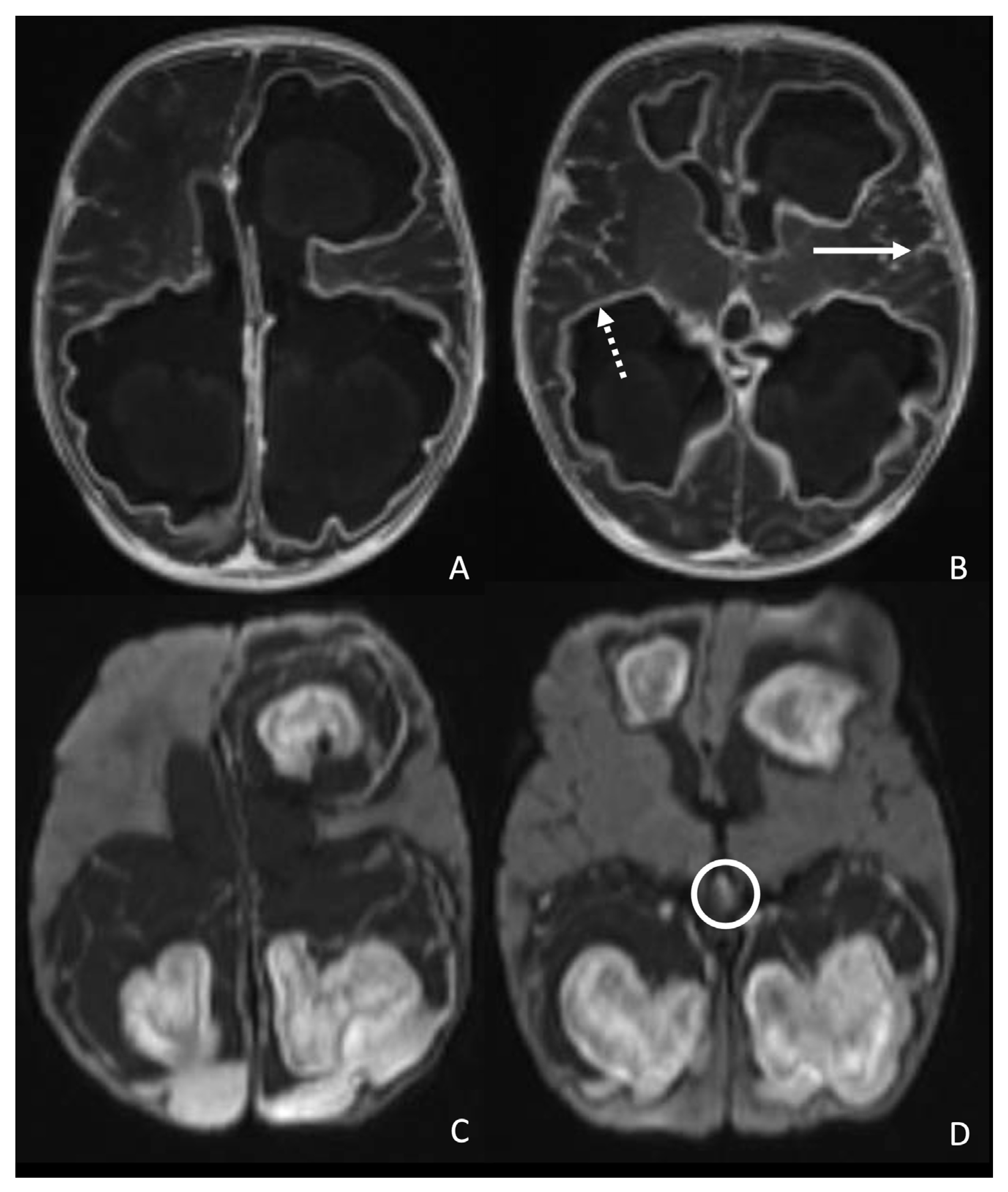
2.1. Edwardsiella Tarda Infection
2.2. Neurosurgical Interventions
2.3. Systemic and Intrathecal Antibiotic Treatment
2.4. Further Management and Follow-Up
3. Materials and Methods
4. Results
5. Discussion
6. Conclusions
Author Contributions
Funding
Institutional Review Board Statement
Informed Consent Statement
Data Availability Statement
Acknowledgments
Conflicts of Interest
Abbreviations
| ABR | Auditory Brainstem Response |
| CNS | Central Nervous System |
| CSF | Cerebrospinal Fluid |
| CT | Computed Tomography |
| DWI | Diffusion-Weighted Imaging |
| EEG | Electroencephalography |
| IgA | Immunoglobulin A |
| IgE | Immunoglobulin E |
| IgG | Immunoglobulin G |
| IgM | Immunoglobulin M |
| MRI | Magnetic Resonance Imaging |
| MPRAGE | Magnetization Prepared Rapid Gradient Echo |
| NICU | Neonatal Intensive Care Unit |
| PCR | Polymerase Chain Reaction |
| PMN | Polymorphonuclear Neutrophils |
| rRNA | Ribosomal Ribonucleic Acid |
| T2-WI | T2-Weighted Imaging |
| TEOAE | Transient-Evoked Otoacoustic Emissions |
| WM | White Matter |
References
- Janda, J.M.; Abbott, S.L. Infections associated with the genus Edwardsiella: The role of Edwardsiella tarda in human disease. Clin. Infect. Dis. 1993, 17, 742–748. [Google Scholar] [CrossRef] [Scilit]
- Chida, R.; Iio, K.; Kaizuka, H.; Hirai, Y.; Ishida, Y.; Yamanaka, G. Chronic Diarrhea Associated with Edwardsiella tarda Gastroenteritis: A Case Report and Literature Review. Pediatr. Infect. Dis. J. 2022, 41, e440–e442. [Google Scholar] [CrossRef] [Scilit] [PubMed]
- Hasegawa, K.; Kenya, M.; Suzuki, K.; Ogawa, Y. Characteristics and prognosis of patients with Edwardsiella tarda bacteremia at a single institution, Japan, 2005–2022. Ann. Clin. Microbiol. Antimicrob. 2022, 21, 56. [Google Scholar] [CrossRef] [Scilit] [PubMed]
- Vohra, K.; Torrijos, E.; Jhaveri, R.; Gordon, H. Neonatal sepsis and meningitis caused by Edwardsiella tarda. Pediatr. Infect. Dis. J. 1988, 7, 814–815. [Google Scholar] [CrossRef] [Scilit] [PubMed]
- Mowbray, E.E.; Buck, G.; Humbaugh, K.E.; Marshall, G.S. Maternal colonization and neonatal sepsis caused by Edwardsiella tarda. Pediatrics 2003, 111, e296–e298. [Google Scholar] [CrossRef] [Scilit]
- Geibel, E.M.; Pearce, M.R.; Zabrocki, L.; Thompson, C. Neonatal sepsis with meningitis, ventriculitis and brain abscess caused by Edwardsiella tarda. BMJ Case Rep. 2024, 17, 2022–2025. [Google Scholar] [CrossRef] [Scilit]
- Hashavya, S.; Averbuch, D.; Berger, I.; Ofek-Shlomai, N.; Pitashny, M.; Hidalgo, C.; Ergaz, Z. Neonatal sepsis following maternal amnionitis by Edwardsiella tarda: A case report and a review of the literature. Eur. J. Pediatr. 2011, 170, 111–113. [Google Scholar] [CrossRef] [Scilit]
- Okubadejo, O.A.; Alausa, K.O. Neonatal Meningitis Caused by Edwardsiella tarda. BMJ 1968, 3, 357–358. [Google Scholar] [CrossRef] [Scilit]
- Takeuchi, H.; Fujita, Y.; Ogawa, H.; Shiomi, K.; Toyokawa, Y.; Yamamoto, T.; Furukawa, T.; Ebisu, T. Multiple brain abscesses in neonate caused by Edwardsiella tarda-case report. Neurol. Med. Chir. 2009, 49, 85–89. [Google Scholar] [CrossRef] [Scilit]
- Miyazawa, Y.; Murakami, K.; Kizaki, Y.; Itaya, Y.; Takai, Y.; Seki, H. Maternal peripartum septic shock caused by intrauterine infection with Edwardsiella tarda: A case report and review of the literature. J. Obstet. Gynaecol. Res. 2018, 44, 171–174. [Google Scholar] [CrossRef] [Scilit]
- Higashigawa, M.; Ito, M.; Nashida, Y. Edwardsiella tarda is an Important Causative Agent of Maternal-Fetal Infections in Pregnant Women: A Case Report and Japanese Literature Review. Jpn. J. Infect. Dis. 2023, 76, 80–83. [Google Scholar] [CrossRef] [Scilit]
- Kadam, S.D. Edwardsiella tarda—A case report. Indian J. Pediatr. 2013, 80, 63–64. [Google Scholar] [CrossRef] [Scilit]
- Egashira, M.; Higuchi, N.; Shichijo, A.; Egashira, T.; Takayanagi, T. Early-onset Edwardsiella tarda septicemia in an extremely preterm infant. Pediatr. Int. 2020, 62, 860–861. [Google Scholar] [CrossRef] [Scilit]
- Tan, Y.P.; Zheng, J.; Tung, S.L.; Rosenshine, I.; Leung, K.Y. Role of type III secretion in Edwardsiella tarda virulence. Microbiology 2005, 151, 2301–2313. [Google Scholar] [CrossRef] [Scilit]
- Leung, K.Y.; Siame, B.A.; Tenkink, B.J.; Noort, R.J.; Mok, Y.K. Edwardsiella tarda—Virulence mechanisms of an emerging gastroenteritis pathogen. Microbes Infect. 2012, 14, 26–34. [Google Scholar] [CrossRef] [Scilit]
- Xie, H.X.; Lu, J.F.; Rolhion, N.; Holden, D.W.; Nie, P.; Zhou, Y.; Yu, X.J. Edwardsiella tarda-Induced cytotoxicity depends on its type III secretion system and flagellin. Infect. Immun. 2014, 82, 3436–3445. [Google Scholar] [CrossRef] [Scilit] [PubMed]
- An, L.; Chan, J.L.; Nguyen, M.; Yang, S.; Deville, J.G. Case Report: Disseminated Edwardsiella tarda infection in an immunocompromised patient. Front. Cell. Infect. Microbiol. 2023, 13, 1292768. [Google Scholar] [CrossRef] [Scilit] [PubMed]
- Barcellini, L.; Ricci, G.; Bresesti, I.; Piazza, A.; Comandatore, F.; Sharland, M.; Zuccotti, G.V.; Folgori, L. The Role of Virulence Factors in Neonatal Sepsis Caused by Enterobacterales: A Systematic Review. Int. J. Mol. Sci. 2022, 23, 11930. [Google Scholar] [CrossRef] [Scilit] [PubMed]
- Kamiyama, S.; Kuriyama, A.; Hashimoto, T. Edwardsiella tarda Bacteremia, Okayama, Japan, 2005–2016. Emerg. Infect. Dis. 2019, 25, 1817–1823. [Google Scholar] [CrossRef] [Scilit]
- Brouwer, M.C.; Tunkel, A.R.; McKhann, G.M., 2nd; van de Beek, D. Brain abscess. N. Engl. J. Med. 2014, 371, 447–456. [Google Scholar] [CrossRef] [Scilit]
- Schiller, A.; Saidouni, A.; Mahrous, H.; Elhakim, M.; Elkholy, A. One Health best practices for addressing health threats at the human-animal-environment interface, with focus on the Eastern Mediterranean Region. Trans. R. Soc. Trop. Med. Hyg. 2025, 30, traf117. [Google Scholar] [CrossRef] [Scilit] [PubMed]


| Antibiogram | RSI | MIC | Break Point MIC |
|---|---|---|---|
| Amikacin | S | 4 | 8 |
| Amoxicillin/clavulanic acid | ≤2 | ||
| Cefepime | S | ≤0.12 | |
| Ceftazidime | S | ≤0.12 | 1 |
| Colistin | R | 16 | 2 |
| Ertapenem | S | ≤0.12 | 0.5 |
| Gentamicin | S | ≤1 | 2 |
| Meropenem | S | ≤0.12 | 2 |
| Trimethoprim/sulfamethoxazole | S | ≤20 | 40 |
| Piperacillin/tazobactam | S | ≤4 | 8 |
| Tigecycline | ≤0.5 | ||
| Ceftazidime/avibactam | S | ≤0.25 | |
| Ceftozolane/tazobactam | S | ≤0.25 | |
| Tobramycin | S | ≤0.5 | 2 |
| Imipenem/relebactam | S | 0.12 | |
| Meropenem/vaborbactam | S | ≤0.06 |
| Author, Year | Gestational Age (weeks)/Birthweight (Grams) | Onset | Delivery Type | Neonatal Clinical Features | Neonatal Management | Positive Cultures for E. tarda | Maternal History | Neurological Outcome of the Child |
|---|---|---|---|---|---|---|---|---|
| Okubadejo and Alausa, 1968 [8] | Term/NA | Day 10 | Vaginal | Poor suckling, loss of weight, fever, with fatal septicemia and meningitis/At autopsy the brain was soft, with a collection of 50 mL of mucopurulent fluid over the surface, meningitis and hydrocephalus | Penicillin, Chloramphenicol, sulphadiazine. After 2 days of unsettled fever, streptomycin was added. Then colistin was given for fever resurgence. Not reported antibiotics-related adverse events. | Positive CSF culture for E. tarda | Unregistered | Death after 4 weeks of hospitalization |
| Vohra et al., 1988 [4] | 33 wks/1820 g | Day 3 | Vaginal | Jaundice, lethargy, hypotonus, sudden apneic spell with cyanosis and bradycardia, hypotension requiring resuscitation/At autopsy the lungs were congested with petechial hemorrhage; hemorrhage was seen in the adrenals, cerebellum and stomach mucosa. There were meningeal congestion and intraventricular hemorrhage with extension into the white matter. | One dose of aqueous penicillin G and gentamycin. Not reported antibiotics-related adverse events. | E. tarda isolated in Columbia broth from post-mortem spinal fluid, blood, brain and heart; the organism was susceptible in vitro to ampicillin, cefazolin, cefoxitin, tetracycline, gentamicin, amikacin and trimethoprim-sulfamethoxazole | Hypertension during the third trimester and self-limited diarrhea 5 days before delivery; Amniotic fluid was clear | Death after 3 h since cardiorespiratory symptoms |
| Mowbray et al., 2003 [5] | Term/NA | Day 6 | Vaginal | Lethargy, poor feeding, sepsis, jaundice | Ampicillin + gentamicin (5 d) → ampicillin alone (5 d); NICU support care. Not reported antibiotics-related adverse events. | Blood (infant), stool & vaginal swab (mother); identical by rep-PCR | Immersion in freshwater lake at 6 months gestation; maternal swabs for E. tarda | Right-sided profound hearing loss |
| Takeuchi et al., 2009 [9] | Term/NA | ~6 h | Vaginal | High fever (38.9 °C), vomiting, moaning, low oxygen saturation (80%), feeding refusal; multiple brain abscesses and cerebritis requiring external drainage of the abscesses; post-encephalitis hydrocephalus requiring ventriculoperitoneal shunt | Cefotaxime + Ampicillin (11 days) → Meropenem (38 days). Not reported antibiotics-related adverse events. | Likely intrauterine infection; no maternal vaginal culture evidence; E. tarda identified from the cultured pus of brain abscesses (infant) | No raw fish consumption; no association with marine or water immersion | Normal developmental milestones, attending kindergarten |
| Hashavya et al., 2011 [7] | 37 wks/3245 g | ~12 h | Vaginal | Sepsis, seizures, cerebral edema, cystic brain lesions | Gentamicin + cefotaxime, phenobarbital. Not reported antibiotics-related adverse events. | Blood (infant), vaginal swab (mother) | Fever, foul-smelling amniotic fluid, chorioamnionitis; swam in Sea of Galilee | Severe cerebral palsy with spastic quadriplegia, microcephaly |
| Kadam, 2013 [12] | 30 wks/1100 g | Day 4 | Vaginal (home birth) | Sepsis, omphalitis, altered sensorium, respiratory failure | Ceftizoxime + amikacin → meropenem. Not reported antibiotics-related adverse events. | Blood | Unregistered, no antenatal care; cow dung on umbilicus; goat/cow milk feeding | Death within 24 h |
| Miyazawa et al., 2018 [10] | 40 wks/3173 g | Birth | Cesarean (emergency) | Hypoxic–ischemic encephalopathy, multicystic encephalomalacia | NICU support care; therapeutic hypothermia; meropenem → ceftazidime. Not reported antibiotics-related adverse events. | Skin, pharynx, gastric fluid (infant); wound & hematoma (mother) | Chorioamnionitis, septic shock, wound abscess with E. tarda | Cerebral palsy (follow-up) |
| Egashira et al., 2020 [13] | 27 wks/1014 g | Day 0 | Vaginal | Sepsis, pulmonary hemorrhage, cerebral hemorrhage | Ampicillin/sulbactam (10 d) + cefotaxime (21 d), intravenous immunoglobulins. Not reported antibiotics-related adverse events. | Cord blood, amniotic fluid, maternal blood, nasal swab | Fever/chills before delivery; septicemia diagnosed; no raw fish exposure | Post-hemorrhagic cyst; no palsy |
| Higashigawa et al., 2023 [11] | 37 wks/NA | /NA | Vaginal | Fever, jaundice, poor suckling, intracranial hemorrhage (intraventricular and subarachnoid hemorrhage), meningitis (CSF: 4773 WBCs/µL, 54 mg/dL protein, 60 mg/dl glucose) | Ampicillin/cloxacillin and cefotaxime for 3 weeks. Not reported antibiotics-related adverse events. | Detected via broad-range PCR targeting 16S rRNA gene and Basic Local Alignment Search Tool (BLAST) analysis; conventional cultures were negative | History of eating raw sweetfish (ayu) at 34 weeks of gestation; mild diarrhea 1 day before delivery (stool culture not performed); vaginal cultures negative for Streptococcus agalactiae, with premature rupture of membranes for 34 h | No neurological sequelae |
| Geibel et al., 2024 [6] | Term/NA | Day 3 | Vaginal | Sepsis, seizures, meningitis, ventriculitis, brain abscess, hydrocephalus, venous thrombosis | Ampicillin + gentamicin → vancomycin + cefepime, abscess drainage, shunt, anticoagulation, seizure control. Not reported antibiotics-related adverse events. | Blood, CSF, middle ear fluid | Maternal endometritis; 12 h rupture of membranes; 4 fish tanks at home | Mild motor delay, ventriculomegaly at 2 yrs |
| De Rose et al., 2025 (present study) | 38 wks/NA | ~18 h | Vaginal | Sepsis, severe meningoencephalitis, brain abscesses requiring 3 neurosurgery interventions and shunt | Initial: Ampicillin + gentamicin + ceftriaxone → Meropenem + trimethoprim-sulfamethoxazole; intrathecal gentamicin (about 6 weeks). Not reported antibiotics-related adverse events. | Blood + CSF (infant), stool (mother) | Recurrent gastroenteritis in pregnancy; positive maternal stool for E. tarda | Ongoing follow-up: mild motor delay with lower limb hypertonia at 6 months; post-infectious hydrocephalus |
Disclaimer/Publisher’s Note: The statements, opinions and data contained in all publications are solely those of the individual author(s) and contributor(s) and not of MDPI and/or the editor(s). MDPI and/or the editor(s) disclaim responsibility for any injury to people or property resulting from any ideas, methods, instructions or products referred to in the content. |
© 2026 by the authors. Licensee MDPI, Basel, Switzerland. This article is an open access article distributed under the terms and conditions of the Creative Commons Attribution (CC BY) license.
Share and Cite
De Rose, D.U.; Martini, L.; Campi, F.; Longo, D.; Guarnera, A.; Lucignani, G.; Conti, M.; Santisi, A.; Nucci, C.G.; Esposito, G.; et al. A Rare Intruder: Neonatal Meningoencephalitis by Edwardsiella tarda Requiring Systemic and Intrathecal Antibiotics and Repeated Neurosurgery. Antibiotics 2026, 15, 59. https://doi.org/10.3390/antibiotics15010059
De Rose DU, Martini L, Campi F, Longo D, Guarnera A, Lucignani G, Conti M, Santisi A, Nucci CG, Esposito G, et al. A Rare Intruder: Neonatal Meningoencephalitis by Edwardsiella tarda Requiring Systemic and Intrathecal Antibiotics and Repeated Neurosurgery. Antibiotics. 2026; 15(1):59. https://doi.org/10.3390/antibiotics15010059
Chicago/Turabian StyleDe Rose, Domenico Umberto, Ludovica Martini, Francesca Campi, Daniela Longo, Alessia Guarnera, Giulia Lucignani, Marta Conti, Alessandra Santisi, Carlotta Ginevra Nucci, Giacomo Esposito, and et al. 2026. "A Rare Intruder: Neonatal Meningoencephalitis by Edwardsiella tarda Requiring Systemic and Intrathecal Antibiotics and Repeated Neurosurgery" Antibiotics 15, no. 1: 59. https://doi.org/10.3390/antibiotics15010059
APA StyleDe Rose, D. U., Martini, L., Campi, F., Longo, D., Guarnera, A., Lucignani, G., Conti, M., Santisi, A., Nucci, C. G., Esposito, G., Romani, L., Bernaschi, P., Goffredo, B. M., Scarpelli, G., Lancella, L., Dotta, A., & Ronchetti, M. P. (2026). A Rare Intruder: Neonatal Meningoencephalitis by Edwardsiella tarda Requiring Systemic and Intrathecal Antibiotics and Repeated Neurosurgery. Antibiotics, 15(1), 59. https://doi.org/10.3390/antibiotics15010059