Lipopeptide Engineering: From Natural Origins to Rational Design Against Antimicrobial Resistance



Abstract
1. Introduction
1.1. Structural Composition and Biological Function of LPs
1.2. Advantages of LPs Targeting MDR Bacteria
1.3. Innovative Strategies for LP Optimization
2. Renewal and Upgrading of LPs
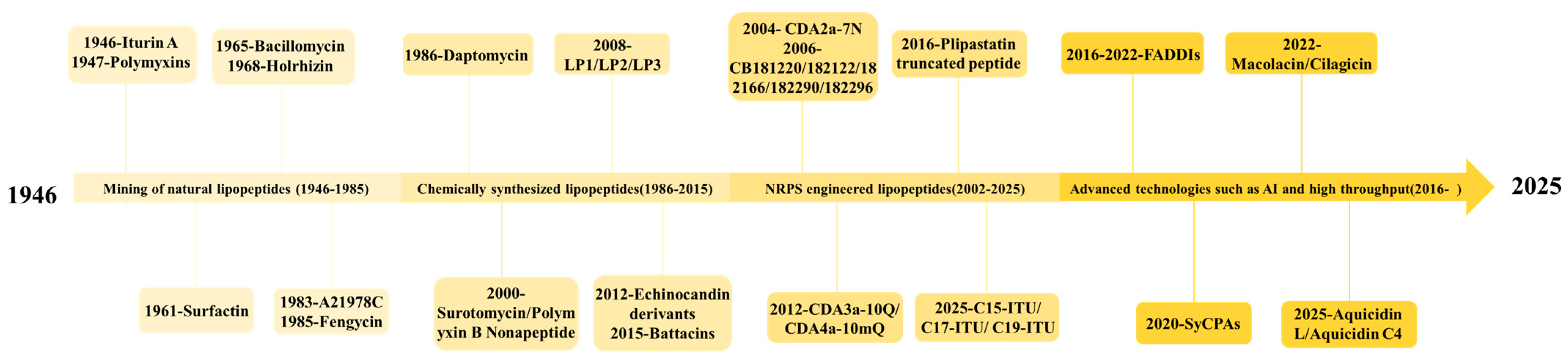
2.1. Discovery of Natural LPs

| Polymyxin Derivatives | Structure | MIC (μg/mL) | Cytotoxicity (μg/mL) | References | |||
|---|---|---|---|---|---|---|---|
| K. pneumoniae | A. baumannii | P. aeruginosa | E. coli | ||||
| Polymyxin A/B/D/E/M/S |  | 0.25–2 | 0.06–2 | 0.5–4 | 0.5–2 | 33–500 | [32] |
| Colistin |  | N.D. | N.D. | 0.25–2 | N.D. | N.D. | [33,34] |
| SPR741 |  | >64 | 64 | 32 | 32 * | N.D. | [35] |
| KA1 |  | 1 | 1 | N.D. | 1 | >16 | [36] |
| KA2 |  | ||||||
| FADDI-287 |  | 64 (64) * | 16 (8) * | 64 (32) * | 8 (64) * | N.D. | [37] |
| FADDI-002 |  | 0.25 (0.25) | 0.5 (16) * | 0.25–1 (32–64) * | 1–2 (0.125–2) * | ≈1280 | [33] |
| FADDI-003 |  | N.D. | 2–16 | N.D. | N.D. | N.D. | [38] |
| CA824 |  | N.D. | N.D. | N.D. | N.D. | 148 | [31] |
| NAB739 |  | 2–4 (0.5–1) | 1–8 (0.5–1) | 16 (2) | 0.5–2 (0.25–1) | 237 | [39,40] |
| NAB815 |  | 2–8 (0.5–1) | 0.5–4 (0.5–1) | 64 (2) | 0.5–4 (0.25–1) | 334 | [40] |
| SPR206 (Upleganan) |  | N.D. | 0.03–4 * (0.5–256) | N.D. | N.D. | N.D. | [34] |
| MRX-8 | N.D. | 0.12 | 0.5 | 0.5 | 0.12 | N.D. | [41,42] |
| Disulfide-linked analog 18b |  | 0.25 (0.25) | 0.25–1 (0.25) | 1 (0.5–1) | 1 (1) | 192 μM (41 μM) | [43] |
| Non-disulfide containing analog 45 |  | ≤0.25 (0.25) | 0.25–0.5 (0.25) | 1 (0.5–1) | 1 (1) | 82 μM (41 μM) | [43] |
| EB12 |  | N.D. | N.D. | 2 (0.25–1) | 32 (1) | >150 | [44] |
| EB13 |  | ||||||
| CEP936 |  | N.D. | N.D. | 0.5–32/0.25–8 (0.125–64) * | N.D. | N.D. | [45] |
| CEP938 |  | ||||||
| Semisynthetic LP derivative-5 v |  | 1 (1) | 0.125 (0.25) | 0.25 (0.5) | 0.25 (0.125) | >300 | [46] |
| Polymyxin-N-terminal | N.D. | 8 -> 64 (0.25) | 0.5–4 (16) * | 16 -> 64 (32–64) * | 4–32 (0.125–2) * | <450 (>1280) | [33] |
| Polymyxin-P6/P7 | N.D. | <0.125–16 (0.25) | <0.25–32 (16) * | 0.125–2 (32–64) * | <0.125–16 (0.125–2) * | <450 (>1280) | [33] |
| Bip-macolacin |  | 2–4 (0.25) | 0.25–0.5 (16) * | 1–2 (32–64) * | 4–8 (0.125–2) * | >1280 | [33] |
2.2. Limitations of Existing LPs
2.3. Novel LPs Based on New Methods
| Year | Representative LPs | Source | Major Function | Mechanism of Action | Limitations | References |
|---|---|---|---|---|---|---|
| 1946 | Iturins | Bacillus subtilis | Anti-G+ Anti-fungal | Binds to ergosterol in the fungal CM via β-amino acid chains, forming ion channels that disrupt membrane integrity | Hemolytic | [82,83] |
| 1947 | Colistins/Polymyxins | Paenibacillus polymyxa | Anti-G− | Positively charged diaminobutyric acid (Dab) residues electrostatically interact with the negatively charged phosphate groups of lipid A | Nephrotoxicity, Neurotoxicity | [26,84,85,86] |
| 1961 | Surfactins | B. subtilis | Surfactant Antiviral Anti-G− | Forming non-specific ion channels or pores in the membrane | Hemolytic toxicity, Cell damage | [25,87,88] |
| 1965 | Bacillomycins | B. subtilis | Anti-fungal | Disrupting fungal CMs through ergosterol binding | Low toxicity to bacteria and mammalian cells | [89,90,91] |
| 1968 | Laspartomycin | Streptomyces viridochromogenes | Anti-G+ | Membrane destruction and depolarization | High doses cause muscle toxicity | [92] |
| 1985 | A21978C | S. roseosporus | Anti-G+ | Membrane damage | Muscle toxicity; Kidney toxicity | [47] |
| 1985 | Fengycin | Bacillus amyloliquefaciens FZB42 | Anti-fungal, Anti-G+ | Targets fungal CMs containing ergosterol-forming pores and disrupting membrane integrity | Low hemolytic toxicity | [93,94,95] |
| 1986 | DAP | Semi-synthetic modification of A21978C | Anti-G+ | Exerts bactericidal effects through calcium-dependent membrane depolarization and by impeding the binding of proteins MurG, PlsX to fluid lipids, causing their mislocalization and functional impairment. | Muscle toxicity | [4,96,97,98] |
| 1988 | Glidobactins | Burkholderia spp. | Anti-G+ Anti-fungal, Anticancer | Irreversibly inhibits the proteasome and interferes with the degradation process of proteins within cells. | n. s. | [99,100] |
| 1990/2019 | A54145/A54145B | Streptomyces fradiae | Anti-G+ | In the presence of Ca2+, it forms membrane pores by binding to specific components, resulting in depolarization and cell death. | n. s. | [101,102] |
| 1995 | Lichenysins | Bacillus licheniformis | Anti-G+ | Exhibits excellent surface activity. | High concentration leads to hemolysis | [103,104] |
| 1995 | Echinocandin B | Aspergillus rugulosus | Anti-fungal | Noncompetitively inhibits 1,3-β-D-glucan synthase by binding to a specific allosteric site on the membrane-bound enzyme complex. | Hemolysis | [105] |
| 2000 | Surotomycin | DAP derivatives | Anti-G+ | Mediating calcium-dependent membrane disruption in vegetative cells. | No significant safety concerns, but low oral bioavailability | [54,106] |
| 2000 | PMB Nonapeptide | Polymyxin derivatives | Anti-G− | Binds to LPS to increase OM permeability, enhancing the efficacy of hydrophobic antibiotics against G− bacteria. | n. s. | [107] |
| 2004 | CDA2a-7N | NRPS engineering | n. s. | n. s. | n. s. | [108] |
| 2005 | Putisolvin I/II | Pseudomonas putida PCL1445 | Surfactant Anti-G− | inhibit biofilm formation and to break down existing biofilms of several Pseudomonas spp. | n. s. | [109] |
| 2006 | CB181220/182122/182166/182290/182296 | NRPS engineering | Anti-G+ | n. s. | n. s. | [57] |
| 2010 | SPR741 (NAB 741) | Chemical synthesis | Antibiotic enhancers, Anti-G− | Penetrates G− bacteria OM. | No nephrotoxicity | [110,111] |
| 2012 | Pelgipeptin | Paenibacillus elgii B69 | Anti-G− Anti-G+ Anti-fungal | Loss of membrane integrity via phospholipid destruction results in leakage of intracellular components. | Low toxicity | [112] |
| 2012 | CDA3a-10Q/CDA4a-10mQ | NRPS engineering | n. s. | n. s. | n. s. | [113] |
| 2012 | Echinocandin derivants | Chemical synthesis | Anti-fungal | Hydrophilic amino acids were favored at the “left” tripeptide segment (A–C) of the cyclo-lipo-hexapeptide scaffold, whereas the “right” lipo-tripeptide segment (D–G) was preferred as a hydrophobic core. | n. s. | [114] |
| 2015 | Battacins | Chemical synthesis | Anti-G+ Anti-G− | Inhibit the formation of biofilms by penetrating the extracellular polymer matrix. | Hemolytic toxicity is negligible | [115] |
| 2016 | FADDI-019 | Chemical synthesis | Anti-G+ Anti-G− | Increasing the hydrophobic range of the molecule at the 6th position broadens the antibacterial spectrum. | n. s. | [116] |
| 2017 | NAB739/NAB815 | Chemical synthesis | Anti-G− | The same as PMB. | Lower nephrotoxicity compared to PMB | [117] |
| 2018 | FADDI-003 | Chemical synthesis | Anti-G− | Possesses a greater hydrophobic character compared to polymyxins. | n. s. | [38] |
| 2018 | Plipastatin (fengycin) derivatives | NRPS engineering | Anti-fungal Anti-G+ | n. s. | n. s. | [118] |
| 2020 | SyCPAs | Synthetic-Bioinformatic Natural Product (Syn-BNP) | Anti-G+ Anti-G− | Cell lysis by the broad-spectrum SyCPAs 12, 102, and 123; Inhibition of cell wall (CW) biosynthesis by SyCPA 4; Membrane depolarization and Mycobacterium tuberculosis growth inhibition by SyCPA 63. | n. s. | [119] |
| 2021 | Glidobactin derivant | Burkholderia spp FA (modification) | Anti-G+ Anti-fungal Anticancer | n. s. | n. s. | [120,121] |
| 2021 | FADDI-287 | Chemical synthesis | Anti-G− | Induces greater membrane destabilization than polymyxin. | n. s. | [122] |
| 2022 | F365 (QPX9003) | Chemical synthesis | Anti-G− | Induces greater membrane destabilization than polymyxin. | No observed acute or renal toxicity at therapeutic levels | [123] |
| 2022 | Autucedines A–C | Streptomyces olivaceus SCSIO T05 | n. s. | n. s. | n. s. | [124] |
| 2022 | Macolacin | Syn-BNP | Anti-G− | The cationic segment disrupts OM integrity via binding to anionic LPS in G− bacteria. | Structural homology to colistin suggests potential nephrotoxicity and neurotoxicity. | [76] |
| 2022 | Cilagicin | Syn-BNP | Anti-G+ | Inhibits CW synthesis by dual targeting of essential lipid carriers (undecaprenyl phosphate and undecaprenyl pyrophosphate). | Nontoxicity | [77] |
| 2023 | FADDI-235/236 | Chemical synthesis | Anti-G− | Minimizing the interaction with phospholipids facilitates polymyxin penetration through the monolayer, resulting in enhanced efficacy. | n. s. | [125] |
| 2023 | Chimeric plipastatin/surfactin NRPS for the production of novel peptides | NRPS engineering | Anti-fungal, Anti-G+ | n. s. | n. s. | [126] |
| 2023 | Plipastatin | NRPS engineering | Anti-fungal, Anti-G+ | It damages the integrity of the fungal CM and inhibits the growth of mycelium. Phospholipase A2, phospholipase C, and phospholipase D of bacteria are inhibited, interfering with cellular signal transduction and metabolism. | Immunosuppressive and cytotoxic at high concentrations | [127] |
| 2025 | C15-ITU/ C17-ITU/ C19-ITU | NRPS engineering | Anti-fungal | n. s. | Hemolysis | [128] |
| 2025 | Aquicidins | Syn-BNP | Aquicidine C4: Anti-G+ Aquicidine L: Anti-G− | The linear peptide aquicidine L showed potent anti-G− bacteria activity by mainly targeting both anionic LPS and phosphatidylethanolamine (PE) in the bacterial membrane. The cyclopeptide aquicidine C4 showed potent anti-G+ activity by mainly binding to both anionic CL and PG in the membrane. | n. s. | [78] |
3. Mechanisms and Solutions of LP Resistance
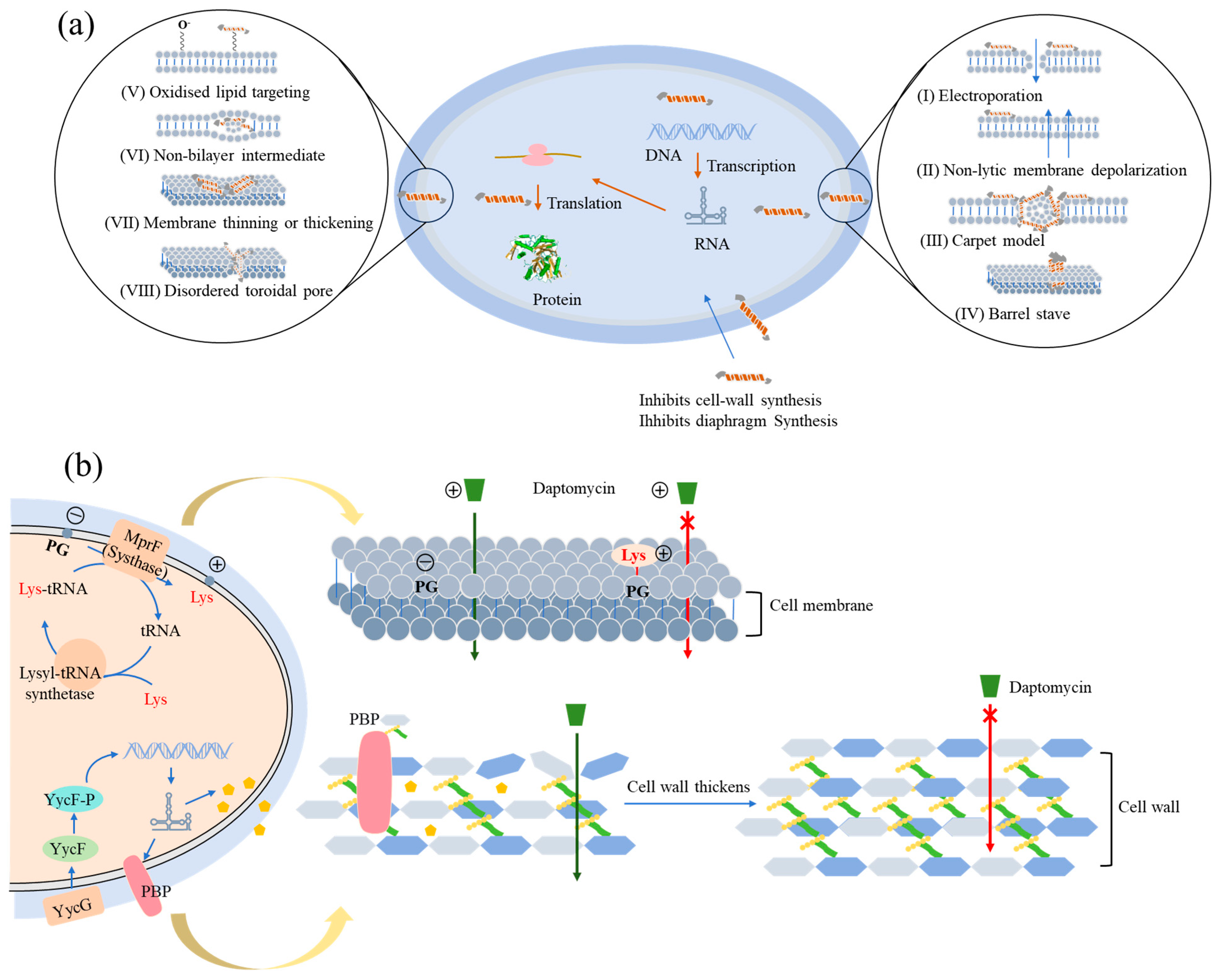
3.1. Membrane Modification
3.1.1. Membrane Charge Remodeling Approaches to Overcome Resistance
3.1.2. Membrane Rigidification Approaches to Overcome Resistance
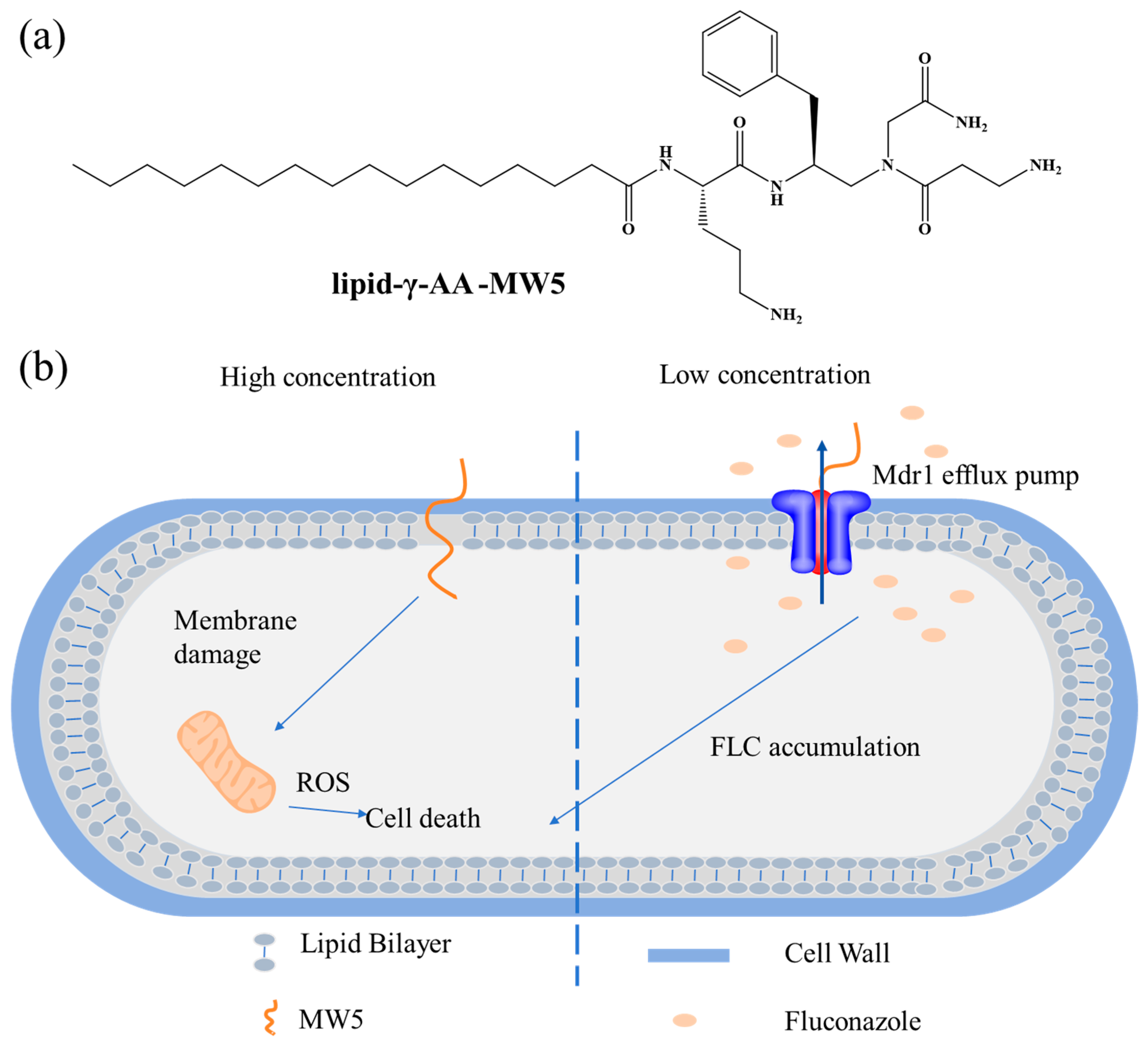
3.2. Efflux Pumps Activation Approaches to Overcome Resistance
3.3. Cell Wall Thickening Approaches to Overcome Resistance
3.4. Biofilm Formation Approaches to Overcome Resistance
| Resistance to LP | Resistant Strain | Resistance Gene | Resistant Phenotype | References |
|---|---|---|---|---|
| DAP | S. aureus E. faecium | MprF | Increased Lys-PG synthesis. Elevated surface positive charge. | [134,135] |
| DAP | S. aureus MRSA | Cls | PG accumulation. Reduced CM negative charge. | [136,137] |
| DAP Microcin J25 | E. coli | RpoB/RpoC | Delayed rpoB/C mutations (post-mprF). Bacterial physiological state shift. | [139,140,141] |
| Polymyxins | E. coli Salmonella K. pneumoniae Enterobacter cloacae Proteus mirabilis A. baumannii | Mcr-1 | Constitutive LPS modification. Reduce the net negative charge on the surface of CMs. | [145] |
| Polymyxins | E. coli Salmonella K. pneumoniae P. aeruginosa | PmrAB/PhoPQ two-component systems | Modification of LPS with PEA or 4-amino-4-deoxy-L-arabinose. | [144] |
| DAP | Mycobacterium P. aeruginosa | Type II FA Synthesis system | Straight-chain saturated FA production. Increased membrane packing density. | [147] |
| DAP | C. striatum S. aureus | PgsA | Decreased membrane PG Disrupted membrane fluidity | [136,149] |
| DAP | E. faecalis E. faecium; S. pneumoniae. | LiaFSR | Expression of efflux pumps Upregulation of membrane repair genes | [156] |
| LP | E. coli K. pneumoniae | AcrAB-TolC | AcrB: Substrate capture and conformational change AcrA-TolC: Channel formation across the envelope Complex: Drug export and virulence enhancement | [157] |
| PMB Colistin | C. albicans L. lactis | P-glycoprotein LmrA protein | MDR/CDR (P-glycoprotein/LmrA protein) mediated efflux | [158,173] |
| DAP Vancomycin | Coagulase-negative staphylococci | The WalKR two-component system | CW thickening | [161,162] |
| DAP | S. aureus E. faecalis L. monocytogenes S. pyogenes | DltABCD operon | Increased CW positive charge | [163] |
| PMB Colistin | P. aeruginosa | ParRS two-component system | LPS modification Enhanced efflux Porin downregulation | [172] |
4. Structural Optimization of LPs for Enhanced Functionality
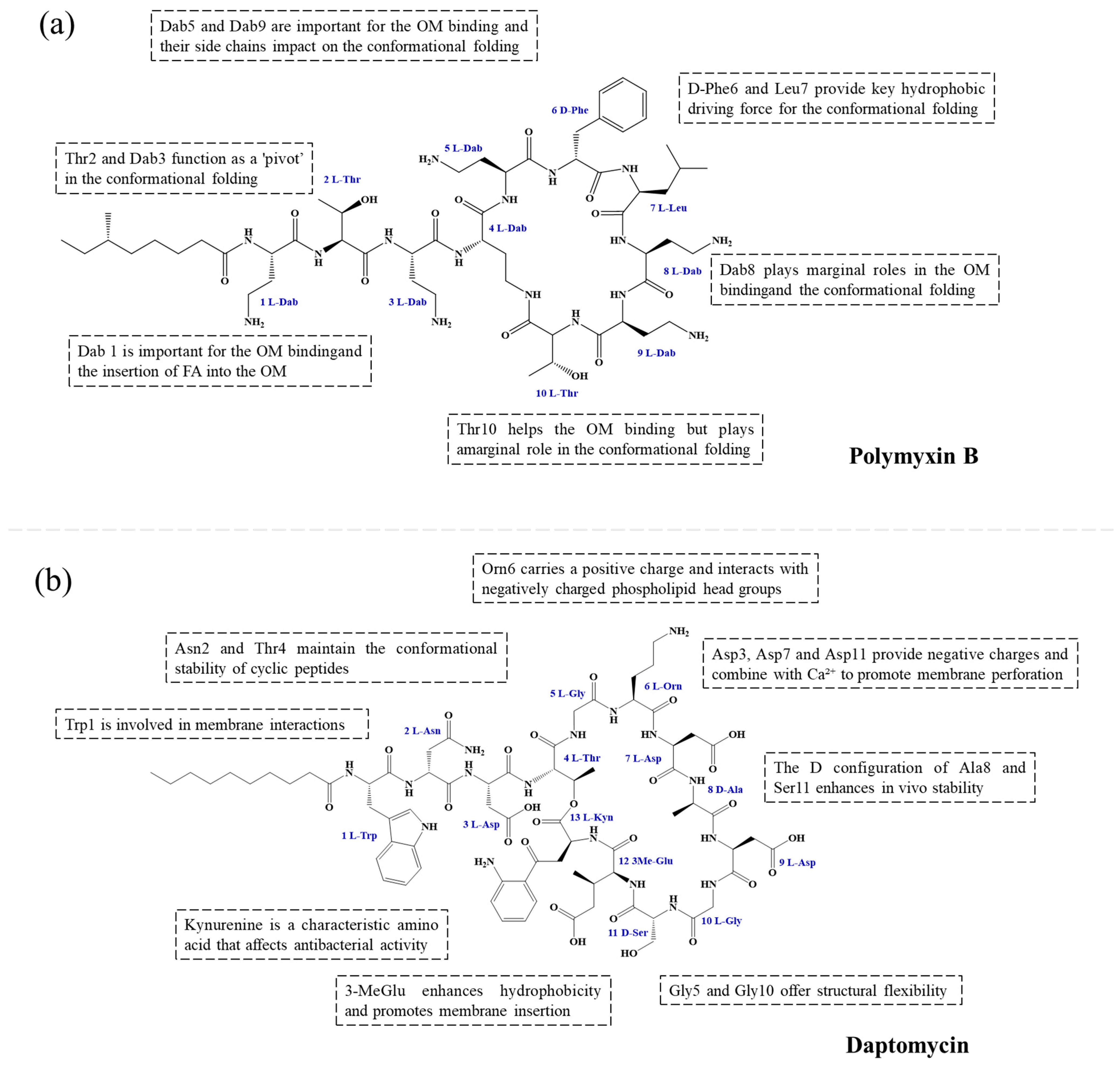
4.1. Structural Optimization of the Peptide Scaffold
4.1.1. Introduction of Specific Amino Acids
4.1.2. Modification of Amino Acids
4.2. Optimization of FA Tailoring
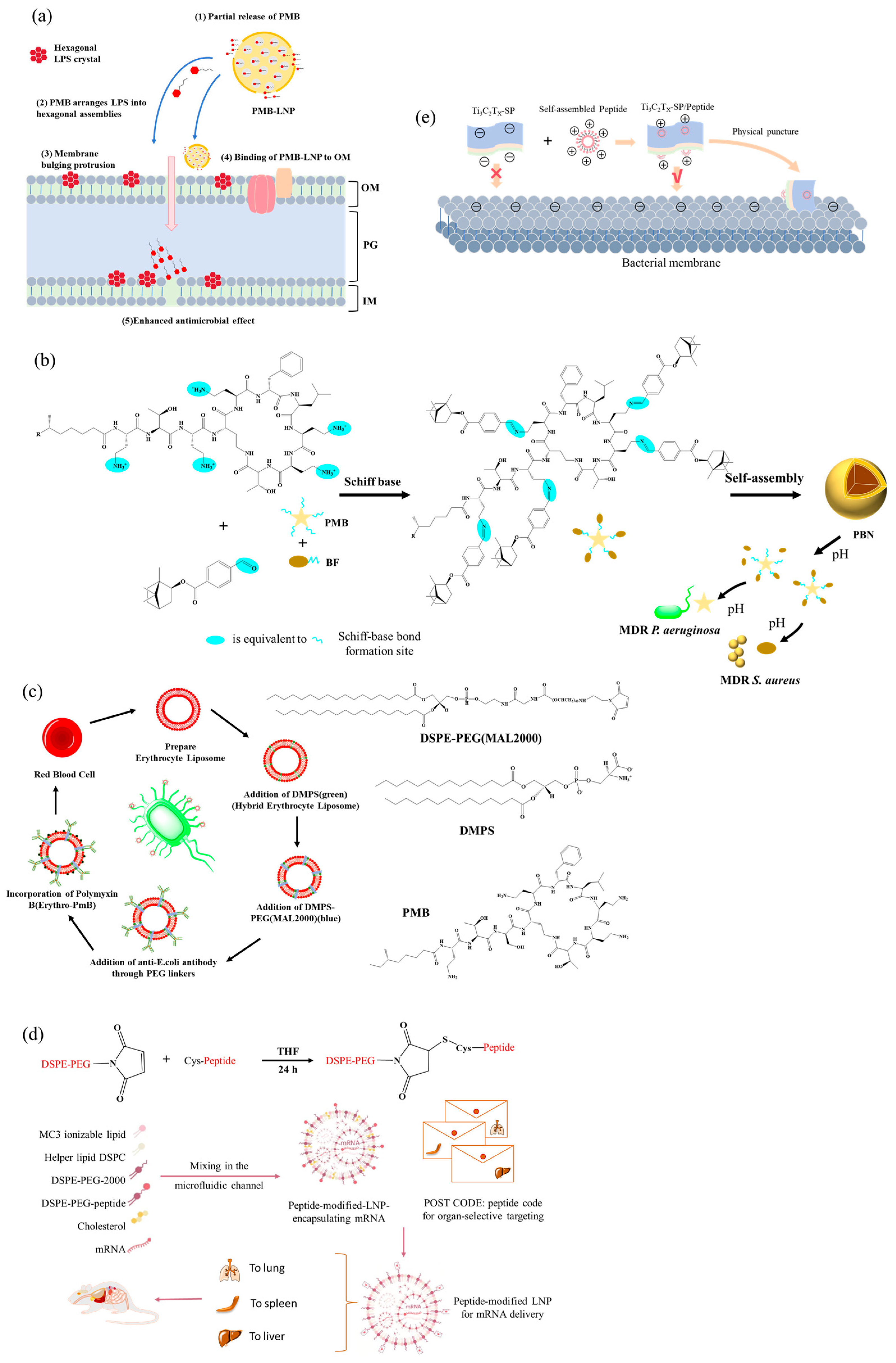
4.3. Construction of Novel Delivery Systems for LPs
5. Emerging Approaches and Enabling Technologies for LP Design and Discovery
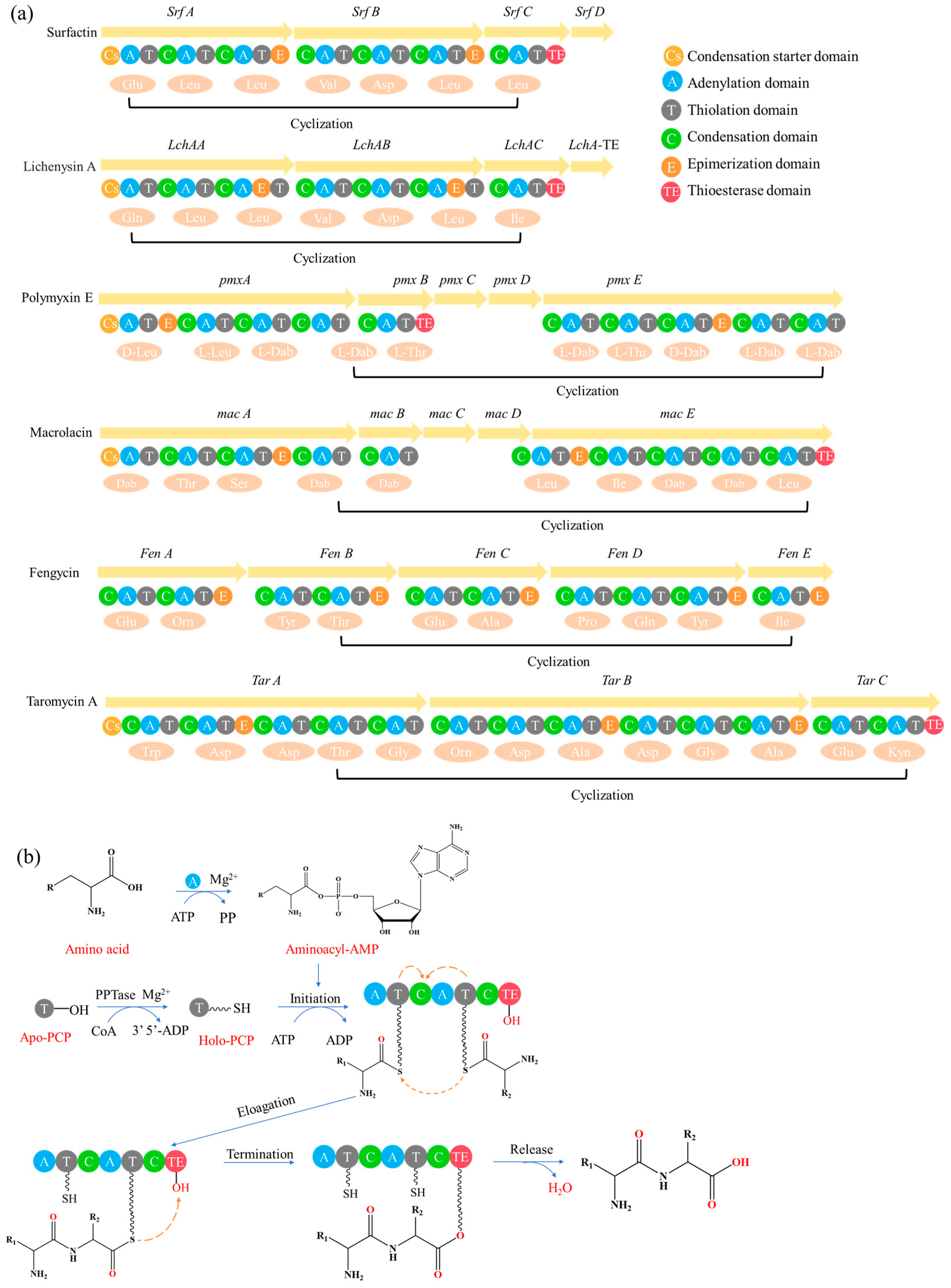
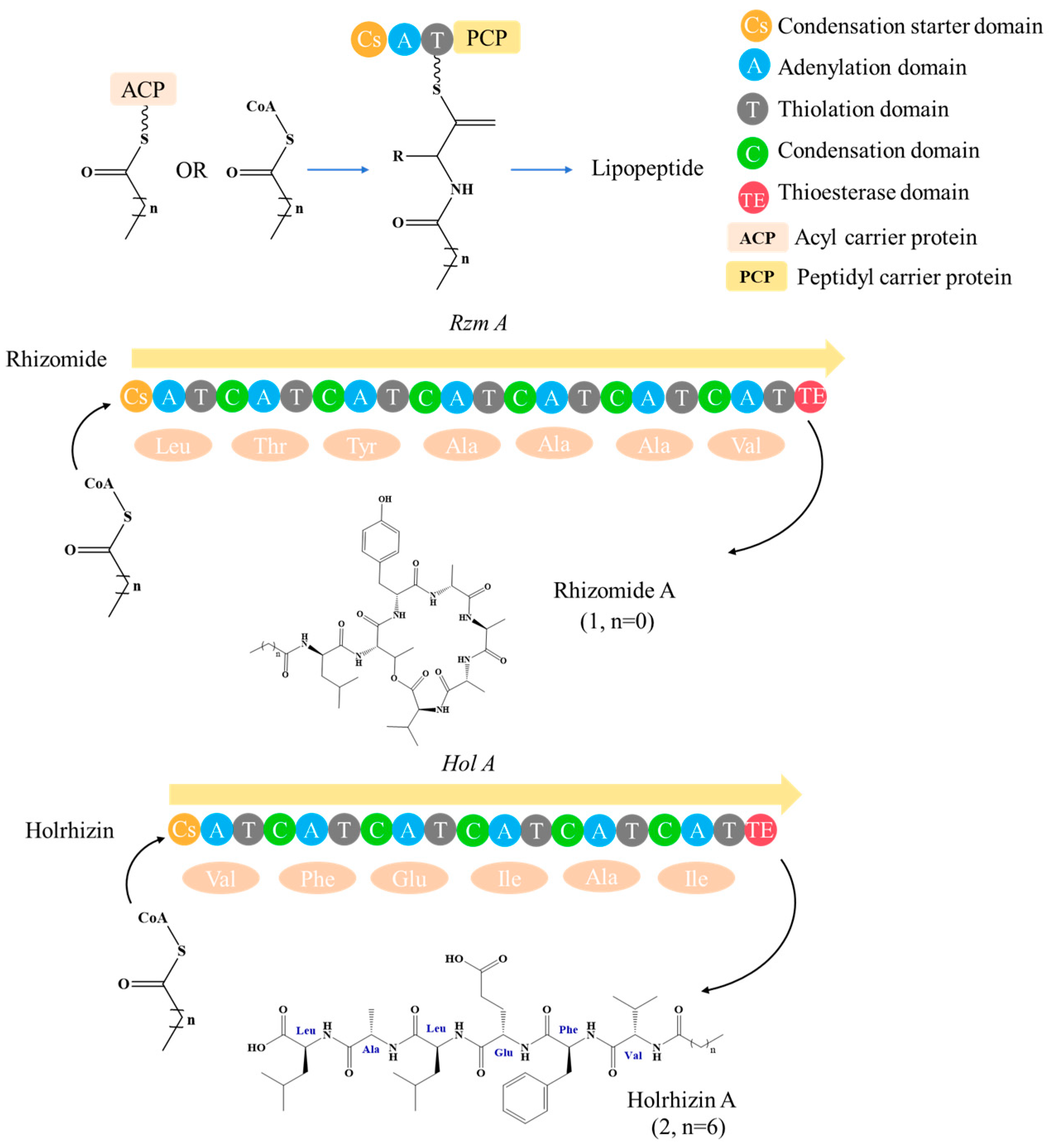
5.1. NRPS Engineering
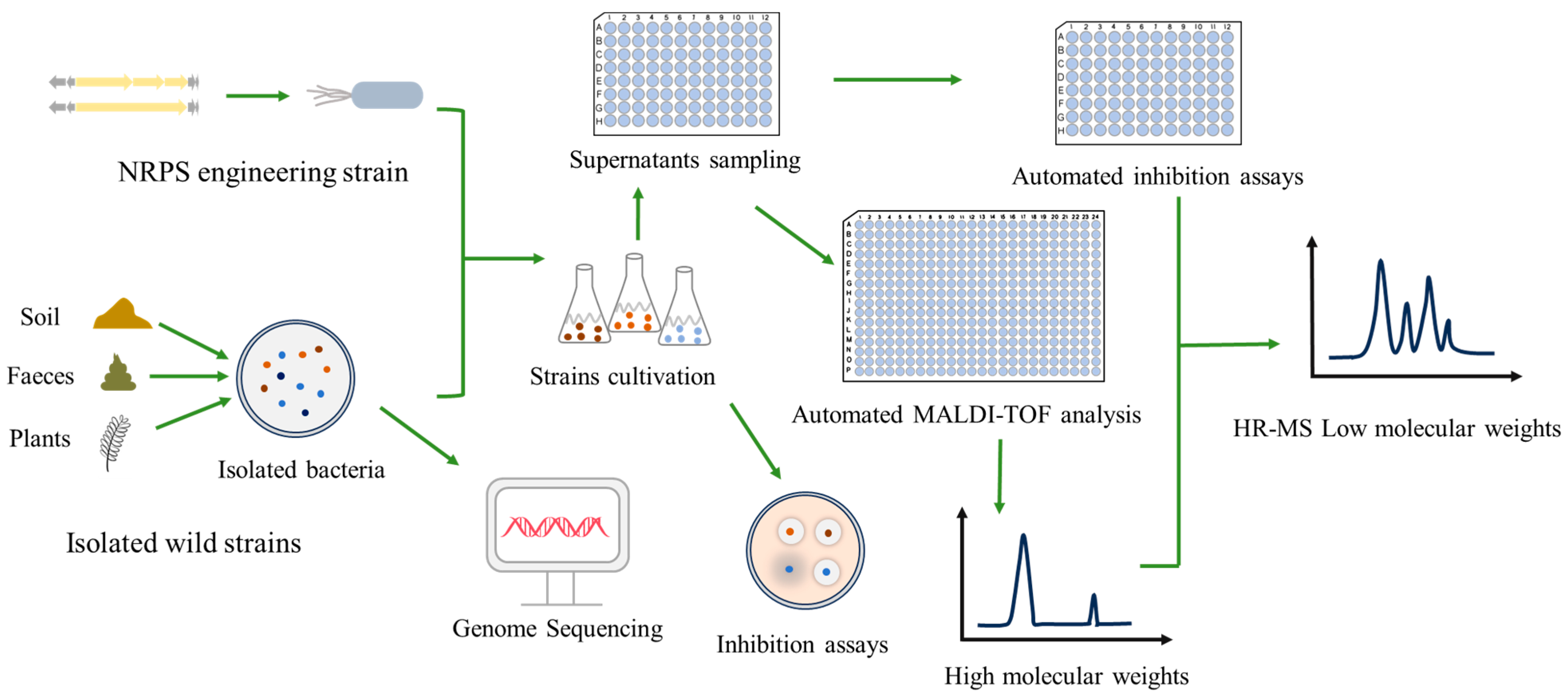
5.2. HTS Driven by Synthetic Biology
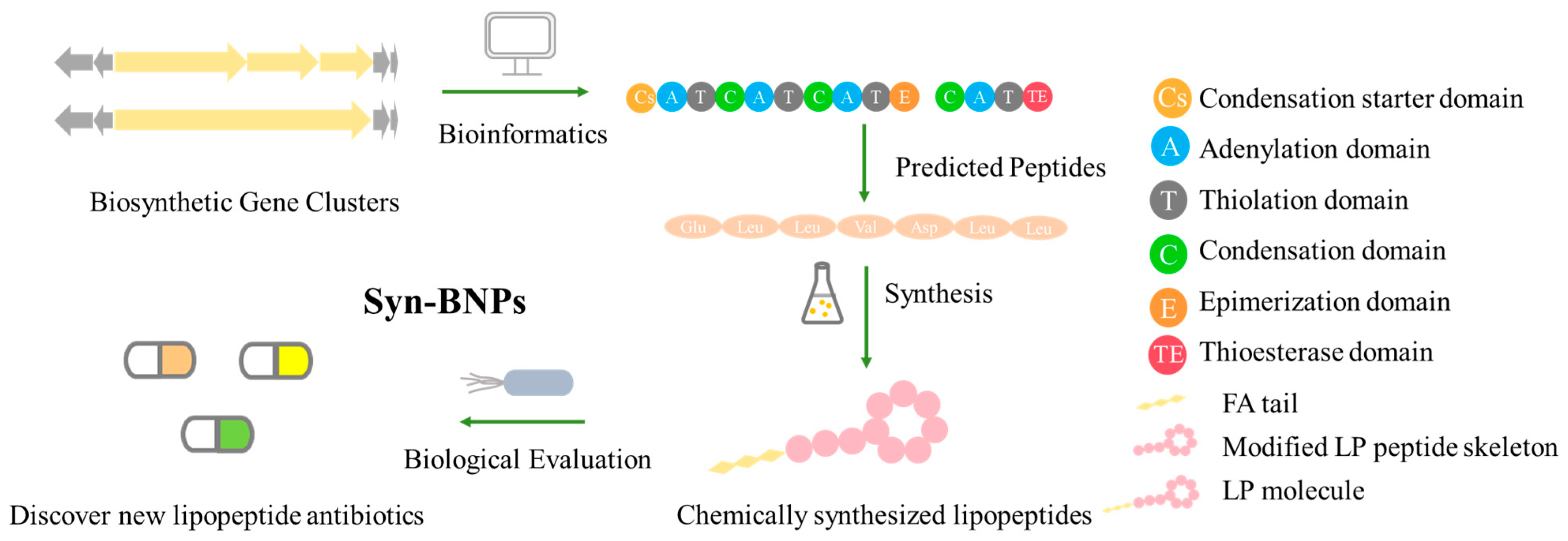
5.3. Syn-BNP Strategies for Next-Generation Natural Product Discovery
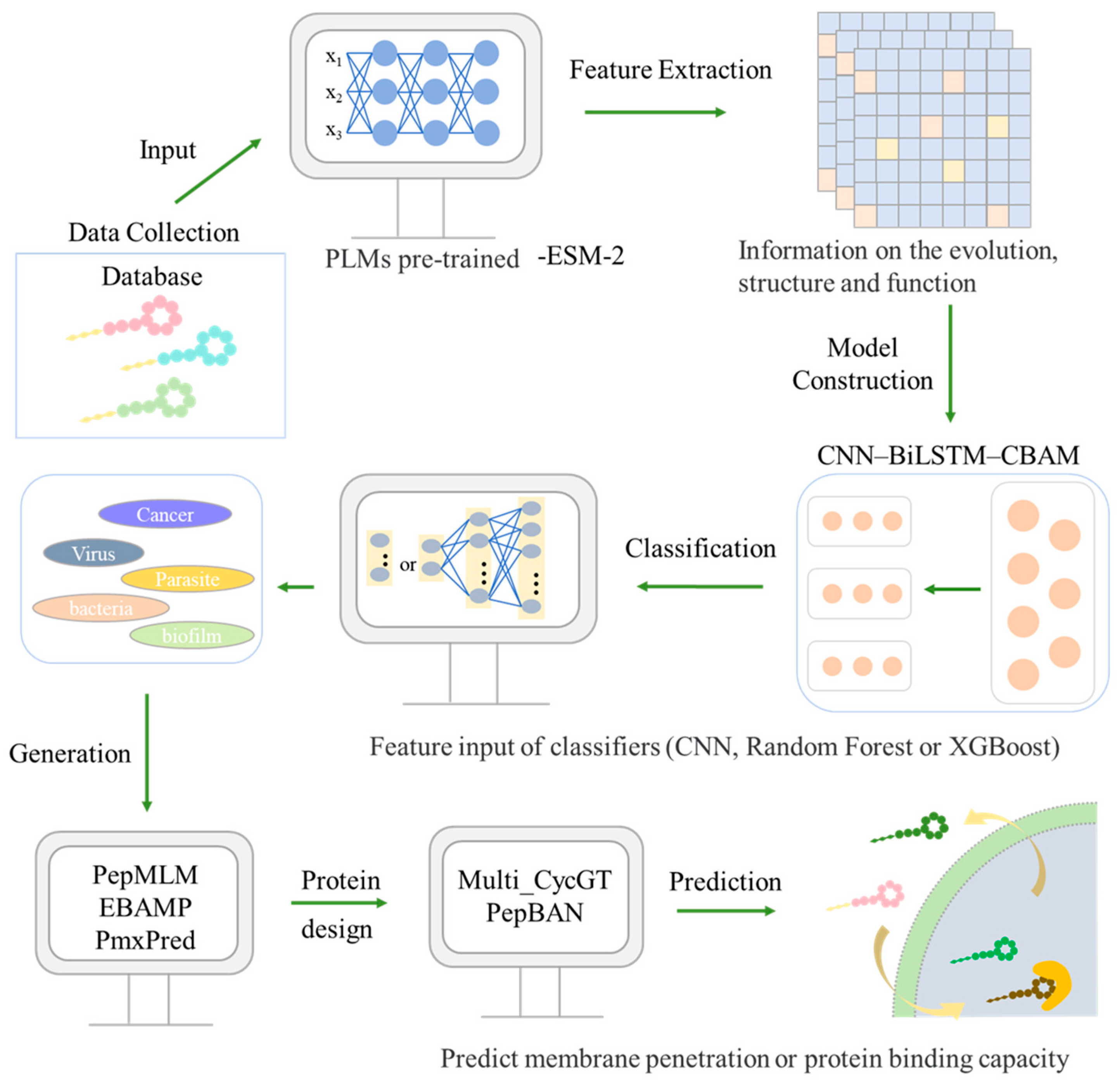
5.4. AI-Driven Discovery of Novel LPs
6. Applications of LPs Across Agriculture, Livestock, Healthcare, Petroleum, and Environmental Remediation
7. Summary and Future Outlook
Author Contributions
Funding
Data Availability Statement
Conflicts of Interest
Abbreviations
| AMR | Antimicrobial resistance |
| AMPs | Antimicrobial peptides |
| AI | Artificial intelligence |
| A domain | Adenylation domain |
| BGCs | Biosynthetic gene clusters |
| Ca2+ | Calcium ions |
| CL | Cardiolipin |
| CM | Cell membranes |
| Cs domain | Starter condensation domain |
| CW | Cell wall |
| C domain | Condensation domain |
| Dab | Diamino butyric acid |
| DAP | Daptomycin |
| E domain | Epimerization domain |
| FA | fatty acid |
| G+ | Gram-positive |
| G− | Gram-negative |
| HTS | High-throughput screening |
| LNPs | Lipid nanoparticles |
| LP | Lipopeptide |
| LPS | Lipopolysaccharide |
| MALDI-TOF MS | Matrix-Assisted Laser Desorption/Ionization Time-of-Flight Mass Spectrometry |
| MDR | Multi-drug resistance |
| ML | Machine learning |
| MRSA | Methicillin-resistant Staphylococcus aureus |
| NRPS | Non-ribosomal peptide synthetase |
| OM | Outer membrane |
| PCP | Peptidyl carrier protein |
| PEA | Phosphatidylethanolamine |
| PMB | Polymyxin B |
| PKS | Polyketide synthases |
| PG | Phosphatidylglycerol |
| RiPP | Post-translationally modified peptide |
| ROS | Reactive oxygen species |
| RP-UPLC | Reversed-Phase Ultra-Performance Liquid Chromatography |
| RT-PCR | Real-Time Polymerase Chain Reaction |
| SAR | Structure–activity relationship |
| Syn-BNP | Synthetic-bioinformatic natural product |
| TE domain | Thioesterase domain |
| T domain | Thiolation domain |
| VRE | Vancomycin-Resistant Enterococcus |
References
- Dini, S.; Oz, F.; Bekhit, A.E.A.; Carne, A.; Agyei, D. Production, characterization, and potential applications of lipopeptides in food systems: A comprehensive review. Compr. Rev. Food Sci. Food Saf. 2024, 23, e13394. [Google Scholar] [CrossRef] [PubMed]
- Magana, M.; Pushpanathan, M.; Santos, A.L.; Leanse, L.; Fernandez, M.; Ioannidis, A.; Giulianotti, M.A.; Apidianakis, Y.; Bradfute, S.; Ferguson, A.L.; et al. The value of antimicrobial peptides in the age of resistance. Lancet Infect. Dis. 2020, 20, e216–e230. [Google Scholar] [CrossRef]
- Spohn, R.; Daruka, L.; Lázár, V.; Martins, A.; Vidovics, F.; Grézal, G.; Méhi, O.; Kintses, B.; Számel, M.; Jangir, P.K.; et al. Integrated evolutionary analysis reveals antimicrobial peptides with limited resistance. Nat. Commun. 2019, 10, 4538. [Google Scholar] [CrossRef]
- Van der Auwera, P. Ex vivo study of serum bactericidal titers and killing rates of daptomycin (LY146032) combined or not combined with amikacin compared with those of vancomycin. Antimicrob. Agents Chemother. 1989, 33, 1783–1790. [Google Scholar] [CrossRef][Green Version]
- Tong, S.Y.C.; Lye, D.C.; Yahav, D.; Sud, A.; Robinson, J.O.; Nelson, J.; Archuleta, S.; Roberts, M.A.; Cass, A.; Paterson, D.L.; et al. Effect of Vancomycin or Daptomycin with vs Without an Antistaphylococcal β-Lactam on Mortality, Bacteremia, Relapse, or Treatment Failure in Patients with MRSA Bacteremia: A Randomized Clinical Trial. JAMA 2020, 323, 527–537. [Google Scholar] [CrossRef]
- Geriak, M.; Haddad, F.; Rizvi, K.; Rose, W.; Kullar, R.; LaPlante, K.; Yu, M.; Vasina, L.; Ouellette, K.; Zervos, M.; et al. Clinical Data on Daptomycin plus Ceftaroline versus Standard of Care Monotherapy in the Treatment of Methicillin-Resistant Staphylococcus aureus Bacteremia. Antimicrob. Agents Chemother. 2019, 63, e02483-18. [Google Scholar] [CrossRef]
- Falagas, M.E.; Rafailidis, P.I. Nephrotoxicity of colistin: New insight into an old antibiotic. Clin. Infect. Dis. 2009, 48, 1729–1731. [Google Scholar] [CrossRef] [PubMed]
- Yahav, D.; Farbman, L.; Leibovici, L.; Paul, M. Colistin: New lessons on an old antibiotic. Clin. Microbiol. Infect. 2012, 18, 18–29. [Google Scholar] [CrossRef]
- Falagas, M.E.; Kasiakou, S.K. Toxicity of polymyxins: A systematic review of the evidence from old and recent studies. Crit. Care 2006, 10, R27. [Google Scholar] [CrossRef] [PubMed]
- Garreau, R.; Pham, T.T.; Bourguignon, L.; Millet, A.; Parant, F.; Bussy, D.; Desevre, M.; Franchi, V.; Ferry, T.; Goutelle, S. Daptomycin Exposure as a Risk Factor for Daptomycin-Induced Eosinophilic Pneumonia and Muscular Toxicity. Clin. Infect. Dis. 2023, 77, 1372–1380. [Google Scholar] [CrossRef]
- Yun, B.; Zhang, T.; Azad, M.A.K.; Wang, J.; Nowell, C.J.; Kalitsis, P.; Velkov, T.; Hudson, D.F.; Li, J. Polymyxin B causes DNA damage in HK-2 cells and mice. Arch. Toxicol. 2018, 92, 2259–2271. [Google Scholar] [CrossRef] [PubMed]
- Azad, M.A.; Finnin, B.A.; Poudyal, A.; Davis, K.; Li, J.; Hill, P.A.; Nation, R.L.; Velkov, T.; Li, J. Polymyxin B Induces Apoptosis in Kidney Proximal Tubular Cells. Antimicrob. Agents Chemother. 2013, 57, 4329–4335. [Google Scholar] [CrossRef] [PubMed]
- Guzman, L.; Rabanal, F.; Garcia, J.; Marqués, A.M.; Sánchez, E.; Cano, A.; Cajal, Y.; Camins, A.; Ettcheto, M.; Barenys, M. B-rich colistin and B-pure colistin as novel strategies to increase the therapeutic window of polymyxin antibiotic therapy. Biomed. Pharmacother. 2025, 190, 118366. [Google Scholar] [CrossRef] [PubMed]
- Stephani, J.C.; Gerhards, L.; Khairalla, B.; Solov’yov, I.A.; Brand, I. How do Antimicrobial Peptides Interact with the Outer Membrane of Gram-Negative Bacteria? Role of Lipopolysaccharides in Peptide Binding, Anchoring, and Penetration. ACS Infect. Dis. 2024, 10, 763–778. [Google Scholar] [CrossRef]
- Gao, R.; Hu, Y.; Li, Z.; Sun, J.; Wang, Q.; Lin, J.; Ye, H.; Liu, F.; Srinivas, S.; Li, D.; et al. Dissemination and Mechanism for the MCR-1 Colistin Resistance. PLoS Pathog. 2016, 12, e1005957. [Google Scholar] [CrossRef]
- Cao, R.; Su, H.; Wei, Z.; He, Z.; Pan, T.; Li, Y.; Sun, B. An induced mutation of ABC-transporter component VraF(K84E) contributes to vancomycin resistance and virulence in Staphylococcus aureus strain MW2. Int. J. Med. Microbiol. 2024, 315, 151624. [Google Scholar] [CrossRef]
- Paszko, E.; Senge, M.O. Immunoliposomes. Curr. Med. Chem. 2012, 19, 5239–5277. [Google Scholar] [CrossRef]
- Huang, H.; Sakurai, F.; Higuchi, Y.; Kawakami, S.; Hashida, M.; Kawabata, K.; Mizuguchi, H. Suppressive effects of sugar-modified cationic liposome/NF-kappaB decoy complexes on adenovirus vector-induced innate immune responses. J. Control. Release 2009, 133, 139–145. [Google Scholar] [CrossRef]
- Tang, C.; Zhang, Y.; Li, B.; Fan, X.; Wang, Z.; Su, R.; Qi, W.; Wang, Y. Modular Design of Lipopeptide-Based Organ-Specific Targeting (POST) Lipid Nanoparticles for Highly Efficient RNA Delivery. Adv. Mater. 2025, 37, e2415643. [Google Scholar] [CrossRef]
- Jani, K.; Mehta, S.; Patel, R.; Prajapati, B.; Patel, G. Focused Insights into Liposomal Nanotherapeutics for Antimicrobial Treatment. Curr. Med. Chem. 2024, 32, 7577–7595. [Google Scholar] [CrossRef]
- Kiaie, S.H.; Majidi Zolbanin, N.; Ahmadi, A.; Bagherifar, R.; Valizadeh, H.; Kashanchi, F.; Jafari, R. Recent advances in mRNA-LNP therapeutics: Immunological and pharmacological aspects. J. Nanobiotechnol. 2022, 20, 276. [Google Scholar] [CrossRef]
- Zhu, J.; Meng, Y.; Gao, W.; Yang, S.; Zhu, W.; Ji, X.; Zhai, X.; Liu, W.Q.; Luo, Y.; Ling, S.; et al. AI-driven high-throughput droplet screening of cell-free gene expression. Nat. Commun. 2025, 16, 2720. [Google Scholar] [CrossRef] [PubMed]
- Cochrane, S.A.; Vederas, J.C. Lipopeptides from Bacillus and Paenibacillus spp.: A Gold Mine of Antibiotic Candidates. Med. Res. Rev. 2016, 36, 4–31. [Google Scholar] [CrossRef]
- Zhang, S.; Chen, Y.; Zhu, J.; Lu, Q.; Cryle, M.J.; Zhang, Y.; Yan, F. Structural diversity, biosynthesis, and biological functions of lipopeptides from Streptomyces. Nat. Prod. Rep. 2023, 40, 557–594. [Google Scholar] [CrossRef] [PubMed]
- Arima, K.; Kakinuma, A.; Tamura, G. Surfactin, a crystalline peptidelipid surfactant produced by Bacillus subtilis: Isolation, characterization and its inhibition of fibrin clot formation. Biochem. Biophys. Res. Commun. 1968, 31, 488–494. [Google Scholar] [CrossRef]
- Ainsworth, G.C.; Brown, A.M.; Brownlee, G. Aerosporin, an antibiotic produced by Bacillus aerosporus Greer. Nature 1947, 159, 263. [Google Scholar] [CrossRef]
- Trimble, M.J.; Mlynárčik, P.; Kolář, M.; Hancock, R.E. Polymyxin: Alternative Mechanisms of Action and Resistance. Cold Spring Harb. Perspect. Med. 2016, 6, a025288. [Google Scholar] [CrossRef] [PubMed]
- Falagas, M.E.; Kasiakou, S.K. Colistin: The revival of polymyxins for the management of multidrug-resistant gram-negative bacterial infections. Clin. Infect. Dis. 2005, 40, 1333–1341. [Google Scholar] [CrossRef]
- Nang, S.C.; Azad, M.A.K.; Velkov, T.; Zhou, Q.T.; Li, J. Rescuing the Last-Line Polymyxins: Achievements and Challenges. Pharmacol. Rev. 2021, 73, 679–728. [Google Scholar] [CrossRef]
- Wolinsky, E.; Hines, J.D. Neurotoxic and nephrotoxic effects of colistin in patients with renal disease. N. Engl. J. Med. 1962, 266, 759–762. [Google Scholar] [CrossRef]
- Vaara, M. New polymyxin derivatives that display improved efficacy in animal infection models as compared to polymyxin B and colistin. Med. Res. Rev. 2018, 38, 1661–1673. [Google Scholar] [CrossRef]
- Cui, A.L.; Hu, X.X.; Gao, Y.; Jin, J.; Yi, H.; Wang, X.K.; Nie, T.Y.; Chen, Y.; He, Q.Y.; Guo, H.F.; et al. Synthesis and Bioactivity Investigation of the Individual Components of Cyclic Lipopeptide Antibiotics. J. Med. Chem. 2018, 61, 1845–1857. [Google Scholar] [CrossRef]
- Jørgensen, J.S.; Mood, E.H.; Knap, A.S.H.; Nielsen, S.E.; Nielsen, P.E.; Żabicka, D.; Matias, C.; Domraceva, I.; Björkling, F.; Franzyk, H. Polymyxins with Potent Antibacterial Activity against Colistin-Resistant Pathogens: Fine-Tuning Hydrophobicity with Unnatural Amino Acids. J. Med. Chem. 2024, 67, 1370–1383. [Google Scholar] [CrossRef] [PubMed]
- Outeda-García, M.; Garcia-Pose, A.; Guijarro-Sánchez, P.; Rodríguez-Coello, A.; Báez-Barroso, G.A.; Maceiras, R.; Alonso-García, I.; Arca-Suárez, J.; Vázquez-Ucha, J.C.; Bou, G.; et al. The novel polymyxin analogue SPR206 exhibits higher activity than colistin against both colistin-susceptible and colistin-resistant strains of Acinetobacter baumannii. Antimicrob. Agents Chemother. 2025, 69, e0194024. [Google Scholar] [CrossRef] [PubMed]
- Catacutan, D.B.; Tran, V.; Arnold, A.; Alexander, J.; Corso, G.; Yousefi, Y.; Tu, M.M.; McLellan, S.; Tertigas, D.; Corneil, K.; et al. Discovery and artificial intelligence-guided mechanistic elucidation of a narrow-spectrum antibiotic. Nat. Microbiol. 2025, 10, 2808–2822. [Google Scholar] [CrossRef]
- Zheng, W.; Wang, X.; Lian, H.; Zou, P.; Sun, T.; Wang, H.; Li, L.L. OBOC screening of high activity and low-toxic polymyxin analogs against MCR-1 resistant strains. Biomater. Sci. 2025, 13, 2651–2655. [Google Scholar] [CrossRef] [PubMed]
- De Oliveira, D.M.P.; Bohlmann, L.; Conroy, T.; Jen, F.E.; Everest-Dass, A.; Hansford, K.A.; Bolisetti, R.; El-Deeb, I.M.; Forde, B.M.; Phan, M.D.; et al. Repurposing a neurodegenerative disease drug to treat Gram-negative antibiotic-resistant bacterial sepsis. Sci. Transl. Med. 2020, 12, eabb3791. [Google Scholar] [CrossRef]
- Schneider-Futschik, E.K.; Paulin, O.K.A.; Hoyer, D.; Roberts, K.D.; Ziogas, J.; Baker, M.A.; Karas, J.; Li, J.; Velkov, T. Sputum Active Polymyxin Lipopeptides: Activity against Cystic Fibrosis Pseudomonas aeruginosa Isolates and Their Interactions with Sputum Biomolecules. ACS Infect. Dis. 2018, 4, 646–655. [Google Scholar] [CrossRef]
- Vaara, M.; Sader, H.S.; Rhomberg, P.R.; Jones, R.N.; Vaara, T. Antimicrobial activity of the novel polymyxin derivative NAB739 tested against Gram-negative pathogens. J. Antimicrob. Chemother. 2013, 68, 636–639. [Google Scholar] [CrossRef]
- Vaara, M.; Vaara, T.; Tyrrell, J.M. Structure-activity studies on polymyxin derivatives carrying three positive charges only reveal a new class of compounds with strong antibacterial activity. Peptides 2017, 91, 8–12. [Google Scholar] [CrossRef]
- Duncan, L.R.; Wang, W.; Sader, H.S. In Vitro Potency and Spectrum of the Novel Polymyxin MRX-8 Tested against Clinical Isolates of Gram-Negative Bacteria. Antimicrob. Agents Chemother. 2022, 66, e0013922. [Google Scholar] [CrossRef]
- Wu, S.; Yin, D.; Zhi, P.; Guo, Y.; Yang, Y.; Zhu, D.; Hu, F. In Vitro Activity of MRX-8 and Comparators Against Clinical Isolated Gram-Negative Bacilli in China. Front. Cell. Infect. Microbiol. 2022, 12, 829592. [Google Scholar] [CrossRef] [PubMed]
- Slingerland, C.J.; Wesseling, C.M.J.; Innocenti, P.; Westphal, K.G.C.; Masereeuw, R.; Martin, N.I. Synthesis and Evaluation of Polymyxins Bearing Reductively Labile Disulfide-Linked Lipids. J. Med. Chem. 2022, 65, 15878–15892. [Google Scholar] [CrossRef] [PubMed]
- Bonvin, E.; Orsi, M.; Paschoud, T.; Gopalasingam, A.; Reusser, J.; Köhler, T.; van Delden, C.; Reymond, J.L. Antimicrobial Peptide-Peptoid Macrocycles from the Polymyxin B2 Chemical Space. Angew. Chem. 2025, 64, e202501299. (In English) [Google Scholar] [CrossRef] [PubMed]
- Jørgensen, J.S.; Laulund Siebert, A.S.; Ciofu, O.; Høiby, N.; Moser, C.; Franzyk, H. Synergistic combinations of novel polymyxins and rifampicin with improved eradication of colistin-resistant Pseudomonas aeruginosa biofilms. Biofilm 2024, 8, 100224. [Google Scholar] [CrossRef]
- Na, T.U.; Sander, V.; Davidson, A.J.; Lin, R.; Hermant, Y.O.; Hardie Boys, M.T.; Pletzer, D.; Campbell, G.; Ferguson, S.A.; Cook, G.M.; et al. Allenamides as a Powerful Tool to Incorporate Diversity: Thia-Michael Lipidation of Semisynthetic Peptides and Access to β-Keto Amides. Angew. Chem. 2024, 63, e202407764. (In English) [Google Scholar] [CrossRef]
- Eliopoulos, G.M.; Thauvin, C.; Gerson, B.; Moellering, R.C., Jr. In vitro activity and mechanism of action of A21978C1, a novel cyclic lipopeptide antibiotic. Antimicrob. Agents Chemother. 1985, 27, 357–362. [Google Scholar] [CrossRef]
- Eliopoulos, G.M.; Willey, S.; Reiszner, E.; Spitzer, P.G.; Caputo, G.; Moellering, R.C., Jr. In vitro and in vivo activity of LY 146032, a new cyclic lipopeptide antibiotic. Antimicrob. Agents Chemother. 1986, 30, 532–535. [Google Scholar] [CrossRef]
- Decker, T.; Rautenbach, M.; Khan, S.; Khan, W. Antibacterial efficacy and membrane mechanism of action of the Serratia-derived non-ionic lipopeptide, serrawettin W2-FL10. Microbiol. Spectr. 2024, 12, e0295223. [Google Scholar] [CrossRef]
- Wardell, S.J.T.; Yung, D.B.Y.; Nielsen, J.E.; Lamichhane, R.; Sørensen, K.; Molchanova, N.; Herlan, C.; Lin, J.S.; Bräse, S.; Wise, L.M.; et al. A biofilm-targeting lipo-peptoid to treat Pseudomonas aeruginosa and Staphylococcus aureus co-infections. Biofilm 2025, 9, 100272. [Google Scholar] [CrossRef]
- Miller, W.R.; Bayer, A.S.; Arias, C.A. Mechanism of Action and Resistance to Daptomycin in Staphylococcus aureus and Enterococci. Cold Spring Harb. Perspect. Med. 2016, 6, a026997. [Google Scholar] [CrossRef]
- Kirkpatrick, P.; Raja, A.; LaBonte, J.; Lebbos, J. Daptomycin. Nat. Rev. Drug Discov. 2003, 2, 943–944. [Google Scholar] [CrossRef]
- Citron, D.M.; Tyrrell, K.L.; Merriam, C.V.; Goldstein, E.J. In vitro activities of CB-183,315, vancomycin, and metronidazole against 556 strains of Clostridium difficile, 445 other intestinal anaerobes, and 56 Enterobacteriaceae species. Antimicrob. Agents Chemother. 2012, 56, 1613–1615. [Google Scholar] [CrossRef]
- Snydman, D.R.; Jacobus, N.V.; McDermott, L.A. Activity of a novel cyclic lipopeptide, CB-183,315, against resistant Clostridium difficile and other Gram-positive aerobic and anaerobic intestinal pathogens. Antimicrob. Agents Chemother. 2012, 56, 3448–3452. [Google Scholar] [CrossRef]
- Guan, D.; Li, J.; Chen, F.; Li, J.; Bian, X.; Yu, Y.; Feng, X.; Lan, L.; Huang, W. A facile and selective derivatization approach on kynurenine-NH(2) in daptomycin, leading to the discovery of hexakynomycin to combat multidrug-resistant Gram-positive pathogens especially daptomycin-resistant bacteria. Eur. J. Med. Chem. 2023, 259, 115638. [Google Scholar] [CrossRef] [PubMed]
- Rubinchik, E.; Schneider, T.; Elliott, M.; Scott, W.R.; Pan, J.; Anklin, C.; Yang, H.; Dugourd, D.; Müller, A.; Gries, K.; et al. Mechanism of action and limited cross-resistance of new lipopeptide MX-2401. Antimicrob. Agents Chemother. 2011, 55, 2743–2754. [Google Scholar] [CrossRef] [PubMed]
- Nguyen, K.T.; Ritz, D.; Gu, J.Q.; Alexander, D.; Chu, M.; Miao, V.; Brian, P.; Baltz, R.H. Combinatorial biosynthesis of novel antibiotics related to daptomycin. Proc. Natl. Acad. Sci. USA 2006, 103, 17462–17467. [Google Scholar] [CrossRef]
- Barnawi, G.; Noden, M.; Goodyear, J.; Marlyn, J.; Schneider, O.; Beriashvili, D.; Schulz, S.; Moreira, R.; Palmer, M.; Taylor, S.D. Discovery of Highly Active Derivatives of Daptomycin by Assessing the Effect of Amino Acid Substitutions at Positions 8 and 11 on a Daptomycin Analogue. ACS Infect. Dis. 2022, 8, 778–789. [Google Scholar] [CrossRef]
- Scull, E.M.; Bandari, C.; Johnson, B.P.; Gardner, E.D.; Tonelli, M.; You, J.; Cichewicz, R.H.; Singh, S. Chemoenzymatic synthesis of daptomycin analogs active against daptomycin-resistant strains. Appl. Microbiol. Biotechnol. 2020, 104, 7853–7865. [Google Scholar] [CrossRef] [PubMed]
- Chow, H.Y.; Po, K.H.L.; Gao, P.; Blasco, P.; Wang, X.; Li, C.; Ye, L.; Jin, K.; Chen, K.; Chan, E.W.C.; et al. Methylation of Daptomycin Leading to the Discovery of Kynomycin, a Cyclic Lipodepsipeptide Active against Resistant Pathogens. J. Med. Chem. 2020, 63, 3161–3171. [Google Scholar] [CrossRef]
- Goode, A.; Yeh, V.; Bonev, B.B. Interactions of polymyxin B with lipopolysaccharide-containing membranes. Faraday Discuss. 2021, 232, 317–329. [Google Scholar] [CrossRef]
- Feingold, D.S.; HsuChen, C.C.; Sud, I.J. Basis for the selectivity of action of the polymyxin antibiotics on cell membranes. Ann. N. Y. Acad. Sci. 1974, 235, 480–492. [Google Scholar] [CrossRef]
- Kreutzberger, M.A.; Pokorny, A.; Almeida, P.F. Daptomycin-Phosphatidylglycerol Domains in Lipid Membranes. Langmuir ACS J. Surf. Colloids 2017, 33, 13669–13679. [Google Scholar] [CrossRef]
- Daugelavicius, R.; Bakiene, E.; Bamford, D.H. Stages of polymyxin B interaction with the Escherichia coli cell envelope. Antimicrob. Agents Chemother. 2000, 44, 2969–2978. [Google Scholar] [CrossRef]
- Azad, M.A.K.; Nation, R.L.; Velkov, T.; Li, J. Mechanisms of Polymyxin-Induced Nephrotoxicity. Adv. Exp. Med. Biol. 2019, 1145, 305–319. [Google Scholar]
- Sorlí, L.; Luque, S.; Grau, S.; Berenguer, N.; Segura, C.; Montero, M.M.; Alvarez-Lerma, F.; Knobel, H.; Benito, N.; Horcajada, J.P. Trough colistin plasma level is an independent risk factor for nephrotoxicity: A prospective observational cohort study. BMC Infect. Dis. 2013, 13, 380. [Google Scholar] [CrossRef] [PubMed]
- Forrest, A.; Garonzik, S.M.; Thamlikitkul, V.; Giamarellos-Bourboulis, E.J.; Paterson, D.L.; Li, J.; Silveira, F.P.; Nation, R.L. Pharmacokinetic/Toxicodynamic Analysis of Colistin-Associated Acute Kidney Injury in Critically Ill Patients. Antimicrob. Agents Chemother. 2017, 61, e01367-17. [Google Scholar] [CrossRef] [PubMed]
- Horcajada, J.P.; Sorlí, L.; Luque, S.; Benito, N.; Segura, C.; Campillo, N.; Montero, M.; Esteve, E.; Mirelis, B.; Pomar, V.; et al. Validation of a colistin plasma concentration breakpoint as a predictor of nephrotoxicity in patients treated with colistin methanesulfonate. Int. J. Antimicrob. Agents 2016, 48, 725–727. [Google Scholar] [CrossRef]
- Angelini, J.; Giuliano, S.; Russiani, F.; Lo Re, F.; Flammini, S.; Cadeo, B.; Martini, L.; Tascini, C.; Baraldo, M. PK/PD Analysis of High-Dose Daptomycin Use in the Treatment of Bone and Joint Infections: Data from a Real-World Setting. Microorganisms 2025, 13, 304. [Google Scholar] [CrossRef] [PubMed]
- Gisler, V.; Müller, S.; Müller, L.; Jörg-Walther, L.; Sendi, P. Acute Angioedema Triggered by Daptomycin. Infect. Dis. Ther. 2016, 5, 201–205. [Google Scholar] [CrossRef][Green Version]
- Henao, M.P.; Ghaffari, G. Anaphylaxis to polymyxin B-trimethoprim eye drops. Ann. Allergy Asthma Immunol. 2016, 116, 372. [Google Scholar] [CrossRef]
- Gimenez, D.; Phelan, A.; Murphy, C.D.; Cobb, S.L. Fengycin A Analogues with Enhanced Chemical Stability and Antifungal Properties. Org. Lett. 2021, 23, 4672–4676. [Google Scholar] [CrossRef] [PubMed]
- Zou, J.; Wang, J.; Gao, L.; Xue, W.; Zhu, J.; Zhang, Y.; Gou, S.; Liu, H.; Zhong, C.; Ni, J. Ultra-short lipopeptides containing d-amino acid exhibiting excellent stability and antibacterial activity against gram-positive bacteria. Eur. J. Med. Chem. 2025, 287, 117341. [Google Scholar] [CrossRef]
- Thong, W.L.; Zhang, Y.; Zhuo, Y.; Robins, K.J.; Fyans, J.K.; Herbert, A.J.; Law, B.J.C.; Micklefield, J. Gene editing enables rapid engineering of complex antibiotic assembly lines. Nat. Commun. 2021, 12, 6872. [Google Scholar] [CrossRef] [PubMed]
- Hou, Z.J.; Lai, H.M.; Cao, C.Y.; Xu, Q.M.; Cheng, J.S. Targeted knockout and plasmid-based transfer of NRPS/PKS for improving lipopeptide iturin A synthesis. Int. J. Biol. Macromol. 2025, 302, 140610. [Google Scholar] [CrossRef] [PubMed]
- Wang, Z.; Koirala, B.; Hernandez, Y.; Zimmerman, M.; Park, S.; Perlin, D.S.; Brady, S.F. A naturally inspired antibiotic to target multidrug-resistant pathogens. Nature 2022, 601, 606–611. [Google Scholar] [CrossRef]
- Wang, Z.; Koirala, B.; Hernandez, Y.; Zimmerman, M.; Brady, S.F. Bioinformatic prospecting and synthesis of a bifunctional lipopeptide antibiotic that evades resistance. Science 2022, 376, 991–996. [Google Scholar] [CrossRef]
- Li, L.; Zhou, Y.; Wu, Y. Identification of a Pair of Linear or Cyclic Naturally Inspired Bifunctional Lipopeptide Antibiotics That Overcome Antimicrobial Resistance. Adv. Sci. 2025, 12, e09796. [Google Scholar] [CrossRef]
- Szymczak, P.; Szczurek, E. Artificial intelligence-driven antimicrobial peptide discovery. Curr. Opin. Struct. Biol. 2023, 83, 102733. [Google Scholar] [CrossRef]
- Fan, X.; Matsumoto, H.; Xu, H.; Fang, H.; Pan, Q.; Lv, T.; Zhan, C.; Feng, X.; Liu, X.; Su, D.; et al. Aspergillus cvjetkovicii protects against phytopathogens through interspecies chemical signalling in the phyllosphere. Nat. Microbiol. 2024, 9, 2862–2876. [Google Scholar] [CrossRef]
- Santos-Júnior, C.D.; Torres, M.D.T.; Duan, Y.; Rodríguez Del Río, Á.; Schmidt, T.S.B.; Chong, H.; Fullam, A.; Kuhn, M.; Zhu, C.; Houseman, A.; et al. Discovery of antimicrobial peptides in the global microbiome with machine learning. Cell 2024, 187, 3761–3778.e3716. [Google Scholar] [CrossRef]
- Wan, C.; Fan, X.; Lou, Z.; Wang, H.; Olatunde, A.; Rengasamy, K.R.R. Iturin: Cyclic lipopeptide with multifunction biological potential. Crit. Rev. Food Sci. Nutr. 2022, 62, 7976–7988. [Google Scholar] [CrossRef] [PubMed]
- Yang, S.; Ji, Y.; Xue, P.; Li, Z.; Chen, X.; Shi, J.; Jiang, C. Insights into the antifungal mechanism of Bacillus subtilis cyclic lipopeptide iturin A mediated by potassium ion channel. Int. J. Biol. Macromol. 2024, 277, 134306. [Google Scholar] [CrossRef] [PubMed]
- Vaara, M. Polymyxins and their novel derivatives. Curr. Opin. Microbiol. 2010, 13, 574–581. [Google Scholar] [CrossRef]
- Poirel, L.; Jayol, A.; Nordmann, P. Polymyxins: Antibacterial Activity, Susceptibility Testing, and Resistance Mechanisms Encoded by Plasmids or Chromosomes. Clin. Microbiol. Rev. 2017, 30, 557–596. [Google Scholar] [CrossRef]
- Padhy, I.; Dwibedy, S.K.; Mohapatra, S.S. A molecular overview of the polymyxin-LPS interaction in the context of its mode of action and resistance development. Microbiol. Res. 2024, 283, 127679. [Google Scholar] [CrossRef]
- Qin, W.Q.; Liu, Y.F.; Gang, H.Z.; Liu, J.F.; Zhou, L.; Yang, S.Z.; Mu, B.Z. Structural diversity of surfactin lipopeptides and their molecular behaviors in solutions and at interfaces. Adv. Colloid Interface Sci. 2025, 343, 103581. [Google Scholar] [CrossRef]
- Sengupta, P.; Seo, A.Y.; Pasolli, H.A.; Song, Y.E.; Johnson, M.C.; Lippincott-Schwartz, J. A lipid-based partitioning mechanism for selective incorporation of proteins into membranes of HIV particles. Nat. Cell Biol. 2019, 21, 452–461. [Google Scholar] [CrossRef] [PubMed]
- Jin, P.; Wang, H.; Tan, Z.; Xuan, Z.; Dahar, G.Y.; Li, Q.X.; Miao, W.; Liu, W. Antifungal mechanism of bacillomycin D from Bacillus velezensis HN-2 against Colletotrichum gloeosporioides Penz. Pestic. Biochem. Physiol. 2020, 163, 102–107. [Google Scholar] [CrossRef]
- Landy, M.W.G.H.; Warren, G.H.; RosenmanM, S.B.; Colio, L.G. Bacillomycin; an antibiotic from Bacillus subtilis active against pathogenic fungi. Proc. Soc. Exp. Biol. Med. 1948, 67, 539–541. [Google Scholar] [CrossRef]
- Tanaka, K.; Ishihara, A.; Nakajima, H. Isolation of anteiso-C17, iso-C17, iso-C16, and iso-C15 bacillomycin D from Bacillus amyloliquefaciens SD-32 and their antifungal activities against plant pathogens. J. Agric. Food Chem. 2014, 62, 1469–1476. [Google Scholar] [CrossRef]
- Naganawa, H.; Hamada, M.; Maeda, K.; Okami, Y.; Takeushi, T. Laspartomycin, a new anti-staphylococcal peptide. J. Antibiot. 1968, 21, 55–62. [Google Scholar] [CrossRef]
- Liu, Y.; Lu, J.; Sun, J.; Zhu, X.; Zhou, L.; Lu, Z.; Lu, Y. C16-Fengycin A affect the growth of Candida albicans by destroying its cell wall and accumulating reactive oxygen species. Appl. Microbiol. Biotechnol. 2019, 103, 8963–8975. [Google Scholar] [CrossRef]
- Piewngam, P.; Zheng, Y.; Nguyen, T.H.; Dickey, S.W.; Joo, H.S.; Villaruz, A.E.; Glose, K.A.; Fisher, E.L.; Hunt, R.L.; Li, B.; et al. Pathogen elimination by probiotic Bacillus via signalling interference. Nature 2018, 562, 532–537. [Google Scholar] [CrossRef] [PubMed]
- Chen, M.; Wang, H.; Zhang, C.; Zhang, Y.; Sun, H.; Yu, L.; Zhang, Q.; Chen, X.; Xiao, H. Recent advances in antimicrobial lipopeptide fengycin secreted by Bacillus: Structure, biosynthesis, antifungal mechanisms, and potential application in food preservation. Food Chem. 2025, 489, 144937. [Google Scholar] [CrossRef]
- Schneider, E.K.; Huang, J.X.; Carbone, V.; Han, M.; Zhu, Y.; Nang, S.; Khoo, K.K.; Mak, J.; Cooper, M.A.; Li, J.; et al. Plasma Protein Binding Structure-Activity Relationships Related to the N-Terminus of Daptomycin. ACS Infect. Dis. 2017, 3, 249–258. [Google Scholar] [CrossRef]
- Müller, A.; Wenzel, M.; Strahl, H.; Grein, F.; Saaki, T.N.V.; Kohl, B.; Siersma, T.; Bandow, J.E.; Sahl, H.G.; Schneider, T.; et al. Daptomycin inhibits cell envelope synthesis by interfering with fluid membrane microdomains. Proc. Natl. Acad. Sci. USA 2016, 113, E7077–E7086. [Google Scholar] [CrossRef]
- Humphries, R.M.; Pollett, S.; Sakoulas, G. A current perspective on daptomycin for the clinical microbiologist. Clin. Microbiol. Rev. 2013, 26, 759–780. [Google Scholar] [CrossRef] [PubMed]
- Oka, M.; Nishiyama, Y.; Ohta, S.; Kamei, H.; Konishi, M.; Miyaki, T.; Oki, T.; Kawaguchi, H. Glidobactins A, B and C, new antitumor antibiotics. I. Production, isolation, chemical properties and biological activity. J. Antibiot. 1988, 41, 1331–1337. [Google Scholar] [CrossRef] [PubMed]
- Groll, M.; Schellenberg, B.; Bachmann, A.S.; Archer, C.R.; Huber, R.; Powell, T.K.; Lindow, S.; Kaiser, M.; Dudler, R. A plant pathogen virulence factor inhibits the eukaryotic proteasome by a novel mechanism. Nature 2008, 452, 755–758. [Google Scholar] [CrossRef]
- Fukuda, D.S.; Du Bus, R.H.; Baker, P.J.; Berry, D.M.; Mynderse, J.S. A54145, a new lipopeptide antibiotic complex: Isolation and characterization. J. Antibiot. 1990, 43, 594–600. [Google Scholar] [CrossRef]
- Chen, D.; Chow, H.Y.; Po, K.H.L.; Ma, W.; Leung, E.L.Y.; Sun, Z.; Liu, M.; Chen, S.; Li, X. Total Synthesis and Structural Establishment/Revision of Antibiotics A54145. Org. Lett. 2019, 21, 5639–5644. [Google Scholar] [CrossRef]
- Yakimov, M.M.; Timmis, K.N.; Wray, V.; Fredrickson, H.L. Characterization of a new lipopeptide surfactant produced by thermotolerant and halotolerant subsurface Bacillus licheniformis BAS50. Appl. Environ. Microbiol. 1995, 61, 1706–1713. [Google Scholar] [CrossRef]
- Gudiña, E.J.; Teixeira, J.A. Bacillus licheniformis: The unexplored alternative for the anaerobic production of lipopeptide biosurfactants? Biotechnol. Adv. 2022, 60, 108013. [Google Scholar] [CrossRef]
- Debono, M.; Turner, W.W.; LaGrandeur, L.; Burkhardt, F.J.; Nissen, J.S.; Nichols, K.K.; Rodriguez, M.J.; Zweifel, M.J.; Zeckner, D.J.; Gordee, R.S.; et al. Semisynthetic chemical modification of the antifungal lipopeptide echinocandin B (ECB): Structure-activity studies of the lipophilic and geometric parameters of polyarylated acyl analogs of ECB. J. Med. Chem. 1995, 38, 3271–3281. [Google Scholar] [CrossRef]
- Alam, M.Z.; Wu, X.; Mascio, C.; Chesnel, L.; Hurdle, J.G. Mode of action and bactericidal properties of surotomycin against growing and nongrowing Clostridium difficile. Antimicrob. Agents Chemother. 2015, 59, 5165–5170. [Google Scholar] [CrossRef] [PubMed]
- Tsubery, H.; Ofek, I.; Cohen, S.; Fridkin, M. Structure-function studies of polymyxin B nonapeptide: Implications to sensitization of gram-negative bacteria. J. Med. Chem. 2000, 43, 3085–3092. [Google Scholar] [CrossRef]
- Uguru, G.C.; Milne, C.; Borg, M.; Flett, F.; Smith, C.P.; Micklefield, J. Active-site modifications of adenylation domains lead to hydrolysis of upstream nonribosomal peptidyl thioester intermediates. J. Am. Chem. Soc. 2004, 126, 5032–5033. [Google Scholar] [CrossRef] [PubMed]
- Dubern, J.F.; Lagendijk, E.L.; Lugtenberg, B.J.; Bloemberg, G.V. The heat shock genes dnaK, dnaJ, and grpE are involved in regulation of putisolvin biosynthesis in Pseudomonas putida PCL1445. J. Bacteriol. 2005, 187, 5967–5976. [Google Scholar] [CrossRef]
- Corbett, D.; Wise, A.; Langley, T.; Skinner, K.; Trimby, E.; Birchall, S.; Dorali, A.; Sandiford, S.; Williams, J.; Warn, P.; et al. Potentiation of Antibiotic Activity by a Novel Cationic Peptide: Potency and Spectrum of Activity of SPR741. Antimicrob. Agents Chemother. 2017, 61, e00200–e00217. [Google Scholar] [CrossRef] [PubMed]
- Vaara, M.; Siikanen, O.; Apajalahti, J.; Fox, J.; Frimodt-Møller, N.; He, H.; Poudyal, A.; Li, J.; Nation, R.L.; Vaara, T. A novel polymyxin derivative that lacks the fatty acid tail and carries only three positive charges has strong synergism with agents excluded by the intact outer membrane. Antimicrob. Agents Chemother. 2010, 54, 3341–3346. [Google Scholar] [CrossRef]
- Qian, C.D.; Liu, T.Z.; Zhou, S.L.; Ding, R.; Zhao, W.P.; Li, O.; Wu, X.C. Identification and functional analysis of gene cluster involvement in biosynthesis of the cyclic lipopeptide antibiotic pelgipeptin produced by Paenibacillus elgii. BMC Microbiol. 2012, 12, 197. [Google Scholar] [CrossRef]
- Thirlway, J.; Lewis, R.; Nunns, L.; Al Nakeeb, M.; Styles, M.; Struck, A.W.; Smith, C.P.; Micklefield, J. Introduction of a non-natural amino acid into a nonribosomal peptide antibiotic by modification of adenylation domain specificity. Angew. Chem. 2012, 51, 7181–7184. (In English) [Google Scholar] [CrossRef] [PubMed]
- Yao, J.; Liu, H.; Zhou, T.; Chen, H.; Miao, Z.; Sheng, C.; Zhang, W. Total synthesis and structure-activity relationships of new echinocandin-like antifungal cyclolipohexapeptides. Eur. J. Med. Chem. 2012, 50, 196–208. [Google Scholar] [CrossRef] [PubMed]
- De Zoysa, G.H.; Cameron, A.J.; Hegde, V.V.; Raghothama, S.; Sarojini, V. Antimicrobial peptides with potential for biofilm eradication: Synthesis and structure activity relationship studies of battacin peptides. J. Med. Chem. 2015, 58, 625–639. [Google Scholar] [CrossRef] [PubMed]
- Zhao, J.; Cheah, S.E.; Roberts, K.D.; Nation, R.L.; Thompson, P.E.; Velkov, T.; Du, Z.; Johnson, M.D.; Li, J. Transcriptomic Analysis of the Activity of a Novel Polymyxin against Staphylococcus aureus. mSphere 2016, 1, e00119-16. [Google Scholar] [CrossRef]
- Vaara, M.; Vaara, T.; Vingsbo Lundberg, C. Polymyxin derivatives NAB739 and NAB815 are more effective than polymyxin B in murine Escherichia coli pyelonephritis. J. Antimicrob. Chemother. 2018, 73, 452–455. [Google Scholar] [CrossRef]
- Gao, L.; Guo, J.; Fan, Y.; Ma, Z.; Lu, Z.; Zhang, C.; Zhao, H.; Bie, X. Module and individual domain deletions of NRPS to produce plipastatin derivatives in Bacillus subtilis. Microb. Cell Factories 2018, 17, 84. [Google Scholar] [CrossRef]
- Chu, J.; Koirala, B.; Forelli, N.; Vila-Farres, X.; Ternei, M.A.; Ali, T.; Colosimo, D.A.; Brady, S.F. Synthetic-Bioinformatic Natural Product Antibiotics with Diverse Modes of Action. J. Am. Chem. Soc. 2020, 142, 14158–14168. [Google Scholar] [CrossRef]
- Krahn, D.; Ottmann, C.; Kaiser, M. The chemistry and biology of syringolins, glidobactins and cepafungins (syrbactins). Nat. Prod. Rep. 2011, 28, 1854–1867. [Google Scholar] [CrossRef]
- Cook, T.B.; Jacobson, T.B.; Venkataraman, M.V.; Hofstetter, H.; Amador-Noguez, D.; Thomas, M.G.; Pfleger, B.F. Stepwise genetic engineering of Pseudomonas putida enables robust heterologous production of prodigiosin and glidobactin A. Metab. Eng. 2021, 67, 112–124. [Google Scholar] [CrossRef]
- Jiang, X.; Patil, N.A.; Azad, M.A.K.; Wickremasinghe, H.; Yu, H.; Zhao, J.; Zhang, X.; Li, M.; Gong, B.; Wan, L.; et al. A novel chemical biology and computational approach to expedite the discovery of new-generation polymyxins against life-threatening Acinetobacter baumannii. Chem. Sci. 2021, 12, 12211–12220. [Google Scholar] [CrossRef]
- Roberts, K.D.; Zhu, Y.; Azad, M.A.K.; Han, M.L.; Wang, J.; Wang, L.; Yu, H.H.; Horne, A.S.; Pinson, J.A.; Rudd, D.; et al. A synthetic lipopeptide targeting top-priority multidrug-resistant Gram-negative pathogens. Nat. Commun. 2022, 13, 1625. [Google Scholar] [CrossRef]
- Zhang, H.; Zhang, C.; Li, Q.; Ma, J.; Ju, J. Metabolic Blockade-Based Genome Mining Reveals Lipochain-Linked Dihydro-β-alanine Synthetases Involved in Autucedine Biosynthesis. Org. Lett. 2022, 24, 5535–5540. [Google Scholar] [CrossRef]
- Jiang, X.; Patil, N.A.; Xu, Y.; Wickremasinghe, H.; Zhou, Q.T.; Zhou, F.; Thompson, P.E.; Wang, L.; Xiao, M.; Roberts, K.D.; et al. Structure-Interaction Relationship of Polymyxins with Lung Surfactant. J. Med. Chem. 2023, 66, 16109–16119. [Google Scholar] [CrossRef]
- Jagadeesh, V.; Yoshida, T.; Uraji, M.; Okahashi, N.; Matsuda, F.; Vavricka, C.J.; Tsuge, K.; Kondo, A. Simple and Rapid Non-ribosomal Peptide Synthetase Gene Assembly Using the SEAM-OGAB Method. ACS Synth. Biol. 2023, 12, 305–318. [Google Scholar] [CrossRef]
- Zhou, J.; Wu, G.; Zheng, J.; Abdalmegeed, D.; Wang, M.; Sun, S.; Sedjoah, R.A.; Shao, Y.; Sun, S.; Xin, Z. Research on the Regulation of Plipastatin Production by the Quorum-Sensing ComQXPA System of Bacillus amyloliquefaciens. J. Agric. Food Chem. 2023, 71, 10683–10692. [Google Scholar] [CrossRef]
- Aoki, R.; Kumagawa, E.; Kamata, K.; Ago, H.; Sakai, N.; Hasunuma, T.; Taoka, N.; Ohta, Y.; Kobayashi, S. Engineering of acyl ligase domain in non-ribosomal peptide synthetases to change fatty acid moieties of lipopeptides. Commun. Chem. 2025, 8, 17. [Google Scholar] [CrossRef]
- Zakharova, A.A.; Efimova, S.S.; Malev, V.V.; Ostroumova, O.S. Fengycin induces ion channels in lipid bilayers mimicking target fungal cell membranes. Sci. Rep. 2019, 9, 16034. [Google Scholar] [CrossRef]
- Zampaloni, C.; Mattei, P.; Bleicher, K.; Winther, L.; Thäte, C.; Bucher, C.; Adam, J.M.; Alanine, A.; Amrein, K.E.; Baidin, V.; et al. A novel antibiotic class targeting the lipopolysaccharide transporter. Nature 2024, 625, 566–571. [Google Scholar] [CrossRef]
- Nguyen, L.T.; Haney, E.F.; Vogel, H.J. The expanding scope of antimicrobial peptide structures and their modes of action. Trends Biotechnol. 2011, 29, 464–472. [Google Scholar] [CrossRef]
- Shu, X.; Shi, Y.; Huang, Y.; Yu, D.; Sun, B. Transcription tuned by S-nitrosylation underlies a mechanism for Staphylococcus aureus to circumvent vancomycin killing. Nat. Commun. 2023, 14, 2318. [Google Scholar] [CrossRef]
- Mascio, C.T.; Alder, J.D.; Silverman, J.A. Bactericidal action of daptomycin against stationary-phase and nondividing Staphylococcus aureus cells. Antimicrob. Agents Chemother. 2007, 51, 4255–4260. [Google Scholar] [CrossRef]
- Ernst, C.M.; Slavetinsky, C.J.; Kuhn, S.; Hauser, J.N.; Nega, M.; Mishra, N.N.; Gekeler, C.; Bayer, A.S.; Peschel, A. Gain-of-Function Mutations in the Phospholipid Flippase MprF Confer Specific Daptomycin Resistance. mBio 2018, 9, 2318. [Google Scholar] [CrossRef]
- Fischer, A.; Yang, S.J.; Bayer, A.S.; Vaezzadeh, A.R.; Herzig, S.; Stenz, L.; Girard, M.; Sakoulas, G.; Scherl, A.; Yeaman, M.R.; et al. Daptomycin resistance mechanisms in clinically derived Staphylococcus aureus strains assessed by a combined transcriptomics and proteomics approach. J. Antimicrob. Chemother. 2011, 66, 1696–1711. [Google Scholar] [CrossRef]
- Cameron, D.R.; Mortin, L.I.; Rubio, A.; Mylonakis, E.; Moellering, R.C., Jr.; Eliopoulos, G.M.; Peleg, A.Y. Impact of daptomycin resistance on Staphylococcus aureus virulence. Virulence 2015, 6, 127–131. [Google Scholar] [CrossRef]
- Li, W.; Hu, J.; Li, L.; Zhang, M.; Cui, Q.; Ma, Y.; Su, H.; Zhang, X.; Xu, H.; Wang, M. New Mutations in cls Lead to Daptomycin Resistance in a Clinical Vancomycin- and Daptomycin-Resistant Enterococcus faecium Strain. Front. Microbiol. 2022, 13, 896916. [Google Scholar] [CrossRef]
- Mishra, N.N.; Rubio, A.; Nast, C.C.; Bayer, A.S. Differential Adaptations of Methicillin-Resistant Staphylococcus aureus to Serial In Vitro Passage in Daptomycin: Evolution of Daptomycin Resistance and Role of Membrane Carotenoid Content and Fluidity. Int. J. Microbiol. 2012, 2012, 683450. [Google Scholar] [CrossRef]
- Friedman, L.; Alder, J.D.; Silverman, J.A. Genetic changes that correlate with reduced susceptibility to daptomycin in Staphylococcus aureus. Antimicrob. Agents Chemother. 2006, 50, 2137–2145. [Google Scholar] [CrossRef]
- Bæk, K.T.; Thøgersen, L.; Mogenssen, R.G.; Mellergaard, M.; Thomsen, L.E.; Petersen, A.; Skov, S.; Cameron, D.R.; Peleg, A.Y.; Frees, D. Stepwise decrease in daptomycin susceptibility in clinical Staphylococcus aureus isolates associated with an initial mutation in rpoB and a compensatory inactivation of the clpX gene. Antimicrob. Agents Chemother. 2015, 59, 6983–6991. [Google Scholar] [CrossRef]
- Cui, L.; Isii, T.; Fukuda, M.; Ochiai, T.; Neoh, H.M.; Camargo, I.L.; Watanabe, Y.; Shoji, M.; Hishinuma, T.; Hiramatsu, K. An RpoB mutation confers dual heteroresistance to daptomycin and vancomycin in Staphylococcus aureus. Antimicrob. Agents Chemother. 2010, 54, 5222–5233. [Google Scholar] [CrossRef]
- Sasal, W.M.; Gmiter, D.; Kaca, W. Polymyxin resistance in Gram-negative bacteria: A comprehensive review with a focus on the role of 4-amino-4-doexy-L-arabinose. Mol. Biol. Rep. 2025, 53, 223. [Google Scholar] [CrossRef]
- Choi, Y.; Lee, J.Y.; Lee, H.; Park, M.; Kang, K.; Lim, S.K.; Shin, D.; Ko, K.S. Comparison of Fitness Cost and Virulence in Chromosome- and Plasmid-Mediated Colistin-Resistant Escherichia coli. Front. Microbiol. 2020, 11, 798. [Google Scholar] [CrossRef]
- Dalebroux, Z.D.; Miller, S.I. Salmonellae PhoPQ regulation of the outer membrane to resist innate immunity. Curr. Opin. Microbiol. 2014, 17, 106–113. [Google Scholar] [CrossRef]
- Liu, Y.Y.; Wang, Y.; Walsh, T.R.; Yi, L.X.; Zhang, R.; Spencer, J.; Doi, Y.; Tian, G.; Dong, B.; Huang, X.; et al. Emergence of plasmid-mediated colistin resistance mechanism MCR-1 in animals and human beings in China: A microbiological and molecular biological study. Lancet Infect. Dis. 2016, 16, 161–168. [Google Scholar] [CrossRef]
- Cheng, S.; Liao, J.; Chen, Z.; Li, F.; Zhu, Y.; Zhang, J.; Guan, D. Novel Rationally Designed Lipopeptides Derived from Bacitracin: Combating Multidrug Resistance and Evading Bacitracin Resistance via Potentiated Cell Wall and Membrane Inhibitions. J. Med. Chem. 2025, 68, 16410–16426. [Google Scholar] [CrossRef]
- Morvan, C.; Halpern, D.; Kénanian, G.; Hays, C.; Anba-Mondoloni, J.; Brinster, S.; Kennedy, S.; Trieu-Cuot, P.; Poyart, C.; Lamberet, G.; et al. Environmental fatty acids enable emergence of infectious Staphylococcus aureus resistant to FASII-targeted antimicrobials. Nat. Commun. 2016, 7, 12944. [Google Scholar] [CrossRef]
- Gotoh, K.; Mayura, I.P.B.; Enomoto, Y.; Iio, K.; Matsushita, O.; Otsuka, F.; Hagiya, H. Detection of in-frame mutation by IS30-family insertion sequence in the phospholipid phosphatidylglycerol synthase gene (pgsA2) of high-level daptomycin-resistant Corynebacterium striatum. Eur. J. Clin. Microbiol. Infect. Dis. 2022, 41, 331–333. [Google Scholar] [CrossRef]
- Hines, K.M.; Waalkes, A.; Penewit, K.; Holmes, E.A.; Salipante, S.J.; Werth, B.J.; Xu, L. Characterization of the Mechanisms of Daptomycin Resistance among Gram-Positive Bacterial Pathogens by Multidimensional Lipidomics. mSphere 2017, 2, e00492-17. [Google Scholar] [CrossRef]
- Hu, J.; Liu, N.; Fan, Q.; Gu, Y.; Chen, S.; Zhu, F.; Cheng, Y. A Fluorous Peptide Amphiphile with Potent Antimicrobial Activity for the Treatment of MRSA-induced Sepsis and Chronic Wound Infection. Angew. Chem. 2024, 63, e202403140. (In English) [Google Scholar] [CrossRef]
- Zou, D.; Deng, K.; Zeng, Z.; Gong, W.; Guo, B.; Liu, Y.; Xie, Y.; Li, Y.; Xu, X. A Bioinspired Lipopeptide Surmounts Therapeutic Dilemmas of Gram-Positive and Gram-Negative Polymicrobial Infection. J. Am. Chem. Soc. 2025, 147, 36339–36351. [Google Scholar] [CrossRef] [PubMed]
- Amer, A.M.; Charnock, C.; Ovchinnikov, K.V.; Thorstensen, T.; Nguyen, S. Phospholipid acyl chain length modulation: A strategy to enhance liposomal drug delivery of the hydrophobic bacteriocin Micrococcin P1 to biofilms. Eur. J. Pharm. Sci. 2025, 211, 107149. [Google Scholar]
- Dewangan, R.P.; Verma, D.P.; Verma, N.K.; Gupta, A.; Pant, G.; Mitra, K.; Habib, S.; Ghosh, J.K. Spermine-Conjugated Short Proline-Rich Lipopeptides as Broad-Spectrum Intracellular Targeting Antibacterial Agents. J. Med. Chem. 2022, 65, 5433–5448. [Google Scholar] [CrossRef]
- Delmar, J.A.; Su, C.C.; Yu, E.W. Bacterial multidrug efflux transporters. Annu. Rev. Biophys. 2014, 43, 93–117. [Google Scholar] [CrossRef] [PubMed]
- Garcia, Í.R.; de Oliveira Garcia, F.A.; Pereira, P.S.; Coutinho, H.D.M.; Siyadatpanah, A.; Norouzi, R.; Wilairatana, P.; de Lourdes Pereira, M.; Nissapatorn, V.; Tintino, S.R.; et al. Microbial resistance: The role of efflux pump superfamilies and their respective substrates. Life Sci. 2022, 295, 120391. [Google Scholar] [CrossRef]
- Arias, C.A.; Panesso, D.; McGrath, D.M.; Qin, X.; Mojica, M.F.; Miller, C.; Diaz, L.; Tran, T.T.; Rincon, S.; Barbu, E.M.; et al. Genetic basis for in vivo daptomycin resistance in enterococci. N. Engl. J. Med. 2011, 365, 892–900. [Google Scholar] [CrossRef]
- Padilla, E.; Llobet, E.; Doménech-Sánchez, A.; Martínez-Martínez, L.; Bengoechea, J.A.; Albertí, S. Klebsiella pneumoniae AcrAB efflux pump contributes to antimicrobial resistance and virulence. Antimicrob. Agents Chemother. 2010, 54, 177–183. [Google Scholar] [CrossRef] [PubMed]
- Yang, G.Z.; Wang, L.; Gao, K.; Zhu, X.; Lou, L.G.; Yue, J.M. Design and Synthesis of Cyclolipopeptide Mimics of Dysoxylactam A and Evaluation of the Reversing Potencies against P-Glycoprotein-Mediated Multidrug Resistance. J. Med. Chem. 2024, 67, 4560–4582. [Google Scholar] [CrossRef]
- Goldberg, K.; Sarig, H.; Zaknoon, F.; Epand, R.F.; Epand, R.M.; Mor, A. Sensitization of gram-negative bacteria by targeting the membrane potential. FASEB J. 2013, 27, 3818–3826. [Google Scholar] [CrossRef]
- Zhang, X.; Wang, M.; Zhu, X.; Peng, Y.; Fu, T.; Hu, C.H.; Cai, J.; Liao, G. Development of Lipo-γ-AA Peptides as Potent Antifungal Agents. J. Med. Chem. 2022, 65, 8029–8039. [Google Scholar] [CrossRef]
- Jiang, J.H.; Dexter, C.; Cameron, D.R.; Monk, I.R.; Baines, S.L.; Abbott, I.J.; Spelman, D.W.; Kostoulias, X.; Nethercott, C.; Howden, B.P.; et al. Evolution of Daptomycin Resistance in Coagulase-Negative Staphylococci Involves Mutations of the Essential Two-Component Regulator WalKR. Antimicrob. Agents Chemother. 2019, 63, e01926-18. [Google Scholar] [CrossRef]
- Tan, S.; Cho, K.; Nodwell, J.R. A defect in cell wall recycling confers antibiotic resistance and sensitivity in Staphylococcus aureus. J. Biol. Chem. 2022, 298, 102473. [Google Scholar] [CrossRef]
- Neuhaus, F.C.; Baddiley, J. A continuum of anionic charge: Structures and functions of D-alanyl-teichoic acids in gram-positive bacteria. Microbiol. Mol. Biol. Rev. MMBR 2003, 67, 686–723. [Google Scholar] [CrossRef]
- Xie, Y.; Wang, X.; Li, F.; Chen, Z.; Li, Q.; Liu, S.; Zhang, J.; Wang, H.; Wu, Z.; Zhang, J.; et al. A Rationally Designed Sulfonium Lipoglycopeptide with Micelles Self-Assembly to Combat Multidrug Resistance via Dual Enhanced Cell Wall-Membrane Inhibition and T7SS Proteins Downregulation. J. Am. Chem. Soc. 2025, 147, 12587–12603. [Google Scholar] [CrossRef] [PubMed]
- Ledger, E.V.K.; Sabnis, A.; Edwards, A.M. Polymyxin and lipopeptide antibiotics: Membrane-targeting drugs of last resort. Microbiology 2022, 168, 001136. [Google Scholar] [CrossRef]
- Yan, J.; Bassler, B.L. Surviving as a Community: Antibiotic Tolerance and Persistence in Bacterial Biofilms. Cell Host Microbe 2019, 26, 15–21. [Google Scholar] [CrossRef] [PubMed]
- Zhang, Y.; Cai, Y.; Jin, X.; Wu, Q.; Bai, F.; Liu, J. Persistent glucose consumption under antibiotic treatment protects bacterial community. Nat. Chem. Biol. 2025, 21, 238–246. [Google Scholar] [CrossRef]
- LaPlante, K.L.; Woodmansee, S. Activities of daptomycin and vancomycin alone and in combination with rifampin and gentamicin against biofilm-forming methicillin-resistant Staphylococcus aureus isolates in an experimental model of endocarditis. Antimicrob. Agents Chemother. 2009, 53, 3880–3886. [Google Scholar] [CrossRef] [PubMed]
- Cirioni, O.; Giacometti, A.; Ghiselli, R.; Kamysz, W.; Silvestri, C.; Orlando, F.; Mocchegiani, F.; Vittoria, A.D.; Kamysz, E.; Saba, V.; et al. The lipopeptides Pal-Lys-Lys-NH(2) and Pal-Lys-Lys soaking alone and in combination with intraperitoneal vancomycin prevent vascular graft biofilm in a subcutaneous rat pouch model of staphylococcal infection. Peptides 2007, 28, 1299–1303. [Google Scholar] [CrossRef]
- Fu, Y.Y.; Zhang, L.; Yang, Y.; Liu, C.W.; He, Y.N.; Li, P.; Yu, X. Synergistic antibacterial effect of ultrasound microbubbles combined with chitosan-modified polymyxin B-loaded liposomes on biofilm-producing Acinetobacter baumannii. Int. J. Nanomed. 2019, 14, 1805–1815. [Google Scholar] [CrossRef]
- Shao, H.; Zhou, J.; Lin, X.; Zhou, Y.; Xue, Y.; Hong, W.; Lin, X.; Jia, X.; Fan, Y. Bio-inspired peptide-conjugated liposomes for enhanced planktonic bacteria killing and biofilm eradication. Biomaterials 2023, 300, 122183. [Google Scholar] [CrossRef]
- Muller, C.; Plésiat, P.; Jeannot, K. A two-component regulatory system interconnects resistance to polymyxins, aminoglycosides, fluoroquinolones, and β-lactams in Pseudomonas aeruginosa. Antimicrob. Agents Chemother. 2011, 55, 1211–1221. [Google Scholar] [CrossRef]
- van Veen, H.W.; Callaghan, R.; Soceneantu, L.; Sardini, A.; Konings, W.N.; Higgins, C.F. A bacterial antibiotic-resistance gene that complements the human multidrug-resistance P-glycoprotein gene. Nature 1998, 391, 291–295. [Google Scholar] [PubMed]
- Azuma, E.; Choda, N.; Odaki, M.; Yano, Y.; Matsuzaki, K. Improvement of Therapeutic Index by the Combination of Enhanced Peptide Cationicity and Proline Introduction. ACS Infect. Dis. 2020, 6, 2271–2278. [Google Scholar] [CrossRef]
- Sang, M.; Wu, Q.; Xi, X.; Ma, C.; Wang, L.; Zhou, M.; Burrows, J.F.; Chen, T. Identification and target-modifications of temporin-PE: A novel antimicrobial peptide in the defensive skin secretions of the edible frog, Pelophylax kl. esculentus. Biochem. Biophys. Res. Commun. 2018, 495, 2539–2546. [Google Scholar] [CrossRef] [PubMed]
- Guilhaudis, L.; Cunning, T.S.; Delaney, J.J.; Ternan, N.G.; Mechkarska, M.; Attoub, S.; Conlon, J.M. Substitution of a proline residue in the frog skin host-defense peptide, figainin-2PL by D-lysine generates an analog with potent activity against antibiotic-resistant ESKAPE pathogens. Peptides 2025, 192, 171430. [Google Scholar] [CrossRef]
- Strandberg, E.; Tiltak, D.; Ieronimo, M.; Kanithasen, N.; Wadhwani, P.; Ulrich, A.S. Influence of C-terminal amidation on the antimicrobial and hemolytic activities of cationic α-helical peptides. Pure Appl. Chem. 2007, 79, 717–728. [Google Scholar] [CrossRef]
- Brown, P.; Dawson, M.J. Development of new polymyxin derivatives for multi-drug resistant Gram-negative infections. J. Antibiot. 2017, 70, 386–394. [Google Scholar] [CrossRef]
- Paduszynska, M.A.; Maciejewska, M.; Neubauer, D.; Golacki, K.; Szymukowicz, M.; Bauer, M.; Kamysz, W. Influence of Short Cationic Lipopeptides with Fatty Acids of Different Chain Lengths on Bacterial Biofilms Formed on Polystyrene and Hydrogel Surfaces. Pharmaceutics 2019, 11, 506. [Google Scholar] [CrossRef]
- Zhao, X.; Wang, X.; Shukla, R.; Kumar, R.; Weingarth, M.; Breukink, E.; Kuipers, O.P. Brevibacillin 2V, a Novel Antimicrobial Lipopeptide with an Exceptionally Low Hemolytic Activity. Front. Microbiol. 2021, 12, 693725. [Google Scholar] [CrossRef]
- Yang, P.; Mao, W.; Zhang, J.; Yang, Y.; Zhang, F.; Ouyang, X.; Li, B.; Wu, X.; Ba, Z.; Ran, K.; et al. A novel antimicrobial peptide with broad-spectrum and exceptional stability derived from the natural peptide Brevicidine. Eur. J. Med. Chem. 2024, 269, 116337. [Google Scholar] [CrossRef]
- Oliveras, À.; Moll, L.; Riesco-Llach, G.; Tolosa-Canudas, A.; Gil-Caballero, S.; Badosa, E.; Bonaterra, A.; Montesinos, E.; Planas, M.; Feliu, L. D-Amino Acid-Containing Lipopeptides Derived from the Lead Peptide BP100 with Activity against Plant Pathogens. Int. J. Mol. Sci. 2021, 22, 6631. [Google Scholar] [CrossRef]
- Tyurin, A.P.; Alferova, V.A.; Paramonov, A.S.; Shuvalov, M.V.; Kudryakova, G.K.; Rogozhin, E.A.; Zherebker, A.Y.; Brylev, V.A.; Chistov, A.A.; Baranova, A.A.; et al. Gausemycins A,B: Cyclic Lipoglycopeptides from Streptomyces sp. Angew. Chem. 2021, 60, 18694–18703. (In English) [Google Scholar] [CrossRef]
- Humpola, M.V.; Spinelli, R.; Erben, M.; Perdomo, V.; Tonarelli, G.G.; Albericio, F.; Siano, A.S. D- and N-Methyl Amino Acids for Modulating the Therapeutic Properties of Antimicrobial Peptides and Lipopeptides. Antibiotics 2023, 12, 821. [Google Scholar] [CrossRef]
- Gerhardt, H.; Sievers-Engler, A.; Jahanshah, G.; Pataj, Z.; Ianni, F.; Gross, H.; Lindner, W.; Lämmerhofer, M. Methods for the comprehensive structural elucidation of constitution and stereochemistry of lipopeptides. J. Chromatogr. A 2016, 1428, 280–291. [Google Scholar] [CrossRef]
- Si, Z.; Li, J.; Ruan, L.; Reghu, S.; Ooi, Y.J.; Li, P.; Zhu, Y.; Hammond, P.T.; Verma, C.S.; Bazan, G.C.; et al. Designer co-beta-peptide copolymer selectively targets resistant and biofilm Gram-negative bacteria. Biomaterials 2023, 294, 122004. [Google Scholar] [CrossRef] [PubMed]
- Stachurski, O.; Neubauer, D.; Walewska, A.; Iłowska, E.; Bauer, M.; Bartoszewska, S.; Sikora, K.; Hać, A.; Wyrzykowski, D.; Prahl, A.; et al. Understanding the Role of Self-Assembly and Interaction with Biological Membranes of Short Cationic Lipopeptides in the Effective Design of New Antibiotics. Antibiotics 2022, 11, 1491. [Google Scholar] [CrossRef]
- Howan, D.H.O.; Jenei, S.; Szolomajer, J.; Endre, G.; Kondorosi, É.; Tóth, G.K. Enhanced Antibacterial Activity of Substituted Derivatives of NCR169C Peptide. Int. J. Mol. Sci. 2023, 24, 2694. [Google Scholar] [CrossRef] [PubMed]
- Li, Y.; Lan, N.; Xu, L.; Yue, Q. Biosynthesis of pneumocandin lipopeptides and perspectives for its production and related echinocandins. Appl. Microbiol. Biotechnol. 2018, 102, 9881–9891. [Google Scholar] [CrossRef] [PubMed]
- Domalaon, R.; Berry, L.; Tays, Q.; Zhanel, G.G.; Schweizer, F. Development of dilipid polymyxins: Investigation on the effect of hydrophobicity through its fatty acyl component. Bioorg. Chem. 2018, 80, 639–648. [Google Scholar] [CrossRef]
- Makowska, M.; Wardowska, A.; Bauer, M.; Wyrzykowski, D.; Małuch, I.; Sikorska, E. Impact of lipidation site on the activity of α-helical antimicrobial peptides. Bioorganic Chem. 2024, 153, 107821. [Google Scholar] [CrossRef]
- Gallardo-Godoy, A.; Muldoon, C.; Becker, B.; Elliott, A.G.; Lash, L.H.; Huang, J.X.; Butler, M.S.; Pelingon, R.; Kavanagh, A.M.; Ramu, S.; et al. Activity and Predicted Nephrotoxicity of Synthetic Antibiotics Based on Polymyxin B. J. Med. Chem. 2016, 59, 1068–1077. [Google Scholar] [CrossRef]
- Sultan, F.; Maji, D.; Phatake, R.S.; Kumar, K. Pharmaceutical applications of microbial biosurfactants. Int. J. Pharm. 2025, 681, 125887. [Google Scholar] [CrossRef] [PubMed]
- Makowska, M.; Kosikowska-Adamus, P.; Zdrowowicz, M.; Wyrzykowski, D.; Prahl, A.; Sikorska, E. Lipidation of Naturally Occurring α-Helical Antimicrobial Peptides as a Promising Strategy for Drug Design. Int. J. Mol. Sci. 2023, 24, 3951. [Google Scholar] [CrossRef] [PubMed]
- Powell, A.; Borg, M.; Amir-Heidari, B.; Neary, J.M.; Thirlway, J.; Wilkinson, B.; Smith, C.P.; Micklefield, J. Engineered biosynthesis of nonribosomal lipopeptides with modified fatty acid side chains. J. Am. Chem. Soc. 2007, 129, 15182–15191. [Google Scholar] [CrossRef] [PubMed]
- Huang, S.; Su, G.; Jiang, S.; Chen, L.; Huang, J.; Yang, F. New N-Terminal Fatty-Acid-Modified Melittin Analogs with Potent Biological Activity. Int. J. Mol. Sci. 2024, 25, 867. [Google Scholar] [CrossRef]
- Jian, C.; Zhang, P.; Ma, J.; Jian, S.; Zhang, Q.; Liu, B.; Liang, S.; Liu, M.; Zeng, Y.; Liu, Z. The Roles of Fatty-Acid Modification in the Activity of the Anticancer Peptide R-Lycosin-I. Mol. Pharm. 2018, 15, 4612–4620. [Google Scholar] [CrossRef]
- Bochynek, M.; Lewińska, A.; Witwicki, M.; Dębczak, A.; Łukaszewicz, M. Formation and structural features of micelles formed by surfactin homologues. Front. Bioeng. Biotechnol. 2023, 11, 1211319. [Google Scholar] [CrossRef]
- Besson, F.; Peypoux, F.; Michel, G.; Delcambe, L. Antifungal activity upon Saccharomyces cerevisiae of iturin A, mycosubtilin, bacillomycin L and of their derivatives; inhibition of this antifungal activity by lipid antagonists. J. Antibiot. 1979, 32, 828–833. [Google Scholar] [CrossRef]
- Sun, Y.; Deng, Z.; Jiang, X.; Yuan, B.; Yang, K. Interactions between polymyxin B and various bacterial membrane mimics: A molecular dynamics study. Colloids Surf. B Biointerfaces 2022, 211, 112288. [Google Scholar] [CrossRef]
- Cai, J.; Shi, J.; Chen, C.; He, M.; Wang, Z.; Liu, Y. Structural-Activity Relationship-Inspired the Discovery of Saturated Fatty Acids as Novel Colistin Enhancers. Adv. Sci. 2023, 10, e2302182. [Google Scholar] [CrossRef]
- Numata, K.; Oka, M.; Nakakita, Y.; Murakami, T.; Miyaki, T.; Konishi, M.; Oki, T.; Kawaguchi, H. Enzymatic formation of glidobactamine: A peptide nucleus of glidobactins A, B and C, new lipopeptide antitumor antibiotics. J. Antibiot. 1988, 41, 1351–1357. [Google Scholar] [CrossRef] [PubMed]
- Amatuni, A.; Shuster, A.; Abegg, D.; Adibekian, A.; Renata, H. Comprehensive Structure-Activity Relationship Studies of Cepafungin Enabled by Biocatalytic C-H Oxidations. ACS Cent. Sci. 2023, 9, 239–251. [Google Scholar] [CrossRef]
- Biggins, J.B.; Kang, H.S.; Ternei, M.A.; DeShazer, D.; Brady, S.F. The chemical arsenal of Burkholderia pseudomallei is essential for pathogenicity. J. Am. Chem. Soc. 2014, 136, 9484–9490. [Google Scholar] [CrossRef]
- Zhang, P.; Ma, J.; Zhang, Q.; Jian, S.; Sun, X.; Liu, B.; Nie, L.; Liu, M.; Liang, S.; Zeng, Y.; et al. Monosaccharide Analogues of Anticancer Peptide R-Lycosin-I: Role of Monosaccharide Conjugation in Complexation and the Potential of Lung Cancer Targeting and Therapy. J. Med. Chem. 2019, 62, 7857–7873. [Google Scholar] [CrossRef]
- Saurav, K.; Caso, A.; Urajová, P.; Hrouzek, P.; Esposito, G.; Delawská, K.; Macho, M.; Hájek, J.; Cheel, J.; Saha, S.; et al. Fatty Acid Substitutions Modulate the Cytotoxicity of Puwainaphycins/Minutissamides Isolated from the Baltic Sea Cyanobacterium Nodularia harveyana UHCC-0300. ACS Omega 2022, 7, 11818–11828. [Google Scholar] [CrossRef]
- Vicente-Garcia, C.; Colomer, I. Lipopeptides as tools in catalysis, supramolecular, materials and medicinal chemistry. Nat. Rev. Chem. 2023, 7, 710–731. [Google Scholar] [CrossRef]
- Hu, X.; Li, D.; Li, H.; Piao, Y.; Wan, H.; Zhou, T.; Karimi, M.; Zhao, X.; Li, Y.; Shi, L.; et al. Reaction-Induced Self-Assembly of Polymyxin Mitigates Cytotoxicity and Reverses Drug Resistance. Adv. Mater. 2024, 36, e2406156. [Google Scholar] [CrossRef]
- Yi, K.; Leng, W.; Ma, X.; Liu, P.; Li, Z.; He, D.; Yuan, L.; Hu, G.; Zhai, Y. Self-assembly pH-sensitive polyelectrolyte complex co-delivers niclosamide and colistin to overcome colistin resistance in bacterial infections. Int. J. Biol. Macromol. 2025, 306, 141415. [Google Scholar] [CrossRef] [PubMed]
- Ang, M.J.Y.; Balakrishnan, N.; Bae, K.H.; Wang, Q.; Wu, Z.; Wang, Y.; Zhang, P.; Seow, B.Y.L.; Liu, X.; Yang, Y.Y. Functional lipid nanoparticles for safe delivery of macromolecular antibiotics to gram-negative bacteria. J. Control. Release 2025, 384, 113907. [Google Scholar] [CrossRef] [PubMed]
- Yang, J.; Zhang, X.; Fu, Y.; Li, G.; Xie, W.; Wang, X. Dual Antibiotics-Based pH-Responsive Carrier-Free Nanodrug against Bacterial Mixed Infection for Accelerated Wound Healing. Adv. Healthc. Mater. 2025, 14, e01845. [Google Scholar] [CrossRef]
- Krivić, H.; Himbert, S.; Sun, R.; Feigis, M.; Rheinstädter, M.C. Erythro-PmBs: A Selective Polymyxin B Delivery System Using Antibody-Conjugated Hybrid Erythrocyte Liposomes. ACS Infect. Dis. 2022, 8, 2059–2072. [Google Scholar] [CrossRef] [PubMed]
- Chang, T.; Zheng, Y.; Jiang, M.; Jia, S.; Bai, J.; Zheng, Z.; Li, S.; Guo, J.; Wang, Y.; Wang, Y.; et al. Peptide codes for organ-selective mRNA delivery. Nat. Mater. 2025, 25, 146–159. [Google Scholar] [CrossRef] [PubMed]
- Zhang, D.Y.; Wang, M.X.; Cai, C.; Cheng, W.W.; Cheng, Y.J.; Liu, W.L.; Huang, R.; Zhang, A.Q.; Qin, S.Y. Bacterial membrane-anchored lipopeptide/MXene nanoplatform for tri-modal therapy toward bacteria-infected diabetic wound. Biomater. Adv. 2025, 175, 214324. [Google Scholar] [CrossRef]
- Dubashynskaya, N.V.; Bokatyi, A.N.; Dobrodumov, A.V.; Kudryavtsev, I.V.; Trulioff, A.S.; Rubinstein, A.A.; Aquino, A.D.; Dubrovskii, Y.A.; Knyazeva, E.S.; Demyanova, E.V.; et al. Succinyl Chitosan-Colistin Conjugates as Promising Drug Delivery Systems. Int. J. Mol. Sci. 2022, 24, 166. [Google Scholar] [CrossRef] [PubMed]
- Ghosh, M.; Miller, P.A.; Möllmann, U.; Claypool, W.D.; Schroeder, V.A.; Wolter, W.R.; Suckow, M.; Yu, H.; Li, S.; Huang, W.; et al. Targeted Antibiotic Delivery: Selective Siderophore Conjugation with Daptomycin Confers Potent Activity against Multidrug Resistant Acinetobacter baumannii Both in Vitro and in Vivo. J. Med. Chem. 2017, 60, 4577–4583. [Google Scholar] [CrossRef]
- Bloudoff, K.; Fage, C.D.; Marahiel, M.A.; Schmeing, T.M. Structural and mutational analysis of the nonribosomal peptide synthetase heterocyclization domain provides insight into catalysis. Proc. Natl. Acad. Sci. USA 2017, 114, 95–100. [Google Scholar] [CrossRef]
- Schneider, A.; Stachelhaus, T.; Marahiel, M.A. Targeted alteration of the substrate specificity of peptide synthetases by rational module swapping. Mol. Gen. Genet. MGG 1998, 257, 308–318. [Google Scholar] [CrossRef]
- Stachelhaus, T.; Mootz, H.D.; Marahiel, M.A. The specificity-conferring code of adenylation domains in nonribosomal peptide synthetases. Chem. Biol. 1999, 6, 493–505. [Google Scholar] [CrossRef]
- Wu, Z.; Li, Y.; Fang, Y.; Zhang, J.; Yang, T.; Zhu, H.; Tao, G.; Ding, Z.; Zhang, L.; Shi, G. Adenylation domains of nonribosomal peptide synthetase: A potential biocatalyst for synthesis of dipeptides and their derivatives. Enzym. Microb. Technol. 2022, 160, 110089. [Google Scholar] [CrossRef]
- Kries, H.; Niquille, D.L.; Hilvert, D. A subdomain swap strategy for reengineering nonribosomal peptides. Chem. Biol. 2015, 22, 640–648. [Google Scholar] [CrossRef] [PubMed]
- Du, L.; Lou, L. PKS and NRPS release mechanisms. Nat. Prod. Rep. 2010, 27, 255–278. [Google Scholar] [CrossRef]
- Kohli, R.M.; Trauger, J.W.; Schwarzer, D.; Marahiel, M.A.; Walsh, C.T. Generality of peptide cyclization catalyzed by isolated thioesterase domains of nonribosomal peptide synthetases. Biochemistry 2001, 40, 7099–7108. [Google Scholar] [CrossRef]
- Trauger, J.W.; Kohli, R.M.; Mootz, H.D.; Marahiel, M.A.; Walsh, C.T. Peptide cyclization catalysed by the thioesterase domain of tyrocidine synthetase. Nature 2000, 407, 215–218. [Google Scholar] [CrossRef] [PubMed]
- Shaw-Reid, C.A.; Kelleher, N.L.; Losey, H.C.; Gehring, A.M.; Berg, C.; Walsh, C.T. Assembly line enzymology by multimodular nonribosomal peptide synthetases: The thioesterase domain of E. coli EntF catalyzes both elongation and cyclolactonization. Chem. Biol. 1999, 6, 385–400. [Google Scholar] [CrossRef] [PubMed][Green Version]
- Walsh, C.T. Insights into the chemical logic and enzymatic machinery of NRPS assembly lines. Nat. Prod. Rep. 2016, 33, 127–135. [Google Scholar] [CrossRef]
- Hu, F.; Cai, W.; Lin, J.; Wang, W.; Li, S. Genetic engineering of the precursor supply pathway for the overproduction of the nC(14)-surfactin isoform with promising MEOR applications. Microb. Cell Factories 2021, 20, 96. [Google Scholar] [CrossRef]
- Gao, L.; Liu, H.; Ma, Z.; Han, J.; Lu, Z.; Dai, C.; Lv, F.; Bie, X. Translocation of the thioesterase domain for the redesign of plipastatin synthetase. Sci. Rep. 2016, 6, 38467. [Google Scholar] [CrossRef]
- Bloudoff, K.; Alonzo, D.A.; Schmeing, T.M. Chemical Probes Allow Structural Insight into the Condensation Reaction of Nonribosomal Peptide Synthetases. Cell Chem. Biol. 2016, 23, 331–339. [Google Scholar] [CrossRef]
- Zhong, L.; Diao, X.; Zhang, N.; Li, F.; Zhou, H.; Chen, H.; Bai, X.; Ren, X.; Zhang, Y.; Wu, D.; et al. Engineering and elucidation of the lipoinitiation process in nonribosomal peptide biosynthesis. Nat. Commun. 2021, 12, 296. [Google Scholar] [CrossRef]
- Penn, J.; Li, X.; Whiting, A.; Latif, M.; Gibson, T.; Silva, C.J.; Brian, P.; Davies, J.; Miao, V.; Wrigley, S.K.; et al. Heterologous production of daptomycin in Streptomyces lividans. J. Ind. Microbiol. Biotechnol. 2006, 33, 121–128. [Google Scholar] [CrossRef]
- Yakimov, M.M.; Giuliano, L.; Timmis, K.N.; Golyshin, P.N. Recombinant acylheptapeptide lichenysin: High level of production by Bacillus subtilis cells. J. Mol. Microbiol. Biotechnol. 2000, 2, 217–224. [Google Scholar]
- Doekel, S.; Coëffet-Le Gal, M.F.; Gu, J.Q.; Chu, M.; Baltz, R.H.; Brian, P. Non-ribosomal peptide synthetase module fusions to produce derivatives of daptomycin in Streptomyces roseosporus. Microbiology 2008, 154, 2872–2880. [Google Scholar] [CrossRef] [PubMed]
- Kozakai, R.; Ono, T.; Hoshino, S.; Takahashi, H.; Katsuyama, Y.; Sugai, Y.; Ozaki, T.; Teramoto, K.; Teramoto, K.; Tanaka, K.; et al. Acyltransferase that catalyses the condensation of polyketide and peptide moieties of goadvionin hybrid lipopeptides. Nat. Chem. 2020, 12, 869–877. [Google Scholar] [CrossRef] [PubMed]
- Zhao, X.; Zhang, P.; Li, Y.; Wu, S.; Li, F.; Wang, Y.; Liang, S.; He, X.; Zeng, Y.; Liu, Z. Glucose-Lipopeptide Conjugates Reveal the Role of Glucose Modification Position in Complexation and the Potential of Malignant Melanoma Therapy. J. Med. Chem. 2021, 64, 11483–11495. [Google Scholar] [CrossRef] [PubMed]
- Chen, J.S.; Su, M.; Shao, L.; Wang, Y.X.; Lin, H.M.; Chen, D.J. Investigation of halogenation during the biosynthesis of ramoplanin in Actinoplanes sp. ATCC33076. Appl. Microbiol. Biotechnol. 2016, 100, 289–298. [Google Scholar] [CrossRef]
- Chen, H.; Zhong, L.; Zhou, H.; Sun, T.; Zhong, G.; Tu, Q.; Zhuang, Y.; Bai, X.; Wang, X.; Xu, J.; et al. Biosynthesis of Glidomides and Elucidation of Different Mechanisms for Formation of β-OH Amino Acid Building Blocks. Angew. Chem. 2022, 61, e202203591. (In English) [Google Scholar] [CrossRef]
- Mattay, J.; Houwaart, S.; Hüttel, W. Cryptic Production of trans-3-Hydroxyproline in Echinocandin B Biosynthesis. Appl. Environ. Microbiol. 2018, 84, e02370-17. [Google Scholar] [CrossRef]
- Zhang, F.; Liu, H.; Zhang, T.; Pijning, T.; Yu, L.; Zhang, W.; Liu, W.; Meng, X. Biochemical and genetic characterization of fungal proline hydroxylase in echinocandin biosynthesis. Appl. Microbiol. Biotechnol. 2018, 102, 7877–7890. [Google Scholar] [CrossRef]
- Zhang, S.; Zhang, L.; Greule, A.; Tailhades, J.; Marschall, E.; Prasongpholchai, P.; Leng, D.J.; Zhang, J.; Zhu, J.; Kaczmarski, J.A.; et al. P450-mediated dehydrotyrosine formation during WS9326 biosynthesis proceeds via dehydrogenation of a specific acylated dipeptide substrate. Acta Pharm. Sin. B 2023, 13, 3561–3574. [Google Scholar] [CrossRef]
- Kwong, T.; Ma, M.; Pan, G.; Hindra; Yang, D.; Yang, C.; Lohman, J.R.; Rudolf, J.D.; Cleveland, J.L.; Shen, B. P450-Catalyzed Tailoring Steps in Leinamycin Biosynthesis Featuring Regio- and Stereoselective Hydroxylations and Substrate Promiscuities. Biochemistry 2018, 57, 5005–5013. [Google Scholar] [CrossRef] [PubMed]
- Pourmasoumi, F.; Hengoju, S.; Beck, K.; Stephan, P.; Klopfleisch, L.; Hoernke, M.; Rosenbaum, M.A.; Kries, H. Analysing Megasynthetase Mutants at High Throughput Using Droplet Microfluidics. ChemBioChem Eur. J. Chem. Biol. 2023, 24, e202300680. [Google Scholar] [CrossRef]
- Zhu, L.; Xu, Q.; Jiang, L.; Huang, H.; Li, S. Polydiacetylene-based high-throughput screen for surfactin producing strains of Bacillus subtilis. PLoS ONE 2014, 9, e88207. [Google Scholar] [CrossRef]
- Yang, H.; Yu, H.; Shen, Z. A novel high-throughput and quantitative method based on visible color shifts for screening Bacillus subtilis THY-15 for surfactin production. J. Ind. Microbiol. Biotechnol. 2015, 42, 1139–1147. [Google Scholar] [CrossRef]
- Heuson, E.; Etchegaray, A.; Filipe, S.L.; Beretta, D.; Chevalier, M.; Phalip, V.; Coutte, F. Screening of Lipopeptide-Producing Strains of Bacillus sp. Using a New Automated and Sensitive Fluorescence Detection Method. Biotechnol. J. 2019, 14, e1800314. [Google Scholar] [CrossRef]
- Munakata, Y.; Heuson, E.; Daboudet, T.; Deracinois, B.; Duban, M.; Hehn, A.; Coutte, F.; Slezack-Deschaumes, S. Screening of Antimicrobial Activities and Lipopeptide Production of Endophytic Bacteria Isolated from Vetiver Roots. Microorganisms 2022, 10, 209. [Google Scholar] [CrossRef]
- Wang, G.; Wang, Y.; Hu, J.; Zhang, X.; Chen, D.; Liu, X.; Mohamed, S.R.; Lee, Y.W.; Yang, C.; Shi, J.; et al. Strain prioritization for lipopeptide-producing bacteria with antagonistic effects against Fusarium graminearum. Microb. Pathog. 2025, 206, 107758. [Google Scholar] [CrossRef]
- Nelson, S.; Parkinson, E.I. Synthetic-bioinformatic natural product-inspired peptides. Nat. Prod. Rep. 2025, 42, 50–66. [Google Scholar] [CrossRef]
- Wang, X.; Patil, N.; Li, F.; Wang, Z.; Zhan, H.; Schmidt, D.; Thompson, P.; Guo, Y.; Landersdorfer, C.B.; Shen, H.H.; et al. PmxPred: A data-driven approach for the identification of active polymyxin analogues against gram-negative bacteria. Comput. Biol. Med. 2024, 168, 107681. [Google Scholar] [CrossRef] [PubMed]
- Peng, W.; Zhong, J.; Yang, J.; Ren, Y.; Xu, T.; Xiao, S.; Zhou, J.; Tan, H. The artificial neural network approach based on uniform design to optimize the fed-batch fermentation condition: Application to the production of iturin A. Microb. Cell Factories 2014, 13, 54. [Google Scholar] [CrossRef] [PubMed]
- Albornoz, R.V.; Oyarzún, D.; Burgess, K. Optimisation of surfactin yield in Bacillus using data-efficient active learning and high-throughput mass spectrometry. Comput. Struct. Biotechnol. J. 2024, 23, 1226–1233. [Google Scholar] [CrossRef]
- Deng, Y.; Ma, S.; Li, J.; Zheng, B.; Lv, Z. Using the Random Forest for Identifying Key Physicochemical Properties of Amino Acids to Discriminate Anticancer and Non-Anticancer Peptides. Int. J. Mol. Sci. 2023, 24, 10854. [Google Scholar] [CrossRef] [PubMed]
- Taherzadeh, G.; Zhou, Y.; Liew, A.W.; Yang, Y. Structure-based prediction of protein- peptide binding regions using Random Forest. Bioinformatics 2018, 34, 477–484. [Google Scholar] [CrossRef]
- Sanner, M.F.; Dieguez, L.; Forli, S.; Lis, E. Improving Docking Power for Short Peptides Using Random Forest. J. Chem. Inf. Model. 2021, 61, 3074–3090. [Google Scholar] [CrossRef]
- Feng, H.; Wang, F.; Li, N.; Xu, Q.; Zheng, G.; Sun, X.; Hu, M.; Xing, G.; Zhang, G. A Random Forest Model for Peptide Classification Based on Virtual Docking Data. Int. J. Mol. Sci. 2023, 24, 11409. [Google Scholar] [CrossRef] [PubMed]
- Wan, F.; Torres, M.D.T.; Peng, J.; de la Fuente-Nunez, C. Deep-learning-enabled antibiotic discovery through molecular de-extinction. Nat. Biomed. Eng. 2024, 8, 854–871. [Google Scholar] [CrossRef] [PubMed]
- Imre, A.; Balogh, B.; Mándity, I. GraphCPP: The new state-of-the-art method for cell-penetrating peptide prediction via graph neural networks. Br. J. Pharmacol. 2025, 182, 495–509. [Google Scholar] [CrossRef]
- Jia, W.; Peng, J.; Zhang, Y.; Zhu, J.; Qiang, X.; Zhang, R.; Shi, L. Exploring novel ANGICon-EIPs through ameliorated peptidomics techniques: Can deep learning strategies as a core breakthrough in peptide structure and function prediction? Food Res. Int. 2023, 174, 113640. [Google Scholar] [CrossRef]
- Tsaban, T.; Varga, J.K.; Avraham, O.; Ben-Aharon, Z.; Khramushin, A.; Schueler-Furman, O. Harnessing protein folding neural networks for peptide-protein docking. Nat. Commun. 2022, 13, 176. [Google Scholar] [CrossRef]
- Müller, A.T.; Hiss, J.A.; Schneider, G. Recurrent Neural Network Model for Constructive Peptide Design. J. Chem. Inf. Model. 2018, 58, 472–479. [Google Scholar] [CrossRef]
- Ebrahimikondori, H.; Sutherland, D.; Yanai, A.; Richter, A.; Salehi, A.; Li, C.; Coombe, L.; Kotkoff, M.; Warren, R.L.; Birol, I. Structure-aware deep learning model for peptide toxicity prediction. Protein Sci. Publ. Protein Soc. 2024, 33, e5076. [Google Scholar] [CrossRef]
- Jiao, S.; Ye, X.; Sakurai, T.; Zou, Q.; Han, W.; Zhan, C. Integration of pre-trained protein language models with equivariant graph neural networks for peptide toxicity prediction. BMC Biol. 2025, 23, 229. [Google Scholar] [CrossRef]
- Shoombuatong, W.; Mookdarsanit, P.; Mookdarsanit, L.; Schaduangrat, N.; Ahmed, S.; Kabir, M.; Chumnanpuen, P. Advancing the Accuracy of Anti-MRSA Peptide Prediction Through Integrating Multi-Source Protein Language Models. Interdiscip. Sci. Comput. Life Sci. 2025, 17, 716–729. [Google Scholar] [CrossRef]
- Zhang, F.; Li, J.; Wen, Z.; Fang, C. FusPB-ESM2: Fusion model of ProtBERT and ESM-2 for cell-penetrating peptide prediction. Comput. Biol. Chem. 2024, 111, 108098. [Google Scholar] [CrossRef]
- Zhao, J.; Liu, H.; Kang, L.; Gao, W.; Lu, Q.; Rao, Y.; Yue, Z. deep-AMPpred: A Deep Learning Method for Identifying Antimicrobial Peptides and Their Functional Activities. J. Chem. Inf. Model. 2025, 65, 997–1008. [Google Scholar] [CrossRef] [PubMed]
- Cao, L.; Xu, Z.; Shang, T.; Zhang, C.; Wu, X.; Wu, Y.; Zhai, S.; Zhan, Z.; Duan, H. Multi_CycGT: A Deep Learning-Based Multimodal Model for Predicting the Membrane Permeability of Cyclic Peptides. J. Med. Chem. 2024, 67, 1888–1899. [Google Scholar] [CrossRef]
- Li, S.; Wang, X.; Zhu, Y.; Ge, J.; Zhao, D.; Xu, H.; Hou, T.; Hsieh, C.Y. PepBAN: A Deep Learning Framework with Bilinear Attention and Adversarial Learning for Peptide-Protein Interaction Prediction. J. Chem. Inf. Model. 2025, 65, 9061–9074. [Google Scholar] [CrossRef]
- Chen, L.T.; Quinn, Z.; Dumas, M.; Peng, C.; Hong, L.; Lopez-Gonzalez, M.; Mestre, A.; Watson, R.; Vincoff, S.; Zhao, L.; et al. Target sequence-conditioned design of peptide binders using masked language modeling. Nat. Biotechnol. 2025; Online ahead of printing. [Google Scholar]
- Zhao, Y.; Li, Q.; Sun, M.; Su, Y.; Su, X.; Jiang, L.; Zhang, X.; Hu, Y.; Wang, B.; Yu, H.; et al. EBAMP: An efficient de novo broad-spectrum antimicrobial peptide discovery framework. Cell Rep. 2025, 44, 116215. [Google Scholar] [CrossRef] [PubMed]
- Meng, Q.; Guan, Y.; Wang, J.; Wang, X.; Ren, X.; Sui, H.; Wei, B.; Bian, X. Genome Mining of Chromobacterium Genus Reveals a Class of Nonribosomal Lipopeptides with Potent Antifungal Activity. J. Agric. Food Chem. 2025, 73, 21920–21931. [Google Scholar] [CrossRef] [PubMed]
- Yuan, Q.S.; Yang, P.; Liu, Y.K.; Tabl, K.M.; Guo, M.W.; Zhang, J.B.; Wu, A.B.; Liao, Y.C.; Huang, T.; He, W.J. Iturin and fengycin lipopeptides inhibit pathogenic Fusarium by targeting multiple components of the cell membrane and their regulative effects in wheat. J. Integr. Plant Biol. 2025, 67, 2184–2197. [Google Scholar] [CrossRef]
- Chen, H.J.; Liu, Y.; Zhong, Y.S.; Li, M.Z.; Lai, J.J.; Luo, Y.Y.; Huang, S.L.; Liu, S.Q.; Yu, G.H.; Sun, Y.H.; et al. Modulating Surfactin Biosynthesis in Bacillus subtilis R31 Enhances Behavioural Traits and Biocontrol Efficacy Against Banana Fusarium Wilt. Microb. Biotechnol. 2025, 18, e70261. [Google Scholar] [CrossRef]
- Figueiredo, J.E.F.; Diniz, G.F.D.; Marins, M.S.; Silva, F.C.; Ribeiro, V.P.; Lanza, F.E.; de Oliveira-Paiva, C.A.; Cruz-Magalhães, V. Bacillus velezensis CNPMS-22 as biocontrol agent of pathogenic fungi and plant growth promoter. Front. Microbiol. 2025, 16, 1522136. [Google Scholar] [CrossRef]
- Chen, H.W.; Yu, Y.H. Effects of cyclic antimicrobial lipopeptides from Bacillus subtilis on growth performance, intestinal morphology, and cecal gene expression and microbiota community in broilers. Anim. Sci. J. 2024, 95, e13971. [Google Scholar] [CrossRef]
- Di Giácomo, A.L.; Azcurra, L.N.; García, G.; Dogi, C.A.; González Pereyra, M.L. Therapeutic potential of Bacillus-derived lipopeptides in controlling enteropathogens and modulating immune responses to mitigate post-weaning diarrhea in swine. Vet. Res. Commun. 2025, 49, 83. [Google Scholar] [CrossRef]
- Diguță, F.C.; Toma, R.C.; Matei, F. In Vitro Evaluation of Halotolerant Bacillus velezensis 24.5 as a Promising Probiotic with Broad-Spectrum Antimicrobial Activity. Microorganisms 2025, 13, 2240. [Google Scholar] [CrossRef]
- Aslan, A.T.; Akova, M.; Paterson, D.L. Next-Generation Polymyxin Class of Antibiotics: A Ray of Hope Illuminating a Dark Road. Antibiotics 2022, 11, 2240. [Google Scholar] [CrossRef] [PubMed]
- Khondee, N.; Suksomboon, B.; Khun-Arwut, N.; Soonglerdsongpha, S.; Luepromchai, E. Scaled-up production and recovery of lipopeptide biosurfactant and its application for washing petroleum-contaminated drill cuttings. J. Environ. Chem. Eng. 2024, 12, 114605. [Google Scholar] [CrossRef]
- Al-Wahaibi, Y.; Joshi, S.; Al-Bahry, S.; Elshafie, A.; Al-Bemani, A.; Shibulal, B. Biosurfactant production by Bacillus subtilis B30 and its application in enhancing oil recovery. Colloids Surf. B Biointerfaces 2014, 114, 324–333. [Google Scholar] [CrossRef]
- Conte, P.; Agretto, A.; Spaccini, R.; Piccolo, A. Soil remediation: Humic acids as natural surfactants in the washings of highly contaminated soils. Environ. Pollut. 2005, 135, 515–522. [Google Scholar] [CrossRef] [PubMed]
- Aparna, A.; Srinikethan, G.; Smitha, H. Production and characterization of biosurfactant produced by a novel Pseudomonas sp. 2B. Colloids Surf. B Biointerfaces 2012, 95, 23–29. [Google Scholar] [CrossRef] [PubMed]
- Nogueira Felix, A.K.; Martins, J.J.L.; Lima Almeida, J.G.; Giro, M.E.A.; Cavalcante, K.F.; Maciel Melo, V.M.; Loiola Pessoa, O.D.; Ponte Rocha, M.V.; Rocha Barros Gonçalves, L.; Saraiva de Santiago Aguiar, R. Purification and characterization of a biosurfactant produced by Bacillus subtilis in cashew apple juice and its application in the remediation of oil-contaminated soil. Colloids Surf. B Biointerfaces 2019, 175, 256–263. [Google Scholar] [CrossRef]
- Lai, C.C.; Huang, Y.C.; Wei, Y.H.; Chang, J.S. Biosurfactant-enhanced removal of total petroleum hydrocarbons from contaminated soil. J. Hazard. Mater. 2009, 167, 609–614. [Google Scholar] [CrossRef]
- Chen, X.; Lu, Y.; Shan, M.; Zhao, H.; Lu, Z.; Lu, Y. A mini-review: Mechanism of antimicrobial action and application of surfactin. World J. Microbiol. Biotechnol. 2022, 38, 143. [Google Scholar] [CrossRef] [PubMed]
- Taylor, S.D.; Palmer, M. The action mechanism of daptomycin. Bioorg. Med. Chem. 2016, 24, 6253–6268. [Google Scholar] [CrossRef] [PubMed]
- Kaguchi, R.; Katsuyama, A.; Sato, T.; Takahashi, S.; Horiuchi, M.; Yokota, S.I.; Ichikawa, S. Discovery of Biologically Optimized Polymyxin Derivatives Facilitated by Peptide Scanning and In Situ Screening Chemistry. J. Am. Chem. Soc. 2023, 145, 3665–3681. [Google Scholar] [CrossRef]
- Ma, Y.; Jiang, Q.; Liu, X.; Sun, X.; Liang, G. In situ peptide assembly for cell membrane rewiring in tumor therapy. J. Control. Release 2025, 381, 113637. [Google Scholar] [CrossRef] [PubMed]
- Sreedharan, S.M.; Rishi, N.; Singh, R. Microbial lipopeptides: Properties, mechanics and engineering for novel lipopeptides. Microbiol. Res. 2023, 271, 127363. [Google Scholar] [CrossRef]
- Hamley, I.W.; Castelletto, V.; Rowding, C.; Wilkinson, C.; de Mello, L.R.; Mendes, B.; Barrett, G.; Seitsonen, J. Diverse nanostructures and antimicrobial activity of lipopeptides bearing lysine-rich tripeptide sequences. Soft Matter 2025, 21, 6058–6069. [Google Scholar] [CrossRef]
- Gong, H.; Hu, X.; Liao, M.; Fa, K.; Ciumac, D.; Clifton, L.A.; Sani, M.A.; King, S.M.; Maestro, A.; Separovic, F.; et al. Structural Disruptions of the Outer Membranes of Gram-Negative Bacteria by Rationally Designed Amphiphilic Antimicrobial Peptides. ACS Appl. Mater. Interfaces 2021, 13, 16062–16074. [Google Scholar] [CrossRef]


| DAP Derivatives | Structure | MIC (μg/mL) | Cytotoxicity (μg/mL) | Reference | ||
|---|---|---|---|---|---|---|
| S. aureus | E. faecium | Streptococcus | ||||
| DAP |  | 0.12–1 | 1–4 | 0.06–0.5 | N.D. | [52] |
| Surotomycin |  | 0.25–1 | ≤0.125–2 | ≤0.125–2 | N.D. | [54] |
| Hexakynomycin |  | 0.125–2 (2–8) * | 0.25 (8) * | N.D. | N.D. | [55] |
| MX-2401 |  | 2 (1) | 4 (4) | N.D. | N.D. | [56] |
| CB182122 |  | 0.5–8 (1–16) | 1–32 (2–64) | 0.125 (0.125) | N.D. | [57] |
| DAP-8(Lys/Arg)-11(Arg) | / | 0.13–1 (0.13–0.25) * | N.D. | N.D. | >128 | [58] |
| Alkyl-Dap analogs(41) |  | 0.5–2.1 (0.6–8.1) * | 0.1 (1.5) * | N.D. | Comparable to DAP | [59] |
| DAP-Me-Kyn-13(Kynomycin) |  | 0.25–0.5 (0.5–2) * | 1 (2–4) | 0.5 (0.5) | >80 (>20) | [60] |
| DAP-1-Me-Trp-1 |  | 0.25–2 (0.5–2) * | 1–2 (2–4) | N.D. | N.D. | [60] |
| Method | Basic Principle | Advantage | Drawback | Representative LPs |
|---|---|---|---|---|
| Structural rational design based on chemical synthesis | Based on structure–activity relationships, target LPs are directly constructed with precise control over each amino acid and lipid unit. | Extensive design flexibility Well-defined and high-purity products | High cost and synthetic complexity Poor scalability Heavy reliance on known SAR | BP475 and BP485 R-lycosin-I Biphenyl-Macolacin Biphenyl-Cilagicin |
| NRPS engineering | Genetic engineering is carried out on non-ribosomal peptide synthases responsible for LP biosynthesis, and the product structure is changed through methods such as module replacement and domain modification. | Enables production of complex LPs with defined stereochemistry. Potential for scalable production. | Technically complex Potentially very low yield Heavily reliant on native NRPS modules | Goadvionin A4 Iturin and rhizomide derivatization |
| HTS | Large LP libraries (chemically or biologically sourced) are constructed and rapidly screened via automated platforms to identify hit compounds. | May discover novel mechanisms of action Directly links to bioactivity data | Inefficient with low hit rates Dependent on library quality and diversity Hit-to-lead optimization is laborious | Brevistin S Surfactins Plipastatins |
| Syn-BNP | Predict LP structures from genomic data and chemically synthesize the resulting “virtual” molecules for activity validation. | Accesses nature’s “dark matter” Bypasses difficult heterologous expression Efficient | Prediction accuracy is not guaranteed Dependent on genomic data quality Challenging synthesis of complex structures remains | Macolacin Cilagicin |
| AI-powered discovery of novel LPs | Deep learning models learn the sequence–structure–activity relationships of known LPs to predict novel sequences with desired properties, which are then validated through synthesis. | Strong generative capability Rapid virtual screening of vast molecular libraries Multi-property optimization | Highly data-dependent Poor interpretability May generate infeasible or hard-to-synthesize molecules | Polymyxin derivatives |
Disclaimer/Publisher’s Note: The statements, opinions and data contained in all publications are solely those of the individual author(s) and contributor(s) and not of MDPI and/or the editor(s). MDPI and/or the editor(s) disclaim responsibility for any injury to people or property resulting from any ideas, methods, instructions or products referred to in the content. |
© 2026 by the authors. Licensee MDPI, Basel, Switzerland. This article is an open access article distributed under the terms and conditions of the Creative Commons Attribution (CC BY) license.
Share and Cite
Xie, S.-Y.; He, F.-J.; Yang, Y.-Y.; Tao, Y.-F.; Wang, X. Lipopeptide Engineering: From Natural Origins to Rational Design Against Antimicrobial Resistance. Antibiotics 2026, 15, 100. https://doi.org/10.3390/antibiotics15010100
Xie S-Y, He F-J, Yang Y-Y, Tao Y-F, Wang X. Lipopeptide Engineering: From Natural Origins to Rational Design Against Antimicrobial Resistance. Antibiotics. 2026; 15(1):100. https://doi.org/10.3390/antibiotics15010100
Chicago/Turabian StyleXie, Shi-Yu, Fang-Jing He, Ying-Ying Yang, Yan-Fei Tao, and Xu Wang. 2026. "Lipopeptide Engineering: From Natural Origins to Rational Design Against Antimicrobial Resistance" Antibiotics 15, no. 1: 100. https://doi.org/10.3390/antibiotics15010100
APA StyleXie, S.-Y., He, F.-J., Yang, Y.-Y., Tao, Y.-F., & Wang, X. (2026). Lipopeptide Engineering: From Natural Origins to Rational Design Against Antimicrobial Resistance. Antibiotics, 15(1), 100. https://doi.org/10.3390/antibiotics15010100