

Impact of the COVID-19 Pandemic on the Outcomes of a Multifaceted Program on Antibiotic Prescribing in Primary Care Among Children Under Three Years of Age
 , and
, and
Abstract
1. Introduction
2. Results
3. Discussion
4. Materials and Methods
4.1. Study Design
4.2. Study Setting
4.3. Study Population
4.4. Quantitative Assessment of Antibiotic Consumption
4.5. Information Consumption Data Collection
4.6. Measurement and Indicators of Consumption
4.7. Statistical Analysis
4.8. Ethical Consideration
4.9. Use of Generative Artificial Intelligence
5. Conclusions
Author Contributions
Funding
Institutional Review Board Statement
Informed Consent Statement
Data Availability Statement
Acknowledgments
Conflicts of Interest
Abbreviations
| AB | Antibiotics |
| ANOVA | Analysis of Variance |
| AOM | Acute Otitis Media |
| ATC | Anatomical Therapeutic Chemical Classification System |
| CI | Confidence Interval |
| DHD | Defined Daily Doses per 1000 inhabitants per day. |
| DDD | Defined Daily Doses. |
| FACETA | Pharmacy Information System of the Department of Health |
| HCAs | Healthcare Areas |
| PRAN | National Antibiotic Resistance Plan (Spain) |
| PURAPI | Program for the Responsible Use of Antibiotics in Early Childhood |
| RSV | Respiratory Syncytial Virus |
| SD | Standard Deviation |
| SMS | Murciano Health Service |
| SUAPs | Primary Care Emergency Services |
| URTIs | Upper Respiratory Tract Infections |
References
- Kronman, M.P.; Gerber, J.S.; Grundmeier, R.W.; Zhou, C. Reducing Antibiotic Prescribing in Primary Care for Respiratory Illness. Pediatrics 2020, 146, e20200038. [Google Scholar] [CrossRef] [PubMed]
- Hersh, A.L.; Shapiro, D.J.; Pavia, A.T.; Shah, S.S. Antibiotic prescribing in ambulatory pediatrics in the United States. Pediatrics 2011, 128, 1053–1061. [Google Scholar] [CrossRef] [PubMed]
- Yonts, A.B.; Kronman, M.P.; Hamdy, R.F. The Burden and Impact of Antibiotic Prescribing in Ambulatory Pediatrics. Curr. Probl. Pediatr. Adolesc. Health Care 2018, 48, 272–288. [Google Scholar] [PubMed]
- Mack, I.; Bielicki, J. What Can We Do About Antimicrobial Resistance? Pediatr. Infect. Dis. J. 2019, 38, S33–S38. [Google Scholar] [CrossRef]
- Skajaa, N.; Gehrt, L.; Nieminen, H.; Laake, I.; Englund, H.; Sönksen, U.W.; Feiring, B.; Benn, C.S.; Trogstad, L.; A Palmu, A.; et al. Trends in Antibiotic Use in Danish, Finnish, Norwegian and Swedish Children. Clin. Epidemiol. 2022, 14, 937–947. [Google Scholar] [CrossRef]
- Vangay, P.; Ward, T.; Gerber, J.S.; Knights, D. Antibiotics, Pediatric Dysbiosis, and Disease. Cell Host Microbe 2015, 17, 553–564. [Google Scholar] [CrossRef]
- Aversa, Z.; Atkinson, E.J.; Schafer, M.J.; Theiler, R.N.; Rocca, W.A.; Blaser, M.J.; LeBrasseur, N.K. Association of Infant Antibiotic Exposure with Childhood Health Outcomes. Mayo Clin. Proc. 2021, 96, 66–77. [Google Scholar]
- Mbakwa, C.A.; Scheres, L.; Penders, J.; Mommers, M.; Thijs, C.; Arts, I.C.W. Early Life Antibiotic Exposure and Weight Development in Children. J. Pediatr. 2016, 176, 105–113.e2. [Google Scholar] [CrossRef]
- Health Ministry. Guía Terapéutica Antimicrobiana del SNS (Salud Humana)|PRAN. Available online: https://www.resistenciaantibioticos.es/es/guia-terapeutica-antimicrobiana-del-sns-salud-humana (accessed on 13 October 2025).
- Glazier, R.H.; Green, M.E.; Wu, F.C.; Frymire, E.; Kopp, A.; Kiran, T. Shifts in office and virtual primary care during the early COVID-19 pandemic in Ontario, Canada. Can. Med Assoc. J. 2021, 193, E200–E210. [Google Scholar] [CrossRef]
- Dutcher, L.; Li, Y.; Lee, G.; Grundmeier, R.; Hamilton, K.W.; Gerber, J.S. COVID-19 and Antibiotic Prescribing in Pediatric Primary Care. Pediatrics 2022, 149, e2021053079. [Google Scholar] [CrossRef]
- Givon-Lavi, N.; Danino, D.; Adriaan Van Der Beek, B.; Sharf, A.; Greenberg, D.; Ben-Shimol, S. Disproportionate reduction in respiratory vs. non-respiratory outpatient clinic visits and antibiotic use in children during the COVID-19 pandemic. BMC Pediatr. 2021, 22, 254. [Google Scholar] [CrossRef] [PubMed]
- Lai, J.; Ma, S.; Wang, Y.; Cai, Z.; Hu, J.; Wei, N.; Wu, J.; Du, H.; Chen, T.; Li, R.; et al. Factors Associated With Mental Health Outcomes Among Health Care Workers Exposed to Coronavirus Disease 2019. JAMA Netw. Open 2020, 3, e203976. [Google Scholar] [CrossRef] [PubMed]
- ISCIII CNE—RENAVE. Madrid, Spain. 2023. Available online: https://cnecovid.isciii.es/ (accessed on 20 October 2024).
- Estrategia Estatal Contra La Segunda Ola. 2020. 64p. Available online: https://www.sanidad.gob.es/areas/alertasEmergenciasSanitarias/alertasActuales/nCov/documentos/Estrategia_estatal_segunda_ola.pdf (accessed on 15 January 2025).
- Alfayate-Miguélez, S.; Martín-Ayala, G.; Jiménez-Guillén, C.; Alcaraz-Quiñonero, M.; Delicado, R.H.; Arnau-Sánchez, J. Implementation of a Multifaceted Program to Improve the Rational Use of Antibiotics in Children under 3 Years of Age in Primary Care. Antibiotics 2024, 13, 572. [Google Scholar] [CrossRef] [PubMed]
- Pérez Solís, D.; Gómez de Oña, C.; Nicieza García, M.L.; Suárez Gil, P.; Pérez Solís, P.; Suárez Mier, B.; Rolle Sóñora, V. Use of antibiotics in Paediatric Primary Health Care before and during the COVID-19 pandemic. Enfermedades Infecc. Microbiol. Clin. 2023, 41, 529–534. [Google Scholar] [CrossRef]
- Akmatov, M.K.; Kohring, C.; Dammertz, L.; Heuer, J.; Below, M.; Bätzing, J.; Holstiege, J. The Effect of the COVID-19 Pandemic on Outpatient Antibiotic Prescription Rates in Children and Adolescents-A Claims-Based Study in Germany. Antibiotics 2022, 11, 1433. [Google Scholar] [CrossRef]
- Barbieri, E.; Liberati, C.; Cantarutti, A.; Di Chiara, C.; Lupattelli, A.; Sharland, M.; Giaquinto, C.; Hsia, Y.; Doná, D. Antibiotic Prescription Patterns in the Paediatric Primary Care Setting before and after the COVID-19 Pandemic in Italy: An Analysis Using the AWaRe Metrics. Antibiotics 2022, 11, 457. [Google Scholar] [CrossRef]
- Kuitunen, I.; Renko, M. Antibiotic prescriptions during the first 2 years of the COVID-19 pandemic in Finnish children. Acta Paediatr. 2023, 112, 143–145. [Google Scholar] [CrossRef]
- de Sá Del Fiol, F.; Pereira Andrade, I., Jr. Impact of COVID-19 on antibiotic prescriptions for Brazilian children. Sci. Rep. 2022, 12, 22579. [Google Scholar] [CrossRef]
- Chua, K.P.; Volerman, A.; Conti, R.M. Prescription Drug Dispensing to US Children During the COVID-19 Pandemic. Pediatrics 2021, 148, e2021049972. [Google Scholar] [CrossRef]
- Wattles, B.A.; Jawad, K.S.; Feygin, Y.F.; Stahl, J.D.; Vidwan, N.K.; Stevenson, M.D.; Kong, M.; Smith, M.J. Quality of antibiotic prescribing to children through the coronavirus disease 2019 (COVID-19) pandemic. Antimicrob. Steward. Healthc. Epidemiol. ASHE 2022, 2, e94. [Google Scholar] [CrossRef]
- Ventura-Gabarró, C.; Leung, V.H.; Vlahović-Palčevski, V.; Machowska, A.; Monnet, D.L.; Högberg, L.D.; ESAC-Net study group; ESAC-Net study group participants. Rebound in community antibiotic consumption after the observed decrease during the COVID-19 pandemic, EU/EEA, 2022. Eurosurveillance 2023, 28, 2300604. [Google Scholar] [CrossRef]
- Vermeulen, H.; Catry, B.; Catteau, L.; Hens, N. Community antibiotic consumption in the European Union/European economic area: Late-pandemic rebound and seasonality analysis. Arch. Public Health 2024, 82, 197. [Google Scholar] [CrossRef]
- ECDC. Antimicrobial Consumption in the EU/EEA (ESAC-NET)—Annual Epidemiological Report for 2022. Available online: https://www.ecdc.europa.eu/sites/default/files/documents/AER-antimicrobial-consumption.pdf#:~:text=The%202022%20EU%20population%2Dweighted%20mean%20total%20(community,observed%20for%20two%20countries%20(Bulgaria%20and%20Cyprus) (accessed on 22 June 2024).
- Ma, E.S.K.; Hsu, E.; Chow, V.; Chow, T.; Kung, K.H.; Au, A.; Chen, H. Rebound of Antibiotic Use and Respiratory Infections After Resumption of Normalcy From COVID-19 in Hong Kong. Infect. Drug Resist. 2025, 18, 1325–1337. [Google Scholar] [CrossRef] [PubMed]
- Principi, N.; Autore, G.; Ramundo, G.; Esposito, S. Epidemiology of Respiratory Infections during the COVID-19 Pandemic. Viruses 2023, 15, 1160. [Google Scholar] [CrossRef] [PubMed]
- Krogh, E.; Bjørnshave Bomholt, K.; Amalie Nebsbjerg, M.; Høstrup Vestergaard, C.; Bondo Christensen, M.; Huibers, L. The impact of the COVID-19 pandemic on antibiotic prescription rates in out-of-hours primary care–a register-based study in Denmark. Scand. J. Prim. Health Care 2025, 43, 140–147. [Google Scholar] [CrossRef] [PubMed]
- Dillen, H.; Van De Velde, A.; Withofs, C.; Wynants, L.; Verbakel, J.Y. Trends in antibiotic dispensing for children in Belgian ambulatory care: Time series analysis before, during, and after the COVID-19 pandemic. JAC-Antimicrob. Resist. 2025, 7, dlaf135. [Google Scholar] [CrossRef]
- Pedersen, S.J.V.; Reilev, M.; Henriksen, T.B.; Kildegaard, H. Antibiotic use among Danish children and adolescents 2010–2023: A nationwide drug utilisation study. Infect. Dis. 2025, 57, 1144–1153. [Google Scholar] [CrossRef]
- Bizune, D.; Gouin, K.; Powell, L.; Hersh, A.L.; Hicks, L.A.; Kabbani, S. Update on outpatient antibiotic prescribing during the COVID-19 pandemic: United States, 2020–2022. Antimicrob. Steward. Healthc. Epidemiol. ASHE 2024, 4, e193. [Google Scholar]
- Vermeulen, H.; Hens, N.; Catteau, L.; Catry, B.; Coenen, S. Impact of the COVID-19 pandemic on community antibiotic consumption in the EU/European Economic Area: A changepoint analysis. J. Antimicrob. Chemother. 2023, 78, 2572–2580. [Google Scholar] [CrossRef]
- Guía Terapéutica Antimicrobiana del SNS (Salud Humana)—Estrategia Para la Seguridad del Paciente. 2023. Available online: https://www.seguridadpaciente.es/guia-terapeutica-antimicrobiana-del-sns-salud-humana/ (accessed on 14 October 2025).
- Tandon, P.; Brown, K.A.; Daneman, N.; Langford, B.J.; Leung, V.; Friedman, L.; Schwartz, K.L. Variability in changes in physician outpatient antibiotic prescribing from 2019 to 2021 during the COVID-19 pandemic in Ontario, Canada. Antimicrob. Steward. Healthc. Epidemiol. ASHE 2023, 3, e171. [Google Scholar] [CrossRef]
- Hersh, A.L.; King, L.M.; Shapiro, D.J.; Hicks, L.A.; Fleming-Dutra, K.E. Unnecessary Antibiotic Prescribing in US Ambulatory Care Settings, 2010-2015. Clin. Infect. Dis. 2021, 72, 133–137. [Google Scholar] [CrossRef]
- CREM: Statistical Portal of the Region of Murcia. 2023. Available online: https://econet.carm.es/ (accessed on 11 June 2025).



| Variable | Years | Total HCAs (n = 9) | Mean ± SD | Across Years | Across Areas |
|---|---|---|---|---|---|
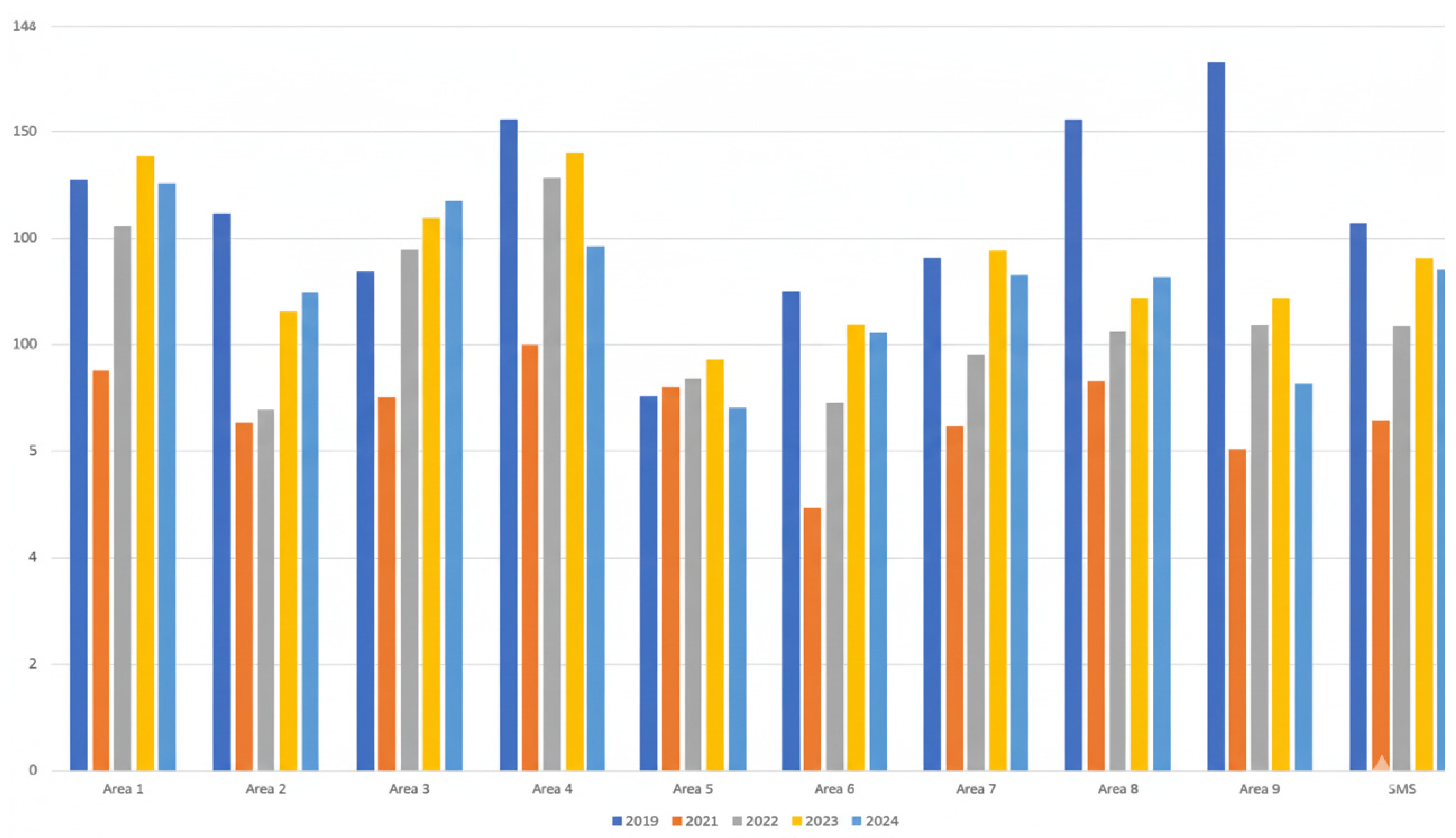
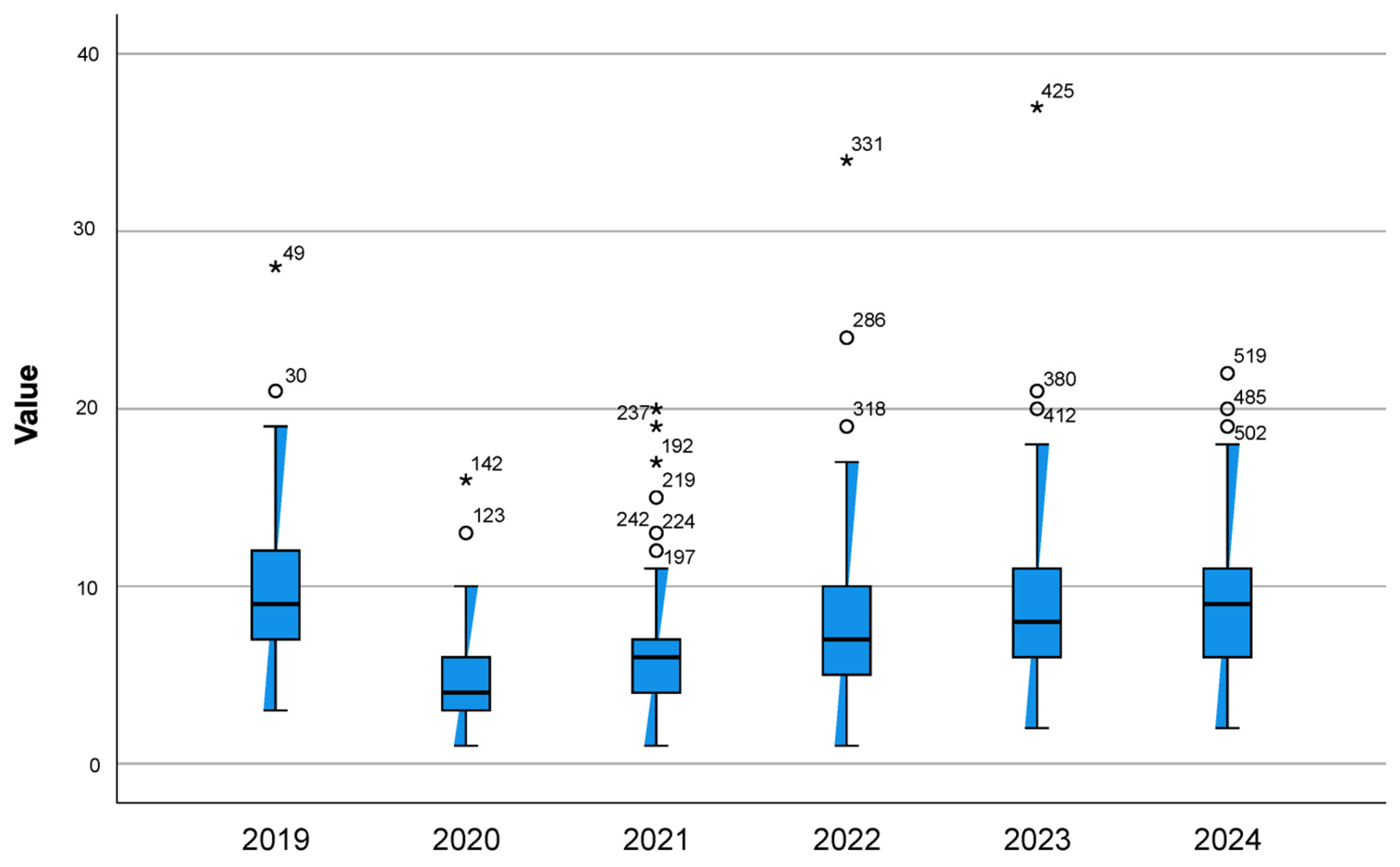
| DHD | 2019 | 10.33 ± 4.00 | |||
| DHD | 2020 | 5.29 ± 2.38 | |||
| DHD | 2021 | 6.72 ± 3.56 | |||
| DHD | 2022 | 8.50 ± 4.63 | |||
| DHD | 2023 | 9.79 ± 4.78 | |||
| DHD | 2024 | 9.42 ± 3.75 | <0.001 | <0.001 |
| Variable | 2019-Year | Total HCAs (n = 9) | Mean Differences | p Value | 95% Confidence Intervale |
|---|---|---|---|---|---|
| DHD | 2020 | 5.03 | <0.001 | 3.39–6.67 | |
| DHD | 2021 | 3.6 | <0.001 | 1.96–5.23 | |
| DHD | 2022 | 1.82 | 0.19 | 0.18–3.46 | |
| DHD | 2023 | 0.53 | 0.940 | −1.1–2.1 | |
| DHD | 2024 | 0.90 | 0.55 | −0.73–2.5 |
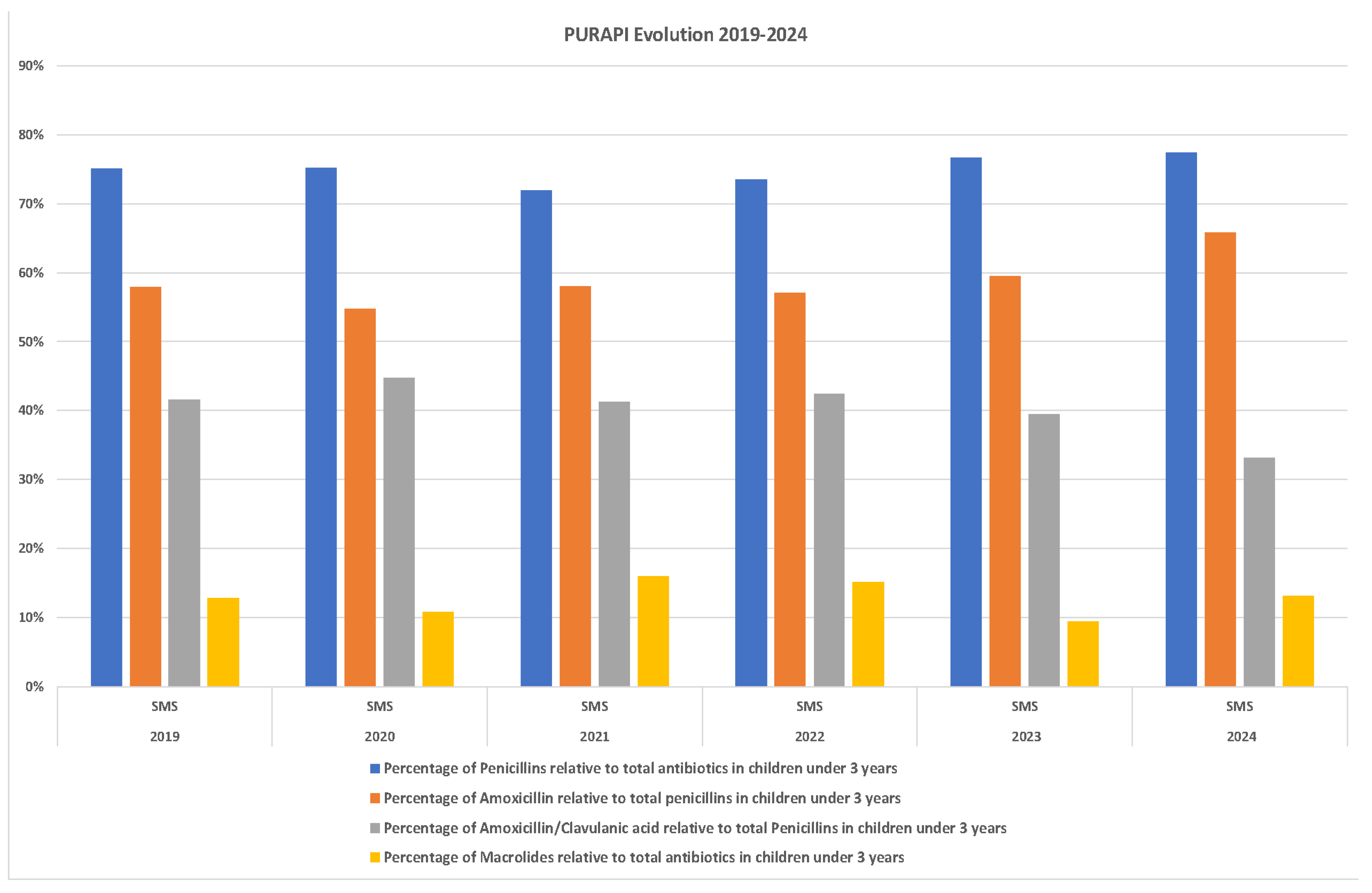
| Year | Penicillins (% Antibiotics) | Amoxicillin (% Penicillins) | Amoxicillin–Clavulanic (% Penicillins) | Macrolides (% Antibiotics) |
|---|---|---|---|---|
| 2019 | 75.10 | 57.87 | 41.58 | 12.73 |
| 2020 | 75.23 | 54.70 | 44.77 | 10.79 |
| 2021 | 71.91 | 58.05 | 41.29 | 15.90 |
| 2022 | 73.51 | 57.02 | 42.38 | 15.06 |
| 2023 | 76.73 | 59.54 | 39.42 | 9.38 |
| 2024 | 77.46 | 65.78 | 33.11 | 13.04 |
Disclaimer/Publisher’s Note: The statements, opinions and data contained in all publications are solely those of the individual author(s) and contributor(s) and not of MDPI and/or the editor(s). MDPI and/or the editor(s) disclaim responsibility for any injury to people or property resulting from any ideas, methods, instructions or products referred to in the content. |
© 2026 by the authors. Licensee MDPI, Basel, Switzerland. This article is an open access article distributed under the terms and conditions of the Creative Commons Attribution (CC BY) license.
Share and Cite
Martín-Ayala, G.; Alfayate-Miguélez, S.; Jiménez-Guillén, C.; Alcaraz-Quiñonero, M.; Iofrío-De Arce, A.; Arnau-Sánchez, J. Impact of the COVID-19 Pandemic on the Outcomes of a Multifaceted Program on Antibiotic Prescribing in Primary Care Among Children Under Three Years of Age. Antibiotics 2026, 15, 101. https://doi.org/10.3390/antibiotics15010101
Martín-Ayala G, Alfayate-Miguélez S, Jiménez-Guillén C, Alcaraz-Quiñonero M, Iofrío-De Arce A, Arnau-Sánchez J. Impact of the COVID-19 Pandemic on the Outcomes of a Multifaceted Program on Antibiotic Prescribing in Primary Care Among Children Under Three Years of Age. Antibiotics. 2026; 15(1):101. https://doi.org/10.3390/antibiotics15010101
Chicago/Turabian StyleMartín-Ayala, Gema, Santiago Alfayate-Miguélez, Casimiro Jiménez-Guillén, Manuel Alcaraz-Quiñonero, Antonio Iofrío-De Arce, and José Arnau-Sánchez. 2026. "Impact of the COVID-19 Pandemic on the Outcomes of a Multifaceted Program on Antibiotic Prescribing in Primary Care Among Children Under Three Years of Age" Antibiotics 15, no. 1: 101. https://doi.org/10.3390/antibiotics15010101
APA StyleMartín-Ayala, G., Alfayate-Miguélez, S., Jiménez-Guillén, C., Alcaraz-Quiñonero, M., Iofrío-De Arce, A., & Arnau-Sánchez, J. (2026). Impact of the COVID-19 Pandemic on the Outcomes of a Multifaceted Program on Antibiotic Prescribing in Primary Care Among Children Under Three Years of Age. Antibiotics, 15(1), 101. https://doi.org/10.3390/antibiotics15010101