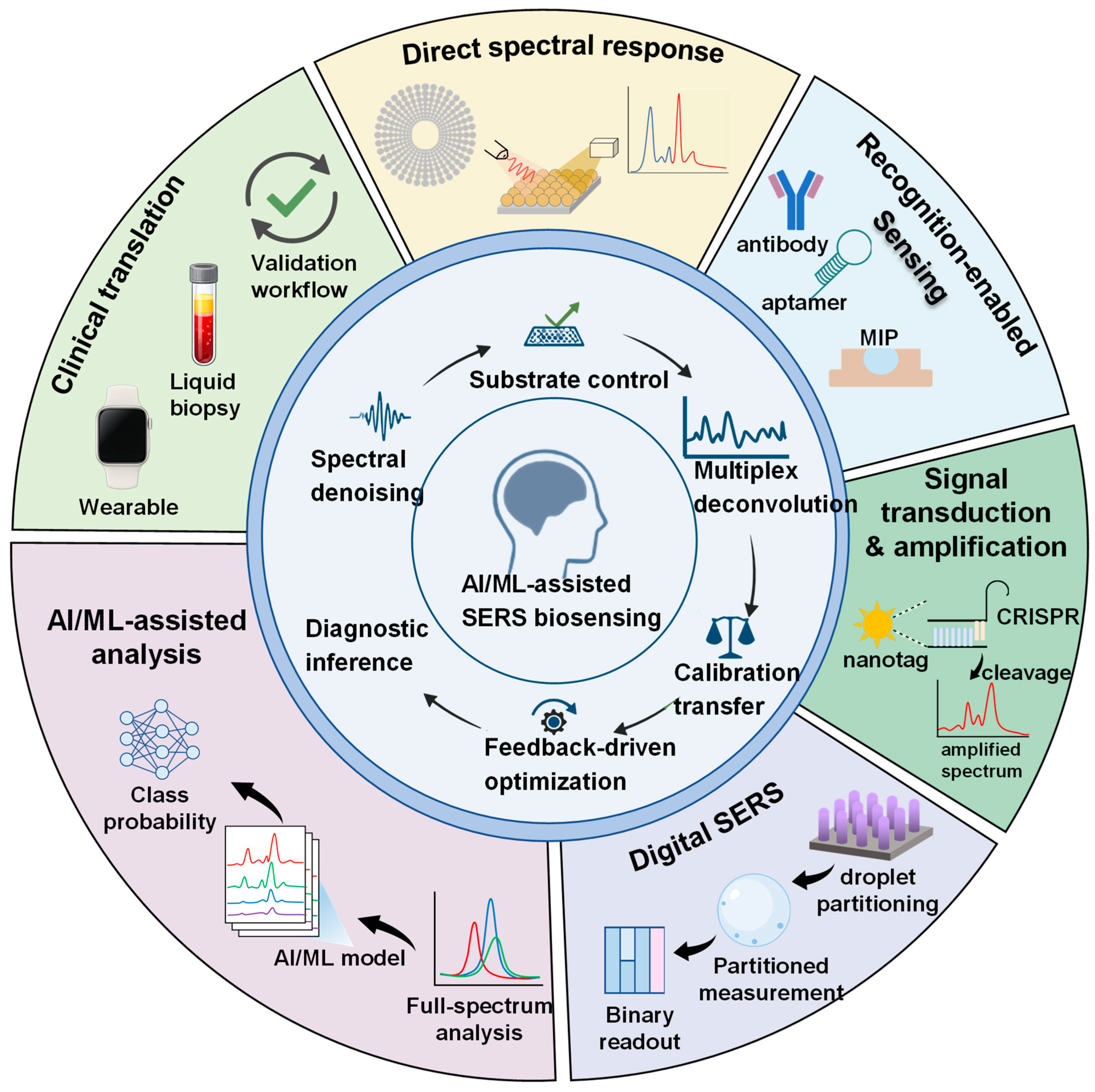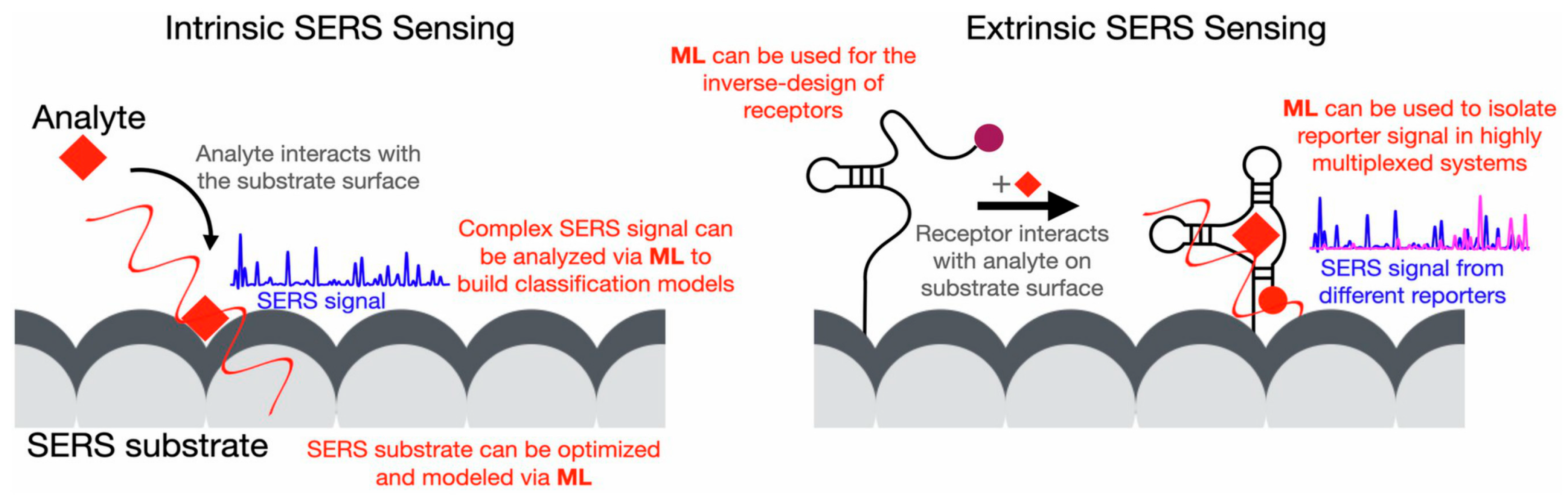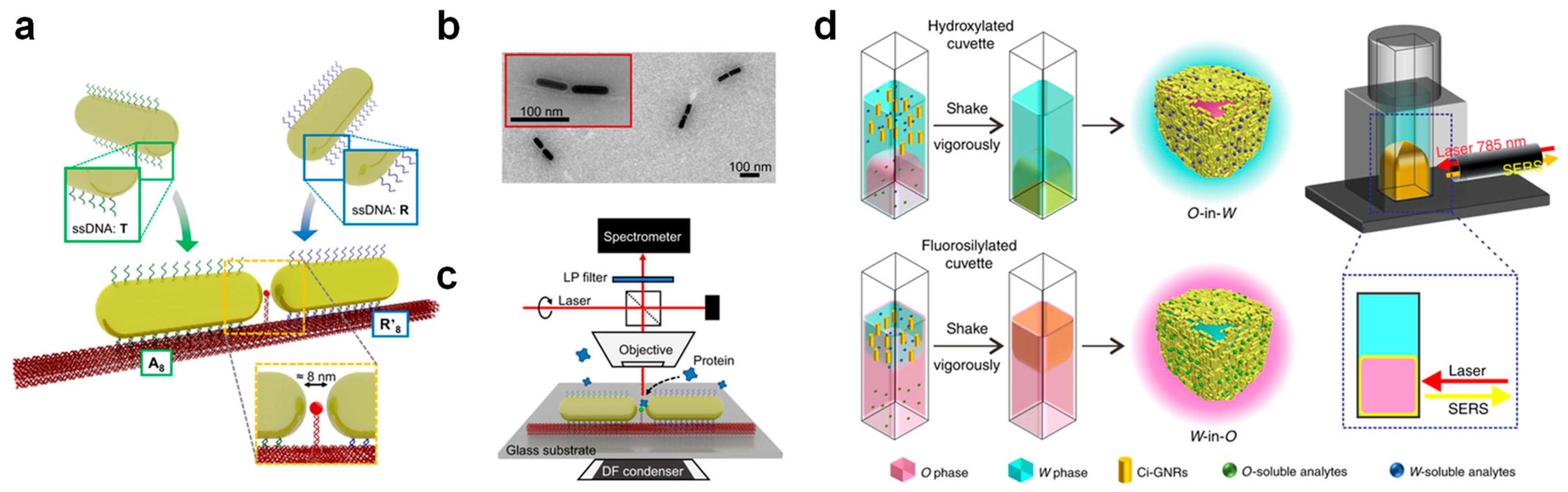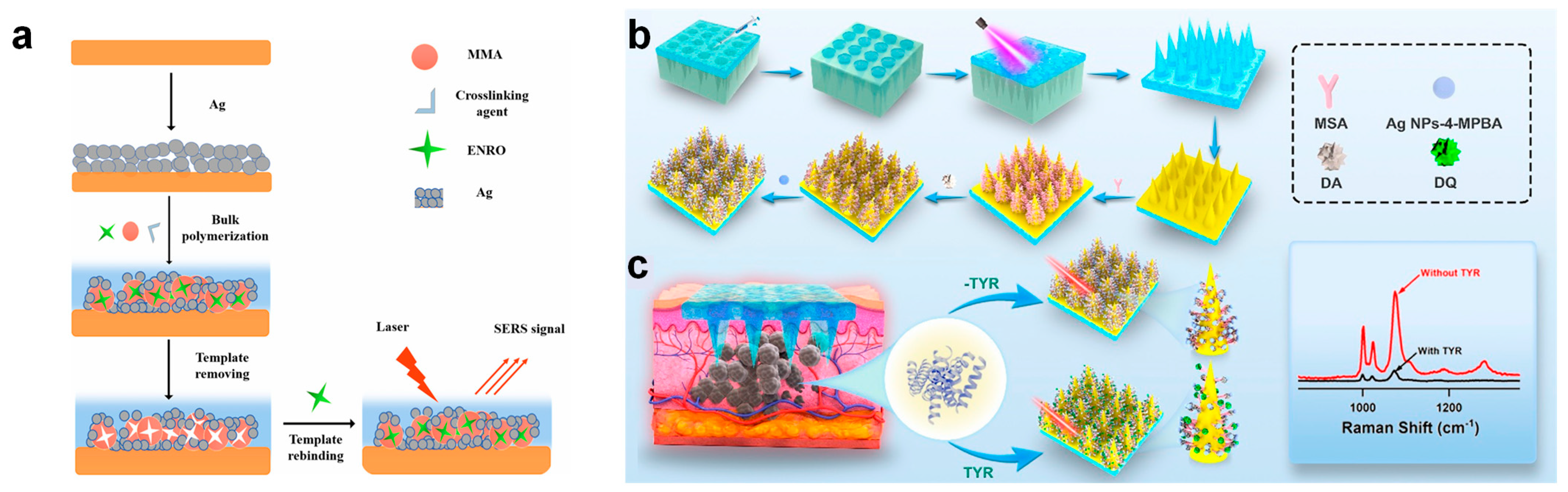
AI/ML-Assisted SERS Biosensing for Biomolecular Detection: From Direct Spectral Response to Integrated Diagnostic Systems



Abstract
1. Introduction
2. Direct Label-Free SERS and Substrate-Controlled Spectral Readout
3. Recognition-Enabled SERS: From Random Adsorption to Controlled Target Localization
4. Signal Transduction and Amplification: From Target Spectrum to Designed Response
5. Digital SERS and AI/ML-Assisted Interpretation: From Spectral Measurement to Diagnostic Inference
6. Clinical Translation and Validation: From Analytical Performance to Deployable Systems
7. Future Perspectives: Toward AI-Assisted SERS as a Diagnostic System
8. Conclusions
Author Contributions
Funding
Institutional Review Board Statement
Informed Consent Statement
Data Availability Statement
Acknowledgments
Conflicts of Interest
Abbreviations
| SERS | Surface-enhanced Raman scattering |
| AI | Artificial intelligence |
| ML | Machine learning |
| AI/ML | Artificial intelligence/machine learning |
| POC | Point-of-care |
| LOD | Limit of detection |
| RSD | Relative standard deviation |
| EV | Extracellular vesicle |
| MIP | Molecularly imprinted polymer |
| CRISPR | Clustered regularly interspaced short palindromic repeats |
| Cas12a | CRISPR-associated protein 12a |
| LFIA | Lateral-flow immunoassay |
| NPoM | Nanoparticle-on-mirror |
| PCA | Principal component analysis |
| LDA | Linear discriminant analysis |
| PCA-LDA | Principal component analysis–linear discriminant analysis |
| SVM | Support vector machine |
| CNN | Convolutional neural network |
| 1D-CNN | One-dimensional convolutional neural network |
| XAI | Explainable artificial intelligence |
| SHAP | SHapley Additive exPlanations |
| Grad-CAM | Gradient-weighted class activation mapping |
| LOPO-CV | Leave-one-patient-out cross-validation |
| ROC | Receiver operating characteristic |
| AUC | Area under the receiver operating characteristic curve |
| SaMD | Software as a medical device |
| STARD-AI | Standards for Reporting Diagnostic Accuracy Studies–Artificial Intelligence |
| bHCR | Branched hybridization chain reaction |
| PSA | Prostate-specific antigen |
| CA19-9 | Carbohydrate antigen 19-9 |
References
- Langer, J.; Jimenez de Aberasturi, D.; Aizpurua, J.; Alvarez-Puebla, R.A.; Auguié, B.; Baumberg, J.J.; Bazan, G.C.; Bell, S.E.J.; Boisen, A.; Brolo, A.G.; et al. Present and Future of Surface-Enhanced Raman Scattering. ACS Nano 2020, 14, 28–117. [Google Scholar] [CrossRef] [PubMed]
- Cialla-May, D.; Bonifacio, A.; Bocklitz, T.; Markin, A.; Markina, N.; Fornasaro, S.; Dwivedi, A.; Dib, T.; Farnesi, E.; Liu, C.; et al. Biomedical SERS—The current state and future trends. Chem. Soc. Rev. 2024, 53, 8957–8979. [Google Scholar] [CrossRef] [PubMed]
- Jamieson, L.E.; Asiala, S.M.; Gracie, K.; Faulds, K.; Graham, D. Bioanalytical Measurements Enabled by Surface-Enhanced Raman Scattering (SERS) Probes. Annu. Rev. Anal. Chem. 2017, 10, 415–437. [Google Scholar] [CrossRef] [PubMed]
- Zheng, X.S.; Jahn, I.J.; Weber, K.; Cialla-May, D.; Popp, J. Label-free SERS in biological and biomedical applications: Recent progress, current challenges and opportunities. Spectrochim. Acta A Mol. Biomol. Spectrosc. 2018, 197, 56–77. [Google Scholar] [CrossRef] [PubMed]
- Chen, M.; Zhao, M.; Cai, Y.; Zhang, Q.; Peng, Z.; Li, Q.; Wang, Z. Surface-enhanced Raman spectroscopy for label-free cancer liquid biopsy: From fundamentals to clinical analysis of biofluid. Front. Chem. 2026, 13, 1696979. [Google Scholar] [CrossRef] [PubMed]
- Panikar, S.S.; Cialla-May, D.; De la Rosa, E.; Salas, P.; Popp, J. Towards translation of surface-enhanced Raman spectroscopy (SERS) to clinical practice: Progress and trends. TrAC Trends Anal. Chem. 2021, 134, 116122. [Google Scholar] [CrossRef]
- Cialla-May, D.; Zheng, X.-S.; Weber, K.; Popp, J. Recent progress in surface-enhanced Raman spectroscopy for biological and biomedical applications: From cells to clinics. Chem. Soc. Rev. 2017, 46, 3945–3961. [Google Scholar] [CrossRef] [PubMed]
- Schlücker, S. Surface-enhanced Raman spectroscopy: Concepts and chemical applications. Angew. Chem. Int. Ed. 2014, 53, 4756–4795. [Google Scholar] [CrossRef] [PubMed]
- Le Ru, E.C.; Blackie, E.; Meyer, M.; Etchegoin, P.G. Surface enhanced Raman scattering enhancement factors: A comprehensive study. J. Phys. Chem. C 2007, 111, 13794–13803. [Google Scholar] [CrossRef]
- Constantinou, M.; Hadjigeorgiou, K.; Abalde-Cela, S.; Andreou, C. Label-Free Sensing with Metal Nanostructure-Based Surface-Enhanced Raman Spectroscopy for Cancer Diagnosis. ACS Appl. Nano Mater. 2022, 5, 12276–12299. [Google Scholar] [CrossRef] [PubMed]
- Lee, H.K.; Lee, Y.H.; Koh, C.S.L.; Phan-Quang, G.C.; Han, X.; Lay, C.L.; Sim, H.Y.F.; Kao, Y.-C.; An, Q.; Ling, X.Y. Designing surface-enhanced Raman scattering (SERS) platforms beyond hotspot engineering: Emerging opportunities in analyte manipulations and hybrid materials. Chem. Soc. Rev. 2019, 48, 731–756. [Google Scholar] [CrossRef] [PubMed]
- Ding, S.-Y.; You, E.-M.; Tian, Z.-Q.; Moskovits, M. Electromagnetic theories of surface-enhanced Raman spectroscopy. Chem. Soc. Rev. 2017, 46, 4042–4076. [Google Scholar] [CrossRef] [PubMed]
- Choi, N.; Zhang, Y.; Wang, Y.; Schlücker, S. iSERS: From nanotag design to protein assays and ex vivo imaging. Chem. Soc. Rev. 2024, 53, 7014–7047. [Google Scholar] [CrossRef] [PubMed]
- García-Ramírez, J.I.; Luna-Cervantes, M.; Izaguirre-Hernández, I.Y.; Hernández-Torres, J.; Juárez-Aguilar, E.; Thomas-Dupont, P.; Remes-Troche, J.M.; Zamora-Peredo, L. SERS-Based Immunoassay for α-Fetoprotein Biomarker Detection Using an Au-Ag Nanostars Platform. Biosensors 2025, 15, 632. [Google Scholar] [CrossRef] [PubMed]
- Muhammad, M.; Huang, Q. A review of aptamer-based SERS biosensors: Design strategies and applications. Talanta 2021, 227, 122188. [Google Scholar] [CrossRef] [PubMed]
- Pavan, S.; Berti, F. Short peptides as biosensor transducers. Anal. Bioanal. Chem. 2012, 402, 3055–3070. [Google Scholar] [CrossRef] [PubMed]
- Mosier-Boss, P.A. Review of SERS Substrates for Chemical Sensing. Nanomaterials 2017, 7, 142. [Google Scholar] [CrossRef] [PubMed]
- Granger, J.H.; Granger, M.C.; Firpo, M.A.; Mulvihill, S.J.; Porter, M.D. Toward development of a surface-enhanced Raman scattering (SERS)-based cancer diagnostic immunoassay panel. Analyst 2013, 138, 410–416. [Google Scholar] [CrossRef] [PubMed]
- Chen, D.; Ma, Y.; Yang, A.; Hu, L.; Zhou, H.; Xu, J.; Chen, S.; Nie, D.; Feng, W.; Cai, H.; et al. Dual-Enhanced SERS Satellite Immuno-Nanocomplex for Multiple PSA-Mediated PHI Assay Toward Clinical Prostate Cancer Screening. Adv. Sci. 2025, 12, 2411747. [Google Scholar] [CrossRef]
- Chen, X.; Liu, T.; Chen, W.; Lin, Z.; Zhang, Q.; Zhou, B.; Zhou, X. From nanotags to precision biomedicine: SERS-driven progress and innovation in tumor biomarker profiling, dynamic bioimaging, AI-enhanced diagnostics and therapy. Theranostics 2026, 16, 3447–3487. [Google Scholar] [CrossRef] [PubMed]
- Laing, S.; Sloan-Dennison, S.; Faulds, K.; Graham, D. Surface Enhanced Raman Scattering for Biomolecular Sensing in Human Healthcare Monitoring. ACS Nano 2025, 19, 8381–8400. [Google Scholar] [CrossRef] [PubMed]
- Hu, C.; Guan, M.; Mi, F.; Zhang, S.; Geng, P. Multimodal SERS Biosensing Platforms: Emerging Opportunities for Ultrasensitive Biomarker Detection and Intelligent Diagnostics. ACS Sens. 2026, 11, 1794–1830. [Google Scholar] [CrossRef] [PubMed]
- Lin, D.; Hsieh, C.-L.; Hsu, K.-C.; Liao, P.-H.; Qiu, S.; Gong, T.; Yong, K.-T.; Feng, S.; Kong, K.V. Geometrically encoded SERS nanobarcodes for the logical detection of nasopharyngeal carcinoma-related progression biomarkers. Nat. Commun. 2021, 12, 3430. [Google Scholar] [CrossRef] [PubMed]
- Liang, J.; Teng, P.; Xiao, W.; He, G.; Song, Q.; Zhang, Y.; Peng, B.; Li, G.; Hu, L.; Cao, D.; et al. Application of the amplification-free SERS-based CRISPR/Cas12a platform in the identification of SARS-CoV-2 from clinical samples. J. Nanobiotechnol. 2021, 19, 273. [Google Scholar] [CrossRef] [PubMed]
- Wang, H.; Su, A.; Bao, C.; Liang, C.; Xu, W.; Chang, J.; Xu, S. A CRISPR/Cas12a-SERS platform for amplification-free gene detection of African swine fever virus. Talanta 2024, 267, 125225. [Google Scholar] [CrossRef] [PubMed]
- Rabiee, N. SERS-Enhanced CRISPR Biosensors: A Platform for Ultrasensitive Molecular Diagnostics. Anal. Chem. 2026, 98, 7911–7936. [Google Scholar] [CrossRef] [PubMed]
- Li, Z.; Hu, J.; Zhan, Y.; Shao, Z.; Gao, M.; Yao, Q.; Li, Z.; Sun, S.; Wang, L. Coupling Bifunctional Nanozyme-Mediated Catalytic Signal Amplification and Label-Free SERS with Immunoassays for Ultrasensitive Detection of Pathogens in Milk Samples. Anal. Chem. 2023, 95, 6417–6424. [Google Scholar] [CrossRef] [PubMed]
- Li, Y.; Li, P.; Chen, Y.; Wu, Y.; Wei, J. Interfacial Deposition of Ag Nanozyme on Metal-Polyphenol Nanosphere for SERS Detection of Cellular Glutathione. Biosens. Bioelectron. 2023, 228, 115200. [Google Scholar] [CrossRef] [PubMed]
- Wang, X.; Sheng, J.; Yang, H.; Shen, K.; Yao, J.; Qian, Y.; Chen, G. Au@Pt@HP1-HP2@Fe3O4 Nanoenzymatic Complexes Based on CHA Signal Amplification Strategy for Ultrasensitive SERS Detection of ctDNA in Liver Cancer. Int. J. Nanomed. 2025, 20, 8891–8905. [Google Scholar] [CrossRef] [PubMed]
- Hwang, J.; Lee, S.; Choo, J. Application of a SERS-based lateral flow immunoassay strip for the rapid and sensitive detection of staphylococcal enterotoxin B. Nanoscale 2016, 8, 11418–11425. [Google Scholar] [CrossRef] [PubMed]
- Park, S.; Jeong, Y.; Jang, S.; Yang, C.-H.; Chu, J.; Kang, H.; Park, S.; Chang, H.; Jun, B.-H. Multiplexed Detection of Cancer Biomarker Using a Dual-Mode Colorimetric-SERS Lateral Flow Immunoassay Based on Elongated Rod Ag Nanoshell (ERNS) SERS Tags. Biosensors 2026, 16, 129. [Google Scholar] [CrossRef] [PubMed]
- Zhi, W.; Wang, L.; Dai, L.; Xu, J.; He, T.; Zong, X.; Xu, J.; Cai, H.; Pi, J.; Sun, P.; et al. SERS-based lateral flow immunoassay for rapid and sensitive sensing of nucleocapsid protein toward SARS-CoV-2 screening in clinical samples. Anal. Chim. Acta 2025, 1360, 344149. [Google Scholar] [CrossRef] [PubMed]
- Bi, X.; Czajkowsky, D.M.; Shao, Z.; Ye, J. Digital colloid-enhanced Raman spectroscopy by single-molecule counting. Nature 2024, 628, 771–775. [Google Scholar] [CrossRef] [PubMed]
- Ando, J.; Asanuma, M.; Dodo, K.; Fujita, H.; Yamakoshi, H.; Sodeoka, M.; Watanabe, T.M. Digital SERS bioanalysis of single-enzyme biomarkers. Proc. Natl. Acad. Sci. USA 2025, 122, e2510559122. [Google Scholar] [CrossRef] [PubMed]
- Wang, W.; Srivastava, S.; Garg, A.; Xiao, C.; Hawks, S.; Pan, J.; Duggal, N.; Isaacman-VanWertz, G.; Zhou, W.; Marr, L.C.; et al. Digital Surface-Enhanced Raman Spectroscopy–Lateral Flow Test Dipstick: Ultrasensitive, Rapid Virus Quantification in Environmental Dust. Environ. Sci. Technol. 2024, 58, 4926–4936. [Google Scholar] [CrossRef] [PubMed]
- Li, J.; Wuethrich, A.; Edwardraja, S.; Lobb, R.J.; Puttick, S.; Rose, S.; Trau, M. A digital single-molecule nanopillar SERS platform for predicting and monitoring immune toxicities in immunotherapy. Nat. Commun. 2021, 12, 1087. [Google Scholar] [CrossRef] [PubMed]
- Thrift, W.J.; Ragan, R. Quantification of Analyte Concentration in the Single Molecule Regime Using Convolutional Neural Networks. Anal. Chem. 2019, 91, 13337–13342. [Google Scholar] [CrossRef] [PubMed]
- Dong, S.; He, D.; Zhang, Q.; Huang, C.; Hu, Z.; Zhang, C.; Nie, L.; Wang, K.; Luo, W.; Yu, J.; et al. Early cancer detection by serum biomolecular fingerprinting spectroscopy with machine learning. eLight 2023, 3, 17. [Google Scholar] [CrossRef]
- Shi, Y.; Shi, W.; Sun, M.; Lin, L.; Ye, J. Early cancer detection by SERS spectroscopy and machine learning. Light Sci. Appl. 2023, 12, 291. [Google Scholar] [CrossRef] [PubMed]
- Srivastava, S.; Garg, A.; Xiao, C.; Hawks, S.; Pan, J.; Duggal, N.; Isaacman-VanWertz, G.; Zhou, W.; Marr, L.C.; Vikesland, P.J. Machine Learning-Assisted Surface-Enhanced Raman Spectroscopy Detection for Environmental Applications: A Review. Environ. Sci. Technol. 2024, 58, 20830–20848. [Google Scholar] [CrossRef] [PubMed]
- Shin, H.; Choi, B.H.; Shim, O.; Kim, J.; Park, Y.; Cho, S.K.; Kim, H.K.; Choi, Y. Single test-based diagnosis of multiple cancer types using Exosome-SERS-AI for early stage cancers. Nat. Commun. 2023, 14, 1644. [Google Scholar] [CrossRef] [PubMed]
- Xiong, C.-C.; Zhu, S.-S.; Yan, D.-H.; Yao, Y.-D.; Zhang, Z.; Zhang, G.-J.; Chen, S. Rapid and precise detection of cancers via label-free SERS and deep learning. Anal. Bioanal. Chem. 2023, 415, 3449–3462. [Google Scholar] [CrossRef] [PubMed]
- Diao, X.; Li, X.; Hou, S.; Li, H.; Qi, G.; Jin, Y. Machine Learning-Based Label-Free SERS Profiling of Exosomes for Accurate Fuzzy Diagnosis of Cancer and Dynamic Monitoring of Drug Therapeutic Processes. Anal. Chem. 2023, 95, 7552–7559. [Google Scholar] [CrossRef] [PubMed]
- Quarin, S.M.; Vang, D.; Dima, R.I.; Stan, G.; Strobbia, P. AI in SERS sensing moving from discriminative to generative. npj Biosens. 2025, 2, 9. [Google Scholar] [CrossRef] [PubMed]
- Das, G.M.; Managò, S.; Mangini, M.; De Luca, A.C. Biosensing Using SERS Active Gold Nanostructures. Nanomaterials 2021, 11, 2679. [Google Scholar] [CrossRef] [PubMed]
- Moskovits, M. Surface-enhanced Raman spectroscopy: A brief retrospective. J. Raman Spectrosc. 2005, 36, 485–496. [Google Scholar] [CrossRef]
- Guerrini, L.; Graham, D. Molecularly-mediated assemblies of plasmonic nanoparticles for surface-enhanced Raman spectroscopy applications. Chem. Soc. Rev. 2012, 41, 7085–7107. [Google Scholar] [CrossRef] [PubMed]
- Tian, L.; Su, M.; Yu, F.; Xu, Y.; Li, X.; Li, L.; Liu, H.; Tan, W. Liquid-state quantitative SERS analyzer on self-ordered metal liquid-like plasmonic arrays. Nat. Commun. 2018, 9, 3642. [Google Scholar] [CrossRef] [PubMed]
- Benz, F.; Schmidt, M.K.; Dreismann, A.; Chikkaraddy, R.; Zhang, Y.; Demetriadou, A.; Carnegie, C.; Ohadi, H.; de Nijs, B.; Esteban, R.; et al. Single-molecule optomechanics in “picocavities”. Science 2016, 354, 726–729. [Google Scholar] [CrossRef] [PubMed]
- de Nijs, B.; Bowman, R.W.; Herrmann, L.O.; Benz, F.; Barrow, S.J.; Sigle, D.; Mertens, J.; Oulton, R.; Esteban, R.; Aizpurua, J.; et al. SERS of Individual Nanoparticles on a Mirror: Size Does Matter, but so does Shape. J. Phys. Chem. Lett. 2016, 7, 2264–2270. [Google Scholar] [CrossRef] [PubMed]
- Schuknecht, F.; Kołątaj, K.; Steinberger, M.; Liedl, T.; Lohmueller, T. Accessible hotspots for single-protein SERS in DNA-origami assembled gold nanorod dimers with tip-to-tip alignment. Nat. Commun. 2023, 14, 7192. [Google Scholar] [CrossRef] [PubMed]
- Lin, L.L.; Alvarez-Puebla, R.; Liz-Marzán, L.M.; Trau, M.; Wang, J.; Fabris, L.; Wang, X.; Liu, G.; Xu, S.; Han, X.X.; et al. Surface-Enhanced Raman Spectroscopy for Biomedical Applications: Recent Advances and Future Challenges. ACS Appl. Mater. Interfaces 2025, 17, 16287–16379. [Google Scholar] [CrossRef] [PubMed]
- Liu, Y.; Li, M.; Liu, H.; Kang, C.; Wang, C. Cancer diagnosis using label-free SERS-based exosome analysis. Theranostics 2024, 14, 1966–1981. [Google Scholar] [CrossRef] [PubMed]
- Phyo, J.B.; Woo, A.; Yu, H.J.; Lim, K.; Cho, B.H.; Jung, H.S.; Lee, M.-Y. Label-Free SERS Analysis of Urine Using a 3D-Stacked AgNW-Glass Fiber Filter Sensor for the Diagnosis of Pancreatic Cancer and Prostate Cancer. Anal. Chem. 2021, 93, 3778–3785. [Google Scholar] [CrossRef] [PubMed]
- Sloan-Dennison, S.; Wallace, G.Q.; Hassanain, W.A.; Laing, S.; Faulds, K.; Graham, D. Advancing SERS as a quantitative technique: Challenges, considerations, and correlative approaches to aid validation. Nano Converg. 2024, 11, 33. [Google Scholar] [CrossRef] [PubMed]
- Rojalin, T.; Antonio, D.; Kulkarni, A.; Carney, R.P. Machine Learning-Assisted Sampling of Surface-Enhanced Raman Scattering (SERS) Substrates Improves Data Collection Efficiency. Appl. Spectrosc. 2022, 76, 485–495. [Google Scholar] [CrossRef] [PubMed]
- Yan, C.; Li, Y.; Zhang, X.; Liang, M.; Zhang, J.; Zhang, Y. A review on spectral data preprocessing techniques for machine learning and quantitative analysis. iScience 2025, 28, 112759. [Google Scholar] [CrossRef] [PubMed]
- Hashemi, P.; Afkhami, A.; Baradaran, B.; Halabian, R.; Madrakian, T.; Arduini, F.; Nguyen, T.A.; Bagheri, H. Well-Orientation Strategy for Direct Immobilization of Antibodies: Development of the Immunosensor Using the Boronic Acid-Modified Magnetic Graphene Nanoribbons for Ultrasensitive Detection of Lymphoma Cancer Cells. Anal. Chem. 2020, 92, 11405–11412. [Google Scholar] [CrossRef] [PubMed]
- Huang, J.; Xie, Z.; Xie, L.; Luo, S.; Zeng, T.; Zhang, Y.; Zhang, M.; Wang, S.; Li, M.; Wei, Y.; et al. Explore how immobilization strategies affected immunosensor performance by comparing four methods for antibody immobilization on electrode surfaces. Sci. Rep. 2022, 12, 22444. [Google Scholar] [CrossRef] [PubMed]
- Simões, B.; Guedens, W.J.; Keene, C.; Kubiak-Ossowska, K.; Mulheran, P.; Kotowska, A.M.; Scurr, D.J.; Alexander, M.R.; Broisat, A.; Johnson, S.; et al. Direct Immobilization of Engineered Nanobodies on Gold Sensors. ACS Appl. Mater. Interfaces 2021, 13, 17353–17360. [Google Scholar] [CrossRef] [PubMed]
- Çapkın, E.; Kutlu, A.; Yüce, M. Repurposing Fc Gamma Receptor I (FcγRI, CD64) for Site-Oriented Monoclonal Antibody Capture: A Proof-of-Concept Study for Real-Time Detection of TNF-α. Heliyon 2023, 9, e19469. [Google Scholar] [CrossRef] [PubMed]
- Du, Q.; Wang, W.; Zeng, X.; Luo, X. Antifouling zwitterionic peptide hydrogel based electrochemical biosensor for reliable detection of prostate specific antigen in human serum. Anal. Chim. Acta 2023, 1239, 340674. [Google Scholar] [CrossRef] [PubMed]
- Stefancu, A.; Moisoiu, V.; Couti, R.; Andras, I.; Rahota, R.; Crisan, D.; Pavel, I.E.; Socaciu, C.; Leopold, N.; Crisan, N. Combining SERS analysis of serum with PSA levels for improving the detection of prostate cancer. Nanomedicine 2018, 13, 2455–2467. [Google Scholar] [CrossRef] [PubMed]
- Garg, A.; Zong, Z.; Vikesland, P.; Gloag, E.S.; Zhou, W. Zwitterionic nanoplasmonic bio-meshes for in situ spatiotemporal SERS monitoring of Pseudomonas aeruginosa biofilms. npj Biosens. 2025, 2, 30. [Google Scholar] [CrossRef]
- Ji, B.; Liu, Z.; Lv, Z.; Yang, Q.; Sun, J.; Su, G.; Xia, Y.; Yan, X.; Hu, J.; Hu, P.; et al. Targeted molecular rapid SERS diagnosis in clinical human serum through aptamer origami-collapsed nanofingers chip. Biosens. Bioelectron. 2025, 285, 117583. [Google Scholar] [CrossRef] [PubMed]
- Chen, C.; Wang, X.; Wang, X.; Waterhouse, G.I.N.; Wang, R.; Sun, Y.; Xu, Z. SERS aptasensor utilizing aptamer-conformation-mediated regulation of Au dumbbell dimers for the ultrasensitive detection of β-phenethylamine in foods. Sens. Actuators B Chem. 2024, 404, 135293. [Google Scholar] [CrossRef]
- Liu, X.; Zhang, J.; Chen, Z.; He, X.; Yan, C.; Lv, H.; Chen, Z.; Liu, Y.; Wang, L.; Song, C. Branched hybridization chain reaction and tetrahedral DNA-based trivalent aptamer powered SERS sensor for ultra-highly sensitive detection of cancer-derived exosomes. Biosens. Bioelectron. 2025, 267, 116737. [Google Scholar] [CrossRef] [PubMed]
- Neng, J.; Wang, Y.; Zhang, Y.; Chen, P.; Yang, K. MIPs–SERS Sensor Based on Ag NPs Film for Selective Detection of Enrofloxacin in Food. Biosensors 2023, 13, 330. [Google Scholar] [CrossRef] [PubMed]
- Gu, Z.; Zhao, D.; He, H.; Wang, Z. SERS-Based Microneedle Biosensor for In Situ and Sensitive Detection of Tyrosinase. Biosensors 2024, 14, 202. [Google Scholar] [CrossRef] [PubMed]
- Wang, Y.; Yan, B.; Chen, L. SERS Tags: Novel Optical Nanoprobes for Bioanalysis. Chem. Rev. 2013, 113, 1391–1428. [Google Scholar] [CrossRef] [PubMed]
- Spaziani, S.; Quero, G.; Managò, S.; Zito, G.; Terracciano, D.; Macchia, P.E.; Galeotti, F.; Pisco, M.; De Luca, A.C.; Cusano, A. SERS assisted sandwich immunoassay platforms for ultrasensitive and selective detection of human Thyroglobulin. Biosens. Bioelectron. 2023, 233, 115322. [Google Scholar] [CrossRef] [PubMed]
- Wang, T.; Yang, Y.; Lu, H.; Cui, J.; Chen, X.; Ma, P.; Zhong, W.; Zhao, Y. Functional regression for SERS spectrum transformation across diverse instruments. Analyst 2025, 150, 460–469. [Google Scholar] [CrossRef] [PubMed]
- Lai, J.; Li, M.; Chen, S.; Long, J.; Chen, Y.; Lu, H.; Zou, C.; Zhang, Z. Calibration Transfer of Deep Learning Models among Multiple Raman Spectrometers via Low-Rank Adaptation. Anal. Chem. 2025, 97, 19009–19018. [Google Scholar] [CrossRef] [PubMed]
- Geddis, A.; Williams, H.; Bashir, S.; Malenfant, J.; Dubois, C.; Hamlet, L.; Masson, J.-F. Artificial intelligence and machine learning for plasmonic and surface-enhanced sensing. Chem. Soc. Rev. 2026, 55, 3599–3644. [Google Scholar] [CrossRef] [PubMed]
- Yin, B.; Zhang, Q.; Xia, X.; Li, C.; Ho, W.K.H.; Yan, J.; Huang, Y.; Wu, H.; Wang, P.; Yi, C.; et al. A CRISPR-Cas12a integrated SERS nanoplatform with chimeric DNA/RNA hairpin guide for ultrasensitive nucleic acid detection. Theranostics 2022, 12, 5914–5930. [Google Scholar] [CrossRef] [PubMed]
- Zhou, C.; Zhang, Y.; Yang, X.; Zhao, Z.; Xia, M.; Wei, C.; Wu, Q.; Chang, Z.; Ma, L.; Yin, L. A magnetic CRISPR/Cas12a-SERS nanobiosensor for amplification-free and ultrasensitive detection of norovirus in water and food samples. Anal. Chim. Acta 2025, 1363, 344133. [Google Scholar] [CrossRef] [PubMed]
- Kissell, L.N.; Han, D.; Vang, D.; Cikanek, A.W.R.; Steckl, A.J.; Strobbia, P. Improved point-of-care detection of P. gingivalis using optimized surface-enhanced Raman scattering in lateral flow assays. Sens. Diagn. 2024, 3, 839–849. [Google Scholar] [CrossRef]
- Ho, K.H.W.; Lai, H.; Zhang, R.; Chen, H.; Yin, W.; Yan, X.; Xiao, S.; Lam, C.Y.K.; Gu, Y.; Yan, J.; et al. SERS-Based Droplet Microfluidic Platform for Sensitive and High-Throughput Detection of Cancer Exosomes. ACS Sens. 2024, 9, 4860–4869. [Google Scholar] [CrossRef] [PubMed]
- Yang, J.; Cui, Y.; Wang, M.; Zheng, S.; Luo, S.; Huang, Y.; He, J.; Zhang, R.; Jiang, X.; Zhong, S. Application of serum SERS technology combined with deep learning algorithm in the rapid diagnosis of immune diseases and chronic kidney disease. Sci. Rep. 2023, 13, 15719. [Google Scholar] [CrossRef] [PubMed]
- Ho, C.-S.; Jean, N.; Hogan, C.A.; Blackmon, L.; Jeffrey, S.S.; Holodniy, M.; Banaei, N.; Saleh, A.A.E.; Ermon, S.; Dionne, J. Rapid identification of pathogenic bacteria using Raman spectroscopy and deep learning. Nat. Commun. 2019, 10, 4927. [Google Scholar] [CrossRef] [PubMed]
- Tseng, Y.-M.; Chen, K.-L.; Chao, P.-H.; Han, Y.-Y.; Huang, N.-T. Deep Learning–Assisted Surface-Enhanced Raman Scattering for Rapid Bacterial Identification. ACS Appl. Mater. Interfaces 2023, 15, 26398–26406. [Google Scholar] [CrossRef] [PubMed]
- Chen, H.; Zhao, R.; Bi, X.; Shen, N.; Mo, X.; Tao, Y.; Chen, Z.; Ye, J. Bacterial identification by metabolite-level interpretable surface-enhanced Raman spectroscopy (SERSome). Adv. Photonics 2025, 7, 046007. [Google Scholar] [CrossRef]
- Szymborski, T.R.; Berus, S.M.; Nowicka, A.B.; Słowiński, G.; Kamińska, A. Machine Learning for COVID-19 Determination Using Surface-Enhanced Raman Spectroscopy. Biomedicines 2024, 12, 167. [Google Scholar] [CrossRef] [PubMed]
- Nyamdavaa, A.; Kaladharan, K.; Ganbold, E.-O.; Jeong, S.; Paek, S.; Su, Y.; Tseng, F.-G.; Ishdorj, T.-O. DeepATsers: A deep learning framework for one-pot SERS biosensor to detect SARS-CoV-2 virus. Sci. Rep. 2025, 15, 12245. [Google Scholar] [CrossRef] [PubMed]
- Yuan, R.; Zhan, H.; Liu, Y.; Su, J.; Ju, J.; Qiao, X. Integrating AI-assisted SERS Biosensing and Photoactivated Antibacterial Therapy in Au@Cu2−xSe for Combating Multidrug-Resistant Bacteria. Anal. Chem. 2025, 97, 27160–27170. [Google Scholar] [CrossRef] [PubMed]
- Hu, J.; Chen, G.J.; Xue, C.; Shum, P.P. RSPSSL: A novel high-fidelity Raman spectral preprocessing scheme to enhance biomedical applications and chemical resolution visualization. Light Sci. Appl. 2024, 13, 52. [Google Scholar] [CrossRef] [PubMed]
- Zhao, F.; Zheng, Y.; Zhao, Z.; Wang, W.; Xu, T.; Xue, X.; Fu, W.; Ling, Y.; Shi, J.; Zhang, Z. Re-understanding of SERS for General and Standardized Quantitative Analysis. Nano Lett. 2024, 24, 10290–10296. [Google Scholar] [CrossRef] [PubMed]
- Cui, J.; Chen, X.; Zhao, Y. Beyond Traditional airPLS: Improved Baseline Removal in SERS with Parameter-Focused Optimization and Prediction. Anal. Chem. 2025, 97, 16211–16218. [Google Scholar] [CrossRef] [PubMed]
- Farnesi, E.; Guliev, R.; Liu, C.; Ballmaier, J.; Guntinas-Lichius, O.; Schmitt, M.; Popp, J.; Cialla-May, D. Point-of-care SERS-based ML diagnosis of head and neck cancer via cerumen analysis. npj Biosens. 2025, 2, 14. [Google Scholar] [CrossRef]
- Chen, X.; Wu, X.; Chen, C.; Luo, C.; Shi, Y.; Li, Z.; Lv, X.; Chen, C.; Su, J.; Wu, L. Raman spectroscopy combined with a support vector machine algorithm as a diagnostic technique for primary Sjögren’s syndrome. Sci. Rep. 2023, 13, 5137. [Google Scholar] [CrossRef] [PubMed]
- Liu, J.; Osadchy, M.; Ashton, L.; Foster, M.; Solomon, C.J.; Gibson, S.J. Deep convolutional neural networks for Raman spectrum recognition: A unified solution. Analyst 2017, 142, 4067–4074. [Google Scholar] [CrossRef] [PubMed]
- Wu, M.; Wang, S.; Pan, S.; Terentis, A.C.; Strasswimmer, J.; Zhu, X. Deep learning data augmentation for Raman spectroscopy cancer tissue classification. Sci. Rep. 2021, 11, 23842. [Google Scholar] [CrossRef] [PubMed]
- Zaki, J.K.; Tomasik, J.; McCune, J.A.; Bahn, S.; Lió, P.; Scherman, O.A. Explainable Deep Learning Framework for SERS Bioquantification. ACS Sens. 2025, 10, 6597–6606. [Google Scholar] [CrossRef] [PubMed]
- Sounderajah, V.; Guni, A.; Liu, X.; Collins, G.S.; Karthikesalingam, A.; Markar, S.R.; Golub, R.M.; Denniston, A.K.; Shetty, S.; Moher, D.; et al. The STARD-AI Reporting Guideline for Diagnostic Accuracy Studies Using Artificial Intelligence. Nat. Med. 2025, 31, 3283–3289. [Google Scholar] [CrossRef] [PubMed]
- Ebrahimi, F.; Kumari, A.; Dellinger, K. Integration of Nanoengineering with Artificial Intelligence and Machine Learning in Surface-Enhanced Raman Spectroscopy (SERS) for the Development of Advanced Biosensing Platforms. Adv. Sens. Res. 2024, 4, 2400155. [Google Scholar] [CrossRef] [PubMed]
- Giordano, A.N.; Franqui-Rios, S.; Quarin, S.M.; Vang, D.; Austin, D.R.; Doyle, A.G.; Baldwin, L.A.; Strobbia, P.; Rao, R. Fabrication of SERS Substrates Using Silver-Coated Gold Nanostars for Chemical Sensing: A Multiobjective Bayesian Optimization Approach. ACS Appl. Nano Mater. 2025, 8, 11930–11939. [Google Scholar] [CrossRef]
- Liu, A.; Gao, C.; Xue, J.; Xie, Y.; Miao, X.; Chen, T.; Wu, A.; Lin, J. Toward reproducible SERS biosensing: Analysing instability origins and mitigation approaches from sample preparation to detection. J. Mater. Chem. B 2026, 14, 3071–3092. [Google Scholar] [CrossRef] [PubMed]
- Lyu, N.; Hassanzadeh-Barforoushi, A.; Rey Gomez, L.M.; Zhang, W.; Wang, Y. SERS biosensors for liquid biopsy towards cancer diagnosis by detection of various circulating biomarkers: Current progress and perspectives. Nano Converg. 2024, 11, 22. [Google Scholar] [CrossRef] [PubMed]
- Zong, C.; Xu, M.; Xu, L.-J.; Wei, T.; Ma, X.; Zheng, X.-S.; Hu, R.; Ren, B. Surface-Enhanced Raman Spectroscopy for Bioanalysis: Reliability and Challenges. Chem. Rev. 2018, 118, 4946–4980. [Google Scholar] [CrossRef] [PubMed]
- Bratchenko, I.A.; Bratchenko, L.A.; Khristoforova, Y.A.; Moryatov, A.A.; Kozlov, S.V.; Zakharov, V.P. Classification of skin cancer using convolutional neural networks analysis of Raman spectra. Comput. Methods Programs Biomed. 2022, 219, 106755. [Google Scholar] [CrossRef] [PubMed]
- Vázquez-Iglesias, L.; Stanfoca Casagrande, G.M.; García-Lojo, D.; Ferro Leal, L.; Ngo, T.A.; Pérez-Juste, J.; Reis, R.M.; Kant, K.; Pastoriza-Santos, I. SERS sensing for cancer biomarker: Approaches and directions. Bioact. Mater. 2024, 34, 248–268. [Google Scholar] [CrossRef] [PubMed]
- Zhao, Z.; Huang, C.; Zeng, H. Zwitterion-Conjugated Protein Coatings for Enhanced Antifouling in Complex Biofluids: Underlying Molecular Interaction Mechanisms. Langmuir 2024, 40, 25708–25716. [Google Scholar] [CrossRef] [PubMed]
- Tan, E.X.; Nguyen, L.B.T.; Jin, Y.; Lv, Y.; Phang, I.Y.; Ling, X.Y. SERS Cheminformatics: Opportunities for Data-Driven Discovery and Applications. ACS Cent. Sci. 2025, 11, 2034–2052. [Google Scholar] [CrossRef] [PubMed]
- Tripathy, S.; Chavva, S.; Coté, G.L.; Mabbott, S. Modular and handheld Raman systems for SERS-based point-of-care diagnostics. Curr. Opin. Biomed. Eng. 2023, 28, 100488. [Google Scholar] [CrossRef]
- Lian, S.; Li, X.; Lv, X. Recent Developments in SERS Microfluidic Chips: From Fundamentals to Biosensing Applications. ACS Appl. Mater. Interfaces 2025, 17, 10193–10230. [Google Scholar] [CrossRef] [PubMed]
- Wang, N.; Weng, Y.; Liu, Y.; Wu, Y.; Weng, S.; Shen, Y.; Feng, S.; Lin, D. Wearable nanoplasmonic sensor based on surface-enhanced Raman scattering for multiplexed analysis of sweat. Photon. Res. 2025, 13, 2316–2327. [Google Scholar] [CrossRef]
- Duffield, C.; Rey Gomez, L.M.; Tsao, S.C.-H.; Wang, Y. Recent advances in SERS assays for detection of multiple extracellular vesicles biomarkers for cancer diagnosis. Nanoscale 2025, 17, 3635–3655. [Google Scholar] [CrossRef] [PubMed]
- U.S. Food and Drug Administration. Artificial Intelligence and Machine Learning (AI/ML) Software as a Medical Device Action Plan; FDA: Silver Spring, MD, USA, 2021. Available online: https://www.fda.gov/medical-devices/software-medical-device-samd/artificial-intelligence-software-medical-device (accessed on 1 June 2025).
- Reddy, S. Global Harmonization of Artificial Intelligence-Enabled Software as a Medical Device Regulation: Addressing Challenges and Unifying Standards. Mayo Clin. Proc. Digit. Health 2025, 3, 100191. [Google Scholar] [CrossRef] [PubMed]



| Target/Sample | SERS Strategy | Signal or Analysis Type | Reported Performance | Ref. |
|---|---|---|---|---|
| Urine metabolites/urine | Label-free SERS | Spectral profiling | Cancer discrimination | [54] |
| Single protein | Gap-mode SERS | Direct spectral response | Single-protein-level detection | [51] |
| α-Fetoprotein | Immuno-SERS | Au–Ag nanostar probe | High-sensitivity biomarker detection | [14] |
| Thyroglobulin | Sandwich immuno-SERS | Raman reporter immunoassay | 7 pg/mL | [71] |
| Gastric cancer exosomes | Aptamer-SERS + bHCR | Amplified aptamer scaffold | Single-exosome-level sensitivity | [67] |
| Enrofloxacin | MIP-SERS | Imprinted capture + SERS | Selective detection | [68] |
| SARS-CoV-2 RNA | CRISPR/Cas12a-SERS | Reporter cleavage/release | 1 fM | [24] |
| Salmonella typhimurium | Nanozyme-SERS | Catalytic amplification | 10 CFU/mL | [27] |
| PSA/CA19-9 | SERS-LFIA | Test-line nanotag accumulation | 8.0 × 10⁻³ ng/mL (PSA); 5.4 × 10⁻² U/mL (CA19-9) | [31] |
| Cytokines | Digital SERS | Nanopillar event counting | Attomolar-range cytokine detection | [36] |
| Plasma exosomes/multi-cancer | Exosome-SERS-AI | Deep-learning classification | Patient-level cancer classification | [41] |
| Application Domain | Samples (Independent Units) | Spectra (Training + Evaluation) | Model | Augmentation/Transfer Learning | Reported Performance | Ref. |
|---|---|---|---|---|---|---|
| Bacteria—species and antibiotic identification | 30 isolates | 60,000 (2000/isolate) + 100 fine-tune + 100 test | 1D-ResNet (CNN) | Transfer learning across batches | 82.2% isolate-level; 97.0% antibiotic-group accuracy | [80] |
| Bacteria—clinical blood pathogens | 8 species (clinical isolates) | 11,774 | Vision Transformer (ViT) + transfer learning | Yes—Gram-positive model reused for MRSA/MSSA with only 200 spectra (98.5%) | Gram type 99.30%; species 97.56% | [81] |
| Bacteria—metabolite-level interpretable | 8 species, 10 independent days | 8000 (1000/species; 100 spectra × 10 days) | CNN + Random Forest + SVM | No; day-stratified design | Accuracy > 90%; AUC > 0.99 | [82] |
| Multi-cancer diagnosis—plasma exosomes | 753 patients (train 233/test 520) | 23,051 (HC 4943 + cancer 18,108) | 1D-CNN binary + tissue-of-origin | None; empirical saturation at 30–40 samples/class | Sensitivity 90.2% at specificity 94.4%; TOO mean AUC 0.945 | [41] |
| Serum cancer (4 groups) | 110 patients (30 HC + 30 BC + 30 AC + 20 AML) | 110 → 1100 after augmentation | 1D-CNN | Yes—random linear combination | 98.27% accuracy | [42] |
| Head and neck cancer—cerumen | 13 donors (6 CTRL + 7 HNC) | ~1238 (~100/donor) | PCA-LDA (classical ML) | None | 87% balanced accuracy; AUC 0.90 | [89] |
| Pancreatic and prostate cancer—urine | 74 subjects (30 NC + 22 PC + 22 PrC) | Multiple spectra/subject | PCA + OPLS-DA (classical ML) | None | 100% sensitivity/100% specificity across PC, PrC, NC | [54] |
| COVID-19—saliva and nasopharyngeal swab | 289 samples (175 saliva + 114 swab) | 289 spectra; 3062 spectral features per spectrum | Random Forest; PCA/UMAP + Gaussian process | Dimensionality reduction (PCA 11/UMAP 4) | RF precision 94.1%; recall 88.9% | [83] |
| COVID-19—SARS-CoV-2 proteins (DeepATsers) | 5 protein groups | 126 → 780 after GAN augmentation | 1D-CNN | GAN-based augmentation | Accuracy 60% → 97.5% after augmentation | [84] |
| Substrate quality control | N/A; substrate spectra | 1995 (940 good + 936 bad + 119 misc.) | XGBoost (classical ML) | None | Successful good/bad spectrum filtering | [56] |
| Single-molecule quantification | Concentration sweep | 1–100 8 × 8-pixel maps per concentration × 32 × augmentation | CNN with transfer learning | Yes—extensive augmentation | Quantification in single-molecule regime | [37] |
| AI/ML Role | Typical Methods | Main Risk | Recommended Validation |
|---|---|---|---|
| Spectral preprocessing | Baseline correction, smoothing, normalization | Preprocessing choices may introduce bias | Lock preprocessing before final testing |
| Feature extraction | PCA, band selection, feature attribution | Selected features may reflect batch effects | Test feature stability across batches |
| Classical ML classification | PCA-LDA, SVM, random forest | Inflated performance from spectral-level splitting | Patient- or sample-level validation |
| Deep learning | 1D-CNN, ResNet-type models | Requires larger datasets; limited interpretability | External cohort and batch-separated testing |
| Calibration transfer | Domain adaptation, transfer learning, instrument correction | Model may fail on unseen instruments | Independent instrument validation |
| Explainable AI | SHAP, Grad-CAM, band-importance mapping | Attribution may not represent mechanism | Compare with plausible Raman assignments |
| Uncertainty estimation | Ensemble models, calibrated probabilities | Overconfident predictions outside training domain | Report confidence and out-of-distribution behavior |
| Closed-loop optimization | Bayesian optimization, active learning | Optimization may follow model artifacts | Experimental confirmation of optimized conditions |
Disclaimer/Publisher’s Note: The statements, opinions and data contained in all publications are solely those of the individual author(s) and contributor(s) and not of MDPI and/or the editor(s). MDPI and/or the editor(s) disclaim responsibility for any injury to people or property resulting from any ideas, methods, instructions or products referred to in the content. |
© 2026 by the authors. Licensee MDPI, Basel, Switzerland. This article is an open access article distributed under the terms and conditions of the Creative Commons Attribution (CC BY) license.
Share and Cite
Park, J.G.; Park, W.; Choi, S.; Lee, S.; Kim, M. AI/ML-Assisted SERS Biosensing for Biomolecular Detection: From Direct Spectral Response to Integrated Diagnostic Systems. Biosensors 2026, 16, 346. https://doi.org/10.3390/bios16060346
Park JG, Park W, Choi S, Lee S, Kim M. AI/ML-Assisted SERS Biosensing for Biomolecular Detection: From Direct Spectral Response to Integrated Diagnostic Systems. Biosensors. 2026; 16(6):346. https://doi.org/10.3390/bios16060346
Chicago/Turabian StylePark, Jun Gyu, Woohyun Park, Suji Choi, Sanghyo Lee, and Minseok Kim. 2026. "AI/ML-Assisted SERS Biosensing for Biomolecular Detection: From Direct Spectral Response to Integrated Diagnostic Systems" Biosensors 16, no. 6: 346. https://doi.org/10.3390/bios16060346
APA StylePark, J. G., Park, W., Choi, S., Lee, S., & Kim, M. (2026). AI/ML-Assisted SERS Biosensing for Biomolecular Detection: From Direct Spectral Response to Integrated Diagnostic Systems. Biosensors, 16(6), 346. https://doi.org/10.3390/bios16060346