Prediction of Chronic Kidney Disease Based on Simulated Serum Analysis by Vibrational Spectroscopy




Abstract
1. Introduction
2. Materials and Methods
2.1. Biological Sample Preparation
2.2. MIR-Spectroscopy
2.3. NIR-Spectroscopy
2.4. Spectra Pre-Processing and Processing
3. Results and Discussion
- PCA was performed to enable a preliminary spectral data analysis for a data pattern search.
- PLS regression models were used to predict the creatinine, urea, and albumin concentrations.
- Supervised classification models of Random Forest, XGBoost, and SVM were used to predict the disease, i.e., to discriminate between healthy and diseased states, and the CKD stage.
3.1. Data Pattern Search
3.2. Simultaneous Prediction of the Creatinine, Urea and Albumin Concentrations
3.3. Discriminating Disease States and Disease Stages
4. Conclusions
Author Contributions
Funding
Institutional Review Board Statement
Informed Consent Statement
Data Availability Statement
Conflicts of Interest
References
- Stevens, P.E.; Ahmed, S.B.; Carrero, J.J.; Foster, B.; Francis, A.; Hall, R.K.; Herrington, W.G.; Hill, G.; Inker, L.A.; Kazancıoğlu, R.; et al. KDIGO 2024 Clinical Practice Guideline for the Evaluation and Management of Chronic Kidney Disease. Kidney Int. 2024, 105, S117–S314. [Google Scholar] [CrossRef] [PubMed]
- World Health Organization. Reducing the Burden of Noncommunicable Diseases Through Promotion of Kidney Health and Strengthening Prevention and Control of Kidney Disease. World Health Assembly Resolution WHA78.6; World Health Organization: Geneva, Switzerland, 2025; Available online: https://apps.who.int/gb/ebwha/pdf_files/WHA78/A78_R6-en.pdf (accessed on 23 April 2026).
- Serrano, D.; Zoio, P.; Fonseca, L.P.; Calado, C.R.C. Comparison of Mid and Near-Infrared Spectroscopy to Predict Creatinine, Urea and Albumin in Serum Samples as Biomarkers of Renal Function. Biosensors 2025, 15, 786. [Google Scholar] [CrossRef]
- Lubnow, M.; Dreier, T.; Schulz, C. NIR sensor for aqueous urea solution film thickness and concentration measurement using a broadband light source. Appl. Opt. 2019, 58, 4546–4552. [Google Scholar] [CrossRef] [PubMed]
- Ogawa, M.; Yamakoshi, T.; Yamakoshi, Y.; Yamakoshi, K. Determination of concentrations of human serum albumin in phosphate buffer solutions using near-infrared spectroscopy in the region of 750–2500 nm. Internet J. Bioeng. 2009, 4, 2. [Google Scholar]
- Shaw, R.A.; Kotowich, S.; Mantsch, H.H.; Leroux, M. Quantitation of protein, creatinine, and urea in urine by near-infrared spectroscopy. Clin. Biochem. 1996, 29, 11–19. [Google Scholar] [CrossRef] [PubMed]
- Claudel, S.E.; Waikar, S.S. Imprecise, Measure it Twice? Dealing With the Biological Variability of Albuminuria in Diabetes. Am. J. Kidney Dis. 2024, 84, 1–3. [Google Scholar] [CrossRef] [PubMed]
- Levin, A.; Ahmed, S.B.; Carrero, J.J.; Foster, B.; Francis, A.; Hall, R.K.; Herrington, W.G.; Hill, G.; Inker, L.A.; Kazancıoğlu, R.; et al. Executive summary of the KDIGO 2024 Clinical Practice Guideline for the Evaluation and Management of Chronic Kidney Disease: Known knowns and known unknowns. Kidney Int. 2024, 105, 684–701. [Google Scholar] [CrossRef] [PubMed]
- D’Marco, L.; Guerra-Torres, X.; Viejo, I.; Lopez-Romero, L.; Yugueros, A.; Bermúdez, V. Non-albuminuric Diabetic Kidney Disease Phenotype: Beyond Albuminuria. touchRev. Endocrinol. 2022, 18, 102–105. [Google Scholar] [CrossRef] [PubMed]
- Thorn, L.M.; Gordin, D.; Harjutsalo, V.; Hägg, S.; Masar, R.; Saraheimo, M.; Tolonen, N.; Wadén, J.; Groop, P.-H.; Forsblom, C.M. The Presence and Consequence of Nonalbuminuric Chronic Kidney Disease in Patients With Type 1 Diabetes. Diabetes Care 2015, 38, 2128–2133. [Google Scholar] [CrossRef] [PubMed]
- Henn, R.; Kirchler, C.G.; Schirmeister, Z.L.; Roth, A.; Mäntele, W.; Huck, C.W. Hemodialysis monitoring using mid- and near-infrared spectroscopy with partial least squares regression. J. Biophotonics 2018, 11, e201700365. [Google Scholar] [CrossRef] [PubMed]
- Rodrigues, R.P.; Aguiar, E.M.; Cardoso-Sousa, L.; Caixeta, D.C.; Guedes, C.C.; Siqueira, W.L.; Maia, Y.C.P.; Cardoso, S.V.; Sabino-Silva, R. Differential Molecular Signature of Human Saliva Using ATR-FTIR Spectroscopy for Chronic Kidney Disease Diagnosis. Braz. Dent. J. 2019, 30, 437–445. [Google Scholar] [CrossRef] [PubMed]
- Navarro-Esteve, V.; Sánchez-Illana, Á.; Pórtoles, J.; Marques-Vidas, M.; Ventura-Gayete, J.; Capell, N.E.; Viejo-Boyano, I.; Valero-Mena, F.; Sanchez-Lopez, A.J.; Wood, B.R.; et al. Towards a global model for Diabetic kidney disease screening using ATR-FTIR. Microchem. J. 2025, 215, 114193. [Google Scholar] [CrossRef]
- Hall, J.W.; Pollard, A. Near-infrared spectroscopic determination of serum total proteins, albumin, globulins, and urea. Clin. Biochem. 1993, 26, 483–490. [Google Scholar] [CrossRef] [PubMed]
- Barnea, Z.H.; Abookasis, D. Determination of creatinine level in patient blood samples by Fourier NIR spectroscopy and multivariate analysis in comparison with biochemical assay. J. Innov. Opt. Health Sci. 2019, 12, 1950015. [Google Scholar] [CrossRef]
- Tangwanichgapong, K.; Klanrit, P.; Chatchawal, P.; Wongwattanakul, M.; Pongskul, C.; Chaichit, R.; Hormdee, D. Identification of molecular biomarkers in human serum for chronic kidney disease using attenuated total reflectance-Fourier transform infrared (ATR-FTIR) spectroscopy. Spectrochim. Acta A Mol. Biomol. Spectrosc. 2025, 334, 125941. [Google Scholar] [CrossRef] [PubMed]
- Perez-Guaita, D.; Ventura-Gayete, J.; Pérez-Rambla, C.; Sancho-Andreu, M.; Garrigues, S.; De la Guardia, M. Evaluation of infrared spectroscopy as a screening tool for serum analysis: Impact of the nature of samples included in the calibration set. Microchem. J. 2013, 106, 202–211. [Google Scholar] [CrossRef]
- Delrue, C.; De Bruyne, S.; Speeckaert, M.M. The Potential Use of Near- and Mid-Infrared Spectroscopy in Kidney Diseases. Int. J. Mol. Sci. 2023, 24, 6740. [Google Scholar] [CrossRef] [PubMed]
- Pezzaniti, J.L.; Jeng, T.W.; McDowell, L.; Oosta, G.M. Preliminary investigation of near-infrared spectroscopic measurements of urea, creatinine, glucose, protein, and ketone in urine. Clin. Biochem. 2001, 34, 239–246. [Google Scholar] [CrossRef] [PubMed]
- Shaw, R.A.; Low-Ying, S.; Leroux, M.; Mantsch, H.H. Toward Reagent-free Clinical Analysis: Quantitation of Urine Urea, Creatinine, and Total Protein from the Mid-Infrared Spectra of Dried Urine Films. Clin. Chem. 2000, 46, 1493–1495. [Google Scholar] [CrossRef]
- Lin, T.L.; Evans, R.D.R.; Unwin, R.J.; Norman, J.T.; Rich, P.R. Assessment of measurement of salivary urea by ATR-FTIR spectroscopy to screen for CKD. Kidney360 2022, 3, 357–363. [Google Scholar] [CrossRef] [PubMed]
- Tangwanichgapong, K.; Klanrit, P.; Chatchawal, P.; Wongwattanakul, M.; Pongskul, C.; Chaichit, R.; Hormdee, D. Salivary attenuated total reflectance-fourier transform infrared spectroscopy combined with chemometric analysis: A potential point-of-care approach for chronic kidney disease screening. Photodiagnosis Photodyn. Ther. 2025, 52, 104502. [Google Scholar] [CrossRef] [PubMed]
- Yu, M.-C.; Rich, P.; Foreman, L.; Smith, J.; Yu, M.-S.; Tanna, A.; Dibbur, V.; Unwin, R.; Tam, F.W.K. Label-free detection of sensitive mid-infrared biomarkers of glomerulonephritis in urine using Fourier transform infrared spectroscopy. Sci. Rep. 2017, 7, 4601. [Google Scholar] [CrossRef] [PubMed]
- Khanmohammadi, M.; Garmarudi, A.B.; Ramin, M.; Ghasemi, K. Diagnosis of renal failure by infrared spectrometric analysis of human serum samples and soft independent modeling of class analogy. Microchem. J. 2013, 106, 67–72. [Google Scholar] [CrossRef]
- Ramalhete, L.; Araújo, R.; Vieira, M.B.; Vigia, E.; Aires, I.; Ferreira, A.; Calado, C.R.C. Integration of FTIR Spectroscopy and Machine Learning for Kidney Allograft Rejection: A Complementary Diagnostic Tool. J. Clin. Med. 2025, 14, 846. [Google Scholar] [CrossRef] [PubMed]
- National Institute of Diabetes and Digestive and Kidney Diseases. eGFR Equations for Adults. Available online: https://www.niddk.nih.gov/research-funding/research-programs/kidney-clinical-research-epidemiology/laboratory/glomerular-filtration-rate-equations/adults (accessed on 12 August 2025).
- National Institute of Diabetes and Digestive and Kidney Diseases. Estimated Glomerular Filtration Rate Calculators. Available online: https://www.niddk.nih.gov/health-information/professionals/clinical-tools-patient-management/kidney-disease/laboratory-evaluation/estimated-gfr-calculators (accessed on 12 August 2025).
- Vaidya, S.R.; Aeddula, N.R. Chronic Kidney Disease. In StatPearls; StatPearls Publishing: Treasure Island, FL, USA, 2024. [Google Scholar]
- Kalantar-Zadeh, K.; Ficociello, L.H.; Bazzanella, J.; Mullon, C.; Anger, M.S. Slipping Through the Pores: Hypoalbuminemia and Albumin Loss During Hemodialysis. Int. J. Nephrol. Renov. Dis. 2021, 14, 11–21. [Google Scholar] [CrossRef] [PubMed]
- Shariati, S.; Khayatian, G. A new method for selective determination of creatinine using smartphone-based digital image. Microfluid. Nanofluidics 2022, 26, 30. [Google Scholar] [CrossRef]
- Hoşafçı, G.; Klein, O.; Oremek, G.; Mäntele, W. Clinical chemistry without reagents? An infrared spectroscopic technique for determination of clinically relevant constituents of body fluids. Anal. Bioanal. Chem. 2007, 387, 1815–1822. [Google Scholar] [CrossRef] [PubMed]
- Low-Ying, S.; Shaw, R.A.; Leroux, M.; Mantsch, H.H. Quantitation of glucose and urea in whole blood by mid-infrared spectroscopy of dry films. Vib. Spectrosc. 2002, 28, 111–116. [Google Scholar] [CrossRef]
- Jessen, T.E.; Höskuldsson, A.T.; Bjerrum, P.J.; Verder, H.; Sørensen, L.; Bratholm, P.S.; Christensen, B.; Jensen, L.S.; Jensen, M.A. Simultaneous determination of glucose, triglycerides, urea, cholesterol, albumin and total protein in human plasma by Fourier transform infrared spectroscopy: Direct clinical biochemistry without reagents. Clin. Biochem. 2014, 47, 1306–1312. [Google Scholar] [CrossRef] [PubMed]
- Raihan, M.J.; Khan, M.A.M.; Kee, S.H.; Al Nahid, A. Detection of chronic kidney disease using the XGBoost classifier and explaining the influence of the attributes on the model using SHAP. Sci. Rep. 2023, 13, 7930. [Google Scholar] [CrossRef] [PubMed]
- Chang, H.H.; Chiang, J.H.; Tsai, C.C.; Chiu, P.F. Predicting hyperkalemia in patients with advanced chronic kidney disease using the XGBoost model. BMC Nephrol. 2023, 24, 260. [Google Scholar] [CrossRef] [PubMed]
- Song, W.; Zhou, X.; Duan, Q.; Wang, Q.; Li, Y.; Li, A.; Zhou, W.; Sun, L.; Qiu, L.; Li, R.; et al. Using random forest algorithm for glomerular and tubular injury diagnosis. Front. Med. 2022, 9, 911737. [Google Scholar] [CrossRef] [PubMed]
- Mendapara, K. Development and evaluation of a chronic kidney disease risk prediction model using random forest. Front. Genet. 2024, 15, 1409755. [Google Scholar] [CrossRef] [PubMed]
- Hsieh, P.H.; Wu, O.; Geue, C.; McIntosh, E.; McInnes, I.B.; Siebert, S. Diagnostic performance of attenuated total reflectance Fourier transform infrared (ATR-FTIR) spectroscopy for detecting osteoarthritis and rheumatoid arthritis from blood serum. Spectrochim. Acta A Mol. Biomol. Spectrosc. 2025, 338, 126206. [Google Scholar] [CrossRef] [PubMed]
- Pang, N.; Yang, W.; Yang, G.; Yang, C.; Tong, K.; Yu, R.; Jiang, F. The utilization of blood serum ATR-FTIR spectroscopy for the identification of gastric cancer. Discov. Oncol. 2024, 15, 350. [Google Scholar] [CrossRef] [PubMed]
- Zong, M.; Zhou, L.; Guan, Q.; Lin, D.; Zhao, J.; Qi, H.; Harriman, D.; Fan, L.; Zeng, H.; Du, C. Comparison of Surface-Enhanced Raman Scattering Properties of Serum and Urine for the Detection of Chronic Kidney Disease in Patients. Appl. Spectrosc. 2020, 75, 412–423. [Google Scholar] [CrossRef] [PubMed]
- Marom, O.; Nakhoul, F.; Tisch, U.; Shiban, A.; Abassi, Z.; Haick, H. Gold nanoparticle sensors for detecting chronic kidney disease and disease progression. Nanomedicine 2012, 7, 639–650. [Google Scholar] [CrossRef] [PubMed]
- Wu, Y.; Lu, K.; Liao, Y.; Wang, J.; Yang, T.; Wang, L.; Li, F. Comparison of Seven Artificial Intelligence-Assisted Prediction Models for Renal Fibrosis in Chronic Kidney Disease Using Aggregate Index of Systemic Inflammation and Ultrasound Radiomics. Int. J. Gen. Med. 2025, 18, 6483. [Google Scholar] [CrossRef] [PubMed]
- Metherall, B.; Berryman, A.K.; Brennan, G.S. Machine learning for classifying chronic kidney disease and predicting creatinine levels using at-home measurements. Sci. Rep. 2025, 15, 4364. [Google Scholar] [CrossRef] [PubMed]
- Chandralekha, E.; Saravanan, T.R.; Vijayaraj, N. Clinical decision system for chronic kidney disease staging using machine learning. Technol. Health Care 2025, 33, 1959–1987. [Google Scholar] [CrossRef] [PubMed]
- Tannock, L.R. Dyslipidemia in Chronic Kidney Disease. In Endotext; MDText.com, Inc.: South Dartmouth, MA, USA, 2025. Available online: https://www.ncbi.nlm.nih.gov/books/NBK305899/ (accessed on 1 May 2026).



| Reference | Matrix | Spectral Domain | Task (Binary/Multi) | n (Classes) | Best Reported Metrics (Primary Set) |
|---|---|---|---|---|---|
| Tangwanichgapong et al. [16] (2025) | Serum | ATR-MIR | ESRD (hemodialysis) vs. control (binary) | 42 (21/21) | PLS-DA: Acc 1.00; Sens 1.00; Spec 1.00 |
| Navarro-Esteve et al. [13] (2025) | Urine protein extracts | ATR-MIR | DKD vs. control (binary) and microalbuminuria identification (binary) | AUS: 177 (155 DKD/22 ctrl); ESP: 61 (35 DKD/26 ctrl) | PLS-DA: AUC 0.87 (DKD); SVMDA: AUC 0.98 (microalbuminuria) |
| Khanmohammadi et al. [24] (2013) | Serum | ATR-MIR, 1800–900 cm−1 | Renal failure vs. normal (binary) | 75 (35 RF/40 normal) | SIMCA Acc 0.95; Sens 1.00; Spec 0.91 |
| Ramalhete et al. [25] (2025) | Serum (pre-biopsy) | MIR | (1) Rejection vs. non-rejection (binary) (2) TCMR vs. AMR (binary) | 81 (25 non-rej/56 rej; within rej: 12 TCMR/44 AMR) | Naïve Bayes (1) AUC 0.95 (2) AUC 0.99 |
| Stage of CKD | GFR Interval | Corresponding Creatinine Interval (mg/dL) | Implication | |
|---|---|---|---|---|
| Minimum | Maximum | |||
| Stage 1 | >90 | - | 1.07 | Mild kidney damage Kidney works as well as normal |
| Stage 2 | 60–89 | 1.08 | 1.50 | Mild kidney damage Kidney still works well |
| Stage 3a | 45–59 | 1.52 | 1.9 | Mild to moderate kidney damage Kidneys do not work as well as they should |
| Stage 3b | 30–44 | 1.95 | 2.7 | Moderate to severe damage Kidneys do not work as well as they should |
| Stage 4 | 15–29 | 2.75 | 4.7 | Severe kidney damage Kidney is close to not working at all |
| Stage 5 | <15 | 4.9 | - | Most severe kidney damage Kidneys are very close to not working or have stopped working (failed) |
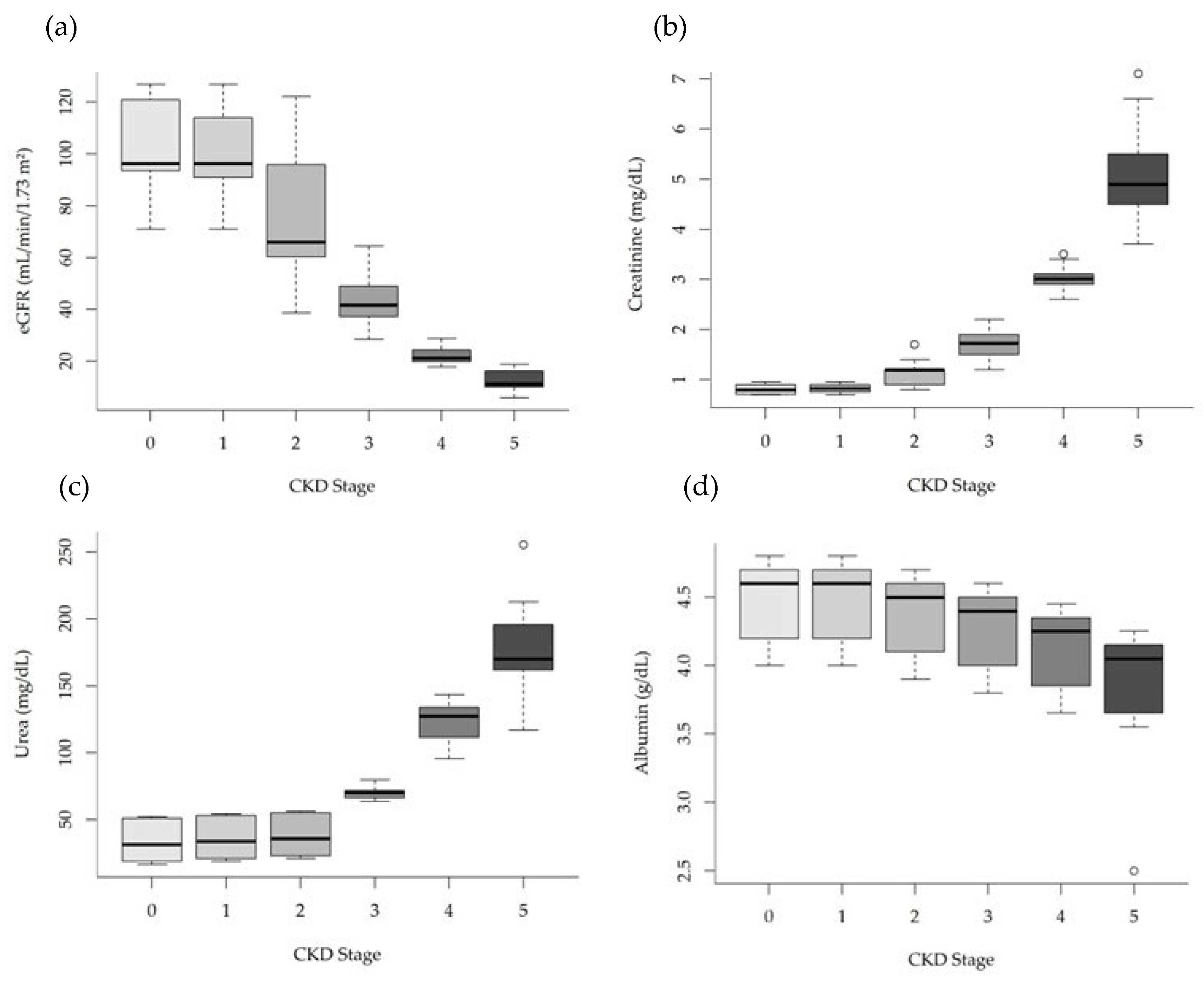
| CKD Stage | Age | 25 | 27 | 34 | 38 | 40 | 43 | 52 | 65 | 63 |
|---|---|---|---|---|---|---|---|---|---|---|
| Gender | F | M | F | M | F | F | M | F | M | |
| 0 | Creatinine (mg/dL) | 0.71 | 0.75 | 0.90 | 0.70 | 0.80 | 0.80 | 0.95 | 0.90 | 0.70 |
| Urea (mg/dL) | 17 | 19 | 32 | 51 | 32 | 34 | 19 | 51 | 52 | |
| Albumin (g/dL) | 4.8 | 4.2 | 4.1 | 4.6 | 4 | 4.5 | 4.6 | 4.8 | 4.7 | |
| eGFR ((mL/min/1.73 m2)-CKD-EPI 2021) | 120.9 | 126.8 | 86.0 | 121.0 | 95.5 | 93.5 | 96.3 | 70.9 | 103.5 | |
| 1 | Creatinine (mg/dL) | 0.71 | 0.75 | 0.90 | 0.85 | 0.8 | 0.82 | 0.95 | 0.90 | 0.70 |
| Urea (mg/dL) | 19 | 21 | 34 | 53 | 34 | 36 | 21 | 53 | 54 | |
| Albumin (g/dL) | 4.8 | 4.2 | 4.1 | 4.6 | 4 | 4.5 | 4.6 | 4.8 | 4.7 | |
| eGFR ((mL/min/1.73 m2)-CKD-EPI 2021) | 120.9 | 126.8 | 86.0 | 114.1 | 95.5 | 91.0 | 96.3 | 70.9 | 103.5 | |
| 2 | Creatinine (mg/dL) | 0.8 | 0.9 | 1.2 | 1.4 | 1.7 | 1.2 | 1.2 | 1.2 | 0.9 |
| Urea (mg/dL) | 21.3 | 23.4 | 36.2 | 55.3 | 36.2 | 38.4 | 23.4 | 55.3 | 56.4 | |
| Albumin (g/dL) | 4.6 | 4.1 | 4.0 | 4.5 | 3.9 | 4.4 | 4.5 | 4.7 | 4.6 | |
| eGFR ((mL/min/1.73 m2)-CKD-EPI 2021) | 104.8 | 122.1 | 60.9 | 66.0 | 38.6 | 60.2 | 72.8 | 50.2 | 96.0 | |
| 3 | Creatinine (mg/dL) | 1.2 | 1.9 | 1.7 | 1.5 | 2.2 | 1.7 | 1.8 | 1.4 | 2.1 |
| Urea (mg/dL) | 63.8 | 65.2 | 66.5 | 69.1 | 71.8 | 70.3 | 74.5 | 71.8 | 79.8 | |
| Albumin (g/dL) | 4.5 | 4.0 | 3.9 | 4.4 | 3.8 | 4.3 | 4.4 | 4.6 | 4.5 | |
| eGFR ((mL/min/1.73 m2)-CKD-EPI 2021) | 64.4 | 49.0 | 40.1 | 60.7 | 28.4 | 37.3 | 44.7 | 41.8 | 34.7 | |
| 4 | Creatinine (mg/dL) | 3.5 | 3.4 | 2.9 | 3.1 | 2.9 | 3.0 | 2.6 | 2.6 | 3.1 |
| Urea (mg/dL) | 127.7 | 111.7 | 111.7 | 143.6 | 95.7 | 124.5 | 127.7 | 134.0 | 143.6 | |
| Albumin (g/dL) | 4.4 | 3.9 | 3.8 | 4.3 | 3.7 | 4.1 | 4.3 | 4.5 | 4.4 | |
| eGFR ((mL/min/1.73 m2)—CKD-EPI 2021) | 17.8 | 24.4 | 21.1 | 25.4 | 20.4 | 19.1 | 28.8 | 19.9 | 21.8 | |
| 5 | Creatinine (mg/dL) | 5.5 | 4.5 | 4.9 | 4.5 | 4.6 | 5.2 | 3.7 | 7.1 | 6.6 |
| Urea (mg/dL) | 170.2 | 161.7 | 195.7 | 212.8 | 117.0 | 180.3 | 255.3 | 159.6 | 170.2 | |
| Albumin (g/dL) | 4.2 | 3.7 | 3.6 | 4.1 | 2.5 | 3.8 | 4.1 | 4.3 | 4.2 | |
| eGFR ((mL/min/1.73 m2)—CKD-EPI 2021) | 10.4 | 17.4 | 11.3 | 16.3 | 11.7 | 10.0 | 18.8 | 5.9 | 8.8 |
| Metabolite | Pre-Processing/Sub-Region | Latent Variables | Calibration | Validation | ||
|---|---|---|---|---|---|---|
| R2 | RMSE | R2 | RMSE | |||
| Creatinine | Raw | 8 | 0.77 | 0.77 | 0.72 | 0.86 |
| BC | 6 | 0.76 | 0.80 | 0.71 | 0.88 | |
| BC+SNV | 5 | 0.79 | 0.74 | 0.76 | 0.80 | |
| 1D | 3 | 0.76 | 0.80 | 0.71 | 0.88 | |
| 1D+SNV | 3 | 0.81 | 0.71 | 0.76 | 0.79 | |
| 2D | 7 | 0.91 | 0.48 | 0.69 | 0.92 | |
| 2D+SNV | 6 | 0.92 | 0.45 | 0.68 | 0.93 | |
| Urea | Raw | 8 | 0.95 | 12.82 | 0.92 | 16.08 |
| BC | 7 | 0.94 | 14.39 | 0.90 | 17.90 | |
| BC+SNV | 6 | 0.98 | 8.69 | 0.97 | 9.98 | |
| 1D | 4 | 0.94 | 13.76 | 0.90 | 17.68 | |
| 1D+SNV | 4 | 0.98 | 8.50 | 0.97 | 10.12 | |
| 2D | 7 | 0.97 | 9.67 | 0.87 | 20.70 | |
| 2D+SNV | 7 | 0.97 | 8.94 | 0.91 | 17.55 | |
| Albumin | Raw | 7 | 0.52 | 0.28 | 0.44 | 0.30 |
| BC | 6 | 0.52 | 0.28 | 0.46 | 0.30 | |
| BC+SNV | 5 | 0.55 | 0.27 | 0.49 | 0.29 | |
| 1D | 10 | 0.90 | 0.13 | 0.53 | 0.28 | |
| 1D+SNV | 10 | 0.92 | 0.11 | 0.52 | 0.28 | |
| 2D | 1 | 0.25 | 0.35 | 0.23 | 0.36 | |
| 2D+SNV | 1 | 0.43 | 0.31 | 0.28 | 0.35 | |
| Normalized First Derivative (1D+SNV) sub-regions of the spectra (cm−1) | ||||||
| Creatinine | 3500–2800 | 3 | 0.79 | 0.75 | 0.75 | 0.82 |
| 3500–3200 | 3 | 0.79 | 0.74 | 0.75 | 0.82 | |
| 3200–3000 | 3 | 0.74 | 0.83 | 0.68 | 0.93 | |
| 3000–2800 | 4 | 0.60 | 1.03 | 0.51 | 1.15 | |
| 1750–1200 | 9 | 0.92 | 0.45 | 0.85 | 0.64 | |
| 1750–1600 | 4 | 0.79 | 0.74 | 0.77 | 0.78 | |
| 1600–1500 | 3 | 0.79 | 0.75 | 0.78 | 0.78 | |
| 1450–1200 | 3 | 0.79 | 0.75 | 0.77 | 0.79 | |
| 1200–1000 | 4 | 0.82 | 0.70 | 0.74 | 0.83 | |
| 1200–600 | 3 | 0.81 | 0.72 | 0.74 | 0.84 | |
| Urea | 3500–2800 | 4 | 0.96 | 10.84 | 0.96 | 12.02 |
| 3500–3200 | 3 | 0.96 | 11.62 | 0.95 | 12.29 | |
| 3200–3000 | 5 | 0.88 | 20.11 | 0.82 | 24.48 | |
| 3000–2800 | 6 | 0.64 | 34.50 | 0.46 | 42.43 | |
| 1750–1200 | 3 | 0.96 | 11.13 | 0.96 | 11.58 | |
| 1750–1600 | 4 | 0.96 | 11.92 | 0.95 | 12.55 | |
| 1600–1500 | 4 | 0.96 | 11.39 | 0.95 | 12.84 | |
| 1450–1200 | 3 | 0.97 | 10.56 | 0.96 | 11.37 | |
| 1200–1000 | 3 | 0.94 | 13.49 | 0.93 | 15.05 | |
| 1200–600 | 5 | 0.96 | 11.02 | 0.92 | 15.90 | |
| Albumin | 3500–2800 | 3 | 0.55 | 0.27 | 0.48 | 0.30 |
| 3500–3200 | 2 | 0.51 | 0.28 | 0.47 | 0.30 | |
| 3200–3000 | 4 | 0.60 | 0.26 | 0.45 | 0.30 | |
| 3000–2800 | 3 | 0.47 | 0.30 | 0.37 | 0.33 | |
| 1750–1200 | 8 | 0.80 | 0.18 | 0.71 | 0.22 | |
| 1750–1600 | 8 | 0.66 | 0.24 | 0.56 | 0.27 | |
| 1600–1500 | 1 | 0.44 | 0.30 | 0.42 | 0.31 | |
| 1450–1200 | 5 | 0.64 | 0.24 | 0.55 | 0.27 | |
| 1200–1000 | 3 | 0.45 | 0.30 | 0.33 | 0.34 | |
| 1200–600 | 5 | 0.75 | 0.20 | 0.44 | 0.30 | |
| Metabolite | Pre-Processing/Sub-Region | Latent Variables | Calibration | Validation | ||
|---|---|---|---|---|---|---|
| R2 | RMSE | R2 | RMSE | |||
| Creatinine | Raw | 5 | 0.91 | 0.50 | 0.83 | 0.68 |
| BC | 5 | 0.88 | 0.56 | 0.73 | 0.85 | |
| BC+SNV | 5 | 0.84 | 0.66 | 0.61 | 1.02 | |
| 1D | 10 | 0.92 | 0.45 | 0.38 | 1.28 | |
| 1D+SNV | 10 | 0.92 | 0.46 | 0.36 | 1.32 | |
| 2D | 1 | 0.25 | 1.41 | 0 | 1.72 | |
| 2D+SNV | 1 | 0.24 | 1.42 | 0 | 1.76 | |
| Urea | Raw | 7 | 0.97 | 9.27 | 0.91 | 17.05 |
| BC | 7 | 0.97 | 9.49 | 0.86 | 21.26 | |
| BC+SNV | 6 | 0.93 | 15.60 | 0.72 | 30.72 | |
| 1D | 10 | 0.91 | 16.97 | 0.29 | 48.50 | |
| 1D+SNV | 10 | 0.91 | 17.03 | 0.26 | 49.70 | |
| 2D | 1 | 0.26 | 49.50 | 0 | 62.20 | |
| 2D+SNV | 1 | 0.25 | 49.73 | 0 | 63.20 | |
| Albumin | Raw | 4 | 0.94 | 0.10 | 0.92 | 0.11 |
| BC | 4 | 0.94 | 0.10 | 0.93 | 0.11 | |
| BC+SNV | 4 | 0.92 | 0.11 | 0.90 | 0.13 | |
| 1D | 7 | 0.95 | 0.09 | 0.83 | 0.17 | |
| 1D+SNV | 7 | 0.95 | 0.09 | 0.81 | 0.18 | |
| 2D | 1 | 0.25 | 0.35 | 0 | 0.46 | |
| 2D+SNV | 1 | 0.25 | 0.35 | 0 | 0.46 | |
| Baseline-corrected sub-regions of the spectra (cm−1) | ||||||
| Creatinine | 3rd Overtone | 6 | 0.98 | 0.24 | 0.91 | 0.48 |
| 2nd Overtone | 4 | 0.59 | 1.04 | 0.53 | 1.12 | |
| 1st Overtone | 2 | 0.44 | 1.22 | 0.41 | 1.26 | |
| Combination Bands | 4 | 0.79 | 0.74 | 0.55 | 1.10 | |
| 11,000–8600 | 6 | 0.95 | 0.37 | 0.84 | 0.65 | |
| 7800–7050 | 10 | 0.80 | 0.73 | 0.70 | 0.90 | |
| 5800–5300 | 10 | 0.76 | 0.80 | 0.71 | 0.88 | |
| Urea | 3rd Overtone | 6 | 0.97 | 8.80 | 0.91 | 16.84 |
| 2nd Overtone | 10 | 0.85 | 22.44 | 0.49 | 41.22 | |
| 1st Overtone | 2 | 0.32 | 47.23 | 0.29 | 48.80 | |
| Combination Bands | 4 | 0.82 | 24.62 | 0.58 | 37.19 | |
| 11,000–8600 | 7 | 0.96 | 11.06 | 0.84 | 22.94 | |
| 7800–7050 | 10 | 0.79 | 26.46 | 0.67 | 32.84 | |
| 5800–5300 | 10 | 0.80 | 25.56 | 0.77 | 27.61 | |
| Albumin | 3rd Overtone | 7 | 0.97 | 0.07 | 0.81 | 0.18 |
| 2nd Overtone | 4 | 0.94 | 0.10 | 0.93 | 0.11 | |
| 1st Overtone | 4 | 0.94 | 0.10 | 0.93 | 0.11 | |
| Combination Bands | 7 | 0.96 | 0.08 | 0.80 | 0.18 | |
| 11,000–8600 | 5 | 0.89 | 0.13 | 0.71 | 0.22 | |
| 7800–7050 | 6 | 0.92 | 0.12 | 0.89 | 0.14 | |
| 5800–5300 | 8 | 0.94 | 0.10 | 0.93 | 0.11 | |
| Discriminant Parameter | Region | Spectrum | Tested Models | AUC | Recall | Specificity | Accuracy | Precision | F1 |
|---|---|---|---|---|---|---|---|---|---|
| Healthy vs. Diseased | MIR | Raw whole spectra | XGBoost | 0.94 | 0.87 | 0.87 | 0.87 | 0.87 | 0.87 |
| SVM | 0.77 | 0.68 | 0.68 | 0.68 | 0.69 | 0.68 | |||
| Random Forest | 0.92 | 0.84 | 0.84 | 0.84 | 0.84 | 0.84 | |||
| 1D+SNV whole spectra | XGBoost | 0.99 | 0.96 | 0.96 | 0.96 | 0.96 | 0.96 | ||
| SVM | 0.98 | 0.93 | 0.93 | 0.93 | 0.93 | 0.93 | |||
| Random Forest | 0.99 | 0.97 | 0.97 | 0.97 | 0.97 | 0.97 | |||
| 1D+SNV (1750–1200) | XGBoost | 0.99 | 0.95 | 0.95 | 0.95 | 0.95 | 0.95 | ||
| SVM | 0.99 | 0.94 | 0.94 | 0.94 | 0.94 | 0.94 | |||
| Random Forest | 0.99 | 0.94 | 0.94 | 0.94 | 0.94 | 0.94 | |||
| NIR | Raw whole spectra | XGBoost | 0.99 | 0.94 | 0.94 | 0.94 | 0.94 | 0.94 | |
| SVM | 1.00 | 0.95 | 0.96 | 0.95 | 0.96 | 0.95 | |||
| Random Forest | 1.00 | 0.98 | 0.98 | 0.98 | 0.98 | 0.98 | |||
| BC whole spectra | XGBoost | 0.98 | 0.93 | 0.93 | 0.93 | 0.93 | 0.93 | ||
| SVM | 1.00 | 0.96 | 0.96 | 0.96 | 0.96 | 0.96 | |||
| Random Forest | 0.99 | 0.95 | 0.95 | 0.95 | 0.95 | 0.95 | |||
| BC (3rd Overtone) | XGBoost | 0.97 | 0.93 | 0.92 | 0.93 | 0.93 | 0.93 | ||
| SVM | 0.94 | 0.92 | 0.92 | 0.92 | 0.93 | 0.92 | |||
| Random Forest | 0.99 | 0.95 | 0.95 | 0.95 | 0.95 | 0.95 | |||
| Stage | MIR | Raw whole spectra | XGBoost | 0.81 | 0.46 | 0.89 | 0.46 | 0.46 | 0.46 |
| SVM | 0.69 | 0.35 | 0.87 | 0.35 | 0.34 | 0.32 | |||
| Random Forest | 0.82 | 0.46 | 0.89 | 0.46 | 0.44 | 0.44 | |||
| 1D+SNV whole spectra | XGBoost | 0.89 | 0.65 | 0.93 | 0.65 | 0.64 | 0.64 | ||
| SVM | 0.88 | 0.54 | 0.91 | 0.54 | 0.54 | 0.52 | |||
| Random Forest | 0.93 | 0.68 | 0.93 | 0.68 | 0.66 | 0.66 | |||
| 1D+SNV (1750–1200) | XGBoost | 0.92 | 0.72 | 0.95 | 0.72 | 0.71 | 0.71 | ||
| SVM | 0.93 | 0.72 | 0.94 | 0.72 | 0.72 | 0.72 | |||
| Random Forest | 0.94 | 0.74 | 0.94 | 0.74 | 0.74 | 0.74 | |||
| NIR | Raw whole spectra | XGBoost | 0.96 | 0.76 | 0.95 | 0.76 | 0.77 | 0.76 | |
| SVM | 0.96 | 0.71 | 0.94 | 0.71 | 0.72 | 0.70 | |||
| Random Forest | 0.99 | 0.87 | 0.97 | 0.87 | 0.88 | 0.87 | |||
| BC whole spectra | XGBoost | 0.97 | 0.82 | 0.96 | 0.82 | 0.82 | 0.82 | ||
| SVM | 0.98 | 0.83 | 0.97 | 0.83 | 0.83 | 0.83 | |||
| Random Forest | 0.97 | 0.82 | 0.96 | 0.82 | 0.82 | 0.82 | |||
| BC (3rd Overtone) | XGBoost | 0.93 | 0.68 | 0.94 | 0.68 | 0.69 | 0.68 | ||
| SVM | 0.88 | 0.51 | 0.90 | 0.51 | 0.61 | 0.50 | |||
| Random Forest | 0.96 | 0.77 | 0.95 | 0.77 | 0.78 | 0.77 |
| Scientific Article | Methodology | Matrix | Biomarkers | Healthy vs. Diseased | CKD Stage Separation | Observations |
|---|---|---|---|---|---|---|
| Present Work | MIR/NIR | Serum | Creatinine, urea, albumin | AUC > 0.97 | 6 stages AUC > 0.93 (MIR) AUC > 0.98 (NIR) | High-throughput (MIR) or in situ (NIR) analysis. Physiologically CKD-like calibration of the 5 stages. |
| Zong et al. [40] | SERS | Serum, Urine | Creatinine, urea | AUC > 0.94 (Serum) AUC > 0.89 (Urine) | Accuracy = 78% Overlap of CKD stages (0–1, 2–3, 4–5) | Good binary classification (healthy vs. diseased). Lower resolution of CKD stages with moderate accuracy. |
| Marom et al. [41] | Gold nanoparticle sensors | Breath | Volatile organic compounds | Accuracy = 79% (Early CKD vs. Healthy) | Accuracy of 79 and 85% for stages 0–1 to 2–3 and 4 to 5, respectively | Limited accuracy for early disease compared to serum methods. |
| Rodrigues et al. [12] | ATR-FTIR | Saliva | Thioisocyanate, phospholipids, carbohydrates | AUC ~ 0.88 | N/A | Saliva is less invasive but offers lower discriminatory power than serum for this condition. |
| Tangwanichgapong et al. [16] | ATR-FTIR | Serum | Lipids, proteins, etc. | Accuracy = 100% | N/A | Excellent for End-Stage Renal Disease (ESRD), but did not test stratification of earlier stages. |
| Metherall et al. [43] | Clinical Data | N/A | Clinical markers | AUC > 0.96 | N/A | Successful application of ML algorithms to diverse sets of clinical data (at home, laboratory and monitoring) for the binary classification of healthy vs. diseased profiles. |
Disclaimer/Publisher’s Note: The statements, opinions and data contained in all publications are solely those of the individual author(s) and contributor(s) and not of MDPI and/or the editor(s). MDPI and/or the editor(s) disclaim responsibility for any injury to people or property resulting from any ideas, methods, instructions or products referred to in the content. |
© 2026 by the authors. Licensee MDPI, Basel, Switzerland. This article is an open access article distributed under the terms and conditions of the Creative Commons Attribution (CC BY) license.
Share and Cite
Serrano, D.; Zoio, P.; Fonseca, L.P.; Calado, C.R.C. Prediction of Chronic Kidney Disease Based on Simulated Serum Analysis by Vibrational Spectroscopy. Biosensors 2026, 16, 347. https://doi.org/10.3390/bios16060347
Serrano D, Zoio P, Fonseca LP, Calado CRC. Prediction of Chronic Kidney Disease Based on Simulated Serum Analysis by Vibrational Spectroscopy. Biosensors. 2026; 16(6):347. https://doi.org/10.3390/bios16060347
Chicago/Turabian StyleSerrano, Diogo, Paulo Zoio, Luís P. Fonseca, and Cecília R. C. Calado. 2026. "Prediction of Chronic Kidney Disease Based on Simulated Serum Analysis by Vibrational Spectroscopy" Biosensors 16, no. 6: 347. https://doi.org/10.3390/bios16060347
APA StyleSerrano, D., Zoio, P., Fonseca, L. P., & Calado, C. R. C. (2026). Prediction of Chronic Kidney Disease Based on Simulated Serum Analysis by Vibrational Spectroscopy. Biosensors, 16(6), 347. https://doi.org/10.3390/bios16060347