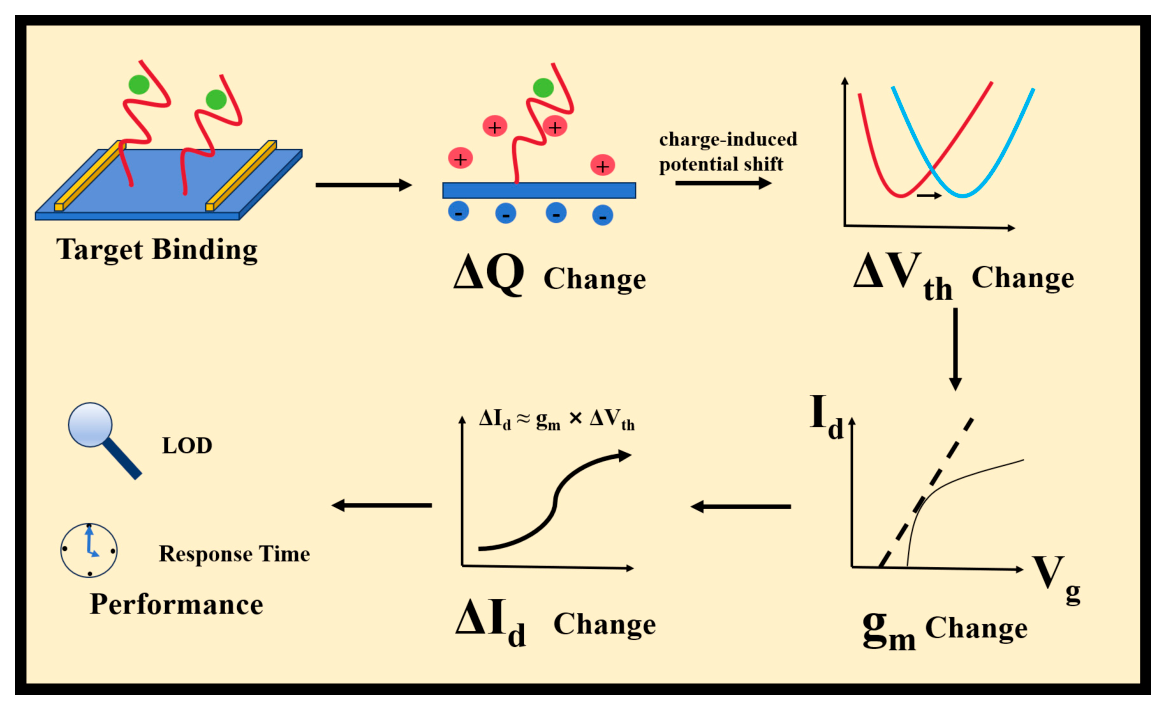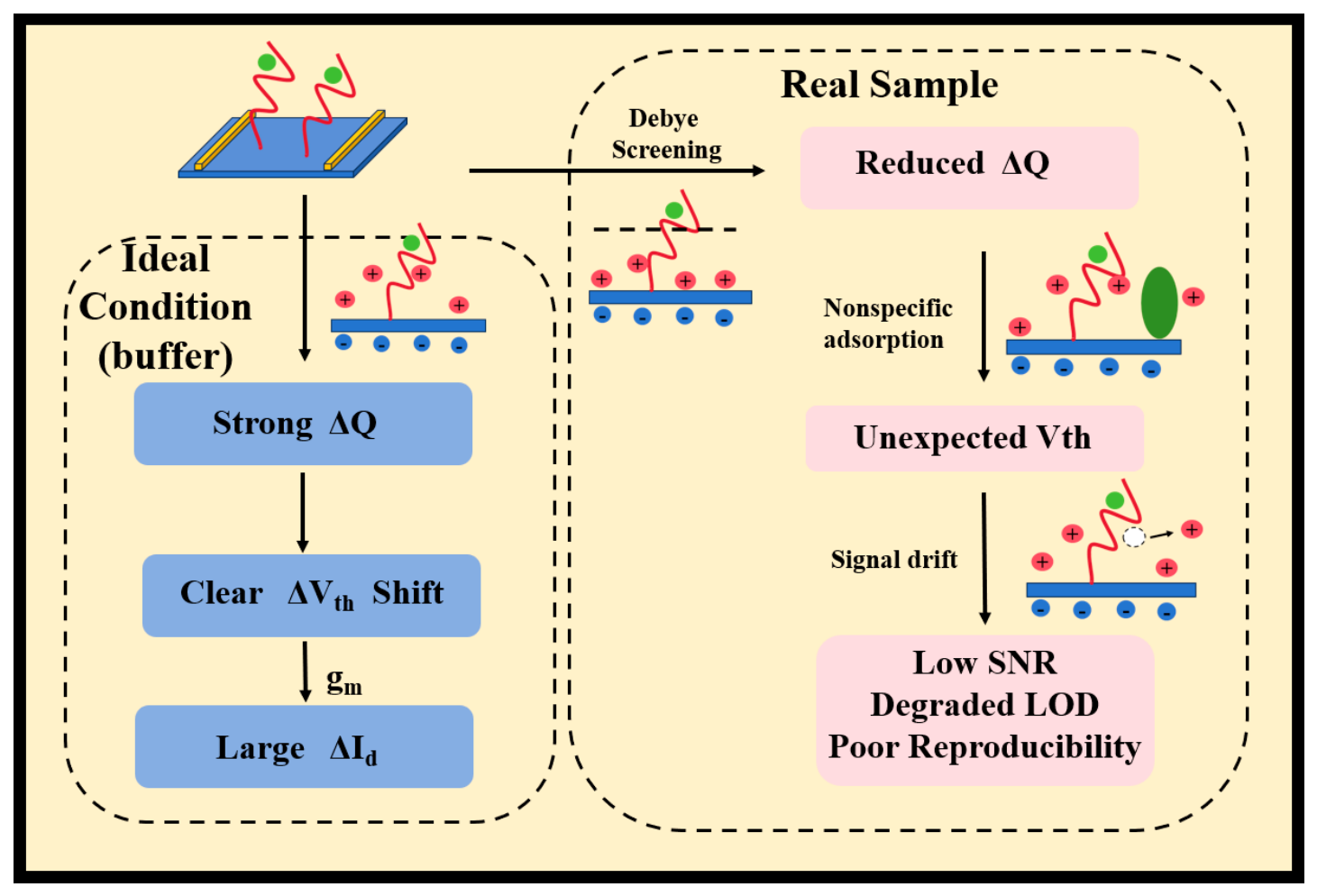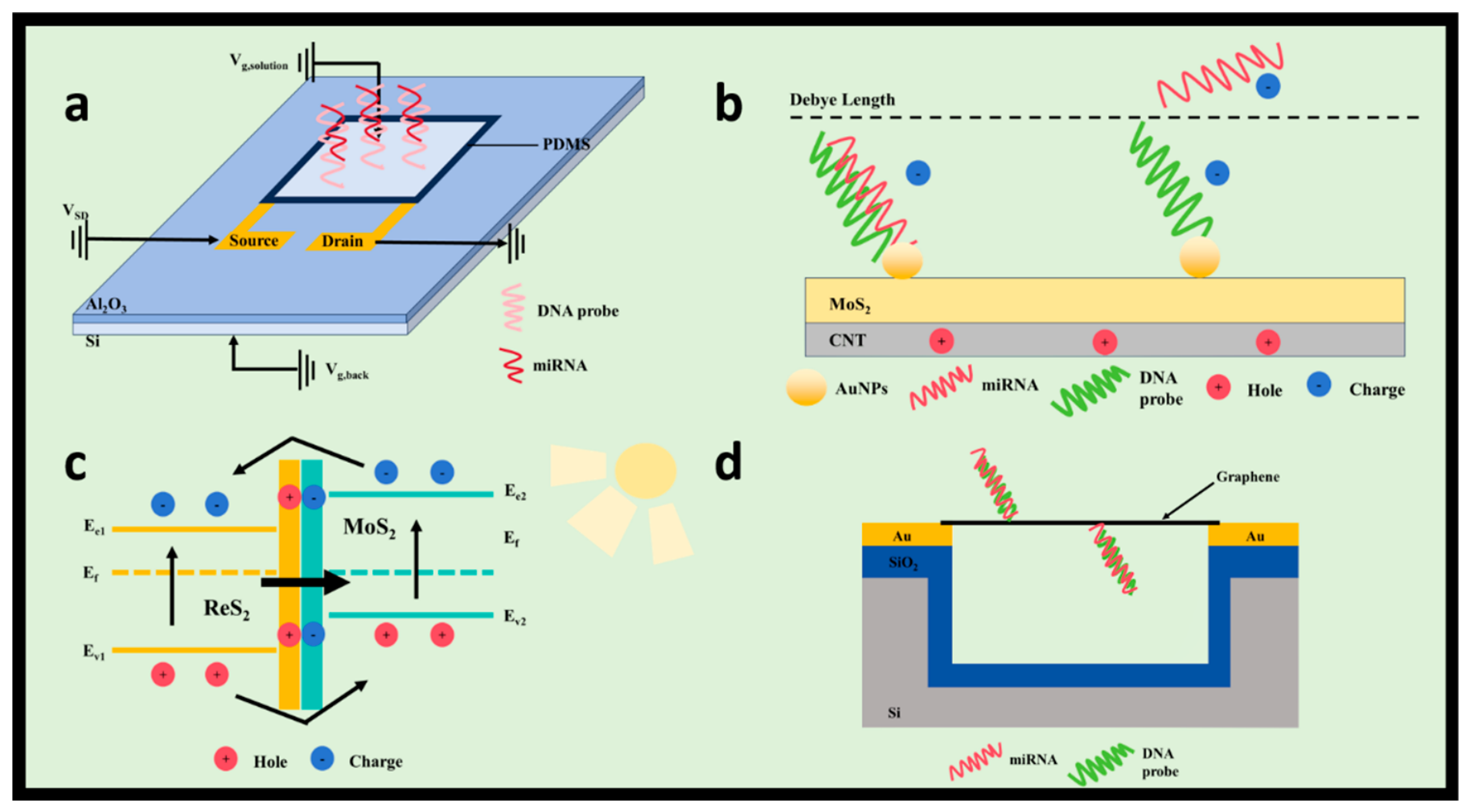
Practical Applications of 2D Material FET Biosensors: Functionalization Strategies and Detection Performance

 , ,
, ,  ,
,
Abstract
1. Introduction
2. Functionalization Strategies and Deposition Methods of 2D Materials for FET Biosensors
2.1. Deposition Methods of 2D Materials onto Substrates
2.2. Covalent Functionalization
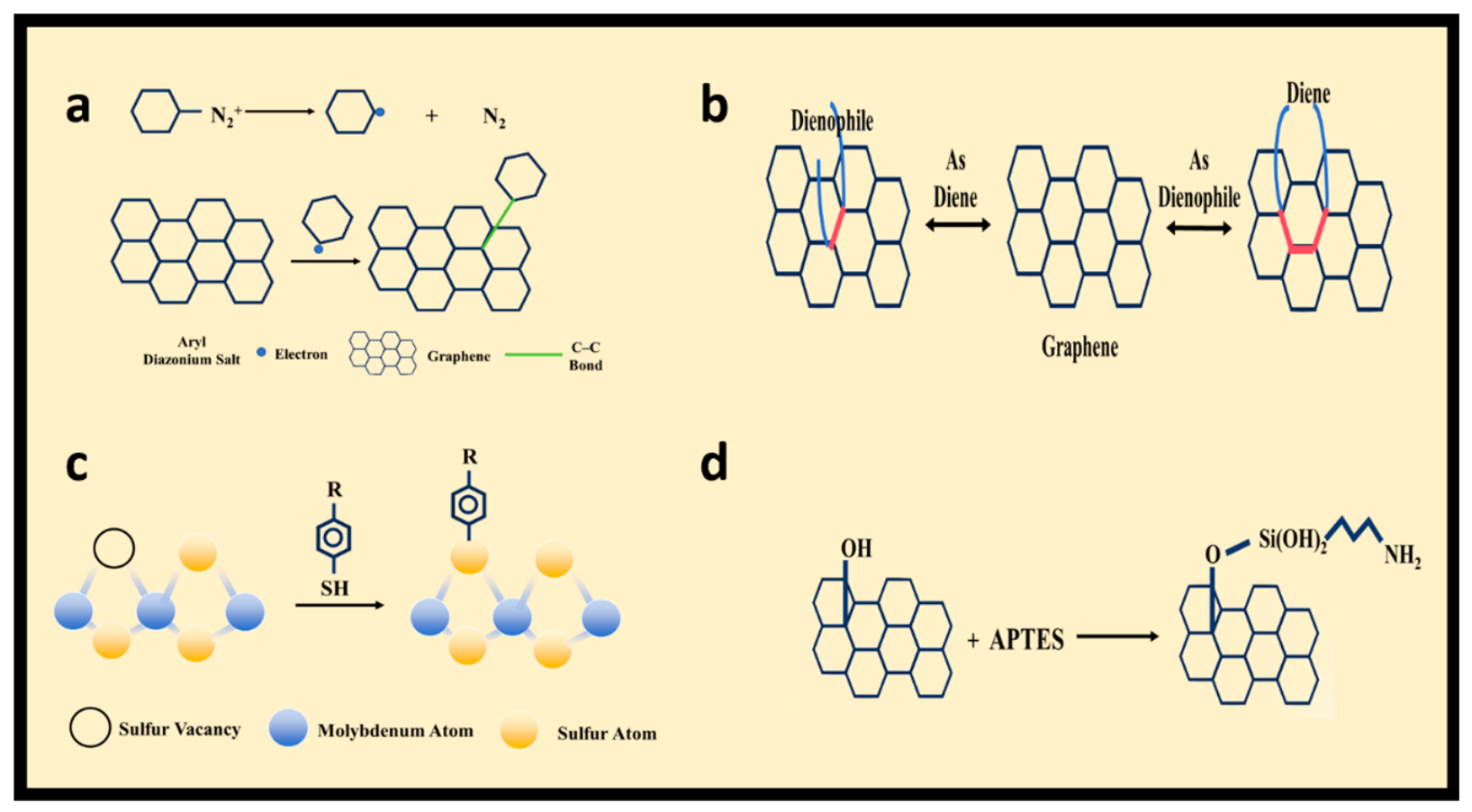
2.3. Noncovalent Functionalization
3. Practical Applications of 2D-Material FET Biosensors
3.1. Nucleic Acids
3.2. Proteins
3.3. Small Molecular and Ionic Targets
4. Challenges in Practical Biosensing Applications
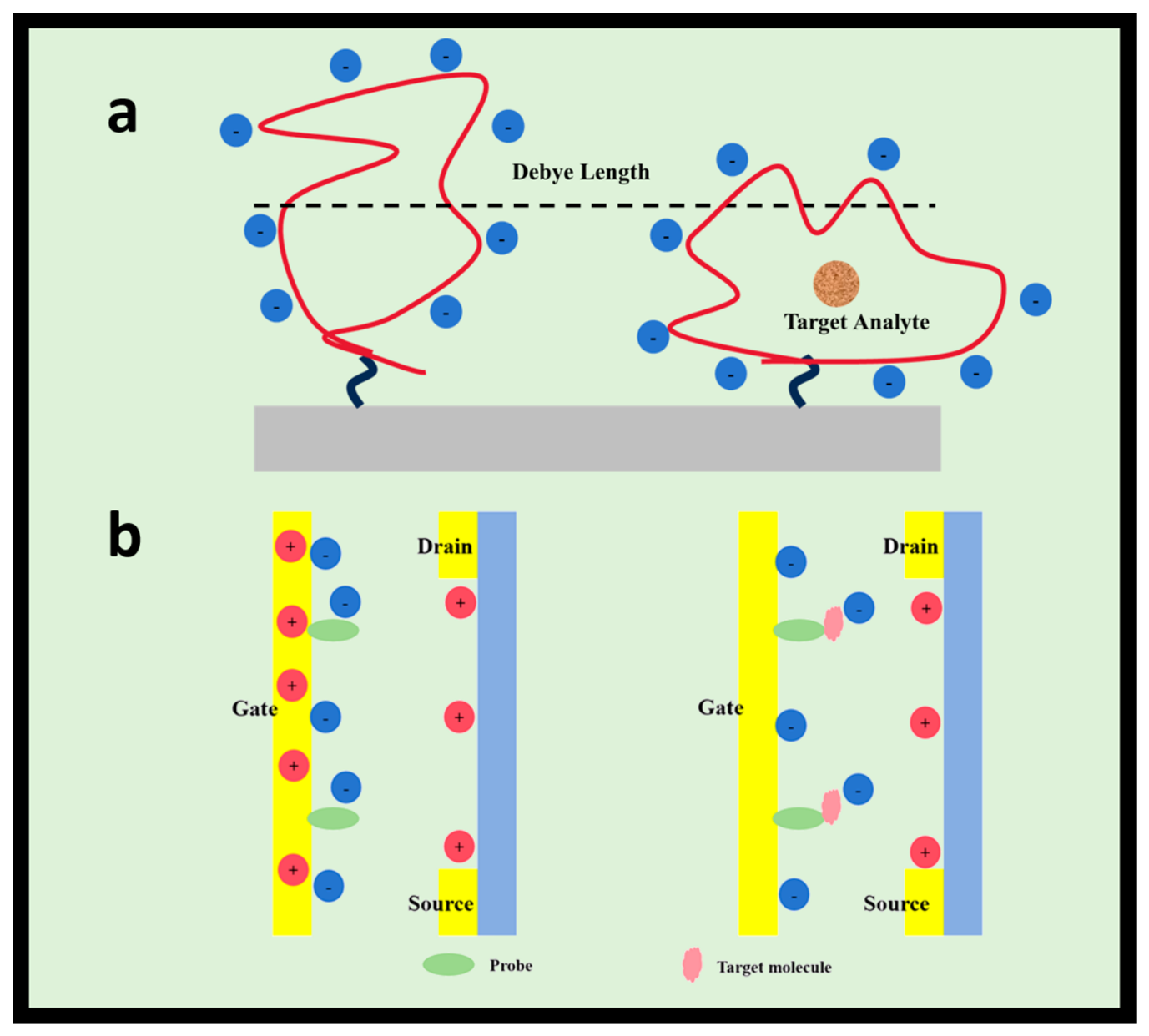
4.1. Debye Screening Effect in Complex Biological Media
4.2. Nonspecific Adsorption and Surface Fouling
4.3. Operational Stability and Signal Drift in 2D FET Biosensors
5. Interface–Device Coupling Strategies for Signal-Transduction Enhancement
5.1. Interfacial Charge Regulation in Electrolyte-Gated FET Biosensors
5.2. Device-Level Signal Amplification in FET Biosensors

6. Conclusions
Author Contributions
Funding
Institutional Review Board Statement
Informed Consent Statement
Data Availability Statement
Acknowledgments
Conflicts of Interest
References
- Vo, D.-K.; Trinh, K.T. Advances in wearable biosensors for healthcare: Current trends, applications, and future perspectives. Biosensors 2024, 14, 560. [Google Scholar] [CrossRef] [Scilit]
- Gulati, S.; Yadav, R.; Kumari, V.; Nair, S.; Gupta, C.; Aishwari, M. Nanosensors in healthcare: Transforming real time monitoring and disease management with cutting-edge nanotechnology. RSC Pharm. 2025, 2, 1003–1018. [Google Scholar] [CrossRef] [Scilit]
- Marques, L.; Costa, B.; Pereira, M.; Silva, A.; Santos, J.; Saldanha, L.; Silva, I.; Magalhães, P.; Schmidt, S.; Vale, N. Advancing precision medicine: A review of innovative in silico approaches for drug development, clinical pharmacology and personalized healthcare. Pharmaceutics 2024, 16, 332. [Google Scholar] [CrossRef] [Scilit] [PubMed]
- Masson, J.-F. Ultralow concentration sensing: What should we be aware of? ACS Sens. 2023, 8, 941–942. [Google Scholar] [CrossRef] [Scilit] [PubMed]
- Marvi, F.; Jafari, K.; Shahabadi, M.; Tabarzad, M.; Ghorbani-Bidkorpeh, F.; Azad, T. Ultrasensitive detection of vital biomolecules based on a multi-purpose BioMEMS for point-of-care testing: Digoxin measurement as a case study. Sci. Rep. 2024, 14, 1633. [Google Scholar] [CrossRef] [Scilit]
- Hao, R.; Liu, L.; Yuan, J.; Wu, L.; Lei, S. Recent advances in field-effect transistor biosensors: Designing strategies and applications for sensitive assay. Biosensors 2023, 13, 426. [Google Scholar] [CrossRef] [Scilit]
- Janićijević, Ž.; Baraban, L. Integration strategies and formats in field-effect transistor chemo- and biosensors: A critical review. ACS Sens. 2025, 10, 2431–2452. [Google Scholar] [CrossRef] [Scilit]
- Nguyen, T.T.-H.; Nguyen, C.M.; Huynh, M.A.; Vu, H.H.; Nguyen, T.-K.; Nguyen, N.-T. Field-effect transistor-based wearable biosensors for healthcare monitoring. J. Nanobiotechnol. 2023, 21, 411. [Google Scholar] [CrossRef] [Scilit]
- Chen, S.; Sun, Y.; Fan, X.; Xu, Y.; Chen, S.; Zhang, X.; Man, B.; Yang, C.; Du, J. Review on two dimensional material-based field-effect transistor biosensors: Accomplishments, mechanisms, and perspectives. J. Nanobiotechnol. 2023, 21, 144. [Google Scholar] [CrossRef] [Scilit]
- Sadighbayan, D.; Hasanzadeh, M.; Ghafar-Zadeh, E. Biosensing based on field-effect transistors (FET): Recent progress and challenges. TrAC Trends Anal. Chem. 2020, 133, 116067. [Google Scholar] [CrossRef] [Scilit]
- Masud; Song, J.; Ahmed, F.; Kim, J. 2D materials: From design and synthesis to applications in electrical and electrochemical biosensors. Small 2025, 21, e04955. [Google Scholar] [CrossRef] [Scilit] [PubMed]
- Ghasemi, F.; Salimi, A. Advances in 2D-based field-effect transistors as biosensing platforms: From principle to biomedical applications. Microchem. J. 2023, 187, 108432. [Google Scholar] [CrossRef] [Scilit]
- Li, J.; Wijaya, L.N.A.; Jang, D.W.; Hu, Y.; You, J.; Cai, Y.; Gao, Z.; Mi, Y.; Luo, Z. 2D materials-based field-effect transistor biosensors for healthcare. Small 2025, 21, 2408961. [Google Scholar] [CrossRef] [Scilit]
- Dastgeer, G.; Nisar, S.; Rasheed, A.; Imran, M.; Rabani, I. Exploring 2D material-based biosensors for real time detection of target analytes. ACS Appl. Electron. Mater. 2025, 7, 7447–7472. [Google Scholar] [CrossRef] [Scilit]
- Poghossian, A.; Schöning, M.J. Label-free sensing of biomolecules with field-effect devices for clinical applications. Electroanalysis 2014, 26, 1197–1213. [Google Scholar] [CrossRef] [Scilit]
- Sorgenfrei, S.; Chiu, C.-Y.; Gonzalez, R.L.; Yu, Y.-J.; Kim, P.; Nuckolls, C.; Shepard, K.L. Label-free single-molecule detection of DNA hybridization kinetics with a carbon nanotube field-effect transistor. Nat. Nanotechnol. 2011, 6, 126–132. [Google Scholar] [CrossRef] [Scilit]
- Stern, E.; Wagner, R.; Sigworth, F.J.; Breaker, R.; Fahmy, T.M.; Reed, M.A. Importance of the Debye screening length on nanowire field-effect transistor sensors. Nano Lett. 2007, 7, 3405–3409. [Google Scholar] [CrossRef] [Scilit]
- Shoorideh, K.; Chui, C.O. On the origin of enhanced sensitivity in nanoscale FET-based biosensors. Proc. Natl. Acad. Sci. USA 2014, 111, 5111–5116. [Google Scholar] [CrossRef] [Scilit] [PubMed]
- Ono, T.; Okuda, S.; Ushiba, S.; Kanai, Y.; Matsumoto, K. Challenges for field-effect transistor-based graphene biosensors. Materials 2024, 17, 333. [Google Scholar] [CrossRef] [Scilit]
- Chen, Y.; Vicente, N.; Pham, T.; Mulchandani, A. Biological sensing using vertical MoS2–graphene heterostructure-based field-effect transistor biosensors. Biosensors 2025, 15, 373. [Google Scholar] [CrossRef] [Scilit] [PubMed]
- Jang, M.; Na, W.; Lee, M.; Jung, S.; Woo, Y.; Yoo, H.Y.; Lee, T.; Min, J. Light-induced field-effect transistor-based biosensor consisted of aptamer and ReS2 single crystal layer for exosome detection. Mater. Today Bio 2025, 35, 102281. [Google Scholar] [CrossRef] [Scilit]
- Bharathi, G.; Hong, S. Gate engineering in two dimensional (2D) channel FET chemical sensors: A comprehensive review of architectures, mechanisms, and materials. Chemosensors 2025, 13, 217. [Google Scholar] [CrossRef] [Scilit]
- Wang, S.; Qi, X.; Hao, D.; Moro, R.; Ma, Y.; Ma, L. Review—Recent advances in graphene-based field-effect-transistor biosensors: A review on biosensor designing strategy. J. Electrochem. Soc. 2022, 169, 027509. [Google Scholar] [CrossRef] [Scilit]
- Thriveni, G.; Ghosh, K. Advancement and challenges of biosensing using field-effect transistors. Biosensors 2022, 12, 647. [Google Scholar] [CrossRef] [Scilit] [PubMed]
- Sakata, T. Signal transduction interfaces for field-effect transistor-based biosensors. Commun. Chem. 2024, 7, 35. [Google Scholar] [CrossRef] [Scilit]
- Zhuang, J.H.; Li, Z.; Liang, Y.; Tang, T.; Hu, X.Y.; Ou, R.; Ma, Q.J.; Zhang, B.Y.; Cheng, Y.F.; Feng, W.L.; et al. Recent progress in two dimensional materials: From emerging structures and synthesis approaches to electronic and sensing applications. Chem. Eng. J. 2025, 520, 166133. [Google Scholar] [CrossRef] [Scilit]
- Son, B.H.; Kim, H.S.; Jeong, H.; Park, J.-Y.; Lee, S.; Ahn, Y.H. Electron beam induced removal of PMMA layer used for graphene transfer. Sci. Rep. 2017, 7, 18058. [Google Scholar] [CrossRef] [Scilit] [PubMed]
- Mishyn, V.; Rodrigues, T.; Leroux, Y.R.; Aspermair, P.; Happy, H.; Bintinger, J.; Kleber, C.; Boukherroub, R.; Knoll, W.; Szunerits, S. Controlled covalent functionalization of a graphene channel of a field-effect transistor as an ideal platform for (bio)sensing applications. Nanoscale Horiz. 2021, 6, 819–829. [Google Scholar] [CrossRef] [Scilit] [PubMed]
- Paulus, G.L.C.; Wang, Q.H.; Strano, M.S. Covalent electron transfer chemistry of graphene with diazonium salts. Acc. Chem. Res. 2013, 46, 160–170. [Google Scholar] [CrossRef] [Scilit] [PubMed]
- Huang, P.; Jing, L.; Zhu, H.; Gao, X. Diazonium functionalized graphene: Microstructure, electric, and magnetic properties. Acc. Chem. Res. 2013, 46, 43–52. [Google Scholar] [CrossRef] [Scilit]
- Fournier, T.; Crespos, C.; Arshad, I.; Dubois, M.; Lassagne, B.; Monthioux, M.; Piazza, F.; Puech, P. Quantifying the sp3/sp2 ratio in functionalized graphene. Carbon 2025, 244, 120657. [Google Scholar] [CrossRef] [Scilit]
- Ambrosio, G.; Brown, A.; Daukiya, L.; Drera, G.; Di Santo, G.; Petaccia, L.; De Feyter, S.; Sangaletti, L.; Pagliara, S. Impact of covalent functionalization by diazonium chemistry on the electronic properties of graphene on SiC. Nanoscale 2020, 12, 9032–9037. [Google Scholar] [CrossRef] [Scilit]
- Georgakilas, V.; Otyepka, M.; Bourlinos, A.B.; Chandra, V.; Kim, N.; Kemp, K.C.; Hobza, P.; Zboril, R.; Kim, K.S. Functionalization of graphene: Covalent and non-covalent approaches, derivatives and applications. Chem. Rev. 2012, 112, 6156–6214. [Google Scholar] [CrossRef] [Scilit] [PubMed]
- Stathouraki, M.-M.; Pantazidis, C.; Mygiakis, E.; Avgeropoulos, A.; Sakellariou, G. Functionalization of single-walled carbon nanotubes with end-capped polystyrene via a single-step Diels–Alder cycloaddition. Polymers 2021, 13, 1169. [Google Scholar] [CrossRef] [Scilit] [PubMed]
- Denis, P.A. Organic chemistry of graphene: The Diels–Alder reaction. Chem.–A Eur. J. 2013, 19, 15719–15725. [Google Scholar] [CrossRef] [Scilit]
- Tu, J.; Zhou, W.; Wolf, L.M.; Yan, M. Inverse-electron-demand Diels–Alder reaction of tropone with graphene supported on Cu(111). Small 2025, 21, e03669. [Google Scholar] [CrossRef] [Scilit]
- Sarkar, S.; Bekyarova, E.; Niyogi, S.; Haddon, R.C. Diels–Alder chemistry of graphite and graphene: Graphene as diene and dienophile. J. Am. Chem. Soc. 2011, 133, 3324–3327. [Google Scholar] [CrossRef] [Scilit]
- Sarkar, S.; Bekyarova, E.; Haddon, R.C. Covalent chemistry in graphene electronics. Mater. Today 2012, 15, 276–285. [Google Scholar] [CrossRef] [Scilit]
- Piñeiro-García, A.; Vega-Díaz, S.M.; Tristán, F.; Meneses-Rodríguez, D.; Labrada-Delgado, G.J.; Semetey, V. New insights in the chemical functionalization of graphene oxide by thiol-ene Michael addition reaction. FlatChem 2021, 26, 100230. [Google Scholar] [CrossRef] [Scilit]
- Xu, X.; Li, P.; Zhang, L.; Liu, X.; Zhang, H.-L.; Shi, Q.; He, B.; Zhang, W.; Qu, Z.; Liu, P. Covalent Functionalization of Graphene by Nucleophilic Addition Reaction: Synthesis and Optical-Limiting Properties. Chem.–Asian J. 2017, 12, 2583–2590. [Google Scholar] [CrossRef] [Scilit]
- Cho, K.; Min, M.; Kim, T.-Y.; Jeong, H.; Pak, J.; Kim, J.-K.; Jang, J.; Yun, S.J.; Lee, Y.H.; Hong, W.-K.; et al. Electrical and optical characterization of MoS2 with sulfur vacancy passivation by treatment with alkanethiol molecules. ACS Nano 2015, 9, 8044–8053. [Google Scholar] [CrossRef] [Scilit]
- Vera-Hidalgo, M.; Giovanelli, E.; Navío, C.; Pérez, E.M. Mild covalent functionalization of transition metal dichalcogenides with maleimides: A “click” reaction for 2H-MoS2 and WS2. J. Am. Chem. Soc. 2019, 141, 3767–3771. [Google Scholar] [CrossRef] [Scilit] [PubMed]
- Zhao, Y.; Gali, S.M.; Wang, C.; Pershin, A.; Slassi, A.; Beljonne, D.; Samorì, P. Molecular functionalization of chemically active defects in WSe2 for enhanced opto-electronics. Adv. Funct. Mater. 2020, 30, 2005045. [Google Scholar] [CrossRef] [Scilit]
- Kuperman Benedik, H.; Rom, N.; Caspary Toroker, M. The effect of sulfur vacancy distribution on charge transport across MoS2 monolayers: A quantum mechanical study. ACS Mater. Au 2025, 5, 641–655. [Google Scholar] [CrossRef] [Scilit]
- Qiu, H.; Xu, T.; Wang, Z.; Ren, W.; Nan, H.; Ni, Z.; Chen, Q.; Yuan, S.; Miao, F.; Song, F.; et al. Hopping transport through defect-induced localized states in molybdenum disulphide. Nat. Commun. 2013, 4, 2642. [Google Scholar] [CrossRef] [Scilit]
- Makarova, M.; Okawa, Y.; Aono, M. Selective adsorption of thiol molecules at sulfur vacancies on MoS2(0001), followed by vacancy repair via S–C dissociation. J. Phys. Chem. C 2012, 116, 22411–22416. [Google Scholar] [CrossRef] [Scilit]
- Saha, D.; Angizi, S.; Darestani-Farahani, M.; Dalmieda, J.; Selvaganapathy, P.R.; Kruse, P. Tuning the chemical and mechanical properties of conductive MoS2 thin films by surface modification with aryl diazonium salts. Langmuir 2022, 38, 3666–3675. [Google Scholar] [CrossRef] [Scilit]
- Gu, D.; Sistiabudi, R.; Dey, S.K. Modification of work function of Ti by self-assembled monolayer molecules on SiO2/p-Si. J. Appl. Phys. 2005, 97, 123710. [Google Scholar] [CrossRef] [Scilit]
- Serodre, T.; Oliveira, N.A.P.; Miquita, D.R.; Ferreira, M.P.; Santos, A.P.; Resende, V.G.; Furtado, C.A. Surface silanization of graphene oxide under mild reaction conditions. J. Braz. Chem. Soc. 2019, 30, 2488–2499. [Google Scholar] [CrossRef] [Scilit]
- Sánchez-López, L.; Chico, B.; Escudero, M.L.; Lozano, R.M.; García-Alonso, M.C. Barrier graphene oxide on a CoCr alloy via silane/GO covalent bonding and its electrochemical behavior in a simulated synovial fluid electrolyte. Metals 2023, 13, 1331. [Google Scholar] [CrossRef] [Scilit]
- Méndez, J.A.C.; Bueno, J.d.J.P.; Vong, Y.M.; García, N.L.Á.; Rodríguez, D.M.; Quiroz, J.T.P.; Miguel, A.L.; López, C.M. Graphene oxide coatings with silane coupling agent by atmospheric pressure plasma jet for aluminum protection against corrosion. Surf. Interfaces 2025, 76, 107869. [Google Scholar] [CrossRef] [Scilit]
- Zahra, T.; Javeria, U.; Jamal, H.; Baig, M.M.; Akhtar, F.; Kamran, U. A review of biocompatible polymer-functionalized two dimensional materials: Emerging contenders for biosensors and bioelectronics applications. Anal. Chim. Acta 2024, 1316, 342880. [Google Scholar] [CrossRef] [Scilit]
- Huang, W.; Diallo, A.K.; Dailey, J.L.; Besar, K.; Katz, H.E. Electrochemical processes and mechanistic aspects of field-effect sensors for biomolecules. J. Mater. Chem. C 2015, 3, 6445–6470. [Google Scholar] [CrossRef] [Scilit]
- Zhang, Y.; Chen, D.; He, W.; Chen, N.; Zhou, L.; Yu, L.; Yang, Y.; Yuan, Q. Interface-engineered field-effect transistor electronic devices for biosensing. Adv. Mater. 2025, 37, 2306252. [Google Scholar] [CrossRef]
- Kala, D.; Sharma, T.K.; Gupta, S.; Verma, V.; Thakur, A.; Kaushal, A.; Trukhanov, A.V.; Trukhanov, S.V. Graphene oxide nanoparticles modified paper electrode as a biosensing platform for detection of the htrA gene of O. tsutsugamushi. Sensors 2021, 21, 4366. [Google Scholar] [CrossRef] [Scilit]
- Tongpeng, S.; Weerapakdee, C.; Sonklin, T.; Pojprapai, S.; Jiansirisomboon, S. A portable QCM-based biosensor incorporated graphene oxide for point-of-care prostate cancer marker detection. Technologies 2025, 13, 544. [Google Scholar] [CrossRef] [Scilit]
- Brill, A.R.; Kuntumalla, M.K.; de Ruiter, G.; Koren, E. Formation of highly ordered self-assembled monolayers on two dimensional materials via noncovalent functionalization. ACS Appl. Mater. Interfaces 2020, 12, 33941–33949. [Google Scholar] [CrossRef] [Scilit]
- Min, K.H.; Kim, K.H.; Pack, S.P. Two dimensional materials for biosensing: Emerging bio-converged strategies for wearable and implantable platforms. Chemosensors 2025, 13, 209. [Google Scholar] [CrossRef] [Scilit]
- Cai, B.; Zhang, S.; Yan, Z.; Zeng, H. Noncovalent molecular doping of two dimensional materials. ChemNanoMat 2015, 1, 542–557. [Google Scholar] [CrossRef] [Scilit]
- Ramoso, J.P.; Rasekh, M.; Balachandran, W. Graphene-based biosensors: Enabling the next generation of diagnostic technologies—A review. Biosensors 2025, 15, 586. [Google Scholar] [CrossRef] [Scilit]
- Krishnan, S.K.; Nataraj, N.; Meyyappan, M.; Pal, U. Graphene-based field-effect transistors in biosensing and neural interfacing applications: Recent advances and prospects. Anal. Chem. 2023, 95, 2590–2622. [Google Scholar] [CrossRef] [Scilit]
- Nekrasov, N.; Jarić, S.; Kireev, D.; Emelianov, A.V.; Orlov, A.V.; Gadjanski, I.; Nikitin, P.I.; Akinwande, D.; Bobrinetskiy, I. Real time detection of ochratoxin A in wine through insight of aptamer conformation in conjunction with graphene field-effect transistor. Biosens. Bioelectron. 2022, 200, 113890. [Google Scholar] [CrossRef] [Scilit]
- de Souza, F.M.; Raizada, P.; Lims, S.C.; Singh, P.; Kumar, R.; Soni, V.; Nguyen, V.-H.; Ponnusamy, V.K.; Gupta, R.K.; Pham, P.V. Doping in 2D heterostructures. Nano Energy 2025, 144, 111350. [Google Scholar] [CrossRef] [Scilit]
- Hossen, M.F.; Shendokar, S.; Aravamudhan, S. Defects and defect engineering of two dimensional transition metal dichalcogenide (2D TMDC) materials. Nanomaterials 2024, 14, 410. [Google Scholar] [CrossRef] [Scilit]
- Jiang, J.; Xu, T.; Lu, J.; Sun, L.; Ni, Z. Defect engineering in 2D materials: Precise manipulation and improved functionalities. Research 2019, 2019, 4641739. [Google Scholar] [CrossRef] [Scilit] [PubMed]
- Chen, H.-Y.; Hsu, H.-C.; Liang, J.-Y.; Wu, B.-H.; Chen, Y.-F.; Huang, C.-C.; Li, M.-Y.; Radu, I.P.; Chiu, Y.-P. Atomically resolved defect-engineering scattering potential in 2D semiconductors. ACS Nano 2024, 18, 17622–17629. [Google Scholar] [CrossRef] [Scilit]
- Kesler, V.; Murmann, B.; Soh, H.T. Going beyond the Debye length: Overcoming charge screening limitations in next-generation bioelectronic sensors. ACS Nano 2020, 14, 16194–16201. [Google Scholar] [CrossRef] [Scilit]
- Bhattacharyya, I.M.; Shalev, G. Electrostatically governed Debye screening length at the solution–solid interface for biosensing applications. ACS Sens. 2020, 5, 154–161. [Google Scholar] [CrossRef] [Scilit]
- Vu, C.A.; Chen, W.Y. Field-effect transistor biosensors for biomedical applications: Recent advances and future prospects. Sensors 2019, 19, 4214. [Google Scholar] [CrossRef] [Scilit] [PubMed]
- Sekhon, S.; Bayford, R.; Demosthenous, A. Capacitive sensors for label-free detection in high-ionic-strength bodily fluids: A review. Biosensors 2025, 15, 491. [Google Scholar] [CrossRef] [Scilit] [PubMed]
- Babbar, S.; Bhattarai, S.; Harilal, S.; Eisenberg-Lerner, A.; Rotfogel, Z.; Pikhay, E.; Shehter, I.; Elkayam, A.; Bashouti, M.Y.; Akabayov, B.; et al. Reassessing the challenge of Debye length in field-effect biosensors. Chem. Eng. J. 2026, 527, 172070. [Google Scholar] [CrossRef] [Scilit]
- Béraud, A.; Sauvage, M.; Bazán, C.M.; Tie, M.; Bencherif, A.; Bouilly, D. Graphene field-effect transistors as bioanalytical sensors: Design, operation and performance. Analyst 2021, 146, 403–428. [Google Scholar] [CrossRef] [Scilit]
- Hwang, M.T.; Heiranian, M.; Kim, Y.; You, S.; Leem, J.; Taqieddin, A.; Faramarzi, V.; Jing, Y.; Park, I.; van der Zande, A.M.; et al. Ultrasensitive detection of nucleic acids using deformed graphene channel field-effect biosensors. Nat. Commun. 2020, 11, 1543. [Google Scholar] [CrossRef] [Scilit] [PubMed]
- Fan, H.; Ye, D.; Gao, X.; Luo, Y.; Wang, L. Nucleic acid-based field-effect transistor biosensors. Biosensors 2026, 16, 95. [Google Scholar] [CrossRef] [Scilit] [PubMed]
- Gao, N.; Zhou, W.; Jiang, X.; Hong, G.; Fu, T.-M.; Lieber, C.M. General strategy for biodetection in high ionic strength solutions using transistor-based nanoelectronic sensors. Nano Lett. 2015, 15, 2143–2148. [Google Scholar] [CrossRef] [Scilit] [PubMed]
- Wang, C.; Wang, Z.; Gao, M.; Zhu, Y.; Zhu, H.; Zhou, L.; Zhou, Y.; Tian, X.; Liu, Y.; Zhang, Y.; et al. Highly stable and integrable graphene/molybdenum disulfide heterojunction field-effect transistor-based miRNA biosensor. ACS Appl. Mater. Interfaces 2025, 17, 28585–28596. [Google Scholar] [CrossRef] [Scilit]
- Hu, J.; Liu, X.; Li, F.; Qiu, Y.; Hu, Y.; Zhou, Y.; Wang, P.; Wan, H. Ultrasensitive graphene field-effect transistor biosensor for rapidly detecting miRNA-208a. Sens. Actuators B Chem. 2024, 418, 136262. [Google Scholar] [CrossRef] [Scilit]
- Xing, Y.; Wang, S.; Wu, Z.; Huang, P.; Li, B.; Liu, L. ReS2–MoS2 heterojunction nanotube FET with superlattice structures for ultrasensitive detection of miRNA. Chem. Eng. J. 2024, 488, 150987. [Google Scholar] [CrossRef] [Scilit]
- Zhao, Y.; Zou, R.; Liao, C.; Chen, Y.; Xu, Z.; Liu, S.; Chang, G.; He, H. A transistor array biosensor based on reduced graphene oxide prepared electrochemically for detection of multiplex circulating miRNAs of non-small cell lung cancer in human serum. Sens. Actuators B Chem. 2025, 438, 137787. [Google Scholar] [CrossRef] [Scilit]
- Zhang, L.; Fan, Z.; Sang, H.; Zhao, C.; Xia, B.; Jina, Z.; Hong, H.; Ge, Q.; Yang, Y.; Chen, L.; et al. Ultrasensitive engineered two dimensional metal carbide-based transistor biosensor for point-of-care lung cancer diagnosis via exosomal miRNA profiling. Sens. Actuators Rep. 2025, 10, 100364. [Google Scholar] [CrossRef] [Scilit]
- Calvo-Lozano, O.; García-Aparicio, P.; Raduly, L.-Z.; Estévez, M.C.; Berindan-Neagoe, I.; Ferracin, M.; Lechuga, L.M. One-step and real time detection of microRNA-21 in human samples for lung cancer biosensing diagnosis. Anal. Chem. 2022, 94, 14659–14665. [Google Scholar] [CrossRef] [Scilit] [PubMed]
- Alnaji, N.; Wasfi, A.; Awwad, F. The design of a point-of-care FET biosensor to detect and screen COVID-19. Sci. Rep. 2023, 13, 4485. [Google Scholar] [CrossRef] [Scilit]
- Wang, H.; Hou, S.; Feng, W.; Li, D.; Liu, J.; Yang, W.; Huang, S.; Li, F.; Zhao, X.; Chen, F.; et al. An aptamer-based MoS2 field-effect transistor biosensor with high sensitivity for cytokine detection. Mater. Today Nano 2024, 29, 100565. [Google Scholar] [CrossRef] [Scilit]
- Corstjens, P.L.A.M.; Zuiderwijk, M.; Tanke, H.J.; van der Ploeg-van Schip, J.J.; Ottenhoff, T.H.M.; Geluk, A. A user-friendly, highly sensitive assay to detect the IFN-γ secretion by T cells. Clin. Biochem. 2008, 41, 440–444. [Google Scholar] [CrossRef] [Scilit]
- Wen, X.; Zhao, X.; Shan, X.; Lu, H.; Gao, X.; Zhuang, S. Biofunctionalization-optimized MoS2-based FET biosensors for the detection of tau protein. Appl. Surf. Sci. 2024, 670, 160616. [Google Scholar] [CrossRef] [Scilit]
- Fathi-Hafshejani, P.; Azam, N.; Wang, L.; Kuroda, M.A.; Hamilton, M.C.; Hasim, S.; Mahjouri-Samani, M. Two dimensional-Material-Based Field-Effect Transistor Biosensor for Detecting COVID-19 Virus (SARS-CoV-2). ACS Nano 2021, 15, 11461–11469. [Google Scholar] [CrossRef] [Scilit] [PubMed]
- Nisar, S.; Shahzadi, M.; Zafar, M.S.; Kim, D.-K.; Dastgeer, G.M.; Irfan, A.; Al-Sehemi, A. MoTe2 field-effect transistor for the rapid detection of streptavidin via engineered support construct. ACS Appl. Electron. Mater. 2023, 5, 5714–5721. [Google Scholar] [CrossRef] [Scilit]
- Lee, S.E.; Choi, Y.; Oh, Y.; Lee, D.; Kim, J.; Hong, S. Black phosphorus-based reusable biosensor platforms for the ultrasensitive detection of cortisol in saliva. ACS Appl. Mater. Interfaces 2024, 16, 11305–11314. [Google Scholar] [CrossRef] [Scilit]
- Kim, K.H.; Kim, J.-T.; Seo, S.E.; Lee, H.G.; Kwon, O.S. Immuno-graphene field-effect transistor-based cortisol bioelectronics using a novel cortisol antibody. BioChip J. 2025, 19, 194–203. [Google Scholar] [CrossRef] [Scilit]
- Tian, M.; Li, C.; Yu, R.; Shen, C.; Wang, J.; Lu, J.; Liu, G.; Wang, Z.; Wang, T.; Zhao, X.; et al. Ultrasensitive Detection of Dopamine in Complex Components by Field-Effect Transistor Sensor Based on Synergistic Enhancement Effect and Overcoming Debye Length Limitations. Results Phys. 2024, 58, 107487. [Google Scholar] [CrossRef] [Scilit]
- Tu, J.; Gan, Y.; Liang, T.; Hu, Q.; Wang, Q.; Ren, T.; Sun, Q.; Wan, H.; Wang, P. Graphene FET array biosensor based on ssDNA aptamer for ultrasensitive Hg2+ detection in environmental pollutants. Front. Chem. 2018, 6, 333. [Google Scholar] [CrossRef] [Scilit]
- Zhang, W.; Pan, X.; Yan, J.; Liu, L.; Nie, A.; Cheng, Y.; Wen, F.; Mu, C.; Zhai, K.; Xiang, J.; et al. High-active surface of centimeter-scale β-In2S3 for attomolar-level Hg2+ sensing. Nano Lett. 2024, 24, 12684–12690. [Google Scholar] [CrossRef] [Scilit]
- Yu, J.; Yang, S.; Ming, W.; Zhang, Y.; Xu, S.; Huang, B.; Wang, Q.; Li, J. Photoinduced deterministic polarization switching in CuInP2S6 for multifunctional optoelectronic logic gates. Nano Lett. 2025, 25, 3471–3478. [Google Scholar] [CrossRef] [Scilit] [PubMed]
- McCann, B.; Tipper, B.; Shahbeigi, S.; Soleimani, M.; Jabbari, M.; Nasr Esfahani, M. A review on perception of binding kinetics in affinity biosensors: Challenges and opportunities. ACS Omega 2025, 10, 4197–4216. [Google Scholar] [CrossRef] [Scilit]
- Wang, J.; Chen, D.; Huang, W.; Yang, N.; Yuan, Q.; Yang, Y. Aptamer-functionalized field-effect transistor biosensors for disease diagnosis and environmental monitoring. Exploration 2023, 3, 20210027. [Google Scholar] [CrossRef] [Scilit]
- Ushiba, S.; Nakano, T.; Tokuda, Y.; Watanabe, Y.; Ono, T.; Tani, S.; Kimura, M.; Matsumoto, K. Graphene field-effect transistors with surface-charge modulation for C-reactive protein detection in artificial saliva. Electrochemistry 2024, 92, 037006. [Google Scholar] [CrossRef] [Scilit]
- Zhang, H.; Sun, Z.; Sun, K.; Liu, Q.; Chu, W.; Fu, L.; Dai, D.; Liang, Z.; Lin, C.-T. Electrochemical impedance spectroscopy-based biosensors for label-free detection of pathogens. Biosensors 2025, 15, 443. [Google Scholar] [CrossRef] [Scilit] [PubMed]
- Chu, C.-H.; Sarangadharan, I.; Regmi, A.; Chen, Y.-W.; Hsu, C.-P.; Chang, W.-H.; Lee, G.-Y.; Chyi, J.-I.; Chen, C.-C.; Shiesh, S.-C.; et al. Beyond the Debye length in high ionic strength solution: Direct protein detection with field-effect transistors in human serum. Sci. Rep. 2017, 7, 5256. [Google Scholar] [CrossRef] [Scilit]
- Chen, H.; Zhao, X.; Xi, Z.; Zhang, Y.; Li, H.; Li, Z.; Shi, H.; Huang, L.; Shen, R.; Tao, J.; et al. A new biosensor detection system to overcome the Debye screening effect: Dialysis-silicon nanowire field-effect transistor. Int. J. Nanomed. 2019, 14, 2985–2993. [Google Scholar] [CrossRef] [Scilit]
- Pattiya Arachchillage, K.G.G.; Chandra, S.; Williams, A.; Piscitelli, P.; Pham, J.; Castillo, A.; Florence, L.; Rangan, S.; Artes Vivancos, J.M. Electrical detection of RNA cancer biomarkers at the single-molecule level. Sci. Rep. 2023, 13, 12428. [Google Scholar] [CrossRef] [Scilit] [PubMed]
- Lichtenberg, J.Y.; Ling, Y.; Kim, S. Non-specific adsorption reduction methods in biosensing. Sensors 2019, 19, 2488. [Google Scholar] [CrossRef] [Scilit] [PubMed]
- Krauss, T.F.; Miller, L.; Wälti, C.; Johnson, S. Photonic and electrochemical biosensors for near-patient tests: A critical comparison. Optica 2024, 11, 1408–1418. [Google Scholar] [CrossRef] [Scilit]
- Movilli, J.; Rozzi, A.; Ricciardi, R.; Corradini, R.; Huskens, J. Control of probe density at DNA biosensor surfaces using poly(l-lysine) with appended reactive groups. Bioconjugate Chem. 2018, 29, 4110–4118. [Google Scholar] [CrossRef] [Scilit] [PubMed]
- Charles, P.T.; Stubbs, V.R.; Soto, C.M.; Martin, B.D.; White, B.J.; Taitt, C.R. Reduction of non-specific protein adsorption using poly(ethylene glycol) (PEG)-modified polyacrylate hydrogels in immunoassays for Staphylococcal enterotoxin B detection. Sensors 2009, 9, 645–655. [Google Scholar] [CrossRef] [Scilit]
- Kruk, T.; Bzowska, M.; Hinz, A.; Szuwarzyński, M.; Szczepanowicz, K. Control of specific/nonspecific protein adsorption: Functionalization of polyelectrolyte multilayer films as a potential coating for biosensors. Materials 2021, 14, 7629. [Google Scholar] [CrossRef] [Scilit]
- Yin, T.; Song, J.; Hao, X.; Wen, Y.; Yang, P.; Gao, C.; Cui, R.; Li, D.; Hu, Y.; Xu, L.; et al. Engineering graphene field-effect transistor biosensors for disease biomarker detection in liquid biopsy. ACS Nano 2026, 20, 163–207. [Google Scholar] [CrossRef] [Scilit] [PubMed]
- Kim, J.A.; Lee, J.Y.; Seong, S.; Cha, S.H.; Lee, S.H.; Kim, J.J.; Park, T.H. Fabrication and characterization of a PDMS–glass hybrid continuous-flow PCR chip. Biochem. Eng. J. 2006, 29, 91–97. [Google Scholar] [CrossRef] [Scilit]
- Bocchino, A.; Teixeira, S.R.; Iadanza, S.; Melnik, E.; Kurzhals, S.; Mutinati, G.C.; O’Mahony, C. Development and characterization of passivation methods for microneedle-based biosensors. In Proceedings of the 44th Annual International Conference of the IEEE Engineering in Medicine and Biology Society (EMBC), Glasgow, UK, 12–15 July 2022; pp. 1275–1278. [Google Scholar] [CrossRef] [Scilit]
- Huang, W.; Zhang, Y.; Song, M.; Wang, B.; Hou, H.; Hu, X.; Chen, X.; Zhai, T. Encapsulation strategies on 2D materials for field-effect transistors and photodetectors. Chin. Chem. Lett. 2022, 33, 2281–2290. [Google Scholar] [CrossRef] [Scilit]
- Kuo, W.-C.; Sarangadharan, I.; Pulikkathodi, A.K.; Chen, P.-H.; Wang, S.-L.; Wu, C.-R.; Wang, Y.-L. Investigation of electrical stability and sensitivity of electric double layer gated FETs for miRNA detection. Sensors 2019, 19, 1484. [Google Scholar] [CrossRef] [Scilit]
- Mouro, J.; Domingues, T.; Pereira, T.; Campos, R.; Borme, J.; Alpuim, P. Analytical modeling and experimental characterization of drift in electrolyte-gated graphene field-effect transistors. npj 2D Mater. Appl. 2025, 9, 26. [Google Scholar] [CrossRef] [Scilit]
- Goumas, G.; Vlachothanasi, E.N.; Fradelos, E.C.; Mouliou, D.S. Biosensors, artificial intelligence biosensors, false results and novel future perspectives. Diagnostics 2025, 15, 1037. [Google Scholar] [CrossRef] [Scilit]
- Massaro, A. Artificial intelligence enabling denoising in passive electronic filtering circuits for Industry 5.0 machines. Machines 2024, 12, 551. [Google Scholar] [CrossRef] [Scilit]
- Nakatsuka, N.; Yang, K.-A.; Abendroth, J.M.; Cheung, K.M.; Xu, X.; Yang, H.; Zhao, C.; Zhu, B.; Rim, Y.S.; Yang, Y.; et al. Aptamer field-effect transistors overcome Debye length limitations for small-molecule sensing. Science 2018, 362, 319–324. [Google Scholar] [CrossRef] [Scilit]
- Wang, D.; Wang, G. Dynamics of ion transport and electric double layer in single conical nanopores. J. Electroanal. Chem. 2016, 779, 39–46. [Google Scholar] [CrossRef] [Scilit]
- Liu, Y.; Huber, D.E.; Tabard-Cossa, V.; Dutton, R.W. Descreening of field effect in electrically gated nanopores. Appl. Phys. Lett. 2010, 97, 143109. [Google Scholar] [CrossRef] [Scilit]
- Nik Zulkarnine, N.H.; Faramarzi, V.; Huang, S.; Chandrasekar, N.; Perala, R.S.; Park, J.S.; Koprowski, K.; Chen, S.; Zhang, Y.; Darsi, S.; et al. Multi-modal biosensing enabled by on-chip nano-corrugated graphene. Device 2025, 3, 100572. [Google Scholar] [CrossRef] [Scilit]
- Liu, N.; Chen, R.; Wan, Q. Recent advances in electric-double-layer transistors for biochemical sensing applications. Sensors 2019, 19, 3425. [Google Scholar] [CrossRef] [Scilit]
- Pang, Y.; Zhou, Y.; Tong, L.; Xu, J. 2D dual-gate field-effect transistor enabled versatile functions. Small 2024, 20, 2304173. [Google Scholar] [CrossRef] [Scilit]
- Ahn, J.-H.; Choi, B.; Choi, S.-J. Understanding the signal amplification in dual-gate FET-based biosensors. J. Appl. Phys. 2020, 128, 184502. [Google Scholar] [CrossRef] [Scilit]
- Ahn, J.-H.; Choi, S.-J.; Han, J.-W.; Park, T.J.; Lee, S.Y.; Choi, Y.-K. Double-gate nanowire field-effect transistor for a biosensor. Nano Lett. 2010, 10, 2934–2938. [Google Scholar] [CrossRef] [Scilit]
- Kammarchedu, V.; Asgharian, H.; Chenani, H.; Ebrahimi, A. Active dual-gated graphene transistors for low-noise, drift-stable, and tunable chemical sensing. NPJ 2D Mater. Appl. 2026, 10, 37. [Google Scholar] [CrossRef] [Scilit]
- Huang, C.-H.; Huang, W.-T.; Huang, T.-T.; Ciou, S.-H.; Kuo, C.-F.; Hsieh, A.-H.; Hsiao, Y.-S.; Lee, Y.-J. Dual-gate enhancement of the sensitivity of miRNA detection of a solution-gated field-effect transistor featuring a graphene oxide/graphene layered structure. ACS Appl. Electron. Mater. 2021, 3, 4300–4307. [Google Scholar] [CrossRef] [Scilit]
- Kajale, S.N.; Yadav, S.; Cai, Y.; Joy, B.; Sarkar, D. 2D material-based field-effect transistors and nanoelectromechanical systems for sensing applications. iScience 2021, 24, 103513. [Google Scholar] [CrossRef] [Scilit]
- Xing, Y.; Hu, J.; Wu, Z.; Huang, P.; Li, B.; Liu, L. Ultrasensitive detection of miRNA based on single-walled carbon nanotube@MoS2 field-effect transistor regulated by atomic layer deposition. Carbon 2024, 223, 119022. [Google Scholar] [CrossRef] [Scilit]
- Meng, Q.; Li, H.; Zhao, W.; Song, M.; Zhang, W.; Li, X.; Chen, J.; Wang, L. Overcoming Debye screening effect in field-effect transistors for enhanced biomarker detection sensitivity. Nanoscale 2024, 16, 20864–20884. [Google Scholar] [CrossRef] [Scilit]
- Smaani, B.; Nafa, F.; Benlatrech, M.S.; Mahdi, I.; Akroum, H.; Azizi, M.W.; Harrar, K.; Kanungo, S. Recent progress on field-effect transistor-based biosensors: Device perspective. Beilstein J. Nanotechnol. 2024, 15, 977–994. [Google Scholar] [CrossRef] [Scilit]
- Xie, H.; Liu, H. Performance assessment of a junctionless heterostructure tunnel FET biosensor using dual material gate. Micromachines 2023, 14, 805. [Google Scholar] [CrossRef] [Scilit]
- Howe, L.; Wang, Y.; Ellepola, K.H.; Ho, V.X.; Dohmen, R.L.; Pinto, M.M.; Hoff, W.D.; Cooney, M.P.; Vinh, N.Q. Interfacial photogating of graphene field-effect transistor for photosensory biomolecular detection. Adv. Electron. Mater. 2025, 11, 2400716. [Google Scholar] [CrossRef] [Scilit]
- Konstantatos, G.; Badioli, M.; Gaudreau, L.; Osmond, J.; Bernechea, M.; Garcia de Arquer, F.P.; Gatti, F.; Koppens, F.H. Hybrid graphene–quantum dot phototransistors with ultrahigh gain. Nat. Nanotechnol. 2012, 7, 363–368. [Google Scholar] [CrossRef] [Scilit]
- Furchi, M.M.; Polyushkin, D.K.; Pospischil, A.; Mueller, T. Mechanisms of photoconductivity in atomically thin MoS2. Nano Lett. 2014, 14, 6165–6170. [Google Scholar] [CrossRef]
- Wang, F.; Fang, S.; Zhang, Y.; Wang, Q. Two dimensional computational photodetectors enabling multidimensional optical information perception. Nat. Commun. 2025, 16, 6791. [Google Scholar] [CrossRef] [Scilit]
- Deng, Z.; Zeng, C.; Wu, Q.; Zhang, F.; Zhuang, P. A suspended graphene field-effect transistor for ultrasensitive and label-free detection of cancer biomarker miR-21. Biosensors 2026, 16, 125. [Google Scholar] [CrossRef] [Scilit]
- Dai, Y.; Xue, T.; Han, X.; Huang, X.; Zhang, D.; Huang, M.; Yan, J.; Zhao, J.; Laxmi, V.; Liu, L.; et al. Suspended 2D materials: A short review. Crystals 2023, 13, 1337. [Google Scholar] [CrossRef] [Scilit]



| Functionalization Strategy | Primary Mechanism | Interfacial Charge Behavior | Band/Fermi Level Effect | Channel Modulation Pathway | Key Feature | References |
|---|---|---|---|---|---|---|
| Radical grafting | Covalent sp3 defect formation | Charge transfer at bonding sites | Localized states, DOS modification | Defects → scattering → conductance change | Structural modification, high stability | [29,30,31,32] |
| Cycloaddition | π-bond covalent reaction | Charge redistribution in bonding region | Local band distortion | Covalent bond → electronic perturbation | Partial π-conjugation preserved | [34,35,36,37] |
| Michael/nucleophilic addition | Defect-site reaction | Localized charge transfer | Formation of localized electronic states | Defect sites → local conductance change | Site-selective functionalization | [39,40,41,42] |
| Silanization | Surface bonding + dipole layer | Dipole-induced potential shift | Interfacial band bending | Dipole → potential → carrier modulation | Stable surface anchoring | [48,49,50,51] |
| Polymer grafting | Polymer-coating layer | Charge screening/distribution | Minimal band impact | Distance increase → field attenuation | Debye-screening limitation | [52,53,54] |
| Π–π stacking | π–π orbital interaction | Interfacial charge transfer | Fermi-level shift (no lattice damage) | Surface adsorption → charge modulation → current change | Preserves intrinsic structure | [60,61,62] |
| Electrostatic adsorption | Coulomb interaction | Surface charge-density change | Fermi-level modulation | Charge → electric field → carrier modulation | Fast and reversible | [8,11,35] |
| Category | Target | Channel Material | LOD | Linear Range | Response Time | Reference |
|---|---|---|---|---|---|---|
| Nucleic acids | DNA | Deformed Graphene | ~0.6 aM | — | 1 h | [73] |
| miRNA-21 | Graphene- MoS2 | 6.06 fM | 10 fM–10 nM | ~30 min | [76] | |
| miRNA-155 | 2.59 fM | |||||
| miRNA-208a | Graphene | 5.3 fM | — | ~40 min | [77] | |
| miRNA-21 | ReS2–MoS2 | 2.1 aM | 10 aM–1 nM | — | [78] | |
| miRNA-21 | rGO | 4.38 fM | 10 fM–1 nM | — | [79] | |
| miRNA-486-5p | 6.4 fM | |||||
| miRNA-155 | 2.47 fM | |||||
| miRNA-205 | 2.36 fM | |||||
| miRNA-21 | PtNWs@MXene | 0.84 fM | — | — | [80] | |
| Proteins | IFN-γ | MoS2 | 59.8 fM | 2 pM–250 nM | — | [83] |
| Tau | MoS2 | * 0.2 fM | * 0.2 fM–20 pM | — | [85] | |
| Spike protein | WSe2 | * 140 fM | * 140 fM–56 nM | real time | [86] | |
| Streptavidin | MoTe2 | 1 pM | 1–10 pM | 20 s | [87] | |
| HIgG antigen | Graphene–MoS2 | * 0.083 fM | — | [20] | ||
| MoS2–graphene | * 0.176 fM | |||||
| Small molecules | Cortisol | Black phosphorus | 1 aM | 100 aM–10 nM | tens of seconds | [88] |
| Cortisol | Graphene | 500 fM | 500 fM–100 nM | 20 s | [89] | |
| Dopamine | Graphene | 60 zM | 0.1 zM–10 pM | — | [90] | |
| Ions | Hg2+ | Graphene | 20 pM | 100 pM–100 nM | — | [91] |
| Engineering Category | Strategy | Affected Parameter | Mechanism | Reference |
|---|---|---|---|---|
| Interfacial engineering | Covalent functionalization (e.g., silanization, diazonium) | ΔQ | Strong charge transfer, stable immobilization | [28,29,30,31,32,33,48,49,50,51] |
| Noncovalent functionalization (e.g., PBASE and π–π stacking) | ΔQ | Charge redistribution without lattice damage | [60,61,62] | |
| Probe design (PNA and short probes) | ΔQ | Reduced sensing distance, enhanced effective charge | [73,99] | |
| AuNP-assisted coupling | ΔQ to ΔVth | Charge bridging and signal amplification | [125,126] | |
| PEG/antifouling layer | ΔId (SNR) | Suppression of nonspecific adsorption and noise | [105,106] | |
| EDL regulation | ΔVth | Enhanced interfacial capacitance coupling | [98,119] | |
| Nanogap/nanopore structures | ΔQ/ΔVth | Descreening effect, direct charge transport | [101,118] | |
| Aptamer conformational switching | ΔVth | Structural change induces potential variation | [115] | |
| Device engineering | Dual-gate structure | gm | Enhanced gate coupling and transconductance | [120,121] |
| Heterostructures (e.g., MoS2/graphene) | gm | Improved carrier transport and band alignment | [20,125,127,128,129] | |
| Optoelectronic coupling | gm/ΔId | Photo-induced carrier modulation | [78,130,131] | |
| Suspended channel structure | ΔId (SNR) | Reduced substrate scattering and noise | [133,134] | |
| Microfluidic integration | ΔId/stability | Controlled sample environment | [78,107,108,109] | |
| Passivation layers (e.g., Al2O3) | ΔId | Noise suppression and improved stability | [107,108,109] | |
| Others | AI/signal processing | ΔId (SNR) | Signal extraction and noise filtering | [115] |
Disclaimer/Publisher’s Note: The statements, opinions and data contained in all publications are solely those of the individual author(s) and contributor(s) and not of MDPI and/or the editor(s). MDPI and/or the editor(s) disclaim responsibility for any injury to people or property resulting from any ideas, methods, instructions or products referred to in the content. |
© 2026 by the authors. Licensee MDPI, Basel, Switzerland. This article is an open access article distributed under the terms and conditions of the Creative Commons Attribution (CC BY) license.
Share and Cite
Gao, B.; Li, G.; Balaban, M.; Antic, V.; Tahir, M.Z.; Gao, L. Practical Applications of 2D Material FET Biosensors: Functionalization Strategies and Detection Performance. Biosensors 2026, 16, 304. https://doi.org/10.3390/bios16060304
Gao B, Li G, Balaban M, Antic V, Tahir MZ, Gao L. Practical Applications of 2D Material FET Biosensors: Functionalization Strategies and Detection Performance. Biosensors. 2026; 16(6):304. https://doi.org/10.3390/bios16060304
Chicago/Turabian StyleGao, Binbin, Guohui Li, Milica Balaban, Vesna Antic, Muhammad Zeeshan Tahir, and Li Gao. 2026. "Practical Applications of 2D Material FET Biosensors: Functionalization Strategies and Detection Performance" Biosensors 16, no. 6: 304. https://doi.org/10.3390/bios16060304
APA StyleGao, B., Li, G., Balaban, M., Antic, V., Tahir, M. Z., & Gao, L. (2026). Practical Applications of 2D Material FET Biosensors: Functionalization Strategies and Detection Performance. Biosensors, 16(6), 304. https://doi.org/10.3390/bios16060304