Article

Catalytic Reduction of H2O2 by Polyvinylpyrrolidone Nickel Oxide Nanozymatic Activity and Colorimetric Sensing of Ascorbic Acid


Institute for Nanotechnology Innovation, Rhodes University, P.O. Box 94, Makhanda 6140, South Africa
*
Author to whom correspondence should be addressed.
Biosensors 2026, 16(5), 299; https://doi.org/10.3390/bios16050299
Submission received: 2 April 2026 / Revised: 23 April 2026 / Accepted: 30 April 2026 / Published: 21 May 2026

Abstract

Ascorbic acid (AA) or vitamin C is an important biomolecule that plays a crucial role in biological and physiological systems. Deficiency and/or excess of AA in the body can lead to severe diseases such as scurvy and gastrointestinal complications. Therefore, it is crucial to monitor the levels of AA in the body and supplements. Polyvinylpyrrolidone nickel oxide nanoparticles (PVP-NiONPs) are prepared and evaluated for their potential as nanozymes with peroxidase-like activity. o-Phenylenediamine (OPD) was used as a chromogen in the presence of hydrogen peroxide. The oxidized OPD was produced by ROS from PVP-NiONPs and H2O2. This was monitored using UV-vis spectra and by colour changes using the naked eye. AA reduced the oxidized OPD during its sensing. The UV-vis signal was linear for AA concentrations ranging from 40 µM to 400 μM. The limit of detection (LOD) for AA was calculated to be 0.11 μM using 3σ and the limit of quantification (LOQ) was 0.36 μM using 10σ indicating a very high sensitivity. The colorimetric sensor showed good reproducibility and a recovery rate between 92.3% and 102.6%, indicating high accuracy and reliability. The findings of this work confirmed that PVP-NiONPs possess enzyme-like activity and are a promising alternative for the quantitative, on-site detection of ascorbic acid.

1. Introduction

Ascorbic acid (AA), commonly known as vitamin C, is an essential water-soluble biomolecule. It plays a crucial role in biological and physiological processes. It acts as an antioxidant and an immune booster. AA plays a role in the synthesis of collagen and regulation of neurotransmitters [1,2,3]. The antioxidant properties of AA allow it to scavenge reactive oxygen species (ROS). Therefore, it is able to relieve biological cells from oxidative stress and the associated damages. Deficiency and/or excess levels of AA can result in serious health complications. vitamin C deficiency is related to anemia, scurvy and slow wound healing. Excess Vitamin C intake is associated with gastrointestinal complications and elevated risks of kidney stones. Therefore, it is critical to maintain and accurately monitor the levels of AA in clinical, pharmaceutical and food products [4].
There are many methods employed for the detection of ascorbic acid and these include high-performance liquid chromatography (HPLC) [5,6], capillary electrophoresis [7], redox titration [8,9,10] and electrochemical methods [11,12,13,14,15]. These conventional methods offer high accuracy, selectivity and sensitivity but require complex instrumentation, time-consuming sample preparations and highly skilled operators. These limitations have necessitated the need for alternative methods that are simple to use, low-cost and rapid. As a result, colorimetric sensors which allow for visual detection through colour changes and measurable signals have emerged as promising tools [16,17,18,19].
Nanostructured metal oxides have received research attention due to myriad applications. They have been shown to possess peroxidase-like activity [20,21,22]. Nickel oxide nanoparticles (NiONPs) have been widely evaluated as catalysts with a tuneable band gap, large surface area and strong electron transfer abilities [23,24].
In this work, polyvinylpyrrolidone (PVP)-stabilized NiONPs are prepared and evaluated for their properties as a catalytic reactive oxygen radical species (ROS) generator. The ROS generation ability will be utilized for the oxidation of OPD resulting in a colour change. Ascorbic acid, when introduced into this catalytic system, acts as a mild reducing agent. It reduces the oxidized OPD resulting in its colorimetric detection. In this way, ascorbic acid is quantified [25,26]. The use of PVP-NiONPs for AA detection is reported here for the first time.

2. Experimental

2.1. Material and Reagents

Potassium hydroxide (KOH), sodium hydroxide (NaOH), nickel (II) nitrate hexahydrate (Ni(NO3)2·6H2O), ethanol (EtOH), hydrogen peroxide (H2O2), sodium acetate (NaOAc), o-phenylenediamine (OPD), acetic acid (CH3COOH), polyvinylpyrrolidone (PVP), isopropanol (IPA), dimethyl sulfoxide (DMSO), terephthalic acid (TA), ethylenediaminetetraacetic acid (EDTA), p-benzoquinone (PBQ), ascorbic acid (AA), 32% hydrochloric acid (HCl), sucrose (Suc), fructose (Fru), lactose (Lac), fucose (Fuc), galactose (Gala), glucose (Glu), cysteine (Cys), glycine (Gly), lysine (Lys), glutathione (Glut), urea, uric acid (UA), glycolic acid (Gla), magnesium sulphate (MgSO4), potassium chloride (KCl), sodium chloride (NaCl), adenine (Ade, A), guanine (Gua, G), thymine (Thy, T) and cytosine (Cyt, C) were all purchased from Sigma-Aldrich South Africa. All the reagents were of analytical grade. Vitamin C tablets were purchased from Alpha Pharm Grahamstown. All aqueous solutions were prepared using ultrapure water with a resistivity of 18.2 ΩM.cm obtained using Elga LabWater laboratory water purification (Elga Veolia) was purchased from ELGA LabWater, UK. Acetate buffer (0.20 M) and phosphate-buffered saline (0.15 M) solutions were prepared following AAT Bioquest. The aqueous solutions were mixed into a 1 L volumetric flask. The pH of the solutions was adjusted by NaOH (1.0 M) or HCl (1.0 M) to the desired pH values. OPD is a carcinogenic compound. Care must be taken when working with it; that is, work should be undertaken in a well-ventilated laboratory with appropriate PPE worn at all times and proper chemical waste disposal must be strictly followed.

2.2. Apparatus

UV-vis spectroscopy measurements were carried out using a ThermoFischer Scientific South Africa, Multiskan Sky with Cuvette and Touch screen, 100–240 V. Fourier Transform Infrared (FTIR) spectroscopy measurements were carried out using a PerkinElmer spectrum 100 FTIR spectrometer purchased from PerkinElmer South Africa, Midrand. The infrared spectra were recorded between 500 and 4000 cm−1. The measurement of nanoparticle size was carried out using a Malvern Zetasizer Nano-ZS90 series equipped with a 633 nm He/Ne laser for dynamic light scattering (DLS) purchased from Malvern Panalytical UK. X-ray diffraction (XRD) patterns were obtained with a BRUKER D8 Advance X-ray diffractometer purchased from Bruker AXS GmbH, Karlsruhe Germany using the Cu Kα radiations (λ = 1.54059 Å). Data was collected in the angular region of 2θ = 20–90° at room temperature in a step-scanning mode, with a step length of 0.02° to obtain the crystallinity of nanoparticles. The particle sizes were calculated using the Debye–Scherrer Equation (1) and the XRD peak at (200):
D = K λ   β C o s θ
where D is the nanoparticle crystalline size, K represents the Scherrer constant (0.98), λ denotes the wavelength (1.54), and β denotes the full width at half maximum (FWHM).
A BRUKER Vertex 70-Ram II Raman spectrometer purchased from Bruker, Germany (equipped with a 1064 nm Nd:YAG laser and liquid nitrogen-cooled germanium detector) was used to collect Raman spectral data. Transmission Electron Microscopy (TEM) micrographs were obtained using a Zeiss Libra 120 TEM operating at 80 kV purchased from Zeiss, Oberkochen Germany. PVP-NiONPs were dissolved in water, dropped onto a carbon-coated copper grid and allowed to dry overnight at room temperature before measurement.

2.3. Preparation of PVP-NiONPs

The preparation of PVP-NiONPs was achieved using a hydrothermal method. Briefly, nickel (II) nitrate hexahydrate (2.0 g, 6.8 mmol) and 1.0 g of PVP were added into 50 mL ultrapure water and stirred at room temperature for 10 min or until a homogenous solution was achieved. A 50 mL aqueous solution of NaOH (0.20 g, 5.0 mmol) was added dropwise and the solution was murky. The slurry mixture was then transferred into a high-pressure autoclave reactor. The autoclave was sealed, and the mixture was hydrothermally treated at 120 °C for 12 h with stirring. The autoclave was then allowed to cool to room temperature. The precipitate was then collected by centrifugation and washed several times with ethanol and deionized water. After filtration, the precipitate (PVP-NiONPs) was left to dry overnight in an oven. The dried green precursor was transferred to a ceramic crucible and calcined in a furnace at 400 °C for 3 h. The black powder that resulted was collected to yield PVP-NiONPs.

2.4. ROS Generated by PVP-NiONPs and H2O2 Oxidize OPD

The oxidation of OPD by ROS (generated by PVP-NiONPs and H2O2) was investigated at room temperature (25 °C). Briefly, PVP-NiONPs (2.0 mg/mL, 400 μL), H2O2 (0.10 mM, 200 μL), and OPD (3.20 mM, 100 μL) in acetate buffer (pH 4.0, 0.20 M, 2.30 mL) were incubated together for 10 min. An orange- or yellow-coloured solution resulted and was monitored using a UV-vis spectrophotometer and the absorption peak of oxidized OPD was observed at 450 nm.

2.5. Optimizing of Conditions of Enzyme-like Activity of PVP-NiONPs

2.5.1. Effect of pH on Oxidation of OPD

The absorption of oxidized OPD at 450 nm was monitored in the presence of PVP-NiONPs and H2O2 in acetate buffer with different pH values. Briefly, OPD (0.10 mM), PVP-NiONPs (0.27 mg/mL) and H2O2 (0.10 mM) were added together in acetate of different pH values from pH 2.0 to pH 8.0. In each of the pH solutions, the concentrations of PVP-NiONPs, OPD and H2O2 were the same. The reaction time of 5 min and temperature (25 °C) were kept constant.

2.5.2. Effect of Time on Oxidation of OPD

The oxidation of OPD was investigated over a period of time. For this investigation, the OPD (0.10 mM), PVP-NiONPs (0.27 mg/mL) and H2O2 (0.10 mM) in pH 4.0 (0.20 M) acetate buffer was allowed to react over time up to 30 min. The oxidation of OPD was measured. The reaction concentrations of PVP-NiONPs, OPD, and H2O2 were the same. The temperature (25 °C) was also kept constant.

2.5.3. Effect of Temperature on Oxidation of OPD

For PVP-NiONPs, the effect of temperatures was investigated by monitoring the oxidized OPD absorbance at different temperatures. The concentration of OPD (0.10 mM), PVP-NiONPs (0.27 mg/mL) and H2O2 (0.10 mM) in pH 4.0 (0.20 M) acetate buffer were kept the same and used to study the change in absorbance at 450 nm in different temperatures ranging from 20 °C to 70 °C. The reaction time of 5 min was kept constant.

2.5.4. Effect of the H2O2 Concentration on Oxidation of OPD

The initial rates (V0) of decreasing absorption of OPD were monitored against the changes in concentration of H2O2. The concentration of PVP-NiONPs (0.27 mg/mL), OPD (0.10 mM) and acetate buffer (pH 4.0, 0.20 M) were kept the same. The concentrations of H2O2 studied ranged from 2.0 to 20 mM. The reaction time of 5 min and temperature (25 °C) were kept constant.

2.5.5. Effect of the OPD Concentration

The changes in concentration and initial rates (V0) of OPD absorption were measured. The concentration of PVP-NiONPs (0.27 mg/mL), H2O2 (0.10 mM) and pH 4 (0.20 M) acetate buffer were kept the same. The OPD concentrations investigated ranged from 0.20 to 2.0 mM. The reaction conditions such as the reaction time of 5 min and temperature (25 °C) were also kept constant.

2.5.6. ROS Confirmation Using Radical Scavengers

The enzyme-mimetic properties of PVP-NiONPs were evaluated using reactive oxygen radical species scavengers. To identify the contribution of reactive oxygen radical species, generated EDTA, IPA and PBQ were used. EDTA captures holes (h+) due to photoexcitation, IPA is selective toward hydroxyl radicals (HO●─) and PBQ is a superoxide radical (O2●─) scavenger. The investigation relies on the oxidation of OPD to produce a yellow-coloured chromophore with absorbance at 450 nm. The effect of different scavengers on the reaction was monitored using UV-vis spectroscopy. Experimentally, in four 1.5 mL vials using acetate buffer (pH 4.0) as medium, PVP-NiONPs (2.0 mg/mL, 400 μL) and OPD (200 µL of 1.0 mM) were added. This was followed by the addition of 300 μL solution of H2O2 (2.0 mM) and 100 µL of radical scavengers (EDTA or IPA or PBQ). The control experiment was without radical scavengers, whilst the three other vials contained IPA to scavenge hydroxyl radicals (HO●─), PBQ as a superoxide radical (O2●─) scavenger, and the last 1.5 mL vial contained EDTA to scavenge electron holes (h+). The changes in absorbance at 450 nm were monitored using a UV-vis spectrophotometer over a fixed time interval. For each of the scavengers, EDTA or IPA or PBQ, the experiments were done in triplicates to ensure reproducibility.

2.5.7. Detection of Ascorbic Acid, Scheme 1

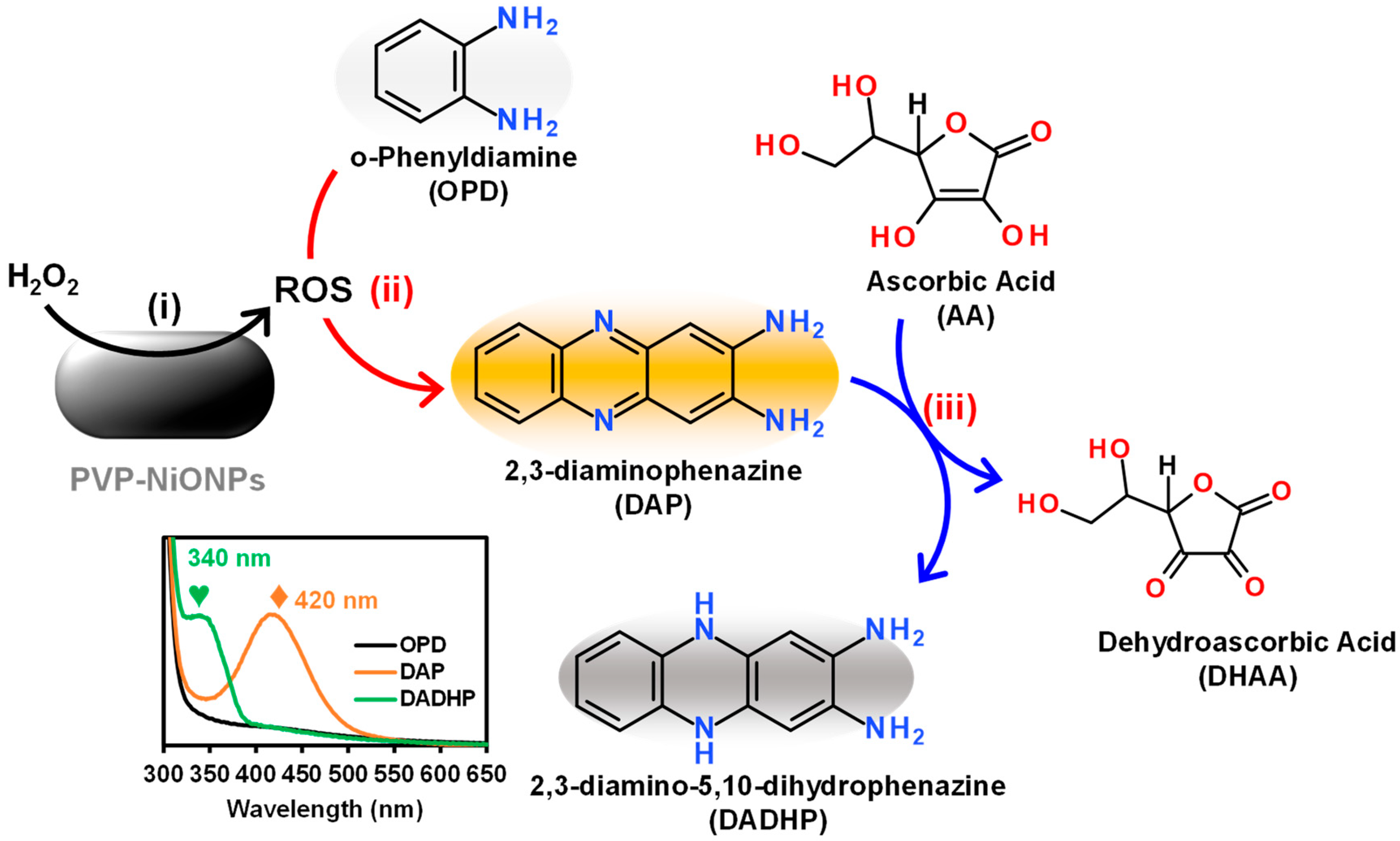
Ascorbic acid is a mild reducing agent, and this property has been used in the preparation of metal nanoparticles [27]. Scheme 1 shows the mechanistic illustration of the detection of ascorbic acid through the OPD/H2O2 catalytic reaction in the presence of PVP-NiONPs. Here, PVP-NiONPs catalytically reduce H2O2 to form reactive oxygen radical species resulting in the oxidation of OPD to form DAP. The presence of AA in the same solution reduces DAP to form 2,3-diamino-5,10-dihydrophenazine (DADHP). The increasing optical signal was monitored as a function of varied concentration of AA for colorimetric sensing. Ascorbic acid standards with concentrations from 40 μM to 400 μM were prepared and analyzed. To conduct this investigation, PVP-NiONPs were dispersed in acetate buffer (pH 4.0) followed by the addition of a substrate (H2O2 and OPD). Different concentrations of AA were immediately added into the solution. H2O2 acted as the fuel of the reaction. The reaction was allowed to react for 5 min. Colour change was observed and monitored using a UV-vis spectrophotometer.

2.5.8. Selectivity, Reproducibility, and Applications

The selectivity of the proposed PVP-NiONP-based sensor for ascorbic acid was investigated against closely related species. The compounds were added in the solution following the method in Section 2.5.7 but AA was substituted by the interfering species. The investigated interfering compounds included common sugars such as sucrose (Suc), fructose (Fru), lactose (Lac), fucose (Fuc), galactose (Gala) and glucose (Glu), and amino acids such as cysteine (Cys), glycine (Gly), lysine (Lys) and glutathione (Glut). Organic compounds and inorganic salts such as urea, uric acid (UA), glycolic acid (GLA), magnesium sulphate (MgSO4), potassium chloride (KCl), and sodium chloride (NaCl) were evaluated. Nucleobases were also investigated and these are adenine (Ade, A), guanine (Gua, G), thymine (Thy, T), and cytosine (Cyt, C). The reproducibility was evaluated by the measuring of three consecutive detections. The measurements were performed on the same day and during the same laboratory experiment under the same conditions. Percentage relative standard deviation (%RSD) values were calculated. Furthermore, the sensor was applied for ascorbic acid detection in vitamin C supplements as a representative of real samples. The 10% vitamin C was spiked with known concentrations of ascorbic acid (120 µM, 160 µM, 200 µM). The optical signal change was investigated and quantified using the ascorbic acid calibration curve.

3. Results and Discussion

3.1. Characterization of PVP-NiONPs

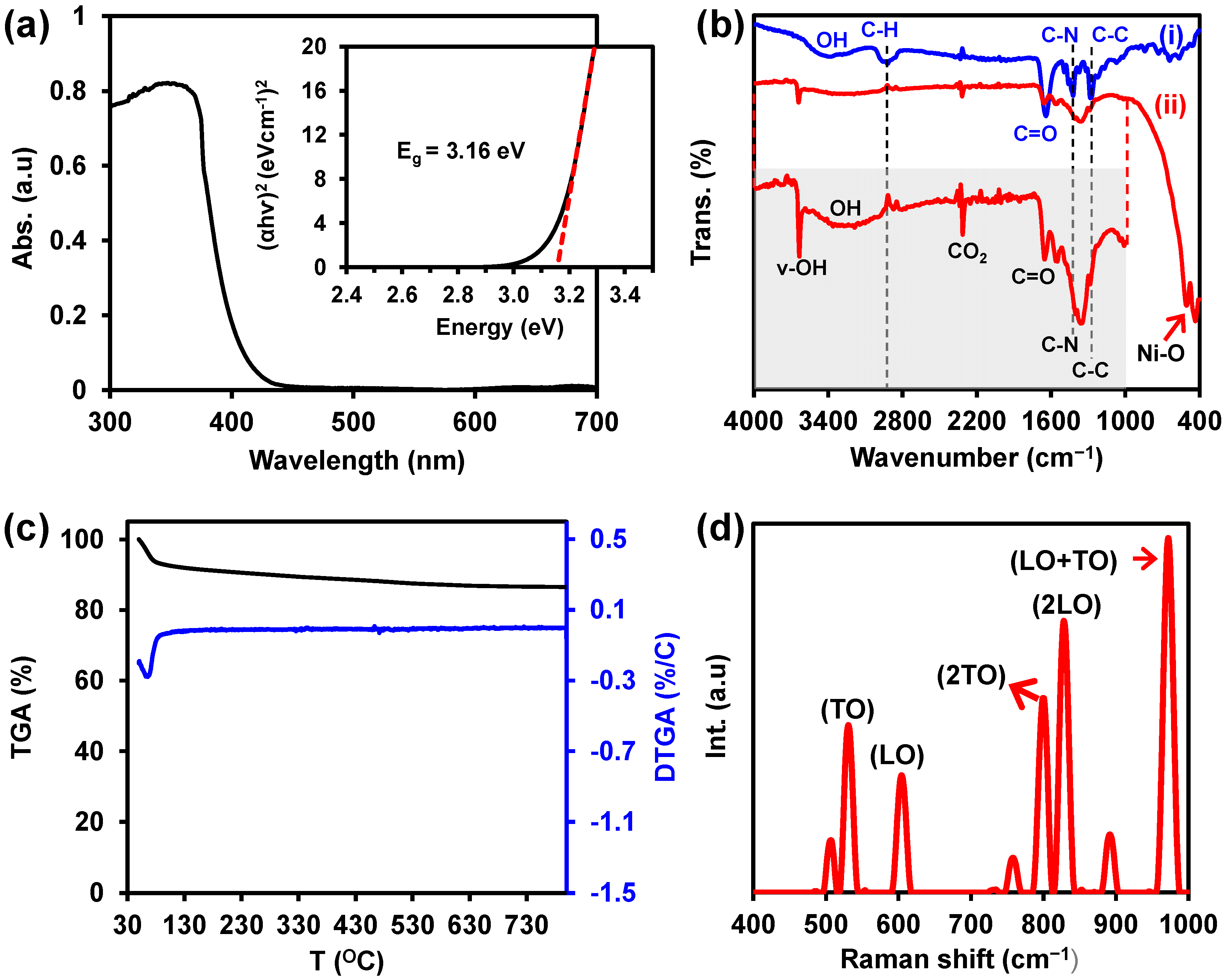
UV-vis absorption spectroscopy was used to investigate the optical characteristics of the PVP-NiONPs. The spectrum in Figure 1a shows an absorption peak at around 347 nm. The optical band gap energy of the prepared PVP-NiONPs was accessed using the Tauc Equation (2) [28].
( α h v ) 2 = B ( h ν E g )
where α is the absorption coefficient, hν is the photon energy, Eg is the band gap energy, and B is a constant.
From Equation (2), a plot of (αhv)2 vs. photon energy (hv, eV) was obtained. A linear portion of the Tauc plot was extrapolated to the photon energy axis to estimate the band gap which was found to be 3.16 eV. This suggests the electrons in the PVP-NiONPs move directly from the valence band to the conduction band without any change in momentum. This transition makes the PVP-NiONPs exhibit strong ultraviolet (UV) light absorption that enhances their optical and catalytic ideal for colorimetric sensing. The obtained band gap is in good concordance with previously reported values for NiO nanoparticles which usually range from 3.10 eV to 4.00 eV, depending on the synthetic route, size of the nanoparticles, and their crystallinity. Ahmed et al. [29] reported a band gap of 3.07 eV using computational methods while Patel et al. [30] obtained a bang gap of 3.80 eV for NiO nanofilms prepared using DC reactive sputtering.
The FTIR spectrum in Figure 1b for the PVP-NiONPs was recorded from 4000 cm−1 to 400 cm−1 to identify functional groups present and to confirm the interaction between PVP as a stabilizing agent and the surface of the NiONPs. A sharp absorption band observed at 3640 cm−1 corresponds to the free-base hydroxyl stretching from the nanoparticle surface-adsorbed water molecules [31]. Two overlapping bands at 1650 cm−1 are attributed to the C=O vibration band from the pyrrolidone ring. Also, the coexisting broad peaks observed at 1360 cm−1 correspond to C-N and C-C bending vibration peaks from the PVP. The presence of typical intense peaks at 500 and 450 cm−1 corresponds to stretching vibrations of the cubic NiO lattice [32,33].
Thermogravimetric analysis (TGA) was studied to assess thermal stability of the prepared PVP-NiONPs under nitrogen gas in the range between 50 °C and 800 °C. The PVP-NiONPs decomposed in one step during heat treatment as shown in Figure 1c. The weight loss was approximately 6% between 50 °C and 90 °C attributable to the evaporation of surface moisture as observed in FTIR spectra. At temperatures above 100 °C, the PVP-NiONPs became stable. The residual weight is around 94% at 800 °C confirming high purity and stability of the PVP-NiONPs. The Ni-O ionic bond is very strong and resulted in strong resistance to decomposition even at elevated temperatures. These results show that NiONPs can be used in high temperature applications. Similar observations were found by Salavati et al. [34] where the observed total weight loss was around 40% while Silviya and Mahalakshmi [35] only observed a total weight loss of only 6% with very stable NiONPs.
The Raman spectrum of the as-prepared PVP-NiONPs have peaks characteristic of a cubic crystal structure as shown in Figure 1d. A sharp band at 550 cm−1 corresponds to one phonon transverse optical (TO). A band at 600 cm−1 corresponds to a longitudinal optical (LO) phonon of the PVP-NiONPs. In bulk NiO, there is no first-order symmetric Raman scattering because of the rock salt. The appearance of first order peaks is due to the nano-size PVP-NiONPs and defects because of phonon confinement lattice strain and also the oxygen vacancies. A peak at 800 cm−1 corresponds to second-order two-phonon scattering (2TO mode) which forms due to distortions. The last two peaks of 850−1 and 1000 cm−1 can be attributed to combination bands or overtones. The combination at 850 cm−1 is two longitudinal optical phonons while at 1000 cm−1 the combination consists of one longitudinal and one transverse optical phonon similar to the previous report [36]. Defects play a significant role by creating more reactive sites on the surface of the NiONPs [37]. Overall, the Raman spectrum confirms the successful synthesis of PVP-stabilized NiONPs with a wurtzite structure with high crystalline peaks.
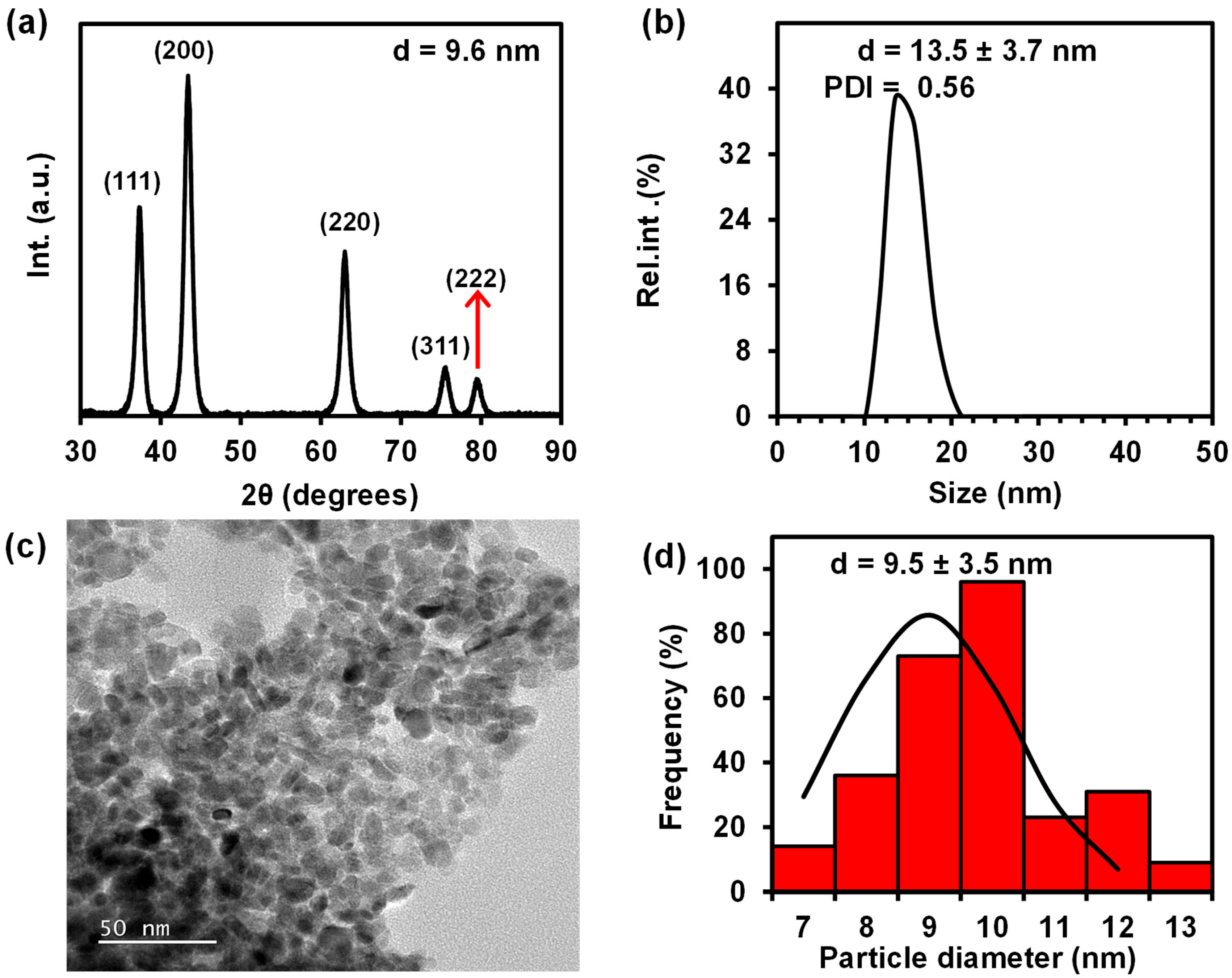
XRD was used to confirm the crystallinity of PVP-NiONPs in Figure 2a. The Braggs reflections show the crystalline nature of the PVP-NiONPs, and the broad peaks confirm that the prepared material consists of nano-sized particles. The diffraction patterns at the 2θ (degree) values 37.3°, 43.4°, 63.0°, 75.5°, and 79.5° correspond to (111), (200), (220), (311) and (222) Miller Indices, respectively. The diffraction pattern and their corresponding Miller Indices of the as-prepared PVP-NiONPs were similar to those reported in the literature [38,39,40] and match the Joint Committee on Powder Diffraction Standards (JCPDS Card No. 47–1049) with the lattice constants a = 3.249 Å and c = 5.206 Å of the pure face-centred cubic (FCC) structure of PVP-NiO [41]. There are no additional peaks in the XRD pattern confirming that the NiONPs are pure. The average particle size of 9.6 nm of the PVP-NiONPs was determined from the broadening of the peak at the 43.4° most intense peak (200) in the XRD pattern using Debye–Scherrer’s equation.
The DLS in Figure 2b shows PVP-NiONPs in solution with narrow particle sizes found to be 13.5 ± 3.7 nm. The obtained Polydispersity Index (PDI) on DLS is a measure of the size distribution of PVP-NiONPs in a suspension and was found to be 0.56. The range between 0.1 and 0.3 means that the particles are monodisperse. The PDI was more than 0.3 confirming that the particles were moderately polydisperse [42]. There was a slight difference between the calculated particle sizes from XRD and DLS, in that DLS measures hydrodynamic diameter which includes the solvating layer. There is a clear indication of large and small particles co-existing in the suspension and DLS is more sensitive to larger particles as shown by PDI. According to the study of Rehman et al. [43] it was found that using a stabilizing/capping agent can actually increase the PDI value which was the case for PVP-NiONPs with PVP as a stabilizing agent.
The morphology and size of the nanoparticles was further evaluated using TEM as shown with different magnifications of 50 nm and 10 nm. The TEM image with magnification at 50 nm in Figure 2c is densely packed with clustered ultra-small PVP-NiONPs. The PVP-NiONPs consist of a mixture of oval and some spherical particles. A histogram in Figure 2d shows the nanoparticle sizes were found to be 9.5 ± 3.5 nm. The TEM nanoparticle size was in concordance with the particle size estimated from XRD using the Scherrer equation.

3.2. Peroxidase-like Activity of PVP-NiONPs

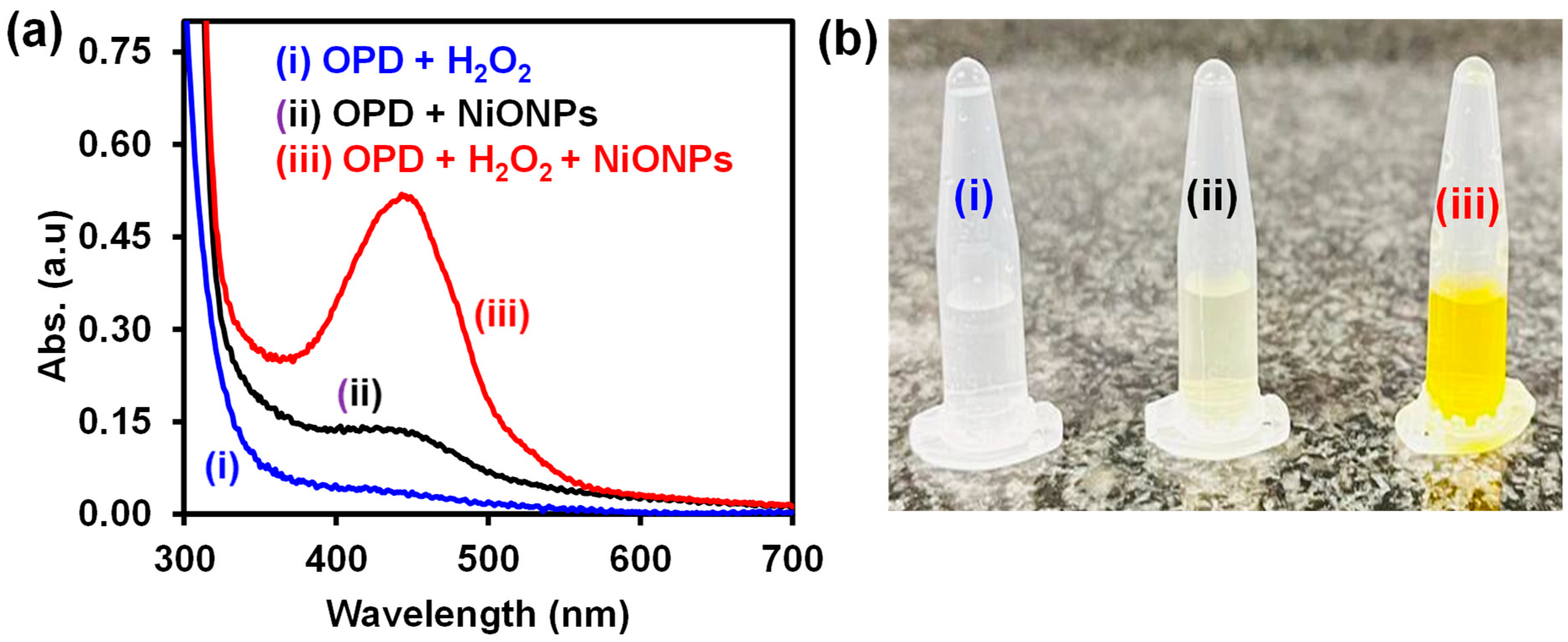
The peroxidase-like activity of PVP-NiONPs was investigated by the oxidation of OPD in the presence of H2O2. The UV-vis spectrum in Figure 3a shows absorption spectra of (i) H2O2 and OPD, (ii) OPD and PVP-NiONPs, and (iii) OPD, H2O2 and PVP-NiONPs in pH 4.0 acetate buffer. In a solution containing OPD with H2O2 alone the solution remained clear, and no absorption was observed. The UV-vis spectrum of OPD containing PVP-NiONPs and H2O2 showed the absorption peak at 450 nm. This is due to the oxidation of OPD to form 2,3-diaminophenazine (DAP). A similar observation was discovered in the reaction system oxidoperoxido molybdenum (VI) complex with OPD and H2O2 [44]. The colour of the solution turned dark yellow at pH 4.0 buffer solution as seen in Figure 3b and this confirms that PVP-NiONPs possess peroxidase-like activity. Both OPD and H2O2 are necessary for the peroxidase-like activity of PVP-NiONPs. This behaviour was similar to the commonly used horse-radish peroxidase (HRP) enzyme with OPD and H2O2 in the similar solution. The biomolecule HRP requires reaction conditions to be controlled. NiONPs possess enzyme-like activity that can be optimized for enhanced signal by changing the experimental conditions.

3.3. Conditions Affecting Peroxidase-like Activity of PVP-NiONPs

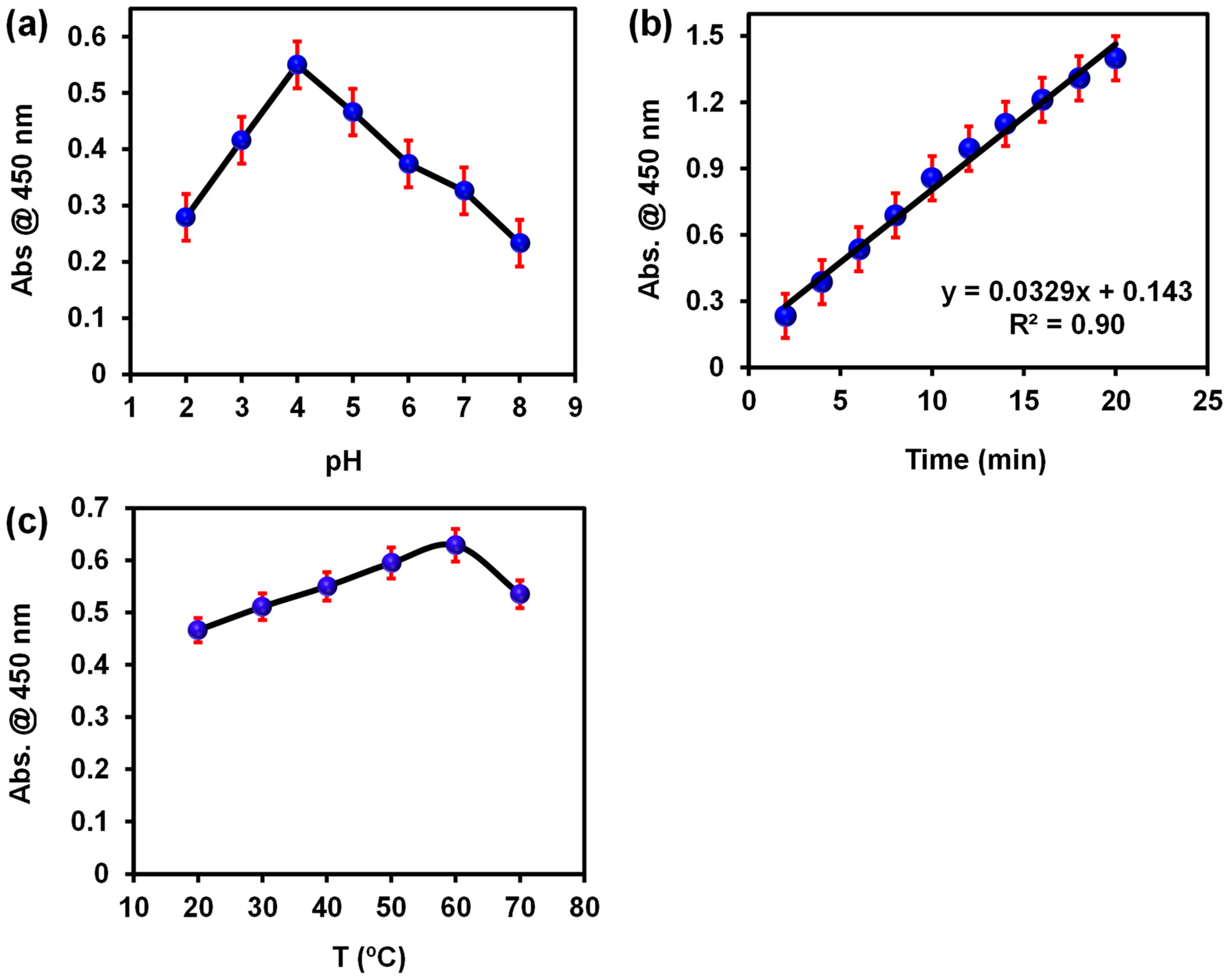
Similar to natural enzymes, the peroxidase-like activity of PVP-NiONPs as artificial enzymes can be affected by different reaction conditions. The effect of pH, reaction time and temperature were evaluated in a reaction system containing OPD, PVP-NiONPs and H2O2. The effect of pH conditions was assessed in acetate buffers with pH values ranging from pH 2.0 to pH 8.0, as seem in Figure 4a. The OPD absorption in a solution containing PVP-NiONPs and H2O2 was recorded and the peak at 450 nm was observed and due to OPD oxidation as seen in Figure S1a. The optimum pH value of 4.0 had highest absorption intensity and the most intense yellow colour. The solution colour fading from yellow to colourless was observed at pH 7.0 and pH 8.0. In the basic solution, hydrogen peroxide decomposes to form water and oxygen. Vallabi et al. [45] and Drozd et al. [46] showed similar results for peroxidase-like activity of iron oxide and gold nanoparticles, respectively. In both cases, the acidic pH conditions exhibited the highest relative activity.
The effect of the reaction time ranging from 2 to 20 min and the absorbance at 450 nm for the OPD oxidation (PAD) was investigated. The UV-vis spectra in Figure S1b shows the increasing absorption at 450 nm as the reaction was allowed to react for a long reaction time. The graph of the absorbance intensity at 450 nm increased linearly with time as shown in Figure 4b. Allowing for the reaction to take longer also resulted in the increase in colour intensity of the working solutions from yellow to orange. The regression line in Figure 4b shows excellent linearity, with a correlation coefficient (R2) of 0.990, which is very close to 1 suggesting a very close relationship between variables. The reaction time of 5 min of absorption of OPD at 450 nm was chosen for quick analysis.
The effect of the change in temperature, ranging from 20 °C to 70 °C, for the reaction system with OPD, PVP-NiONPs and H2O2, was investigated. The UV-vis spectra were recorded as shown in Figure S1c. The graph of absorbance at 450 nm versus temperature is shown in Figure 4c and it increased from 20 °C to 60 °C and it decreased afterwards. As the temperature increased, H2O2 became unstable and converted to water vapour and oxygen.

3.4. Effect of Substrate (OPD and H2O2) Concentration

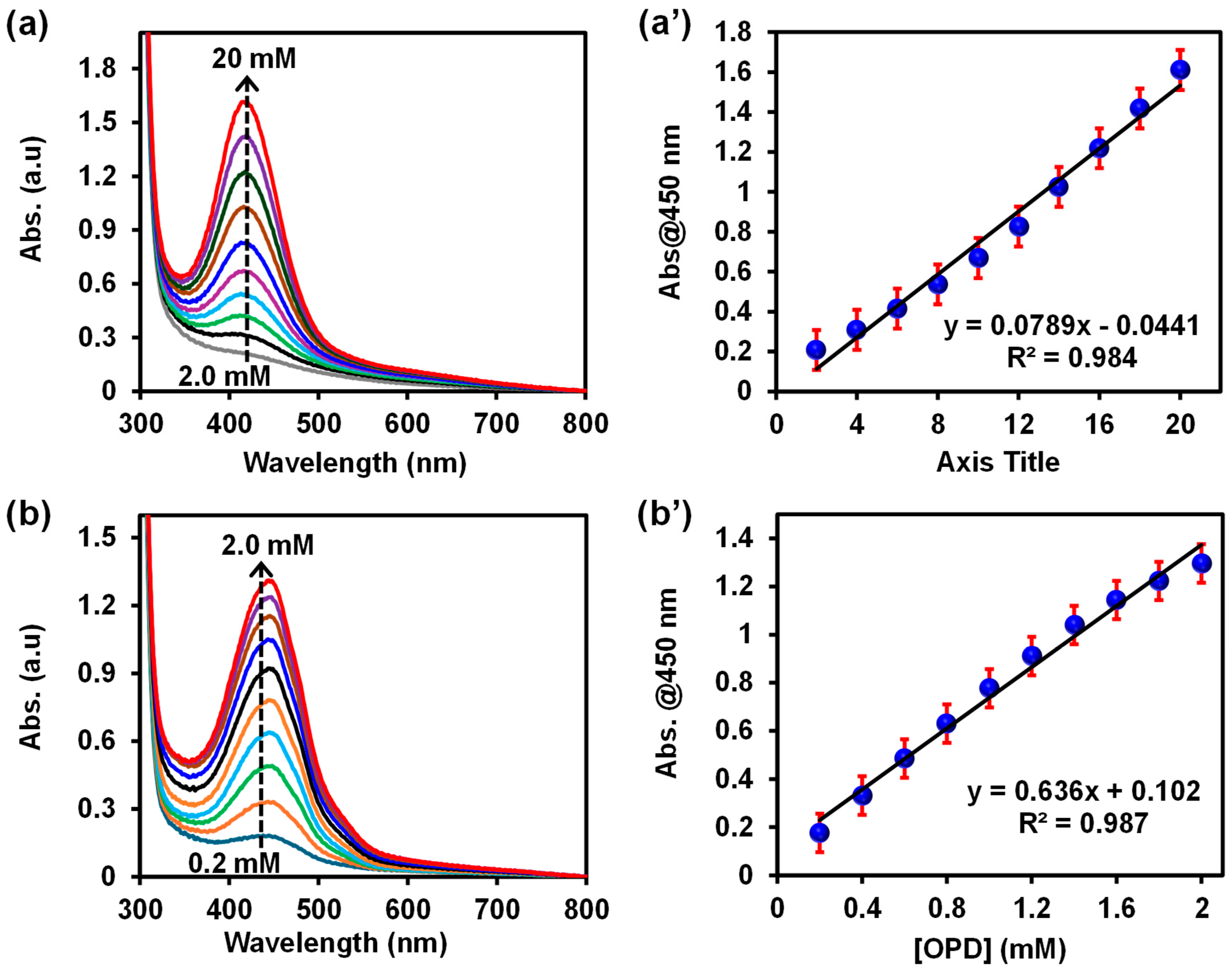
The effect of the changes in concentrations of H2O2 and OPD were evaluated at pH 4.0 for 5 min of reaction time. For H2O2, the absorbance at 450 nm for the oxidation of OPD was investigated. The concentration of H2O2 investigated was from 2.0 mM to 20 mM. The absorbance values at 450 nm increased with the increase in concentration of H2O2 as shown in Figure 5a. The increase in the absorption of OPD at 450 nm was also linear with the increase in H2O2 concentration, as shown in Figure 5(a’). This observation confirms that the catalytic activity of PVP-NiONPs is significantly affected by the concentration of H2O2. The H2O2 concentration of 2.0 mM was chosen for further studies. This phenomenon was also observed in the study of Chen et al. [17] where the catalytic activity was increasing rapidly with increased concentrations of H2O2 up to 8.0 mM. In this work, the increase in H2O2 concentration was up to 20 mM which is much higher than the value reported by Chen et al. [17]. The concentration of OPD investigated ranged from 0.20 mM to 2.0 mM as shown in Figure 5b. An increase in the oxidation of OPD as the concentration increased was observed as shown in Figure 5(b’). Similarly, the change in absorption at 450 nm increased with increasing concentration of OPD. This observation confirms that the catalytic activity of PVP-NiONPs is affected by the concentrations of the OPD substrate.

3.5. Steady-State Kinetic Analysis of PVP-NiONPs

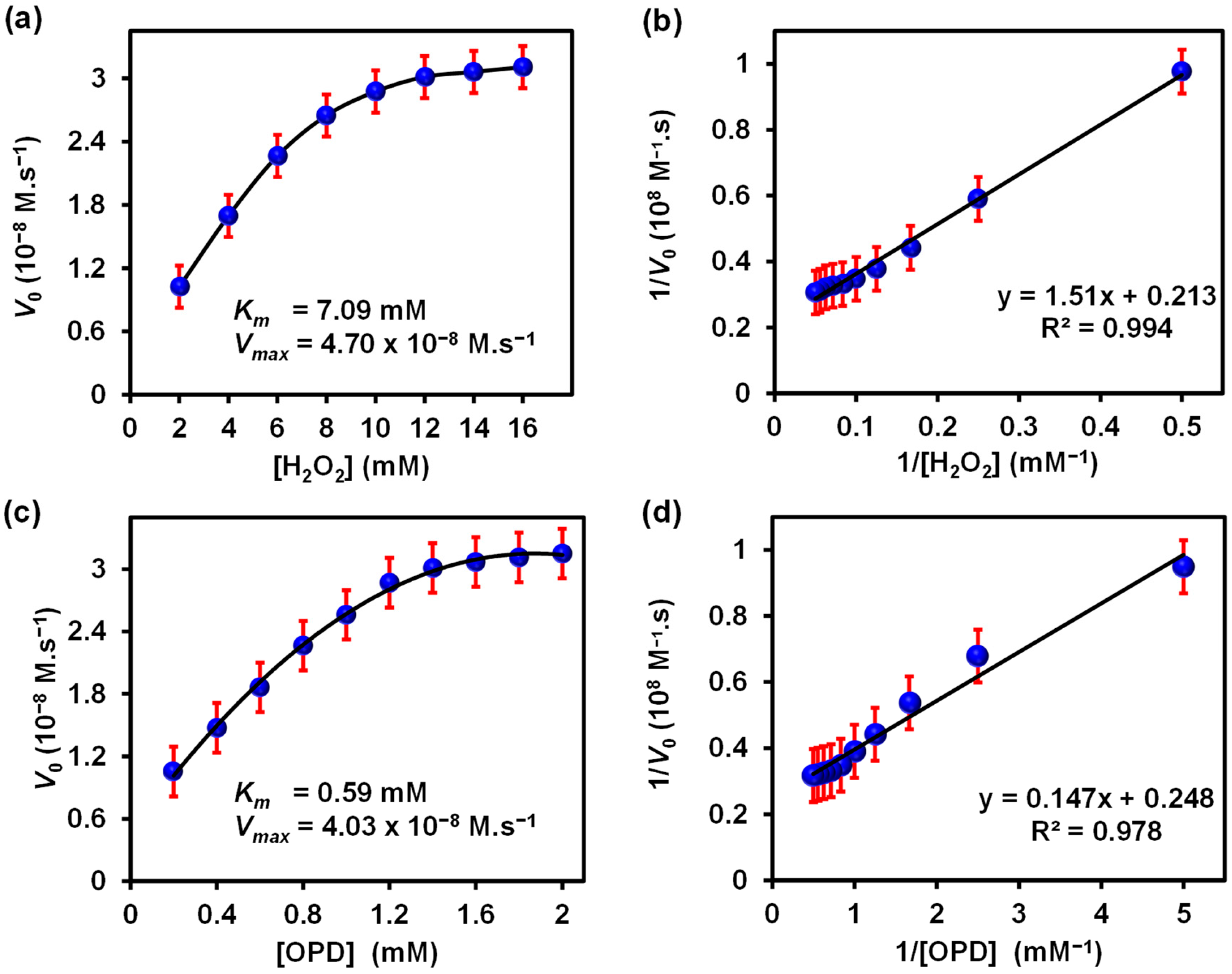
The steady-state kinetic parameters of PVP-NiONPs were evaluated using the Michaelis–Menten and Lineweaver–Burk (double reciprocal) models. The analysis was performed by varying individual substrate concentration while keeping others constant. H2O2 and OPD are the components of the substrate solution. The initial rates (V0) were calculated from the linear region obtained from the time-dependent absorption value at 450 nm. The absorbance values were converted to the concentration using the Beer–Lambert law and the molar absorption coefficient (ԑ = 16,700 M−1.cm−1) of the oxidized OPD.
Figure 6a showed an increase in V0 with the increasing concentration of H2O2. The graph reached a plateau at a high concentration ≥ 12 mM. This confirmed the typical Michaelis–Menten enzyme-like behaviour for the PVP-NiONPs. In Figure 6b, the double reciprocal plot was linear and used to calculate the Km value from the slope and Vmax from the y-intercept using Equation (3).
1   V 0 =   K m V m a x . 1 [ S ] +   1 V m a x
where V0 is the initial rate, Vmax is the maximum reaction rate, [S] is the concentration of the substrate (H2O2), and Km is the Michaelis–Menten constant. The affinity between the enzyme and the substrate is defined by Km. The higher the Km, the weaker the interaction between the enzyme and substrate. A low Km value indicates a strong interaction between the substrate and catalyst. The apparent Michaelis–Menten constant (Km) for H2O2 was found to be 7.09 mM. This is the concentration at which the reaction rate reaches half of its maximum value. The maximum velocity (Vmax) was calculated to be 4.70 × 10⁻⁸ M−1.s. The average Km value suggests good interaction of PVP-NiONPs toward H2O2. This is good for effective ROS generation and OPD oxidation can occur when H2O2 is present in relatively low concentrations. For the OPD calculation from graphs in Figure 6c,d, the Km and Vmax values obtained were 0.59 mM and 4.03 × 10⁻⁸ M−1.s, respectively. The much lower Km value obtained for OPD indicates excellent interaction between PVP-NiONPs and OPD for optimal OPD oxidation by ROS. These findings were also observed for other reported metal oxide nanomaterials which rely on surface-mediated electron transfer or catalytic processes rather than substrate-specific binding in natural enzymes [47]. For comparison with other nanozymes in Table 1, the PVP-NiONPs have very low Km values and the highest Vmax values. This shows that PVP-NiONPs performed much better.

3.6. Confirming Reaction Oxygen Radical Species (ROS) Generation

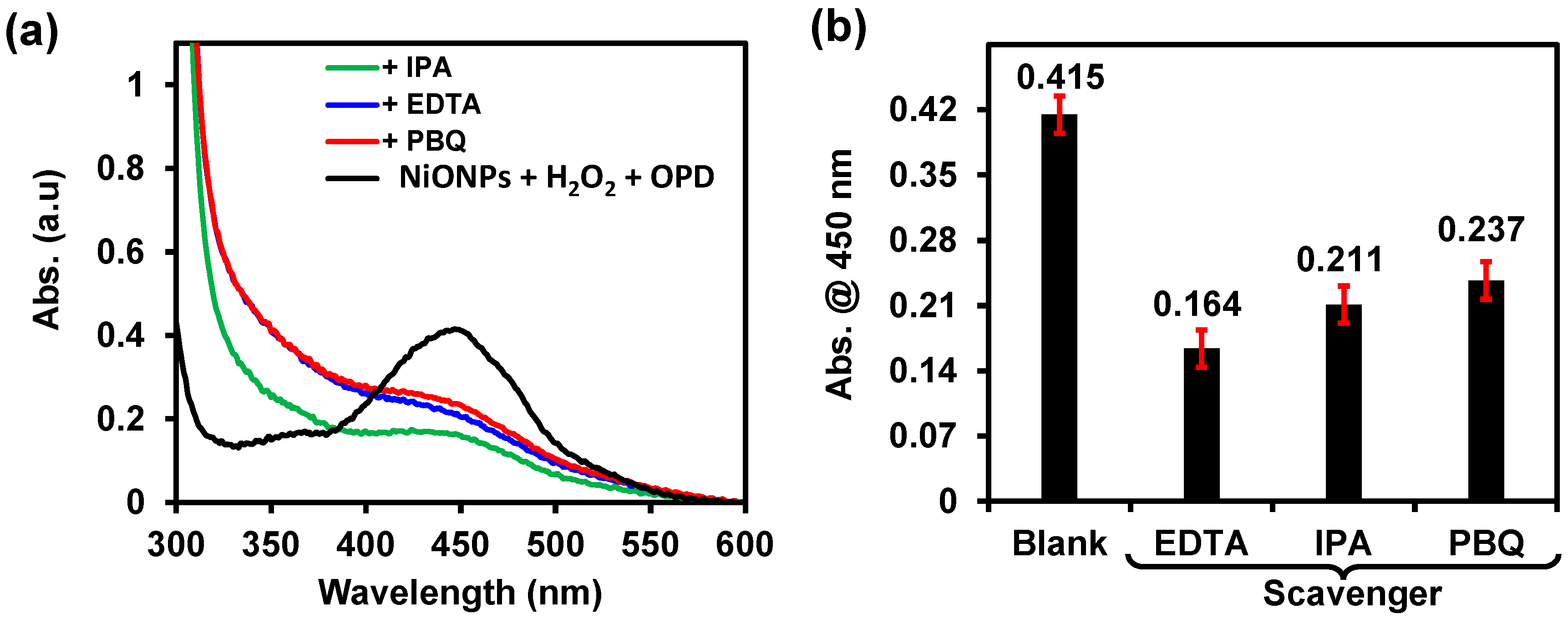
The absorption of oxidized OPD was investigated in a solution containing PVP-NiONPs and H2O2. The catalytic reaction of PVP-NiONPs and H2O2 generates reactive oxygen radical species (h+, HO●─, HO2 and O2●─). ROS generation was investigated using a scavenger experiment to capture the radical species and evaluate the impact of each radical. The radical scavengers investigated are EDTA, IPA and PBQ, known to scavenge h+, HO●─ and O2●─, respectively. Figure 7a shows the effect before and after adding a scavenger in the reaction containing PVP-NiONPs, H2O2, and OPD. The absorption of the oxidized OPD was monitored at 450 nm. Figure 7b shows the absorbance of oxidized OPD in the absence of a scavenger with the average absorbance value of 0.415 a.u and the presence of a scavenger which resulted in the decrease in the absorption of OPD due to the scavenger. The average absorbance values in the presence of the scavenger were 0.164 a.u (EDTA), 0.211 a.u (IPA), and 0.237 a.u (PBQ).
The absorption values at 450 nm decreased when the scavenger was added. The highest decrease (60.5%) was observed for EDTA, specifically for h+. This was followed by the 49.2% decrease when IPA was added to scavenge hydroxyl radicals, HO●─, and lastly the PBQ scavenged peroxyradicals (O2●─) with about 42.9%. Thus, the mechanism of peroxidase-like activity of PVP-NiONPs proceeded via catalytic reduction of H2O2 to generate reactive oxygen radical species that catalyze the oxidation of OPD to yellow-coloured products (2,3-diaminophenazine).

3.7. Colorimetric Detection of Ascorbic Acid

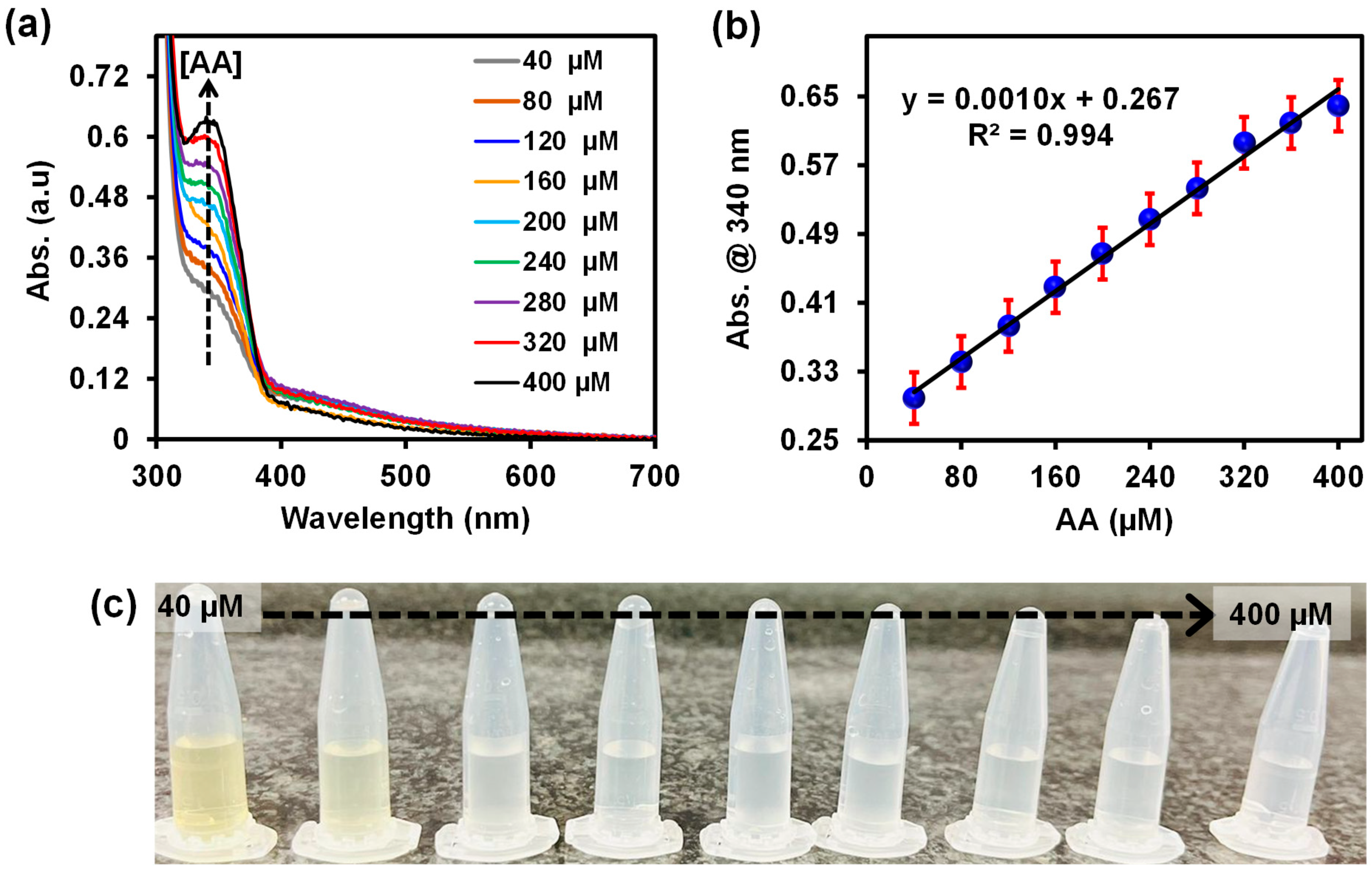
Ascorbic acid detection was followed by the reduction of the oxidized OPD (DAP) to form 2,3-diamino-5,10-dihydrophenazine (DADHP) using UV-vis spectroscopy and absorption at 340 nm. The detection of AA in Figure 8a show UV-vis spectra. ROS generated by PVP-NiONPs and H2O2 oxidize OPD to form 2,3-diaminophenazine (DAP). In the presence of AA, the oxidized OPD products are reduced to 2,3-diamino-5,10-dihydrophenazine (DADHP). The increase in the absorption peak at 340 nm is due to the formation of DADHP and can be linearly related to the concentration of AA as shown in Figure 8b. Figure 8c shows the images of solutions upon adding varying concentrations of ascorbic acid. The intensity of absorption at 340 nm was found to be proportional to the ascorbic acid concentration from 40 µM to 400 µM. The linear regression Equation (4) of the absorbance graph versus varied ascorbic acid concentration was:
Abs. @340 nm = 0.0010 [AA] + 0.267
with an R2 value of 0.994. The linear relation suggests that this colorimetric system provides a reliable response in the concentration range investigated. The correlation coefficient corresponds to excellent linearity and minimal deviation. Moreover, it validates the applicability of this sensor for the analytical detection of AA. The limit of detection (LOD) and limit of quantification (LOQ) were calculated using the slope of the regression line and standard deviation of the blank, and the values obtained were 0.11 µM using 3σ and 0.36 µM using 10σ respectively. This reaction system is highly sensitive and reproducible. Similar observations were found in the study of Isho et al. [25].
The peak due to DAP at 450 nm was not observed and this was due to the instant reduction of DAP to form DADHP with an absorption at 340 nm. Similar observations were reported by Yan et al. [52]. They observed that ascorbic acid has antioxidant and redox properties that enable it to immediately reduce DAP to DADHP as shown in Scheme 1. This was observed for the oxidation of 3,3′,5,5′-tetramethylbenzidine (TMB) to a blue-coloured product, thus preventing colour change. For the blank reaction, the absorption of oxidized OPD occurs in the presence of PVP-NiONPs and H2O2 to form 2,3-diaminophenazine (DAP) with a measurable peak at 450 nm [53]. When a different concentration of AA is introduced, it results in the reduction of oxidized OPD to form DADHP with a wavelength at 340 nm. Compared with other nanozymes for sensing ascorbic acid, the proposed colorimetric method using PVP-NiONPs exhibited a better limit of detection and limit of quantification in a linear range as summarized in Table 2.

3.8. Selectivity, Reproducibility, and Applicability

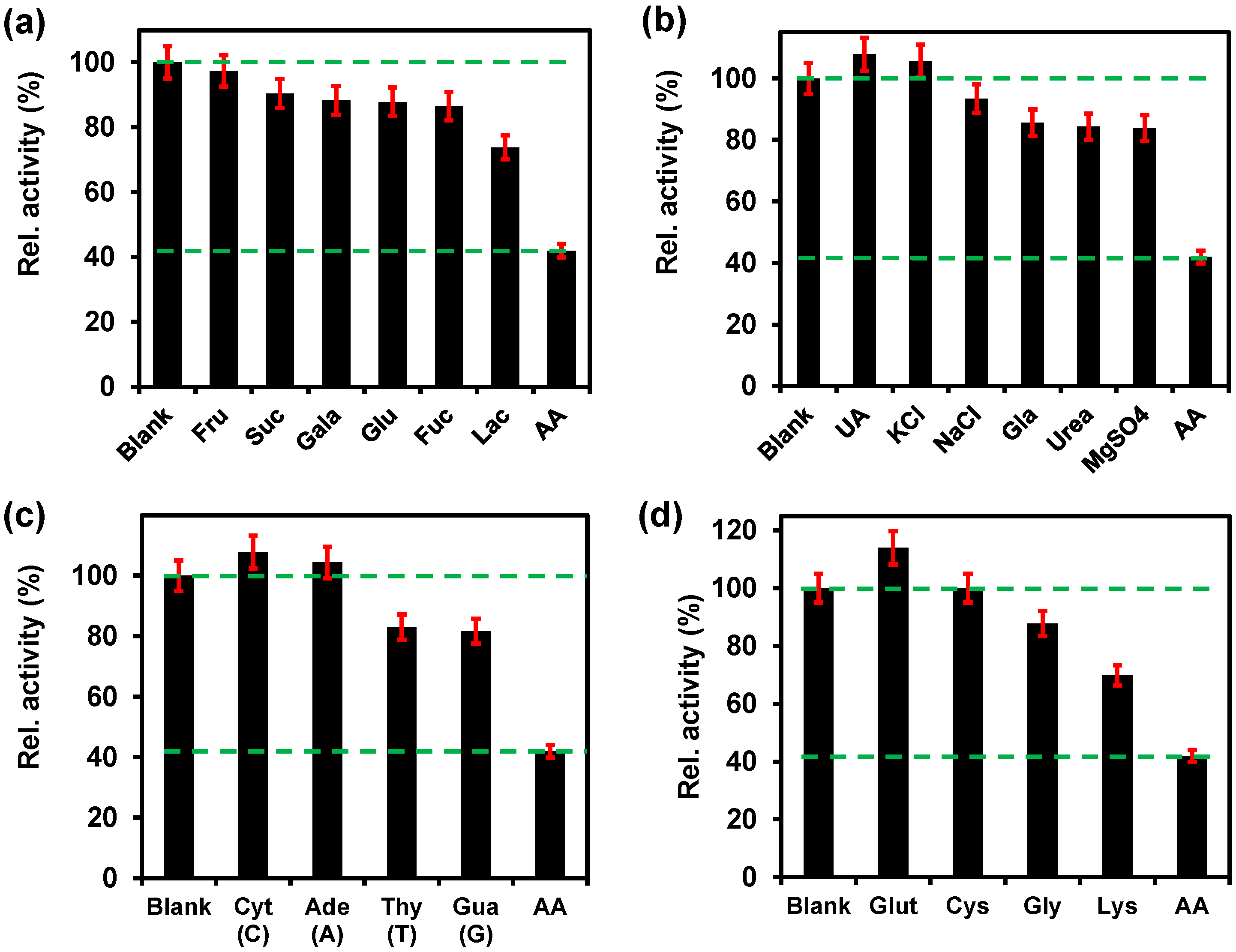
The selectivity of the developed ascorbic acid sensor was evaluated by investigating its response to other closely related biomolecules. The interfering species included metal ions, reducing agents, carbohydrates and amino acids. Each of the interfering species was individually added instead of ascorbic acid under identical experimental conditions to assess any non-specific interactions. The control or blank solution, containing PVP-NiONPs, H2O2 and OPD, resulted in a colour change to yellow and high absorption intensity at 450 nm due to the oxidation of OPD as shown in Figure 9. The relative activity of the blank was treated as 100%. After adding AA, there was a dramatic decrease in the absorption intensity at 450 nm to about 41.0% and there was no colour. The majority of the interfering species resulted in an increase in intensity at 450 nm and colour changes to yellow similar to the control or blank solution, signifying no interference. When the relative reactivity was investigated as shown in Figure 9, glutathione (Glut, 113.9%), adenine (Ade, 104.4%), cytosine (Cyt, 107.9%), uric acid (UA, 107.9%) and KCl (105.7%) exhibited an absorption intensity slightly higher than the control or blank solution. This signifies that these compounds induce some oxidation properties towards OPD. Lysine showed a decrease in absorption intensity to 69.9%, still much higher than the 41.9% for AA. This can be attributed to the fact that it has two amine groups that undergo weak electron transfer and exhibit electrochemical activity [59] that allows it to partially convert oxidized OPD to its reduced form. Furthermore, it is known to be a weak antioxidant in nature and act as a radical scavenger to reduce hydroxyl radicals [60]. This suggests that the proposed sensor is highly selective as it selectively detects AA even in the presence of other reducing agents.
The colorimetric sensing of ascorbic acid was further investigated in 10% vitamin C tablets purchased at a Grahamstown Pharmacy, representing real sample. The 10% vitamin C solution was prepared in pH 4.0 acetate buffer spiked with known concentrations of ascorbic acid within the calibration curve in Figure 8. Table 3 shows the % recovery of ascorbic acid in 10% vitamin C tablets was between 92.3% and 102.6% falling within acceptable analytical limits. The percentage relative standard deviation (%RSD) values were between 0.46% and 1.25%, indicating the high precision and reproducibility of this method. The results showed the feasibility and reliability of the proposed PVP-NiONPs, OPD and H2O2 combination as the colorimetric sensor for detecting ascorbic acid in 10% vitamin C.

4. Conclusions

The preparation of polyvinylpyrrolidone nickel oxide nanoparticles was successful and characterized using various spectroscopic and microscopic techniques to confirm their preparation. The PVP-NiONP particle sizes were found to be 9.6 nm using XRD, 13.5 ± 3.7 nm using DLS and 9.5 ± 3.5 nm using TEM. The nanomaterials also showed the presence of oxygen vacancy (useful for catalysis) as showed by Raman spectroscopy. The PVP-NiONPs exhibited excellent peroxidase-like activity using OPD and H2O2 as substrates. A typical Michaelis−Menten enzyme behaviour was observed for the PVP-NiONPs using steady-state kinetic analysis which showed good affinity towards H2O2 and OPD compared to other reported nanozymes. The PVP-NiONPs were utilized for the detection of ascorbic acid with a wide linear concentration range between 40 μM and 400 μM. The limit of detection and limit of quantification were determined to be 0.11 μM and 0.36 μM respectively. Selectivity towards ascorbic acid compared to potential interfering species was achieved. PVP-NiONPs applied in a real sample analysis using 10% vitamin C tablets confirmed the reliability for ascorbic acid detection in real-life applications. The % recovery of ascorbic acid in 10% vitamin C was between 92.3% and 102.6% and the %RSD values were between 0.46% and 1.25% indicating the high precision and reproducibility of this method.

Supplementary Materials

The following supporting information can be downloaded at: https://www.mdpi.com/article/10.3390/bios16050299/s1, Figure S1: UV-vis spectra showing the effect of reaction conditions on the peroxidase-like activity of PVP-NiONPs in a solution containing OPD and H2O2. (a) pH (2.0–8.0), (b) reaction time (2 min–20 min), and (c) temperature (20 °C–70 °C).

Author Contributions

Conceptualization, M.R. and P.M.; Methodology, M.R., R.C. and P.M.; Software, R.C.; Validation, M.R. and P.M.; Formal analysis, M.R., R.C. and P.M.; Investigation, M.R., R.C. and P.M.; Resources, P.M.; Data curation, M.R. and P.M.; Writing—original draft, M.R.; Writing—review & editing, P.M.; Visualization, M.R. and P.M.; Supervision, P.M.; Project administration, P.M.; Funding acquisition, P.M. All authors have read and agreed to the published version of the manuscript.

Funding

This research was funded by the [Department of Science, Technology and Innovation (DSTI) and Technology Innovation Agency (TIA)] grant number [DSTI-TIA Nano Technology Platform], [National Research Foundation (NRF) through Competitive Rated Research Programme] grant number [NRF-CPRR] and [Rhodes University through Rated Research Grant] grant number [RRG].

Institutional Review Board Statement

Not applicable.

Informed Consent Statement

Not applicable.

Data Availability Statement

The original contributions presented in this study are included in the article/supplementary material. Further inquiries can be directed to the corresponding author.

Acknowledgments

M.R. is grateful for the DST-Mintek Nanotechnology Innovation Centre (DST/Mintek NIC) Scholarship.

Conflicts of Interest

The authors declare no conflicts of interest.

References

  1. Agwu, E.; Ezihe, C.; Kaigama, G. Antioxidant roles/functions of ascorbic acid (Vitamin C). In Ascorbic Acid—Biochemistry and Functions; Kurkut, A., Gelen, V., Eds.; IntechOpen: London, UK, 2024; Chapter 4. [Google Scholar]
  2. Kükürt, A.; Gelen, V. Understanding Vitamin C: Comprehensive examination of its biological significance and antioxidant properties. In Ascorbic Acid: Biochemistry and Functions; Kurkut, A., Gelen, V., Eds.; IntechOpen: London, UK, 2024; Chapter 1. [Google Scholar]
  3. Guo, D.; Liao, Y.; Na, J.; Wu, L.; Yin, Y.; Mi, Z.; Fang, S.; Liu, X.; Huang, Y. The involvement of ascorbic acid in cancer treatment. Molecules 2024, 29, 2295. [Google Scholar] [CrossRef]
  4. Celin, T.; Gandhimathi, S. Synthesis and characterization of bipyridine modified Cu-POMs as chemosensors for the detection of ascorbic acid and hydrogen sulphide. J. Mol. Struct. 2025, 1326, 141071. [Google Scholar] [CrossRef]
  5. Caban, M.; Lenard, K.; Nowak, A.; Dzimitrowicz, A. New method for quantification of ascorbic acid in fruit juices with an application of ionic liquids as phase modifier in reverse phase HPLC. Microchem. J. 2025, 215, 114440. [Google Scholar] [CrossRef]
  6. Jabbar, S.; Abid, M.; Hu, B.; Hashim, M.M.; Saeeduddin, M.; Lei, S.; Wu, T.; Zeng, X. Influence of sonication and high hydrostatic pressure on the quality of carrot juice. Int. J. Food Sci. Technol. 2014, 49, 2449–2457. [Google Scholar] [CrossRef]
  7. Kim, W.-S.; Dahlgren, R.L.; Moroz, L.L.; Sweedler, J.V. Ascorbic acid assays of individual neurons and neuronal tissues using capillary electrophoresis with laser-induced fluorescence detection. Anal. Chem. 2002, 74, 5614–5620. [Google Scholar] [CrossRef] [PubMed]
  8. Verdini, R.A.; Lagier, C.M. Voltammetric iodometric titration of ascorbic acid with dead-stop end-point detection in fresh vegetables and fruit samples. J. Agric. Food Chem. 2000, 48, 2812–2817. [Google Scholar] [CrossRef]
  9. Pilarski, B.; Wyrzykowski, D. A novel approach to study ascorbic acid oxidation using hexavalent chromium species—Theoretical and practical perspectives of the use of potentiometric titration technique. Transit. Met. Chem. 2025, 50, 33–41. [Google Scholar] [CrossRef]
  10. Tee, E.S.; Young, S.I.; Ho, S.K.; Mizura, S.S. Determination of Vitamin C in fresh fruits and vegetables using the dye-titration and microfluorometric methods. Pertanika 1988, 11, 39–44. [Google Scholar]
  11. Aliabadi, F.; Zaimbashi, R. MnWO4/reduced graphene oxide/modified glassy carbon electrode for determination of ascorbic acid in the presence of vitamin B6 in the real sample. J. Environ. Bioanal. Electrochem. 2025, 1, 84–95. [Google Scholar] [CrossRef]
  12. Tajik, S.; Dourandish, Z.; Nejad, F.G.; Beitollahi, H. Evaluating the electrochemical detection of three antioxidants, ascorbic acid, salicylic acid, and glutathione by using a screen-printed carbon electrode modified with nanocomposite of cobalt nanosheets anchored on reduced graphene oxide. Monatshefte Für Chem. Chem. Mon. 2025, 156, 1119–1127. [Google Scholar] [CrossRef]
  13. Wang, G.; Tang, T.; Liu, R.; Li, J.; Xu, Y.; Liao, S. Novel electrochemical sensor based on Cu-MOF/MWCNT-COOH for the simultaneous detection of ascorbic acid and dopamine. Langmuir 2025, 41, 4102–4112. [Google Scholar] [CrossRef]
  14. Li, S.N.; Zhang, J.; Liu, Y.Q.; Zhou, K.P.; Jiang, X.Y.; Yu, J.G. Cobalt vanadate intertwined in carboxylated multiple-walled carbon nanotubes for simultaneous electrochemical detection of ascorbic acid, dopamine and uric acid. Talanta 2025, 282, 127038. [Google Scholar] [CrossRef]
  15. Wang, R.; Liang, Y.; Huang, H.; Su, C.; Pei, Y.; Jing, Y. The electrochemical detection of ascorbic acid constructed on CuO nanocubes with excellent sensitivity and wide linearity. J. Mol. Struct. 2025, 1328, 141314. [Google Scholar] [CrossRef]
  16. Kukreja, E.A.; Tripathi, R.M.; Chung, S.J. Colorimetric and smartphone-based dual modality sensing platform for detection of ascorbic acid. Sens. Actuator A Phys. 2025, 389, 116573. [Google Scholar] [CrossRef]
  17. Chen, Y.Y.; Sun, J.X.; Wang, A.J.; Mei, L.P.; Song, P.; Zhao, T.; Feng, J.J. Well-defined PtMn alloy/porous N-doped carbon nanoflowers with bifunctional activities for colorimetric/fluorescent dual-mode determination of ascorbic acid in juice beverages. Microchim. Acta 2025, 192, 583. [Google Scholar] [CrossRef]
  18. Kanwal, N.; Khan, M.; Khan, S.A.; Bari, A.; Ali, E.A.; Sun, W.; Rehman, T.; Nishan, U.; Badshah, A. Chitosan-stabilized copper oxide nanoparticles: A novel colorimetric approach for ascorbic acid sensing. Anal. Biochem. 2025, 702, 115855. [Google Scholar] [CrossRef]
  19. Dong, W.; Liu, J.; Lan, H.; Lu, T.; Liu, Y.; Ran, Z.; Wang, Z.; Cao, H.; Shi, W.; Chen, G. A novel detection mode for ascorbic acid with high selectivity based on peroxidase mimetic system. Microchem. J. 2025, 209, 112753. [Google Scholar] [CrossRef]
  20. Mathur, P.; Singh, R.; Kumawat, M.; Srinivas, S.P.; Daima, H.K. Trends in designer-made metal oxide nanozymes for environmental applications. Inorg. Chem. Comm. 2025, 181, 115190. [Google Scholar] [CrossRef]
  21. Chen, S.; Yu, Z.; Wang, Y.; Tian, S.; Wei, Q.; Tang, D. Pioneering food analysis: Transformative antioxidant testing with colorimetric assays using Co–Mn bimetallic oxide nanozyme. Anal. Chim. Acta 2025, 1333, 343389. [Google Scholar] [CrossRef] [PubMed]
  22. Huang, S.; Yang, P.; Yuan, Y.; Wan, S.; Xu, J.; Fu, J.; Tan, Q.; Zhang, J. Nanozyme-Based Therapy in Gout. ACS Appl. Mater. Interfaces 2025, 17, 39863–39879. [Google Scholar] [CrossRef] [PubMed]
  23. Fite, M.C.; Karse, S.D.; Gode, L.M. Optical and photocatalytic properties of nickel oxide nanoparticles. J. Cryst. Growth 2025, 660, 128163. [Google Scholar] [CrossRef]
  24. Mahmud, M.; Rahman, M.S. A concise review on applications of nickel oxide nanoparticles and their extraction parts. Int. J. Adv. Biol. Biomed. Res. 2025, 13, 317–340. [Google Scholar] [CrossRef]
  25. Isho, R.D.; Mohammed, N.M.S.; Idrees, S.A. Bimetallic oxide (CoNi2O4) nanozyme as ROS independent for ascorbic acid detection with computational study. Talanta 2025, 295, 128315. [Google Scholar] [CrossRef] [PubMed]
  26. Pham, T.-H.; Ngo, X.-D.; Van Tuyen, N.; Quang, C.X.; De, P.-C.; Van Tran, T.; Linh, N.P.D.; Hoang, V.-T.; Le, A.-T. Insight into the oxidase-mimicking activity enhancement of MnO2 nanozymes by Co ion-doping for colorimetric sensor assays. RSC Adv. 2025, 15, 34537–34550. [Google Scholar] [CrossRef]
  27. Menamo, D.S.; Ayele, D.W.; Ali, M.T. Green synthesis, characterization and antibacterial activity of copper nanoparticles using L-ascorbic acid as a reducing agent. Ethiop. J. Sci. Technol. 2017, 10, 209–220. [Google Scholar] [CrossRef]
  28. Makuła, P.; Pacia, M.; Macyk, W. How to correctly determine the band gap energy of modified semiconductor photocatalysts based on UV–Vis spectra. J. Phys. Chem. Lett. 2018, 9, 6814–6817. [Google Scholar] [CrossRef]
  29. Ahmed, T.Y.; Saeed, S.R.; Aziz, S.B.; Abdullah, O.G. Enhancing electronic and optical properties of NiO using Cu-doping: A DFT approach for band gap reduction. Oxf. Open Mater. Sci. 2025, 5, itaf009. [Google Scholar] [CrossRef]
  30. Patel, M.; Park, S.H.; Kim, J. Optical, electrical and photoresponse data of flexible and high-performing NiO/ZnO ultraviolet photodetector. Data Brief 2018, 17, 520–525. [Google Scholar] [CrossRef]
  31. Litvintseva, K.; Kaichev, V. Operando infrared spectroscopy study of dehydration of isopropanol to propylene over a monolayer V2O5/TiO2 catalyst. React. Kinet. Mech. Catal. 2025, 138, 2741–2758. [Google Scholar] [CrossRef]
  32. Yousaf, S.; Zulfiqar, S.; Shahi, M.N.; Warsi, M.F.; Al-Khalli, N.F.; Aboud, M.F.A.; Shakir, I. Tuning the structural, optical and electrical properties of NiO nanoparticles prepared by wet chemical route. Ceram. Int. 2020, 46, 3750–3758. [Google Scholar] [CrossRef]
  33. Gondal, M.A.; Saleh, T.A.; Drmosh, Q.A. Synthesis of nickel oxide nanoparticles using pulsed laser ablation in liquids and their optical characterization. Appl. Surf. Sci. 2012, 258, 6982–6986. [Google Scholar] [CrossRef]
  34. Salavati-Niasari, M.; Mir, N.; Davar, F. Synthesis and characterization of NiO nanoclusters via thermal decomposition. Polyhedron 2009, 28, 1111–1114. [Google Scholar] [CrossRef]
  35. Silviya, N.; Mahalakshmi, S. A study on the oxidative property using thermogravimetric analysis of NiO nanoparticles prepared by a simple wet chemical method. Chem. Phys. Impact 2024, 8, 100613. [Google Scholar] [CrossRef]
  36. Gebretinsae, H.G.; Tsegay, M.G.; Nuru, Z.Y. Biosynthesis of nickel oxide (NiO) nanoparticleiss from cactus plant extract. Mater. Today Proc. 2020, 36, 566–570. [Google Scholar] [CrossRef]
  37. Thema, F.T.; Manikandan, E.; Gurib-Fakim, A.; Maaza, M. Single phase Bunsenite NiO nanoparticles green synthesis by Agathosma betulina natural extract. J. Alloys Compd. 2016, 657, 655–661. [Google Scholar] [CrossRef]
  38. Peck, M.A.; Langell, M.A. Comparison of nanoscaled and bulk NiO structural and environmental characteristics by XRD, XAFS, and XPS. Chem. Mater. 2012, 24, 4483–4490. [Google Scholar] [CrossRef]
  39. Qiao, H.; Wei, Z.; Yang, H.; Zhu, L.; Yan, X. Preparation of NiO nanoparticles by anodic arc plasma method. J. Nanomater. 2009, 2009, 795928. [Google Scholar] [CrossRef]
  40. Kathiravan, P.; Thillaivelavan, K.; Viruthagiri, G.; Shanmugam, N. Investigations of thermal, structural, optical, morphological and magnetic properties of chemical precipitation synthesized NiO nanoparticles for optoelectronic applications. J. Indian Chem. Soc. 2024, 101, 101171. [Google Scholar] [CrossRef]
  41. Al Boukhari, J.; Bitar, Z.; Azab, A.A.; Awad, R.; Rekaby, M. Synthesis and physical properties of pure NiO and Ni1–2xMgxMxO (M = Cu, Ru) nanoparticles: Role of growth temperature. J. Alloys Compd. 2023, 969, 172500. [Google Scholar] [CrossRef]
  42. Kunjir, S.; Pathare, P.; Sharma, S.; Malayandi, R.; Malgave, A.; Natesan, S. Development and validation of particle size measurement for mesalamine nanocrystals using Dynamic Light Scattering and Microscopic Techniques. BioNanoScience 2025, 15, 27. [Google Scholar] [CrossRef]
  43. Rehman, H.U.; Khan, H.; Abbasi, Z.; Tahar, L.B.; Khan, R.A.; Waseem, A.; Shaikh, A.J. DLS-based optimization of ZnS-CoS Nanoparticles with Enhanced energy and power density for supercapacitor applications and validation by AI models. Mater. Adv. 2025, 6, 7847–7865. [Google Scholar] [CrossRef]
  44. Dheeraj; Rana, L.; Hundal, G. New bis[MoO2] and [MoO(O2)] compounds: An artificial enzyme with peroxidase activity against o-phenyldiamine and dopamine. J. Inorg. Biochem. 2023, 244, 112231. [Google Scholar] [CrossRef] [PubMed]
  45. Vallabani, N.V.S.; Karakoti, A.S.; Singh, S. ATP-mediated intrinsic peroxidase-like activity of Fe3O4-based nanozyme: One step detection of blood glucose at physiological pH. Coll. Surf. B Biointerfaces 2017, 153, 52–60. [Google Scholar] [CrossRef]
  46. Drozd, M.; Pietrzak, M.; Parzuchowski, P.G.; Malinowska, E. Pitfalls and capabilities of various hydrogen donors in evaluation of peroxidase-like activity of gold nanoparticles. Anal. Bioanal. Chem. 2016, 408, 8505–8513. [Google Scholar] [CrossRef] [PubMed]
  47. Han, Y.; Luo, L.; Zhang, L.; Kang, Y.; Sun, H.; Dan, J.; Sun, J.; Zhang, W.; Yue, T.; Wang, J. Oxidase-like Fe–Mn bimetallic nanozymes for colorimetric detection of ascorbic acid in kiwi fruit. LWT Food Sci. Technol. 2022, 154, 112821. [Google Scholar] [CrossRef]
  48. Liu, X.; Wang, Q.; Zhao, H.; Zhang, L.; Su, Y.; Lv, Y. BSA-templated MnO2 nanoparticles as both peroxidase and oxidase mimics. Analyst 2012, 137, 4552–4558. [Google Scholar] [CrossRef]
  49. Hu, Y.; Wang, J.; Wu, Y. A simple and rapid chemosensor for colorimetric detection of dimethoate pesticide based on the peroxidase-mimicking catalytic activity of gold nanoparticles. Anal. Methods 2019, 11, 5337–5347. [Google Scholar] [CrossRef]
  50. Chen, J.; Wei, X.; Tang, H.; Munyemana, J.C.; Guan, M.; Zhang, S.; Qiu, H. Deep eutectic solvents-assisted synthesis of ZnCo2O4 nanosheets as peroxidase-like nanozyme and its application in colorimetric logic gate. Talanta 2021, 222, 121680. [Google Scholar] [CrossRef]
  51. Alizadeh, N.; Salimi, A.; Hallaj, R.; Fathi, F.; Soleimani, F. CuO/WO3 nanoparticles decorated graphene oxide nanosheets with enhanced peroxidase-like activity for electrochemical cancer cell detection and targeted therapeutics. Mater. Sci. Eng. C 2019, 99, 1374–1383. [Google Scholar] [CrossRef]
  52. Yan, L.-X.; Yan, Z.-Y.; Zhao, X.; Chen, L.-J.; Yan, X.-P. Highly efficient persistent luminescent nanozymes-based luminescence-colorimetric dual-mode sensor for total antioxidant capacity assay. Sens. Actuator B Chem. 2024, 405, 135333. [Google Scholar] [CrossRef]
  53. Bu, X.; Fu, Y.; Jin, H.; Gui, R. Specific enzymatic synthesis of 2,3-diaminophenazine and copper nanoclusters used for dual-emission ratiometric and naked-eye visual fluorescence sensing of choline. New J. Chem. 2018, 42, 17323. [Google Scholar] [CrossRef]
  54. Wu, A.; Ding, H.; Zhang, W.; Rao, H.; Wang, L.; Chen, Y.; Lu, C.; Wang, X. A colorimetric and fluorescence turn-on probe for the detection of ascorbic acid in living cells and beverages. Food Chem. 2021, 363, 130325. [Google Scholar] [CrossRef] [PubMed]
  55. Chen, H.; Liu, Y.; Li, H.; Zhang, Y.; Yao, S. Non-oxidation reduction strategy for highly selective detection of ascorbic acid with dual-ratio fluorescence and colorimetric signals. Sens. Actuator B Chem. 2019, 281, 983–988. [Google Scholar] [CrossRef]
  56. Chandra, S.; Singh, V.K.; Yadav, P.K.; Bano, D.; Kumar, V.; Pandey, V.K.; Talat, M.; Hasan, S.H. Mustard seeds derived fluorescent carbon quantum dots and their peroxidase-like activity for colorimetric detection of H2O2 and ascorbic acid in a real sample. Anal. Chim. Acta 2019, 1054, 145–156. [Google Scholar] [CrossRef] [PubMed]
  57. Lian, Q.; Zheng, X.; Peng, G.; Liu, Z.; Chen, L.; Wu, S. Oxidase mimicking of CuMnO2 nanoflowers and the application in colorimetric detection of ascorbic acid. Coll. Surf. A Physicochem. Eng. Asp. 2022, 652, 129887. [Google Scholar] [CrossRef]
  58. Badshah, A.; Noreen, S.; Shah, M.; Asad, M.; Ullah, R.; Ali, E.A.; Iqbal, J.; Sun, W.; Nishan, U. From waste to wealth: Iron oxide doped hydroxyapatite-based biosensor for the colorimetric detection of ascorbic acid. RSC Adv. 2024, 14, 19539–19549. [Google Scholar] [CrossRef]
  59. Tureček, F.; Chen, X.; Hao, C. Where does the electron go? Electron distribution and reactivity of peptide cation radicals formed by electron transfer in the gas phase. J. Am. Chem. Soc. 2008, 130, 8818–8833. [Google Scholar] [CrossRef]
  60. Xu, P.; Zheng, Y.; Zhu, X.; Li, S.; Zhou, C. L-lysine and L-arginine inhibit the oxidation of lipids and proteins of emulsion sausage by chelating iron ion and scavenging radical. Asian-Australas. J. Anim. Sci. 2017, 31, 905–913. [Google Scholar] [CrossRef]
Scheme 1. (i) Production of ROS by PVP-NiONPs, (ii) oxidation of DAP by ROS, (iii) oxidation of AA to form DHAA and reduction of DAP to form DADHP.
Biosensors 16 00299 sch001
Figure 1. (a) UV-vis spectrum with fitted Tauc plot (inset), (b) FTIR spectra of (i) PVP and (ii) PVP-NiONPs, (c) thermogram with its derivative, and (d) Raman spectrum of PVP-NiONPs.
Biosensors 16 00299 g001
Figure 2. (a) XRD pattern, (b) particle size from DLS, (c) TEM micrographs 50 nm magnification, and corresponding (d) particle size distribution histogram obtained from 50 nm magnification.
Biosensors 16 00299 g002
Figure 3. (a) UV-vis spectra of OPD in the presence of (i) H2O2, (ii) PVP-NiONPs, and (iii) H2O2 and PVP-NiONPs, and (b) corresponding images of the reactions.
Biosensors 16 00299 g003
Figure 4. Effect of (a) pH, (b) reaction time, and (c) temperature on the peroxidase-like activity of PVP-NiONPs in a solution containing OPD and H2O2.
Biosensors 16 00299 g004
Figure 5. UV-vis spectra of (a) H2O2 and (b) OPD showing the effect of changing concentrations and the corresponding calibration curves (a’) and (b’) of peroxidase-like activity of PVP-NiONPs. Dotted arrows shows increasing concentrations of (a) H2O2 and (b) OPD.
Biosensors 16 00299 g005
Figure 6. Michaelis–Menten kinetic plots of initial velocity versus the concentration of substrates. (a) H2O2 and (b) its double-reciprocal plot, (c) OPD and (d) its double-reciprocal plot.
Biosensors 16 00299 g006
Figure 7. (a) UV-vis spectra of the oxidation of OPD to coloured products with (NiONPs + H2O2 + OPD) with addition of radical scavengers (+ EDTA, + IPA, and + PBQ) and (b) the corresponding bar graph.
Biosensors 16 00299 g007
Figure 8. (a) UV-vis spectra and (b) corresponding linear calibration curve. (c) Images showing colour changes at the increase in concentration of ascorbic acid from 40 µM to 400 µM.
Biosensors 16 00299 g008
Figure 9. Selectivity of the proposed colorimetric sensor based on NiONPs towards (a) carbohydrates, (b) organic compounds and inorganic salts, (c) nucleobases, and (d) amino acids.
Biosensors 16 00299 g009
Table 1. Summary of the kinetic parameters (Km and Vmax) for the substrates (H2O2 and OPD) with PVP-NiONPs, HRP and other reported nanozymes. TW: This Work.
NanozymesKm (mM)Vmax (×10−8 M.s−1)
H2O2OPDH2O2OPD
PVP-NiONPsTW7.090.594.704.03
BSA-MnO2 NPs [48]0.120.315.718.21
HRP [48]0.340.599.484.65
cc-AuNPs [49]159.70.6959.745.4
ZnCo2O4 nanosheet [50]0.230.404.755.90
CuO/WO3-GO [51]2770.15219.815.8
CoO-GO [52]7730.32819.713.0
Table 2. Comparison of PVP-NiONPs for colorimetric detection of ascorbic acid with reported nanozyme-based sensors. TW: This Work. a colorimetric and b fluorescence.
NanozymesLinear Range (µM)LoD (µM)LoQ (µM)
PVP-NiONPsTW40–4000.110.36
CoNi2O4 [21]1–1400.44-
AuNCs [54]0.5–2000.22 a-
0.15 b-
AgNPs [55]0–1000.69 a
0.17 b
M.CQDs [56]10–703.36-
CuMnO2 nanoflowers [57]1–1050.39-
HAp@Fe2O3 [58]0.6–560.160.53
Table 3. Summary of the analytical results of the amount of AA recovered in the commercial 10% vitamin C tablets dissolved in pH 4.0 acetate buffer solution.
Added [AA] (µM)Detected [AA] (µM)Recovery (%)RSD (%)
120111.698.00.66
160147.692.31.25
200205.1102.60.46
Disclaimer/Publisher’s Note: The statements, opinions and data contained in all publications are solely those of the individual author(s) and contributor(s) and not of MDPI and/or the editor(s). MDPI and/or the editor(s) disclaim responsibility for any injury to people or property resulting from any ideas, methods, instructions or products referred to in the content.