Article

The Label-Free Fluorescence Detection of Inorganic and Organic Mercury Based on DNA-Templated Gold Nanoclusters

1
School of Food Engineering, Zhangzhou Institute of Technology, Zhangzhou 363000, China
2
School of Advanced Manufacturing, Fuzhou University, Quanzhou 362251, China
*
Author to whom correspondence should be addressed.
Biosensors 2026, 16(4), 218; https://doi.org/10.3390/bios16040218
Submission received: 6 March 2026 / Revised: 6 April 2026 / Accepted: 10 April 2026 / Published: 14 April 2026
(This article belongs to the Section Environmental, Agricultural, and Food Biosensors)

Abstract

Heavy metal mercury is one of the most significant and toxic environmental contaminants. Its inorganic form (Hg2+) and organic form (organic mercury, OrHg) can cause irreversible harm to human health and the ecological environment, and the latter is particularly prone to bioaccumulation and bioamplification in the food chain. Therefore, there is an urgent need for a rapid, reliable and specific detection of Hg2+ and OrHg to evaluate the potential risk for human health. Here, a novel label-free fluorescent sensing platform based on ssDNA aptamer (AA-T7)-templated AuNCs was established for sensitive recognition and specific detection of Hg2+ and OrHg. In the presence of OrHg, the fluorescence of pure AA-T7-templated AuNCs was visibly enhanced through forming Ag/AuNCs based on Ag0-doped AIEE effect. However, they were obviously quenched because of generating non-fluorescent Au/Ag/Hg ANPs via metallophilic interactions among Au3+, Ag+, and Hg2+ (5d10-4d10-5d10) when only Hg2+ existed. This fluorescent sensing platform could detect as low as 20.0 nM (4.0 ng Hg/g) and has a good linear detection range, with target concentrations ranging from 0.25 μM to 2.00 μM, recoveries of 98.0–108.0%, and RSD ≤ 5.0%. Low-toxic AA-T7-templated AuNCs could be used for cytotoxicity analysis and intracellular fluorescent imaging. The method has been successfully applied to the determination of Hg2+ and OrHg in tap water, seawater and dried golden pomfret fish muscle samples, demonstrating promising prospects for the assay of mercury species in environmental samples and aquatic products to ensure human health and food safety.

1. Introduction

Heavy metals play a fundamental role in industry, serving as key materials that underpin economic and social development [1]. Along with the rapid progress in the global industrial economy over the past decades, however, a series of unprecedentedly solemn environmental problems of heavy metals has been emerging in an endless stream [2]. According to relevant data, up to 8000 tons of mercury are released into the environment each year by natural processes and human activities [3,4]. Among them, coal combustion and small-scale artisanal gold mining are the main sources of mercury released by human activities. As one of the most significant and toxic heavy metal sources, mercury is ranked by the World Health Organization (WHO) as the world’s third-largest pollutant and is also listed as a global contaminant by the United Nations Environment Programme (UNEP) [5].
Different mercury species exhibit different biological toxicities. For example, elemental mercury (Hg0) vapor released mostly from burning fossil fuels to the atmosphere is oxidized to soluble inorganic mercury ion (Hg2+), diffusing into the soil and aquatic environments where bacteria translate Hg2+ into much higher toxic organic mercury (OrHg) represented by methylmercury (MeHg) and ethylmercury (EtHg) via methylation [6,7,8]. They were primarily accumulated in predatory fishes and delivered to human bodies through the food chain of the ecological system, as well as eventually bioamplification in the human brain, triggering irreversible diseases, teratogenic effects, genetic mutations, and even death, especially under the circumstance of long-term intake of organic mercury-rich fishes [9,10,11,12,13]. It can thus be seen that OrHg has stronger biological toxicity than Hg2+ and other mercury species.
Therefore, many countries and international institutions have imposed strict restrictions on the use of mercury-containing products and on mercury levels in drinking water, and have also issued advisories regarding the weekly tolerable intake of fish with higher OrHg content [14,15,16,17,18,19,20,21,22]. Among these restrictive measures, China and the European Union (EU) have revised and limited the maximum MeHg content in most carnivorous fish and their products to as low as 1.0 mg/kg. However, the most fundamental or challenging task at present remains the monitoring and determination of OrHg concentration in the aquatic environment and in seafood using technological means to prevent mercury poisoning and ensure food safety.
The detection techniques for mercury species have progressed from single-instrument to combined-instrument, and ultimately to a portable, rapid assay system. Conventional methods, which integrate separation techniques including capillary electrophoresis (CE), gas chromatography (GC) and high-performance liquid chromatography (HPLC) with detection techniques like inductively coupled plasma mass spectrometry (ICP-MS), atomic fluorescence spectrometry, and atomic absorption spectroscopy (AAS), exhibit high precision in the determination of Hg2+ [23,24,25,26,27,28,29,30]. However, they suffer from limitations, including high cost, low sensitivity and selectivity, reliance on complex operations and specialized techniques, and lengthy analysis times, which cannot meet the requirements for on-site detection. Emerging methods, such as hybrid techniques combining surface-enhanced Raman spectroscopy (SERS) and ion-imprinted polymers (IIPs), have merely enhanced the sensitivity and selectivity for Hg2+ [31,32,33].
With the interdisciplinary application of materials in the chem-biological field, colorimetric methods that utilize biomolecular element recognition based on DNA-based sensors and functional nanomaterials have been developed in recent years to enable simple, real-time detection of Hg2+ or MeHg [34,35,36,37]. Even more surprisingly, subsequent fluorescence methods overcome the shortcomings of colorimetric methods, such as matrix interference, poor specificity and low sensitivity and detection limits. Unfortunately, fluorescence methods are primarily based on organic fluorescent dyes that cause environmental pollution, have short fluorescence lifetimes and are unable to detect MeHg and EtHg simultaneously [38,39]. Lately, fluorescent noble metal nanoclusters (MNCs), with nanoscale substances consisted of pure noble metal atoms (or their alloys), include gold nanoclusters (AuNCs) as well as silver nanoclusters (AgNCs), and they are regarded as a promising alternative because of their strong fluorescence emission, unique physicochemical properties, high sensitivity and specificity, good water compatibility and easy to modification [40,41,42,43,44]. In addition, low-cost and relatively stable deoxyribonucleic acid (DNA) sequences with a thymine-rich (T-rich) base can bind specifically to Hg2+ and are often used to build biosensors for detecting Hg2+ [45]. Inspired by the above methods, herein we propose a novel biosensor for rapidly determining OrHg that combines self-assembled AuNCs and T-rich single-stranded DNA (ssDNA) to form DNA-templated AuNCs, where T-rich ssDNA and DNA-templated AuNCs serve as recognition and signal elements, respectively. This study not only expands the innovative applications of AuNCs for mercury species detection but also provides a simple and reliable method for rapid detection of Hg2+ and OrHg in water and seafish samples, thereby providing technical support for improving the safety of drinking water and seafood consumption.

2. Materials and Methods

2.1. Chemical Reagents

All the ssDNA sequences (Table S1 in Supplementary Materials) we used in this experiment were synthesized and verified through HPLC purification and mass spectrometry analysis by Sangon Biotech Co., Ltd. (Shanghai, China). Methyl-mercuric chloride (MeHgCl) and ethyl-mercuric chloride (EtHgCl) were purchased from Dr. Ehrenstorfer GmbH (Augsburg, Germany). Chloroauric acid trihydrate (HAuCl4·3H2O) and mercury nitrate monohydrate (Hg(NO3)2·H2O) were produced by J&K Scientific Group (Beijing, China). Silver nitrate (AgNO3), hydroxylamine hydrochloride (HONH3Cl) and citric acid (CA) were obtained from Sigma-Aldrich Company (Shanghai, China). L(+)-ascorbic acid (AA) and sodium borohydride (NaBH4) were purchased from Sinopharm Chemical Reagent Co., Ltd. (Shanghai, China). Nitric acid (HNO3), sodium dihydrogen phosphate dihydrate (NaH2PO4·2H2O), disodium hydrogen phosphate dihydrate (Na2HPO4·2H2O) and disodium ethylenediaminetetraacetate dihydrate (Na2EDTA·2H2O) were obtained from Xilong Chemical Co., Ltd. (Guangzhou, China). Phosphate-buffered saline (PBS) solution was received from Hyclone (Logan, UT, USA). Tris-(hydroxymethyl) aminomethane (Tris) was obtained from Merck (Darmstadt, Germany). RPMI1640 cell culture medium and fetal bovine serum (FBS) were purchased from Gibco (Logan, UT, USA). The cell viability was assessed using a Cell Counting Kit-8 (CCK-8) from Dojindo (Kumamoto-ken, Japan).
Before the formal experiment, the concentration of each ssDNA sequence was also accurately quantified by the optical density (OD) at a wavelength of 260 nm (OD260) based on its individual absorption coefficients. Phosphate buffer (PB) solution (10 mM, pH 7.5) was prepared by mixing equivalent Na2HPO4 and NaH2PO4 solutions (10 mM), and its pH was adjusted with 10 mM Na2HPO4 solution. In this work, all reagents were at least grade of analytical reagent (AR) and experimental water was generated from a sterile Millipore Milli-Q ultrapure water system (18.2 MΩ·cm).

2.2. Main Instruments

The fluorescence spectroscopy and UV–vis absorption spectroscopy were obtained by Tecan’s Infinite M200 PRO multifunctional microplate reader (Männedorf, Switzerland). The confocal fluorescence imaging analysis was performed by Nikon A1R HD25 confocal laser scanning microscopy (Tokyo, Japan). Transmission electron microscope (TEM) images and energy-dispersive X-ray (EDX) spectra analysis were measured by FEI Tecnai G2 F20 U-TWIN (Portland, OR, USA). The concentrations of MeHg and EtHg were confirmed using an Agilent 7800 ICP-MS (Santa Clara, CA, USA). The pH was measured by the Ohaus Starter 2100/E acidometer (Ohaus Corporation, Parsippany, NJ, USA). The particle size was analyzed using dynamic light scattering (DLS) by Malvern Panalytical Zetasizer Nano ZS90 analyzer (Malvern, UK). The single-channel/multichannel pipette and low-temperature high-speed centrifuge were purchased from Eppendorf AG (Hamburg, Germany).

2.3. Experimental Methods

2.3.1. Preparation of DNA-Templated AuNCs

DNA-templated AuNCs were prepared by using the AA-T7 aptamer (5’-AAA AAA AAA AAA AAA AAA AAA AAA AAA AAA GTT CTT TGT TAA AAA TTC TTT GTT CGG-3’) as template, referring to the reported methods previously [46,47]. Briefly, 60 μL of 5 mM HAuCl4, 20 μL of 15 μM AA-T7 aptamer, 20 µL of freshly prepared 0.6 mM NaBH4 and 150 µL of 10 mM Tris-HNO3 buffer solution (pH 7.5) were mixed gently in a new 1.5 mL non-enzyme Eppendorf (EP) centrifuge tube. The entire mixed solution was kept away from light at 95 °C for 10 min to form AA-T7-templated AuNCs, which would be stored in the dark at 4 °C for subsequent experiments.

2.3.2. Specific Fluorescent Detection for Hg2+ and OrHg

For inorganic and organic mercury detection, 180 µL of the as-prepared AA-T7-templated AuNCs solution was subsequently added to a new 1.5 mL non-enzyme EP tube. Before shaking gently, 10 µL of 0.16 mM Ag+ solution and 10 µL of Hg2+ or OrHg at different concentrations were sequentially added. Then 20 µL of 0.6 mM NaBH4 was added to the aforementioned mixture, which was incubated at 25 °C for 5 min. Eventually, the excitation wavelength was set at 350 nm, and the fluorescence emission spectra of the final reaction system solution were scanned from 450 to 650 nm. The concentration of Hg2+ or OrHg was calculated in accordance with the rate of change in the fluorescence intensity (ΔF/F0), where ΔF = |F − F0|, F0 and F represented the fluorescence intensity of AA-T7-templated AuNCs at 514 nm in the absence and presence of Hg2+ or OrHg, respectively.

2.3.3. Pretreatment and Determination of Actual Samples

Tap water and seawater samples collected from the lab tap and coastal waters of Zhangzhou, Fujian, China, were directly filtered through a 0.22 µm membrane filter to remove suspended particles and macromolecules. After that, the filtrate could be directly analyzed for Hg2+ content in tap water or seawater using the above procedure. In order to determine OrHg in tap water or seawater, however, before being analyzed by the method proposed in Section 2.3.2, the above filtrate needs to be further treated by AA for 1 h to remove Hg2+ and nitrogen (N2) for 5 min to remove Hg0 according to a previously reported method [48].
The selected seafish samples were dried golden pomfret fish muscle collected from coastal waters off Zhangzhou, Fujian, China. The dried golden pomfret fish muscle was extracted, concentrated to near-dryness, and finally diluted with 5.0 mL of Tris-HNO3 buffer solution (pH 7.5) using the method described in reference [49]. At last, the Hg2+ and OrHg in golden pomfret fish muscle were separately detected with the same method in Section 2.3.2, respectively. Tap water, seawater and seafish samples spiked with different concentrations of Hg2+ or OrHg were prepared and analyzed in the same manner to determine recovery (Rec.).

2.3.4. Assessment of Cell Viability and Intracellular Fluorescent Imaging Analysis

Human cervical cancer cells (HeLa cells) were initially cultured in RPMI 1640 medium containing 10% heated, inactivated FBS. HeLa cells were washed twice with PBS solution and digested with 0.25% Trypsin-0.53 mM EDTA (TE) solution. Then 200 μL of the above AA-T7-templated AuNCs system solution with/without 1.0 μM Hg2+ or OrHg was added into RPMI 1640 cell culture medium and co-incubated for 6 h at 37 °C with 5% CO2. Cell viability assessment and intracellular fluorescent imaging analysis were performed as described below.
To assess cell viability, after adding 10 μL of CCK-8 solution, HeLa cells were incubated for 4 h in the dark. The absorbance at 450 nm (OD450) of the final solution was measured, where cell viability (%) = (OD450 of mercury species group—OD450 of blank control group)/(OD450 of negative control group—OD450 of blank control group) × 100%. Furthermore, HeLa cells were treated with the AA-T7-templated AuNCs system solution with/without Hg2+ or OrHg, and incubated in laser confocal culture dishes for 6 h. After being washed twice with PBS, HeLa cells were stained for intracellular fluorescent imaging analysis with an excitation wavelength of 488 nm. Moreover, a fluorescent emission filter (band-pass filter) is used in Nikon A1R HD25 confocal laser scanning microscopy for fluorescent imaging analysis, and the fluorescent emission range is collected from 400 nm to 750 nm.

3. Results and Discussion

3.1. The Principle of Specific Fluorescent Detection for Hg2+ and OrHg

DNA is a fascinating template and desirable option for synthesizing fluorescent MNCs, such as AuNCs, with potential applications in biosensing. Due to the strong affinity of adenine (A) for binding with Au3+ to form the A-Au3+-A complex, especially, adenine-rich (A-rich) ssDNA can toughly template with AuNCs to self-assembly ssDNA-templated AuNCs that have higher fluorescence quantum yield, more stable fluorescence response and longer fluorescence lifetime than AgNCs [50,51]. The binding affinity of ssDNA with transition metal ions may be influenced by the orientation of ssDNA. Meanwhile, thymine-rich (T-rich) ssDNA display different binding affinity with transition metal ions following the order of OrHg, Hg2+, Ag+ and Au3+, so T-rich ssDNA can be employed as a scaffold for specific recognition and binding with target mercury species [38,52]. In addition, the incorporation of Ag+ improves material stability and significantly enhances the fluorescence intensity of AuNCs via “Ag effect”, which may be because the electronic contribution of Ag0 within the alloy structure promotes radiative recombination in aggregated states and thereby heightens the fluorescence response [53].
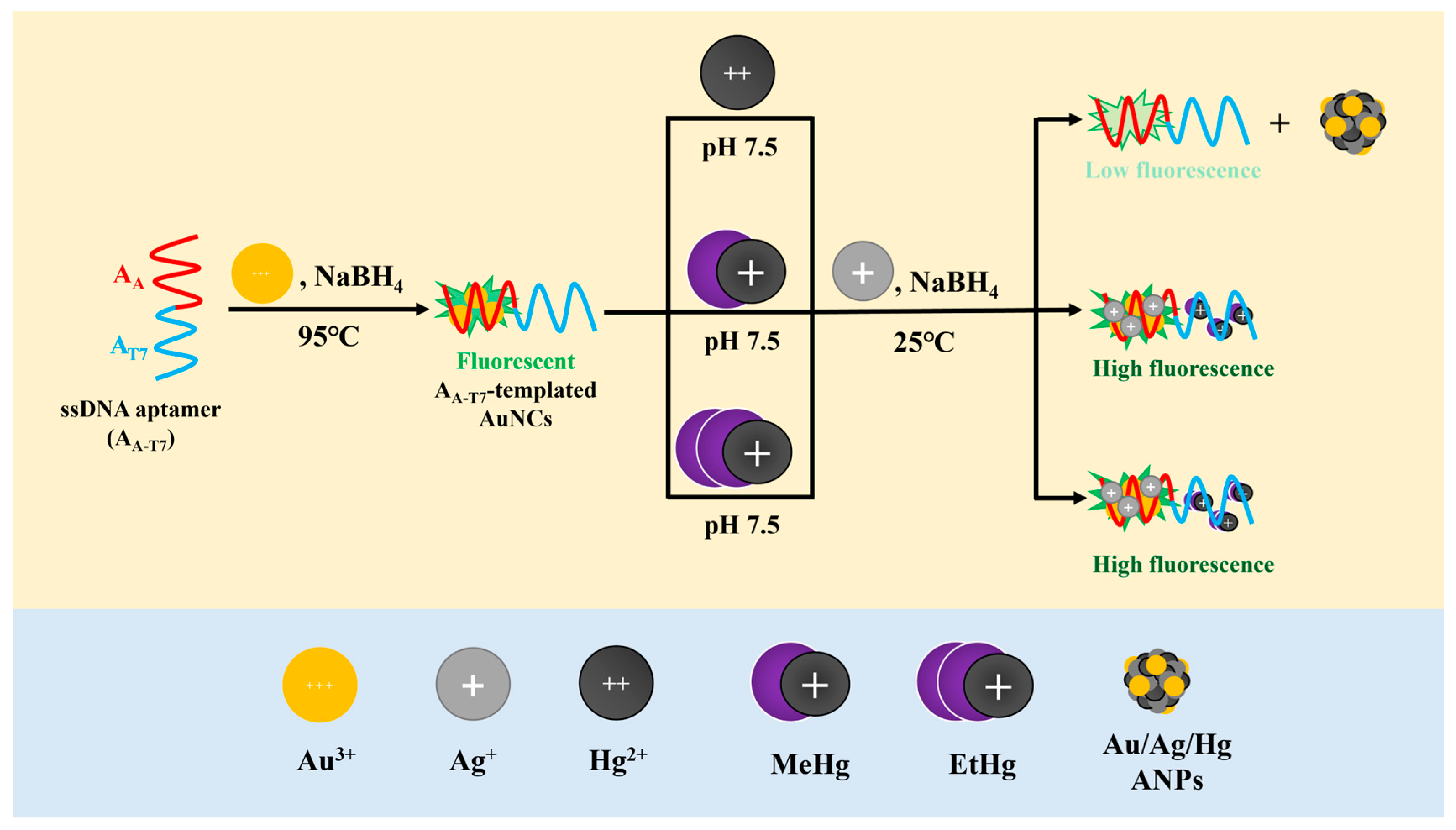
Inspired by the above research, we here built a novel label-free fluorescent sensing platform based on ssDNA aptamer (AA-T7)-templated AuNCs for specific detection of Hg2+ and OrHg. A-rich AA and T-rich AT7 were the two parts that made up AA-T7. The former primarily formed fluorescent AA-templated AuNCs, while the latter specifically bound to OrHg. As shown in Scheme 1, AA-T7-templated AuNCs were generated by the binding of bases A in AA-T7 with Au3+ to form an A-Au3+ complex, where Au3+ was then reduced to Au0 by NaBH4, and eventually Au0 was assembled along the contour of the AA-T7 template to shape fluorescent AuNCs [54]. When Hg2+ or OrHg was introduced in the presence of Ag+, the fluorescence intensity of AA-T7-templated AuNCs would be significantly changed. More specifically, if there was Hg2+ in the final solution of the target system, Hg2+ was combined with Au3+ and Ag+, and reduced by NaBH4 to generate non-fluorescent Au/Ag/Hg alloy nanoparticles (ANPs) via metallophilic interactions among Au3+, Ag+, and Hg2+ (5d10-4d10-5d10) [46], so the fluorescence of AA-T7-templated AuNCs could be quenched. Conversely, due to stronger binding affinity than Hg2+, OrHg was bound preferentially on AT7, but free Ag+ in solution was reduced by NaBH4 to Ag0 gathering around AuNCs, namely forming Ag/AuNCs. This ultimately led to fluorescence enhancement of AA-T7-templated AuNCs via an Ag0-doped aggregation-induced emission (AIE) effect.

3.2. Characterization of Label-Free AA-T7-Templated AuNCs-Based Fluorescent Sensing Platform

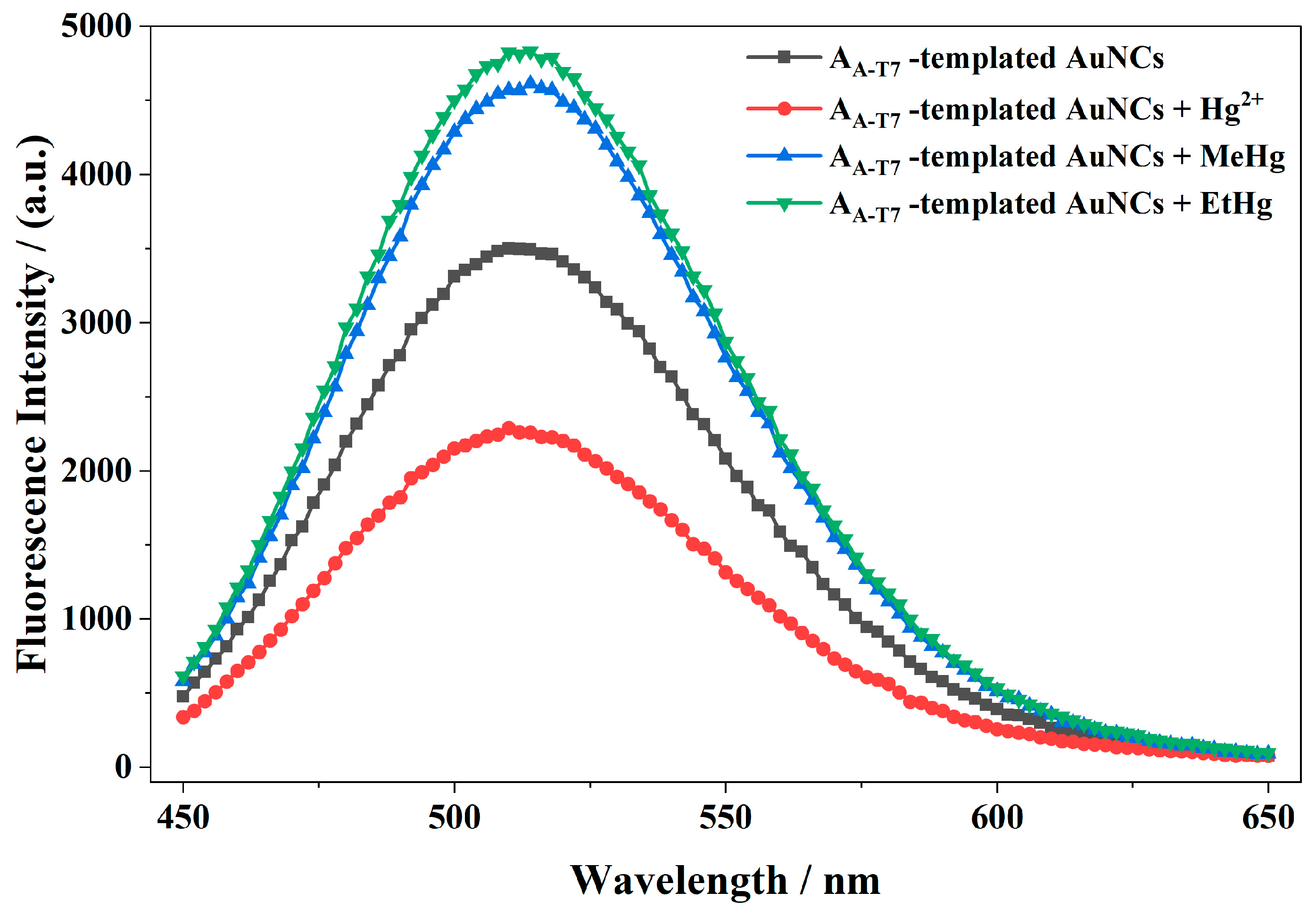
To verify the effectiveness and feasibility of the label-free AA-T7-templated AuNCs-based fluorescent sensing platform we proposed, the fluorescence emission spectra of the AA-T7-templated AuNCs with/without Hg2+ or OrHg were first measured using the same procedures shown in Scheme 1. At 350 nm excitation wavelength, as illustrated in Figure 1, the pure AA-T7-templated AuNCs showed an obvious fluorescent response in the wavelength range from 450 nm to 650 nm, and exhibited a maximum emission peak around 514 nm, which demonstrated the successful synthesis of AA-T7-templated AuNCs. Moreover, their fluorescence quantum yield (QY) was expected to approach 6%, consistent with the results reported in the literature [50,55]. While Hg2+ was introduced, the fluorescence intensity of the system’s final solution was significantly quenched; on the contrary, the presence of OrHg sensibly enhanced the fluorescence intensity of the system’s final solution. This phenomenon indicated the difference between Hg2+ and OrHg in affecting the fluorescence intensity of AA-T7-templated AuNCs and also preliminarily confirmed our deduction.
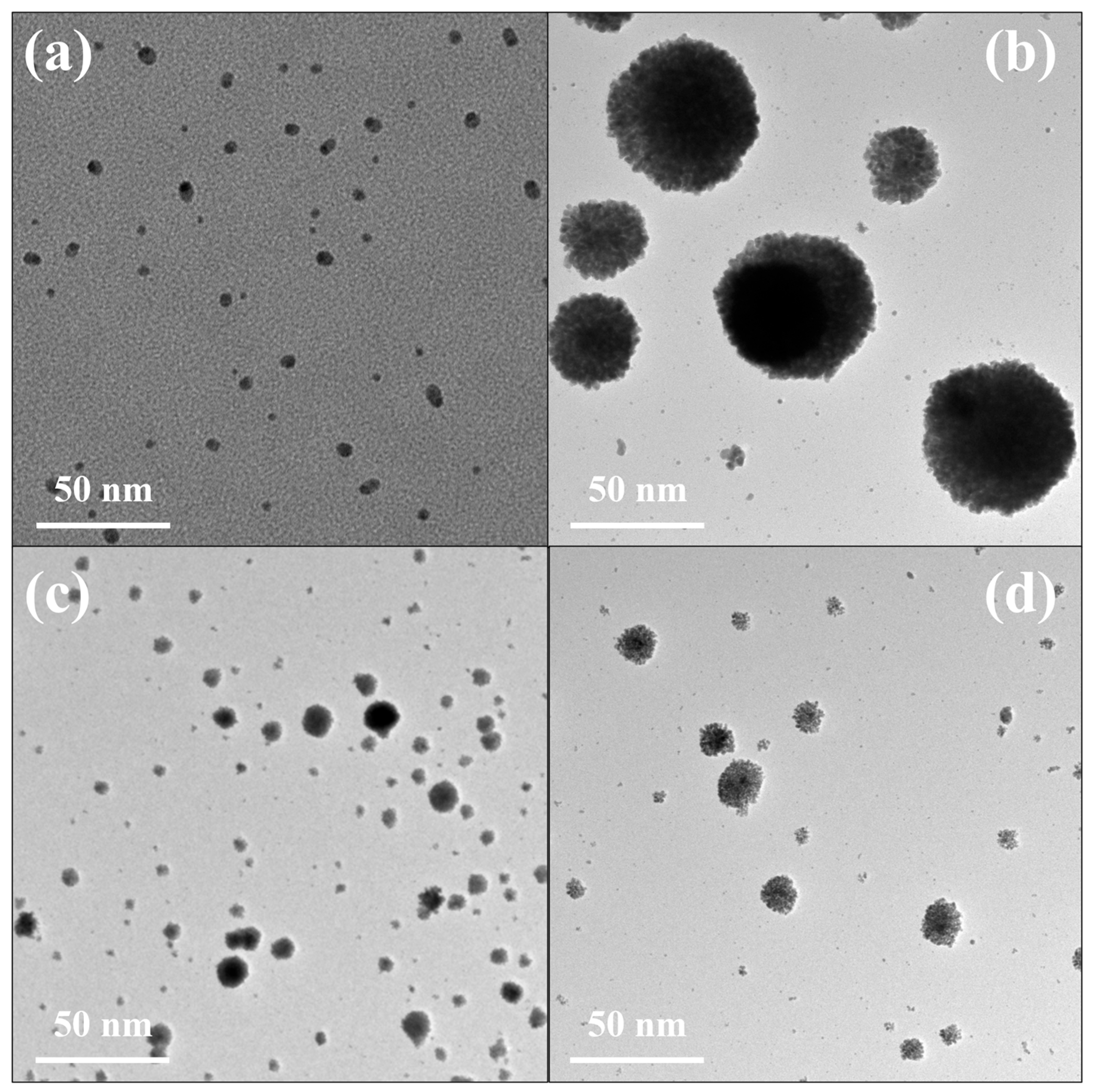
To further support our inference, the morphological characterization of AA-T7-templated AuNCs with/without mercury species was performed using TEM images (Figure 2). Found from Figure 2a, there were quasi-spherical AA-T7-templated AuNCs with an average diameter (AD) ~5 nm, as well as good dispersibility and stability. When Hg2+ existed in the final solution, however, the AD was increased to ~50 nm (Figure 2b) and key elements, including Au, Ag and Hg, were determined by EDX spectra for elemental analysis among these particles (Figure S1b), suggesting that Au/Ag/Hg ANPs were formed by reducing mixed Au3+, Ag+ and Hg2+. In the presence of OrHg, the mean size of particles lay between 5 nm and 50 nm (Figure 2c,d). What’s more, the corresponding EDX spectra (Figure S1c,d) only displayed the signal elemental signatures of Au and Ag, but not Hg. This possible reason was due to multi-particle aggregation or the Ag0-doped AIEE effect, but not to any chemical interaction, because the formed AA-T7-templated AuNCs displayed the same absorption spectra in the presence or absence of mercury species (Figure S2). Ag+ was reduced to Ag0 and aggregated on the surface of AA-T7-templated AuNCs (especially in the AA section of AA-T7) to form Ag/AuNCs, and meanwhile, OrHg was bound preferentially on the AT7 section of AA-T7. Furthermore, the surface coverage of the AuNCs with AA-T7 was determined by the reported method to verify that there was a difference in the quantification of AA-T7 attached on AuNCs in the presence or absence of mercury species, following the order of OrHg > Hg2+ (Figure S3), consistent with the order of binding affinity [38,56]. Additionally, the particle-size distribution obtained by DLS analysis of AA-T7-templated AuNCs under different conditions was analyzed, further verifying the above deduction (Figure S4).

3.3. Optimization of ssDNA Aptamer

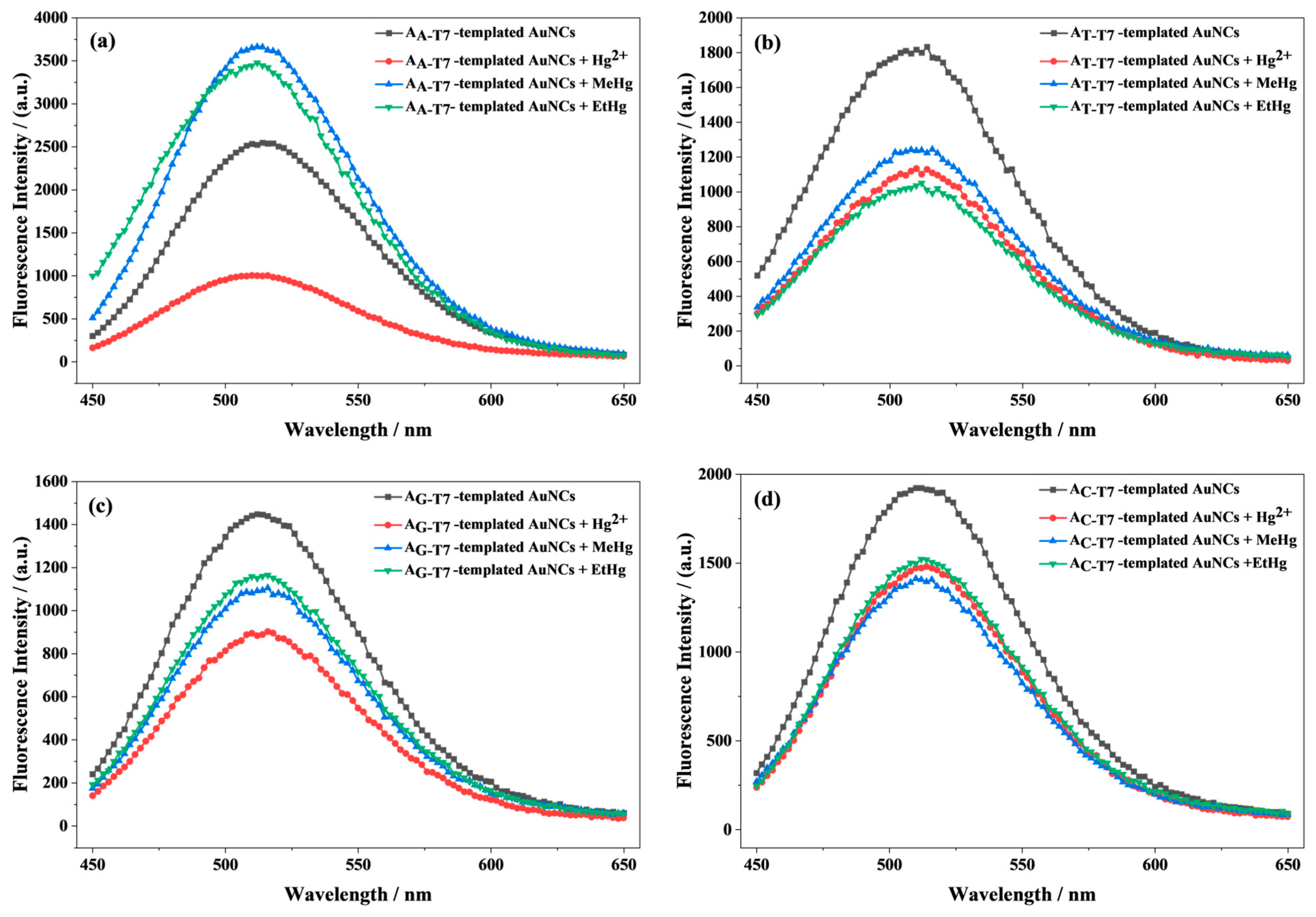
It was widely acknowledged that DNA had four bases, including adenine (A), thymine (T), guanine (G) and cytosine (C). As an interesting template molecule with secondary structure, ssDNA was suitable for templating MNCs and had specific recognition of mercury species [51,57,58]. According to the literature, A-rich ssDNA could be used for the synthesis of ssDNA-templated AuNCs by A-Au3+-A base pairs, but T-rich ssDNA tended to bind with Hg2+ instead of OrHg to form T-Hg2+-T structures [38,46,59]. Based on the above facts, we designed the novel ssDNA aptamer, consisting of two segments: segment 1 (T-rich ssDNA, AT7) and segment 2 (any base-rich ssDNA, Arich-in-base). Under the above same procedures as shown in Scheme 1, to ascertain the optimal Arich-in-base of ssDNA aptamer, four different types of sequence rich in A, T, G and C bases (namely AA, AT, AG and AC) were set to explore the fluorescence characteristics. As shown in Figure 3, the fluorescence intensity of the system solution was relatively low and readily quenched by Hg2+ and OrHg, regardless of the selected ssDNA aptamer (AT-T7, AG-T7, or AC-T7). A possible reason was that, owing to their insensitivity to Au3+, the ssDNA-templated AuNCs were unstable and vulnerable to Hg2+ and OrHg attack, thereby affecting their fluorescence emission [60]. In other words, only when AA-T7 was used in this reaction system, the synthesized AuNCs exhibited a strong fluorescence signal at 514 nm, which could also be quenched and enhanced by Hg2+ and OrHg, respectively. AA-T7 was therefore identified as the optimal ssDNA aptamer for specificity analysis of Hg2+ and OrHg.

3.4. Optimization of Other Important Experimental Conditions

In this study, many factors had an influence on assay results. Under the above optimal experimental conditions, in addition to the discussed ssDNA aptamer (AA-T7), other important experimental conditions, such as the concentration of AA-T7, the reducing agent and its concentration, the pH of the Tris-HNO3 buffer solution, and the concentration of Au3+, should be considered to improve analytical performance.
As mentioned above, AA-T7 was the most suitable scaffold for establishing a stable AuNC fluorescent system, so we first evaluated AA-T7 at concentrations ranging from 2.0 μM to 20 μM using the same procedures and optimal conditions. Figure S5 shows the fluorescence emission spectra obtained with our proposed method. With increasing concentrations of AA-T7, the fluorescence intensity of the system solution in the presence of different mercury species was gradually enhanced. However, when concentrations of AA-T7 were increased between 2.0 μM and 10 μM, it was difficult to judge Hg2+ and OrHg since their closely or nearly overlapping fluorescence emission spectra could not be distinctly distinguished, indicating that a low concentration of AA-T7 was hard to form sufficient templated AuNCs without significant fluorescence quenching or enhancement effect during the subsequent process. At the concentration of 20 μM, nevertheless, the fluorescence intensity of AA-T7-templated AuNCs was quenched by Hg2+ and OrHg, which implied possibly forming plenties of Au/Ag/Hg ANPs. Specific fluorescence detection by Hg2+ and OrHg met our expectations only at 15 μM. Hence, we considered 15 μM to be the optimal concentration of AA-T7.
The role of the reducing agent was to reduce Au3+, Ag+ and Hg2+ to form self-assembled AuNCs or ANPs, so its reduction ability was closely related to the quality of the analysis results. AA, CA, NaBH4 and HONH3Cl were used and compared here. Under the above same procedures and optimal conditions, as shown in Figure S6, AA, CA and HONH3Cl did not trigger an obvious fluorescence phenomenon, probably because of their relatively low reducibility and stability compared with NaBH4 [61]. By utilizing NaBH4 as a reducing agent, an evident fluorescence signal and notable reaction distinction occurred between Hg2+ and OrHg groups. That is, NaBH4 was the optimal reducing agent, serving both reducing and stabilizing roles. Furthermore, we selected 0.6 mM as the optimal concentration of NaBH4 after optimization (Figure S7).
The pH directly influenced the size and fluorescence emission characteristics of AA-T7-templated AuNCs [62]. Between pH 6.5 and pH 8.0, four candidate pH values were set, and the result was displayed in Figure S8, under the same procedures and optimal conditions as above. We note that when the pH value of the analysis system was pH ≤ 7.0, not only was the fluorescence intensity of AA-T7-templated AuNCs relatively low, but also Hg2+ or OrHg could not clearly influence the fluorescence response of AA-T7-templated AuNCs, demonstrating that fluorescent AA-T7-templated AuNCs were suppressed and possessed similar binding affinity to Hg2+ and OrHg, under weakly acidic or neutral conditions. However, excessively high pH value (pH 8.0) decreased the fluorescence intensity of AA-T7-templated AuNCs, which was also significantly quenched by Hg2+ and OrHg. Therefore, pH 7.5 was chosen as the most suitable pH as a result of specific fluorescence quenching by Hg2+ and fluorescence enhancement by OrHg at this pH value.
Au3+ was adsorbed and locally enriched through electrostatic and coordination interactions with the AA-T7 backbone to form AuNCs by reduction [63]. As a key precursor for synthesizing AuNCs, Au3+ had a decisive influence on nucleation, growth and optical properties of AA-T7-templated AuNCs. Figure S9 shows the fluorescence emission spectra of the system solution at different Au3+ concentrations, obtained under the same procedures and optimal conditions. The results indicated that excessively high concentrations of Au3+ might readily cause untemplated growth or transform into large-sized nanoparticle structures [55], but they did not offer an adequate amount of Au3+ for generating fluorescent AA-T7-templated AuNCs in the presence of low concentrations of Au3+. On the contrary, 5.0 mM of Au3+ resulted in AA-T7-templated AuNCs exhibiting higher fluorescence intensity and specifically detecting Hg2+ and OrHg. Accordingly, 5.0 mM was confirmed as the optimal concentration of Au3+ and used in further procedures.

3.5. The Selectivity of the Developed Method for Hg2+ and OrHg Detection

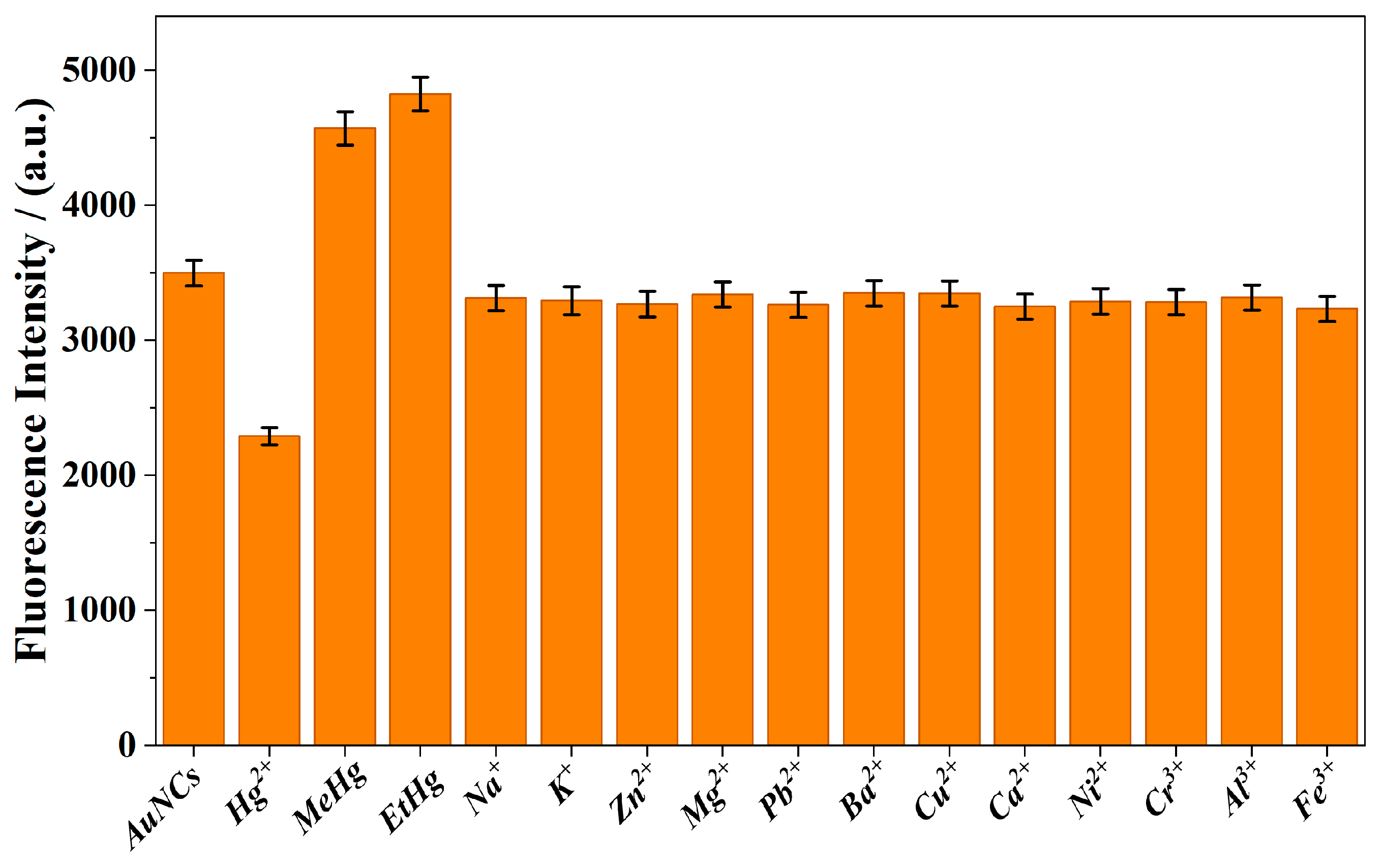
To evaluate the specificity of our fluorescent sensing platform, potential interference effects of common coexisting metallic ions, including K+, Na+, Mg2+, Zn2+, Pb2+, Ba2+, Ca2+, Ni2+, Cu2+, Fe3+, Cr3+ and Al3+ should be taken into consideration by comparing their differences in fluorescence response under the above optimal experimental conditions. Under the above same procedures and optimal conditions, the concentration of common coexisting metallic ions (100 μM) was 100 times higher than that of mercury species. The fluorescence emission spectra (Figure 4) showed that these common coexisting metallic ions had no significant impact on fluorescence intensity, indicating that they did not interfere with the assay of Hg2+ and OrHg. This further illustrated that, in coexisting natural environments, our method showed strong specificity and selectivity for simultaneous detection of Hg2+ and OrHg.

3.6. The Analytical Performance of Our Proposed Method

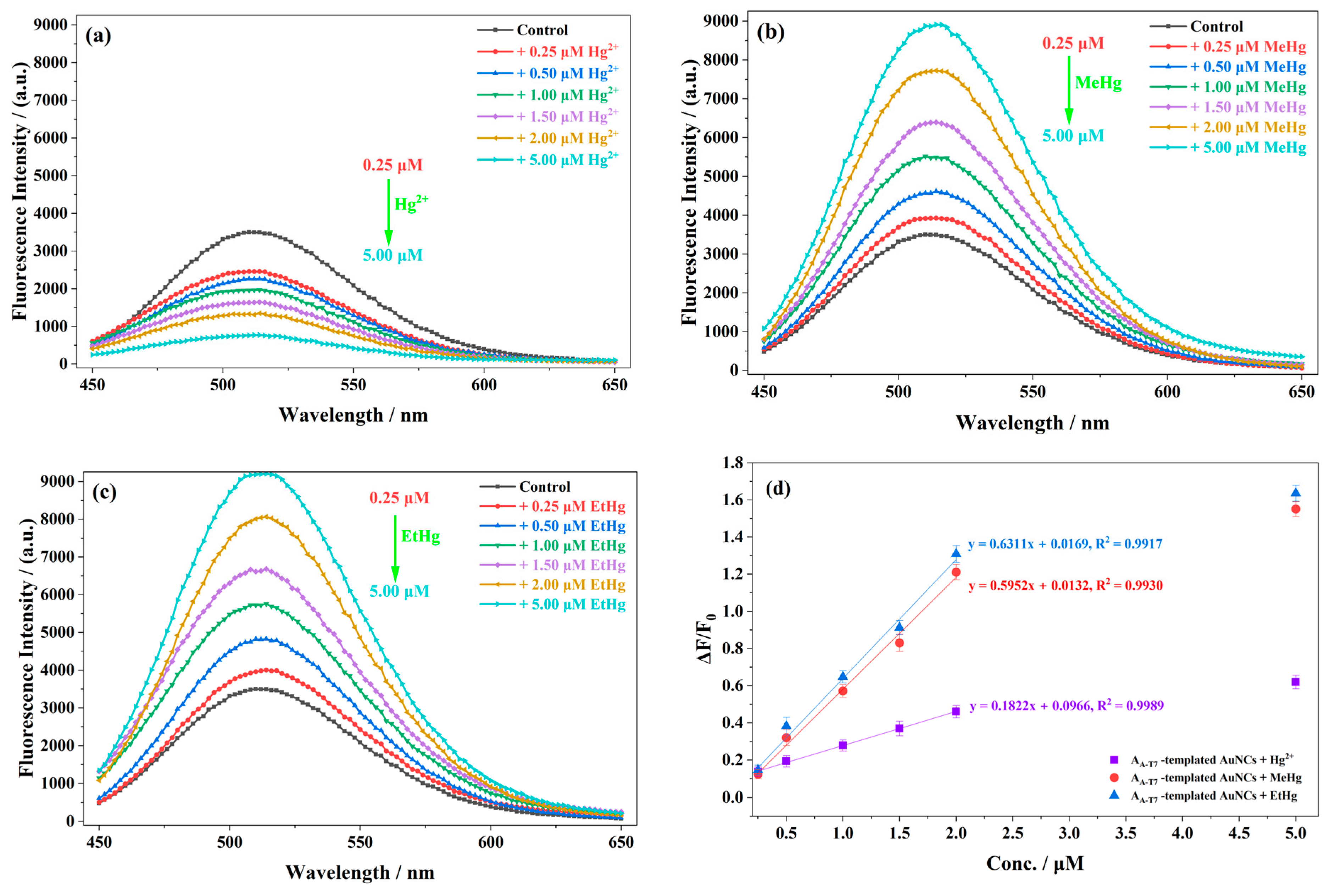
To achieve the optimal analytical performance of proposed method, the fluorescence emission spectra from 450 to 650 nm with different concentrations of Hg2+ and OrHg were collected under the above same procedures and optimal conditions, selected above and the results displayed in Figure 5 indicated a continuous decrease or increase in fluorescence intensity at 514 nm with the increase concentration of Hg2+ or OrHg from 0.25 μM to 5.00 μM. Linear equations also revealed good linear relationship between rate of change in the fluorescence intensity (ΔF/F0) and their concentration (Conc.) ranging from 0.25 μM to 2.00 μM, and their equations of the regression curve: ∆F/F0 = 0.1822 × C + 0.0966 (R2 = 0.9989) for Hg2+; ∆F/F0 = 0.5952 × C + 0.0132 (R2 = 0.9930) for MeHg; ∆F/F0 = 0.6311 × C + 0.0169 (R2 = 0.9917) for EtHg, where C representing the concentration of Hg2+ or OrHg with the unit of μM (Figure 5d). It was worth noting that the sensitivity for determining MeHg was virtually the same as that for EtHg, so it could be regarded as detecting the concentration of OrHg. In addition, the theoretical limit of detection (3σ/S) was calculated to be 20.0 nM (4.00 ng Hg/g) and 25.0 nM (5.00 ng Hg/g) for Hg2+ and OrHg, respectively. These values are well below the maximum mercury level (0.5 mg/kg) for food according to the latest Chinese National Food Safety Standard (GB 2762–2025). Therefore, we conclude that the analytical performance of our established label-free AA-T7-templated AuNCs-based fluorescent sensing platform was superior to that of the majority of reported methods for mercury assay [47,48,63,64,65,66,67] (Table 1).

3.7. Determination of Hg2+ and OrHg in Actual Samples

To ensure the reliability and practical applicability of the analysis results obtained with this fluorescent sensing method, actual samples were pretreated and analyzed for mercury species content under the same procedures and optimal conditions. Tap water sourced from a lab tap, seawater and seafish (dried golden pomfret fish muscle) samples collected from the coastal water of Zhangzhou, Fujian, China, were selected. Before the fluorescence assay, partially pretreated actual samples were spiked with different Conc. of Hg2+ or OrHg. As listed in Table 2 and Table 3, the content of Hg2+ or OrHg in tap water, seawater and dried golden pomfret fish muscle samples was accurately determined with Rec. of 98.0–108.0% and a relative standard deviation (RSD, n = 6) ≤ 5.0%. The above-obtained actual samples were also verified by capillary electrophoresis combined with ICP-MS (CE-ICP-MS) [49], yielding results similar to those obtained by CE-ICP-MS. The above facts indicate that the label-free fluorescent sensing method could be applied to specific detection and trace analysis of mercury species in actual samples.

3.8. AA-T7-Templated AuNCs for Cell Viability Analysis and Intracellular Fluorescent Imaging

To assess the application of AA-T7-templated AuNCs at the cellular level, their cytotoxicity and biocompatibility were eventually tested by a CCK-8 cell viability assay. The results (Figure S10) demonstrated that AA-T7-templated AuNCs were slightly to negligibly toxic and, conversely, that 1.0 μM of Hg2+ or OrHg was highly toxic. In addition, HeLa cells were incubated with AA-T7-templated AuNCs for intracellular confocal fluorescence imaging analysis. As shown in Figure S11, upon excitation at 488 nm, red fluorescent AA-T7-templated AuNCs were expressed in HeLa cells, indicating good cell imaging performance. Meanwhile, the introduction of trace Hg2+ or OrHg could effectively induce fluorescence quenching or enhancement, demonstrating that AA-T7-templated AuNCs were capable of intracellularly detecting trace mercury species in live cells.

4. Conclusions

A novel label-free fluorescent sensing platform based on ssDNA aptamer (AA-T7)-templated AuNCs was herein developed for specific detection of Hg2+ and OrHg. Due to stronger binding affinity to OrHg than Hg2+, the fluorescent AA-T7-templated AuNCs were enhanced visibly through forming Ag/AuNCs based on Ag0-doped AIEE effect, but they were obviously quenched as a result of generating non-fluorescent Au/Ag/Hg ANPs via metallophilic interactions among Au3+, Ag+, and Hg2+ (5d10-4d10-5d10). The proposed fluorescent sensing platform possessed a low limit of detection (20.0 nM for Hg2+ and 25.0 nM for OrHg) and a good linear relationship between ΔF/F0 and their concentration, ranging from 0.25 μM to 2.0 μM. This method has been successfully applied to the assay of Hg2+ and OrHg in tap water, seawater and dried golden pomfret fish muscle samples and is expected to promote the development of novel aptamer-based biosensors for the detection of mercury species in environmental samples and aquatic products to ensure human health and food safety.
Admittedly, though the proposed method has been mentioned above, there are still some potential drawbacks and limitations that need to be improved or explored further throughout the entire process. For example, the quantification and orientation of AA-T7 attached to AuNCs, as well as the binding affinity between AA-T7 and Hg2+ or OrHg, should be optimized and discussed in depth. Then, X-ray photoelectron spectroscopy (XPS) should be considered another effective approach to verify the actual state of mercury in the reaction system under four conditions. Furthermore, the current method detection limit is not sufficiently low and should be further reduced by optimizing additional influencing factors, such as the system’s temperature and the concentration of the Tris-HNO3 buffer solution. Additionally, in the field of evaluating the application of AA-T7-templated AuNCs at the cell level, several details such as cellular quantitative capability and uptake efficiency, as well as intracellular localization of AA-T7-templated AuNCs with/without Hg2+ or OrHg, should also be implemented and refined to fully elaborate the good analytical performance of this method.

Supplementary Materials

The following supporting information can be downloaded at: https://www.mdpi.com/article/10.3390/bios16040218/s1, Figure S1: EDX spectra of AA-T7-templated AuNCs without any mercury species (a), as well as with Hg2+ (b), MeHg (c) or EtHg (d); Figure S2: The ultraviolet-visible absorption spectra of AA-T7-templated AuNCs without any mercury species, as well as with Hg2+, MeHg or EtHg; Figure S3: The surface coverage of the AuNCs with AA-T7 in the presence or absence of mercury species; Figure S4: Particle-size distribution from DLS analysis of AA-T7-templated AuNCs without any mercury species (a), as well as with Hg2+ (b), MeHg (c) or EtHg (d); Figure S5: Optimization of the concentration of AA-T7 ranging from 2.0 μM to 20 μM. (a) 2.0 μM; (b) 10 μM; (c) 15 μM; (d) 20 μM; Figure S6: Optimization of reducing agent. (a) AA; (b) CA; (c) NaBH4; (d) HONH3Cl; Figure S7: Optimization of the concentration of NaBH4 ranging from 0.2 mM to 0.8 mM. (a) 0.2 mM; (b) 0.4 mM; (c) 0.6 mM; (d) 0.8 mM; Figure S8: Optimization of pH value in system solution ranging from pH 6.5 to pH 8.0. (a) pH 6.5; (b) pH 7.0; (c) pH 7.5; (d) pH 8.0; Figure S9: Optimization of concentrations of Au3+ ranging from 3.0 mM to 6.0 mM. (a) 3.0 mM; (b) 4.0 mM; (c) 5.0 mM; (d) 6.0 mM; Figure S10: Cell viability analysis of AA-T7-templated AuNCs with/without Hg2+, MeHg or EtHg (n = 4); Figure S11: Intracellular confocal fluorescence imaging analysis. (a) Hela cells at bright field; (b) Hela cells at dark field; (c) Hela cells incubated with AA-T7-templated AuNCs at dark field; (d) Hela cells co-incubated with AA-T7-templated AuNCs and Hg2+ at dark field; (e) Hela cells co-incubated with AA-T7-templated AuNCs and MeHg at dark field; (f) Hela cells co-incubated with AA-T7-templated AuNCs and EtHg at dark field; Table S1: The sequences of synthesized ssDNA aptamer used in this work.

Author Contributions

Conceptualization, Z.C.; methodology, K.Z.; validation, Z.C.; formal analysis, Z.C.; investigation, K.Z.; data curation, Z.C.; writing—original draft preparation, Z.C.; writing—review and editing, Z.C. and K.Z.; visualization, Z.C.; supervision, K.Z.; project administration, Z.C.; funding acquisition, Z.C. and K.Z. All authors have read and agreed to the published version of the manuscript.

Funding

This research was funded by the Project of Doctoral Research Initiation Fund of 2022 Zhangzhou Institute of Technology (ZZYB2202), the research project of 2024 Zhangzhou Institute of Technology (zzykyk24002), the Joint Project of Zhangzhou Municipal Natural Science Foundation (ZZ2025LH24), Education and Science for Young and Middle-aged Teachers of Fujian Provincial Department of Education (JAT210859), Fujian Provincial Department of Science and Technology (2022J05132).

Institutional Review Board Statement

Not applicable.

Informed Consent Statement

Not applicable.

Data Availability Statement

The details of the data supporting the reported results are available in the article or the Supplementary Materials. Further inquiries can be directed to the corresponding author.

Acknowledgments

We sincerely acknowledge technical support from Ye He, College of Public Health, Fujian Medical University. All individuals included in this section have consented to the acknowledgement.

Conflicts of Interest

The authors declare no conflicts of interest.

Abbreviations

The following abbreviations are used in this manuscript:
WHOWorld Health Organization
UNEPUnited Nations Environment Programme
OrHgOrganic mercury
MeHgMethylmercury
EtHgEthylmercury
EUEuropean Union
CECapillary electrophoresis
GCGas chromatography
HPLCHigh-performance liquid chromatography
ICP-MSInductively coupled plasma-mass spectrometry
AFSAtomic fluorescence spectrometry
AASAtomic absorption spectroscopy
SERSSurface-enhanced Raman spectroscopy
IIPsIon-imprinted polymers
MNCsMetal nanoclusters
AgNCsSilver nanoclusters
AuNCsGold nanoclusters
ANPsAlloy nanoparticles
DNADeoxyribonucleic acid
T-richThymine-rich
A-richAdenine-rich
ssDNASingle-stranded DNA
ODOptical density
PBSPhosphate buffered saline
PBPhosphate buffer
FBSFetal bovine serum
CCK-8Cell counting kit-8
ARAnalytical reagent
TEMTransmission electron microscope
EDXEnergy dispersive X-ray
ADAverage diameter
DLSDynamic light scattering
EPEppendorf
TETrypsin-EDTA
AIEEAggregation-induced emission enhancement
QYQuantum yield
Conc.Concentrations
Rec.Recoveries
RSDRelative standard deviation

References

  1. Kim, M.J.; Heo, M.; Kim, S.J.; Song, H.E.; Lee, H.; Kim, N.E.; Shin, H.; Do, A.R.; Kim, J.; Cho, Y.M.; et al. Associations between plasma metabolites and heavy metal exposure in residents of environmentally polluted areas. Environ. Int. 2024, 187, 108709. [Google Scholar] [CrossRef]
  2. Robinson, B.H. E-waste: An assessment of global production and environmental impacts. Sci. Total Environ. 2009, 408, 183–191. [Google Scholar] [CrossRef] [PubMed]
  3. Singh, A.D.; Khanna, K.; Kour, J.; Dhiman, S.; Bhardwaj, T.; Devi, K.; Sharma, N.; Kumar, P.; Kapoor, N.; Sharma, P.; et al. Critical review on biogeochemical dynamics of mercury (Hg) and its abatement strategies. Chemosphere 2023, 319, 137917. [Google Scholar] [CrossRef]
  4. Veeraswamy, D.; Subramanian, A.; Mohan, D.; Ettiyagounder, P.; Selvaraj, P.S.; Ramasamy, S.P.; Veeramani, V. Exploring the origins and cleanup of mercury contamination: A comprehensive review. Environ. Sci. Pollut. Res. 2024, 31, 53943–53972. [Google Scholar] [CrossRef]
  5. Crespo-Lopez, M.E.; Lopes-Araújo, A.; Basta, P.C.; Soares-Silva, I.; de Souza, C.B.; Leal-Nazaré, C.G.; Santos-Sacramento, L.; Barthelemy, J.L.; Arrifano, J.P.; Augusto-Oliveira, M. Environmental pollution challenges public health surveillance: The case of mercury exposure and intoxication in Brazil. Lancet Reg. Health-Am. 2024, 39, 100880. [Google Scholar] [CrossRef]
  6. Sun, C.; Wang, X.; Qiao, X. Multimedia fate simulation of mercury in a coastal urban area based on the fugacity/aquivalence method. Sci. Total Environ. 2024, 915, 170084. [Google Scholar] [CrossRef] [PubMed]
  7. Blanchfield, P.J.; Rudd, J.W.; Hrenchuk, L.E.; Amyot, M.; Babiarz, C.L.; Beaty, K.G.; Bodaly, R.A.D.; Branfireun, B.A.; Gilmour, C.C.; Graydon, J.A.; et al. Experimental evidence for recovery of mercury-contaminated fish populations. Nature 2022, 601, 74–78. [Google Scholar] [CrossRef]
  8. Zhang, X.; Li, F.; Chao, J.; Li, Z.; Zhang, G.; Zhai, L.; Hu, L.; Jiao, H.; Wang, Z. Simultaneous enrichment and speciation of lead and mercury by magnetic solid-phase extraction coupled to HPLC-ICP-MS based on magnetic hydrazine-linked covalent organic frameworks. Anal. Chim. Acta 2024, 1307, 342622. [Google Scholar] [CrossRef]
  9. Médieu, A.; Point, D.; Allain, V.; Bodin, N.; Lemire, M.; Ayotte, P.; Dhurmeea, Z.; Waeles, M.; Laffont, L.; Gohalen, A.L.; et al. Species-specific mercury speciation in billfishes and its implications for food safety monitoring and dietary advice. Environ. Int. 2025, 195, 109252. [Google Scholar] [CrossRef]
  10. Stevenson, L.M.; Matson, P.G.; Pilla, R.M.; Pouil, S.; Geeza, T.J.; Hills, A.; Ellis, Z.; Smith, S.; Mathews, T.J. Analysis of biokinetic parameters reveals patterns in mercury accumulation across aquatic species. Sci. Total Environ. 2025, 959, 178129. [Google Scholar] [CrossRef] [PubMed]
  11. Kang, B.; Wang, J.; Guo, S.; Yang, L. Mercury-induced toxicity: Mechanisms, molecular pathways, and gene regulation. Sci. Total Environ. 2024, 943, 173577. [Google Scholar] [CrossRef] [PubMed]
  12. Li, M.L.; Thackray, C.P.; Lam, V.W.; Cheung, W.W.; Sunderland, E.M. Global fishing patterns amplify human exposures to methylmercury. Proc. Natl. Acad. Sci. USA 2024, 121, e2405898121. [Google Scholar] [CrossRef]
  13. Moniruzzaman, M.; Lee, S.; Park, Y.; Min, T.; Bai, S.C. Evaluation of dietary selenium, vitamin C and E as the multi-antioxidants on the methylmercury intoxicated mice based on mercury bioaccumulation, antioxidant enzyme activity, lipid peroxidation and mitochondrial oxidative stress. Chemosphere 2021, 273, 129673. [Google Scholar] [CrossRef]
  14. Hurrell, A.; Webster, L.; Chappell, L.C.; Shennan, A.H. The assessment of blood pressure in pregnant women: Pitfalls and novel approaches. Am. J. Obstet. Gynecol. 2022, 226, S804–S818. [Google Scholar] [CrossRef]
  15. CXS 193-1995; General Standard for Contaminants and Toxins in Food and Feed. The Codex Alimentarius Commission (CAC): Geneva, Switzerland, 2023.
  16. Lu, C.; Lv, Q.; Lin, Y.; Gao, L. Ultra-sensitive detection of mercury by using field-effect transistor biosensors based on single-walled carbon nanotubes. Biosensors 2025, 15, 779. [Google Scholar] [CrossRef] [PubMed]
  17. GB2762-2025; National Standardization Administration of China. National Standards for Food Safety. Limits of Contaminants in Food. China Standard Press: Beijing, China, 2025.
  18. Ye, X.; Lee, C.S.; Shipley, O.N.; Frisk, M.G.; Fisher, N.S. Risk assessment for seafood consumers exposed to mercury and other trace elements in fish from Long Island, New York, USA. Mar. Pollut. Bull. 2022, 176, 113442. [Google Scholar] [CrossRef]
  19. Capodiferro, M.; Marco, E.; Grimalt, J.O. Wild fish and seafood species in the western Mediterranean Sea with low safe mercury concentrations. Environ. Pollut. 2022, 314, 120274. [Google Scholar] [CrossRef]
  20. Gastellu, T.; Karakoltzidis, A.; Ratier, A.; Bellouard, M.; Alvarez, J.C.; Le Bizec, B.; Rivière, G.; Karakitsios, S.; Sarigiannis, D.A.; Vogs, C. A comprehensive library of lifetime physiological equations for PBK models: Enhancing dietary exposure modeling with mercury as a case study. Environ. Res. 2025, 265, 120393. [Google Scholar] [CrossRef]
  21. Yang, M.; Sun, C.; Yang, L.; Zheng, S.; Fu, H. Hierarchical porous loofah-like carbon with sulfhydryl functionality for electrochemical detection of trace mercury in water. Anal. Chim. Acta 2023, 1276, 341646. [Google Scholar] [CrossRef]
  22. Arisekar, U.; Shalini, R.; Shakila, R.J.; Iburahim, S.A.; Anantharaja, K.; Rathinam, R.B.; Sundhar, S. Selenium and mercury concentration, Se/Hg molar ratio and risk–benefit assessment of marine fish consumption: Human health risks and protective role of Se against Hg toxicity. Food Res. Int. 2024, 180, 114086. [Google Scholar] [CrossRef] [PubMed]
  23. Yao, Z.; Liu, J.; Mao, X.; Chen, G.; Ma, Z.; Li, B. Ultratrace mercury speciation analysis in rice by in-line solid phase extraction–liquid chromatography–atomic fluorescence spectrometry. Food Chem. 2022, 379, 132116. [Google Scholar] [CrossRef]
  24. de Oliveira, A.P.; Naozuka, J.; Figueroa, J.A.L. Feasibility study for mercury remediation by selenium competition in Pleurotus mushrooms. J. Hazard. Mater. 2023, 451, 131098. [Google Scholar] [CrossRef]
  25. Volynkin, S.S.; Demakov, P.A.; Shuvaeva, O.V.; Kovalenko, K.A. Metal-organic framework application for mercury speciation using solid phase extraction followed by direct thermal release–electrothermal atomization atomic absorption spectrophotometric detection (ETA AAS). Anal. Chim. Acta 2021, 1177, 338795. [Google Scholar] [CrossRef]
  26. Montoro-Leal, P.; García-Mesa, J.C.; Morales-Benítez, I.; Vázquez-Palomo, L.; López Guerrero, M.D.M.; Vereda Alonso, E.I. Synthesis of a novel magnetic nanomaterial for the development of a multielemental speciation method of lead, mercury, and vanadium via HPLC-ICP MS. Microchim. Acta 2023, 190, 296. [Google Scholar] [CrossRef] [PubMed]
  27. Song, Y.; Ma, Q.; Cheng, H.; Liu, J.; Wang, Y. Simultaneous enrichment of inorganic and organic species of lead and mercury in pg·L−1 levels by solid phase extraction online combined with high performance liquid chromatography and inductively coupled plasma mass spectrometry. Anal. Chim. Acta 2021, 1157, 338388. [Google Scholar] [CrossRef] [PubMed]
  28. Emteborg, H.; Sinemus, H.W.; Radziuk, B.; Baxter, D.C.; Frech, W. Gas chromatography coupled with atomic absorption spectrometry-a sensitive instrumentation for mercury speciation. Spectrochim. Acta B 1996, 51, 829–837. [Google Scholar] [CrossRef]
  29. Chen, Y.; Cheng, X.; Mo, F.; Huang, L.; Wu, Z.; Wu, Y.; Xu, L.; Fu, F. Ultra-sensitive speciation analysis of mercury by CE-ICP-MS together with field-amplified sample stacking injection and dispersive solid-phase extraction. Electrophoresis 2016, 37, 1055–1062. [Google Scholar] [CrossRef]
  30. Jackson, B.; Taylor, V.; Baker, R.A.; Miller, E. Low-level mercury speciation in freshwaters by isotope dilution GC-ICP-MS. Environ. Sci. Technol. 2009, 43, 2463–2469. [Google Scholar] [CrossRef]
  31. Tukur, F.; Tukur, P.; Murph, S.E.H.; Wei, J. Advancements in mercury detection using surface-enhanced Raman spectroscopy (SERS) and ion-imprinted polymers (IIPs): A review. Nanoscale 2024, 16, 11384–11410. [Google Scholar] [CrossRef] [PubMed]
  32. Low, K.M.; Lin, X.; Wu, H.; Li, S.F.Y. Ion-imprinted polymer-based sensor for the detection of mercury ions. Polymers 2024, 16, 652. [Google Scholar] [CrossRef]
  33. Tao, J.; Chen, S.; Fodjo, E.K.; Deng, W.; Li, D. Tailoring dual-functional gold nanoplasmonic rods for colorimetric and SERS detection of mercury species in complex matrices. Chem. Eng. J. 2023, 452, 139026. [Google Scholar] [CrossRef]
  34. Li, Q.; Li, H.; Li, K.; Gu, Y.; Wang, Y.; Yang, D.; Yang, Y.; Gao, L. Specific colorimetric detection of methylmercury based on peroxidase-like activity regulation of carbon dots/Au NPs nanozyme. J. Hazard. Mater. 2023, 441, 129919. [Google Scholar] [CrossRef]
  35. Fu, Y.; Du, C.; Zhang, Q.; Xiao, K.; Zhang, X.; Chen, J. Colorimetric and photocurrent-polarity-switching photoelectrochemical dual-mode sensing platform for highly selective detection of mercury ions based on the split G-quadruplex–hemin complex. Anal. Chem. 2022, 94, 15040–15047. [Google Scholar] [CrossRef]
  36. Li, F.; Lin, J.; Lichtfouse, E.; Qi, H.; Peng, L.; Yu, Y.; Gao, L. DNA Sensors for the detection of mercury ions. Biosensors 2025, 15, 275. [Google Scholar] [CrossRef]
  37. Wang, S. Construction of DNA biosensors for mercury (II) ion detection based on enzyme-driven signal amplification strategy. Biomolecules 2021, 11, 399. [Google Scholar] [CrossRef]
  38. Deng, L.; Li, Y.; Yan, X.; Xiao, J.; Ma, C.; Zheng, J.; Liu, S.; Yang, R. Ultrasensitive and highly selective detection of bioaccumulation of methyl-mercury in fish samples via Ag0/Hg0 amalgamation. Anal. Chem. 2015, 87, 2452–2458. [Google Scholar] [CrossRef] [PubMed]
  39. Galhano, J.; Kurutos, A.; Dobrikov, G.M.; Duarte, M.P.; Santos, H.M.; Capelo-Martínez, J.L.; Lodeiro, C.; Oliveira, E. Fluorescent polymers for environmental monitoring: Targeting pathogens and metal contaminants with naphthalimide derivatives. J. Hazard. Mater. 2024, 480, 136107. [Google Scholar] [CrossRef] [PubMed]
  40. Lin, J.H.; Chen, S.J.; Lee, J.E.; Chu, W.Y.; Yu, C.J.; Chang, C.C.; Chen, C.F. The detection of Mercury (II) ions using fluorescent gold nanoclusters on a portable paper-based device. Chem. Eng. J. 2022, 430, 133070. [Google Scholar] [CrossRef]
  41. Xie, R.; Su, D.; Song, Y.; Sun, P.; Mao, B.; Tian, M.; Chai, F. The synthesis of gold nanoclusters with high stability and their application in fluorometric detection for Hg2+ and cell imaging. Talanta 2023, 260, 124573. [Google Scholar] [CrossRef]
  42. Chang, H.C.; Chang, Y.F.; Fan, N.C.; Ho, J.A.A. Facile preparation of high-quantum-yield gold nanoclusters: Application to probing mercuric ions and biothiols. ACS Appl. Mater. Interfaces 2014, 6, 18824–18831. [Google Scholar] [CrossRef]
  43. Jiang, X.; Zhang, H.; Yang, C.; Xia, J.; Liu, G.; Luo, X. A novel electrostatic drive strategy to prepare glutathione-capped gold nanoclusters embedded quaternized cellulose membranes fluorescent colorimetric sensor for Pb (II) and Hg (II) ions detection. Sens. Actuat. B-Chem. 2022, 368, 132046. [Google Scholar] [CrossRef]
  44. Nilghaz, A.; Mousavi, S.M.; Tian, J.; Cao, R.; Guijt, R.M.; Wang, X. Noble-metal nanoparticle-based colorimetric diagnostic assays for point-of-need applications. ACS Appl. Nano Mater. 2021, 4, 12808–12824. [Google Scholar] [CrossRef]
  45. Gao, L.; Lv, Q.; Xia, N.; Lin, Y.; Lin, F.; Han, B. Detection of mercury ion with high sensitivity and selectivity using a DNA/graphene oxide hybrid immobilized on glass slides. Biosensors 2021, 11, 300. [Google Scholar] [CrossRef]
  46. Wang, H.B.; Bai, H.Y.; Mao, A.L.; Gan, T.; Liu, Y.M. Poly(adenine)-templated fluorescent Au nanoclusters for the rapid and sensitive detection of melamine. Spectrochim. Acta A 2019, 219, 375–381. [Google Scholar] [CrossRef]
  47. Huang, L.; Li, P.; Lin, C.; Wu, Y.; Chen, Z.; Fu, F. DNA-templated fluorescent silver nanoclusters on-off switch for specific and sensitive determination of organic mercury in seafood. Biosens. Bioelectron. 2021, 183, 113217. [Google Scholar] [CrossRef]
  48. Chen, Z.; Li, P.; Cheng, X.; Yang, W.; Wu, Y.; Chen, Q.; Fu, F. Multicolor aptasensor based on DNA-induced Au–Ag nanorods for simultaneous and visual detection of inorganic and organic mercury. Acs Omega 2019, 4, 15112–15119. [Google Scholar] [CrossRef] [PubMed]
  49. Zhao, Y.; Zheng, J.; Fang, L.; Lin, Q.; Wu, Y.; Xue, Z.; Fu, F. Speciation analysis of mercury in natural water and fish samples by using capillary electrophoresis–inductively coupled plasma mass spectrometry. Talanta 2012, 89, 280–285. [Google Scholar] [CrossRef] [PubMed]
  50. Wang, H.B.; Mao, A.L.; Tao, B.B.; Zhang, H.D.; Xiao, Z.L.; Liu, Y.M. L-Histidine-DNA interaction: A strategy for the improvement of the fluorescence signal of poly (adenine) DNA-templated gold nanoclusters. Microchim. Acta 2021, 188, 198. [Google Scholar] [CrossRef]
  51. Tang, X.; Lu, M.; Wang, J.; Man, S.; Peng, W.; Ma, L. Recent advances of DNA-templated metal nanoclusters for food safety detection: From synthesis, applications, challenges, and beyond. J. Agric. Food Chem. 2024, 72, 5542–5554. [Google Scholar] [CrossRef]
  52. Chen, Z.; Wang, X.; Cheng, X.; Yang, W.; Wu, Y.; Fu, F. Specifically and visually detect methyl-mercury and ethyl-mercury in fish sample based on DNA-templated alloy Ag–Au nanoparticles. Anal. Chem. 2018, 90, 5489–5495. [Google Scholar] [CrossRef]
  53. Wang, Y.; Gao, M.; Yang, J.; Li, H.; Han, X.; Wang, S.; Pan, M. Bimetallic Ag/Au nanoclusters encapsulated in ZIF-8 framework: A novel strategy for ratiometric fluorescence detection of doxycycline in food. Food Chem. 2024, 445, 138738. [Google Scholar] [CrossRef]
  54. Wu, N.N.; Chen, L.G.; Xiao, M.Z.; Yuan, R.Y.; Wang, H.B. Determination of trypsin using protamine mediated fluorescent enhancement of DNA templated Au nanoclusters. Microchim. Acta 2023, 190, 158. [Google Scholar] [CrossRef]
  55. Lu, H.; Xuan, Y.; Sun, H.; Miao, Z.; Zhan, Y.; Zhang, Z.; Zhang, Q. One-pot synthesis of ultra-bright water-soluble gold nanoclusters for LAT1-targeted cancer cell imaging. Nanoscale 2025, 17, 19426–19433. [Google Scholar] [CrossRef]
  56. Lee, S.; Pandit, S.; Gilman, G.; Bhattacharya, A.; Samanta, D. Label-free quantification of DNA loading on centrifugation-resistant spherical nucleic acids. Anal. Chem. 2025, 97, 12267–12275. [Google Scholar] [CrossRef]
  57. Rajeev, A.; Bhatia, D. DNA-templated fluorescent metal nanoclusters and their illuminating applications. Nanoscale 2024, 16, 18715–18731. [Google Scholar] [CrossRef]
  58. Jin, X.; Sun, T.; Wu, Z.; Wang, D.; Hu, F.; Xu, J.; Li, X.; Qiu, J. Label-free hairpin probe for the rapid detection of Hg (II) based on T-Hg (II)-T. Anal. Chim. Acta 2022, 1221, 340113. [Google Scholar] [CrossRef]
  59. Li, Y.; Jiang, Y.; Yan, X.P. Probing mercury species-DNA interactions by capillary electrophoresis with on-line electrothermal atomic absorption spectrometric detection. Anal. Chem. 2006, 78, 6115–6120. [Google Scholar] [CrossRef]
  60. Wang, C.; Yin, X.; Zhang, L.; Ye, N.; Xiang, Y. Synthesis of polyadenine-aptamer-stabilized gold nanoclusters and application to the detection of tobramycin in real samples based on their peroxidase-like activity. Food Chem. 2025, 474, 143194. [Google Scholar] [CrossRef]
  61. Sivakumar, R.; Park, S.K.; Lee, N.Y. Single-tube instantaneous generation of CTAB-stabilized gold nanoparticles for the on-site molecular identification of foodborne and multidrug-resistant pathogens. Anal. Chem. 2026, 98, 182–191. [Google Scholar] [CrossRef]
  62. Sheetal, S.; Mittal, R.; Gupta, N. Selective synthesis of fluorescent metal nanoclusters over metal nanoparticles. Microchim. Acta 2024, 191, 735. [Google Scholar] [CrossRef]
  63. Kim, D.; Kim, S.J.; Jeong, J.; Han, S.; Kim, H.; Lee, S.; Choi, I.; Hong, J.; Jin, J.O.; Lee, J.B. Multimodal golden DNA superstructures (GDSs) for highly efficient photothermal immunotherapy. ACS Nano 2024, 18, 1744–1755. [Google Scholar] [CrossRef] [PubMed]
  64. Qi, M.; Zhang, Z.; Li, L.; Mu, X.; Wang, Y. A sensitive ratiometric fluorescent chemosensor for visual and wearable mercury (II) recognition in river prawn and water samples. Food Chem. 2023, 408, 135211. [Google Scholar] [CrossRef]
  65. Zhu, S.; Zhuo, Y.; Miao, H.; Zhong, D.; Yang, X. Detection of mercury (II) by DNA templated gold nanoclusters based on forming thymidine-Hg2+-thymidine duplexes. Luminescence 2015, 30, 631–636. [Google Scholar] [CrossRef]
  66. Chen, L.; Li, J.; Chen, L. Colorimetric detection of mercury species based on functionalized gold nanoparticles. ACS Appl. Mater. Interfaces 2014, 6, 15897–15904. [Google Scholar] [CrossRef] [PubMed]
  67. Kim, J.; Jeon, J.; Wang, C.; Chang, G.T.; Park, J. Asymmetric nanochannel network-based bipolar ionic diode for enhanced heavy metal ion detection. ACS Nano 2022, 16, 8253–8263. [Google Scholar] [CrossRef] [PubMed]
Scheme 1. Experimental principle of specific fluorescent detection for inorganic and organic mercury based on AA-T7-templated AuNCs.
Biosensors 16 00218 sch001
Figure 1. The fluorescence emission spectra of AA-T7-templated AuNCs with/without Hg2+ or OrHg.
Biosensors 16 00218 g001
Figure 2. TEM images of the AA-T7-templated AuNCs without any mercury species (a), as well as with Hg2+ (b), MeHg (c) or EtHg (d).
Biosensors 16 00218 g002
Figure 3. Optimization of ssDNA aptamer for specific detection of Hg2+ and OrHg. (a) AA-T7; (b) AT-T7; (c) AG-T7; (d) AC-T7.
Biosensors 16 00218 g003
Figure 4. The selectivity of the developed method for Hg2+ and OrHg detection. The fluorescence intensity of the assay system at 514 nm was recorded in the presence of common coexisting metallic ions with AA-T7-templated AuNCs under the above optimal conditions.
Biosensors 16 00218 g004
Figure 5. The analytical performance of AA-T7-templated AuNCs-based fluorescent sensing platform. (a) The fluorescence intensity of the assay system in the presence of AA-T7 templated AuNCs with different Conc. of Hg2+; (b) The fluorescence intensity of the assay system in the presence of AA-T7 templated AuNCs with different Conc. of MeHg; (c) The fluorescence intensity of the assay system in the presence of AA-T7 templated AuNCs with different Conc. of EtHg; (d) The relationship between the ΔF/F0 and Conc. of Hg2+, MeHg or EtHg ranging from 0.25 μM to 5.00 μM and their calibration curves.
Biosensors 16 00218 g005
Table 1. Comparison of the analytical performance of the proposed method with other methods.
MethodsMercury SpeciesAnalytical PerformanceReferences
LOD (μM)LOQ (nM)Detection Range (μM)
FluorescentOrHg0.055.00.05–5.0[47]
ColorimetricHg2+; OrHg2.0–10.02.0–10.00.0–100.0[48]
FluorescentHg2+0.512.00.5–2.5[64]
FluorescentHg2+0.131.20.13–1.5[40]
FluorescentHg2+0.183.00.1–100.0[65]
ColorimetricHg2+; OrHg0.01–0.0262.6–30.00.01–1.5[66]
ElectrochemicalHg2+0.010.011.0 × 10−6–0.01[67]
FluorescentHg2+; OrHg0.2520.0–25.00.25–5.0This work
Table 2. Analytical results of Hg2+ in tap water, seawater and dried golden pomfret fish muscle samples.
SamplesAdded Hg2+ (μM)Detected by Our MethodVerified by CE-ICP-MS (μM)
Conc. (μM)Rec. (%)RSD (%)
Tap water10.00----
20.500.4798.04.20.49
31.001.02102.03.61.01
42.001.9898.54.02.02
Seawater10.00----
20.500.4898.24.50.50
31.001.14104.63.21.02
42.002.12104.53.82.01
Fish muscle10.000.08-5.00.07
20.500.61106.03.60.61
31.001.0799.02.91.08
42.002.10105.94.62.09
Table 3. Analytical results of OrHg in tap water, seawater and dried golden pomfret fish muscle samples.
SamplesAdded OrHg (μM)Detected by Our MethodVerified by CE-ICP-MS (μM)
MeHgEtHgConc. (μM)Rec. (%)RSD (%)MeHgEtHg
Tap water10.000.00-----
21.000.001.02104.93.01.020.0
30.001.000.9999.34.20.001.01
40.500.500.9899.04.50.510.49
Seawater10.000.00-----
21.000.000.9999.44.21.010.00
30.001.001.03105.02.80.001.00
40.500.501.01102.63.20.500.51
Fish muscle10.000.000.28-5.00.270.00
21.000.001.2598.34.61.250.01
30.001.001.2799.54.10.280.99
40.500.501.29108.02.60.760.52
Disclaimer/Publisher’s Note: The statements, opinions and data contained in all publications are solely those of the individual author(s) and contributor(s) and not of MDPI and/or the editor(s). MDPI and/or the editor(s) disclaim responsibility for any injury to people or property resulting from any ideas, methods, instructions or products referred to in the content.