Multiscale Cosine Convolution Neural Network for Robust and Interpretable Epileptic EEG Detection


Abstract
1. Introduction
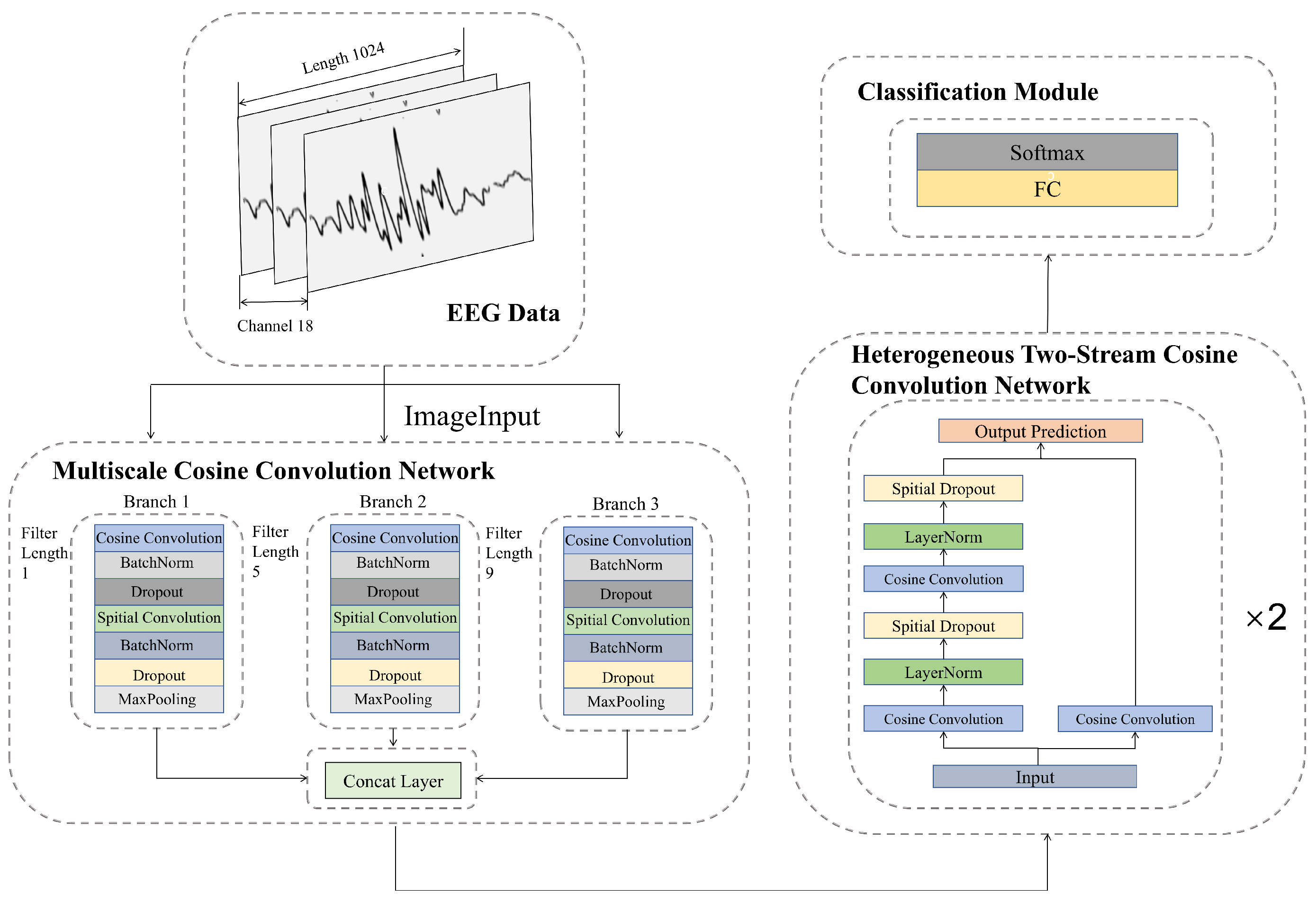
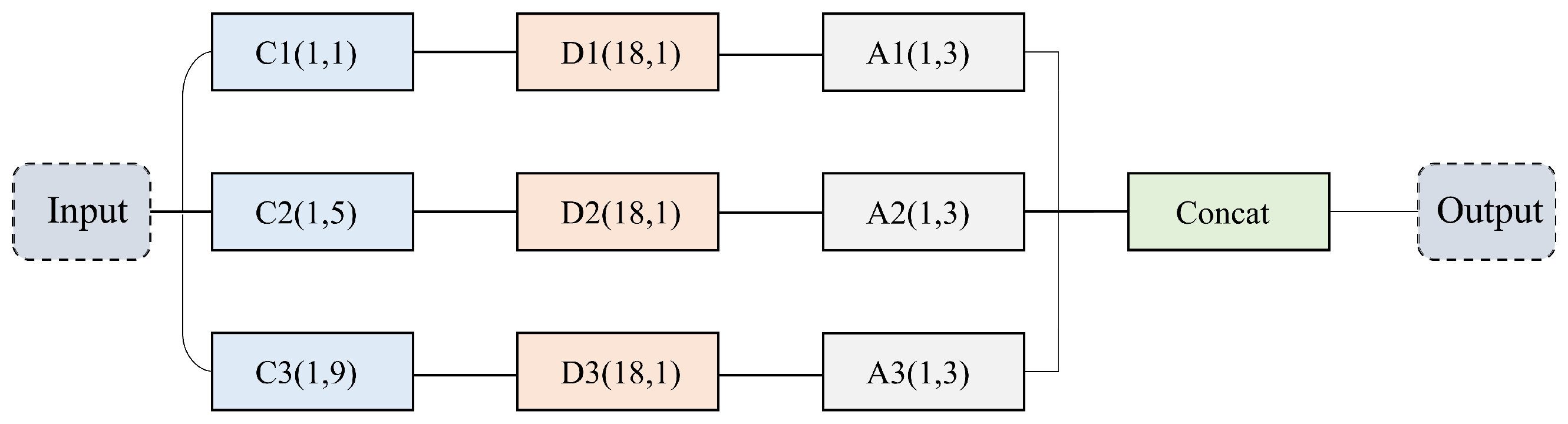
- We propose an MCC module that explicitly extends previous single-scale cosine-kernel EEG detectors to a multiscale formulation, enabling the network to capture epileptic EEG patterns at multiple temporal receptive field scales with a compact cosine parameterized kernel set. This design improves discriminability and patient-specific generalization under limited seizure data while maintaining low storage and computational cost.
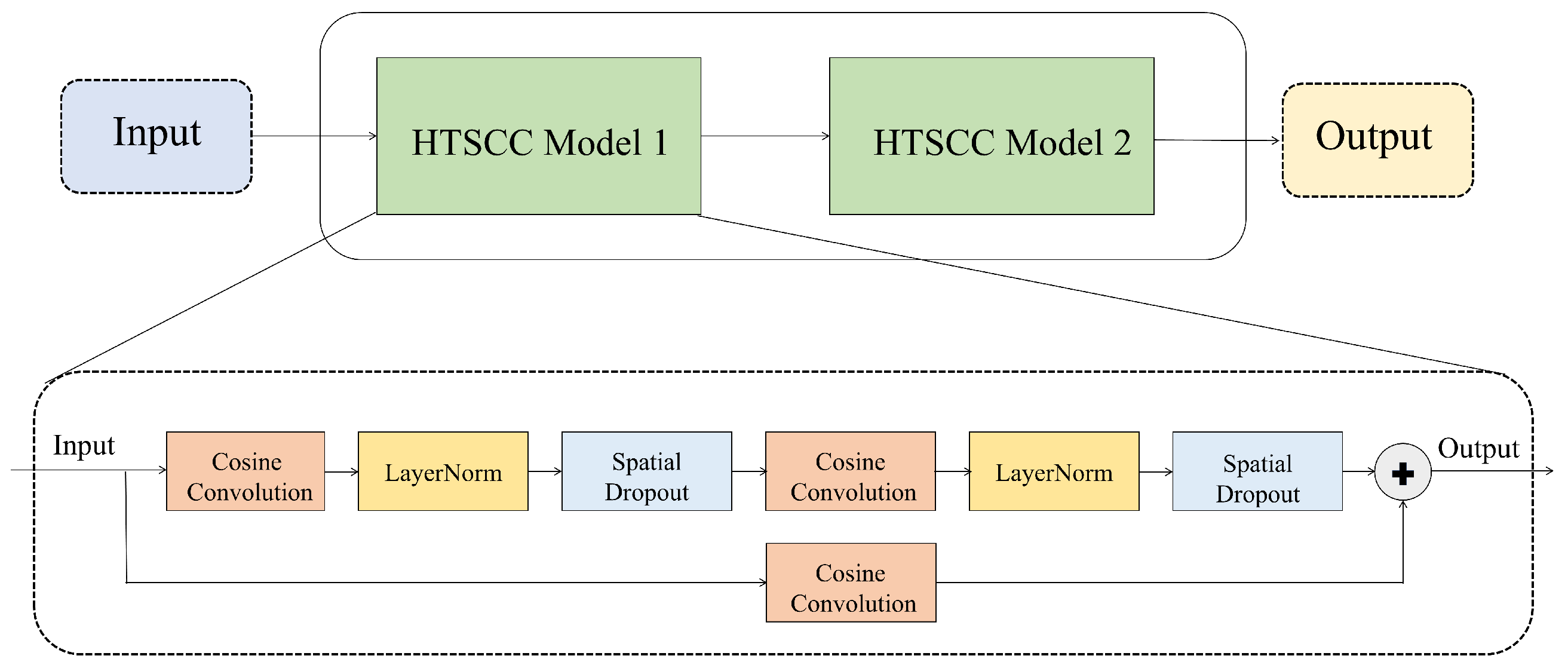
- We introduce a novel HTSCC module designed to comprehensively extract multiscale EEG features, substantially enhancing the robustness and computational efficiency of the model. This dual-stream heterogeneous design allows the network to achieve strong detection performance on two independent patient-specific EEG cohorts.
- Extensive experimental evaluations performed on both the publicly available CHB-MIT epileptic EEG dataset and our clinically collected SH-SDU database demonstrate the proposed model’s outstanding performance, validating its efficacy and superiority in epileptic seizure detection tasks. Additionally, we utilize Gradient-weighted Class Activation Mapping (Grad-CAM) [39] to visualize and interpret the decision-making process of the network, significantly improving the interpretability and transparency of the proposed model.
2. Materials and Methods
2.1. Preprocessing
2.2. Multiscale Cosine Convolution
2.3. Heterogeneous Two-Stream Cosine Convolution
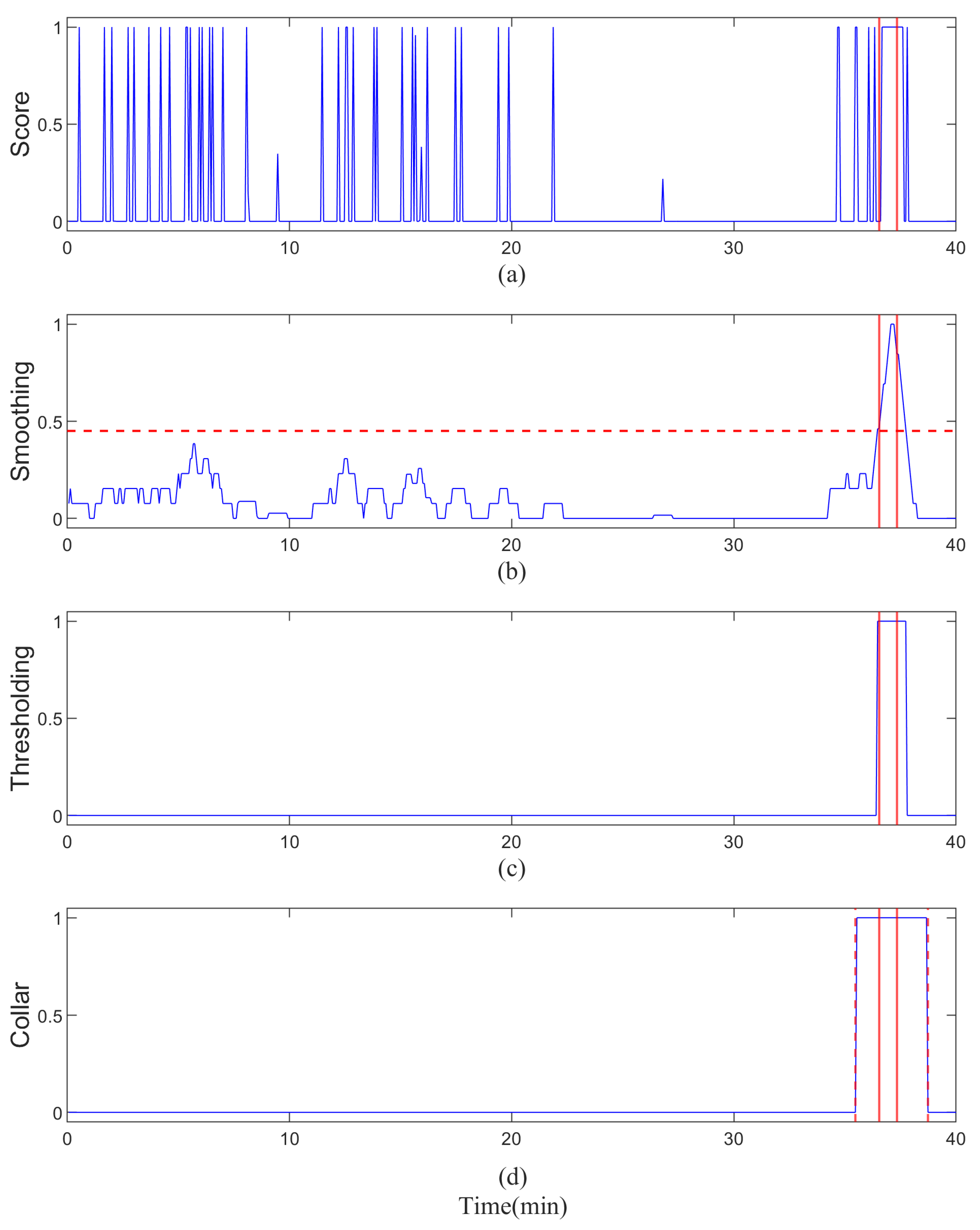
2.4. Postprocessing
3. Results
3.1. Datasets
3.1.1. CHB-MIT EEG Database
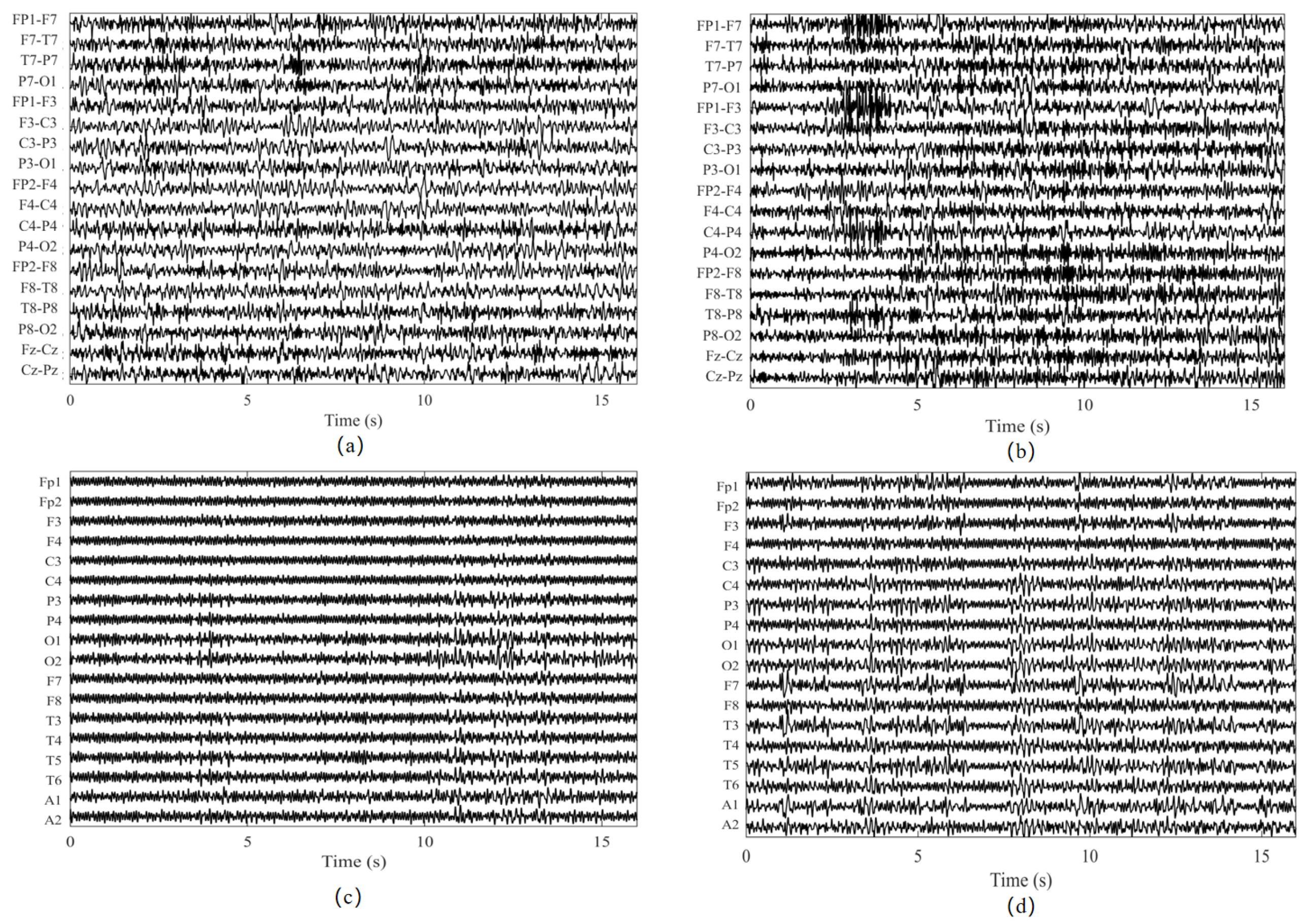
3.1.2. SH-SDU EEG Database
3.2. Experimental Setup
3.3. Results on CHB-MIT Database
3.4. Results on SH-SDU Database
4. Discussion
4.1. Ablation Studies
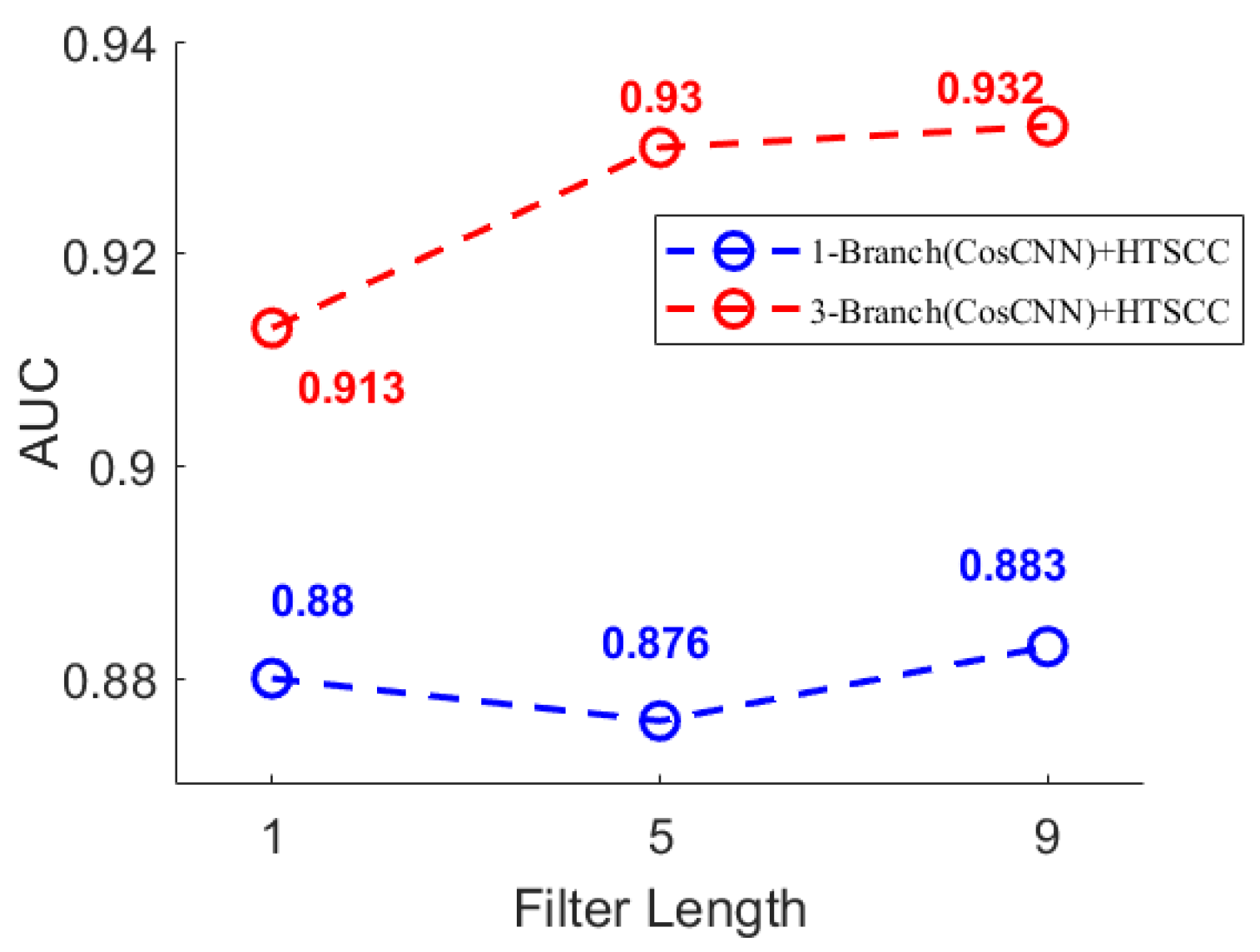
4.1.1. Effect of the Number of Branches
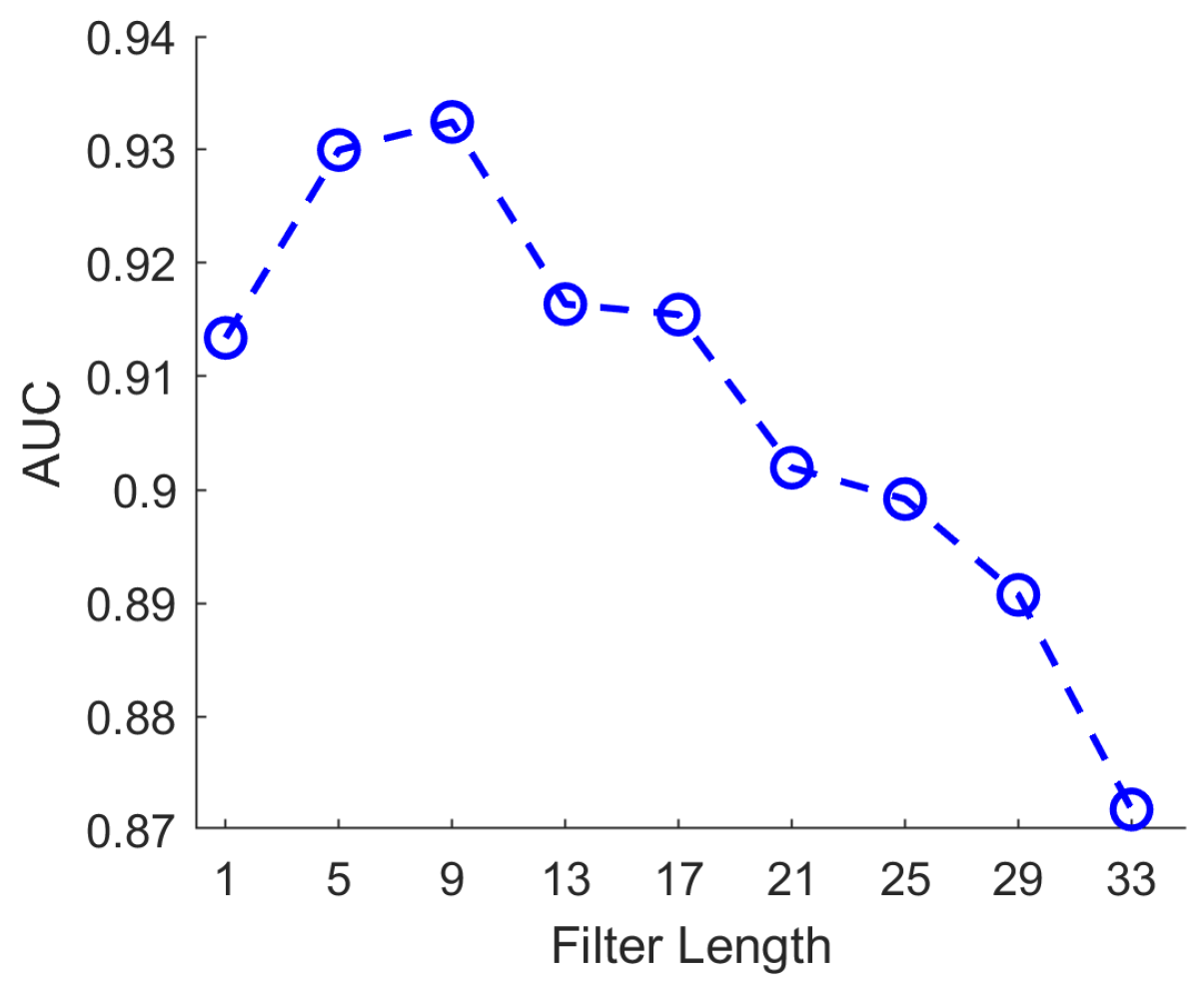
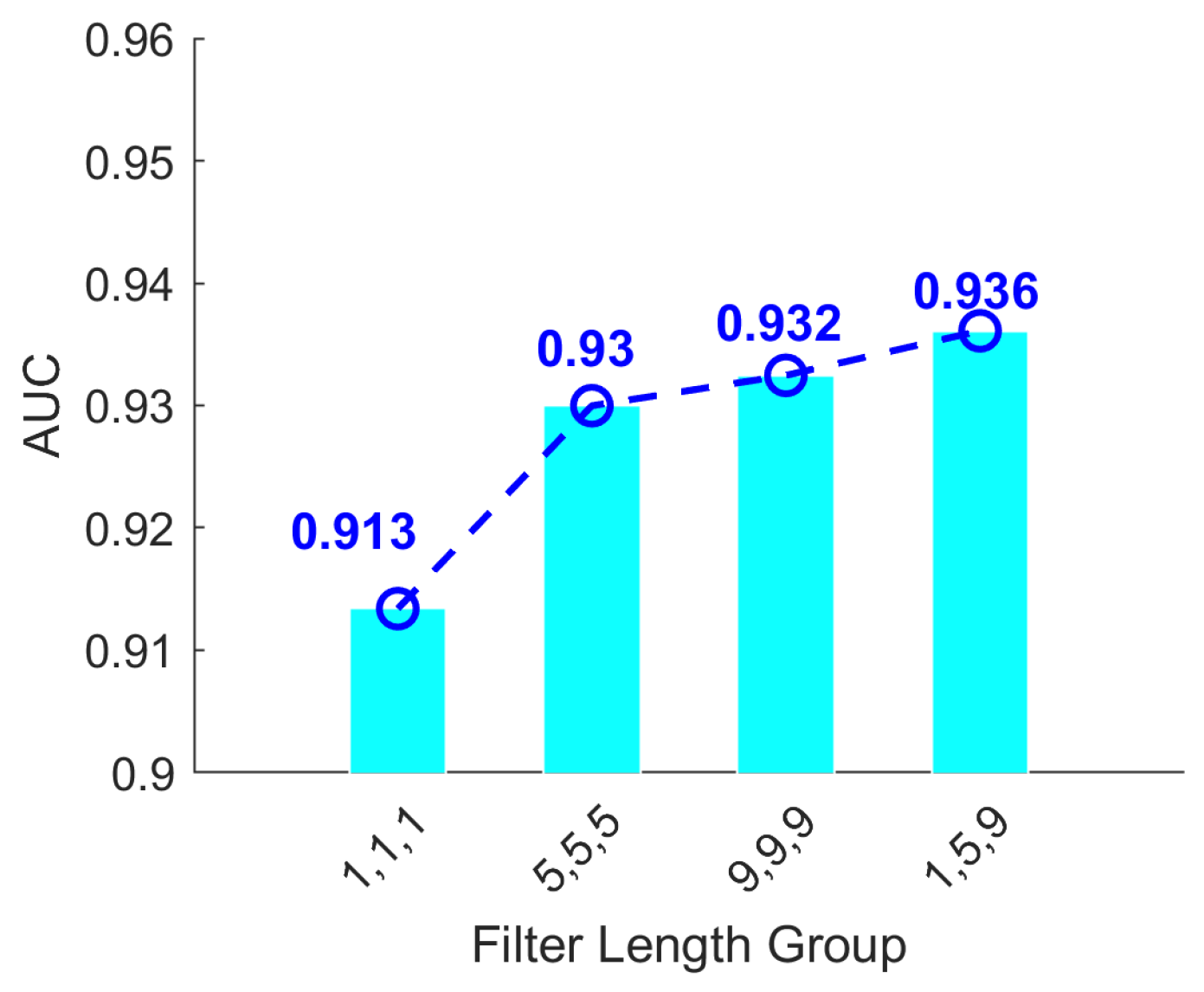
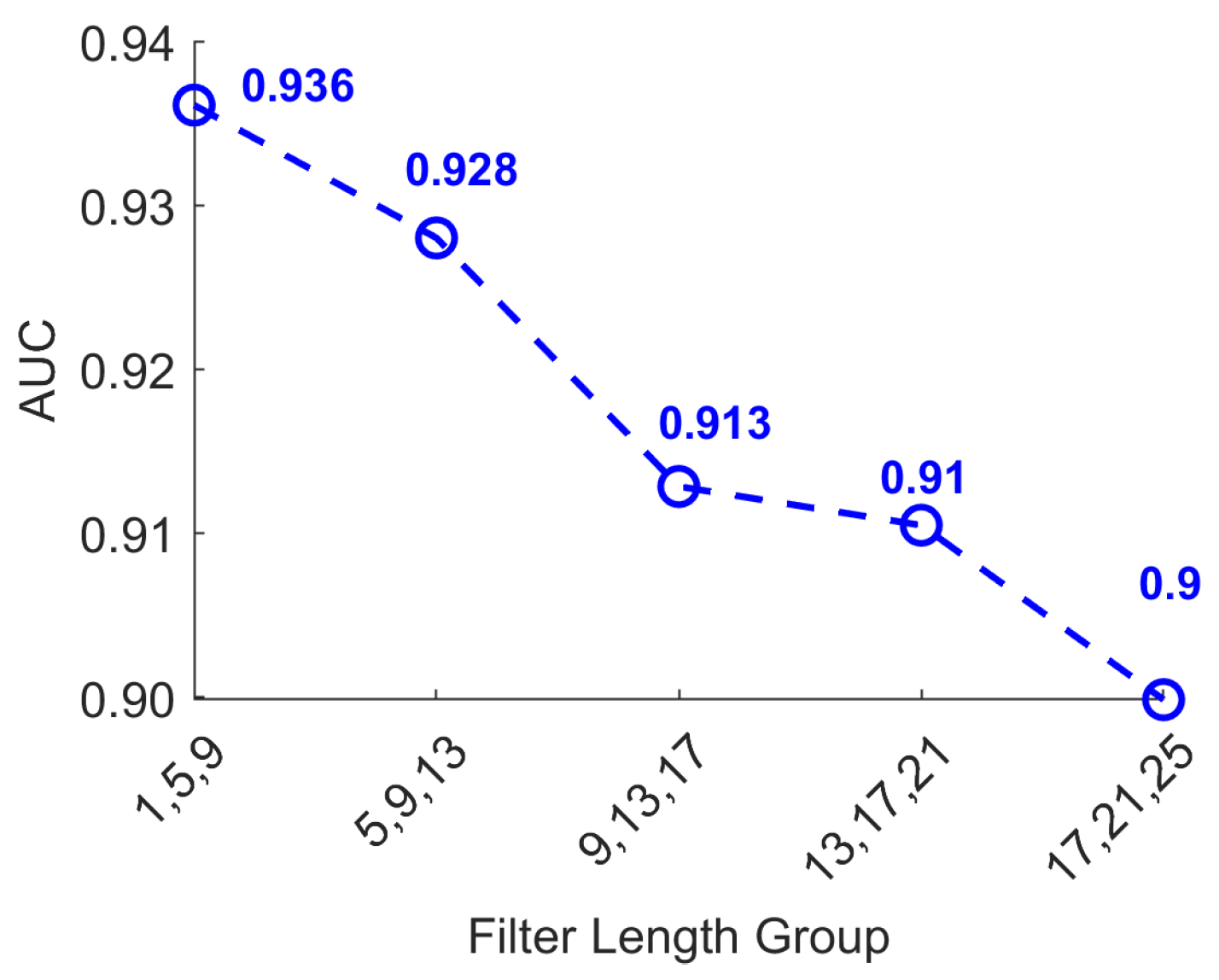
4.1.2. Effect of the Cosine-Kernel Lengths
4.1.3. Effect of the HTSCC Module
4.1.4. Effect of the Cosine Convolution Module
4.2. Visualization and Interpretability Analysis
4.2.1. t-SNE Visualization
4.2.2. Interpretability Analysis
4.3. Performance Comparisons
5. Conclusions
Author Contributions
Funding
Institutional Review Board Statement
Informed Consent Statement
Data Availability Statement
Acknowledgments
Conflicts of Interest
Abbreviations
| EEG | Electroencephalogram |
| MCC | Multiscale Cosine Convolution |
| HTSCC | Heterogeneous Two-Stream Cosine Convolution |
| MCC-HTSCC | Multiscale Cosine Convolutional Heterogeneous Two-Stream Cosine Convolution Network |
| CosCNN | Cosine Convolutional Neural Network |
| CNN | Convolutional Neural Network |
| FCN | Fully Convolutional Network |
| FC-NLSTM | Fully Convolutional Nested Long Short-Term Memory |
| LSTM | Long Short-Term Memory |
| Bi-LSTM | Bidirectional Long Short-Term Memory |
| GRU | Gated Recurrent Unit |
| Bi-GRU | Bidirectional Gated Recurrent Unit |
| TCN | Temporal Convolutional Network |
| STFT | Short-Time Fourier Transform |
| FFT | Fast Fourier Transform |
| CWT | Continuous Wavelet Transform |
| DWT | Discrete Wavelet Transform |
| Db4 | Daubechies-4 wavelet |
| ST | Stockwell Transform (S-transform) |
| ASTFT | Adaptive Short-Time Fourier Transform |
| SST | Synchrosqueezing Transform |
| MAF | Moving Average Filter |
| CSP | Common Spatial Pattern |
| SCSP | Sparse Common Spatial Pattern |
| PSD | Power Spectral Density |
| SVM | Support Vector Machine |
| EMD | Empirical Mode Decomposition |
| DTW | Dynamic Time Warping |
| PCA | Principal Component Analysis |
| LightGBM | Light Gradient Boosting Machine |
| OOD | Out-of-Distribution |
| MSA-DCNN | Multi-Scale Atrous-based Deep Convolutional Neural Network |
| Grad-CAM | Gradient-weighted Class Activation Mapping |
| t-SNE | t-distributed Stochastic Neighbor Embedding |
| ROC | Receiver Operating Characteristic |
| AUC | Area Under the Curve |
| AUROC | Area Under the Receiver Operating Characteristic Curve |
| FDR | False Detection Rate |
| CHB-MIT | Children’s Hospital Boston–MIT EEG Database |
| SH-SDU | Second Hospital of Shandong University EEG Database |
References
- Fisher, R.S.; Acevedo, C.; Arzimanoglou, A.; Bogacz, A.; Cross, J.H.; Elger, C.E.; Engel, J.; Forsgren, L.; French, J.A.; Glynn, M.; et al. ILAE official report: A practical clinical definition of epilepsy. Epilepsia 2014, 55, 475–482. [Google Scholar] [CrossRef]
- Yan, K.; Luo, X.; Ye, L.; Geng, W.; He, J.; Mu, J.; Hou, X.; Zan, X.; Ma, J.; Li, F.; et al. Automated seizure detection in epilepsy using a novel dynamic temporal-spatial graph attention network. Sci. Rep. 2025, 15, 16392. [Google Scholar] [CrossRef]
- World Health Organization (WHO). Epilepsy (Fact Sheet), Updated 7 February 2024. World Health Organization 2024. Available online: https://www.who.int/news-room/fact-sheets/detail/epilepsy (accessed on 25 February 2026).
- GBD 2016 Epilepsy Collaborators. Global, regional, and national burden of epilepsy, 1990–2016: A systematic analysis for the Global Burden of Disease Study 2016. Lancet Neurol. 2019, 18, 357–375. [Google Scholar] [CrossRef]
- Gu, L.; Liang, B.; Chen, Q.; Long, J.; Xie, J.; Wu, G.; Yan, Y.; Tan, J.; Dou, W.; Chen, W.; et al. Prevalence of epilepsy in the People’s Republic of China: A systematic review. Epilepsy Res. 2013, 105, 195–205. [Google Scholar] [CrossRef]
- Eltrass, A.S.; Tayel, M.B.; EL-qady, A.F. Automatic epileptic seizure detection approach based on multi-stage Quantized Kernel Least Mean Square filters. Biomed. Signal Process. Control 2021, 70, 103031. [Google Scholar] [CrossRef]
- Gotman, J. Automatic recognition of epileptic seizures in the EEG. Electroencephalogr. Clin. Neurophysiol. 1982, 54, 530–540. [Google Scholar] [CrossRef] [PubMed]
- Gotman, J. Automatic seizure detection: Improvements and evaluation. Electroencephalogr. Clin. Neurophysiol. 1990, 76, 317–324. [Google Scholar] [CrossRef]
- Yuan, S.; Zhou, W.; Chen, L. Epileptic seizure prediction using diffusion distance and bayesian linear discriminate analysis on intracranial EEG. Int. J. Neural Syst. 2018, 28, 1750043. [Google Scholar] [CrossRef] [PubMed]
- Li, S.; Zhou, W.; Yuan, Q.; Liu, Y. Seizure prediction using spike rate of intracranial EEG. IEEE Trans. Neural Syst. Rehabil. Eng. 2013, 21, 880–886. [Google Scholar] [CrossRef] [PubMed]
- Khanmohammadi, S.; Chou, C.-A. Adaptive seizure onset detection framework using a hybrid PCA–CSP approach. IEEE J. Biomed. Health Inform. 2017, 22, 154–160. [Google Scholar] [CrossRef]
- Li, C.; Zhou, W.; Liu, G.; Zhang, Y.; Geng, M.; Liu, Z.; Wang, S.; Shang, W. Seizure onset detection using empirical mode decomposition and common spatial pattern. IEEE Trans. Neural Syst. Rehabil. Eng. 2021, 29, 458–467. [Google Scholar] [CrossRef]
- Zhang, Z.; Parhi, K.K. Low-complexity seizure prediction from iEEG/sEEG using spectral power and ratios of spectral power. IEEE Trans. Biomed. Circuits Syst. 2015, 10, 693–706. [Google Scholar] [CrossRef]
- Redwan, S.M.; Uddin, M.P.; Ulhaq, A.; Sharif, M.I.; Krishnamoorthy, G. Power spectral density-based resting-state EEG classification of first-episode psychosis. Sci. Rep. 2024, 14, 15154. [Google Scholar] [CrossRef]
- Ahmadlou, M.; Adeli, H.; Adeli, A. Improved visibility graph fractality with application for the diagnosis of autism spectrum disorder. Phys. A Stat. Mech. Its Appl. 2012, 391, 4720–4726. [Google Scholar] [CrossRef]
- Zhang, Y.; Zhou, W.; Yuan, S.; Yuan, Q. Seizure detection method based on fractal dimension and gradient boosting. Epilepsy Behav. 2015, 43, 30–38. [Google Scholar] [CrossRef]
- Mursalin, M.; Zhang, Y.; Chen, Y.; Chawla, N.V. Automated epileptic seizure detection using improved correlation-based feature selection with random forest classifier. Neurocomputing 2017, 241, 204–214. [Google Scholar] [CrossRef]
- Sadati, N.; Mohseni, H.R.; Maghsoudi, A. Epileptic seizure detection using neural fuzzy networks. In 2006 IEEE International Conference on Fuzzy Systems; IEEE: New York, NY, USA, 2006; pp. 596–600. [Google Scholar]
- Nkengfack, L.C.D.; Tchiotsop, D.; Atangana, R.; Louis-Door, V.; Wolf, D. Classification of EEG signals for epileptic seizures detection and eye states identification using Jacobi polynomial transforms-based measures of complexity and least-square support vector machine. Inform. Med. Unlocked 2021, 23, 100536. [Google Scholar] [CrossRef]
- LeCun, Y.; Bengio, Y.; Hinton, G. Deep learning. Nature 2015, 521, 436–444. [Google Scholar] [CrossRef]
- Slama, K.; Yahyaouy, A.; Riffi, J.; Mahraz, M.A.; Tairi, H. Comprehensive review of machine learning and deep learning techniques for epileptic seizure detection and prediction based on neuroimaging modalities. Vis. Comput. Ind. Biomed. Art 2025, 8, 27. [Google Scholar] [CrossRef] [PubMed]
- Chen, W.; Wang, Y.; Ren, Y.; Jiang, H.; Du, G.; Zhang, J.; Li, J. An automated detection of epileptic seizures EEG using CNN classifier based on feature fusion with high accuracy. BMC Med. Inform. Decis. Mak. 2023, 23, 96. [Google Scholar] [CrossRef]
- Nie, J.; Shu, H.; Wu, F. An epilepsy classification based on FFT and fully convolutional neural network nested LSTM. Front. Neurosci. 2024, 18, 1436619. [Google Scholar] [CrossRef]
- Anita, M.; Meena Kowshalya, A. Automatic epileptic seizure detection using MSA-DCNN and LSTM techniques with EEG signals. Expert Syst. Appl. 2024, 238, 121727. [Google Scholar] [CrossRef]
- Shen, M.; Yang, F.; Wen, P.; Song, B.; Li, Y. A real-time epilepsy seizure detection approach based on EEG using short-time Fourier transform and Google-Net convolutional neural network. Heliyon 2024, 10, e31827. [Google Scholar] [CrossRef]
- Amiri, M.; Aghaeinia, H.; Amindavar, H.R. Automatic epileptic seizure detection in EEG signals using sparse common spatial pattern and adaptive short-time Fourier transform-based synchrosqueezing transform. Biomed. Signal Process. Control 2023, 79, 104022. [Google Scholar] [CrossRef]
- Zhong, X.; Liu, G.; Dong, X.; Li, C.; Li, H.; Cui, H.; Zhou, W. Automatic seizure detection based on stockwell transform and transformer. Sensors 2023, 24, 77. [Google Scholar] [CrossRef]
- Liu, Y.; Liu, G.; Wu, S.; Tin, C. Phase spectrogram of EEG from S-transform Enhances epileptic seizure detection. Expert Syst. Appl. 2025, 262, 125621. [Google Scholar] [CrossRef]
- Howard, A.G.; Zhu, M.; Chen, B.; Kalenichenko, D.; Wang, W.; Weyand, T.; Andreetto, M.; Adam, H. MobileNets: Efficient Convolutional Neural Networks for Mobile Vision Applications. arXiv 2017, arXiv:1704.04861. [Google Scholar] [CrossRef]
- Xie, S.; Girshick, R.; Dollár, P.; Tu, Z.; He, K. Aggregated Residual Transformations for Deep Neural Networks. In Proceedings of the IEEE Conference on Computer Vision and Pattern Recognition (CVPR), Honolulu, HI, USA, 21–26 July 2017; pp. 1492–1500. [Google Scholar]
- He, K.; Zhang, X.; Ren, S.; Sun, J. Deep Residual Learning for Image Recognition. In Proceedings of the IEEE Conference on Computer Vision and Pattern Recognition (CVPR), Las Vegas, NV, USA, 27–30 June 2016; pp. 770–778. [Google Scholar]
- Ravanelli, M.; Bengio, Y. Interpretable Convolutional Filters with SincNet. arXiv 2018, arXiv:1811.09725. [Google Scholar]
- Alekseev, A.; Lobachev, I.; Khvedchenya, E.; Dévyatkin, A.; Nikolenko, S. GaborNet: Gabor Filters with Learnable Parameters in Deep Convolutional Neural Networks. arXiv 2019, arXiv:1904.13204. [Google Scholar] [CrossRef]
- Cotter, F.; Kingsbury, N. Deep Learning in the Wavelet Domain. arXiv 2018, arXiv:1811.06115. [Google Scholar] [CrossRef]
- Romero, D.W.; Bekkers, E.J.; Tomczak, J.M. CKConv: Continuous Kernel Convolution for Sequential Data. In Proceedings of the International Conference on Learning Representations (ICLR), Virtual Event, 25–29 April 2022. [Google Scholar]
- Liu, G.; Tian, L.; Wen, Y.; Yu, W.; Zhou, W. Cosine convolutional neural network and its application for seizure detection. Neural Netw. 2024, 174, 106267. [Google Scholar] [CrossRef]
- Liu, Y.; Qi, P.; Su, X.; Zhou, W.; Liu, G. CosCNN-DTQ: An integrated framework for efficient deployment of cosine convolutional neural networks. Neurocomputing 2026, 677, 133110. [Google Scholar] [CrossRef]
- Zhang, R.; Zheng, K.; Wang, Y.; Zhou, W.; Tian, L.; Liu, G. Lightweight cosine convolution network for sleep apnea detection with single-lead ECG. Neurocomputing 2025, 669, 132457. [Google Scholar] [CrossRef]
- Selvaraju, R.R.; Cogswell, M.; Das, A.; Vedantam, R.; Parikh, D.; Batra, D. Grad-cam: Visual explanations from deep networks via gradient-based localization. In Proceedings of the IEEE International Conference on Computer Vision, Venice, Italy, 22–29 October 2017; pp. 618–626. [Google Scholar]
- Guttag, J. CHB-MIT Scalp EEG Database (version 1.0.0). PhysioNet 2010, RRID:SCR_007345. [Google Scholar] [CrossRef]
- Liu, G.; Tian, L.; Zhou, W. Patient-independent seizure detection based on channel-perturbation convolutional neural network and bidirectional long short-term memory. Int. J. Neural Syst. 2022, 32, 2150051. [Google Scholar] [CrossRef]
- Liu, G.; Zhou, W.; Geng, M. Automatic seizure detection based on S-transform and deep convolutional neural network. Int. J. Neural Syst. 2020, 30, 1950024. [Google Scholar] [CrossRef]
- Heil, C.E.; Walnut, D.F. Continuous and discrete wavelet transforms. SIAM Rev. 1989, 31, 628–666. [Google Scholar] [CrossRef]
- Liu, G.; Ren, S.; Wang, J.; Zhou, W. Efficient Group Cosine Convolutional Neural Network for EEG-based Seizure Identification. In IEEE Transactions on Instrumentation and Measurement; IEEE: New York, NY, USA, 2025. [Google Scholar]
- Van der Maaten, L.; Hinton, G. Visualizing data using t-SNE. J. Mach. Learn. Res. 2008, 9, 2579–2605. [Google Scholar]
- Li, Y.; Yu, Z.; Chen, Y.; Yang, C.; Li, Y.; Li, X.A.; Li, B. Automatic seizure detection using fully convolutional nested LSTM. Int. J. Neural Syst. 2020, 30, 2050019. [Google Scholar] [CrossRef]
- Wang, X.; Wang, X.; Liu, W.; Chang, Z.; Kärkkäinen, T.; Cong, F. One dimensional convolutional neural networks for seizure onset detection using long-term scalp and intracranial EEG. Neurocomputing 2021, 459, 212–222. [Google Scholar] [CrossRef]
- Zhang, Y.; Yao, S.; Yang, R.; Liu, X.; Qiu, W.; Han, L.; Zhou, W.; Shang, W. Epileptic seizure detection based on bidirectional gated recurrent unit network. IEEE Trans. Neural Syst. Rehabil. Eng. 2022, 30, 135–145. [Google Scholar] [CrossRef]
- Sopic, D.; Teijeiro, T.; Atienza, D.; Aminifar, A.; Ryvlin, P. Personalized seizure signature: An interpretable approach to false alarm reduction for long-term epileptic seizure detection. Epilepsia 2023, 64, S23–S33. [Google Scholar] [CrossRef] [PubMed]
- Wong, S.; Simmons, A.; Villicana, J.R.; Barnett, S. Estimating Patient-Level Uncertainty in Seizure Detection Using Group-Specific Out-of-Distribution Detection Technique. Sensors 2023, 23, 8375. [Google Scholar] [CrossRef] [PubMed]
- Wang, Z.; Sperling, M.R.; Wyeth, D.; Guez, A. Automated Seizure Detection Based on State-Space Model Identification. Sensors 2024, 24, 1902. [Google Scholar] [CrossRef] [PubMed]
- Saranya, D.; Bharathi, A. Automatic detection of epileptic seizure using machine learning-based IANFIS-LightGBM system. J. Intell. Fuzzy Syst. 2024, 46, 2463–2482. [Google Scholar] [CrossRef]
- Dong, X.; Wen, Y.; Ji, D.; Yuan, S.; Liu, Z.; Shang, W.; Zhou, W. Epileptic Seizure Detection with an End-to-End Temporal Convolutional Network and Bidirectional Long Short-Term Memory Model. Int. J. Neural Syst. 2024, 34, 2450012. [Google Scholar] [CrossRef]





| Patient | Sex | Age | Seizure Type | Seizure Onset Zone | Total Duration (h) | Mean Seizure Duration (s) |
|---|---|---|---|---|---|---|
| 1 | F | 11 | SP, CP | Temporal | 40.55 | 63.15 |
| 2 | M | 11 | SP, CP, GTC | Frontal | 35.27 | 57.34 |
| 3 | F | 14 | SP, CP | Temporal | 38.00 | 57.43 |
| 4 | M | 22 | SP, CP, GTC | Temporal, Occipital | 156.07 | 94.50 |
| 5 | F | 7 | CP, GTC | Frontal | 39.00 | 111.60 |
| 6 | F | 1.5 | CP, GTC | Temporal | 66.74 | 15.30 |
| 7 | F | 14.5 | SP, CP, GTC | Temporal | 67.05 | 108.34 |
| 8 | M | 3.5 | SP, CP, GTC | Temporal | 20.01 | 183.80 |
| 9 | F | 10 | CP, GTC | Frontal | 67.87 | 69.00 |
| 10 | M | 3 | SP, CP, GTC | Temporal | 50.02 | 65.50 |
| 11 | F | 12 | SP, CP, GTC | Frontal | 34.79 | 268.67 |
| 12 | F | 2 | SP, CP, GTC | Frontal | 20.69 | 36.63 |
| 13 | F | 3 | SP, CP, GTC | Temporal, Occipital | 33.00 | 44.59 |
| 14 | F | 9 | CP, GTC | Temporal | 26.00 | 21.13 |
| 15 | M | 16 | SP, CP, GTC | Frontal, Temporal | 40.01 | 99.60 |
| 16 | F | 7 | SP, CP, GTC | Temporal | 19.00 | 8.40 |
| 17 | F | 12 | SP, CP, GTC | Temporal | 21.01 | 97.67 |
| 18 | F | 18 | SP, CP | Temporal, Occipital | 35.63 | 52.84 |
| 19 | F | 19 | SP, CP, GTC | Frontal | 29.93 | 78.67 |
| 20 | F | 6 | SP, CP, GTC | Temporal | 27.60 | 36.75 |
| 21 | F | 13 | SP, CP | Temporal | 32.83 | 49.75 |
| 22 | F | 9 | - | Temporal, Occipital | 31.00 | 68.00 |
| 23 | F | 6 | - | Frontal | 26.56 | 60.58 |
| 24 | - | - | - | - | 21.30 | 31.94 |
| Summary | - | - | - | - | 979.93 | - |
| Patient | Sex | Age | Total Duration (h) | Mean Seizure Duration (s) | Number of EEG Channels |
|---|---|---|---|---|---|
| 1 | F | 28 | 20.58 | 40.53 | 18 |
| 2 | F | 28 | 23.74 | 68.8 | 18 |
| 3 | M | 61 | 16.04 | 220.8 | 18 |
| 4 | M | 34 | 12 | 52.38 | 18 |
| 5 | M | 33 | 7.24 | 28.47 | 18 |
| 6 | M | 72 | 15.56 | 105.08 | 18 |
| 7 | M | 45 | 6 | 59.33 | 18 |
| 8 | M | 71 | 17.22 | 795.67 | 18 |
| 9 | F | 45 | 26.05 | 120.06 | 18 |
| 10 | F | 37 | 3.8 | 23.00 | 18 |
| Summary | – | 45.4 | 148.23 | 151.412 | – |
| Patient | Sensitivity | Specificity | Accuracy |
|---|---|---|---|
| 1 | 81.58% | 99.22% | 99.06% |
| 2 | 73.05% | 83.57% | 83.50% |
| 3 | 88.58% | 97.01% | 96.67% |
| 4 | 95.24% | 96.85% | 96.79% |
| 5 | 85.90% | 99.75% | 97.35% |
| 6 | 87.38% | 99.82% | 96.74% |
| 7 | 89.96% | 93.05% | 92.89% |
| 8 | 95.08% | 99.94% | 95.66% |
| 9 | 100.00% | 99.95% | 99.79% |
| 10 | 84.17% | 89.77% | 87.16% |
| Average | 88.09% ± 9.56% | 95.89% ± 7.46% | 94.56% ± 8.59% |
| Patient | Number of Experts-Marked Seizures | Number of Detected Seizures | Sensitivity | FDR (/h) |
|---|---|---|---|---|
| 1 | 18 | 12 | 66.67% | 0.28 |
| 2 | 10 | 7 | 70.00% | 1.98 |
| 3 | 9 | 9 | 100.00% | 0.19 |
| 4 | 9 | 8 | 88.89% | 1.67 |
| 5 | 19 | 19 | 100.00% | 0.14 |
| 6 | 8 | 6 | 87.50% | 0.08 |
| 7 | 28 | 28 | 100.00% | 1.42 |
| 8 | 37 | 37 | 100.00% | 0.06 |
| 9 | 2 | 2 | 100.00% | 0.00 |
| 10 | 3 | 3 | 100.00% | 0.41 |
| Average | 143 | 131 | 91.31% ± 12.36% | 0.62 ± 0.71 |
| Patient | Sensitivity | Specificity | Accuracy |
|---|---|---|---|
| 1 | 100.00% | 99.71% | 99.71% |
| 2 | 100.00% | 99.72% | 99.72% |
| 3 | 100.00% | 99.07% | 99.07% |
| 4 | 100.00% | 97.56% | 97.56% |
| 5 | 100.00% | 99.95% | 99.95% |
| 6 | 100.00% | 96.99% | 96.99% |
| 7 | 100.00% | 99.92% | 99.92% |
| 8 | 94.27% | 95.14% | 95.09% |
| 9 | 100.00% | 100.00% | 100.00% |
| 10 | 100.00% | 99.97% | 99.97% |
| 11 | 100.00% | 99.92% | 99.92% |
| 12 | 98.32% | 97.31% | 97.24% |
| 13 | 81.11% | 98.19% | 98.14% |
| 14 | 100.00% | 96.70% | 96.70% |
| 15 | 98.97% | 98.86% | 98.85% |
| 16 | 100.00% | 91.34% | 91.29% |
| 17 | 100.00% | 99.92% | 99.92% |
| 18 | 87.50% | 99.70% | 99.67% |
| 19 | 100.00% | 99.92% | 99.92% |
| 20 | 98.63% | 97.10% | 97.04% |
| 21 | 100.00% | 99.85% | 99.85% |
| 22 | 100.00% | 99.99% | 99.99% |
| 23 | 100.00% | 99.70% | 99.70% |
| 24 | 92.65% | 98.28% | 98.24% |
| Average | 97.98% ± 4.60% | 98.53% ± 2.01% | 98.52% ± 2.03% |
| Patient | Number of Seizures Experts Marked | Number of Seizures Detected | Sensitivity | FDR (/h) |
|---|---|---|---|---|
| 1 | 6 | 6 | 100.00% | 0.02 |
| 2 | 2 | 2 | 100.00% | 0.23 |
| 3 | 6 | 6 | 100.00% | 0.32 |
| 4 | 3 | 3 | 100.00% | 0.22 |
| 5 | 4 | 4 | 100.00% | 0.03 |
| 6 | 6 | 6 | 100.00% | 3.30 |
| 7 | 2 | 2 | 100.00% | 0.1 |
| 8 | 4 | 4 | 100.00% | 0.65 |
| 9 | 3 | 3 | 100.00% | 0.01 |
| 10 | 5 | 5 | 100.00% | 0.02 |
| 11 | 2 | 2 | 100.00% | 0 |
| 12 | 23 | 23 | 100.00% | 1.7 |
| 13 | 8 | 7 | 87.50% | 0.76 |
| 14 | 7 | 7 | 100.00% | 2.54 |
| 15 | 19 | 19 | 100.00% | 0.20 |
| 16 | 2 | 2 | 100.00% | 10.65 |
| 17 | 2 | 2 | 100.00% | 0.05 |
| 18 | 5 | 4 | 80.00% | 0.06 |
| 19 | 2 | 2 | 100.00% | 0 |
| 20 | 7 | 7 | 100.00% | 0.62 |
| 21 | 3 | 3 | 100.00% | 0.03 |
| 22 | 2 | 2 | 100.00% | 0 |
| 23 | 6 | 6 | 100.00% | 0.11 |
| 24 | 15 | 15 | 100.00% | 1.08 |
| Average | 144 | 142 | 98.61% ± 4.62% | 0.95 ± 2.18 |
| Seizure Type | Sensitivity | Specificity | Event-Based Sensitivity | Accuracy | FDR (/h) |
|---|---|---|---|---|---|
| SP, CP | 96.88% | 99.58% | 95.00% | 99.58% | 0.11 |
| SP, CP, GTC | 97.79% | 98.07% | 99.04% | 98.04% | 1.16 |
| CP, GTC | 100.00% | 98.41% | 100.00% | 98.41% | 1.47 |
| Model | Parameters | AUC |
|---|---|---|
| 1-Branch(CosCNN) + 2HTSCC | 35 k | 0.883 |
| 2-Branch(CosCNN) + 2HTSCC | 57.5 k | 0.911 |
| 3-Branch(CosCNN) + 2HTSCC | 80 k | 0.932 |
| 4-Branch(CosCNN) + 2HTSCC | 99.9 k | 0.919 |
| 5-Branch(CosCNN) + 2HTSCC | 125 k | 0.898 |
| Model | Parameters | AUC |
|---|---|---|
| 3-Branch(CosCNN) + 1HTSCC | 76.9 k | 0.897 |
| 3-Branch(CosCNN) + 2HTSCC | 80 k | 0.936 |
| 3-Branch(CosCNN) + 3HTSCC | 92.5 k | 0.931 |
| 3-Branch(CosCNN) + 4HTSCC | 99.9 k | 0.926 |
| Model | Configuration | AUC | Parameters |
|---|---|---|---|
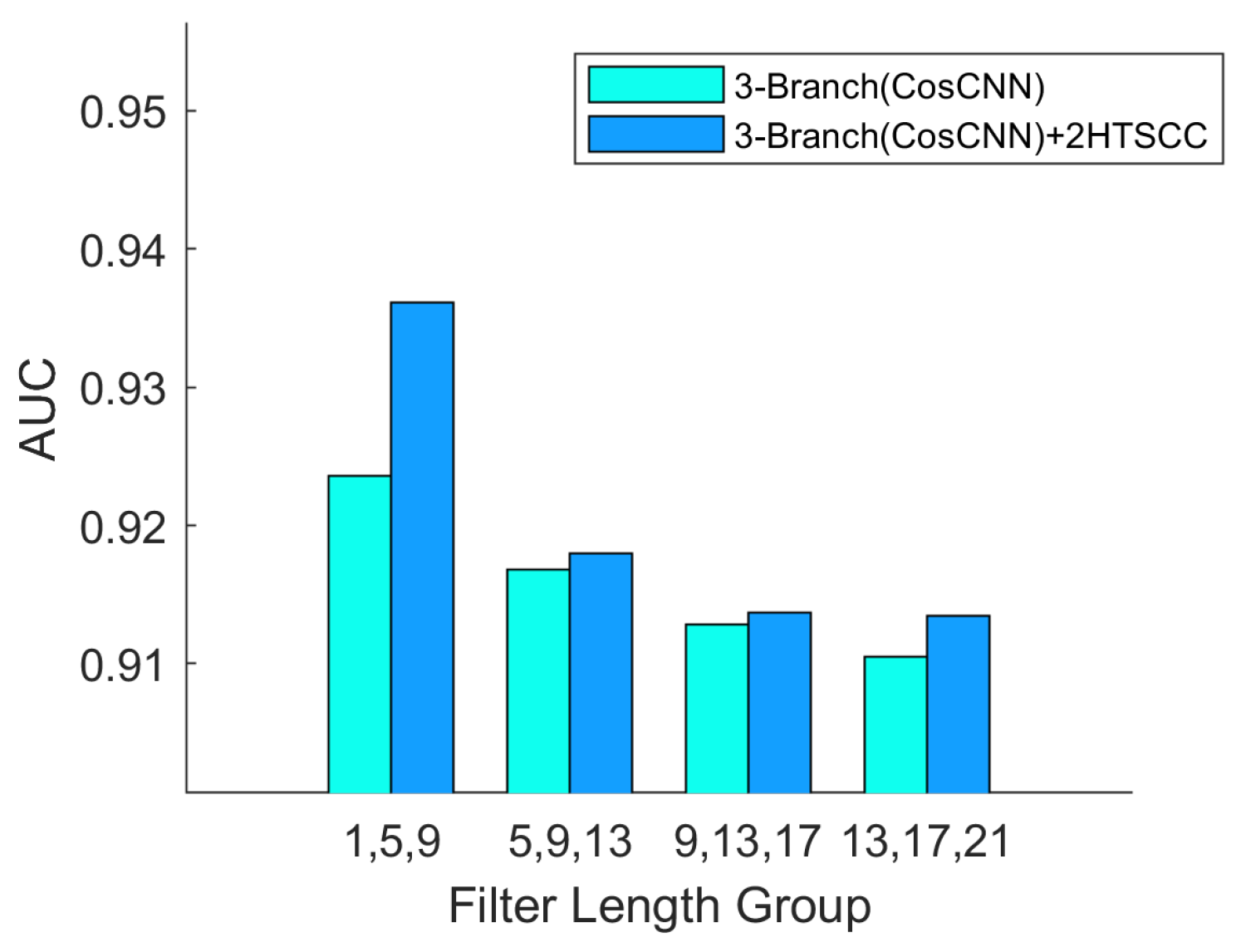
| 3-Branch(CosCNN) + 2HTSCC | 1, 5, 9 | 0.936 | 80 k |
| 5, 9, 13 | 0.928 | 80 k | |
| 3-Branch(CNN) + 2HTSCC | 1, 5, 9 | 0.932 | 97.7 k |
| 5, 9, 13 | 0.927 | 97.7 k |
| No. | Author (Year) | Method | Window Length | Length of EEG Data Used | Number of Used Seizure | Sensitivity (Segment-Based/ Event-Based) | Specificity | Accuracy | FDR (/h) |
|---|---|---|---|---|---|---|---|---|---|
| 1 | Li et al. (2020) [46] | FC-NLSTM | 4 s | 846.23 | 198 | 95.42%/95.29% | 95.29% | - | 0.66 |
| 2 | Wang et al. (2021) [47] | 1D-CNN + RS-DA | 2 s | 916 h | 198 | 88.14%/99.31% | 99.62% | 99.54% | 0.2 |
| 3 | Li et al. (2021) [12] | EMD-CSP + SVM | 2 s | 976.9 h | 185 | 97.34%/98.47% | 97.50% | - | 0.63 |
| 4 | Zhang et al. (2022) [48] | Bi-GRU + Transform | 4 s | 870.44 h | 198 | 93.89%/95.49% | 98.49% | 98.49% | 0.63 |
| 5 | Sopic et al. (2023) [49] | DTW | 1s | 996 h | 198 | 96%/90.4% | - | - | 0 |
| 6 | Wong et al. (2023) [50] | OOD | 1 s | 916 h | 198 | 75%/- | 89.00% | 87.00% | 0.94 |
| 7 | Wang et al. (2024) [51] | SSDS + DT | 1 s | - | - | 94.1%/- | 87.60% | 97.50% | - |
| 8 | Saranya et al. (2024) [52] | CWT + LightGBM | 4 s | - | - | 99.74%/- | 98.26% | 98.53% | - |
| 9 | Dong et al. (2024) [53] | TCN-Bi-LSTM | 4 s | 820.26 | 115 | 94.31%/96.48% | 97.13% | 97.09% | 0.38 |
| 10 | Liu et al. (2025b) [28] | ST + CNN | 4 s | 979.93 h | 184 | 79.59%/85% | 92.23% | 93.45% | 2.52 |
| 11 | This work | MCC-HTSCC | 4 s | 979.93 h | 184 | 97.98%/98.65% | 98.53% | 98.52% | 0.94 |
Disclaimer/Publisher’s Note: The statements, opinions and data contained in all publications are solely those of the individual author(s) and contributor(s) and not of MDPI and/or the editor(s). MDPI and/or the editor(s) disclaim responsibility for any injury to people or property resulting from any ideas, methods, instructions or products referred to in the content. |
© 2026 by the authors. Licensee MDPI, Basel, Switzerland. This article is an open access article distributed under the terms and conditions of the Creative Commons Attribution (CC BY) license.
Share and Cite
Chen, J.; Zhou, W.; Liu, G. Multiscale Cosine Convolution Neural Network for Robust and Interpretable Epileptic EEG Detection. Biosensors 2026, 16, 203. https://doi.org/10.3390/bios16040203
Chen J, Zhou W, Liu G. Multiscale Cosine Convolution Neural Network for Robust and Interpretable Epileptic EEG Detection. Biosensors. 2026; 16(4):203. https://doi.org/10.3390/bios16040203
Chicago/Turabian StyleChen, Jiale, Weidong Zhou, and Guoyang Liu. 2026. "Multiscale Cosine Convolution Neural Network for Robust and Interpretable Epileptic EEG Detection" Biosensors 16, no. 4: 203. https://doi.org/10.3390/bios16040203
APA StyleChen, J., Zhou, W., & Liu, G. (2026). Multiscale Cosine Convolution Neural Network for Robust and Interpretable Epileptic EEG Detection. Biosensors, 16(4), 203. https://doi.org/10.3390/bios16040203