A Deep Learning-Based EIT System for Robust Gesture Recognition Under Confounding Factors


Abstract
1. Introduction
- (1)
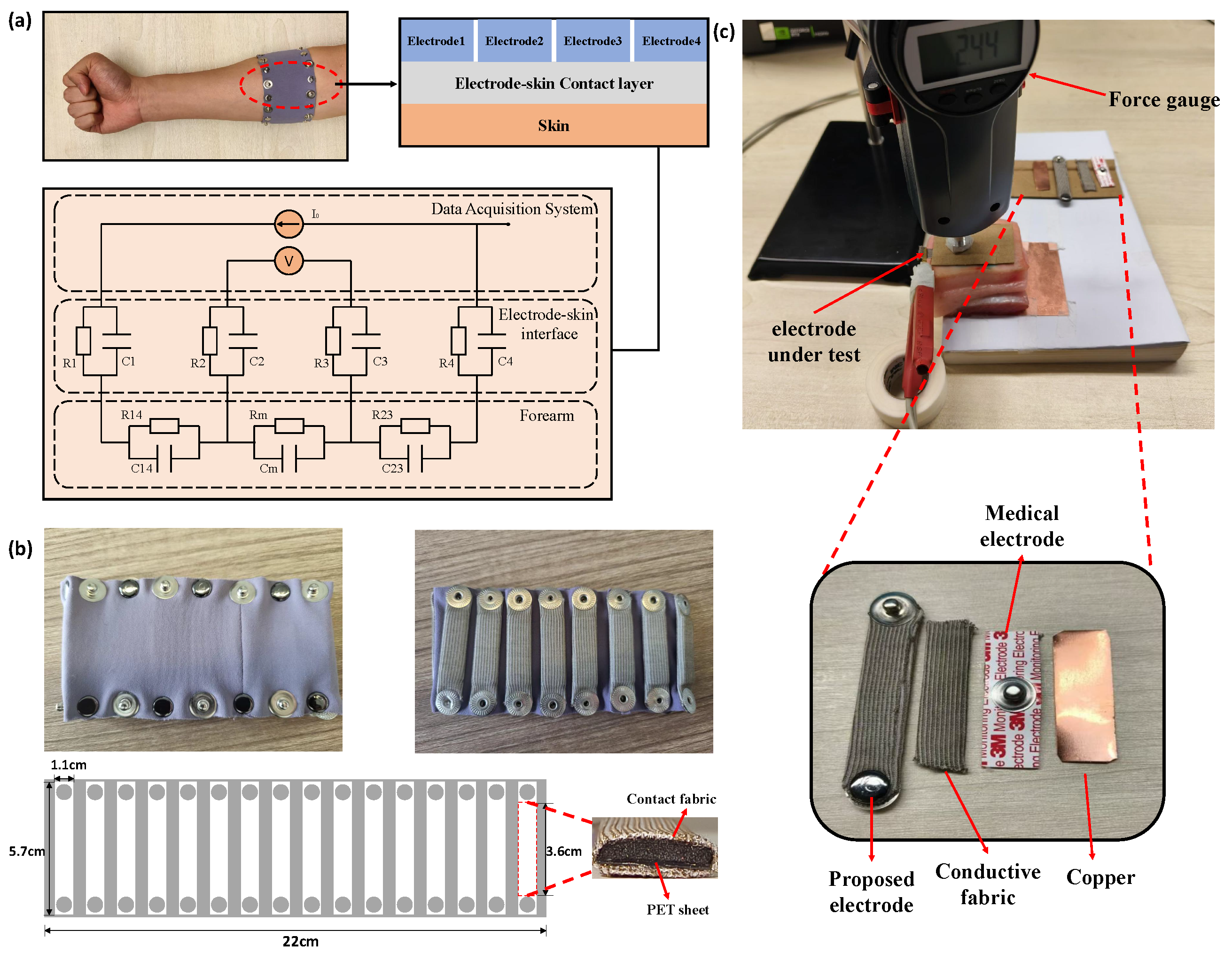
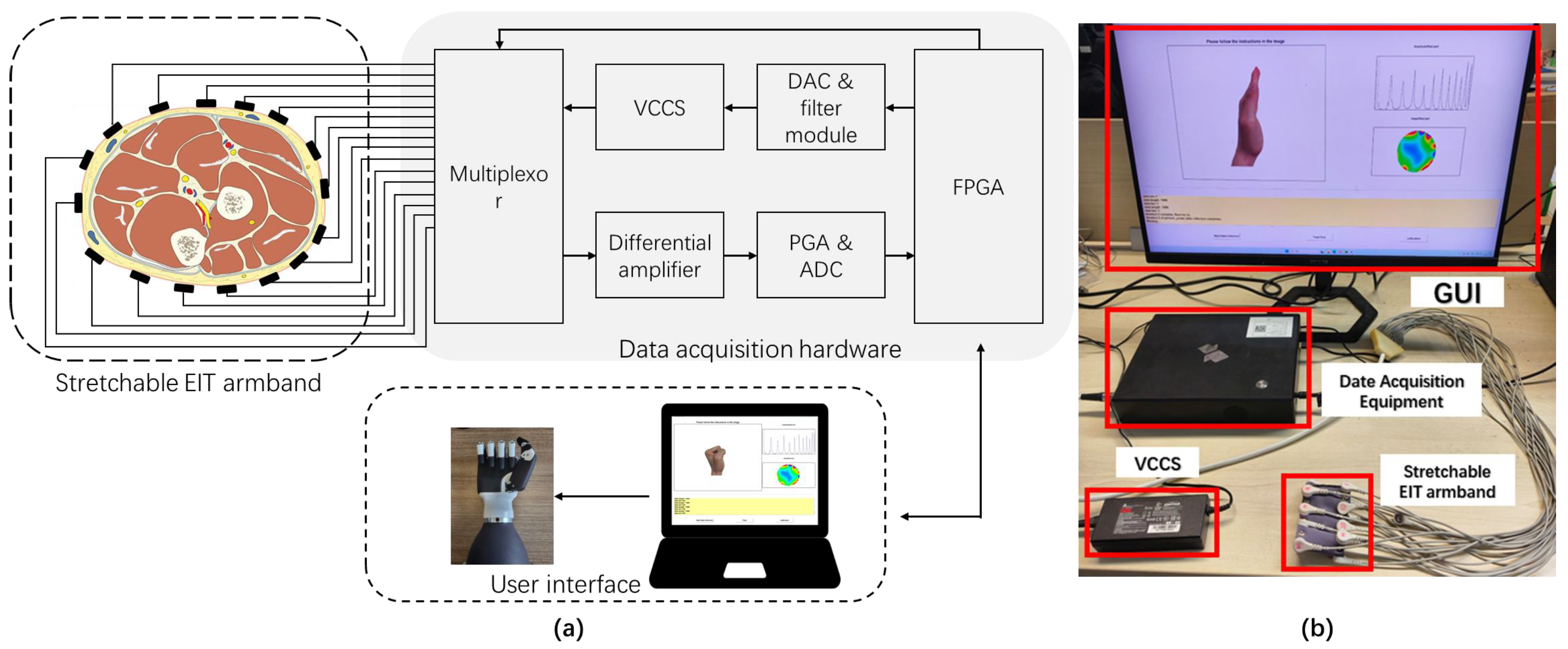
- A 16-channel stretchable EIT armband is developed for the acquisition of data for the forearm. The armband is made of elastic materials so that it can fit different participants. A novel structure is adopted in the design of the electrode, which maintains a steady electrode–skin interface to provide stable boundary voltage measurements.
- (2)
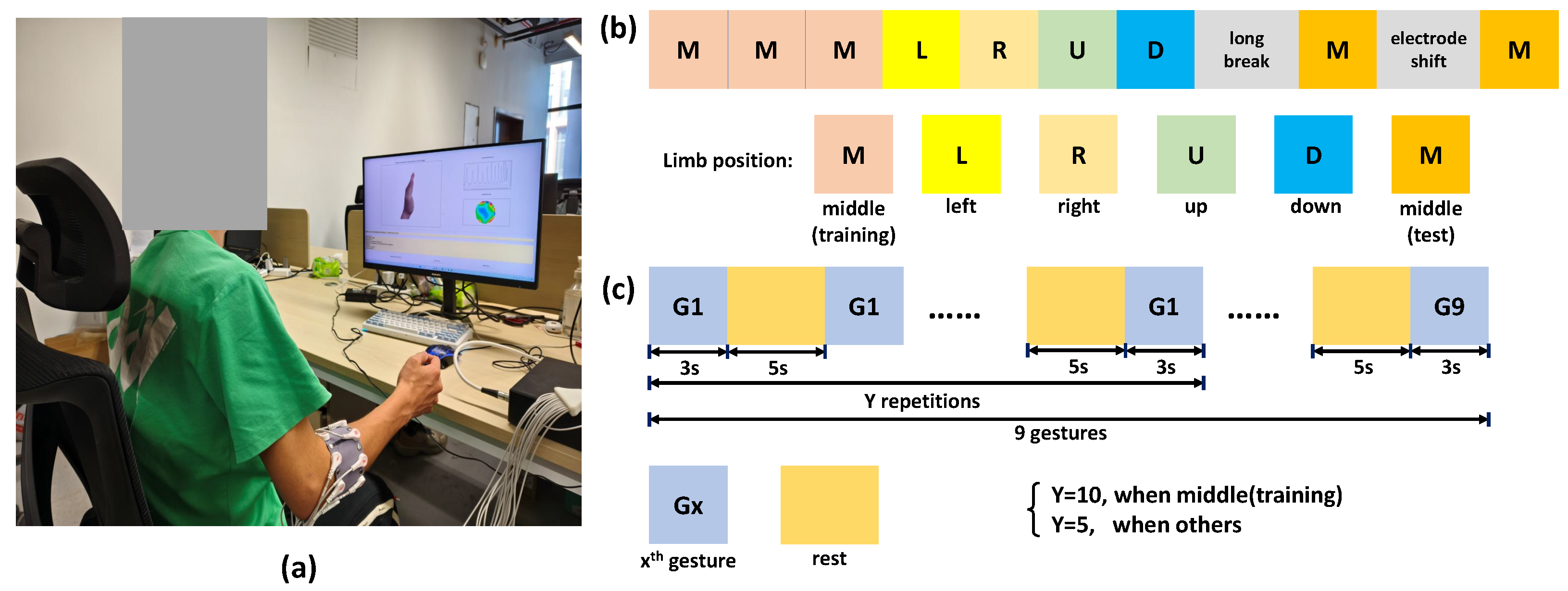
- A protocol is designed to develop an EIT dataset for gesture recognition under real-life settings. Three confounding factors for gesture recognition in daily life, including limb position interference, time interference and contact interference, are investigated. Both transient-state and steady-state data are collected, which provides additional information for model training.
- (3)
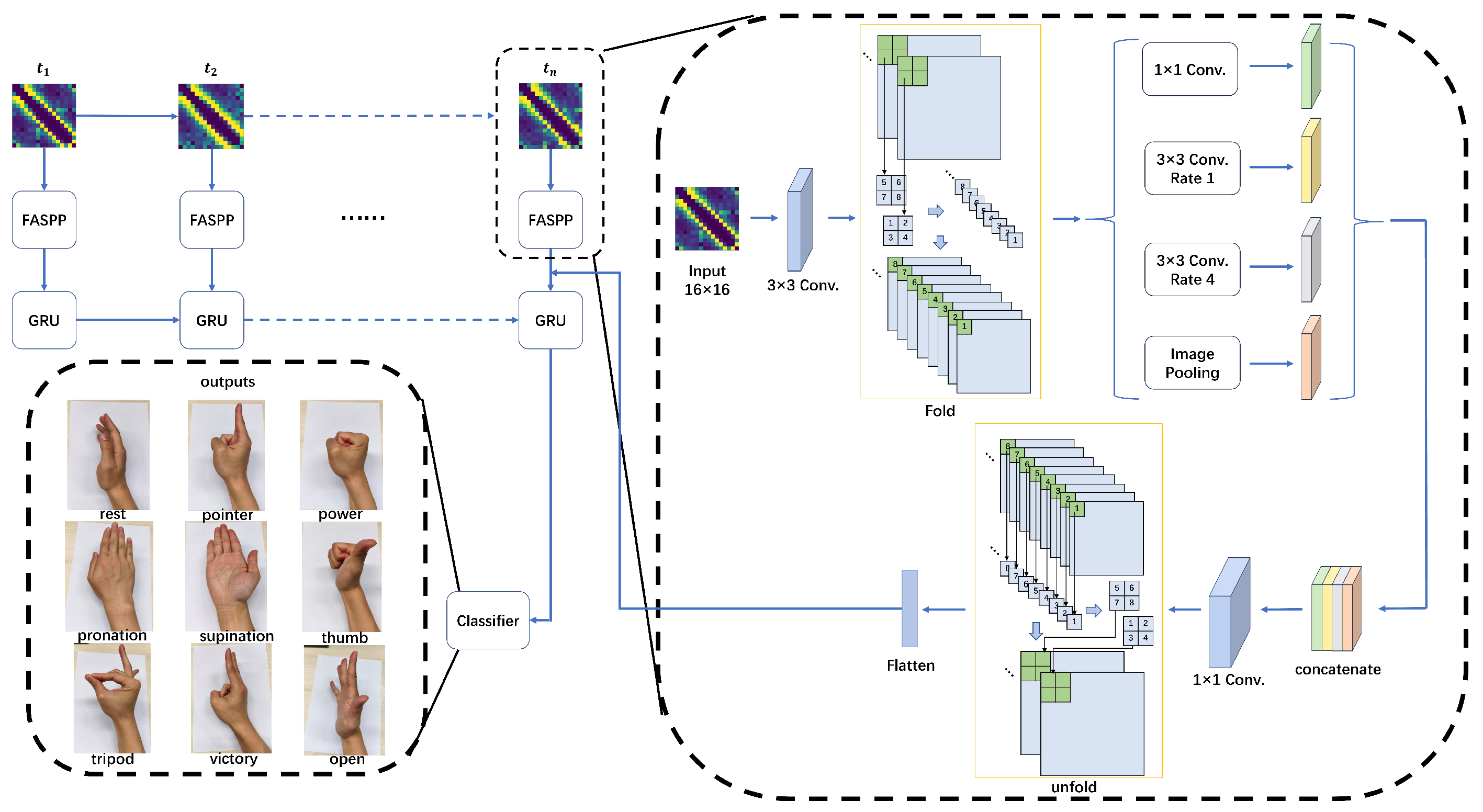
- A gesture recognition model, named FASPP-GRU, is proposed for high-accuracy gesture recognition under confounding factors. Spatial–temporal features from EIT measurements are extracted with the integration of an Atrous Spatial Pyramid Pooling (ASPP) module. Fold operation is applied to enhance the spatial correlation between sampling points and, thus, generates more stable features.
2. Methodology
2.1. Design of Stretchable EIT Armband
2.2. Design of EIT-Based Gesture Recognition System
2.3. EIT Image Reconstruction
2.4. FASPP-GRU Robust Gesture Classifier
2.5. Data Collection Protocol
2.6. Conventional Classifiers for EIT Gesture Recognition
2.7. Model Training
2.8. Evaluation Matrices
3. Results
3.1. Evaluation of the Electrode Performance
3.2. Analysis of the Impedance Pattern
3.3. Visualization of the Muscle Activities
3.4. Gesture Recognition Results
3.4.1. Overall Performance
3.4.2. Confusion Matrix
3.4.3. Analysis of the Limb Position Effect on Gesture Recognition
3.4.4. Performance Analysis
4. Discussions
5. Conclusions
Author Contributions
Funding
Institutional Review Board Statement
Informed Consent Statement
Data Availability Statement
Conflicts of Interest
References
- Islam, M.R.; Massicotte, D.; Massicotte, P.; Zhu, W.P. Surface EMG-based inter-session/inter-subject gesture recognition by leveraging lightweight all-ConvNet and transfer learning. IEEE Trans. Instrum. Meas. 2024, 73, 2514716. [Google Scholar] [CrossRef]
- Yang, P.; Liu, Z.; Qin, S.; Hu, J.; Yuan, S.; Wang, Z.L.; Chen, X. A wearable triboelectric impedance tomography system for noninvasive and dynamic imaging of biological tissues. Sci. Adv. 2024, 10, eadr9139. [Google Scholar] [CrossRef]
- Chadwell, A.; Kenney, L.; Granat, M.; Thies, S.; Head, J.; Galpin, A.; Baker, R.; Kulkarni, J. Upper limb activity in myoelectric prosthesis users is biased towards the intact limb and appears unrelated to goal-directed task performance. Sci. Rep. 2018, 8, 11084. [Google Scholar] [CrossRef]
- Marin-Pardo, O.; Laine, C.M.; Rennie, M.; Ito, K.L.; Finley, J.; Liew, S.L. A virtual reality muscle–computer interface for neurorehabilitation in chronic stroke: A pilot study. Sensors 2020, 20, 3754. [Google Scholar] [CrossRef]
- Woodward, R.B.; Hargrove, L.J. Adapting myoelectric control in real-time using a virtual environment. J. Neuroeng. Rehabil. 2019, 16, 11. [Google Scholar] [CrossRef]
- Oyedotun, O.K.; Khashman, A. Deep learning in vision-based static hand gesture recognition. Neural Comput. Appl. 2017, 28, 3941–3951. [Google Scholar] [CrossRef]
- Trigueiros, P.; Ribeiro, F.; Reis, L. Hand Gesture Recognition System Based in Computer Vision and Machine Learning; Springer: Cham, Switzerland, 2015. [Google Scholar]
- Chen, J.; Bi, S.; Zhang, G.; Cao, G. High-Density Surface EMG-Based Gesture Recognition Using a 3D Convolutional Neural Network. Sensors 2020, 20, 1201. [Google Scholar] [CrossRef]
- Qi, J.; Jiang, G.; Li, G.; Sun, Y.; Tao, B. Intelligent Human-Computer Interaction Based on Surface EMG Gesture Recognition. IEEE Access 2019, 7, 61378–61387. [Google Scholar] [CrossRef]
- Kim, M.; Cho, J.; Lee, S.; Jung, Y. IMU Sensor-Based Hand Gesture Recognition for Human-Machine Interfaces. Sensors 2019, 19, 3827. [Google Scholar] [CrossRef] [PubMed]
- Zhang, D.; Liao, Z.; Xie, W.; Wu, X.; Xie, H.; Xiao, J.; Jiang, L. Fine-Grained and Real-Time Gesture Recognition by Using IMU Sensors. IEEE Trans. Mob. Comput. 2023, 22, 2177–2189. [Google Scholar] [CrossRef]
- Gao, K.; Zhang, H.; Liu, X.; Wang, X.; Xie, L.; Ji, B.; Yan, Y.; Yin, E. Challenges and solutions for vision-based hand gesture interpretation: A review. Comput. Vis. Image Underst. 2024, 248, 104095. [Google Scholar] [CrossRef]
- Simon, A.M.; Turner, K.L.; Miller, L.A.; Potter, B.K.; Beachler, M.D.; Dumanian, G.A.; Hargrove, L.J.; Kuiken, T.A. User performance with a transradial multi-articulating hand prosthesis during pattern recognition and direct control home use. IEEE Trans. Neural Syst. Rehabil. Eng. 2022, 31, 271–281. [Google Scholar] [CrossRef]
- Campbell, E.; Phinyomark, A.; Scheme, E. Current trends and confounding factors in myoelectric control: Limb position and contraction intensity. Sensors 2020, 20, 1613. [Google Scholar] [CrossRef]
- Yang, Y.; Jia, J. An image reconstruction algorithm for electrical impedance tomography using adaptive group sparsity constraint. IEEE Trans. Instrum. Meas. 2017, 66, 2295–2305. [Google Scholar] [CrossRef]
- Yang, L.; Gao, Z.; Cao, X.; Sun, S.; Wang, C.; Wang, H.; Dai, J.; Liu, Y.; Qin, Y.; Dai, M.; et al. Electrical impedance tomography as a bedside assessment tool for COPD treatment during hospitalization. Front. Physiol. 2024, 15, 1352391. [Google Scholar] [CrossRef]
- Guo, Y.; Yang, C.; Zhu, W.; Zhao, R.; Ren, K.; Duan, W.; Liu, J.; Ma, J.; Chen, X.; Liu, B.; et al. Electrical impedance tomography provides information of brain injury during total aortic arch replacement through its correlation with relative difference of neurological biomarkers. Sci. Rep. 2024, 14, 14236. [Google Scholar] [CrossRef] [PubMed]
- Wu, Y.; Jiang, D.; Duan, J.; Liu, X.; Bayford, R.; Demosthenous, A. Towards a high accuracy wearable hand gesture recognition system using EIT. In Proceedings of the 2018 IEEE International Symposium on Circuits and Systems (ISCAS), Florence, Italy, 27–30 May 2018; pp. 1–4. [Google Scholar]
- Wu, Y.; Jiang, D.; Liu, X.; Bayford, R.; Demosthenous, A. A human–machine interface using electrical impedance tomography for hand prosthesis control. IEEE Trans. Biomed. Circuits Syst. 2018, 12, 1322–1333. [Google Scholar] [CrossRef]
- Yao, J.; Chen, H.; Xu, Z.; Huang, J.; Li, J.; Jia, J.; Wu, H. Development of a wearable electrical impedance tomographic sensor for gesture recognition with machine learning. IEEE J. Biomed. Health Inform. 2019, 24, 1550–1556. [Google Scholar] [CrossRef] [PubMed]
- Liebing, T.; Kähler, D.; Kern, T.A. Design of a miniaturized wearable EIT system for imaging and hand gesture recognition. Curr. Dir. Biomed. Eng. 2023, 9, 443–446. [Google Scholar] [CrossRef]
- Jiang, D.; Wu, Y.; Demosthenous, A. Hand gesture recognition using three-dimensional electrical impedance tomography. IEEE Trans. Circuits Syst. II Express Briefs 2020, 67, 1554–1558. [Google Scholar] [CrossRef]
- Chen, H.; Ma, G.; Wang, P.; Wang, X. A bio-impedance analysis method based on human hand anatomy for hand gesture recognition. IEEE Trans. Instrum. Meas. 2021, 70, 1–10. [Google Scholar] [CrossRef]
- Huynh, H.N.; Diep, Q.T.N.; Dinh, M.Q.C.; Tran, A.T.; Dang, N.C.; Phan, T.L.; Tran, T.N.; Ching, C.T.S. Machine learning-enhanced gesture recognition through impedance signal analysis. J. Electr. Bioimpedance 2024, 15, 63–74. [Google Scholar] [CrossRef] [PubMed]
- Ma, G.; Chen, H.; Wang, P.; Dong, S.; Wang, X. A two-electrode frequency-scan system for gesture recognition. Mechatronics 2023, 94, 103039. [Google Scholar] [CrossRef]
- Leins, D.P.; Gibas, C.; Brück, R.; Haschke, R. Toward more robust hand gesture recognition on EIT data. Front. Neurorobot. 2021, 15, 659311. [Google Scholar] [CrossRef]
- Nawaz, M.; Chan, R.W.; Malik, A.; Khan, T.; Cao, P. Hand gestures classification using electrical impedance tomography images. IEEE Sens. J. 2022, 22, 18922–18932. [Google Scholar] [CrossRef]
- Wang, S.; Zhang, T.; Yang, S.; Liu, R.; Li, B.; Wang, J.; Zhang, D.-W.; Zhao, Z. A Gesture Recognition System Using Electrical Impedance Tomography with Improved Electrode Layout and Classification Techniques. IEEE Trans. Instrum. Meas. 2025, 74, 2518911. [Google Scholar] [CrossRef]
- Kyu, A.; Mao, H.; Zhu, J.; Goel, M.; Ahuja, K. EITPose: Wearable and Practical Electrical Impedance Tomography for Continuous Hand Pose Estimation. In Proceedings of the CHI Conference on Human Factors in Computing Systems, Honolulu, HI, USA, 11–16 May 2024; pp. 1–10. [Google Scholar]
- Zhao, X.; Pang, Y.; Zhang, L.; Lu, H.; Zhang, L. Suppress and Balance: A Simple Gated Network for Salient Object Detection. In Proceedings of the Computer Vision–ECCV 2020, Glasgow, UK, 23 August 2020; pp. 35–51. [Google Scholar]
- Guo, G.; Wang, H.; Bell, D.; Bi, Y.; Greer, K. KNN Model-Based Approach in Classification; Springer: Berlin/Heidelberg, Germany, 2003; pp. 986–996. [Google Scholar]
- Schuldt, C.; Laptev, I.; Caputo, B. Recognizing human actions: A local SVM approach. In Proceedings of the 17th International Conference on Pattern Recognition, Cambridge, UK, 26 August 2004; Volume 3, pp. 32–36. [Google Scholar]
- López, L.I.B.; Ferri, F.M.; Zea, J.; Caraguay, Á.L.V.; Benalcázar, M.E. CNN-LSTM and post-processing for EMG-based hand gesture recognition. Intell. Syst. Appl. 2024, 22, 200352. [Google Scholar]
- Hahne, J.M.; Markovic, M.; Pardo, L.A.; Kusche, R.; Ryschka, M.; Schilling, A.F. On the Utility of Bioimpedance in the Context of Myoelectric Control. IEEE Sens. J. 2021, 21, 19505–19515. [Google Scholar] [CrossRef]




| Electrode Material | Contact Area/mm2 | Pressure and Impedance (Ω) | |||||
|---|---|---|---|---|---|---|---|
| 0 N | 2 N | 4 N | 6 N | 8 N | 10 N | ||
| Copper | 36 × 11 | 2404 ± 16 | 2118 ± 15 | 2007 ± 10 | 1925 ± 12 | 1852 ± 10 | 1779 ± 11 |
| 3M electrode | 36 × 11 | 957 ± 14 | 912 ± 14 | 913 ± 16 | 898 ± 12 | 893 ± 10 | 897 ± 14 |
| Conductive fabric | 36 × 11 | 802 ± 10 | 508 ± 5 | 466 ± 5 | 444 ± 3 | 429 ± 3 | 414 ± 2 |
| Proposed electrode | 36 × 11 | 615 ± 8 | 520 ± 3 | 495 ± 3 | 483 ± 5 | 471 ± 4 | 461 ± 3 |
Disclaimer/Publisher’s Note: The statements, opinions and data contained in all publications are solely those of the individual author(s) and contributor(s) and not of MDPI and/or the editor(s). MDPI and/or the editor(s) disclaim responsibility for any injury to people or property resulting from any ideas, methods, instructions or products referred to in the content. |
© 2026 by the authors. Licensee MDPI, Basel, Switzerland. This article is an open access article distributed under the terms and conditions of the Creative Commons Attribution (CC BY) license.
Share and Cite
Wu, H.; Huang, G.; Wang, W.; Wen, Y. A Deep Learning-Based EIT System for Robust Gesture Recognition Under Confounding Factors. Biosensors 2026, 16, 200. https://doi.org/10.3390/bios16040200
Wu H, Huang G, Wang W, Wen Y. A Deep Learning-Based EIT System for Robust Gesture Recognition Under Confounding Factors. Biosensors. 2026; 16(4):200. https://doi.org/10.3390/bios16040200
Chicago/Turabian StyleWu, Hancong, Guanghong Huang, Wentao Wang, and Yuan Wen. 2026. "A Deep Learning-Based EIT System for Robust Gesture Recognition Under Confounding Factors" Biosensors 16, no. 4: 200. https://doi.org/10.3390/bios16040200
APA StyleWu, H., Huang, G., Wang, W., & Wen, Y. (2026). A Deep Learning-Based EIT System for Robust Gesture Recognition Under Confounding Factors. Biosensors, 16(4), 200. https://doi.org/10.3390/bios16040200