Recent Advances in Metal–Organic Framework-Based Nanozymes for Enhanced Biosensing Applications


Abstract
1. Introduction

| MOF-Based Nanozymes [14,15,16,17,18,30] | Carbon-Based Nanozymes [31,32,33] | Metal Nanozymes [34,35,36] | |
|---|---|---|---|
| Material composition | Metal ions/clusters and organic ligands form porous crystalline structures through coordination bonds. | Carbon materials, such as fullerenes, graphene and carbon quantum dots. | Precious metals (Au, Pt), transition metals (Fe, Co), and metal oxides (Fe3O4, CeO2). |
| Structural designability | The structure of MOFs exhibits exceptional designability. By varying the types of metal nodes (single or bimetallic) and organic linkers, precise control over their pore size, surface chemistry, and active sites can be achieved. | The structure can be varied, with the electronic structure being tunable via the addition of heteroatoms (e.g., N, S). | These materials generally exist as nanoparticles with simple architectures, enabling property modulation through precise control of their dimensions and shapes. |
| Catalytic performance | The most abundant sources of activity include intrinsic activity (metallic nodes/unsaturated sites), encapsulated/composite activity (loaded metal nanoparticles or native enzymes), and derived material activity (highly reactive carbonaceous or metallic compounds formed via pyrolysis). | The catalytic activity of these surfaces is understood to originate from surface defects, edge effects, and dopant sites. The type and density of surface functional groups have been demonstrated to be pivotal in determining catalytic activity. | While certain single-atom metal nano-enzymes have been demonstrated to exhibit catalytic activity that approaches that of natural enzymes, their substrate selectivity remains comparatively poor. |
| Major limitations | Catalytic activity is significantly affected by pH, and electrical conductivity is poor. | The regulation of catalytic activity is challenging, and the density of active sites is relatively low. | The inherent tendency towards aggregation, metal ion leakage, relatively high cost (due to the use of precious metals), poor selectivity and limited functionality are significant drawbacks. |
2. Classification of Representative MOF-Based Nanozymes
2.1. Peroxidases
2.2. Oxidases
2.3. Catalases
2.4. Superoxide Dismutase
2.5. Hydrolysis Enzymes
2.6. Multi-Enzyme Assembly
3. Synthesis of MOF-Based Nanozymes
3.1. Direct Synthesis
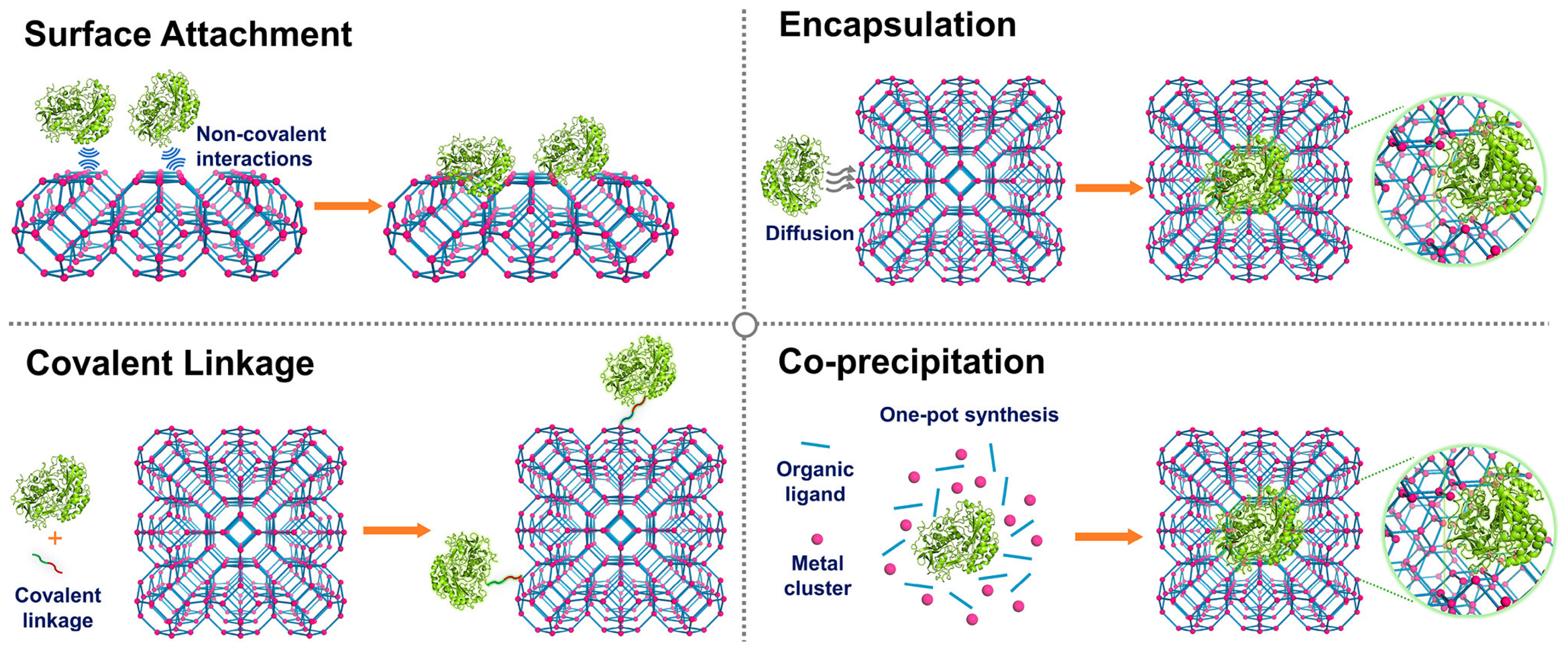
3.2. Co-Precipitation
3.3. Post-Synthetic Modification
3.4. Pyrolysis Synthesis
4. Sensing Applications of MOF-Based Nanozymes
4.1. Biomarker Detection
4.2. Bacterial Detection
4.3. Virus Detection
4.4. Mycotoxins and Antibiotics Detection
4.5. Pesticide Residues Detection
5. Summary and Prospects
Author Contributions
Funding
Institutional Review Board Statement
Informed Consent Statement
Data Availability Statement
Conflicts of Interest
References
- Sharma, A.; Gupta, G.; Ahmad, T.; Mansoor, S.; Kaur, B. Enzyme Engineering: Current Trends and Future Perspectives. Food Rev. Int. 2019, 37, 121–154. [Google Scholar] [CrossRef]
- Rodrigues, R.C.; Ortiz, C.; Berenguer-Murcia, Á.; Torres, R.; Fernández-Lafuente, R. Modifying enzyme activity and selectivity by immobilization. Chem. Soc. Rev. 2013, 42, 6290–6307. [Google Scholar] [CrossRef] [PubMed]
- Cao, Y.; Ge, J. Hybrid enzyme catalysts synthesized by a de novo approach for expanding biocatalysis. Chin. J. Catal. 2021, 42, 1625–1633. [Google Scholar] [CrossRef]
- Wu, J.; Wang, X.; Wang, Q.; Lou, Z.; Li, S.; Zhu, Y.; Qin, L.; Wei, H. Nanomaterials with enzyme-like characteristics (nanozymes): Next-generation artificial enzymes (II). Chem. Soc. Rev. 2019, 48, 1004–1076. [Google Scholar] [CrossRef]
- Huang, Y.; Ren, J.; Qu, X. Nanozymes: Classification, Catalytic Mechanisms, Activity Regulation, and Applications. Chem. Rev. 2019, 119, 4357–4412. [Google Scholar] [CrossRef]
- Zhang, Y.; Wei, G.; Liu, W.; Li, T.; Wang, Y.; Zhou, M.; Liu, Y.; Wang, X.; Wei, H. Nanozymes for nanohealthcare. Nat. Rev. Methods Prim. 2024, 4, 36. [Google Scholar] [CrossRef]
- Ma, L.; Jiang, F.; Fan, X.; Wang, L.; He, C.; Zhou, M.; Li, S.; Luo, H.; Cheng, C.; Qiu, L. Metal–Organic-Framework-Engineered Enzyme-Mimetic Catalysts. Adv. Mater. 2020, 32, e2003065. [Google Scholar] [CrossRef]
- Wei, H.; Wang, E. Nanomaterials with enzyme-like characteristics (nanozymes): Next-generation artificial enzymes. Chem. Soc. Rev. 2013, 42, 6060–6093. [Google Scholar] [CrossRef]
- Gao, L.; Zhuang, J.; Nie, L.; Zhang, J.; Zhang, Y.; Gu, N.; Wang, T.; Feng, J.; Yang, D.; Perrett, S.; et al. Intrinsic peroxidase-like activity of ferromagnetic nanoparticles. Nat. Nanotechnol. 2007, 2, 577–583. [Google Scholar] [CrossRef]
- Dong, H.; Du, W.; Dong, J.; Che, R.; Kong, F.; Cheng, W.; Ma, M.; Gu, N.; Zhang, Y. Depletable peroxidase-like activity of Fe3O4 nanozymes accompanied with separate migration of electrons and iron ions. Nat. Commun. 2022, 13, 5365. [Google Scholar] [CrossRef] [PubMed]
- Huang, Y.; Gu, Y.; Liu, X.; Deng, T.; Dai, S.; Qu, J.; Yang, G.; Qu, L. Reusable ring-like Fe3O4/Au nanozymes with enhanced peroxidase-like activities for colorimetric-SERS dual-mode sensing of biomolecules in human blood. Biosens. Bioelectron. 2022, 209, 114253. [Google Scholar] [CrossRef]
- Guo, N.; Yang, J.; Li, Y.; Wang, W.; Liang, X.; Xu, Q.; Du, L.; Qin, J. A review of a colorimetric biosensor based on Fe3O4 nanozymes for food safety detection. Anal. Bioanal. Chem. 2024, 417, 1713–1730. [Google Scholar] [CrossRef]
- Li, X.; Wu, X.; Xu, Q.; Zhu, Q. Hierarchically Ordered Pore Engineering of Metal–Organic Framework-Based Materials for Electrocatalysis. Adv. Mater. 2024, 36, e2401926. [Google Scholar] [CrossRef] [PubMed]
- Furukawa, H.; Cordova, K.E.; O’Keeffe, M.; Yaghi, O.M. The Chemistry and Applications of Metal-Organic Frameworks. Science 2013, 341, 1230444. [Google Scholar] [CrossRef] [PubMed]
- Wu, M.; Yang, Y. Metal–Organic Framework (MOF)-Based Drug/Cargo Delivery and Cancer Therapy. Adv. Mater. 2017, 29, 1606134. [Google Scholar] [CrossRef]
- Li, S.; Liu, X.; Chai, H.; Huang, Y. Recent advances in the construction and analytical applications of metal-organic frameworks-based nanozymes. TrAC Trends Anal. Chem. 2018, 105, 391–403. [Google Scholar] [CrossRef]
- Zhang, X.; Li, G.; Wu, D.; Li, X.; Hu, N.; Chen, J.; Chen, G.; Wu, Y. Recent progress in the design fabrication of metal-organic frameworks-based nanozymes and their applications to sensing and cancer therapy. Biosens. Bioelectron. 2019, 137, 178–198. [Google Scholar] [CrossRef] [PubMed]
- Wang, Y.; Yang, Y.; Liu, J.; Zi, X.; Zhu, H.; Sun, X.; Miao, Y.; Fu, Y. Revolutionizing nanozyme technology with metal-organic frameworks: Classification, catalytic mechanisms, regulation and applications in biotechnology. Chem. Eng. J. 2024, 500, 156850. [Google Scholar] [CrossRef]
- Xu, W.; Wu, Y.; Jiao, L.; Gu, W.; Du, D.; Lin, Y.; Zhu, C. Engineering Metal-Organic Framework-based Nanozymes for Enhanced Biosensing. Curr. Anal. Chem. 2022, 18, 739–752. [Google Scholar] [CrossRef]
- Mussa, N.-S.; Toshtay, K.; Dumeignil, F. Recent developments in the field of MOF-based catalytic systems: A review. Appl. Catal. A Gen. 2025, 708, 120555. [Google Scholar] [CrossRef]
- Xu, X.; Wan, J.; Sun, J.; Wu, L.; Lei, J. Tailored Metal-Organic Framework-Based Enzyme Hybrids: Immobilization Strategies, Improved Performance, and Biological Applications. Small Sci. 2025, 5, 2500222. [Google Scholar] [CrossRef]
- Kim, M.; Yi, J.; Park, S.H.; Park, S.S. Heterogenization of Molecular Electrocatalytic Active Sites through Reticular Chemistry. Adv. Mater. 2022, 35, 2203791. [Google Scholar] [CrossRef] [PubMed]
- Zhu, R.; Liu, L.; Zhang, G.; Zhang, Y.; Jiang, Y.; Pang, H. Advances in electrochemistry of intrinsic conductive metal-organic frameworks and their composites: Mechanisms, synthesis and applications. Nano Energy 2024, 122, 109333. [Google Scholar] [CrossRef]
- Xie, L.S.; Skorupskii, G.; Dincă, M. Electrically Conductive Metal–Organic Frameworks. Chem. Rev. 2020, 120, 8536–8580. [Google Scholar] [CrossRef]
- Song, J.; Ji, L.; Chen, J.; Rao, L.; Hu, J.; Li, X.-G.; Ma, J. Recent development and electrochemical applications of conductive MOFs with proton, electron, and ion transfer. Coord. Chem. Rev. 2026, 549, 217271. [Google Scholar] [CrossRef]
- Diao, B.; Cong, C.; Sun, F.; Li, H.; Zhang, H.; Wang, X.; Jin, M.; Lim, S.; Li, X.; Kim, S.H. Printed flexible supercapacitors utilizing composites of MWCNT/MOF ultrathin nanosheets: Exploring 1D/2D structural adjustment. Chem. Eng. J. 2024, 500, 156993. [Google Scholar] [CrossRef]
- Feng, K.; Wang, G.; Wang, S.; Ma, J.; Wu, H.; Ma, M.; Zhang, Y. Breaking the pH Limitation of Nanozymes: Mechanisms, Methods, and Applications. Adv. Mater. 2024, 36, e2401619. [Google Scholar] [CrossRef]
- Li, T.; Wang, X.; Wang, Y.; Zhang, Y.; Li, S.; Liu, W.; Liu, S.; Liu, Y.; Xing, H.; Otake, K.-I.; et al. Microenvironmental modulation breaks intrinsic pH limitations of nanozymes to boost their activities. Nat. Commun. 2024, 15, 10861. [Google Scholar] [CrossRef]
- Hu, Z.; Sun, X.; Sun, Y.; Dong, Y.; Wang, G.L. Histidine-Induced Cu(II) Coordination Distortion in Cu-MOF: A Groundbreaking Strategy to Revolutionize Nanozyme Catalytic Mechanisms and Break pH Limitations. Adv. Funct. Mater. 2025, 35, e10837. [Google Scholar] [CrossRef]
- Jacob, E.; Mathew, D.; Benny, L.; Varghese, A. Emerging Nanomaterials as Versatile Nanozymes: A New Dimension in Biomedical Research. Top. Curr. Chem. 2024, 382, 28. [Google Scholar] [CrossRef] [PubMed]
- Sun, Y.; Xu, B.; Pan, X.; Wang, H.; Wu, Q.; Li, S.; Jiang, B.; Liu, H. Carbon-based nanozymes: Design, catalytic mechanism, and bioapplication. Coord. Chem. Rev. 2023, 475, 214896. [Google Scholar] [CrossRef]
- Ye, H.; Lai, Y.; Wu, Z.; Li, G.; Hua, Q.; Zhu, W. Carbon-based nanozymes: Catalytic mechanisms, performance tuning, and environmental and biomedical applications. Anal. Methods 2025, 17, 6264–6281. [Google Scholar] [CrossRef]
- Ding, H.; Hu, B.; Zhang, B.; Zhang, H.; Yan, X.; Nie, G.; Liang, M. Carbon-based nanozymes for biomedical applications. Nano Res. 2020, 14, 570–583. [Google Scholar] [CrossRef]
- Qin, J.; Guo, N.; Yang, J.; Wei, J. Recent advances in metal oxide nanozyme-based optical biosensors for food safety assays. Food Chem. 2024, 447, 139019. [Google Scholar] [CrossRef]
- Liu, Q.; Zhang, A.; Wang, R.; Zhang, Q.; Cui, D. A Review on Metal- and Metal Oxide-Based Nanozymes: Properties, Mechanisms, and Applications. Nano-Micro Lett. 2021, 13, 154. [Google Scholar] [CrossRef] [PubMed]
- Fu, Q.; Wei, C.; Wang, M. Transition-Metal-Based Nanozymes: Synthesis, Mechanisms of Therapeutic Action, and Applications in Cancer Treatment. ACS Nano 2024, 18, 12049–12095. [Google Scholar] [CrossRef] [PubMed]
- Wang, M.; Zhang, H.; Yan, S.; Zhou, Y.; Guo, X.; An, D.; Zhong, W.; Zhang, Y. Fabrication of MOF-based Nanozyme sensor arrays and their application in disease diagnosis. Coord. Chem. Rev. 2025, 532, 216506. [Google Scholar] [CrossRef]
- Ding, S.-S.; He, L.; Bian, X.-W.; Tian, G. Metal-organic frameworks-based nanozymes for combined cancer therapy. Nano Today 2020, 35, 100920. [Google Scholar] [CrossRef]
- Ling, P.-H.; Zang, X.-N.; Qian, C.-H.; Gao, F. A metal–organic framework with multienzyme activity as a biosensing platform for real-time electrochemical detection of nitric oxide and hydrogen peroxide. Analyst 2021, 146, 2609–2616. [Google Scholar] [CrossRef]
- Xia, Q.; Wang, H.; Huang, B.; Yuan, X.; Zhang, J.; Zhang, J.; Jiang, L.; Xiong, T.; Zeng, G. State-of-the-Art Advances and Challenges of Iron-Based Metal Organic Frameworks from Attractive Features, Synthesis to Multifunctional Applications. Small 2018, 15, e1803088. [Google Scholar] [CrossRef]
- Wang, X.; Xu, M.; Fan, W.; Sun, D. Fe-Based Metal-Organic Frameworks: From Various Synthesis, Diverse Structures to Multifunctional Applications. Chin. J. Chem. 2023, 41, 3772–3791. [Google Scholar] [CrossRef]
- Huang, X.; Zhang, S.; Tang, Y.; Zhang, X.; Bai, Y.; Pang, H. Advances in metal–organic framework-based nanozymes and their applications. Coord. Chem. Rev. 2021, 449, 214216. [Google Scholar] [CrossRef]
- Mishra, S.R.; Chavda, V.; Roy, S.; Rawat, S.; Panda, S.; Sarkar, N.; Pasha, S.K.; Ahmaruzzaman, M.; Nagaraja, B.M. Zirconium-based metal-organic frameworks and nanocomposites: Structure-Function correlations in electrochemical applications. Mater. Today Nano 2025, 31, 100665. [Google Scholar] [CrossRef]
- Wu, Q.; Zheng, G.; Li, L.; Wang, L. Enhancing Peroxidase-Like Activity and Photothermal Property of Copper Single-Atom Nanozyme via A Cascade Competition Strategy. Adv. Funct. Mater. 2025, 35, 2422588. [Google Scholar] [CrossRef]
- Wang, D.; Wang, J.; Gao, X.J.; Ding, H.; Yang, M.; He, Z.; Xie, J.; Zhang, Z.; Huang, H.; Nie, G.; et al. Employing Noble Metal–Porphyrins to Engineer Robust and Highly Active Single-Atom Nanozymes for Targeted Catalytic Therapy in Nasopharyngeal Carcinoma. Adv. Mater. 2023, 36, e2310033. [Google Scholar] [CrossRef]
- Wang, X.; Hu, W.; Xia, X.; Wang, C. Implanting of Single Zinc Sites into 2D Metal–Organic Framework Nanozymes for Boosted Antibiofilm Therapy. Adv. Funct. Mater. 2022, 33, 2212798. [Google Scholar] [CrossRef]
- Liu, J.; Wang, Y.; He, M.; Gao, Y.; Pan, Q.; Li, J. Cerium-based metal–organic framework nanozyme with high oxidase-like activity at neutral pH for discrimination and detection of antioxidants. Biosens. Bioelectron. 2025, 285, 117608. [Google Scholar] [CrossRef]
- Yang, B.; Yao, H.; Yang, J.; Chen, C.; Shi, J. Construction of a two-dimensional artificial antioxidase for nanocatalytic rheumatoid arthritis treatment. Nat. Commun. 2022, 13, 1988. [Google Scholar] [CrossRef]
- Yuan, X.; Xiong, J.; Wu, X.; Ta, N.; Liu, S.; Li, Z.; Lou, W.-Y. Ultrasmall Ce-based metal–organic frameworks nanozyme with hydrolytic activity for boosting antibiofilm therapy. Chem. Eng. J. 2024, 480, 148246. [Google Scholar]
- Feng, M.; Li, X.; Zhang, X.; Huang, Y. Recent advances in the development and analytical applications of oxidase-like nanozymes. TrAC Trends Anal. Chem. 2023, 166, 117220. [Google Scholar] [CrossRef]
- Wang, Z.; Li, H.; Jiang, C.; Liu, W.; Zhang, S.; Zhou, Y.; Liu, K.; Xiao, Y.; Hou, R.; Wan, X.; et al. Mn-modified porphyrin metal–organic framework mediated colorimetric and photothermal dual-channel probe for sensitive detection of organophosphorus pesticides. J. Colloid Interface Sci. 2024, 661, 1060–1069. [Google Scholar] [CrossRef]
- Zhang, Y.; Zeng, X.; Jiang, X.; Chen, H.; Long, Z. Ce-based UiO-66 metal-organic frameworks as a new redox catalyst for atomic spectrometric determination of Se(VI) and colorimetric sensing of Hg(II). Microchem. J. 2019, 149, 103967. [Google Scholar] [CrossRef]
- Ren, M.; Zhang, Y.; Yu, L.; Qu, L.; Li, Z.; Zhang, L. A Co-based MOF as nanozyme with enhanced oxidase-like activity for highly sensitive and selective colorimetric differentiation of aminophenol isomers. Talanta 2023, 255, 124219. [Google Scholar]
- Xu, D.; Wu, L.; Yao, H.; Zhao, L. Catalase-Like Nanozymes: Classification, Catalytic Mechanisms, and Their Applications. Small 2022, 18, e2203400. [Google Scholar] [CrossRef]
- Abdelhamid, H.N.; Sharmoukh, W. Intrinsic catalase-mimicking MOFzyme for sensitive detection of hydrogen peroxide and ferric ions. Microchem. J. 2021, 163, 105873. [Google Scholar] [CrossRef]
- Han, Z.; Fu, Q.; Lv, Y.; Wang, N.; Su, X. A two-dimensional iron-doped carbon-based nanoenzyme with catalase-like activity for the detection of alkaline phosphatase and ascorbate oxidase. Talanta 2024, 272, 125704. [Google Scholar] [CrossRef]
- Zhao, H.; Zhang, R.; Yan, X.; Fan, K. Superoxide dismutase nanozymes: An emerging star for anti-oxidation. J. Mater. Chem. B 2021, 9, 6939–6957. [Google Scholar] [CrossRef]
- Chen, Y.; Li, B.; Li, K.; Lin, Y. Superoxide dismutase nanozymes: Current status and future perspectives on brain disease treatment and diagnosis. Chem. Commun. 2024, 60, 4140–4147. [Google Scholar] [CrossRef]
- Liu, Y.; Li, H.; Liu, W.; Guo, J.; Yang, H.; Tang, H.; Tian, M.; Nie, H.; Zhang, X.; Long, W. Design of Monovalent Cerium-Based Metal Organic Frameworks as Bioinspired Superoxide Dismutase Mimics for Ionizing Radiation Protection. ACS Appl. Mater. Interfaces 2022, 14, 54587–54597. [Google Scholar] [CrossRef]
- Nakahara, H.; Nomura, A.; Tokuda, S.; Okamura, M.; Fujisawa, K.; Koitaya, T.; Yoshida, Y.; Furukawa, S.; Hitomi, Y. Superoxide Dismutase-like Activity of Zeolitic Imidazolate Framework Nanoparticles Comprising Biomimetic Imidazolato-bridged CuZn Units. Chem.–Eur. J. 2023, 29, e202300881. [Google Scholar] [CrossRef]
- Wang, J.; Zhao, Y.; Peng, R.; Wang, Y.; Zhang, J.; Zhu, X.; Kang, H.; Guo, C.; Mao, Y.; Kim, J.; et al. When enzyme meet MOFs: Emerging opportunities toward water treatment. Chem. Eng. J. 2023, 466, 142993. [Google Scholar] [CrossRef]
- Chen, T.; Lu, Y.; Xiong, X.; Qiu, M.; Peng, Y.; Xu, Z. Hydrolytic nanozymes: Preparation, properties, and applications. Adv. Colloid Interface Sci. 2024, 323, 103072. [Google Scholar] [CrossRef]
- Patil, P.D.; Gargate, N.; Tiwari, M.S.; Nadar, S.S. Compartmentalization of multi-enzymes within designable metal-organic frameworks (MOF): A review of systematic approaches. Int. J. Biol. Macromol. 2025, 328, 147317. [Google Scholar] [CrossRef]
- Sheng, J.; Wu, Y.; Ding, H.; Feng, K.; Shen, Y.; Zhang, Y.; Gu, N. Multienzyme-Like Nanozymes: Regulation, Rational Design, and Application. Adv. Mater. 2023, 36, 2211210. [Google Scholar] [CrossRef]
- Man, T.; Xu, C.; Liu, X.-Y.; Li, D.; Tsung, C.-K.; Pei, H.; Wan, Y.; Li, L. Hierarchically encapsulating enzymes with multi-shelled metal-organic frameworks for tandem biocatalytic reactions. Nat. Commun. 2022, 13, 305. [Google Scholar] [CrossRef]
- Fan, W.; Yu, Z.; Appadoo, D.; Liang, K.; Liang, J. Enhancing Multi-Enzyme Cascade Activity in Metal-Organic Frameworks via Controlled Enzyme Encapsulation. Small 2025, 21, e2503059. [Google Scholar] [CrossRef]
- Chandio, I.; Ai, Y.; Wu, L.; Liang, Q. Recent progress in MOFs-based nanozymes for biosensing. Nano Res. 2023, 17, 39–64. [Google Scholar] [CrossRef]
- Niu, X.; Li, X.; Lyu, Z.; Pan, J.; Ding, S.; Ruan, X.; Zhu, W.; Du, D.; Lin, Y. Metal–organic framework based nanozymes: Promising materials for biochemical analysis. Chem. Commun. 2020, 56, 11338–11353. [Google Scholar] [CrossRef]
- Shu, Y.; Ye, Q.; Tan, J.; Lv, H.; Liu, Z.; Mo, Q. Metalloporphyrin-Based Metal–Organic Framework Nanorods for Peroxidase-Like Catalysis. ACS Appl. Nano Mater. 2022, 5, 17909–17918. [Google Scholar] [CrossRef]
- Wang, J.; Zhou, Y.; Zeng, M.; Zhao, Y.; Zuo, X.; Meng, F.; Lv, F.; Lu, Y. Zr(IV)-based metal-organic framework nanocomposites with enhanced peroxidase-like activity as a colorimetric sensing platform for sensitive detection of hydrogen peroxide and phenol. Environ. Res. 2022, 203, 111818. [Google Scholar]
- Han, M.; Ren, M.; Li, Z.; Qu, L.; Yu, L. A two-dimensional thin Co-MOF nanosheet as a nanozyme with high oxidase-like activity for GSH detection. New J. Chem. 2022, 46, 10682–10689. [Google Scholar] [CrossRef]
- Mao, Z.; Chen, J.; Wang, Y.; Xia, J.; Zhang, Y.; Zhang, W.; Zhu, H.; Hu, X.; Chen, H. Copper metal organic framework as natural oxidase mimic for effective killing of Gram-negative and Gram-positive bacteria. Nanoscale 2022, 14, 9474–9484. [Google Scholar] [CrossRef]
- Zandieh, M.; Liu, J. Surface Science of Nanozymes and Defining a Nanozyme Unit. Langmuir 2022, 38, 3617–3622. [Google Scholar] [CrossRef]
- Xia, Y.; Zhou, J.; Liu, Y.; Liu, Y.; Huang, K.; Yu, H.; Jiang, X.; Xiong, X. Microplasma-assisted synthesis of a mixed-valence Ce-MOF with enhanced oxidase-like activity for colorimetric sensing of dopamine. Analyst 2022, 147, 5355–5362. [Google Scholar] [CrossRef]
- Wu, X.; Yue, H.; Zhang, Y.; Gao, X.; Li, X.; Wang, L.; Cao, Y.; Hou, M.; An, H.; Zhang, L.; et al. Packaging and delivering enzymes by amorphous metal-organic frameworks. Nat. Commun. 2019, 10, 5165. [Google Scholar] [CrossRef]
- Jiang, D.; Ni, D.; Rosenkrans, Z.T.; Huang, P.; Yan, X.; Cai, W. Nanozyme: New horizons for responsive biomedical applications. Chem. Soc. Rev. 2019, 48, 3683–3704. [Google Scholar] [CrossRef]
- Wang, D.; Zhao, Y. Single-atom engineering of metal-organic frameworks toward healthcare. Chem 2021, 7, 2635–2671. [Google Scholar] [CrossRef]
- Wu, T.; Huang, S.; Yang, H.; Ye, N.; Tong, L.; Chen, G.; Zhou, Q.; Ouyang, G. Bimetal Biomimetic Engineering Utilizing Metal–Organic Frameworks for Superoxide Dismutase Mimic. ACS Mater. Lett. 2022, 4, 751–757. [Google Scholar] [CrossRef]
- Li, L.; Li, H.; Shi, L.; Shi, L.; Li, T. Tin Porphyrin-Based Nanozymes with Unprecedented Superoxide Dismutase-Mimicking Activities. Langmuir 2022, 38, 7272–7279. [Google Scholar] [CrossRef]
- Li, S.; Zhou, Z.; Tie, Z.; Wang, B.; Ye, M.; Du, L.; Cui, R.; Liu, W.; Wan, C.; Liu, Q.; et al. Data-informed discovery of hydrolytic nanozymes. Nat. Commun. 2022, 13, 827. [Google Scholar] [CrossRef]
- Dai, S.; Simms, C.; Dovgaliuk, I.; Patriarche, G.; Tissot, A.; Parac-Vogt, T.N.; Serre, C. Monodispersed MOF-808 Nanocrystals Synthesized via a Scalable Room-Temperature Approach for Efficient Heterogeneous Peptide Bond Hydrolysis. Chem. Mater. 2021, 33, 7057–7066. [Google Scholar] [CrossRef]
- Ly, H.G.T.; Fu, G.; Kondinski, A.; Bueken, B.; De Vos, D.; Parac-Vogt, T.N. Superactivity of MOF-808 toward Peptide Bond Hydrolysis. J. Am. Chem. Soc. 2018, 140, 6325–6335. [Google Scholar] [CrossRef]
- Masoomi, M.Y.; Morsali, A.; Dhakshinamoorthy, A.; Garcia, H. Mixed-Metal MOFs: Unique Opportunities in Metal–Organic Framework (MOF) Functionality and Design. Angew. Chem. Int. Ed. Engl. 2019, 58, 15188–15205. [Google Scholar] [CrossRef]
- Hao, F.; Yan, Z.; Yan, X. Recent Advances in Research on the Effect of Physicochemical Properties on the Cytotoxicity of Metal–Organic Frameworks. Small Sci. 2022, 2, 2200044. [Google Scholar] [CrossRef]
- Li, Y.; Chai, H.; Yuan, Z.; Huang, C.; Wang, S.; Sun, Y.; Zhang, X.; Zhang, G. Metal–organic framework-engineered enzyme/nanozyme composites: Preparation, functionality, and sensing mechanisms. Chem. Eng. J. 2024, 496, 153884. [Google Scholar] [CrossRef]
- Ding, W.; Tai, H.; Tang, X.; Xu, D.; Jin, S.; Kang, X.; Liu, Z. The effects of different functional groups in Ni3-cluster MOFs on the efficient capture and transformation for flue gas CO2. Appl. Catal. B Environ. 2025, 361, 124685. [Google Scholar] [CrossRef]
- Suo, T.; Shi, X.; Su, Y.; Wang, Y.; Wang, Z.; Yun, R. Rational Grafting of Specific Functional Groups to Heterostructured MOF Catalysts for Enhanced Hydrogenation. ACS Appl. Mater. Interfaces 2025, 17, 39473–39479. [Google Scholar] [CrossRef]
- Wang, Y.; Zhao, M.; Ping, J.; Chen, B.; Cao, X.; Huang, Y.; Tan, C.; Ma, Q.; Wu, S.; Yu, Y.; et al. Bioinspired Design of Ultrathin 2D Bimetallic Metal–Organic-Framework Nanosheets Used as Biomimetic Enzymes. Adv. Mater. 2016, 28, 4149–4155. [Google Scholar] [CrossRef]
- Fatima, H.; Khan, Z.U.H.; Shah, N.S.; Hayat, B.; Khasim, S. Metal–organic frameworks for next-generation supercapacitors: Synthesis, architectures, and applications. Coord. Chem. Rev. 2026, 551, 217487. [Google Scholar] [CrossRef]
- Zhao, X.; Yang, Z.; Niu, R.; Tang, Y.; Wang, H.; Gao, R.; Zhao, Y.; Jing, X.; Wang, D.; Lin, P.; et al. MIL-101(CuFe) Nanozymes with Excellent Peroxidase-like Activity for Simple, Accurate, and Visual Naked-Eye Detection of SARS-CoV-2. Anal. Chem. 2022, 95, 1731–1738. [Google Scholar] [CrossRef]
- Tao, C.-A.; Zhao, H.; Dong, R.; Li, Y.; Wang, F.; Zhao, S.; Wang, J. Zr-MOF Nanosheets Vertically Grown on Fabrics for Rapid Catalytic Elimination of Nerve Agent Simulants. ACS Appl. Nano Mater. 2024, 7, 13681–13692. [Google Scholar] [CrossRef]
- Vaitsis, C.; Sourkouni, G.; Argirusis, C. Metal Organic Frameworks (MOFs) and ultrasound: A review. Ultrason. Sonochem. 2019, 52, 106–119. [Google Scholar] [CrossRef]
- Yu, K.; Lee, Y.-R.; Seo, J.Y.; Baek, K.-Y.; Chung, Y.-M.; Ahn, W.-S. Sonochemical synthesis of Zr-based porphyrinic MOF-525 and MOF-545: Enhancement in catalytic and adsorption properties. Microporous Mesoporous Mater. 2021, 316, 110985. [Google Scholar] [CrossRef]
- Liang, W.; Wied, P.; Carraro, F.; Sumby, C.J.; Nidetzky, B.; Tsung, C.-K.; Falcaro, P.; Doonan, C.J. Metal–Organic Framework-Based Enzyme Biocomposites. Chem. Rev. 2021, 121, 1077–1129. [Google Scholar] [CrossRef]
- Liu, J.; Tang, J.; Mo, Y.; Zhou, L.; Cai, T.; Yang, H. Metal-organic framework-sealed heterogeneous nanoenzyme: A dual-mode core–shell sensor for sensitive determination of the chlorpyrifos residue in environment and bioaccumulation in food. Chem. Eng. J. 2024, 501, 157693. [Google Scholar] [CrossRef]
- Wang, K.-Y.; Zhang, J.; Hsu, Y.-C.; Lin, H.; Han, Z.; Pang, J.; Yang, Z.; Liang, R.-R.; Shi, W.; Zhou, H.-C. Bioinspired Framework Catalysts: From Enzyme Immobilization to Biomimetic Catalysis. Chem. Rev. 2023, 123, 5347–5420. [Google Scholar] [CrossRef]
- Fu, Z.; Yang, L.; Ji, Y.; Xie, J.; Ding, Z. Metal-organic frameworks for enzymes immobilization: Advances in design strategies and food safety sensing. Coord. Chem. Rev. 2026, 548, 217157. [Google Scholar] [CrossRef]
- Liu, Y.; Chen, Z.; Wang, Z.; Lv, Y. Boosted Enzyme Activity via Encapsulation within Metal–Organic Frameworks with Pores Matching Enzyme Size and Shape. Adv. Sci. 2024, 11, 2309243. [Google Scholar] [CrossRef]
- Yin, Z.; Wan, S.; Yang, J.; Kurmoo, M.; Zeng, M.-H. Recent advances in post-synthetic modification of metal–organic frameworks: New types and tandem reactions. Coord. Chem. Rev. 2019, 378, 500–512. [Google Scholar] [CrossRef]
- Sun, Y.; Zhou, H.-C. Recent progress in the synthesis of metal–organic frameworks. Sci. Technol. Adv. Mater. 2016, 16, 054202. [Google Scholar] [CrossRef]
- Burrows, A.D.; Fisher, L.C.; Mays, T.J.; Rigby, S.P.; Ashbrook, S.E.; Dawson, D.M. Post-synthetic modification of zinc metal-organic frameworks through palladium-catalysed carbon–carbon bond formation. J. Organomet. Chem. 2015, 792, 134–138. [Google Scholar] [CrossRef]
- Figueroa-Quintero, L.; Villalgordo-Hernández, D.; Delgado-Marín, J.J.; Narciso, J.; Velisoju, V.K.; Castaño, P.; Gascón, J.; Ramos-Fernández, E.V. Post-Synthetic Surface Modification of Metal–Organic Frameworks and Their Potential Applications. Small Methods 2023, 7, e2201413. [Google Scholar] [CrossRef]
- Ma, D.; Li, B.; Shi, Z. Multi-functional sites catalysts based on post-synthetic modification of metal-organic frameworks. Chin. Chem. Lett. 2018, 29, 827–830. [Google Scholar] [CrossRef]
- Zhang, Y.; Wang, B.; Wang, R. Functionally decorated metal–organic frameworks in environmental remediation. Chem. Eng. J. 2023, 455, 140741. [Google Scholar] [CrossRef]
- Ma, S.; Zhou, Z.; Zhang, Y.; Rao, R.; Han, H.; Liang, J.; Zhao, Z.; Bi, F.; Liu, N.; Zhang, X. Review of irradiation treatments on MOFs and COFs: Synthesis, modification, and application. Sep. Purif. Technol. 2024, 339, 126636. [Google Scholar] [CrossRef]
- Sun, B.; Panferov, V.; Guo, X.; Xiong, J.; Zhang, S.; Qin, L.; Yin, C.; Wang, X.; Liu, C.; Han, K.; et al. A novel triple-signal biosensor based on ZrFe-MOF@PtNPs for ultrasensitive aflatoxins detection. Biosens. Bioelectron. 2025, 267, 116797. [Google Scholar] [CrossRef]
- Mandal, S.; Natarajan, S.; Mani, P.; Pankajakshan, A. Post-Synthetic Modification of Metal–Organic Frameworks Toward Applications. Adv. Funct. Mater. 2020, 31, 2006291. [Google Scholar] [CrossRef]
- Zhao, Z.; Huang, Y.; Liu, W.; Ye, F.; Zhao, S. Immobilized Glucose Oxidase on Boronic Acid-Functionalized Hierarchically Porous MOF as an Integrated Nanozyme for One-Step Glucose Detection. ACS Sustain. Chem. Eng. 2020, 8, 4481–4488. [Google Scholar] [CrossRef]
- Chai, L.; Li, R.; Sun, Y.; Zhou, K.; Pan, J. MOF-derived Carbon-Based Materials for Energy-Related Applications. Adv. Mater. 2025, 37, e2413658. [Google Scholar] [CrossRef]
- Chen, D.; Xia, Z.; Guo, Z.; Gou, W.; Zhao, J.; Zhou, X.; Tan, X.; Li, W.; Zhao, S.; Tian, Z.; et al. Bioinspired porous three-coordinated single-atom Fe nanozyme with oxidase-like activity for tumor visual identification via glutathione. Nat. Commun. 2023, 14, 7127. [Google Scholar] [CrossRef]
- Califf, R.M. Biomarker definitions and their applications. Exp. Biol. Med. 2018, 243, 213–221. [Google Scholar] [CrossRef]
- Goossens, N.; Nakagawa, S.; Sun, X.C.; Hoshida, Y. Cancer biomarker discovery and validation. Transl. Cancer Res. 2015, 4, 256–269. [Google Scholar] [CrossRef]
- Hosseini, E.S.; Mohammadi, S.; Khodarahmi, R.; Fouani, M.H.; Tavallaei, O.; Jaberi, K.R.; Shabaninejad, Z.; Janfaza, S.; Yazdian-Robati, R.; Sajadimajd, S. New Insights into the Biosensing of Parkinson’s Disease Biomarkers: A Concise Review. Curr. Med. Chem. 2022, 29, 3945–3972. [Google Scholar] [CrossRef]
- Wang, Z.; Huang, Y.; Xu, K.; Zhong, Y.; He, C.; Jiang, L.; Sun, J.; Rao, Z.; Zhu, J.; Huang, J.; et al. Natural oxidase-mimicking copper-organic frameworks for targeted identification of ascorbate in sensitive sweat sensing. Nat. Commun. 2023, 14, 69. [Google Scholar] [CrossRef]
- Yang, X.; Yi, J.; Wang, T.; Feng, Y.; Wang, J.; Yu, J.; Zhang, F.; Jiang, Z.; Lv, Z.; Li, H.; et al. Wet-Adhesive On-Skin Sensors Based on Metal–Organic Frameworks for Wireless Monitoring of Metabolites in Sweat. Adv. Mater. 2022, 34, e2201768. [Google Scholar] [CrossRef]
- Wu, P.; Gong, F.; Feng, X.; Xia, Y.; Xia, L.; Kai, T.; Ding, P. Multimetallic nanoparticles decorated metal-organic framework for boosting peroxidase-like catalytic activity and its application in point-of-care testing. J. Nanobiotechnol. 2023, 21, 185. [Google Scholar] [CrossRef]
- Bargagli, M.; Scoglio, M.; Howles, S.A.; Fuster, D.G. Kidney stone disease: Risk factors, pathophysiology and management. Nat. Rev. Nephrol. 2025, 21, 794–808. [Google Scholar] [CrossRef]
- Zhao, J.; Zhu, W.; Mao, Y.; Ling, G.; Zhang, P. Enhanced enzyme-like DNAzyme@MOFs for non-enzymatic uric acid detection in interstitial fluid. Chem. Eng. J. 2024, 500, 156837. [Google Scholar] [CrossRef]
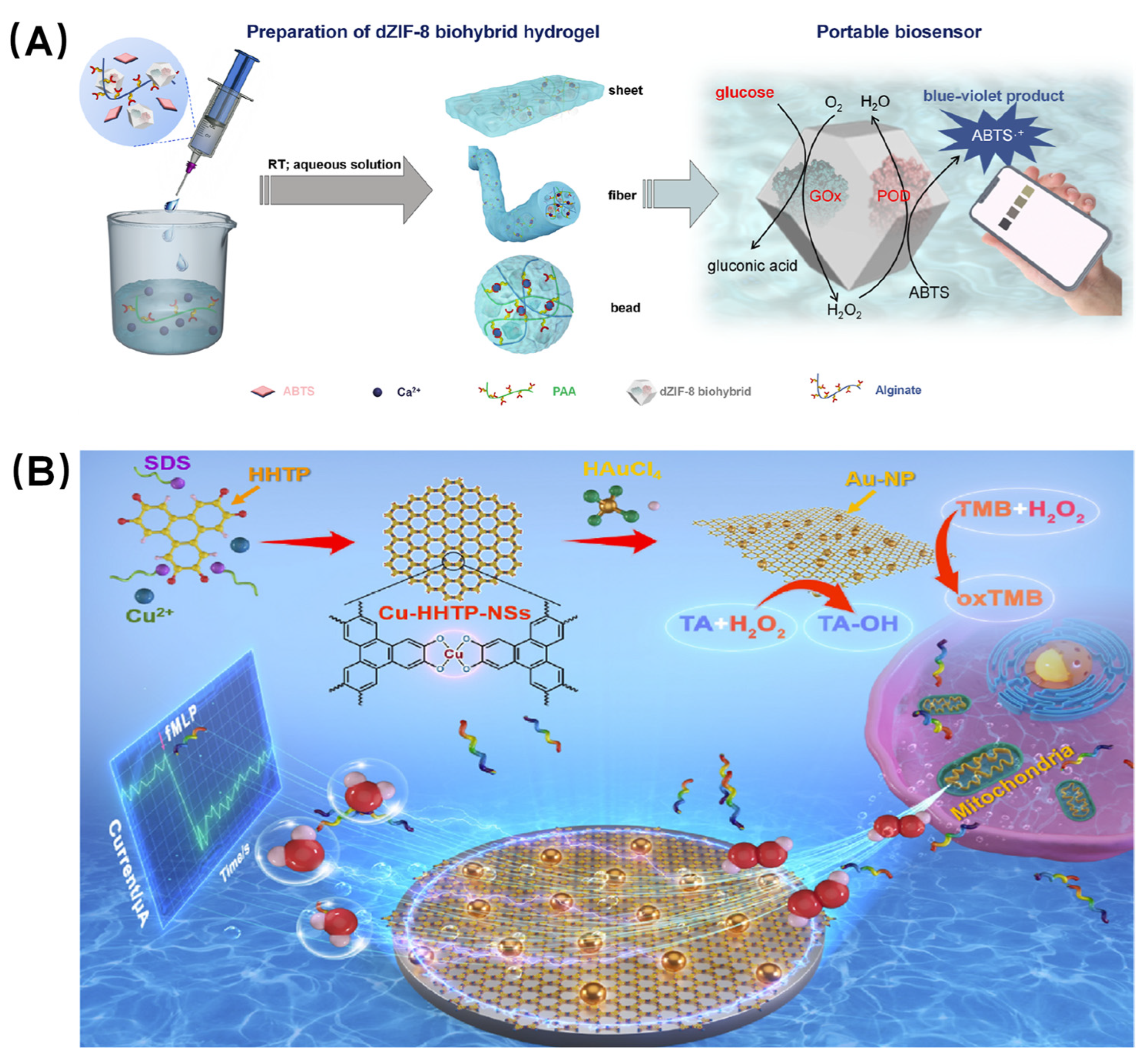
- Zhong, N.; Gao, R.; Shen, Y.; Kou, X.; Wu, J.; Huang, S.; Chen, G.; Ouyang, G. Enzymes-Encapsulated Defective Metal–Organic Framework Hydrogel Coupling with a Smartphone for a Portable Glucose Biosensor. Anal. Chem. 2022, 94, 14385–14393. [Google Scholar] [CrossRef]
- Huang, W.; Xu, Y.; Wang, Z.; Liao, K.; Zhang, Y.; Sun, Y. Dual nanozyme based on ultrathin 2D conductive MOF nanosheets intergraded with gold nanoparticles for electrochemical biosensing of H2O2 in cancer cells. Talanta 2022, 249, 123612. [Google Scholar] [CrossRef]
- Le, K.T.M.; Vu, X.; Nguyen, T.; Nguyen, N. Advancing Electronic Biosensors with 2D Conjugated Metal–Organic Frameworks. Small 2025, 22, e05697. [Google Scholar] [CrossRef]
- Peterson, G.W.; Lee, D.T.; Barton, H.F.; Epps, T.H.; Parsons, G.N. Fibre-based composites from the integration of metal–organic frameworks and polymers. Nat. Rev. Mater. 2021, 6, 605–621. [Google Scholar] [CrossRef]
- Ma, S.; Xiao, S.; Hong, Y.; Bao, Y.; Xu, Z.; Chen, D.; Huang, X. Coupling metal organic frameworks nanozyme with carbon nanotubes on the gradient porous hollow fiber membrane for nonenzymatic electrochemical H2O2 detection. Anal. Chim. Acta 2024, 1293, 342285. [Google Scholar] [CrossRef]
- Islam, M.A.; Masson, J.-F. Plasmonic Biosensors for Health Monitoring: Inflammation Biomarker Detection. ACS Sens. 2025, 10, 577–601. [Google Scholar] [CrossRef]
- Deng, S.; Hao, Y.; Yang, L.; Yu, T.; Wang, X.; Liu, H.; Liu, Y.; Xie, M. Construction of nanozyme based with mixed valence manganese oxide loaded on defective metal-organic frameworks for sensitive detection of biomarker procalcitonin. Biosens. Bioelectron. 2025, 278, 117339. [Google Scholar] [CrossRef]
- Law, J.W.-F.; Ab Mutalib, N.-S.; Chan, K.-G.; Lee, L.-H. Rapid methods for the detection of foodborne bacterial pathogens: Principles, applications, advantages and limitations. Front. Microbiol. 2015, 5, 770. [Google Scholar] [CrossRef]
- Wang, Y.; Hai, X.; Yan, Y.; Zhi, S.; Bi, S. Self-Powered Biosensor-Based Multifunctional Platform for Detection and In Situ Elimination of Bacteria. Adv. Funct. Mater. 2025, 35, 2420480. [Google Scholar] [CrossRef]
- Gao, Y.; Xu, S.; Guo, G.; Li, Y.; Zhou, W.; Li, H.; Yang, Z. MoO3/MIL-125-NH2 with boosted peroxidase-like activity for electrochemical staphylococcus aureus sensing via specific recognition of bacteriophages. Biosens. Bioelectron. 2024, 252, 116134. [Google Scholar] [CrossRef]
- Shang, Y.; Xing, G.; Lin, H.; Chen, S.; Xie, T.; Lin, J.-M. Portable Biosensor with Bimetallic Metal–Organic Frameworks for Visual Detection and Elimination of Bacteria. Anal. Chem. 2023, 95, 13368–13375. [Google Scholar] [CrossRef]
- Chen, W.; Liang, J.; Yin, X.; Yan, Y.; Wang, J.; Wan, Y.; Zhang, Y.; Zhang, M.; Wang, K.; Yang, T. Biomimetic Bacterial Framework-Driven Point-of-Care Platform Enables Broad-Spectrum Bacterial Sensing via PAMPs-Triggered Competitive Recognition. Adv. Funct. Mater. 2025, 35, e04522. [Google Scholar] [CrossRef]
- Mirsadoughi, E.; Pebdeni, A.B.; Hosseini, M. Sensitive colorimetric aptasensor based on peroxidase-like activity of ZrPr-MOF to detect Salmonella Typhimurium in water and milk. Food Control. 2023, 146, 109500. [Google Scholar] [CrossRef]
- Wang, S.; Deng, W.; Yang, L.; Tan, Y.; Xie, Q.; Yao, S. Copper-Based Metal–Organic Framework Nanoparticles with Peroxidase-Like Activity for Sensitive Colorimetric Detection of Staphylococcus aureus. ACS Appl. Mater. Interfaces 2017, 9, 24440–24445. [Google Scholar] [CrossRef]
- Li, J.; Lin, X.; Wu, J.; Ying, D.; Duan, N.; Wang, Z.; Wu, S. Multifunctional magnetic composite nanomaterial for Colorimetric-SERS Dual-Mode detection and photothermal sterilization of Vibrio parahaemolyticus. Chem. Eng. J. 2023, 477, 147113. [Google Scholar] [CrossRef]
- Cai, J.; Lin, Y.; Yu, X.; Yang, Y.; Hu, Y.; Gao, L.; Xiao, H.; Du, J.; Wang, H.; Zhong, X.; et al. Multifunctional AuAg-doping Prussian Blue-based MOF: Enhanced colorimetric catalytic activities and amplified SERS signals for bacteria discrimination and detection. Sens. Actuators B Chem. 2023, 394, 134279. [Google Scholar] [CrossRef]
- Song, Y.; Zhao, L.; Li, W.; Xu, X.; Xu, Q.; Xu, H. Sea cucumber-inspired self-assembly nanozyme for ultrasensitive and tri-modal colorimetric quantification of pathogenic bacteria. Sens. Actuators B Chem. 2025, 431, 137314. [Google Scholar] [CrossRef]
- Cao, X.; Zhang, C.; Xu, Y.; Wang, W.; Hu, H.; Chen, K.; Yang, J.; He, S.; Sun, H.; Ye, Y. Electrochemical detection of S. typhimurium based on peroxidase-like activity of gold nanoparticle-doped CuZr-MOF nanozyme. Microchim. Acta 2025, 192, 296. [Google Scholar] [CrossRef]
- Hu, J.; Wu, D.; Li, T.; Cao, Y.; Wang, X.; Gan, N. Ratiometric electrochemical aptasensor for point-of-care testing Vibrio parahaemolyticus together with antimicrobial peptide-labeled nano metal-organic framework signal tag. Sens. Actuators B Chem. 2022, 352, 130987. [Google Scholar] [CrossRef]
- Zhang, X.; Xie, G.; Gou, D.; Luo, P.; Yao, Y.; Chen, H. A novel enzyme-free electrochemical biosensor for rapid detection of Pseudomonas aeruginosa based on high catalytic Cu-ZrMOF and conductive Super P. Biosens. Bioelectron. 2019, 142, 111486. [Google Scholar] [CrossRef]
- Wang, K.; Du, L.; Zhang, L.; Luo, X.; Yang, T.; Zeng, H. On-site marine pathogen (Vibrio parahaemolyticus) rapid colorimetric determination based on modified-free aptamer and metal-organic frameworks with simple washing step. Sens. Actuators B Chem. 2022, 372, 132695. [Google Scholar] [CrossRef]
- Su, Z.Y.; Siak, P.Y.; Leong, C.-O.; Cheah, S.-C. The role of Epstein–Barr virus in nasopharyngeal carcinoma. Front. Microbiol. 2023, 14, 1116143. [Google Scholar] [CrossRef]
- Wang, D.; Wang, J.; Liu, D.; He, J.; Wang, M.; Huang, H.; Nie, G.; Ding, H.; Yan, X. Rapid and sensitive detection of Epstein-Barr virus antibodies in nasopharyngeal carcinoma by chemiluminescence strips based on iron-porphyrin single atom nanozyme. Nano Res. 2023, 17, 1827–1836. [Google Scholar] [CrossRef]
- Peng, Y.; Liu, J.; Zhao, X.; Sun, H.; Liu, Z.; Jing, X.; Meng, L. A nanozyme-catalyzed nasopharyngeal swab sensor for ultra-fast colorimetric detection and highly sensitive Raman spectroscopic qualitative analysis of influenza virus. Biosens. Bioelectron. 2025, 277, 117280. [Google Scholar] [CrossRef]
- Yang, H.; Zheng, J.; Wang, W.; Lin, J.; Wang, J.; Liu, L.; Wu, W.; Zhang, C.; Zhang, M.; Fu, Y.; et al. Zr-MOF Carrier-Enhanced Dual-Mode Biosensing Platforms for Rapid and Sensitive Diagnosis of Mpox. Adv. Sci. 2024, 11, e2405848. [Google Scholar] [CrossRef]
- Li, Y.-L.; Chen, Y.-Y.; Xie, F.-T.; Li, Q.-X.; Yang, T.; Yang, Y.-H.; Hu, R. Smartphone-based dual-mode aptasensor with bifunctional metal-organic frameworks as signal probes for ochratoxin A detection. Food Chem. 2025, 464, 141540. [Google Scholar] [CrossRef]
- He, X.-Y.; Wang, Y.; Xue, Q.; Qian, W.-F.; Li, G.-L.; Li, Q. Molecularly imprinted MOF nanozymes: Demonstration of smartphone-integrated dual-mode platform for ratiometric fluorescent/colorimetric detection of chloramphenicol. Food Chem. X 2025, 26, 102322. [Google Scholar] [CrossRef]
- Ren, Y.; Cao, L.; Li, H.; Jiao, R.; Zhan, Y.; Zhang, X.; Yu, X.; Li, M.; Wu, W.; Liang, Z.; et al. Trimetal–Organic Framework-Derived Diatomic Nanozymes-Driven Cascaded Signal Sensitization Intelligent Flexible Sensors for In Situ Detection of the Pesticide Residue. ACS Nano 2025, 19, 23703–23718. [Google Scholar] [CrossRef]
- Fahy, K.M.; Lee, S.; Akpinar, I.; Sha, F.; Khoshooei, M.A.; Su, S.; Islamoglu, T.; Gianneschi, N.C.; Farha, O.K. Thermodynamic Insights into Phosphonate Binding in Metal–Azolate Frameworks. J. Am. Chem. Soc. 2024, 146, 5661–5668. [Google Scholar] [CrossRef]





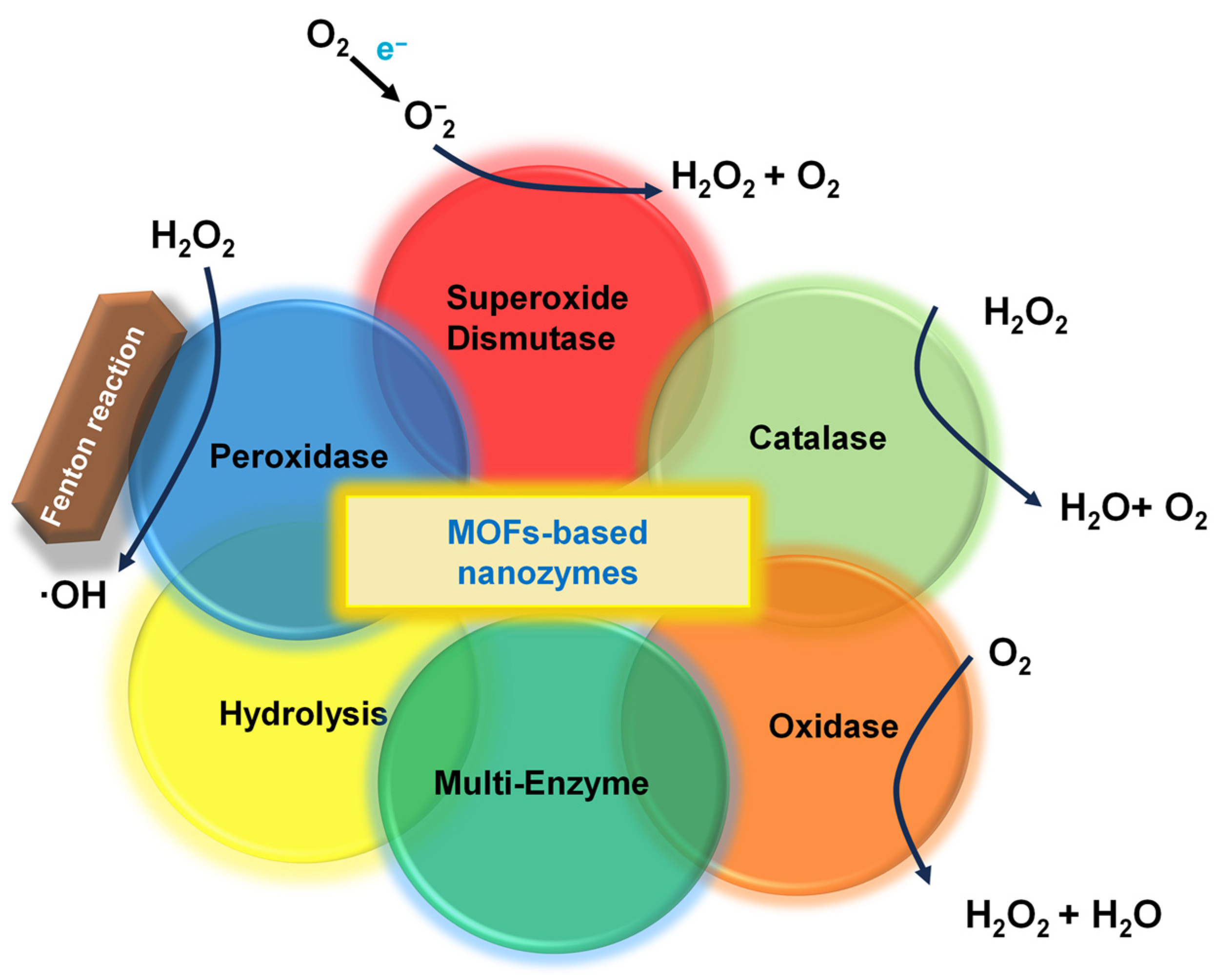
| Classification | Advantages and Limitations | Representative Materials | Reaction | Ref. |
|---|---|---|---|---|
| Peroxidase | Higher catalytic activity, but only in weak acidity conditions (pH about 4). | MOFs 808, Fe-PCN-222, Ni-MOFs | Fenton-like reaction | [68,69,70] |
| Oxidase | Higher catalytic activity, but the selectivity and specificity of substrate are insufficient in complex samples. | Ce-MOFs, D-ZIF-67, Cu-MOFs | ROS | [71,72,73,74,75] |
| Catalase | High stability, but only at specific pH. | Ce-MOFs, Mn-MOFs | Disproportionate decomposition | [76,77] |
| Superoxide dismutase | Higher stability, high catalytic activity, but poor biocompatibility. | Cu/Zr-MOF 818, Sn-PCN222 | Superoxide anion disproportionation | [78,79] |
| Hydrolase | Higher stability, but activity of catalyst is affected by strong acids and bases. | MOFs-808, Ce-MOFs | Hydrolysis of metal nodes and coordination structures | [80,81,82] |
| Detected Bacteria | MOF Type | MOF Synthesis | Principle | Linearity Range | LOD | Ref. |
|---|---|---|---|---|---|---|
| Staphylococcus aureus | MoO3/MIL-125-NH2 | Solvothermal | Bacteriophages-specific recognition | 101–108 CFU/mL | 16 CFU/mL | [128] |
| E. coli O157:H7 | AgPt/PCN-223-Fe | Solvothermal | Antibody-modified MOFs | 103 to 108 CFU/mL | 276 CFU/mL | [129] |
| S. typhimurium | ZrPr-UIO-66 | Solvothermal | Aptamer-modified MOFs | 102–108 CFU/mL | 37 CFU/mL | [131] |
| Staphylococcus aureus | Cu-MOFs | Solvothermal | Aptamer-modified Cu-MOFs | 50 to 10 000 CFU/mL | 20 CFU/mL | [132] |
| Vibrio parahaemolyticus | Fe3O4@MOFs(Fe-Cu)-GNS-MBA | Solvothermal | Aptamer-modified Cu-MOFs | 101–105 CFU/mL | 9 CFU/mL | [133] |
| E. coli and Staphylococcus aureus | AuAg@PB MOFs | Stirring at room temperature | 4-mercaptophenylboronic acid conjugated bacteria | 101–109 CFU/mL 101–108 CFU/mL | 2 CFU/mL | [134] |
| E. coli O157:H7 | AuPt/PCN-224 | Solvothermal | Aptamer-modified MOFs | 101–106 CFU/mL | 10 CFU/mL | [135] |
| S. typhimurium | AuNPs@CuZr-MOFs | Solvothermal and stirring | DNA probe | 3.5 to 3.5 × 10⁶ CFU/mL | 0.82 CFU/mL | [136] |
| Vibrio parahaemolyticus | UiO-66 | Solvothermal | Aptamer-modified MOFs | 101–107 CFU/mL | 4 CFU/mL | [137] |
| Pseudomonas aeruginosa | Cu-ZrMOFs | Solvothermal | Aptamer-modified MOFs | 101–106 CFU/mL | 2 CFU/mL | [138] |
| Vibrio parahaemolyticus | Fe3O4@ZIF-8 and Pt@ZIF-8 | Solvothermal | Aptamer-modified MOFs | 102–107 CFU/mL | 15 CFU/mL | [139] |
Disclaimer/Publisher’s Note: The statements, opinions and data contained in all publications are solely those of the individual author(s) and contributor(s) and not of MDPI and/or the editor(s). MDPI and/or the editor(s) disclaim responsibility for any injury to people or property resulting from any ideas, methods, instructions or products referred to in the content. |
© 2026 by the authors. Licensee MDPI, Basel, Switzerland. This article is an open access article distributed under the terms and conditions of the Creative Commons Attribution (CC BY) license.
Share and Cite
Wang, J.; Zhou, X.; Dai, Z.; Xu, L.; Nie, S.; Yang, D.; Yang, Y.; Wang, L.; Yao, J.; Ye, Z. Recent Advances in Metal–Organic Framework-Based Nanozymes for Enhanced Biosensing Applications. Biosensors 2026, 16, 197. https://doi.org/10.3390/bios16040197
Wang J, Zhou X, Dai Z, Xu L, Nie S, Yang D, Yang Y, Wang L, Yao J, Ye Z. Recent Advances in Metal–Organic Framework-Based Nanozymes for Enhanced Biosensing Applications. Biosensors. 2026; 16(4):197. https://doi.org/10.3390/bios16040197
Chicago/Turabian StyleWang, Jianping, Xiaoying Zhou, Zhonghao Dai, Lu Xu, Siyu Nie, Dongjie Yang, Yi Yang, Liyuan Wang, Jiayun Yao, and Zihong Ye. 2026. "Recent Advances in Metal–Organic Framework-Based Nanozymes for Enhanced Biosensing Applications" Biosensors 16, no. 4: 197. https://doi.org/10.3390/bios16040197
APA StyleWang, J., Zhou, X., Dai, Z., Xu, L., Nie, S., Yang, D., Yang, Y., Wang, L., Yao, J., & Ye, Z. (2026). Recent Advances in Metal–Organic Framework-Based Nanozymes for Enhanced Biosensing Applications. Biosensors, 16(4), 197. https://doi.org/10.3390/bios16040197