A High-Precision Screen-Printed Glucose Sensor with In Situ Impedance-Based HCT Correction and Temperature Compensation


Abstract
1. Introduction
2. Materials and Methods
2.1. Reagents and Materials
2.2. Preparation of Glucose Sensing Strip
2.3. Electrochemical Measurement System and Procedure
2.4. Performance Evaluation and Experimental Design
3. Results
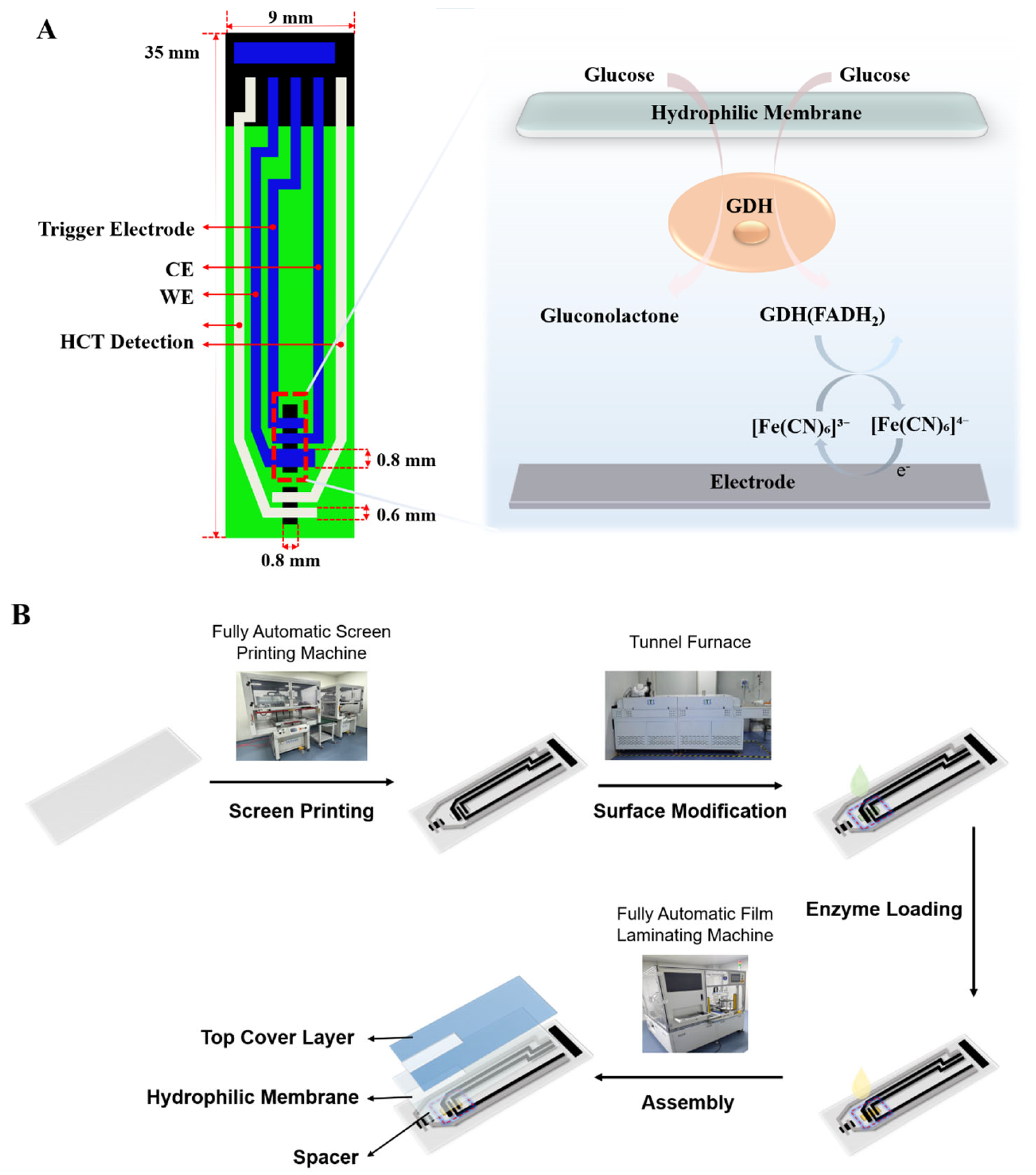
3.1. Sensing Principle and Dual-Mode Detection Mechanism
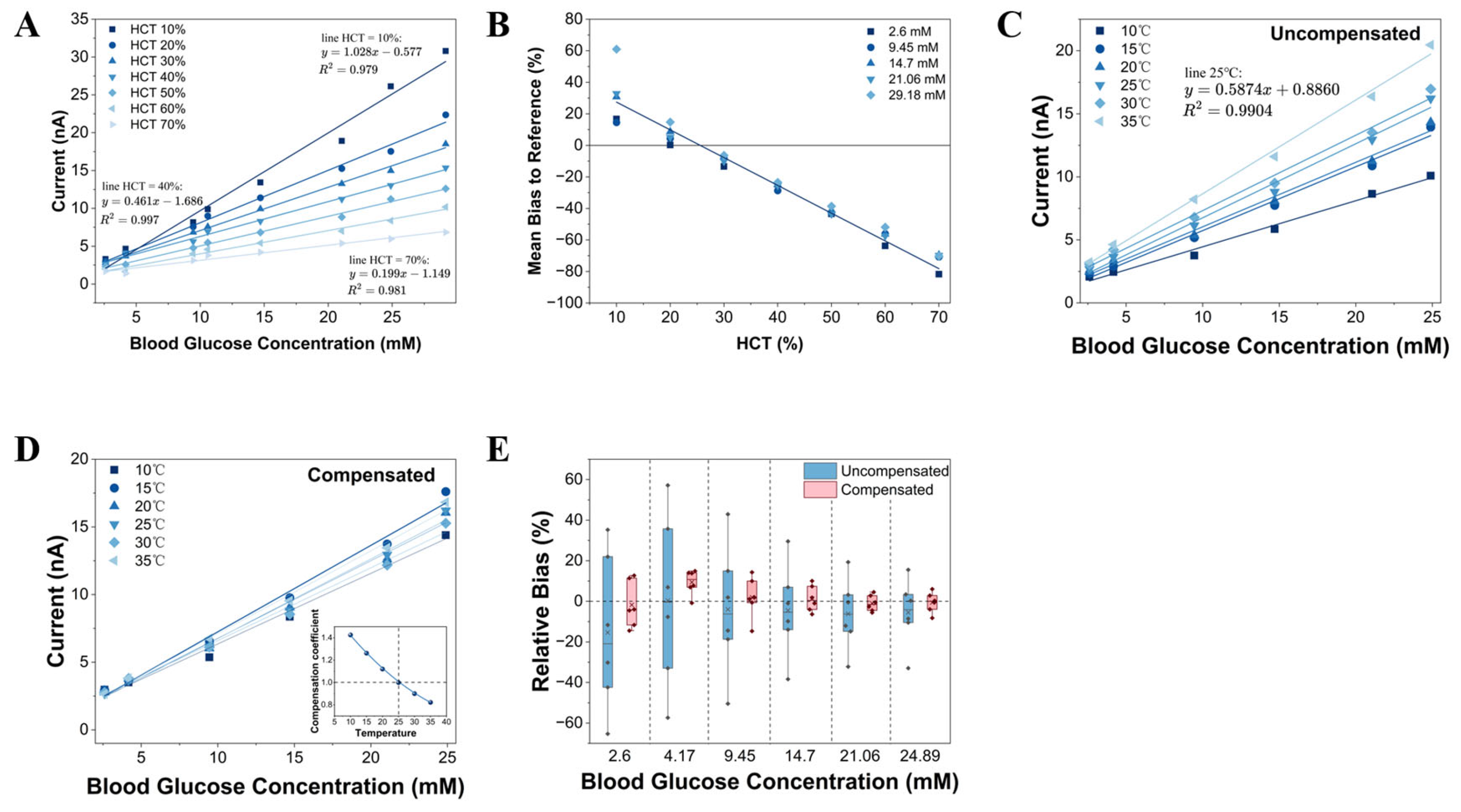
3.2. Impact of HCT on Electrochemical Response
3.3. Temperature Effect and Thermodynamic Compensation
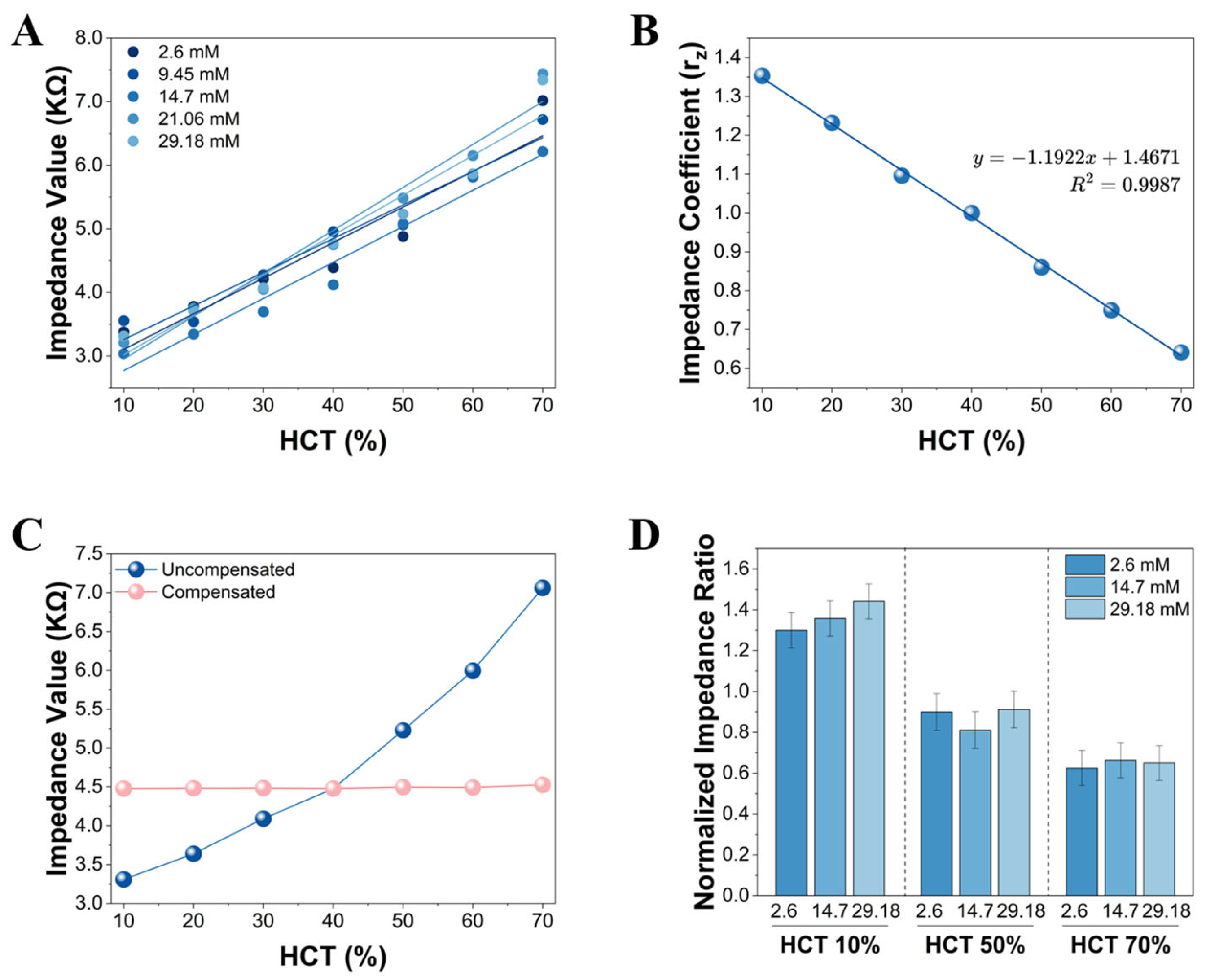
3.4. Impedance-Based HCT Estimation Method
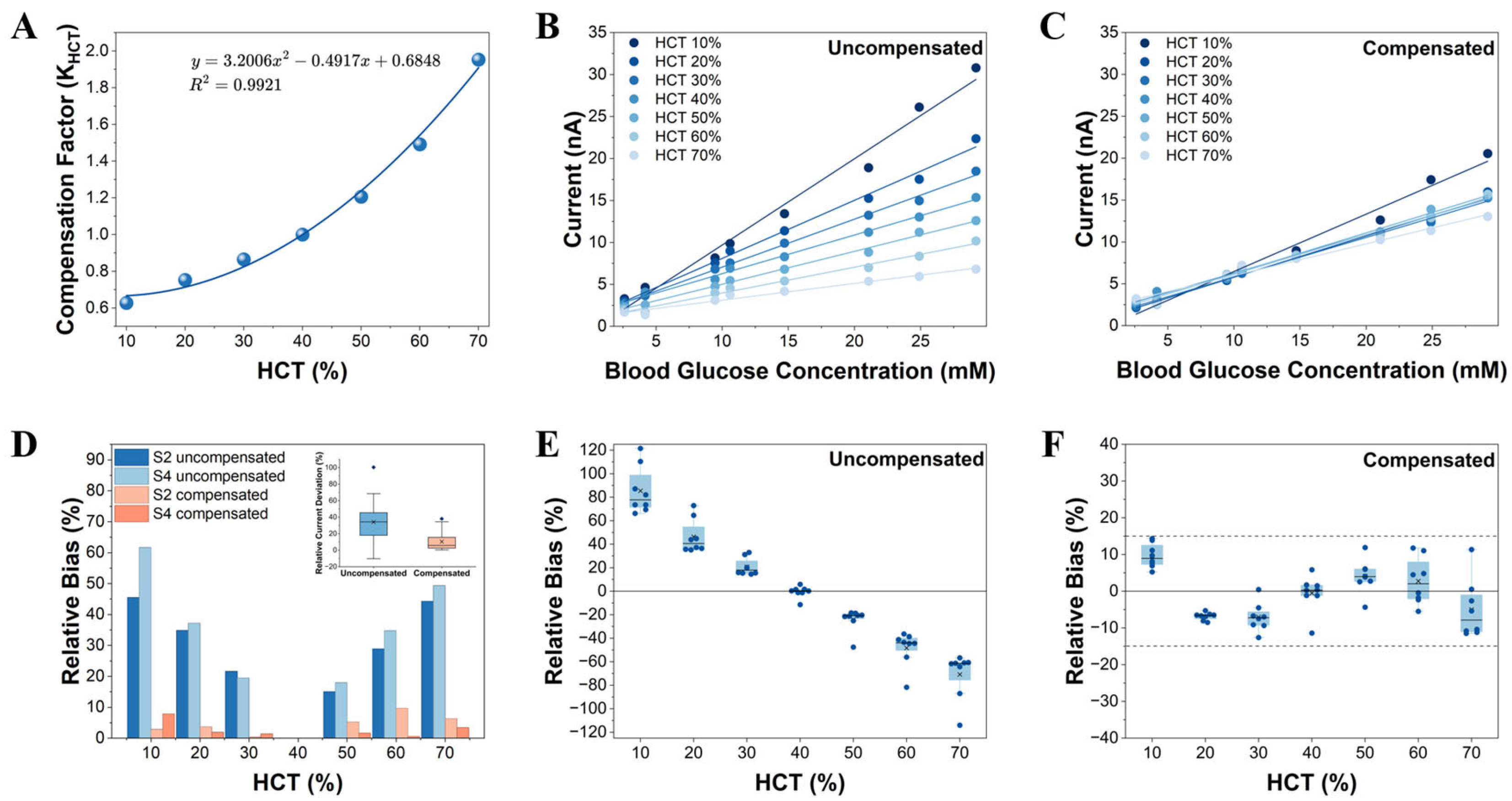
3.5. HCT Current Compensation Model and Performance Evaluation
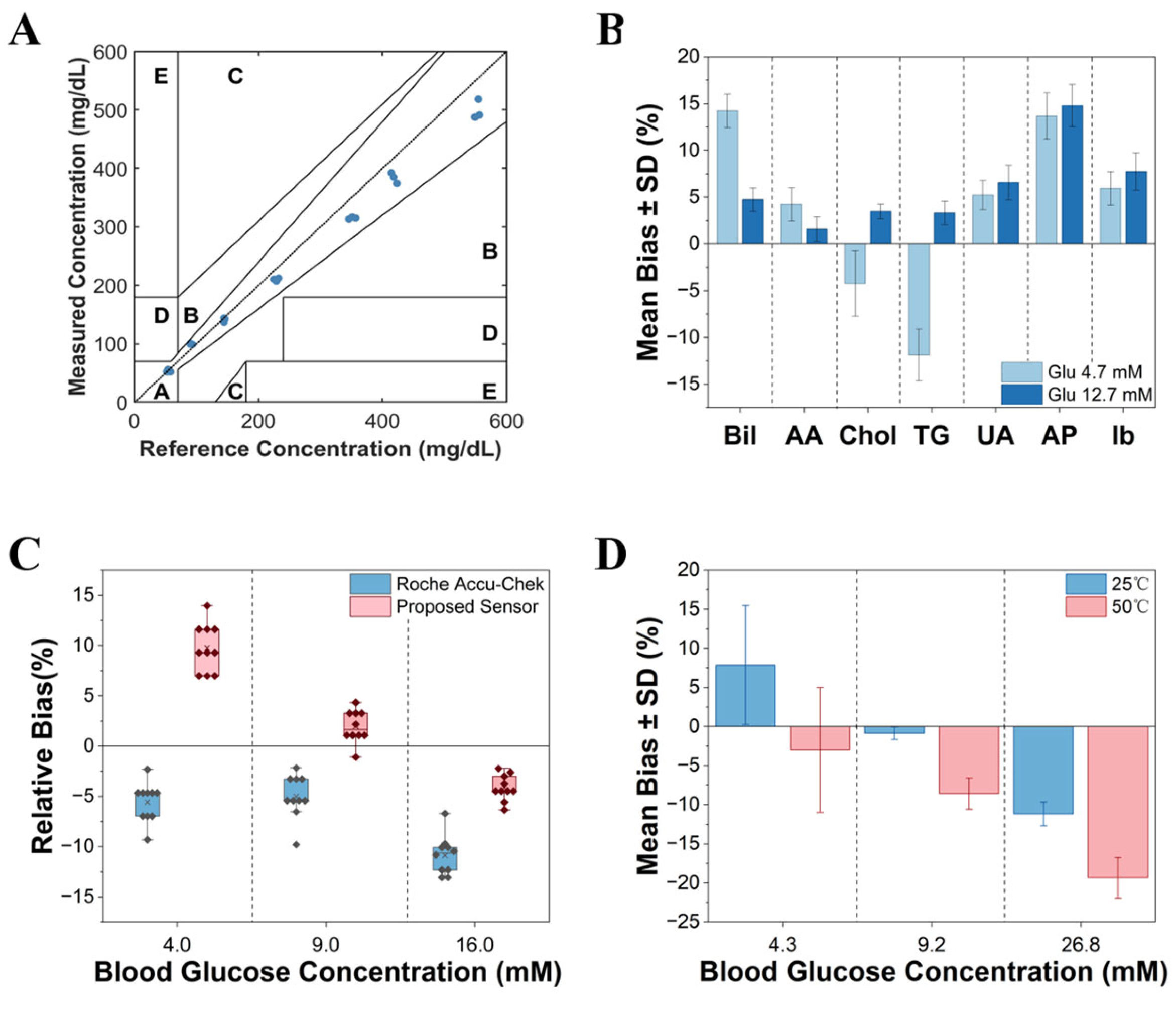
3.6. Validation of Analytical Performance and Stability
3.6.1. Selectivity and Anti-Interference Evaluation
3.6.2. Measurement Precision and System Accuracy
3.6.3. Accelerated Aging Tests and Long-Term Stability
- (1)
- Low to Medium Concentration Range (S1 = 2.6 mM, S2 = 10.59 mM): After aging at 50 °C for 21 days, the response current of the strips to low and medium glucose concentrations showed only minor fluctuations, with measurement deviations remaining within the acceptable range. This indicates that the GDH enzyme protein maintained good structural integrity at these concentrations, and the chemical components in the dried enzyme layer remained relatively stable.
- (2)
- High Concentration Range (S3 = 29.18 mM): At high glucose levels, the aged strips exhibited significant signal attenuation, with measured values significantly lower than the reference values (deviation > 15%). This may be attributed to high temperatures accelerating the crystallization or aggregation of the electron mediator (ferricyanide) within the microstructure, leading to increased resistance to electron transfer under high electron flux demands (i.e., high-concentration reactions); alternatively, the enzyme cofactor FAD may have partially dissociated under extreme thermal stress, reducing the maximum catalytic rate.
4. Conclusions
Author Contributions
Funding
Institutional Review Board Statement
Informed Consent Statement
Data Availability Statement
Acknowledgments
Conflicts of Interest
References
- Khunti, K.; Zaccardi, F.; Amod, A.; Aroda, V.R.; Aschner, P.; Colagiuri, S.; Mohan, V.; Chan, J.C.N. Glycaemic control is still central in the hierarchy of priorities in type 2 diabetes management. Diabetologia 2025, 68, 17–28. [Google Scholar] [CrossRef]
- Wu, Q.; Gong, S.; Hu, M.; Pan, L.; Liu, X.; Tao, W. Study on Diabetes Detection Based on DBO-RF Pulse Wave Analysis. Smart Wearable Technol. 2025. [Google Scholar] [CrossRef]
- Montagnana, M.; Caputo, M.; Giavarina, D.; Lippi, G. Overview on self-monitoring of blood glucose. Clin. Chim. Acta 2009, 402, 7–13. [Google Scholar] [CrossRef] [PubMed]
- Pleus, S.; Freckmann, G.; Schauer, S.; Heinemann, L.; Ziegler, R.; Ji, L.; Mohan, V.; Calliari, L.E.; Hinzmann, R. Self-Monitoring of Blood Glucose as an Integral Part in the Management of People with Type 2 Diabetes Mellitus. Diabetes Ther. 2022, 13, 829–846. [Google Scholar] [CrossRef] [PubMed]
- Lu, W.; Wang, Y.; Liu, S.; Xie, W.; Wei, M.; Hao, R. Synthesis of PbCrO4 nanorods-Ti3C2Tx MXene composites: A sensitive photoelectrochemical sensor for the detection of cysteine in human blood serum. Anal. Chim. Acta 2025, 1344, 343715. [Google Scholar] [CrossRef]
- Wang, H.; Liu, C.; Feng, T.; Zhang, Y.; Wu, Y.; Dai, Z.; Yi, C. Enzyme-Based Electrochemical Sensing Systems for On-Site Detection: Recent Progress and Prospects. Small 2025, 21, e07926. [Google Scholar] [CrossRef]
- Nikitina, V.N.; Daboss, E.V.; Vokhmyanina, D.V.; Solovyev, I.D.; Andreev, E.A.; Komkova, M.A.; Karyakin, A.A. The widest linear range of glucose test strips based on various mediators and membranes for whole blood analysis. J. Electroanal. Chem. 2023, 938, 117445. [Google Scholar] [CrossRef]
- Nikitina, V.N.; Karastsialiova, A.R.; Karyakin, A.A. Glucose test strips with the largest linear range made via single step modification by glucose oxidase-hexacyanoferrate-chitosan mixture. Biosens. Bioelectron. 2023, 220, 114851. [Google Scholar] [CrossRef]
- Zolotukhina, E.V.; Gerasimova, E.V.; Sorokin, V.V.; Levchenko, M.G.; Freiman, A.S.; Silina, Y.E. The Impact of the Functional Layer Composition of Glucose Test-Strips on the Stability of Electrochemical Response. Chemosensors 2022, 10, 298. [Google Scholar] [CrossRef]
- Teodorczyk, M.; Cardosi, M.; Setford, S. Hematocrit compensation in electrochemical blood glucose monitoring systems. J. Diabetes Sci. Technol. 2012, 6, 648–655. [Google Scholar] [CrossRef]
- Solnica, B.; Skupien, J.; Kusnierz-Cabala, B.; Slowinska-Solnica, K.; Witek, P.; Cempa, A.; Malecki, M.T. The effect of hematocrit on the results of measurements using glucose meters based on different techniques. Clin. Chem. Lab. Med. 2011, 50, 361–365. [Google Scholar] [CrossRef] [PubMed]
- Magner, E. Detection of ferricyanide as a probe for the effect of hematocrit in whole blood biosensors. Analyst 2001, 126, 861–865. [Google Scholar] [CrossRef] [PubMed]
- Guo, J. Uric Acid Monitoring with a Smartphone as the Electrochemical Analyzer. Anal. Chem. 2016, 88, 11986–11989. [Google Scholar] [CrossRef] [PubMed]
- Guo, J. Smartphone-Powered Electrochemical Dongle for Point-of-Care Monitoring of Blood β-Ketone. Anal. Chem. 2017, 89, 8609–8613. [Google Scholar] [CrossRef]
- Yu, R.; Fang, M.; Xu, H.; Meng, F.; Tang, N.; Liu, X.; Feng, S.; Wang, K.; Guo, J. ProgenCare: A noninvasive salivary progesterone monitoring platform based on MXene-modified microfluidic electrochemical immunosensor. Biosens. Bioelectron. 2026, 293, 118161. [Google Scholar] [CrossRef]
- Pham, H.N.; Pham, P.N.H.; Phan, H.T.; Cao, L.T.; Thoi, H.T.T.; Do, T.D.T.; Truong, T.T.A. Impact of hematocrit levels on the accuracy of specific blood glucose meters: A hospital-based study. J. Diabetes Investig. 2024, 15, 1472–1482. [Google Scholar] [CrossRef]
- Musholt, P.B.; Schipper, C.; Thomé, N.; Ramljak, S.; Schmidt, M.; Forst, T.; Pfützner, A. Dynamic electrochemistry corrects for hematocrit interference on blood glucose determinations with patient self-measurement devices. J. Diabetes Sci. Technol. 2011, 5, 1167–1175. [Google Scholar] [CrossRef]
- ISO 15197:2013; Vitro Diagnostic Test Systems—Requirements for Blood-Glucose Monitoring Systems for Self-Testing in Managing Diabetes Mellitus. 2nd ed. International Organization for Standardization: Geneva, Switzerland, 2013.
- Sharif-Nia, H.; Mokhtari, H.; Osborne, J.W.; Shafaei, S.; Soltanzade, M. Evaluation of the accuracy, precision, and agreement of a glucometer compared to the standard laboratory test in diabetic and non-diabetic patients. Sci. Rep. 2025, 15, 44517. [Google Scholar] [CrossRef]
- Ukpe, M.P.; Ezeanuka, A.C. Assessment of accuracy, clinical validity, and analytical linearity in point-of-care glucose monitoring devices for diabetes mellitus: A systematic review and meta-analysis. Clin. Biochem. 2025, 137, 110911. [Google Scholar] [CrossRef]
- Ramljak, S.; Lock, J.P.; Schipper, C.; Musholt, P.B.; Forst, T.; Lyon, M.; Pfützner, A. Hematocrit interference of blood glucose meters for patient self-measurement. J. Diabetes Sci. Technol. 2013, 7, 179–189. [Google Scholar] [CrossRef]
- Demircik, F.; Kirsch, V.; Ramljak, S.; Vogg, M.; Pfützner, A.H.; Pfützner, A. Laboratory Evaluation of Linearity, Repeatability, and Hematocrit Interference with an Internet-Enabled Blood Glucose Meter. J. Diabetes Sci. Technol. 2019, 13, 514–521. [Google Scholar] [CrossRef] [PubMed]
- Grzych, G.; Defauwes, I.; De Tullio, P.; Pekar, J.D.; Brousseau, T.; Lippi, G.; Cavalier, E. Blood glucose measurement inside and outside the laboratory: Both preanalytical and analytical challenges. Crit. Rev. Clin. Lab. Sci. 2025, 62, 613–630. [Google Scholar] [CrossRef] [PubMed]
- Tang, Z.; Lee, J.H.; Louie, R.F.; Kost, G.J. Effects of Different Hematocrit Levels on Glucose Measurements with Handheld Meters for Point-of-Care Testing. Arch. Pathol. Lab. Med. 2000, 124, 1135–1140. [Google Scholar] [CrossRef] [PubMed]
- Lee, J.; Liberty, L.M.; Soltis, I.; Kwon, K.; Chong, D.; Kwon, Y.; Yeo, W.-H. Wireless Flexible Potentiometric Microsensors for Temperature-Compensated Sweat Electrolyte Monitoring. ACS Appl. Mater. Interfaces 2025, 17, 36345–36355. [Google Scholar] [CrossRef]
- Yang, P.H.; Chang, Y.S.; Chan, C.T. A Potentiometric Enzymatic Flexible Dopamine Biosensor with Temperature Compensation Based on the Flexible Printed Circuit Board. IEEE Trans. Instrum. Meas. 2023, 72, 1–8. [Google Scholar] [CrossRef]
- Yang, J.; Bai, Y.; Yang, J.; Yang, C.; Ye, P.; Gao, S.; Shi, J.; Guan, C. A glucose biosensor with temperature and pH compensation based on mode resonance coupling in hole-assisted multi-core fiber. Opt. Laser Technol. 2026, 197, 114754. [Google Scholar] [CrossRef]
- Nilghaz, A.; Shen, W. Low-cost blood plasma separation method using salt functionalized paper. RSC Adv. 2015, 5, 53172–53179. [Google Scholar] [CrossRef]
- Berry, S.B.; Fernandes, S.C.; Rajaratnam, A.; Dechiara, N.S.; Mace, C.R. Measurement of the hematocrit using paper-based microfluidic devices. Lab Chip 2016, 16, 3689–3694. [Google Scholar] [CrossRef]
- Weng, C.-W.; Hsieh, B.-C.; Hou, Y.-T.; Cheng, T.-J. Determination of hematocrit by voltage-induced hemolysis on a disposable electrochemical sensing strip. Analyst 2015, 140, 6619–6624. [Google Scholar] [CrossRef]
- Kim, N.Y.; Dhakal, R.; Adhikari, K.K.; Kim, E.S.; Wang, C. A reusable robust radio frequency biosensor using microwave resonator by integrated passive device technology for quantitative detection of glucose level. Biosens. Bioelectron. 2015, 67, 687–693. [Google Scholar] [CrossRef]
- He, L.; Li, J.; Wan, N.; Hu, Y.; Ma, J.; Chen, K.; Wang, Y.; Shen, Y.; Ming, Y.; Ge, C.; et al. A disc-shaped centrifugal microfluidic system for the detection of hematocrit based on electrical impedance spectroscopy. Measurement 2026, 257, 118737. [Google Scholar] [CrossRef]
- Zhbanov, A.; Lee, Y.S.; Son, M.; Kim, B.J.; Yang, S. Improved Hematology Analysis Based on Microfluidic Impedance Spectroscopy: Erythrocyte Orientation and Anisotropic Dielectric Properties of Flowing Blood. Anal. Chem. 2025, 97, 4871–4880. [Google Scholar] [CrossRef] [PubMed]
- Chakraborty, S.; Das, S.; Das, C.; Chandra, S.; Sharma, K.D.; Karmakar, A.; Chattoapadhyay, S. On-chip estimation of hematocrit level for diagnosing anemic conditions by Impedimetric techniques. Biomed. Microdevices 2020, 22, 38. [Google Scholar] [CrossRef] [PubMed]
- Forrow, N.J.; Bayliff, S.W. A commercial whole blood glucose biosensor with a low sensitivity to hematocrit based on an impregnated porous carbon electrode. Biosens. Bioelectron. 2005, 21, 581–587. [Google Scholar] [CrossRef]
- Treo, E.F.; Felice, C.J.; Tirado, M.C.; Valentinuzzi, M.E.; Cervantes, D.O. Comparative analysis of hematocrit measurements by dielectric and impedance techniques. IEEE Trans. Biomed. Eng. 2005, 52, 549–552. [Google Scholar] [CrossRef]
- Lee, S.R.; Kyung, C.M. Development of hematocrit monitoring sensor using screen printed carbon electrode. In Proceedings of the 2013 Transducers & Eurosensors XXVII: The 17th International Conference on Solid-State Sensors, Actuators and Microsystems (Transducers & Eurosensors XXVII), Barcelona, Spain, 16–20 June 2013; pp. 2165–2168. [Google Scholar]
- Weng, C.-W.; Cheng, T.-J.; Chen, R.L.C.; Hsieh, B.-C. On-chip Hematocrit Correction for Whole Blood Glucose Amperometric Sensing Strip Using a Post-Measurement Potential Step. Int. J. Electrochem. Sci. 2017, 12, 4990–4999. [Google Scholar] [CrossRef]
- Cinti, S.; Cusenza, R.; Moscone, D.; Arduini, F. Paper-based synthesis of Prussian Blue Nanoparticles for the development of whole blood glucose electrochemical biosensor. Talanta 2018, 187, 59–64. [Google Scholar] [CrossRef]
- He, X.; Chang, S.J.; Settu, K.; Chen, C.-J.; Liu, J.-T. An anti-HCT-interference glucose sensor based on a fiber paper-based screen-printed carbon electrode. Sens. Actuators B Chem. 2019, 297, 126763. [Google Scholar] [CrossRef]
- Biswas, S.K.; Chatterjee, S.; Laha, S.; Pakira, V.; Som, N.K.; Saha, S.; Chakraborty, S. Instrument-free single-step direct estimation of the plasma glucose level from one drop of blood using smartphone-interfaced analytics on a paper strip. Lab Chip 2022, 22, 4666–4679. [Google Scholar] [CrossRef]
- Cai, Z.X.; Jiang, M.Z.; Chuang, Y.J.; Kuo, J.N. Paper-Based Microfluidic Analytical Device Patterned by Label Printer for Point-of-Care Blood Glucose and Hematocrit Detection Using 3D-Printed Smartphone Cassette. Sensors 2024, 24, 4792. [Google Scholar] [CrossRef]



| Ref | Electrode Material & Mediator | Production Method | HCT Detection/Compensation Strategy | HCT Correction Range | Linear Range (mM)/LOD (μM) of Glucose |
|---|---|---|---|---|---|
| This Work | Carbon and potassium ferricyanide | Screen-printing | Impedance + Temperature Calibration | 10%~70% | 2.6~29.18/200 |
| Lee et al. (2013) [37] | Carbon and potassium ferricyanide | Screen-printing | Chrono-amperometry | 0%~100% | N/A (HCT Sensor Only) |
| Weng et al. (2017) [38] | Carbon and Ferricyanide | Screen-printing | DC pulse breakdown & Current decay ratio | 9%~70% | 2.2~33.7/N/A |
| Cinti et al. (2018) [39] | Carbon and Prussian Blue Nanoparticles | wax- and screen-printing | Physical filtration by fiber paper | N/A | 0~25/170 |
| He et al. (2019) [40] | Carbon and potassium ferricyanide | Screen-printing | Physical filtration by fiber paper | 20%~70% | 0~16/470 |
| Biswas et al. (2022) [41] | N/A (Colorimetric) | Paper-based assembly | Physical filtration by glass fiber membrane | 20%~65% | 2.78~22.22/~2220 |
| Cai et al. (2024)[42] | N/A (Colorimetric) | Label Printer Patterning | Physical wicking distance | 25%~55% | 2.5~35/~222 |
Disclaimer/Publisher’s Note: The statements, opinions and data contained in all publications are solely those of the individual author(s) and contributor(s) and not of MDPI and/or the editor(s). MDPI and/or the editor(s) disclaim responsibility for any injury to people or property resulting from any ideas, methods, instructions or products referred to in the content. |
© 2026 by the authors. Licensee MDPI, Basel, Switzerland. This article is an open access article distributed under the terms and conditions of the Creative Commons Attribution (CC BY) license.
Share and Cite
Lu, M.; Cheng, J.; Lei, Q.; Guo, J.; Chen, K. A High-Precision Screen-Printed Glucose Sensor with In Situ Impedance-Based HCT Correction and Temperature Compensation. Biosensors 2026, 16, 193. https://doi.org/10.3390/bios16040193
Lu M, Cheng J, Lei Q, Guo J, Chen K. A High-Precision Screen-Printed Glucose Sensor with In Situ Impedance-Based HCT Correction and Temperature Compensation. Biosensors. 2026; 16(4):193. https://doi.org/10.3390/bios16040193
Chicago/Turabian StyleLu, Mingxin, Jie Cheng, Qinyao Lei, Jinhong Guo, and Kuo Chen. 2026. "A High-Precision Screen-Printed Glucose Sensor with In Situ Impedance-Based HCT Correction and Temperature Compensation" Biosensors 16, no. 4: 193. https://doi.org/10.3390/bios16040193
APA StyleLu, M., Cheng, J., Lei, Q., Guo, J., & Chen, K. (2026). A High-Precision Screen-Printed Glucose Sensor with In Situ Impedance-Based HCT Correction and Temperature Compensation. Biosensors, 16(4), 193. https://doi.org/10.3390/bios16040193