Advancements in Machine Learning-Assisted Flexible Electronics: Technologies, Applications, and Future Prospects

 ,
,  ,
,
Abstract
1. Introduction
2. ML-Assisted Information Processing Technology for Flexible Electronics
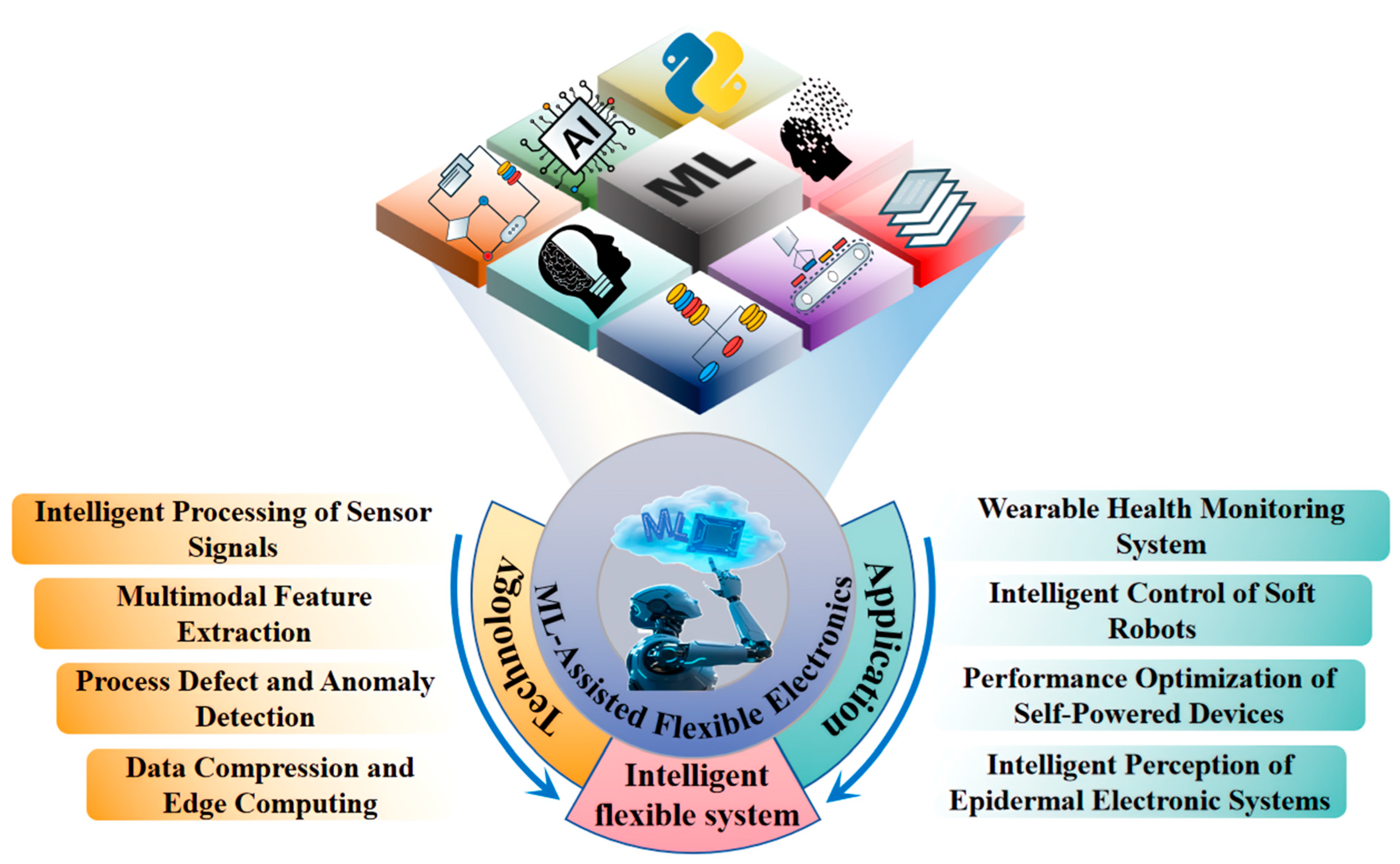
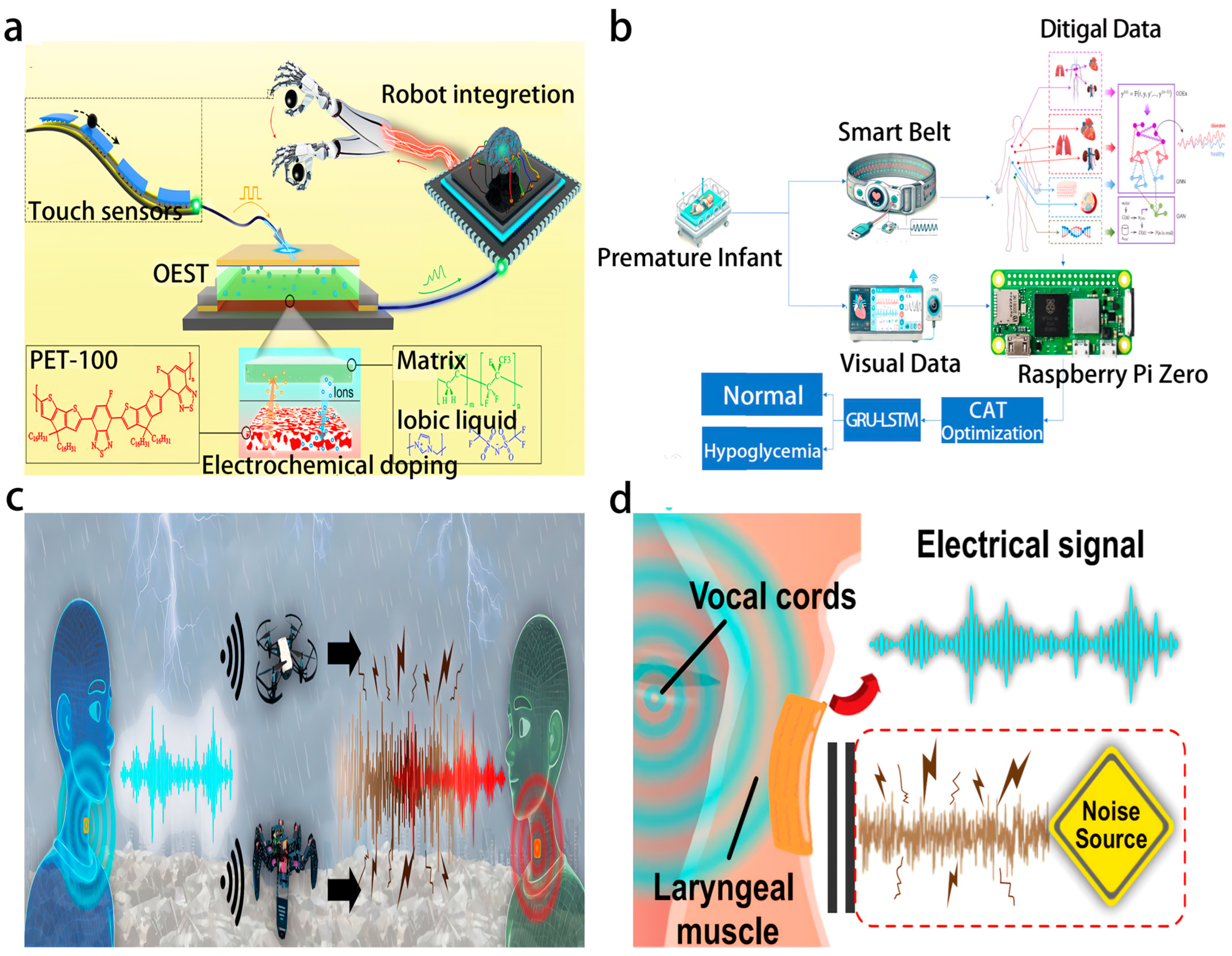
2.1. Intelligent Processing of Sensor Signals (IPSS)
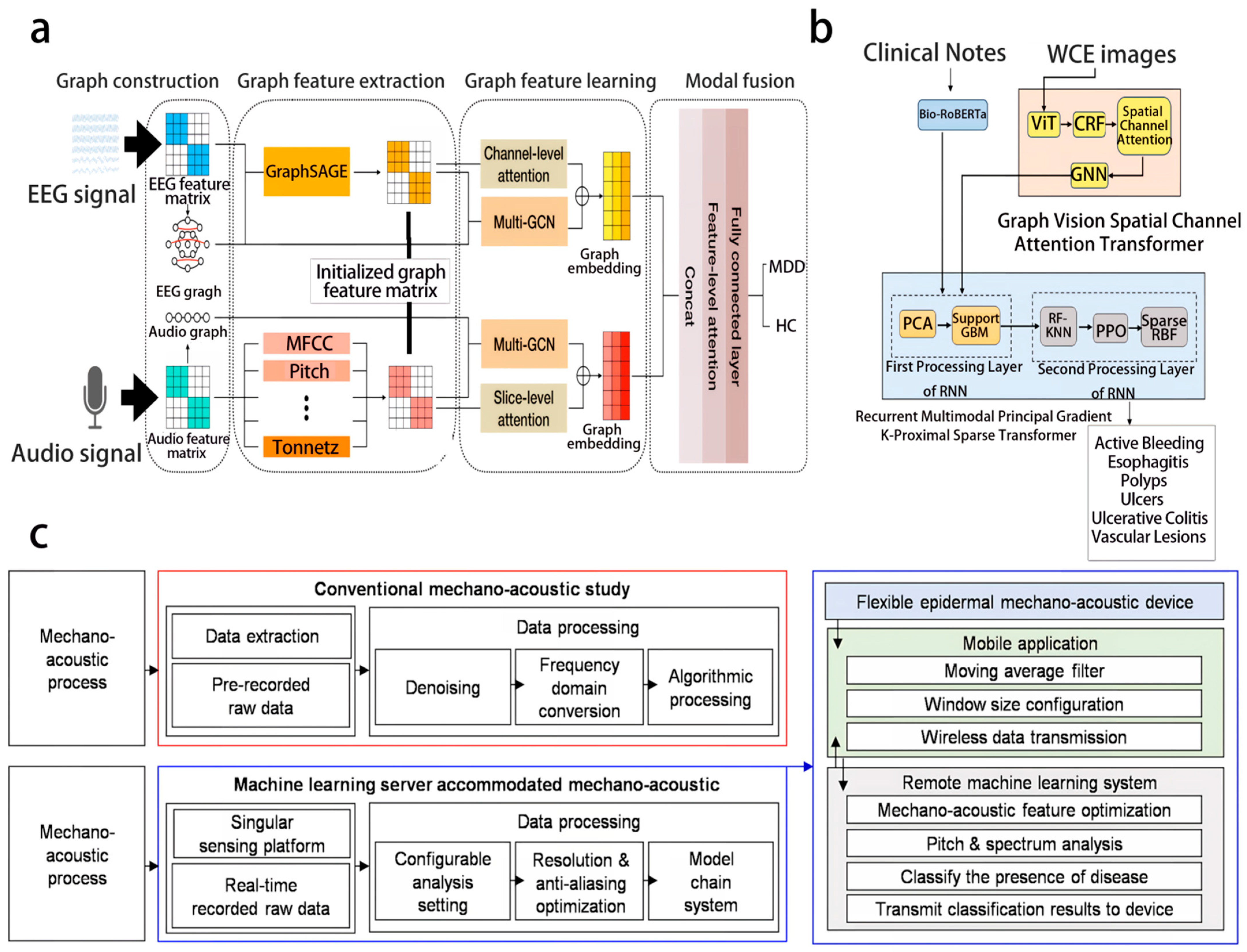
2.2. Multimodal Feature Extraction (MFE)
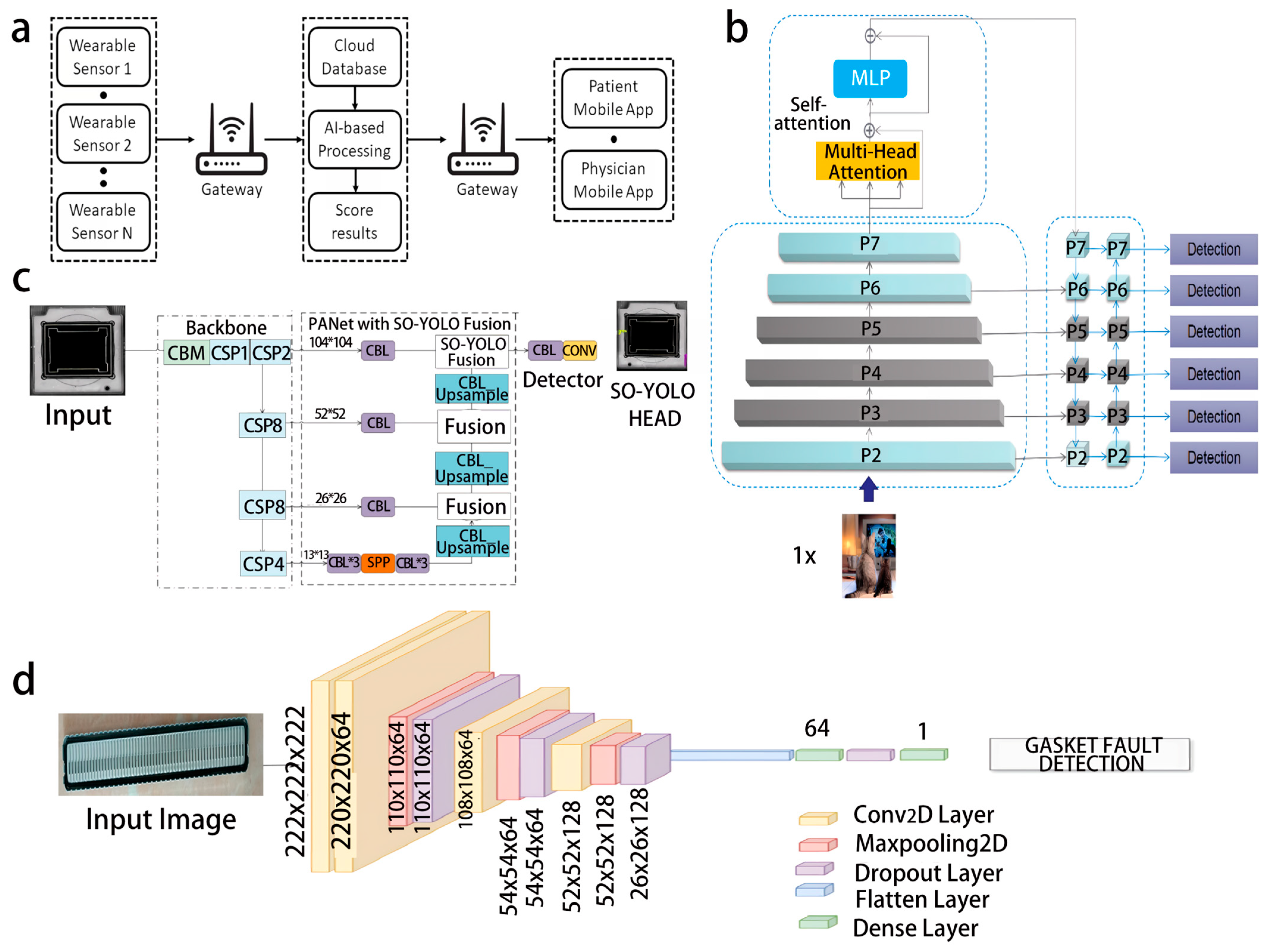
2.3. Process Defect and Anomaly Detection (PDAD)
2.4. Data Compression and Edge Computing (DCEC)

3. Applications of ML in Flexible Electronics
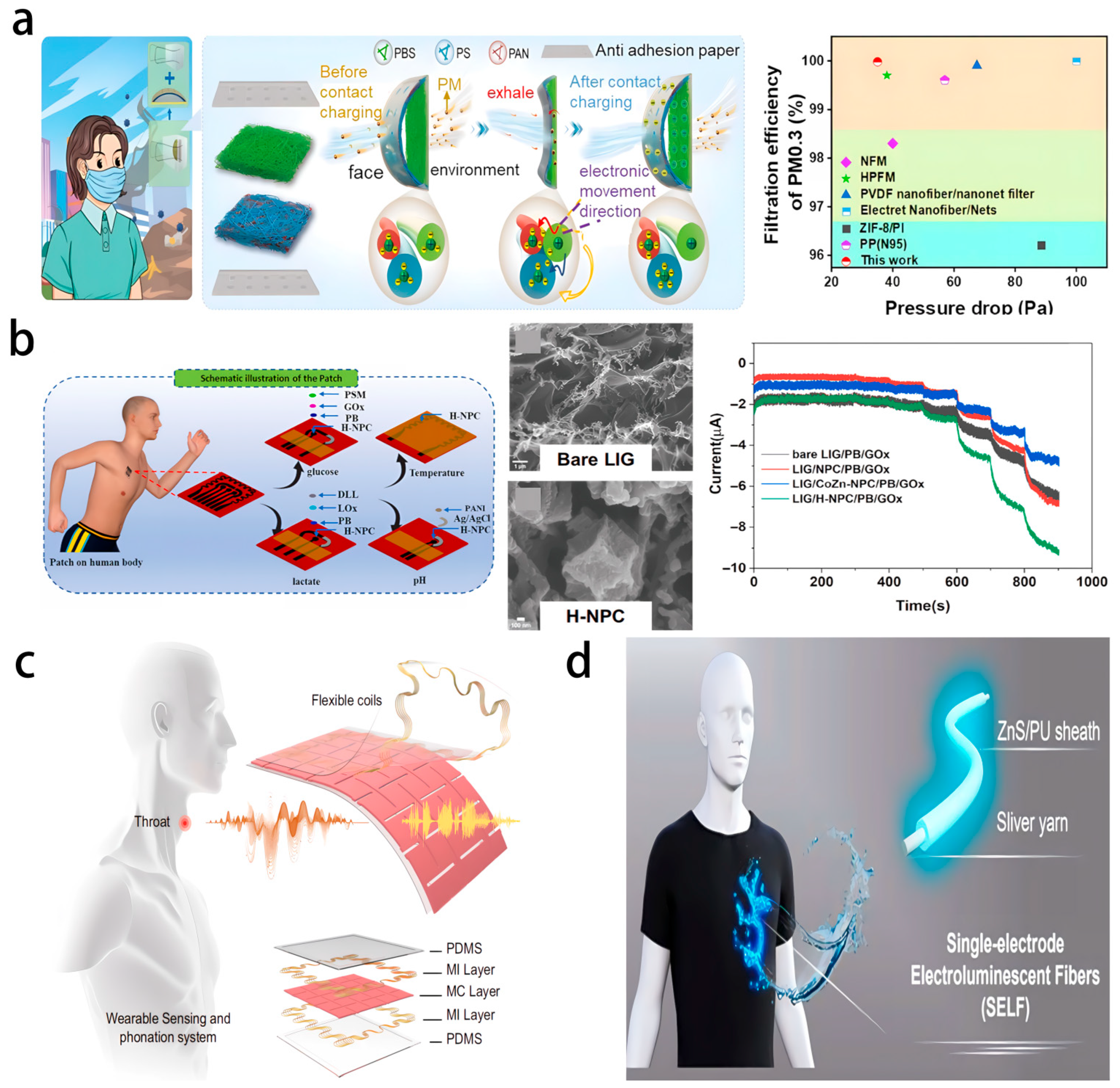
3.1. Wearable Health Monitoring System
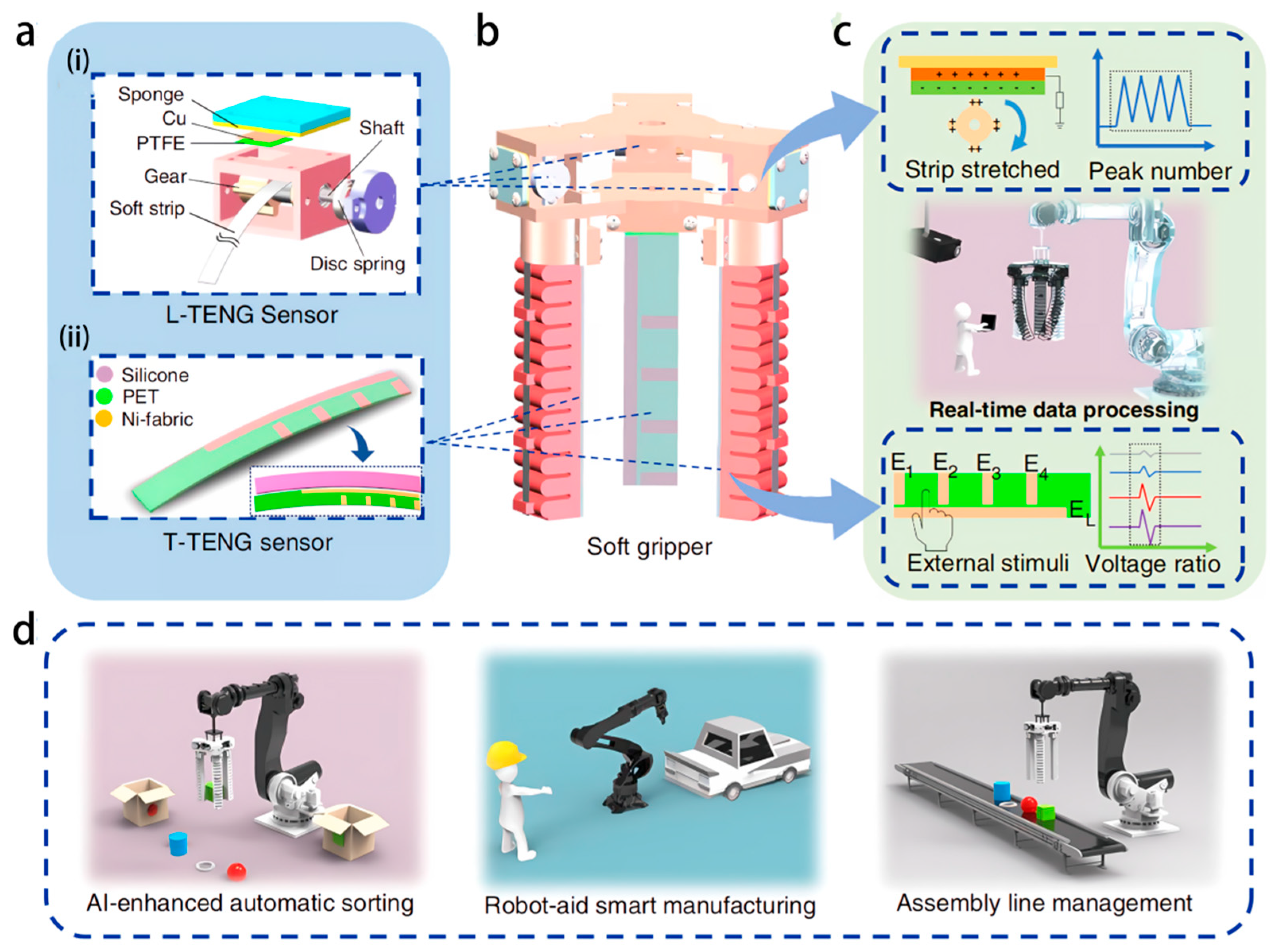
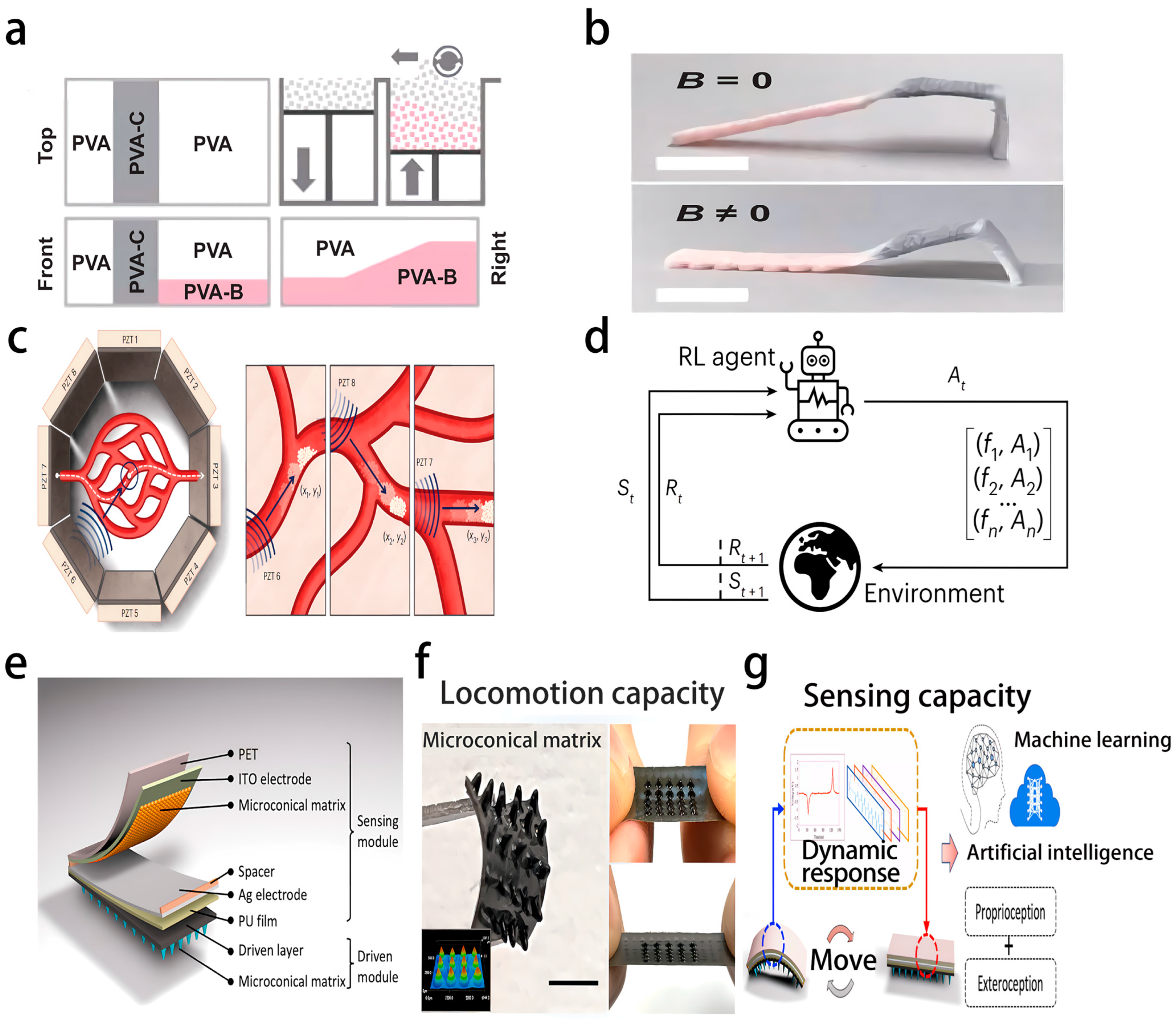
3.2. Intelligent Control of Soft Robots
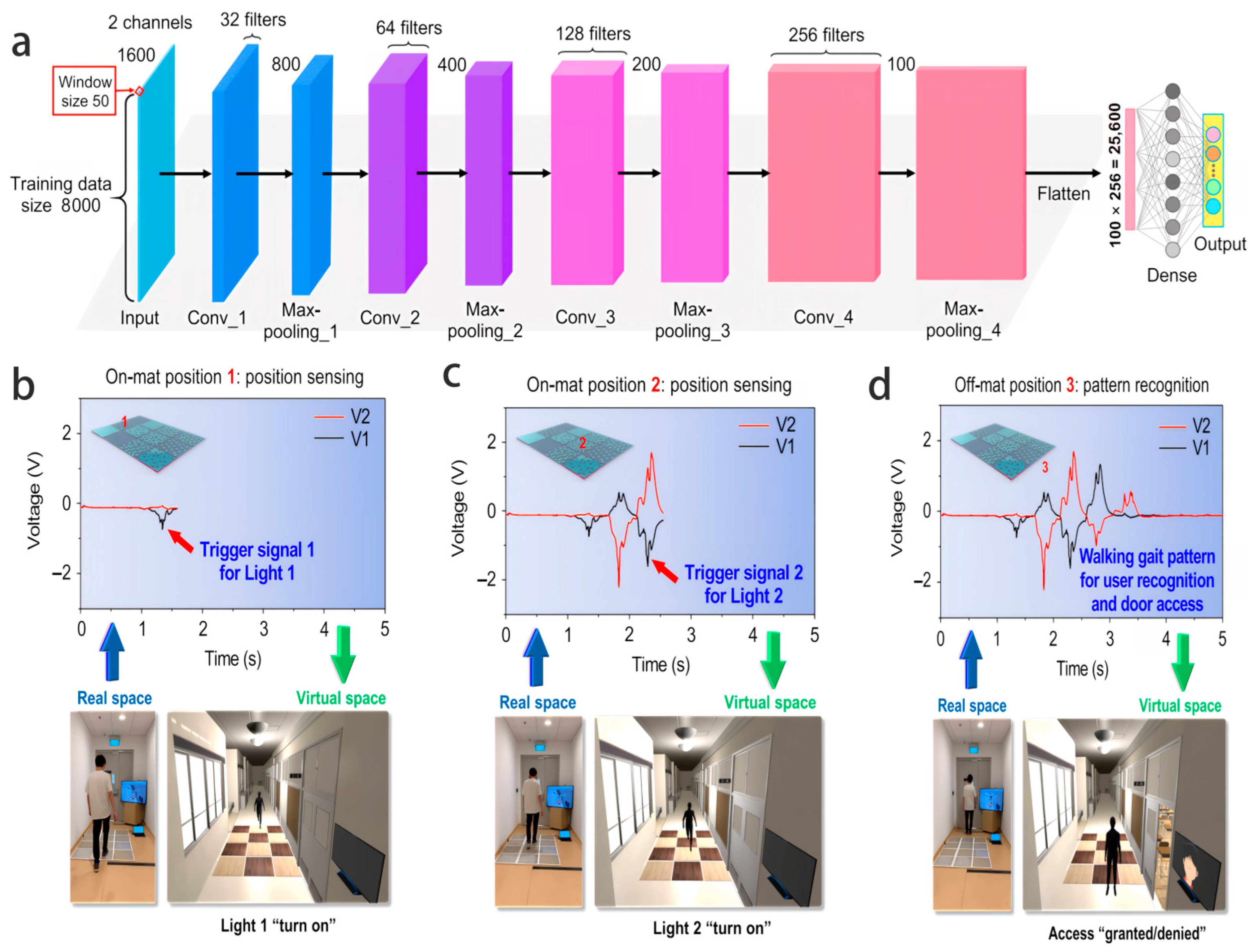
3.3. Performance Optimization of Self-Powered Devices
3.4. Intelligent Perception of Epidermal Electronic Systems
3.5. Cross-Domain Transferable Methodologies: Bridging Industrial ML to Biosensing Paradigms
3.6. Toward Clinically Actionable Systems: Data Rigor and Evaluation Standards
4. Conclusions and Future Prospects
Author Contributions
Funding
Institutional Review Board Statement
Informed Consent Statement
Data Availability Statement
Acknowledgments
Conflicts of Interest
Abbreviations
| ML | Machine Learning |
| LSTM | Long Short-Term Memory Network |
| CNN | Convolutional Neural Network |
| RL | Reinforcement Learning |
| IPSS | Intelligent Processing of Sensor Signals |
| MFE | Multimodal Feature Extraction |
| PDAD | Process Defect and Anomaly Detection |
| DCEC | Data Compression and Edge Computing |
| ResNet | Residual Network |
| OEST | Organic Electrochemical Synaptic Transistors |
| COA | Crocodile Optimization Algorithm |
| GRU | Gated Recurrent Unit |
| CRO | Chemical Reaction Optimization |
| LM | Liquid Metal |
| SVM | Support Vector Machines |
| NLP | Natural Language Processing |
| EDA | Electrodermal Activity |
| ACC | Accelerometer |
| AOI | Automatic Optical Inspection |
| ATT-YOLO | Attention Mechanism You Only Look Once |
| SO-YOLO | Solder Object You Only Look Once |
| PCBs | Printed Circuit Boards |
| MLR | Multiple Linear Regression |
| SBF | Selective Box Fusion |
| SDWD | Soft Decision Wavelet Decomposition |
| SVR | Support Vector Regression |
| EMG | Electromyography |
| FISA | Flexible Integrated Sensing Array |
| RF | Random Forest |
| L-TENG | Length TENG |
| PPO | Proximal Policy Optimization |
| IMUs | Inertial Measurement Units |
| T-DNN | Tandem Deep Neural Network |
| EBFCs | Enzyme Biofuel Cells |
| CAM | Relevant Class Activation Map |
| SNR | Signal-To-Noise Ratio |
References
- Qiao, Y.; Luo, J.; Cui, T.; Liu, H.; Tang, H.; Zeng, Y.; Liu, C.; Li, Y.; Jian, J.; Wu, J.; et al. Soft Electronics for Health Monitoring Assisted by Machine Learning. Nano-Micro. Lett. 2023, 15, 66. [Google Scholar] [CrossRef]
- Loke, G.; Khudiyev, T.; Wang, B.; Fu, S.; Payra, S.; Shaoul, Y.; Fung, J.; Chatziveroglou, I.; Chou, P.; Chinn, I.; et al. Digital electronics in fibres enable fabric-based machine-learning inference. Nat. Commun. 2021, 12, 3317. [Google Scholar] [CrossRef]
- Sun, T.; Feng, B.; Huo, J.; Xiao, Y.; Peng, J.; Zou, G.; Li, Z.; Du, C.; Wang, W.; Zou, G. Artificial Intelligence Meets Flexible Sensors: Emerging Smart Flexible Sensing Systems Driven by Machine Learning and Artificial Synapses. Nano-Micro. Lett. 2024, 16, 14. [Google Scholar] [CrossRef]
- Xu, H.; Zheng, W.; Zhang, Y.; Zhao, D.; Wang, L.; Zhao, Y.; Wang, W.; Huo, Z.; Yuan, Y.; Zhang, J.; et al. A fully integrated, standalone stretchable device platform with in-sensor adaptive machine learning for rehabilitation. Nat. Commun. 2023, 14, 7769. [Google Scholar] [CrossRef] [PubMed]
- Wang, Y.; Lawan, M.; Zhao, Y.; Zheng, W.; Gao, L.; Yin, Z.; Zhao, H. Machine Learning-Enhanced Flexible Mechanical Sensing. Nano-Micro. Lett. 2023, 15, 55. [Google Scholar] [CrossRef] [PubMed]
- Lee, J.; Kwon, K.; Soltis, I.; Matthews, J.; Jae, Y.; Kim, H.; Romero, L.; Zavanelli, N.; Kwon, Y.; Kwon, S.; et al. Intelligent upper-limb exoskeleton integrated with soft bio electronics and deep learning for intention-driven augmentation. npj Flex. Electron. 2024, 8, 11. [Google Scholar] [CrossRef]
- Nunes, A.; Yıldız, I.; Kinker, R.; Casado, J.; Dana, N.; Geronimo, A.; Tarolli, C.G.; Schneider, R.B.; Dorsey, E.R.; Adams, J.L.; et al. Using wearable sensors and machine learning to assess upper limb function in Huntington’s disease. Commun. Med. 2025, 5, 50. [Google Scholar] [CrossRef] [PubMed]
- Rok, K.; Kwon, K.; Jin, M.; Kyu, K.; Gong, D.; Yeo, W.; Hwan, S.; Han, S. Machine-learned wearable sensors for real-time hand-motion recognition: Toward practical applications. Natl. Sci. Rev. 2024, 11, 298. [Google Scholar]
- Liu, T.; Zhang, M.; Li, Z.; Dou, H.; Zhang, W.; Yang, J.; Wu, P.; Li, D.; Mu, X. Machine learning-assisted wearable sensing systems for speech recognition and interaction. Nat. Commun. 2025, 16, 2363. [Google Scholar] [CrossRef]
- Yu, S. Research on the Application of Flexible Electronics Technology in Wearable Devices. World J. Eng. Technol. 2024, 12, 1024–1033. [Google Scholar] [CrossRef]
- Mahdi, M. Kalman contrastive unsupervised representation learning. Sci. Rep. 2024, 14, 30243. [Google Scholar] [CrossRef]
- Shafiq, M.; Kavitha, J.; Rinku, D.; Senthil, N.; Poon, K.; Jaffar, A.; Saravanan, V. Dual smart sensor data-based deep learning network for premature infant hypoglycemia detection. Sci. Rep. 2025, 15, 23442. [Google Scholar] [CrossRef]
- Cheng, A.; Li, X.; Li, D.; Chen, Z.; Cui, T.; Tao, L.; Tang, Z.; Li, X.; Dong, Z.; Liu, H.; et al. An intelligent hybrid-fabric wristband system enabled by thermal encapsulation for ergonomic human-machine interaction. Nat. Commun. 2025, 16, 591. [Google Scholar] [PubMed]
- Yao, C.; Liu, S.; Liu, Z.; Huang, S.; Sun, T.; He, M.; He, W.; Xiao, M.; Ou, H.; Tao, Y.; et al. Deep learning-enhanced anti-noise triboelectric acoustic sensor for human-machine collaboration in noisy environments. Nat. Commun. 2025, 16, 4276. [Google Scholar]
- Chen, S.; Zhou, Z.; Hou, K.; Wu, X.; He, Q.; Tang, C.; Li, T.; Zhang, X.; Jie, J.; Gao, Z.; et al. Artificial organic afferent nerves enable closed-loop tactile feedback for intelligent robot. Nat. Commun. 2024, 15, 7056. [Google Scholar] [CrossRef] [PubMed]
- Jayasri, C.; Balaji, V.; Nalayini, C.; Pradeep, S. Detecting cyber attacks in vehicle networks using improved LSTM based optimization methodology. Sci. Rep. 2025, 15, 19141. [Google Scholar] [CrossRef]
- Ren, M.; Wei, J.; Qin, J.; Guo, X.; Wang, H.; Li, S. Attention based LSTM framework for robust UWB and INS integration in NLOSenvironments. Sci. Rep. 2025, 15, 21637. [Google Scholar] [CrossRef]
- Huang, H.; Shi, S.; Zha, J.; Xia, Y.; Wang, H.; Yang, P.; Zheng, L.; Xu, S.; Wang, W.; Ren, Y.; et al. In-sensor compressing via programmable optoelectronic sensors based on van der Waals hetero structures for intelligent machine vision. Nat. Commun. 2025, 16, 383. [Google Scholar]
- Shahtalebi, S.; Farokh, S.; Samotus, O.; Patel, R.; Jog, M.; Mohammadi, A. PHTNet: Characterization and Deep Mining of Involuntary Pathological Hand Tremor using Recurrent Neural Network Models. Sci. Rep. 2020, 10, 2195. [Google Scholar] [CrossRef]
- Sharma, S.; Kumar, P. Reduced sampling rate Kalman filters for carrier phase and frequency offset tracking in 200 Gbps 16 QAM coherent communication system. Sci. Rep. 2021, 11, 1991. [Google Scholar] [CrossRef]
- Zhang, Y.; Liu, Z.; Bi, Y. Node deployment optimization of underwater wireless sensor networks using intelligent optimization algorithm and robot collaboration. Sci. Rep. 2023, 13, 15920. [Google Scholar] [CrossRef]
- Wang, B.; Zheng, Y.; Han, X.; Kong, L.; Xiao, G.; Xiao, Z.; Chen, S. A systematic literature review on integrating AI-powered smart glasses into digital health management for proactive healthcare solutions. npj Digit. Med. 2025, 8, 410. [Google Scholar]
- Kim, H.; Cha, H.; Kim, M.; Jae, Y.; Yi, H.; Hoon, S.; Ira, S.; Kim, H.; Hwan, C.; Yeo, W. AR-Enabled Persistent Human–Machine Interfaces via a Scalable Soft Electrode Array. Adv. Sci. 2024, 11, 2305871. [Google Scholar] [CrossRef] [PubMed]
- Qiu, Y.; Zou, Z.; Zou, Z.; Kurnia, N.; Vivek, K.; Whiting, G.; Yang, F.; Zhang, W.; Lu, J.; Zhong, B.; et al. Deep-learning-assisted printed liquid metal sensory system for wearable application sand boxing training. npj Flex. Electron. 2023, 7, 37. [Google Scholar] [CrossRef]
- Wen, L.; Nie, M.; Chen, P.; Zhao, Y.; Shen, J.; Wang, C.; Xiong, Y.; Yin, K.; Sun, L. Wearable multimode sensor with a seamless integrated structure for recognition of different joint motion states with the assistance of a deep learning algorithm. Microsyst. Nanoeng. 2022, 8, 24. [Google Scholar] [CrossRef] [PubMed]
- Choi, Y.; Jin, R.; Lee, S.; Song, Y.; Tay, R.; Kim, G.; Yoo, J.; Han, H.; Yeom, J.; Cho, J.; et al. All-printed chip-less wearable neuromorphic system for multimod physicochemical health monitoring. Nat. Commun. 2025, 16, 5689. [Google Scholar] [CrossRef]
- Gao, Q.; Sun, F.; Li, Y.; Li, L.; Liu, M.; Wang, S.; Wang, Y.; Li, T.; Liu, L.; Feng, S.; et al. Biological Tissue-Inspired Ultrasoft, Ultrathin, and Mechanically Enhanced Microfiber Composite Hydrogel for Flexible Bio electronics. Nano-Micro. Lett. 2023, 15, 139. [Google Scholar] [CrossRef]
- Tian, H.; Zhao, J.; Sun, Y.; An, J. Dynamic bone recognition for robotic vertebral plate cutting via unit energy consumption and SVM optimized by PSO. Sci. Rep. 2025, 15, 16378. [Google Scholar] [CrossRef]
- Yang, S.; Gao, Y.; Zhu, Y.; Zhang, L.; Xie, Q.; Lu, X.; Wang, F.; Zhang, Z. A deep learning approach to stress recognition through multimodal physiological signal image transformation. Sci. Rep. 2025, 15, 22258. [Google Scholar] [CrossRef]
- Xu, C.; Zhan, Y.; Wang, Z.; Yang, J. Multimodal fusion based few-shot network intrusion detection system. Sci. Rep. 2025, 15, 21986. [Google Scholar] [CrossRef]
- Xing, T.; Dou, Y.; Chen, X.; Zhou, J.; Xie, X.; Peng, S. An adaptive multi-graph neural network with multimodal feature fusion learning for MDD detection. Sci. Rep. 2024, 14, 28400. [Google Scholar] [CrossRef] [PubMed]
- Sharmila, V.; Geetha, S. A recurrent multimodal sparse transformer framework for gastrointestinal disease classification. Sci. Rep. 2025, 15, 24206. [Google Scholar] [CrossRef]
- Kyu, H.; Uk, S.; Kong, S.; Ryu, H.; Bin, H.; Hoon, S.; Kang, D.; Hye, S.; Jun, K.; Cho, J.; et al. Real-time deep learning-assisted mechano-acoustic system for respiratory diagnosis and multifunctional classification. npj Flex. Electron. 2024, 8, 69. [Google Scholar]
- Xiang, Z. VSS-SpatioNet: A multi-scale feature fusion network for multimodal image integrations. Sci. Rep. 2025, 15, 9306. [Google Scholar]
- Nazim, S.; Mansoor, M.; Rizvi, S.; Che, J.; Shujaa, S.; Mohd, M. Multimodal malware classification using proposed ensemble deep neural network framework. Sci. Rep. 2025, 15, 18006. [Google Scholar] [CrossRef] [PubMed]
- Berrich, Y.; Guennoun, Z. EEG-based epilepsy detection using CNN-SVM and DNN-SVM with feature dimensionality reduction by PCA. Sci. Rep. 2025, 15, 14313. [Google Scholar] [CrossRef]
- Cai, Y.; Li, X.; Zhang, Y.; Li, J.; Zhu, F.; Rao, L. Multimodal sentiment analysis based on multi-layer feature fusion and multi-task learning. Sci. Rep. 2025, 15, 2126. [Google Scholar]
- Huang, H.; Tang, X.; Wen, F.; Jin, X. Small object detection method with shallow feature fusion network for chip surface defect detection. Sci. Rep. 2022, 12, 3914. [Google Scholar] [CrossRef]
- Bhattacharya, A.; Cloutier, S. End-to-end deep learning framework for printed circuit board manufacturing defect classification. Sci. Rep. 2022, 12, 12559. [Google Scholar] [CrossRef]
- Arpaia, P.; Crauso, F.; De, E.; Duraccio, L.; Improta, G.; Serino, F. Soft Transducer for Patient’s Vitals Telemonitoring with Deep Learning-Based Personalized Anomaly Detection. Sensors 2022, 22, 536. [Google Scholar]
- Wang, J.; Dai, H.; Chen, T.; Liu, H.; Zhang, X.; Zhong, Q.; Lu, R. Toward surface defect detection in electronics manufacturing by an accurate and lightweight YOLO-style object detector. Sci. Rep. 2023, 13, 7062. [Google Scholar] [CrossRef]
- Suh, S. Optimal surface defect detector design based on deep learning for 3D geometry. Sci. Rep. 2025, 15, 5527. [Google Scholar] [CrossRef]
- Arumai, S.; Seetharaman, R.; Sharmila, V.; Prathiba, S. Deep learning based gasket fault detection: A CNN approach. Sci. Rep. 2025, 15, 4776. [Google Scholar] [CrossRef]
- Arthi, R.; Krishnaveni, S.; Zeadally, S. An Intelligent SDN-IoT Enabled Intrusion Detection System for Healthcare Systems Using a Hybrid Deep Learning and Machine Learning Approach. China Commun. 2024, 21, 267–287. [Google Scholar] [CrossRef]
- Han, R.; Wang, C.; Wang, Y.; Zhang, Y.; Guo, W.; Zi, Y.; Zhao, J. Defect detection in EBSM components through selective box fusion of modern object detection. Sci. Rep. 2025, 15, 11899. [Google Scholar] [CrossRef]
- Dong, J.; Li, J.; Ding, Y.; Zhang, X.; Wang, N.; Li, D.; Yan, W.; Shen, C.; He, Y.; Ren, X.; et al. Machine learning application to predict the electron temperature on the J-TEXT tokamak. Plasma Sci. Technol. 2021, 23, 085101. [Google Scholar] [CrossRef]
- Hossen, A.; Rauf, A.; Koirala, N.; Ding, H.; Budker, D.; Wickenbrock, A.; Heute, U.; Deuschl, J.; Groppa, S.; Muthuraman, M. Machine learning aided classification of tremor in multiple sclerosis. EBioMedicine 2022, 82, 104152. [Google Scholar] [CrossRef] [PubMed]
- Yang, H.; Li, J.; Xiao, X.; Wang, J.; Li, Y.; Li, K.; Li, Z.; Yang, H.; Wang, Q.; Wang, X.; et al. Topographic design in wearable MXene sensors with in-sensor machine learning for full-body avatar reconstruction. Nat. Commun. 2022, 13, 5311. [Google Scholar] [PubMed]
- Levy, J.; Davis, M.; Chacko, R.; Davis, M.; Fu, L.; Goel, T.; Pamal, A.; Nafi, I.; Angirekula, A.; Suvarna, A.; et al. Intraoperative margin assessment for basal cell carcinoma with deep learning and histologic tumor mapping to surgical site. npj Precis. Oncol. 2024, 8, 2. [Google Scholar] [CrossRef] [PubMed]
- Bai, X.; Li, Y.; Xie, Y.; Chen, Q.; Zhang, X.; Li, J. High-throughput screening of CO2 cycloaddition MOF catalyst with an explainable machine learning model. Green Energy Environ. 2025, 10, 132–138. [Google Scholar] [CrossRef]
- Al-Khafaji, M.; Ramaha, N. Hybrid deep learning architecture for scalable and high-quality image compression. Sci. Rep. 2025, 15, 22926. [Google Scholar] [CrossRef]
- Sun, L.; Deng, A.; Wang, H.; Zhou, Y.; Song, Y. A soft exoskeleton for hip extension and flexion assistance based on reinforcement learning control. Sci. Rep. 2025, 15, 5435. [Google Scholar] [CrossRef]
- Fountzilas, E.; Pearce, T.; Baysal, M.; Chakraborty, A.; Tsimberidou, A. Convergence of evolving artificial intelligence and machine learning techniques in precision oncology. npj Digit. Med. 2025, 8, 75. [Google Scholar] [CrossRef]
- Zhang, R.; Yuan, Y.; Wang, X.; Sun, X.; Wang, S.; Yang, Z.; Ma, Y.; Zhang, E.; Li, Y. Machine learning-assisted rapid electromagnetic design of flexible graphene-based absorptive composites. Chem. Eng. J. 2025, 511, 161634. [Google Scholar] [CrossRef]
- Iqbal, S.; Mahgoub, I.; Du, E.; Ann, M.; Asghar, W. Advances in healthcare wearable devices. npj Flex. Electron. 2021, 5, 9. [Google Scholar] [CrossRef]
- Song, Z.; Zhou, S.; Qin, Y.; Xia, X.; Sun, Y.; Han, G.; Shu, T.; Hu, L.; Zhang, Q. Flexible and Wearable Biosensors for Monitoring Health Conditions. Biosensors 2023, 13, 630. [Google Scholar] [CrossRef] [PubMed]
- Asael, A.; Li, R.; Tsz, Z. Reshaping healthcare with wearable biosensors. Sci. Rep. 2023, 13, 4998. [Google Scholar] [CrossRef]
- Yang, L.; Wang, Z.; Wang, H.; Jin, B.; Meng, C.; Chen, X.; Li, R.; Wang, H.; Xin, M.; Zhao, Z.; et al. Self-Healing, Reconfigurable, Thermal-Switching, Transformative Electronics for Health Monitoring. Adv. Mater. 2023, 35, 15. [Google Scholar] [CrossRef]
- Xu, J.; Fang, Y.; Chen, J. Wearable Biosensors for Non-Invasive Sweat Diagnostics. Biosensors 2021, 11, 245. [Google Scholar] [CrossRef] [PubMed]
- Mi, Z.; Xia, Y.; Dong, H.; Shen, Y.; Feng, Z.; Hong, Y.; Zhu, H.; Yin, B.; Ji, Z.; Xu, Q.; et al. Microfluidic Wearable Electrochemical Sensor Based on MOF-Derived Hexagonal Rod-Shaped Porous Carbon for Sweat Metabolite and Electrolyte Analysis. Anal. Chem. 2024, 42, 96. [Google Scholar] [CrossRef]
- Adans-Dester, C.; Hankov, N.; O’Brien, A.; Vergara-Diaz, G.; Black-Schaffer, R.; Zafonte, R.; Dy, J.; Lee, S.; Bonato, P. Enabling precision rehabilitation interventions using wearable sensors and machine learning to track motor recovery. npj Digit. Med. 2020, 3, 121. [Google Scholar] [CrossRef]
- Kwon, M.; Hullfish, T.; Humbyrd, C.; Boakye, L.; Baxter, J. Wearable sensor and machine learning estimate tendon load and walking speed during immobilizing boot ambulation. Sci. Rep. 2023, 13, 18086. [Google Scholar] [CrossRef] [PubMed]
- Ban, S.; Jae, Y.; Kwon, S.; Kim, Y.; Won, J.; Kim, J.; Yeo, W. Soft Wireless Headband Bioelectronics and Electrooculography for Persistent Human–Machine Interfaces. ACS Appl. Electron. Mater. 2023, 5, 877–886. [Google Scholar] [CrossRef]
- Mohammadi, H.; Tarvirdizadeh, B.; Alipour, K.; Ghamari, M. Cuff-less blood pressure monitoring via PPG signals using a hybrid CNN-BiLSTM deep learning model with attention mechanism. Sci. Rep. 2025, 15, 22229. [Google Scholar]
- Jacobsen, M.; Gholamipoor, R.; Dembek, T.; Rottmann, P.; Verket, M.; Brandts, J.; Jäger, P.; Baermann, B.; Kondakci, M.; Heinemann, L.; et al. Wearable based monitoring and self-supervised contrastive learning detect clinical complications during treatment of Hematologic malignancies. npj Digit. Med. 2023, 6, 105. [Google Scholar]
- Corniani, G.; Sapienza, S.; Vergara-Diaz, G.; Valerio, A.; Vaziri, A.; Bonato, P.; Wayne, P. Remote monitoring of Tai Chi balance training interventions in older adults using wearable sensors and machine learning. Sci. Rep. 2025, 15, 10444. [Google Scholar] [CrossRef]
- Li, J.; Jia, H.; Zhou, J.; Huang, X.; Xu, L.; Jia, S.; Gao, Z.; Yao, K.; Li, D.; Zhang, B.; et al. Thin, soft, wearable system for continuous wireless monitoring of artery blood pressure. Nat. Commun. 2023, 14, 5009. [Google Scholar] [CrossRef]
- Un, K.; Wong, C.; Lau, Y.; Lee, J.; Tam, F.; Lai, W.; Lau, Y.; Chen, H.; Wibowo, S.; Zhang, X.; et al. Observational study on wearable biosensors and machine learning-based remote monitoring of COVID-19 patients. Sci. Rep. 2021, 11, 4388. [Google Scholar] [CrossRef] [PubMed]
- Ghomrawi, H.; O’Brien, M.; Carter, M.; Macaluso, R.; Khazanchi, R.; Fanton, M.; DeBoer, C.; Linton, S.; Zeineddin, S.; Pitt, J.; et al. Applying machine learning to consumer wearable data for the early detection of complications after pediatric appendectomy. npj Digit. Med. 2023, 6, 148. [Google Scholar]
- Kadirvelu, B.; Gavriel, C.; Nageshwaran, S.; Ping, J.; Nethisinghe, S.; Chan, J.P.K.; Nethisinghe, S.; Athanasopoulos, S.; Ricotti, V.; Voit, T.; et al. A wearable motion capture suit and machine learning predict disease progression in Friedreich’s ataxia. Nat. Med. 2023, 29, 86–94. [Google Scholar] [CrossRef] [PubMed]
- Prakash, K.; Naga, M.; Naga, G.; Moses, P.; Sumanth, M.; Bansal, S.; Iqbal, M.; Mugren, K. MyWear revolutionizes real-time health monitoring with comparative analysis of machine learning. Sci. Rep. 2025, 15, 17026. [Google Scholar] [CrossRef]
- Parisi, F.; Corniani, G.; Bonato, P.; Balkwill, D.; Acuna, P.; Go, C.; Sharma, N.; Stephen, C. Motor assessment of X-linked dystonia parkinsonism via machine-learning-based analysis of wearable sensor data. Sci. Rep. 2024, 14, 13229. [Google Scholar] [CrossRef]
- Kim, Y.; Kim, J.; Chicas, R.; Xiuhtecutli, N.; Matthews, J.; Zavanelli, N.; Kwon, S.; Lee, S.; Hertzberg, V.; Yeo, W. Soft Wireless Bioelectronics Designed for Real-Time, Continuous Health Monitoring of Farm workers. Adv. Healthc. Mater. 2022, 11, 13. [Google Scholar]
- Alghieth, M. DeepECG-Net: A hybrid transformer-based deep learning model for real-time ECG anomaly detection. Sci. Rep. 2025, 15, 20714. [Google Scholar] [CrossRef]
- Wang, Y.; Sun, C.; Ahmed, D. A smart acoustic textile for health monitoring. Nat. Electron. 2025, 8, 485–495. [Google Scholar] [CrossRef]
- Yang, T.; Xiao, Y.; Zhang, Z.; Liang, Y.; Li, G.; Zhang, M.; Li, S.; Wong, T.; Wang, Y.; Li, T.; et al. A soft artificial muscle driven robot with reinforcement learning. Sci. Rep. 2018, 8, 14518. [Google Scholar] [CrossRef] [PubMed]
- Zhang, L.; Xing, S.; Yin, H.; Weisbecker, H.; Tran, H.; Guo, Z.; Han, T.; Wang, Y.; Liu, Y.; Wu, Y.; et al. Skin-inspired, sensory robots for electronic implants. Nat. Commun. 2024, 15, 4777. [Google Scholar] [CrossRef] [PubMed]
- Zhou, X.; Cao, W. Flexible and Stretchable Carbon-Based Sensors and Actuators for Soft Robots. Nanomaterials 2023, 13, 316. [Google Scholar] [CrossRef]
- Wang, J.; Liu, B.; Wu, E.Q.; Ma, J.; Li, P. Simulation Analysis of Deformation Control for Magnetic Soft Medical Robots. IEEE/CAA J. Autom. Sin. 2024, 11, 794–796. [Google Scholar] [CrossRef]
- Jin, T.; Sun, Z.; Li, L.; Zhang, Q.; Zhu, M.; Zhang, Z.; Yuan, G.; Chen, T.; Tian, Y.; Hou, X.; et al. Triboelectric nanogenerator sensors for soft robotics aiming at digital twin applications. Nat. Commun. 2020, 11, 5381. [Google Scholar] [CrossRef]
- Yu, Y.; Li, J.; Solomon, S.A.; Min, J.; Tu, J.; Guo, W.; Xu, C.; Song, Y.; Gao, W. All-printed soft human-machine interface for robotic physicochemical sensing. Sci. Robot. 2022, 7, 67. [Google Scholar] [CrossRef]
- Youssef, S.; Soliman, M.; Saleh, M.; Elsayed, A.; Radwan, A. Design and control of soft biomimetic pangasius fish robot using fin ray effect and reinforcement learning. Sci. Rep. 2022, 12, 21861. [Google Scholar] [CrossRef]
- Zhang, Y.; Zhang, W.; Gao, P.; Zhong, X.; Pu, W. Finger-palm synergistic soft gripper for dynamic capture via energy harvesting and dissipation. Nat. Commun. 2022, 13, 7700. [Google Scholar] [CrossRef]
- Ou, X.; Huang, J.; Huang, D.; Li, X.; Chen, G.; Yang, Y.; Bi, R.; Sheng, Y.; Guo, S. 4D-printed snake-like biomimetic soft robots. Bio-Des. Manuf. 2025, 8, 55–67. [Google Scholar] [CrossRef]
- Shi, X.; Lee, A.; Yang, B.; Ning, H.; Liu, H.; An, K.; Liao, H.; Huang, K.; Luo, X.; Zhang, L.; et al. Machine Learning Assisted Electronic/Ionic Skin Recognition of Thermal Stimuli and Mechanical Deformation for Soft Robots. Adv. Sci. 2024, 11, 2401123. [Google Scholar] [CrossRef] [PubMed]
- Zhai, Z.; Moradi, M.; Kong, L.; Glaz, B.; Haile, M.; Lai, Y. Model-free tracking control of complex dynamical trajectories with machine learning. Nat. Commun. 2023, 14, 5698. [Google Scholar] [CrossRef]
- Triantafyllidis, E.; Acero, F.; Liu, Z.; Li, Z. Hybrid hierarchical learning for solving complex sequential tasks using the robotic manipulation network ROMAN. Nat. Mach. Intell. 2023, 5, 991–1005. [Google Scholar] [CrossRef]
- Zou, S.; Picella, S.; De, J.; Kortman, V.; Sakes, A.; Overvelde, J. A retrofit sensing strategy for soft fluidic robots. Nat. Commun. 2024, 15, 539. [Google Scholar] [CrossRef]
- Tricomi, E.; Missiroli, F.; Xiloyannis, M.; Lotti, N.; Zhang, X.; Stefanakis, M.; Theisen, M.; Bauer, J.; Becker, C.; Masia, L. Soft robotic shorts improve outdoor walking efficiency in older adults. Nat. Mach. Intell. 2024, 6, 1145–1155. [Google Scholar] [CrossRef]
- Kim, D.; Kim, S.; Kim, T.; Kang, B.; Lee, M.; Park, W.; Ku, S.; Kim, D.; Kwon, J.; Lee, H.; et al. Review of machine learning methods in soft robotics. PLoS ONE 2021, 16, 2. [Google Scholar] [CrossRef]
- Heng, W.; Solomon, S.; Gao, W. Flexible Electronics and Devices as Human–Machine Interfaces for Medical Robotics. Adv. Mater. 2022, 34, 2107902. [Google Scholar] [CrossRef] [PubMed]
- Medany, M.; Piglia, L.; Achenbach, L.; Karthik, S.; Ahmed, D. Model-based reinforcement learning for ultrasound-driven autonomous microrobots. Nat. Mach. Intell. 2025, 7, 1076–1090. [Google Scholar] [CrossRef] [PubMed]
- Zhou, N.; Cui, T.; Lei, Z.; Wu, P. Bioinspired learning and memory in ionogels through fast response and slow relaxation dynamics of ions. Nat. Commun. 2025, 16, 4573. [Google Scholar] [CrossRef] [PubMed]
- Young, S.; Hae, D.; Byeok, S.; Ho, J. Direct 4D printing of functionally graded hydrogel networks for biodegradable, untethered, and multimorphic soft robots. Int. J. Extrem. Manuf. 2024, 6, 025002. [Google Scholar]
- Liu, Z.; Jian, X.; Sadiq, T.; Ahmed, Z.; Alfarraj, O.; Alblehai, F.; Tolba, A. Efficient control of spider-like medical robots with capsule neural networks and modified spring search algorithm. Sci. Rep. 2025, 15, 13828. [Google Scholar] [CrossRef]
- Zeng, W.; Ding, X.; Jin, Y.; Liu, B.; Zeng, R.; Gong, F.; Lou, Y.; Jiang, L.; Li, H. Magnetic soft millirobot with simultaneous locomotion and sensing capability. npj Flex. Electron. 2025, 9, 59. [Google Scholar] [CrossRef]
- Shi, Q.; Zhang, Z.; He, T.; Sun, Z.; Wang, B.; Feng, Y.; Shan, X.; Salam, B.; Lee, C. Deep learning enabled smart mats as a scalable floor monitoring system. Nat. Commun. 2020, 11, 4609. [Google Scholar] [CrossRef]
- Chen, B.; Feng, Z.; Yao, F.; Zhang, M.; Wang, K.; Wei, Y.; Gong, W.; Rödel, J. Flexible piezoelectrics: Integration of sensing, actuating and energy harvesting. npj Flex. Electron. 2025, 9, 58. [Google Scholar] [CrossRef]
- Wang, L. A biodegradable and restorative peripheral neural interface for the interrogation of neuropathic injuries. Nat. Commun. 2025, 16, 1716. [Google Scholar] [CrossRef]
- Xu, S.; Chen, X.; Wang, S.; Chen, Z.; Pan, P.; Huang, Q. Integrating machine learning for the optimization of polyacrylamide/alginate hydrogel. Regen. Biomater. 2024, 11, 109. [Google Scholar] [CrossRef]
- Tao, D.; Su, P.; Chen, A.; Gu, D.; Eginligil, M.; Huang, W. Electro-spun nanofibers-based triboelectric nanogenerators in wearable electronics: Status and perspectives. npj Flex. Electron. 2025, 9, 4. [Google Scholar]
- Sun, Z.; Zhu, M.; Shan, X.; Lee, C. Augmented tactile-perception and haptic-feedback rings as human-machine interfaces aiming for immersive interactions. Nat. Commun. 2022, 13, 5224. [Google Scholar] [CrossRef] [PubMed]
- Khumngern, S.; Jeerapan, I. Synergistic convergence of materials and enzymes for biosensing and self-sustaining energy devices towards on-body health monitoring. Commun. Mater. 2024, 5, 135. [Google Scholar]
- Xu, C.; Song, Y.; Han, M.; Zhang, H. Portable and wearable self-powered systems based on emerging energy harvesting technology. Microsyst. Nanoeng. 2021, 7, 25. [Google Scholar] [CrossRef] [PubMed]
- Che, Z.; Wan, X.; Xu, J.; Duan, C.; Zheng, T.; Chen, J. Speaking without vocal folds using a machine-learning-assisted wearable sensing-actuation system. Nat. Commun. 2024, 15, 1873. [Google Scholar]
- Alderete, N.; Pathak, N.; Espinosa, H. Machine learning assisted design of shape-programmable 3D kirigami metamaterials. npj Comput. Mater. 2022, 8, 191. [Google Scholar]
- Yao, M.; Richter, O.; Zhao, G.; Qiao, N.; Xing, Y.; Wang, D.; Hu, T.; Fang, W.; Demirci, T.; Marchi, M.; et al. Spike-based dynamic computing with asynchronous sensing-computing neuromorphic chip. Nat. Commun. 2024, 15, 4464. [Google Scholar]
- Liu, H.; Shi, Y.; Pan, Y.; Wang, Z.; Wang, B. Sensory interactive fibers and textiles. npj Flex. Electron. 2025, 9, 23. [Google Scholar]
- Liu, H.; Dong, W.; Li, Y.; Li, F.; Geng, J.; Zhu, M.; Chen, T.; Zhang, H.; Sun, L.; Lee, C. An epidermal sEMG tattoo-like patch as a new human–machine interface for patients with loss of voice. Microsyst. Nanoeng. 2020, 6, 16. [Google Scholar] [CrossRef]
- Lim, K.; Seo, H.; Gi, W.; Song, H.; Oh, M.; Young, S.; Kim, Y.; Park, J. Material and structural considerations for high-performance electrodes for wearable skin devices. Commun. Mater. 2024, 5, 49. [Google Scholar] [CrossRef]
- So, C.; Kim, J.; Luan, W.; Park, S.; Kim, H.; Han, S.; Kim, D.; Shin, C.; Kim, T.; Lee, W.; et al. Epidermal piezoresistive structure with deep learning-assisted data translation. npj Flex. Electron. 2022, 6, 70. [Google Scholar] [CrossRef]
- Yang, H.; Wang, Y.; Peng, H.; Huang, C. Breath biopsy of breast cancer using sensor array signals and machine learning analysis. Sci. Rep. 2021, 11, 103. [Google Scholar] [CrossRef] [PubMed]
- Zhao, Y.; Zhang, S.; Yu, T.; Zhang, Y.; Ye, G.; Cui, H.; He, C.; Jiang, W.; Zhai, Y.; Lu, C.; et al. Ultra-conformal skin electrodes with synergistically enhanced conductivity for long-time and low-motion artifact epidermal electrophysiology. Nat. Commun. 2021, 12, 4880. [Google Scholar] [CrossRef]
- Zhang, J.; Hu, Y.; Zhang, L.; Zhou, J.; Lu, A. Transparent, Ultra-Stretching, Tough, Adhesive Carboxyethyl Chitin/Polyacrylamide Hydrogel Toward High-Performance Soft Electronics. Nano-Micro. Lett. 2023, 15, 8. [Google Scholar] [CrossRef]
- Yao, H.; Yang, W.; Cheng, W.; Tan, Y.; See, H.; Li, S.; Ali, H.; Lim, B.; Liu, Z.; Tee, B. Near–hysteresis-free soft tactile electronic skins for wearables and reliable machine learning. Proc. Natl. Acad. Sci. USA 2020, 117, 25352–25359. [Google Scholar] [CrossRef]
- Zhu, P.; Du, H.; Hou, X.; Lu, P.; Wang, L.; Huang, J.; Bai, N.; Wu, Z.; Fang, N.; Fei, C. Skin-electrode iontronic interface for mechanosensing. Nat. Commun. 2021, 12, 4731. [Google Scholar] [CrossRef] [PubMed]
- Kim, T.; Shin, Y.; Kang, K.; Kim, K.; Kim, G.; Byeon, Y.; Kim, H.; Gao, Y.; Lee, J.; Son, G.; et al. Ultrathin crystalline-silicon-based strain gauges with deep learning algorithms for silent speech interfaces. Nat. Commun. 2022, 13, 5815. [Google Scholar] [CrossRef]
- Wang, Q.; Li, Y.; Lin, Y.; Sun, Y.; Bai, C.; Guo, H.; Lu, Y.; Kong, D. A Generic Strategy to Create Mechanically Interlocked Nanocomposite/Hydrogel Hybrid Electrodes for Epidermal Electronics. Nano-Micro. Lett. 2024, 16, 87. [Google Scholar] [CrossRef]
- Cai, L.; Burton, A.; Gonzales, D.; Kasper, K.; Azami, A.; Peralta, R.; Johnson, M.; Bakall, J.; Villalobos, E.; Ross, E.; et al. Osseosurface electronics—Thin, wireless, battery-free and multimodal musculoskeletal biointerfaces. Nat. Commun. 2021, 12, 6707. [Google Scholar] [CrossRef]
- Peng, Y.; Dong, J.; Long, J.; Zhang, Y.; Tang, X.; Lin, X.; Liu, H.; Liu, T.; Fan, W.; Liu, T.; et al. Thermally Conductive and UV-EMI Shielding Electronic Textiles for Unrestricted and Multifaceted Health Monitoring. Nano-Micro. Lett. 2024, 16, 199. [Google Scholar] [CrossRef]
- Wang, Y.; Tang, T.; Xu, Y.; Bai, Y.; Yin, L.; Li, G.; Zhang, H.; Liu, H.; Huang, Y. All-weather, natural silent speech recognition via machine-learning-assisted tattoo-like electronics. npj Flex. Electron. 2021, 5, 20. [Google Scholar] [CrossRef]
- Amraei, J.; Mirzapoor, A.; Motarjem, K.; Abdolahad, M. Enhancing breast cancer diagnosis through machine learning algorithms. Sci. Rep. 2025, 15, 23316. [Google Scholar] [CrossRef] [PubMed]
- Rafeedi, T.; Abdal, A.; Polat, B.; Hutcheson, K.; Shinn, E.; Lipomi, D. Wearable, epidermal devices for assessment of swallowing function. npj Flex. Electron. 2023, 7, 52. [Google Scholar] [CrossRef]
- Wang, Z.; Lu, Q.; Xia, Y.; Feng, S.; Shi, Y.; Wang, S.; Yang, X.; Zhao, Y.; Sun, F.; Li, T.; et al. Stable epidermal electronic device with strain isolation induced by in situ Joule heating. Microsyst. Nanoeng. 2021, 7, 56. [Google Scholar] [CrossRef]
- Cheng, L.; Li, J.; Guo, A.; Zhang, J. Recent advances in flexible noninvasive electrodes for surface electromyography acquisition. npj Flex. Electron. 2023, 7, 39. [Google Scholar] [CrossRef]
- He, T.; Wang, J.; Hu, D.; Yang, Y.; Chae, E.; Lee, C. Epidermal electronic-tattoo for plant immune response monitoring. Nat. Commun. 2025, 16, 3244. [Google Scholar] [CrossRef]
- Shirsavar, M.; Taghavimehr, M.; Ouedraogo, L.; Javaheripi, M.; Hashemi, N.; Koushanfar, F.; Montazami, R. Machine learning-assisted E-jet printing for manufacturing of organic flexible electronics. Biosens. Bioelectron. 2022, 212, 114418. [Google Scholar] [CrossRef]
- ISO 81060-2:2018; Non-Invasive Sphygmomanometers—Part 2: Clinical Investigation of Intermittent Automated Measurement Type. International Organization for Standardization: Geneva, Switzerland, 2018.



| Technology Category | Model/Algorithm | Application Task | Key Evaluation Metrics | Ref. |
|---|---|---|---|---|
| LSTM | Robot tactile signal classification | Accuracy 98.7% → 99.0% (after 50 training sessions) | [15] | |
| Improved LSTM + COA | Vehicle network attack identification | Accuracy 98.9% | [16] | |
| IPSS | Attention-LSTM | UWB/INS fusion positioning | Positioning accuracy 0.08–0.17 m | [17] |
| CNN | Laryngeal vibration semantic recognition | Accuracy > 99% | [14] | |
| GRU-LSTM hybrid network | Early hypoglycemia detection in preterm infants | Accuracy 99.6% | [12] | |
| LSTM | Joint posture recognition | Accuracy 97.13% | [25] | |
| Neuromorphic computing | Sepsis classification | Accuracy 84.4% | [26] | |
| MFE | PSO-SVM | Vertebral bone layer recognition | Accuracy 90.64% | [28] |
| EMO-GCN | Major depressive disorder detection | Accuracy 96.76% | [31] | |
| CNN | Stress state classification | Accuracy 90.96% | [29] | |
| SO-YOLO | Chip surface defect detection | mAP 86% | [38] | |
| PDAD | Transformer + CNN | PCB manufacturing defect classification | mAP 98.1%, parameters 7.02 M | [39] |
| ATT-YOLO | Surface defect detection of electronic components | mAP 90.3%, inference speed 111 FPS | [41] | |
| LSTM autoencoder | Anomaly detection in remote patient monitoring | Accuracy 93%, F1-score 0.96 | [40] | |
| CNN-GNN hybrid model | Margin assessment in basal cell carcinoma | Single-case processing time 78 s | [49] | |
| DCEC | Random Forest | High-throughput screening of MOF catalysts | Test accuracy 98.65% | [50] |
| Hybrid deep learning compression architecture | Medical image compression | PSNR 50.36 dB, encoding/decoding time 0.065 s | [51] | |
| TD3 algorithm | Soft exoskeleton walking assistance | Metabolic cost reduction 12.9% ± 3.3% | [52] |
| Technology | Advancement and Advantages | Key Challenges | Applications | Refs. |
|---|---|---|---|---|
| IPSS | improved SNR, dynamic feature extraction, hardware-level compression, strong motion artifact resistance | signal drift, poor multimodal synchronization, environmental noise interference, high hardware integration complexity | robotic tactile sensing, speech recognition, health monitoring | [11,12,13,14,15,17] |
| MFE | multi-source information fusion, cross-modal feature complementarity, improved classification accuracy, adaptability to complex scenarios | high data heterogeneity, difficult feature alignment, high model complexity, low real-time fusion efficiency | emotion recognition, disease diagnosis, gesture recognition, motion state analysis | [24,25,26,31,32,33] |
| PDAD | high-resolution imaging, strong capability for small defect detection, real-time monitoring, adaptability to complex industrial environments | difficulty in extracting features of minor defects, strong environmental interference, poor model generalization, high computational resource demand | chip surface defect detection, PCB manufacturing quality inspection, medical anomaly warning | [38,39,40,41,43,44,45] |
| DCEC | reduced data transmission volume, real-time local processing, low power consumption, data privacy protection | balance between compression loss and accuracy, limited edge device computing power, difficulty in model lightweighting, low multi-device collaboration efficiency | wearable health monitoring, mobile medical diagnosis, smart textiles, industrial IoT sensing | [46,47,48,49,50,51,52,53,54] |
| Application Domain | Core ML Contribution | Primary Challenge | Cost–Benefit Analysis | Refs. |
|---|---|---|---|---|
| Wearable Health Monitoring System | Enables precise analysis of physiological signals for disease prediction and rehabilitation assessment. | Signal interference from motion artifacts; Lack of large-scale clinical validation. | Sensor Cost: Moderate to High; Data Processing Cost: Moderate; Benefit: High potential for reducing hospital visits and enabling early intervention. | [12,55,58,61,64,68] |
| Intelligent Control of Soft Robots | Provides adaptive control and environmental perception for robots in unstructured environments. | Modeling nonlinear dynamics; Real-time sensor fusion; Material durability. | System Cost: High; Development Cost: High; Benefit: Enables robots to operate in complex, human-centric environments. | [76,80,82,85,92] |
| Performance Optimization of Self-Powered Devices | Optimizes energy harvesting and management, and enhances signal recognition from body-powered sensors. | Stability of energy output (e.g., signal drift); Balance between efficiency and biocompatibility. | Device Cost: Moderate; Lifetime Cost: Low; Benefit: Enables long-term, maintenance-free deployment for IoT and wearable sensing. | [97,101,102,103,105] |
| Intelligent Perception of Epidermal Electronic Systems | Transforms high-noise, multi-modal skin signals into commands for silent speech interfaces and non-invasive diagnostics. | Long-term signal stability on skin; Generalization of models across users; Clinical translation. | Fabrication Cost: High; Algorithm Development Cost: High; Benefit: Enables revolutionary human–computer interfaces and point-of-care diagnostics. | [109,115,117,121,123] |
Disclaimer/Publisher’s Note: The statements, opinions and data contained in all publications are solely those of the individual author(s) and contributor(s) and not of MDPI and/or the editor(s). MDPI and/or the editor(s) disclaim responsibility for any injury to people or property resulting from any ideas, methods, instructions or products referred to in the content. |
© 2026 by the authors. Licensee MDPI, Basel, Switzerland. This article is an open access article distributed under the terms and conditions of the Creative Commons Attribution (CC BY) license.
Share and Cite
Su, H.; Wang, H.; Sang, D.; Kumar, S.; Xiao, D.; Sun, J.; Wang, Q. Advancements in Machine Learning-Assisted Flexible Electronics: Technologies, Applications, and Future Prospects. Biosensors 2026, 16, 58. https://doi.org/10.3390/bios16010058
Su H, Wang H, Sang D, Kumar S, Xiao D, Sun J, Wang Q. Advancements in Machine Learning-Assisted Flexible Electronics: Technologies, Applications, and Future Prospects. Biosensors. 2026; 16(1):58. https://doi.org/10.3390/bios16010058
Chicago/Turabian StyleSu, Hao, Hongcun Wang, Dandan Sang, Santosh Kumar, Dao Xiao, Jing Sun, and Qinglin Wang. 2026. "Advancements in Machine Learning-Assisted Flexible Electronics: Technologies, Applications, and Future Prospects" Biosensors 16, no. 1: 58. https://doi.org/10.3390/bios16010058
APA StyleSu, H., Wang, H., Sang, D., Kumar, S., Xiao, D., Sun, J., & Wang, Q. (2026). Advancements in Machine Learning-Assisted Flexible Electronics: Technologies, Applications, and Future Prospects. Biosensors, 16(1), 58. https://doi.org/10.3390/bios16010058