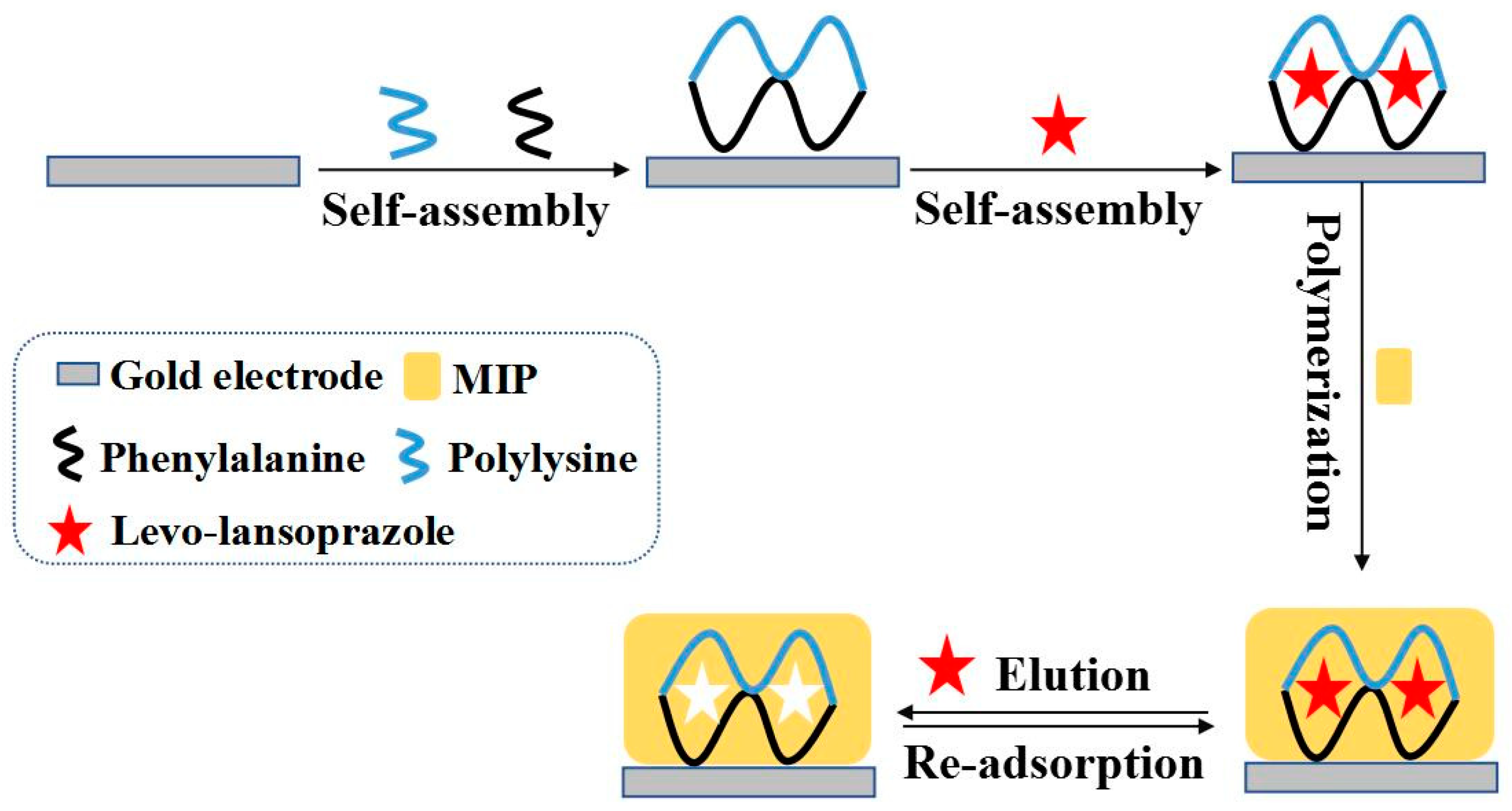
Development of Levo-Lansoprazole Chiral Molecularly Imprinted Polymer Sensor Based on the Polylysine–Phenylalanine Complex Framework Conformational Separation


Abstract
Share and Cite
Zhang, L.; Wang, Z.; Li, D.; Yuan, Y.; Ouyang, H.; Li, J. Development of Levo-Lansoprazole Chiral Molecularly Imprinted Polymer Sensor Based on the Polylysine–Phenylalanine Complex Framework Conformational Separation. Biosensors 2023, 13, 509. https://doi.org/10.3390/bios13050509
Zhang L, Wang Z, Li D, Yuan Y, Ouyang H, Li J. Development of Levo-Lansoprazole Chiral Molecularly Imprinted Polymer Sensor Based on the Polylysine–Phenylalanine Complex Framework Conformational Separation. Biosensors. 2023; 13(5):509. https://doi.org/10.3390/bios13050509
Chicago/Turabian StyleZhang, Lianming, Zian Wang, Dan Li, Yali Yuan, Huixiang Ouyang, and Jianping Li. 2023. "Development of Levo-Lansoprazole Chiral Molecularly Imprinted Polymer Sensor Based on the Polylysine–Phenylalanine Complex Framework Conformational Separation" Biosensors 13, no. 5: 509. https://doi.org/10.3390/bios13050509
APA StyleZhang, L., Wang, Z., Li, D., Yuan, Y., Ouyang, H., & Li, J. (2023). Development of Levo-Lansoprazole Chiral Molecularly Imprinted Polymer Sensor Based on the Polylysine–Phenylalanine Complex Framework Conformational Separation. Biosensors, 13(5), 509. https://doi.org/10.3390/bios13050509