Review

Electrochemical Biosensors for Tracing Cyanotoxins in Food and Environmental Matrices


by
Antonella Miglione
1,
Maria Napoletano
1 and
Stefano Cinti
1,2,*
1
Department of Pharmacy, University Naples Federico II, Via Domenico Montesano 49, 80131 Naples, Italy
2
BAT Center–Interuniversity Center for Studies on Bioinspired Agro-Environmental Technology, University Naples Federico II, 80055 Naples, Italy
*
Author to whom correspondence should be addressed.
Biosensors 2021, 11(9), 315; https://doi.org/10.3390/bios11090315
Submission received: 10 August 2021 / Revised: 30 August 2021 / Accepted: 1 September 2021 / Published: 4 September 2021
(This article belongs to the Special Issue Sensors for Environmental Monitoring and Food Safety)

Abstract

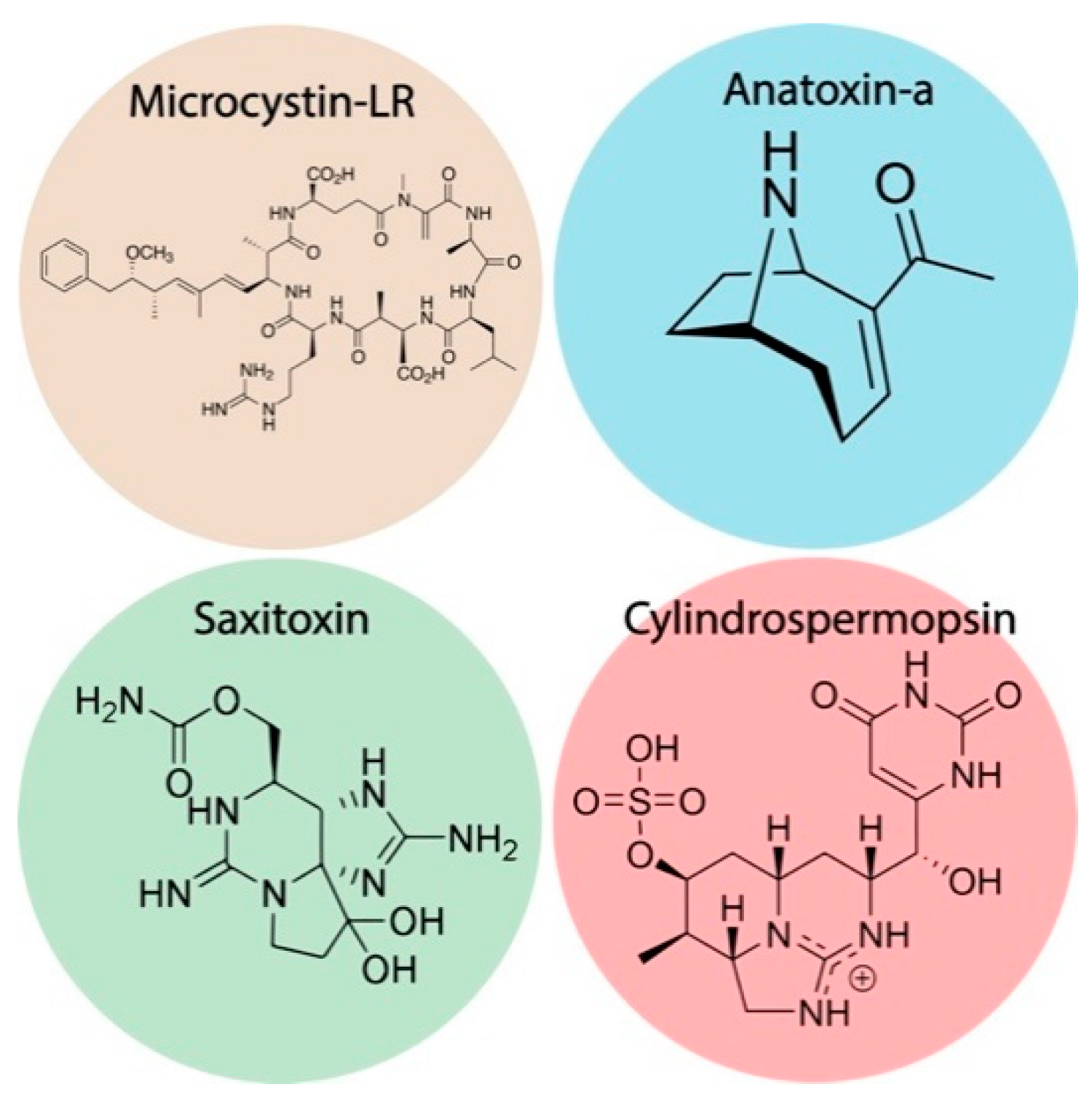
The adoption of electrochemical principles to realize on-field analytical tools for detecting pollutants represents a great possibility for food safety and environmental applications. With respect to the existing transduction mechanisms, i.e., colorimetric, fluorescence, piezoelectric etc., electrochemical mechanisms offer the tremendous advantage of being easily miniaturized, connected with low cost (commercially available) readers and unaffected by the color/turbidity of real matrices. In particular, their versatility represents a powerful approach for detecting traces of emerging pollutants such as cyanotoxins. The combination of electrochemical platforms with nanomaterials, synthetic receptors and microfabrication makes electroanalysis a strong starting point towards decentralized monitoring of toxins in diverse matrices. This review gives an overview of the electrochemical biosensors that have been developed to detect four common cyanotoxins, namely microcystin-LR, anatoxin-a, saxitoxin and cylindrospermopsin. The manuscript provides the readers a quick guide to understand the main electrochemical platforms that have been realized so far, and the presence of a comprehensive table provides a perspective at a glance.
Keywords: electroanalysis; screen printed electrodes; voltammetry; impedance; aptamer; microcystin-LR; anatoxin-a; saxitoxin; cylindrospermopsin electroanalysis; screen printed electrodes; voltammetry; impedance; aptamer; microcystin-LR; anatoxin-a; saxitoxin; cylindrospermopsin