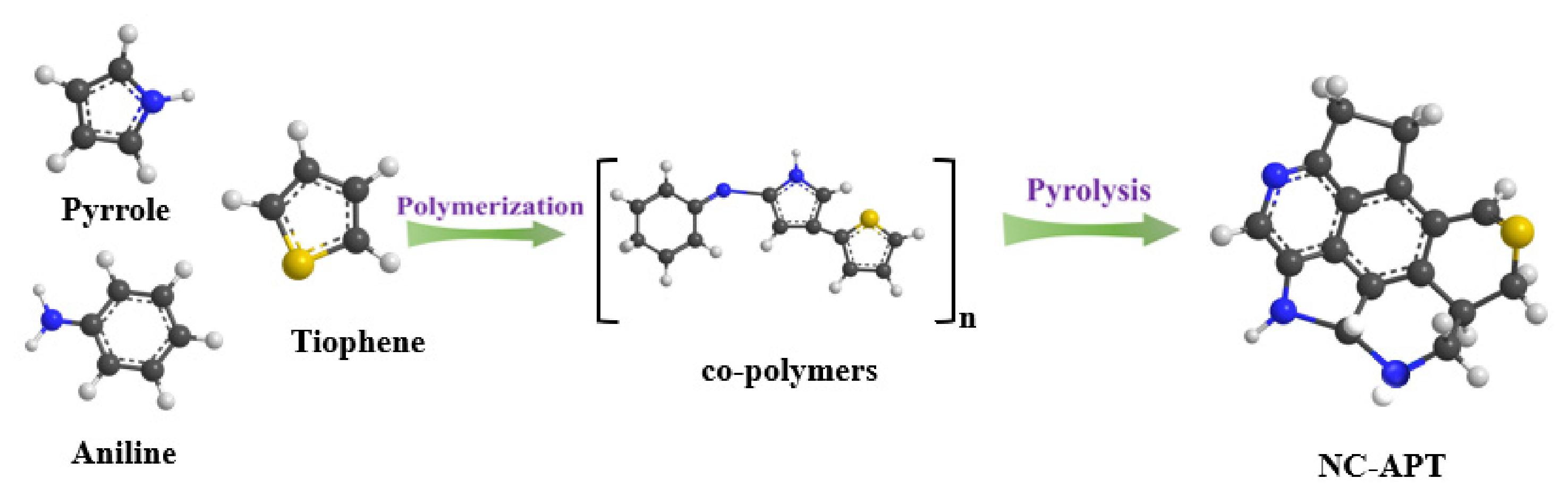
Engineering of Edge-Enriched Nitrogen-Doped Porous Carbon as a High-Performance Metal-Free Catalyst for Acetylene Hydrochlorination
 and
and 
Abstract
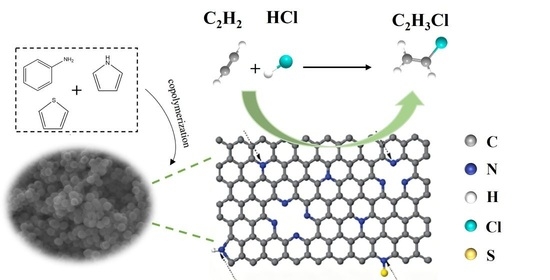
1. Introduction
2. Experimental
2.1. Materials
2.2. Catalyst Preparation
2.3. Catalytic Performance Evaluation
3. Characterizations
4. Results and Discussion
5. Conclusions
Supplementary Materials
Author Contributions
Funding
Data Availability Statement
Conflicts of Interest
References
- Liu, Y.; Zhao, L.; Zhang, Y.; Zhang, L.; Zan, X. Progress and Challenges of Mercury-Free Catalysis for Acetylene Hydrochlorination. Catalysts 2020, 10, 1218. [Google Scholar] [CrossRef]
- Wang, X.; Chen, W.; Lei, X.; Lei, C.; Zhu, N.; Huang, B. Progress of p-block element-regulated catalysts for acetylene hydrochlorination. Coord. Chem. Rev. 2024, 500, 215541. [Google Scholar] [CrossRef]
- Qiao, X.; Zhao, Z.-H.; Zhang, J. Progress in mercury-free catalysts for acetylene hydrochlorination. Catal. Sci. Technol. 2024, 14, 3838–3852. [Google Scholar] [CrossRef]
- Jia, Y.; Zhang, T.; Liu, M.; Zhang, J.; Han, Y. Effect of Different Heteroatoms Anchoring a Cu Single-Atom Catalyst on Acetylene Hydrochlorination. J. Phys. Chem. C 2022, 126, 20401–20410. [Google Scholar] [CrossRef]
- Lu, F.; Lu, Y.; Zhu, M.; Dai, B. Macroporous Carbon Material with High Nitrogen Content for Excellent Catalytic Performance of Acetylene Hydrochlorination. ChemistrySelect 2020, 5, 878–885. [Google Scholar] [CrossRef]
- Qi, X.; Chen, W.; Zhang, J. Sulphur-doped activated carbon as a metal-free catalyst for acetylene hydrochlorination. RSC Adv. 2020, 10, 34612–34620. [Google Scholar] [CrossRef] [PubMed]
- Dawson, S.R.; Pattisson, S.; Malta, G.; Dummer, N.F.; Smith, L.R.; Lazaridou, A.; Allen, C.S.; Davies, T.E.; Freakley, S.J.; Kondrat, S.A.; et al. Sulfur Promotion in Au/C Catalyzed Acetylene Hydrochlorination. Small 2021, 17, 2007221. [Google Scholar] [CrossRef]
- Wang, X.; Lan, G.; Cheng, Z.; Han, W.; Tang, H.; Liu, H.; Li, Y. Carbon-supported ruthenium catalysts prepared by a coordination strategy for acetylene hydrochlorination. Chin. J. Catal. 2020, 41, 1683–1691. [Google Scholar] [CrossRef]
- Kaiser, S.K.; Fako, E.; Surin, I.; Krumeich, F.; Kondratenko, V.A.; Kondratenko, E.V.; Clark, A.H.; López, N.; Pérez-Ramírez, J. Performance descriptors of nanostructured metal catalysts for acetylene hydrochlorination. Nat. Nanotechnol. 2022, 17, 606–612. [Google Scholar] [CrossRef] [PubMed]
- Lan, G.; Zhou, J.; Ye, Q.; Lin, D.; Qiu, Y.; Cheng, Z.; Sun, X.; Li, Y. A hierarchically porous carbon stabilized atomically dispersed Au catalyst for acetylene hydrochlorination. Inorg. Chem. Front. 2024, 11, 5657–5665. [Google Scholar] [CrossRef]
- Sun, S.; Xu, H.; Fan, Y.; Liu, Z.; Hong, Q.; Huang, W.; Qu, Z.; Yan, N. Construction of a Thermally Stable Low-HgCl2 Catalyst via Chalcogen Bonding and Its Enhanced Activity in Acetylene Hydrochlorination. Ind. Eng. Chem. Res. 2022, 61, 17057–17064. [Google Scholar] [CrossRef]
- Wang, X.; Zeng, W.; Kong, X.; Xin, C.; Dong, Y.; Hu, X.; Guo, Q. Development of Low-Cost Porous Carbons Through Alkali Activation of Crop Waste for CO2 Capture. ACS Omega 2022, 7, 46992–47001. [Google Scholar] [CrossRef]
- Mei, S.; Gu, J.; Ma, T.; Li, X.; Hu, Y.; Li, W.; Zhang, J.; Han, Y. N-doped activated carbon from used dyeing wastewater adsorbent as a metal-free catalyst for acetylene hydrochlorination. Chem. Eng. J. 2019, 371, 118–129. [Google Scholar] [CrossRef]
- Wang, X.; Zeng, W.; Xin, C.; Kong, X.; Hu, X.; Guo, Q. The development of activated carbon from corncob for CO2 capture. RSC Adv. 2022, 12, 33069–33078. [Google Scholar] [CrossRef] [PubMed]
- Koshy, D.M.; Chen, S.; Lee, D.U.; Stevens, M.B.; Abdellah, A.M.; Dull, S.M.; Chen, G.; Nordlund, D.; Gallo, A.; Hahn, C.; et al. Understanding the Origin of Highly Selective CO2 Electroreduction to CO on Ni,N-doped Carbon Catalysts. Angew. Chem. Int. Ed. 2020, 59, 4043–4050. [Google Scholar] [CrossRef]
- Bobrin, V.A.; Hackbarth, H.G.; Yao, Y.; Kundu, D.; Bedford, N.M.; Kuchel, R.P.; Zhang, J.; Corrigan, N.; Boyer, C. Design and 3D Printing of Polyacrylonitrile-Derived Nanostructured Carbon Architectures. Small Sci. 2024, 4, 2300275. [Google Scholar] [CrossRef]
- Li, X.; Pan, X.; Yu, L.; Ren, P.; Wu, X.; Sun, L.; Jiao, F.; Bao, X. Silicon carbide-derived carbon nanocomposite as a substitute for mercury in the catalytic hydrochlorination of acetylene. Nat. Commun. 2014, 5, 3688. [Google Scholar] [CrossRef]
- Bao, Y.; Zheng, X.; Cao, J.; Li, S.; Tuo, Y.; Feng, X.; Zhu, M.; Dai, B.; Yang, C.; Chen, D. Free radicals induced ultra-rapid synthesis of N-doped carbon sphere catalyst with boosted pyrrolic N active sites for efficient acetylene hydrochlorination. Nano Res. 2022, 16, 6178–6186. [Google Scholar] [CrossRef]
- Zhu, X.; Zhou, E.; Tai, X.; Zong, H.; Yi, J.; Yuan, Z.; Zhao, X.; Huang, P.; Xu, H.; Jiang, Z. g-C3N4 S-Scheme Homojunction through Van der Waals Interface Regulation by Intrinsic Polymerization Tailoring for Enhanced Photo. Angew. Chem. Int. Ed. 2025, 64, e202425439. [Google Scholar] [CrossRef]
- Yang, J.; Wang, S.; Yan, Q.; Hu, H.; Xu, H.; Ma, H.; Su, X.; Gao, Y. Novel nitrogen-rich conjugated microporous polymers for efficient capture of iodine and methyl iodide. Polym. Chem. 2024, 15, 2652–2661. [Google Scholar] [CrossRef]
- Chao, S.; Zou, F.; Wan, F.; Dong, X.; Wang, Y.; Wang, Y.; Guan, Q.; Wang, G.; Li, W. Nitrogen-Doped Carbon Derived from ZIF-8 as a High-Performance Metal-Free Catalyst for Acetylene Hydrochlorination. Sci. Rep. 2017, 7, 39789. [Google Scholar] [CrossRef]
- Qiao, X.; Zhao, C.; Zhou, Z.; Guan, Q.; Li, W. Constructing Pyridinic N-Rich Aromatic Ladder Structure Catalysts from Industrially Available Polyacrylonitrile Resin for Acetylene Hydrochlorination. ACS Sustain. Chem. Eng. 2019, 7, 17979–17989. [Google Scholar] [CrossRef]
- Lin, R.; Kaiser, S.K.; Hauert, R.; Pérez-Ramírez, J. Descriptors for High-Performance Nitrogen-Doped Carbon Catalysts in Acetylene Hydrochlorination. ACS Catal. 2018, 8, 1114–1121. [Google Scholar] [CrossRef]
- Chen, S.; Ding, R.; Li, B.; Lu, J.; Zhang, X. A robust aerogel incorporated with phthalocyanine-based porous organic polymers for highly efficient gold extraction. Sep. Purif. Technol. 2025, 354, 129451. [Google Scholar] [CrossRef]
- Yang, Y.; Wang, H.; Qin, W.; Guo, Y.; Yao, H.; Li, J.; Shi, K.; Ma, S. MoS2/Au0/N-CNT derived from Au(III) extraction by polypyrrole/MoS4 as an electrocatalyst for hydrogen evolution reaction. J. Colloid Interface Sci. 2020, 561, 298–306. [Google Scholar] [CrossRef]
- Ding, R.; Chen, S.; Chen, M.; Lu, J.; Zhang, X. Engineering ion-framed porous organic polymer for synergistic high-capacity adsorption and ultra-trace recovery of gold. J. Colloid Interface Sci. 2026, 701, 138702. [Google Scholar]
- Sokka, A.; Mooste, M.; Marandi, M.; Käärik, M.; Kozlova, J.; Kikas, A.; Kisand, V.; Treshchalov, A.; Tamm, A.; Leis, J.; et al. Polypyrrole and Polythiophene Modified Carbon Nanotube-Based Cathode Catalysts for Anion Exchange Membrane Fuel Cell. ChemElectroChem 2022, 9, e202200161. [Google Scholar] [CrossRef]
- Khan, N.A.; Hassan, M.; Lee, H.J.; Jhung, S.H. Highly porous polyaniline- or polypyrrole-derived carbons: Preparation, characterization, and applications in adsorption. Chem. Eng. J. 2023, 474, 145472. [Google Scholar] [CrossRef]
- Li, K.; Meng, F.; Li, J.; Wu, H.; Jia, H.; Ji, Q. Engineering accessible Fe-N sites in polypyrrole-derived catalysts via a dynamic coordination strategy. Sustain. Energy Fuels 2026, 10, 587–595. [Google Scholar] [CrossRef]
- Tao, X.; Chen, F.; Xie, Y.; Cheng, X.; Liu, X.; Gao, G. Microporous nitrogen-doped carbon from polyaniline as a highly efficient and stable catalyst for acetylene hydrochlorination. J. Taiwan Inst. Chem. Eng. 2021, 126, 80–87. [Google Scholar] [CrossRef]
- Li, X.; Zhu, M.; Dai, B. AuCl3 on polypyrrole-modified carbon nanotubes as acetylene hydrochlorination catalysts. Appl. Catal. B Environ. 2013, 142–143, 234–240. [Google Scholar] [CrossRef]
- Tai, X.-S.; Zhao, W.-H. Synthesis, crystal structure, and antibacterial activity of magnesium(II) coordination polymers formed by hydrogen bonding. Res. Chem. Intermed. 2013, 41, 3471–3478. [Google Scholar] [CrossRef]
- Zhang, H.; Yuan, Z.; Zhao, X.; Zhu, X.; Wang, H.; Luo, Y.; Wang, Z.; Jiang, Z. Graphitic carbon nitride photocatalysts for sustainable energy and environmental remediation: Performance optimization and future perspectives. J. Environ. Sci. 2026, 163, 59–75. [Google Scholar]
- Saes, B.W.H.; Wienk, M.M.; Janssen, R.A.J. The Effect of α-Branched Side Chains on the Structural and Opto-Electronic Properties of Poly(Diketopyrrolopyrrole-alt-Terthiophene). Chem. A Eur. J. 2020, 26, 14221–14228. [Google Scholar] [CrossRef] [PubMed]
- Vasiliou, A.K.; Hu, H.; Cowell, T.W.; Whitman, J.C.; Porterfield, J.; Parish, C.A. Modeling Oil Shale Pyrolysis: High-Temperature Unimolecular Decomposition Pathways for Thiophene. J. Phys. Chem. A 2017, 121, 7655–7666. [Google Scholar] [CrossRef]
- Pan, X.; Ji, J.; Zhang, N.; Xing, M. Research progress of graphene-based nanomaterials for the environmental remediation. Chin. Chem. Lett. 2020, 31, 1462–1473. [Google Scholar] [CrossRef]
- Dong, X.; Chao, S.; Wan, F.; Guan, Q.; Wang, G.; Li, W. Sulfur and nitrogen co-doped mesoporous carbon with enhanced performance for acetylene hydrochlorination. J. Catal. 2018, 359, 161–170. [Google Scholar] [CrossRef]
- Liu, W.; Zhu, M.; Dai, B. Nitrogen doped nanoflower porous carbon as a nonmetal catalyst for acetylene hydrochlorination. New J. Chem. 2018, 42, 20131–20136. [Google Scholar] [CrossRef]
- Shen, Z.; Xing, P.; Wen, K.; Jiang, B. Cationic Covalent Triazine Network: A Metal-Free Catalyst for Effective Acetylene Hydrochlorination. Catalysts 2023, 13, 432. [Google Scholar] [CrossRef]
- Wang, D.; Su, Y.; Chen, D.; Wang, L.; Xiang, X.; Zhu, D. Preparation and characterization of poly(3-octylthiophene)/carbon fiber thermoelectric composite materials. Compos. Part B Eng. 2015, 69, 467–471. [Google Scholar] [CrossRef]
- Guo, X.; Ye, Y.; Fang, G.; Peng, T.; Chen, Y.; Zhao, Y.; Pan, X. Boron Nitride-Confined Nanographene as a Metal-Free Catalyst for Acetylene Hydrochlorination. J. Am. Chem. Soc. 2025, 147, 47109–47116. [Google Scholar] [CrossRef]
- Li, X.; Li, P.; Pan, X.; Ma, H.; Bao, X. Deactivation mechanism and regeneration of carbon nanocomposite catalyst for acetylene hydrochlorination. Appl. Catal. B Environ. 2017, 210, 116–120. [Google Scholar] [CrossRef]
- Li, X.; Wang, Y.; Kang, L.; Zhu, M.; Dai, B. A novel, non-metallic graphitic carbon nitride catalyst for acetylene hydrochlorination. J. Catal. 2014, 311, 288–294. [Google Scholar] [CrossRef]
- Zhang, C.; Kang, L.; Zhu, M.; Dai, B. Nitrogen-doped active carbon as a metal-free catalyst for acetylene hydrochlorination. RSC Adv. 2015, 5, 7461–7468. [Google Scholar] [CrossRef]
- Zhang, T.; Zhao, J.; Xu, J.; Xu, J.; Di, X.; Li, X. Oxygen and nitrogen-doped metal-free carbon catalysts for hydrochlorination of acetylene. Chin. J. Chem. Eng. 2016, 24, 484–490. [Google Scholar] [CrossRef]
- Wang, J.; Zhao, F.; Zhang, C.; Kang, L.; Zhu, M. A novel S, N dual doped carbon catalyst for acetylene hydrochlorination. Appl. Catal. A Gen. 2018, 549, 68–75. [Google Scholar] [CrossRef]
- Wang, J.; Gong, W.; Zhu, M.; Dai, B. Effect of carbon defects on the nitrogen-doped carbon catalytic performance for acetylene hydrochlorination. Appl. Catal. A Gen. 2018, 564, 72–78. [Google Scholar] [CrossRef]
- Shen, Z.; Liu, Y.; Han, Y.; Qin, Y.; Li, J.; Xing, P.; Jiang, B. Nitrogen-doped porous carbon from biomass with superior catalytic performance for acetylene hydrochlorination. RSC Adv. 2020, 10, 14556–14569. [Google Scholar] [CrossRef]

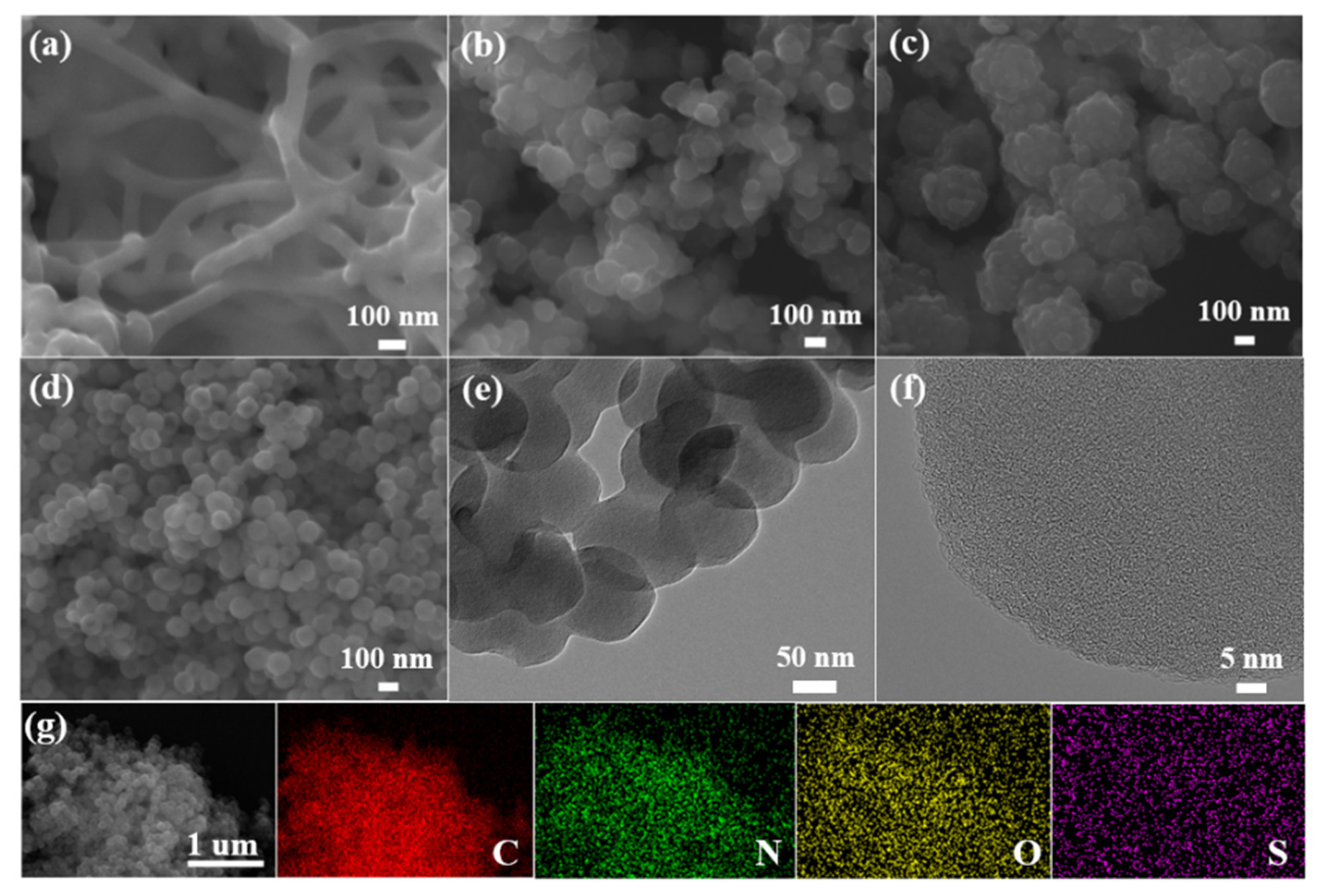



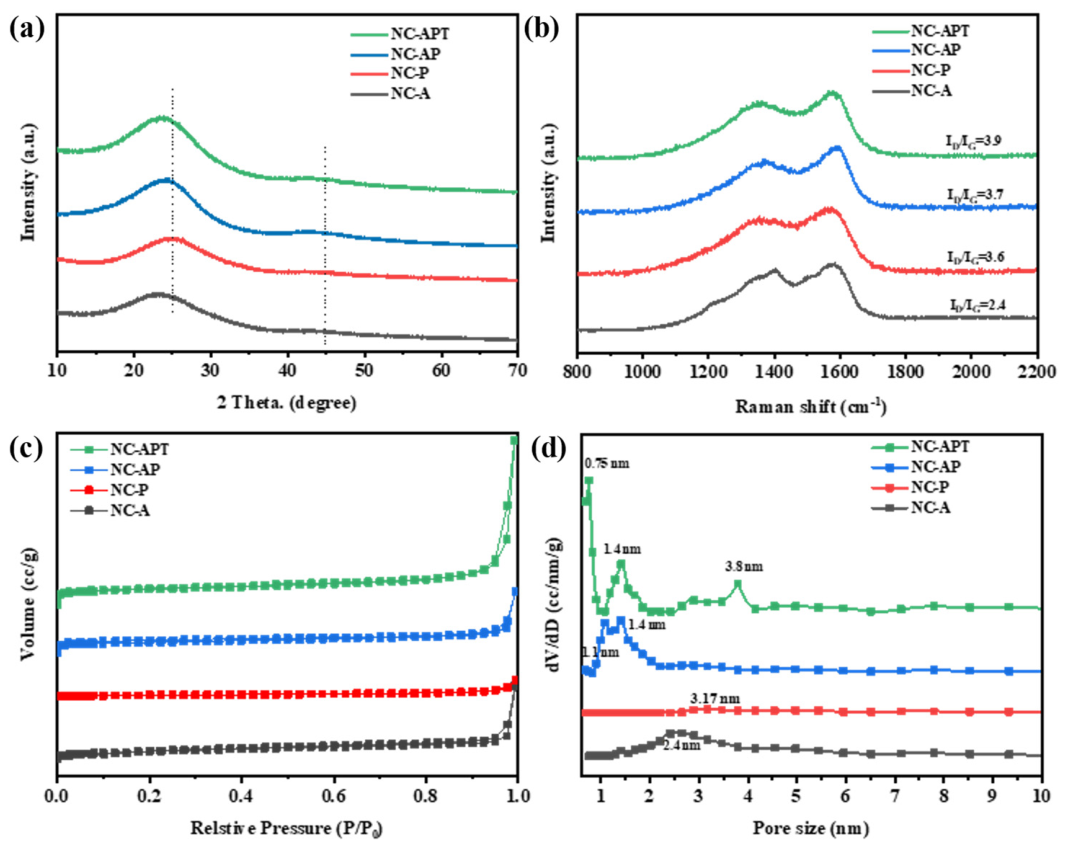
| Sample | ID/IG a | Specific Surface Area/m2·g−1 | Vtotal b/cm3·g−1 |
|---|---|---|---|
| NC-A | 2.4 | 286.4 | 0.62 |
| NC-P | 3.6 | 169.0 | 0.14 |
| NC-AP | 3.7 | 295.0 | 0.52 |
| NC-APT | 3.9 | 375.7 | 1.44 |
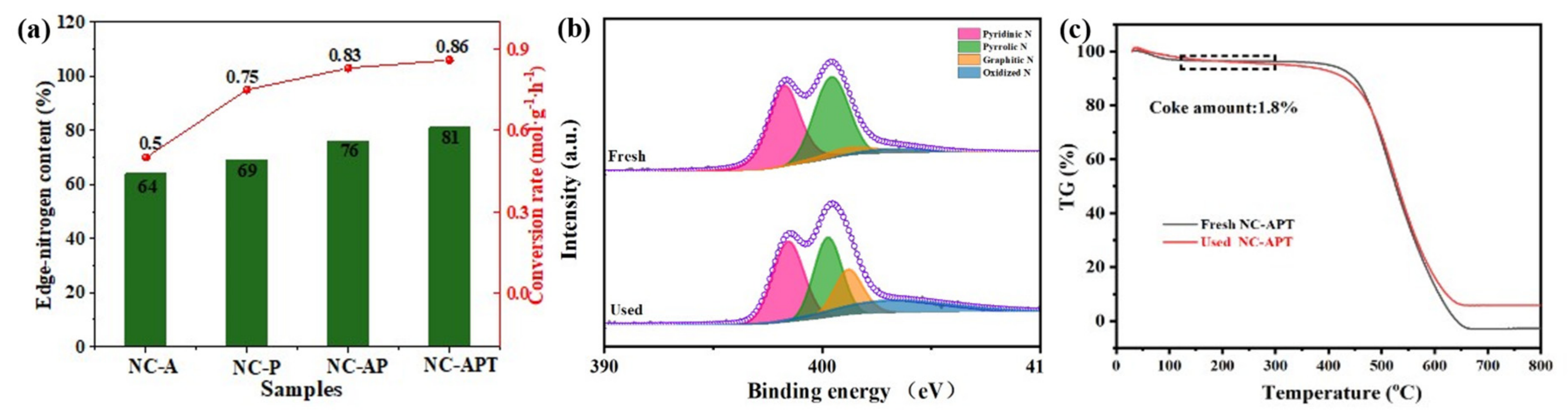
| Sample | Element Composition (%) | N Species Content (%) | ||||||
|---|---|---|---|---|---|---|---|---|
| C | N | O | S | Pyridinic N | Pyrrolic N | Graphitic N | Oxidized N | |
| NC-P | 81.7 | 11.2 | 7.1 | - | 38 | 26 | 26 | 10 |
| NC-A | 87.5 | 9.5 | 2.9 | - | 42 | 32 | 17 | 8 |
| NC-AP | 83.7 | 11.5 | 4.9 | - | 39 | 37 | 13 | 11 |
| NC-APT | 82.8 | 14.4 | 2.7 | 0.1 | 41 | 40 | 10 | 9 |
Disclaimer/Publisher’s Note: The statements, opinions and data contained in all publications are solely those of the individual author(s) and contributor(s) and not of MDPI and/or the editor(s). MDPI and/or the editor(s) disclaim responsibility for any injury to people or property resulting from any ideas, methods, instructions or products referred to in the content. |
© 2026 by the authors. Licensee MDPI, Basel, Switzerland. This article is an open access article distributed under the terms and conditions of the Creative Commons Attribution (CC BY) license.
Share and Cite
Zhang, Z.; Zhang, D.; Hao, Y.; Fang, G.; Li, X.; Qi, J. Engineering of Edge-Enriched Nitrogen-Doped Porous Carbon as a High-Performance Metal-Free Catalyst for Acetylene Hydrochlorination. Nanomaterials 2026, 16, 568. https://doi.org/10.3390/nano16090568
Zhang Z, Zhang D, Hao Y, Fang G, Li X, Qi J. Engineering of Edge-Enriched Nitrogen-Doped Porous Carbon as a High-Performance Metal-Free Catalyst for Acetylene Hydrochlorination. Nanomaterials. 2026; 16(9):568. https://doi.org/10.3390/nano16090568
Chicago/Turabian StyleZhang, Zhenzhen, Dashuai Zhang, Yalei Hao, Guangzong Fang, Xingyun Li, and Jian Qi. 2026. "Engineering of Edge-Enriched Nitrogen-Doped Porous Carbon as a High-Performance Metal-Free Catalyst for Acetylene Hydrochlorination" Nanomaterials 16, no. 9: 568. https://doi.org/10.3390/nano16090568
APA StyleZhang, Z., Zhang, D., Hao, Y., Fang, G., Li, X., & Qi, J. (2026). Engineering of Edge-Enriched Nitrogen-Doped Porous Carbon as a High-Performance Metal-Free Catalyst for Acetylene Hydrochlorination. Nanomaterials, 16(9), 568. https://doi.org/10.3390/nano16090568