Morphology-Driven SERS Activation in TMDCs: A Dual-Mode Platform for Sensorics and Theranostics

 , , , , , , ,
  , and
, and 
Abstract
1. Introduction
2. Materials and Methods
2.1. Synthesis of TMDC Nanomaterials
2.1.1. Nanoparticle Synthesis via Femtosecond PLAL
2.1.2. Flake Synthesis via Ultrasonic Exfoliation
2.2. Structural and Morphological Characterization
2.3. SERS Substrate Fabrication and Measurements
2.4. Enhancement Factor (EF) Calculation
2.5. Photothermal Studies
3. Results and Discussion
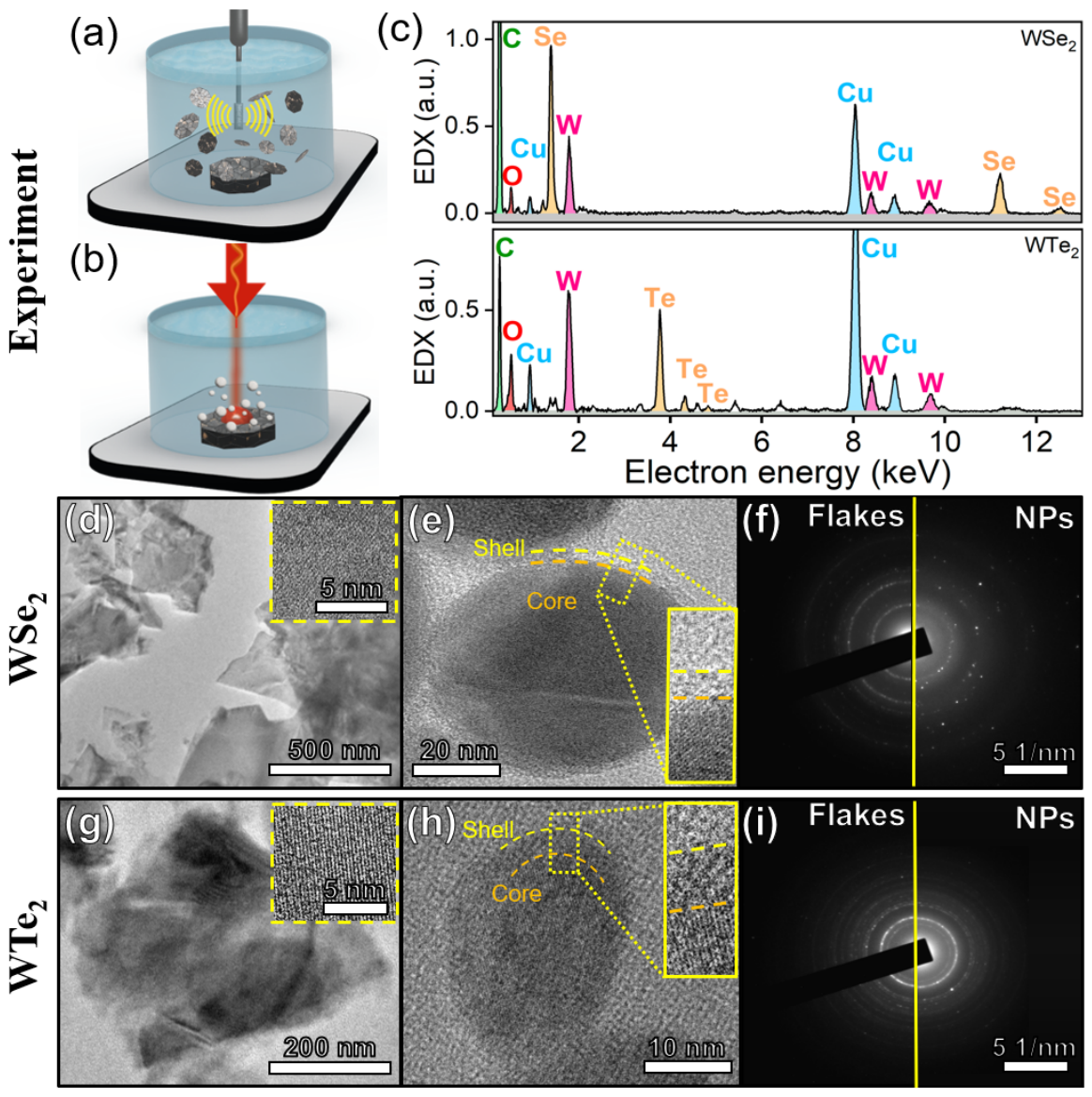
3.1. Synthesis Dictates Nanomaterial Morphology While Preserving Crystallinity
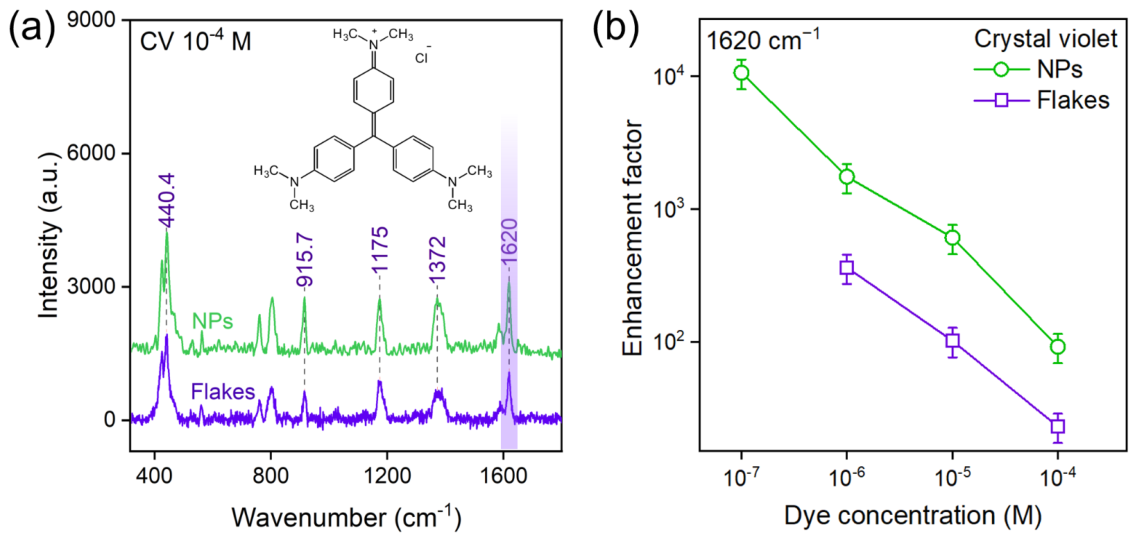
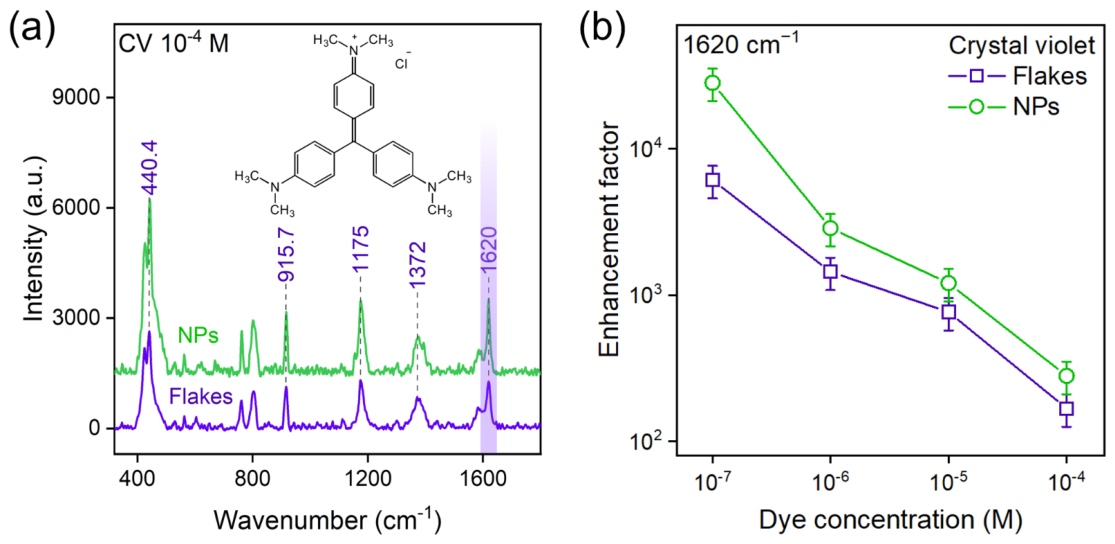
3.2. Nanoparticle Morphology Unlocks Superior SERS Performance
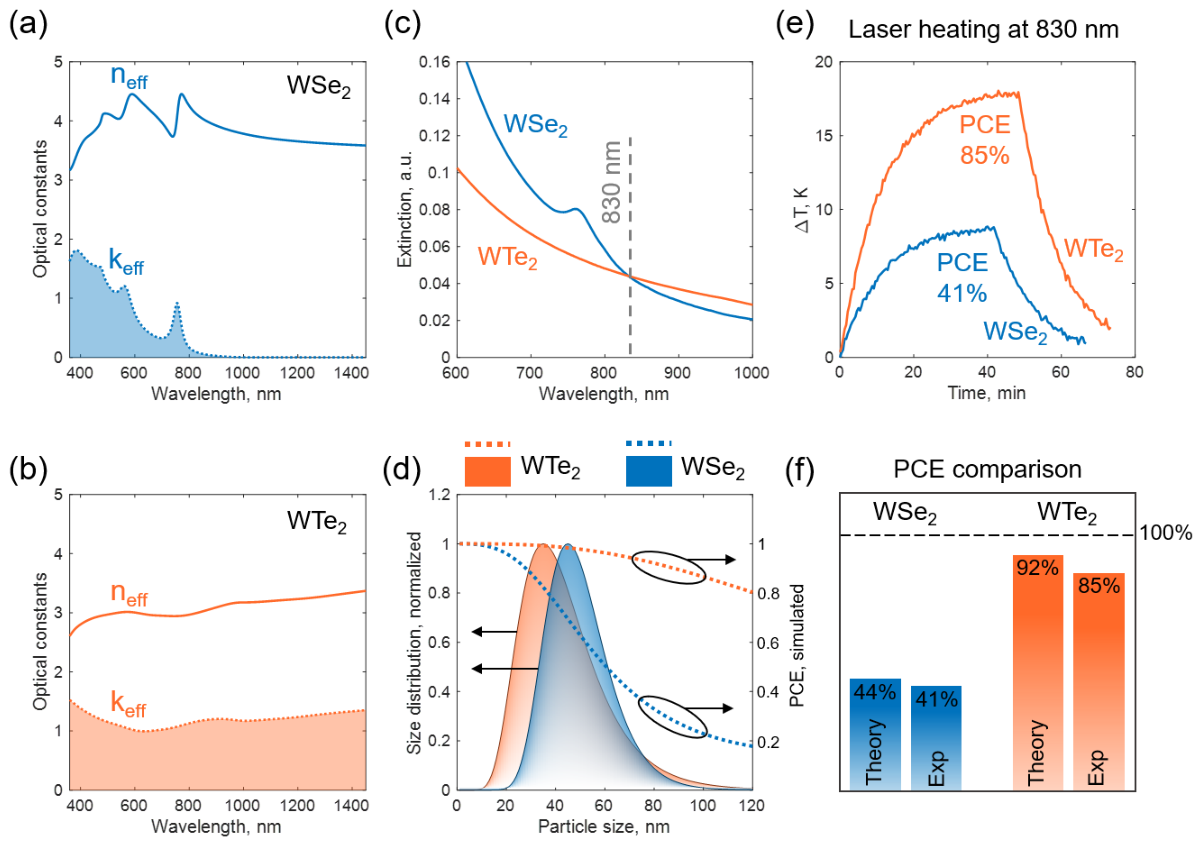
3.3. Colloidal Photothermal Response Governed by Bulk Effective Optical Constants
3.4. Benchmarking and Suitability for Biological Environments
4. Conclusions
Supplementary Materials
Author Contributions
Funding
Data Availability Statement
Conflicts of Interest
Abbreviations
| LSPR | Localized surface plasmon resonances |
| CM | Chemical mechanism |
| PICT | Photoinduced charge transfer |
| DI water | Deionized water |
| TMDC | Transition metal dichalcogenide |
| NP | Nanoparticle |
| PLAL | Pulsed laser ablation in liquid |
| TEM | Transmission electron microscope |
| HRTEM | High-resolution transmission electron microscope |
| SAED | Selected area electron diffraction |
| EDX | Energy-dispersive X-ray spectroscopy |
| SERS | Surface-enhanced Raman scattering |
| CV | Crystal violet |
| LOD | The limit of detection |
| EF | Enhancement factor |
| NA | Numeric aperture |
| PCE | Photothermal conversion efficiency |
References
- Onyemaobi, I.M.; Xie, Y.; Xu, L.; Zhang, J.; Xiang, L.; Lin, J.; Wu, A. Nanomaterials and clinical SERS technology: Broad applications in disease diagnosis. J. Mater. Chem. B 2025, 13, 2890–2911. [Google Scholar] [CrossRef]
- Zong, C.; Xu, M.; Xu, L.J.; Wei, T.; Ma, X.; Zheng, X.S.; Hu, R.; Ren, B. Surface-enhanced Raman spectroscopy for bioanalysis: Reliability and challenges. Chem. Rev. 2018, 118, 4946–4980. [Google Scholar] [CrossRef]
- Liu, Y.; Qin, Z.; Deng, J.; Zhou, J.; Jia, X.; Wang, G.; Luo, F. The advanced applications of 2D materials in SERS. Chemosensors 2022, 10, 455. [Google Scholar] [CrossRef]
- Yu, L.x.; Lv, R.t. Two-dimensional layer materials for highly efficient molecular sensing based on surface-enhanced Raman scattering. New Carbon Mater. 2021, 36, 995–1012. [Google Scholar] [CrossRef]
- Tang, X.; Hao, Q.; Hou, X.; Lan, L.; Li, M.; Yao, L.; Zhao, X.; Ni, Z.; Fan, X.; Qiu, T. Exploring and engineering 2D transition metal dichalcogenides toward ultimate SERS performance. Adv. Mater. 2024, 36, 2312348. [Google Scholar] [CrossRef]
- Nie, S.; Emory, S.R. Probing single molecules and single nanoparticles by surface-enhanced Raman scattering. Science 1997, 275, 1102–1106. [Google Scholar] [CrossRef]
- Kneipp, K.; Wang, Y.; Kneipp, H.; Perelman, L.T.; Itzkan, I.; Dasari, R.R.; Feld, M.S. Single molecule detection using surface-enhanced Raman scattering (SERS). Phys. Rev. Lett. 1997, 78, 1667. [Google Scholar] [CrossRef]
- Sharma, B.; Frontiera, R.R.; Henry, A.I.; Ringe, E.; Van Duyne, R.P. SERS: Materials, applications, and the future. Mater. Today 2012, 15, 16–25. [Google Scholar] [CrossRef]
- Majumdar, D. 2D Material-Based Surface-Enhanced Raman Spectroscopy Platforms (Either Alone or in Nanocomposite Form) - From a Chemical Enhancement Perspective. ACS Omega 2024, 9, 40242–40258. [Google Scholar] [CrossRef] [PubMed]
- Langer, J.; Jimenez de Aberasturi, D.; Aizpurua, J.; Alvarez-Puebla, R.A.; Auguie, B.; Baumberg, J.J.; Bazan, G.C.; Bell, S.E.; Boisen, A.; Brolo, A.G.; et al. Present and future of surface-enhanced Raman scattering. ACS Nano 2019, 14, 28–117. [Google Scholar] [CrossRef] [PubMed]
- Le Ru, E.; Etchegoin, P. Principles of Surface-Enhanced Raman Spectroscopy: And Related Plasmonic Effects; Elsevier: Amsterdam, The Netherlands, 2008. [Google Scholar]
- Aroca, R. Surface-Enhanced Vibrational Spectroscopy; Wiley: Hoboken, NJ, USA, 2006. [Google Scholar]
- Goel, R.; Vij, R.; Chakraborty, S.; Achanta, V.G.; Dubey, S.K. Application of plasmonic quasi crystal (PIQC) in surface enhanced Raman spectroscopy (SERS). In Proceedings of the Optical Sensors 2023; SPIE: Bellingham, WA, USA, 2023; Volume 12572, pp. 84–88. [Google Scholar]
- Lombardi, J.R.; Birke, R.L. A unified approach to surface-enhanced Raman spectroscopy. J. Phys. Chem. C 2008, 112, 5605–5617. [Google Scholar] [CrossRef]
- Pilot, R.; Signorini, R.; Durante, C.; Orian, L.; Bhamidipati, M.; Fabris, L. A review on surface-enhanced Raman scattering. Biosensors 2019, 9, 57. [Google Scholar] [CrossRef]
- Karagianni, K.; Leontidou, T.; Constantinou, M.; Andreou, C. Bacterial detection with electrochemical, SERS, and electrochemical SERS sensors. Analyst 2025, 150, 3762–3787. [Google Scholar] [CrossRef]
- Tahir, M.A.; Dina, N.E.; Cheng, H.; Valev, V.K.; Zhang, L. Surface-enhanced Raman spectroscopy for bioanalysis and diagnosis. Nanoscale 2021, 13, 11593–11634. [Google Scholar] [CrossRef] [PubMed]
- Chaudhry, I.; Hu, G.; Ye, H.; Jensen, L. Toward modeling the complexity of the chemical mechanism in SERS. ACS Nano 2024, 18, 20835–20850. [Google Scholar] [CrossRef]
- Chen, L.; Liu, H.; Gao, J.; Wang, J.; Jin, Z.; Lv, M.; Yan, S. Development and Biomedical Application of Non-Noble Metal Nanomaterials in SERS. Nanomaterials 2024, 14, 1654. [Google Scholar] [CrossRef]
- Chen, M.; Liu, D.; Du, X.; Lo, K.H.; Wang, S.; Zhou, B.; Pan, H. 2D materials: Excellent substrates for surface-enhanced Raman scattering (SERS) in chemical sensing and biosensing. TrAC Trends Anal. Chem. 2020, 130, 115983. [Google Scholar] [CrossRef]
- Ling, X.; Moura, L.; Pimenta, M.A.; Zhang, J. Charge-transfer mechanism in graphene-enhanced Raman scattering. J. Phys. Chem. C. 2012, 116, 25112–25118. [Google Scholar] [CrossRef]
- Ling, X.; Xie, L.; Fang, Y.; Xu, H.; Zhang, H.; Kong, J.; Dresselhaus, M.S.; Zhang, J.; Liu, Z. Can graphene be used as a substrate for Raman enhancement? Nano Lett. 2010, 10, 553–561. [Google Scholar] [CrossRef] [PubMed]
- Zhao, S.; Zhao, Y.; Tao, L. Interface engineering in 2D materials for SERS sensing. Front. Mater. 2023, 10, 1272826. [Google Scholar] [CrossRef]
- Wan, J.; Lacey, S.D.; Dai, J.; Bao, W.; Fuhrer, M.S.; Hu, L. Tuning two-dimensional nanomaterials by intercalation: Materials, properties and applications. Chem. Soc. Rev. 2016, 45, 6742–6765. [Google Scholar] [CrossRef]
- Akhound, M.A.; Jacobsen, K.W.; Thygesen, K.S. Activating the Basal Plane of 2D Transition Metal Dichalcogenides via High-Entropy Alloying. J. Am. Chem. Soc. 2025, 147, 5743–5754. [Google Scholar] [CrossRef] [PubMed]
- Li, H.; Tsai, C.; Koh, A.L.; Cai, L.; Contryman, A.W.; Fragapane, A.H.; Zhao, J.; Han, H.S.; Manoharan, H.C.; Abild-Pedersen, F.; et al. Activating and optimizing MoS2 basal planes for hydrogen evolution through the formation of strained sulphur vacancies. Nat. Mater. 2016, 15, 48–53. [Google Scholar] [CrossRef]
- Huang, B.; Li, N.; Ong, W.J.; Zhou, N. Single atom-supported MXene: How single-atomic-site catalysts tune the high activity and selectivity of electrochemical nitrogen fixation. J. Mater. Chem. A 2019, 7, 27620–27631. [Google Scholar] [CrossRef]
- Sim, Y.; Chae, Y.; Kwon, S.Y. Recent advances in metallic transition metal dichalcogenides as electrocatalysts for hydrogen evolution reaction. Iscience 2022, 25, 105098. [Google Scholar] [CrossRef] [PubMed]
- Song, G.; Cong, S.; Zhao, Z. Defect engineering in semiconductor-based SERS. Chem. Sci. 2022, 13, 1210–1224. [Google Scholar] [CrossRef] [PubMed]
- Jaramillo, T.F.; Jorgensen, K.P.; Bonde, J.; Nielsen, J.H.; Horch, S.; Chorkendorff, I. Identification of active edge sites for electrochemical H2 evolution from MoS2 nanocatalysts. Science 2007, 317, 100–102. [Google Scholar] [CrossRef]
- Li, Z.; Zhai, L.; Zhang, Q.; Zhai, W.; Li, P.; Chen, B.; Chen, C.; Yao, Y.; Ge, Y.; Yang, H.; et al. 1T’-transition metal dichalcogenide monolayers stabilized on 4H-Au nanowires for ultrasensitive SERS detection. Nat. Mater. 2024, 23, 1355–1362. [Google Scholar] [CrossRef]
- Lv, Q.; Tan, J.; Wang, Z.; Gu, P.; Liu, H.; Yu, L.; Wei, Y.; Gan, L.; Liu, B.; Li, J.; et al. Ultrafast charge transfer in mixed-dimensional WO3-x nanowire/WSe2 heterostructures for attomolar-level molecular sensing. Nat. Commun. 2023, 14, 2717. [Google Scholar] [CrossRef]
- Tang, X.; Fan, X.; Zhou, J.; Wang, S.; Li, M.; Hou, X.; Jiang, K.; Ni, Z.; Zhao, B.; Hao, Q.; et al. Alloy engineering allows on-demand design of ultrasensitive monolayer semiconductor SERS substrates. Nano Lett. 2023, 23, 7037–7045. [Google Scholar] [CrossRef]
- Li, Z.; Zhai, W.; Yang, H.; Zhai, L.; Long, X.; Shi, Z.; Zhang, A.; Lai, Z.; He, Q.; Zhang, H. Phase engineering of two-dimensional transition metal dichalcogenides for surface-enhanced Raman scattering. Matter 2025, 8, 102210. [Google Scholar] [CrossRef]
- Nicolosi, V.; Chhowalla, M.; Kanatzidis, M.G.; Strano, M.S.; Coleman, J.N. Liquid exfoliation of layered materials. Science 2013, 340, 1226419. [Google Scholar] [CrossRef]
- Hernandez, Y.; Nicolosi, V.; Lotya, M.; Blighe, F.M.; Sun, Z.; De, S.; McGovern, I.T.; Holland, B.; Byrne, M.; Gun’Ko, Y.K.; et al. High-yield production of graphene by liquid-phase exfoliation of graphite. Nat. Nanotechnol. 2008, 3, 563–568. [Google Scholar] [CrossRef]
- Yi, M.; Shen, Z. A review on mechanical exfoliation for the scalable production of graphene. J. Mater. Chem. A 2015, 3, 11700–11715. [Google Scholar] [CrossRef]
- Tselikov, G.I.; Ermolaev, G.A.; Popov, A.A.; Tikhonowski, G.V.; Panova, D.A.; Taradin, A.S.; Vyshnevyy, A.A.; Syuy, A.V.; Klimentov, S.M.; Novikov, S.M.; et al. Transition metal dichalcogenide nanospheres for high-refractive-index nanophotonics and biomedical theranostics. Proc. Natl. Acad. Sci. USA 2022, 119, e2208830119. [Google Scholar] [CrossRef]
- Amendola, V.; Meneghetti, M. Laser ablation synthesis in solution and size manipulation of noble metal nanoparticles. Phys. Chem. Chem. Phys. 2009, 11, 3805–3821. [Google Scholar] [CrossRef]
- Zhang, D.; Gokce, B.; Barcikowski, S. Laser synthesis and processing of colloids: Fundamentals and applications. Chem. Rev. 2017, 117, 3990–4103. [Google Scholar] [CrossRef]
- Forsythe, R.C.; Cox, C.P.; Wilsey, M.K.; Muller, A.M. Pulsed laser in liquids made nanomaterials for catalysis. Chem. Rev. 2021, 121, 7568–7637. [Google Scholar] [CrossRef]
- Rao, S.V.; Podagatlapalli, G.K.; Hamad, S. Ultrafast laser ablation in liquids for nanomaterials and applications. J. Nanosci. Nanotechnol. 2014, 14, 1364–1388. [Google Scholar] [CrossRef] [PubMed]
- Maiti, R.; Patil, C.; Saadi, M.; Xie, T.; Azadani, J.; Uluutku, B.; Amin, R.; Briggs, A.; Miscuglio, M.; Van Thourhout, D.; et al. Strain-engineered high-responsivity MoTe2 photodetector for silicon photonic integrated circuits. Nat. Photonics 2020, 14, 578–584. [Google Scholar] [CrossRef]
- Kosmider, K.; Fernandez-Rossier, J. Electronic properties of the MoS 2-WS 2 heterojunction. Phys. Rev. B—Condensed Matter Mater. Phys. 2013, 87, 075451. [Google Scholar] [CrossRef]
- Liu, F.; Ming, P.; Li, J. Ab initio calculation of ideal strength and phonon instability of graphene under tension. Phys. Rev. B—Condensed Matter Mater. Phys. 2007, 76, 064120. [Google Scholar] [CrossRef]
- Chavalekvirat, P.; Hirunpinyopas, W.; Deshsorn, K.; Jitapunkul, K.; Iamprasertkun, P. Liquid phase exfoliation of 2D materials and its electrochemical applications in the data-driven future. Precis. Chem. 2024, 2, 300–329. [Google Scholar] [CrossRef]
- Ushkov, A.; Belozerova, N.; Dyubo, D.; Martynov, I.; Syuy, A.; Tselikov, D.; Ermolaev, G.; Bazhenov, S.V.; Romanov, R.I.; Kruglov, I.; et al. Laser-Synthesized Amorphous PdSe2-x Nanoparticles: A Defect-Rich Platform for High-Efficiency SERS, Photocatalysis, and Photothermal Conversion. Adv. Mater. Interfaces 2025, 13, e00902. [Google Scholar]
- Balati, A.; Tek, S.; Nash, K.; Shipley, H. Nanoarchitecture of TiO2 microspheres with expanded lattice interlayers and its heterojunction to the laser modified black TiO2 using pulsed laser ablation in liquid with improved photocatalytic performance under visible light irradiation. J. Colloid Interface Sci. 2019, 541, 234–248. [Google Scholar]
- Zavidovskiy, I.A.; Martynov, I.V.; Tselikov, D.I.; Syuy, A.V.; Popov, A.A.; Novikov, S.M.; Kabashin, A.V.; Arsenin, A.V.; Tselikov, G.I.; Volkov, V.S.; et al. Leveraging femtosecond laser ablation for tunable near-infrared optical properties in MoS2-Gold nanocomposites. Nanomaterials 2024, 14, 1961. [Google Scholar]
- Lasemi, N.; Rupprechter, G. Chemical and laser ablation synthesis of monometallic and bimetallic Ni-based nanoparticles. Catalysts 2020, 10, 1453. [Google Scholar] [CrossRef]
- Ushkov, A.; Dyubo, D.; Belozerova, N.; Kazantsev, I.; Yakubovsky, D.; Syuy, A.; Tikhonowski, G.V.; Tselikov, D.; Martynov, I.; Ermolaev, G.; et al. Tungsten diselenide nanoparticles produced via femtosecond ablation for SERS and theranostics applications. Nanomaterials 2024, 15, 4. [Google Scholar] [CrossRef]
- Munkhbat, B.; Wrobel, P.; Antosiewicz, T.J.; Shegai, T.O. Optical constants of several multilayer transition metal dichalcogenides measured by spectroscopic ellipsometry in the 300–1700 nm range: High index, anisotropy, and hyperbolicity. ACS Photonics 2022, 9, 2398–2407. [Google Scholar] [CrossRef]
- Ushkov, A.; Belozerova, N.; Dyubo, D.; Syuy, A.; Chernov, A.; Novikov, S.; Vyshnevyy, A.A.; Leiman, V.G.; Arsenin, A.; Kabashin, A.V.; et al. Narrowband vs broadband optical absorption: Photothermal behavior of laser-synthesized TMDC nanoparticles. Appl. Surf. Sci. 2026, 730, 166095. [Google Scholar] [CrossRef]
- Abu Serea, E.S.; Orue, I.; Garcia, J.A.; Lanceros-Mendez, S.; Reguera, J. Enhancement and tunability of plasmonic-magnetic hyperthermia through shape and size control of Au: Fe3O4 Janus nanoparticles. ACS Appl. Nano Mater. 2023, 6, 18466–18479. [Google Scholar] [CrossRef]
- Hohenester, U. Nano and Quantum Optics: An Introduction to Basic Principles and Theory; Springer Nature: Cham, Switzerland, 2019. [Google Scholar]
- Huang, S.; Ling, X.; Liang, L.; Song, Y.; Fang, W.; Zhang, J.; Kong, J.; Meunier, V.; Dresselhaus, M.S. Molecular selectivity of graphene-enhanced Raman scattering. Nano Lett. 2015, 15, 2892–2901. [Google Scholar] [CrossRef]
- Ling, X.; Fang, W.; Lee, Y.H.; Araujo, P.T.; Zhang, X.; Rodriguez-Nieva, J.F.; Lin, Y.; Zhang, J.; Kong, J.; Dresselhaus, M.S. Raman enhancement effect on two-dimensional layered materials: Graphene, h-BN and MoS2. Nano Lett. 2014, 14, 3033–3040. [Google Scholar] [CrossRef]
- Er, E.; Hou, H.L.; Criado, A.; Langer, J.; Moller, M.; Erk, N.; Liz-Marzan, L.M.; Prato, M. High-yield preparation of exfoliated 1T-MoS2 with SERS activity. Chem. Mater. 2019, 31, 5725–5734. [Google Scholar] [CrossRef]
- Dong, X.; Cheng, R.; Zhu, S.; Liu, H.; Zhou, R.; Zhang, C.; Chen, K.; Mei, L.; Wang, C.; Su, C.; et al. A heterojunction structured WO2.9-WSe2 nanoradiosensitizer increases local tumor ablation and checkpoint blockade immunotherapy upon low radiation dose. ACS Nano 2020, 14, 5400–5416. [Google Scholar] [CrossRef] [PubMed]
- Jia, X.; Bai, J.; Ma, Z.; Jiang, X. BSA-exfoliated WSe2 nanosheets as a photoregulated carrier for synergistic photodynamic/photothermal therapy. J. Mater. Chem. B 2017, 5, 269–278. [Google Scholar] [CrossRef]
- Hou, F.; Zhang, D.; Sharma, P.; Singh, S.; Wu, T.; Seidel, J. Oxidation kinetics of WTe2 surfaces in different environments. ACS Appl. Electron. Mater. 2020, 2, 2196–2202. [Google Scholar] [CrossRef]
- Jansons, A.; Terehovs, A.; Spustaka, A.; Gabrusenoks, J.; Chikvaidze, G.; Sarakovskis, A.; Kunakova, G. Development of a Capping Layer for Air-Stable 2D WTe2 Materials. ACS Omega 2025, 10, 20444–20451. [Google Scholar] [CrossRef] [PubMed]



| Materials | Atomic Composition (at.%) | Stoichiometry | ||
|---|---|---|---|---|
| W | Se/Te | |||
| WSe2 | Flakes | 30.51 | 61.77 | ∼1:2 |
| NPs | 31.08 | 56.31 | ∼1:1.8 | |
| WTe2 | Flakes | 29.54 | 59.15 | ∼1:2 |
| NPs | 26.20 | 44.38 | ∼1:1.7 | |
| Substrate | Synthesis Method | Morphology | Analyte | EF | LOD |
|---|---|---|---|---|---|
| WSe2 | Ultrasonic Exfoliation | Crystalline Flakes | CV | 3.6 ± 0.9 × | M |
| WSe2 | Femtosecond PLAL | Crystalline Nanoparticles | CV | 1.1 ± 0.3 × | M |
| WTe2 | Ultrasonic Exfoliation | Crystalline Flakes | CV | 6.1 ± 1.5 × | M |
| WTe2 | Femtosecond PLAL | Crystalline Nanoparticles | CV | 2.8 ± 0.7 × | M |
Disclaimer/Publisher’s Note: The statements, opinions and data contained in all publications are solely those of the individual author(s) and contributor(s) and not of MDPI and/or the editor(s). MDPI and/or the editor(s) disclaim responsibility for any injury to people or property resulting from any ideas, methods, instructions or products referred to in the content. |
© 2026 by the authors. Licensee MDPI, Basel, Switzerland. This article is an open access article distributed under the terms and conditions of the Creative Commons Attribution (CC BY) license.
Share and Cite
Belozerova, N.M.; Ushkov, A.A.; Dyubo, D.V.; Syuy, A.V.; Chernov, A.I.; Vyshnevyy, A.A.; Novikov, S.M.; Tselikov, G.I.; Arsenin, A.V.; Leiman, V.G.; et al. Morphology-Driven SERS Activation in TMDCs: A Dual-Mode Platform for Sensorics and Theranostics. Nanomaterials 2026, 16, 546. https://doi.org/10.3390/nano16090546
Belozerova NM, Ushkov AA, Dyubo DV, Syuy AV, Chernov AI, Vyshnevyy AA, Novikov SM, Tselikov GI, Arsenin AV, Leiman VG, et al. Morphology-Driven SERS Activation in TMDCs: A Dual-Mode Platform for Sensorics and Theranostics. Nanomaterials. 2026; 16(9):546. https://doi.org/10.3390/nano16090546
Chicago/Turabian StyleBelozerova, Nadezhda M., Andrei A. Ushkov, Dmitriy V. Dyubo, Alexander V. Syuy, Alexander I. Chernov, Andrey A. Vyshnevyy, Sergey M. Novikov, Gleb I. Tselikov, Aleksey V. Arsenin, Vladimir G. Leiman, and et al. 2026. "Morphology-Driven SERS Activation in TMDCs: A Dual-Mode Platform for Sensorics and Theranostics" Nanomaterials 16, no. 9: 546. https://doi.org/10.3390/nano16090546
APA StyleBelozerova, N. M., Ushkov, A. A., Dyubo, D. V., Syuy, A. V., Chernov, A. I., Vyshnevyy, A. A., Novikov, S. M., Tselikov, G. I., Arsenin, A. V., Leiman, V. G., & Volkov, V. S. (2026). Morphology-Driven SERS Activation in TMDCs: A Dual-Mode Platform for Sensorics and Theranostics. Nanomaterials, 16(9), 546. https://doi.org/10.3390/nano16090546