Article

Nonequilibrium Photocarrier and Phonon Dynamics in Dirac Semimetal NiTe2 Microcrystals Probed by Ultrafast Reflectivity Spectroscopy


Department of Physics, Shanghai University, Shanghai 200444, China
*
Authors to whom correspondence should be addressed.
Nanomaterials 2026, 16(3), 204; https://doi.org/10.3390/nano16030204
Submission received: 12 January 2026 / Revised: 3 February 2026 / Accepted: 3 February 2026 / Published: 5 February 2026

Abstract

Topological 3D Dirac semimetals are characterized by bulk Dirac cone band crossings and nontrivial topological surface states, giving rise to a wealth of exotic physical properties and attracting considerable attention in recent years. Understanding the nonequilibrium dynamics of Dirac semimetals in micro-size provides critical guidance for the design of micro- and nanoscale optoelectronic and ultrafast photonic devices. In this work, we employ time-resolved microscopic transient spectroscopy to investigate the nonequilibrium photocarrier and lattice dynamics in microcrystalline Dirac semimetal NiTe2, a prototypical 3D Dirac semimetal. Following photoexcitation at 390 nm, the transient reflectivity kinetics of NiTe2 can be well described with a triple-exponential decay function. The fastest relaxation component occurs on a sub-picosecond timescale and increases with pump fluence, which originates from electron-optical phonon coupling. An intermediate relaxation process with a characteristic time of ~8 ps is attributed to electron–hole recombination, while a slower decay component on the order of ~20–30 ps can be assigned to the anharmonic decay of optical phonons into acoustic phonons. Polarization-resolved measurements reveal nearly in-plane isotropic transient responses, which are insensitive to the polarization of probe light. These findings contribute to the physical insights for the development of future photonics and optoelectronic devices based on topological Dirac semimetals.

1. Introduction

Three-dimensional (3D) topological Dirac semimetals are a prototypical class of quantum materials in which conduction and valence bands cross linearly at discrete Dirac points, giving rise to massless Dirac fermions characterized by linear energy-momentum dispersion [1,2,3,4]. With their symmetry-protected band crossings [5,6], nontrivial topological surface states [7,8], and strong spin–orbit coupling [9,10], 3D Dirac semimetals have emerged as a versatile platform for investigating relativistic quasiparticles and various exotic quantum phenomena in condensed matter systems. Beyond fundamental significance, they also hold great promise for next-generation photonics [11], optoelectronic [12], and terahertz technologies [13], where their low energy dissipation and ultrahigh carrier mobility play a crucial role.
Among the family of 3D Dirac semimetals, NiTe2 has recently been identified as a type-II Dirac semimetal, characterized by strongly tilted Dirac cones [14,15]. More importantly, its Dirac nodes are located close to the Fermi level [16], meaning that the resulting Dirac fermions participate in the charge transport, thus providing an ideal platform for investigating the transport behaviors of type-II Dirac Fermions. An experimental study has demonstrated the planar Hall effect arising from the chiral anomaly of topological electrons in NiTe2 [17]. In addition, strong spin–orbit coupling combined with lattice anharmonicity in NiTe2 leads to complex electro-phonon and phonon-phonon interactions, as revealed by Raman spectroscopy and supported by first-principles calculations [18]. Furthermore, NiTe2 has also emerged as a promising candidate for optoelectronic devices [12], particularly in high-performance photodetectors [19,20].
Ultrafast spectroscopy has served as a powerful tool for elucidating nonequilibrium carrier and lattice dynamics in 3D Dirac semimetals [21]. To date, extensive transient studies have been carried out on representative 3D Dirac semimetals, such as Cd3As2 [22,23], PdTe2 [13,24], and PtTe2 [25,26], uncovering the fundamental dynamical evolution of microscopic degrees of freedom and clarifying the underlying interaction mechanism among various elementary excitations. Carrier relaxation dynamics are highly sensitive to the electronic structure and scattering mechanisms in a material. Thus, a profound understanding of the ultrafast carrier relaxation behaviors in NiTe2 may offer valuable insights into the connection between the macroscopic physical properties and their microscopic origins.
A recent study has reported carrier relaxation and coherent phonon dynamics in bulk single-crystalline NiTe2, thereby providing a basic understanding of its photoexcited nonequilibrium response [27]. Nevertheless, the transient dynamics in high-quality NiTe2 microcrystal flakes remain largely unexplored. In fact, micrometer-sized flakes are more directly relevant to practical device architectures, as integrated optoelectronic and photonic devices are typically fabricated from micro- or nanoscale materials rather than bulk crystals. Consequently, investigating ultrafast carrier dynamics at the microcrystal scale is essential for the physics-guided design and optimization of NiTe2-based integrated devices.
In this work, we investigate the ultrafast nonequilibrium dynamics of NiTe2 microcrystals deposited on a sapphire substrate using optical pump–optical probe (OPOP) spectroscopy. The temporal evolution, encompassing initial electronic excitation, energy transfer to the lattice, and eventual thermal diffusion, is explicitly resolved. Upon 390 nm photoexcitation, NiTe2 displays a sub-picosecond recovery component governed by electron–phonon (e-ph) coupling, followed by a secondary relaxation process on a timescale of ~8 ps arising from electron–hole (e-h) recombination. A slower relaxation component is attributed to the anharmonic decay of hot optical phonons into cold acoustic phonons, while the residual long-lived offset is associated with heat diffusion. Furthermore, polarization-dependent kinetics show that the ultrafast optical response is nearly in-plane isotropic and insensitive to the probe polarization. These results elucidate the relaxation pathways of ultrafast carrier and phonon dynamics in 3D Dirac semimetal NiTe2 microcrystals, validating their suitability for application in microscale integrated ultrafast optoelectronic devices.

2. Experimental Setup and Characterizations

The nonequilibrium ultrafast photocarrier dynamics of NiTe2 microcrystals were investigated using a home-built micro-area pump-probe system in a reflection geometry. The laser pulses were delivered from a Ti: sapphire regenerative amplifier (Spitfire Pro, Spectra-Physics, Milpitas, CA, USA) operating at a center wavelength of 780 nm, a pulse duration of 120 fs, and a repetition rate of 1 kHz. The output beam was divided into two branches: one served as the probe beam at the fundamental wavelength (780 nm), while the other beam was frequency-doubled using a β-BBO crystal to generate 390 nm (3.18 eV) light pulses for ultrafast pumping. The transient reflectivity signals were collected via a lock-in amplifier (SR830, Stanford Research Systems, Sunnyvale, CA, USA). All measurements were performed at room temperature under ambient conditions.
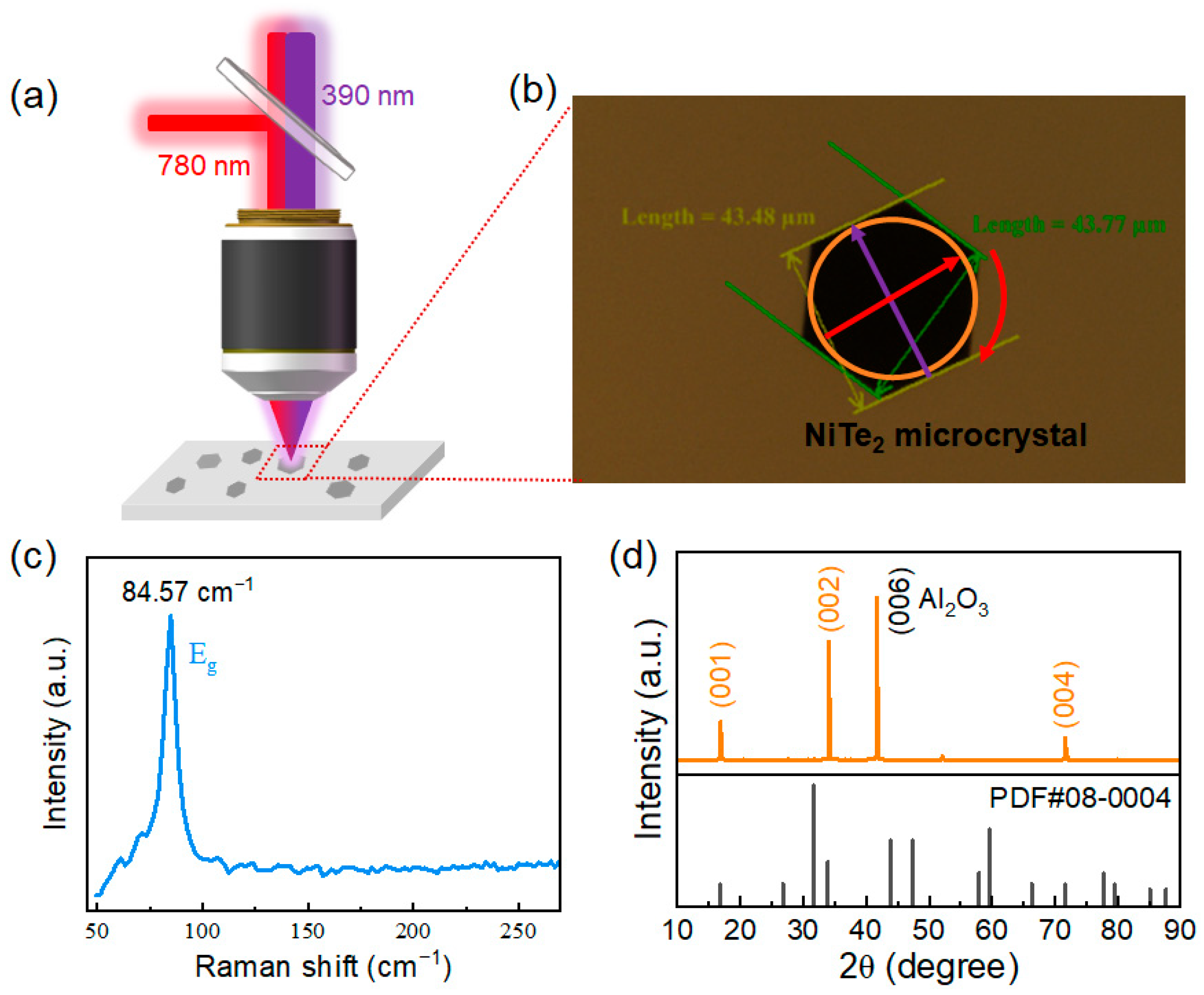
A schematic illustration of the experimental setup is shown in Figure 1a. The 390 nm pump beam (purple) and the 780 nm probe beam (red) were collinearly focused onto a selected NiTe2 microcrystal through a high-numerical-aperture objective lens. An optical image of a representative NiTe2 microcrystal is presented in Figure 1b, revealing a well-defined hexagonal morphology with an edge length of ~43 μm. The pump and probe spots had diameters of approximately 40 μm and 30 μm, respectively, with spatial overlap on the sample. The polarizations of the pump and probe beams were set to be orthogonal, as indicated in Figure 1b. During polarization-dependent measurements, the probe polarization was rotated with respect to the fixed pump polarization (denoted by the curved red arrow), with 0° corresponding to the orthogonal configuration.
NiTe2 microcrystals were synthesized directly on sapphire substrates (1 cm × 1 cm) via chemical vapor deposition. The microcrystals have a thickness of ~100 nm, and Figure 1a illustrates the spatial distribution of isolated microcrystal flakes on the sapphire substrate. Raman spectroscopy measurements were carried out under 532 nm excitation, with the spectrum in the range of 50–250 cm−1 displayed in Figure 1c. A characteristic peak at ~84.6 cm−1, corresponding to the in-plane Eg vibrational mode, is clearly resolved, in good agreement with previous reports [28,29]. X-ray diffraction (XRD) measurements were further performed, as shown in Figure 1d. Sharp diffraction peaks indexed to the (001), (002), and (004) planes are observed, indicating the high crystallinity and a preferential orientation along the c-axis [29,30]. An additional diffraction peak at 41.8° originates from the sapphire substrate. These structural characterizations confirm the high crystalline quality of the investigated NiTe2 microcrystals.

3. Results and Discussion

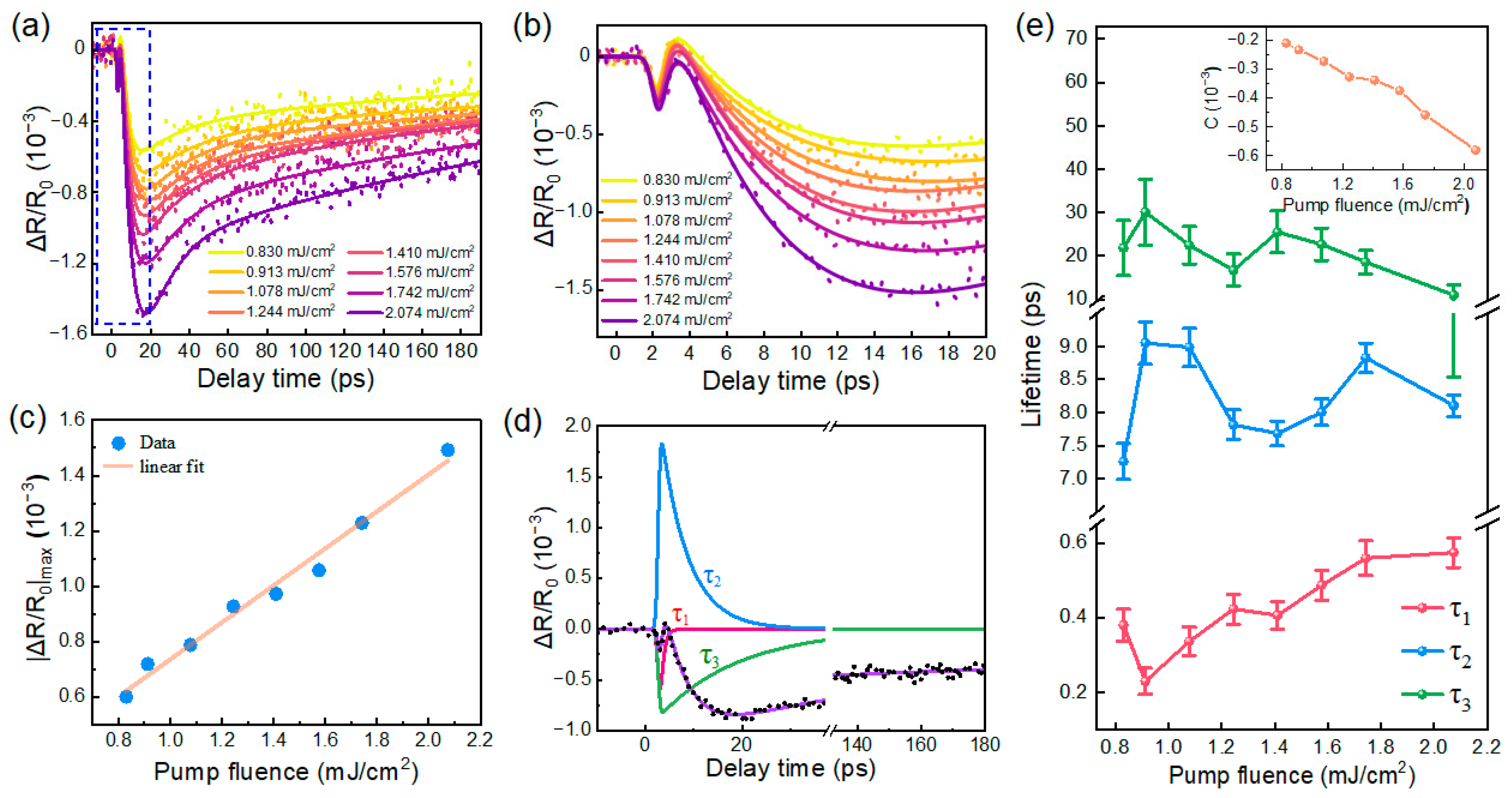
The time-resolved differential reflectance, ΔR/R0, was recorded by varying the delay time between the pump and probe pulses, where R0 denotes the optical reflection of the probe light in the absence of photoexcitation, and ΔR represents the photoinduced change in reflection of the probe beam. Figure 2a displays the transient reflection spectra of NiTe2 measured at different pump fluences, with Figure 2b providing an enlarged view of the first 20 ps (dashed box in Figure 2a). Notably, the relaxation kinetics exhibit multiple distinct stages. Following photoexcitation, the ΔR/R0 response exhibits a sharp drop to a minimum, followed by a rapid recovery, with the signal slightly rising above zero at low pump fluences. Subsequently, the ΔR/R0 decreases again, reaching a second minimum at approximately 16 ps, and then gradually relaxes back to the equilibrium state over a prolonged timescale extending to several hundreds of picoseconds. The peak intensity, i.e., |ΔR/R0|max, is plotted in Figure 2c, revealing a linear dependence with respect to pump fluence. This behavior indicates that the transient response does not saturate within the pump fluence range employed in this work.
To quantitatively extract the relaxation lifetimes and disentangle the complicated relaxation processes, a tri-exponential decay function convoluted with the laser pulse width in the following form was tentatively used to fit the transient reflectivity traces:
Δ R R 0 = i = 1 , 2 , 3 A i   exp t τ i     erfc ω τ i t 2 ω + C
where Ai and τi represent the amplitude and decay time of the i-th relaxation component, respectively. t is the delay time between the pump and probe pulses, ω is the temporal duration of the laser pulse, C denotes a constant offset, and erfc(t) = 1 − erf(t) is the complementary error function. As shown in Figure 2a (solid line), the measured ΔR/R0 response can be well reproduced by the fitting model, yielding three distinct characteristic time constants as well as a negative offset. Figure 2d shows a representative fitting result decomposed into three dominant components together with the total fitted curve at a selected pump fluence. Among these components, the τ2 process contributes positively to ΔR/R0 (i.e., A2 > 0), which is attributed to photoinduced bleaching associated with conduction-band filling, that is, the population of pump-excited electrons in the conduction band suppresses interband transitions at probing wavelength through Pauli blocking. In contrast, the τ1, τ3, and offset components contribute negatively to ΔR/R0 (i.e., A1, A3, C < 0), and are related to thermally driven processes. The extracted relaxation lifetimes as a function of pump fluence are summarized in Figure 2e, with the fitted constant C shown in the inset. Below, we analyze the underlying microscopic mechanisms responsible for the observed ultrafast reflectance dynamics step by step.
For the semimetal NiTe2, optical excitation with 390 nm pump pulses promotes a large population of electrons into the conduction band, leaving holes in the valence band. The photoexcited electron system rapidly thermalizes via electron-electron (e-e) scattering, forming a quasi-equilibrium Fermi–Dirac distribution characterized by an elevated electronic temperature relative to the lattice temperature owing to the different heat capacities of electrons and phonons. Subsequently, the relaxation dynamics are generally dominated by the cooling of hot electrons through electron-optical phonon scattering, during which excess electronic energy is transferred to the lattice system. This process typically occurs on a sub-picosecond to few-picosecond timescale and can be described within the framework of the two-temperature model (TTM) [31,32,33]. It is worth noting that the TTM is commonly employed to interpret the cooling and relaxation dynamics of hot electrons in metallic or semimetallic systems [34,35,36].
In our NiTe2 microcrystals, the fastest relaxation component, τ1, occurs on a sub-picosecond timescale and increases with pump fluence. Both its timescale and fluence dependence are consistent with the TTM, in which the e-ph interaction time can be expressed as [37,38]:
1 / τ e - ph = 3 λ ω 2 / π k B T e
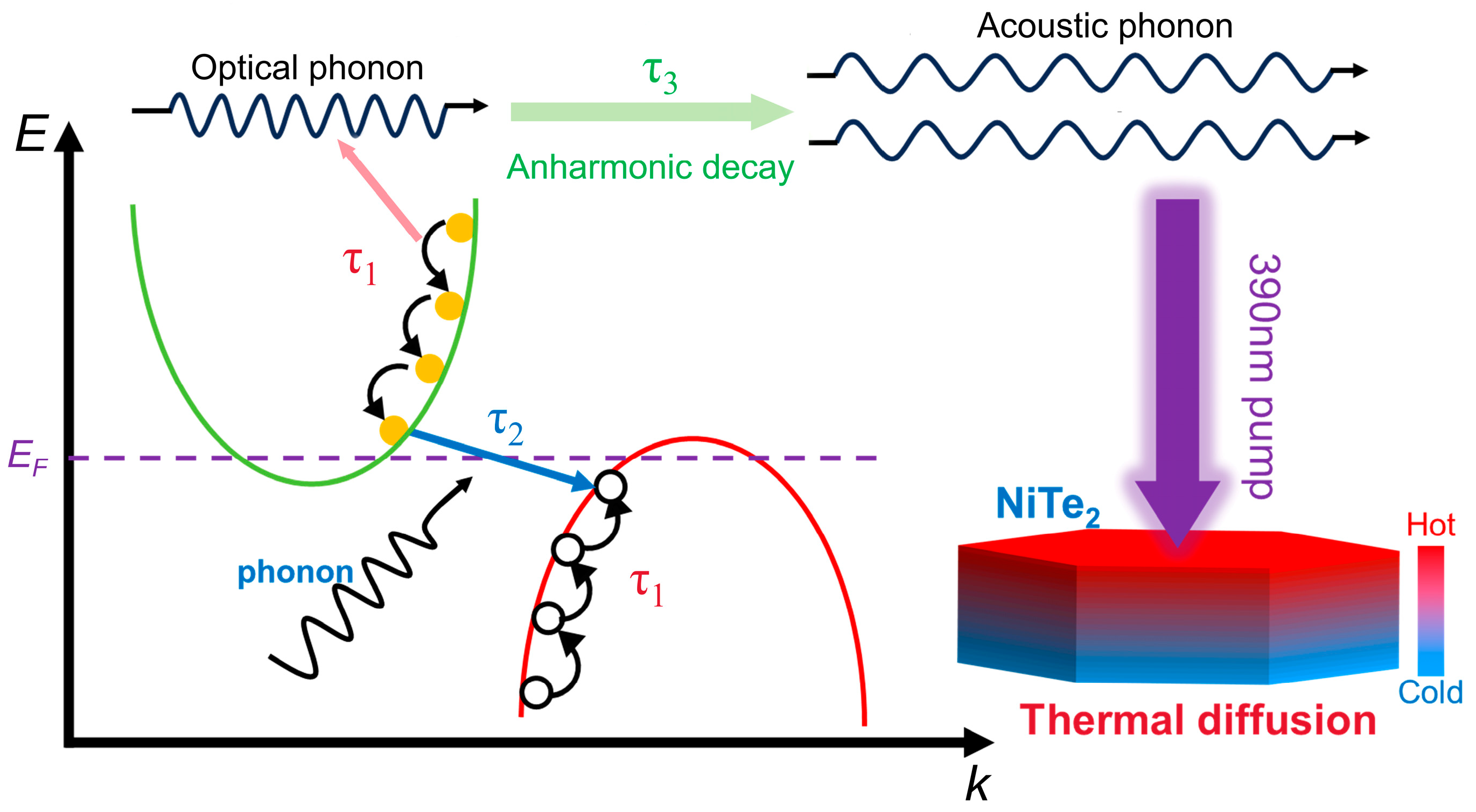
where λ2> is the second moment of the Eliashberg function, kB is the Boltzmann constant, and Te is the electronic temperature. Within this scenario, a higher pump fluence leads to a higher electronic temperature Te, thereby leading to a longer e-ph coupling time τe-ph. Accordingly, we ascribe the fastest relaxation process τ1 to the cooling of the hot electrons that relax toward the conduction band edge via e-ph interaction, similar to observations in other semimetal materials [34,39,40]. A schematic illustration of the relaxation picture in NiTe2 microcrystals is presented in Figure 3, which will help us to understand the origin of various relaxation processes.
After e-ph thermalization, there are still excess electrons (holes) remaining in the conduction (valence) band. The intermediate relaxation process with a characteristic relaxation time of τ2~7–9 ps can therefore be associated with e-h recombination between the conduction and valence bands. In principle, such recombination may proceed via a radiative pathway, in which an electron in the conduction band can recombine with a hole in the valence band by emitting a photon. However, this scenario is unlikely for τ2 in NiTe2, since radiative recombination generally occurs on much longer timescales, typically on the order of several nanoseconds [41]. Alternatively, e-h recombination can occur through a three-body Auger process [42,43,44], where an electron and a hole recombine and transfer the released energy to a third carrier. Nevertheless, this mechanism is not supported by the pump fluence dependence of τ2 observed in our experiments. In Auger recombination, the relaxation rate scales with the third power of the carrier density, given by d n / d t C n 3 [45,46]. This implies that Auger recombination would lead to a strong fluence-dependent recombination lifetime, in clear contradiction to the near-constant τ2 observed here. Finally, considering that NiTe2 is a semimetal with energy band overlap, and its conduction and valence band extrema are located at different points in the Brillouin zone. Consequently, direct interband e-h recombination requires additional momentum to satisfy momentum conservation, which can be supplied by phonons. We therefore attribute τ2 to phonon-assisted e-h recombination between momentum-mismatched electron and hole pockets, as schematically illustrated in Figure 3. As e-h recombination proceeds, the carrier population in the conduction band decreases, thereby weakening the band-filling effect and leading to the recovery of the bleaching signal. This behavior is consistent with the positive contribution of τ2 to the ΔR/R0 response shown in Figure 2d.
Following the establishment of quasi-thermal equilibrium between the hot electrons and hot optical phonons (τ1), the subsequent dynamics are dominated by energy redistribution among phonon subsystems through phonon–phonon (ph-ph) scattering. Therefore, the process τ3, with a time constant of ~20–30 ps, can be attributed to the anharmonic energy transfer from hot optical phonons to other uncoupled phonons (primarily lower energy acoustic phonon branch), similar to previous experimental and theoretical studies on Dirac materials [47,48,49]. It is noted that τ3 exhibits a weak pump fluence dependence, which reflects that the ph-ph scattering rate is nearly constant over the applied fluence range. Finally, the offset term C is usually associated with spatial heat diffusion out of the excitation volume on a timescale much longer than our measurement window (~200 ps) [37,38,47]. The thermal spot created by pump pulses eventually cools down by transferring heat to the surroundings, thus the long-lived offset component can be ascribed to a spatial flow of heat carried by acoustic phonons. Given that the size of the NiTe2 microcrystal studied here is comparable to the pump spot, lateral heat flow is negligible. Considering that the optical penetration depth of ~10 nm [50] is smaller than the thickness of NiTe2 flakes, heat diffusion occurs predominantly via longitudinal diffusion into the bulk.
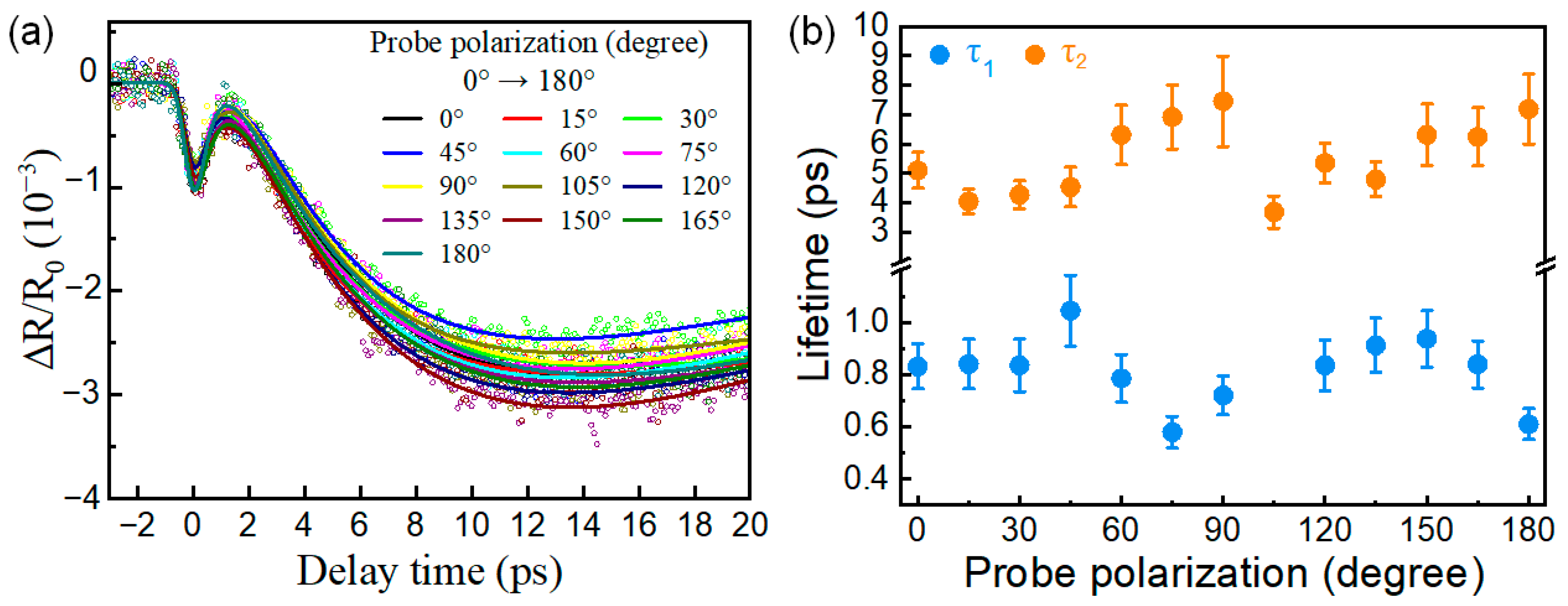
Additionally, we investigated the transient in-plane isotropy of NiTe2 microcrystals. We fixed the pump beam polarization and tuned the probe polarization angle with a half-wave plate. Figure 4a shows the transient reflectivity trace ΔR/R0 measured at various probe polarization angles from 0° to 180°, where 0° is defined as orthogonal to the pump polarization. It can be seen that the transient signals do not vary noticeably with the probe polarization angle, indicating that the underlying dynamics are insensitive to the polarization state of the probe beam. In Figure 4b, the extracted τ1 and τ2 relaxation times as a function of polarization angle do not exhibit significant variations within the experimental error. These results indicate that the ultrafast optical response of NiTe2 is nearly in-plane isotropic under the current pump-probe configuration, which is in significant contrast to many typical topological semimetals, where they often exhibit strongly anisotropic photocarriers and phonon dynamics [51,52,53,54]. Such isotropic behavior is beneficial for the design of polarization-insensitive optoelectronic devices, enabling robust performance under arbitrary light polarization.
It is worth mentioning that Cheng et al. [27] previously performed a degenerate 800 nm OPOP study on a bulk NiTe2 single crystal (~1 mm) employing a high-repetition-rate setup (80 MHz), identifying sub-picosecond and few-picosecond timescale relaxation components attributed to e-ph scattering and phonon-assisted e-h recombination, respectively. Our study on NiTe2 microcrystals not only reproduced these results (τ1 and τ2), but also extended the analysis to the slower recovery dynamics in detail, including ph-ph coupling (τ3) and longitudinal thermal diffusion (offset term C). In addition to mapping the full relaxation processes, we examined the transient in-plane isotropy dynamics of the NiTe2 microcrystals. These findings demonstrate that bulk-derived ultrafast relaxation mechanisms remain valid in device-compatible NiTe2 microcrystals, underscoring their relevance for integrated optoelectronic applications. Looking forward, recent studies have demonstrated the capability of the fractional description in analyzing complex photoconductive and nonlinear optical behaviors in micro- and nanomaterials [55]. In light of this, applying such a model to NiTe2, when combined with ultrafast spectroscopy, could pave the way for the development of optoelectronic circuits and all-optical signal processing in NiTe2.

4. Conclusions

We conducted a comprehensive investigation of ultrafast carrier and phonon dynamics in microcrystalline NiTe2 using time-resolved OPOP spectroscopy. The complete relaxation dynamics are resolved, encompassing sub-picosecond e-ph scattering, phonon-assisted e-h recombination, anharmonic decay of optical phonons into acoustic phonons, and eventual heat diffusion into the bulk. Polarization-dependent measurements further reveal a nearly isotropic ultrafast optical response, underscoring the robustness of NiTe2 for polarization-insensitive device applications. Our results unravel and validate the microscopic relaxation mechanisms in Dirac semimetal NiTe2, thereby laying a foundation for the development of NiTe2-based micrometer-scale, ultrafast optoelectronics devices.

Author Contributions

S.M. performed the experiments, analyzed the results, and wrote the original draft. K.S. assisted in conducting the experiments and contributed to data analysis. P.S. and G.M. conceived and designed the experiments, analyzed the results, and revised the manuscript. All authors have read and agreed to the published version of the manuscript.

Funding

This work was supported by the National Natural Science Foundation of China (Grant nos. 12574464, 12404396, 92150101); China Postdoctoral Science Foundation (Grant no. 2024M751932); Postdoctoral Fellowship Program of CPSF (Grant no. GZB20240418).

Data Availability Statement

The original contributions presented in this study are included in the article. Further inquiries can be directed to the corresponding authors.

Conflicts of Interest

The authors declare no conflicts of interest.

References

  1. Liu, Z.K.; Zhou, B.; Zhang, Y.; Wang, Z.J.; Weng, H.M.; Prabhakaran, D.; Mo, S.-K.; Shen, Z.X.; Fang, Z.; Dai, X.; et al. Discovery of a three-dimensional topological Dirac semimetal, Na3Bi. Science 2014, 343, 864–867. [Google Scholar] [CrossRef]
  2. Armitage, N.P.; Mele, E.J.; Vishwanath, A. Weyl and Dirac semimetals in three-dimensional solids. Rev. Mod. Phys. 2018, 90, 015001. [Google Scholar] [CrossRef]
  3. Lv, B.Q.; Qian, T.; Ding, H. Experimental perspective on three-dimensional topological semimetals. Rev. Mod. Phys. 2021, 93, 025002. [Google Scholar] [CrossRef]
  4. Yan, M.; Huang, H.; Zhang, K.; Wang, E.; Yao, W.; Deng, K.; Wan, G.; Zhang, H.; Arita, M.; Yang, H.; et al. Lorentz-violating type-II Dirac fermions in transition metal dichalcogenide PtTe2. Nat. Commun. 2017, 8, 257. [Google Scholar] [CrossRef]
  5. Liang, T.; Gibson, Q.; Ali, M.N.; Liu, M.; Cava, R.J.; Ong, N.P. Ultrahigh mobility and giant magnetoresistance in the Dirac semimetal Cd3As2. Nat. Mater. 2015, 14, 280–284. [Google Scholar] [CrossRef] [PubMed]
  6. Borisenko, S.; Gibson, Q.; Evtushinsky, D.; Zabolotnyy, V.; Büchner, B.; Cava, R.J. Experimental realization of a three-dimensional Dirac semimetal. Phys. Rev. Lett. 2014, 113, 027603. [Google Scholar] [CrossRef]
  7. Xiong, J.; Kushwaha, S.K.; Liang, T.; Krizan, J.W.; Hirschberger, M.; Wang, W.; Cava, R.J.; Ong, N.P. Evidence for the chiral anomaly in the Dirac semimetal Na3Bi. Science 2015, 350, 413–416. [Google Scholar] [CrossRef]
  8. Wang, S.; Lin, B.-C.; Wang, A.-Q.; Yu, D.-P.; Liao, Z.-M. Quantum transport in Dirac and Weyl semimetals: A review. Adv. Phys. X 2017, 2, 518–544. [Google Scholar] [CrossRef]
  9. Clark, O.J.; Neat, M.J.; Okawa, K.; Bawden, L.; Markovic, I.; Mazzola, F.; Feng, J.; Sunko, V.; Riley, J.M.; Meevasana, W.; et al. Fermiology and superconductivity of topological surface states in PdTe2. Phys. Rev. Lett. 2018, 120, 156401. [Google Scholar] [CrossRef] [PubMed]
  10. Chang, T.R.; Xu, S.Y.; Sanchez, D.S.; Tsai, W.F.; Huang, S.M.; Chang, G.; Hsu, C.H.; Bian, G.; Belopolski, I.; Yu, Z.M.; et al. Type-II symmetry-protected topological Dirac semimetals. Phys. Rev. Lett. 2017, 119, 026404. [Google Scholar] [CrossRef] [PubMed]
  11. Zhou, R.; Ullah, K.; Hussain, N.; Fadhali, M.M.; Yang, S.; Lin, Q.; Zubair, M.; Iqbal, M.F. Recent advances in photonics of three-dimensional Dirac semimetal Cd3As2. Adv. Photon. Nexus 2022, 1, 024001. [Google Scholar] [CrossRef]
  12. Zhang, L.; Chen, Z.; Zhang, K.; Wang, L.; Xu, H.; Han, L.; Guo, W.; Yang, Y.; Kuo, C.N.; Lue, C.S.; et al. High-frequency rectifiers based on type-II Dirac fermions. Nat. Commun. 2021, 12, 1584. [Google Scholar] [CrossRef]
  13. Guo, Y.; Chen, Z.; Jin, Z.; Wang, X.; Zhang, C.; Balakin, A.V.; Shkurinov, A.P.; Peng, Y.; Zhu, Y.; Zhuang, S. Dynamically controllable terahertz electromagnetic interference shielding by small polaron responses in Dirac semimetal PdTe2 thin films. Adv. Funct. Mater. 2024, 34, 2407749. [Google Scholar] [CrossRef]
  14. Nurmamat, M.; Eremeev, S.V.; Wang, X.; Yoshikawa, T.; Kono, T.; Kakoki, M.; Muro, T.; Jiang, Q.; Sun, Z.; Ye, M.; et al. Bulk Dirac cone and highly anisotropic electronic structure of NiTe2. Phys. Rev. B 2021, 104, 155133. [Google Scholar] [CrossRef]
  15. Zhang, J.; Huang, G.Q. The superconductivity and topological surface state of type-II Dirac semimetal NiTe2. J. Phys. Condens. Matter 2020, 32, 205702. [Google Scholar] [CrossRef] [PubMed]
  16. Ghosh, B.; Mondal, D.; Kuo, C.-N.; Lue, C.S.; Nayak, J.; Fujii, J.; Vobornik, I.; Politano, A.; Agarwal, A. Observation of bulk states and spin-polarized topological surface states in transition metal dichalcogenide Dirac semimetal candidate NiTe2. Phys. Rev. B 2019, 100, 195134. [Google Scholar] [CrossRef]
  17. Liu, Q.; Fei, F.; Chen, B.; Bo, X.; Wei, B.; Zhang, S.; Zhang, M.; Xie, F.; Naveed, M.; Wan, X.; et al. Nontopological origin of the planar Hall effect in the type-II Dirac semimetal NiTe2. Phys. Rev. B 2019, 99, 155119. [Google Scholar] [CrossRef]
  18. James, M.T.; Mandal, S.; Sebastian, N.K.; Mishra, P.; Ganesan, R.; Kumar, P.S.A. Probing electron-phonon and phonon-phonon coupling in type-II Dirac semi-metal NiTe2 via temperature-dependent Raman spectroscopy. J. Phys. Condens. Matter 2021, 33, 135602. [Google Scholar] [CrossRef] [PubMed]
  19. Li, X.; Wu, D.; Lin, P.; Han, B.; Shi, Z.; Tian, Y.; Li, X.; Zeng, L. Low-temperature synthesis of wafer-scale 2D topological semimetal NiTe2 for high-efficiency broadband photodetection and imaging. Laser Photonics Rev. 2025, 19, e01119. [Google Scholar] [CrossRef]
  20. Zhang, Y.; Chen, L.; Ding, T.; Xu, J.; Zhang, X.; Liu, H.; Chen, G. NiTe2 nanosheets for broadband photodetection. ACS Appl. Nano Mater. 2022, 5, 6094–6099. [Google Scholar] [CrossRef]
  21. Liu, H.; Meng, J. Research on topological materials using ultrafast spectroscopy. Acta Phys. Sin. 2025, 75, 040703. [Google Scholar] [CrossRef]
  22. Zhai, G.; Ma, C.; Xiang, J.; Ye, J.; Li, T.; Li, Y.; Sun, P.; Chen, G.; Wu, X.; Zhang, X. Mid-infrared transient reflectance study of the Dirac semimetal Cd3As2 under strong optical pumping. Phys. Rev. B 2020, 101, 174310. [Google Scholar] [CrossRef]
  23. Ghalgaoui, A.; Yang, F.; Pilch, P.; Kang, T.; Runge, M.; Yue, S.; Chen, Y.; Yang, Y.; Xiu, F.; Sheng, X.-L.; et al. Nonlinear terahertz phononics in the Dirac semimetal Cd3As2. Phys. Rev. B 2025, 112, L041117. [Google Scholar] [CrossRef]
  24. Liu, S.-Y.; Zhu, S.-X.; Wu, Q.-Y.; Zhang, C.; Song, P.-B.; Shi, Y.-G.; Liu, H.; Liu, Z.-T.; Song, J.-J.; Wu, F.-Y.; et al. Dirac semimetal PdTe2 temperature-dependent quasiparticle dynamics and electron-phonon coupling. Results Phys. 2021, 30, 104816. [Google Scholar] [CrossRef]
  25. Suo, P.; Zhang, H.; Yan, S.; Zhang, W.; Fu, J.; Lin, X.; Hao, S.; Jin, Z.; Zhang, Y.; Zhang, C.; et al. Observation of negative terahertz photoconductivity in large area type-II Dirac semimetal PtTe2. Phys. Rev. Lett. 2021, 126, 227402. [Google Scholar] [CrossRef] [PubMed]
  26. Suo, P.; Yan, S.; Pu, R.; Zhang, W.; Li, D.; Chen, J.; Fu, J.; Lin, X.; Miao, F.; Liang, S.-J.; et al. Ultrafast photocarrier and coherent phonon dynamics in type-II Dirac semimetal PtTe2 thin films probed by optical spectroscopy. Photon. Res. 2022, 10, 653–661. [Google Scholar] [CrossRef]
  27. Cheng, L.; Fei, F.C.; Hu, H.; Dai, Y.M.; Song, F.Q.; Qi, J. Ultrafast carrier and lattice dynamics in the Dirac semimetal NiTe2. Phys. Rev. B 2022, 106, 104308. [Google Scholar] [CrossRef]
  28. Zhai, X.; Xu, X.; Peng, J.; Jing, F.; Zhang, Q.; Liu, H.; Hu, Z. Enhanced optoelectronic performance of CVD-grown metal-semiconductor NiTe2/MoS2 heterostructures. ACS Appl. Mater. Interfaces 2020, 12, 24093–24101. [Google Scholar] [CrossRef]
  29. Shi, J.; Huan, Y.; Xiao, M.; Hong, M.; Zhao, X.; Gao, Y.; Cui, F.; Yang, P.; Pennycook, S.J.; Zhao, J.; et al. Two-dimensional metallic NiTe2 with ultrahigh environmental stability, conductivity, and electrocatalytic activity. ACS Nano 2020, 14, 9011–9020. [Google Scholar] [CrossRef] [PubMed]
  30. Xu, C.; Li, B.; Jiao, W.; Zhou, W.; Qian, B.; Sankar, R.; Zhigadlo, N.D.; Qi, Y.; Qian, D.; Chou, F.-C.; et al. Topological type-II Dirac fermions approaching the Fermi level in a transition metal dichalcogenide NiTe2. Chem. Mater. 2018, 30, 4823–4830. [Google Scholar] [CrossRef]
  31. Groeneveld, R.H.; Sprik, R.; Lagendijk, A. Femtosecond spectroscopy of electron-electron and electron-phonon energy relaxation in Ag and Au. Phys. Rev. B 1995, 51, 11433–11445. [Google Scholar] [CrossRef]
  32. Allen, P.B. Theory of thermal relaxation of electrons in metals. Phys. Rev. Lett. 1987, 59, 1460–1463. [Google Scholar] [CrossRef] [PubMed]
  33. Demsar, J.; Averitt, R.D.; Ahn, K.H.; Graf, M.J.; Trugman, S.A.; Kabanov, V.V.; Sarrao, J.L.; Taylor, A.J. Quasiparticle relaxation dynamics in heavy fermion compounds. Phys. Rev. Lett. 2003, 91, 027401. [Google Scholar] [CrossRef]
  34. Dai, Y.M.; Bowlan, J.; Li, H.; Miao, H.; Wu, S.F.; Kong, W.D.; Shi, Y.G.; Trugman, S.A.; Zhu, J.X.; Ding, H.; et al. Ultrafast carrier dynamics in the large-magnetoresistance material WTe2. Phys. Rev. B 2015, 92, 161104. [Google Scholar] [CrossRef]
  35. Suo, P.; Zhang, W.; Yang, Y.; Geng, L.; Wang, C.; Sun, K.; Lin, X.; Lv, L.-P.; Qiao, L.; Xiu, F.; et al. Tracking and manipulating ultrafast photocarrier dynamics in 3D Dirac semimetal Cd3As2 by chemical doping. Photon. Res. 2025, 13, 1028–1037. [Google Scholar] [CrossRef]
  36. Yuan, Y.; Kissin, P.; Puggioni, D.; Cremin, K.; Lei, S.; Wang, Y.; Mao, Z.; Rondinelli, J.M.; Averitt, R.D.; Gopalan, V. Ultrafast quasiparticle dynamics in the correlated semimetal Ca3Ru2O7. Phys. Rev. B 2019, 99, 155111. [Google Scholar] [CrossRef]
  37. Cheng, L.; La-o-vorakiat, C.; Tang, C.S.; Nair, S.K.; Xia, B.; Wang, L.; Zhu, J.-X.; Chia, E.E.M. Temperature-dependent ultrafast carrier and phonon dynamics of topological insulator Bi1.5Sb0.5Te1.8Se1.2. Appl. Phys. Lett. 2014, 104, 211906. [Google Scholar] [CrossRef]
  38. Luo, C.W.; Wu, I.H.; Cheng, P.C.; Lin, J.Y.; Wu, K.H.; Uen, T.M.; Juang, J.Y.; Kobayashi, T.; Chareev, D.A.; Volkova, O.S.; et al. Quasiparticle dynamics and phonon softening in FeSe superconductors. Phys. Rev. Lett. 2012, 108, 257006. [Google Scholar] [CrossRef]
  39. Zhu, S.-X.; Zhang, C.; Wu, Q.-Y.; Tang, X.-F.; Liu, H.; Liu, Z.-T.; Luo, Y.; Song, J.-J.; Wu, F.-Y.; Zhao, Y.-Z.; et al. Temperature evolution of quasiparticle dispersion and dynamics in semimetallic 1T-TiTe2 via high-resolution angle-resolved photoemission spectroscopy and ultrafast optical pump-probe spectroscopy. Phys. Rev. B 2021, 103, 115108. [Google Scholar] [CrossRef]
  40. Sheu, Y.M.; Chien, Y.J.; Uher, C.; Fahy, S.; Reis, D.A. Free-carrier relaxation and lattice heating in photoexcited bismuth. Phys. Rev. B 2013, 87, 075429. [Google Scholar] [CrossRef]
  41. Othonos, A. Probing ultrafast carrier and phonon dynamics in semiconductors. J. Appl. Phys. 1998, 83, 1789–1830. [Google Scholar] [CrossRef]
  42. Takeshima, M. Theory of phonon-assisted Auger recombination in semiconductors. Phys. Rev. B 1981, 23, 6625–6637. [Google Scholar] [CrossRef]
  43. Vodopyanov, K.L.; Graener, H.; Phillips, C.C.; Tate, T.J. Picosecond carrier dynamics and studies of Auger recombination processes in indium arsenide at room temperature. Phys. Rev. B 1992, 46, 13194–13200. [Google Scholar] [CrossRef] [PubMed]
  44. Onishi, Y.; Ren, Z.; Segawa, K.; Kaszub, W.; Lorenc, M.; Ando, Y.; Tanaka, K. Ultrafast carrier relaxation through Auger recombination in the topological insulator Bi1.5Sb0.5Te1.7Se1.3. Phys. Rev. B 2015, 91, 085306. [Google Scholar] [CrossRef]
  45. Bushick, K.; Kioupakis, E. Phonon-assisted Auger-Meitner recombination in silicon from first principles. Phys. Rev. Lett. 2023, 131, 076902. [Google Scholar] [CrossRef]
  46. Kioupakis, E.; Rinke, P.; Delaney, K.T.; Van de Walle, C.G. Indirect Auger recombination as a cause of efficiency droop in nitride light-emitting diodes. Appl. Phys. Lett. 2011, 98, 161107. [Google Scholar] [CrossRef]
  47. Ishida, Y.; Masuda, H.; Sakai, H.; Ishiwata, S.; Shin, S. Revealing the ultrafast light-to-matter energy conversion before heat diffusion in a layered Dirac semimetal. Phys. Rev. B 2016, 93, 100302. [Google Scholar] [CrossRef]
  48. Lu, W.; Ling, J.; Xiu, F.; Sun, D. Terahertz probe of photoexcited carrier dynamics in the Dirac semimetal Cd3As2. Phys. Rev. B 2018, 98, 104310. [Google Scholar] [CrossRef]
  49. Tse, W.-K.; Das Sarma, S. Energy relaxation of hot Dirac fermions in graphene. Phys. Rev. B 2009, 79, 235406. [Google Scholar] [CrossRef]
  50. Fazeli, Y.; Etesami, Z.; Nourbakhsh, Z.; Vashaee, D. Unveiling the properties of transition-metal dichalcogenides: A comprehensive study of WTe2, WSe2, ZrTe2, and NiTe2 in bulk and monolayer forms. J. Mater. Sci. 2023, 58, 10023–10042. [Google Scholar] [CrossRef]
  51. Li, Z.; Chen, Y.; Song, A.; Zhang, J.; Zhang, R.; Zhang, Z.; Wang, X. Anisotropic phonon dynamics in Dirac semimetal PtTe2 thin films enabled by helicity-dependent ultrafast light excitation. Light Sci. Appl. 2024, 13, 181. [Google Scholar] [CrossRef]
  52. Zhuo, X.; Lai, J.; Yu, P.; Yu, Z.; Ma, J.; Lu, W.; Liu, M.; Liu, Z.; Sun, D. Dynamical evolution of anisotropic response of type-II Weyl semimetal TaIrTe4 under ultrafast photoexcitation. Light Sci. Appl. 2021, 10, 101. [Google Scholar] [CrossRef] [PubMed]
  53. Drueke, E.; Yang, J.; Zhao, L. Observation of strong and anisotropic nonlinear optical effects through polarization-resolved optical spectroscopy in the type-II Weyl semimetal Td−WTe2. Phys. Rev. B 2021, 104, 064304. [Google Scholar] [CrossRef]
  54. Yoshizawa, H.; Sakai, H.; Kondo, M.; Ochi, M.; Kuroki, K.; Hanasaki, N.; Fujioka, J. In-plane anisotropic charge dynamics in the layered polar Dirac semimetal BaMnSb2. Phys. Rev. B 2022, 105, L241110. [Google Scholar] [CrossRef]
  55. Garcia-de-los-Rios, V.M.; Arano-Martínez, J.A.; Trejo-Valdez, M.; Hernández-Pichardo, M.L.; Vidales-Hurtado, M.A.; Torres-Torres, C. Fractional photoconduction and nonlinear optical behavior in ZnO micro and nanostructures. Fractal Fract. 2023, 7, 885. [Google Scholar] [CrossRef]
Figure 1. Micro-area OPOP setup and structural characterization of NiTe2 microcrystals. (a) Schematic illustration of the OPOP experimental system with a reflective configuration. A 390 nm pump beam (purple) and a 780 nm probe beam (red) are collinearly focused through a microscope objective onto a single NiTe2 flake grown on a sapphire substrate. The reflected probe beam is collected and guided to the detector. (b) Optical image of the hexagonal NiTe2 microcrystal shown in (a). The brown-yellow and green lines mark the characteristic lateral dimensions of the NiTe2 microcrystal, while the orange-shaded circular region indicates the spatial area excited by the pump beam. The purple and red arrows denote the polarization directions of the pump and probe beams, respectively, which are mutually orthogonal. During polarization-dependent measurements, the probe polarization is rotated, as indicated by the red arrow. (c) Raman spectrum of the NiTe2 microcrystal, showing a prominent characteristic peak at 84.57 cm−1 corresponding to the Eg phonon mode. (d) X-ray diffraction (XRD) pattern of the NiTe2 microcrystal. The diffraction peaks at 16.74°, 33.87°, and 71.72° are indexed to the (001), (002), and (004) crystal planes of NiTe2, respectively. The additional peak at 41.75° originates from the sapphire substrate.
Nanomaterials 16 00204 g001
Figure 2. Pump fluence dependence of the ultrafast reflection response in NiTe2 microcrystals. (a) Transient reflectivity traces measured at different pump fluences. The colored data points represent the experimentally measured ΔR/R0 signals, and the corresponding solid lines are tri-exponential fitting results. (b) Enlarged view of the transient signals within the first 20 ps. (c) ΔR/R0 peak amplitude as a function of pump fluence. The solid line represents a linear fit. (d) Representative fitting result at a selected pump fluence, displaying the experimental data (colored dots), the overall fit (purple curve), and the decomposed relaxation components (τ1: red, τ2: blue, τ3: green). (e) Extracted relaxation lifetimes with respect to pump fluence. The inset shows the offset term C versus pump fluence.
Nanomaterials 16 00204 g002
Figure 3. Schematic illustration of ultrafast carrier and phonon relaxation dynamics in NiTe2 microcrystals. The red and green curves represent the valence band and conduction band, respectively, while the purple dashed line denotes the Fermi level. The purple arrow indicates photoexcitation by the 390 nm pump pulse. The blue arrows illustrate the phonon-assisted electron–hole recombination process corresponding to τ2. The pink arrows represent optical phonons involved in electron–phonon coupling (τ1). The light-green arrows depict the anharmonic decay of optical phonons into acoustic phonons (τ3). The subsequent thermal diffusion process in the microcrystal after photoexcitation is illustrated using red (hot) and blue (cold) color contrast.
Nanomaterials 16 00204 g003
Figure 4. Probe polarization dependence of the ultrafast dynamics in NiTe2 microcrystals. (a) Transient reflectivity traces measured at probe polarization angles from 0° to 180° (where 0° is defined as the direction orthogonal to the pump polarization). The circular symbols represent the experimentally measured data, while the solid lines correspond to the fitting results. (b) Extracted relaxation times τ1 and τ2 at various probe polarization angles.
Nanomaterials 16 00204 g004
Disclaimer/Publisher’s Note: The statements, opinions and data contained in all publications are solely those of the individual author(s) and contributor(s) and not of MDPI and/or the editor(s). MDPI and/or the editor(s) disclaim responsibility for any injury to people or property resulting from any ideas, methods, instructions or products referred to in the content.