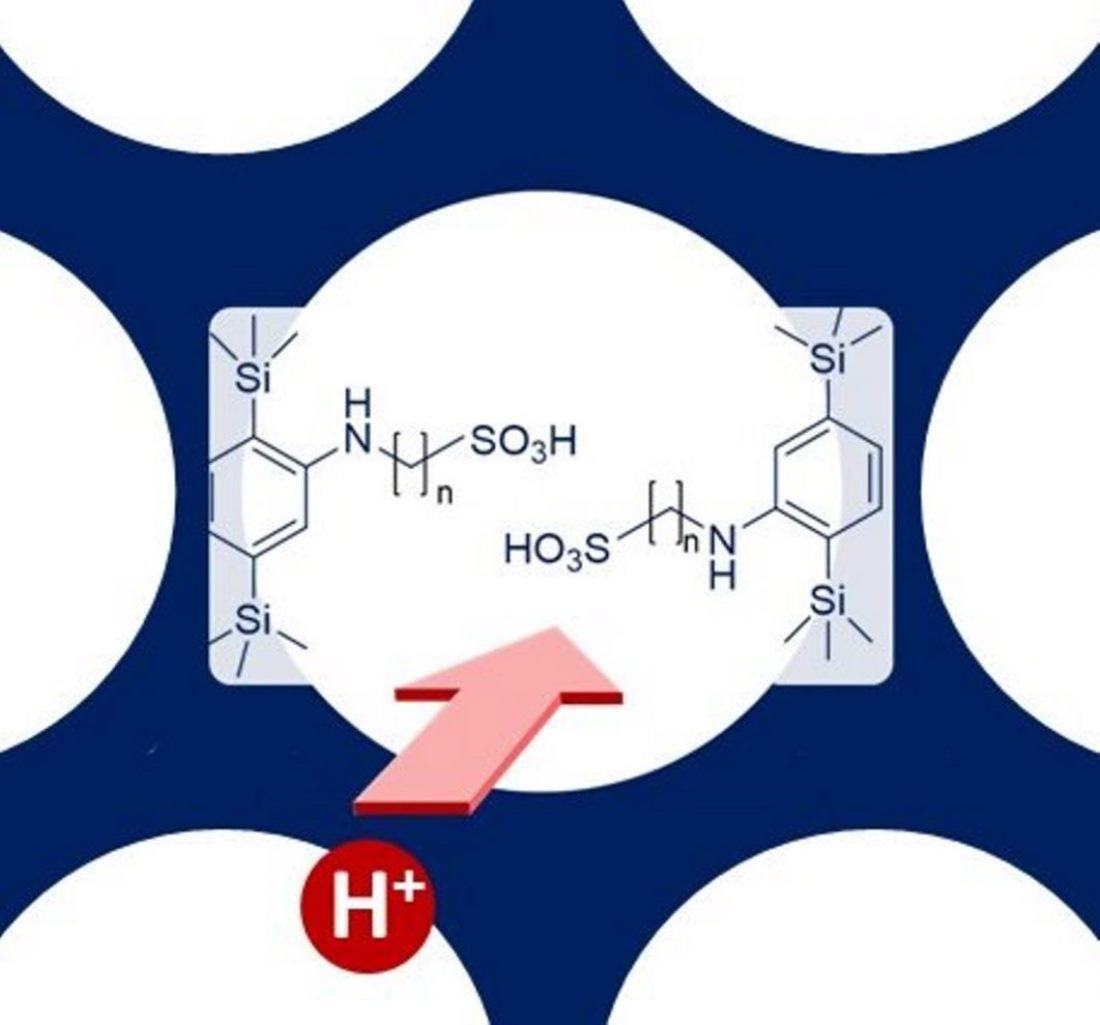
Proton-Conducting Sulfonated Periodic Mesoporous Organosilica



Abstract
1. Introduction
2. Materials and Methods
2.1. Synthesis
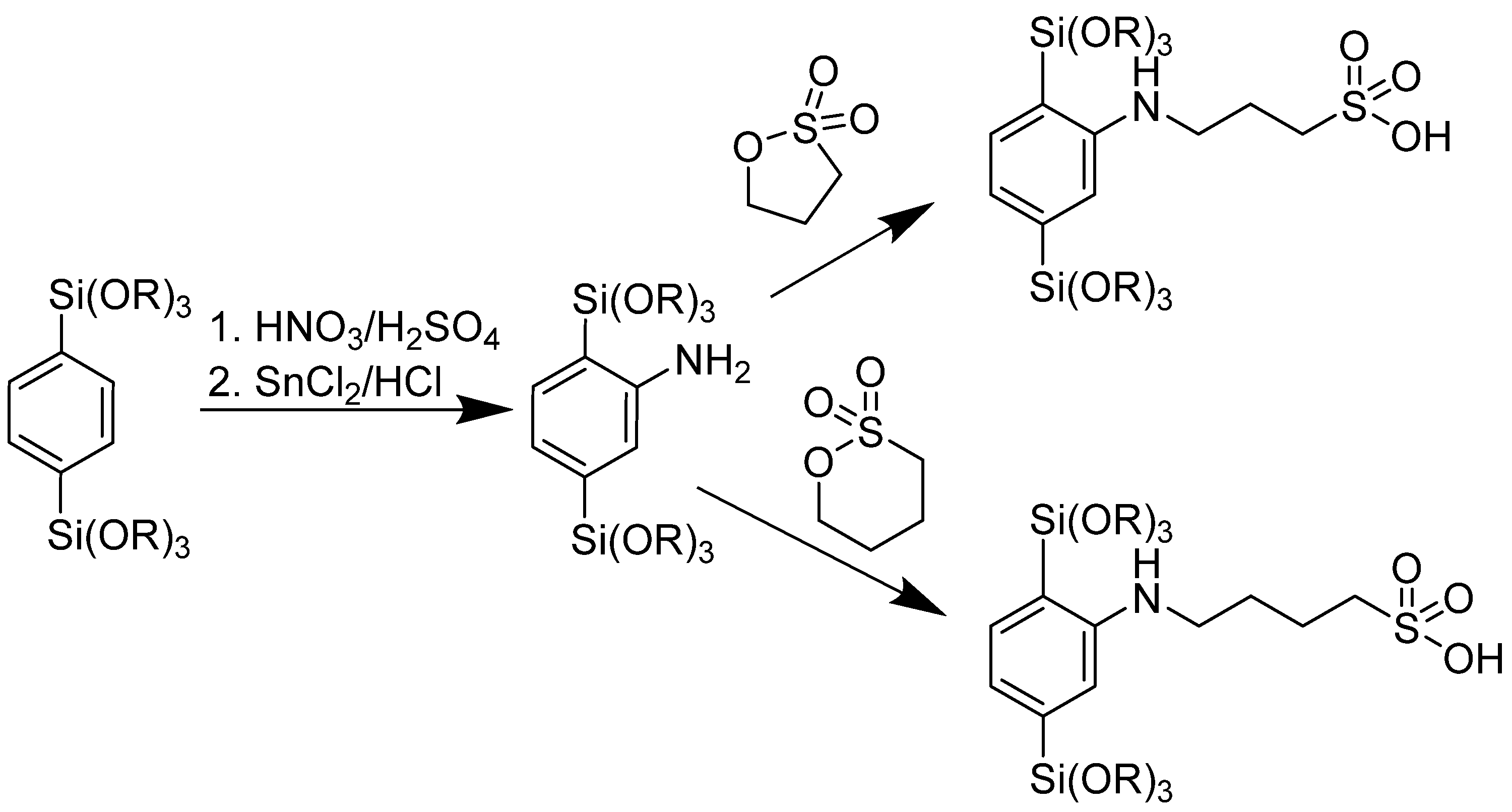
2.2. Functionalization
2.3. Characterization
3. Results and Discussion
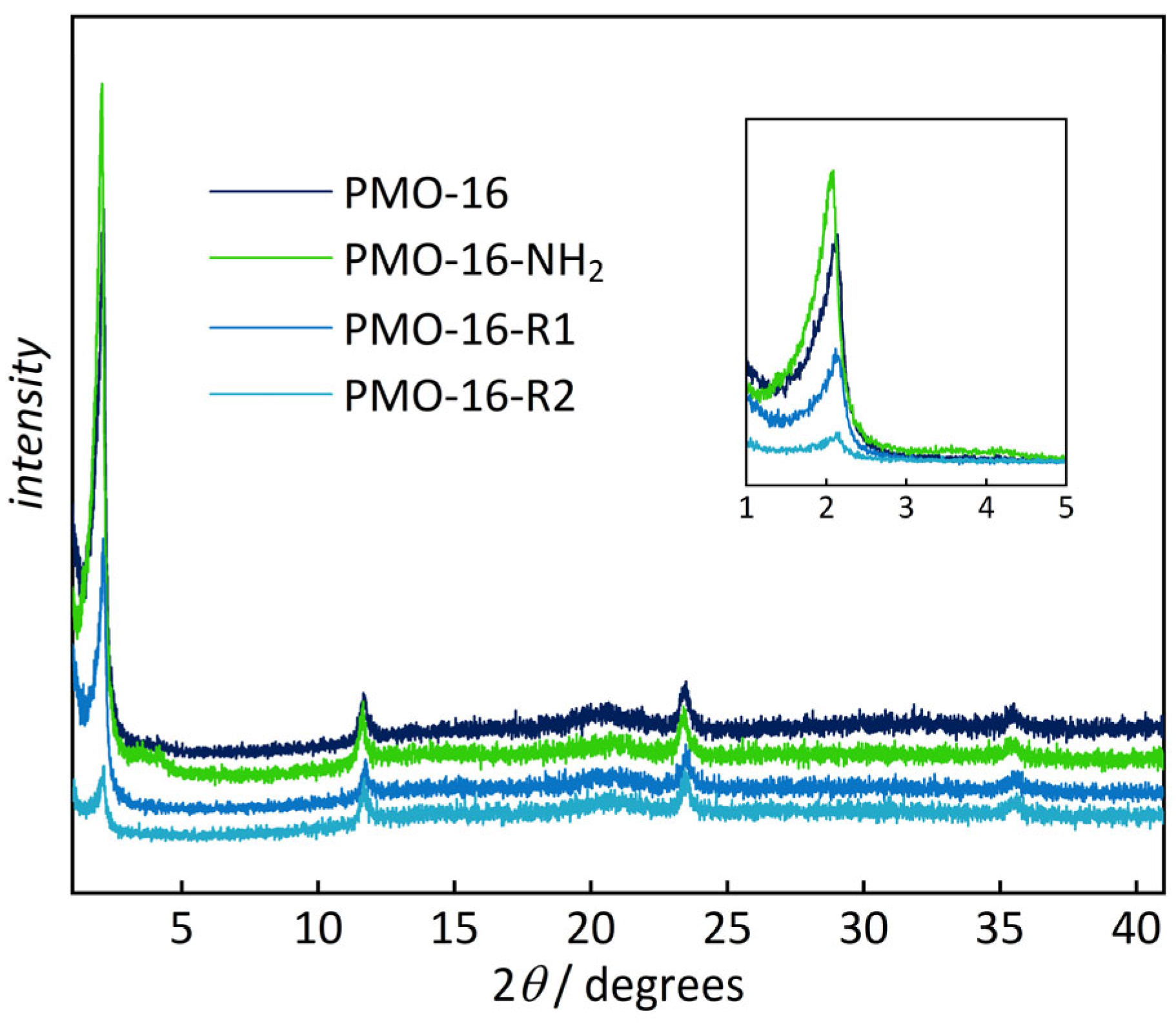
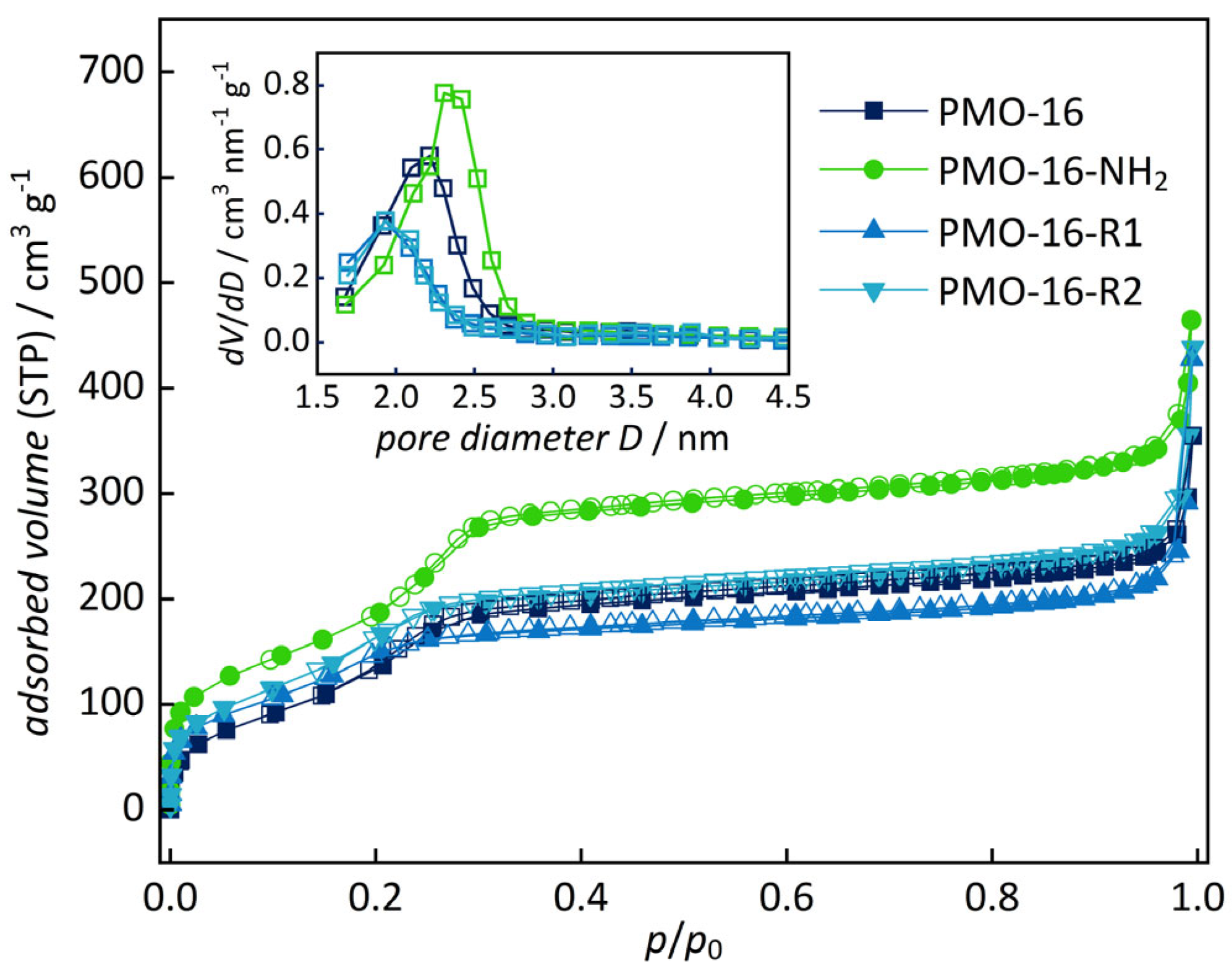
3.1. Non-Functionalized PMOs
3.2. Characterization of Functionalized Samples
3.3. Proton Conductivity
4. Conclusions
Supplementary Materials
Author Contributions
Funding
Data Availability Statement
Conflicts of Interest
References
- Lucia, U. Overview on fuel cells. Renew. Sustain. Energy Rev. 2014, 30, 164–169. [Google Scholar] [CrossRef]
- Jiao, K.; Xuan, J.; Du, Q.; Bao, Z.; Xie, B.; Wang, B.; Zhao, Y.; Fan, L.; Wang, H.; Hou, Z.; et al. Designing the next generation of proton-exchange membrane fuel cells. Nature 2021, 595, 361–369. [Google Scholar] [CrossRef] [PubMed]
- Meng, G.; Li, X.; Liu, M.; Grigoriev, S.A.; Tolj, I.; Shen, J.; Yue, C.; Sun, C. Investigations of Dongyue Series Perfluorosulfonic Acid Membranes for Applications in Proton Exchange Membrane Fuel Cells (PEMFCs). Batteries 2025, 11, 277. [Google Scholar] [CrossRef]
- Rác, B.; Hegyes, P.; Forgo, P.; Molnár, Á. Sulfonic acid-functionalized phenylene-bridged periodic mesoporous organosilicas as catalyst materials. Appl. Catal. A Gen. 2006, 299, 193–201. [Google Scholar] [CrossRef]
- Dufaud, V.; Davis, M.E. Design of heterogeneous catalysts via multiple active site positioning in organic-inorganic hybrid materials. J. Am. Chem. Soc. 2003, 125, 9403–9413. [Google Scholar] [CrossRef] [PubMed]
- Galarneau, A.; Sachse, A.; Said, B.; Pelisson, C.-H.; Boscaro, P.; Brun, N.; Courtheoux, L.; Olivi-Tran, N.; Coasne, B.; Fajula, F. Hierarchical porous silica monoliths: A novel class of microreactors for process intensification in catalysis and adsorption. C. R. Chim. 2016, 19, 231–247. [Google Scholar] [CrossRef]
- Kraytsberg, A.; Ein-Eli, Y. Review of advanced materials for proton exchange membrane fuel cells. Energy Fuels 2014, 28, 7303–7330. [Google Scholar] [CrossRef]
- Niazvand, F.; Cheshmi, A.; Zand, M.; NasrAzadani, R.; Kumari, B.; Raza, A.; Nasibi, S. An overview of the development of composites containing Mg and Zn for drug delivery. J. Compos. Compd. 2020, 2, 193–204. [Google Scholar] [CrossRef]
- Lei, Q.; Guo, J.; Noureddine, A.; Wang, A.; Wuttke, S.; Brinker, C.J.; Zhu, W. Sol–Gel-Based Advanced Porous Silica Materials for Biomedical Applications. Adv. Funct. Mater. 2020, 30, 1909539. [Google Scholar] [CrossRef]
- Hoffmann, F.; Cornelius, M.; Morell, J.; Fröba, M. Silica-based mesoporous organic-inorganic hybrid materials. Angew. Chem. Int. Ed. Engl. 2006, 45, 3216–3251. [Google Scholar] [CrossRef]
- Inagaki, S.; Guan, S.; Ohsuna, T.; Terasaki, O. An ordered mesoporous organosilica hybrid material with a crystal-like wall structure. Nature 2002, 416, 304–307. [Google Scholar] [CrossRef] [PubMed]
- Kapoor, M.P.; Yang, Q.; Inagaki, S. Organization of Phenylene-Bridged Hybrid Mesoporous Silisesquioxane with a Crystal-like Pore Wall from a Precursor with Nonlinear Symmetry. Chem. Mater. 2004, 16, 1209–1213. [Google Scholar] [CrossRef]
- Temtsin, G.; Asefa, T.; Bittner, S.; Ozin, G.A. Aromatic PMOs: Tolyl, xylyl and dimethoxyphenyl groups integrated within the channel walls of hexagonal mesoporous silicas. J. Mater. Chem. 2001, 11, 3202–3206. [Google Scholar] [CrossRef]
- Yoshina-Ishii, C.; Asefa, T.; Coombs, N.; MacLachlan, M.J.; Ozin, G.A. Periodic mesoporous organosilicas, PMOs: Fusion of organic and inorganic chemistry ’inside’ the channel walls of hexagonal mesoporous silica. Chem. Commun. 1999, 24, 2539–2540. [Google Scholar] [CrossRef]
- López, M.I.; Esquivel, D.; Jiménez-Sanchidrián, C.; Romero-Salguero, F.J. Application of Sulfonic Acid Functionalised Hybrid Silicas Obtained by Oxidative Cleavage of Tetrasulfide Bridges as Catalysts in Esterification Reactions. ChemCatChem 2013, 5, 1002–1010. [Google Scholar] [CrossRef]
- Yang, Q.; Kapoor, M.P.; Inagaki, S. Sulfuric acid-functionalized mesoporous benzene-silica with a molecular-scale periodicity in the walls. J. Am. Chem. Soc. 2002, 124, 9694–9695. [Google Scholar] [CrossRef]
- Ohashi, M.; Kapoor, M.P.; Inagaki, S. Chemical modification of crystal-like mesoporous phenylene-silica with amino group. Chem. Commun. 2008, 7, 841–843. [Google Scholar] [CrossRef]
- Furtmair, M.; Timm, J.; Marschall, R. Sulfonation of porous materials and their proton conductivity. Microporous Mesoporous Mater. 2021, 312, 110745. [Google Scholar] [CrossRef]
- Mosa, J.; Durán, A.; Aparicio, M. Sulfonic acid-functionalized hybrid organic–inorganic proton exchange membranes synthesized by sol–gel using 3-mercaptopropyl trimethoxysilane (MPTMS). J. Power Sources 2015, 297, 208–216. [Google Scholar] [CrossRef]
- Sharifi, M.; Köhler, C.; Tölle, P.; Frauenheim, T.; Wark, M. Proton conductivity of SO3H-functionalized benzene-periodic mesoporous organosilica. Small 2011, 7, 1086–1097. [Google Scholar] [CrossRef]
- Marschall, R.; Bannat, I.; Caro, J.; Wark, M. Proton conductivity of sulfonic acid functionalised mesoporous materials. Microporous Mesoporous Mater. 2007, 99, 190–196. [Google Scholar] [CrossRef]
- Xie, L.; Cho, E.B.; Kim, D. Sulfonated PEEK/cubic (Im3m) mesoporous benzene-silica composite membranes operable at low humidity. Solid State Ion. 2011, 203, 1–8. [Google Scholar] [CrossRef]
- Fujita, S.; Koiwai, A.; Kawasumi, M.; Inagaki, S. Enhancement of proton transport by high densification of sulfonic acid groups in highly ordered mesoporous silica. Chem. Mater. 2013, 25, 1584–1591. [Google Scholar] [CrossRef]
- Daiko, Y.; Kasuga, T.; Nogami, M. Pore size effect on proton transfer in sol-gel porous silica glasses. Microporous Mesoporous Mater. 2004, 69, 149–155. [Google Scholar] [CrossRef]
- Mietner, J.B.; Brieler, F.J.; Lee, Y.J.; Fröba, M. Properties of Water Confined in Periodic Mesoporous Organosilicas: Nanoimprinting the Local Structure. Angew. Chem. Int. Ed. Engl. 2017, 56, 12348–12351. [Google Scholar] [CrossRef]
- Jana, S.K.; Mochizuki, A.; Namba, S. Progress in Pore-Size Control of Mesoporous MCM-41 Molecular Sieve Using Surfactant Having Different Alkyl Chain Lengths and Various Organic Auxiliary Chemicals. Catal. Surv. Asia 2004, 8, 1–13. [Google Scholar] [CrossRef]
- Mukhopadhyay, S.; Debgupta, J.; Singh, C.; Sarkar, R.; Basu, O.; Das, S.K. Designing UiO-66-Based Superprotonic Conductor with the Highest Metal-Organic Framework Based Proton Conductivity. ACS Appl. Mater. Interfaces 2019, 11, 13423–13432. [Google Scholar] [CrossRef] [PubMed]
- Bion, N.; Ferreira, P.; Valente, A.; Gonçalves, I.S.; Rocha, J. Ordered benzene-silica hybrids with molecular-scale periodicity in the walls and different mesopore sizes. J. Mater. Chem. 2003, 13, 1910–1913. [Google Scholar] [CrossRef]
- Huybrechts, W.; Mali, G.; Kuśtrowski, P.; Willhammar, T.; Mertens, M.; Bals, S.; van der Voort, P.; Cool, P. Post-synthesis bromination of benzene bridged PMO as a way to create a high potential hybrid material. Microporous Mesoporous Mater. 2016, 236, 244–249. [Google Scholar] [CrossRef]
- Coates, J. Encyclopedia of Analytical Chemistry: Applications, Theory and Instrumentation, 1st ed.; Wiley: Chichester, UK, 2000; ISBN 9780471976707. [Google Scholar]
- Song, Y.; Guo, Z.; Yin, J.; Liu, M.; Tolj, I.; Grigoriev, S.A.; Ge, M.; Sun, C. Investigations of the Sulfonated Poly(ether ether ketone) Membranes with Various Degrees of Sulfonation by Considering Durability for the Proton Exchange Membrane Fuel Cell (PEMFC) Applications. Polymers 2025, 17, 2181. [Google Scholar] [CrossRef] [PubMed]
- Mustafa, A. The Chemistry of Sultones and Sultams. Chem. Rev. 1954, 54, 195–223. [Google Scholar] [CrossRef]
- Yang, F.; Xu, G.; Dou, Y.; Wang, B.; Zhang, H.; Wu, H.; Zhou, W.; Li, J.R.; Chen, B. A flexible metal-organic framework with a high density of sulfonic acid sites for proton conduction. Nat. Energy 2017, 2, 877–883. [Google Scholar] [CrossRef]
- Halla, J.D.; Mamak, M.; Williams, D.E.; Ozin, G.A. Meso-SiO2–C12EO10OH-CF3SO3H—A Novel Proton-Conducting Solid Electrolyte. Adv. Funct. Mater. 2003, 13, 133–138. [Google Scholar] [CrossRef]
- Thommes, M.; Morell, J.; Cychosz, K.A.; Fröba, M. Combining nitrogen, argon, and water adsorption for advanced characterization of ordered mesoporous carbons (CMKs) and periodic mesoporous organosilicas (PMOs). Langmuir 2013, 29, 14893–14902. [Google Scholar] [CrossRef]
- Weinberger, C.; Zysk, F.; Hartmann, M.; Kaliannan, N.K.; Keil, W.; Kühne, T.D.; Tiemann, M. The Structure of Water in Silica Mesopores—Influence of the Pore Wall Polarity. Adv. Mater. Interfaces 2022, 9, 2200245. [Google Scholar] [CrossRef]
- Javed, A.; Strauss, I.; Bunzen, H.; Caro, J.; Tiemann, M. Humidity-mediated anisotropic proton conductivity through the 1d channels of co-mof-74. Nanomaterials 2020, 10, 1263. [Google Scholar] [CrossRef]
- Javed, A.; Steinke, F.; Wöhlbrandt, S.; Bunzen, H.; Stock, N.; Tiemann, M. The role of sulfonate groups and hydrogen bonding in the proton conductivity of two coordination networks. Beilstein J. Nanotechnol. 2022, 13, 437–443. [Google Scholar] [CrossRef]
- Mikhailenko, S.; Desplantier-Giscard, D.; Danumah, C.; Kaliaguine, S. Solid electrolyte properties of sulfonic acid functionalized mesostructured porous silica. Microporous Mesoporous Mater. 2002, 52, 29–37. [Google Scholar] [CrossRef]
- Sone, Y.; Ekdunge, P.; Simonsson, D. Proton Conductivity of Nafion 117 as Measured by a Four-Electrode AC Impedance Method. J. Electrochem. Soc. 1996, 143, 1254–1259. [Google Scholar] [CrossRef]
- Sigwadi, R.; Dhlamini, M.S.; Mokrani, T.; Ṋemavhola, F.; Nonjola, P.F.; Msomi, P.F. The proton conductivity and mechanical properties of Nafion®/ZrP nanocomposite membrane. Heliyon 2019, 5, e02240. [Google Scholar] [CrossRef] [PubMed]
- Klumpen, C.; Gödrich, S.; Papastavrou, G.; Senker, J. Water mediated proton conduction in a sulfonated microporous organic polymer. Chem. Commun. 2017, 53, 7592–7595. [Google Scholar] [CrossRef] [PubMed]
- Gao, Y.; Zhou, Q.; Xu, H.; Liu, B.; Zhang, Q.; Dai, Z.; Wang, S.; Jiang, R. Improved proton conductivity in UiO-66-(COOH)2@PP composites with reduced activation energy at low humidity. Int. J. Hydrogen Energy 2024, 61, 415–423. [Google Scholar] [CrossRef]
- Li, X.; Ye, T.; Meng, X.; He, D.; Li, L.; Song, K.; Jiang, J.; Sun, C. Advances in the Application of Sulfonated Poly(Ether Ether Ketone) (SPEEK) and Its Organic Composite Membranes for Proton Exchange Membrane Fuel Cells (PEMFCs). Polymers 2024, 16, 2840. [Google Scholar] [CrossRef] [PubMed]



| Sample | Amino Function [%] | Sulfonate Function [%] | Overall [%] | Ion Exchange Capacity [mmol/g] | Functionalization Density [nm−2] |
|---|---|---|---|---|---|
| PMO-12-R1 | 42 ± 1.5 | 90 ± 2.6 | 38 ± 1.4 | 1.64 | 3.77 |
| PMO-14-R1 | 60 ± 1.5 | 77 ± 2.6 | 46 ± 1.4 | 1.89 | 4.84 |
| PMO-16-R1 | 35 ± 1.5 | 111 ± 2.6 | 39 ± 1.4 | 1.68 | 1.94 |
| PMO-18-R1 | 40 ± 1.5 | 55 ± 2.6 | 22 ± 1.4 | 1.04 | 1.65 |
| PMO-12-R2 | 43 ± 1.5 | 58 ± 2.6 | 25 ± 1.4 | 1.13 | 2.06 |
| PMO-14-R2 | 61 ± 1.5 | 46 ± 2.6 | 28 ± 1.4 | 1.24 | 2.71 |
| PMO-16-R2 | 36 ± 1.5 | 65 ± 2.6 | 24 ± 1.4 | 1.09 | 1.10 |
| PMO-18-R2 | 41 ± 1.5 | 33 ± 2.6 | 13 ± 1.4 | 0.65 | 0.88 |
| Sample | Amino Function [%] | Sulfonate Function [%] | Overall [%] | ABET [m2/g] | Ion Exchange Capacity [mmol/g] | Functionalization Density [nm−2] |
|---|---|---|---|---|---|---|
| 1 | 36 ± 1.5 | 40 ± 2.6 | 14 ± 1.4 | 660 | 0.70 | 0.64 |
| 2 | 32 ± 1.5 | 47 ± 2.6 | 15 ± 1.4 | 709 | 0.70 | 0.60 |
| 3 | 35 ± 1.5 | 95 ± 2.6 | 33 ± 1.4 | 529 | 1.44 | 1.63 |
| 4 | 35 ± 1.5 | 111 ± 2.6 | 39 ± 1.4 | 521 | 1.68 | 1.94 |
| 5 | 33 ± 1.5 | 125 ± 2.6 | 42 ± 1.4 | 522 | 1.73 | 2.00 |
| 6 | 34 ± 1.5 | 137 ± 2.6 | 46 ± 1.4 | 512 | 1.87 | 2.16 |
Disclaimer/Publisher’s Note: The statements, opinions and data contained in all publications are solely those of the individual author(s) and contributor(s) and not of MDPI and/or the editor(s). MDPI and/or the editor(s) disclaim responsibility for any injury to people or property resulting from any ideas, methods, instructions or products referred to in the content. |
© 2026 by the authors. Licensee MDPI, Basel, Switzerland. This article is an open access article distributed under the terms and conditions of the Creative Commons Attribution (CC BY) license.
Share and Cite
Wagner, T.; Tiemann, M. Proton-Conducting Sulfonated Periodic Mesoporous Organosilica. Nanomaterials 2026, 16, 203. https://doi.org/10.3390/nano16030203
Wagner T, Tiemann M. Proton-Conducting Sulfonated Periodic Mesoporous Organosilica. Nanomaterials. 2026; 16(3):203. https://doi.org/10.3390/nano16030203
Chicago/Turabian StyleWagner, Tobias, and Michael Tiemann. 2026. "Proton-Conducting Sulfonated Periodic Mesoporous Organosilica" Nanomaterials 16, no. 3: 203. https://doi.org/10.3390/nano16030203
APA StyleWagner, T., & Tiemann, M. (2026). Proton-Conducting Sulfonated Periodic Mesoporous Organosilica. Nanomaterials, 16(3), 203. https://doi.org/10.3390/nano16030203