Activation of Biomass-Derived Carbon Platelets for EDLC Symmetrical Devices

Abstract
1. Introduction
2. Materials and Methods
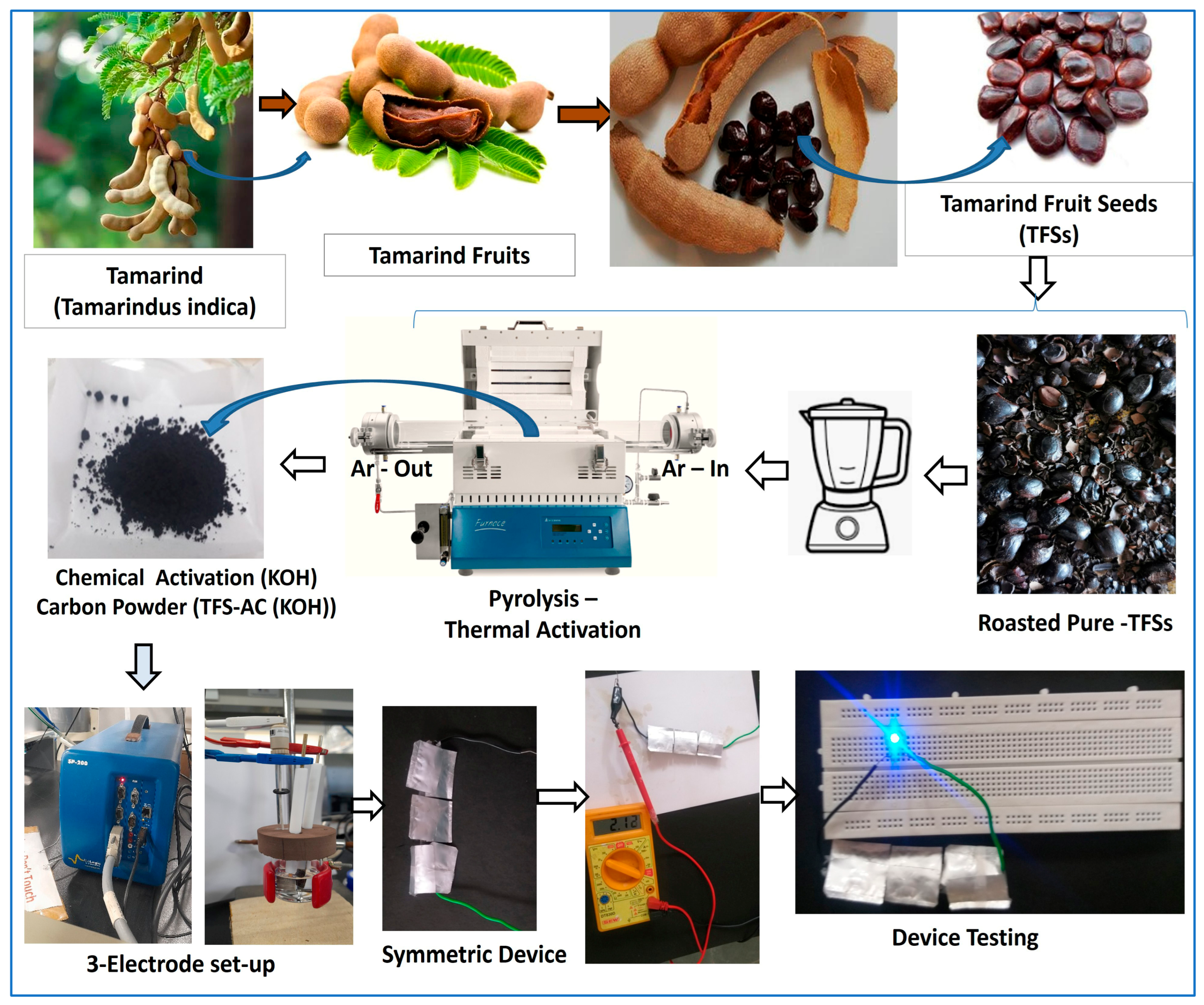
2.1. Collection and Pre-Treatment of Tamarind Seed Shells
2.2. Chemical Activation Using Potassium Hydroxide (KOH)
2.3. Synthesis of Activated Carbon Materials
2.4. Materials Characterization
2.5. Electrochemical Measurement
Three-Electrode Cell Setup
3. Results and Discussion
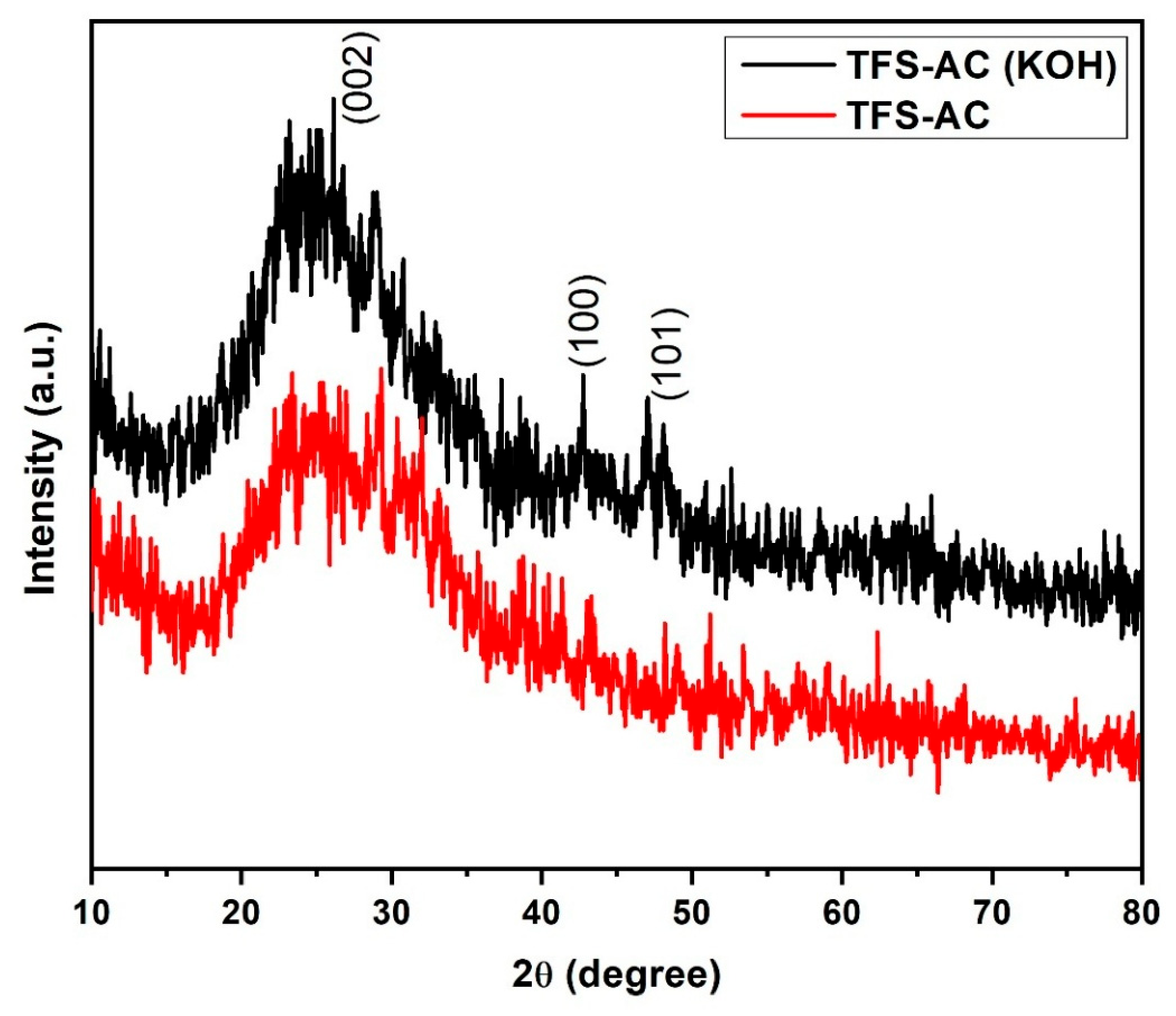
3.1. X-Ray Diffraction (XRD) Analysis
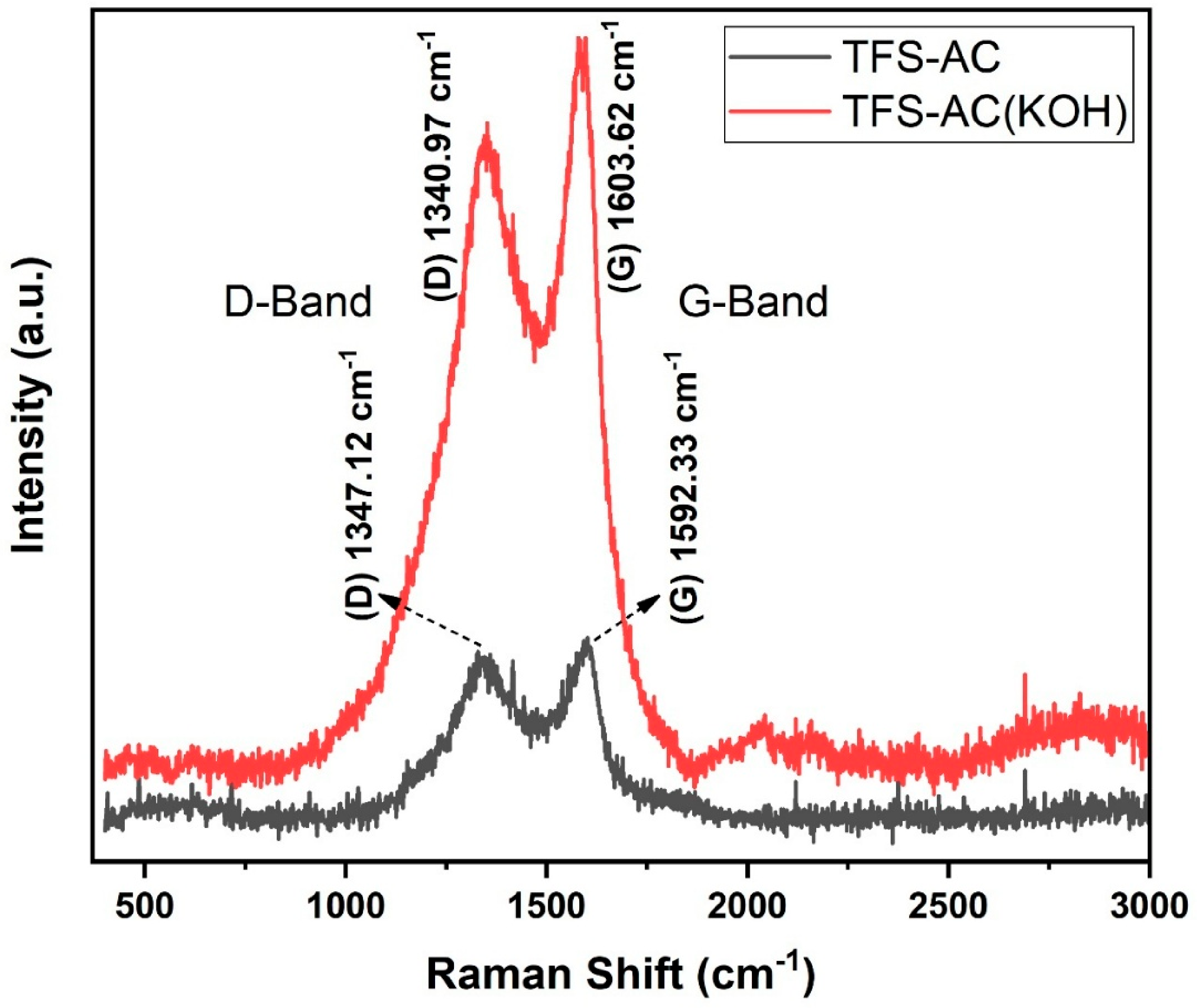
3.2. RAMAN Analysis
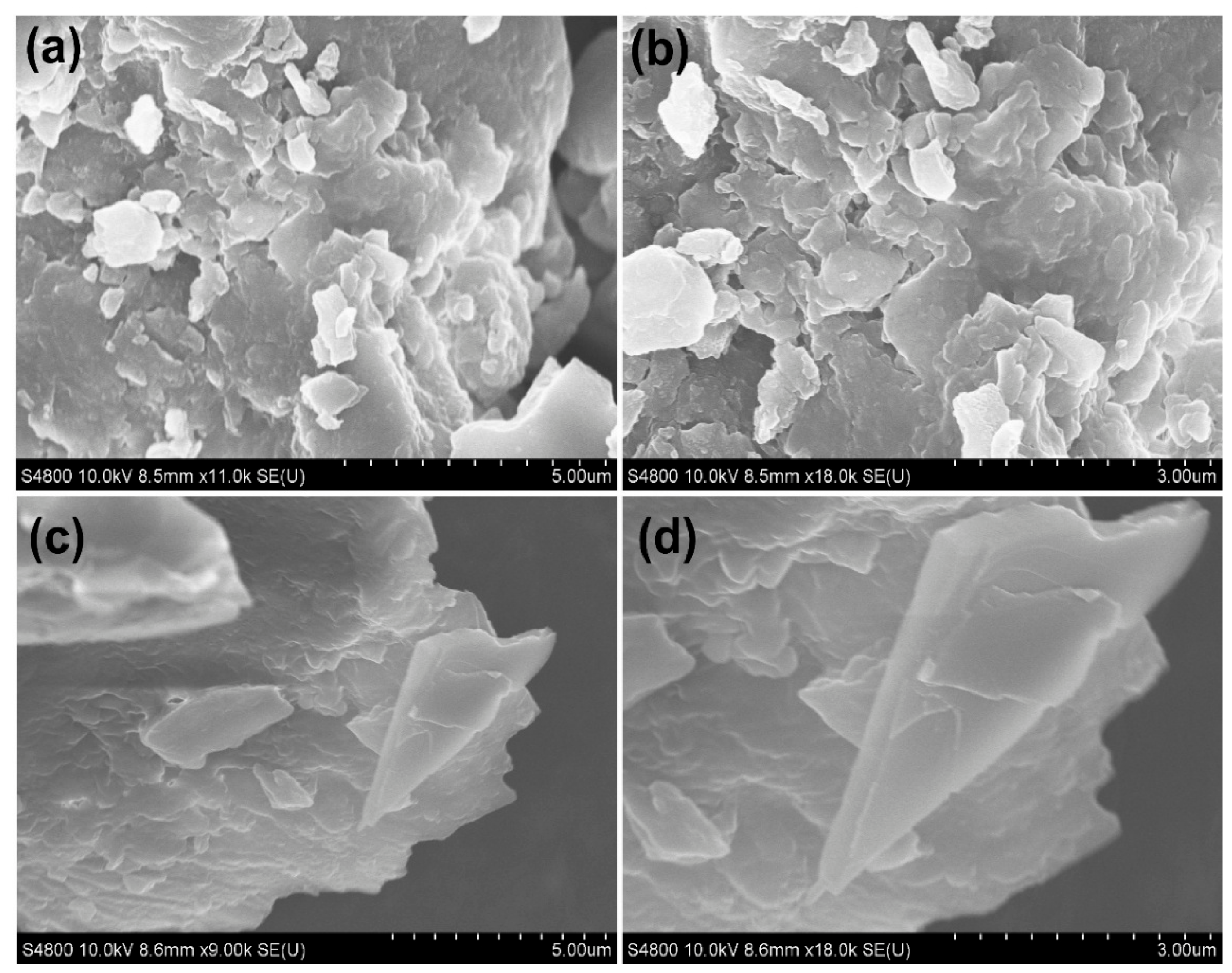
3.3. FE-SEM—Morphological Studies
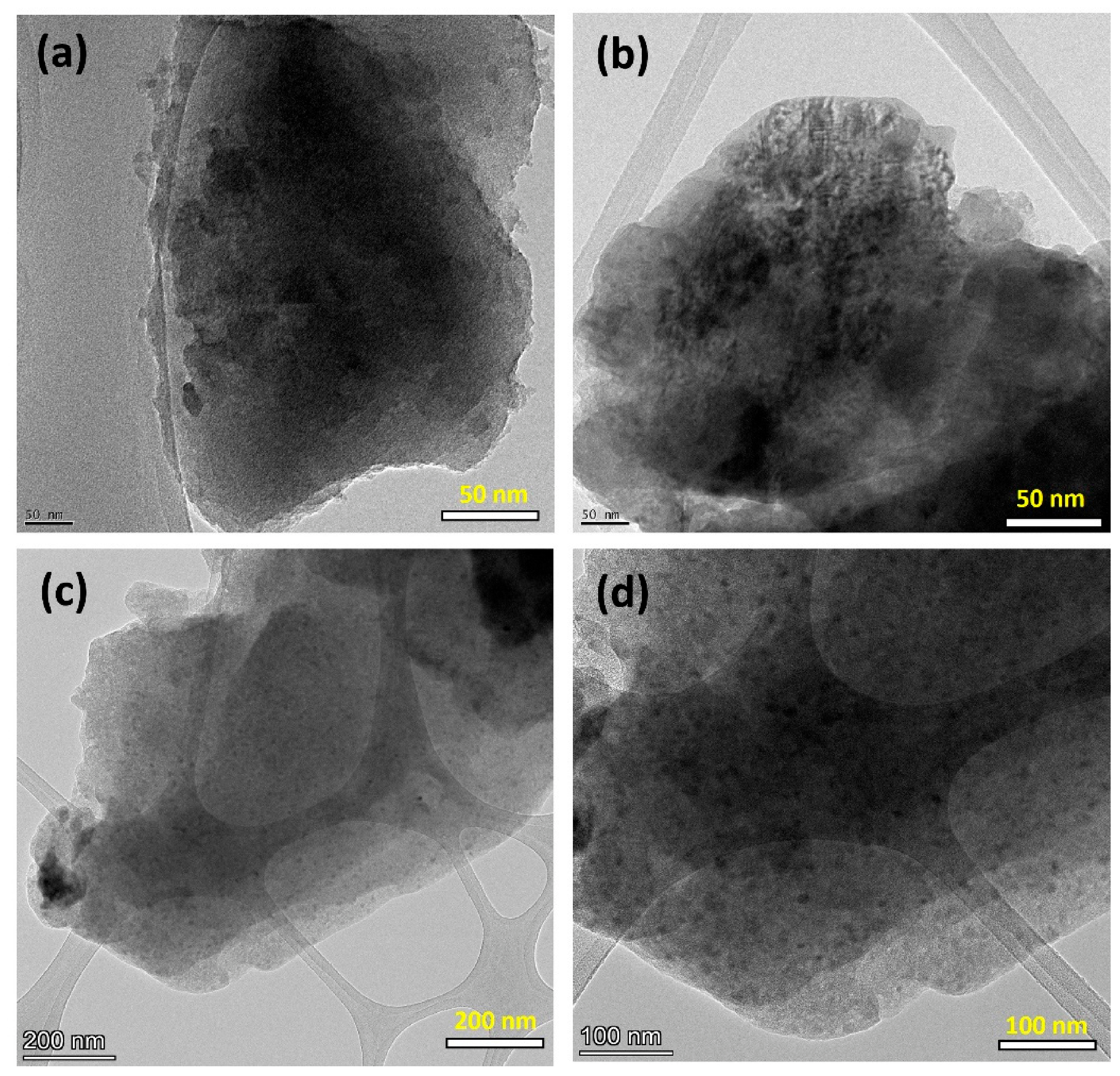
3.4. FE-TEM—Morphological Studies
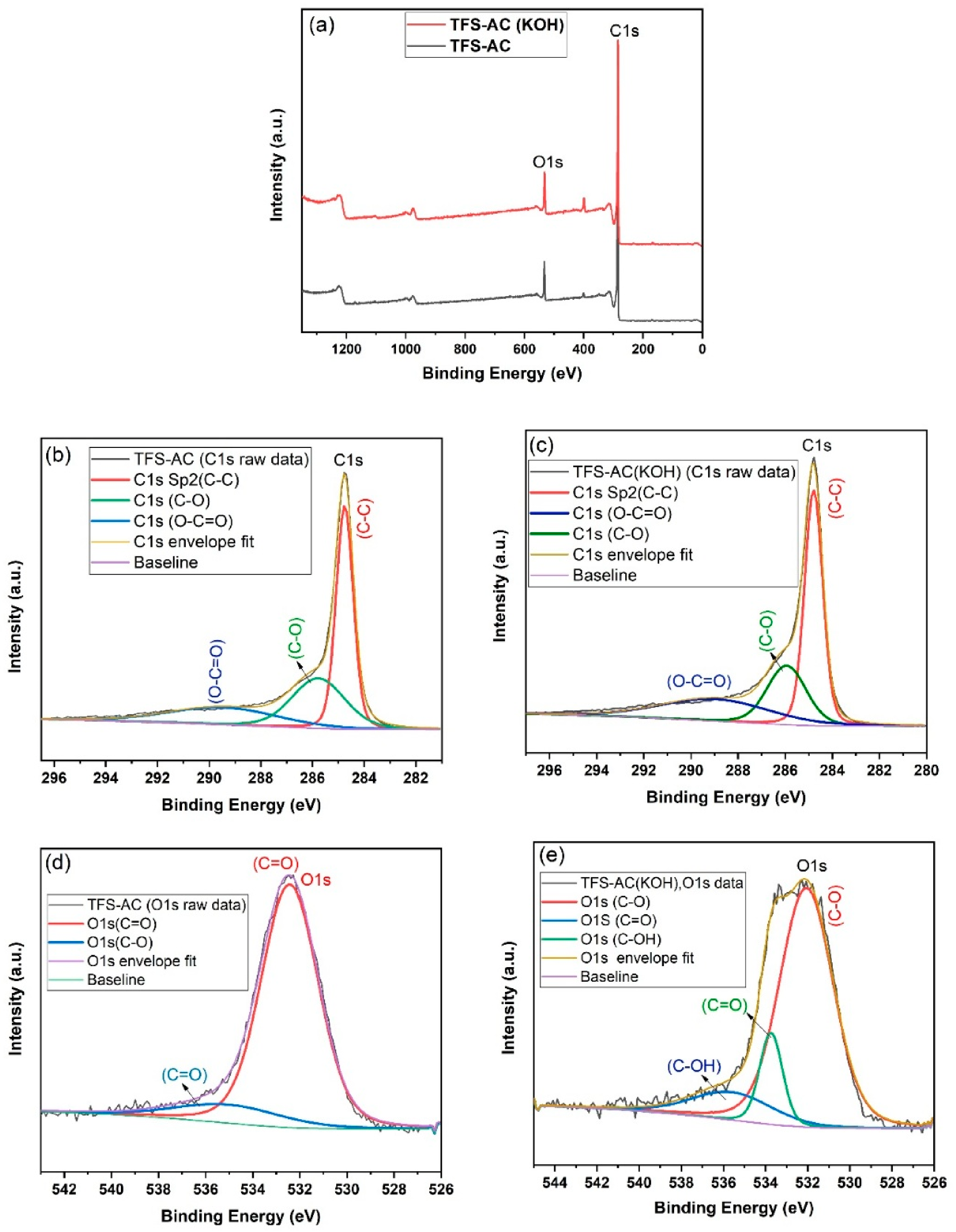
3.5. XPS Analysis
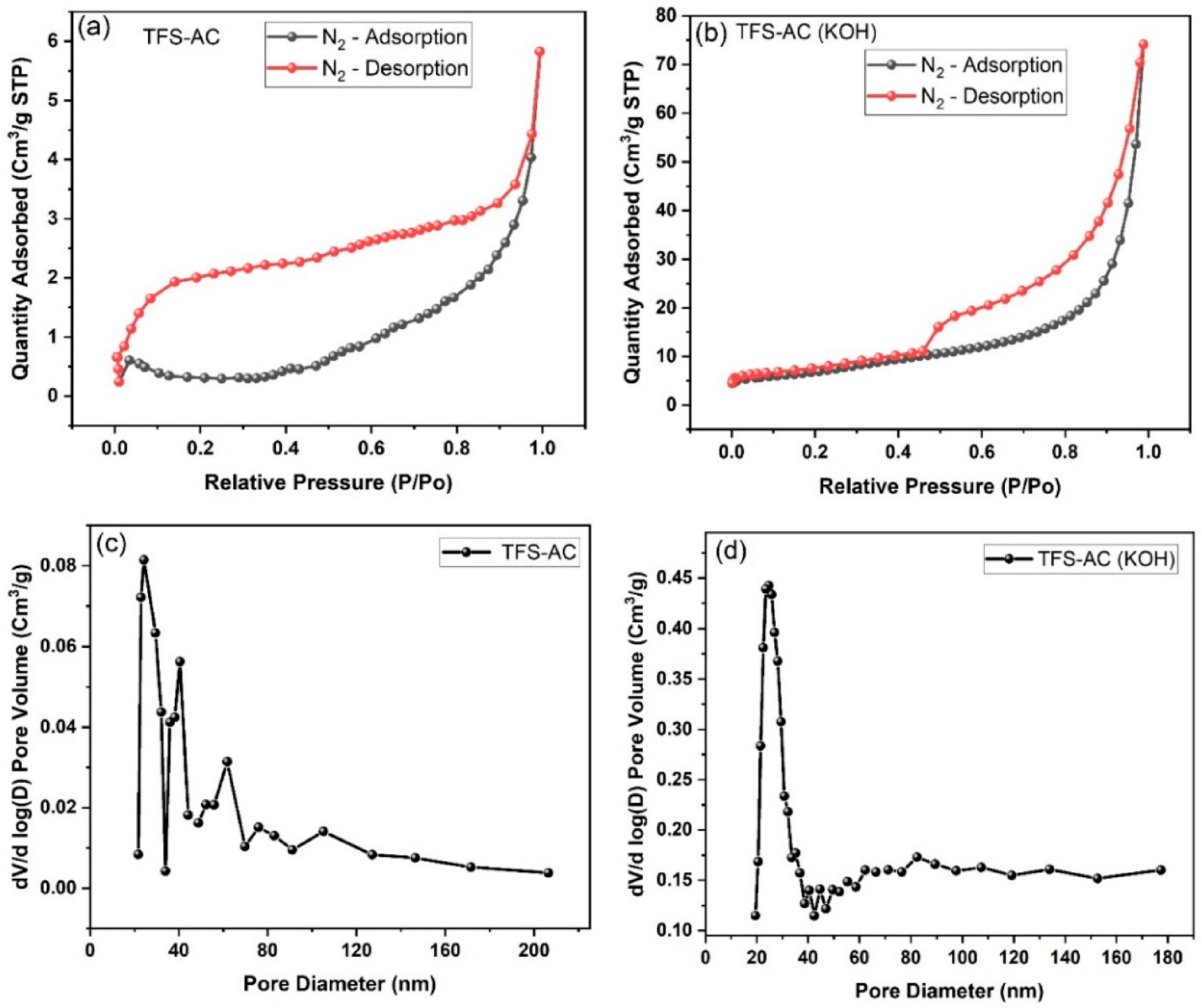
3.6. Surface Area Analysis by BET Characterization
4. Electrochemical—Supercapacitor Applications
4.1. Three-Electrode Cell Analysis
4.2. Electrochemical Analysis: TFS-AC
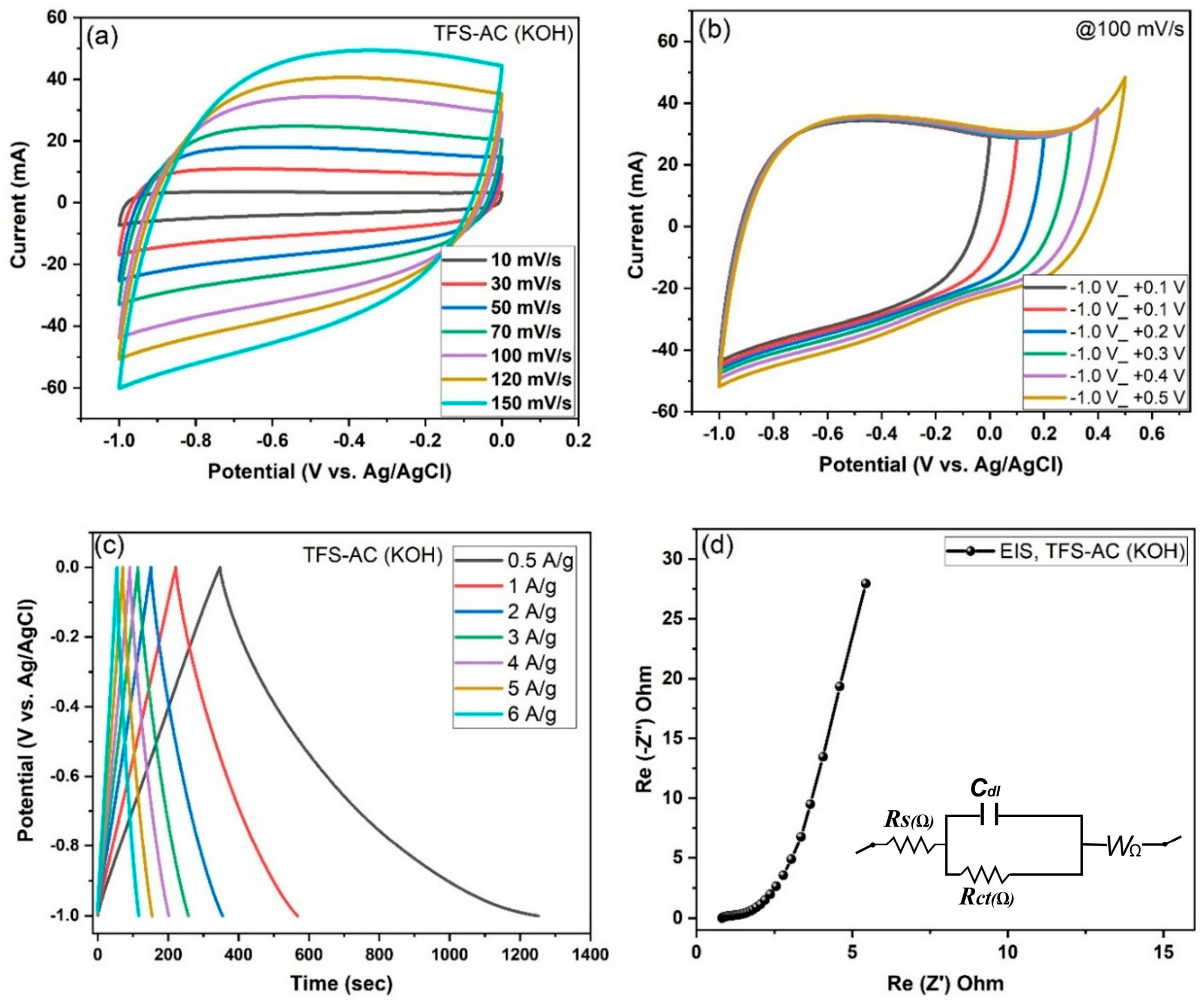
4.3. Electrochemcial Analysis: Activated TFS-AC (KOH)
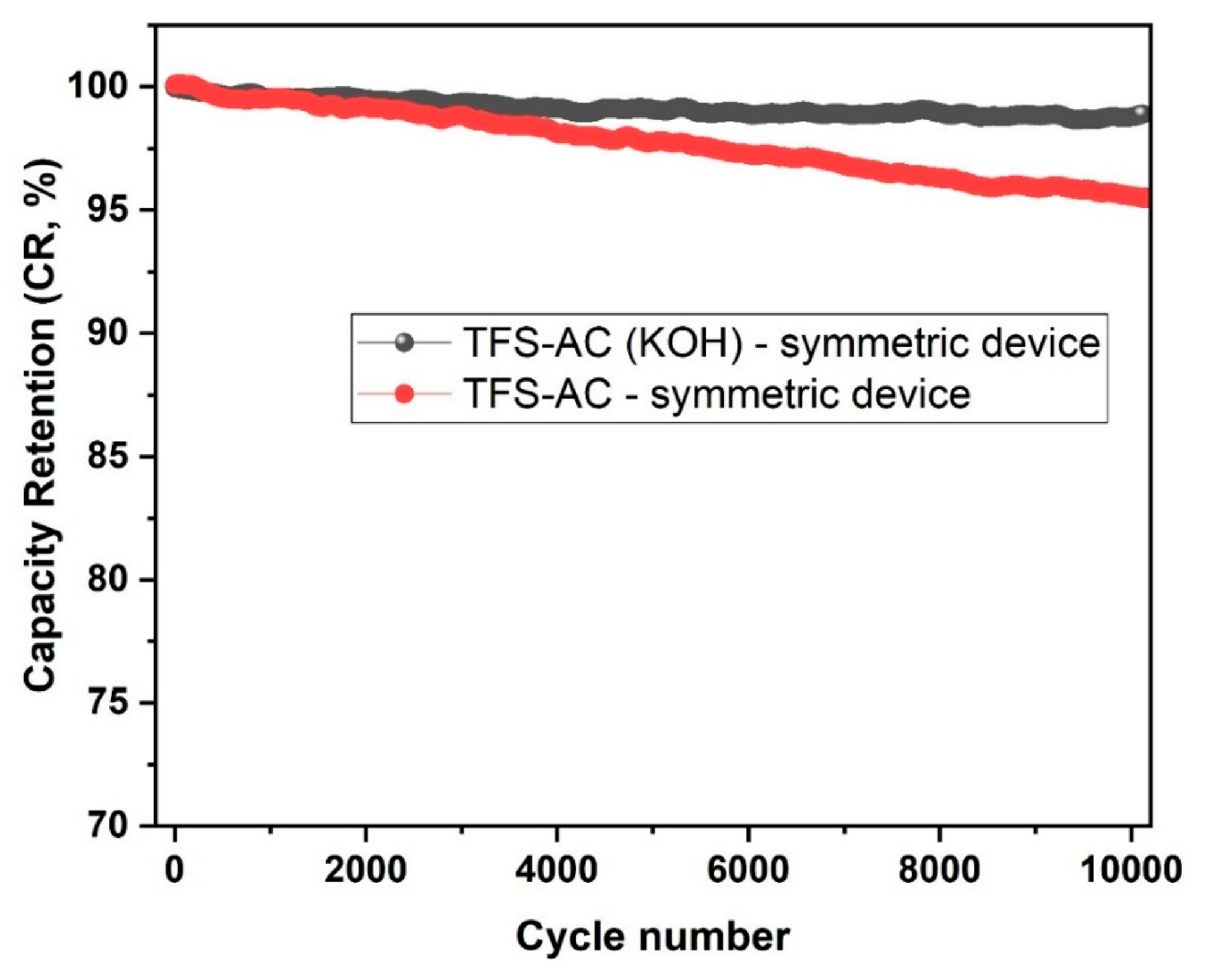
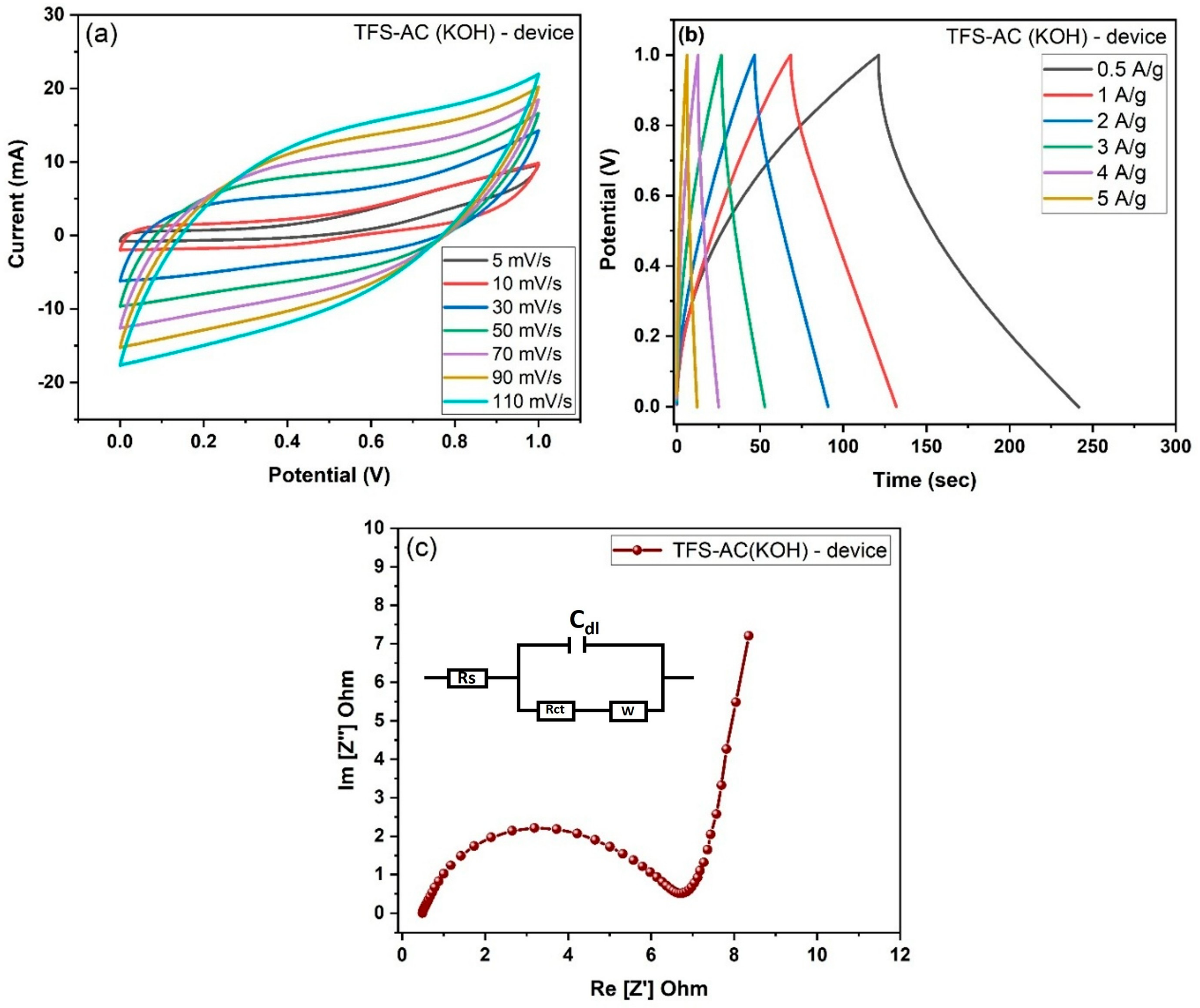
4.4. Two-Electrode Symmetric Device: TFS-AC and TFS-AC (KOH)
5. Conclusions
Supplementary Materials
Author Contributions
Funding
Data Availability Statement
Conflicts of Interest
References
- Yahya, M.A.; Al-Qodah, Z.; Ngah, C.W.Z. Agricultural bio-waste materials as potential sustainable precursors used for activated carbon production: A review. Renew. Sustain. Energy Rev. 2015, 46, 218–235. [Google Scholar] [CrossRef]
- Roop, C.B.; Meenakshi, G. Activated Carbon Adsorption; Taylor & Francis Group, LLC: Abingdon, UK, 2005. [Google Scholar]
- Wang, D.; Li, B.; Yang, H.; Zhao, C.; Yao, D.; Chen, H. Influence of biochar on the steam reforming of biomass volatiles: Effects of activation temperature and atmosphere. Energy Fuels 2019, 33, 2328–2334. [Google Scholar] [CrossRef]
- Enaime, G.; Ennaciri, K.; Ounas, A.; Baçaoui, A.; Seffen, M.; Selmi, T.; Yaacoubi, A. Preparation and characterization of activated carbons from olive wastes by physical and chemical activation: Application to Indigo carmine adsorption. J. Mater. Environ. Sci. 2017, 8, 4125–4137. [Google Scholar]
- Sahu, J.N.; Acharya, J.; Meikap, B.C. Optimization of production conditions for activated carbons from Tamarind wood by zinc chloride using response surface methodology. Bioresour. Technol. 2010, 101, 1974–1982. [Google Scholar] [CrossRef] [PubMed]
- Ferrera-Lorenzo, N.; Fuente, E.; Suarez-Ruiz, I.; Ruiz, B. KOH activated carbon from conventional and microwave heating system of a macroalgae waste from the agareagar industry. Fuel Process. Technol. 2014, 121, 25–31. [Google Scholar] [CrossRef]
- Un, U.T.; Ates, F.; Erginel, N.; Ozca, O.; Oduncu, E. Adsorption of Disperse Orange 30 dye onto activated carbon derived from Holm Oak (Quercus ilex) acorns: A 3k factorial design and analysis. J. Environ. Manag. 2015, 155, 89–96. [Google Scholar] [CrossRef] [PubMed]
- Ma, C.; Min, J.; Gong, J.; Liu, X.; Mu, X.; Chen, X.; Tang, T. Transforming polystyrene waste into 3D hierarchically porous carbon for high-performance supercapacitors. Chemosphere 2020, 253, 126755. [Google Scholar] [CrossRef] [PubMed]
- Kim, S.; Lee, J.; Kang, J.S.; Jo, K.; Kim, S.; Sung, Y.-E.; Yoon, J. Lithium recovery from brine using a λ-MnO2/activated carbon hybrid supercapacitor system. Chemosphere 2015, 125, 50–56. [Google Scholar] [CrossRef] [PubMed]
- Bakierska, M.; Lis, M.; Pacek, J.; Swi etosławski, M.; Gajewska, M.; Tata, A.; Proniewiecz, E.; Molenda, M. Bio-derived carbon nanostructures for high-performance lithium-ion batteries. Carbon 2019, 145, 426–432. [Google Scholar] [CrossRef]
- Campbell, B.; Ionescu, R.; Favors, Z.; Ozkan, C.S.; Ozkan, M. Bio-Derived, Binderless, Hierarchically Porous Carbon Anodes for Li-ion Batteries. Sci. Rep. 2015, 5, 14575. [Google Scholar] [CrossRef] [PubMed]
- Tian, X.; Zhou, M.; Tan, C.; Li, M.; Liang, L.; Li, K.; Su, P. KOH activated N-doped novel carbon aerogel as efficient metal-free oxygen reduction catalyst for microbial fuel cells. Chem. Eng. J. 2018, 348, 775–785. [Google Scholar] [CrossRef]
- Chen, W.; Feng, H.; Shen, D.; Jia, Y.; Li, N.; Ying, X.; Chen, T.; Zhou, Y.; Guo, J.; Zhou, M. Carbon materials derived from waste tires as high-performance anodes in microbial fuel cells. Sci. Total Environ. 2018, 618, 804–809. [Google Scholar] [CrossRef] [PubMed]
- Sun, G.; Wan, J.; Sun, Y.; Li, H.; Chang, C.; Wang, Y. Enhanced removal of nitrate and refractory organic pollutants from bio-treated coking waste water using corncobs as carbon sources and bio-film carriers. Chemosphere 2019, 237, 124520. [Google Scholar] [CrossRef] [PubMed]
- Sharaf, A.; Liu, Y. Mechanisms and kinetics of grey water treatment using biologically active granular activated carbon. Chemosphere 2021, 263, 128113. [Google Scholar] [CrossRef] [PubMed]
- Deng, J.; Li, M.; Wang, Y. Biomass-derived carbon: Synthesis and applications in energy storage and conversion. Green Chem. 2016, 18, 4824–4854. [Google Scholar] [CrossRef]
- Jiang, L.; Sheng, L.; Fan, Z. Biomass-derived carbon materials with structural diversities and their applications in energy storage. Sci. China Mater. 2018, 61, 133–158. [Google Scholar]
- Babu, B.; Lashmi, P.; Shaijumon, M. Li-ion capacitor based on activated rice husk derived porous carbon with improved electrochemical performance. Electrochim. Acta 2016, 211, 289–296. [Google Scholar] [CrossRef]
- Maharjan, M.; Ulaganathan, M.; Aravindan, V.; Sreejith, S.; Yan, Q.; Madhavi, S.; Wang, J.Y.; Lim, T.M. Fabrication of high energy Li-ion capacitors from orange peel derived porous carbon. Chem. Sel. 2017, 2, 5051–5058. [Google Scholar] [CrossRef]
- Gao, Y.P.; Zhai, Z.B.; Huang, K.-J.; Zhang, Y.Y. Energy storage applications of biomass-derived carbon materials: Batteries and supercapacitors. New J. Chem. 2017, 41, 11456–11470. [Google Scholar] [CrossRef]
- Lu, H.; Zhao, X. Biomass-derived carbon electrode materials for supercapacitors, Sustain. Energy Fuels 2017, 1, 1265–1281. [Google Scholar] [CrossRef]
- Raveendran, K.; Ganesh, A.; Khilar, K.C. Pyrolysis characteristics of biomass and biomass components. Fuel 1996, 75, 987–998. [Google Scholar] [CrossRef]
- Wei, L.; Yushin, G. Nanostructured activated carbons from natural precursors for electrical double layer capacitors. Nano Energy 2012, 1, 552–565. [Google Scholar] [CrossRef]
- Béguin, F.; Presser, V.; Balducci, A.; Frackowiak, E. Carbons and electrolytes for advanced supercapacitors. Adv. Mater. 2014, 26, 2219–2251. [Google Scholar] [CrossRef] [PubMed]
- Zhai, Y.; Dou, Y.; Zhao, D.; Fulvio, P.F.; Mayes, R.T.; Dai, S. Carbon materials for chemical capacitive energy storage. Adv. Mater. 2011, 23, 4828–4850. [Google Scholar] [CrossRef] [PubMed]
- Ismail, I.M.K.; Rose, M.M.; Mahowald, M.A. Chemical vapor deposition of pyrolytic carbon on carbon substrates: I: Effect of substrate surface characteristics on the kinetics of deposition. Carbon 1991, 29, 575–585. [Google Scholar] [CrossRef]
- Li, A.; Zhang, S.; Reznik, B.; Lichtenberg, S.; Schoch, G.; Deutschmann, O. Chemistry and kinetics of chemical vapor deposition of pyrolytic carbon from ethanol. Proc. Combust. Inst. 2011, 33, 1843–1850. [Google Scholar] [CrossRef]
- Osman, A.I.; Abdelkader, A.; Johnston, C.R.; Morgan, K.; Rooney, D.W. Thermal Investigation and Kinetic Modeling of Lignocellulosic Biomass Combustion for Energy Production and Other Applications. Ind. Eng. Chem. Res. 2017, 56, 12119–12130. [Google Scholar] [CrossRef]
- Karnan, M.; Karthick Raj, A.G.; Subramani, K.; Santhoshkumara, S.; Sathish, M. The fascinating supercapacitive performance of activated carbon electrodes with enhanced energy density in multifarious electrolytes. Sustain. Energy Fuels 2020, 4, 3029–3041. [Google Scholar] [CrossRef]
- Maher, M.; Hassan, S.; Shoueir, K.; Yousif, B.; Abo-Elsoud, M.E.A. Activated carbon electrode with promising specific capacitance based on potassium bromide redox additive electrolyte for supercapacitor application. J. Mater. Res. Technol. 2021, 11, 1232–1244. [Google Scholar] [CrossRef]
- Ghosh, S.; Santhosh, R.; Jeniffer, S.; Raghavan, V.; Jacob, G.; Nanaji, K.; Kollu, P.; Jeong, S.K.; Grace, A.N. Natural biomass derived hard carbon and activated carbons as electrochemical supercapacitor electrodes. Sci. Rep. 2019, 9, 16315. [Google Scholar] [CrossRef] [PubMed]
- Kumar, C.S.; Bhattacharya, S. Tamarind seed: Properties, processing and utilization. Crit. Rev. Food Sci. Nutr. 2008, 48, 1–20. [Google Scholar] [CrossRef] [PubMed]
- Prabhu, K.H.; Teli, M.D. Eco-dyeing using Tamarindus indica L. seed coat tannin as a natural mordant for textiles with antibacterial activity. J. Saudi Chem. Soc. 2014, 18, 864–872. [Google Scholar] [CrossRef]
- Ramesh, T.; Rajalakshmi, N.; Dhathathreyan, K.S. Activated carbons derived from tamarind seeds for hydrogen storage. J. Energy Storage 2015, 4, 89–95. [Google Scholar] [CrossRef]
- Radhakrishnan, K.; Kumar, A. Advances and challenges in biomass-derived supercapacitors. Renew. Sustain. Energy Rev. 2026, 229, 116624. [Google Scholar] [CrossRef]
- Panda, M.R.; Kathribail, A.R.; Modak, B.; Sau, S.; Dutta, D.P.; Mitra, S. Electrochemical properties of biomass-derived carbon and its composite along with Na2Ti3O7 as potential high-performance anodes for Na-ion and Li-ion batteries. Electrochim. Acta 2021, 392, 139026. [Google Scholar] [CrossRef]
- Wang, Y.; Cheng, F.; Huang, Y.; Cai, C.; Fu, Y. Vertically-oriented growth of MgMOF layer via heteroepitaxial guidance for highly stable magnesium-metal anode. Energy Storage Mater. 2023, 61, 102911. [Google Scholar] [CrossRef]
- Malarda, L.M.; Pimenta, M.A.; Dresselhaus, G.; Dresselhaus, M.S. Raman spectroscopy in graphene. Phys. Rep. 2009, 473, 51–87. [Google Scholar] [CrossRef]
- Unwin, P.R.; Güell, A.G.; Zhang, G. Nanoscale Electrochemistry of sp(2) Carbon Materials: From Graphite and Graphene to Carbon Nanotubes. Acc. Chem. Res. 2016, 49, 2041. [Google Scholar] [CrossRef] [PubMed]
- Liu, G.; Ma, D.; Zheng, Y.; Ling, M.; Ya, W.; Wang, L.; Hu, H.; Wei, J.; Zhong, Q.; Liu, Z.; et al. Ethanol extraction pretreatment to improve the performance of banana pseudostem-derived porous carbon as supercapacitor electrodes. Resour. Chem. Mater. 2026, 5, 100145. [Google Scholar] [CrossRef]
- Suguna, M.; Kumar, N.S.; Subbaiah, M.V.; Krishnaiah, A. Removal of divalent manganese from aqueous solution using Tamarindus indica Fruit Nut Shell. J. Chem. Pharm. Res. 2010, 2, 7–20. [Google Scholar]
- Fatimah, S.; Bilqis, S.M.; Isnaeni; Tahir, D. Luminescence properties of carbon dots synthesis from sugar for enhancing glows in paints. Mater. Res. Express 2019, 6, 095006. [Google Scholar] [CrossRef]
- Tiana, C.; Feng, C.; Wei, M.; Wu, Y. Enhanced adsorption of anionic toxic contaminant Congo Red by activated carbon with electropositive amine modification. Chemosphere 2018, 208, 476–483. [Google Scholar] [CrossRef] [PubMed]
- Sathish Kumar, K.; Vazquez-Huerta, G.; Rodríguez-Castellanos, A.; Poggi-Varaldo, H.M.; Solorza-Feria, O. Microwave assisted synthesis and characterizations of decorated activated carbon. Int. J. Electrochem. Sci. 2012, 7, 5484–5494. [Google Scholar] [CrossRef]
- Jena, L.; Soren, D.; Deheri, P.K.; Pattojoshi, P. Preparation, characterization and optical properties evaluations of bamboo charcoal. Curr. Res. Green Sustain. Chem. 2021, 4, 100077. [Google Scholar] [CrossRef]
- Jia, Q.; Li, H.; Lu, S.; Xiong, C.; Zhang, Y. Thermodynamic Mechanisms of Co-S Bond Anchoring in Few-Layered 1T-MoS2 for Enhanced Capacitive Performance via Spin State Regulation and Ion Diffusion Kinetics. Energy Environ. Mater. 2025, 9, e70218. [Google Scholar] [CrossRef]
- Carbonaro, C.M.; Chiriu, D.; Stagi, L.; Casula, M.F.; Thakkar, S.V.; Malfatti, L.; Suzuki, K.; Ricci, P.C.; Corpino, R. Carbon dots in water and mesoporous matrix: Chasing the origin of their photoluminescence. J. Phys. Chem. C 2018, 122, 25638–25650. [Google Scholar] [CrossRef]





Disclaimer/Publisher’s Note: The statements, opinions and data contained in all publications are solely those of the individual author(s) and contributor(s) and not of MDPI and/or the editor(s). MDPI and/or the editor(s) disclaim responsibility for any injury to people or property resulting from any ideas, methods, instructions or products referred to in the content. |
© 2026 by the authors. Licensee MDPI, Basel, Switzerland. This article is an open access article distributed under the terms and conditions of the Creative Commons Attribution (CC BY) license.
Share and Cite
Thirumal, V.; Rajivgandhi, P.; Sekar, A.; Kim, J. Activation of Biomass-Derived Carbon Platelets for EDLC Symmetrical Devices. Nanomaterials 2026, 16, 957. https://doi.org/10.3390/nano16150957
Thirumal V, Rajivgandhi P, Sekar A, Kim J. Activation of Biomass-Derived Carbon Platelets for EDLC Symmetrical Devices. Nanomaterials. 2026; 16(15):957. https://doi.org/10.3390/nano16150957
Chicago/Turabian StyleThirumal, Vediyappan, Perumal Rajivgandhi, Alagan Sekar, and Jinho Kim. 2026. "Activation of Biomass-Derived Carbon Platelets for EDLC Symmetrical Devices" Nanomaterials 16, no. 15: 957. https://doi.org/10.3390/nano16150957
APA StyleThirumal, V., Rajivgandhi, P., Sekar, A., & Kim, J. (2026). Activation of Biomass-Derived Carbon Platelets for EDLC Symmetrical Devices. Nanomaterials, 16(15), 957. https://doi.org/10.3390/nano16150957