This is an early access version, the complete PDF, HTML, and XML versions will be available soon.
Article

Antimicrobial Effect of Silver Nanoparticles Capped with Killer Yeast-Derived Protein Fractions

by
Carlos Molina-Vera
1,
Verónica Morales-Tlalpan
1,2,
Juan Campos-Guillén
3,
Jorge Luis Chávez-Servín
4 and
Carlos Saldaña
1,2,*
1
Laboratorio de Biofísica de Membranas y Nanotecnología, Universidad Autónoma de Querétaro, Av. De las Ciencias S/N, Juriquilla, Querétaro 76010, Mexico
2
Laboratorio de Visualización Científica Avanzada, Universidad Autónoma de Querétaro, Querétaro 7601, Mexico
3
Facultad de Química, Universidad Autónoma de Querétaro, Santiago de Querétaro, Cerro de las Campanas S/N, Querétaro 76010, Mexico
4
Facultad de Ciencias Naturales, Universidad Autónoma de Querétaro, Av. De las Ciencias S/N, Juriquilla, Querétaro 76010, Mexico
*
Author to whom correspondence should be addressed.
Nanomaterials 2026, 16(15), 918; https://doi.org/10.3390/nano16150918
Submission received: 14 July 2026 / Revised: 23 July 2026 / Accepted: 23 July 2026 / Published: 26 July 2026
(This article belongs to the Section Biology and Medicines)

Abstract

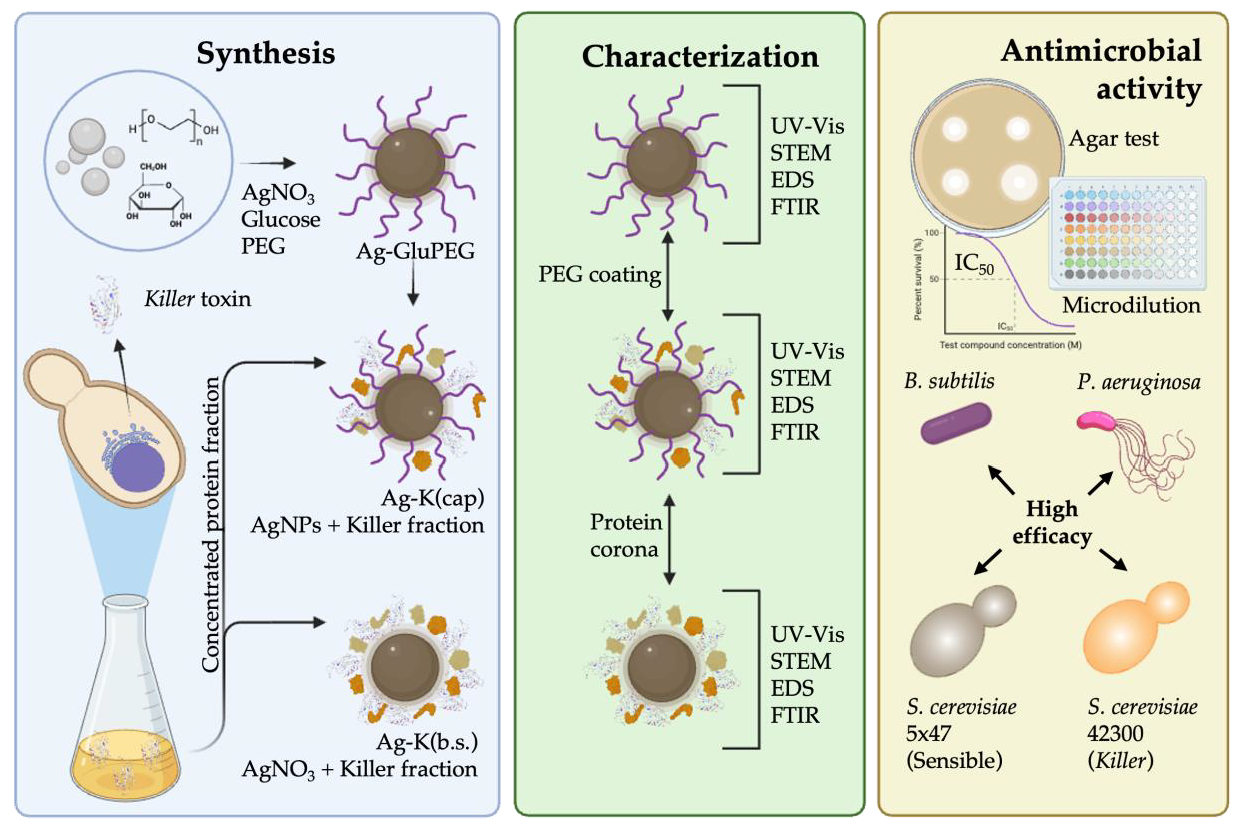
Recently, novel nanobiotechnological approaches have been developed to reduce the impact of pollutants during the synthesis of nanoparticles (NPs). To do so, green synthesis methods have now become widely adopted, using biomolecules to produce high-quality, stable nanoparticles. In this work, we employed the K1 toxin produced by S. cerevisiae as a reducing and capping agent for silver nanoparticles. The synthesis of Ag-K1 NPs was carried out using a concentrated protein fraction from the culture medium of S. cerevisiae 42300 containing the secreted K1 toxin. The obtained nanoparticles were characterized using UV–Vis spectroscopy, STEM, EDS, and FTIR, and the antimicrobial efficacy was determined against S. cerevisiae, P. aeruginosa, and B. subtilis. The synthesized NPs showed high antimicrobial efficacy, killing all tested strains; additionally, dose–response modeling suggested differential activity among the nanoparticles. This work reports, for the first time, the bio-assisted synthesis and antimicrobial characterization of silver nanoparticles associated with K1 killer toxin-containing protein fractions.
Keywords: green synthesis; bio-assisted synthesis; killer toxin; AgNPs; antimicrobials; protein corona; Saccharomyces cerevisiae green synthesis; bio-assisted synthesis; killer toxin; AgNPs; antimicrobials; protein corona; Saccharomyces cerevisiae
Graphical Abstract