Review

Research Progress of Ionic Liquids Hybridized with Porous Materials for CO2 Capture: From Bulk to Confinement-Enhanced Adsorbents


Henan Key Laboratory of Green Chemistry, Collaborative Innovation Center of Henan Province for Green Manufacturing of Fine Chemicals, Key Laboratory of Green Chemical Media and Reactions, Ministry of Education, School of Chemistry and Chemical Engineering, Henan Normal University, Xinxiang 453007, China
*
Authors to whom correspondence should be addressed.
Nanomaterials 2026, 16(12), 727; https://doi.org/10.3390/nano16120727 (registering DOI)
Submission received: 8 May 2026 / Revised: 2 June 2026 / Accepted: 9 June 2026 / Published: 11 June 2026

Abstract

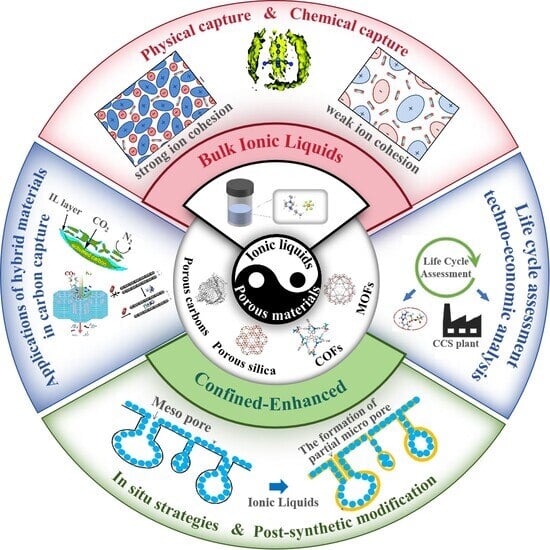
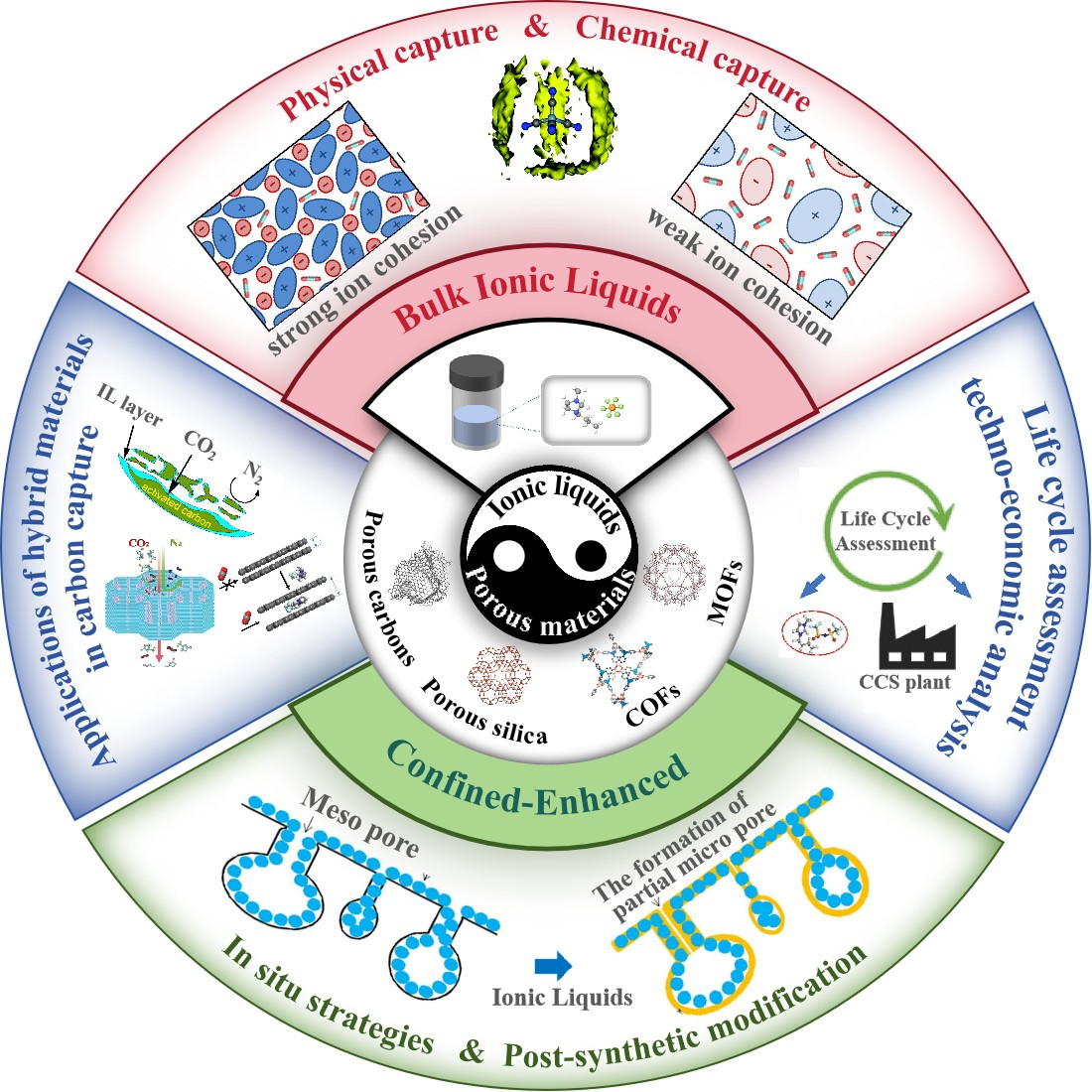
The continuous rise in carbon emissions poses a serious threat to the global climate, driving the urgent need for efficient CCUS technologies. Ionic liquids (ILs), with their negligible vapor pressure, excellent thermal stability, and tunable molecular structures, have emerged as promising materials for CO2 capture. However, the high viscosity of bulk ILs severely restricts gas mass transfer. To overcome this limitation, integrating ILs with porous materials featuring large surface areas and well-defined pore structures has emerged as a synergistic strategy, combining the high CO2 affinity and selectivity of ILs with the rapid mass transfer and structural stability of porous supports. This review systematically summarizes the CO2 capture mechanisms and limitations of bulk ILs and further highlights recent advances in the design, synthesis, and applications of IL-based hybrid adsorbents. Particular attention is given to confinement-enhanced mechanisms, whereby nanoscale confinement fundamentally alters the physicochemical behavior of ILs, transforming them from disordered bulk liquids into ordered, interface-dominated systems. In addition, the life-cycle assessment and techno-economic analysis of IL hybrid systems are critically evaluated.

Graphical Abstract

1. Introduction

The continuous increase in anthropogenic CO2 emissions has become one of the most critical environmental challenges threatening global climate stability, ecosystem sustainability, and human health [1]. To achieve carbon neutrality and mitigate climate change, the development of efficient carbon capture, utilization, and storage (CCUS) technologies has been become an urgent global priority [2,3,4]. However, conventional amine-based solvents still suffer from several inherent drawbacks, including high volatility, severe corrosiveness, solvent degradation, and high regeneration energy consumption [5,6]. Therefore, the development of alternative carbon capture technology featuring high efficiency, low energy consumption, and long-term stability has attracted widespread attention [7].
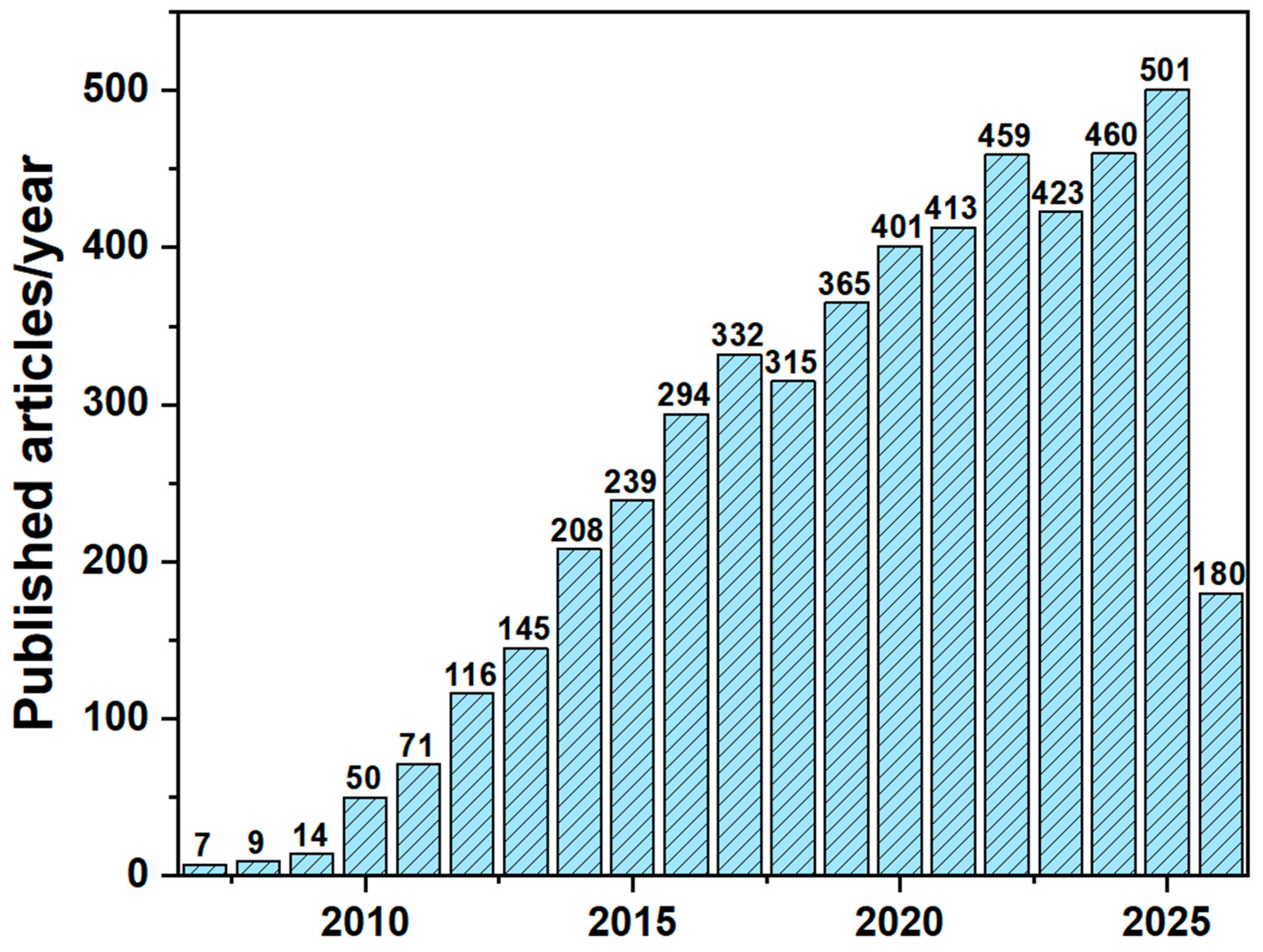
Ionic liquids (ILs) are a class of organic salts entirely composed of cations and anions that typically remain liquid below 100 °C [8]. Owing to their negligible vapor pressure, excellent thermal and chemical stability, wide electrochemical windows, and highly tunable molecular structures, ILs have been widely regarded as promising media for CO2 capture [9,10,11]. By tailoring the types and functional groups of cations and anions, the polarity, free volume, hydrogen-bonding capability, and CO2 affinity of ILs can be precisely regulated at the molecular level, thereby endowing them with excellent CO2-selective adsorption performance, particularly under low CO2 partial pressure conditions [12,13]. As of 27 May 2026, a search of the Web of Science database using the keywords “CO2 capture” and “ionic liquids” indicates that this field is rapidly progressing toward greater performance (Figure 1). Nevertheless, despite their high tunability and superior CO2 adsorption selectivity, bulk ILs still suffer from several limitations, including intrinsically high viscosity, slow gas diffusion, severe mass-transfer resistance, and limited gas–liquid interfacial area [14,15,16]. These drawbacks not only hinder CO2 transport within ILs but also significantly increase the energy consumption of adsorption–desorption processes, thereby severely restricting their practical large-scale applications in carbon capture [13].
To overcome these limitations, researchers have increasingly incorporated ILs into porous materials to construct hybrid materials with both high CO2 affinity and rapid mass-transfer capability [17,18,19]. Porous materials generally refer to solid materials containing interconnected pores or cavities, including porous silica materials [20,21,22], porous carbon materials [23,24,25], metal–organic frameworks (MOFs) [26,27,28], and covalent organic frameworks (COFs) [29,30,31]. These materials possess large specific surface areas, tunable pore structures, abundant surface sites, and well-ordered porous channels, which not only provide rapid diffusion pathways for gas molecules but also enable the highly dispersed immobilization of ILs, thereby effectively reducing the mass-transfer resistance of bulk ILs and improving active-site utilization [32,33,34,35,36]. More importantly, the confined spaces created by nanopores can significantly alter the local microenvironment of ILs, causing confined ILs to exhibit physicochemical behaviors distinct from those of bulk ILs [37,38]. Compared with bulk ILs, ILs confined within porous structures often exhibit ionic rearrangement, free-volume variation, local electric-field modulation, and enhanced interfacial interactions [38,39]. These confinement-enhanced effects not only facilitate the diffusion and enrichment of CO2 within nanopores but also significantly improve CO2 capture performance by strengthening CO2–IL interactions, increasing active-site accessibility, and regulating adsorption thermodynamics [40,41,42,43].
Although numerous studies have been separately reviewed IL-based CO2 capture systems and porous adsorbent materials, systematic understanding and analysis of the confinement-enhanced mechanisms arising from the incorporation of ILs into porous materials remain insufficient [44,45,46,47]. Therefore, the primary objective of this review is to systematically elucidate the confinement-enhanced effects of ILs within porous materials, with particular emphasis on how nanoscale confinement regulates the free volume, pore structures, interfacial interactions, active-site accessibility, and adsorption thermodynamics of ILs. On this basis, the hybridization strategies of ILs with porous silica materials, porous carbon materials, MOFs, and COFs, as well as their applications in CO2 capture, are comprehensively summarized. Moreover, this review discusses the CO2 capture mechanisms, recent advances, and current limitations of bulk IL, thereby providing a theoretical basis for understanding the performance enhancement mechanisms in hybrid adsorbents. Furthermore, the life-cycle assessment (LCA), techno-economic analysis (TEA), and practical challenges associated with ionic liquid (IL)-based hybrid systems are critically analyzed, and future perspectives for the rational design and industrial application of confinement-enhanced IL hybrid adsorbents are proposed.

2. Applications and Challenges of ILs in CO2 Capture

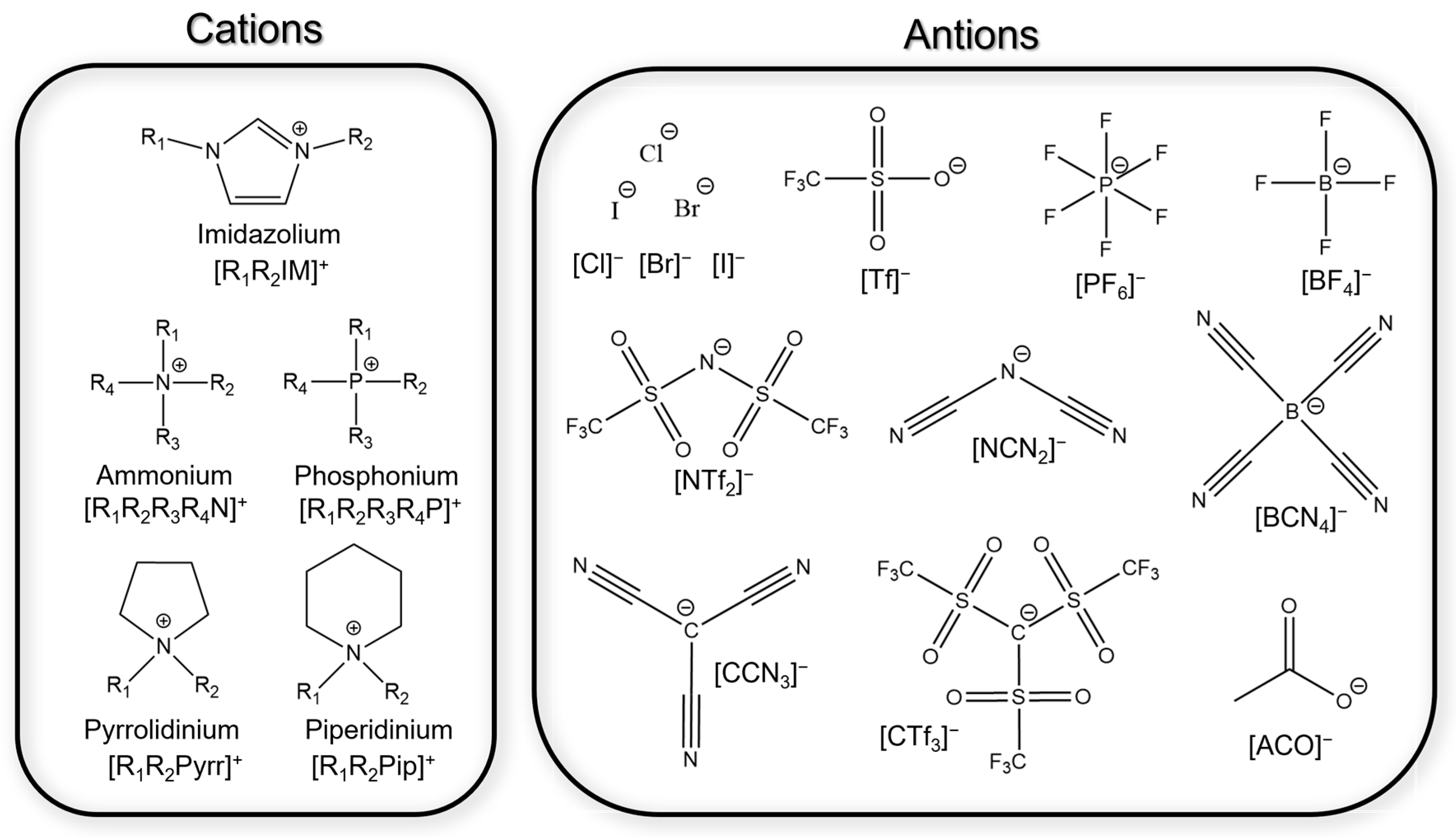
The outstanding advantages of ILs in CO2 capture stem from their high degree of structural designability. By independently controlling the structures of cations and anions, their physicochemical properties can be precisely tailored [7,12]. Common cations and anions are shown in Figure 2.

2.1. CO2 Capture Mechanism by ILs

The interaction mechanism between ILs and CO2 primarily involves two types: physical adsorption and chemical adsorption. The specific mechanism depends on the molecular structure and functional group composition of the IL [44]. By controlling the alkyl side-chain length, introducing electron-donating or electron-withdrawing groups, and constructing functional sites such as -NH2, -OH, or -COO, the polarity, free volume, and local interaction environment of ILs can be precisely tuned at the molecular level [13]. This, in turn, influences the interaction patterns and adsorption behavior between ILs and CO2.

2.1.1. Physical Adsorption

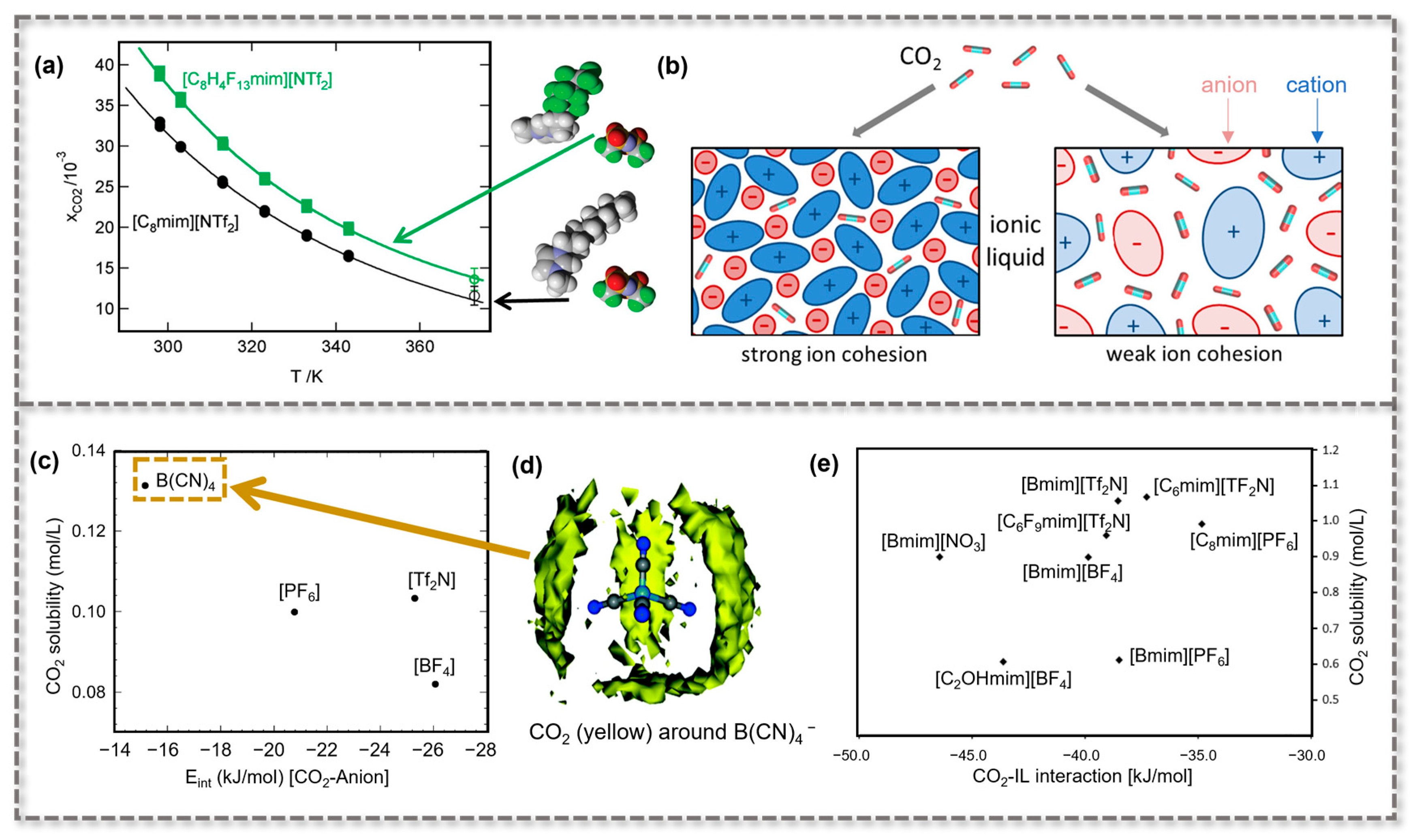
Physical trapping primarily depends on non-covalent interactions between CO2 and ILs, including electrostatic interactions, van der Waals forces, and weak hydrogen bonding [48,49,50]. This process typically involves low adsorption enthalpy, leading to reduced energy consumption during desorption and solvent regeneration, while maintaining good reversibility and stability [51]. However, physical absorption capacity is relatively limited and sensitive to temperature, pressure, and the microstructure of the system [52,53,54]. Extensive studies indicate that the anion structure generally exerts a greater influence on CO2 solubility than the cation structure [55,56,57]. Anthony et al. systematically examined various cation systems and reported that ILs containing [NTf2] exhibit higher CO2 solubility than those incorporating [BF4] or [PF6] anions [58]. When the cation was fixed as [Bmim]+, CO2 solubility followed a clear anion-dependent trend: [NO3] < [DCA] < [BF4] ≈ [PF6] < [TfO] < [NTf2] < [methide] [59]. This trend is commonly attributed to the stronger polarizability of fluorinated anions and their enhanced weak Lewis acid–base and electrostatic interactions with CO2 [60]. Consistently, fluorinated cations can further increase CO2 solubility. For example, the perfluoroalkyl-substituted [C8H4F13mim][NTf2] exhibits higher absorption capacity than [Omim][NTf2] (Figure 3a) [61].
However, the strength of intermolecular interactions alone cannot fully account for the physical dissolution behavior of CO2 in ILs. The free-volume distribution, governed by interionic cohesive forces, also plays a critical role [62]. When interionic interactions are weak, the system more readily forms transient cavities capable of accommodating CO2, thereby enhancing solubility (Figure 3b). For example, despite its lower polarity, the [B(CN)4]-based ILs exhibit higher CO2 solubility than the commonly studied [NTf2] system (Figure 3c) [63]. This behavior primarily arises from the weaker cohesive interactions between [B(CN)4] and the corresponding cations, leading to a looser structural organization and a significantly increased fractional free volume (FFV) (Figure 3d) [64]. Therefore, CO2 dissolution in IL is jointly governed by CO2–anion interactions and the free-volume effect (Figure 3e).

2.1.2. Chemical Adsorption

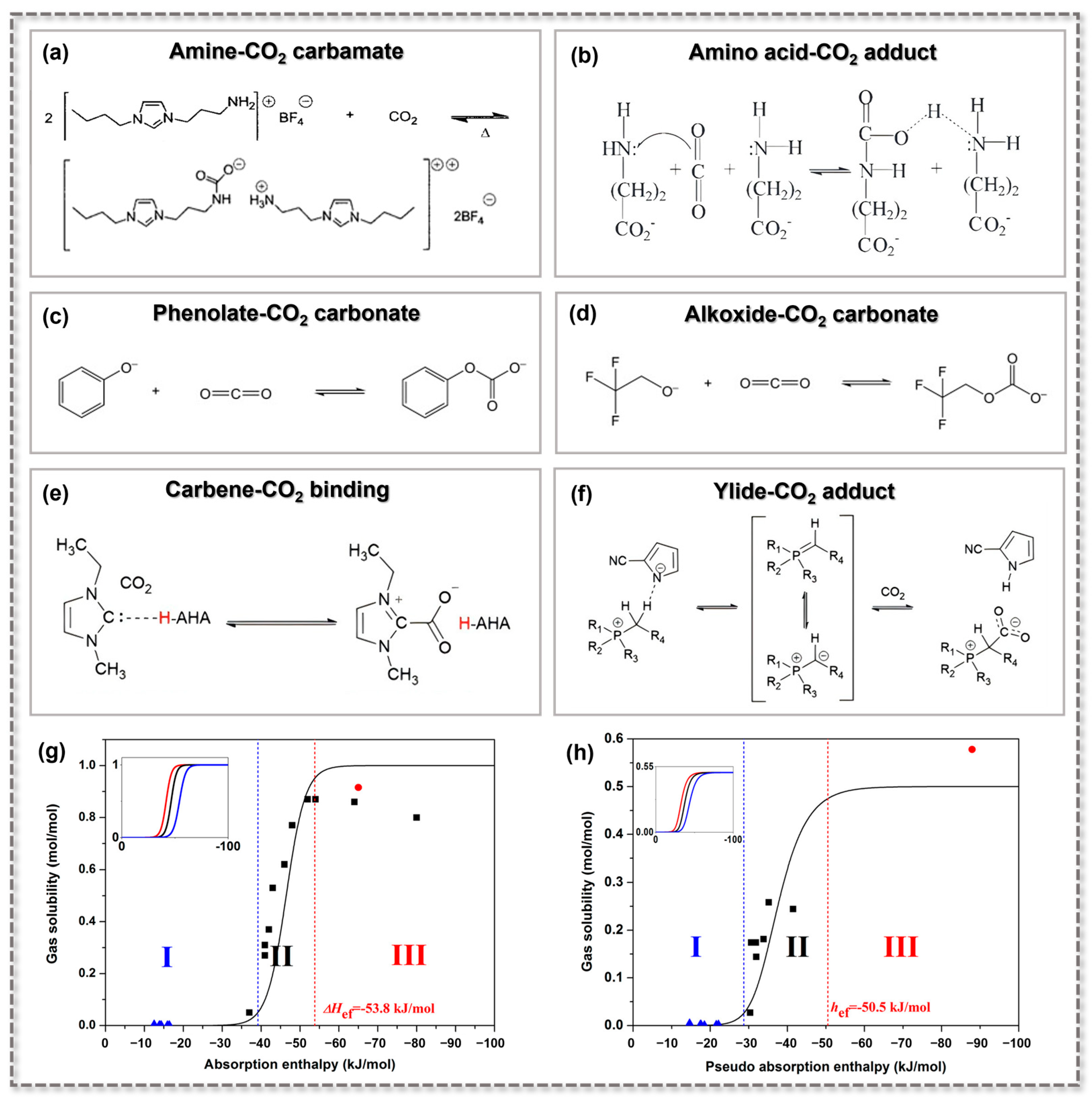
Compared with physical adsorption, chemical adsorption involves the formation of reversible chemical bonds between CO2 and functionalized ILs, which markedly enhances capture capacity and selectivity [65,66,67]. This approach is particularly suitable for post-combustion flue gas treatment and direct air capture (DAC) under low CO2 partial pressures. The capture performance of representative ILs is summarized in Table 1. The underlying mechanism is primarily based on nucleophilic attack facilitated by Lewis acid–base interactions, with active sites typically located on carbon, nitrogen, or oxygen atoms [13,44,68]. For instance, cations bearing primary amine groups or amino-acid-based anions can nucleophilically attack the carbon atom of CO2 via the nitrogen atom, forming carbamate or ammonium carbamate (Figure 4a,b) [69,70]. Due to hydrogen-bonding networks and conformational constraints, these systems generally exhibit a 1:2 stoichiometry, with a theoretical absorption capacity limited to 0.5 mol CO2 per mol of active site. Moreover, phenolate and alkoxide-type ILs can achieve chemical capture through O-site reaction with CO2 to form carbonates following deprotonation induced by superbases (Figure 4c,d) [71,72]. When the basicity of the anion is further increased, it can abstract an acidic proton from imidazolium or phosphonium cations to generate carbene or zwitterionic intermediates, allowing CO2 to bind directly to the carbon center in a 1:1 stoichiometry (Figure 4e,f) [65,66,73,74,75]. Although this pathway overcomes the stoichiometric limitation, it simultaneously introduces stronger conformational constraints.
Although chemisorption markedly strengthens the interaction between CO2 and ILs, its benefits are not unlimited. The thermodynamic feasibility of both physical and chemical absorption is governed by the Gibbs free energy change (ΔG) [76,77,78]. As interaction strength increases, the decrease in absorption enthalpy (ΔH) is typically accompanied by a greater entropy loss (−TΔS), thereby substantially increasing regeneration energy consumption [79,80]. Huang et al. identified a generalized S-shaped relationship between CO2 solubility and absorption enthalpy based on the van’t Hoff equation and thermodynamic equilibrium modeling (Figure 4g,h) [81]. Good agreement between experimental and model results was observed when |ΔH| < 40 kJ/mol. In this range, the system is dominated by physical dissolution (region I). Within the moderately exothermic regime, solubility becomes highly sensitive to ΔH (region II). Upon approaching the stoichiometric upper limit, the system enters a high-capacity plateau (region III), where further increases in |ΔH| scarcely enhance capacity but markedly raise regeneration energy demand. This trend applies to both 1:1 and 1:2 chemisorption systems, with plateau heights constrained by stoichiometric ratios. Notably, although stronger CO2–IL interactions can improve uptake capacity, they are generally accompanied by significant entropy penalty and higher regeneration energy requirements. Therefore, simply pursuing stronger binding is not optimal; instead, mitigating kinetic and energetic limitations while maintaining high selectivity is crucial for the continued development of IL CO2 capture systems.
Figure 4. CO2 capture mechanisms in ILs: (a) Carbamate formation in primary-amine-functionalized ILs [69]. (b) Ammonium carbamate in amino acid anionic ILs [70]. (c) Carbonate formation in deprotonated phenolate ILs. (d) Carbonate formation in alkoxide ILs [72]. (e) Carbene generation via imidazolium deprotonation [13]. (f) Amphiphilic intermediates in phosphonium ILs [74]. (g) CO2 solubility vs. absorption enthalpy in 1:1 chemisorption ILs at 298 K and 0.15 bar (red line: T = 298.15 K and PCO2G= 1 bar; black line: T = 298.15 K and PCO2G = 0.15 bar; blue line: T = 348.15 K and PCO2G = 0.15 bar. Blue triangles: physical absorbents, including normal organic solvents and ionic liquids; black squares: chemically tunable ionic liquids with aprotic heterocyclic anions and amino acid anions; red circle: 25 wt % aqueous MDEA). (h) Absorption enthalpy vs. capacity in 1:2 chemisorption ILs at 298 K and 0.15 bar [81].
Nanomaterials 16 00727 g004
Table 1. Summary of adsorption properties of selected ILs.
ILPCO2 (bar)T (K)CO2 Absorption Capacity
(mol CO2/mol IL)
Dominant Interaction MechanismReaction Enthalpy (kJ/mol)Ref.
[Hmim][NTf2]8.592980.31Physisorption-[82]
[Hmim][BF4]8.992980.20Physisorption-[82]
[Hmim][PF6]9.272980.20Physisorption-[82]
[Emim][BF4]8.752980.12Physisorption-[82]
[Emim][NTf2]9.032980.26Physisorption-[82]
[Emim][TfO]1493031.67Physisorption-[83]
[Bmim][BF4]103030.07Physisorption-[84]
[Bmim][PF6]103030.20Physisorption-[84]
[Bmim][NTf2]103030.29Physisorption-[84]
[Hmim][TfO]11.53040.38Physisorption-[83]
[Omim][TfO]12.53040.40Physisorption-[83]
[Bmim][NO3]-308-Physisorption−16[85]
[Bmim][SCN]-308-Physisorption−12[85]
[S222][NTf2]193130.44Physisorption−14.6[86]
[Deme][NTf2]193130.47Physisorption−13.4[86]
[Pmim][NTf2]193130.46Physisorption−10.5[86]
[Amim][NTf2]193130.46Physisorption−14.3[86]
[4Mbp][BF4]193130.26Physisorption−12.7[86]
[ImNH2][BF4]12950.50Primary amine-[69]
[P66614][4NH2-NC]13030.80Primary amine-[87]
[18C6-K][Pro]12980.99Secondary amine−39[88]
[MTBD][Im]12961.03Tertiary amine−85.2[72]
[P66614][Triz]13030.95Tertiary amine−56.4[89]
[P66614][Ind]13030.98Tertiary amine−52[89]
[P66614][Im]13031Tertiary amine−49[89]
[P66614][4-ABI]12931.60Di-tertiary amine sites-[90]
[MTBDH][TFE]12961.13Alkoxide–16.8[72]
[P66614][4-Me-PhO]13030.91Phenoxide-[71]
[P66614][3-HMPz]12930.96Phenoxide−4.5[91]
[P66614][PPhO]12930.93Phenoxide−51[91]
[P66614][2-Op]12931.58Synergistic chemisorption-[90]
[P4442][IDA]13131.69Cooperative chemisorption−89, −52.8[92]
- Specific values are not mentioned in the cited articles; PCO2 (bar): Partial pressure of CO2 during the adsorption measurement.

2.2. Progress and Challenges of CO2 Capture Using ILs

The key breakthrough in the early development of IL research was the discovery of the high solubility of CO2 in typical ILs such as [Bmim][PF6] [93]. However, ILs based on physical absorption are primarily suitable for high-pressure conditions and exhibit limited efficiency under low-pressure environments, such as post-combustion carbon capture (PCC). To address this limitation, research has been progressively shifted toward functionalized ILs [94,95,96]. Introducing specific functional groups, such as amine [69,97], amino acid [70,98], carboxyl [99], pyridine [100], or imidazole moieties [13,101] into the IL structure enhances chemical reactivity with CO2, thereby significantly improving capture capacity and selectivity. For example, Bates et al. reported task-specific ILs featuring primary-amine-functionalized imidazolium cations [69]. Building on this concept, amino-acid-based ILs have attracted significant attention owing to their environmental compatibility, high CO2 uptake capacity, and good regenerability [102]. Subsequently, new IL systems were developed by combining propane-sulfonate-functionalized imidazolium cations with amino acid anions for CO2 capture [103]. However, many functionalized ILs exhibit a marked increase in viscosity after CO2 uptake due to hydrogen-bond network reorganization, which diminishes their high-capacity advantage [104,105].
To reduce viscosity while simultaneously enhancing CO2 uptake capacity, efforts have focused on the gradual introduction of electron-withdrawing and CO2-philic functional groups [106,107]. Research results have been shown that incorporating carbonyl-containing groups, such as -OAc or -CHO, into the anion is more effective than modifying the cation, as these groups can form stable complexes with CO2 via chemisorption [108]. For example, Chen et al. introduced electron-withdrawing groups, including IDA, HIDA, EDDA, and NTA, into amino acid anions to reduce the negative inductive effect of the amino group, thereby enhancing the affinity of carboxylates for CO2 [92]. Consequently, [P4442]2[IDA] achieved an absorption capacity as high as 1.69 mol CO2 per mol IL at 313 K and 1 bar. In addition, phenolate-, pyridinate-, and carboxylate-based ILs have attracted considerable attention owing to their relatively low viscosities [44,109].
To address the viscosity increase observed in protic ILs due to hydrogen-bonded complex formation after CO2 absorption, Wang et al. synthesized protic ILs via direct neutralization of superbases with weak proton donors [72]. Most systems achieved CO2 uptake values exceeding 1 mol CO2 per mol IL and remained liquid after absorption, without gelation, which is beneficial for mass transfer and process operation. In addition, Samuel Seo et al. proposed and systematically investigated a series of ILs based on aprotic heterocyclic anions by pairing [P66614]+ with azole-based heterocyclic anions (AHAs) derived from indazole, benzimidazole, and pyrrole [80]. Molecular dynamics simulations revealed that these AHA ILs exhibit nearly 1:1 stoichiometric CO2 uptake at 0–1 bar and 295 K. Owing to the absence of acidic protons, the number of hydrogen bonds changes minimally before and after CO2 uptake. Meanwhile, ionic translational and rotational dynamics remain essentially unchanged, resulting in negligible viscosity increase upon saturation [110].
Although this issue can be partially mitigated through molecular design, for example, by using superbase-derived protic ILs or non-protic heterocyclic anion systems [80,111,112], these strategies are typically associated with engineering challenges, including complex synthesis, high cost, and difficulty in scale-up [113].

3. Strategies for Hybridizing ILs with Porous Materials

To overcome mass-transfer limitations arising from the high viscosity of ILs, while fully leveraging their selective solubility and molecular recognition capabilities, ILs are incorporated into porous materials to form hybrid adsorbents [36]. The essence of this strategy lies in confining or anchoring ILs within nano- to sub-nanometer-scale pores via physical or chemical approaches, thereby enabling synergistic integration of the large surface area of porous supports with the functionalized interfaces of ILs. This, in turn, enhances both the kinetic and thermodynamic performance beyond that of conventional bulk IL [40,114].

3.1. Confined Effects and Interfacial Adsorption

Confinement of ILs within porous materials is not merely a filling process but a complex physicochemical transformation that fundamentally reshapes interfacial adsorption behavior. Unlike conventional adsorption mechanisms, which mainly rely on intrinsic surface sites or pore-filling effects, confinement-enhanced mechanisms arise from the synergistic interactions between confined ILs and nanoscale porous environments [40,41,114,115]. Under confinement, restricted spaces and interfacial interactions can reorganize IL microstructures, alter ion dynamics, regulate free volume, and reconstruct local physicochemical environments, thereby generating non-bulk properties unattainable in conventional adsorbents [38,39]. This mechanism differs fundamentally from traditional physical or chemical adsorption [116]. Conventional adsorption primarily depends on direct interactions between gas molecules and solid surfaces, with performance governed by factors such as surface area, pore size, and binding affinity [117]. In contrast, confinement-enhanced adsorption originates from the altered behavior of ILs within nanopores. The porous framework functions not only as a passive support but also as an active confinement environment that regulates IL configuration, transport behavior, and interfacial states [40,118]. As a result, the enhanced adsorption performance arises from the cooperative effects of pore confinement, IL restructuring, and interfacial interactions, rather than solely from the intrinsic adsorption capacity of the solid framework [39,41,114].

3.1.1. Free-Volume Modulation of Confined ILs

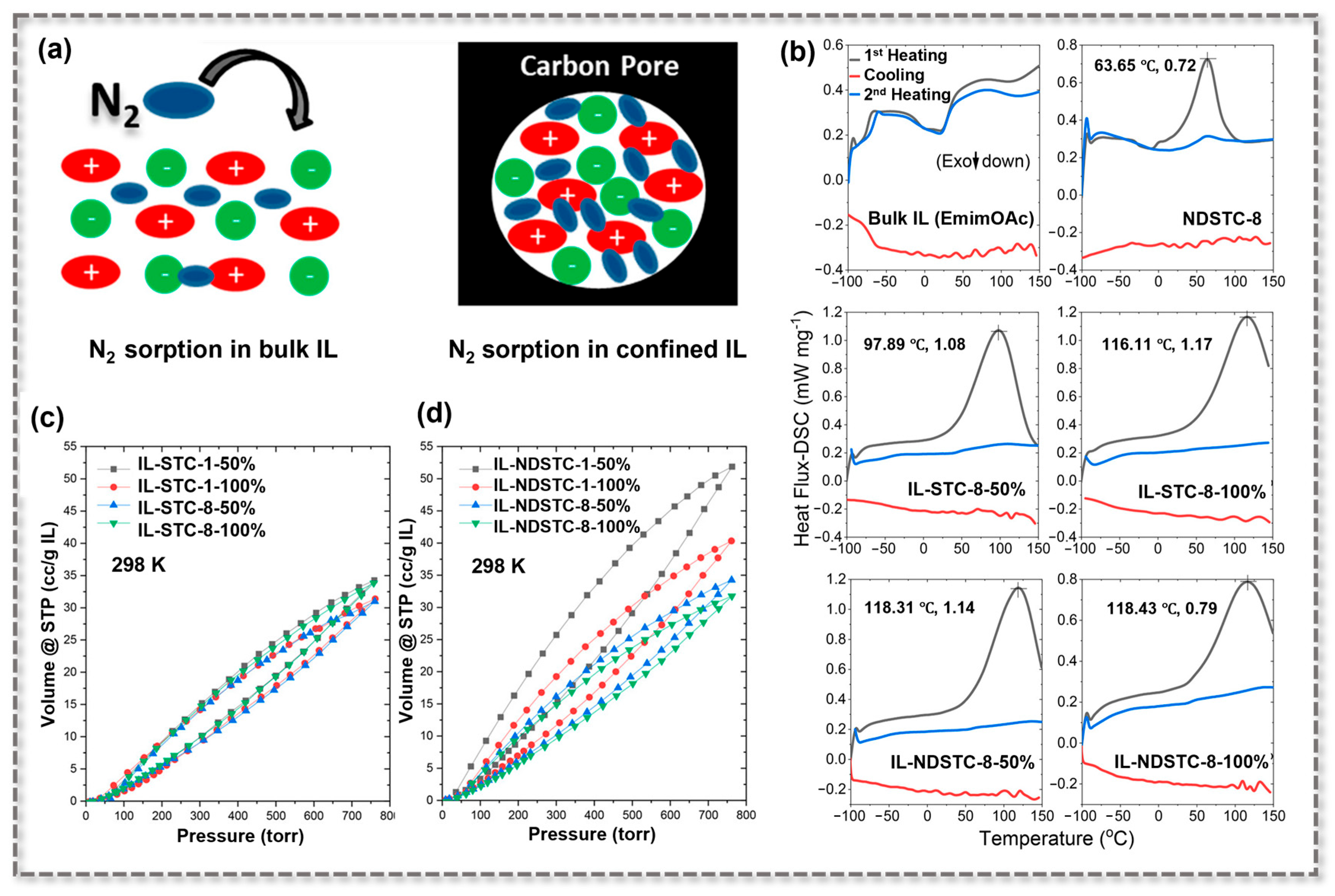
When ILs are confined within porous materials such as zeolites, MOFs, porous carbons, and mesoporous silica, the pore structures of the host materials can significantly alter the microstructural organization of the ILs, with one of the most direct consequences being changes in free-volume fraction [43,116]. Nanoconfinement can weaken the strong ion–ion interactions that dominate in bulk ILs, thereby promoting an increase in free volume [38]. Harmanli et al. systematically investigated confined [Emim][OAc] within carbon pores and found that the mismatch between pore size and ion size forces the IL to adopt a “frustrated arrangement” under nanoconfinement [39]. This disrupts the extended and optimized ionic network present in bulk ILs, driving the ions toward more open packing configurations that reduce local packing density and increase accessible free volume (Figure 5a). Differential scanning calorimetry (DSC) results revealed that the characteristic phase-transition signal of bulk [Emim][OAc] completely disappeared after confinement within micropores (Figure 5b). The absence of phase-transition behavior indicates that the confined ions exist in a coordinatively unsaturated state due to strong interactions with the pore walls, implying enlarged interionic distances and increased free volume. Consequently, even in the absence of measurable open porosity, the confined IL exhibited substantially enhanced gas absorption capability, with absorption performance more than ten times higher than that of the bulk IL (Figure 5c,d) [38].
Surface effects within nanoscale pores can further modify the phase behavior and ion dynamics of ILs, leading to properties distinct from those of bulk systems. For example, in V-shaped confined pores, ILs exhibit reduced phase-transition temperatures and enhanced ion diffusivity, both of which contribute to further increases in effective free volume [119,120]. The enlarged free volume provides more transient cavities for CO2 accommodation, thereby enhancing physisorption capacity [121,122]. Meanwhile, the more open ionic configurations induced by confinement can improve the accessibility of active sites, such as the -NH2 groups in amino-acid-based ILs, thereby facilitating chemisorption kinetics [123].

3.1.2. Pore Structure Reconstruction

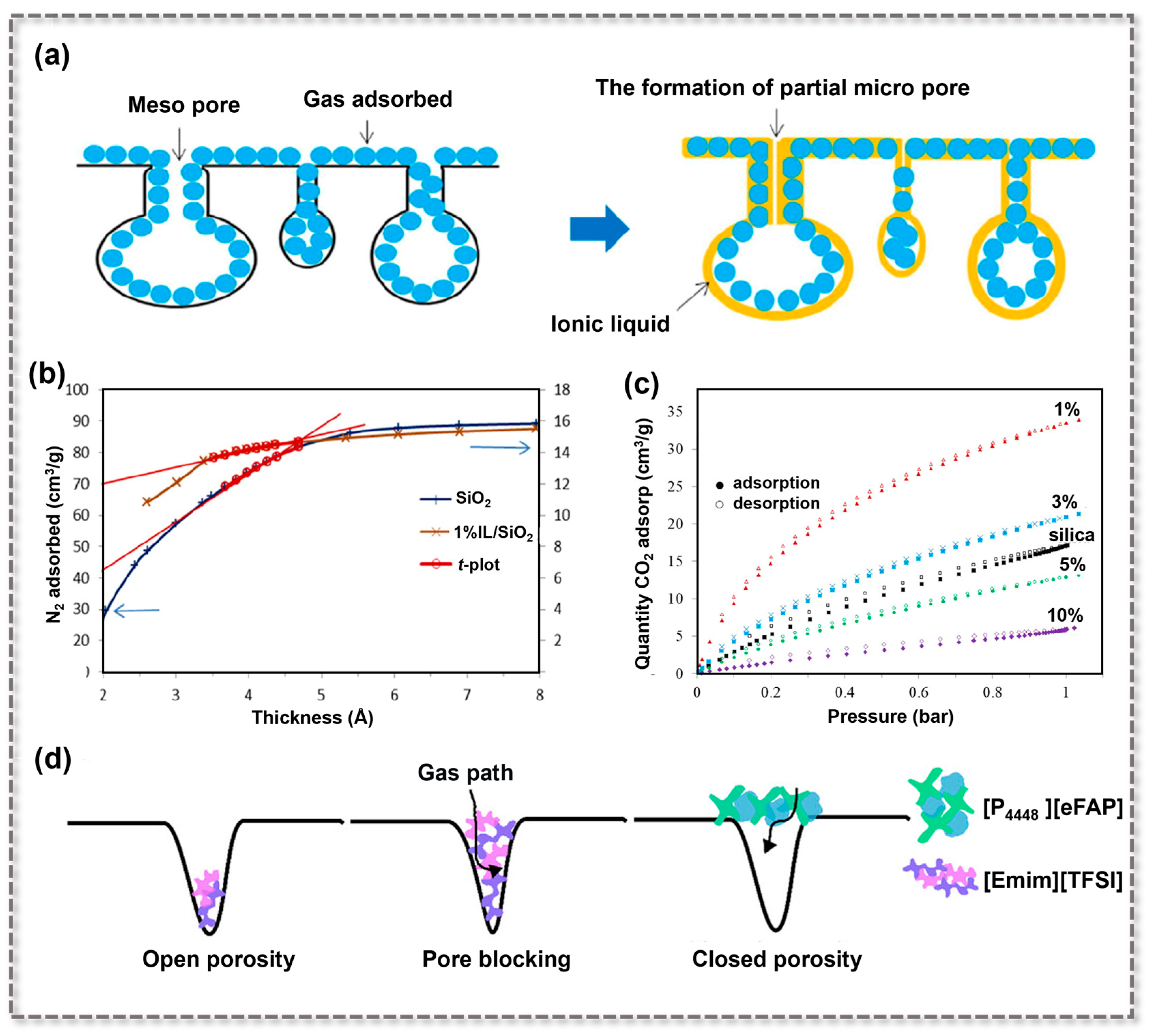
ILs introduced into porous supports initially occupy the pore space, typically leading to pronounced decreases in specific surface area and pore volume [124,125,126]. For instance, in the [Bmim][CF3SO3]/SiO2 adsorbents prepared via a sol–gel method by Marliza et al., increasing the IL loading from 1% to 10% reduces the surface area from 266 m2/g to nearly 1 m2/g, accompanied by a substantial decline in pore volume [118]. More importantly, moderate loading does not merely cause pore blockage but can instead induce the formation of new microporous structures (Figure 6a). At a loading of 1%, however, the surface area decreases markedly, and the CO2 uptake increases from 33.7 to 66.7 mg/g. t-Plot analysis indicates that this enhancement arises from the partitioning and constriction of mesopores by a small amount of IL, generating micropores with sizes better matched to CO2 molecules (Figure 6b). This confinement-induced pore reconstruction effectively drives a transition from mesoporous to microporous structures, thereby strengthening physical adsorption (Figure 6c).
Furthermore, the size matching between IL molecules and pore dimensions dictates the pathway of pore structure evolution, as illustrated in Figure 6d [41,115]. Ayyildiz et al. demonstrated that, when the IL size is well matched with the pore diameter, ILs can penetrate pores and maintain an open-pore structure after partial filling [40]. In contrast, when the pore size is slightly smaller, ILs preferentially adsorb at the pore entrances and, at higher loadings, lead to the formation of closed pore structures. For bulkier ILs, a surface coverage layer is more likely to form at the pore openings, inducing pore blockage. This configuration effectively creates an “IL gate” at the pore exterior, allowing CO2 to diffuse through while imposing additional mass-transfer resistance on other gases, thereby enhancing selectivity to a certain extent.

3.1.3. Interfacial Stabilization and Activation

Confining functionalized ILs within porous materials can markedly enhance the stability and utilization efficiency of active sites [127,128,129]. On the one hand, nanoscale confinement suppresses IL leakage and aggregation through capillary forces and interfacial interactions [130,131]. Wang et al. employed the Young–Laplace equation to theoretically predict and experimentally validate the mechanical stability of ILs within porous networks [42]:
Ρ = 2 γ cos θ r p
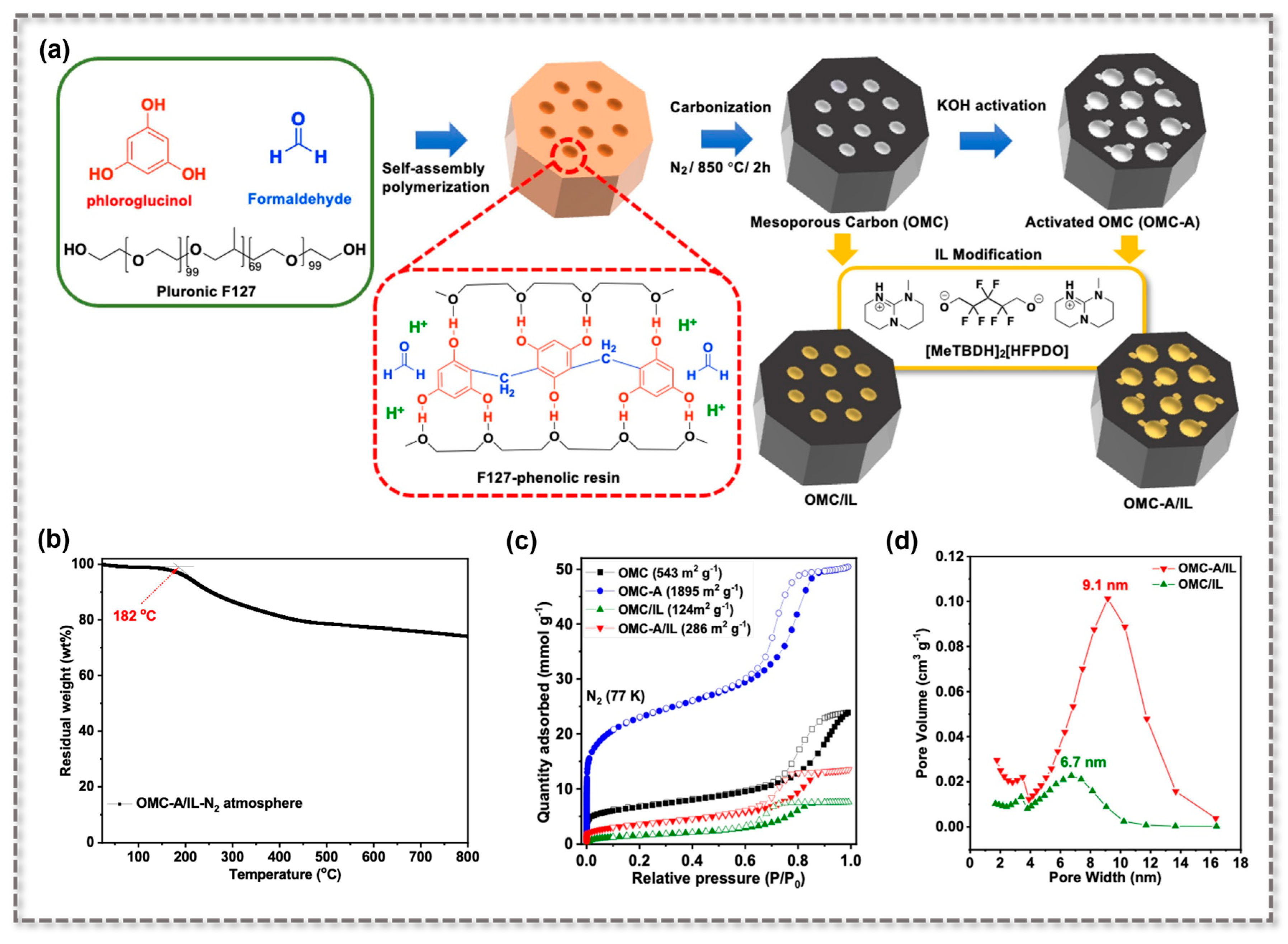
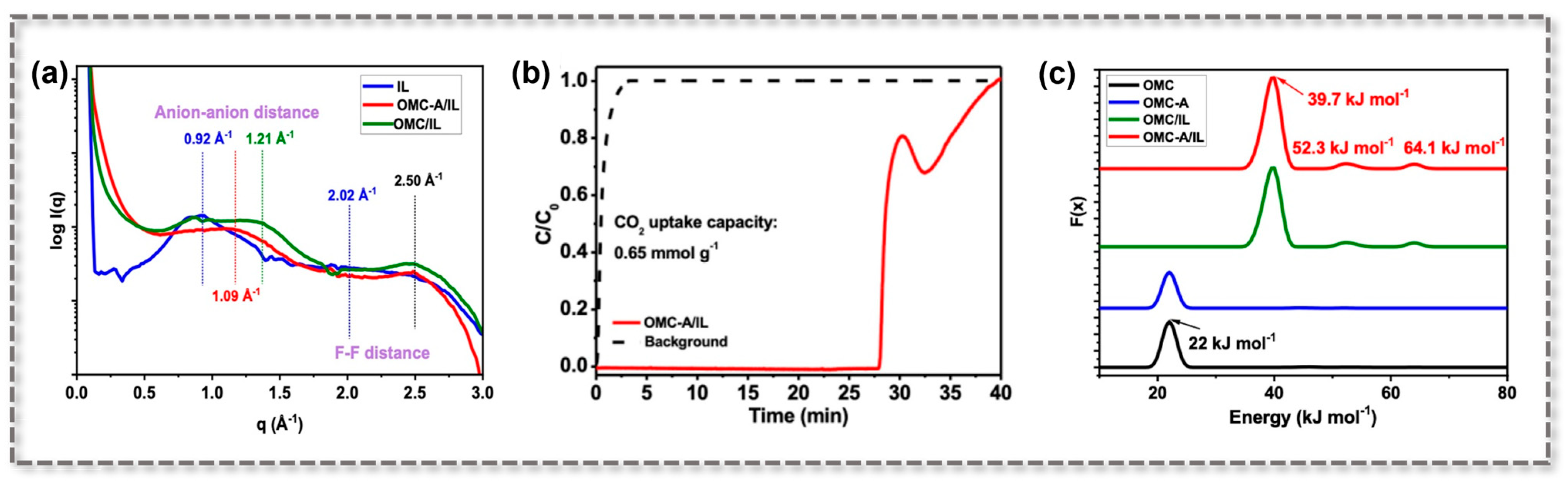
Here, the stability of ILs within pores is described by the breakthrough pressure (Equation (1)), which is positively correlated with surface tension (γ) and wettability (cos θ) and inversely proportional to the pore radius (rp). Accordingly, reducing pore size, increasing IL surface tension, and optimizing wettability can significantly enhance mechanical stability. Wang et al. further confined [Emim][Gly] within a single-walled carbon nanotube network, with both theoretical and experimental results indicating a breakthrough pressure exceeding 25 bar, maintaining structural and functional stability even under high-pressure gas conditions. On this basis, the confined effect is further reflected in enhanced thermal stability [129,132,133]. For example, Mokhtari-Nori et al. confined [MeTBDH]2[HFPDO] within ordered mesoporous carbon, which significantly improves the thermal stability of the IL, due to the synergistic effects of π–π interactions with the carbon materials and spatial confinement (Figure 7a) [41]. Thermogravimetric analysis shows that the onset decomposition temperature of the bulk IL is approximately 455 K, whereas it increases markedly after incorporation into OMC-A, indicating that confinement effectively suppresses thermally induced migration and decomposition (Figure 7b). Meanwhile, the pore structure remains well preserved, with a mesopore size of about 9.1 nm and a total pore volume of 0.91 cm3/g, ensuring continuous gas transport pathways (Figure 7c,d). Therefore, the rational construction of hierarchical pore structures can maintain efficient mass transfer while enhancing stability.
Beyond stabilization, confinement further strengthens CO2–IL interactions through interfacial regulation [41,114]. Compared with bulk ILs, those confined in nanopores undergo significant reorganization in local electric fields, molecular orientation, and electron distribution [39,50]. Confinement enhances electrostatic interactions between the CO2 quadrupole and ionic species, while modulating the interfacial electric field, thereby stabilizing adsorption intermediates and strengthening interactions, as demonstrated by Mokhtari-Nori et al. [41,134,135]. Wide-angle X-ray scattering shows that the characteristic peaks shift to higher scattering vectors after confinement, indicating a more compact packing structure within carbon nanopores (Figure 8a). This arises from strong interactions between the π-conjugated carbon surface and aromatic IL cations, leading to reorganization of molecular arrangement and electronic structure. Small-angle neutron scattering further reveals confinement-induced ordering, reflected by a narrower mesopore size distribution after IL incorporation and a reduced power-law decay upon CO2 adsorption. These results indicate a more ordered IL phase and a smoother interface under CO2, promoting greater exposure of active sites. Compared with conventional OMC, OMC-A, with larger surface area and larger mesopores, exhibits higher CO2 uptake at the same IL loading of 30 wt% (Figure 8b). This improvement is attributed to a more developed mesoporous network that enables uniform IL dispersion, thereby maximizing active-site utilization under dilute CO2 conditions [136].
Moreover, confined effects typically reduce the apparent reaction enthalpy of CO2 adsorption, as the interactions with the porous material surface moderately decrease the electronic density of active sites (Figure 8c), an effect akin to “interfacial passivation”. While this slightly weakens the binding strength at individual sites, it enhances thermodynamic reversibility, facilitates regeneration under mild conditions, lowers energy consumption, and improves cycling stability, thus achieving an optimized balance between adsorption capacity and energy efficiency [137,138,139]. Meanwhile, the introduction of hydrophobic ILs, such as fluorinated or long-alkyl-chain ILs, can create hydrophobic interfaces within pores or on surfaces, effectively suppressing water intrusion into active sites and mitigating competitive adsorption and structural hydrolysis [127,140]. For example, fluorinated IL-modified UiO-66 retains over 90% of its initial CO2 adsorption capacity at a relative humidity of 80% [141]. These observations suggest that synergistic control of pore structure and IL confinement is key to achieving efficient CO2 capture and separation.

3.2. Methods of Nanoscale Confinement

ILs typically interact with porous materials in two ways: first, via chemical coupling, where ILs are grafted onto pore walls through covalent bonds [142,143,144]; second, via physical impregnation, where ILs are encapsulated within the porous structure [145,146,147]. The adsorption capacity, selectivity, mass transfer kinetics, and regeneration energy of hybrid adsorbents can be finely tuned by synergistically controlling IL composition, pore structure, and loading mode, thanks to the designability of ILs and the tunable features of porous carriers [148,149]. Based on the combination mode of ILs with porous materials, current nanoscale confined strategies can generally be classified into two categories: in situ construction and post-synthetic modification.

3.2.1. In Situ Construction Strategy

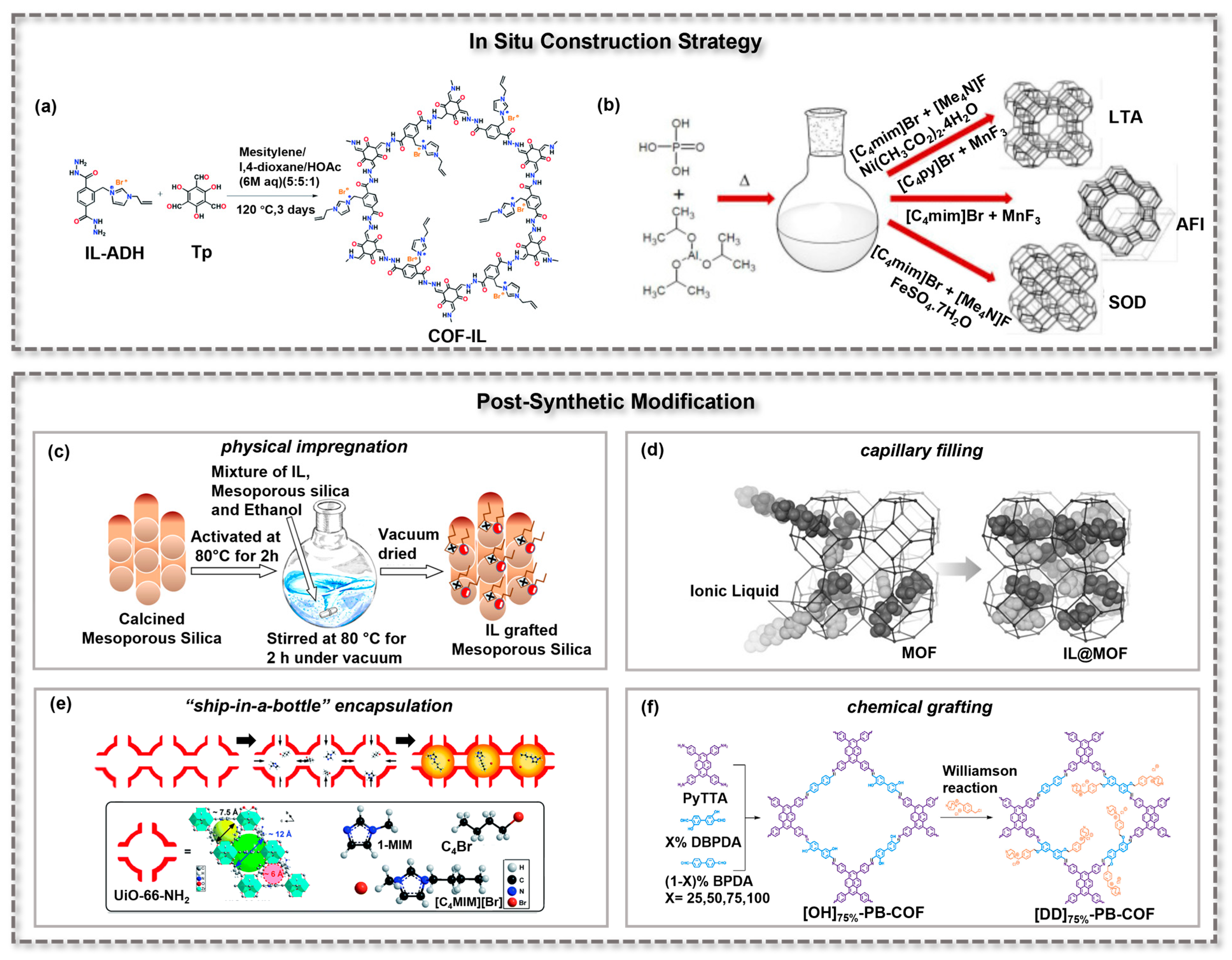
The in situ construction strategy involves introducing ILs or their precursors during the formation of porous materials. This allows them to directly participate in self-assembly, crystallization, or crosslinking processes, thereby enabling tighter structural synergy and interfacial coupling (Figure 9a,b) [150]. A defining feature of this approach is that ILs function not only as active components but also as reaction media, structure-directing agents, or catalytic species, regulating pore architecture and the local chemical environment at the molecular level [143,151]. Under solvothermal or ionothermal conditions, ILs can cooperatively modulate framework formation through electrostatic interactions, steric effects, and weak coordination interactions with inorganic or organic building units [152,153]. This method results in the stable confinement of IL species within pores or cage-like structures. Such hybrid adsorbents typically exhibit enhanced loading stability and a more uniform distribution of active sites, which is advantageous for efficient CO2 capture under low partial pressure. Furthermore, constructing polymeric IL networks via in situ polymerization or crosslinking can further suppress IL migration while improving the thermal stability and cyclic durability of the hybrid materials [154].

3.2.2. Post-Synthetic Modification

Post-synthetic modification involves introducing ILs into pre-formed porous materials through physical impregnation [145,155,156], capillary filling [146,157,158,159], “ship-in-a-bottle” encapsulation [147,160,161,162], or chemical grafting [144,163], constructing hybrid structures via pore-confined effects and interfacial interactions (Figure 9c–f). This strategy is mild, operationally flexible, and compatible with diverse porous materials, making it one of the most widely applied hybridization approaches [164]. In physical modification, ILs are typically distributed within pores as ultrathin liquid films or nanodroplets, with loading primarily governed by van der Waals forces, hydrogen bonding, and capillary effects [146,155,157,159]. This method is straightforward but may encounter IL migration or leakage under high-loading conditions. In contrast, “ship-in-a-bottle” encapsulation and chemical grafting achieve spatial confinement or strong interfacial anchoring of ILs through size matching or covalent bonding, effectively preventing leakage and deactivation during operation and significantly enhancing cycling stability [144,147,160,163]. Table 2 summarizes the advantages and limitations of various hybridization strategies for comparative reference.
As shown in Table 2, different hybridization strategies involve inherent trade-offs among IL loading, pore accessibility, and long-term stability. Among these factors, IL migration, leakage, or structural deactivation during repeated adsorption–desorption cycles remains a challenge affecting the long-term performance and practical applicability of hybrid materials [144,163,168]. Overall, in situ construction strategies are generally more effective in improving IL immobilization stability, as they enable stronger interfacial coupling and structural synergy during material formation [150]. In contrast, post-synthetic modification strategies primarily rely on pore confinement effects, capillary forces, or chemical bonding to achieve stable IL anchoring [155,159]. Among these approaches, “ship-in-a-bottle” encapsulation and chemical grafting are particularly effective in suppressing IL leakage and enhancing cycling stability [147,160].
Moreover, constructing polymeric IL networks or strengthening interfacial interactions can further reduce IL migration, thereby improving the stability and reusability of hybrid materials under harsh operating conditions [169,170,171]. On the one hand, the intrinsic stability of ILs can be enhanced through structural optimization. For example, polyprotic ILs containing multiple –OH, or –SO3H groups within the cation not only strengthen interactions with target gases but also reduce IL migration and loss during regeneration through enhanced intermolecular interactions [168]. On the other hand, introducing additional functional components can further improve the robustness of hybrid materials. For instance, bimetallic IL-hybridized zeolite adsorbents and amino-functionalized porous ILs provide additional interaction sites through synergistic multicomponent effects, thereby maintaining good cycling stability under harsh conditions [172].

4. Applications of IL Hybrid Materials in Carbon Capture

ILs can be coupled with a variety of porous materials to construct hybrid adsorbents with diverse performance characteristics. Common supports include porous silica-based materials [22,173,174,175], porous carbon materials [176,177,178], MOFs [46,179,180,181,182], and COFs [183,184,185]. These materials exhibit clear differences in pore architecture, specific surface area, surface chemistry, and mechanical and chemical stability (Table 3), which in turn determine their interaction modes with ILs, achievable loading capacities, and the resulting mass-transfer and adsorption behaviors [186,187,188,189,190]. The following sections systematically discuss the design strategies for these IL/porous hybrid materials, as well as their applications in carbon capture.

4.1. IL/Porous Silicon Hybrid Materials

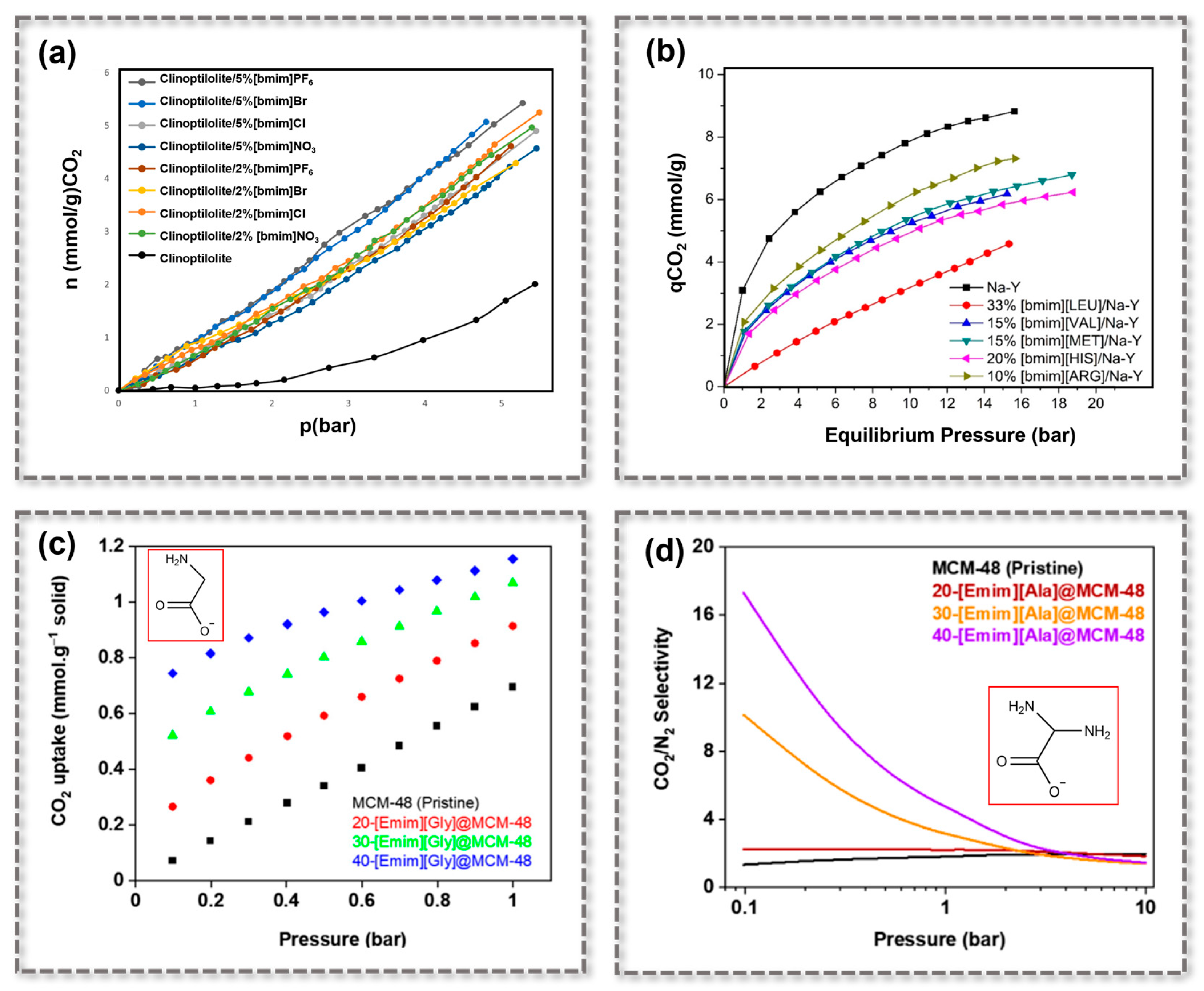
Porous silicon-based materials include microporous zeolites and ordered mesoporous silica, which differ in pore size and surface chemistry, leading to distinct IL-confined and CO2 capture behaviors [191,192,193]. Microporous zeolites, such as 13X and Na-Y, feature uniform sub-nanometer channels and exchangeable metal cations, enabling high CO2 selectivity via Lewis acid–base interactions and molecular sieving [194,195]. Mortazavi et al. incorporated 2–5 wt% [Bmim]+ ILs into natural clinoptilolite via wet impregnation [186]. The 5 wt% [Bmim][PF6] sample exhibited a 4.35-fold higher CO2 uptake than pristine zeolite at 4 bar and 298 K (Figure 10a), due to enhanced PF6-CO2 interactions and highly dispersed IL within the pores, which improved IL–CO2 interfacial contact [134,196,197]. However, the sub-nanometer pores (<1.2 nm) of microporous zeolites lead to pore blockage and diffusion limitations at higher IL loadings [198]. Sistla and Khanna reported that IL loadings above 5 wt% severely disrupt Na-Y’s pore structure [191]. For example, 3% [Bmim][LEU]/Na-Y saw its specific surface area decrease from 650 m2/g to near zero, resulting in overall CO2 uptake lower than pristine zeolite (Figure 10b). Nevertheless, IL-specific CO2 capture increased markedly; in 33% [Bmim][LEU]/Na-Y, the IL-specific uptake was approximately three times that of neat IL. These findings indicate that, in strongly confined microporous systems, zeolites primarily enhance IL intrinsic adsorption by shortening diffusion paths and modulating the local microenvironment, rather than by providing additional physical adsorption sites.
In contrast, ordered mesoporous silica, such as MCM-41, SBA-15, and MCM-48, features large pores (2–50 nm), low diffusion resistance, and abundant silanol groups, providing an ideal platform for highly dispersed ILs [199,200]. Philip and Henni loaded [Emim][Gly] and [Emim][Ala] into the 3D cubic channels of MCM-48 via wet impregnation, achieving uniform IL distribution and rapid CO2 diffusion [192]. Amino acid anions react with CO2 via -NH2 to form carbamates, governing chemisorption. At 303 K and 0.1 bar, 40 wt% [Emim][Gly]@MCM-48 exhibited a CO2 uptake of 0.74 mmol/g, ten times that of pristine MCM-48 (Figure 10c), owing to small side-chain H atoms that enable high amine density. The bulkier methyl group of [Emim][Ala] reduces surface area and suppresses N2 adsorption at the same loading. Nevertheless, CO2 chemisorption remains effective, yielding a CO2/N2 selectivity of 17 for 40 wt% [Emim][Ala]@MCM-48, far surpassing that of pristine MCM-48 (Figure 10d).
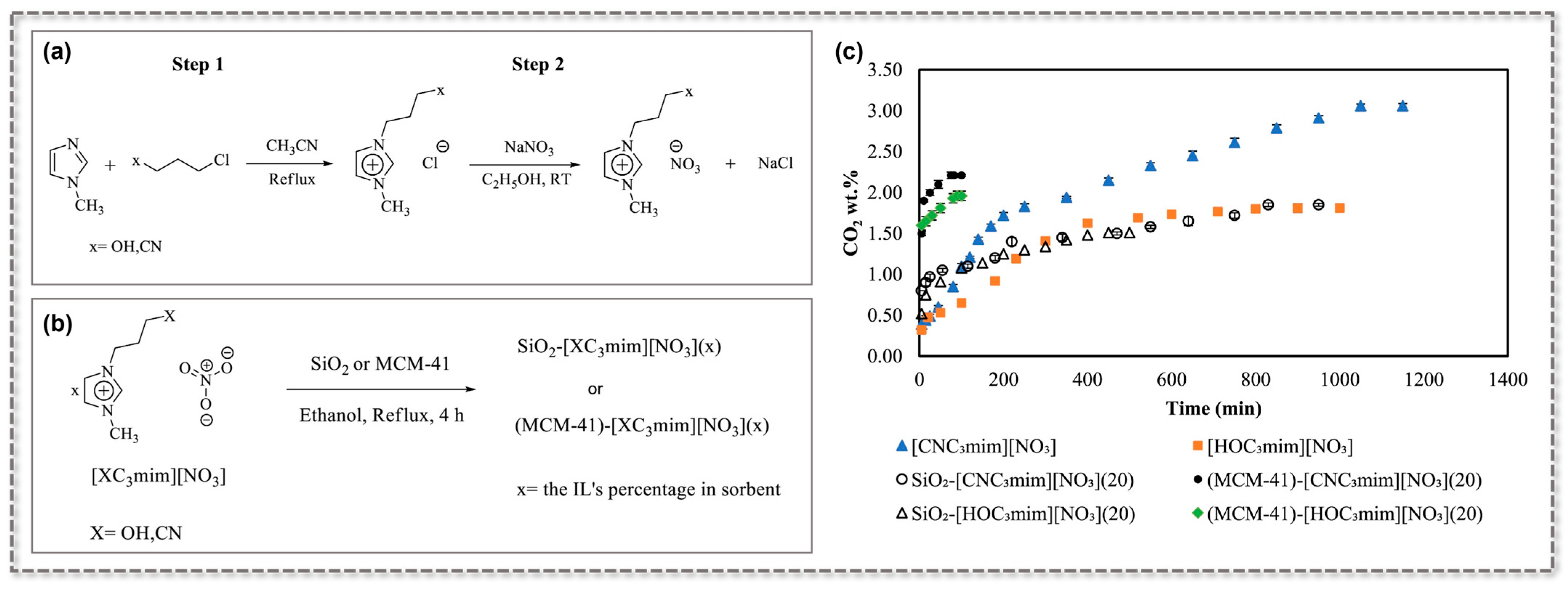
Similarly, Mirzaei compared the CO2 adsorption of hydroxyl-([OHC3mim][NO3]) and cyano-functionalized ([CNC3mim][NO3]) loaded on amorphous SiO2 and MCM-41 (Figure 11a,b) [201]. The cyano-group significantly enhanced CO2 affinity, with MCM-41-[CNC3mim][NO3] achieving 2.21 wt% uptake at 298 K and 1 bar, exceeding the 1.96 wt% observed for the hydroxyl analog (Figure 11c), due to the -CN group acting as a Lewis base. Consistent with the findings of Philip and Henni, increasing IL loading reduced surface area and N2 physisorption but improved CO2 selectivity. For instance, increasing [OHC3mim][NO3] loading from 10% to 40% raised the CO2/N2 selectivity of SiO2-based adsorbents from 15 to 25. These results indicate that functional group tuning combined with optimized IL loading enables mesoporous silica-based hybrid adsorbents to achieve both high CO2 uptake and selectivity.
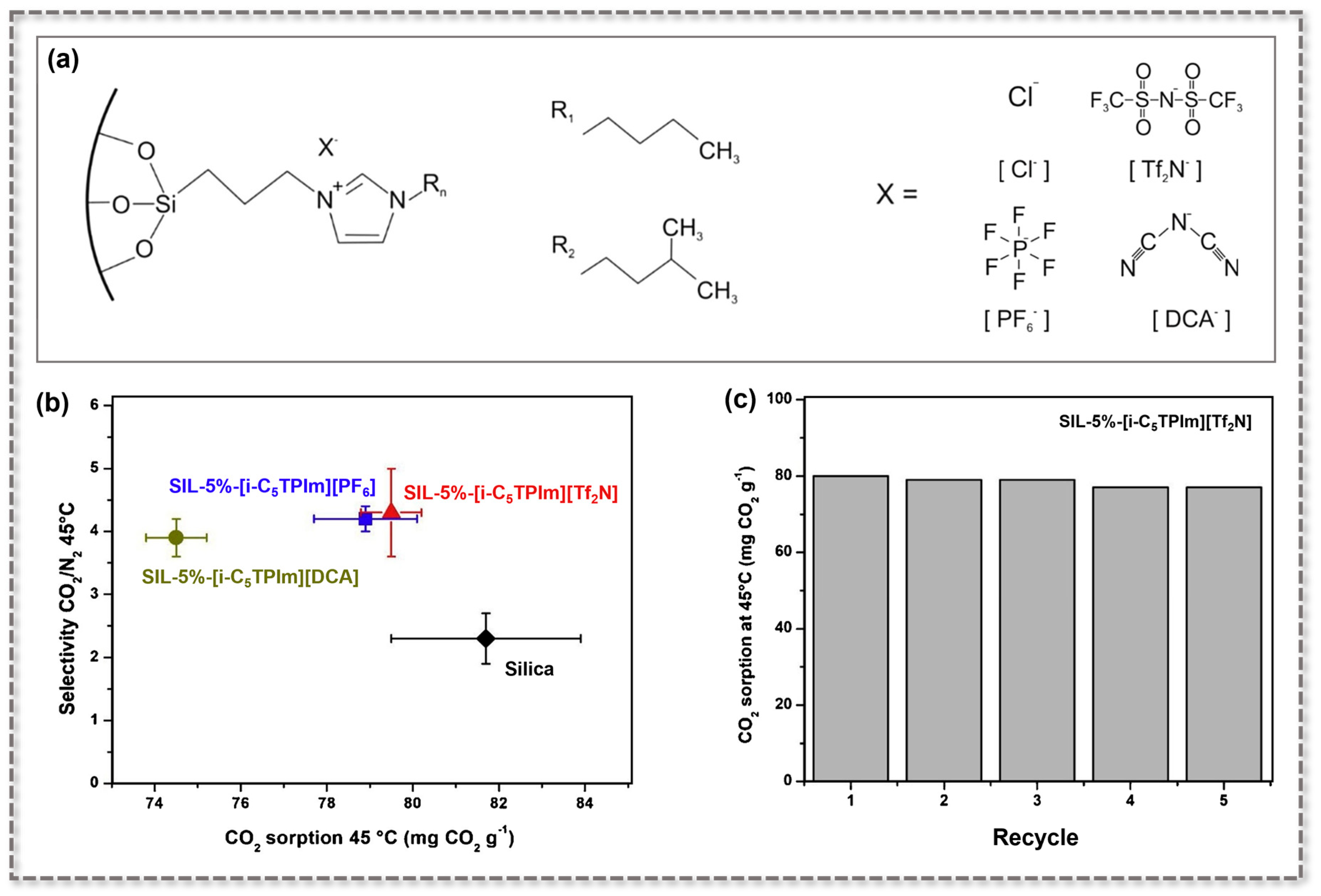
To achieve efficient utilization and long-term stability of IL functional sites, chemical grafting has become an effective strategy for constructing mesoporous silica/IL hybrids [200]. In this approach, silane-functionalized IL cations are covalently anchored to surface silanol groups, ensuring uniform, high-density immobilization and suppressing IL leaching during operation. Duczinski et al. grafted -Si(OCH2CH3)3-functionalized imidazolium ILs ([C4TPIm][Cl], [i-C5TPIm][Cl]) onto mesoporous silica (Figure 12a) and tuned CO2 affinity through anion exchange [187]. At low loadings of approximately 5 wt%, pore accessibility is maintained while maximizing functional-site availability, resulting in CO2 uptake comparable to pristine silica. SIL-5%-[i-C5TPIm][NTf2] achieved 79.50 mg/g, compared with 81.70 mg/g for bare silica. Fluorinated anions such as [NTf2] and [PF6] double CO2/N2 selectivity at low loadings owing to strong CO2 affinity, large free volume, and the high electronegativity of fluorine, without compromising capacity (Figure 12b). Moreover, branched cation chains, for example, isopentyl [i-C5mim]+ versus linear butyl [mim]+, further increase free volume and enhance selectivity. Cycling tests confirm the excellent regeneration stability of these grafted hybrids (Figure 12c).

4.2. IL/Porous Carbon Hybrid Materials

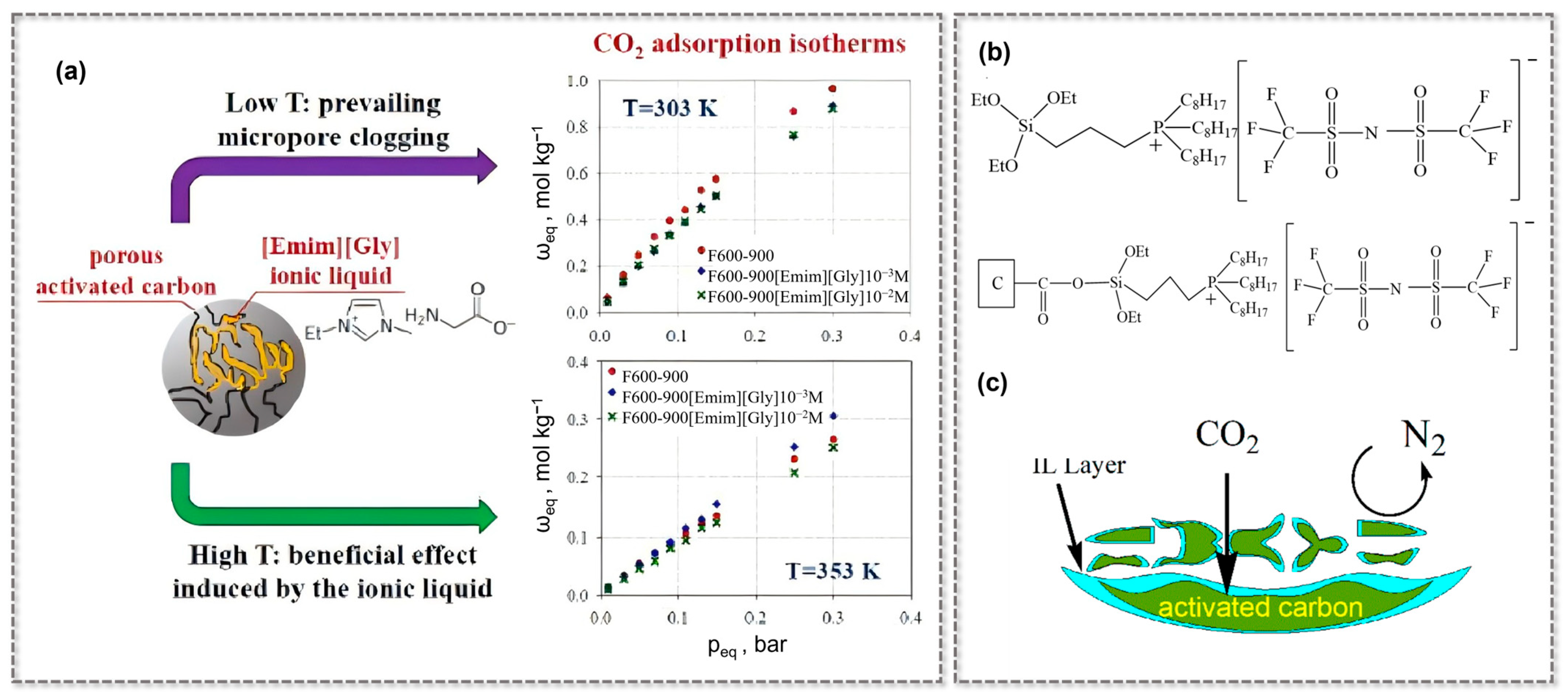
Porous carbon materials, including activated carbon (AC) [202,203], graphene [204,205], carbon nanotubes (CNTs) [206,207], and carbon molecular sieves, are widely utilized for CO2 capture owing to their well-developed pore structures, large surface areas, and excellent stability [208,209]. Among them, AC is particularly attractive due to its low cost and broad availability. Erto et al. loaded the physically adsorbing [Hmim][BF4] and the chemically reactive [Emim][Gly] onto two ACs with markedly different pore architectures [188]. The results indicate that ILs preferentially occupy micropores, leading to significant pore blockage, especially in the micropore-rich F600-900 AC sample, and consequently lower CO2 uptake for all modified samples compared with pristine carbons at 303 K (Figure 13a). When the temperature was increased to 353 K, the -NH2 group of the glycinate anion in [Emim][Gly] chemically interacted with CO2. At low IL loadings, the modified samples outperformed the unmodified carbons on both supports, demonstrating that introducing chemisorption sites while preserving pore accessibility is critical for performance enhancement. [Hmim][BF4], lacking reactive functional groups, was unable to compensate for the capacity loss caused by micropore blockage, even at elevated temperatures.
To address the limitations of micropore blockage on IL performance, He et al. compared impregnation and grafting methods for loading [P8883][NTf2] onto AC, as shown in Figure 13b [210]. The results showed that the impregnation method tends to form a relatively thick IL film, which enhances selectivity but severely obstructs the pore channels (Figure 13c). In contrast, grafting preserves the pore structure even at low IL loadings, enabling higher adsorption capacity and faster mass transfer.
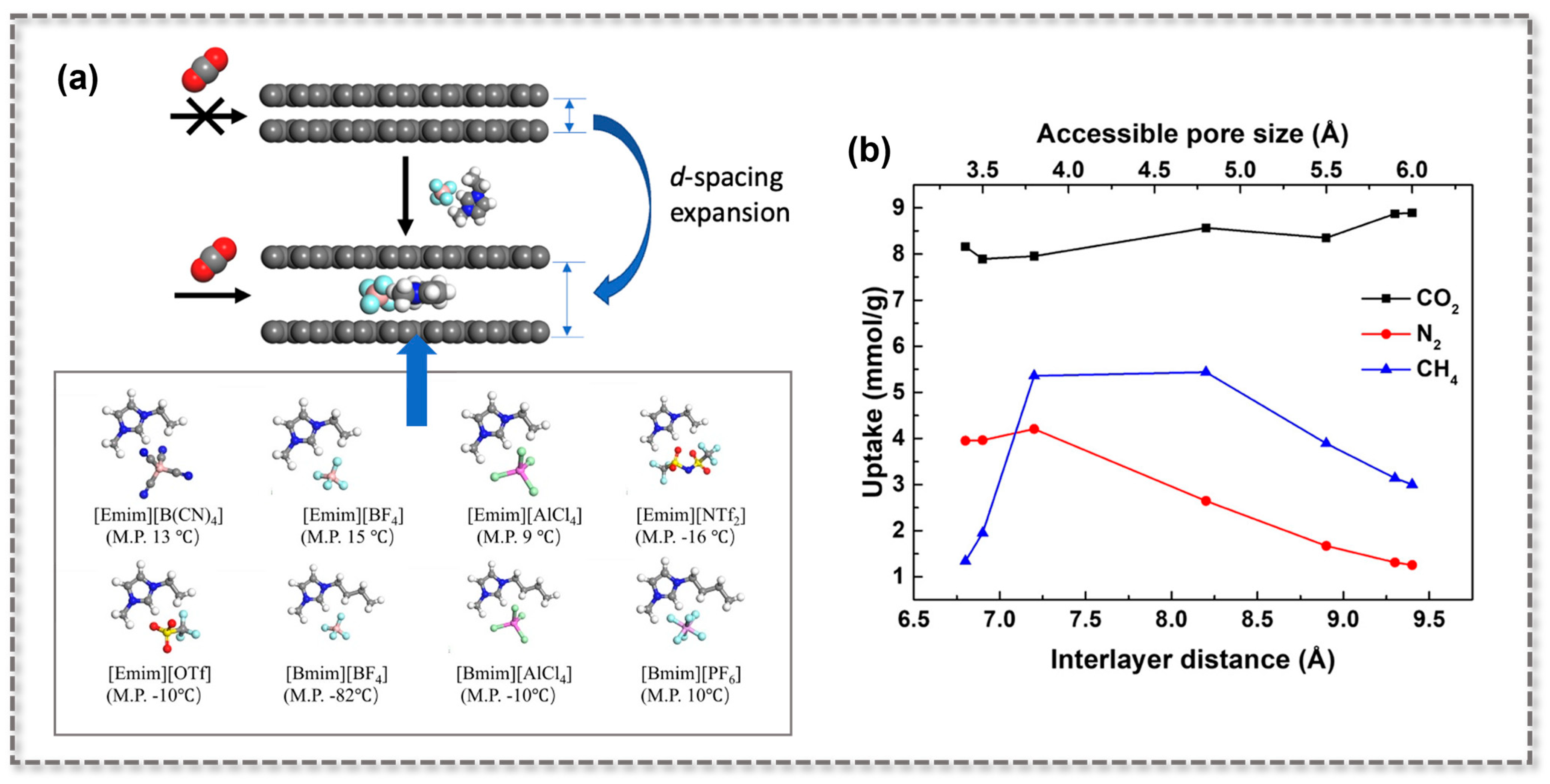
From the above studies, it is clear that severe micropore blockage induced by IL incorporation in AC limits pore accessibility and mass transfer. Graphene, with an open, two-dimensional architecture, alleviates pore blocking and enables well-defined interlayer channels [211]. At the same time, its structural robustness and confinement capabilities make it an ideal matrix for stabilizing ILs in membrane-based systems [212,213,214]. In regulating the interfacial microenvironment through anion engineering, Wang et al. inserted ILs as interlayer spacers between graphene sheets to construct tunable slit-like pores [141]. Density functional theory (DFT) calculations and grand canonical Monte Carlo (GCMC) simulations revealed that the accessible pore size is primarily determined by the anion size, following the order [BF4] < [PF6] < [TfO] < [AlCl4] ≈ [NTf2] < [B(CN)4] (Figure 14a). Because the imidazolium cations adopt a flat orientation between graphene layers, their contribution to the interlayer spacing is limited. Therefore, the anions dominate the regulation of both the interlayer distance (6.8–9.4 Å) and the accessible pore size (3.4–6.0 Å). Adsorption simulations indicate that CO2 uptake slightly increases with pore size, whereas N2 adsorption decreases significantly. In contrast, CH4, whose molecular diameter of approximately 4.0 Å matches the pore size, exhibits a maximum adsorption capacity at this dimension due to optimal van der Waals interactions with the upper and lower graphene layers (Figure 14b). These results demonstrate that anion engineering enables nanoscale pore-size tuning, thereby optimizing CO2/N2 and CO2/CH4 separation performance and offering a promising strategy for the rational design of highly selective carbon capture materials.
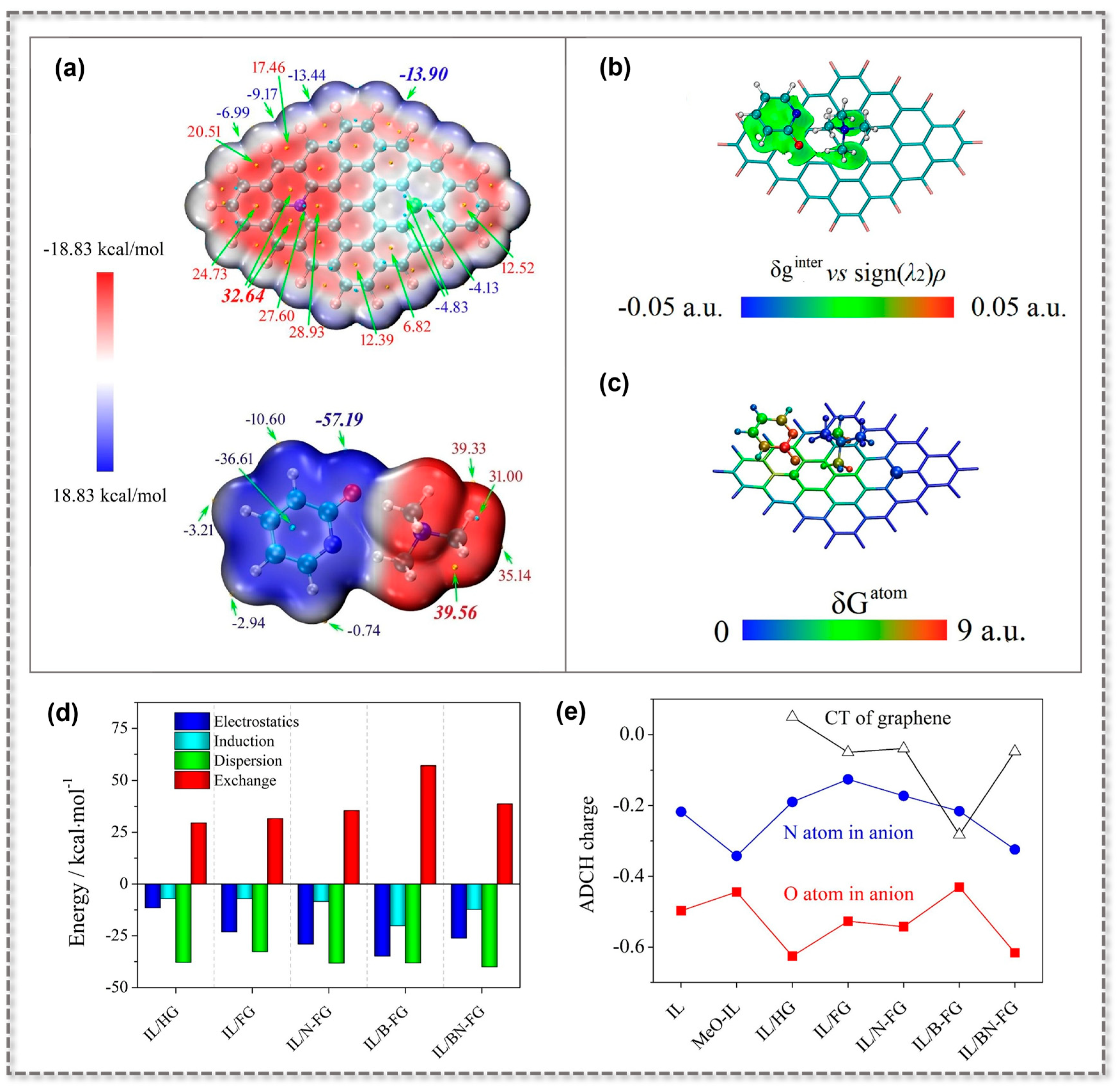
Building upon the above work, Zhang et al. elucidated how graphene supports regulate the intrinsic properties of ILs from an electronic structure perspective [215]. Distinct from the geometrical pore modulation via interlayer confinement reported by Wang et al., they showed that fluorinated and heteroatom-doped graphene can directly modulate cation–anion interactions through surface electrostatic potential redistribution and charge transfer, while simultaneously reshaping the charge distribution at anionic active sites to enhance intrinsic CO2 affinity (Figure 15a). DFT calculations were conducted to systematically examine the interfacial interactions and electronic responses of the hydroxypyridine-based [TMA][HPy] on hydrogen-terminated graphene (HG), fluorinated graphene (FG), and boron–nitrogen co-doped fluorinated graphene (BN-FG). Among these, BN-FG exhibits the strongest modulation effect, markedly weakening hydrogen-bonding and coulombic interactions between ion pairs, with the binding energy decreasing from −100.42 to −81.89 kcal/mol, thereby promoting a shift from tightly associated to more dissociated ion pairs (Figure 15b,d). This is accompanied by a simultaneous increase in negative charge density at both N and O sites of the anion, enhancing the electron-donating capability of CO2 binding sites. This behavior contrasts with conventional anion substitution strategies, which typically involve a trade-off in charge distribution between N and O sites. Conversely, the doped graphene system enables concurrent enhancement at both sites, improving adsorption activity while maintaining a balanced charge distribution (Figure 15c,e).
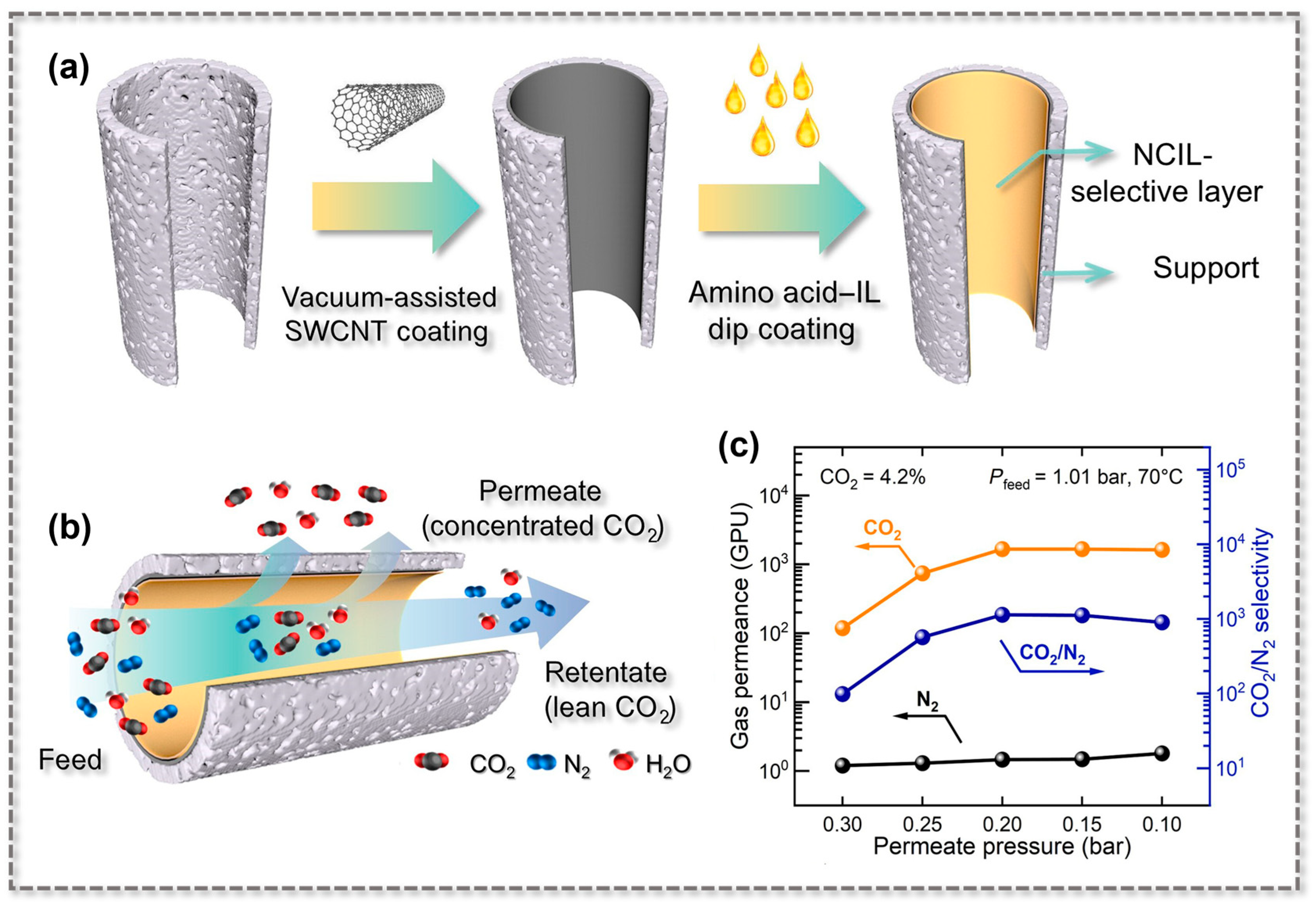
In addition, CNTs, composed of rolled graphene sheets, exhibit excellent mechanical properties and can efficiently capture CO2 over a temperature range of 273–473 K, with adsorption capacities nearly twice those of AC, making them attractive for gas adsorption under specific conditions [216,217,218]. Zeng et al. systematically investigated the CO2 adsorption and separation performance of IL-modified CNTs, with particular focus on stability under humid conditions [219]. The study revealed that water molecules form hydrogen bonds with the IL and interact with the CNT surface, occupying adsorption sites. Water uptake increases with pressure, leading to a significant decrease in CO2 adsorption at high pressures. Against this backdrop, Wang et al. proposed and fabricated a nanoconfined IL membrane composed of a single-walled CNT nanoscale confined network combined with highly selective amino acid ILs (Figure 16) [42]. By constructing an ultrathin transport layer with controllable thickness, open structure, and strong confined effects, the membrane achieves significantly enhanced CO2 permeance of up to 1654 GPU and CO2/N2 selectivity of up to 1132, while effectively addressing the liquid loss and poor stability issues that affect conventional supported IL membranes under high pressure and long-term operation. Although CNTs and graphene demonstrate outstanding CO2 adsorption performance, their strong intermolecular cohesion results in high separation and purification costs, limiting some of the industrial applications [220]. Therefore, further optimization of material synthesis and operational protocols is required to enable practical industrial deployment.

4.3. IL/MOF Hybrid Materials

MOFs, constructed from inorganic metal nodes and multidentate organic ligands, possess high crystallinity, ultrahigh surface area, tunable pore structures, open metal sites, and abundant functional sites, making them highly promising materials for CO2 adsorption and separation [182,221]. Representative structures such as MIL-53 [222,223], ZIF-8 [129], HKUST-1 [224], MOF-74 [225,226], and UiO-66 [227] have demonstrated considerable CO2 capture performance. However, pristine MOFs still face three major limitations in CO2 capture, particularly under low partial pressure conditions. First, many MOFs exhibit high water sensitivity; H2O can competitively occupy open metal sites or induce framework hydrolysis, thereby reducing adsorption capacity and cyclic stability [228,229]. Second, in some MOFs, rotatable ligand groups (e.g., -CH3) allow pore expansion during adsorption, weakening the molecular sieving effect for CO2/N2 separation [230]. Third, most MOFs rely primarily on physisorption, and their interaction differences with N2 and CH4 are relatively small, leading to a sharp decline in adsorption capacity under DAC conditions (Table 4, entries 1–3) [231]. Due to the designability of IL structure, introducing ILs with carbon capture sites into MOFs via impregnation, confinement, or grafting has been regarded as an effective strategy to enhance carbon capture performance [232,233]. This incorporation can improve CO2 adsorption by regulating pore structure and interfacial interactions (Table 4, entries 4–11). In addition, longer alkyl chains impart greater hydrophobicity, thus improving the material’s water vapor tolerance [234,235].
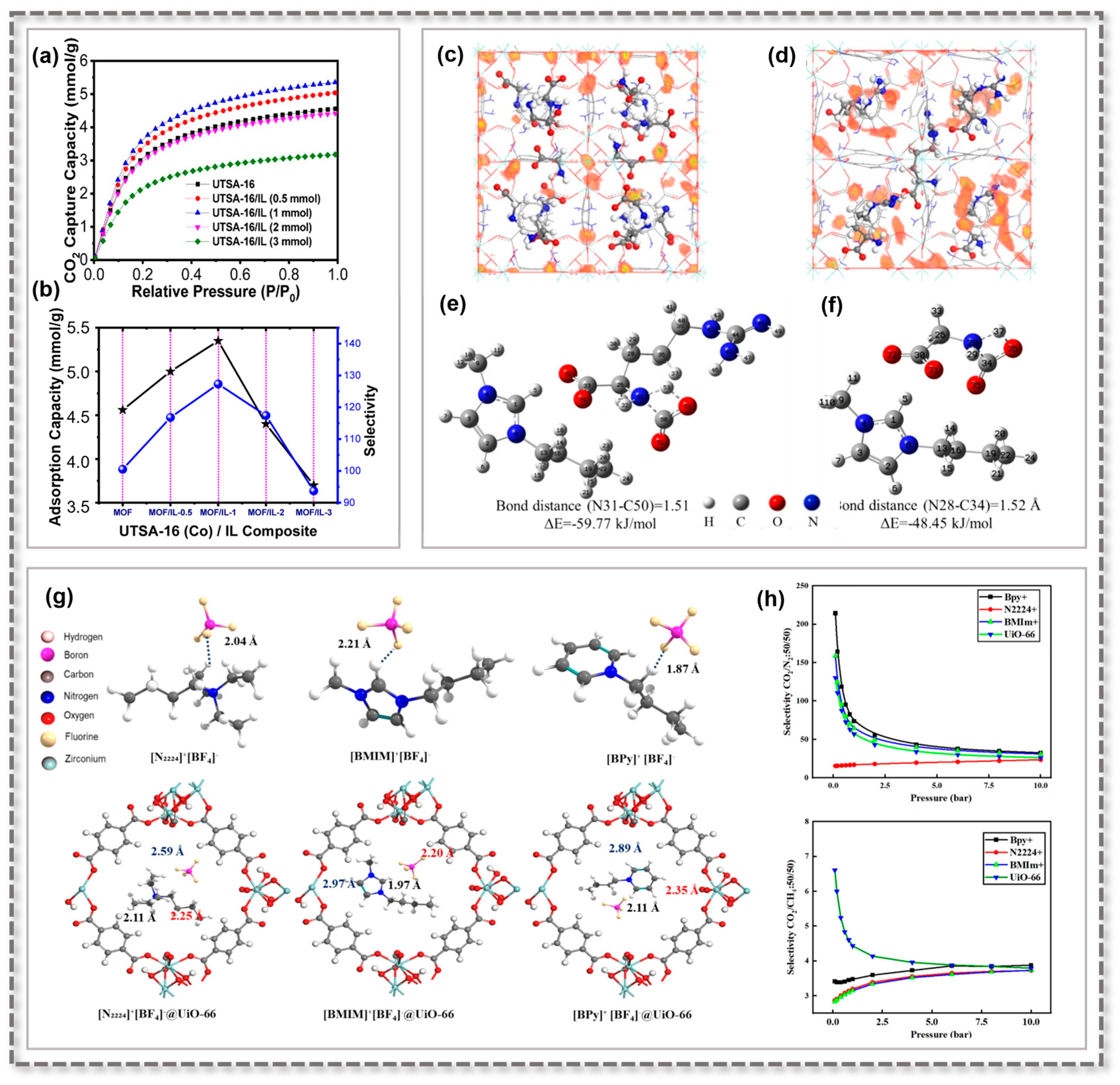
Gaikwad et al. incorporated [Bmim][BF4] into UTSA-16(Co) via a microwave-assisted solvothermal method. A moderate IL loading of 1 mmol markedly improves CO2/N2 selectivity and enhances CO2 uptake (Figure 17a) [240]. However, higher loadings of 2 mmol or more result in pronounced pore filling, which partially blocks the framework, reduces the BET surface area from 792 to 216 m2/g, and decreases the pore volume by approximately 62%, ultimately lowering the CO2 adsorption capacity (Figure 17b). By comparison, Zhao et al. demonstrated that the chemical reactivity of ILs, when combined with the ultramicropores of MOFs, effectively mitigates pore blockage [138]. [Bmim]Gly and [Bmim]Arg were impregnated into NH2-UiO-66(Zr) and NH2-MIL-125(Ti) at loadings of 10–70 wt%. At 50 wt%, the amino-acid-based ILs preserved pore accessibility while generating abundant ultramicropores below 0.65 nm that closely matched the kinetic diameter of CO2 (Figure 17c,d). These confined pores strengthen physical adsorption, while the -NH2 groups in Gly and Arg reversibly form carbamates, producing a synergistic effect of chemical adsorption and confinement (Figure 17e,f). The guanidinium-containing Arg, with its higher basicity and greater number of active sites, enables a CO2 uptake of 2.93 mmol/g at 0.0005 bar, along with excellent CO2/N2 selectivity.
Beyond anion effects, the structure of IL cations also plays a crucial role in determining CO2 separation performance. Kumar et al. investigated the influence of different IL cations, imidazolium, pyridinium, and quaternary ammonium, incorporated into UiO-66 with BF4 anion, using DFT and grand canonical Monte Carlo (GCMC) simulations [189]. Their results reveal that IL confined within UiO-66 induces ion-pair rearrangement while largely preserving the MOF (Figure 17g). Aromatic cations enhance CO2 adsorption through stronger interfacial and π–π interactions. Aliphatic quaternary ammonium cations exhibit lower selectivity due to steric hindrance (Figure 17h). This trend reflects the importance of both IL anions and cations as key parameters governing interfacial interactions and CO2 separation performance in IL/MOF hybrid adsorbents, providing important guidance for the rational molecular design of advanced CO2 capture materials.
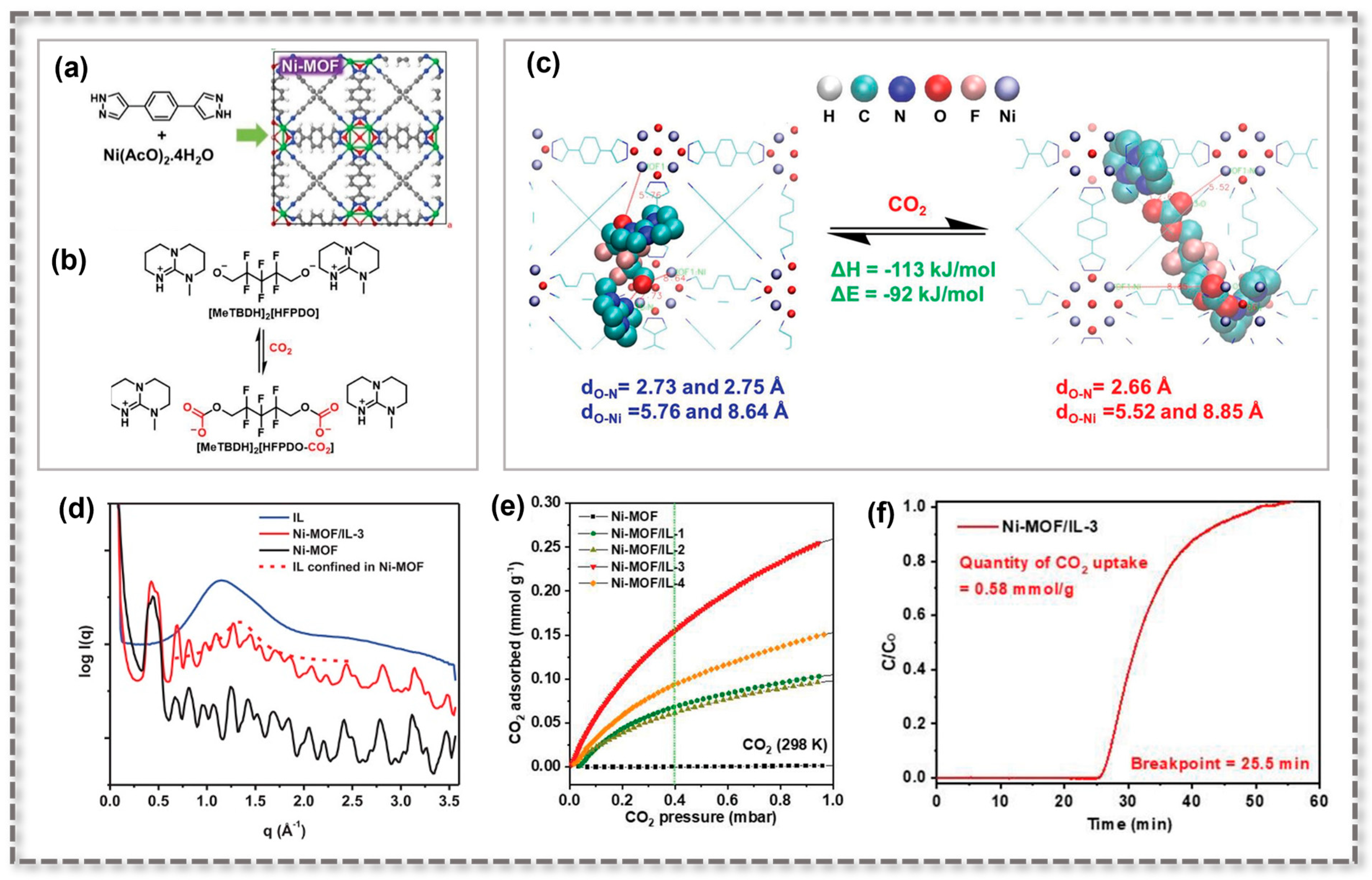
Qiu et al. further demonstrated that integrating strong basics with highly stable MOFs can overcome key limitations in DAC [127]. In their work, a SIL, [MeTBDH]2[HFPDO], was incorporated into a Ni-based MOF that remains structurally stable under strongly basic and high-ionic-strength conditions (Figure 18a). The deprotonated alkoxide sites of the [HFPDO]2− anion react with CO2 to form carbonate adducts, providing a strong chemisorption pathway (Figure 18b). Meanwhile, the SIL is uniformly confined within the MOF nanocavities, increasing the reaction ΔH from −87.8 to −113 kJ/mol, indicating that the confined environment significantly strengthens IL–CO2 interactions (Figure 18c,d) [40]. Consequently, the SIL-doped Ni-MOF exhibits markedly enhanced CO2 uptake in the low-pressure region, particularly at 0.4 mbar (Figure 18e). The Ni-MOF/IL-3 exhibits a CO2 uptake of 0.58 mmol/g at 400 ppm CO2 in fixed-bed experiments, more than 14 times higher than that of the pristine MOF (Figure 18f). In addition, the adsorbent displays minute-scale adsorption–desorption kinetics, reversible regeneration at a relatively low temperature at 353 K, and excellent cycling stability, highlighting the great potential of confinement-enhanced chemisorption for DAC applications.
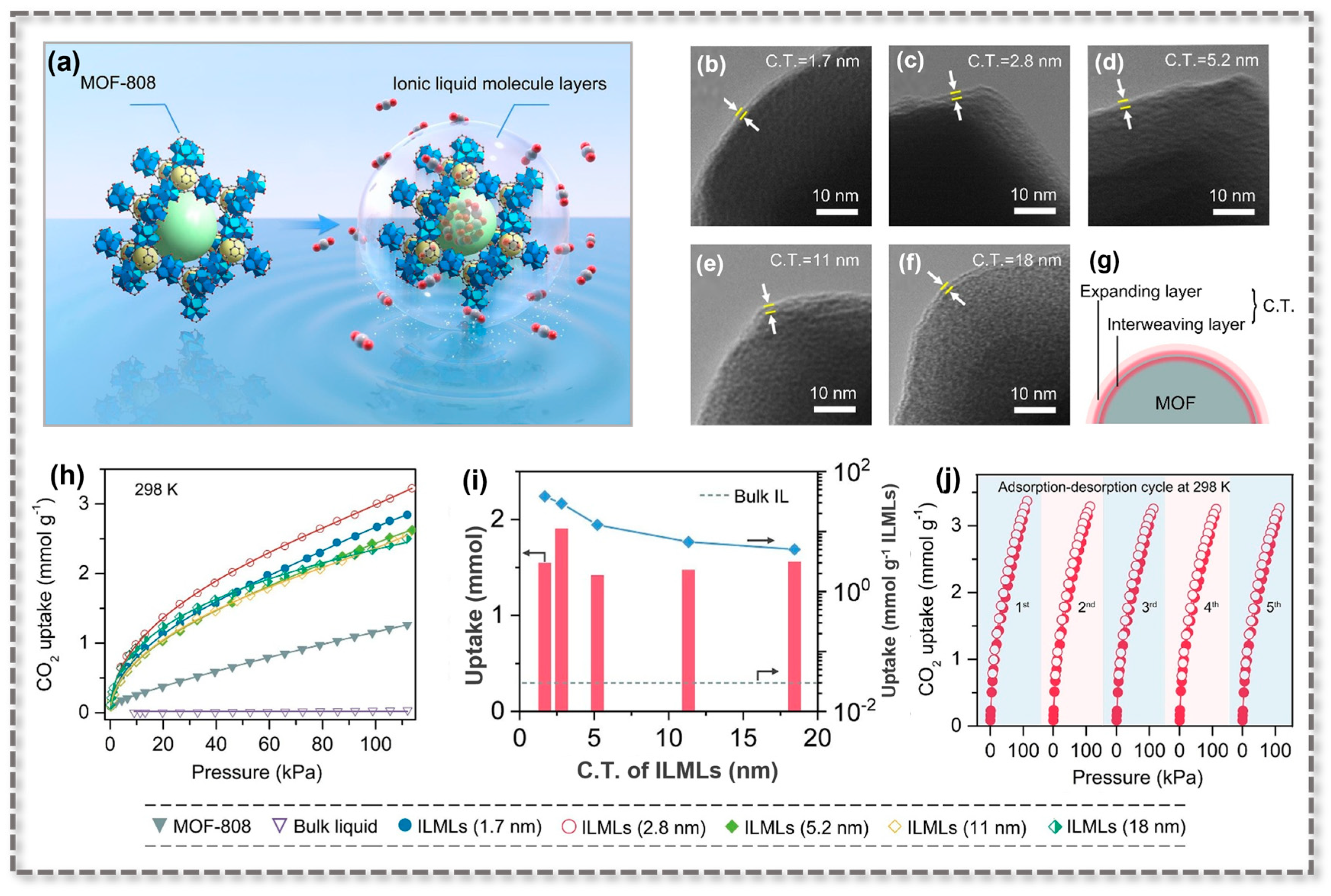
In addition, distinct from conventional encapsulation or pore-filling strategies, Zhao et al. proposed an ingenious wrapping–coupling strategy to circumvent pore blockage (Figure 19a) [241]. Instead of introducing the [Bmim][TFSI] into the internal cavities of MOF-808, the [Bmim][TFSI] was impregnated onto the external surface of MOF-808 from a methanol solution, forming a molecular IL layer with a precisely tunable thickness, as an “IL gate”. The outer IL layer enriches CO2 through Lewis acid–base and van der Waals interactions, while the intact internal cage-like pore structure of MOF-808 serves as the primary CO2 storage space. These components are tightly coupled through a mildly interpenetrated interfacial layer (Figure 19b–g). Notably, when the IL layer thickness is approximately 2.8 nm, the composite achieves a high CO2 uptake of 3.00 mmol/g at ambient temperature (Figure 19h). This remarkable enhancement arises from the dramatically increased CO2 capacity of the confined IL, which is more than three orders of magnitude higher than that of bulk IL, specifically over 1000-fold (Figure 19i). This effectively overcomes the mass-transfer limitations typically associated with gas–liquid interfaces in conventional IL. Moreover, the hybrid system enables complete CO2 desorption at room temperature, allowing nearly zero-energy regeneration during cyclic operation (Figure 19j).

4.4. IL/COF Hybrid Materials

COFs are crystalline, porous organic materials constructed from light elements (e.g., C, H, O, N, and B) linked by strong covalent bonds such as B-O, C-N, and C=N [242]. Since the first report of COF materials by Yaghi’s group in 2005, this class of materials has experienced rapid development over the past two decades [243]. In terms of performance, COFs exhibit structural tunability, facile surface functionalization, large specific surface area, ordered pore structures, and high porosity, features that are comparable to those of MOFs [244,245,246]. However, owing to their covalently bonded frameworks, COFs generally display superior thermal and chemical stability compared with MOFs [247,248]. For example, TpPa-1 COF can function as a hydrophobic selective sieve, reducing interference caused by the preferential adsorption of water on CO2-affinitive sites [249]. This excellent stability confers clear advantages on COFs for recyclability and long-term applications. Nevertheless, the absence of metal active sites and the relatively large average pore size of COFs may limit their gas capture capacity and separation performance. Despite these limitations, the robust framework structures of COFs, together with their abundant reactive organic functional groups and structural building units, offer versatile opportunities for the incorporation and immobilization of ILs, thereby expanding the possibilities for the construction of IL/COF materials [250,251].
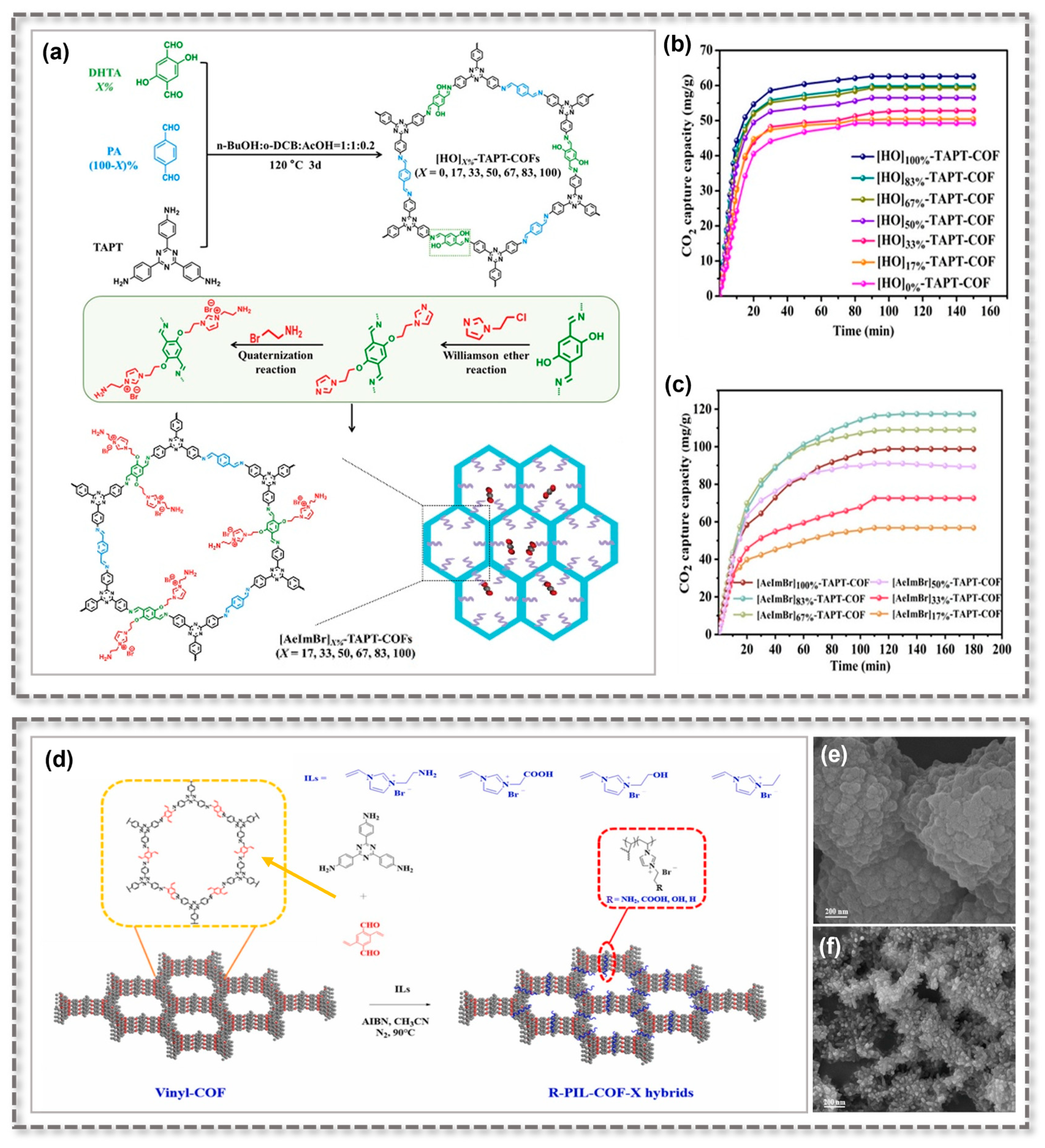
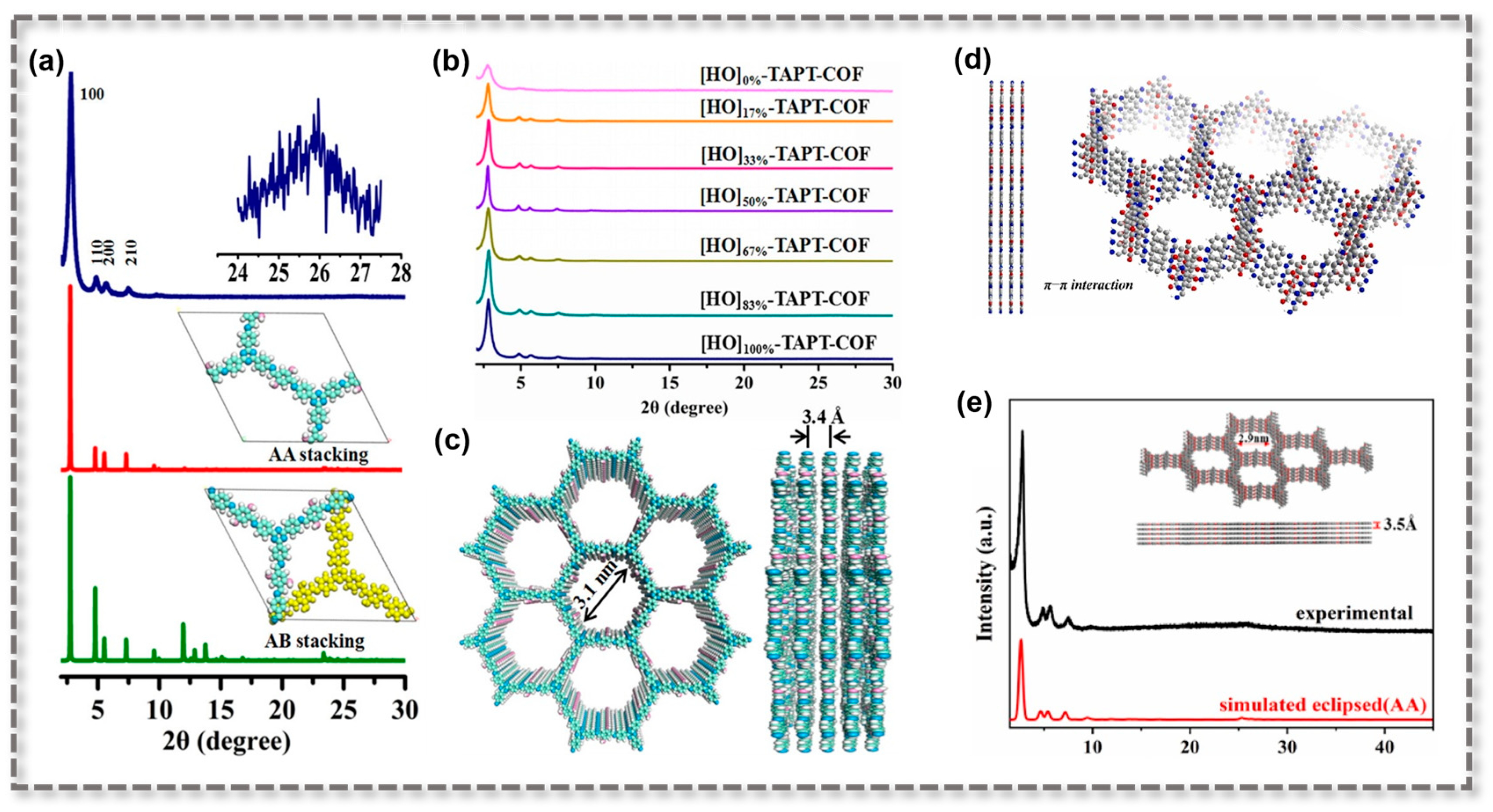
For example, Yin et al. adopted a post-modification strategy to regulate the density of phenolic hydroxyl groups on the COF pore walls, thereby enabling controllable grafting of ILs within the channels (Figure 20a) [190]. TAPT was condensed with DHPA and TA at different ratios to produce a series of [HO]X%-TAPT-COFs with tunable phenolic hydroxyl densities. The IL precursor [AeEIm][Br], containing a bromoethyl group, was subsequently anchored to pore-wall -OH sites via Williamson etherification and further quaternized to form an amino-functionalized imidazolium IL. By varying the -OH content, the spatial density and distribution of IL species within the pores could be precisely regulated. As the phenolic hydroxyl content in [HO]X%-TAPT-COFs increased from 0% to 100%, the CO2 adsorption capacity rose from 49.2 to 62.6 mg/g, mainly due to the increased specific surface area and the affinity of triazine units for CO2 (Figure 20b). After NH2-IL grafting, the CO2 uptake of [AeImBr]X%-TAPT-COFs increased further but exhibited a volcano-type trend. For instance, the CO2 adsorption capacity of [AeImBr]83%-TAPT-COF increased from 62.6 mg/g for the precursor to 117.4 mg/g (Figure 20c). Under the conditions tested, moderate IL functionalization introduces additional active sites while maintaining pore accessibility, whereas excessive grafting blocks the channels and reduces adsorption performance.
Compared with point-like grafting on pore walls, Chen et al. introduced polymerization sites into the COF, transforming IL immobilization from discrete grafting into chain-like structures and enabling molecular-scale crosslinking between the COF and PILs [144]. A vinyl-containing DVTP monomer was incorporated during COF synthesis to distribute polymerizable double bonds along the pore walls uniformly (Figure 20d). Subsequent in situ free-radical polymerization of vinyl-imidazolium IL monomers generated an interpenetrating polymeric IL network within the channels, forming a “ship-in-a-bottle” architecture. This design creates hierarchical micro–meso–macroporous structures while chemically integrating polymeric IL chains with the COF (Figure 20e,f), thereby facilitating CO2 diffusion and adsorption. Owing to the strong polarity of amino-functionalized IL monomers, CH2NH2-PIL-COF-45% achieves a CO2 uptake of 59.5 mg/g at 1 bar.
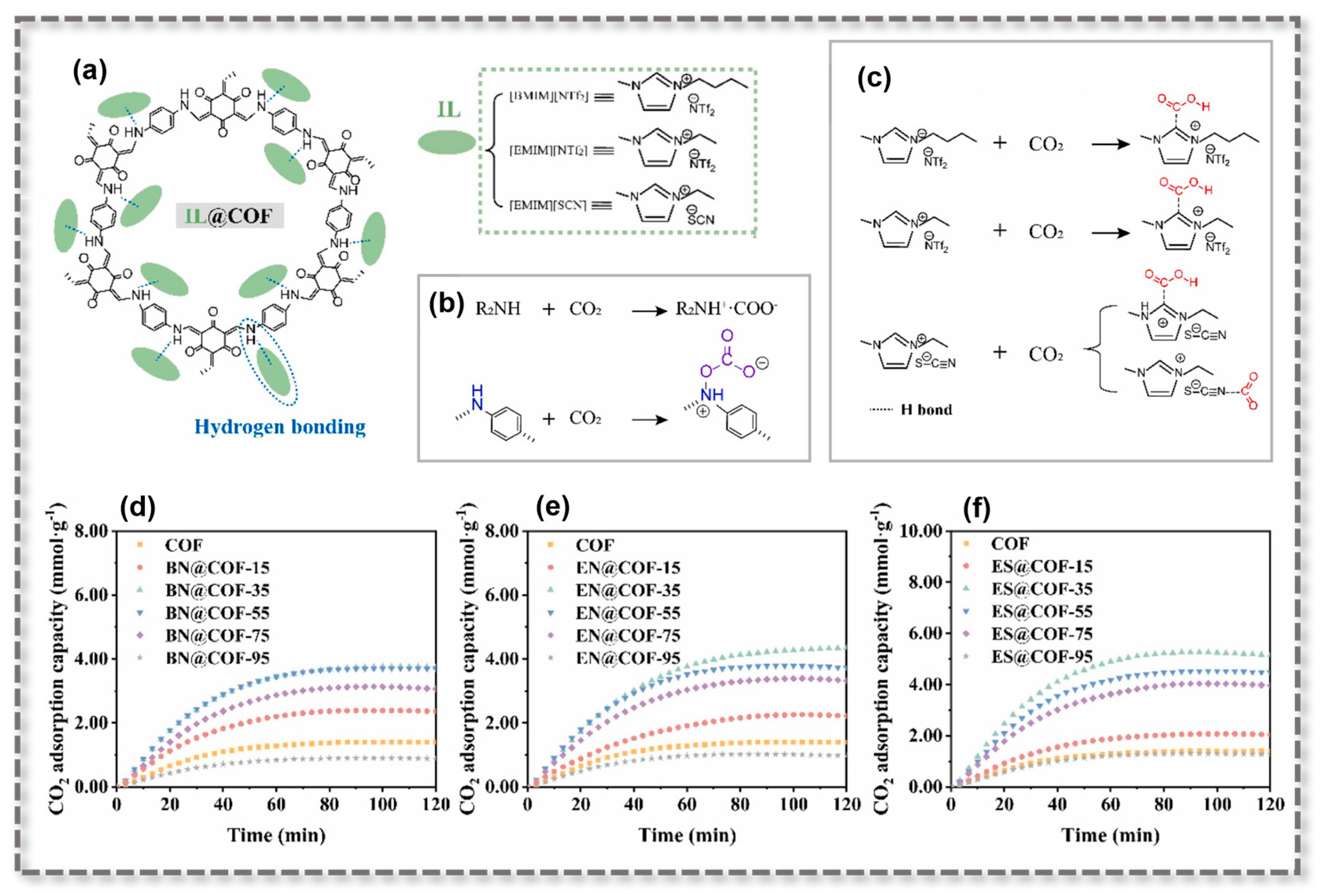
Beyond covalent modification strategies, Zheng et al. introduced an IL@COF coupling mode based on non-covalent confined and hydrogen-bond networks, expanding IL immobilization mechanisms in COF channels [252]. Specifically, ILs with multiple hydrogen-bond donors or acceptors, including [Bmim][NTf2], [Emim][NTf2], and [Emim][SCN], were incorporated into TpPa-1 COFs featuring uniform pores and polar functional groups via post-synthetic impregnation (Figure 21a). The ILs form stable hydrogen bonds with pore-wall C=O and C-N sites, enabling effective confinement without covalent bonding while preserving crystallinity and pore connectivity. This hydrogen-bond-mediated environment enhances CO2 adsorption potential compared with physisorption and promotes carbamate formation by activating lone-pair-rich nitrogen atoms as nucleophilic sites (Figure 21b). CO2 affinity is largely dictated by the anion, whereas the cation indirectly influences adsorption via viscosity, molecular size, and pore accessibility (Figure 21c) [253,254]. At low loadings of 15 wt%, ILs only partially penetrate pores, with higher viscosity [Bmim][NTf2] mainly on the surface, providing initial adsorption sites, yielding higher uptake for BN@COF-15 (Figure 21d–f). At higher loadings of ≥35 wt%, pore filling increases diffusion resistance, and lower viscosity [Emim][NTf2] exhibits superior kinetics. Theoretical calculations indicate that [SCN] binds CO2 more strongly than [NTf2], displaying pronounced chemisorption behavior. Overall, ES@COF-35 achieves the highest CO2 adsorption capacity and selectivity in this series.
Notably, the COF employed in the IL-introduction strategies described above predominantly adopts a two-dimensional AA-stacked architecture (Figure 22), the typical structural motif of many 2D COFs. This configuration aligns adjacent layers to generate ordered one-dimensional channels, providing an ideal platform for the confined immobilization and functional integration of ILs [255,256,257]. The resulting nanopores spatially regulate the distribution of ILs and suppress aggregation and leaching. At the same time, tunable pore-wall functionalities such as -OH, -NH2, and vinyl groups enable chemical grafting, hydrogen bond confinement, or in situ polymerization [258]. Such structural features not only maintain high porosity but also enhance CO2 affinity through the synergistic coupling of confinement and interaction. Nevertheless, post-synthetic IL incorporation may perturb the COF and compromise structural stability [259,260]. Therefore, developing facile construction strategies that balance framework integrity and CO2 capture performance is essential to advance practical IL–COF hybrid materials.
After systematically discussing the design strategies and CO2 capture performance of IL hybrid systems based on silica, carbon materials, MOFs, and COFs, it becomes evident that different porous supports possess distinct advantages and limitations with respect to confinement effects, interfacial interactions, mass-transfer behavior, and structural stability. To more clearly compare the structural features and performance differences among these material systems, a systematic comparative summary is provided in Table 5.

5. Life-Cycle Assessment and Techno-Economic Analysis

IL hybrid porous materials show considerable promise for CO2 capture. However, their practical deployment depends not only on intrinsic material performance but also on life-cycle sustainability and system-level economic feasibility [261,262]. The high cost of IL synthesis, the complexity of hybrid material fabrication, and limited long-term stability may offset their performance advantages when evaluated across the entire life cycle [263,264]. Therefore, a comprehensive assessment of their sustainability at the system level is essential.

5.1. Life-Cycle Environmental Impacts

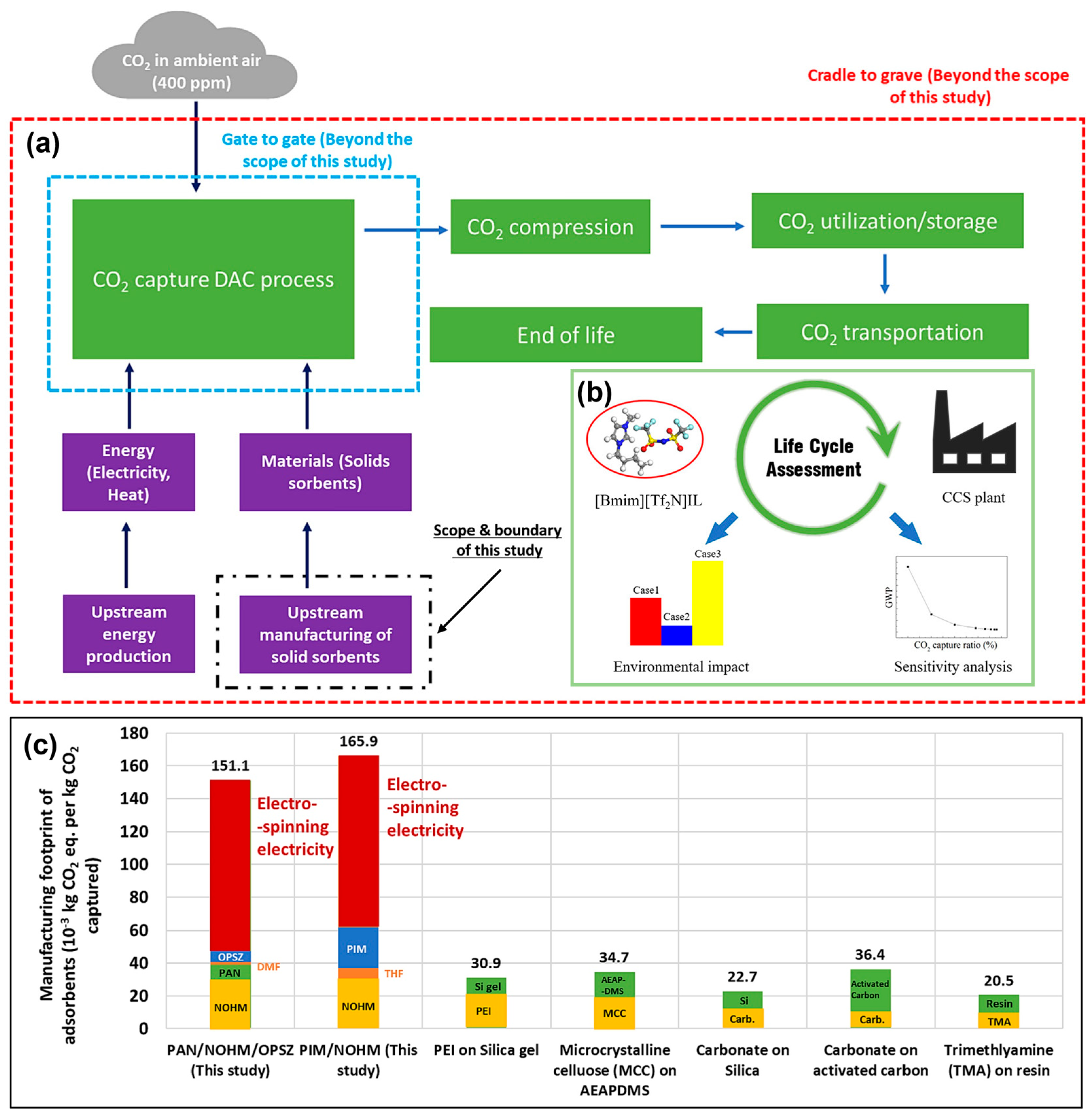
During raw material acquisition and synthesis, the green preparation of s represents a major bottleneck in their life-cycle assessment (LCA) [265,266,267]. A LCA of the carbon capture and storage process based on [Bmim][NTf2] conducted by Zhang showed that solvent production dominates the overall environmental impact, contributing about 90% (Figure 23b) [263]. Specifically, producing 1 kg of [Bmim][NTf2] results in a global warming potential (GWP) of 15.0 kg CO2 eq. In contrast, the impact during the use stage for capturing 1 kg CO2 is less than one-thousandth of this value, underscoring the dominant influence of upstream synthesis. Further analysis indicates that anion synthesis is the principal environmental hotspot. For example, the production of the anion precursor LiNTf2 imposes substantially higher burdens in GWP, human toxicity potential (HTP), and acidification potential (AP) than the cation precursor [Bmim][Cl], mainly due to its complex synthesis route, high energy demand, and significant chemical losses [268]. In addition, most functionalized ILs rely on petrochemical routes involving high-purity halogenated hydrocarbons, strong bases, and noble-metal catalysts, leading to high energy consumption and emissions [269,270]. Consistently, life-cycle studies of materials used in DAC show that the manufacturing stage often contributes more to GWP than the operational stage, further highlighting the decisive role of upstream synthesis in determining the environmental performance of ILs (Figure 23a,c) [271].
In addition, the coupling of ILs with porous materials may increase the overall environmental burden. Common strategies, including impregnation, in situ growth, and covalent grafting, typically require organic solvents and must be performed under strictly anhydrous conditions [272,273]. Meanwhile, the high viscosity of ILs can lead to non-uniform distribution within nanopores, causing pore blockage or aggregation that reduces the effective surface area and restricts CO2 diffusion. These structural constraints not only weaken adsorption performance but may also increase operational energy demand. More importantly, under realistic flue gas conditions, components such as water vapor and oxygen may induce IL degradation or damage the porous materials, resulting in noticeable capacity loss after repeated adsorption–desorption cycles [274,275,276]. Therefore, from an LCA perspective, material stability and regenerability are key factors governing overall environmental performance.
At the end of the life stage, the environmental persistence of ILs also warrants attention. Some conventional ILs, particularly those containing fluorinated anions, exhibit low biodegradability in natural environments and may pose ecological risks if not effectively recovered [277,278]. Although biodegradable ILs derived from precursors such as lactic acid or glycerol have been developed in recent years, their CO2 capture performance still falls short of industrial requirements [278,279,280]. Therefore, establishing efficient recovery and recycling strategies for ILs, such as supercritical CO2 extraction or solvent-based separation, represents an important approach to reducing life-cycle environmental impacts.

5.2. Economic and Industrialization Challenges

Beyond environmental considerations, economic feasibility remains a key constraint on the scale-up of IL/porous hybrid materials. Functionalized ILs typically cost 100–500 USD/kg, far exceeding conventional amine solvents such as 30 wt% MEA solutions, which cost about 1–2 USD/kg [10,109]. Even with hybridization strategies that reduce IL loading, a mass fraction above 10 wt% in the composite can still substantially increase overall material costs [281,282,283]. Meanwhile, porous materials such as high-performance MOFs and COFs also face high synthesis costs [284,285]. MOFs rely on expensive metal salts and organic linkers, and challenges in metal sourcing and hydrothermal stability further limit their scalability [286]. Although mesoporous silica and carbon materials are cheaper, their physisorption-dominated mechanisms result in low capacity under low partial pressures, often requiring larger adsorption beds or more frequent cycling, thereby increasing energy consumption [264,287]. To provide a clearer comparison of the economic burden associated with different porous supports, the synthesis costs of representative porous materials are summarized in Table 6.
Regeneration energy and mass transfer limitations further impact system-level economics [294]. The high viscosity of ILs within porous matrices restricts CO2 diffusion, extending adsorption–desorption cycles and resulting in actual regeneration energy demands exceeding 2.5 GJ/t CO2 [295,296,297]. Structural degradation over repeated cycling increases adsorbent replacement frequency, driving operational costs higher. Techno-economic analyses (TEAs) indicate that CO2 capture using IL hybrid materials typically costs 80–200 USD/t CO2, well above the commercially viable target of 30–50 USD/t CO2 (Table 7) [298]. Even in hybrid liquefaction and low-temperature adsorption systems optimized with waste heat, costs rarely fall below 60 USD/t CO2, with the high expense primarily arising from elevated material prices, substantial regeneration energy requirements, and increased equipment investment due to system complexity [299,300].
Beyond economic barriers, long-term stability under realistic operating conditions remains a critical yet insufficiently explored challenge. In industrial applications, IL-based hybrid adsorbents must function in complex and often harsh environments [308,309]. Although many ILs possess good intrinsic thermal stability, they may still undergo degradation or leakage from porous supports at elevated temperatures [310]. Confinement within nanoscale pores can further modify their decomposition pathways, and in some cases, strong interactions with pore walls or catalytic effects from the support may even accelerate degradation [311]. Industrial flue gases typically contain corrosive species such as H2S, SO2, NOx, and water vapor [312]. These impurities can react with ILs or degrade porous supports. For example, SO2 may strongly interact with certain ILs, inducing structural changes that reduce CO2 uptake capacity and regeneration efficiency [308,312]. Consequently, the long-term stability of IL-based hybrid materials in such chemically complex environments remains poorly understood.
During gas separation, adsorbents are also exposed to mechanical stresses from gas flow and pressure fluctuations associated with adsorption–desorption cycling [313]. Accordingly, mechanical strength and abrasion resistance are essential for reliable long-term operation. However, systematic studies on the mechanical durability of IL-based hybrid adsorbents under cyclic conditions remain limited [314,315]. Taken together with economic constraints, these stability issues underscore the need for more comprehensive investigations that extend beyond intrinsic material properties to include durability, recyclability, and system-level reliability. Without such efforts, the translation of laboratory-scale advances into industrial applications will remain significantly constrained.

5.3. Sustainability Strategies

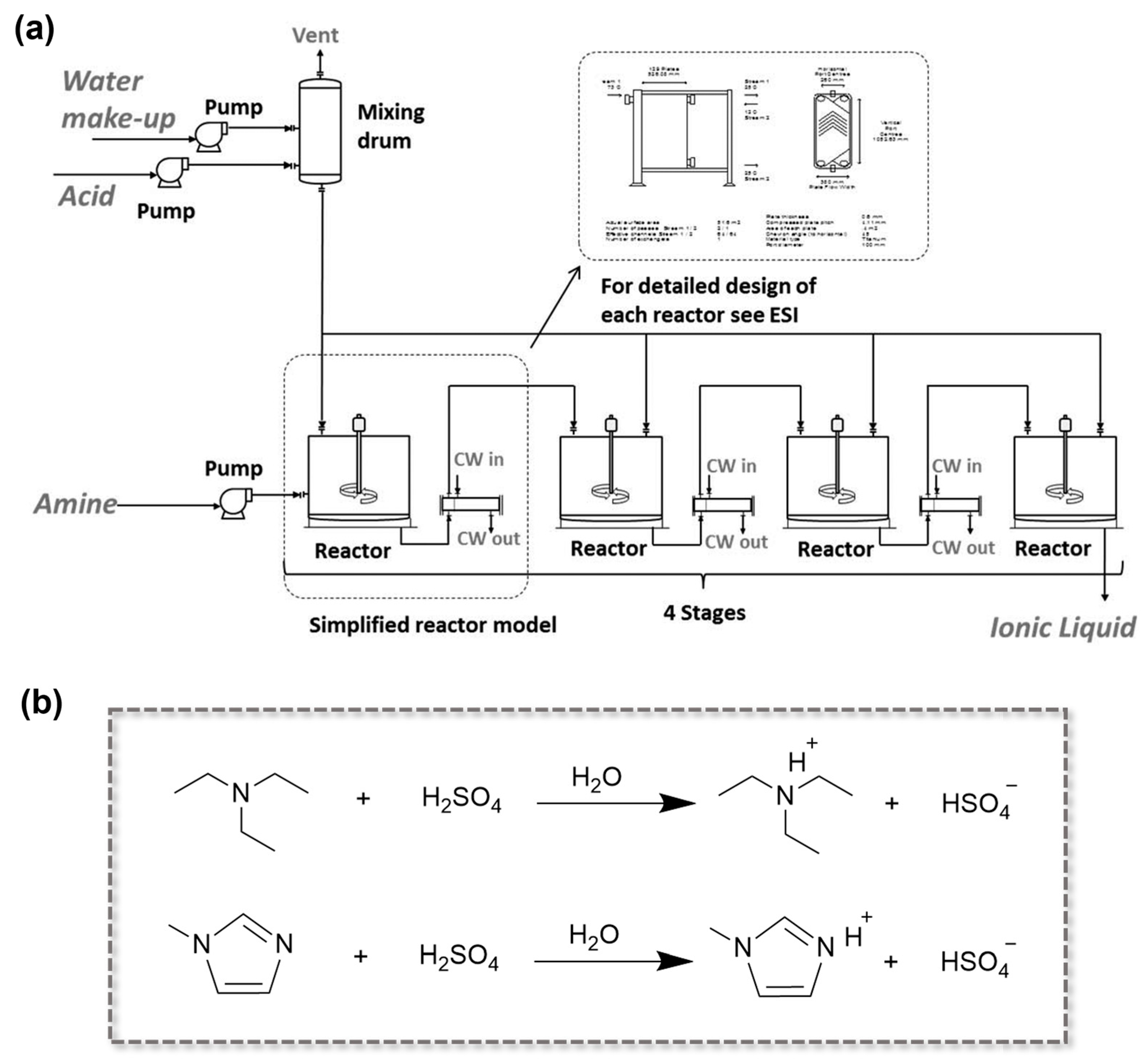
Despite ongoing challenges in life-cycle performance and economic feasibility, the highly tunable structures of IL/porous hybrid materials offer significant opportunities to optimize key parameters, including CO2 selectivity, absorption capacity, and regeneration energy consumption. Developing low-cost, green synthetic routes for ILs is a critical step toward reducing both overall costs and environmental footprint [316,317,318]. For example, the synthesis of the protic IL [HNEt3][HSO4] from basic raw materials requires substantially fewer steps than that of commonly used aprotic dialkylimidazolium ILs (e.g., [Bmim][BF4]), which typically involve more synthetic steps [319,320]. This marked simplification, as reported by Chen et al., reduces the estimated production cost to approximately 1.24 USD/kg, comparable to that of bulk organic solvents such as ethyl acetate or acetone (Figure 24). These results indicate that the high cost of ILs is not an intrinsic feature of the concept itself but rather arises from the design of structurally complex molecules. Similar advantages have been also demonstrated in separation processes. Meindersma et al. showed that using specific ILs to extract aromatics from naphtha cracking feedstocks reduces process energy consumption to 32 MW, well below the 160 MW required by conventional cyclodextrin-based processes, while generating annual revenues of up to €48 million per unit [321].
The development of phase-change or low-viscosity ILs can further improve mass transfer and reduce pumping energy. For example, Zheng et al. developed a reversible-polarity IL, [IPDAH][Im], which undergoes a solid–liquid phase transition upon CO2 absorption, achieving a thermal desorption energy of only 1.23 GJ/t CO2, roughly 67% lower than the MEA system [322]. Additionally, ILs derived from choline, amino acids, or other biomass-based precursors not only reduce dependence on petrochemical feedstocks but also have the potential to lower carbon emissions during synthesis [323,324,325].
For porous organic frameworks, high synthesis costs are largely attributable to conventional solvothermal methods, which require elevated temperatures and large volumes of organic solvents such as DMF, resulting in material prices of 35–71 USD/kg [326,327]. Mason et al. demonstrated that combining liquid-assisted grinding with aqueous-phase synthesis, alongside optimized reaction conditions and improved yields, can reduce MOF production costs to approximately 10 USD/kg [328]. Furthermore, replacing portions of expensive frameworks with low-cost, structurally robust porous supports, such as biomass-derived carbons or industrial byproducts, offers an effective route to reduce adsorbent costs [329]. Coupling CO2 capture with subsequent catalytic or electrochemical conversion, such as capture-enabled electrochemical CO2 reduction, to construct integrated capture-conversion systems further enables partial cost offset through the generation of high-value chemicals [11,330,331,332]. Collectively, these results indicate that the high costs of both ILs and porous materials are not intrinsic material properties but are strongly governed by synthetic routes, processing strategies, and scale-up level.
Overall, IL/porous hybrid materials represent a highly designable class of advanced materials for CO2 capture. However, their future development should extend beyond improvements in adsorption performance and instead emphasize stronger integration among material design, process optimization, and system-level engineering. From an LCA perspective, optimizing feedstock sources, synthetic pathways, and material recycling strategies will be crucial for advancing these materials toward industrially viable carbon capture technologies.

6. Conclusions and Outlook

ILs/porous hybrid materials have evolved beyond simple immobilization systems into confinement-enhanced adsorption platforms, in which nanoscale confinement fundamentally alters the physicochemical behavior of ILs. Through the synergistic regulation of free volume, interfacial interactions, ion arrangement, active-site accessibility, and adsorption thermodynamics, the hybrid systems effectively overcome the intrinsic limitations of bulk ILs, including high viscosity, slow gas diffusion, and severe mass-transfer resistance. As a result, ILs/porous hybrid materials exhibit significantly enhanced CO2 capture capacity, selectivity, regeneration efficiency, and cyclic stability, demonstrating broad potential for applications ranging from post-combustion carbon capture to DAC.
Despite substantial progress in this field, several challenges and knowledge gaps remain and require further investigation. First, the fundamental mechanisms governing confinement-induced IL restructuring and interfacial adsorption behavior remain insufficiently understood, particularly under realistic multicomponent and humid conditions. Advanced in situ characterization techniques, molecular dynamics, and multiscale theoretical models are still required to establish quantitative relationships among pore structure, IL organization, transport behavior, and adsorption thermodynamics. Second, excessive IL loading may cause pore blockage, diffusion resistance, and active-site shielding, indicating that achieving an optimal balance among IL loading, pore accessibility, and confinement-enhanced effects remains a central challenge. Third, the long-term stability and lifetime of hybrid materials under cyclic operation and complex conditions, especially regarding IL leakage, structural degradation, and moisture tolerance, still need to be further improved for industrial implementation. In addition, challenges also persist in the precise construction, scalable production, and cost-effective synthesis of IL hybrid systems. Furthermore, comprehensive assessments of energy consumption, carbon footprint, and economic feasibility across the entire process chain are still needed.
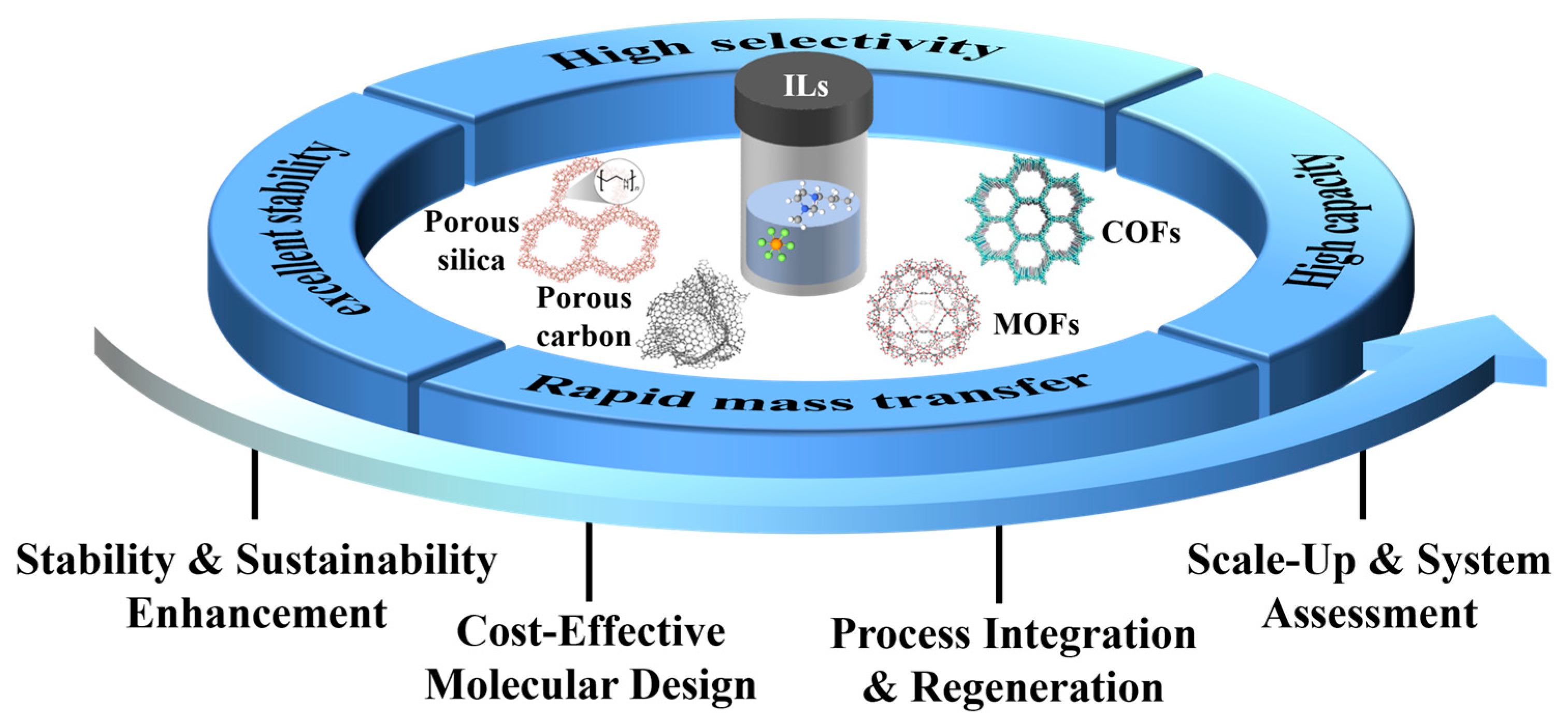
Future research should move beyond simply maximizing CO2 uptake toward the rational design of confinement-enhanced IL hybrid systems with balanced adsorption capacity, selectivity, kinetics, stability, and regeneration energy consumption. Research on ILs/porous hybrid materials for carbon capture is expected to focus on the following directions (Figure 25):
(1)
Molecular design and synthesis of low-cost, high-performance ILs. Breaking the cost barrier requires the development of alternative feedstocks and optimized synthetic routes, such as employing biomass-derived components or industrial by-products as precursors and developing one-step or solid-state synthesis methods. Meanwhile, functionalized ILs with both high CO2 affinity and low viscosity should be designed to balance improved thermodynamic adsorption performance with efficient mass-transfer kinetics.
(2)
Rational regulation of confinement-enhanced hybrid architectures. Future studies should focus on constructing hierarchical pore structures and precisely regulating the interfacial microenvironment of confined ILs to optimize free volume, ion arrangement, active-site accessibility, and mass-transfer pathways. Moreover, advances in in situ regeneration of ILs and structural repair of porous materials are needed to enhance the recyclability and economic viability of hybrid materials. The integration of hybrid adsorbents with catalytic conversion, electrochemical systems, or other processes should also be explored to construct low-energy and highly efficient carbon capture platforms.
(3)
Stability enhancement and environmental compatibility of hybrid adsorbents. For practical conditions such as flue gas treatment and DAC, hydrophobic ILs with strong resistance to moisture and impurity gases should be developed. In parallel, following the principles of green chemistry, comprehensive evaluation frameworks covering the entire life cycle, from material synthesis and operation to disposal, should be established to ensure environmental sustainability.
(4)
AI-driven material discovery and system-level optimization for carbon capture. Future research should transition from conventional data-driven approaches toward AI-driven frameworks for the rapid discovery of confinement-enhanced ILs/porous hybrid materials. By integrating high-throughput simulations, experimental data, and machine learning, these platforms can enable the inverse design of IL structures and porous architectures for targeted CO2 capture. They may also clarify structure–property relationships governing adsorption thermodynamics, mass transfer, confinement effects, and stability. Coupling AI-assisted material design with process modeling can further guide the development of optimized DAC systems, supporting the co-design of materials and processes for improved efficiency, lower energy consumption, and scalable industrial applications.
Overall, the transition from bulk ILs to confinement-enhanced IL hybrid adsorbents provides a promising pathway toward efficient, stable, and energy-efficient CO2 capture technologies. With continued advances in confinement engineering, interfacial regulation, multiscale material design, and AI-assisted design, IL-based hybrid systems are expected to play an increasingly important role in future CCUS technologies and global carbon-neutral energy systems.

Author Contributions

Conceptualization, Z.W. and Z.L.; writing—original draft preparation, E.Z., Z.L. and Y.C.; writing—review and editing, E.Z., Z.L. and Y.C.; visualization, E.Z. and Z.W.; supervision, Z.L. and Y.C.; funding acquisition, Z.L.; project administration, Z.L. All authors have read and agreed to the published version of the manuscript.

Funding

This work was supported by the National Natural Science Foundation of China (No. 22273016), the Natural Science Foundation of Henan Province (No. 252300421043), Plan for Henan Province University Science and Technology Innovation Team (No. 25IRTSTHN002).

Data Availability Statement

Data sharing is not applicable to this article as no new data were created or analyzed in this study.

Conflicts of Interest

The authors have no conflicts to disclose.

Nomenclature

13XType 13X zeolite
AeImBrAminoethyl-imidazolium bromide
AFIAlPO4-5-type framework
CH4Methane
-CHOAldehyde
CO2Carbon dioxide
-COOHCarboxyl
DHPA2,5-Dihydroxyterephthalaldehyde
DMFN, N-dimethylformamide
DVTP2,5-Divinylterephthalaldehyde
EDDAEthylenediamine-N, N′-diacetate
HIDAHydroxy-iminodiacetate
HKUST-1Hong Kong University of Science and Technology-1
IDAIminodiacetate
LiNTf2Lithium bis(trifluoromethanesulfonyl)imide
LTALinde type A framework
MAPOsMetal aluminophosphates
MCM-41Mobil Composition of Matter No. 41
MCM-48Mobil Composition of Matter No. 48
MEAMonoethanolamine
MIL-53Materials of Institute Lavoisier-53
MOF-74Also known as CPO-27
N2Nitrogen
Na-YSodium Y zeolite
-NH2Amino
NTANitrilotriacetate
-OAcAcetate
-OHPhenolic hydroxyl
OPSZOrganopolysilazane
PAN/Polyacrylonitrile
SBA-15Santa Barbara Amorphous-15
-Si(OCH2CH3)3Triethoxysilyl
SiO2Silicon dioxide
SODSodalite-type framework
TATerephthalaldehyde
TAPT2,4,6-Tris(4-aminophenyl)-1,3,5-triazine
TpPa-11,3,5-Triformylphloroglucinol–p-phenylenediamine
UiO-66University of Oslo-66
UTSA-16University of Texas at San Antonio-16
ZIF-8Zeolitic imidazolate framework-8
[18C6-K][Pro]Potassium(18-crown-6) prolinate
[4Mbp][BF4]4-Methyl-N-butylpyridinium tetrafluoroborate
[AeEIm][Br]1-Aminoethyl-3-ethylimidazolium bromide
[AlCl4]Tetrachloroaluminate
[Amim][NTf2]1-Allyl-3-methylimidazolium bis(trifluoromethylsulfonyl)imide
[B(CN)4]Tetracyanoborate
[BF4]Tetrafluoroborate
[Bmim][Ac]1-Butyl-3-methylimidazolium acetate
[Bmim][Arg]1-Butyl-3-methylimidazolium argininate
[Bmim][BF4]1-Butyl-3-methylimidazolium tetrafluoroborate
[Bmim][CF3SO3]1-Butyl-3-methylimidazolium trifluoromethanesulfonate
[Bmim][Cl]1-Butyl-3-methylimidazolium chloride
[Bmim][Gly]1-Butyl-3-methylimidazolium glycinate
[Bmim][LEU]1-Butyl-3-methylimidazolium leucinate
[Bmim][NO3]1-Butyl-3-methylimidazolium nitrate
[Bmim][NTf2]1-Butyl-3-methylimidazolium bis(trifluoromethanesulfonyl)imide
[Bmim][PF6]1-Butyl-3-methylimidazolium hexafluorophosphate
[Bmim][SCN]1-Butyl-3-methylimidazolium thiocyanate
[Bmim][TFSI]1-Butyl-3-methylimidazolium bis(trifluoromethylsulfonyl)imide
[Bmim]+1-Butyl-3-methylimidazolium
[Br]Bromide
[C1Him][HSO4]1-Methylimidazolium hydrogen sulfate
[C4TPIm][Cl]1-Butyl-3-(3-triethoxysilylpropyl)imidazolium chloride
[C8H4F13mim][NTf2]1-(Perfluorooctyl)-3-methylimidazolium bis(trifluoromethylsulfonyl)imide
[Omim][NTf2]1-Octyl-3-methylimidazolium bis(trifluoromethylsulfonyl)imide
[Cl]Chloride
[CNC3mim][NO3]1-(3-Hyanopropyl)-3-methylimidazolium nitrate
[DCA]Dicyanamide
[Deme][NTf2]N,N-Diethyl-N-methyl-N-(2-methoxyethyl)ammonium bis(trifluoromethylsulfonyl)imide
[Emim][Ac]1-Ethyl-3-methylimidazolium acetate
[Emim][Ala]1-Ethyl-3-methylimidazolium alaninate
[Emim][BF4]1-Ethyl-3-methylimidazolium tetrafluoroborate
[Emim][Gly]1-Ethyl-3-methylimidazolium glycinate
[Emim][NTf2]1-Ethyl-3-methylimidazolium bis(trifluoromethylsulfonyl)imide
[Emim][OAc]1-Ethyl-3-methylimidazolium acetate
[Emim][SCN]1-Ethyl-3-methylimidazolium thiocyanate
[Emim][TfO]1-Ethyl-3-methylimidazolium trifluoromethanesulfonate
[Emim][TFSA]1-ethyl-3-methylimidazolium bis(trifluoromethylsulfonyl)amide
[Hmim][BF4]1-Hexyl-3-methylimidazolium tetrafluoroborate
[Hmim][NTf2]1-Hexyl-3-methylimidazolium bis(trifluoromethylsulfonyl)imide
[Hmim][PF6]1-Hexyl-3-methylimidazolium hexafluorophosphate
[Hmim][TfO]1-Hexyl-3-methylimidazolium trifluoromethanesulfonate
[HNEt3][HSO4]Triethylammonium hydrogen sulfate
[HSO4]Bisulfate
[i-C5mim]+1-(Isopentyl)-3-(3-triethoxysilylpropyl)imidazolium
[i-C5TPIm][Cl]1-(Isopentyl)-3-(3-triethoxysilylpropyl)imidazolium chloride
[i-C5TPIm][NTf2]1-(Isopentyl)-3-(3-triethoxysilylpropyl)imidazolium chloride bis(trifluoromethanesulfonyl)imide
[ImNH2][BF4]1-Aminoimidazolium tetrafluoroborate
[IPDAH][Im]Isophorone diamine imidazolate
[MeTBDH]2[HFPDO]1-Methyl-1,5,7-triazabicyclo[4.4.0]dec-5-enium perfluorinated diol-derived dianion
[methide]Tris(trifluoromethylsulfonyl)methide
[MTBD][Im]7-Methyl-1,5,7-triazabicyclo[4.4.0]dec-5-ene imidazolate
[MTBDH][TFE]7-Methyl-1,5,7-triazabicyclo[4.4.0]dec-5-enium 2,2,2-trifluoroethoxide
[NO3]Nitrate
[NTf2]Bis(trifluoromethanesulfonyl)imide
[OHC3mim][NO3]1-(3-Hydroxypropyl)-3-methylimidazolium nitrate
[Omim][TfO]1-Octyl-3-methylimidazolium trifluoromethanesulfonate
[P4442]2[IDA]Tri-n-butylphosphonium iminodiacetate
[P66614][2-Op]Trihexyl(tetradecyl)phosphonium 2-oxypyridinate
[P66614][3-HMPz]Trihexyl(tetradecyl)phosphonium 3-hydroxymethylpyrazolate
[P66614][4-ABI]Trihexyl(tetradecyl)phosphonium 4-aminobenzimidazolate
[P66614][4-Me-PhO]Trihexyl(tetradecyl)phosphonium 4-methylphenoxide
[P66614][4NH2-NC]Trihexyl(tetradecyl)phosphonium 4-aminonicotinate
[P66614][Im]Trihexyl(tetradecyl)phosphonium imidazolate
[P66614][Ind]Trihexyl(tetradecyl)phosphonium indolide
[P66614][p-AA]Trihexyl(tetradecyl)phosphonium p-aminobenzoate
[P66614][PPhO]Trihexyl(tetradecyl)phosphonium phenylphosphonate
[P66614][Triz]Trihexyl(tetradecyl)phosphonium triazolate
[P66614]+trihexyl(tetradecyl)phosphonium
[P8883][NTf2]Trihexyltetradecylphosphonium bis(trifluoromethylsulfonyl)imide
[PF6]Hexafluorophosphate
[Pmim][NTf2]1-Propyl-3-methylimidazolium bis(trifluoromethylsulfonyl)imide
[S222][NTf2]Triethylsulfonium bis(trifluoromethylsulfonyl)imide
[SCN]Thiocyanate
[TfO]Trifluoromethanesulfonate
[TMA][HPy]Tetramethylammonium 2-hydroxypyridinate

References

  1. Matthews, H.D.; Wynes, S. Current global efforts are insufficient to limit warming to 1.5 °C. Science 2022, 376, 1404–1409. [Google Scholar] [CrossRef]
  2. Mao, H.; Tang, J.; Day, G.S.; Peng, Y.; Wang, H.; Xiao, X.; Yang, Y.; Jiang, Y.; Chen, S.; Halat, D.M.; et al. A scalable solid-state nanoporous network with atomic-level interaction design for carbon dioxide capture. Sci. Adv. 2022, 8, eabo6849. [Google Scholar] [CrossRef]
  3. Rochelle, G.T. Amine scrubbing for CO2 capture. Science 2009, 325, 1652–1654. [Google Scholar] [CrossRef]
  4. Zhao, Y. CCUS: A panacea or a placebo in the fight against climate change? Green Energy Environ. 2025, 10, 239–243. [Google Scholar] [CrossRef]
  5. Loachamin, D.; Casierra, J.; Calva, V.; Palma-Cando, A.; Ávila, E.E.; Ricaurte, M. Amine-based solvents and additives to improve the CO2 capture processes: A review. ChemEngineering 2024, 8, 129. [Google Scholar] [CrossRef]
  6. Mirzaei, S.; Hsu, C.-Y.; Shie, R.-H.; Chauhan, A. A review of recent advances in solvent-based technologies for postcombustion CO2 capture. Rev. Chem. Eng. 2026, 42, 353–380. [Google Scholar] [CrossRef]
  7. Chen, L.; Xiong, Y.; Qin, H.; Qi, Z. Advances of ionic liquids and deep eutectic solvents in green processes of biomass-derived 5-hydroxymethylfurfural. ChemSusChem 2022, 15, e202102635. [Google Scholar] [CrossRef]
  8. Hayes, R.; Warr, G.G.; Atkin, R. Structure and nanostructure in ionic liquids. Chem. Rev. 2015, 115, 6357–6426. [Google Scholar] [CrossRef] [PubMed]
  9. Earle, M.J.; Esperança, J.M.S.S.; Gilea, M.A.; Lopes, J.N.C.; Rebelo, L.P.N.; Magee, J.W.; Seddon, K.R.; Widegren, J.A. The distillation and volatility of ionic liquids. Nature 2006, 439, 831–834. [Google Scholar] [CrossRef]
  10. Lian, S.; Song, C.; Liu, Q.; Duan, E.; Ren, H.; Kitamura, Y. Recent advances in ionic liquids-based hybrid processes for CO2 capture and utilization. J. Environ. Sci. 2021, 99, 281–295. [Google Scholar] [CrossRef]
  11. Zafar, A.; Matuszek, K.; MacFarlane, D.R.; Zhang, X. Recent progress and future perspectives of ionic liquid-based carbon dioxide capture and conversion. Green Energy Environ. 2025, 10, 1097–1129. [Google Scholar] [CrossRef]
  12. Ali, S.A.; Mulk, W.U.; Ullah, Z.; Khan, H.; Zahid, A.; Shah, M.U.H.; Shah, S.N. Recent advances in the synthesis, application and economic feasibility of ionic liquids and deep eutectic solvents for CO2 capture: A review. Energies 2022, 15, 9098. [Google Scholar] [CrossRef]
  13. Zhao, Z.; Wang, K.; Tao, H.; Zhang, Z.; Lin, W.; Xiao, Q.; Jiang, L.; Li, H.; Wang, C. Thermodynamic regulation of carbon dioxide capture by functionalized ionic liquids. Chem. Soc. Rev. 2025, 54, 2091–2126. [Google Scholar] [CrossRef] [PubMed]
  14. Mota-Martinez, M.T.; Brandl, P.; Hallett, J.P.; Dowell, N.M. Challenges and opportunities for the utilisation of ionic liquids as solvents for CO2 capture. Mol. Syst. Des. Eng. 2018, 3, 560–571. [Google Scholar] [CrossRef]
  15. Greer, A.J.; Jacquemin, J.; Hardacre, C. Industrial applications of ionic liquids. Molecules 2020, 25, 5207. [Google Scholar] [CrossRef]
  16. Zhang, X.; Bao, D.; Huang, Y.; Dong, H.; Zhang, X.; Zhang, S. Gas–liquid mass-transfer properties in CO2 absorption system with ionic liquids. AIChE J. 2014, 60, 2929–2939. [Google Scholar] [CrossRef]
  17. Zeeshan, M.; Yalcin, K.; Oztuna, F.E.S.; Unal, U.; Keskin, S.; Uzun, A. A new class of porous materials for efficient CO2 separation: Ionic liquid/graphene aerogel composites. Carbon 2021, 171, 79–87. [Google Scholar] [CrossRef]
  18. Zhang, Y.; Yang, D.-H.; Qiao, S.; Han, B.-H. Synergistic Catalysis of Ionic Liquid-Decorated Covalent Organic Frameworks with Polyoxometalates for CO2 Cycloaddition Reaction under Mild Conditions. Langmuir 2021, 37, 10330–10339. [Google Scholar] [CrossRef]
  19. Zeeshan, M.; Nozari, V.; Yagci, M.B.; Isık, T.; Unal, U.; Ortalan, V.; Keskin, S.; Uzun, A. Core–shell type ionic liquid/metal organic framework composite: An exceptionally high CO2/CH4 selectivity. J. Am. Chem. Soc. 2018, 140, 10113–10116. [Google Scholar] [CrossRef]
  20. Mofarahi, M.; Gholipour, F. Gas adsorption separation of CO2/CH4 system using zeolite 5A. Microporous Mesoporous Mater. 2014, 200, 1–10. [Google Scholar] [CrossRef]
  21. Fauth, D.; Gray, M.; Pennline, H.; Krutka, H.; Sjostrom, S.; Ault, A. Investigation of porous silica supported mixed-amine sorbents for post-combustion CO2 capture. Energy Fuels 2012, 26, 2483–2496. [Google Scholar] [CrossRef]
  22. Amaraweera, S.M.; Gunathilake, C.A.; Gunawardene, O.H.; Dassanayake, R.S.; Cho, E.-B.; Du, Y. Carbon capture using porous silica materials. Nanomaterials 2023, 13, 2050. [Google Scholar] [CrossRef] [PubMed]
  23. Li, T.; An, X.; Fu, D. Review on nitrogen-doped porous carbon materials for CO2 adsorption and separation: Recent advances and outlook. Energy Fuels 2023, 37, 8160–8179. [Google Scholar] [CrossRef]
  24. Steel, K.M.; Koros, W.J. Investigation of porosity of carbon materials and related effects on gas separation properties. Carbon 2003, 41, 253–266. [Google Scholar] [CrossRef]
  25. Wang, J.; Yang, G.; Wu, L.; Zhou, B.; Wang, Z.; Huang, Z.; Liu, G.; Wang, M. Porous carbon-based adsorbents for CO2 sequestration from flue gases: Tuning porosity, surface chemistry, and metal impregnation for sustainable capture. Green Chem. Technol. 2026, 3, 10003. [Google Scholar] [CrossRef]
  26. Mao, V.Y.; Milner, P.J.; Lee, J.-H.; Forse, A.C.; Kim, E.J.; Siegelman, R.L.; McGuirk, C.M.; Zasada, L.B.; Neaton, J.B.; Reimer, J.A.; et al. Cooperative carbon dioxide adsorption in alcoholamine- and alkoxyalkylamine-functionalized metal–organic frameworks. Angew. Chem. Int. Ed. 2020, 59, 19468–19477. [Google Scholar] [CrossRef]
  27. Liu, J.; Chen, C.; Zhang, K.; Zhang, L. Applications of metal–organic framework composites in CO2 capture and conversion. Chin. Chem. Lett. 2021, 32, 649–659. [Google Scholar] [CrossRef]
  28. He, Y.O.; Zheng, W.Y.; Liu, Y.; Zhang, W.D.; Pang, H.; Zhang, J.; Han, W.K.; Gu, Z.G. Direct air capture and photoconversion of CO2 to ethylene by defect-tailored Cu3-based metal–organic frameworks. Angew. Chem. Int. Ed. 2025, 65, e16438. [Google Scholar] [CrossRef]
  29. Lyu, H.; Li, H.; Hanikel, N.; Wang, K.; Yaghi, O.M. Covalent organic frameworks for carbon dioxide capture from air. J. Am. Chem. Soc. 2022, 144, 12989–12995. [Google Scholar] [CrossRef] [PubMed]
  30. Zhou, Z.; Ma, T.; Zhang, H.; Sabeva, N.S.; Yaghi, O.M. Fast and selective CO2 capture from outdoor air by covalent organic frameworks. Nat. Sustain. 2026, 9, 431–438. [Google Scholar] [CrossRef]
  31. Wen, F.; Huang, N. Reticular synthesis of covalent organic frameworks for carbon dioxide adsorption. Chin. J. Chem. 2026, 44, 1223–1238. [Google Scholar] [CrossRef]
  32. Nugent, P.; Belmabkhout, Y.; Burd, S.D.; Cairns, A.J.; Luebke, R.; Forrest, K.; Pham, T.; Ma, S.; Space, B.; Wojtas, L.; et al. Porous materials with optimal adsorption thermodynamics and kinetics for CO2 separation. Nature 2013, 495, 80–84. [Google Scholar] [CrossRef]
  33. Xue, Q.; Wang, P.; Cheng, L.; Wei, Y.; Wang, Y.; Lin, J.; Zhang, Z.; Fang, C.; Li, H.; Ding, J.; et al. Triazole-based COF tightly hugging ionic liquids through interactions of hydrogen bonds for enhanced atmospheric CO2 conversion. Sep. Purif. Technol. 2025, 352, 128175. [Google Scholar] [CrossRef]
  34. Guo, S.; He, J.; Han, H.; Han, R.; Shou, J.; Ai, C.; Tang, R.; Gu, S.; Tang, J.; Yu, G. A phase-transition ionic liquid endows COF-based mixed matrix membranes with efficient CO2 separation. Chem. Commun. 2025, 61, 8212–8215. [Google Scholar] [CrossRef] [PubMed]
  35. Wen, T.-T.; Liu, X.-H.; Feng, J.-R.; Zheng, S.-Y.; Zhong, H.-K.; Zhang, H.-W.; Xue, C.; Zhou, X.-T. Ionic liquid-functionalized covalent organic frameworks for CO2 to cyclic carbonate conversion under solvent, metal, and co-catalyst free conditions. ACS Appl. Mater. Interfaces 2025, 17, 40574–40582. [Google Scholar] [CrossRef]
  36. Li, X.; Chen, K.; Guo, R.; Wei, Z. Ionic liquids functionalized MOFs for adsorption. Chem. Rev. 2023, 123, 10432–10467. [Google Scholar] [CrossRef]
  37. Wu, N.; Ji, X.; Xie, W.; Liu, C.; Feng, X.; Lu, X. Confinement phenomenon effect on the CO2 absorption working capacity in ionic liquids immobilized into porous solid supports. Langmuir 2017, 33, 11719–11726. [Google Scholar] [CrossRef] [PubMed]
  38. Nesterova, I.; Kondratyuk, N.; Budkov, Y.A.; Gerke, K.M.; Khlyupin, A. The role of surface material properties on the behavior of ILs in nanoconfinement: A critical review and perspective of theory and simulations. Adv. Colloid Interface Sci. 2025, 346, 103623. [Google Scholar] [CrossRef]
  39. Harmanli, I.; Tarakina, N.V.; Antonietti, M.; Oschatz, M. “Giant” Nitrogen uptake in ILs confined in carbon pores. J. Am. Chem. Soc. 2021, 143, 9377–9384. [Google Scholar] [CrossRef]
  40. Ayyildiz, M.; Hetze, K.; Schutjajew, K.; Poudel, P.; Paulus, R.M.; Schacher, F.H.; Dellith, J.; Schubert, U.S.; Oschatz, M. Understanding the interplay between pore structure and ionic liquid interaction on the gas uptake of microporous carbons. Small 2025, 21, e01928. [Google Scholar] [CrossRef]
  41. Mokhtari-Nori, N.; Qiu, L.; Song, Y.; He, L.; Ganesan, A.; Ivanov, A.S.; Wang, Q.; Wang, T.; Yang, Z.; Dai, S. Unveiling the porosity effect of superbase ionic liquid-modified carbon sorbents in CO2 capture from air. Mater. Today Energy 2024, 45, 101693. [Google Scholar] [CrossRef]
  42. Wang, F.; Behera, D.K.; Sengupta, B.; Li, D.; Yu, M. Scalable nanoconfined ionic liquid membranes with ultrapermeance and ultraselectivity for efficient CO2 capture. Sci. Adv. 2026, 12, eaea1329. [Google Scholar] [CrossRef] [PubMed]
  43. Drake, A.D.; He, Y.; Ladipo, F.; Knutson, B.L.; Rankin, S.E. Effect of pore confinement of ILs on solute diffusion within mesoporous silica microparticles. J. Phys. Chem. B 2024, 128, 3046–3060. [Google Scholar] [CrossRef]
  44. Cui, G.; Wang, J.; Zhang, S. Active chemisorption sites in functionalized ionic liquids for carbon capture. Chem. Soc. Rev. 2016, 45, 4307–4339. [Google Scholar] [CrossRef]
  45. Xing, H.; Yu, F.; Li, X.; Bao, Y.; Ye, W.; Li, C.; Zheng, S.; Huang, M. Application of ionic liquids in CO2 capture and conversion: A review. Sep. Purif. Technol. 2025, 360, 130981. [Google Scholar] [CrossRef]
  46. Ding, M.; Flaig, R.W.; Jiang, H.-L.; Yaghi, O.M. Carbon capture and conversion using metal–organic frameworks and MOF-based materials. Chem. Soc. Rev. 2019, 48, 2783–2828. [Google Scholar] [CrossRef] [PubMed]
  47. Li, W.-L.; Shuai, Q.; Yu, J. Recent advances of carbon capture in metal–organic frameworks: A comprehensive review. Small 2024, 20, 2402783. [Google Scholar] [CrossRef]
  48. Zhang, X.; Zhang, X.; Dong, H.; Zhao, Z.; Zhang, S.; Huang, Y. Carbon capture with ionic liquids: Overview and progress. Energy Environ. Sci. 2012, 5, 6668–6681. [Google Scholar] [CrossRef]
  49. Dong, K.; Zhang, S.; Wang, J. Understanding the hydrogen bonds in ionic liquids and their roles in properties and reactions. Chem. Commun. 2016, 52, 6744–6764. [Google Scholar] [CrossRef]
  50. Zeng, S.; Zhang, X.; Bai, L.; Zhang, X.; Wang, H.; Wang, J.; Bao, D.; Li, M.; Liu, X.; Zhang, S. Ionic-liquid-based CO2 capture systems: Structure, interaction and process. Chem. Rev. 2017, 117, 9625–9673. [Google Scholar] [CrossRef]
  51. Dai, Z.; Wang, L.; Lu, X.; Ji, X. Melting points of ionic liquids: Review and evaluation. Green Energy Environ. 2024, 9, 1802–1811. [Google Scholar] [CrossRef]
  52. Bai, L.; Shang, D.; Li, M.; Dai, Z.; Deng, L.; Zhang, X. CO2 absorption with ionic liquids at elevated temperatures. J. Energy Chem. 2017, 26, 1001–1006. [Google Scholar] [CrossRef]
  53. Palomar, J.; Gonzalez-Miquel, M.; Polo, A.; Rodriguez, F. Understanding the physical absorption of CO2 in ionic liquids using the COSMO-RS method. Ind. Eng. Chem. Res. 2011, 50, 3452–3463. [Google Scholar] [CrossRef]
  54. Babamohammadi, S.; Shamiri, A.; Aroua, M.K. A review of CO2 capture by absorption in ionic liquid-based solvents. Rev. Chem. Eng. 2015, 31, 383–412. [Google Scholar] [CrossRef]
  55. Chen, Y.; Zhang, S.; Yuan, X.; Zhang, Y.; Zhang, X.; Dai, W.; Mori, R. Solubility of CO2 in imidazolium-based tetrafluoroborate ionic liquids. Thermochim. Acta 2006, 441, 42–44. [Google Scholar] [CrossRef]
  56. Hasib-ur-Rahman, M.; Siaj, M.; Larachi, F. Ionic liquids for CO2 capture—Development and progress. Chem. Eng. Process. Process Intensif. 2010, 49, 313–322. [Google Scholar] [CrossRef]
  57. Hou, Y.; Baltus, R.E. Experimental measurement of the solubility and diffusivity of CO2 in room-temperature ionic liquids using a transient thin-liquid-film method. Ind. Eng. Chem. Res. 2007, 46, 8166–8175. [Google Scholar] [CrossRef]
  58. Anthony, J.L.; Anderson, J.L.; Maginn, E.J.; Brennecke, J.F. Anion effects on gas solubility in ionic liquids. J. Phys. Chem. B 2005, 109, 6366–6374. [Google Scholar] [CrossRef]
  59. Shariati, A.; Peters, C.J. High-pressure phase behavior of systems with ionic liquids: Part III. The binary system carbon dioxide + 1-hexyl-3-methylimidazolium hexafluorophosphate. J. Supercrit. Fluids 2004, 30, 139–144. [Google Scholar] [CrossRef]
  60. Zhang, X.; Liu, Z.; Wang, W. Screening of ionic liquids to capture CO2 by COSMO-RS and experiments. AIChE J. 2008, 54, 2717–2728. [Google Scholar] [CrossRef]
  61. Almantariotis, D.; Gefflaut, T.; Pádua, A.A.H.; Coxam, J.-Y.; Gomes, M.F.C. Effect of fluorination and size of the alkyl side-chain on the solubility of carbon dioxide in 1-alkyl-3-methylimidazolium bis(trifluoromethylsulfonyl)amide ionic liquids. J. Phys. Chem. B 2010, 114, 3608–3617. [Google Scholar] [CrossRef]
  62. Klahn, M.; Seduraman, A. What determines CO2 solubility in ionic liquids? A molecular simulation study. J. Phys. Chem. B 2015, 119, 10066–10078. [Google Scholar] [CrossRef]
  63. Babarao, R.; Dai, S.; Jiang, D.-E. Understanding the high solubility of CO2 in an ionic liquid with the tetracyanoborate anion. J. Phys. Chem. B 2011, 115, 9789–9794. [Google Scholar] [CrossRef]
  64. Liu, H.; Dai, S.; Jiang, D.-E. Structure and dynamics of CO2 and N2 in a tetracyanoborate based ionic liquid. Phys. Chem. Chem. Phys. 2014, 16, 1909–1913. [Google Scholar] [CrossRef]
  65. Oh, S.; Morales-Collazo, O.; Keller, A.N.; Brennecke, J.F. Cation-anion and anion-CO2 interactions in triethyl(octyl)phosphonium ionic liquids with aprotic heterocyclic anions (AHAs). J. Phys. Chem. B 2020, 124, 8877–8887. [Google Scholar] [CrossRef] [PubMed]
  66. Gohndrone, T.R.; Lee, T.B.; DeSilva, M.A.; Quiroz-Guzman, M.; Schneider, W.F.; Brennecke, J.F. Competing reactions of CO2 with cations and anions in azolide ionic liquids. ChemSusChem 2014, 7, 1970–1975. [Google Scholar] [CrossRef] [PubMed]
  67. Zhang, R.; Ke, Q.; Zhang, Z.; Zhou, B.; Cui, G.; Lu, H. Tuning functionalized ionic liquids for CO2 capture. Int. J. Mol. Sci. 2022, 23, 11401. [Google Scholar] [CrossRef]
  68. Maniam, K.K.; Paul, S. Ionic liquids and deep eutectic solvents for CO2 conversion technologies—A review. Materials 2021, 14, 4519. [Google Scholar] [CrossRef]
  69. Bates, E.D.; Mayton, R.D.; Ntai, I.; Davis, J.H. CO2 capture by a task-specific ionic liquid. J. Am. Chem. Soc. 2002, 124, 926–927. [Google Scholar] [CrossRef]
  70. Zhang, J.; Zhang, S.; Dong, K.; Zhang, Y.; Shen, Y.; Lv, X. Supported absorption of CO2 by tetrabutylphosphonium amino acid ionic liquids. Chem.—A Eur. J. 2006, 12, 4021–4026. [Google Scholar] [CrossRef] [PubMed]
  71. Wang, C.; Luo, H.; Li, H.; Zhu, X.; Yu, B.; Dai, S. Tuning the physicochemical properties of diverse phenolic ionic liquids for equimolar CO2 capture by the substituent on the anion. Chem.—A Eur. J. 2012, 18, 2153–2160. [Google Scholar] [CrossRef]
  72. Wang, C.; Luo, H.; Jiang, D.-E.; Li, H.; Dai, S. Carbon dioxide capture by superbase-derived protic ionic liquids. Angew. Chem. Int. Ed. 2010, 49, 5978–5981. [Google Scholar] [CrossRef]
  73. Seo, S.; DeSilva, M.A.; Brennecke, J.F. Physical properties and CO2 reaction pathway of 1-ethyl-3-methylimidazolium ionic liquids with aprotic heterocyclic anions. J. Phys. Chem. B 2014, 118, 14870–14879. [Google Scholar] [CrossRef] [PubMed]
  74. Lee, T.B.; Oh, S.; Gohndrone, T.R.; Morales-Collazo, O.; Seo, S.; Brennecke, J.F.; Schneider, W.F. CO2 chemistry of phenolate-based ionic liquids. J. Phys. Chem. B 2016, 120, 1509–1517. [Google Scholar] [CrossRef]
  75. Gurau, G.; Rodríguez, H.; Kelley, S.P.; Janiczek, P.; Kalb, R.S.; Rogers, R.D. Demonstration of chemisorption of carbon dioxide in 1,3-dialkylimidazolium acetate ionic liquids. Angew. Chem. Int. Ed. 2011, 50, 12024–12026. [Google Scholar] [CrossRef] [PubMed]
  76. Wu, C.; Senftle, T.P.; Schneider, W.F. First-principles-guided design of ionic liquids for CO2 capture. Phys. Chem. Chem. Phys. 2012, 14, 13163–13170. [Google Scholar] [CrossRef] [PubMed]
  77. Wang, T.; Lackner, K.S.; Wright, A.B. Moisture-swing sorption for carbon dioxide capture from ambient air: A thermodynamic analysis. Phys. Chem. Chem. Phys. 2013, 15, 504–514. [Google Scholar] [CrossRef]
  78. Van Nierop, E.A.; Hormoz, S.; House, K.Z.; Aziz, M.J. Effect of absorption enthalpy on temperature-swing CO2 separation process performance. Energy Procedia 2011, 4, 1783–1790. [Google Scholar] [CrossRef]
  79. Bhattacharjee, S.; Lin, S.-T. Thermodynamic origins of the interfacial-bulk solubility trade-off for CO2 in ionic liquids: A molecular dynamics simulation study. Phys. Chem. Chem. Phys. 2026, 28, 5958–5969. [Google Scholar] [CrossRef]
  80. Seo, S.; Quiroz-Guzman, M.; DeSilva, M.A.; Lee, T.B.; Huang, Y.; Goodrich, B.F.; Schneider, W.F.; Brennecke, J.F. Chemically tunable ionic liquids with aprotic heterocyclic anion (AHA) for CO2 capture. J. Phys. Chem. B 2014, 118, 5740–5751. [Google Scholar] [CrossRef]
  81. Huang, K.; Wu, Y.-T.; Dai, S. Sigmoid correlations for gas solubility and enthalpy change of chemical absorption of CO2. Ind. Eng. Chem. Res. 2015, 54, 10126–10133. [Google Scholar] [CrossRef]
  82. Kim, Y.S.; Choi, W.Y.; Jang, J.H.; Yoo, K.P.; Lee, C.S. Solubility measurement and prediction of carbon dioxide in ionic liquids. Fluid Phase Equilibria 2005, 228–229, 439–445. [Google Scholar] [CrossRef]
  83. Shin, E.-K.; Lee, B.-C. High-pressure phase behavior of carbon dioxide with ionic liquids: 1-alkyl-3-methylimidazolium trifluoromethanesulfonate. J. Chem. Eng. Data 2008, 53, 2728–2734. [Google Scholar] [CrossRef]
  84. Torralba-Calleja, E.; Skinner, J.; Gutiérrez-Tauste, D. CO2 capture in ionic liquids: A review of solubilities and experimental methods. J. Chem. 2013, 2013, 473584. [Google Scholar] [CrossRef]
  85. Balogun, M.Y.; Thacker, P.J.; Cañada, L.M.; Brennecke, J.F. Physical absorption of CO2, CH4, and N2 in nine imidazolium-based ionic liquids. Ind. Eng. Chem. Res. 2025, 64, 20729–20743. [Google Scholar] [CrossRef]
  86. Nonthanasin, T.; Henni, A.; Saiwan, C. Densities and low pressure solubilities of carbon dioxide in five promising ionic liquids. RSC Adv. 2014, 4, 7566–7578. [Google Scholar] [CrossRef]
  87. Luo, X.Y.; Fan, X.; Shi, G.L.; Li, H.R.; Wang, C.M. Decreasing the viscosity in CO2 capture by amino-functionalized ionic liquids through the formation of intramolecular hydrogen bond. J. Phys. Chem. B 2016, 120, 2807–2813. [Google Scholar] [CrossRef] [PubMed]
  88. Yang, Z.-Z.; Jiang, D.-E.; Zhu, X.; Tian, C.; Brown, S.; Do-Thanh, C.-L.; He, L.-N.; Dai, S. Coordination effect-regulated CO2 capture with an alkali metal onium salts/crown ether system. Green Chem. 2014, 16, 253–258. [Google Scholar] [CrossRef]
  89. Wang, C.; Luo, X.; Luo, H.; Jiang, D.-E.; Li, H.; Dai, S. Tuning the basicity of ionic liquids for equimolar CO2 capture. Angew. Chem. Int. Ed. 2011, 50, 4918–4922. [Google Scholar] [CrossRef]
  90. Luo, X.; Guo, Y.; Ding, F.; Zhao, H.; Cui, G.; Li, H.; Wang, C. Significant improvements in CO2 capture by pyridine-containing anion-functionalized ionic liquids through multiple-site cooperative interactions. Angew. Chem. Int. Ed. 2014, 53, 7053–7057. [Google Scholar] [CrossRef]
  91. Pan, M.; Cao, N.; Lin, W.; Luo, X.; Chen, K.; Che, S.; Li, H.; Wang, C. Reversible CO2 capture by conjugated ionic liquids through dynamic covalent carbon–oxygen bonds. ChemSusChem 2016, 9, 2351–2357. [Google Scholar] [CrossRef]
  92. Chen, F.F.; Huang, K.; Zhou, Y.; Tian, Z.Q.; Zhu, X.; Tao, D.J.; Jiang, D.E.; Dai, S. Multi-molar absorption of CO2 by the activation of carboxylate groups in amino acid ionic liquids. Angew. Chem. Int. Ed. 2016, 55, 7166–7170. [Google Scholar] [CrossRef]
  93. Urukova, I.; Vorholz, J.; Maurer, G. Solubility of CO2, CO, and H2 in the ionic liquid [Bmim][PF6] from Monte Carlo simulations. J. Phys. Chem. B 2005, 109, 12154–12159. [Google Scholar] [CrossRef]
  94. Sistla, Y.S.; Khanna, A. CO2 absorption studies in amino acid-anion based ionic liquids. Chem. Eng. J. 2015, 273, 268–276. [Google Scholar] [CrossRef]
  95. Lv, B.; Xia, Y.; Shi, Y.; Liu, N.; Li, W.; Li, S. A novel hydrophilic amino acid ionic liquid [C2OHmim][Gly] as aqueous sorbent for CO2 capture. Int. J. Greenh. Gas Control 2016, 46, 1–6. [Google Scholar] [CrossRef]
  96. Yunus, N.M.; Mutalib, M.A.; Man, Z.; Bustam, M.A.; Murugesan, T. Solubility of CO2 in pyridinium based ionic liquids. Chem. Eng. J. 2012, 189–190, 94–100. [Google Scholar] [CrossRef]
  97. Voskian, S.; Brown, P.; Halliday, C.; Rajczykowski, K.; Hatton, T.A. Amine-based ionic liquid for CO2 capture and electrochemical or thermal regeneration. ACS Sustain. Chem. Eng. 2020, 8, 8356–8361. [Google Scholar] [CrossRef]
  98. Yoon, B.; Voth, G.A. Elucidating the molecular mechanism of CO2 capture by amino acid ionic liquids. J. Am. Chem. Soc. 2023, 145, 15663–15667. [Google Scholar] [CrossRef]
  99. Zhang, Y.; Ma, D.; Fu, T.; Zhu, C.; Ma, Y. A high-efficiency carboxylated choline amino acid ionic liquid for CO2 capture and its absorption-desorption performance. AIChE J. 2026, 72, e70301. [Google Scholar] [CrossRef]
  100. Clarke, C.J.; Bui-Le, L.; Hallett, J.P.; Licence, P. Thermally-stable imidazolium dicationic ionic liquids with pyridine functional groups. ACS Sustain. Chem. Eng. 2020, 8, 8762–8772. [Google Scholar] [CrossRef]
  101. Lei, X.; Xu, Y.; Zhu, L.; Wang, X. Highly efficient and reversible CO2 capture through 1,1,3,3-tetramethylguanidinium imidazole ionic liquid. RSC Adv. 2014, 4, 7052–7057. [Google Scholar] [CrossRef]
  102. Parameswaran, J.; Ghani, N.A.; Hossain, M.S.; Rahim, A.H.A.; Razip, M.A.A.M.; Yunus, N.M.; Leveque, J.-M. Enhanced carbon dioxide capture using phosphonium and ammonium-based amino acid ionic liquids as next-generation functional materials. J. Mol. Liq. 2025, 439, 128951. [Google Scholar] [CrossRef]
  103. Karim, H.; Sardar, S.; Mumtaz, A.; Tabassum, A.; Arfan, M.; Mahmood, A.; Leveque, J.-M.; Wilfred, C.D.; Adil, S.F.; Hatshan, M.R.; et al. Unravelling the role of non-covalent interactions using imidazolium and amino acid based organic salts for efficient CO2 capture: Experimental, DFT and COSMO-RS explorations. J. Environ. Chem. Eng. 2025, 13, 116237. [Google Scholar] [CrossRef]
  104. Lei, Z.; Dai, C.; Chen, B. Gas solubility in ionic liquids. Chem. Rev. 2014, 114, 1289–1326. [Google Scholar] [CrossRef]
  105. Gutowski, K.E.; Maginn, E.J. Amine-functionalized task-specific ionic liquids: A mechanistic explanation for the dramatic increase in viscosity upon complexation with CO2 from molecular simulation. J. Am. Chem. Soc. 2008, 130, 14690–14704. [Google Scholar] [CrossRef]
  106. Jiang, Y.-Y.; Wang, G.-N.; Zhou, Z.; Wu, Y.-T.; Geng, J.; Zhang, Z.-B. Tetraalkylammonium amino acids as functionalized ionic liquids of low viscosity. Chem. Commun. 2008, 4, 505–507. [Google Scholar] [CrossRef]
  107. Yuan, S.; Chen, Y.; Ji, X.; Yang, Z.; Lu, X. Experimental study of CO2 absorption in aqueous cholinium-based ionic liquids. Fluid Phase Equilibria 2017, 445, 14–24. [Google Scholar] [CrossRef]
  108. Yokozeki, A.; Shiflett, M.B.; Junk, C.P.; Grieco, L.M.; Foo, T. Physical and chemical absorptions of carbon dioxide in room-temperature ionic liquids. J. Phys. Chem. B 2008, 112, 16654–16663. [Google Scholar] [CrossRef] [PubMed]
  109. Rahim, A.H.A.; Yunus, N.M.; Bustam, M.A. Ionic liquids hybridization for carbon dioxide capture: A review. Molecules 2023, 28, 7091. [Google Scholar] [CrossRef]
  110. Overbeck, V.; Schröder, H.; Bonsa, A.-M.; Neymeyr, K.; Ludwig, R. Insights into the translational and rotational dynamics of cations and anions in protic ionic liquids by means of NMR fast-field-cycling relaxometry. Phys. Chem. Chem. Phys. 2021, 23, 2663–2675. [Google Scholar] [CrossRef] [PubMed]
  111. Jiang, B.; Meng, H.; You, C.; Dai, H.; Chen, M.; Zhang, F.; Zhang, Z. Proton-transfer-activated polyamine for highly efficient CO2 capture. Sep. Purif. Technol. 2025, 378, 134459. [Google Scholar] [CrossRef]
  112. Wang, Y.; Wang, Y.; Zhao, Y.; Fu, J.; Liu, Z. Ionic liquids promoted transformation of carbon dioxide. Chem. Rev. 2025, 125, 6057–6129. [Google Scholar] [CrossRef]
  113. Singh, S.K.; Savoy, A.W. Ionic liquids synthesis and applications: An overview. J. Mol. Liq. 2020, 297, 112038. [Google Scholar] [CrossRef]
  114. Yin, H.; Huang, H.; Bai, L.; Liu, Z.; Yan, X.; Sun, R.; Li, Z.; Bai, F.; Chen, E.; Xiong, L.; et al. Ionic liquid-confined covalent-organic framework pores as nanoreactors for CO2 photoconversion. Angew. Chem. Int. Ed. 2025, 64, e202505886. [Google Scholar] [CrossRef]
  115. Li, K.; Xue, Y.-R.; Xu, G.-C.; Yang, H.-C.; Xu, Z.-K. Janus-confined ionic liquid membranes for boosted CO2 separation. J. Membr. Sci. 2025, 741, 125057. [Google Scholar] [CrossRef]
  116. Zhu, J.; He, B.; Huang, J.; Li, C.; Ren, T. Effect of immobilization methods and the pore structure on CO2 separation performance in silica-supported ionic liquids. Microporous Mesoporous Mater. 2018, 260, 190–200. [Google Scholar] [CrossRef]
  117. Moretti, A.L.; Pereira, M.V.; Diório, A.; de Oliveira, L.H.; Nascimento, J.F.D.; Arroyo, P.A. Comparison of upward and downward flow in high-pressure bulk CO2 gas adsorption on NaY zeolite fixed bed. Sep. Purif. Technol. 2025, 356, 129896. [Google Scholar] [CrossRef]
  118. Marliza, T.S.; Yarmo, M.A.; Lahuri, A.H.; Taufiq-Yap, Y.H. CO2 capture using ionic liquid hybrid sorbent: Physical and chemical adsorption-desorption study. Mater. Today Proc. 2022, 64, 20–26. [Google Scholar] [CrossRef]
  119. Dong, Y.; Butt, H.-J.; Floudas, G. Effects of V-shaped confinement on the phase state and ion dynamics of ILs containing the 1-butyl-3-methylimidazolium cation. J. Phys. Chem. C 2025, 129, 7530–7540. [Google Scholar] [CrossRef]
  120. Gkoura, L.; Panopoulos, N.; Karagianni, M.; Romanos, G.; Chatzichristos, A.; Papavassiliou, G.; Hassan, J.; Fardis, M. Investigation of dynamic behavior of confined IL [Bmim][TCM] in silica material SBA-15 using NMR. Int. J. Mol. Sci. 2023, 24, 6739. [Google Scholar] [CrossRef]
  121. Eichenlaub, J.; Baran, K.; Śmiechowski, M.; Kloskowski, A. Free volume in physical absorption of carbon dioxide in ILs: Molecular dynamics supported modeling. Sep. Purif. Technol. 2023, 313, 123464. [Google Scholar] [CrossRef]
  122. Wenny, M.B.; Molinari, N.; Slavney, A.H.; Thapa, S.; Lee, B.; Kozinsky, B.; Mason, J.A. Understanding relationships between Free volume and oxygen absorption in ILs. J. Phys. Chem. B 2022, 126, 1268–1274. [Google Scholar] [CrossRef] [PubMed]
  123. Kodirov, A.; Abduvokhidov, D.; Mamatkulov, S.; Shahzad, A.; Razzokov, J. The absorption mechanisms of CO2, H2S and CH4 molecules in [Emim][SCN] and [Emim][DCA] ILs: A computational insight. Fluid Phase Equilibria 2024, 581, 114080. [Google Scholar] [CrossRef]
  124. Mohamedali, M.; Ibrahim, H.; Henni, A. Incorporation of acetate-based ionic liquids into a zeolitic imidazolate framework (ZIF-8) as efficient sorbents for carbon dioxide capture. Chem. Eng. J. 2018, 334, 817–828. [Google Scholar] [CrossRef]
  125. Rajput, N.N.; Monk, J.; Singh, R.; Hung, F.R. On the influence of pore size and pore loading on structural and dynamical heterogeneities of an ionic liquid confined in a slit nanopore. J. Phys. Chem. C 2012, 116, 5169–5181. [Google Scholar] [CrossRef]
  126. Qiu, L.; Li, E.; Ke, T.; Wang, Q.; Tong, Y.; Li, B.; Liu, H.; Jiang, D.-E.; Mahurin, S.M.; Yang, Z.; et al. Frontiers of ionic liquids in carbon dioxide separation and valorization. Chem. Rev. 2025, 125, 10876–10955. [Google Scholar] [CrossRef]
  127. Qiu, L.; Peng, L.; Moitra, D.; Liu, H.; Fu, Y.; Dong, Z.; Hu, W.; Lei, M.; Jiang, D.-E.; Lin, H.; et al. Harnessing the hybridization of a metal-organic framework and superbase-derived ionic liquid for high-performance direct air capture of CO2. Small 2023, 19, 2302708. [Google Scholar] [CrossRef] [PubMed]
  128. Liu, S.; Chen, L.; Xie, B.; Yang, X.; Zhao, T. Confinement of multi-active ionic salts within carbon nanocages for boosting CO2 cycloaddition. Sep. Purif. Technol. 2026, 400, 138411. [Google Scholar] [CrossRef]
  129. Ban, Y.; Li, Z.; Li, Y.; Peng, Y.; Jin, H.; Jiao, W.; Guo, A.; Wang, P.; Yang, Q.; Zhong, C.; et al. Confinement of ionic liquids in nanocages: Tailoring the molecular sieving properties of ZIF-8 for membrane-based CO2 capture. Angew. Chem. Int. Ed. 2015, 54, 15483–15487. [Google Scholar] [CrossRef] [PubMed]
  130. Borghi, F.; Podestà, A. Ionic liquids under nanoscale confinement. Adv. Phys. X 2020, 5, 1736949. [Google Scholar] [CrossRef]
  131. Zhang, S.; Zhang, J.; Zhang, Y.; Deng, Y. Nanoconfined ionic liquids. Chem. Rev. 2017, 117, 6755–6833. [Google Scholar] [CrossRef]
  132. Babucci, M.; Akçay, A.; Balci, V.; Uzun, A. Thermal stability limits of imidazolium ionic liquids immobilized on metal-oxides. Langmuir 2015, 31, 9163–9176. [Google Scholar] [CrossRef]
  133. Wang, C.; Wang, Y.; Lu, Y.; He, H.; Huo, F.; Dong, K.; Wei, N.; Zhang, S. Height-driven structure and thermodynamic properties of confined ionic liquids inside carbon nanochannels from molecular dynamics study. Phys. Chem. Chem. Phys. 2019, 21, 12767–12776. [Google Scholar] [CrossRef] [PubMed]
  134. Gupta, K.M.; Chen, Y.; Hu, Z.; Jiang, J. Metal–organic framework supported ionic liquid membranes for CO2 capture: Anion effects. Phys. Chem. Chem. Phys. 2012, 14, 5785–5794. [Google Scholar] [CrossRef]
  135. Liang, C.; Zhang, Y.; Yu, J.; Che, Q.; Wang, S.; Li, X. Regulating the positive localized electric field in mixed matrix membranes by charge reversal of ILs-COF for boosting CO2 separation. Adv. Funct. Mater. 2025, 35, 2419475. [Google Scholar] [CrossRef]
  136. Wu, Y.; Ma, L.; Song, Z.; Dong, S.; Guo, Z.; Wang, J.; Zhou, Y. Ordered mesoporous carbon encapsulated linear poly(ionic liquid) s enabling synergy effect of surface groups and ionic moieties for CO2 fixation under mild conditions. Carbon Neutrality 2023, 2, 1. [Google Scholar] [CrossRef]
  137. Gu, S.; Feng, L.; Dai, G.; Zhang, F.; Deng, L.; Peng, B.; Zeng, H.; Ai, C.; Tang, J.; Yu, G. Building ternary mixed matrix membranes with ionic liquid-functional COF fillers for efficient CO2 separation. J. Membr. Sci. 2025, 716, 123506. [Google Scholar] [CrossRef]
  138. Zhao, C.; Li, X.; Liu, G.; Wang, X. Selective adsorption of trace CO2 by immobilized amino acid ionic liquids with ultra-micropores based on amino MOFs. Sep. Purif. Technol. 2025, 356, 129742. [Google Scholar] [CrossRef]
  139. Zhou, T.; Wen, Y.; Wu, Z.; Song, S.; Wu, B.; Guo, H.; Chen, H.; Feng, X.; Mu, L.; Lu, X.; et al. Dual-bonded polyethyleneimine network with electron-withdrawing groups at α, β-sites for ultra-stable and low-energy CO2 capture in harsh environments. Green Energy Environ. 2025, 10, 1039–1049. [Google Scholar] [CrossRef]
  140. Kaur, P.; Chopra, H.K. Recent advances in supported ionic liquid membrane technology in gas/organic compounds separations. Curr. Org. Chem. 2022, 26, 1149–1184. [Google Scholar] [CrossRef]
  141. Wang, S.; Mahurin, S.M.; Dai, S.; Jiang, D.-E. Design of graphene/ionic liquid composites for carbon capture. ACS Appl. Mater. Interfaces 2021, 13, 17511–17516. [Google Scholar] [CrossRef]
  142. Ding, L.-G.; Yao, B.-J.; Li, F.; Shi, S.-C.; Huang, N.; Yin, H.-B.; Guan, Q.; Dong, Y.-B. Ionic liquid-decorated COF and its covalent composite aerogel for selective CO2 adsorption and catalytic conversion. J. Mater. Chem. A 2019, 7, 4689–4698. [Google Scholar] [CrossRef]
  143. Azim, M.M.; Stark, A. Ionothermal synthesis and characterisation of Mn-, Co-, Fe- and Ni-containing aluminophosphates. Microporous Mesoporous Mater. 2018, 272, 251–259. [Google Scholar] [CrossRef]
  144. Chen, W.; Meng, L.; Sun, J.; Mu, M.; Yin, X. Vinyl-containing covalent organic frameworks co-polymerized with imidazolium ionic liquids for the efficient cycloaddition of CO2 with epoxides. Polymer 2024, 312, 127639. [Google Scholar] [CrossRef]
  145. Jadav, D.; Pandey, M.; Bhojani, A.K.; Amen, T.W.M.; Tsunoji, N.; Singh, D.K.; Bandyopadhyay, M. Mesoporous silica supported ionic liquid materials with high efficacy for CO2 adsorption studies. J. Ion. Liq. 2024, 4, 100102. [Google Scholar] [CrossRef]
  146. Fujie, K.; Yamada, T.; Ikeda, R.; Kitagawa, H. Introduction of an ionic liquid into the micropores of a metal–organic framework and its anomalous phase behavior. Angew. Chem. Int. Ed. 2014, 126, 11484–11487. [Google Scholar] [CrossRef]
  147. Park, S.; Jeong, H.-K. Highly H2O permeable ionic liquid encapsulated metal-organic framework membranes for energy-efficient air-dehumidification. J. Mater. Chem. A 2020, 8, 23645–23653. [Google Scholar] [CrossRef]
  148. Patil, T.; Dharaskar, S.; Sinha, M.; Jampa, S.S. Effectiveness of ionic liquid-supported membranes for carbon dioxide capture: A review. Environ. Sci. Pollut. Res. 2022, 29, 35723–35745. [Google Scholar] [CrossRef] [PubMed]
  149. Tomé, L.C.; Marrucho, I.M. Ionic liquid-based materials: A platform to design engineered CO2 separation membranes. Chem. Soc. Rev. 2016, 45, 2785–2824. [Google Scholar] [CrossRef] [PubMed]
  150. Parnham, E.R.; Morris, R.E. Ionothermal synthesis of zeolites, metal–organic frameworks, and inorganic–organic hybrids. Acc. Chem. Res. 2007, 40, 1005–1013. [Google Scholar] [CrossRef]
  151. Xie, Z.-L.; Feng, M.-L.; Tan, B.; Huang, X.-Y. The multifunctional roles of the ionic liquid [Bmim][BF4] in the creation of cadmium metal–organic frameworks. CrystEngComm 2012, 14, 4894–4901. [Google Scholar] [CrossRef]
  152. Xu, L.; Choi, E.-Y.; Kwon, Y.-U. Ionothermal syntheses of six three-dimensional zinc metal−organic frameworks with 1-alkyl-3-methylimidazolium bromide ionic liquids as solvents. Inorg. Chem. 2007, 46, 10670–10680. [Google Scholar] [CrossRef]
  153. Hua, Y.; Ahmadi, Y.; Kim, K.-H.; Yu, W. Functional strategies and performance assessment of covalent organic framework–based materials for carbon dioxide capture. Renew. Sustain. Energy Rev. 2025, 222, 115949. [Google Scholar] [CrossRef]
  154. Liu, M.; Ma, C.; Wang, Q.; Li, R.; Yu, S.; Chen, H.; Liu, F. Capture and in-situ conversion of low-concentration CO2 over robust poly(ionic liquid)@porous carbon nanocomposites under green, co-catalyst- and solvent-free conditions. Chem. Eng. J. 2024, 500, 157099. [Google Scholar] [CrossRef]
  155. Zhao, R.; Wu, H.; Yang, L.; Ren, Y.; Liu, Y.; Qu, Z.; Wu, Y.; Cao, L.; Chen, Z.; Jiang, Z. Modification of covalent organic frameworks with dual functions ionic liquids for membrane-based biogas upgrading. J. Membr. Sci. 2020, 600, 117841. [Google Scholar] [CrossRef]
  156. Khan, N.A.; Hasan, Z.; Jhung, S.H. Ionic liquids supported on metal-organic frameworks: Remarkable adsorbents for adsorptive desulfurization. Chem.—A Eur. J. 2014, 20, 376–380. [Google Scholar] [CrossRef] [PubMed]
  157. Chen, S.; Liu, Y.; Fu, H.; He, Y.; Li, C.; Huang, W.; Jiang, Z.; Wu, G. Unravelling the role of the compressed gas on melting point of liquid confined in nanospace. J. Phys. Chem. Lett. 2012, 3, 1052–1055. [Google Scholar] [CrossRef]
  158. Aijaz, A.; Akita, T.; Yang, H.; Xu, Q. From ionic-liquid@metal–organic framework composites to heteroatom-decorated large-surface area carbons: Superior CO2 and H2 uptake. Chem. Commun. 2014, 50, 6498–6501. [Google Scholar] [CrossRef]
  159. Dutta, R.; Kumar, A. Dielectric relaxation dynamics and AC conductivity scaling of metal-organic framework (MOF-5) based polymer electrolyte nanocomposites incorporated with ionic liquid. J. Phys. D Appl. Phys. 2017, 50, 425302. [Google Scholar] [CrossRef]
  160. Yu, Y.; Mai, J.; Wang, L.; Li, X.; Jiang, Z.; Wang, F. Ship-in-a-bottle synthesis of amine-functionalized ionic liquids in NaY zeolite for CO2 capture. Sci. Rep. 2014, 4, 5997. [Google Scholar] [CrossRef]
  161. Xiao, M.; Zhao, C.; Chen, H.; Yang, B.; Wang, J. “Ship-in-a-Bottle” growth of noble metal nanostructures. Adv. Funct. Mater. 2012, 22, 4526–4532. [Google Scholar] [CrossRef]
  162. Nguyen, T.H.A.; Le, T.T.; Vo, T.K. Ionic liquid-entrapped MIL-101 (Cr)-NH2 frameworks with improved phosphate control efficiency in aqueous media. Colloids Surf. A Physicochem. Eng. Asp. 2024, 690, 133766. [Google Scholar] [CrossRef]
  163. Li, C.; Zhang, W.; Meng, Q.; Xu, H.; Shen, C.; Zhang, G. Ionic-liquid-modified MOFs incorporated in a mixed-matrix membrane by metal-site anchoring for gas separation. Chem. Commun. 2024, 60, 4100–4103. [Google Scholar] [CrossRef]
  164. Ha, M.; Kim, J.-H.; You, M.; Li, Q.; Fan, C.; Nam, J.-M. Multicomponent plasmonic nanoparticles: From heterostructured nanoparticles to colloidal composite nanostructures. Chem. Rev. 2019, 119, 12208–12278. [Google Scholar] [CrossRef] [PubMed]
  165. Ji, W.-J.; Zhai, Q.-G.; Li, S.-N.; Jiang, Y.-C.; Hu, M.-C. An anionic metal–organic framework based on infinite [In33-OH)2]n inorganic chains synthesized in ionic liquid. Inorg. Chem. Commun. 2013, 28, 16–19. [Google Scholar] [CrossRef]
  166. Ji, W.-J.; Zhai, Q.-G.; Li, S.-N.; Jiang, Y.-C.; Hu, M.-C. The ionothermal synthesis of a 3D indium metal–organic framework: Crystal structure, photoluminescence property and photocatalytic activity. Inorg. Chem. Commun. 2012, 24, 209–211. [Google Scholar] [CrossRef]
  167. Xu, Z.; Wang, W.; Chen, B.; Zhou, H.; Yao, Q.; Shen, X.; Pan, Y.; Wu, D.; Cao, Y.; Shen, Z.; et al. In Situ rapid synthesis of ionic liquid/ionic covalent organic framework composites for CO2 fixation. Chem. Commun. 2023, 59, 14435–14438. [Google Scholar] [CrossRef]
  168. Li, Y.; Zeng, S.; Zheng, S.; Zhao, T.; Sun, X.; Bai, L.; Deng, C.; Zhang, X. Mesoporous Multiproton Ionic Liquid Hybrid Adsorbents for Facilitating NH3 Separation. Ind. Eng. Chem. Res. 2023, 62, 2829–2842. [Google Scholar] [CrossRef]
  169. Hassan, A.A.; Hassan, H.; Rupam, T.H.; Islam, M.A.; Saha, B.B. Development of novel ionic liquid-based silica gel composite adsorbents for designing high-efficiency adsorption heat pumps. Int. Commun. Heat Mass Transf. 2023, 146, 106862. [Google Scholar] [CrossRef]
  170. Li, Z.; Chen, Y.; Wang, Z.; Zhao, Y.; Xia, Q.; Qiu, J.; Wang, H.; Wang, J. Ionic liquid hybrid metal–organic frameworks for efficient adsorption and selective separation of ammonia at high temperature. Chem. Eng. J. 2023, 464, 142728. [Google Scholar] [CrossRef]
  171. Ikeuba, A.I.; Usibe, B.E.; Sonde, C.U.; Anozie, R.C.; Edet, H.O.; Obono, O.E.; Ita, B.I. Revisiting the advances on specific Industrial applications of ionic liquids for a sustainable green future–a review. Chem. Afr. 2024, 7, 3531–3548. [Google Scholar] [CrossRef]
  172. Li, Z.; Wang, Z.; Cao, D.; Shi, Y.; Zhao, Y.; Wang, H.; Wang, J. Designing bimetallic ionic liquid hybridized molecular sieve adsorbents for efficient ammonia adsorption at high temperature and low content. Sep. Purif. Technol. 2025, 354, 128861. [Google Scholar] [CrossRef]
  173. Zhao, G.; Aziz, B.; Hedin, N. Carbon dioxide adsorption on mesoporous silica surfaces containing amine-like motifs. Appl. Energy 2010, 87, 2907–2913. [Google Scholar] [CrossRef]
  174. Zeleňák, V.; Badaničová, M.; Halamová, D.; Čejka, J.; Zukal, A.; Murafa, N.; Goerigk, G. Amine-modified ordered mesoporous silica: Effect of pore size on carbon dioxide capture. Chem. Eng. J. 2008, 144, 336–342. [Google Scholar] [CrossRef]
  175. Gan, F.; Wang, B.; Jin, Z.; Xie, L.; Dai, Z.; Zhou, T.; Jiang, X. From typical silicon-rich biomass to porous carbon-zeolite composite: A sustainable approach for efficient adsorption of CO2. Sci. Total Environ. 2021, 768, 144529. [Google Scholar] [CrossRef]
  176. Singh, R.; Wang, L.; Ostrikov, K.; Huang, J. Designing carbon-based porous materials for carbon dioxide capture. Adv. Mater. Interfaces 2024, 11, 2202290. [Google Scholar] [CrossRef]
  177. Ramar, V.; Balraj, A. Critical review on carbon-based nanomaterial for carbon capture: Technical challenges, opportunities, and future perspectives. Energy Fuels 2022, 36, 13479–13505. [Google Scholar] [CrossRef]
  178. Zhang, Z.; Cano, Z.P.; Luo, D.; Dou, H.; Yu, A.; Chen, Z. Rational design of tailored porous carbon-based materials for CO2 capture. J. Mater. Chem. A 2019, 7, 20985–21003. [Google Scholar] [CrossRef]
  179. Lin, J.-B.; Nguyen, T.T.; Vaidhyanathan, R.; Burner, J.; Taylor, J.M.; Durekova, H.; Akhtar, F.; Mah, R.K.; Ghaffari-Nik, O.; Marx, S.; et al. A scalable metal-organic framework as a durable physisorbent for carbon dioxide capture. Science 2021, 374, 1464–1469. [Google Scholar] [CrossRef]
  180. Sumida, K.; Rogow, D.L.; Mason, J.A.; McDonald, T.M.; Bloch, E.D.; Herm, Z.R.; Bae, T.-H.; Long, J.R. Carbon dioxide capture in metal–organic frameworks. Chem. Rev. 2012, 112, 724–781. [Google Scholar] [CrossRef]
  181. Liu, J.; Wei, Y.; Zhao, Y. Trace carbon dioxide capture by metal–organic frameworks. ACS Sustain. Chem. Eng. 2018, 7, 82–93. [Google Scholar] [CrossRef]
  182. Li, J.-R.; Ma, Y.; McCarthy, M.C.; Sculley, J.; Yu, J.; Jeong, H.-K.; Balbuena, P.B.; Zhou, H.-C. Carbon dioxide capture-related gas adsorption and separation in metal-organic frameworks. Coord. Chem. Rev. 2011, 255, 1791–1823. [Google Scholar] [CrossRef]
  183. Zeng, Y.; Zou, R.; Zhao, Y. Covalent organic frameworks for CO2 capture. Adv. Mater. 2016, 28, 2855–2873. [Google Scholar] [CrossRef]
  184. Zhou, Z.; Ma, T.; Zhang, H.; Chheda, S.; Li, H.; Wang, K.; Ehrling, S.; Giovine, R.; Li, C.; Alawadhi, A.H.; et al. Carbon dioxide capture from open air using covalent organic frameworks. Nature 2024, 635, 96–101. [Google Scholar] [CrossRef]
  185. Li, H.; Dilipkumar, A.; Abubakar, S.; Zhao, D. Covalent organic frameworks for CO2 capture: From laboratory curiosity to industry implementation. Chem. Soc. Rev. 2023, 52, 6294–6329. [Google Scholar] [CrossRef]
  186. Mortazavi, N.; Bahadori, M.; Marandi, A.; Tangestaninejad, S.; Moghadam, M.; Mirkhani, V.; Mohammadpoor-Baltork, I. Enhancement of CO2 adsorption on natural zeolite, modified clinoptilolite with cations, amines and ionic liquids. Sustain. Chem. Pharm. 2021, 22, 100495. [Google Scholar] [CrossRef]
  187. Duczinski, R.; Polesso, B.B.; Bernard, F.L.; Ferrari, H.Z.; Almeida, P.L.; Corvo, M.C.; Cabrita, E.J.; Menezes, S.; Einloft, S. Enhancement of CO2/N2 selectivity and CO2 uptake by tuning concentration and chemical structure of imidazolium-based ILs immobilized in mesoporous silica. J. Environ. Chem. Eng. 2020, 8, 103740. [Google Scholar] [CrossRef]
  188. Erto, A.; Silvestre-Albero, A.; Silvestre-Albero, J.; Rodríguez-Reinoso, F.; Balsamo, M.; Lancia, A.; Montagnaro, F. Carbon-supported ionic liquids as innovative adsorbents for CO2 separation from synthetic flue-gas. J. Colloid Interface Sci. 2015, 448, 41–50. [Google Scholar] [CrossRef] [PubMed]
  189. Kumar, M.S.; Gopalakrishnan, C.; Prakash, M. Role of cation in ionic liquid impregnated UiO-66 MOF for enhanced CO2 selectivity: Insights from DFT and GCMC simulations. J. Chem. Sci. 2025, 137, 124. [Google Scholar] [CrossRef]
  190. Yin, M.; Wang, L.; Tang, S. Amino-functionalized ionic-liquid-grafted covalent organic frameworks for high-efficiency CO2 capture and conversion. ACS Appl. Mater. Interfaces 2022, 14, 55674–55685. [Google Scholar] [CrossRef]
  191. Sistla, Y.S.; Khanna, A. Room temperature CO2 adsorption studies using pure and ionic liquid immobilized zeolites. J. Chem. Eng. Data 2022, 67, 3503–3515. [Google Scholar] [CrossRef]
  192. Philip, F.A.; Henni, A. Functionalization of ordered mesoporous silica (MCM-48) with task-specific ionic liquid for enhanced carbon capture. Nanomaterials 2024, 14, 514. [Google Scholar] [CrossRef]
  193. Xue, Z.; Yan, W. The development of zeolite-based catalysts for CO2 hydrogenation to dimethyl Ether. Carbon Hydrog. 2025, 27, 43–51. [Google Scholar] [CrossRef]
  194. Zhang, J.; Singh, R.; Webley, P.A. Alkali and alkaline-earth cation exchanged chabazite zeolites for adsorption based CO2 capture. Microporous Mesoporous Mater. 2008, 111, 478–487. [Google Scholar] [CrossRef]
  195. Kwon, S.; Fan, M.; DaCosta, H.F.M.; Russell, A.G. Factors affecting the direct mineralization of CO2 with olivine. J. Environ. Sci. 2011, 23, 1233–1239. [Google Scholar] [CrossRef]
  196. Hao, L.; Zhao, Y.; Yu, B.; Yang, Z.; Zhang, H.; Han, B.; Gao, X.; Liu, Z. Imidazolium-based ionic liquids catalyzed formylation of amines using carbon dioxide and phenylsilane at room temperature. ACS Catal. 2015, 5, 4989–4993. [Google Scholar] [CrossRef]
  197. Pawar, S.A.; Devan, R.; Patil, D.; Burungale, V.; Bhat, T.; Mali, S.; Shin, S.; Ae, J.; Hong, C.; Ma, Y.; et al. Hydrothermal growth of photoelectrochemically active titanium dioxide cauliflower-like nanostructures. Electrochim. Acta 2014, 117, 470–479. [Google Scholar] [CrossRef]
  198. Polisi, M.; Grand, J.; Arletti, R.; Barrier, N.; Komaty, S.; Zaarour, M.; Mintova, S.; Vezzalini, G. CO2 adsorption/desorption in FAU zeolite nanocrystals: In situ synchrotron X-ray powder diffraction and in situ fourier transform infrared spectroscopic study. J. Phys. Chem. C 2019, 123, 2361–2369. [Google Scholar] [CrossRef]
  199. Ullah, R.; Atilhan, M.; Aparicio, S.; Canlier, A.; Yavuz, C.T. Insights of CO2 adsorption performance of amine impregnated mesoporous silica (SBA-15) at wide range pressure and temperature conditions. Int. J. Greenh. Gas Control 2015, 43, 22–32. [Google Scholar] [CrossRef]
  200. Son, W.-J.; Choi, J.-S.; Ahn, W.-S. Adsorptive removal of carbon dioxide using polyethyleneimine-loaded mesoporous silica materials. Microporous Mesoporous Mater. 2008, 113, 31–40. [Google Scholar] [CrossRef]
  201. Mirzaei, M.; Bahrami, F.; Sharifi, A.; Jalali, M.R. Enhancement of CO2/N2 selectivity by hydroxyl or nitrile functionalized ionic liquid immobilized on mesoporous silica. Results Eng. 2025, 26, 104637. [Google Scholar] [CrossRef]
  202. Glenna, D.M.; Jana, A.; Xu, Q.; Wang, Y.; Meng, Y.; Yang, Y.; Neupane, M.; Wang, L.; Zhao, H.; Qian, J.; et al. Carbon capture: Theoretical guidelines for activated carbon-based CO2 adsorption material evaluation. J. Phys. Chem. Lett. 2023, 14, 10693–10699. [Google Scholar] [CrossRef]
  203. Drage, T.C.; Blackman, J.M.; Pevida, C.; Snape, C.E. Evaluation of activated carbon adsorbents for CO2 capture in gasification. Energy Fuels 2009, 23, 2790–2796. [Google Scholar] [CrossRef]
  204. Chowdhury, S.; Balasubramanian, R. Three-dimensional graphene-based porous adsorbents for postcombustion CO2 capture. Ind. Eng. Chem. Res. 2016, 55, 7906–7916. [Google Scholar] [CrossRef]
  205. Isah, M.; Lawal, R.; Onaizi, S.A. CO2 capture and conversion using graphene-based materials: A review on recent progresses and future outlooks. Green Chem. Eng. 2025, 6, 305–334. [Google Scholar] [CrossRef]
  206. Winarto; Yuliati, L.; Purnami; Brumby, P.E.; Yasuoka, K. High selectivity of CO2 capture with single-and double-walled carbon nanotubes. Environ. Sci. Nano 2025, 12, 1375–1383. [Google Scholar] [CrossRef]
  207. Ngoy, J.M.; Wagner, N.; Riboldi, L.; Bolland, O. A CO2 capture technology using multi-walled carbon nanotubes with polyaspartamide surfactant. Energy Procedia 2014, 63, 2230–2248. [Google Scholar] [CrossRef]
  208. Giraldo, L.; Vargas, D.P.; Moreno-Piraján, J.C. Study of CO2 Adsorption on chemically modified activated carbon with nitric acid and ammonium aqueous. Front. Chem. 2020, 8, 543452. [Google Scholar] [CrossRef] [PubMed]
  209. Lu, C.; Bai, H.; Wu, B.; Su, F.; Hwang, J.F. Comparative study of CO2 capture by carbon nanotubes, activated carbons, and zeolites. Energy Fuels 2008, 22, 3050–3056. [Google Scholar] [CrossRef]
  210. He, X.; Zhu, J.; Wang, H.; Zhou, M.; Zhang, S. Surface functionalization of activated carbon with phosphonium ionic liquid for CO2 adsorption. Coatings 2019, 9, 590. [Google Scholar] [CrossRef]
  211. Ying, W.; Khan, A.; Peng, X. Gas transport through two-dimensional nanoslits. Mater. Today Nano 2020, 10, 100074. [Google Scholar] [CrossRef]
  212. Behera, D.K.; Wang, F.; Sengupta, B.; Dong, Q.; Xu, W.; Li, S.; Yu, M. Restricting ionic liquid in a network comprising of GO/CNT as a separation membrane for efficient CO2 capture. Adv. Membr. 2025, 5, 100158. [Google Scholar] [CrossRef]
  213. Wang, Z.; Zhang, Z.; Soltanian, M.R.; Pang, R. Facilitated transport membranes in post-combustion carbon capture: Recent advancements in polymer materials and challenges towards practical application. Green Energy Environ. 2025, 10, 500–517. [Google Scholar] [CrossRef]
  214. Chen, M.; Zhou, J.; Ma, J.; Zheng, W.; Dong, G.; Li, X.; Tian, Z.; Zhang, Y.; Wang, J.; Wang, Y. Merging polymers of intrinsic microporosity and porous carbon-based zinc oxide composites in novel mixed matrix membranes for efficient gas separation. Green Energy Environ. 2025, 10, 203–213. [Google Scholar] [CrossRef]
  215. Zhang, X.; Lang, B.; Song, D.; Li, Y. Enhancing CO2 adsorption capacity of hydroxypyridine-based ionic liquids using fluorinated graphene as carrier material: A density functional theory study. Appl. Surf. Sci. 2024, 659, 159917. [Google Scholar] [CrossRef]
  216. Jin, Y.; Hawkins, S.C.; Huynh, C.P.; Su, S. Carbon nanotube modified carbon composite monoliths as superior adsorbents for carbon dioxide capture. Energy Environ. Sci. 2013, 6, 2591–2596. [Google Scholar] [CrossRef]
  217. Verma, S.K.; Tripathi, P.; Bhatnagar, A. Carbon nanotubes for CO2 capture and conversion. In Nanomaterials for Carbon Dioxide Capture and Conversion Technologies; Elsevier: Amsterdam, The Netherlands, 2023; pp. 245–260. [Google Scholar] [CrossRef]
  218. Liu, Q.; Shi, Y.; Zheng, S.; Ning, L.; Ye, Q.; Tao, M.; He, Y. Amine-functionalized low-cost industrial grade multi-walled carbon nanotubes for the capture of carbon dioxide. J. Energy Chem. 2014, 23, 111–118. [Google Scholar] [CrossRef]
  219. Zeng, Y.; Li, K.; Zhu, Q.; Wang, J.; Cao, Y.; Lu, S. Capture of CO2 in carbon nanotube bundles supported with room-temperature ionic liquids: A molecular simulation study. Chem. Eng. Sci. 2018, 192, 94–102. [Google Scholar] [CrossRef]
  220. Liu, L.; Nicholson, D.; Bhatia, S.K. Exceptionally high performance of charged carbon nanotube arrays for CO2 separation from flue gas. Carbon 2017, 125, 245–257. [Google Scholar] [CrossRef]
  221. Yadav, A.; Kumari, S.; Yadav, P.; Hazra, A.; Chakraborty, A.; Kanoo, P. Open metal site (OMS)-inspired investigation of adsorption and catalytic functions in a porous metal–organic framework (MOF). Dalton Trans. 2022, 51, 15496–15506. [Google Scholar] [CrossRef]
  222. Stavitski, E.; Pidko, E.A.; Couck, S.; Remy, T.; Hensen, E.J.M.; Weckhuysen, B.M.; Denayer, J.; Gascon, J.; Kapteijn, F. Complexity behind CO2 capture on NH2-MIL-53 (Al). Langmuir 2011, 27, 3970–3976. [Google Scholar] [CrossRef]
  223. Damas, G.B.; Costa, L.T.; Ahuja, R.; Araujo, C.M. Understanding carbon dioxide capture on metal–organic frameworks from first-principles theory: The case of MIL-53 (X), with X = Fe3+, Al3+, and Cu2+. J. Chem. Phys. 2021, 155, 024701. [Google Scholar] [CrossRef]
  224. Ye, S.; Jiang, X.; Ruan, L.-W.; Liu, B.; Wang, Y.-M.; Zhu, J.-F.; Qiu, L.-G. Post-combustion CO2 capture with the HKUST-1 and MIL-101 (Cr) metal–organic frameworks: Adsorption, separation and regeneration investigations. Microporous Mesoporous Mater. 2013, 179, 191–197. [Google Scholar] [CrossRef]
  225. Zurrer, T.; Wong, K.; Horlyck, J.; Lovell, E.C.; Wright, J.; Bedford, N.M.; Han, Z.; Liang, K.; Scott, J.; Amal, R. Mixed-metal MOF-74 templated catalysts for efficient carbon dioxide capture and methanation. Adv. Funct. Mater. 2021, 31, 2007624. [Google Scholar] [CrossRef]
  226. Yu, J.; Balbuena, P.B. Water effects on postcombustion CO2 capture in Mg-MOF-74. J. Phys. Chem. C 2013, 117, 3383–3388. [Google Scholar] [CrossRef]
  227. Usman, M.; Helal, A.; Abdelnaby, M.M.; Alloush, A.M.; Zeama, M.; Yamani, Z.H. Trends and prospects in UiO-66 metal-organic framework for CO2 capture, separation, and conversion. Chem. Rec. 2021, 21, 1771–1791. [Google Scholar] [CrossRef]
  228. Belmabkhout, Y.; Guillerm, V.; Eddaoudi, M. Low concentration CO2 capture using physical adsorbents: Are metal–organic frameworks becoming the new benchmark materials? Chem. Eng. J. 2016, 296, 386–397. [Google Scholar] [CrossRef]
  229. Wang, F.; Zhang, Y.; Zhong, Y.; Shen, M.; Sun, H.; Li, J.; Wang, N.; Meng, H.; An, Q.-F. Oriented superhydrophobic bimetallic MOF composite membrane for efficient ethanol–water separation. Green Energy Environ. 2025, 10, 2167–2176. [Google Scholar] [CrossRef]
  230. Qu, K.; Huang, K.; Xu, J.; Dai, L.; Wang, Y.; Cao, H.; Xia, Y.; Wu, Y.; Xu, W.; Yao, Z.; et al. High-efficiency CO2/N2 separation enabled by rotation of electrostatically anchored flexible ligands in metal–organic framework. Angew. Chem. Int. Ed. 2022, 61, e202213333. [Google Scholar] [CrossRef]
  231. Dundar, E.; Zacharia, R.; Chahine, R.; Bénard, P. Potential theory for prediction of high-pressure gas mixture adsorption on activated carbon and MOFs. Sep. Purif. Technol. 2014, 135, 229–242. [Google Scholar] [CrossRef]
  232. Ferreira, T.J.; de Moura, B.A.; Esteves, L.M.; Reis, P.M.; Esperança, J.M.S.S.; Esteves, I.A.A.C. Biocompatible ammonium-based ionic liquids/ZIF-8 composites for CO2/CH4 and CO2/N2 separations. Sustain. Mater. Technol. 2023, 35, e00558. [Google Scholar] [CrossRef]
  233. Zeeshan, M.; Kulak, H.; Kavak, S.; Polat, H.M.; Durak, O.; Keskin, S.; Uzun, A. Influence of anion size and electronic structure on the gas separation performance of ionic liquid/ZIF-8 composites. Microporous Mesoporous Mater. 2020, 306, 110446. [Google Scholar] [CrossRef]
  234. Mukherjee, S.; Datta, K.K.R.; Fischer, R.A. Hydrophobicity: A key factor en route to applications of metal–organic frameworks. Trends Chem. 2021, 3, 911–925. [Google Scholar] [CrossRef]
  235. Jayaramulu, K.; Geyer, F.; Schneemann, A.; Kment, Š.; Otyepka, M.; Zboril, R.; Vollmer, D.; Fischer, R.A. Hydrophobic metal–organic frameworks. Adv. Mater. 2019, 31, 1900820. [Google Scholar] [CrossRef] [PubMed]
  236. Zheng, W.; Li, Z.; Dai, Y.; Li, X.; Ruan, X.; Jiang, X.; Zhang, X.; He, G. Mesopore engineering of ZIF-8 by [Bmim][Tf2N] positioning into nanocage for enhanced CO2 capture. Chem. Eng. Sci. 2023, 280, 118998. [Google Scholar] [CrossRef]
  237. Philip, F.A.; Henni, A. Enhancement of post-combustion CO2 capture capacity by incorporation of task-specific ionic liquid into ZIF-8. Microporous Mesoporous Mater. 2022, 330, 111580. [Google Scholar] [CrossRef]
  238. Kinik, F.P.; Altintas, C.; Balci, V.; Koyuturk, B.; Uzun, A.; Keskin, S. [Bmim][PF6] incorporation doubles CO2 selectivity of ZIF-8: Elucidation of interactions and their consequences on performance. ACS Appl. Mater. Interfaces 2016, 8, 30992–31005. [Google Scholar] [CrossRef]
  239. Zeeshan, M.; Keskin, S.; Uzun, A. Enhancing CO2/CH4 and CO2/N2 separation performances of ZIF-8 by post-synthesis modification with [Bmim][SCN]. Polyhedron 2018, 155, 485–492. [Google Scholar] [CrossRef]
  240. Gaikwad, R.; Joshi, D.N.; Kim, D. Enhanced CO2 capture and selectivity in metal–organic frameworks through ionic liquid modification: Synthesis, characterization, and performance evaluation. Results Eng. 2025, 25, 104140. [Google Scholar] [CrossRef]
  241. Zhao, M.; Ban, Y.; Yang, W. Assembly of ionic liquid molecule layers on metal–organic framework-808 for CO2 capture. Chem. Eng. J. 2022, 439, 135650. [Google Scholar] [CrossRef]
  242. Pan, Q.; Lei, Z.; Zhao, Y.; Zhang, W. Microenvironment effect of covalent organic frameworks on chemical catalysis. EnergyChem 2023, 5, 100107. [Google Scholar] [CrossRef]
  243. Côté, A.P.; Benin, A.I.; Ockwig, N.W.; O’Keeffe, M.; Matzger, A.J.; Yaghi, O.M. Porous, crystalline, covalent organic frameworks. Science 2005, 310, 1166–1170. [Google Scholar] [CrossRef]
  244. Vardhan, H.; Nafady, A.; Al-Enizi, A.M.; Ma, S. Pore surface engineering of covalent organic frameworks: Structural diversity and applications. Nanoscale 2019, 11, 21679–21708. [Google Scholar] [CrossRef] [PubMed]
  245. Liu, R.; Tan, K.T.; Gong, Y.; Chen, Y.; Li, Z.; Xie, S.; He, T.; Lu, Z.; Yang, H.; Jiang, D. Covalent organic frameworks: An ideal platform for designing ordered materials and advanced applications. Chem. Soc. Rev. 2021, 50, 120–242. [Google Scholar] [CrossRef]
  246. Machado, T.F.; Serra, M.E.S.; Murtinho, D.; Valente, A.J.; Naushad, M. Covalent organic frameworks: Synthesis, properties and applications—An overview. Polymers 2021, 13, 970. [Google Scholar] [CrossRef]
  247. Xue, R.; Guo, H.; Yang, W.; Huang, S.-L.; Yang, G.-Y. Cooperation between covalent organic frameworks (COFs) and metal organic frameworks (MOFs): Application of COFs-MOFs hybrids. Adv. Compos. Hybrid. Mater. 2022, 5, 1595–1611. [Google Scholar] [CrossRef]
  248. Evans, A.M.; Ryder, M.R.; Ji, W.; Strauss, M.J.; Corcos, A.R.; Vitaku, E.; Flanders, N.C.; Bisbey, R.P.; Dichtel, W.R. Trends in the thermal stability of two-dimensional covalent organic frameworks. Faraday Discuss. 2021, 225, 226–240. [Google Scholar] [CrossRef]
  249. Gulzar, A.; Gebremariam, S.; Karanikolos, G.N.; Vega, L.F.; Dumée, L.F.; Bahamon, D. Competing CO2-H2O uptake and transfer across MOF@COF hybridized layered membranes−modeling equilibrium and transport properties towards Janus-like separation membranes. Chem. Eng. Sci. 2025, 321, 122830. [Google Scholar] [CrossRef]
  250. Pan, H.; Yu, C.; Suo, X.; Yang, L.; Cui, X.; Xing, H. Emerging porous materials for carbon dioxide adsorptive capture: Progress and challenges. Mater. Chem. Front. 2023, 7, 6463–6482. [Google Scholar] [CrossRef]
  251. Zhang, Y.; Wu, M.-X.; Zhou, G.; Wang, X.-H.; Liu, X. A rising star from two worlds: Collaboration of COFs and ILs. Adv. Funct. Mater. 2021, 31, 2104996. [Google Scholar] [CrossRef]
  252. Zhang, S.; Wei, J.; Zou, X.; Geng, L.; Zhou, X. Engineered ionic liquid-covalent organic framework composites for high-capacity CO2 capture: Mechanism insights and process optimization. J. Environ. Chem. Eng. 2025, 13, 119044. [Google Scholar] [CrossRef]
  253. Pera-Titus, M. Porous inorganic membranes for CO2 capture: Present and prospects. Chem. Rev. 2014, 114, 1413–1492. [Google Scholar] [CrossRef]
  254. Huang, J.; Rüther, T. Why are ionic liquids attractive for CO2 absorption? An overview. Aust. J. Chem. 2009, 62, 298–308. [Google Scholar] [CrossRef]
  255. Rawat, K.S.; Borgmans, S.; Braeckevelt, T.; Stevens, C.V.; Van Der Voort, P.; Van Speybroeck, V. How the layer alignment in two-dimensional nanoporous covalent organic frameworks impacts its electronic properties. ACS Appl. Nano Mater. 2022, 5, 14377–14387. [Google Scholar] [CrossRef]
  256. Zheng, X.; Liu, H.; Cui, J.; Guo, Y.; Xu, H.; Zhang, Z.; Zhang, J.; Zhao, Y. Solvent-directed in situ stacking modulation of 2D covalent organic frameworks for selective separation of xylene isomers. Angew. Chem. Int. Ed. 2026, 138, e19150. [Google Scholar] [CrossRef]
  257. Wu, X.; Han, X.; Liu, Y.; Liu, Y.; Cui, Y. Control interlayer stacking and chemical stability of two-dimensional covalent organic frameworks via steric tuning. J. Am. Chem. Soc. 2018, 140, 16124–16133. [Google Scholar] [CrossRef]
  258. Zhang, Q.; Huang, Y.; Dai, Z.; Li, Y.; Li, Z.; Lai, R.; Wei, F.; Shao, F. Covalent organic framework membranes: Synthesis strategies and separation applications. ACS Appl. Mater. Interfaces 2025, 17, 27605–27628. [Google Scholar] [CrossRef]
  259. Khojastehnezhad, A.; Samie, A.; Bisio, A.; El-Kaderi, H.M.; Siaj, M. Impact of postsynthetic modification on the covalent organic framework (COF) structures. ACS Appl. Mater. Interfaces 2024, 17, 11415–11442. [Google Scholar] [CrossRef]
  260. Segura, J.L.; Royuela, S.; Ramos, M.M. Post-synthetic modification of covalent organic frameworks. Chem. Soc. Rev. 2019, 48, 3903–3945. [Google Scholar] [CrossRef] [PubMed]
  261. Garcia-Garcia, G.; Fernandez, M.C.; Armstrong, K.; Woolass, S.; Styring, P. Analytical review of life-cycle environmental impacts of carbon capture and utilization technologies. ChemSusChem 2021, 14, 995–1015. [Google Scholar] [CrossRef]
  262. Cuéllar-Franca, R.M.; García-Gutiérrez, P.; Hallett, J.P.; Dowell, N.M. A life cycle approach to solvent design: Challenges and opportunities for ionic liquids—Application to CO2 capture. React. Chem. Eng. 2021, 6, 258–278. [Google Scholar] [CrossRef]
  263. Zhang, Z.; Liu, Y.; Dai, Y.; Zhang, H.; Chen, Z.; Shen, Y.; Zhu, Z.; Wang, Y. Life cycle environmental implications of ionic-liquid-based carbon capture and storage processes and its alternative improvement cases. ACS Sustain. Chem. Eng. 2020, 8, 18106–18113. [Google Scholar] [CrossRef]
  264. Huck, J.M.; Lin, L.-C.; Berger, A.H.; Shahrak, M.N.; Martin, R.L.; Bhown, A.S.; Haranczyk, M.; Reuter, K.; Smit, B. Evaluating different classes of porous materials for carbon capture. Energy Environ. Sci. 2014, 7, 4132–4146. [Google Scholar] [CrossRef]
  265. Wu, B.; Dai, C.; Chen, B.; Yu, G.; Liu, N.; Xu, R. Ionic liquid versus traditional volatile organic solvent in the natural gas dehydration process: A comparison from a life cycle perspective. ACS Sustain. Chem. Eng. 2019, 7, 19194–19201. [Google Scholar] [CrossRef]
  266. Cuéllar-Franca, R.M.; García-Gutiérrez, P.; Taylor, S.F.R.; Hardacre, C.; Azapagic, A. A novel methodology for assessing the environmental sustainability of ionic liquids used for CO2 capture. Faraday Discuss. 2016, 192, 283–301. [Google Scholar] [CrossRef]
  267. Mehrkesh, A.; Karunanithi, A.T. Energetic ionic materials: How green are they? A comparative life cycle assessment study. ACS Sustain. Chem. Eng. 2013, 1, 448–455. [Google Scholar] [CrossRef]
  268. Righi, S.; Morfino, A.; Galletti, P.; Samorì, C.; Tugnoli, A.; Stramigioli, C. Comparative cradle-to-gate life cycle assessments of cellulose dissolution with 1-butyl-3-methylimidazolium chloride and N-methyl-morpholine-N-oxide. Green Chem. 2011, 13, 367–375. [Google Scholar] [CrossRef]
  269. Yu, G.; Dai, C.; Liu, N.; Xu, R.; Wang, N.; Chen, B. Hydrocarbon extraction with ionic liquids. Chem. Rev. 2024, 124, 3331–3391. [Google Scholar] [CrossRef]
  270. Bonnet, P.; Pigamo, A.; Bernard, D.; Olivier-Bourbigou, H. Ionic liquid and petrochemistry: A patent survey. In Ionic Liquids Further UnCOILed: Critical Expert Overviews; John Wiley & Sons, Inc.: Hoboken, NJ, USA, 2014; pp. 1–37. [Google Scholar] [CrossRef]
  271. Nagapurkar, P.; Thirumaran, K.; Kidder, M.K. Techno-economic and environmental life cycle assessment of next-generation fiber-encapsulated nanoscale hybrid materials for direct air carbon capture. Sustain. Mater. Technol. 2024, 39, e00803. [Google Scholar] [CrossRef]
  272. Liu, H.; Zhao, W.; Lu, H.; Meng, H. Encapsulated ionic liquids with MOF-driven CO2 channels: Overcoming kinetic limits for rapid carbon capture. ACS Appl. Mater. Interfaces 2025, 17, 50713–50722. [Google Scholar] [CrossRef] [PubMed]
  273. Solangi, N.H.; Hussin, F.; Anjum, A.; Sabzoi, N.; Mazari, S.A.; Mubarak, N.M.; Aroua, M.K.; Siddiqui, M.T.H.; Qureshi, S.S. A review of encapsulated ionic liquids for CO2 capture. J. Mol. Liq. 2023, 374, 121266. [Google Scholar] [CrossRef]
  274. Han, G.; Liu, C.; Yang, Q.; Liu, D.; Zhong, C. Construction of stable IL@MOF composite with multiple adsorption sites for efficient ammonia capture from dry and humid conditions. Chem. Eng. J. 2020, 401, 126106. [Google Scholar] [CrossRef]
  275. Rezaei, F.; Rownaghi, A.A.; Monjezi, S.; Lively, R.P.; Jones, C.W. SOx/NOx removal from flue gas streams by solid adsorbents: A review of current challenges and future directions. Energy Fuels 2015, 29, 5467–5486. [Google Scholar] [CrossRef]
  276. Asselman, K.; Haouas, M.; Houlleberghs, M.; Radhakrishnan, S.; Wangermez, W.; Kirschhock, C.E.A.; Breynaert, E. Does water enable porosity in aluminosilicate zeolites? Porous frameworks versus dense minerals. Cryst. Growth Des. 2023, 23, 3338–3348. [Google Scholar] [CrossRef]
  277. Costa, S.P.F.; Azevedo, A.M.O.; Pinto, P.C.A.G.; Saraiva, M.L.M.F.S. Environmental impact of ionic liquids: Recent advances in (eco)toxicology and (bio)degradability. ChemSusChem 2017, 10, 2321–2347. [Google Scholar] [CrossRef]
  278. Jordan, A.; Gathergood, N. Biodegradation of ionic liquids—A critical review. Chem. Soc. Rev. 2015, 44, 8200–8237. [Google Scholar] [CrossRef]
  279. Marullo, S.; Silaco, M.; D’Anna, F. Valorization of poly(lactic acid) to lactate esters using task-specific ionic liquids. ACS Sustain. Chem. Eng. 2025, 13, 20766–20775. [Google Scholar] [CrossRef]
  280. Gracia-Barberán, S.; del Barrio, J.; Leal-Duaso, A.; Mayoral, J.A.; Pires, E. Glycerol-derived ionic liquids: A new family of high-potential renewable ionic solvents. RSC Sustain. 2025, 3, 5225–5240. [Google Scholar] [CrossRef]
  281. Liu, Y.; Shang, S.; Wei, W.; Zhang, Y.; Chen, W.; Tang, S. Ionic liquid/covalent organic framework/silica composite material: Green synthesis and chromatographic evaluation. Anal. Chim. Acta 2023, 1283, 341992. [Google Scholar] [CrossRef] [PubMed]
  282. Lejeune, M.; Draye, M.; Legeai, S.; Michel, S.; Arrachart, G.; Pellet-Rostaing, S. Easy to scale up synthesis of a high-purity piperidinium based ionic liquid combining both sustainability and cost-effectiveness. J. Ion. Liq. 2024, 4, 100076. [Google Scholar] [CrossRef]
  283. Karadaghi, L.R.; Pan, B.; Baddour, F.G.; Malmstadt, N.; Brutchey, R.L. A techno-economic approach to guide the selection of flow recyclable ionic liquids for nanoparticle synthesis. RSC Sustain. 2023, 1, 1861–1873. [Google Scholar] [CrossRef]
  284. Liu, X.; Wang, A.; Wang, C.; Li, J.; Zhang, Z.; Al-Enizi, A.M.; Nafady, A.; Shui, F.; You, Z.; Li, B.; et al. A general large-scale synthesis approach for crystalline porous materials. Nat. Commun. 2023, 14, 7022. [Google Scholar] [CrossRef]
  285. Wang, X.; Liu, Y.; Dai, H.; Wei, Z.; Xie, S.; Deng, J. MOFs-based porous liquids for CO2 capture and utilization. Green Energy Environ. 2025, 10, 1674–1691. [Google Scholar] [CrossRef]
  286. Bosch, M.; Zhang, M.; Zhou, H.-C. Increasing the stability of metal-organic frameworks. Adv. Chem. 2014, 2014, 182327. [Google Scholar] [CrossRef]
  287. Gunawardene, O.H.; Gunathilake, C.A.; Vikrant, K.; Amaraweera, S.M. Carbon dioxide capture through physical and chemical adsorption using porous carbon materials: A review. Atmosphere 2022, 13, 397. [Google Scholar] [CrossRef]
  288. Sarafraz, H.; Alahyarizadeh, G.; Minuchehr, A.; Modaberi, H.; Naserbegi, A. Economic and efficient phosphonic functional groups mesoporous silica for uranium selective adsorption from aqueous solutions. Sci. Rep. 2019, 9, 9686. [Google Scholar] [CrossRef]
  289. Fu, C.-C.; Juang, R.-S.; Huq, M.M.; Hsieh, C.-T. Enhanced adsorption and photodegradation of phenol in aqueous suspensions of titania/graphene oxide composite catalysts. J. Taiwan Inst. Chem. Eng. 2016, 67, 338–345. [Google Scholar] [CrossRef]
  290. Kang, Y.-G.; Vu, H.C.; Chang, Y.-Y.; Chang, Y.-S. Fe(III) adsorption on graphene oxide: A low-cost and simple modification method for persulfate activation. Chem. Eng. J. 2020, 387, 124012. [Google Scholar] [CrossRef]
  291. Yoon, Y.; Zheng, M.; Ahn, Y.-T.; Park, W.K.; Yang, W.S.; Kang, J.-W. Synthesis of magnetite/non-oxidative graphene composites and their application for arsenic removal. Sep. Purif. Technol. 2017, 178, 40–48. [Google Scholar] [CrossRef]
  292. Babakir, B.A.M.; Ali, L.I.A.; Ismail, H.K. Rapid removal of anionic organic dye from contaminated water using a poly (3-aminobenzoic acid/graphene oxide/cobalt ferrite) nanocomposite low-cost adsorbent via adsorption techniques. Arab. J. Chem. 2022, 15, 104318. [Google Scholar] [CrossRef]
  293. Huang, C.; Zhang, H.; Zheng, K.; Zhang, Z.; Jiang, Q.; Li, J. Two-dimensional hydrophilic ZIF-L as a highly-selective adsorbent for rapid phosphate removal from wastewater. Sci. Total Environ. 2021, 785, 147382. [Google Scholar] [CrossRef]
  294. Han, X.; Wang, X.; Li, X.; Gao, M.; Wang, Q.; Feng, J. CO2 capture and in situ conversion technologies: Prospects and perspectives for green and low-energy transformation. Carbon Hydrog. 2025, 27, 142–163. [Google Scholar] [CrossRef]
  295. Khan, M.F.H.; Ahmed, I.; Shovon, S.M.; Akash, F.A.; Leon, T.I.; Rahman, M.A.; Chanda, R. Advances in sustainable solid adsorbent materials for CO2 capture: Mechanisms, performance, and techno-economic perspectives. Int. J. Green Energy 2026, 23, 1841–1878. [Google Scholar] [CrossRef]
  296. Podder, S.; Jungi, H.; Mitra, J. In pursuit of carbon neutrality: Progresses and innovations in sorbents for direct air capture of CO2. Chem.–A Eur. J. 2025, 31, e202500865. [Google Scholar] [CrossRef]
  297. Zhang, X.; Chen, D.; Li, Z.; Shen, B.; Zhang, X. Biphasic ionic liquid-based absorbent with low regeneration energy for CO2 capture from simulated coal combustion flue gas. Sep. Purif. Technol. 2025, 385, 136364. [Google Scholar] [CrossRef]
  298. Kum, J.; Oh, H.-T.; Park, J.; Kang, J.-H.; Lee, C.-H. Techno-economic analysis and optimization of a CO2 absorption process with a solvent looping system at the absorber using an MDEA/PZ blended solvent for steam methane reforming. Chem. Eng. J. 2023, 455, 140685. [Google Scholar] [CrossRef]
  299. Kwan, T.H.; Liao, Z.; Chen, Z. Techno-economic analysis of hybrid liquefaction and low-temperature adsorption carbon capture based on waste heat utilization. Energy 2024, 288, 129722. [Google Scholar] [CrossRef]
  300. Zhi, X.; Zhao, B.; Yuan, Z.; Ye, H.; Zhu, S.; Fang, S.; Qiu, L. Thermodynamic and economic analysis of a novel liquefied CO2 capture system integrated with compressed flue gas energy storage. J. Energy Storage 2025, 130, 117428. [Google Scholar] [CrossRef]
  301. Yang, J.; Gao, D.; Zhang, H.; Yi, Q. Construction of ZIF-8 and amino functionalized porous ionic liquids for efficient CO2 capture. Fuel 2024, 366, 131351. [Google Scholar] [CrossRef]
  302. Arjona-Jaime, P.; Isaacs-Paez, E.D.; Nieto-Delgado, C.; Chazaro-Ruiz, L.F.; Rangel-Mendez, R. Insight into the effect of pressure on the CO2 capture capacity and kinetics by a biochar-ionic liquid composite. J. Environ. Chem. Eng. 2024, 12, 111804. [Google Scholar] [CrossRef]
  303. Jiang, N.; Shen, Y.; Liu, B.; Zhang, D.; Tang, Z.; Li, G.; Fu, B. CO2 capture from dry flue gas by means of VPSA, TSA and TVSA. J. CO2 Util. 2020, 35, 153–168. [Google Scholar] [CrossRef]
  304. Zhao, R.; Deng, S.; Wang, S.; Zhao, L.; Zhang, Y.; Liu, B.; Li, H.; Yu, Z. Thermodynamic research of adsorbent materials on energy efficiency of vacuum-pressure swing adsorption cycle for CO2 capture. Appl. Therm. Eng. 2018, 128, 818–829. [Google Scholar] [CrossRef]
  305. Luo, X.; Hartono, A.; Hussain, S.; Svendsen, H.F. Mass transfer and kinetics of carbon dioxide absorption into loaded aqueous monoethanolamine solutions. Chem. Eng. Sci. 2015, 123, 57–69. [Google Scholar] [CrossRef]
  306. Yu, J.; Zhou, X.; Song, Q.; Chen, Y.; Yang, F. A new phase-change solvent composed of diethylenetriamine, n-butanol and water for CO2 capture. J. Mol. Liq. 2024, 408, 125367. [Google Scholar] [CrossRef]
  307. Apaiyakul, R.; Chalermsinsuwan, B.; Ngamprasertsith, S.; Tontiwachwuthikul, P.; Gao, H.; Liang, Z.; Sema, T. Comprehensive investigation on carbon dioxide absorption capacity, cyclic capacity, and regeneration heat duty of blended 2-amino-2-methyl-1-propanol (AMP) and N-methyl-4-piperidinol (MPDL) solvent. Int. J. Greenh. Gas Control 2024, 131, 104019. [Google Scholar] [CrossRef]
  308. Sun, L.; Yin, M.; Tang, S. Bi-functionalized ionic liquid/metal-organic framework composite for low-concentration CO2 cycloaddition reaction under atmospheric pressure. J. Environ. Chem. Eng. 2023, 11, 110843. [Google Scholar] [CrossRef]
  309. Han, G.; Li, F.; Guo, M.; Fan, H.; Guo, Q.; Yu, G. MIL-101(Cr) loaded simple ILs for efficient ammonia capture and selective separation. Chem. Eng. J. 2023, 471, 144545. [Google Scholar] [CrossRef]
  310. Zhang, P.; Yin, P.; Yang, L.; Cui, X.; Xing, H.; Suo, X. Recent advances and challenges in ionic materials for post-combustion carbon capture. Carbon Capture Sci. Technol. 2024, 11, 100180. [Google Scholar] [CrossRef]
  311. Karousos, D.S.; Labropoulos, A.I.; Sapalidis, A.; Kanellopoulos, N.K.; Iliev, B.; Schubert, T.J.S.; Romanos, G.E. Nanoporous ceramic supported ionic liquid membranes for CO2 and SO2 removal from flue gas. Chem. Eng. J. 2017, 313, 777–790. [Google Scholar] [CrossRef]
  312. Li, X.; Zhang, L.; Zheng, Y.; Zheng, C. SO2 absorption performance enhancement by ionic liquid supported on mesoporous molecular sieve. Energy Fuels 2015, 29, 942–953. [Google Scholar] [CrossRef]
  313. Vandamme, M. Coupling between adsorption and mechanics (and vice versa). Curr. Opin. Chem. Eng. 2019, 24, 12–18. [Google Scholar] [CrossRef]
  314. Yusuf, N.Y.; Masdar, M.S.; Isahak, W.N.R.W.; Nordin, D.; Husaini, T.; Majlan, E.H.; Rejab, S.A.M.; Chew, C.L. Ionic liquid-impregnated activated carbon for biohydrogen purification in an adsorption unit. IOP Conf. Ser. Mater. Sci. Eng. 2017, 206, 12071. [Google Scholar] [CrossRef]
  315. Zhou, X.; Huang, L.; He, W.; Sui, W.; Yan, L.; Sun, Y.; Xiu, Z. Extractive adsorption of lactic acid from fermentation broth on a novel Ion exchange resin impregnated by the [Bmim]PF6 ionic liquid. ACS Sustain. Chem. Eng. 2023, 11, 16063–16073. [Google Scholar] [CrossRef]
  316. Hallett, J.P.; Welton, T. Room-temperature ionic liquids: Solvents for synthesis and catalysis. 2. Chem. Rev. 2011, 111, 3508–3576. [Google Scholar] [CrossRef]
  317. Ramdin, M.; de Loos, T.W.; Vlugt, T.J.H. State-of-the-art of CO2 capture with ionic liquids. Ind. Eng. Chem. Res. 2012, 51, 8149–8177. [Google Scholar] [CrossRef]
  318. Xiong, W.; Zhang, X.; Hu, X.; Wu, Y. Self-separation ionic liquid catalyst for the highly effective conversion of H2S by α,β-unsaturated carboxylate esters under mild conditions. Green Energy Environ. 2024, 9, 1440–1448. [Google Scholar] [CrossRef]
  319. Chen, L.; Sharifzadeh, M.; Dowell, N.M.; Welton, T.; Shah, N.; Hallett, J.P. Inexpensive ionic liquids: [HSO4]-based solvent production at bulk scale. Green Chem. 2014, 16, 3098–3106. [Google Scholar] [CrossRef]
  320. Jessop, P.G. Searching for green solvents. Green Chem. 2011, 13, 1391–1398. [Google Scholar] [CrossRef]
  321. Meindersma, G.W.; Haan, A.B. Conceptual process design for aromatic/aliphatic separation with ionic liquids. Chem. Eng. Res. Des. 2008, 86, 745–752. [Google Scholar] [CrossRef]
  322. Zheng, Y.; Zhang, S.; Liu, Y.; Wang, C.; Lv, B.; Jing, G.; Zhou, Z. A novel binary solid-liquid biphasic functionalized ionic liquids for efficient CO2 capture: Reversible polarity and low energy penalty. Sep. Purif. Technol. 2023, 313, 123486. [Google Scholar] [CrossRef]
  323. Ruan, H.; Zhang, X.; Chen, H.; Li, J.; Yang, G. Study on CO2 capture performance by novel phase-change absorbent of AEP/DEEA/H2O. Ind. Eng. Chem. Res. 2025, 64, 8531–8541. [Google Scholar] [CrossRef]
  324. Barker-Rothschild, D.; Chen, J.; Wan, Z.; Renneckar, S.; Burgert, I.; Ding, Y.; Lu, Y.; Rojas, O.J. Lignin-based porous carbon adsorbents for CO2 capture. Chem. Soc. Rev. 2025, 54, 623–652. [Google Scholar] [CrossRef]
  325. Xue, K.; Chen, Z.; Wu, X.; Zhang, H.; Chen, H.; Li, J. Superhydrophobic ceramic membrane coupled with a biphasic solvent for efficient CO2 capture. Green Energy Environ. 2025, 10, 834–844. [Google Scholar] [CrossRef]
  326. Cai, G.; Yan, P.; Zhang, L.; Zhou, H.-C.; Jiang, H.-L. Metal-organic framework-based hierarchically porous materials: Synthesis and applications. Chem. Rev. 2021, 121, 12278–12326. [Google Scholar] [CrossRef]
  327. Singh, P.; Panwar, S.; Dave, P.N. Advancing environmental remediation with metal–organic frameworks: Perspectives on green synthesis, scale-up strategies, techno-economic analysis, and life cycle assessment. Adv. Mater. Technol. 2025, 11, e01309. [Google Scholar] [CrossRef]
  328. DeSantis, D.; Mason, J.A.; James, B.D.; Houchins, C.; Long, J.R.; Veenstra, M. Techno-economic analysis of metal–organic frameworks for hydrogen and natural gas storage. Energy Fuels 2017, 31, 2024–2032. [Google Scholar] [CrossRef]
  329. Liu, L.; Liu, H.; Wang, H.; Liu, K.; Hu, G.; She, Y.; Wen, X.; Du, H.; Feng, L.; Gong, J. Converting waste polyimide into porous carbon nanofiber for all-weather freshwater and hydroelectricity generation. Green Energy Environ. 2025, 10, 2187–2200. [Google Scholar] [CrossRef]
  330. Langie, K.; Bak, G.; Lee, U.; Lee, D.K.; Lee, C.W.; Hwang, Y.J.; Won, D.H. Advances in the direct electro-conversion of captured CO2 into valuable products. J. Mater. Chem. A 2024, 12, 10597–10613. [Google Scholar] [CrossRef]
  331. Qiao, T.; Cui, L.; Peng, L.; Zeng, Y.; Kuang, J.; Qiu, R.; Hao, W.; Guo, Y.; Xue, T.; Shao, Z.; et al. Molecular engineering of catalyst–electrolyte interfaces with hydrophobic and CO2-capturing cucurbit [6]uril for enhanced CO2 electroreduction. Carbon Hydrog. 2025, 27, 335–343. [Google Scholar] [CrossRef]
  332. Cao, Y.; Zhou, S.; Chen, L.; Huang, Y.; Liu, H.; Zou, Y.; Wu, P.; Ji, H.; Zhu, W.; Xu, C. Efficient electro-catalytic desulfurization by in-situ oxidant generation. Green Energy Environ. 2025, 10, 2439–2452. [Google Scholar] [CrossRef]
Figure 1. Articles published each year contain the keywords “CO2 capture” and “ionic liquids”.
Nanomaterials 16 00727 g001
Figure 2. Commonly used anions and cations in ILs for CO2 capture.
Nanomaterials 16 00727 g002
Figure 3. (a) Comparison of CO2 solubility as a function of temperature in [C8H4F13mim][NTf2] and [Omim][NTf2] [61]. (b) Schematic illustration of the influence of free volume on CO2 absorption in ILs [62]. (c) Correlation between CO2–anion interaction energy and CO2 solubility [63]. (d) Local distribution of CO2 in the [B(CN)4]-based system [64]. (e) Relationship between cation–anion interaction energy and CO2 solubility [62].
Nanomaterials 16 00727 g003
Figure 5. (a) Schematic illustration of free-volume enhancement in ILs under nanopore confinement. (b) Thermal fingerprints of confined ILs obtained from DSC analysis. (c,d) Volumetric N2 sorption isotherms and enhanced gas uptake behavior of confined IL systems [39].
Nanomaterials 16 00727 g005
Figure 6. (a) Schematic illustration of partial micropore formation in the 1% [Bmim][CF3SO3]/SiO2 adsorbents. (b) t-Plot analysis correlating micropore volume with enhanced CO2 adsorption. (c) Comparison of CO2 physical adsorption isotherms at different IL loadings [118]. (d) Schematic representation of three typical distribution modes of ILs within microporous carbon [40].
Nanomaterials 16 00727 g006
Figure 7. (a) Schematic of the synthesis of OMC and KOH-activated carbon supports. (b) Thermogravimetric comparison of the [MeTBDH]2[HFPDO] and the IL hybrid material confined within OMC-A pores. (c) Pore structure characterization of pristine OMC, OMC-A, and their IL-modified counterparts (solid symbols: adsorption branch; hollow symbols: desorption branch). (d) Mesopore size distribution of the OMC/IL and OMC-A/IL hybrid materials [41].
Nanomaterials 16 00727 g007
Figure 8. (a) Microstructural comparison between the bulk IL and the IL confined within carbon pores. (b) Dynamic CO2 adsorption of OMC-A/IL at 400 ppm CO2. (c) Energy distribution profiles of pristine carbon supports and IL-confined hybrid materials [41].
Nanomaterials 16 00727 g008
Figure 9. (a) Schematic illustration of the synthetic pathway and structural integration of ILs within COFs [142]. (b) IL-directed crystallization pathways of MAPOs toward AFI-, LTA-, and SOD-type framework topologies [143]. (c) Preparation of IL-loaded mesoporous silica via impregnation [145]. (d) Capillary-driven infiltration of [Emim][TFSA] into the micropores of ZIF-8 [146]. (e) MOF cage-enabled IL encapsulation via a stepwise “ship-in-a-bottle” strategy in UiO-66-NH2 [147]. (f) Schematic illustration of the synthesis of [DD]X–PB-COF (X = 25, 50, 75, 100) under the regulation of varying compositional ratios [144].
Nanomaterials 16 00727 g009
Figure 10. (a) CO2 uptake of [Bmim]+ ILs at various pressures. (b) CO2 adsorption isotherms of Na-Y and amino-acid-IL-loaded Na-Y [186]. (c) CO2 adsorption isotherms of [Emim][Gly]@MCM-48 hybrid materials with different loadings at 303 K. (d) CO2/N2 selectivity of [Emim][Ala]@MCM-48 hybrid materials with different loadings at 313 K [191].
Nanomaterials 16 00727 g010
Figure 11. (a) Synthetic routes of ILs [OHC3mim][NO3] and [CNC3mim][NO3]. (b) Schematic of SiO2-IL(x) and MCM-41-IL(x) hybrid adsorbent preparation. (c) CO2 adsorption performance of different adsorbents at 298 K [201].
Nanomaterials 16 00727 g011
Figure 12. (a) Schematic of chemically grafted IL/mesoporous silica hybrid materials. (b) Effect of anion type on CO2 uptake and CO2/N2 selectivity of SIL-5–[i-C5TPIm]+ hybrids. (c) CO2 adsorption cycling stability of SIL-5–[i-C5TPIm][NTf2] hybrids [187].
Nanomaterials 16 00727 g012
Figure 13. (a) Effect of temperature on the CO2 adsorption mechanism of [Emim][Gly]-loaded AC [173]. (b) Molecular structures of phosphonium-based ILs and a schematic illustration of their grafting onto AC. (c) Schematic diagram illustrating CO2/N2 selective separation achieved by an IL thin film on the surface of AC [210].
Nanomaterials 16 00727 g013
Figure 14. (a) Schematic design of graphene/IL hybrid materials for gas adsorption. (b) Adsorption capacities of CO2, N2, and CH4 at 298 K and 1 bar under different interlayer spacings and the corresponding accessible pore sizes [141].
Nanomaterials 16 00727 g014
Figure 15. (a) Electrostatic potential distributions of BN-FG and [TMA][HPy]. (b) IGMH visualization of weak interactions between BN-FG and [TMA][HPy]. (c) Atom-colored δGatom analysis of weak interactions in the BN-FG/[TMA][HPy] system. (d) Influence of different graphene supports on the binding energy of the [TMA][HPy] ion pair, along with energy decomposition analysis. (e) Synergistic modulation of anionic active-site charges induced by BN-FG [215].
Nanomaterials 16 00727 g015
Figure 16. (a) Schematic illustration of the fabrication process of the nanoconfined IL hollow fiber membrane. (b) Schematic of the CO2 selective transport mechanism in the nanoconfined IL hollow fiber membrane. (c) Effect of permeate-side pressure on the separation performance of the nanoconfined IL membrane [42].
Nanomaterials 16 00727 g016
Figure 17. (a) Effect of [Bmim][BF4] loadings on the CO2 adsorption capacity of UTSA-16(Co) at 298 K. (b) Modulation of CO2/N2 selectivity in UTSA-16 induced by IL incorporation (black line: adsorption capacity; blue line: selectivity) [240]. (c,d) Active sites of CO2 within the pores of (c) [Bmim][Arg]-NH2-UiO-66 and (d) [Bmim][Gly]-NH2-UiO-66. (e,f) Binding energies and interaction sites of CO2 with (e) [Bmim][Arg] and (f) [Bmim][Gly] [138]. (g) Confined ion-pair configurations and characteristic distances in IL@UiO-66 hybrid materials. (h) Pressure-dependent adsorption selectivity of different IL@UiO-66 hybrid materials for CO2/N2 (top) and CO2/CH4 (bottom) gas mixtures [189].
Nanomaterials 16 00727 g017
Figure 18. (a) Synthetic route of the superbasic [MeTBDH]2[HFPDO]. (b) Reaction mechanism for carbonate formation via O-C bond formation between the anion and CO2. (c) DFT-optimized configuration of the SIL confined within the Ni-MOF pore and corresponding reaction energy with CO2. (d) Small-angle X-ray scattering patterns of pristine SIL, Ni-MOF, and Ni-MOF/IL-3. (e) CO2 adsorption isotherms of Ni-MOF and Ni-MOF/IL hybrid materials at 298 K. (f) Breakthrough curve of Ni-MOF/IL-3 in a 400 ppm CO2/He stream at 298 K [127].
Nanomaterials 16 00727 g018
Figure 19. (a) Schematic illustration of the solution-assisted assembly of an IL molecular layer on the surface of MOF-808. (bf) Transmission electron microscopy (TEM) images of MOF-808 coated with IL molecular layers of varying thicknesses. (g) High-resolution TEM image of MOF-808 coated with an 18 nm thick IL molecular layer. (h) CO2 adsorption isotherms of MOF-808 modified with IL molecular layers of different thicknesses at 298 K. (i) Contribution of the IL molecular layer to the CO2 adsorption capacity of the composite and comparison of normalized capacities. (j) Five-cycle CO2 adsorption–desorption performance of MOF-808 modified with a 2.8 nm thick IL molecular layer [241].
Nanomaterials 16 00727 g019
Figure 20. (a) Schematic illustration of the synthesis of COFs modified with amino-functionalized ILs via chemical grafting. (b) CO2 equilibrium adsorption capacities of [HO]X%-TAPT-COFs at 298 K and 1 bar. (c) CO2 adsorption capacities of [AeImBr]X%-TAPT-COFs at 298 K and 1 bar [190]. (d) Schematic illustration of the synthesis of PIL-COF hybrid materials via copolymerization of vinylene(vinyl)-COF with functionalized imidazolium ILs. (e,f) Scanning electron microscopy (SEM) image of (e) vinyl-COF, (f) CH2NH2-PIL-COF-45% [144].
Nanomaterials 16 00727 g020
Figure 21. (a) Schematic of IL@COF-X hybrid materials prepared by impregnating COFs with three ILs. (b,c) Synergistic CO2 adsorption mechanisms of COFs and ILs. (df) CO2 uptake vs. IL loading from 15 to 95 wt% at 333 K and 1 bar under simulated flue gas of 15% CO2/85% N2 for (d) [Bmim][NTf2], (e) [Emim][NTf2], and (f) [Emim][SCN]-modified COFs [252].
Nanomaterials 16 00727 g021
Figure 22. (a) Experimental powder X-ray diffraction (PXRD) pattern of [HO]100%-TAPT-COF compared with simulated AA and AB stacking models. (b) PXRD patterns of [HO]X%-TAPT-COFs with varying phenolic hydroxyl contents. (c) Expanded AA-stacked unit-cell model of [HO]100%-TAPT-COF [190]. (d) Expanded AA-stacked unit-cell model of TpPa-1 COF [252]. (e) Experimental PXRD pattern of vinyl-COF (black) compared with the simulated AA stacking model (red) [144].
Nanomaterials 16 00727 g022
Figure 23. (a) System boundary of the LCA for fiber-encapsulated nanoscale hybrid materials used in DAC [271]. (b) LCA framework for [Bmim][NTf2]-based CCS processes [263]. (c) Comparative GWP of various porous sorbents for DAC [271].
Nanomaterials 16 00727 g023
Figure 24. (a) Schematic diagram of the IL-enhanced synthesis process [311]. (b) Chemical structures and synthesis reactions of two protic ILs [HNEt3][HSO4] and [C1Him][HSO4].
Nanomaterials 16 00727 g024
Figure 25. Advantages and future perspectives of IL-hybridized porous materials for carbon capture.
Nanomaterials 16 00727 g025
Table 2. Hybridization Strategies with Advantages and Limitations.
Strategy CategoryAdvantageLimitationRef.
In situ constructionSolvothermal synthesis
  • Framework–IL co-assembly
  • Strong interfacial integration
  • High structural synergy
  • Limited IL stability
  • Stringent reaction conditions
[142,153]
Ionothermal synthesis
  • Solvent-free
  • Structure-directing role of IL
  • Size-matching constraints
  • Potential pore blockage
[143,151,152,165,166,167]
In situ polymerization
  • Strong IL immobilization
  • Formation of stable poly(IL) networks
  • Complex polymerization kinetics
  • Pore control requirements
[154]
Post-synthetic modificationPhysical impregnation
  • Simple and versatile
  • Mild conditions
  • Preserves IL structure
  • Weak interactions and IL leaching
  • Non-uniform distribution
  • Pore blockage
  • Reliance on organic solvents
[145,155,156]
Capillary filling
  • Uniform IL distribution
  • Solvent-free
  • Environmentally friendly
  • Predominantly physically confined
  • Restricted pore size requirements
  • Confinement-induced IL alteration
[146,157,158,159]
“Ship-in-a-bottle” encapsulation
  • Effective confined
  • Minimized IL leakage
  • Controlled nanospaces
  • Stringent reaction conditions
  • Diffusion limitations
  • Risk of pore blockage
[147,160]
Chemical grafting
  • Strong covalent attachment
  • High stability
  • Tunable interfaces
  • Multistep synthesis
  • Possible pore structure alteration
  • Site-limited loading
[144,163]
Table 3. Advantages and limitations of porous materials for carbon capture.
Material TypeAdvantageLimitationRef.
Porous silica materials
  • High surface area
  • Tunable porosity
  • Facile functionalization
  • Good mechanical stability
  • Weak CO2 affinity
  • Limited hydrothermal stability
  • Structural degradation
[22,173,174,175]
Porous carbon materials
  • Low cost and scalability
  • Humidity tolerance
  • Tunable porosity
  • High stability
  • Low polarity and CO2 affinity
  • Poor low-pressure selectivity
  • Pressure-dependent capacity
[176,177,178]
MOFs
  • Ultrahigh surface area
  • Structurally tunable
  • Structural tunability
  • Strong CO2 affinity/selectivity
  • Effective at low pressure
  • High cost
  • Moisture sensitivity
  • Limited durability
  • Metal source constraints
[46,179,180,181,182]
COFs
  • Ordered channels
  • Metal-free
  • High stability
  • Tunable structure
  • Low density
  • Large pore size
  • Weak binding sites
  • Poor low-pressure performance
  • Long synthesis time
[183,184,185]
Table 4. Effect of IL loading of ZIF-8 on CO2 adsorption performance.
No.MaterialLoading (%)PCO2 (bar)T (K)Surface Area (m2/g)Pore Volume (cm3/g)CO2 Uptake
(mmol/g)
αCO2/N2Ref.
1ZIF-8010313~1650~0.70~5~7[236]
2ZIF-801313~1650~0.70~0.4~5[236]
3ZIF-800.13131649 ± 200.70~0.03~3[237]
4[Emim][Gly]@ZIF-8100.13131318 ± 9.60.54~0.06~1[237]
5[Emim][Gly]@ZIF-8200.1313887 ± 7.70.34~0.2~10[237]
6[Emim][Gly]@ZIF-8300.1313634 ± 60.24~0.65~28[237]
7[Emim][Ala]@ZIF-8300.1313718 ± 6.90.26~0.7~18[237]
8[Emim][Ac]@ZIF-8300.1313--~0.6~5[124]
9[Bmim][Ac]@ZIF-8300.13133860.15~0.7~7.5[124]
10[Bmim][PF6]@ZIF-8300.12854150.22-~24.2[238]
11[Bmim][SCN]@ZIF-8300.131360.56--~20[239]
αCO2/N2: The ideal selectivity of CO2 over N2, calculated as the ratio of Henry’s constants or the initial slopes of the adsorption isotherms of CO2 and N2.
Table 5. Comparative summary of IL-based hybrid adsorbents constructed on different porous materials for CO2 capture [40,42,144,187,192,240].
Comparison AspectSilica-Based Hybrid MaterialsCarbon-Based Hybrid MaterialsMOF-Based Hybrid MaterialsCOF-Based Hybrid Materials
Pore characteristics
  • Ordered mesoporous channels
  • Tunable micro-/mesoporous structures
  • Ultramicroporous cages
  • Tailorable frameworks
  • Ordered 1D channels with AA stacking
IL confinement mode
  • Silanol anchoring
  • Physical impregnation
  • π–π interactions
  • Electronic modulation
  • Nanocage encapsulation
  • Metal-site coordination
  • Hydrogen-bond networks
  • Covalent grafting
  • In situ polymerization
Dominant CO2 capture mechanism
  • Functionalized-IL chemisorption
  • Electronic-regulated physisorption
  • Physisorption–chemisorption
  • IL-gating effects
  • Confinement-enhanced chemisorption
Optimal IL loadingModerate to highLow to moderateModerate to highModerate
CO2/N2 selectivityModerate to highModerateHighModerate to high
Advantages
  • Low cost
  • Ordered porosity
  • Facile functionalization
  • Hydrophobicity
  • Moisture tolerance
  • Electrical conductivity
  • Ultrahigh surface area
  • Tunable frameworks
  • Excellent low-pressure capture performance
  • High thermal stability
  • High chemical stability
  • Metal-free framework
  • Uniform channels
Limitations
  • Moderate hydrothermal stability
  • Broad pore-size distribution
  • Limited selectivity
  • Moisture sensitivity
  • Relatively high cost
  • Relatively large pore size
  • Time-consuming synthesis
Table 6. Reporting cost estimates for adsorbents.
AdsorbentCost of Raw MaterialsTransportation CostCost of Required ChemicalsCost of EnergyNet CostOther CostsOther Costs as % of Net CostTotal CostRef.
Mesoporous silica
(sol–gel method)
N.R.N.I.6.51N.I.6.51N.I.N.I.6.51[288]
Mesoporous silica
(template method)
N.R.N.I.24.03N.I.24.03N.I.N.I.24.03[288]
Graphene oxide68.75N.I.130N.I.198.75N.I.N.I.198.75[289]
Graphene oxideN.I.N.I.N.I.N.I.N.I.N.I.N.I.6800[290]
Magnetite/Non-oxidative graphene compositesN.I.N.I.N.I.N.I.N.I.N.I.N.I.2000[291]
Poly(3-aminobenzoic acid/graphene oxide/cobalt ferrite) nanocompositeN.I.N.I.22607002960N.I.N.I.2960[292]
Zeolitic imidazolate framework-8N.I.N.I.51.8762.2814N.I.N.I.814[293]
N.R. = Not required, N.I. = Not included; All costs are based on 1 kg of adsorbents. All costs have been converted to USD.
Table 7. Comparison of life-cycle-related characteristics of different hybrid materials.
Material SystemCapture Cost (USD/t CO2)Regeneration Energy (GJ/t CO2)Material Cost (USD/kg ads)Adsorption Capacity (mmol/g)Cycling StabilityRef.
MOF-superbase IL100–1802.0–3.0Very high1.5–2.5 (400 ppm)Excellent[127]
ZIF-8-amine IL120–2202.2–3.2High2.0–3.0 (1 bar)Moderate[301]
Biochar-IL hybrid90–1601.8–2.8Moderate1.47 (1 bar)Good[302]
Fiber-encapsulated IL nanohybrid150–200>2.5High-Moderate[271]
Hybrid liquefaction and low-temperature adsorption systems80–200>2.5Moderate-Good[299]
Zeolite 13X50–1000.79–4.5Low0.4–0.6 (1 bar)Excellent[303,304]
Activated carbon50–902.0–4.5Low0.3–0.5 (1 bar)Excellent[304]
MEA 30 wt%50–1003.5–4.5Low1.97 (0.1 bar)Poor[305,306,307]
Disclaimer/Publisher’s Note: The statements, opinions and data contained in all publications are solely those of the individual author(s) and contributor(s) and not of MDPI and/or the editor(s). MDPI and/or the editor(s) disclaim responsibility for any injury to people or property resulting from any ideas, methods, instructions or products referred to in the content.