Optimization of Mechanical Properties of Eco-Friendly Mortar Containing Wood Ash and Nano Silica Using Response Surface Methodology and Artificial Neural Networks

Abstract
1. Introduction
2. Methodology
2.1. Materials and Methods
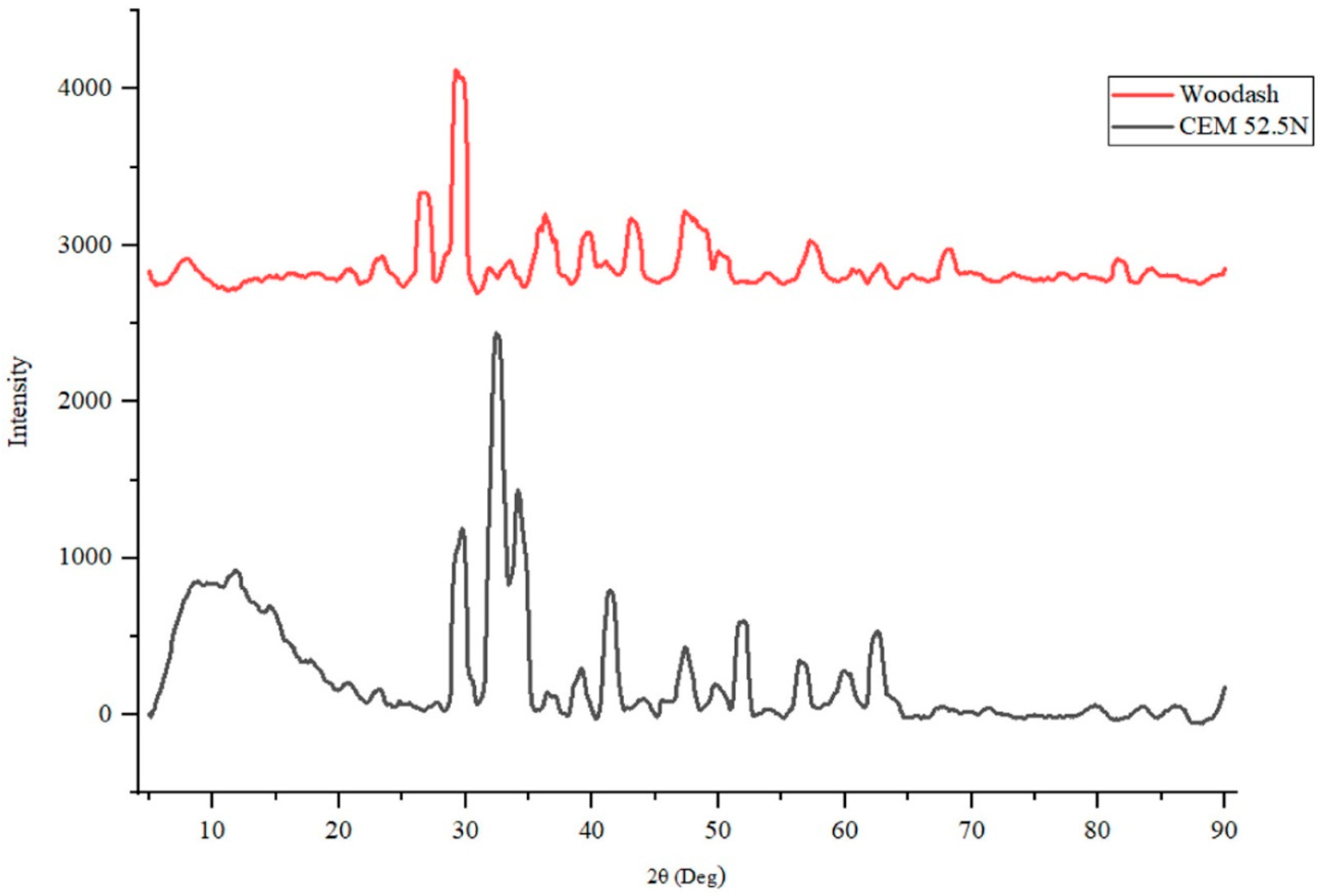
2.1.1. Chemical and Physical Properties of Materials
2.1.2. Mix Design and Preparation
2.1.3. Casting, Curing, and Testing
2.2. Methods
2.2.1. Response Surface Methodology (RSM)
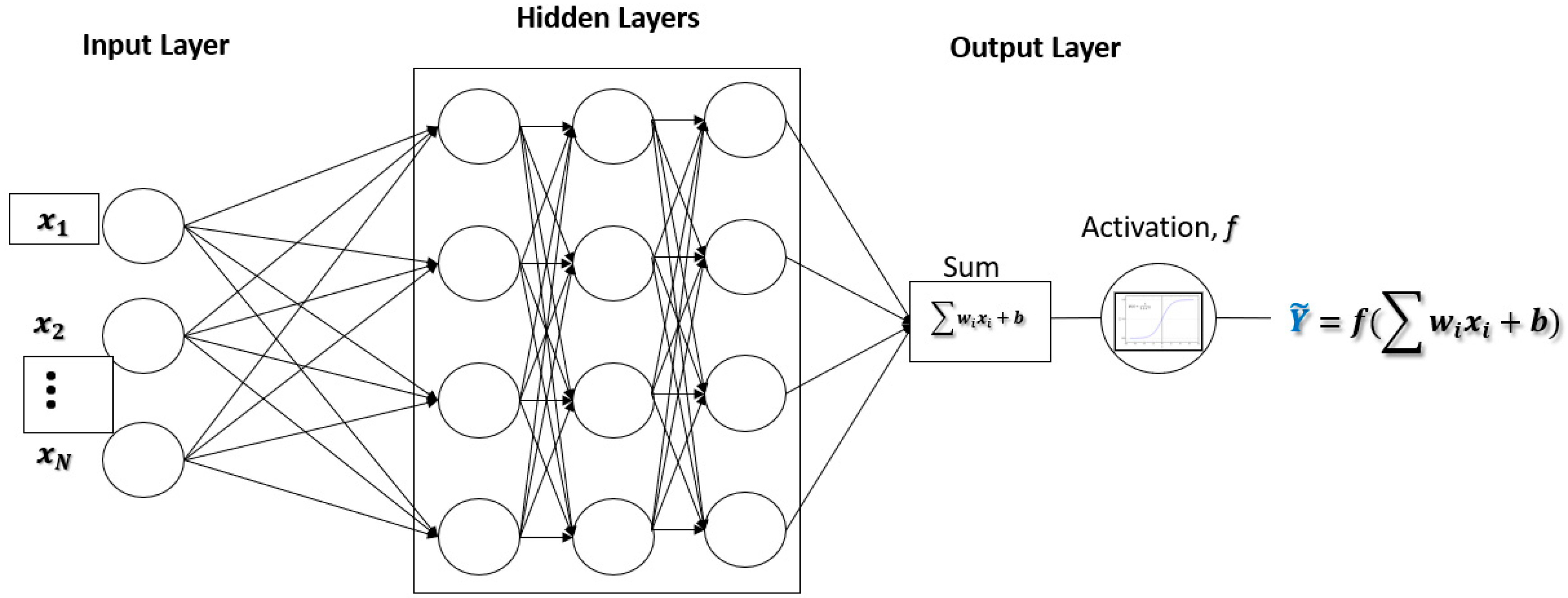
2.2.2. Artificial Neural Network (ANN)
3. Results
3.1. The 28-Day Compressive Strength Analysis
3.2. 28-Day Flexural Strength Analysis
3.3. 180-Day Compressive Strength Analysis
3.3.1. Experimental Insights
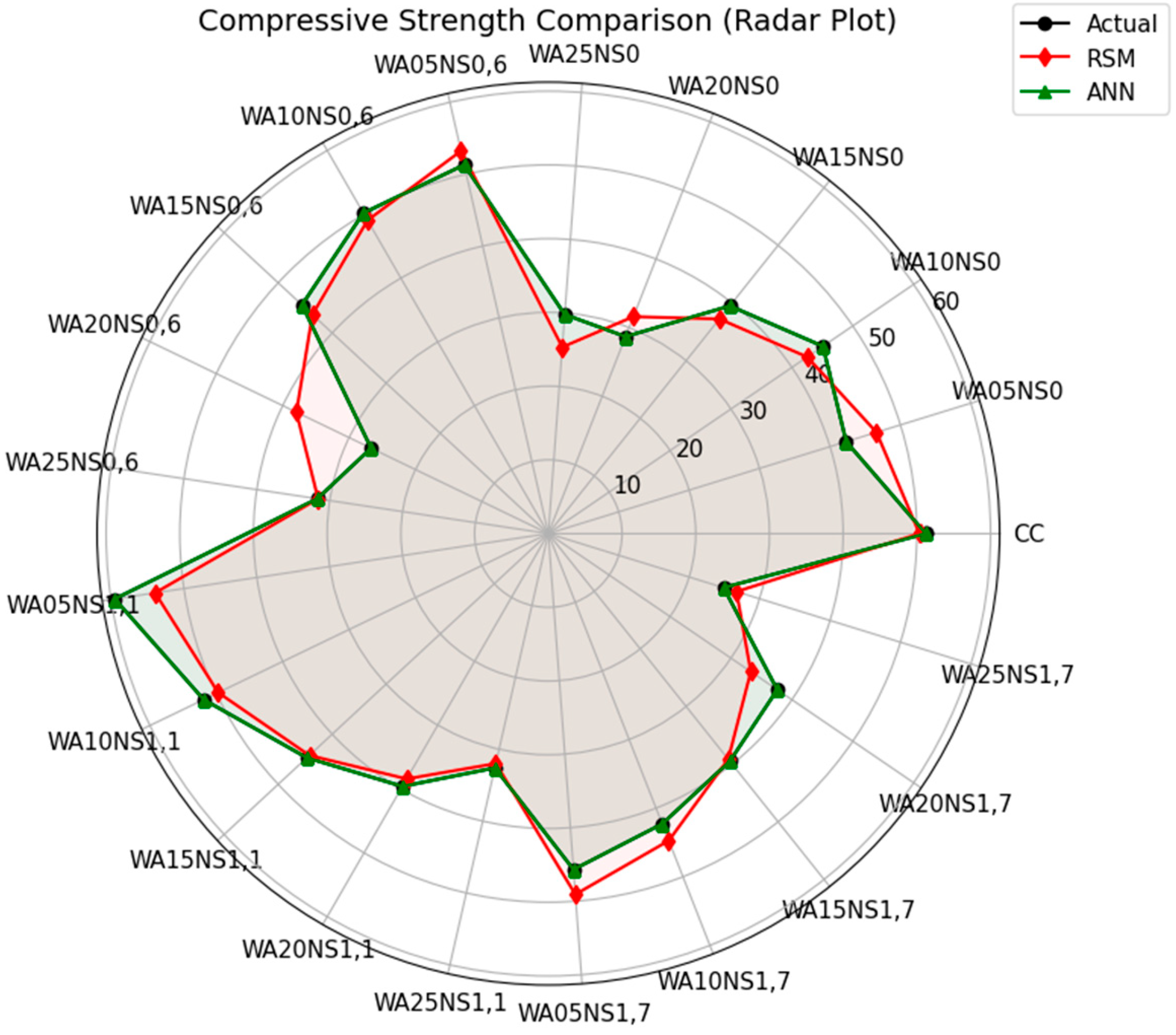
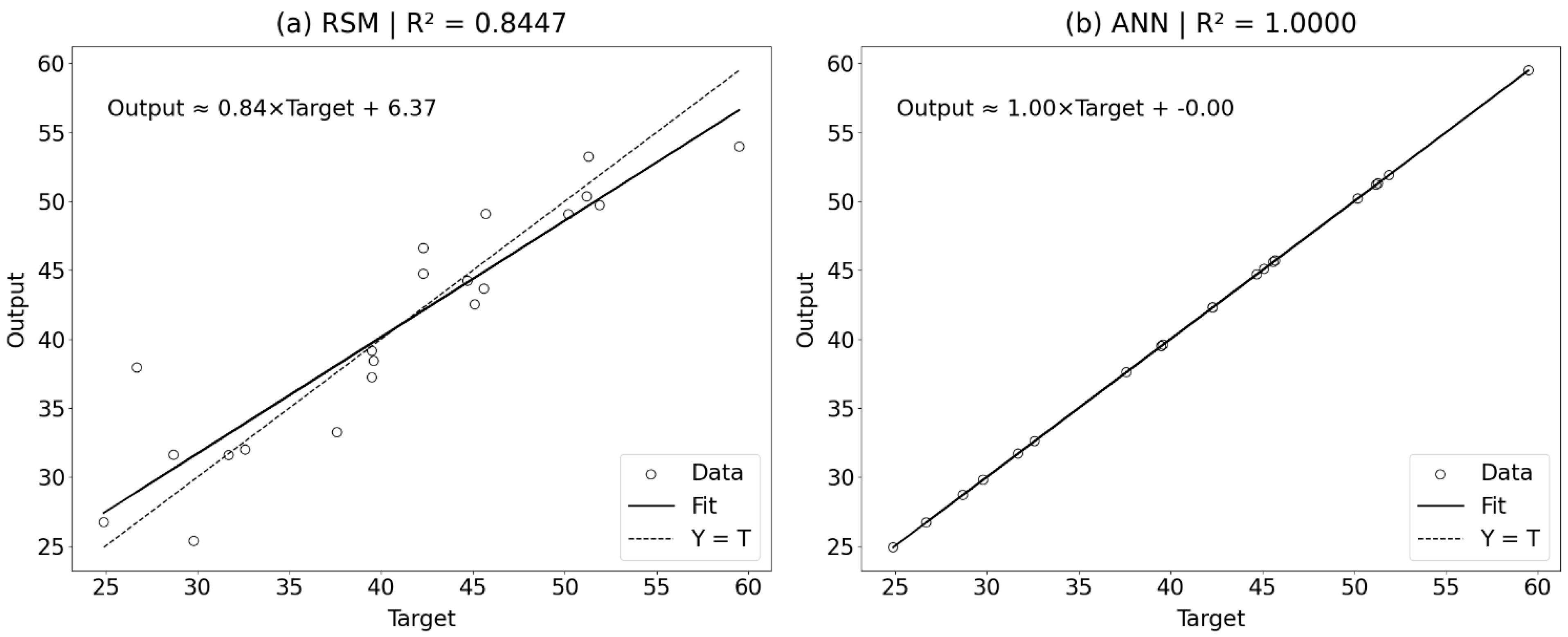
3.3.2. Predictive Modeling and Performance Comparison
3.4. 180-Day Flexural Strength Analysis
3.4.1. Experimental Insights
3.4.2. Predictive Modeling and Performance Comparison
4. Conclusions
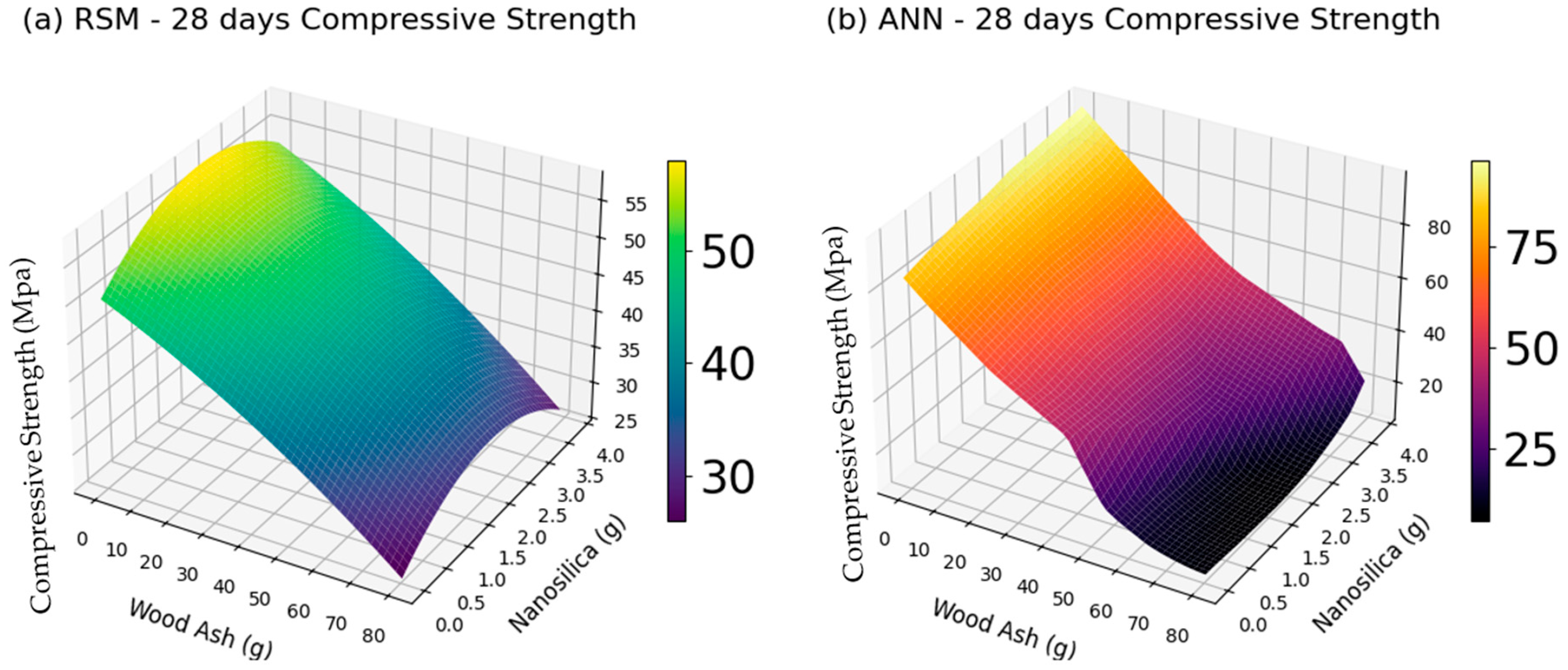
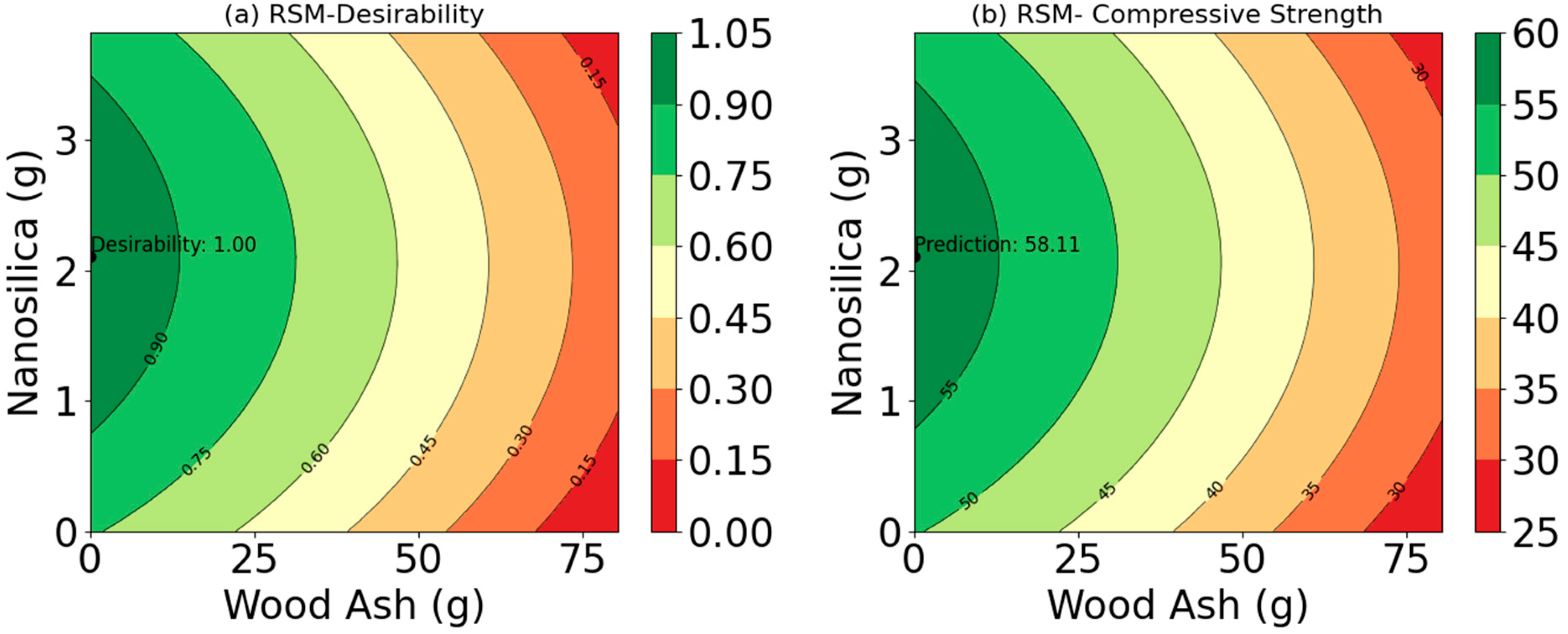
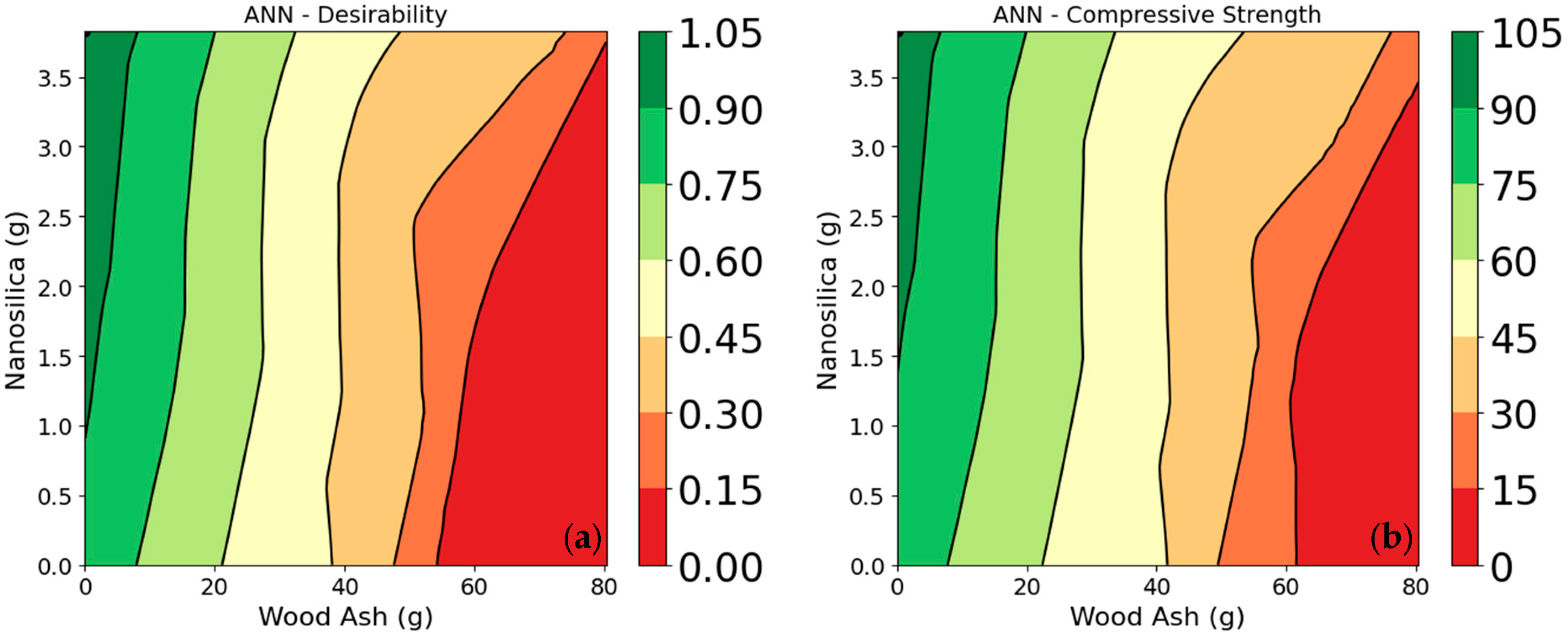
- For 28-day compressive strength, the RSM model predicted a maximum value of 58.11 MPa at 0 g wood ash and 2.12 g nanosilica, while the ANN model estimated values exceeding 60 MPa under comparable conditions. Overall, the findings demonstrate that nanosilica substantially improves strength development, whereas higher wood ash contents reduce strength due to dilution effects and disruption of the cementitious matrix.
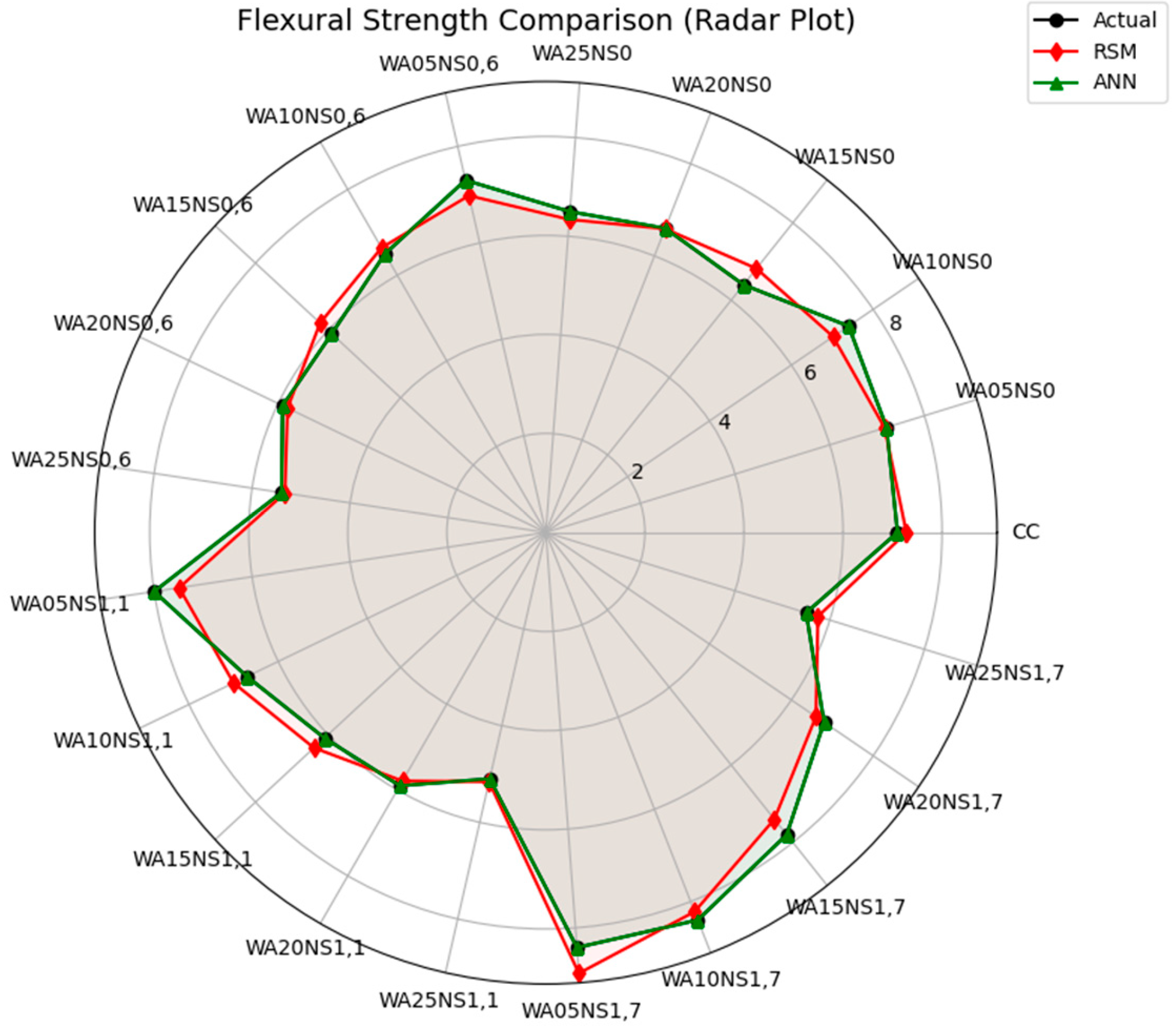
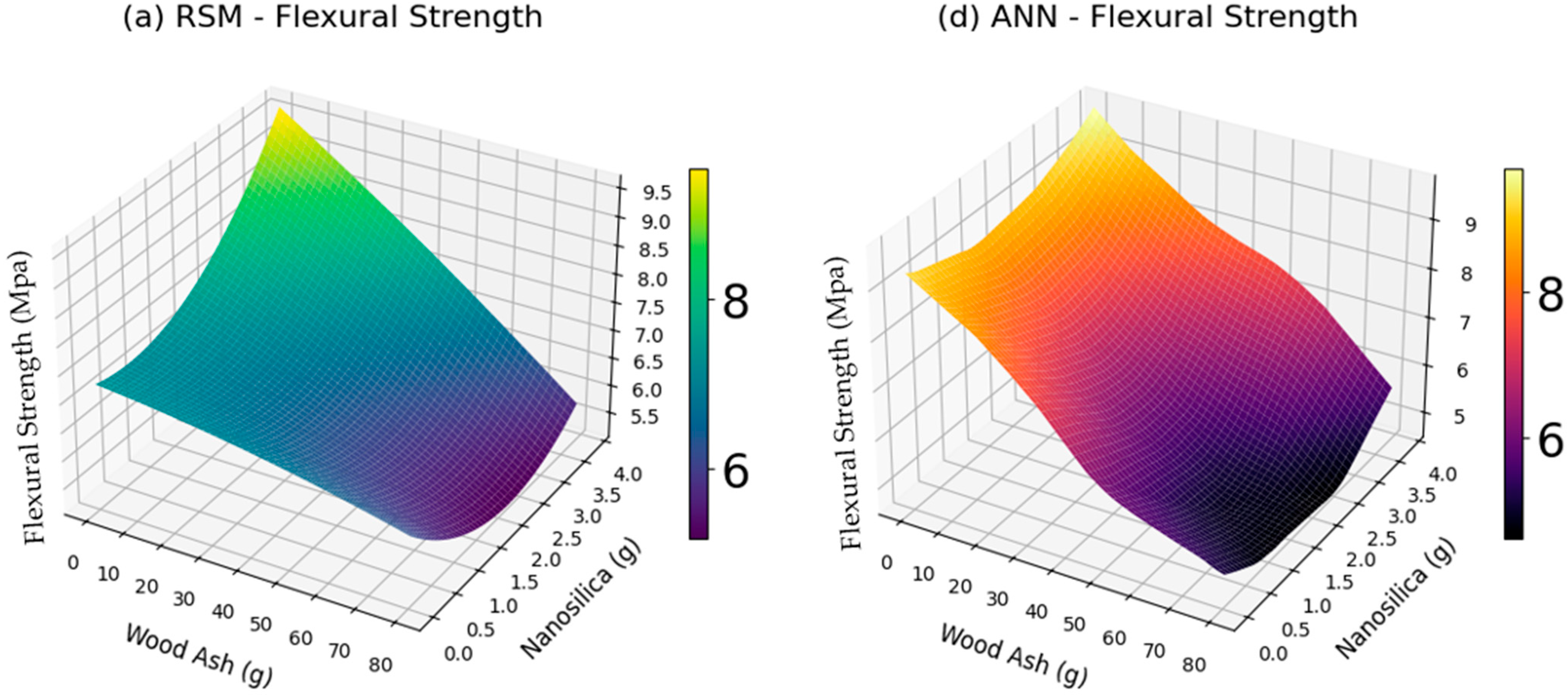
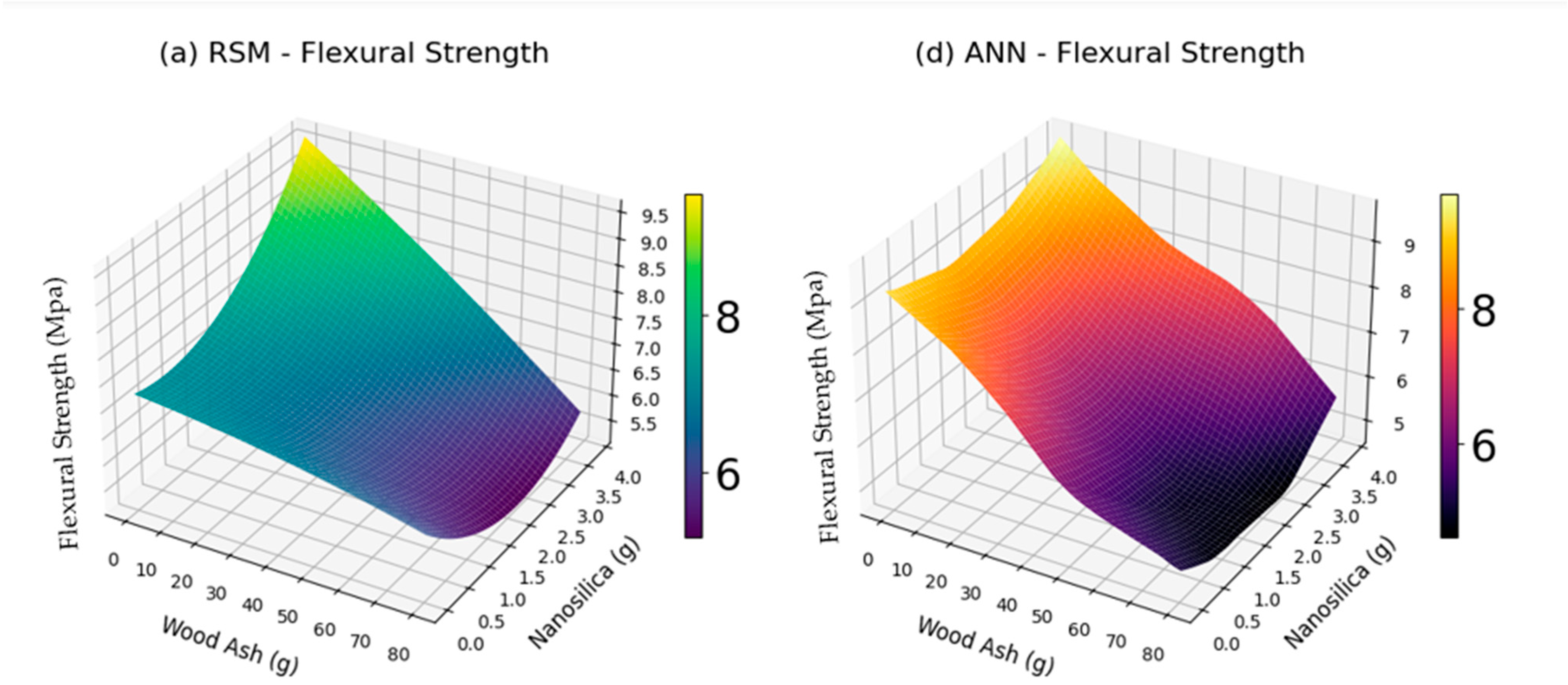
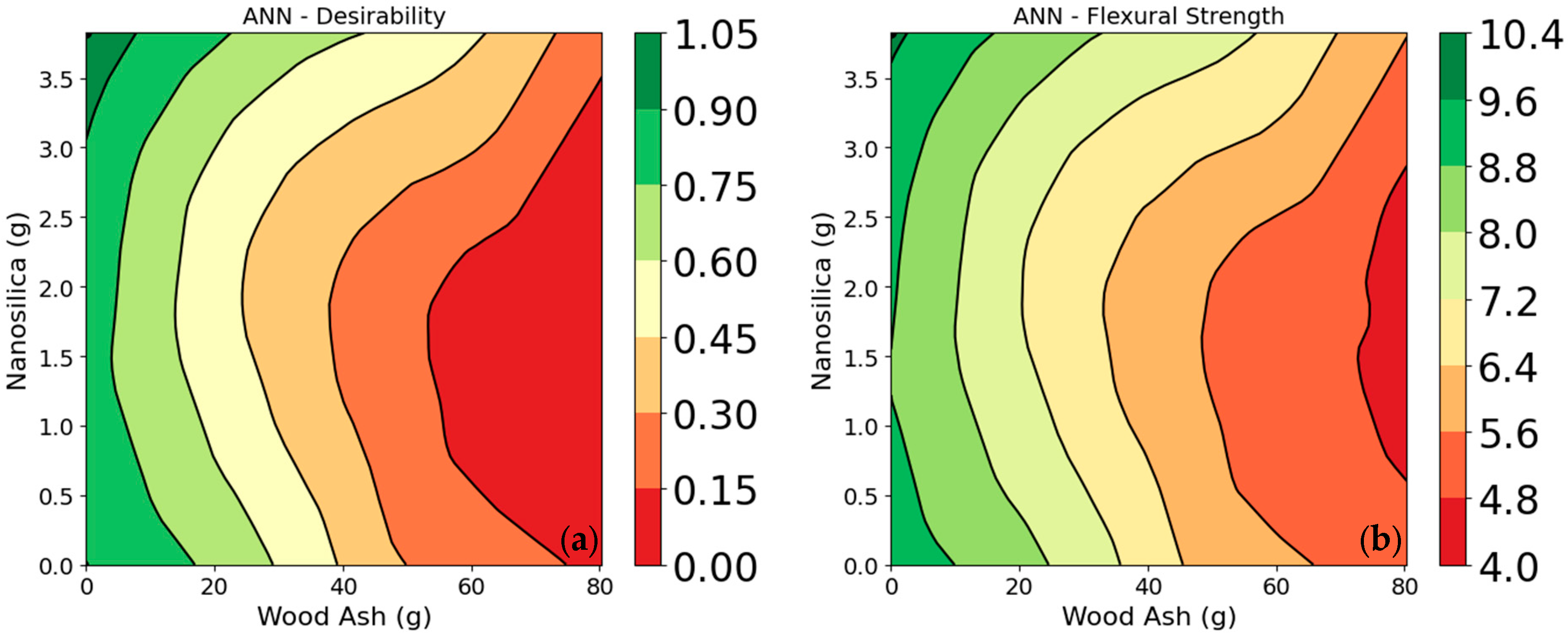
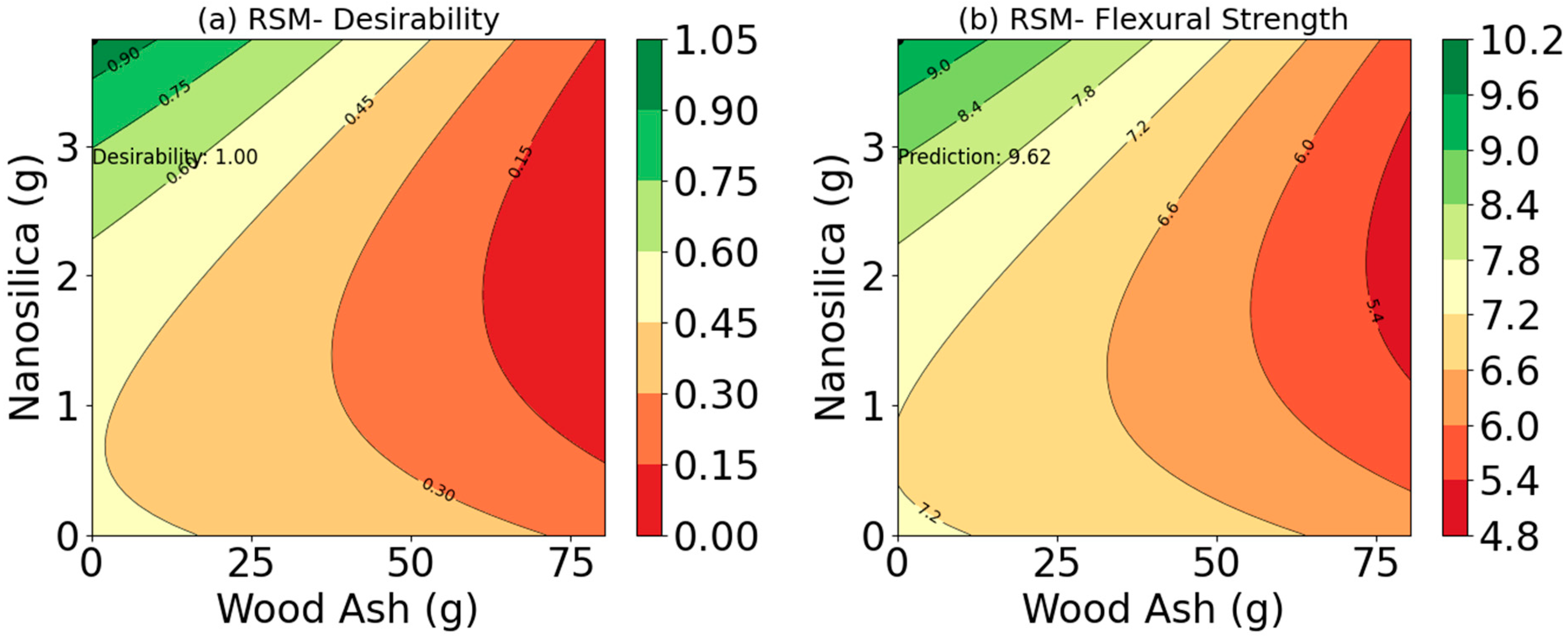
- For 28-day flexural strength, the RSM model predicted a maximum of 9.18 MPa at 0 g wood ash and 2.3 g nanosilica, whereas the ANN model projected values exceeding 10 MPa, thereby reinforcing the superior ability of the ANN approach to capture nonlinear patterns within the dataset.
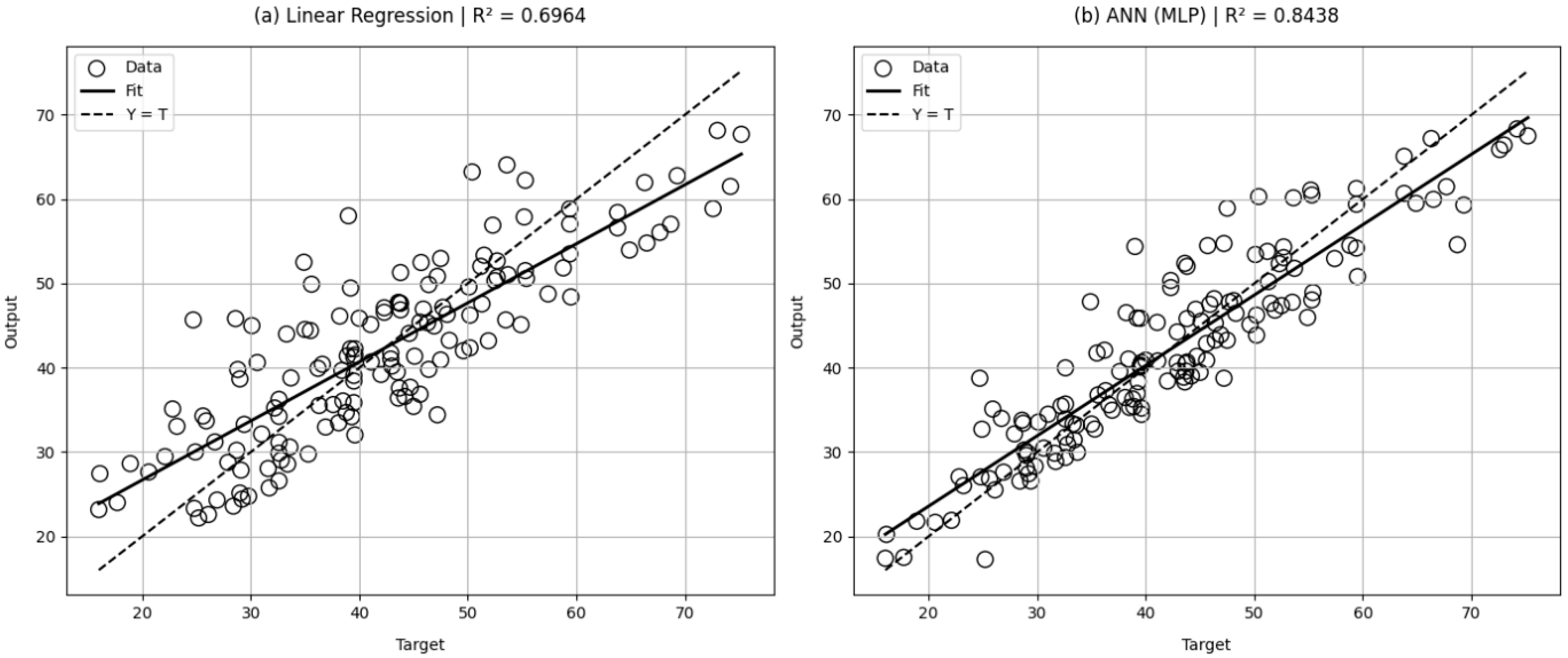
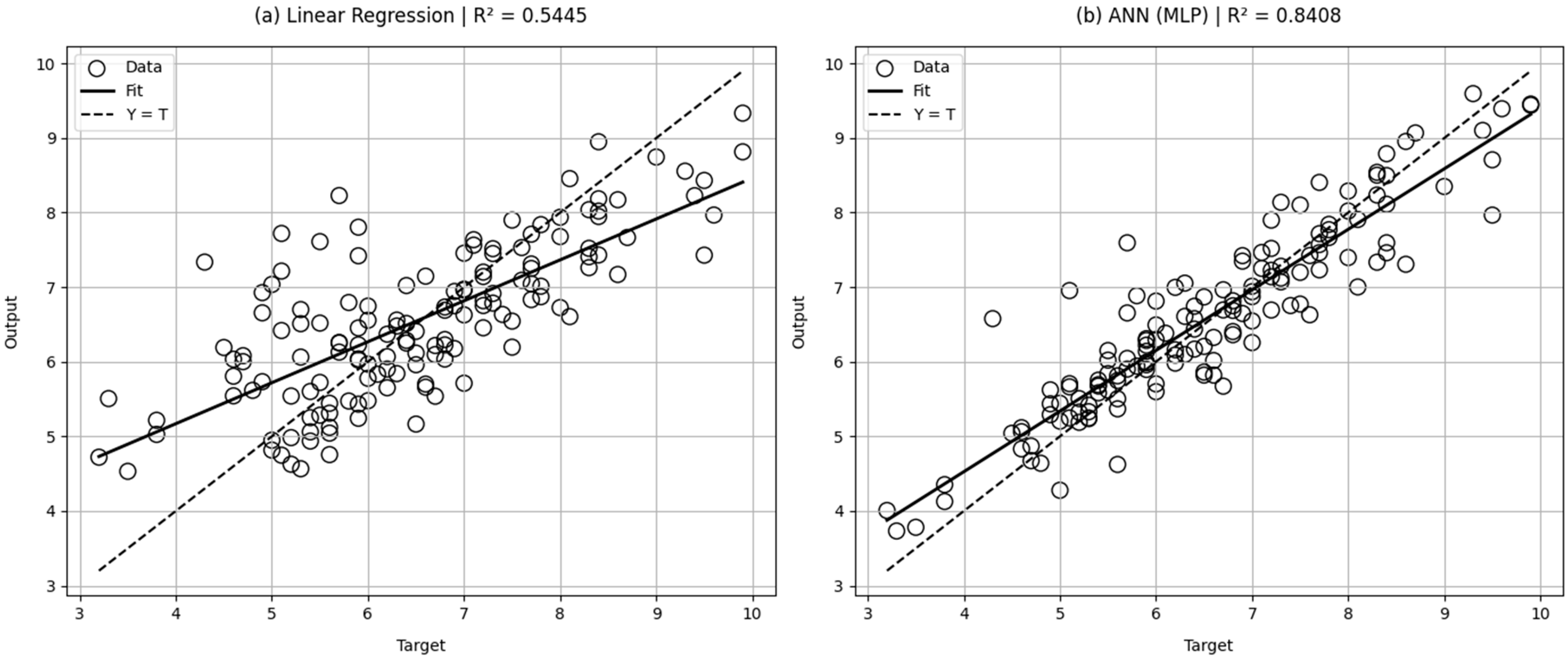
- MLR models showed only moderate predictive accuracy, whereas Optuna-optimized ANN models achieved substantially higher R2 values, confirming ANN as the more reliable approach for forecasting mechanical performance.
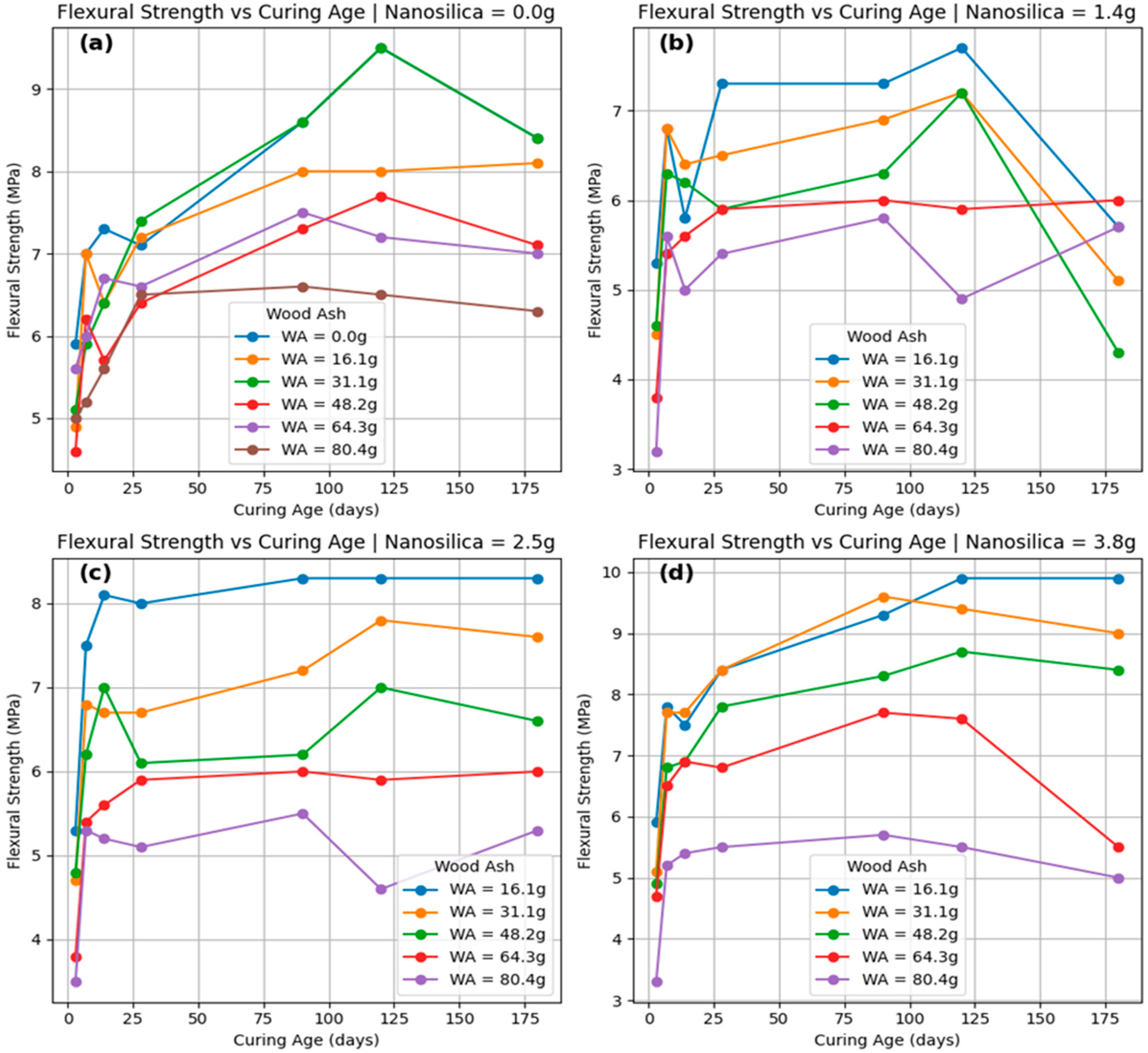
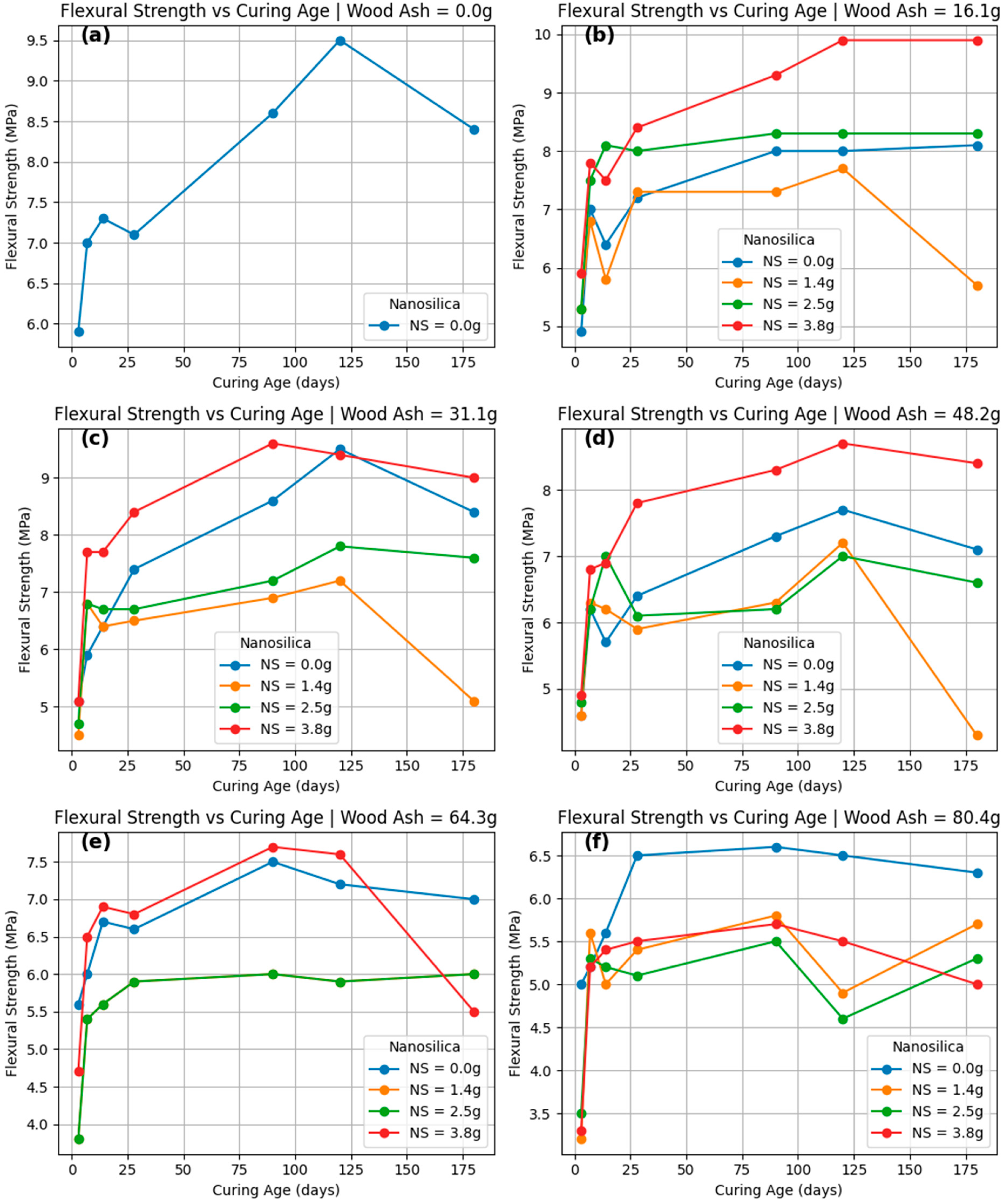
- Optimization results indicated that a nanosilica dosage of 2.0–2.5 g consistently produced the highest mechanical performance.
5. Suggested Future Research Studies
- Microstructural and Chemical Mechanisms
- Further studies should investigate the microstructural evolution and chemical interactions associated with varying nanosilica and wood ash dosages using advanced characterization techniques (e.g., XRD, SEM–EDS, FTIR). This would help clarify the mechanisms behind the observed strength trends.
- 2.
- Durability and Long-Term Performance
- Long-term durability assessments including chloride penetration, carbonation resistance, sulfate attack, freeze–thaw cycles, and drying shrinkage are needed to determine how optimal NS and WA dosages influence performance beyond early-age strength.
- 3.
- Broader Optimization Frameworks
- Future work could explore more advanced or hybrid optimization techniques (e.g., genetic algorithms, Bayesian optimization, particle swarm optimization) to further refine and automate mixture design targeting multiple performance objectives.
- 4.
- Model Generalization and Transferability
- Additional datasets from different binders, aggregates, and curing regimes should be used to evaluate the generalizability of ANN models and assess their robustness across diverse mix designs.
- 5.
- Hybrid or Physics-Informed Machine Learning Models
- Combining machine learning with mechanistic or physics-based models may enhance model interpretability and allow more accurate predictions under extrapolated conditions.
- 6.
- Life-Cycle and Sustainability Assessments
- Given the use of wood ash as a supplementary material, future research should incorporate life-cycle assessment (LCA) and cost–benefit analysis to quantify environmental and economic impacts alongside mechanical performance.
- 7.
- Field-Scale Validation
- Pilot-scale or field-based trials are recommended to validate laboratory-based predictions and confirm the practical feasibility of mixtures optimized using ANN models.
Author Contributions
Funding
Data Availability Statement
Acknowledgments
Conflicts of Interest
Abbreviations
| WA | Wood ash |
| NS | Nanosilica |
| RSM | Response surface methodology |
| ANN | Artificial neural networks |
| CS | Compressive strength |
| CC | Control concrete without WA and NS |
References
- Miller, S.A.; Horvath, A.; Monteiro, P.J. Impacts of booming concrete production on water resources worldwide. Nat. Sustain. 2018, 1, 69–76. [Google Scholar] [CrossRef]
- Andrew, R.M. Global CO2 emissions from cement production. Earth Syst. Sci. Data 2018, 10, 195–217. [Google Scholar] [CrossRef]
- Scrivener, K.L.; John, V.M.; Gartner, E.M. Eco-efficient cements: Potential economically viable solutions for a low-CO2 cement-based materials industry. Cem. Concr. Res. 2018, 114, 2–26. [Google Scholar] [CrossRef]
- Mehta, P.K.; Monteiro, P.J. Concrete: Microstructure, properties, and materials; McGraw-Hill Education: Columbus, OH, USA, 2014. [Google Scholar]
- Benhelal, E.; Zahedi, G.; Shamsaei, E.; Bahadori, A. Global strategies and potentials to curb CO2 emissions in cement industry. J. Clean. Prod. 2013, 51, 142–161. [Google Scholar] [CrossRef]
- Juenger, M.C.; Winnefeld, F.; Provis, J.L.; Ideker, J.H. Advances in alternative cementitious binders. Cem. Concr. Res. 2011, 41, 1232–1243. [Google Scholar] [CrossRef]
- Li, H.; Xiao, H.G.; Yuan, J.; Ou, J. Microstructure of cement mortar with nano-particles. Compos. Part B Eng. 2004, 35, 185–189. [Google Scholar] [CrossRef]
- Björnström, J.; Martinelli, A.; Matic, A.; Börjesson, L.; Panas, I. Accelerating effects of colloidal nano-silica for beneficial calcium–silicate–hydrate formation in cement. Chem. Phys. Lett. 2004, 392, 242–248. [Google Scholar] [CrossRef]
- Vassilev, S.V.; Baxter, D.; Andersen, L.K.; Vassileva, C.G.; Morgan, T.J. An overview of the organic and inorganic phase composition of biomass. Fuel 2012, 94, 1–33. [Google Scholar] [CrossRef]
- Rajamma, R.; Ball, R.J.; Tarelho, L.A.; Allen, G.C.; Labrincha, J.A.; Ferreira, V.M. Characterisation and use of biomass fly ash in cement-based materials. J. Hazard. Mater. 2009, 172, 1049–1060. [Google Scholar] [CrossRef]
- Senff, L.; Hotza, D.; Repette, W.L.; Ferreira, V.M.; Labrincha, J.A. Mortars with nano-SiO2 and micro-SiO2 investigated by experimental design. Constr. Build. Mater. 2010, 24, 1432–1437. [Google Scholar] [CrossRef]
- Cheah, C.B.; Ramli, M. The implementation of wood waste ash as a partial cement replacement material in the production of structural grade concrete and mortar: An overview. Resour. Conserv. Recycl. 2011, 55, 669–685. [Google Scholar] [CrossRef]
- Khademi, F.; Akbari, M.; Jamal, S.M.; Nikoo, M. Multiple linear regression, artificial neural network, and fuzzy logic prediction of 28 days compressive strength of concrete. Front. Struct. Civ. Eng. 2017, 11, 90–99. [Google Scholar] [CrossRef]
- Golafshani, E.M.; Behnood, A.; Arashpour, M. Predicting the compressive strength of normal and High-Performance Concretes using ANN and ANFIS hybridized with Grey Wolf Optimizer. Constr. Build. Mater. 2020, 232, 117266. [Google Scholar] [CrossRef]
- Ahmad, A.; Chaiyasarn, K.; Farooq, F.; Ahmad, W.; Suparp, S.; Aslam, F. Compressive strength prediction via gene expression programming (GEP) and artificial neural network (ANN) for concrete containing RCA. Buildings 2021, 11, 324. [Google Scholar] [CrossRef]
- Nguyen, K.T.; Nguyen, Q.D.; Le, T.A.; Shin, J.; Lee, K. Analyzing the compressive strength of green fly ash based geopolymer concrete using experiment and machine learning approaches. Constr. Build. Mater. 2020, 247, 118581. [Google Scholar] [CrossRef]
- Asteris, P.G.; Skentou, A.D.; Bardhan, A.; Samui, P.; Pilakoutas, K. Predicting concrete compressive strength using hybrid ensembling of surrogate machine learning models. Cem. Concr. Res. 2021, 145, 106449. [Google Scholar] [CrossRef]
- Elinwa, A.U.; Mahmood, Y.A. Ash from timber waste as cement replacement material. Cem. Concr. Compos. 2002, 24, 219–222. [Google Scholar] [CrossRef]
- Cheah, C.B.; Ramli, M. The fluid transport properties of HCWA-DSF hybrid supplementary binder concrete. Compos. Part B Eng. 2012, 43, 1535–1543. [Google Scholar]
- Udoeyo, F.F.; Inyang, H.; Young, D.T.; Oparadu, E.E. Potential of wood waste ash as an additive in concrete. J. Mater. Civ. Eng. 2006, 18, 605–611. [Google Scholar] [CrossRef]
- Malaiškienė, J.; Vaičienė, M. The Influence of Silica Fly Ash and Wood Bottom Ash on Cement Hydration and Durability of Concrete. Materials 2024, 17, 4031. [Google Scholar] [CrossRef]
- Sigvardsen, N.M. Utilisation of Wood Ash in Cement-Based Materials. Ph.D. Thesis, Technical University of Denmark, Kongens Lyngby, Denmark, 2020. [Google Scholar]
- Naik, T.R.; Kraus, R.N.; Siddique, R. Controlled low-strength materials containing mixtures of coal ash and a new pozzolanic material. ACI Mater. J. 2003, 100, 208–215. [Google Scholar] [CrossRef] [PubMed]
- Abdullahi, M. Characteristics of wood ash/OPC concrete. Leonardo Electron. J. Pract. Technol. 2006, 8, 9–16. [Google Scholar]
- Farinda, C.B.; de Brito, J.; Veiga, R. Influence of forest biomass bottom ashes on the fresh, water and mechanical behaviour of cement-based mortars. Resour. Conserv. Recycl. 2019, 149, 750–759. [Google Scholar] [CrossRef]
- Siddique, R. Utilization of wood ash in concrete manufacturing. Resour. Conserv. Recycl. 2012, 67, 27–33. [Google Scholar] [CrossRef]
- Thomas, B.S.; Yang, J.; Mo, K.H.; Abdalla, J.A.; Hawileh, R.A.; Ariyachandra, E. Biomass ashes from agricultural wastes as supplementary cementitious materials or aggregate replacement in cement/geopolymer concrete: A comprehensive review. J. Build. Eng. 2021, 40, 102332. [Google Scholar] [CrossRef]
- Jhonatan, A.; Duitama, B.; Avellaneda, D.R. Pozzolans: A review. Eng. Appl. Sci. Res. 2022, 49, 495–504. [Google Scholar]
- Jo, B.W.; Kim, C.H.; Tae, G.H.; Park, J.B. Characteristics of cement mortar with nano-SiO2 particles. Constr. Build. Mater. 2007, 21, 1351–1355. [Google Scholar] [CrossRef]
- Qing, Y.; Zenan, Z.; Deyu, K.; Rongshen, C. Influence of nano-SiO2 addition on properties of hardened cement paste as compared with silica fume. Constr. Build. Mater. 2007, 21, 539–545. [Google Scholar] [CrossRef]
- Abhilash, P.P.; Nayak, D.K.; Sangoju, B.; Kumar, R.; Kumar, V. Effect of nano-silica in concrete: A review. Constr. Build. Mater. 2021, 278, 122347. [Google Scholar] [CrossRef]
- Khan, K.; Ahmad, W.; Amin, M.N.; Nazar, S. Nano-Silica-Modified Concrete: A Bibliographic Analysis and Comprehensive Review of Material Properties. Nanomaterials 2022, 12, 1989. [Google Scholar] [CrossRef]
- Ltifi, M.; Guefrech, A.; Mounanga, P.; Khelidj, A.; Babaaissa, B. Experimental study of the effect of addition of nano-silica on the behaviour of cement mortars. Procedia Eng. 2011, 10, 900–905. [Google Scholar] [CrossRef]
- Senff, L.; Labrincha, J.A.; Ferreira, V.M.; Hotza, D.; Repette, W.L. Effect of nano-silica on rheology and fresh properties of cement pastes and mortars. Constr. Build. Mater. 2009, 23, 2487–2491. [Google Scholar] [CrossRef]
- Alqamish, H.H.; Al-Tamimi, A.K. Development and Evaluation of Nano-Silica Sustainable Concrete. Appl. Sci. 2018, 11, 3041. [Google Scholar] [CrossRef]
- Golewski, G.L. Combined Effect of Coal Fly Ash (CFA) and Nanosilica (nS) on the Strength Parameters and Microstructural Properties of Eco-Friendly Concrete. Energies 2023, 16, 452. [Google Scholar] [CrossRef]
- Tabish, M.; Zaheer, M.M.; Baqi, A. Effect of nano-silica on mechanical, microstructural and durability properties of cement-based materials: A review. J. Build. Eng. 2023, 65, 105676. [Google Scholar] [CrossRef]
- Aydin, A.C.; Nasl, V.J.; Kotan, T. The synergic influence of nano-silica an carbon nanotube on self-compacting concrete. J. Build. Eng. 2018, 20, 467–475. [Google Scholar] [CrossRef]
- Naniz, O.A.; Mazloom, M. Effects of colloidal nano-silica on fresh and hardened properties of self-compacting lightweight concrete. J. Build. Eng. 2018, 20, 400–410. [Google Scholar] [CrossRef]
- Akinwale, A.; Walied, H.; Raheem, A.A. The Combined effect of wood ash and nanosilica on the mechanical properties of blended mortar. Results Eng. 2025, 27, 105969. [Google Scholar] [CrossRef]
- Samuvel Raj, R.; Arulraj, G.P.; Anand, N.; Kanagaraj, B.; Lubloy, E. Nano-bentonite as a sustainable enhancer for alkali activated nano concrete: Assessing mechanical, microstructural, and sustainable properties. Case Stud. Constr. Mater. 2024, 20, e03213. [Google Scholar] [CrossRef]
- Praveen Kumar, V.V.; Dey, S. Study on strength and durability characteristics of nano-silica based blended concrete. Hybrid Adv. 2023, 2, 100011. [Google Scholar] [CrossRef]
- Anderson, M.J.; Whitcomb, P.J. RSM Simplified: Optimizing Processes Using Response Surface Methods for Design of Experiments; CRC Press: Boca Raton, FL, USA, 2016. [Google Scholar]
- Montgomery, D.C. Design and Analysis of Experiments; John Wiley & Sons: Hoboken, NJ, USA, 2017. [Google Scholar]
- Box, G.E.; Wilson, K.B. On the experimental attainment of optimum conditions. Breakthr. Stat. Methodol. Distrib. 1951, 13, 270–310. [Google Scholar] [CrossRef]
- Khuri, A.I.; Mukhopadhyay, S. Response surface methodology. Wiley Interdiscip. Rev. Comput. Stat. 2010, 2, 128–149. [Google Scholar] [CrossRef]
- Myers, R.H.; Montgomery, D.C.; Anderson-Cook, C.M. Response Surface Methodology: Process and Product Optimization Using Designed Experiments; John Wiley & Sons: Hoboken, NJ, USA, 2016. [Google Scholar]
- Chou, J.S.; Chiu, C.K.; Farfoura, M.; Al-Taharwa, I. Optimizing the prediction accuracy of concrete compressive strength based on a comparison of data-mining techniques. J. Comput. Civ. Eng. 2011, 25, 242–253. [Google Scholar] [CrossRef]
- Asteris, P.G.; Mokos, V.G. Concrete compressive strength using artificial neural networks. Neural Comput. Appl. 2020, 32, 11807–11826. [Google Scholar] [CrossRef]
- Ma, W.; Wang, Y.; Huang, L.; Yan, L.; Kasal, B. Optimisation and prediction of compressive properties for concrete containing recycled aggregates and rice husk ash using response surface methodology (RSM). Build. Mater. Recycl. 2023, 7, 1234–1241. [Google Scholar] [CrossRef]
- Gowda, C.C.; Raju, B.C.K.; Bhojaraj, B.E. Response Surface Models for Optimal Concrete Designs. In Sustainable Construction and Building Materials; Springer: Berlin/Heidelberg, Germany, 2022; pp. 67–78. [Google Scholar]
- Behnood, A.; Golafshani, E.M. Predicting the compressive strength of silica fume concrete using hybrid artificial neural network with multi-objective grey wolves. J. Clean. Prod. 2018, 202, 54–64. [Google Scholar] [CrossRef]
- Duan, Z.H.; Kou, S.C.; Poon, C.S. Prediction of compressive strength of recycled aggregate concrete using artificial neural networks. Constr. Build. Mater. 2013, 40, 1200–1206. [Google Scholar] [CrossRef]
- Hagan, M.T.; Demuth, H.B.; Beale, M.H.; De Jesús, O. Neural Network Design; Martin Hagan: San Diego, CA, USA, 2014. [Google Scholar]
- Haykin, S. Neural Networks and Learning Machines; Pearson Education: Hong Kong, China, 2009. [Google Scholar]
- Sorour, S.S.; Saleh, C.A.; Shazly, M. A review on machine learning implementation for predicting and optimizing the mechanical behaviour of laminated fiber-reinforced polymer composites. Heliyon 2024, 10, e33681. [Google Scholar] [CrossRef]
- Forsdyke, J.C.; Zviazhynski, B.; Lees, J.M.; Conduit, G. Probabilistic selection and design of concrete using machine learning. Data-Centric Eng. 2023, 4, e12. [Google Scholar] [CrossRef]
- Jagadesh, P.; Khan, A.H.; Priya, B.S.; Asheeka, A.; Zoubir, Z.; Magbool, H.M.; Alam, S.; Bakather, O.Y. Artificial neural network, machine learning modelling of compressive strength of recycled coarse aggregate based self-compacting concrete. PLoS ONE 2024, 19, e0303101. [Google Scholar] [CrossRef]
- Lu, K.; Chen, X.; Zhang, J.; Chen, J.; Liu, Z.; Chen, L. Comparison of artificial neural network and response surface methodology prediction in key performance of two-component grout material in shield tunneling. Case Stud. Constr. Mater. 2025, 23, e05020. [Google Scholar] [CrossRef]
- Shaqadan, A.A.; Alshalout, I.; Abojaradeh, M.; Al-Kasasbeh, R.T.; Al-Khatib, A. Developing Artificial Neural Networks Model for Concrete Mix Design BT. In Proceedings of the 2022 5th International Conference on Electronics, Information, and Communication Engineering, Xi’an, China, 16–18 December 2022; p. 50473. [Google Scholar]
- Rao, G.M.; Sandhya, M.M.; Rajeshwari, B.R.; Oggu, P. Artificial Neural Networks, A Tool for Predicting Compressive strength of Recycled Aggregate Concrete. IOP Conf. Ser. Earth Environ. Sci. 2023, 1130, 12016. [Google Scholar]
- Mandal, S.; Shiuly, A.; Sau, D.; Mondal, A.K.; Sarkar, K. Study on the use of different machine learning techniques for prediction of concrete properties from their mixture proportions with their deterministic and robust optimisation. AI Civ. Eng. 2024, 3, 7. [Google Scholar] [CrossRef]
- Rathinam, K.; Sakthivel, S.; Vigneshwaran, S.P.; Vinayagamoorthy, M.; Kumar, N. Properties of nano silica modified cement less geopolymer composite mortar using fly ash and GGBS. Mater. Today Proc. 2022, 65, 589–3595. [Google Scholar] [CrossRef]
- Zinad, A.A.S.; Csiha, C. Improving sustainability of mortar by wood-ash and Nano-SiO2. Case Stud. Chem. Environ. Eng. 2023, 9, 100597. [Google Scholar] [CrossRef]
- Du, Y.; Korjakins, A. Synergic Effects of Nano Additives on Mechanical Performance and Microstrure of Lighweight Cement Mortar. Appl. Sci. 2023, 13, 5130. [Google Scholar] [CrossRef]
- Alvansazyazdi, M.; Figueroa, J.; Paucar, A.; Robles, G.; Khorami, M.; Bonilla-Valladares, P.M. Nano-Silica in Holcim General Use Cement Mortars: A Comparative Study with Traditional and Prefabricated Mortars in Global Sustainable Construction. Adv. Concr. Constr. 2024, 17, 135–150. [Google Scholar] [CrossRef]
- Ikotun, B.D.; Raheem, A.A. Influence of Synthesized Nanosilica on Properties of Wood Ash Cement Mortar; Springer: Singapore, 2023. [Google Scholar] [CrossRef]
- Abdolrasol, M.G.M.; Hussain, S.M.S.; Ustun, T.S.; Sarker, M.R.; Hannan, M.A.; Mohamed, R.; Ali, J.A.; Mekhilef, S.; Milad, A. Artificial neural networks based optimization techniques: A review. Electronics 2008, 10, 2689. [Google Scholar] [CrossRef]
- Topçu, I.B.; Saridemir, M. Prediction of mechanical properties of recycled aggregate concretes containing silica fume using artificial neural networks and fuzzy logic. Comput. Mater. Sci. 2008, 42, 74–82. [Google Scholar] [CrossRef]
- Pedregosa, F.; Varoquaux, G.; Gramfort, A.; Michel, V.; Thirion, B.; Grisel, O.; Blondel, M.; Prettenhofer, P.; Weiss, R.; Dubourg, V.; et al. Scikit-learn: Machine learning in Python. J. Mach. Learn. Res. 2011, 12, 2825–2830. [Google Scholar]
- Akiba, T.; Sano, S.; Yanase, T.; Ohta, T.; Koyama, M. Optuna: A Next-generation Hyperparameter Optimization Framework. In Proceedings of the ACM SIGKDD International Conference on Knowledge Discovery and Data Mining, Anchorage, AK, USA, 4–8 August 2019; pp. 2623–2631. [Google Scholar] [CrossRef]
- Ray, S.; Haque, M.; Ahmed, T.; Nahin, T.T. Comparison of artificial neural network (ANN) and response surface methodology (RSM) in predicting the compressive and splitting tensile strength of concrete prepared with glass waste and tin (Sn) can fiber. J. King Saud Univ.-Eng. Sci. 2023, 35, 185–199. [Google Scholar] [CrossRef]
- Sikora, P.; Chung, S.-Y.; Liard, M.; Lootens, D.; Dorn, T.; Kamm, P.H.; Stephan, D.; Elrahman, M.A. The effects of nanosilica on the fresh and hardened properties of 3D printable mortars. Constr. Build. Mater. 2021, 281, 122574. [Google Scholar] [CrossRef]
- Regalla, S.S.; Senthil, K.N. The enhancing role of nanomaterials in revolutionizing ultra-high-performance concrete (UHPC): A journey from atomic precision to structural prominence. Case Stud. Constr. Mater. 2025, 22, e04608. [Google Scholar] [CrossRef]
- Korondi, P.Z.; Marchi, M.; Poloni, C. Response surface methodology. In Optimization Under Uncertainty with Applications to Aerospace Engineering; Springer: Berlin/Heidelberg, Germany, 2021; pp. 387–409. [Google Scholar] [CrossRef]
- Ustaoglu, A.; Kursuncu, B.; Alptekin, M.; Gok, M.S. Performance optimization and parametric evaluation of the cascade vapor compression refrigeration cycle using Taguchi and ANOVA methods. Appl. Therm. Eng. 2020, 180, 115816. [Google Scholar] [CrossRef]
- Vanneschi, L.; Silva, S. Artificial Neural Networks. In Natural Computing Series; Springer: Berlin/Heidelberg, Germany, 2023; pp. 161–204. [Google Scholar] [CrossRef]
- İIknur, B.K.; Ömer, F.D. Effect of nano silica on cement mortars containing micro silica. Chall. J. Concr. Res. Lett. 2019, 10, 42–49. [Google Scholar] [CrossRef]
- Abd El-Baky, S.; Yehia, S.; Khalil, I.S. Influence of nano-silica addition on properties of fresh and hardened cement mortar. NANOCON 2013, 10, 16–18. [Google Scholar]
- Zhang, M.H.; Islam, J.; Peethamparan, S. Use of nano-silica to increase early strength and reducing setting time of concretes with high volume of slag. Cem. Concr. Compos. 2012, 34, 650–662. [Google Scholar] [CrossRef]
- De Michele, R.; Liguori, B.; Luceri, D.; Zecca, G.; Largo, A.; Koidis, C.; Achillas, C.; Kalaitzidis, A.; Pascale, C.; Menna, C. Wood ash-based materials with improved post-fire resistance for building and infrastructure applications. Resour. Conserv. Recycl. 2025, 222, 108475. [Google Scholar] [CrossRef]
- Gayathiri, K.; Praveenkumar, S. Influence of Nano Silica on Fresh and Hardened Properties of Cement-based Materials—A Review. Silicon 2022, 14, 8327–8357. [Google Scholar] [CrossRef]
- Zhao, L.; Chen, G.; Zhang, Y.; Zhu, H.; Zhao, H.; Tang, J.; Yuan, J. Mechanical properties of hybrid fibers and nano-silica reinforced concrete during exposure to elevated temperatures. Case Stud. Constr. Mater. 2024, 21, e04042. [Google Scholar] [CrossRef]
- Ehsani, A.; Nili, M.; Shaabani, K. Effect of nanosilica on the compressive strength development and water absorption properties of cement paste and concrete containing Fly Ash. KSCE J. Civ. Eng. 2017, 21, 1854–1865. [Google Scholar] [CrossRef]
- Shmueli, G. To Explain or to Predict? Inst. Math. Stat. Sci. 2010, 25, 289–310. [Google Scholar] [CrossRef]
- Vining, G.G.; Peck, E.A.; Montgomery, D.C. Introduction to Linear Regression Analysis; John Wiley and Sons Inc.: Hoboken, NJ, USA, 2012; p. 2. [Google Scholar]
- Harrell, F.E., Jr. Regression Modeling Strategies with Applications to Linear Models, Logistics and Ordinal Regression and Survival Analysis; Springer International Publishing: Cham, Switzerland, 2015. [Google Scholar] [CrossRef]
- Joshua, O.; Tunji-Olayeni, P.; Kolapo, O.; Akingunola, O.A.; Ede, A.; Adewale, B. Investigating for pozzolanic activity in the blend of ground glass waste with cement for sustainable concrete. Int. J. Mech. Eng. Technol. 2018, 9, 808–816. [Google Scholar]







| Properties | Value | Chemical Composition (%) | |
|---|---|---|---|
| SiO2 | 53.57 | ||
| Al2O3 | 33.98 | ||
| Fe2O3 | 6.12 | ||
| Conventional parameters | MgO | 6.23 | |
| Organic material (mg/kg) | <10 | CaO | 3.24 |
| pH | 12.1 | MnO | 1.66 |
| SO3 | 1.58 | ||
| Physical properties | Cl | 0.07 | |
| Density (kg/m3) | 834 | Na2O | 0.00 |
| Specific gravity | 1.92 | K2O | 0.20 |
| Mean size (µm) | 0.4 | TiO2 | 0.20 |
| P2O5 | 0.30 | ||
| SrO2 | 0.08 | ||
| ZrO2 | 0.96 | ||
| ZnO | 2.66 | ||
| (LOI) | 14.2 |
| Mix ID | PC (g) | Sand (g) | Water (g) | Wood Ash (g) | NS (g) |
|---|---|---|---|---|---|
| CC | 450.0 | 1350 | 225 | 0.000 | 0.000 |
| WA05NS0 | 427.5 | 1350 | 225 | 16.071 | 0.000 |
| WA10NS0 | 405.0 | 1350 | 225 | 31.143 | 0.000 |
| WA15NS0 | 385.5 | 1350 | 225 | 48.214 | 0.000 |
| WA20NS0 | 360.0 | 1350 | 225 | 64.286 | 0.000 |
| WA25NS0 | 337.5 | 1350 | 225 | 80.357 | 0.000 |
| WA05NS0.6 | 427.5 | 1350 | 225 | 16.071 | 1.350 |
| WA10NS0.6 | 405.0 | 1350 | 225 | 31.143 | 1.350 |
| WA15NS0.6 | 385.5 | 1350 | 225 | 48.214 | 1.350 |
| WA20NS0.6 | 360.0 | 1350 | 225 | 64.286 | 1.350 |
| WA25NS0.6 | 337.5 | 1350 | 225 | 80.357 | 1.350 |
| WA05NS1.1 | 427.5 | 1350 | 225 | 16.071 | 2.475 |
| WA10NS1.1 | 405.0 | 1350 | 225 | 31.143 | 2.475 |
| WA15NS1.1 | 385.5 | 1350 | 225 | 48.214 | 2.475 |
| WA20NS1.1 | 360.0 | 1350 | 225 | 64.286 | 2.475 |
| WA25NS1.1 | 337.5 | 1350 | 225 | 80.357 | 2.475 |
| WA05NS1.7 | 427.5 | 1350 | 225 | 16.071 | 3.825 |
| WA10NS1.7 | 405.0 | 1350 | 225 | 31.143 | 3.825 |
| WA15NS1.7 | 385.5 | 1350 | 225 | 48.214 | 3.825 |
| WA20NS1.7 | 360.0 | 1350 | 225 | 64.286 | 3.825 |
| WA25NS1.7 | 337.5 | 1350 | 225 | 80.357 | 3.825 |
| Study Type | Design Type | Design Model | Subtype | Runs | Blocks |
|---|---|---|---|---|---|
| Response Surface | User-Defined | Quadratic | Randomized | 21 | No Blocks |
| Test Specimen | Actual CS (MPa) | Predicted CS (RSM) | ANN Predicted (MPa) |
|---|---|---|---|
| CC | 51.2 | 50.35 | 51.2 |
| WA05NS0 | 42.3 | 46.60 | 42.3 |
| WA10NS0 | 45.1 | 42.52 | 45.1 |
| WA15NS0 | 39.5 | 37.23 | 39.5 |
| WA20NS0 | 28.7 | 31.61 | 28.7 |
| WA25NS0 | 29.8 | 25.36 | 29.8 |
| WA05NS0.6 | 51.3 | 53.23 | 51.3 |
| WA10NS0.6 | 50.2 | 49.06 | 50.2 |
| WA15NS0.6 | 45.6 | 43.66 | 45.6 |
| WA20NS0.6 | 26.7 | 37.94 | 26.7 |
| WA25NS0.6 | 31.7 | 31.59 | 31.7 |
| WA05NS1.1 | 59.5 | 53.96 | 59.5 |
| WA10NS1.1 | 51.9 | 49.71 | 51.9 |
| WA15NS1.1 | 44.7 | 44.23 | 44.7 |
| WA20NS1.1 | 39.6 | 38.42 | 39.6 |
| WA25NS1.1 | 32.6 | 31.99 | 32.6 |
| WA05NS1.7 | 45.7 | 49.08 | 45.7 |
| WA10NS1.7 | 42.3 | 44.74 | 42.3 |
| WA15NS1.7 | 39.5 | 39.15 | 39.5 |
| WA20NS1.7 | 37.6 | 33.25 | 37.6 |
| WA25NS1.7 | 24.9 | 26.72 | 24.9 |
| Source | Sum of Squares (SS) | df | F-Value | p-Value |
|---|---|---|---|---|
| WA | 31.1778 | 1.0 | 1.7220 | 0.2092 |
| NS | 183.9173 | 1.0 | 10.1582 | 0.0061 |
| WA2 | 7.9832 | 1.0 | 0.4409 | 0.5167 |
| NS2 | 168.7324 | 1.0 | 9.3195 | 0.0081 |
| WA × NS | 0.5068 | 1.0 | 0.0280 | 0.8694 |
| Residual | 271.5787 | 15.0 | - | - |
| Total | 0.8447 | - | - | - |
| Adj. | 0.7929 | - | - | - |
| Std. Dev. | 3.5962 | - | - | - |
| Mean | 40.9714 | - | - | - |
| C.V. (%) | 8.7772 | - | - | - |
| Test Specimen | Actual FS (MPa) | Predicted FS (RSM) | ANN Predicted (MPa) |
|---|---|---|---|
| CC | 7.10 | 6.40 | 7.10 |
| WA05NS0 | 6.20 | 6.31 | 6.20 |
| WA10NS0 | 5.60 | 5.76 | 5.60 |
| WA15NS0 | 4.70 | 5.21 | 4.70 |
| WA20NS0 | 3.20 | 4.30 | 3.20 |
| WA25NS0 | 3.00 | 3.45 | 3.00 |
| WA05NS0.6 | 7.40 | 7.14 | 7.40 |
| WA10NS0.6 | 6.40 | 6.58 | 6.40 |
| WA15NS0.6 | 5.70 | 6.01 | 5.70 |
| WA20NS0.6 | 3.60 | 5.01 | 3.60 |
| WA25NS0.6 | 4.00 | 4.11 | 4.00 |
| WA05NS1.1 | 8.60 | 7.91 | 8.60 |
| WA10NS1.1 | 7.40 | 7.34 | 7.40 |
| WA15NS1.1 | 6.50 | 6.77 | 6.50 |
| WA20NS1.1 | 5.10 | 5.76 | 5.10 |
| WA25NS1.1 | 4.30 | 4.83 | 4.30 |
| WA05NS1.7 | 6.90 | 7.34 | 6.90 |
| WA10NS1.7 | 6.10 | 6.77 | 6.10 |
| WA15NS1.7 | 5.10 | 6.20 | 5.10 |
| WA20NS1.7 | 4.50 | 5.19 | 4.50 |
| WA25NS1.7 | 3.10 | 4.27 | 3.10 |
| Source | Sum of Squares (SS) | df | F-Value | p-Value |
|---|---|---|---|---|
| WA | 6.2184 | 1 | 2.4146 | 0.1405 |
| NS | 27.4172 | 1 | 10.6411 | 0.0024 |
| WA2 | 0.5801 | 1 | 0.2252 | 0.6410 |
| NS2 | 23.8191 | 1 | 9.2410 | 0.0049 |
| WA × NS | 0.2186 | 1 | 0.0847 | 0.7743 |
| Residual | 38.6374 | 15 | — | — |
| Total R2 | 0.8621 | — | — | — |
| Adj. R2 | 0.8163 | — | — | — |
| Std. Dev. | 0.7586 | — | — | — |
| Mean | 5.6857 | — | — | — |
| C.V. (%) | 13.3432 | — | — | — |
| Factor | Name | Units | Minimum | Maximum | Coded Low | Coded High | Mean | Std. Dev. |
|---|---|---|---|---|---|---|---|---|
| A | Wood ash | g | 16,071 | 80,357 | −1 ↔ 16 | +1↔ 80,357 | 48,214 | 5.45 |
| B | Water | g | 225 | 225 | −1↔ 225.00 | +1 ↔ 225 | 225 | 0 |
| C | Cement | g | 338 | 427.5 | −1 ↔ 338.00 | +1 ↔ 428 | 383 | 63.64 |
| D | Nanosilica | g | 1.35 | 3825 | −1 ↔ 1.35 | +1 ↔ 4 | 2603 | 1.73 |
| Response | Name | Units | Maximum | Mean | Std. Dev. |
|---|---|---|---|---|---|
| R2 | Compressive strength | MPa | 60 | 59 | 0.71 |
| R3 | Flexural strength | MPa | 10 | 9.59 | 0.29 |
Disclaimer/Publisher’s Note: The statements, opinions and data contained in all publications are solely those of the individual author(s) and contributor(s) and not of MDPI and/or the editor(s). MDPI and/or the editor(s) disclaim responsibility for any injury to people or property resulting from any ideas, methods, instructions or products referred to in the content. |
© 2026 by the authors. Licensee MDPI, Basel, Switzerland. This article is an open access article distributed under the terms and conditions of the Creative Commons Attribution (CC BY) license.
Share and Cite
Akinwale, A.; Elsaigh, W.A.; Raheem, A.A. Optimization of Mechanical Properties of Eco-Friendly Mortar Containing Wood Ash and Nano Silica Using Response Surface Methodology and Artificial Neural Networks. Nanomaterials 2026, 16, 717. https://doi.org/10.3390/nano16120717
Akinwale A, Elsaigh WA, Raheem AA. Optimization of Mechanical Properties of Eco-Friendly Mortar Containing Wood Ash and Nano Silica Using Response Surface Methodology and Artificial Neural Networks. Nanomaterials. 2026; 16(12):717. https://doi.org/10.3390/nano16120717
Chicago/Turabian StyleAkinwale, Abiodun, Walied A. Elsaigh, and Akeem Ayinde Raheem. 2026. "Optimization of Mechanical Properties of Eco-Friendly Mortar Containing Wood Ash and Nano Silica Using Response Surface Methodology and Artificial Neural Networks" Nanomaterials 16, no. 12: 717. https://doi.org/10.3390/nano16120717
APA StyleAkinwale, A., Elsaigh, W. A., & Raheem, A. A. (2026). Optimization of Mechanical Properties of Eco-Friendly Mortar Containing Wood Ash and Nano Silica Using Response Surface Methodology and Artificial Neural Networks. Nanomaterials, 16(12), 717. https://doi.org/10.3390/nano16120717