Biological Responses to Combined Nanoparticles: Uptake, Distribution and Toxicity

Abstract
1. Introduction
2. Methodology of Search Strategy
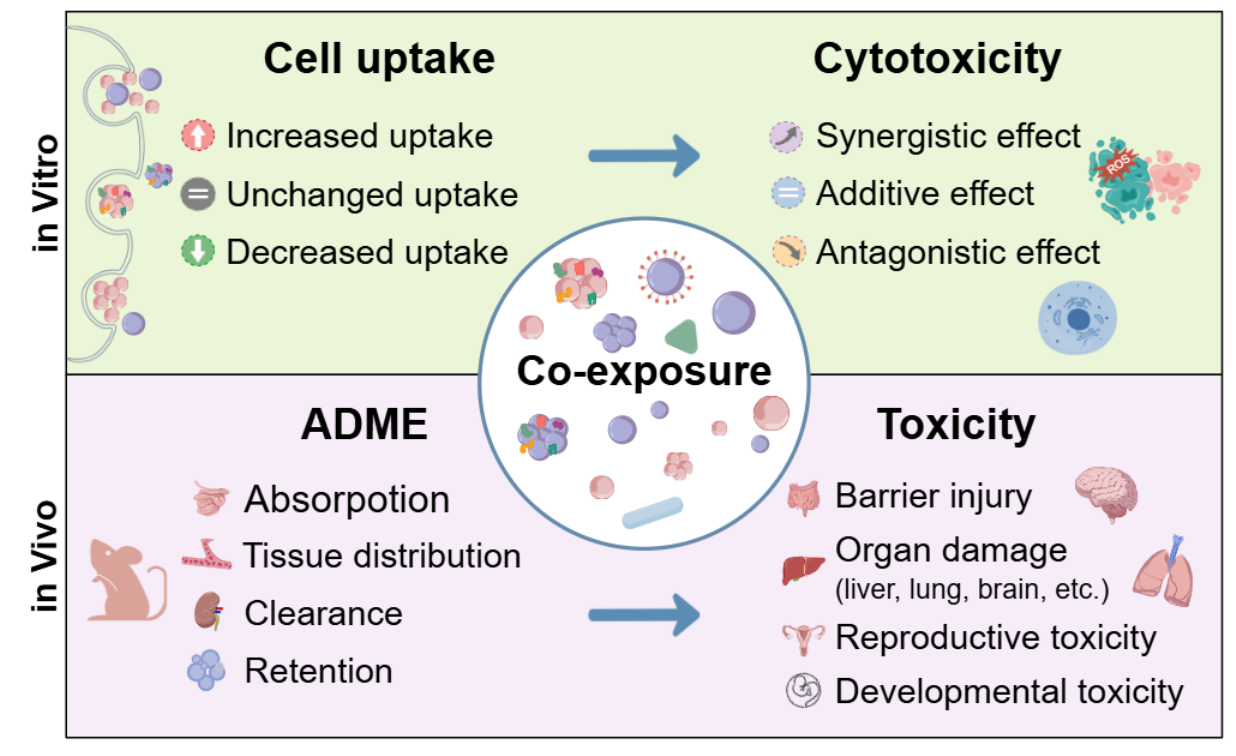
3. In Vitro Responses to Mixed NPs
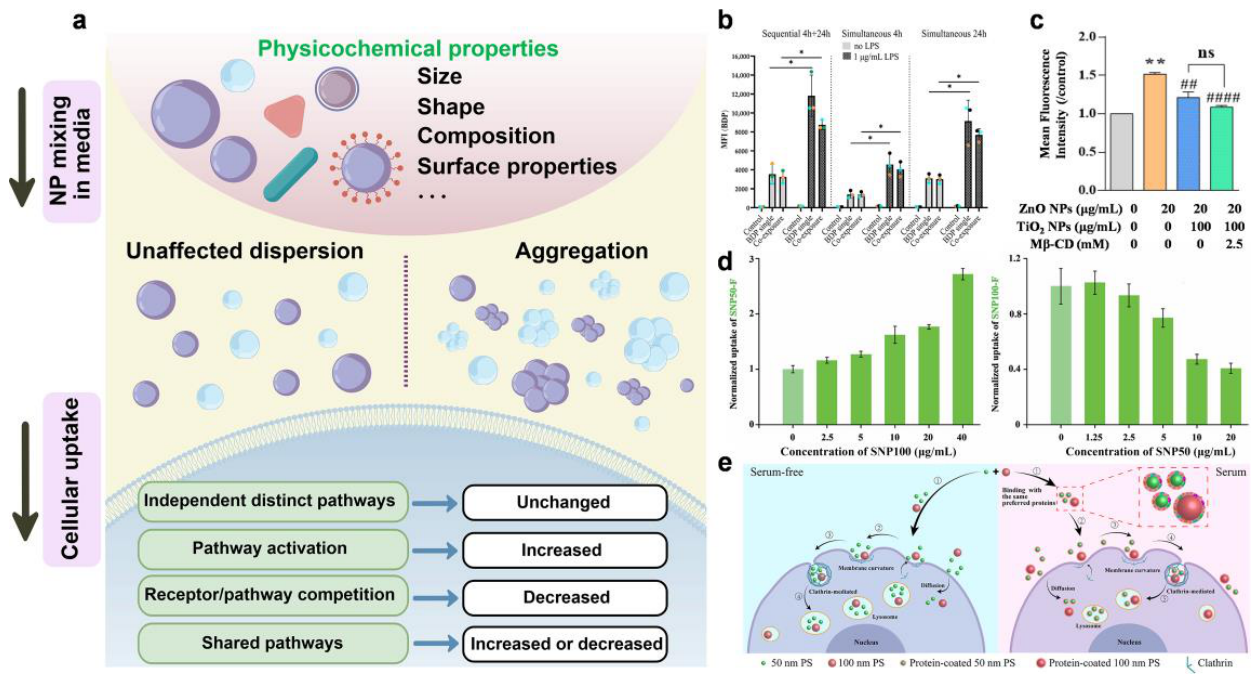
3.1. Cellular Uptake
3.1.1. Unaffected NP Uptake Through Independent Pathways
3.1.2. Increased NP Uptake by Activating Additional Pathways
3.1.3. Decreased NP Uptake Due to Receptors/Pathway Competition
3.1.4. Increased or Decreased NP Uptake by Sharing Pathways
3.2. Cytotoxicity
3.2.1. Synergistic Toxic Effect
3.2.2. Antagonistic Toxic Effect
3.2.3. Dependence of Combined Toxicity on Experimental Variables
4. In Vivo Responses to Mixed NPs
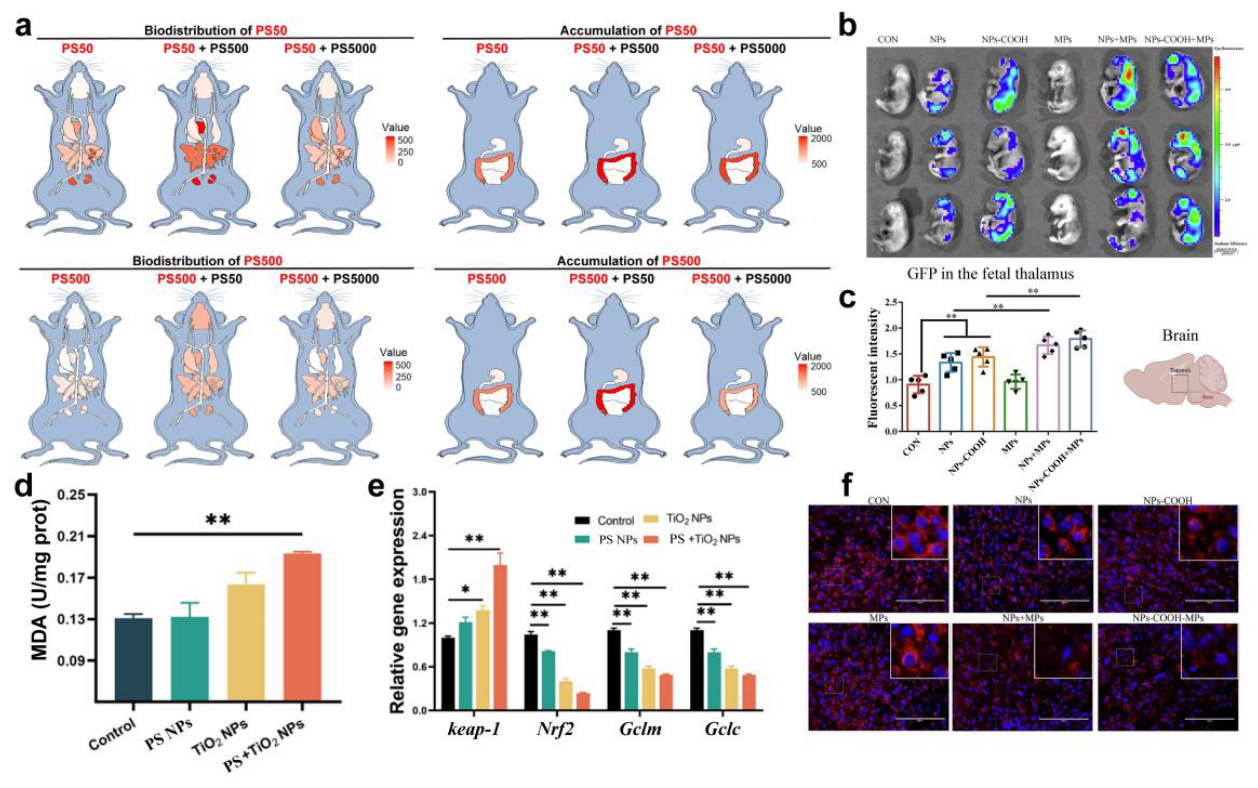
4.1. Alterations in ADME Behavior
4.2. Combined Toxicity In Vivo
5. Conclusions and Outlook
- Currently, most related studies merely report experimental phenomena under simple experimental designs and without elucidating the underlying mechanisms. There are insufficient relevant research data for drawing regular or universal conclusions.
- Critically, characterization of mixed NPs in biosystems is extremely insufficient. Mixing different NPs can result in complex interactions between them, altering their dispersion and aggregation. This not only makes it difficult to correctly analyze the combined effects observed, but also makes it almost impossible to replicate them. In addition, severe aggregation makes it difficult to attribute observed changes in uptake to genuine nanoscale interactions between NPs. Furthermore, sedimentation of large aggregates can lead to an overestimation of uptake due to gravitational settling rather than active endocytosis. Static 2D in vitro models exacerbate this issue further by failing to recapitulate dynamic flow conditions and in vivo clearance mechanisms. Currently, the inconsistent or missing characterization of NPs in biosystems under co-exposure conditions prevents meaningful comparisons.
- The dynamic reshaping of the protein corona in mixed NP systems remains almost entirely unexplored. Key kinetic parameters, such as protein exchange rates, residence times, and competitive redistribution among co-existing NP populations have been overlooked. This critical knowledge gap currently limits our mechanistic understanding. Integrating time-resolved kinetic measurements with high-resolution proteomic profiling is necessary to determine whether the presence of one NP population alters the corona dynamics of another, and how biofluid composition influences these interactions during co-exposure.
- Experimental designs and tested samples varied greatly across studies. Researchers used different combinations of NPs (with different compositions and properties) to measure different biological endpoints (e.g. viability, ROS, cytokine level, and apoptosis) in different biological models (e.g. different types of cells and different animal species in different states) under different experimental conditions (e.g. exposure method, time, and dose). This means that there are several variables in each study, making it difficult to attribute an observed phenomenon to a specific variable. Accordingly, it is impossible to compare experimental results from different studies.
- The mixed NP systems studied in current laboratory settings are far removed from the real-world environmental complexity.
Author Contributions
Funding
Data Availability Statement
Acknowledgments
Conflicts of Interest
Abbreviations
| ADME | Absorption, distribution, metabolism and excretion |
| CB | Carbon black |
| CME | Clathrin-mediated endocytosis |
| DEP | Diesel exhaust particle |
| DLS | Dynamic Light Scattering |
| GABA | γ-aminobutyric acid |
| GO | Graphene oxide |
| LPS | Lipopolysaccharide |
| ND | Nanodiamond |
| NP | Nanoparticle |
| oMWCNTs | Oxidized Multi-walled carbon nanotubes |
| PBS | Phosphate-buffered saline |
| PEG | Polyethylene glycol |
| PMA | Poly (isobutylene-alt-maleic anhydride)-graft-dodecylamine |
| PS | Polystyrene |
| PVP | Poly(vinyl)pyrrolidone |
| SEM | Scanning electron microscope |
| SLN | Solid lipid nanoparticle |
| SNP | Silica nanoparticle |
| SPION | Superparamagnetic iron oxide nanoparticle |
| TAT | Transactivator of transcription |
| TEM | Transmission electron microscopy |
| TMAH | Tetramethyl ammonium hydroxide |
| ZP | Zeta potential |
References
- Manickam, V.; Velusamy, R.K.; Lochana, R.; Amiti; Rajendran, B.; Tamizhselvi, R. Applications and genotoxicity of nanomaterials in the food industry. Environ. Chem. Lett. 2017, 15, 399–412. [Google Scholar] [CrossRef]
- Cho, N.H.; Kim, H.; Kim, J.W.; Lim, Y.-C.; Kim, R.M.; Lee, Y.H.; Nam, K.T. Chiral inorganic nanomaterials for biomedical applications. Chem 2024, 10, 1052–1070. [Google Scholar] [CrossRef]
- Elsaid, K.; Olabi, A.G.; Abdel-Wahab, A.; Elkamel, A.; Alami, A.H.; Inayat, A.; Chae, K.-J.; Abdelkareem, M.A. Membrane processes for environmental remediation of nanomaterials: Potentials and challenges. Sci. Total Environ. 2023, 879, 162569. [Google Scholar] [CrossRef] [PubMed]
- Kamaly, N.; Xiao, Z.Y.; Valencia, P.M.; Radovic-Moreno, A.F.; Farokhzad, O.C. Targeted polymeric therapeutic nanoparticles: Design, development and clinical translation. Chem. Soc. Rev. 2012, 41, 2971–3010. [Google Scholar] [CrossRef]
- Mout, R.; Moyano, D.F.; Rana, S.; Rotello, V.M. Surface functionalization of nanoparticles for nanomedicine. Chem. Soc. Rev. 2012, 41, 2539–2544. [Google Scholar] [CrossRef]
- Elsabahy, M.; Wooley, K.L. Design of polymeric nanoparticles for biomedical delivery applications. Chem. Soc. Rev. 2012, 41, 2545–2561. [Google Scholar] [CrossRef]
- Dreaden, E.C.; Alkilany, A.M.; Huang, X.H.; Murphy, C.J.; El-Sayed, M.A. The golden age: Gold nanoparticles for biomedicine. Chem. Soc. Rev. 2012, 41, 2740–2779. [Google Scholar] [CrossRef]
- Hong, H.; Part, F.; Nowack, B. Prospective dynamic and probabilistic material flow analysis of graphene-based materials in europe from 2004 to 2030. Environ. Sci. Technol. 2022, 56, 13798–13809. [Google Scholar] [CrossRef]
- Padhye, L.P.; Jasemizad, T.; Bolan, S.; Tsyusko, O.; Unrine, J.M.; Biswal, B.K.; Balasubramanian, R.; Zhang, Y.Y.; Zhang, T.; Zhao, J.; et al. Silver contamination and its toxicity and risk management in terrestrial and aquatic ecosystems. Sci. Total Environ. 2023, 871, 161926. [Google Scholar] [CrossRef]
- Piccinno, F.; Gottschalk, F.; Seeger, S.; Nowack, B. Industrial production quantities and uses of ten engineered nanomaterials in Europe and the world. J. Nanopart. Res. 2012, 14, 1109. [Google Scholar] [CrossRef]
- Song, R.; Qin, Y.; Suh, S.; Keller, A.A. Dynamic model for the stocks and release flows of engineered nanomaterials. Environ. Sci. Technol. 2017, 51, 12424–12433. [Google Scholar] [CrossRef]
- Wang, C.Q.; Xu, J.K.; Zhang, L.L.; Yang, X.Q.; Zhang, X.K.; Zhang, C.; Gao, P.; Zhu, L.S.; Chen, L.A. Environmental behaviors and toxic mechanisms of engineered nanomaterials in soil. Environ. Res. 2024, 242, 117820. [Google Scholar] [CrossRef]
- Deng, J.; Ding, Q.M.; Jia, M.X.; Li, W.; Zuberi, Z.; Wang, J.H.; Ren, J.L.; Fu, D.; Zeng, X.X.; Luo, J.F. Biosafety risk assessment of nanoparticles: Evidence from food case studies. Environ. Pollut. 2021, 275, 116662. [Google Scholar] [CrossRef] [PubMed]
- Singh, S.K.; Singh, M.K.; Nayak, M.K.; Kumari, S.; Shrivastava, S.; Grácio, J.J.A.; Dash, D. Thrombus inducing property of atomically thin graphene oxide sheets. ACS Nano 2011, 5, 4987–4996. [Google Scholar] [CrossRef] [PubMed]
- Liu, X.; Sui, B.Y.; Sun, J. Blood-brain barrier dysfunction induced by silica NPs in vitro and in vivo: Involvement of oxidative stress and Rho-kinase/JNK signaling pathways. Biomaterials 2017, 121, 64–82. [Google Scholar] [CrossRef]
- Khodadadi, R.; Jalali, A.; Moghadasi, S.; Farahani, M. Environmental exposure to titanium dioxide nanoparticles disrupts DAZL gene expression and male reproductive function in mice: Protective role of lutein. Food Chem. Toxicol. 2025, 195, 115128. [Google Scholar] [CrossRef] [PubMed]
- Deng, R.; Lin, D.H.; Zhu, L.Z.; Majumdar, S.; White, J.C.; Gardea-Torresdey, J.L.; Xing, B.S. Nanoparticle interactions with co-existing contaminants: Joint toxicity, bioaccumulation and risk. Nanotoxicology 2017, 11, 591–612. [Google Scholar] [CrossRef]
- Abd-Elhakim, Y.M.; Hashem, M.M.; Abo-El-Sooud, K.; Hassan, B.A.; Elbohi, K.M.; Al-Sagheer, A.A. Effects of co-exposure of nanoparticles and metals on different organisms: A Review. Toxics 2021, 9, 284. [Google Scholar] [CrossRef]
- Pikula, K.; Johari, S.A.; Santos-Oliveira, R.; Golokhvast, K. Joint toxicity and interaction of carbon-based nanomaterials with co-existing pollutants in aquatic environments: A Review. Int. J. Mol. Sci. 2024, 25, 11798. [Google Scholar] [CrossRef]
- Barreto, M.; Lopes, I.; Oliveira, M. Micro(nano)plastics: A review on their interactions with pharmaceuticals and pesticides. Trac-Trends Anal. Chem. 2023, 169, 117307. [Google Scholar] [CrossRef]
- Chang, X.R.; Xue, Y.Y.; Li, J.Y.; Zou, L.Y.; Tang, M. Potential health impact of environmental micro- and nanoplastics pollution. J. Appl. Toxicol. 2020, 40, 4–15. [Google Scholar] [CrossRef]
- Naasz, S.; Altenburger, R.; Kühnel, D. Environmental mixtures of nanomaterials and chemicals: The Trojan-horse phenomenon and its relevance for ecotoxicity. Sci. Total Environ. 2018, 635, 1170–1181. [Google Scholar] [CrossRef]
- Liu, Y.; Nie, Y.G.; Wang, J.J.; Wang, J.; Wang, X.; Chen, S.P.; Zhao, G.P.; Wu, L.J.; Xu, A. Mechanisms involved in the impact of engineered nanomaterials on the joint toxicity with environmental pollutants. Ecotoxicol. Environ. Saf. 2018, 162, 92–102. [Google Scholar] [CrossRef] [PubMed]
- Hendren, C.O.; Mesnard, X.; Dröge, J.; Wiesner, M.R. Estimating production data for five engineered nanomaterials as a basis for exposure assessment. Environ. Sci. Technol. 2011, 45, 2562–2569. [Google Scholar] [CrossRef] [PubMed]
- Wu, S.S.; Gaillard, J.F.; Gray, K.A. The impacts of metal-based engineered nanomaterial mixtures on microbial systems: A review. Sci. Total Environ. 2021, 780, 146496. [Google Scholar] [CrossRef] [PubMed]
- Georgantzopoulou, A.; Farkas, J.; Ndungu, K.; Coutris, C.; Carvalho, P.A.; Booth, A.M.; Macken, A. Wastewater-aged silver nanoparticles in single and combined exposures with titanium dioxide affect the early development of the marine copepod tisbe battagliai. Environ. Sci. Technol. 2020, 54, 12316–12325. [Google Scholar] [CrossRef]
- Musee, N.; Zvimba, J.N.; Schaefer, L.M.; Nota, N.; Sikhwivhilu, L.M.; Thwala, M. Fate and behavior of ZnO- and Ag-engineered nanoparticles and a bacterial viability assessment in a simulated wastewater treatment plant. J. Environ. Sci. Health Part A 2014, 49, 59–66. [Google Scholar] [CrossRef]
- Simelane, S.; Dlamini, L.N. An investigation of the fate and behaviour of a mixture of WO3 and TiO2 nanoparticles in a wastewater treatment plant. J. Environ. Sci. 2019, 76, 37–47. [Google Scholar] [CrossRef]
- Singh, D.; Kumar, A. Binary mixture of nanoparticles in sewage sludge: Impact on spinach growth. Chemosphere 2020, 254, 126794. [Google Scholar] [CrossRef]
- Sundaram, B.; Kumar, A. Long-term effect of metal oxide nanoparticles on activated sludge. Water Sci. Technol. 2017, 75, 462–473. [Google Scholar] [CrossRef]
- Koelmans, A.A.; Redondo-Hasselerharm, P.E.; Nor, N.H.M.; de Ruijter, V.N.; Mintenig, S.M.; Kooi, M. Risk assessment of microplastic particles. Nat. Rev. Mater. 2022, 7, 138–152. [Google Scholar] [CrossRef]
- Chithrani, B.D.; Ghazani, A.A.; Chan, W.C.W. Determining the size and shape dependence of gold nanoparticle uptake into mammalian cells. Nano Lett. 2006, 6, 662–668. [Google Scholar] [CrossRef]
- Zhu, D.; Brückner, D.; Sosniok, M.; Skiba, M.; Feliu, N.; Gallego, M.; Liu, Y.; Schulz, F.; Falkenberg, G.; Parak, W.J.; et al. Size-dependent penetration depth of colloidal nanoparticles into cell spheroids. Adv. Drug Deliv. Rev. 2025, 222, 115593. [Google Scholar] [CrossRef]
- Zhang, F.; Wang, Z.; Peijnenburg, W.; Vijver, M.G. Review and prospects on the ecotoxicity of mixtures of nanoparticles and hybrid nanomaterials. Environ. Sci. Technol. 2022, 56, 15238–15250. [Google Scholar] [CrossRef]
- Iversen, T.G.; Skotland, T.; Sandvig, K. Endocytosis and intracellular transport of nanoparticles: Present knowledge and need for future studies. Nano Today 2011, 6, 176–185. [Google Scholar] [CrossRef]
- Zhao, F.; Zhao, Y.; Liu, Y.; Chang, X.L.; Chen, C.Y.; Zhao, Y.L. Cellular uptake, intracellular trafficking, and cytotoxicity of nanomaterials. Small 2011, 7, 1322–1337. [Google Scholar] [CrossRef]
- Awashra, M.; Mlynarz, P. The toxicity of nanoparticles and their interaction with cells: An in vitro metabolomic perspective. Nanoscale Adv. 2023, 5, 2674–2723. [Google Scholar] [CrossRef]
- Lamoree, M.H.; van Boxel, J.; Nardella, F.; Houthuijs, K.J.; Brandsma, S.H.; Béen, F.; van Duursen, M.B.M. Health impacts of microplastic and nanoplastic exposure. Nat. Med. 2025, 31, 2873–2887. [Google Scholar] [CrossRef] [PubMed]
- Liu, J.; Liu, Y.-Y.; Guo, Y.; Chu, Z.; Chen, L.-L.; Tang, H.; Cao, A.; Wang, H. Cell uptake of mixtures of different-sized nanoplastics: Interplay and mechanism. J. Hazard. Mater. 2026, 506, 141578. [Google Scholar] [CrossRef]
- Huang, B.; Li, J.M.; Zang, X.M.; Wang, M.; Pan, W.; Zhang, K.D.; He, H.; Tan, Q.G.; Miao, A.J. Cell-excreted proteins mediate the interactions of differently sized silica nanoparticles during cellular uptake. J. Hazard. Mater. 2024, 469, 133894. [Google Scholar] [CrossRef]
- de Boer, I.; Richards, C.J.; Åberg, C. Simultaneous exposure of different nanoparticles influences cell uptake. Pharmaceutics 2022, 14, 136. [Google Scholar] [CrossRef] [PubMed]
- Conner, S.D.; Schmid, S.L. Regulated portals of entry into the cell. Nature 2003, 422, 37–44. [Google Scholar] [CrossRef]
- Rivera-Gil, P.; De Aberasturi, D.J.; Wulf, V.; Pelaz, B.; Del Pino, P.; Zhao, Y.Y.; De La Fuente, J.M.; De Larramendi, I.R.; Rojo, T.; Liang, X.J.; et al. The challenge to relate the physicochemical properties of colloidal nanoparticles to their cytotoxicity. Acc. Chem. Res. 2013, 46, 743–749. [Google Scholar] [CrossRef] [PubMed]
- Tang, X.-R.; Liu, J.; Zhang, Q.; Liu, Y.-Y.; Chen, L.-L.; Cao, A.; Wang, H. Why do nanoparticles inside cells have a size-distribution different from those outside the cells? Colloids Surf. A 2025, 726, 138085. [Google Scholar] [CrossRef]
- Li, L.; Xi, W.-S.; Su, Q.; Li, Y.; Yan, G.-H.; Liu, Y.; Wang, H.; Cao, A. Unexpected size effect: The interplay between different-sized nanoparticles in their cellular uptake. Small 2019, 15, 1901687. [Google Scholar] [CrossRef]
- Liang, Y.; Simaiti, A.; Xu, M.X.; Lv, S.C.; Jiang, H.; He, X.X.; Fan, Y.; Zhu, S.X.; Du, B.Y.; Yang, W.; et al. Antagonistic skin toxicity of co-exposure to physical sunscreen ingredients zinc oxide and titanium dioxide nanoparticles. Nanomaterials 2022, 12, 2769. [Google Scholar] [CrossRef]
- Męczyńska-Wielgosz, S.; Sikorska, K.; Czerwińska, M.; Kapka-Skrzypczak, L.; Kruszewski, M. Uptake and toxicity of polystyrene NPs in three human cell lines. Int. J. Mol. Sci. 2025, 26, 4783. [Google Scholar] [CrossRef]
- Korzeniowska, B.; Fonseca, M.P.; Gorshkov, V.; Skytte, L.; Rasmussen, K.L.; Schroder, H.D.; Kjeldsen, F. The cytotoxicity of metal nanoparticles depends on their synergistic interactions. Part. Part. Syst. Charact. 2020, 37, 2000135. [Google Scholar] [CrossRef]
- Ilic, K.; Kalcec, N.; Krce, L.; Aviani, I.; Turcic, P.; Pavicic, I.; Vrcek, I.V. Toxicity of nanomixtures to human macrophages: Joint action of silver and polystyrene nanoparticles. Chem.-Biol. Interact. 2022, 368, 110225. [Google Scholar] [CrossRef]
- Wu, B.; Wu, J.L.; Liu, S.; Shen, Z.Y.; Chen, L.; Zhang, X.X.; Ren, H.Q. Combined effects of graphene oxide and zinc oxide nanoparticle on human A549 cells: Bioavailability, toxicity and mechanisms. Environ. Sci.-Nano 2019, 6, 635–645. [Google Scholar] [CrossRef]
- Tang, X.R.; Lei, S.Y.; Zhang, Q.Q.; Liu, Y.Y.; Wu, H.; Cao, A.; Wang, H. How big nanoparticles carry small ones into cells: Actions captured by transmission electron microscopy. Colloids Surf. B 2025, 245, 114272. [Google Scholar] [CrossRef]
- Li, C.-S.; Liu, J.; Zhang, Q.; Tang, X.-R.; Liu, Y.-Y.; Cao, A.; Wang, H. Combined effect of nanoparticles of silver and silica to HeLa cells: Synergistic internalization and toxicity. Environ. Toxicol. 2025, 40, 802–816. [Google Scholar] [CrossRef]
- Wei, Y.S.; Tang, T.; Pang, H.B. Cellular internalization of bystander nanomaterial induced by TAT-nanoparticles and regulated by extracellular cysteine. Nat. Commun. 2019, 10, 3646. [Google Scholar] [CrossRef]
- Wei, Y.S.; Chen, H.B.; Li, Y.X.; He, K.J.; Yang, K.; Pang, H.B. Synergistic entry of individual nanoparticles into mammalian cells driven by free energy decline and regulated by their sizes. ACS Nano 2022, 16, 5885–5897. [Google Scholar] [CrossRef]
- Męczyńska-Wielgosz, S.; Sikorska, K.; Czerwińska, M.; Grzelak, A.; Lankoff, A.; Kruszewski, M. Toxicity of high-density polyethylene nanoparticles in combination with silver nanoparticles to Caco-2 and HT29MTX cells growing in 2D or 3D culture. Molecules 2026, 31, 3. [Google Scholar] [CrossRef]
- Susnik, E.; Taladriz-Blanco, P.; Drasler, B.; Balog, S.; Petri-Fink, A.; Rothen-Rutishauser, B. Increased uptake of silica nanoparticles in inflamed macrophages but not upon co-exposure to micron-sized particles. Cells 2020, 9, 2099. [Google Scholar] [CrossRef]
- Vanhecke, D.; Kuhn, D.A.; de Aberasturi, D.J.; Balog, S.; Milosevic, A.; Urban, D.; Peckys, D.; de Jonge, N.; Parak, W.J.; Petri-Fink, A.; et al. Involvement of two uptake mechanisms of gold and iron oxide nanoparticles in a co-exposure scenario using mouse macrophages. Beilstein J. Nanotechnol. 2017, 8, 2396–2409. [Google Scholar] [CrossRef]
- Tsugita, M.; Morimoto, N.; Nakayama, M. SiO2 and TiO2 nanoparticles synergistically trigger macrophage inflammatory responses. Part. Fibre Toxicol. 2017, 14, 11. [Google Scholar] [CrossRef]
- Li, L.X.Y.; Fernández-Cruz, M.L.; Connolly, M.; Conde, E.; Fernández, M.; Schuster, M.; Navas, J.M. The potentiation effect makes the difference: Non-toxic concentrations of ZnO nanoparticles enhance Cu nanoparticle toxicity in vitro. Sci. Total Environ. 2015, 505, 253–260. [Google Scholar] [CrossRef]
- Ilić, K.; Krce, L.; Rodriguez-Ramos, J.; Rico, F.; Kalčec, N.; Aviani, I.; Turčić, P.; Pavičić, I.; Vinković Vrček, I. Cytotoxicity of nanomixture: Combined action of silver and plastic nanoparticles on immortalized human lymphocytes. J. Trace Elem. Med. Biol. 2022, 73, 127004. [Google Scholar] [CrossRef]
- Domenech, J.; Cortés, C.; Vela, L.; Marcos, R.; Hernández, A. Polystyrene nanoplastics as carriers of metals. Interactions of polystyrene nanoparticles with silver nanoparticles and silver nitrate, and their effects on human intestinal Caco-2 cells. Biomolecules 2021, 11, 859. [Google Scholar] [CrossRef]
- Zerboni, A.; Bengalli, R.; Baeri, G.; Fiandra, L.; Catelani, T.; Mantecca, P. Mixture effects of diesel exhaust and metal oxide nanoparticles in human lung A549 cells. Nanomaterials 2019, 9, 1302. [Google Scholar] [CrossRef] [PubMed]
- He, K.J.; Wei, Y.S.; Zhang, Z.H.; Chen, H.B.; Yuan, B.; Pang, H.B.; Yang, K. Membrane-curvature-mediated co-endocytosis of bystander and functional nanoparticles. Nanoscale 2021, 13, 9626–9633. [Google Scholar] [CrossRef] [PubMed]
- Nienhaus, K.; Nienhaus, G.U. Mechanistic understanding of protein corona formation around nanoparticles: Old puzzles and new insights. Small 2023, 19, 2301663. [Google Scholar] [CrossRef]
- Tenzer, S.; Docter, D.; Kuharev, J.; Musyanovych, A.; Fetz, V.; Hecht, R.; Schlenk, F.; Fischer, D.; Kiouptsi, K.; Reinhardt, C.; et al. Rapid formation of plasma protein corona critically affects nanoparticle pathophysiology. Nat. Nanotechnol. 2013, 8, 772–781. [Google Scholar] [CrossRef] [PubMed]
- Baimanov, D.; Wang, J.; Zhang, J.; Liu, K.; Cong, Y.; Shi, X.; Zhang, X.; Li, Y.; Li, X.; Qiao, R.; et al. In situ analysis of nanoparticle soft corona and dynamic evolution. Nat. Commun. 2022, 13, 5389. [Google Scholar] [CrossRef]
- Faria, M.; Björnmalm, M.; Thurecht, K.J.; Kent, S.J.; Parton, R.G.; Kavallaris, M.; Johnston, A.P.R.; Gooding, J.J.; Corrie, S.R.; Boyd, B.J.; et al. Minimum information reporting in bio–nano experimental literature. Nat. Nanotechnol. 2018, 13, 777–785. [Google Scholar] [CrossRef]
- Rennick, J.J.; Johnston, A.P.R.; Parton, R.G. Key principles and methods for studying the endocytosis of biological and nanoparticle therapeutics. Nat. Nanotechnol. 2021, 16, 266–276. [Google Scholar] [CrossRef]
- Khanna, P.; Ong, C.; Bay, B.H.; Baeg, G.H. Nanotoxicity: An interplay of oxidative stress, inflammation and cell death. Nanomaterials 2015, 5, 1163–1180. [Google Scholar] [CrossRef]
- Nasrullah, M.; Sundaram, D.N.M.; Claerhout, J.; Ha, K.; Demirkaya, E.; Uludag, H. Nanoparticles and cytokine response. Front. Bioeng. Biotechnol. 2023, 11, 1243651. [Google Scholar] [CrossRef]
- Xuan, L.H.; Ju, Z.; Skonieczna, M.; Zhou, P.K.; Huang, R.X. Nanoparticles-induced potential toxicity on human health: Applications, toxicity mechanisms, and evaluation models. MedComm 2023, 4, e327. [Google Scholar] [CrossRef]
- Alabi, O.A.; Silva, A.H.; Rode, M.P.; dal Pizzol, C.; de Campos, A.M.; Filippin-Monteiro, F.B.; Bakare, A.A.; Creczynski-Pasa, T.B. In vitro cytotoxicity of co-exposure to superparamagnetic iron oxide and solid lipid nanoparticles. Toxicol. Ind. Health 2021, 37, 77–89. [Google Scholar] [CrossRef] [PubMed]
- Zhang, Q.; Lai, W.E.; Yin, T.; Zhang, C.L.; Yue, C.X.; Cheng, J.; Wang, K.; Yang, Y.M.; Cui, D.X.; Parak, W.J. Investigation of the viability of cells upon co-exposure to gold and iron oxide nanoparticles. Bioconjugate Chem. 2018, 29, 2120–2125. [Google Scholar] [CrossRef] [PubMed]
- Bushueva, T.V.; Panov, V.G.; Minigalieva, I.A.; Privalova, L.I.; Vedernikova, M.S.; Gurvich, V.B.; Sutunkova, M.P.; Katsnelson, B.A. Dose dependence of the separate and combined impact of copper-oxide and selenium-oxide nanoparticles on oxygen consumption by cells in vitro with or without the background action of some modulators of the mitochondrial respiratory function. Dose-Response 2023, 21, 15593258221106612. [Google Scholar] [CrossRef]
- Yang, D.; Zhu, J.; Zhou, X.; Pan, D.; Nan, S.; Yin, R.; Lei, Q.; Ma, N.; Zhu, H.; Chen, J.; et al. Polystyrene micro- and nano-particle coexposure injures fetal thalamus by inducing ROS-mediated cell apoptosis. Environ. Int. 2022, 166, 107362. [Google Scholar] [CrossRef]
- Rafieepour, A.; Azari, M.R.; Khodagholi, F.; Jaktaji, J.P.; Mehrabi, Y.; Peirovi, H. Interactive toxicity effect of combined exposure to hematite and amorphous silicon dioxide nanoparticles in human A549 cell line. Toxicol. Ind. Health 2021, 37, 289–301. [Google Scholar] [CrossRef]
- Rafieepour, A.; Azari, M.R.; Khodagholi, F.; Jaktaji, J.P.; Mehrabi, Y.; Peirovi, H. The effect of single and combined exposures to magnetite and polymorphous silicon dioxide nanoparticles on the human A549 cell line: In vitro study. Environ. Sci. Pollut. Res. 2019, 26, 31752–31762. [Google Scholar] [CrossRef]
- Li, H.; Tang, S.; Jia, X.; Zhu, X.; Cai, L.; Duan, M.; Wang, S.; Jiang, H.; Ji, M.; Wang, S.; et al. Combined toxicity evaluation of polystyrene nanoplastics and Nano-ZnO of distinctive morphology on human lung epithelial cells. Sci. Total Environ. 2025, 973, 179097. [Google Scholar] [CrossRef]
- Dávila-Grana, A.; Diego-González, L.; González-Fernández, A.; Simón-Vázquez, R. Synergistic effect of metal oxide nanoparticles on cell viability and activation of MAP Kinases and NFκB. Int. J. Mol. Sci. 2018, 19, 246. [Google Scholar] [CrossRef]
- Minigalieva, I.; Bushueva, T.; Fröhlich, E.; Meindl, C.; Öhlinger, K.; Panov, V.; Varaksin, A.; Shur, V.; Shishkina, E.; Gurvich, V.; et al. Are in vivo and in vitro assessments of comparative and combined toxicity of the same metallic nanoparticles compatible, or contradictory, or both? A juxtaposition of data obtained in respective experiments with NiO and Mn3O4 nanoparticles. Food Chem. Toxicol. 2017, 109, 393–404. [Google Scholar] [CrossRef] [PubMed]
- Lowry, G.V.; Gregory, K.B.; Apte, S.C.; Lead, J.R. Transformations of nanomaterials in the environment. Environ. Sci. Technol. 2012, 46, 6893–6899. [Google Scholar] [CrossRef]
- Zhao, J.; Lin, M.; Wang, Z.; Cao, X.; Xing, B. Engineered nanomaterials in the environment: Are they safe? Crit. Rev. Environ. Sci. Technol. 2021, 51, 1443–1478. [Google Scholar] [CrossRef]
- Zhang, J.F.; Zou, Y.Y.; Hu, L.H.; Zhao, Y.; Fen, Y.; Xu, H.Y. TiO2 nanoparticles combined with polystyrene nanoplastics aggravated reproductive toxicity in female mice via exacerbating intestinal barrier disruption. J. Sci. Food Agric. 2023, 103, 6452–6462. [Google Scholar] [CrossRef] [PubMed]
- Lee, J.H.; Sung, J.H.; Ryu, H.R.; Song, K.S.; Song, N.W.; Park, H.M.; Shin, B.S.; Ahn, K.; Gulumian, M.; Faustman, E.M.; et al. Tissue distribution of gold and silver after subacute intravenous injection of co-administered gold and silver nanoparticles of similar sizes. Arch. Toxicol. 2018, 92, 1393–1405. [Google Scholar] [CrossRef]
- Kim, J.K.; Kim, H.P.; Park, J.D.; Ahn, K.; Kim, W.Y.; Gulumian, M.; Oberdörster, G.; Yu, I.J. Lung retention and particokinetics of silver and gold nanoparticles in rats following subacute inhalation co-exposure. Part. Fibre Toxicol. 2021, 18, 12. [Google Scholar] [CrossRef]
- Lee, P.; Kim, J.K.; Jo, M.S.; Kim, H.P.; Ahn, K.; Park, J.D.; Gulumian, M.; Oberdörster, G.; Yu, I.J. Biokinetics of subacutely co-inhaled same size gold and silver nanoparticles. Part. Fibre Toxicol. 2023, 20, 17. [Google Scholar] [CrossRef]
- Jia, T.T.; Nie, P.H.; Xu, H.Y. Combined exposure of nano-titanium dioxide and polystyrene nanoplastics exacerbate oxidative stress-induced liver injury in mice by regulating the Keap-1/Nrf2/ARE pathway. Environ. Toxicol. 2024, 39, 2681–2691. [Google Scholar] [CrossRef]
- Liang, B.X.; Zhong, Y.Z.; Huang, Y.J.; Lin, X.; Liu, J.; Lin, L.; Hu, M.J.; Jiang, J.Y.; Dai, M.Z.; Wang, B.; et al. Underestimated health risks: Polystyrene micro- and nanoplastics jointly induce intestinal barrier dysfunction by ROS-mediated epithelial cell apoptosis. Part. Fibre Toxicol. 2021, 18, 19. [Google Scholar] [CrossRef] [PubMed]
- Yousef, M.I.; Mutar, T.F.; Kamel, M.A.E.-N. Hepato-renal toxicity of oral sub-chronic exposure to aluminum oxide and/or zinc oxide nanoparticles in rats. Toxicol. Rep. 2019, 6, 336–346. [Google Scholar] [CrossRef] [PubMed]
- Alabi, O.A.; Silva, A.H.; Purnhagen, L.R.P.; Souza, G.R.R.; de Mello, L.J.; Filippin-Monteiro, F.B.; Dalmina, M.; Pittella, F.; Bakare, A.A.; Creczynski-Pasa, T.B. Genetic, reproductive and oxidative damage in mice triggered by co-exposure of nanoparticles: From a hypothetical scenario to a real concern. Sci. Total Environ. 2019, 660, 1264–1273. [Google Scholar] [CrossRef]
- Qi, W.; Li, Z.; Bi, J.J.; Wang, J.; Wang, J.J.; Sun, T.L.; Guo, Y.A.; Wu, W.S. Biodistribution of co-exposure to multi-walled carbon nanotubes and nanodiamonds in mice. Nanoscale Res. Lett. 2012, 7, 473. [Google Scholar] [CrossRef]
- Ogunsuyi, O.M.; Ogunsuyi, O.I.; Akanni, O.; Alabi, O.A.; Alimba, C.G.; Adaramoye, O.A.; Cambier, S.; Eswara, S.; Gutleb, A.C.; Bakare, A.A. Alteration of sperm parameters and reproductive hormones in Swiss mice via oxidative stress after co-exposure to titanium dioxide and zinc oxide nanoparticles. Andrologia 2020, 52, e13758. [Google Scholar] [CrossRef]
- Minigalieva, I.A.; Katsnelson, B.A.; Privalova, L.I.; Sutunkova, M.P.; Gurvich, V.B.; Shur, V.Y.; Shishkina, E.V.; Valamina, I.E.; Makeyev, O.H.; Panov, V.G.; et al. Attenuation of combined Nickel(II) Oxide and Manganese(II, III) Oxide nanoparticles’ adverse effects with a complex of bioprotectors. Int. J. Mol. Sci. 2015, 16, 22555–22583. [Google Scholar] [CrossRef] [PubMed]
- Lee, S.; Lee, D.-K.; Jeon, S.; Kim, S.-H.; Jeong, J.; Kim, J.S.; Cho, J.H.; Park, H.; Cho, W.-S. Combination effect of nanoparticles on the acute pulmonary inflammogenic potential: Additive effect and antagonistic effect. Nanotoxicology 2021, 15, 276–288. [Google Scholar] [CrossRef] [PubMed]
- Ma, J.Y.C.; Young, S.-H.; Mercer, R.R.; Barger, M.; Schwegler-Berry, D.; Ma, J.K.; Castranova, V. Interactive effects of cerium oxide and diesel exhaust nanoparticles on inducing pulmonary fibrosis. Toxicol. Appl. Pharmacol. 2014, 278, 135–147. [Google Scholar] [CrossRef] [PubMed]
- Lee, C.-C.; Lin, Y.-H.; Hou, W.-C.; Li, M.-H.; Chang, J.-W. Exposure to ZnO/TiO2 nanoparticles affects health outcomes in cosmetics salesclerks. Int. J. Environ. Res. Public Health 2020, 17, 6088. [Google Scholar] [CrossRef]



| Nanoparticles and Their Properties * | Cell | Experimental Conditions | Results | Ref. |
|---|---|---|---|---|
| SNP50: 51.0 nm (TEM), 67 nm (DLS, in medium), −27.0 mV (ZP); SNP80: 84.6 nm (TEM), 92 nm (DLS, in medium), −25.5 mV (ZP); SNP100: 104.0 nm (TEM), 118 nm (DLS, in medium), −23.5 mV (ZP); SNP150: 152.0 nm (TEM), 152 nm (DLS, in medium), −23.1 mV (ZP). | HeLa | In serum-free medium for 2 h; 2.5–40 µg/mL for each NP type. |
| [45] |
| SNP50: 50.3 nm (TEM), 59.9 nm (DLS in medium); SNP100: 99.7 nm (TEM), 108.8 nm (DLS in medium). | HeLa; A549 | In serum-free medium for 2 h; 5–53.3 µg/mL for SNP50 and SNP100, the number ratio of SNP50 to SNP100 ranged from 1 to 16. |
| [51] |
| SNP40: 39.2 nm (TEM), 68.3 nm (DLS, in medium), −10.9 mV (ZP); SNP70: 69.0 nm (TEM), 82.0 nm (DLS, in medium), −22.7 mV (ZP); SNP100: 98.1 nm (TEM), 112.6 nm (DLS, in medium), −22.3 mV (ZP). | HeLa | In serum-free medium for 2 h; <60 μg/mL for all SNPs. |
| [44] |
| PS NP (50 nm PS): 41.6 nm (TEM), 49.5 nm (DLS, in medium), −34.1 mV (ZP); PS NP (100 nm PS): 94.3 nm (TEM), 83.5 nm (DLS, in medium), −22.2 mV (ZP). | HeLa | In serum-free medium for 2 h and serum-containing medium for 2, 6, 24 h; 2.5, 5, 7.5, 10 μg/mL 50 nm PS; 10–60 μg/mL 100 nm PS; The number ratio of 50 nm PS to 100 nm PS ranged from 0.5 to 12. |
| [39] |
| Ag NP: 34.1 nm (TEM), 34.8 nm (DLS, in medium), −13.8 mV (ZP); SNP (40 nm SNP): 42.1 nm (TEM), 69.3 nm (DLS, in medium), −32.5 mV (ZP); SNP (120 nm SNP): 119.4 nm (TEM), 117.6 nm (DLS, in medium), −26.2 mV (ZP). | HeLa | In serum-free medium for 2 h; 5 or 10 μg/mL SNPs; 2.5–15 μg/mL Ag NPs. |
| [52] |
| SNP: 20.2 nm (TEM), 13.3–27.7 nm (DLS, in medium), −29.1 mV (ZP, in medium); SNP: 95.2 nm (TEM), 87.5–126.4 nm (DLS, in medium), −32.9 mV (ZP, in medium). | A549 | In serum-free medium for 10–120 min; 1–30 mg/L 20 nm SNPs; 3–300 mg/L 100 nm SNPs. |
| [40] |
| Carboxylated PS NP: 40 nm (TEM), 113 nm (DLS, in medium); Carboxylated PS NP: 100 nm (TEM), 171 nm (DLS, in medium). | HeLa | In serum-containing medium for 24 h; 3–100 µg/mL 40 nm PS NPs; 20–80 µg/mL 100 nm PS NPs. |
| [41] |
| Ag NP: 45.4 nm (DLS, in PBS), −7.1 mV (ZP, in PBS); TAT-Ag NP: 55.6 nm (DLS, in PBS), −5.2 mV (ZP, in PBS); Au NP: 39.4 nm (DLS, in PBS), −4.9 mV (ZP, in PBS); TAT-Au NP: 38.7 nm (DLS, in PBS), −3.5 mV (ZP, in PBS); iron oxide NP: 34.2 nm (DLS, in PBS), −5.4 mV (ZP, in PBS); TAT-iron oxide NP: 36.1 nm (DLS, in PBS), −2.5 mV (ZP, in PBS); Quantum dot: 19.4 nm (DLS, in PBS), −6.3 mV (ZP, in PBS); TAT-quantum dot: 23.7 nm (DLS, in PBS), −4.2 mV (ZP, in PBS). | H1975; A549; H2122; MIA; PaCa2; CHO; HeLa; LL/2; PPC1 | In serum-containing medium for 1 h; 0.27 nM Ag NPs; 0.79 nM Au NPs; 50 µg Fe/mL iron oxide NPs; 50 µg/mL quantum dots. |
| [53] |
| PEG-Ag NP: 10.4 nm (TEM), 40.0 nm (DLS, in PBS), −3.4 mV (ZP, in PBS); PEG-Au NP: 15.0 nm (TEM), 28.7 nm (DLS, in PBS), −5.9 mV (ZP, in PBS); TAT-Ag NP: 10.4 nm (TEM), 61.3 nm (DLS, in PBS), −3.4 mV (ZP, in PBS); TAT-Au NP: 15.0 nm (TEM), 58.5 nm (DLS, in PBS), −3.4 mV (ZP, in PBS); TAT-iron oxide NP: 3–5 nm (TEM), 69.7 nm (DLS, in PBS), −4.4 mV (ZP, in PBS). | CHO; H1975 | In serum-containing medium for 1 h; 2 μL/100 μL Ag NPs and Au NPs; 50 μg Fe/mL iron oxide NPs. |
| [54] |
| PS NP: 30.0 nm **, 34.4–50.6 nm (DLS, in different media), −30.6 to −37.7 mV (ZP, in different media); PS NP: 100.0 nm **, 145.0–170.4 nm (DLS, in different media), −33.2 to −49.5 mV (ZP, in different media). | Caco-2; HT-29; HepG2 | In serum-containing medium for 2, 6, 24 h; 100 µg/mL for both types of PS. |
| [47] |
| High-density polyethene NP: 100–200 nm (SEM), 260.6–361.82 nm (DLS, 024 h in different media), −37.9 to −30.9 mV (ZP, 024 h in PBS); Citrate-Ag NP: 20 nm, 80.2–163.4 nm (DLS, 024 h in different media), −36.7 to −28.2 mV (ZP, 024 h in PBS). | Caco-2; HT29MTX | In serum-containing medium for 2, 6, 24 h; 0.01 µg/mL polyethene NP; 40 µg/mL Ag NPs. |
| [55] |
| SNP: 59 nm (TEM), 87 nm (DLS, in medium), −52 mV (ZP); Silica particle: 920 nm (TEM), 931 nm (DLS, in medium), −44 mV (ZP). | J774A.1 | In serum-containing medium for 4, 24 h; 20 μg/mL for both types of NP. |
| [56] |
| PMA-Au NP: 4.7 nm (TEM), 11 nm (DLS, in medium), −26 mV (ZP, in medium); PMA-FeOx NP: 13.6 nm (TEM), 28 nm (DLS, in medium), −37 mV (ZP, in medium). | J774A.1 | In serum-containing medium for 124 h; 38.6 μg/mL Au NPs; 54.8 μg/mL FeOx NPs. |
| [57] |
| SNP: <50 nm (TEM), 1925 nm (DLS, in medium), −2.8 mV (ZP, in medium); TiO2 NP: <50 nm (TEM), 5066 nm (DLS, in medium), −3.3 mV (ZP, in medium). | BMDMs | In serum-containing medium for 4 h; 10 μg/cm3 NPs. |
| [58] |
| TiO2 NP: ~31 nm (TEM), ~300.0 nm (DLS, in medium), ~−12.0 mV (ZP, in medium); ZnO NP: ~33 nm (TEM), 74.6–362.6 nm (DLS, in medium), −(11.2–12.8) mV (ZP, in medium). | HaCaT | In serum-containing medium for 6 and 24 h; 10, 30, 100, 200, 300 μg/mL TiO2 NPs; 5, 10, 20, 30, 50, 100 μg/mL ZnO NPs. |
| [46] |
| graphene oxide (GO): 658.8 nm (DLS, in medium); ZnO NP: 50 nm (TEM), 67.8 nm (DLS, in medium). | A549 | In serum-containing medium for 24 h; 1, 5, 10 mg/L GO; 10, 20, 30, 40 mg/L ZnO NPs. |
| [50] |
| ZnO NP: 19 nm (TEM), 1134 nm (DLS, in medium); ZnO NP: 35 nm (TEM), 1260 nm (DLS, in medium); ZnO NP: 57 nm (TEM), 2978 nm (DLS, in medium); Cu NP: 63 nm (TEM), 265 nm (DLS, in medium). | Hep-G2 | In serum-containing medium for 48 h; 6.25 μg/mL for ZnO NPs; 0.39–25.0 μg/mL for Cu NPs. |
| [59] |
| Citrate-Ag NP: 5 nm (TEM), stable in serum-containing DMEM media; Citrate-Pt NP: 5 nm (TEM), stable in serum-containing DMEM media. | cerebral microvascular endothelial cells (hCMEC/D3); primary astrocytes | In serum (5%)-containing medium (hCMEC/D3) and serum (10%)-containing medium (astrocyte) for 24 h; 0–50 μg/mL Ag NPs; 0–100 μg/mL Pt NPs. |
| [48] |
| PS NP: 19.8 nm (TEM), 27.2 nm (DLS, in medium), −38.3 mV (ZP); PVP-Ag NP: 48.6 nm (TEM), 79.2 nm (DLS, in medium), −26.4 mV (ZP). | THP-1 | In serum-containing medium for 2–24 h; 1, 10, 100 mg/L PS NPs; 1, 5, 10, 50 mg/L Ag NPs. |
| [49] |
| PVP-Ag NP: 67.1 nm (TEM), 881.5/119.5 nm (DLS, in different media), −9.3/−9.7 mV (ZP, in different media); PS NP:17.1 nm (TEM), 46.5/18.5 nm (DLS, in different media), −22.9/−9.3 mV (ZP, in different media); | Jurkat | In serum-containing or serum-free medium for 24 h; 1, 10, 100 mg/L Ag NPs; 10, 100 mg/L PS NPs. |
| [60] |
| PS NP: 45.9 nm (TEM), 86.3 nm (DLS), −36.0 mV (ZP); Ag NP: 4.5 nm (TEM), 137.3 nm (DLS), −16.8 mV (ZP). | Caco-2 | In serum-containing medium for 24 h; 10, 100 µg/mL PS NPs; 0.1, 0.5, 1, 5 µg/mL Ag NPs. |
| [61] |
| ZnO NP: 10–40 nm (TEM), 314.4 nm (DLS, in medium), 25 mV (ZP); CuO NP: 10–50 nm (TEM), 464.7 nm (DLS, in medium), 12 mV (ZP); diesel exhaust particle (DEP): 320.8 nm (DLS, in medium), −35 mV (ZP). | A549 | In serum (1%)-containing Opti-MEM for 3, 24, 48 h; 100 µg/mL DEP; 10, 15, 20, 25 µg/mL for the other NPs. |
| [62] |
| Nanoparticles and Their Properties* | Cell | Experimental Conditions | Results | Ref. |
|---|---|---|---|---|
| Citrate-Ag NP: 5 nm (TEM), stable in serum-containing DMEM media; Citrate-Pt NP: 5 nm (TEM), stable in serum-containing DMEM media. | cerebral microvascular endothelial cell (hCMEC/D3); primary astrocyte | In serum (5%)-containing medium (hCMEC/D3) and serum (10%)-containing medium (astrocyte) for 24 h; 0–50 μg/mL Ag NPs; 0–100 μg/mL Pt NPs. |
| [48] |
| SNP: <50 nm (TEM), 1925 nm (DLS, in medium), −2.8 mV (ZP, in medium); TiO2 NP: <50 nm (TEM), 5066 nm (DLS, in medium), −3.3 mV (ZP, in medium). | B6 mouse bone marrow-derived macrophages (BMDMs) | In serum-containing medium for 4 h; 10 μg/cm3 NPs. |
| [58] |
| ZnO NP: 19 nm (TEM), 1134 nm (DLS, in medium); ZnO NP: 35 nm (TEM), 1260 nm (DLS, in medium); ZnO NP: 57 nm (TEM), 2978 nm (DLS, in medium); Cu NP: 63 nm (TEM), 265 nm (DLS, in medium). | Hep-G2 | In serum-free medium for 48 h; 6.25 μg/mL ZnO NPs; 0.39–25.0 μg/mL Cu NPs. |
| [59] |
| Ag NP: 34.1 nm (TEM), 34.8 nm (DLS, in medium), −13.8 mV (ZP); SNP: 42.1 nm (TEM), 69.3 nm (DLS, in medium), −32.5 mV (ZP); SNP: 119.4 nm (TEM), 117.6 nm (DLS, in medium), −26.2 mV (ZP). | HeLa | In serum-free medium for 2 h; 5 or 10 μg/mL SNPs; 2.5–15 μg/mL Ag NPs. |
| [52] |
| PS NP: 107.5 nm (DLS), ~−60 mV (ZP); PS-COOH NP: 129.2 nm (DLS), ~−50 mV (ZP); PS microparticle: 804.8 nm (DLS), ~−74 mV (ZP). | human choriocarcinoma HLA-G-positive cell (JEG-3) | In serum-containing medium for 24 and 48 h; 60 μg/mL PS. |
| [75] |
| TiO2 NP: 30.8 nm (TEM), ~300 nm (DLS, in medium), ~−12 mV (ZP); ZnO NP: 33.2 nm (TEM), 74.6–362.6 nm (DLS, in medium), −(11.2–12.8) mV (ZP, in medium). | HaCaT | In serum-containing medium for 6 and 24 h; 10, 30, 100, 200, 300 μg/mL TiO2 NPs; 5, 10, 20, 30, 50, 100 μg/mL ZnO NPs. |
| [46] |
| graphene oxide (GO): 658.8 nm (DLS, in medium); ZnO NP: 50 nm (TEM), 67.8 nm (DLS, in medium). | A549 | In serum-containing medium for 24 h; 1, 5, 10 mg/L GO; 10, 20, 30, 40 mg/L ZnO NPs. |
| [50] |
| Fe2O3 NP: 30 nm (TEM), 99.2 nm (DLS, in medium), −33.6 mV (ZP, in medium); SNP: 25 nm (TEM), 253.6 nm (DLS, in medium), −34.2 mV (ZP, in medium). | A549 | In serum-containing medium for 24, 72 h; 10, 50, 100, and 250 μg/mL for each NP type. |
| [76] |
| Fe3O4 NP: 20–30 nm (TEM), 74.2 nm (>90%, DLS, in medium), −31.9 mV (ZP); SNP: 20–100 nm (TEM), 502.9 nm (>90%, DLS, in medium), −34.8 mV (ZP). | A549 | In serum-containing medium for 24, 72 h; 10, 50, 100, 250 μg/mL for each NP type. |
| [77] |
| High-density polyethylene NP: 100–200 nm (SEM), 260.6–361.8 nm (DLS, 0–24 h in different media), −37.9 to −30.9 mV (ZP, 0–24 h in PBS); Citrate-Ag NP: 20 nm, 80.2–163.4 nm (DLS, 0–24 h in different media), −36.7 to −28.2 mV (ZP, 0–24 h in PBS); | Caco-2; HT29MTX | In serum-containing medium for 24, 48 h; 0.01 µg/mL polyethylene NP; 15, 40 µg/mL Ag NPs. |
| [55] |
| PS NP: 19.8 nm (TEM), 27.2 nm (DLS, in medium), −38.3 mV (ZP); PVP-Ag NP: 48.6 nm (TEM), 79.2 nm (DLS, in medium), −26.4 mV (ZP). | THP-1 | In serum-containing medium for 2–24 h; 1, 10, 100 mg/L PS NPs; 1, 5, 10, 50 mg/L Ag NPs. |
| [49] |
| PVP-Ag NP: 67.1 nm (TEM), 881.5/119.5 nm (DLS, in different media), −9.3/−9.7 mV (ZP, in different media); PS NP:17.1 nm (TEM), 46.5/18.5 nm (DLS, in different media), −22.9/−9.3 mV (ZP, in different media); | Jurkat | In serum-containing or serum-free medium for 24 h; 1, 10, 100 mg/L Ag NPs; 10, 100 mg/L PS NPs. |
| [60] |
| PMA-Au NP: 16.5 nm (TEM), 21 nm (DLS), −29.2 mV (ZP); PMA-FeOx NP: 15.8 nm (TEM), 20.1 nm (DLS), −31.4 mV (ZP). | MGC-803; A549 | In serum-containing medium for 24 h; 10−2–106 nM (Au or Fe-equivalent). |
| [73] |
| SeO NP: 51 nm (TEM); CuO NP: 21 nm (TEM). | FLEH-104 monolayer | In serum-containing medium for 24 h; 25, 50, 100 μg/mL for each NP type. |
| [74] |
| PS NP: 45.9 nm (TEM), 86.3 nm (DLS), −36.0 mV (ZP); Ag NP: 4.5 nm (TEM), 137.3 nm (DLS), −16.8 mV (ZP). | Caco-2 | In serum-containing medium for 24 h; 10, 100 µg/mL PS NPs; 0.1, 0.5, 1, 5 µg/mL Ag NPs. |
| [61] |
| polysorbate 80-solid lipid NP (SLN): 100–300 nm (TEM), 142.0 nm (DLS); TMAH-superparamagnetic iron oxide NP (SPION): 16 nm (TEM), 112.4 nm (DLS), −38.7 mV (ZP). | NIH/3T3 MCR5; HEK-293; RWPE-1; H460; J774.1; PC-3; SK-MEL-28; MDA-MB-231; B16F10; LNCaP; MCF-7 | In serum-containing medium for 24 h; 100–189 μg/mL SPIONs; 55–2200 μg/mL SLNs. |
| [72] |
| PS-COOH NP: 77.8 nm (TEM), ~110 nm (DLS), ~−31 mV (ZP); PS-NH2 NP: 68.6 nm (TEM), ~100 nm (DLS), ~−24 mV (ZP); PEG-ZnO-S: 5.7 nm (TEM), ~1100 nm (DLS), ~−8 mV (ZP); PEG-ZnO-TP: 27.6 nm (TEM), ~500 nm (DLS), ~−13 mV (ZP). | BEAS-2B | In serum-containing medium for 24, 48, 96 h; 20, 30, 40, 50, 60 μg/mL PS NPs; 20, 30, 40, 50, 60 μg/mL ZnO NPs. |
| [78] |
| ZnO NP: 20–100 nm (TEM), 530 nm (DLS), 20.3 mV (ZP); TiO2 NP: 4–8 nm (TEM), 31 nm (DLS), 47.0 mV (ZP); CeO2 NP: 4–6 nm (TEM), 200 nm (DLS), 33.4 mV (ZP); Al2O3 NP: 12–21 nm (TEM), 312 nm (DLS), 38.0 mV (ZP); Y2O3 NP: 30–50 nm (TEM), 295 nm (DLS), 25.1 mV (ZP). | Jurkat; THP-1 | Serum-containing medium for 24 h; 60 μg/mL ZnO NPs; 25, 50, 100, 200, 400, 800 μg/mL for the other NPs. |
| [79] |
| ZnO NP: 10–40 (TEM), 314.4 nm (DLS, in medium), 25 mV (ZP); CuO NP: 10–50 nm (TEM), 464.7 nm (DLS, in medium), 12 mV (ZP); diesel exhaust particle (DEP): 320.8 nm (DLS, in medium), −35 mV (ZP). | A549 | In serum (1%)-containing Opti-MEM for 3, 24, 48 h; 100 µg/mL DEP; 10, 15, 20, 25 µg/mL for the other NPs. |
| [62] |
| NiO NP: 16.7 nm (SEM), stable suspension; Mn3O4 NP: 18.4 nm (SEM), less-stable suspension (easily disaggregate). | MRC-5; THP-1; SH-SY5Y | In serum-containing medium for 24 h; 25, 50 μg/mL NiO NPs; 6.25, 12.5 μg/mL Mn3O4 NPs. |
| [80] |
| Nanoparticles and Their Properties * | Animal Model | Experimental Conditions | Results | Ref. |
|---|---|---|---|---|
| PS NP: 95.4 nm (SEM), 130.1 nm (DLS), −21.6 mV (ZP); TiO2 NP: 45.3 nm (SEM), 701.7 nm (DLS), −21.5 mV (ZP). | Female C57BL/6 mice (7 weeks old, 18 ± 2 g, acclimated for 1 week) | Oral gavage for 28 d; 5 μg/day PS NPs; 10 mg/kg/day TiO2 NPs. |
| [83] |
| Ag NP: 10.0 nm (TEM), 66.0 nm (DLS); Au NP: 12.8 nm (TEM), 33.0 nm (DLS). | Male Sprague-Dawley rats (258.12 ± 1.94 g) | Caudal vein injection, once daily, 5 days/week, for 4 weeks, followed by 4-week recovery; 10 or 100 µg/kg/day for each NP type. |
| [84] |
| Ag NP: 10.4 nm (TEM, aerosol in chamber), 10.9 nm (count median diameter); Au NP: 9.5 nm (TEM, aerosol in chamber), 10.8 nm (count median diameter). | Male Sprague-Dawley rats (273.63 ± 2.83 g) | Inhalation for 28 days (6 h/day, 5 days/week for 4 weeks) and measured on day 1 of exposure and days 1, 7, and 28 postexposure; ~20 μg/m3 for single exposure, each ~10 μg/m3 for mixed exposure. |
| [85] |
| Ag NP: 10.4 nm (TEM, aerosol in chamber), 10.9 nm (count median diameter); Au NP: 9.5 nm (TEM, aerosol in chamber), 10.8 nm (count median diameter). | Male Sprague-Dawley rats (273.63 ± 2.83 g) | Inhalation for 28 d (6 h/day, 5 days/week for 4 weeks) and measured on day 1 of exposure and days 1, 7, and 28 postexposure; 8.20 μg/m3 Au NPs; 8.99 μg/m3 Ag NPs. |
| [86] |
| TiO2 NP: 46 nm (SEM), 665.5 nm (DLS), −2.5 mV (ZP); PS NP: 97 nm (SEM), 129.4 nm (DLS), −22.4 mV (ZP). | Female C57BL/6 mice (7 weeks old) | Oral gavage for 28 days; 10 mg/kg TiO2 NPs; ~0.05 mg/mouse PS NPs. |
| [87] |
| PS NP: 50.7 nm (SEM), 54.7 nm (DLS), −38.3 mV (ZP); PS NP: 503.6 nm (SEM), 516.6 nm (DLS), −50.8 mV (ZP). | Male/female C57BL/6 J mice (8–20 g, acclimated for 1 week) | Oral gavage once (biodistribution) and daily for consecutive 28 days; 2.5–500 mg/kg for each type NP. |
| [88] |
| Al2O3 NP: 50 nm, ~45 nm (DLS); ZnO NP: 100 nm, ~75 nm (DLS). | Male Wistar albino rats (160–170 g) | Oral administration daily for consecutive 75 days; 70 mg/kg Al2O3 NPs; 100 mg/kg ZnO NPs. |
| [89] |
| Solid lipid NP (SLN): 100.0–300.0 nm (TEM), 142.0 nm (DLS); Superparamagnetic iron oxide NP (SPION): 16.0 nm (TEM), 112.4 nm (DLS), −38.7 mV (ZP). | Male Swiss albino mice (~37 g for micronucleus assay, ~46.5 g for sperm count and morphology assay) | Intraperitoneal injection daily for 5 consecutive days and Sampling at 24 h post last exposure and 5 weeks from the first day of exposure; 5 mg/kg SLNs; 170 μg/kg SPIONs. |
| [90] |
| oMWCNT: 1–10 μm (length) × 10–30 nm (diameter) (TEM); Nanodiamond (ND): 2–10 nm (TEM). | Female Kunming mice (15–18 g) | Single intravenous injection and sampling at 2, 8, 16, 24 h post-injection; 500 μg/mouse NDs; 100, 500 or 800 μg/mouse oMWCNTs. |
| [91] |
| TiO2 NP: <25 nm (TEM), 1492 nm (DLS), 2.8–5.8 mV (ZP); ZnO NP: <100 nm (TEM), 482.7 nm (DLS), 17.0–20.6 mV (ZP). | Male Swiss mice (28–32 g) | Intraperitoneal injection daily for 5 consecutive days and sampling on day 35; 9.38–75 mg/kg for each NP type. |
| [92] |
| PS NP: 107.5 nm (DLS), ~−60 mV (ZP); PS-COOH NP: 129.2 nm (DLS), ~−50 mV (ZP); PS microparticle: 804.8 nm (DLS), ~−74 mV (ZP). | C57BL mice (8 weeks) (pregnant dams) | Intragastric gavage daily for 17 consecutive days, euthanized on day 18; 1 mg/day for each NP type. |
| [75] |
| NiO NP: 16.7 nm (SEM), stable suspension; Mn3O4 NP: 18.4 nm (SEM), less-stable suspension (easily disaggregate). | Outbred white female rats (150 to 220 g) | Intraperitoneal injection (3 times/week, up to 18 injections); 0.5 mg/rat/injection. |
| [93] |
| CuO NP: 23.1 nm (TEM), 363.1 nm (DLS, in PBS), 7.79 mV (ZP, in PBS); NiO NP: 5.3 nm (TEM), 953.4 nm (DLS, in PBS), −25.5 mV (ZP, in PBS); carbon black (CB): 15.3 nm (TEM), 541.5 nm (DLS, in PBS), 0.03 mV (ZP, in PBS). | Female Wistar rats (6-week-old, acclimatized for 1 week) | Single intratracheal instillation (500 μL) and analyzed at 24 h post-exposure; 16/24/48 cm2/rat for CuO NPs, 120/180/360 cm2/rat for NiO NPs and CB. |
| [94] |
| CeO2 NP: 9.3 nm (SEM), 2.5 μm (DLS, in saline); diesel exhaust particle (DEP): 38 nm (SEM). | Male Sprague-Dawley rats | Single intratracheal instillation (0.3 mL) and analyzed at 1, 3, 10, 28 days post-exposure; 35 mg/kg DEP; 0.15–7 mg/kg CeO2 NPs. |
| [95] |
| SNP: <50 nm (TEM), 1925 nm (DLS, in medium), −2.8 mV (ZP, in medium); TiO2 NP: <50 nm (TEM), 5066 nm (DLS, in medium), −3.3 mV (ZP, in medium). | Female C57BL/6N mice (6–7 weeks old) | Intratracheal instillation for 24 h; 2.5, 5, 10 mg/kg for each NP type. |
| [58] |
Disclaimer/Publisher’s Note: The statements, opinions and data contained in all publications are solely those of the individual author(s) and contributor(s) and not of MDPI and/or the editor(s). MDPI and/or the editor(s) disclaim responsibility for any injury to people or property resulting from any ideas, methods, instructions or products referred to in the content. |
© 2026 by the authors. Licensee MDPI, Basel, Switzerland. This article is an open access article distributed under the terms and conditions of the Creative Commons Attribution (CC BY) license.
Share and Cite
Chen, L.-L.; Guo, J.-H.; Liu, Y.-Y.; Wang, H. Biological Responses to Combined Nanoparticles: Uptake, Distribution and Toxicity. Nanomaterials 2026, 16, 695. https://doi.org/10.3390/nano16110695
Chen L-L, Guo J-H, Liu Y-Y, Wang H. Biological Responses to Combined Nanoparticles: Uptake, Distribution and Toxicity. Nanomaterials. 2026; 16(11):695. https://doi.org/10.3390/nano16110695
Chicago/Turabian StyleChen, Lu-Lu, Jun-Hao Guo, Yuan-Yuan Liu, and Haifang Wang. 2026. "Biological Responses to Combined Nanoparticles: Uptake, Distribution and Toxicity" Nanomaterials 16, no. 11: 695. https://doi.org/10.3390/nano16110695
APA StyleChen, L.-L., Guo, J.-H., Liu, Y.-Y., & Wang, H. (2026). Biological Responses to Combined Nanoparticles: Uptake, Distribution and Toxicity. Nanomaterials, 16(11), 695. https://doi.org/10.3390/nano16110695