Review

Research Progress and Prospects of Ultra-High-Temperature Ceramics: Experimentation, Multiscale Simulation and Data-Driven Design

1
School of Materials Science and Engineering, Harbin Institute of Technology, Harbin 150001, China
2
Science and Technology on Advanced Composites in Special Environments Laboratory, Harbin Institute of Technology, Harbin 150001, China
*
Authors to whom correspondence should be addressed.
These authors contributed equally to this work.
Nanomaterials 2026, 16(11), 693; https://doi.org/10.3390/nano16110693
Submission received: 22 April 2026 / Revised: 20 May 2026 / Accepted: 28 May 2026 / Published: 1 June 2026
(This article belongs to the Special Issue Advanced Carbon/Ceramic Nanocomposites: Microstructure and Properties)

Abstract

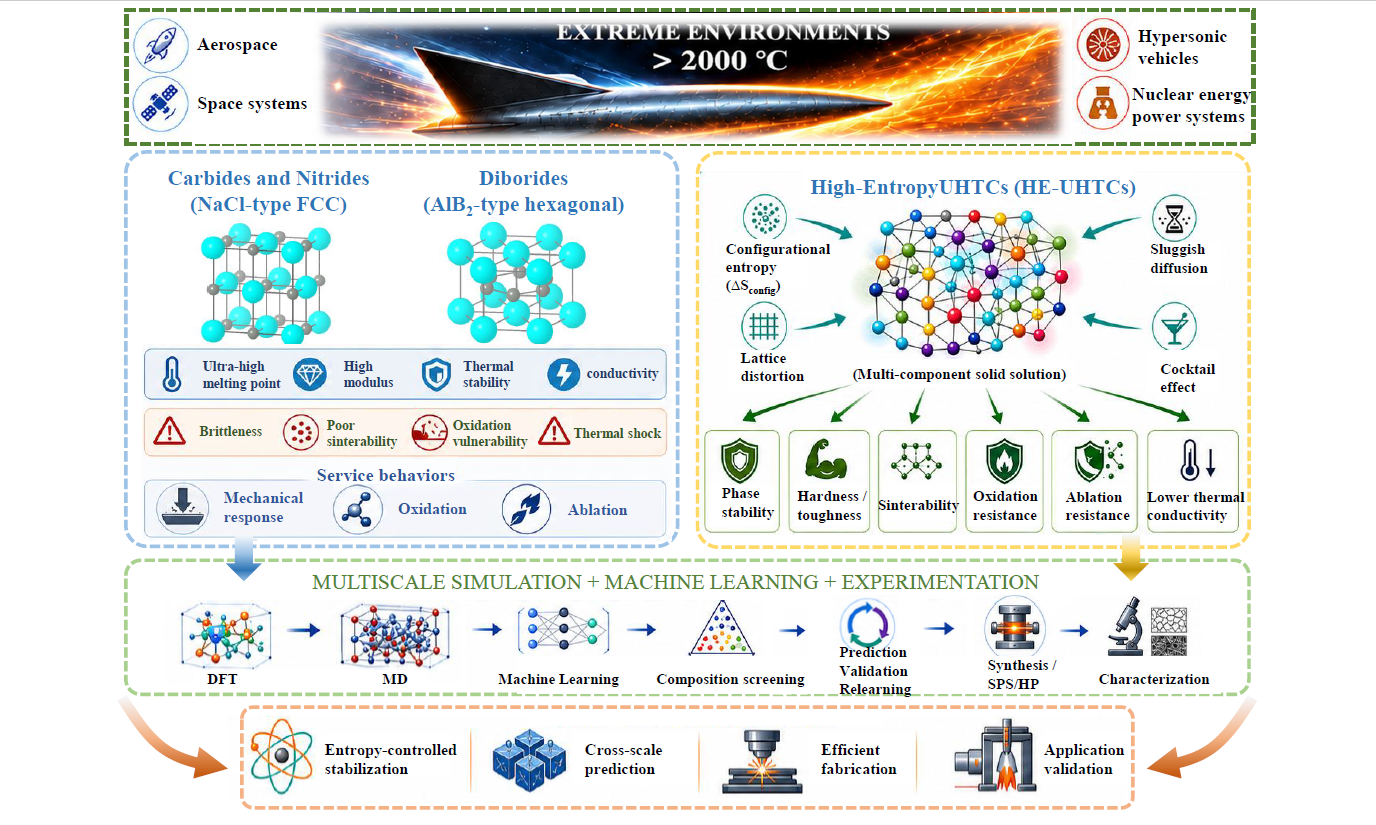
Ultra-high-temperature ceramics (UHTCs), including transition-metal carbides, nitrides, and diborides, have emerged as a class of promising structural materials for applications in extreme aerospace and energy environments. Their strong covalent–metallic bonding endows them with exceptionally high melting points, elastic moduli, and thermal stability. Nevertheless, intrinsic brittleness, limited oxidation resistance, and poor sinterability remain key challenges for the engineering application of conventional UHTCs. Recently, novel material design strategies such as multiphase composites, microstructural engineering, and compositional complexity have emerged. Among these, high-entropy UHTCs (HE-UHTCs) have attracted significant attention due to their configurational entropy, lattice distortion, and sluggish diffusion effects, which collectively enhance oxidation resistance, thermal stability, sinterability, and mechanical performance. This review summarizes the crystal chemistry, mechanical behavior, oxidation, and ablation properties of conventional UHTCs and HE-UHTCs. The four core effects of HE-UHTCs—configurational entropy, lattice distortion, sluggish diffusion, and cocktail effects—are discussed in relation to their mechanical properties and oxidation resistance. The roles of computational materials science, including density functional theory (DFT), molecular dynamics (MD), and machine learning, in composition screening and property prediction are critically reviewed. Finally, key challenges and future directions for the rational design and engineering application of UHTCs are discussed.

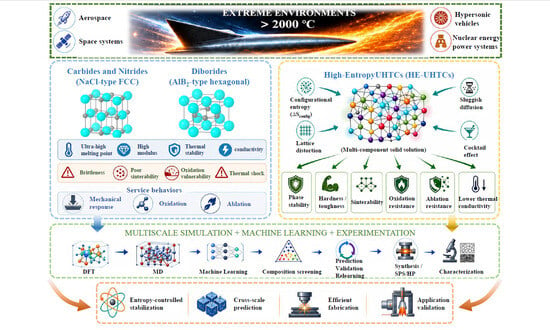
Graphical Abstract

1. Introduction

The rapid advancement of aerospace technologies, particularly hypersonic vehicles and rocket propulsion systems, imposes increasingly stringent requirements on thermal protection materials. Critical components, such as nose cones, leading edges, combustion chambers, and nozzles, must withstand extreme service environments characterized by temperatures exceeding 2000 °C, high-velocity gas erosion, severe thermal shock, and oxygen-rich atmospheres, while maintaining dimensional stability and reliable load-bearing capacity. Conventional high-temperature alloys suffer from significant strength degradation at elevated temperatures and are therefore inadequate for such demanding conditions. Conventional ceramics also face oxidation failure and thermal-shock sensitivity at high temperatures.
UHTCs have emerged as a class of extreme-environment structural materials addressing these challenges. From the perspective of intrinsic material properties, the advantages of UHTCs arise not only from their high melting points but also from their transition-metal–nonmetal bonding characteristics. Typical UHTCs generally have melting points above 3000 °C, and some systems, such as Hf(C,N), can reach approximately 4200 °C. They also exhibit high thermal conductivity (more than 140 W·m−1·K−1) and high elastic modulus (up to 600 GPa) [1]. This mixed covalent–metallic bonding enables UHTCs to maintain structural stability under extreme thermal, mechanical, and chemical environments [2].
Despite these advantages, UHTCs face significant engineering challenges. First, the strong directional covalent bonding makes the material inherently brittle and prone to failure under thermal mechanical coupling. Second, in the high-temperature oxidation environment, the surface oxide layer may volatilize or become porous, making it difficult to provide long-term protection. Third, low self-diffusion coefficients and strong bonding make densification difficult and increase processing costs. Although the composite design, second-phase collaborative optimization and microstructure design have made gradual progress, these strategies have not yet fully overcome the performance limitations of UHTCs under coupled extreme environments.
HE-UHTCs achieve entropy-driven phase stabilization by introducing a variety of near-equiatomic components into the same lattice, providing a promising strategy for overcoming the performance limitations of conventional UHTCs. HE-UHTCs use configurational entropy to stabilize high-temperature single-phase solid solutions. Together with severe lattice distortion and sluggish diffusion, entropy-driven stabilization significantly alters phase stability, diffusion kinetics, oxidation behavior, and mechanical response. Therefore, HE-UHTCs exhibit stronger oxidation resistance, better thermal stability and better sinterability than traditional ceramics.
This review provides a comprehensive assessment of conventional and high-entropy UHTCs. We also highlight how computational materials science and machine learning facilitate exploration of vast compositional spaces, enabling rational design of UHTCs for extreme environments.

2. Typical UHTC Systems and Crystal Structure Characteristics

2.1. Crystal Structures of UHTCs

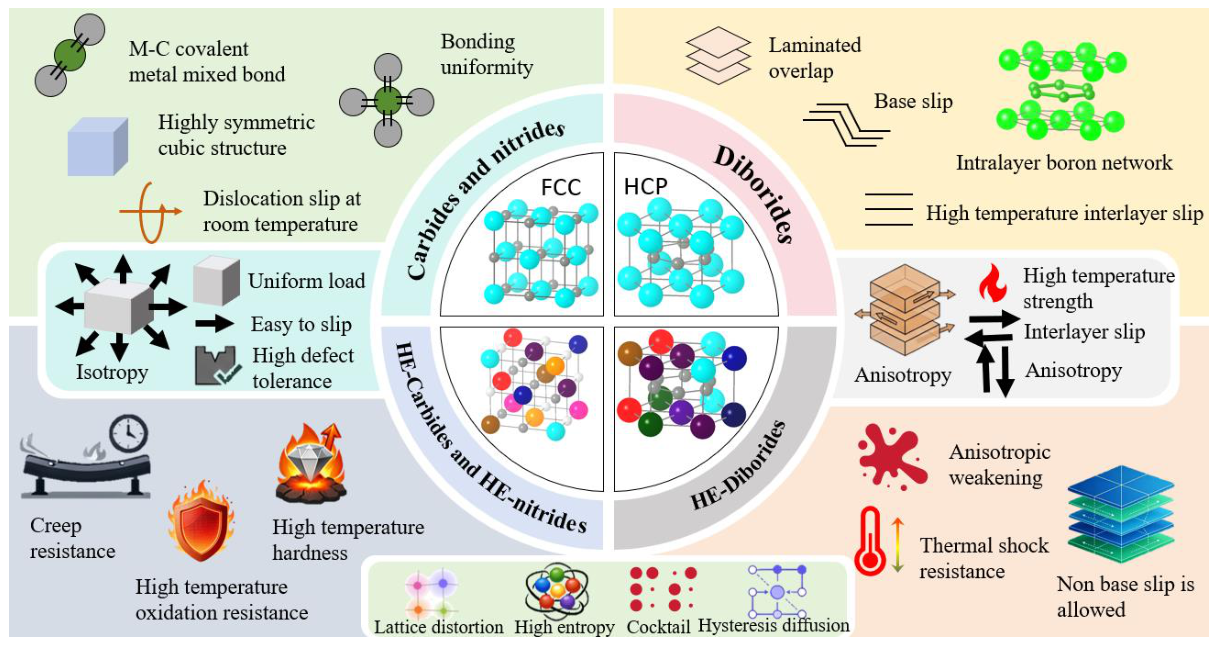
UHTCs mainly include transition-metal carbides, nitrides and diborides. Although UHTCs exhibit ultra-high melting points and excellent thermal stability at the macroscopic scale, fundamental differences exist in their crystal topology, bonding directionality, and defect tolerance. These structural characteristics ultimately determine their mechanical response, thermal transport behavior, and failure mechanisms under extreme service conditions. Figure 1 introduces the types, crystal structures, and related properties of UHTCs.
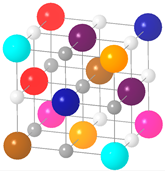
Transition-metal carbides and nitrides typically crystallize in the NaCl-type face-centered cubic (FCC) structure. In this structure, metal atoms form a densely packed FCC lattice, while nonmetal atoms occupy octahedral interstitial sites. The high symmetry and uniform atomic packing of this structure result in nearly isotropic mechanical and thermal responses at the macroscopic scale. Such structural features facilitate homogeneous load transfer at high temperatures and enhance tolerance to point defects and deviations from stoichiometry.
However, due to the relatively limited bond strength of metal–nonmetal (M-X) bonds, the high-temperature strength of NaCl-type UHTCs is generally lower than that of layered diboride systems, especially under ultra-high-temperature and high-stress conditions.
From the perspective of plastic deformation mechanisms, even within the same crystal structure, different transition-metal carbides still show significantly different dislocation slip behavior. For example, TaC preferentially deforms plastically through the {111}<110>slip system. This behavior is closely related to stable intrinsic stacking faults on {111} planes, which reduce the energy barrier for dislocation nucleation and motion. In contrast, HfC tends to deform on the {110}<110>slip system and lacks internal stacking faults, resulting in a significant increase in slip resistance [3,4,5,6].
This difference reflects a general trend in which group-VB carbides typically possess intrinsic stacking faults, whereas group-IVB carbides do not. Consequently, these materials display systematic differences in low-temperature plasticity and high-temperature creep behavior [7]. These observations highlight that microscopic defect structures can significantly influence the mechanical response of UHTCs even within identical crystal structure.
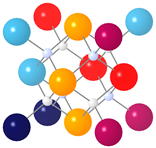
In contrast to carbides and nitrides, transition-metal diborides usually adopt the AlB2-type hexagonal structure. This structure consists of alternating layers of metal atoms and two-dimensional boron honeycomb networks [2]. Strong covalent bonding occurs between boron atoms, whereas metal–boron bonds exhibit mixed covalent–metallic character.
The layered structure leads to pronounced anisotropy in mechanical and transport properties. Within the basal plane (a-direction), the continuous covalent boron network provides extremely high stiffness and load-bearing capacity. Along the c-axis, weaker interlayer bonding results in reduced elastic modulus and fracture resistance. For instance, the elastic modulus of TiB2 reaches approximately 671 GPa in the a-direction but decreases to about 473 GPa along the c-axis [2].
With increasing transition-metal valence electron concentration, the directionality and covalent character of metal–boron bonds are further enhanced. This bond strengthening further increases the anisotropy of diboride materials [2]. Although such structural characteristics contribute to high-temperature stability and strength, they may also intensify thermal stress concentration and promote preferential crack propagation.
Additionally, strong metallic interactions between boron layers facilitate electron transport within the basal plane, leading to relatively high electrical and thermal conductivity in this direction. This structure-dominated anisotropic transport gives diborides excellent high-temperature mechanical properties and thermal conduction along specific crystallographic directions, but also imposes stricter requirements on microstructural design and orientation-dependent service conditions.

2.2. Bonding–Property Relationships of UHTCs

The exceptional melting points and thermal stability of UHTCs originate from the strong interactions between transition-metal d orbitals and nonmetal p orbitals. From the atomic scale, the structural stability and multiphysical properties of UHTCs come from three basic interactions: metal–nonmetal (M–X), metal–metal (M–M), and nonmetal–nonmetal (X–X) bonding.
Among these interactions, M–X bonding exhibits both ionic and covalent character and plays a dominant role in determining melting temperature and high-temperature strength. M–M bonding is primarily metallic and contributes significantly to electronic and thermal conductivity. The X–X bond (especially in boride) has a decisive effect on the structural stiffness and anisotropic response.
The differences in bonding configurations of different UHTC systems directly lead to systematic differences in melting point, thermal conductivity and mechanical properties. Diborides often exhibit higher thermal conductivity than carbides and nitrides due to stronger metallic bonding interactions. In contrast, carbides typically display superior mechanical stability at ultra-high temperatures because of the strong M–C covalent bonds. The high bonding energy significantly suppresses atomic diffusion and lattice vibrations, enabling these materials to retain high elastic modulus and strength even at elevated temperatures. In diborides, the two-dimensional covalent boron networks provide extremely high in-plane stiffness, while the relatively weaker interlayer bonding leads to pronounced anisotropy in crack propagation paths and fracture behavior. In contrast, carbides and nitrides possess nearly isotropic bonding networks, resulting in more uniform macroscopic mechanical responses.
It is worth noting that many typical ultra-high-temperature ceramics, especially transition-metal borides and some carbides, are often considered to be electron-deficient compounds due to the insufficient number of valence electrons required to satisfy the local covalent bond saturation, resulting in pronounced multicenter bonding or mixed covalent–metallic bonding.
In borides, beyond the layered hexagonal sheets found in AlB2-type compounds, boron atoms can also form complex polyhedral structures such as B6 octahedra, B12 cuboctahedra, and B12 icosahedra [1]. Because these polyhedra lack sufficient valence electrons to fully satisfy local bonding requirements, the electronic structure becomes highly sensitive to valence electron concentration [8]. The diversity of structures and bonding characteristics in borides provides opportunities for tailoring the properties of boride-based UHTCs. For example, the incorporation of secondary phases such as Y2O3 has been shown to improve toughness in certain systems [9]. This feature renders the properties of UHTCs highly sensitive to the valence electron concentration (VEC). As the transition-metal constituents or compositional complexity vary, the covalent character of M–X bonds, the degree of electron localization, and the directionality of bonding can be systematically modified, leading to significant variations in melting point, elastic modulus, and thermal transport behavior. In general, increased electron localization enhances M–X covalency, which tends to increase melting point and elastic modulus while reducing thermal conductivity. From the perspective of electron-deficient compounds, the high melting points and moduli of UHTCs are therefore governed not only by bond strength but also by valence-electron filling and electronic-structure stability.
In carbides such as HfC and TaC, and nitrides such as HfN and TaN, because carbon and nitrogen are more electronegative than transition metals, charge transfer tends to occur toward the nonmetal sublattice. These carbides and nitrides therefore exhibit strong covalent bonding with a certain degree of ionic character. In carbides, nitrides and diborides, the melting point, elastic modulus and other mechanical properties of ultra-high-temperature ceramics are changed by changing metal or nonmetal elements to obtain additional valence electrons to change the M–X bond length [2]. Comparisons of bonding energies among compounds with similar crystal structures but different compositions have led to the general conclusion that an increase in the number of valence electrons tends to reduce the formation energy of UHTC systems and consequently decreases the stability of their crystal structures [2]. For nonstoichiometric carbides such as TiCx, ZrCx, and HfCx, the melting point is governed not only by valence-electron filling but also by carbon-vacancy concentration, M-C bond strength, M-M bonding, defect ordering, configurational entropy, and phase stability.
In addition to composition regulation, nonstoichiometric vacancies and point defects have a profound impact on the performance of UHTCs. The introduction of vacancies breaks the long-range periodicity of bonding in the ideal lattice, and systematically regulates covalency, electron localization and bonding directionality through local electron reconstruction, charge compensation and lattice distortion. For transition-metal carbides, metal atoms adjacent to carbon vacancies move closer to each other and form stronger M–M bonds, and the bond length of M–X bonds around the vacancy will be reduced due to charge compensation [10]. Vacancies introduced by nonstoichiometry act as strong phonon-scattering centers. For example, carbon vacancies in ZrCx enhance phonon and electron scattering, resulting in decreased thermal conductivity and heat capacity as the C/Zr ratio decreases [11]. With the continuous decrease in x, ZrCx may transform from a high-thermal-conductivity material to a thermal insulator [11].
Carbon vacancies also induce nonlinear variations in lattice parameters. The lattice constant of ZrCx reaches the maximum when x is about 0.85 and subsequently decreases with further increases in carbon content. This behavior arises from the structural expansion required to accommodate additional carbon atoms. However, as carbon content continues to increase, the lattice parameter decreases due to changes in bonding characteristics associated with composition variations [12]. Vacancies usually reduce melting points by weakening local bonding; however, in some UHTC systems, vacancy-induced M–M bonding can locally increase bonding strength, leading to nonmonotonic melting-point variations with composition. For example, the maximum melting points of TiCx, ZrCx, and HfCx occur at relative carbon contents of x = 0.80, 0.82, and 0.94, reaching 3345 K, 3708 K, and 4192 K, respectively [13].
Furthermore, vacancies can be regarded as atomic-scale defects that distort local bonding environments, and the bonding distortion around vacancies makes the interatomic potential asymmetric; therefore, vacancies generally reduce the elastic modulus. First-principles calculations indicate that tuning carbon concentration can significantly improve the mechanical and thermodynamic properties of Ta–C carbides. In Ta6C5, Ta8C7, TaC, and Ta2C systems, the calculated Vickers hardness and elastic modulus increase with increasing carbon concentration. Ta6C5, Ta8C7, and TaC exhibit brittle behavior, whereas Ta2C and Ta4C3 display ductile characteristics. In addition, these Ta–C carbides show excellent elastic isotropy. The calculated thermodynamic stability follows the trend Ta6C5 > Ta8C7 > TaC > Ta2C [14]. These findings indicate that vacancies do not simply degrade material properties but instead provide a tunable structural design parameter.
Nitrogen vacancies can also significantly influence material performance. One perspective suggests that nitrogen vacancies can serve as pinning centers that inhibit dislocation motion, thereby enhancing the mechanical strength of thin films [15]. Another viewpoint emphasizes that electronic bands and the density of states (DOS) near the Fermi level strongly affect the mechanical rigidity and electronic properties of transition-metal nitride (TMN) films, resulting in anomalous behavior when the number of electrons per unit cell changes [16].
As the concentration of nitrogen vacancies increases, the electronic density near the Fermi level rises, leading to changes in hardness, fracture toughness, and electrical properties. Meanwhile, the lattice parameter decreases with increasing nitrogen vacancy concentration [17].
For hafnium nitride (HfNx), substoichiometric Hf55N45 and near-stoichiometric Hf51N49 films exhibit nanoindentation hardness values of 24.6 GPa and 26.0 GPa, respectively. As the nitrogen content increases further to 53, 58, and 63 at.%, the hardness decreases to 20.7, 18.6, and 17.8 GPa, respectively. Stress-free Hf33N67 films exhibit a hardness as low as 7.1 GPa. Young’s modulus decreases monotonically with increasing stoichiometric variable x [18]. ZrNx films with N/Zr ≈ 0.7 show the lowest corrosion rate and best oxidation resistance, whereas those with N/Zr ≈ 0.75 show the poorest corrosion and oxidation resistance [19].
In terms of electrical properties, a phase transition occurs from HfN to Hf3N4 as the stoichiometric parameter x increases from 1.039 to 1.334, accompanied by an increase in film resistivity of nearly three orders of magnitude, indicating that films with the Hf3N4 structure are nearly electrically insulating, whereas films with the HfN structure exhibit metallic behavior [20]. Collectively, these studies demonstrate that the properties of UHTCs are not determined solely by their ideal crystal structures but instead arise from the complex interplay among electronic structure, valence electron filling, and defect states.

3. Mechanical and Thermal Properties of UHTCs

3.1. Mechanical Properties of UHTCs

UHTCs generally exhibit high hardness and elastic modulus due to their strong atomic bonding and dense crystal structures. These characteristics enable them to maintain structural stability under extreme thermomechanical environments. However, similar to many structural ceramics, UHTCs typically suffer from low fracture toughness, which remains a major limitation for engineering applications. At room temperature, ultra-high-temperature carbides typically possess hardness values of 14–30 GPa and fracture toughness values of approximately 2–3.46 MPa·m1/2 [21]. Their elastic moduli generally fall within 300–540 GPa [22]. In comparison, ultra-high-temperature nitrides exhibit slightly lower hardness (10–18 GPa) but comparable elastic modulus values of 380–490 GPa. However, nitrides tend to possess relatively high coefficients of thermal expansion and lower thermal conductivity, which to some extent weakens their resistance to thermal shock [23].
From a micromechanistic perspective, pronounced covalent bonding and complex crystal structures strongly inhibit dislocation nucleation and motion in UHTCs. As a result, these materials typically exhibit brittle fracture behavior. This intrinsic brittleness significantly limits the reliability of monolithic UHTCs in extreme service environments, making toughening strategies essential for practical applications [24].
The toughening strategies for UHTCs can be divided into intrinsic mechanisms, such as dislocation plasticity and phase transformation, and extrinsic mechanisms, such as crack bridging and fiber pull-out. In UHTC composites, intrinsic toughening mainly involves dislocation plasticity and phase-transformation effects. Lattice distortion and local stress concentration can be manipulated through grain-size control and compositional optimization to improve toughness. Grain refinement can hinder crack propagation and increase the energy consumed during crack growth. In addition, high dislocation densities may enable localized plasticity at ceramic crystal surfaces [25]. Local dislocation slip and stress concentration can guide crack deflection, generate tortuous crack paths, and consume additional crack-propagation energy, thereby improving damage tolerance in the ceramic matrix [26]. However, introducing high dislocation densities into ceramics remains challenging.
Some UHTCs, particularly high-entropy or multicomponent systems, may undergo local microstructural phase transformations in regions subjected to localized heating or stress concentration. Such transformations can absorb crack-tip energy or generate local compressive stresses that suppress crack propagation [23].
Microstructural designs, such as layered architectures and fibrous monolithic structures, can improve fracture toughness [27]. In many cases, microstructural design is more effective than simply adding toughening phases [23], and the fracture toughness can exceed 10 MPa·m1/2 [27].
Extrinsic toughening mechanisms mainly retard crack propagation through the introduction of reinforcing phases, including crack deflection, fiber bridging, fiber pull-out, and crack branching.
The introduction of second-phase particles, whiskers, and fibers can effectively induce crack deflection, bridging, and pull-out, thereby substantially improving damage tolerance [28,29,30,31,32,33,34,35,36]. Continuous fiber reinforcement can also mitigate the poor thermal-shock resistance of UHTCs [30,31,32]. In addition, soft phases such as graphene, nanosheets, and carbon nanotubes (CNTs) can interact with ceramic nanoparticles to suppress crack propagation and thus contribute to strengthening and toughening [35,37]. Microstructural design is often more effective than the simple addition of toughening phases in improving fracture toughness [23]. SiC, BN, ZrO2, Mo, MoSi2, and graphite with different morphologies and sizes can also markedly affect the properties of the final sintered products [28,29]. SiC is the most widely used oxidation-resistant reinforcement in ZrB2/HfB2-based UHTCs. At intermediate temperatures, it can oxidize to form SiO2 or borosilicate glass, which seals pores, reduces oxygen diffusion, and improves thermal-shock stability. However, above 2000 °C or under low oxygen partial pressure, SiC can undergo active oxidation to generate SiO(g) and CO(g), while the SiO2 glass phase may soften, volatilize, or be removed by high-speed flow. Therefore, its long-term protective effect depends on whether it can form a continuous, dense, and erosion-resistant composite oxide scale together with a ZrO2/HfO2 skeleton [23,28,38]. Carbon-based reinforcements, such as carbon fibers, CNTs, and graphene, can improve toughness and thermal-shock resistance at room temperature or in inert atmospheres through crack deflection, bridging, pull-out, and enhanced thermal conductivity. However, they are intrinsically unstable in oxidizing atmospheres and must be protected during long-term service at 2000 °C by dense UHTC/SiC matrices, pyrolytic carbon (PyC)/SiC interphases, or external oxidation-resistant coatings; otherwise, oxidation of carbon fibers may form connected channels and weaken load-bearing capacity [35]. For CNTs and graphene, Jin et al. showed that CNTs can significantly improve the strength and fracture toughness of HfB2, whereas Ni et al. noted that CNTs may react with oxide impurities in UHTCs and deteriorate mechanical properties. Simonenko et al. further found that 1 vol.% graphene in HfB2-30 vol.% SiC-graphene can prolong the time during which the surface temperature remains below 1800–1850 °C and reduce the ablation rate in a supersonic dissociated-air jet for 2000 s, but cannot fully prevent the surface temperature from increasing to 2300–2400 °C. This indicates that graphene mainly improves thermal conductivity and delays thermal instability rather than serving as a long-term oxidation-stable phase [23,33,36]. BN platelets can improve the fracture toughness and thermal-shock resistance of ZrB2-SiC composites through weak interfaces, crack deflection, and stress relaxation. However, the oxidation product B2O3 volatilizes readily at high temperature. Ni et al. reported that B2O3 formed by oxidation of BN interfaces volatilizes strongly above 1100 °C. Therefore, BN is more suitable as an intermediate-temperature weak-interface/toughening phase and should not be regarded as a long-term stable reinforcement in oxidizing environments at 2000 °C [23,29].
In general, extrinsic toughening mechanisms often contribute more directly to composite toughness by delaying crack propagation. Dislocation toughening has limited effectiveness in ceramics, whereas transformation toughening requires strict temperature and stress conditions and may rapidly lose effectiveness at high temperature. Crack bridging, crack deflection, and fiber pull-out are comparatively easier to activate and usually provide stronger toughening effects. Intrinsic mechanisms provide baseline toughness through grain-size control, lattice distortion, and transformation toughening. Combining continuous fiber reinforcement with nanoparticle introduction can simultaneously optimize intrinsic and extrinsic toughening effects and thereby substantially improve toughness [39].
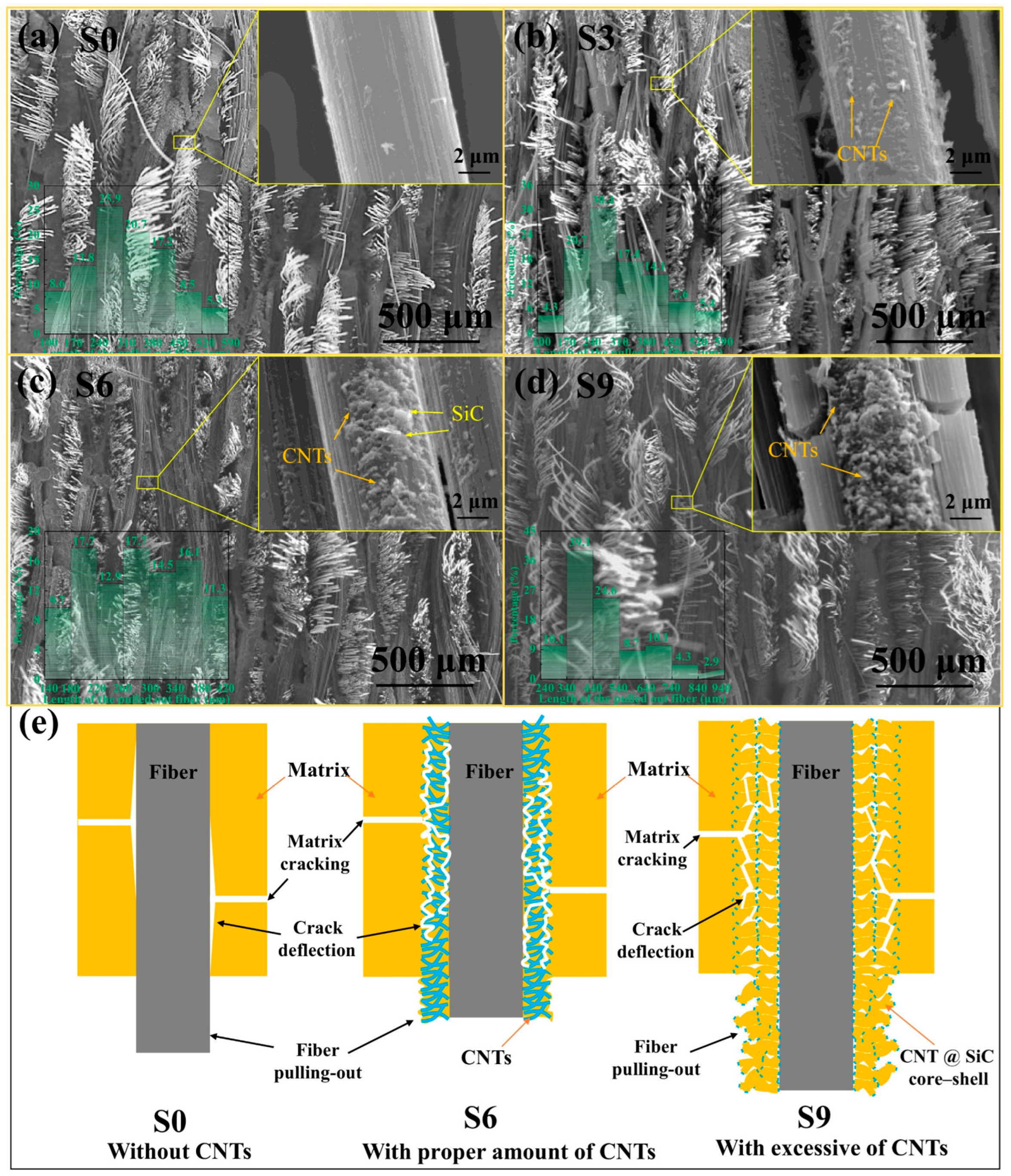
Figure 2 elucidates the effect of CNT growth duration on the fracture characteristics of Cf/CNTs–PyC/SiC composites, as well as the underlying reinforcement and toughening mechanisms. In the CNT-free sample (Figure 2a, S0), fracture is primarily dominated by fiber pull-out, exhibiting a bundle-like morphology. With the introduction of an appropriate amount of CNTs (Figure 2b,c, S3 and S6), the fracture morphology evolves into a hybrid mode characterized by brush-like and filamentous fiber pull-out. This transition reflects a substantial enhancement in both flexural strength and toughness. In contrast, excessive CNT growth (Figure 2d, S9) results in the formation of a thick and porous CNT network on the fiber surface. This overgrowth impedes the infiltration of the SiC precursor, leading to reduced matrix densification.
The schematic illustration in Figure 2e further clarifies the evolution of strengthening and toughening mechanisms. For the CNT-free composite (S0), the dominant mechanisms include matrix cracking, crack deflection, interfacial debonding, fiber pull-out, and fiber bridging. Upon incorporation of an optimal CNT content (S6), additional mechanisms such as CNT-induced crack bridging, “nail-like” reinforcement, extended crack deflection, and enhanced pull-out are activated, along with CNT-assisted densification of the matrix. However, in the case of excessive CNTs (S9), the reduced densification of the SiC matrix and the formation of a CNT-rich interphase (core–shell structure) hinder effective stress transfer from the matrix to the fibers, ultimately diminishing both strength and toughness [40]. Excessive CNT incorporation may also introduce undesirable porosity. Therefore, controlling CNT content is essential for fully exploiting its strengthening and toughening effects.
Compared with carbides and nitrides, transition-metal diborides possess an AlB2-type hexagonal layered crystal structure and generally exhibit relatively high and anisotropic strength. Diborides with a “core–shell” microstructure, in which solid-solution diboride phases encapsulate pure diboride grain seeds, can achieve strengths as high as 660 MPa at 2100 °C. Such structures exhibit remarkable compressive resistance at ultra-high temperatures and may even enhance oxidation behavior [41]. Diborides typically exhibit relatively high elastic moduli, approximately 480–560 GPa, and moderate hardness values in the range of 20–35 GPa. Among these materials, zirconium diboride (ZrB2) has been studied most extensively because of its relatively low density (6.08 g·cm−3), high melting point (3250 °C), high thermal conductivity (60–130 W·m−1·K−1), high electrical conductivity, and good high-temperature strength. ZrB2- and HfB2-based ultra-high-temperature ceramics are capable of maintaining long-term non-ablative behavior in oxidative environments above 2000 °C, making them highly promising candidates for non-ablative ultra-high-temperature thermal protection materials [27].
The ideal tensile strength of a defect-free diboride crystal can be roughly estimated using a Griffith-type bond-breaking approximation [42]:
σ t h = E γ a 0
where σ t h is the ideal theoretical strength, and E, γ and a 0 represent the elastic modulus, surface energy, and average interatomic spacing, respectively. Here:
γ E · a 0 40
σ t h E 40
This value should be regarded only as an upper-bound estimate for an ideal, defect-free crystal. It should not be confused with the measured flexural strength or fracture strength of real UHTCs, which is usually much lower because of porosity, grain boundaries, residual stresses, microcracks, anisotropic bonding, and processing-induced defects. The incorporation of SiC particles into diborides is a commonly adopted toughening strategy. Finer initial SiC particles can effectively reduce the grain size of ZrB2 and HfB2 and promote a morphological transformation of the SiC phase from equiaxed grains to whisker-like structures. The resulting ZrB2–SiC ceramics exhibit the highest flexural strength under optimized conditions. However, when the SiC particles are excessively fine or added in excessive amounts, the elongated morphology of the SiC second phase may become overly pronounced, which can deteriorate the mechanical properties of the material [27].
Continuous fiber reinforcement can transform the failure mode of the material from instantaneous brittle fracture to progressive damage accumulation. The introduction of fibers activates mechanisms such as crack deflection and energy dissipation, thereby significantly enhancing fracture resistance.
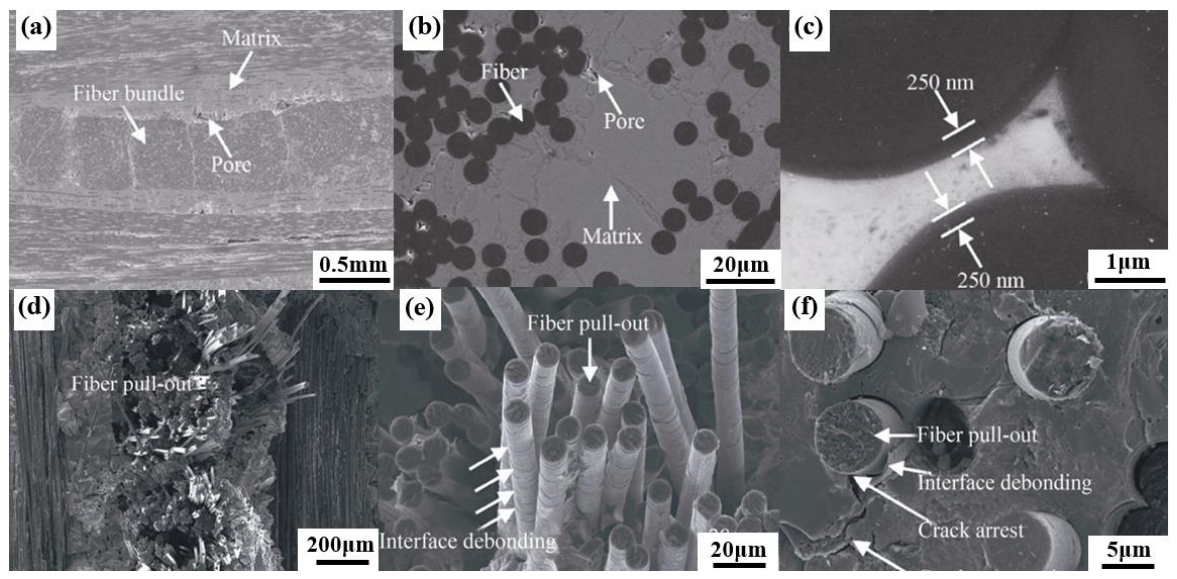
As shown in Figure 3a–c, carbon fiber–reinforced SiBCN-based composites (Cf/SiBCN) exhibit a highly dense microstructure in which the fibers are tightly bonded with the SiBCN matrix. Figure 3d shows extensive fiber pull-out, while Figure 3f reveals multiple toughening mechanisms within the composite, including crack propagation, crack arrest, interfacial debonding, and short-fiber pull-out. These mechanisms collectively contribute to the high fracture toughness of the composite material [32].
Due to the difference in coefficients of thermal expansion between fibers and ceramic matrices, nonuniform thermal expansion occurs between the fibers and the matrix as temperature increases, which weakens the interfacial bonding between them. As a result, mechanisms such as crack deflection and fiber pull-out become more likely, contributing to an increase in the tensile strength of the composite. However, excessively large differences in thermal expansion coefficients may generate significant residual stresses, which can promote crack initiation. Furthermore, at temperatures above approximately 1800 °C, fiber degradation may occur, leading to a reduction in the mechanical strength of the composite [43].
Although these composites are reinforced with continuous fibers, the matrix regions between fiber bundles and between layers still exhibit brittle behavior at the micrometer scale. To address this limitation, some studies have introduced one-dimensional nanostructures into the matrix—such as CNTs, boron nitride nanotubes (BNNTs), and silicon carbide nanowires (SiCNWs) [44]—to develop hierarchically reinforced composites. The incorporation of PyC and PyC/SiC interphases has also been shown to improve the damage tolerance of ultra-high-temperature ceramic matrix composites (UHTCMCs) [45]. Coating fibers with an appropriately thick PyC interphase can reduce chemical reactions between fibers and oxide impurities, promote mechanisms such as fiber pull-out and crack deflection, and provide a weak interfacial bonding strength that helps release stresses and enhance overall toughness [46].
The incorporation of HfC nanowires as a toughening phase in ZrB2–SiC/SiC composites has been shown to improve hardness, elastic modulus, and fracture toughness due to the presence of HfC nanowires. Similarly, the introduction of SiC/PyC nanowires into ZrB2–SiC/SiC and TaB2–SiC materials [47] has been demonstrated to effectively alleviate thermal-stress concentration and enhance ceramic toughness. Among nanoscale reinforcements, ceramic whiskers and nanowires are the most widely utilized.
The toughening mechanisms associated with nanoscale reinforcements can generally be summarized into three main aspects. First, nanoscale reinforcing phases can induce crack deflection at the crack tip, thereby reducing the stress intensity factor and hindering crack propagation. Second, the pull-out of reinforcing phases generates new fracture surfaces, which consumes additional energy during fracture. Third, the reinforcing phases can bridge cracks, providing resistance against crack propagation.
In addition to reinforcement phases, a high density of dislocations can induce localized plasticity at ceramic crystal surfaces. The stress fields surrounding dislocations may also enhance fracture toughness through a stress-shielding effect [26]. However, introducing a high density of dislocations into ceramic materials remains challenging.
Overall, monolithic UHTCs possess excellent hardness, stiffness, and thermal stability but suffer from limited fracture toughness. Therefore, the current research generally adopts composite design to achieve toughening and reliability improvement. In addition, computational design methods can improve the efficiency of identifying materials with desirable properties in large compositional spaces. For example, the bonding strength between different materials can be explored by using simulations such as first-principles calculations to screen better mechanical properties [48].

3.2. Thermal Conductivity

Thermal conductivity is a critical parameter for UHTCs used in thermal protection systems because it directly affects local heat dissipation, temperature-gradient formation, and thermal-stress accumulation. Unlike conventional oxide thermal-barrier materials, transition-metal carbides, nitrides, and diborides generally exhibit mixed metallic and covalent bonding. Therefore, their total thermal conductivity can be considered as the combined contribution of electronic and phononic heat transport, and is commonly expressed as:
κ total = κ e + κ ph
where κ e and κ ph are the electronic and phononic thermal conductivity, respectively. The electronic thermal conductivity can be estimated using the Wiedemann–Franz relation [49]:
κ e = L σ T
where L is the Lorenz constant, σ is the electrical conductivity, and T is the absolute temperature. The phonon thermal conductivity can be further described quantitatively using the phonon gas model [11]:
κ ph = 1 3 C v v g 2 τ
where C v is the phonon heat capacity, v g is the phonon group velocity, and τ is the phonon relaxation time. This relationship indicates that any factor that decreases the phonon group velocity or shortens the relaxation time will reduce the lattice thermal conductivity. Local disorder can enhance Rayleigh-type phonon scattering, shorten the phonon mean free path, and thereby lower lattice thermal conductivity. To quantitatively analyze the effects of lattice distortion, vacancies, grain boundaries, and anharmonicity on thermal conductivity, the phonon relaxation time can be expressed as the combined contribution of multiple scattering processes. According to Matthiessen’s rule, the total phonon scattering rate can be written as:
τ total 1 = τ U 1 + τ B 1 + τ I 1 + τ V 1 + τ e - ph 1
where the τ U 1 , τ B 1 , τ I 1 , τ V 1 ,   and   τ e - ph 1 represent Umklapp, grain-boundary, mass fluctuation, vacancy, and electron–phonon scattering relaxation times, respectively. In HE-UHTCs, random occupation by multiple principal elements significantly enhances mass fluctuation scattering. Lattice distortion and local bond-strength variations increase force-constant-disorder scattering, whereas nanocrystals, second phases, and interfaces enhance boundary scattering. The mass fluctuation and lattice distortion induced by high-entropy design can be semi-quantitatively described using point-defect scattering parameters. Mass fluctuation scattering is generally related to the squared deviation of each constituent mass from the average mass and can be expressed as:
Γ mass = i c i 1 m i m ¯ 2
where c i and m i are the atomic fraction and atomic mass of the i-th component, respectively, and m ¯ is the average atomic mass. For HE-UHTCs, strain-field scattering caused by atomic-radius mismatch should also be considered and can be expressed analogously as:
Γ strain = i c i 1 r i r ¯ 2
where r i and r ¯ are the atomic radius of the i-th component and the average atomic radius, respectively. Therefore, when multiple metallic elements such as Hf, Zr, Ti, Ta, Nb, Mo, and W share the cation sublattice, both mass fluctuation scattering and strain-field scattering are introduced. In addition, differences in metal–nonmetal bond strength generate force-constant disorder, which modifies the phonon dispersion relationship and phonon group velocity. These effects collectively reduce the phonon relaxation time and mean free path and are key mechanisms responsible for the reduced lattice thermal conductivity of HE-UHTCs. Accordingly, the low lattice thermal conductivity of high-entropy ceramics can be quantitatively understood as the result of a reduced phonon mean free path caused by multiple superimposed scattering channels [11,50,51].
In UHTCs, strong covalent bonding generally favors high phonon group velocity; therefore, diborides such as ZrB2 and HfB2 exhibit relatively high thermal conductivity. In HE-UHTCs, however, mass fluctuation, atomic-size mismatch, local strain, and bond-strength variation caused by multicomponent solid solution increase phonon scattering frequency and shorten phonon relaxation time, thereby reducing phonon thermal conductivity. Thus, the primary effect of high-entropy design on thermal conductivity is not simply that more elements necessarily produce lower thermal conductivity; rather, it regulates thermal transport by modifying phonon group velocity and phonon relaxation time [52].
For diborides such as ZrB2 and HfB2, atomistic simulations have shown that the total thermal conductivity of these high-thermal-conductivity UHTCs contains both electronic and phononic carrier contributions. The electronic contribution can be estimated from electrical conductivity using the Wiedemann-Franz relation, whereas the phononic contribution can be directly analyzed using MD or the Green-Kubo method [49]. For carbides such as ZrC, first-principles calculations also indicate the coexistence of electron-phonon interactions and phonon-phonon scattering. The electronic contribution becomes more important at elevated temperature, whereas the phonon thermal conductivity is mainly controlled by phonon-phonon scattering, defect scattering, grain-boundary scattering, and vacancy scattering [50].
The relative contributions of phononic and electronic thermal transport vary among different UHTC systems. Diborides such as ZrB2 and HfB2 possess an AlB2-type layered structure. The strong B-B covalent network favors high phonon velocity, while the transition-metal layers provide a certain degree of metallicity. As a result, diborides usually exhibit high total thermal conductivity and pronounced anisotropic thermal transport [49]. Carbides such as ZrC, HfC, and TaC have rock-salt structures and mixed metallic-covalent bonding, so electronic thermal conduction is non-negligible. Carbon vacancies, grain size, and impurities can also substantially change phonon scattering intensity. Nitrides such as ZrN, HfN, and TiN also exhibit partial metallicity, but their thermal conductivities are strongly influenced by nitrogen vacancies, nonstoichiometry, and changes in electronic structure [23]. Therefore, the thermal conductivity of UHTCs should not be empirically ranked only by whether they are carbides, nitrides, or borides; instead, crystal structure, bonding characteristics, electronic density of states, defect concentration, grain size, and testing temperature should be considered together.
For HE-UHTCs, co-occupation of the cation sublattice by multiple transition-metal elements such as Hf, Zr, Ti, Ta, Nb, Mo, and W further introduces mass fluctuation, size mismatch, bond-strength variation, and local strain fields, thereby significantly enhancing phonon scattering. Transition-metal carbides, nitrides, and borides generally possess mixed metallic and covalent bonding, and some UHTCs exhibit pronounced metallic character. Therefore, the electronic thermal contribution cannot be ignored. Meanwhile, strong M–C, M–N, or B–B covalent networks affect phonon velocity, phonon scattering, and lattice thermal conductivity. Thus, the thermal conductivity of HE-UHTCs should be regarded as the combined result of electronic thermal conduction, lattice thermal conduction, and microstructural thermal resistance [53]. Table 1 presents the mechanical and thermal performance diagrams related to ultra-high temperature and room temperature.

3.3. Thermal Stability and Thermal Shock Resistance

Crystal-structure anisotropy can strongly influence the thermal-shock behavior of UHTCs. FCC carbides and nitrides are relatively isotropic crystallographically, and their thermal expansion and thermal conduction are less direction-dependent. In contrast, AlB2-type hexagonal diborides have layered structures, and their thermal conductivity, coefficient of thermal expansion, and elastic modulus may differ significantly along the a- and c-axes. During thermal shock, this anisotropy can lead to orientation-dependent thermal-stress concentration, grain-boundary mismatch, and microcrack initiation [2,54].
Due to their intrinsic brittleness, UHTCs are susceptible to thermal shock damage under extreme temperature gradients. Two parameters are commonly used to evaluate thermal shock resistance: the thermal shock damage parameter (R) and the thermal shock fracture parameter (R′′′′) [27]:
R = σ f 1 υ E α
R = E γ s σ f 2 1 υ = K IC 2 2 σ f 2 1 υ
where σ f is the fracture strength of the material, υ is Poisson’s ratio, E is the elastic modulus, α is the coefficient of thermal expansion, γ s is the fracture surface energy, and K IC is the fracture toughness.
The thermal shock damage parameter reflects the ability of a material to resist cumulative damage during repeated thermal cycling, whereas the thermal shock fracture parameter is primarily related to fracture toughness and strength. As indicated by Equation (10), when the elastic modulus, coefficient of thermal expansion, and Poisson’s ratio remain constant, improving the strength of UHTC composites is beneficial for enhancing their resistance to thermal shock.
However, large differences in thermal expansion coefficients between the matrix and reinforcement phases may introduce substantial residual stresses during processing. For example, in ZrB2- or HfB2-based composites containing SiC, thermal mismatch during high-temperature sintering can generate internal stresses that reduce thermal shock resistance. Therefore, reducing thermal stress must be considered in materials design. For example, the incorporation of high-melting-point soft phases such as carbon fibers or graphite can help release residual stresses generated during processing, thereby improving the thermal shock resistance of UHTCs.
Microstructural design strategies, including layered architectures and fiber-monolith structures, have also proven effective in enhancing thermal shock resistance. For instance, fiber-monolith ZrB2-based UHTCs can achieve a critical thermal shock temperature difference as high as 1400 °C, representing a 250% improvement compared with conventional ZrB2 materials [55]. As indicated by Equation (11), the thermal shock fracture parameter is proportional to K IC 2 / σ f 2 ; therefore, improving the ratio K IC / σ f is essential for enhancing thermal shock resistance. The addition of graphite can significantly increase the ratio between fracture toughness and strength, leading to more than a twofold improvement in the thermal shock fracture parameter [56].
SiC-reinforced ceramics, when exposed to high-enthalpy and high-heat-flux aerodynamic heating environments, may experience volatilization of SiO2 formed during oxidation. This process alters the catalytic radiation characteristics of the oxide layer surface, causing sudden fluctuations in surface temperature [57]. Such conditions impose more stringent requirements on the thermal shock resistance of UHTCs.
Functionally graded design of UHTCs provides an effective strategy for addressing these challenges. Researchers have developed layered structures by combining high-temperature materials with similar thermal expansion coefficients. The enhanced performance of such systems can be attributed to stress relaxation and crack deflection within the multilayer architecture [58]. This approach not only reduces stresses generated by mismatches in thermal expansion between coatings and substrates but also enables the coating to better retain its intrinsic protective properties. For example, a two-step SiC coating can be employed, where the inner layer consists of b-SiC, and the outer layer is composed of a-SiC, Si, and b-SiC [59]. In addition to improving fracture toughness [60], graded structural designs can also enhance ablation resistance [61].
Table 1. Basic physical, mechanical, and oxidative properties of various ultra-high-temperature ceramics.
MaterialCrystal StructureProcessing Conditions
(°C/min/MPa)
Melting Point (°C)Relative Density (%)CTE (α; 10−6 K−1)Thermal Conductivity (W·m−1·K−1)Electrical Resistivity (µΩ·cm)Elastic Modulus (GPa)Vickers Hardness (GPa)Fracture Toughness (MPa·m1/2)Flexural Strength (MPa)Refs.
Carbides
HfCFCC39006.322.24546124.2[23,62]
TaCFCCSPS, 2300/—/303800926.6–8.422.230–42.153717[23,54,62]
ZrCFCCHPHT, —/—/—353098.56.8220.616838725[23,54,62]
TiCFCCSPS, 1600/10/50306796.17.5–7.717–2152.543723.64240—270[23,62]
Nitrides
TiNFCC29509.3529.121.740018.6[23,62]
ZrNFCCSPS, 2100/10/50295097.77.2420.913.638415[23,62,63]
HfNFCC33856.521.63339816.1[23,62]
TaNFCC29003.28.3128–13549010.8[23,62]
Borides
TiB2HexagonalPS, 1800–2275/60/—3225998.660–12010–30500–56025–355–771–325[64,65]
ZrB2HexagonalHP, 2100/60/3232459734613.73.1392[66,67]
HfB2HexagonalHP, 1800/10/30<89.5183.1259[68]
TaB2HexagonalHPHT, 1400/20/5500320095.1140226[69,70]
Notes: Processing conditions are expressed as sintering temperature (°C)/holding time (min)/applied pressure (MPa); Abbreviations for processing methods: SPS: Spark Plasma Sintering; HP: Hot Pressing; HPHT: High-Pressure–High-Temperature sintering; PS: Pressureless Sintering. Properties listed correspond to dense, bulk specimens; values may vary depending on starting powder purity, particle size, and sintering additive content.

4. High-Temperature Oxidation and Ablation Behavior

4.1. Oxidation Mechanisms of UHTCs

Under high-temperature oxidative environments, UHTCs typically form oxide products such as Ta2O5, HfO2, ZrO2, and B2O3. The type of oxide formed, its density, and its volatilization behavior vary significantly among different UHTC systems during oxidation. Among high-temperature carbides, TaC and HfC have been studied most extensively. TaC begins to oxidize at approximately 400 °C and becomes fully oxidized at around 850 °C, forming Ta2O5, which has a melting point of 1872 °C [71].
Similarly, the oxidation of HfC and ZrC leads to the formation of monoclinic HfO2 and ZrO2, respectively. Both compounds are stable refractory oxides with melting points of approximately 2800 °C and 2700 °C. In particular, ZrO2 exhibits an extremely low vapor pressure and remains highly stable at elevated temperatures [72]. In contrast, B2O3 possesses a relatively high vapor pressure and can undergo significant volatilization at high temperatures.
ZrB2 provides better oxidation protection below about 1200 °C because its oxidation produces a ZrO2 layer containing molten boron oxide [73]. The liquid B2O3 phase can fill cracks and pores, thereby improving the integrity of the protective oxide scale. However, as the temperature increases further, the rapid volatilization of B2O3 significantly reduces its protective effectiveness.
Kuriakose and Margrave first reported the oxidation kinetics of ZrB2 [74], demonstrating that the oxidation of ZrB2 in the temperature range of 945–1256 °C under 1 atm O2 follows a parabolic rate law. At 1056 °C, the rate constant was found to be proportional to the oxygen partial pressure, indicating that oxygen diffusion controls the oxidation rate. Oxygen diffusion is primarily controlled by transport through the oxide scale. As oxidation time and temperature increase, cracking or porosity may develop in the oxide scale, allowing oxygen to rapidly penetrate into the substrate. In addition, oxygen vacancies can provide fast diffusion pathways, increase the oxygen diffusion rate in the oxide layer, and alter the local chemical potential, resulting in nonuniform oxide-scale growth. The oxidation behavior is governed by the combined effects of solid oxide phases, liquid glass, pores, and the monoclinic-to-tetragonal transformation of oxide phases.
The oxidation rate of ZrB2 increases sharply at approximately 1127 °C, while a similar increase occurs for HfB2 at about 1627 °C [75].
Between 800 and 1400 °C, the evaporation rate of B2O3 follows a linear relationship with temperature. Tripp and Graham proposed a quasi-linear equation to describe the oxidation process of ZrB2 [76], expressed as:
Δ nO 2 A = a t 1 / 2 + b t
At temperatures below 1100 °C, the parabolic term a t 1 / 2 predominates, indicating that the reaction kinetics are governed by the diffusion of oxygen through the liquid B2O3 layer. When the temperature exceeds 1400 °C, the linear term becomes dominant due to the volatilization of the protective B2O3(l) layer. The substantial volatilization of B2O3(l) at elevated temperatures compromises the oxidation resistance of the material.
The oxidation process of ultra-high-temperature carbide ceramics involves multiple physicochemical steps, including the inward diffusion of oxygen, the formation of oxide phases, and the release of gaseous products such as carbon monoxide and carbon dioxide. This process inevitably introduces structural defects, including pores, thermal stresses, and internal stresses arising from microstructural evolution. These phenomena lead to the initiation of microcracks and progressive surface spallation. From a mechanistic perspective, the oxidation behavior of various types of ultra-high-temperature ceramics (UHTCs) exhibits fundamental differences at elevated temperatures. During the oxidation of carbides and nitrides, the nonmetallic elements (C or N) escape in the form of gaseous species such as CO, CO2, or N2, which tend to generate porosity within the oxide scale, thereby compromising its density and protective capability. In contrast, diborides can form liquid B2O3 in the intermediate- to high-temperature range, which binds oxide particles and improves oxide-scale integrity. Within a certain temperature window, B2O3 has a relatively low vapor pressure and can act as an effective oxygen-diffusion barrier, thereby significantly delaying further oxidation of the substrate. However, when the temperature exceeds approximately 1200–1800 °C, or under high-velocity aerodynamic flow conditions, the rapid volatilization of B2O3 leads to the gradual degradation of its protective function. Although certain refractory oxides may offer transient protection over short time scales, their inherent volatility and tendency to form porous structures often result in the rapid loss of oxidation resistance.
At the ceramic-oxide interface, the diffusion of oxygen occurs through pores within the oxide layer. The oxygen concentration is governed by its partial pressure, which in turn depends on the temperature. Variations in temperature further influence the diffusion coefficient [77]. Assuming that the cross-sectional area of the oxide layer perpendicular to its growth direction (i.e., the direction along which the thickness L is measured) remains equivalent to that of the parent material and does not change over time, the evolution of oxide thickness L as a function of time t is determined by the porosity f of the oxide scale [78]:
d L d t = 1 1 f 1 ρ HfO 2 d W HfO 2 d t = 1 1 f 2 5 J O 2 M HfO 2 ρ HfO 2 ,
where ρ HfO 2 , W HfO 2 , M HfO 2 and J O 2 represent the density, mass, molar mass of the oxide, and the oxygen flux, respectively. A higher oxide porosity f facilitates oxidation by allowing easier oxygen transport through the oxide layer. The gas diffusion regime can be evaluated using the Knudsen number:
K n = λ g / r p
where λ g is the gas mean free path and r p is the pore radius. When K n 1 , intermolecular gas collisions dominate and transport is mainly described by binary molecular diffusion, for which the diffusion coefficient D 1 2 should be used. When K n 1 , collisions between gas molecules and pore walls dominate and transport follows Knudsen diffusion, for which D K should be used. For the transition pore-size regime commonly observed in high-temperature oxide scales, namely K n approximately 1, both mechanisms jointly limit gas transport, and the Bosanquet relation can be used to describe the combined pore diffusion coefficient:
D K = 4 3 8 R T π M 1 / 2 K 0
1 D e f f = 1 D K + 1 D 1 2
After further considering the oxide scale porosity and pore tortuosity, the effective diffusion coefficient can be written as:
D eff = f τ D pore = f τ 1 D K + 1 D 1 2 1
where f is the open porosity, τ is the pore tortuosity, D pore is the combined gas diffusion coefficient within the pores, and D 1 2 is the binary molecular diffusion coefficient between oxygen and the other gas species. This expression indicates that the effective mass-transport capability of the oxide scale depends not only on porosity but also on pore size, pore connectivity, tortuosity, and the relative contributions of molecule–wall and molecule–molecule collisions. Therefore, dense oxide scales with low pore connectivity and high tortuosity are more effective in reducing oxygen diffusion flux, whereas porous, cracked, or highly connected pore networks substantially weaken the protective effect [78].
Therefore, the compactness of the oxide layer—rather than merely the type of oxide formed—is often the key factor determining the oxidation resistance of UHTCs. This understanding provides a theoretical basis for improving oxidation resistance through microstructural control and composite design.
Introducing oxidation-resistant additives such as SiC is an effective strategy for improving oxidation resistance. During oxidation, these additives promote the formation of a high-viscosity borosilicate glass layer. According to the Stokes–Einstein relationship, an increase in viscosity may reduce the diffusion rate of oxygen:
D l i q = k T 3 π λ η
where k is the Boltzmann constant, T is the thermodynamic temperature, λ represents the hydrated ionic diameter, and η is the viscosity. The liquid-phase diffusion coefficient D liq is inversely proportional to the viscosity η.
At present, most oxidation-resistance strategies rely on introducing multiple oxidation-resistant additives to promote the formation of stable and dense oxide layers on the material surface. Common oxidation-resistant additives include silicon carbide, oxides [79], and silicides. Grain refinement can improve the uniform distribution of these additives, effectively filling voids and bridging defects, thereby inhibiting oxygen ingress and enhancing oxidation resistance. However, excessively fine grain sizes may adversely affect the high-temperature mechanical properties of the material.
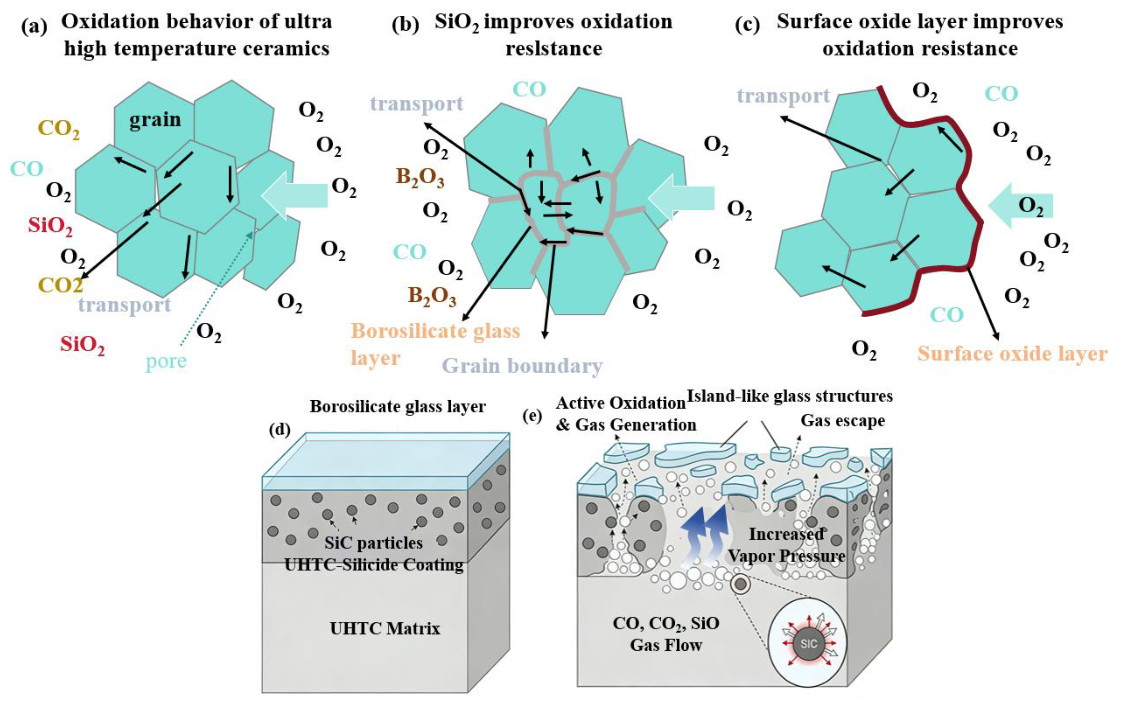
Among various additives, the incorporation of SiC has proven particularly effective in improving the oxidation and ablation resistance, as well as the overall performance, of UHTCs. As illustrated in Figure 4, oxidation of SiC generates SiO2, which can cover the material surface or fill the pores within the ZrO2 skeleton structure, thereby providing effective oxidation protection [72]. However, at temperatures above approximately 1850 °C, SiO2 may lose its protective capability due to rapid volatilization. To address this limitation, researchers have attempted to introduce rare-earth oxides and TiC into the matrix to stabilize the oxidation products and increase the melting point of silica, thereby further enhancing the ablation resistance of UHTCs [80].
During ablation testing, UHTCs are subjected to even more severe aerodynamic loads and higher temperatures. Under such extreme conditions, active oxidation of SiC generates a larger amount of gaseous by-products. Owing to the increased vapor pressure, these gaseous species may penetrate the top glassy layer, leading to the formation of an “island-like” morphology on the surface of UHTC–silicide coatings and thereby disrupting the continuity of the protective glass layer [82], as shown in Figure 4d,e. When the ablation temperature exceeds 2000 °C, the ablation resistance of ceramics depends predominantly on transition-metal (TM) oxides, such as ZrO2 and HfO2. However, volume changes associated with phase transformations in TM oxides can compromise the integrity of the oxide layer and even cause spallation. The addition of rare-earth (RE) compounds can promote reactions with TM oxides and facilitate the formation of complex oxides such as La2Zr2O7 [83]. Additives such as TaSi2 and La2O3 have also been shown to improve the oxidation resistance of ZrB2- and HfB2-based ceramic matrix composites [84].
In addition, highly textured MB2-based UHTCs have been developed through strong magnetic field alignment. Owing to the intrinsic anisotropy of diborides, these materials exhibit direction-dependent oxidation resistance, with surfaces oriented perpendicular to the c-axis of MB2 showing superior oxidation resistance [42].
The oxidation and ablation resistance of UHTCMCs depends to a large extent on the composition and microstructure of the surface oxide layer formed during exposure. Due to the presence of reinforcing fibers, these composites display anisotropic oxidation behavior. Carbon fibers are particularly vulnerable when exposed to oxidative environments and can be rapidly consumed. When oxidation propagates along the fiber layers, the fibers are depleted, leaving pores that facilitate further oxygen diffusion [23]. By contrast, when oxidation proceeds perpendicular to the fiber layers, the fibers are oxidized rapidly and the ceramic matrix becomes exposed. The ceramic matrix can then oxidize to form a denser oxide layer, which provides improved resistance to further oxidation [85].
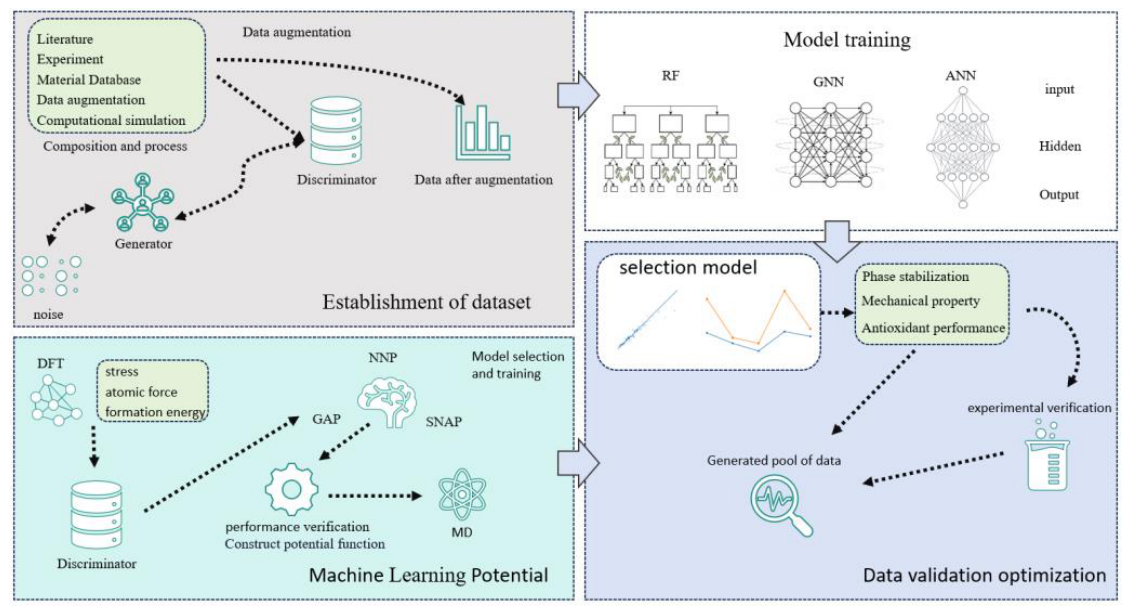
Simulation of the oxidation behavior of high-temperature ceramics represents a viable and increasingly important research approach. For example, modeling the growth and thickness evolution of oxide layers can provide insights into fracture behavior. In parallel, high-throughput experiments combined with data-driven strategies and machine learning have been employed to predict the oxidation behavior of ceramics [86].

4.2. Ablation Behavior

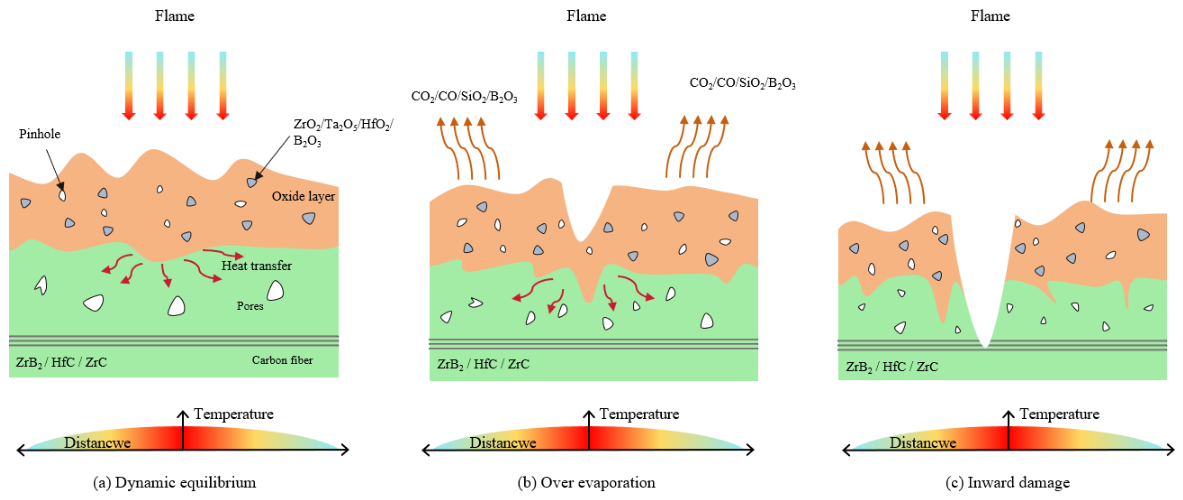
Under extreme aerothermal conditions, UHTCs experience mass loss through oxide volatilization, surface melting, and aerodynamic erosion. These processes often act synergistically, resulting in highly complex ablation behavior that cannot be fully captured by oxidation kinetics alone. Under moderate heat flux, SiC oxidation can generate SiO2 or borosilicate glass phases that fill pores and cracks and reduce oxygen diffusion. ZrO2, HfO2, TiO2, and their complex oxides can improve the erosion resistance of the oxide layer. In contrast, under high heat flux and high-speed flow, loss of volatile species such as SiO2, B2O3, and SiO intensifies, the viscosity of the glassy phase decreases, and active oxidation of SiC produces SiO(g), CO(g), and CO2(g), which can generate pores, bubbles, and local internal pressure, further disrupting the continuity of the oxide scale. In this regime, the ablation mechanism gradually shifts from oxygen diffusion control to a process dominated by volatilization loss, mechanical erosion, and oxide scale spallation. Studies by Pan et al. and Zeng et al. on ZrC-SiC-TiC systems show that high viscosity, low volatility, and a complex-oxide skeleton in multiphase oxide layers help resist high-temperature gas flow erosion, whereas single SiO2 or low viscosity oxide layers are more prone to volatilization and spallation above 2000 °C [87,88]. Figure 5 shows three common processes during the ablation stage.
Oxide-scale spallation is also controlled by thermal stress and interfacial structure. Rapid heating and cooling, oxide phase transformations, and thermal expansion mismatch between coatings and substrates can induce cracking and interfacial debonding. Once cracks form, aerodynamic shear can further peel the oxide layer along cracks and pores. Appropriate coating thickness, embedded interfaces, HfO2-ZrO2 solid-solution sintering, and complex oxide scales such as La2Zr2O7 and Hf-Ta-Si-O can improve spallation resistance by strengthening interfacial bonding, relieving thermal stress, stabilizing ZrO2 phase transformations, and increasing oxide-scale viscosity [80,89,90,91,92].
Severe oxidation and structural degradation are the two principal causes of ablation, as they critically influence the ablation tolerance of the material [93]. Consequently, incorporating oxidation-resistant elements such as Ti, Cr, and Si into the material matrix has been widely regarded as an effective strategy for controlling oxidation. Such additions promote the formation of viscous SiO2 glass phases and solid solutions such as (Zr,Ti)O2 or (Hf,Ti)O2, which help seal oxygen diffusion pathways [94]. Alternatively, the addition of high-melting-point oxides such as HfO2, LaB6, La2O3, and Y2O3 can stabilize the ZrO2 phase and thereby enhance ablation resistance under extreme ultra-high-temperature conditions.
In addition, the sluggish diffusion effect induced by the high configurational entropy in high-entropy ceramics (HECs) can significantly mitigate oxidation processes in high-temperature environments [95]. Therefore, implementing high-entropy design on both anion and cation sublattices can substantially enhance ablation resistance. Furthermore, some studies have reported that introducing medium-entropy oxides can reduce ablation damage caused by oxidation-induced porosity and thermal shock cracking [96].
In general, the ablation resistance of UHTCMCs is achieved through the formation of high-melting-point oxide layers together with glassy phases that fill the pores within the oxide scale [97]. In multiphase ceramics, the incorporation of SiO2 can promote the self-healing of cracks and pores generated during ablation. However, due to the volatility of SiO2, this self-healing capability becomes ineffective at temperatures above approximately 1600 °C [98]. At excessively high temperatures, certain oxide glass phases may volatilize, which can reduce the heat load on the material but also weaken the protective capability of the oxide layer against ablation [99]. Meanwhile, the addition of TiC into UHTCMCs can lead to the formation of high-viscosity and low-volatility Zr1−xTixO2, which provides improved resistance to high-temperature erosion. The precipitation of Zr-rich oxides can further increase the viscosity of the oxide layer, enabling it to better withstand high-temperature gas flow erosion. Generally, Hf-based UHTCMCs exhibit superior ablation resistance compared with Zr-based composites because the melting point of HfO2 is higher than that of ZrO2. Moreover, HfB2 demonstrates better ablation resistance than HfC because its oxidation products tend to adhere to the composite surface [100].
In addition to composition, thermal properties also exert a significant influence on the ablation behavior of composites. Composites with higher thermal conductivity can more effectively dissipate heat, thereby reducing the surface temperature during ablation and improving ablation resistance [101]. In general, heat is primarily conducted through phonon transport within the solid framework of the composite. Phonons are scattered by pores, grain boundaries, and phase interfaces, which reduces the overall thermal conductivity of the composite. Therefore, reducing porosity and establishing a dense, continuous phase distribution are effective strategies for improving thermal conductivity and consequently enhancing ablation resistance [23]. In addition, carbon fibers are particularly vulnerable during ablation, as they are easily oxidized and may form pathways for oxygen diffusion. As a result, ablation resistance can be improved by optimizing the structure of fiber preforms [38] or by developing ultra-high-thermal-conductivity carbon-fiber-reinforced composites [102].
Furthermore, the effects of ablation can be mitigated through the development of oxidation-resistant coatings, multilayer gradient designs, and controlled oxidation–ablation sequences. For example, thermodynamic diagrams can be used to determine the preferential oxidation sequence of different components at ablation temperatures, allowing the ablation performance of multicomponent UHTCs to be evaluated in advance based on different metal compositions or compositional ratios. By carefully designing the composition and controlling the oxidation sequence with temperature, the ablation resistance of UHTCs can be further improved [103].
It should be noted that laboratory ablation results cannot be directly extrapolated to real hypersonic service environments. Oxyacetylene, laser, and plasma ablation tests represent reactive flames, high thermal shock, and high-enthalpy gas flows, respectively, but they cannot simultaneously reproduce the high-Mach-number boundary-layer shear, shock-wave/boundary-layer interactions, atomic oxygen, pressure gradients, component curvature, and nonuniform heat flux encountered in flight. Future evaluations should therefore report heat flux, surface temperature, gas velocity/pressure, oxygen partial pressure, specimen geometry, exposure time, oxide-scale thickness, spallation area, cross-sectional microstructure, and residual mechanical properties, rather than relying solely on mass or linear ablation rates [75].

5. HE-UHTCs

The concept of high-entropy ceramics originated from the development of high-entropy alloys. Unlike traditional single-component or binary systems, HE-UHTCs typically consist of five or more elements occupying equivalent lattice sites in near-equiatomic proportions. The introduction of high configurational entropy fundamentally alters the structure–property relationships of HE-UHTCs. In contrast to conventional UHTCs, whose properties are largely determined by average bonding strength, HE-UHTCs exhibit unique behaviors arising from the combined effects of entropy stabilization, lattice distortion, and chemical disorder. These synergistic effects endow HE-UHTCs with excellent high-temperature oxidation resistance, improved sinterability, strong phase stability, enhanced toughness, and superior ablation resistance [104].
Importantly, the formation of high-entropy ceramics strongly depends on the balance among configurational entropy, mixing enthalpy, atomic size compatibility, and synthesis conditions. Therefore, understanding the thermodynamic principles governing phase stability remains a prerequisite for the rational design of HE-UHTCs.
HE-UHTCs are typically fabricated using techniques such as pressureless sintering (PLS), hot pressing (HP), spark plasma sintering (SPS), and reactive spark plasma sintering (RSPS). Among these methods, HP has been widely employed because it can produce dense HE-UHTCs, although the sintering temperature is often higher than 1800 °C. Owing to its time efficiency, SPS has become the most commonly used technique for densifying high-entropy UHTCs. Most HE-UHTCs are synthesized from the corresponding oxides through borothermal or carbothermal reduction processes [105].

5.1. Crystal Structures of HE-UHTCs

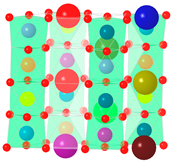
Typical crystal structures of high-entropy oxide ceramics include rock-salt, fluorite, perovskite, pyrochlore, and spinel structures. High-entropy oxides (HEOs) with fluorite structures exhibit low thermal conductivity, high thermal stability, and tunable coefficients of thermal expansion. Perovskite-structured HEOs possess good structural stability [106], whereas pyrochlore-structured HEOs are characterized by high elastic moduli [107] and low thermal conductivity [108]. In addition, monoclinic, rutile, and CaF2-type structures are also commonly found in HEO systems. Table 2 shows the common high entropy ceramic crystal structures.
The synergistic interactions between different types of anions and cations within ceramic lattices endow these materials with high structural stability and favorable thermal expansion characteristics [109], making them attractive candidates for thermal barrier coatings on the surfaces of turbines, engines, and related high-temperature components. High-entropy nitride ceramics generally adopt a NaCl-type crystal structure and exhibit excellent high-temperature oxidation resistance and hardness, which make them suitable for wear-resistant coatings on high-speed cutting tools and corrosion-resistant coatings on gas-turbine compressor blades. High-entropy borides, owing to their high melting temperatures and excellent thermochemical stability, are regarded as promising ultra-high-temperature ceramics. As structural materials, they are capable of operating under ultra-high-temperature conditions [110], although their thermodynamic performance and stability still require further improvement under extreme service environments. High-entropy diborides possess a distinctive layered hexagonal crystal structure composed of alternating rigid two-dimensional boron networks and high-entropy two-dimensional metal-cation layers, in which mixed ionic and covalent bonding exists between the metal and boron atoms (M–B bonds) [111].
Table 2. Crystal structure of high-entropy ceramics.
StructureCrystallographyAppearanceRef.
Rock-saltCubic (Fm-3m)Nanomaterials 16 00693 i001[112]
FluoriteA2B2O7 cubic (Fm-3m)Nanomaterials 16 00693 i002[113]
PerovskiteABO3 Orthorhombic (Pbnm)Nanomaterials 16 00693 i003[114]
PerovskiteABO3 Cubic (Pm3m)Nanomaterials 16 00693 i004[115]
PerovskiteABO3 Hexagonal (P63/mmc)Nanomaterials 16 00693 i005
SpinelAB2O4 Cubic (Fd-3m)Nanomaterials 16 00693 i006
PyrochloreA2B2O7 Cubic (Fd-3m)Nanomaterials 16 00693 i007[116]
AlB2Hexagonal (P6/mmm)Nanomaterials 16 00693 i008[111]

5.2. High-Entropy Effects in HE-UHTCs

According to the Gibbs free energy relationship, the change in Gibbs free energy of a thermodynamically stable single-phase solid solution at high-temperature can be described as:
Δ G = Δ H T Δ S
where Δ G is the change in Gibbs free energy, Δ H is the enthalpy change, T is the absolute temperature, and Δ S is the entropy change. Stability in high-entropy ceramics does not mean that multicomponent ceramics remain thermodynamically stable at all temperatures. Rather, it reflects the competition between mixing enthalpy and configurational entropy. At high temperatures, the T Δ S term increasingly lowers the Gibbs free energy and favors single-phase solid-solution formation. During cooling, however, the entropy contribution decreases, and local chemical ordering, short-range order, phase separation, or kinetic freezing may become dominant, potentially leading to local phase separation or entropy collapse. Therefore, so-called entropy stabilization in HE-UHTCs should be verified using in situ high-temperature X-ray diffraction (XRD), thermal-cycling phase analysis, CALculation of PHAse Diagrams (CALPHAD)/DFT free-energy calculations, and post-quenching phase-retention analysis, rather than inferred solely from the number of constituent elements [53].
As temperature increases, the contribution of entropy to Gibbs free energy becomes more significant, suppressing phase separation that would otherwise be promoted by a positive mixing enthalpy. Consequently, despite the extremely high degree of chemical disorder, simple crystal structures such as rock-salt carbides and hexagonal diborides remain the dominant structural motifs in HE-UHTCs. From a crystallographic perspective, significant atomic size mismatch and electronegativity differences among constituent elements make the stability of simple lattices in HE-UHTCs particularly remarkable. Severe lattice distortion emerges, generating heterogeneous local strain fields and distorted bonding environments. These distortions influence defect energetics, diffusion kinetics, and mechanical responses, thereby forming the structural basis for the unconventional properties observed in HE-UHTCs.
When four or more metallic elements with equimolar or near-equimolar compositions are incorporated into a system, the configurational entropy increases significantly, thermodynamically favoring the formation of simple solid-solution structures rather than multiphase coexistence. The elevated configurational entropy effectively reduces the Gibbs free energy of the system at high temperatures, thereby enhancing the thermodynamic stability of the solid-solution phase. This effect helps suppress the formation of undesirable brittle phases or low-melting-point phases, enabling the material to maintain a stable crystal structure under ultra-high-temperature conditions.
However, the applicability of the term “high-entropy” has been widely debated because the precise role of entropy in stabilizing these systems remains unclear [117]. There is no universally accepted standard defining whether a multicomponent system qualifies as high-entropy. Most high-entropy alloys are typically classified based on composition or configurational entropy. For a random solid solution, the configurational entropy per mole can be expressed as:
Δ S c o n f = R i = 1 n   X i l n X i
where X i is the molar fraction of component i and R is the gas constant. Based on combined definitions involving composition and entropy, a widely accepted classification has emerged: low entropy when S ≤ R, medium entropy when R ≤ S ≤ 1.5R, and high-entropy when S ≥ 1.5R [118].
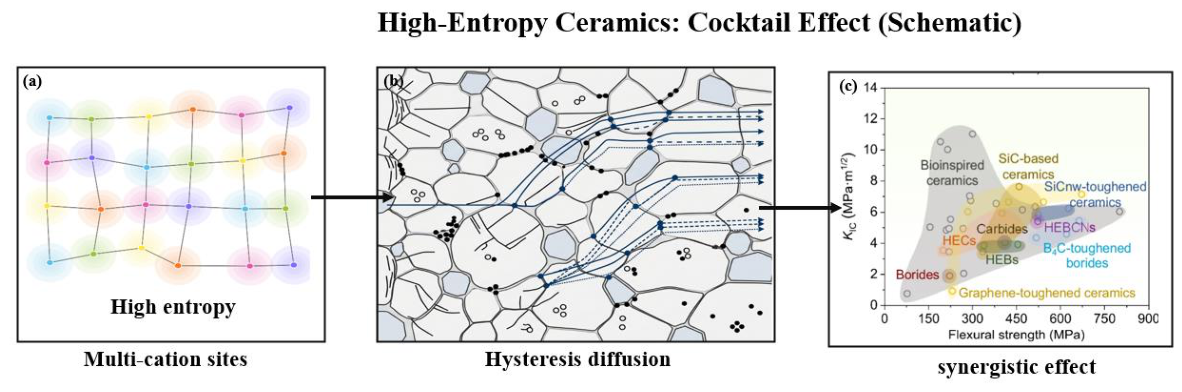
The superior properties of HE-UHTCs do not originate from entropy maximization alone but rather from entropy-induced lattice distortion, sluggish diffusion, and multicomponent synergistic effects. Therefore, in the context of HE-UHTCs, the term “high-entropy” should be regarded primarily as a design strategy rather than a strict thermodynamic definition.
HE-UHTCs exhibit excellent mechanical and physical properties, high-temperature thermal stability, and superior oxidation resistance. Numerous studies on high-entropy borides, carbides, and nitrides have demonstrated superior hardness, wear resistance, and oxidation resistance compared with their single-component counterparts. In addition, increasing configurational entropy generally leads to reduced thermal conductivity in ceramic systems [119]. Furthermore, machine learning approaches combined with descriptor-based methods have been employed to predict entropy-forming ability and explore potential synthesis routes for high-entropy ceramics [120].

5.3. Lattice Distortion Effects in HE-UHTCs

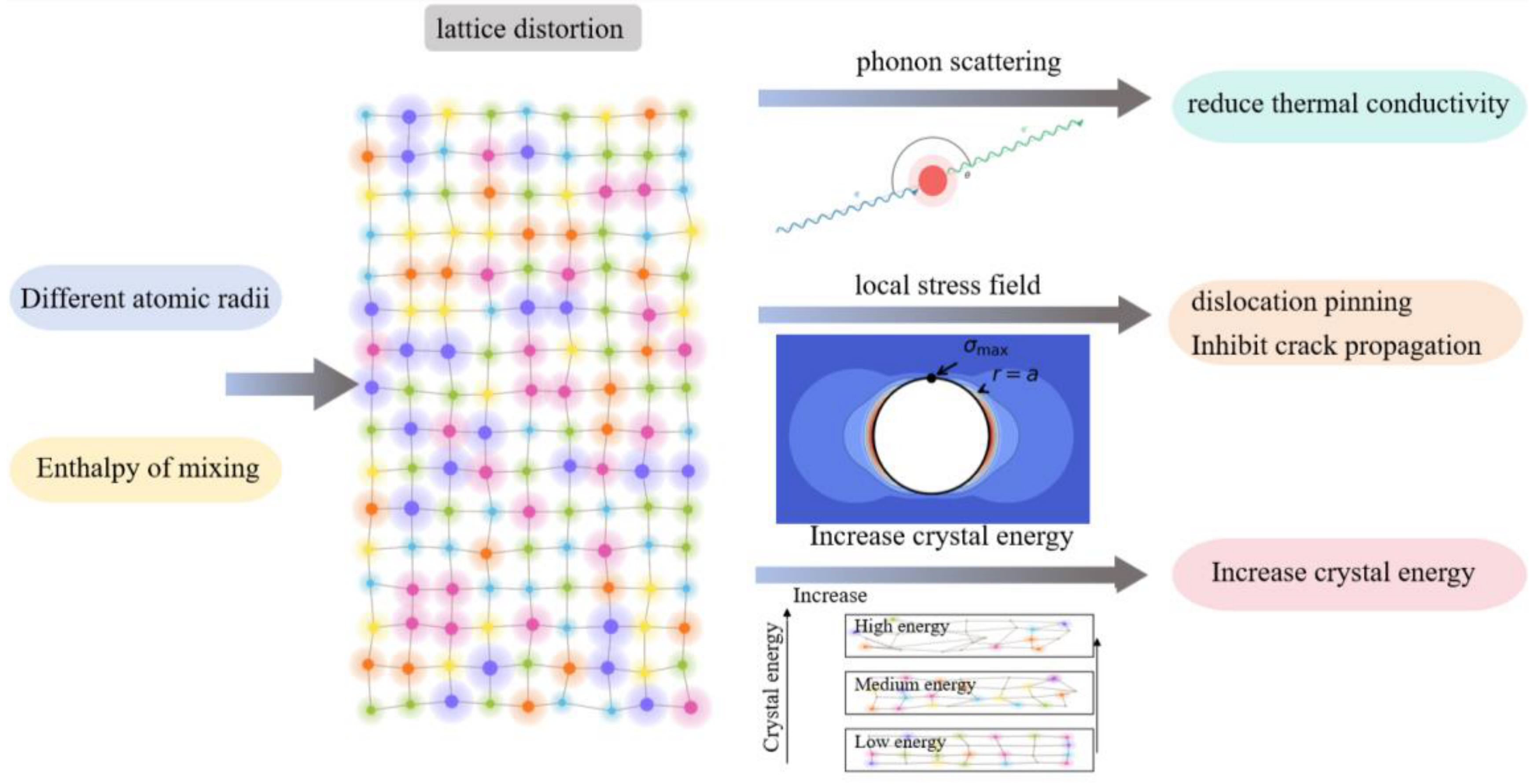
In HE-UHTCs, random occupation of the same cation sublattice by multiple transition-metal elements introduces mass fluctuation, atomic-radius mismatch, local strain fields, and bond-strength variation. These local disorder effects cause mass fluctuation scattering, strain-field scattering, and force-constant-disorder scattering during phonon propagation, thereby shortening the phonon mean free path and reducing lattice thermal conductivity. For high-entropy carbides, nitrides, and diborides, lattice distortion not only modifies phonon dispersion and group velocity but may also further enhance phonon scattering through local short-range order, vacancies, and grain-boundary defects. Therefore, the effect of high-entropy design on thermal conductivity should primarily be understood as regulation of lattice thermal conductivity, rather than being simply equated with a decrease in total thermal conductivity [11,53].
Differences in atomic size, electronegativity, and chemical bonding characteristics among constituent elements can cause ions to deviate from their ideal sublattice positions, leading to lattice distortion. Unlike conventional high-entropy alloys, the increase in entropy in HE-UHTCs primarily arises from increased atomic disorder. Therefore, atomic size mismatch and mixing enthalpy are two primary criteria used to rationalize the formation of high-entropy solid solutions in multicomponent ceramic systems [111]. The average atomic size difference ( δ ) in multicomponent systems can be expressed as [121]:
δ = i = 1 i = N X i 1 r i i = 1 i = N X i r i
where X i and r i represent the molar fraction and atomic radius of the i-th component, respectively. In HE-UHTCs, the atomic radii of constituent elements are generally similar, and the atomic size mismatch parameter typically satisfies δ ≤ 6.6% [122]. Similar to HEAs, the calculation of δ in HE-UHTCs mainly considers the contribution of metallic atoms while neglecting the contributions of B, C, and N atoms in borides, carbides, and nitrides. As a result, the actual lattice distortion in HE-UHTCs may be underestimated. In particular, differences in metallic atomic radii alone cannot fully describe the lattice distortion in boride systems.
Therefore, unlike HEAs, a more accurate representation of atomic size mismatch in multicomponent high-entropy ceramic systems can be obtained using the lattice constants of individual UHTC components:
δ a = i = 1 i = N X i 1 a i i = 1 i = N X i a i
δ c = i = 1 i = N X i 1 c i i = 1 i = N X i c i
where a i and c i are the measured lattice parameters of the i-th UHTC component. Another important parameter governing the formation of solid-solution phases is the mixing enthalpy ΔH_mix [123]:
Δ H m i x = i = 1 ; i j n 4 Δ H A B m i x C i C j
Lower formation enthalpy in HE-UHTCs indicates more favorable energetic conditions for the formation of single-phase high-entropy solid solutions [124]. Severe lattice distortion causes strong phonon scattering, which reduces the thermal conductivity of high-entropy ceramics. For example, the thermal conductivity of (Ce0.2Zr0.2Hf0.2Sn0.2Ti0.2)O2 is only about half that of 7 wt% yttria-stabilized zirconia. Recently, porous (Zr, Hf, Ti, Nb, Ta)B2 has been designed as a novel ultra-high-temperature thermal insulation material [125]. In ultra-high temperature thermal systems, thermal insulation materials are as important as heat-dissipating materials in preventing thermal damage. By optimizing processing conditions and parameters, highly porous structures suitable for thermal insulation can be tailored for HE-UHTCs [117]. Figure 6 shows the effect of lattice distortion on performance.
Severe lattice distortion in HE-UHTCs also generates local stress fields that hinder dislocation motion and crack propagation, leading to dislocation pinning. This mechanism contributes to increased hardness and strength and, in some cases, moderate improvements in fracture toughness. However, comprehensive data on bulk mechanical properties such as fracture strength and fracture toughness remain limited [117]. Additionally, lattice distortion increases the crystal energy, which suppresses grain coarsening by reducing the driving force for grain growth associated with surface energy reduction [126].
However, the influence of lattice distortion on toughness is not straightforward. Although crack deflection and energy dissipation may be promoted at the microscopic scale, chemical disorder may alter the dominant slip systems and thus influence ductility and hardness [127]. Excessive chemical disorder can also suppress dislocation mobility, limiting plastic accommodation. Therefore, entropy-induced strengthening does not necessarily translate into substantial improvements in toughness. The hardness of HE-UHTCs is generally higher than that of single-component UHTCs, and conventional rule-of-mixtures models are not applicable for predicting hardness in such multicomponent systems. Machine learning approaches have also been applied to predict lattice mismatch in high-entropy ceramics and to tune their elastic and mechanical properties [128,129].

5.4. Sluggish Diffusion Effects in HE-UHTCs

One of the most prominent consequences of high-entropy design is the so-called sluggish diffusion effect. In HE-UHTCs, multiple principal elements randomly occupy lattice sites in near-equimolar proportions, creating highly complex local chemical environments. Differences in atomic size, bonding characteristics, and electronegativity lead to pronounced lattice distortion and fluctuations in potential energy landscapes. As a result, atomic diffusion pathways become nonuniform, and migration energy barriers increase, hindering both cation and anion diffusion. Figure 7 shows the atomic delayed diffusion behavior.
Furthermore, chemical short-range order (CSRO) and multicomponent interactions significantly increase the activation energy required for atomic jumps and broaden the distribution of migration energy barriers, thereby reducing diffusion coefficients. Driven by the thermodynamics of mixing enthalpy, CSRO refers to the tendency of specific atoms to preferentially occupy nearest-neighbor positions and form locally ordered clusters at the nanoscale. These ordered regions act as asymmetric energy wells: the energy required for an atom to escape from an ordered region is much higher than that required to enter it, producing a pronounced atomic trapping effect and increasing the average residence time of atoms at specific lattice sites. In addition, atomic migration within CSRO regions often cannot proceed through single-atom jumps but requires cooperative multi-atom rearrangements, which substantially increases the effective activation energy. At the same time, CSRO clusters act as local energy minima, forcing diffusion paths to become more tortuous and increasing the effective diffusion distance. Macroscopically, this behavior appears as a non-Arrhenius decrease in diffusion coefficients and a significant reduction in the pre-exponential factor. This effect becomes particularly pronounced at high temperatures. Sluggish diffusion directly suppresses grain growth during sintering and thermal exposure [130,131], thereby enhancing microstructural stability and maintaining high strength at elevated temperatures.
From a functional perspective, reduced diffusion kinetics are crucial for maintaining mechanical integrity during prolonged high-temperature exposure. Compared with conventional UHTCs, HE-UHTCs exhibit improved resistance to grain coarsening and phase decomposition after long-term thermal exposure. Moreover, sluggish diffusion enhances high-temperature creep resistance and microstructural stability, enabling superior durability under prolonged service conditions.
In oxidation processes, the multicomponent cation sublattice creates a complex local chemical environment, broadening the distributions of atomic migration pathways and migration barriers. This may reduce long-range diffusion rates and delay phase separation or oxide scale growth. The thermal conductivity of high-entropy UHTCs can also be affected by oxygen impurity content. Introducing reducing components such as graphite can remove oxygen impurities, thereby increasing thermal conductivity and alleviating localized thermal gradients [132].
In irradiation environments, large numbers of point defects and dislocation loops are typically generated. Their aggregation and growth usually rely on diffusion-mediated migration. Sluggish diffusion reduces the effective mobility of these defects, suppressing the formation and evolution of defect clusters and thereby enhancing radiation tolerance in HE-UHTCs [133]. This diffusion-controlled behavior provides potential advantages for applications in extreme nuclear environments or high-energy particle irradiation conditions.
For HE-UHTCs, irradiation tolerance should be understood as a coupled defect-production, defect-migration and defect-annihilation problem. Energetic particles generate primary knock-on atoms (PKAs) and collision cascades, producing Frenkel pairs, vacancy, interstitial clusters, dislocation loops and stacking faults. Ramesh et al. showed that Frenkel-pair density can evolve through linear, exponential and plateau stages with increasing radiation dose, indicating that defect accumulation eventually approaches a saturation regime controlled by defect recombination and clustering. Their results also highlight the role of chemistry: higher Fe content increases vacancy formation energy and improves radiation resistance, whereas higher Cr content promotes diffusivity and defect accumulation due to a lower migration barrier. Aksoy et al. further demonstrated that amorphous interphase and grain-boundary complexions can markedly reduce residual radiation damage because excess free volume and interfacial disorder provide efficient defect recombination sites. Therefore, for HE-UHTCs, improved irradiation tolerance may arise from the combined effects of sluggish diffusion, lattice distortion, high defect-sink density, amorphous, nanostructured interphases and controlled grain-boundary chemistry [134,135].
However, the sluggish diffusion effect also presents challenges during material processing. Sintering densification relies on mass transport and pore elimination, and diffusion limitations significantly reduce the rate of densification, requiring longer sintering times and higher temperatures. Therefore, the fabrication of HE-UHTCs often relies on external-field-assisted techniques such as spark plasma sintering and hot pressing, or carefully designed sintering additive systems to overcome these processing limitations.

5.5. Cocktail Effect in HE-UHTCs

The cocktail effect should be understood as a nonlinear property response caused by multielement coupling rather than a simple superposition of multiple elements. In HE-UHTCs, metal–nonmetal bond strength, electronic structure, lattice distortion, defect chemistry, phase stability, and microstructural evolution are coupled, which may cause hardness, elastic modulus, fracture toughness, oxidation resistance, thermal conductivity, or melting point to deviate from simple rule-of-mixtures predictions [53]. Figure 8 shows the changes in material properties caused by the cocktail effect.
Chemical complexity promotes the formation of multicomponent oxide scales with higher thermodynamic stability and lower volatility. These complex oxides generally exhibit higher viscosity, lower oxygen diffusivity, and stronger adhesion compared with binary oxides. Solid-solution strengthening effects arising from the mutual dissolution of different metallic elements have been associated with improved hardness and fracture toughness [136]. The cocktail effect arising from multicomponent coupling can simultaneously enhance strength and fracture toughness in selected HE-UHTCs.
For example, the addition of Mo has been reported to promote grain refinement and achieve fine-grain strengthening, whereas the addition of K can facilitate densification during ceramic sintering. The synergistic effect of these mechanisms improves the fracture toughness of HE-UHTCs [137,138].
Figure 8. Schematic diagram of cocktail effect of high-entropy ceramics: (a) lattice distortion induced by high entropy, (b) atomic displacement associated with diffusion, and (c) fracture toughness KIC and flexural strength of HEC/Cr7C3 all-ceramics compared to those of other reported structural ceramics. The colored shadings represent different categories of ceramic materials as labeled, and the circles indicate the specific values of these materials. Reproduced from [139], under the terms of the Creative Commons Attribution-NonCommercial-NoDerivatives 4.0 International License (CC BY-NC-ND 4.0).
Nanomaterials 16 00693 g008
In high-entropy carbides and diborides, selective oxidation may occur during the early stages of oxidation. Elements that form thermodynamically stable oxides, such as HfO2 and ZrO2, preferentially oxidize to form refractory barrier layers. Meanwhile, other elements can generate glassy or semi-glassy phases that seal microcracks and pores. This cooperative oxidation behavior allows HE-UHTCs to maintain protective surface layers over broader temperature and flow conditions. High-entropy diborides generally exhibit better oxidation resistance than the average performance of their single-metal diboride counterparts [111]. (Al0.34Cr0.22Nb0.11Si0.11Ti0.22)50N50 showed a weight gain of only 0.015 mg·cm−2 after oxidation at 1573 K for 50 h [140]. Using a pulsed current processing method, B4(HfMo2TaTi)C + SiC exhibited less than 1% weight loss after oxidation at 1173 K for 50 h [124]. Furthermore, the addition of SiC can significantly improve oxidation resistance by forming a protective SiO2 layer on the sample surface.
Wang et al. [141] investigated the oxidation resistance of (Hf0.2Zr0.2Ta0.2Nb0.2Ti0.2)C mixed with different amounts of SiC (10, 20, and 30 vol%) in the temperature range of 1573–1773 K. Due to the formation of protective complex oxides such as HfZrSiO4 and HfZrTiO4, dense oxide layers were formed without reacting with the underlying substrate. These results highlight the importance of understanding the formation and evolution of complex oxides during oxidation of multicomponent HE-UHTCs. Although the addition of SiC does not fundamentally change the oxidation mechanism, it delays the outward diffusion of other elements. The sample containing 20 vol% SiC exhibited the best oxidation resistance.
Gild et al. [111] synthesized high-entropy diboride ceramics via ball milling and spark plasma sintering and reported hardness values higher than those of conventional diborides. However, ball milling may introduce pores and oxides into the structure, which can negatively affect hardness. They synthesized several compositions, including (Hf0.2Zr0.2Ta0.2Nb0.2Ti0.2)B2, (Hf0.2Zr0.2Ta0.2Mo0.2Ti0.2)B2, (Hf0.2Zr0.2Mo0.2Nb0.2Ti0.2)B2, (Hf0.2Mo0.2Ta0.2Nb0.2Ti0.2)B2, (Mo0.2Zr0.2Ta0.2Nb0.2Ti0.2)B2, and (Hf0.2Zr0.2Ta0.2Cr0.2Ti0.2)B2, and investigated their oxidation behavior. The results showed that all of these high-entropy borides exhibited better oxidation resistance than their corresponding binary borides (except HfB2). In addition, (Hf0.2Mo0.2Zr0.2Nb0.2Ti0.2)B2 prepared by reactive spark plasma sintering exhibited excellent oxidation resistance at temperatures up to 1473 K for 6 h [142]. Its oxidation behavior was similar to that of oxidation-resistant HfB2 but superior to that of most other binary diborides.
To date, oxidation studies of HE-UHTCs reported in the literature have largely been limited to furnace oxidation experiments. However, to make these materials suitable for real ultra-high temperature environments, dynamic oxidation testing is also required.
Finally, it should be noted that oxidation resistance still depends strongly on composition. Excessive incorporation of elements that form volatile oxides or low-melting-point phases can weaken the protective oxide layer. Therefore, high-entropy design must be guided by oxide thermodynamics and diffusion kinetics rather than relying solely on entropy maximization.

5.6. Comparative Properties of HE-UHTCs

It should be noted that processing routes, relative density, grain size, second-phase content, applied load, oxidation atmosphere, and testing temperature differ among the cited studies. Therefore, the table should not be interpreted as an absolute ranking, but rather as a direct comparison of property ranges and design trends among different material systems. Overall, HE-UHTCs generally exhibit higher hardness or lower thermal conductivity and, in some systems, improved oxidation stability. However, their fracture toughness and ablation resistance remain strongly dependent on density, second phases, oxide scale composition, and testing conditions. Table 3 presents commonly used high entropy ceramics for ultra-high temperature applications.
Table 3. Properties of selected high-entropy ceramics.
High-Entropy CarbidePreparation ConditionCrystal StructureVickers Hardness (GPa)Elastic Modulus (GPa)Fracture Toughness (MPa·m1/2)Reference
Hf0.2Ta0.2Ti0.2Nb0.2Zr0.2CFCC25.7 ± 3.5473 ± 37[143]
Hf0.2Ta0.2Ti0.2Nb0.2Mo0.2CFCC23.8 ± 2.7544 ± 48[143]
(Hf0.2Zr0.2Ta0.2Nb0.2Ti0.2)CSPSRock-salt17.07 ± 0.54 (9.8 N)5.9 ± 0.7[144]
(Hf0.2Zr0.2Ta0.2Nb0.2Ti0.2)CPLS17.7 ± 0.5 (9.8 N)4.3 ± 0.2[145]
(TiZrHfNbTaMo)CPLS23.2 (9.8 N)3.7 ± 0.2[146]
(Hf,Zr,Ti,Ta,Nb)CCTRRock-salt24.8 ± 0.8 (4.9 N)452 ± 6[105]
(Hf0.2Ta0.2Zr0.2Nb0.2Ti0.2)CHP242.306[147]
(Hf–Ta–Zr–Nb)CSPSRock-salt36.1 ± 1.6598 ± 15[148]
(NbTaZrTiHfVWMo)C38.714.67[149]
(Ti0.2Zr0.2Hf0.2Nb0.2Ta0.2)C + 20 vol.% SiCSPSFCC25 ± 0.8 (9.8 N)5.24 ± 0.41[150]
(Ti0.2Zr0.2Hf0.2Nb0.2Ta0.2)CSPS21.9 ± 0.4 (9.8 N)4.51 ± 0.61[150]
(TiZrNbTaMo)CHP25.3 (9.8 N)3.28[137]
(Ti0.2Zr0.2Hf0.2Ta0.2Nb0.2)CSPS20.39 (9.8 N)4.5 ± 0.6[151]
(TiZrHfVNbTa)C24.9 (9.8 N)[152]
(VNbTaMoW)C5SPS19.65.4[153]
(VNbTaMoW)CSPSRock-salt23.83.34[154]
(Zr0.25Nb0.25Ti0.25V0.25)CRock-salt30.3 ± 0.7460.4 ± 19.24.7 ± 0.5[136]
(Zr0.25Hf0.25Ta0.25Nb0.25)CSPS4.73[155]
High-entropy nitrides
(Al29.1Cr30.8Nb11.2Si7.7Ti21.2)NxRMSFCC (NaCl-type)36.7[156]
(Al23.1Cr30.8Nb7.7Si7.7Ti30.7)N50RMSFCC (NaCl-type)36.1[156]
(AlCrNbSiTiV)NRMSFCC (NaCl-type)4130[157]
(AlCrTiZrHf)NRMSFCC33.1[158]
(Al0.34Cr0.22Nb0.11Si0.11Ti0.22)50N50RMSFCC (NaCl-type)36 (5 mN)[159]
(Al,Ta,Ti,V,Zr)NRMS~204332.4[160]
(AlCrNbSiTiV)NRMSFCC (NaCl-type)>40[126]
(AlCrTiZrHf)NRMSFCC33.1[158]
(CrHfTaTiZr)1NxFCC (NaCl-type)26.5465.5[161]
(CrHfNbTiZr)1NxFCC27.3488.4[161]
(CrHfNbTaTi)1NxFCC26.2488.9[161]
(CrNbTaTiV)1NxFCC24.4476.7[161]
(Hf,Ta,Ti,V,Zr)NRMSFCC (NaCl-type)32.5 ± 0.8[162]
Hf–Nb–Ti–V–Zr–NRMSFCC18.8418[163]
(Hf0.2Nb0.2Ta0.2Ti0.2Zr0.2)NSPSFCCUp to 33 (4.9 N)Up to 5.2[164]
(MoSiTiVZr)NxRMS45.6[165]
(HfNbTaTiZr)1NxFCC (NaCl-type)27.8502.6[161]
(TiZrNbHfTa)N/WNVACFCC34325[166]
(TiVCrZrNbMoHfTaWAlSi)NRMSFCC + Hexagonal34.8[167]
High-entropy boride
(Hf0.2Zr0.2Ta0.2Nb0.2Ti0.2)B2SPSHexagonal17.5 ± 1.2 (1.96 N)[111]
(Hf0.2Zr0.2Ta0.2Mo0.2Ti0.2)B2SPSHexagonal19.1 ± 1.8 (1.96 N)[111]
(Hf0.2Zr0.2Mo0.2Nb0.2Ti0.2)B2SPSHexagonal21.9 ± 1.7 (1.96 N)[111]
(Hf0.2Mo0.2Ta0.2Nb0.2Ti0.2)B2SPSHexagonal22.5 ± 1.7 (1.96 N)[111]
(Hf0.2Zr0.2Ta0.2Cr0.2Ti0.2)B2SPSHexagonal21.0 ± 2.8 (1.96 N)[111]
(Hf0.2Mo0.2Ta0.2Nb0.2Ti0.2)B2SPSHexagonal22.5 ± 1.7 (1.96 N)[168]
(Hf0.2Zr0.2Ti0.2Ta0.2Mo0.2)B2BCRHexagonal24.9 ± 1.0 (1.96 N)[169]
(Hf0.2Zr0.2Ti0.2Ta0.2Nb0.2)B2BCRHexagonal20.5 ± 1.0 (1.96 N)[169]
(Hf0.2Zr0.2Ti0.2Ta0.2Cr0.2)B2BCRHexagonal24.9 ± 1.0 (1.96 N)[169]
(Hf0.2Zr0.2Ta0.2Nb0.2Ti0.2)B2SPSHexagonal21.7 ± 1.1 (1.96 N)4.06 ± 0.35[170]
(Hf0.2Zr0.2Mo0.2Nb0.2Ti0.2)B2SPSHexagonal26.3 ± 1.8 (1.96 N)3.64 ± 0.36[170]
(Hf0.2Mo0.2Ta0.2Nb0.2Ti0.2)B2SPSHexagonal27.0 ± 0.4 (1.96 N)4.47 ± 0.40[170]
(Hf0.2Zr0.2Ta0.2Cr0.2Ti0.2)B2SPSHexagonal28.3 ± 1.6 (1.96 N)[171]
(Hf0.2Mo0.2Zr0.2Nb0.2Ti0.2)B2SPSHexagonal26.3 ± 0.7 (1.96 N)[171]
(Hf0.2Zr0.2Ta0.2Cr0.2Ti0.2)B2SPSHexagonal29.3 (1.96 N)3.56[172]
(Hf0.2Zr0.2Ti0.2Ta0.2Cr0.2)B2AC22.6 (1.96 N)[173]
(Mo0.2Zr0.2Ta0.2Nb0.2Ti0.2)B2SPSHexagonal23.7 ± 1.7 (1.96 N)[111]
(Ti0.2Hf0.2Zr0.2Nb0.2Ta0.2)B2BCRHexagonal25.6 ± 0.85002.83 ± 0.15[174]
(Ti0.2Zr0.2Hf0.2Mo0.2W0.2)B2BCRHexagonal26.0 ± 1.5 (1.96 N)[175]
(Ti0.2Ta0.2Cr0.2Mo0.2W0.2)B2BCRHexagonal23.7 ± 1.3 (1.96 N)[175]
(Ti0.2Zr0.2Hf0.2Nb0.2Ta0.2)B2BCRHexagonal20.9 ± 1.3 (1.96 N)5053[175]
(Ti0.2Zr0.2Hf0.2Nb0.2Ta0.2)B2HP23.7 ± 0.7 (1.96 N)3.81 ± 0.40[176]
(Ti0.2Zr0.2Hf0.2Nb0.2Ta0.2)B2-20vol.% SiCHP24.8 ± 1.2 (1.96 N)4.85 ± 0.33[176]
(Zr0.2Hf0.2Nb0.2Ta0.2W0.2)B2BCRHexagonal26.7 ± 1.1 (1.96 N)[175]
(Zr0.23Ti0.20Hf0.19V0.14Ta0.24)B2NRMSHexagonal47.2 ± 1.8540.1 ± 17.1[118]
Notes: The “Preparation condition” column lists the primary densification or deposition method used to fabricate the specimen. Abbreviations: SPS: Spark Plasma Sintering. HP: Hot Pressing. PLS: Pressureless Sintering. CTR: Carbothermal Reduction (followed by densification). BCR: Borocarbothermal Reduction (followed by densification). RMS: Reactive Magnetron Sputtering. NRMS: Non-reactive Magnetron Sputtering. VAC: Vacuum Arc deposition. AC: Arc-melting. “—”: not reported or not specified. Vickers hardness values are reported at the indentation load indicated in parentheses. Direct numerical comparison between entries tested at different loads should be made with caution, as hardness values typically decrease with increasing load due to the indentation size effect. Properties listed correspond to dense, bulk specimens or coatings as fabricated. values may vary depending on starting powder purity, relative density, grain size, and second-phase content.
As shown in Table 4, the advantages of HE-UHTCs do not arise from simultaneous improvement in all properties, but rather from a redistribution of property profiles. High-entropy carbides and nitrides often exhibit higher hardness than conventional carbides and nitrides. For example, (Zr0.25Nb0.25Ti0.25V0.25)C has a hardness of 30.3 GPa, higher than most conventional carbides. Some high-entropy nitrides can reach hardness values of 36–45.6 GPa. The fracture toughness of high-entropy carbides and borides is commonly around 4–6 MPa·m1/2, which is higher than that of many monolithic carbides and ZrB2/HfB2, although not necessarily higher than TiB2 or continuous-fiber-reinforced composites. High-entropy design typically enhances mass fluctuation, atomic-size-mismatch, and force-constant-disorder scattering, thereby reducing lattice thermal conductivity. For instance, (Zr0.25Nb0.25Ti0.25V0.25)C has a room-temperature thermal conductivity of approximately 15.3 W·m−1·K−1, lower than that of most conventional diborides and some carbides. The oxidation-resistance advantage of HE-UHTCs mainly originates from multicomponent oxide scales, sluggish diffusion, and cooperative protection by complex oxides, rather than solely from increased configurational entropy. For example, high-entropy borides and SiC-containing high-entropy carbides can form protective scales containing HfO2, ZrO2, TiO2, SiO2, or complex silicates, thereby improving oxide scale density and volatility resistance. A current limitation is that many HE-UHTCs still lack thermal conductivity, oxidation-onset temperature, and long-term ablation data measured under identical testing conditions. Therefore, standardized datasets should be established to enable rigorous quantitative comparison between conventional UHTCs and HE-UHTCs.
Table 4. Key property comparison between representative conventional UHTCs and HE-UHTCs.
CategoryRepresentative CompositionCrystal StructureHardness (GPa)Fracture Toughness (MPa·m1/2)Oxidation Temperature or BehaviorThermal Conductivity (W·m−1·K−1)Refs.
Conventional carbideHfCFCC24.2Forms HfO2; refractory oxide may provide short-term protection.22.2[23,62,72]
Conventional carbideZrCFCC25Forms ZrO2; C escapes as CO/CO2 and may introduce pores.20.61[23,54,62,72]
Conventional carbideTiCFCC23.64Forms TiO2 at high temperature; limited oxidation protection.17–21[23,62]
Conventional nitrideTiNFCC18.6N may escape as N2 during oxidation, reducing oxide scale integrity.29.1[23,62]
Conventional nitrideZrNFCC15Forms ZrO2; nitrogen release may generate porosity.20.9[23,62,63]
Conventional borideTiB2Hexagonal25–355–7B2O3 can seal pores at intermediate temperature but volatilizes at high temperature.60–120[64,65]
Conventional borideZrB2Hexagonal13.73.1Near-parabolic oxidation at 945–1256 °C; B2O3 volatilization dominates above 1400 °C.60–130[66,67,74,76,177]
Conventional borideHfB2Hexagonal183.1Oxidation accelerates near 1627 °C.[68,75]
HE carbide(Zr0.25Nb0.25Ti0.25V0.25)CRock-salt30.3 ± 0.74.7 ± 0.5Not systematically reported.15.3 ± 0.3[136]
HE carbide(Hf0.2Zr0.2Ta0.2Nb0.2Ti0.2)CRock-salt17.07 ± 0.545.9 ± 0.7Not systematically reported.[144]
HE carbide + SiC(Ti0.2Zr0.2Hf0.2Nb0.2Ta0.2)C + 20% SiCFCC25 ± 0.85.24 ± 0.41Best oxidation resistance among 10–30 vol.% SiC samples at 1573–1773 K.[141,150]
HE nitride(Al0.34Cr0.22Nb0.11Si0.11Ti0.22)50N50NaCl-type36Mass gain of only 0.015 mg·cm−2 after oxidation at 1573 K for 50 h.[140,159]
HE boride(Hf0.2Zr0.2Ta0.2Nb0.2Ti0.2)B2Hexagonal21.7 ± 1.14.06 ± 0.35HE borides generally show better oxidation resistance than most corresponding binary diborides.[111,170]
HE boride(Hf0.2Mo0.2Ta0.2Nb0.2Ti0.2)B2Hexagonal27.0 ± 0.44.47 ± 0.40Not systematically reported.[170]
HE boride + SiC(Ti0.2Zr0.2Hf0.2Nb0.2Ta0.2)B220 vol.% SiC24.8 ± 1.24.85 ± 0.33SiC can support formation of silicate glass protection.[176]
HE boride(Hf0.2Mo0.2Zr0.2Nb0.2Ti0.2)B2Hexagonal26.3 ± 0.7Good oxidation resistance after exposure at 1473 K for 6 h.[142,171]
HE boride(Zr0.23Ti0.20Hf0.19V0.14Ta0.24)B2Hexagonal47.2 ± 1.8Not systematically reported.[118]
Notes: This table is intended as a qualitative comparison of representative property ranges and design trends between conventional UHTCs and HE-UHTCs. It should not be interpreted as an absolute performance ranking. “—” indicates data not reported or not available under comparable testing conditions. Hardness values correspond to Vickers indentation measurements. Indentation loads differ among cited studies and are not uniformly specified. Fracture toughness values were obtained by different methods across studies, and cross-method comparison may introduce systematic discrepancy. Thermal conductivity values are reported at or near room temperature unless otherwise stated. Oxidation behavior descriptions are summarized from individual studies conducted under varying atmospheres, temperatures, and exposure durations. They do not represent standardized or directly comparable test results. Processing routes, relative density, grain size, and second-phase content differ among cited studies and critically influence all listed properties.
Although high-entropy design has been widely used to improve the phase stability, thermal conductivity, and mechanical properties of UHTCs, clear comparability limitations remain among existing studies. Differences in processing routes, sintered density, grain size, nonstoichiometry, second-phase content, and testing temperature make direct numerical comparison of properties potentially misleading. In addition, the sluggish diffusion and cocktail effects are still inferred indirectly in many studies, with limited direct evidence such as diffusion coefficients, activation energies, deviations from rule-of-mixtures behavior, or in situ high-temperature characterization. Future HE-UHTC research should therefore shift from simply reporting new compositions and high performance values toward verifiable mechanisms, comparable datasets, and predictable design [53].
The final properties of HE-UHTCs depend not only on compositional design but also strongly on the sintering route, residual porosity, grain-boundary chemistry, and non-equilibrium phase formation during rapid densification. HP generally relies on high temperature, long dwell time, and sustained external pressure to promote mass diffusion and pore closure, which favors high relative density but can also cause grain coarsening, grain-boundary segregation, and second-phase growth. In contrast, SPS features high heating rates, short dwell times, and field-assisted densification, allowing grain growth to be suppressed and high density to be achieved within a short time; consequently, it is widely used to fabricate HE-UHTCs. However, the rapid non-equilibrium nature of SPS may also lead to insufficient elemental interdiffusion, local chemical heterogeneity, incomplete removal of residual oxides, and retention of metastable or intermediate reaction phases. Wyatt et al. pointed out that the sinterability of UHTCs is first controlled by the oxygen content, inorganic impurities, and particle size of the starting powders. Native oxide layers hinder densification and limit high-temperature thermomechanical properties, whereas smaller particle size and higher powder purity favor near-full densification at lower temperatures [178,179]. For example, the thermal conductivity of ZrB2 can increase from approximately 80 W·m−1·K−1 to approximately 150 W·m−1·K−1 depending on the powder synthesis route and purity, showing that processing conditions and impurity control can significantly alter final properties rather than merely phase composition [2,179]. In addition, the strong covalent M–B and M–C bonds in UHTCs lead to low grain-boundary and lattice diffusion rates, making densification difficult. Additives such as SiC, B4C, MoSi2, metals, and rare-earth oxides are therefore commonly used to promote liquid-phase sintering, increase diffusion rates, or inhibit grain growth [64,180,181]. However, these grain-boundary phases and additives have dual effects: they can promote densification, close pores, and improve oxide scale continuity, but soft glassy phases, residual oxides, silicides, or low-melting phases may soften, decompose, or segregate at high temperature, thereby reducing elastic modulus, yield strength, and fracture toughness [182,183]. Therefore, processing parameters such as SPS or HP temperature, pressure, heating rate, dwell time, powder particle size, and oxygen content determine relative density, open porosity, grain size, grain-boundary phases, and second-phase distribution, and are critical to the properties of UHTCs.

6. Artificial Intelligence-Accelerated Design of UHTCs

The design and optimization of UHTCs have traditionally been constrained by the vast compositional space, complex phase equilibria, and the extreme experimental conditions required for validation. In recent years, artificial intelligence (AI) and machine learning (ML), initially regarded as supplementary tools to conventional computational approaches, have gradually evolved into key technological pathways for overcoming the design bottlenecks of UHTCs. Their central advantage lies in the rapid establishment of data-driven mappings among composition, structure, processing, and properties.

6.1. Machine Learning for UHTC Design

Conventional experimental methods are mainly suitable for exploring low-dimensional compositional spaces, such as binary, ternary, or additive-containing systems [184,185], whereas ML is better suited for high-dimensional compositional searches, such as five-component, six-component, multicomponent, and multiple processing-parameter combinations in high-entropy ceramics. Machine learning models can dynamically adjust input variables and generate rapid and accurate predictions under diverse conditions, thereby substantially accelerating the UHTC design cycle [54]. Existing ML studies have mainly focused on HfB2, ZrB2, and additive-containing systems. Kaufmann et al. [186] were the first to introduce ML methods into the design of high-entropy ceramics. Using decision-tree models, they predicted the entropy forming ability (EFA) of HECs, and the results showed strong agreement with DFT calculations.
A typical ML workflow includes data collection, database construction, feature engineering, model training and selection, model application, and experimental validation. The success of ML studies depends fundamentally on the availability of suitable datasets. To date, ML techniques have already been successfully applied in UHTCs research for both property prediction and materials design [184]. By integrating physical models with data-driven approaches, researchers have predicted the thermal load-bearing capacity and ablation resistance of ultra-high-temperature ceramics [187]. ML has also been used to predict Young’s modulus, flexural strength, fracture toughness [188], and oxide scale thickness [189,190].
The descriptors employed in ML for materials design typically include elemental properties, such as atomic radius, electronegativity, and melting point; thermodynamic parameters, such as mixing enthalpy and configurational entropy; and structural features, such as crystal structure type and lattice distortion. These descriptors serve as inputs to supervised learning models in order to establish quantitative relationships between composition and target properties.
It should be noted that ML models for UHTCs and HE-UHTCs should use descriptors selected according to the target property. For hardness and mechanical properties, effective descriptors generally include VEC, shear modulus G, bulk modulus B , Pugh’s ratio G / B , Young’s modulus, bond strength, lattice-distortion parameters, and electronic deviations among constituent elements. For example, in high-throughput studies of Hf-Ta-C-N systems, Vickers hardness can be semi-quantitatively estimated using the Tian formula [191]:
H V = 0.92 ( G / B ) 1.137 G 0.708
The formula can be used for semi-quantitative estimation, and carbonitrides exhibit relatively high shear stiffness near the corresponding optimized composition range such as V E C 8.3 8.5 , indicating a coupling among VEC, elastic modulus, shear resistance, and hardness [54,191]. For oxidation and ablation resistance, descriptors should extend beyond composition alone to include oxidation reaction enthalpy, formation energy, melting point, density, coating thickness, porosity, transition layers, testing temperature, oxygen gas flow rate, ablation distance, and exposure time. Hao et al. developed a random forest regression (RFR) model for the mass ablation rate of UHTC-coated C/C composites. The model achieved MAE = 0.55 and MSE = 0.71 and R2 = 0.87 on the test set. SHapley Additive exPlanations (SHAP) analysis showed that the most important features were the minimum melting point among coating constituent phases M p min , the weighted average oxidation reaction enthalpy of non-oxide components H f o ave , the weighted average formation energy of coating phases F e ave , the distance between the specimen and the torch during ablation testing T d , and the specimen surface temperature during ablation testing T e m . The mass ablation rate increased with increasing M p min , H f o ave , H f ave and F e ave . whereas the mass ablation rate decreased with increasing the density of the highest-density constituent phase in the coating ρ max and the molar-weighted average density of the coating constituent phases ρ ave . These results indicate that a high-density, low-porosity structure is more effective in reducing ablation loss than simply introducing high-melting-point phases [192]. Bianco et al. developed an ML model for oxidation damage in Hf/Zr/Ta carbides using composition, mean grain size, relative densification, holding time, and temperature as descriptors. The model predicted oxide-scale thickness with an MAE of ±65.45 μm. However, when the recession rate exceeded approximately 60 μm·min−1, the error increased to ±134.34 μm, indicating that data remain insufficient under rapid spallation, volume expansion, and extreme ablation conditions [184]. For phase stability, disordered enthalpy-entropy descriptor (DEED), Δ H hull , formation-enthalpy distribution width, configurational entropy, and compensation temperature Θ = ( k B D E E D ) 1 are more suitable than VEC alone as descriptors for single-phase solid-solution synthesizability. Divilov et al. proposed the DEED, which simultaneously considers the entropy gain associated with forming disordered solid solutions and the enthalpy cost relative to stable phases on the convex hull. This descriptor is better suited for predicting the functional synthesizability of high-entropy carbides, carbonitrides, and borides and can be expressed as:
DEED = σ 1 H f Ω Δ H hull Ω
where Ω represents the thermodynamic density of states of the disordered system, H f represents the formation enthalpy of each configuration, and Δ H hull represents the energy distance of each configuration from the convex hull. The entropy-related term describes the entropy gain associated with forming disordered configurations σ 1 H f Ω , whereas the enthalpy-related term describes the average enthalpy penalty relative to thermodynamically stable convex-hull phases Δ H hull Ω . Therefore, DEED is essentially an entropy gain/enthalpy cost balance descriptor and can more directly reflect the thermodynamic driving force for single-phase high-entropy ceramic formation than VEC alone [120]. Kim et al. constructed temperature and nitrogen-partial-pressure-dependent phase diagrams for the Hf-Ta-C-N quaternary system using ab initio thermodynamics. They found that solid solutions occupy a large phase space at relatively low temperatures, but as temperature increases, the stable compositional region shifts from the Ta/N-rich side toward the Hf/C-rich side, confirming high phase stability of (Hf0.2Ta0.8)C. Therefore, data-driven screening of HE-UHTCs for extreme service environments should include temperature, atmosphere, Δ H h u l l , stable regions in phase diagrams, and nonstoichiometry as phase-stability descriptors [191].
Current ML models for UHTCs are still limited by small datasets, inconsistent testing methods, and missing key variables. Although Han et al.’s mechanical-property model integrated data from 32 publications, the datasets for Young’s modulus, flexural strength, and fracture toughness contained only 122, 182, and 104 data points, respectively. The fracture-toughness model showed the lowest accuracy, mainly because of small data volume and inconsistent testing methods, including four-point bending, chevron-notch beam, Vickers indentation, and single-edged notch beam methods. Key variables such as residual stress are also often not reported [188]. Hao et al.’s ablation model for UHTC coatings retained only 123 complete samples after cleaning 159 experimental samples and required treatment of missing values, outliers, and dimensional normalization [192]. Bianco et al.’s carbide oxidation model contained only 76 data points, with fewer than 10 samples representing rapid volume expansion; therefore, the model error increased significantly when the recession rate exceeded approximately 60 μm·min−1 [184]. These results indicate that ML models in the UHTC field are currently more suitable as candidate prescreening tools than as high-precision substitutes for experimental validation. Future databases should standardize records of composition, sintering conditions, relative density, grain size, porosity, testing temperature, oxygen partial pressure, heat flux, exposure time, testing method, and uncertainty range, and should evaluate model generalization using external test sets or cross-literature validation whenever possible.
As a powerful data-driven methodology, ML has recently become one of the most influential modeling tools in materials science. Although ML methods have been successfully applied to multicomponent UHTCs for tasks such as phase prediction and mechanical-property prediction [193], only a limited number of studies have attempted to use ML for oxidation prediction in relatively simple ceramic systems [189]. A major challenge arises from the severe scarcity of data and the variable quality of existing datasets. To address this issue, researchers have proposed methods such as data augmentation, generative adversarial networks (GANs), and transfer learning. For example, data-augmented GANs (DAGANs) have been used to predict hardness, elastic modulus, and wear resistance in high-entropy nitride ceramics, with the generated samples improving the robustness of the models [194].
In addition, by integrating structural and thermodynamic parameters, ML can be used to predict the formation of single-phase solid solutions in multicomponent ultra-high-temperature ceramics [195]. Physics-based multiscale methods can also generate high-quality input datasets, which are essential for the successful application of ML techniques in materials research [185].
To bridge the gap between the computational cost of first-principles calculations and the predictive limitations of traditional ML models, a new class of methods has emerged in which ML is used to construct interatomic potential functions, commonly referred to as machine learning potentials (MLPs). These approaches use large datasets of structure–energy–force relationships generated by first-principles calculations such as DFT to fit high-dimensional potential energy surfaces in a data-driven manner, thereby achieving near-first-principles accuracy with computational efficiency approaching that of classical empirical potentials. MLPs include Behler–Parrinello neural network potentials, Gaussian approximation potentials (GAPs), spectral neighbor analysis potentials (SNAPs), moment tensor potentials (MTPs), and NequIP. Behler–Parrinello neural network potentials use atom-centered symmetry functions to describe local chemical environments and decompose the total energy into atomic energy contributions. They are suitable for fitting complex nonlinear potential energy surfaces, but in multicomponent systems the descriptors and network size become increasingly complex as the number of elements increases. GAP commonly combines local structural descriptors such as SOAP with Gaussian process regression, providing high accuracy and some uncertainty-estimation capability, but its computational cost is relatively high for large datasets and multicomponent systems. SNAP uses bispectrum components to represent local atomic environments and offers good computational efficiency and interpretability. Zhang et al. constructed a SNAP-based machine learning force field for ZrB2 and successfully predicted its structural, elastic, phonon, thermal-expansion, and thermal-transport properties, with applicability extended to 2500 K. This demonstrates that SNAP-type machine learning force fields (MLFFs) can be used for atomistic simulations of UHTCs at extreme temperatures [196].
MTP uses moment tensors to describe local environments and provides systematically expandable polynomial basis functions with high computational efficiency, making it suitable for combination with active learning in phase-space sampling. NequIP can achieve high-accuracy force and energy prediction with relatively small training datasets, but its training and inference costs are generally higher than those of linear or shallow-descriptor potentials. For HE-UHTCs, the highly complex local environments caused by random occupation by multiple principal elements mean that the key challenge for machine learning interatomic potentials (MLIPs) is not only fitting error but also transferability across composition, temperature, and defect structures. Liu et al. recently constructed a transferable neuroevolution potential (NEP) for high-entropy carbides. Using unary and binary carbide training data, they realized MD prediction of mechanical and thermal properties for 4–8 component high-entropy carbides and validated the results against first-principles and experimental data. This indicates that MLIPs for HE-UHTCs should focus on training-set coverage, representativeness of local environments, and cross-composition transferability [197].
In recent years, ML has progressively evolved from an auxiliary screening tool into one of the core methods driving the rational design of HE-UHTCs. Unlike conventional design routes that rely heavily on empirical intuition and expensive first-principles calculations, ML can rapidly identify high-potential candidate systems across immense compositional spaces by constructing quantitative mappings among composition, processing, and performance. Figure 9 shows the application of machine learning in high entropy ceramics.
Particularly in high-entropy nitride and carbide systems, researchers have proposed ML-based design strategies built on low-cost descriptors, using readily accessible physicochemical parameters such as average atomic radius, mixing enthalpy, valence electron concentration, and electronegativity difference as input features. These models have achieved high-accuracy prediction of key mechanical properties, including hardness and elastic modulus [198]. Such approaches effectively circumvent the limitations of first-principles calculations in handling the large configurational space of high-entropy systems and provide a feasible route for screening multicomponent UHTCs. More importantly, some studies have coupled ML prediction with experimental synthesis to establish a closed-loop design framework of prediction–synthesis–validation–relearning, successfully identifying high-entropy ceramic materials with properties significantly superior to those of conventional systems within a limited number of iterations. This data-driven design paradigm is widely regarded as a crucial means of overcoming both the vast compositional space and the high experimental cost associated with HE-UHTCs [199].
In high-entropy nitrides and related coating systems, ML has further revealed the nonlinear relationships between compositional complexity and mechanical performance. Studies have shown that nitrogen content, the fraction of strong nitride-forming elements such as Al, Cr, Ta, and Nb, and deposition-processing parameters jointly determine the critical conditions for the transition of high-entropy nitrides from amorphous states to single-phase FCC solid solutions. This transition directly corresponds to a marked increase in hardness and elastic modulus [200].
Using interpretable models such as random forests combined with SHAP analysis, researchers have found that nitrogen content and substrate bias occupy dominant roles in hardness prediction for high-entropy nitrides, whereas the introduction of weak nitride-forming elements such as Ni and Mn significantly weakens solid-solution strengthening [200]. These findings provide clear physical guidance for compositional design of HE-UHTCs in coating applications: by strengthening nitride bonding and suppressing weakly bonded constituents, it is possible to achieve synergistic optimization of high hardness and high thermal stability. The combination of ML with high-throughput experiments has further demonstrated the power of data-driven approaches in establishing quantitative relationships among composition, processing parameters, and hardness in superhard ceramics [200].

6.2. Multiscale Modeling for the Design of UHTCs

Multiscale modeling provides a foundational framework for understanding and predicting the behavior of UHTCs across different length and time scales, spanning electronic structure to macroscopic performance. In 2011, the establishment of the Materials Genome Initiative [201,202] promoted the integration of high-efficiency computation, advanced experimentation, and big data throughout the entire chain of materials design, manufacturing, and application. High-throughput computation (HTC) has become not only a computational strategy for resource reallocation but also an efficient route for materials design and virtual screening, whereby promising candidates can be identified from a vast materials space through computation [203]. For example, an HTC framework combining Taylor expansion and DFT calculations has been employed to predict the thermoelastic properties of UHTCs [204]. High-throughput DFT calculations have also been used to investigate the structural, elastic, and thermodynamic properties of solid solutions relevant to high-temperature UHTC applications [191]. Figure 10 shows the calculation and design route for high entropy ceramics.
At the atomic scale, first-principles calculations based on DFT have been widely used to evaluate intrinsic properties such as phase stability, bonding characteristics, elastic constants, and defect energetics. These calculations provide critical insights into the thermodynamic and mechanical behavior of UHTCs and serve as reliable sources of high-accuracy data for subsequent modeling efforts. In the design of high-entropy ceramic materials, DFT and MD simulations are commonly employed to evaluate Gibbs free energy and related thermodynamic quantities [205,206]. The material point method (MPM) has also been used to investigate microscale elastic deformation and damage evolution [207].
DFT and MD are both effective for probing atomic-scale phenomena, although they differ substantially in scope and precision. DFT calculations are typically limited to smaller systems but offer higher accuracy, whereas MD simulations can address larger systems and are therefore more suitable for materials with greater compositional complexity. In compositional design of high-entropy ceramics, first-principles calculations based on DFT are widely used to determine fundamental material parameters [208,209], while crystal structures are often modeled using special quasirandom structures (SQS), the coherent potential approximation (CPA), and the virtual crystal approximation (VCA). The VCA does not explicitly account for interactions among different elements. The SQS approach, although computationally more demanding and still limited in representing intrinsic atomic characteristics, incorporates the influence of the local atomic environment and is therefore generally more realistic than VCA. The CPA accounts for interactions among all constituent atoms and often yields predictions close to experiment, although it neglects local lattice distortion and is therefore limited in defect analysis [210].
At the mesoscale, thermodynamic modeling approaches such as CALPHAD and phase-field simulations are employed to predict phase equilibria, solid-solution stability, and microstructural evolution at elevated temperatures. These methods enable the assessment of multiphase interactions, grain growth behavior, and oxidation-induced phase transformations, all of which are critical to the long-term stability of ultra-high-temperature ceramics in extreme environments [211]. At the macroscopic scale, finite element modeling is commonly used to simulate thermal stresses, oxidation damage, and ablation behavior.
DFT or SQS/partial occupation (POCC) calculations can provide fundamental thermodynamic and mechanical information, including formation enthalpy, distance from the convex hull, elastic constants, electronic structure, local bonding, and energy distributions of disordered configurations. These data can be used to evaluate the phase stability of high-entropy ceramics. For example, Qureshi et al. used a free-energy model Δ G = Δ H T Δ S that combines DFT-calculated enthalpy relative to competing phases on the convex hull with ideal mixing entropy to predict the single-phase stability of high-entropy carbides and borides. When Delta Δ G < 0 , a single phase is predicted to form; when Δ G > 0 , multiphase decomposition is favored, and a 20 meV·atom−1 buffer region is used to represent model uncertainty. DFT data can also be transferred to machine learning potential functions to construct transferable MLIP or NEP energy surfaces, thereby extending atomic-scale energy, force, and stress information to larger length scales and higher-temperature MD simulations [212]. Liu et al. used high-entropy carbides as an example and trained a transferable neuroevolution potential using DFT data from unary and binary carbides. They then applied it to MD simulations of 4–8 component HECs to predict elastic constants, bulk modulus, shear modulus, tensile strength, lattice thermal conductivity, coefficient of thermal expansion, and melting point. This work shows that DFT training data can be converted through MLIP-MD into finite-temperature predictions of mechanical and thermophysical properties. Macroscopic processing parameters can also be transferred to mesoscale models [197]. In a study of chemical vapor deposition (CVD) growth of 2D materials, Momeni et al. fed temperature fields, gas-flow velocities, precursor concentration distributions, and deposition rates calculated by reactor-scale finite element modeling (FEM) into a phase-field model to predict island morphology, size, and spatial distribution, and validated the FEM-phase-field linkage experimentally. This strategy is also instructive for UHTCs: CALPHAD or DFT can provide phase stability and reaction driving forces; MD/MLIP can provide diffusion coefficients, thermal conductivity, elastic constants, and local distortion; phase-field models can describe oxide scale growth, phase decomposition, and microstructural evolution; and FEM can further receive these temperature-dependent parameters to calculate thermal stress, thermal-shock damage, ablation degradation, and component-level service reliability [213]. Therefore, future computational design of UHTCs should emphasize coupling among multiple computational methods [53].
AI and ML are transforming UHTC research from experimentally driven exploration toward data-assisted rational design. Nevertheless, their effectiveness ultimately depends on the integration of high-fidelity physical models, high-quality datasets, and realistic experimental constraints. In the future, the role of AI in UHTC research will extend beyond property prediction toward inverse design, multiscale coupling, and service-condition-aware models. Only through the deep integration of physics-informed machine learning, active learning, and high-throughput experimentation can the reliable design and engineering deployment of UHTCs in extreme environments truly be realized.

7. Conclusions and Future Perspectives

Although substantial progress has been made in compositional design, mechanical properties, oxidation/ablation resistance, and data-driven research on UHTCs, their engineering application remains constrained by several key scientific questions. Future work should not remain at the generic level of developing new compositions or introducing machine learning, but should instead prioritize the following three specific questions.
First, can the high-entropy effect persist during real high-temperature service? At present, the phase stability of HE-UHTCs is often evaluated based on room temperature characterization or ideal thermodynamic calculations. However, during sintering, cooling, oxidation, and long-term service, short-range order, elemental segregation, selective oxidation, and defect evolution may reduce local configurational entropy and even weaken entropy stabilization. Therefore, in situ high-temperature characterization, DFT, CALPHAD, MD, and oxidation experiments should be combined to clarify the competition among entropy stabilization, enthalpy-driven decomposition, and defect evolution [54,120,212].
Second, how can quantitative co-design rules be established among strength, toughness, thermal conductivity, and oxidation resistance and ablation resistance. Existing studies often optimize hardness, toughness, or oxidation resistance separately. In practical thermal protection system (TPS) components, however, materials simultaneously experience high heat flux, thermal stress, oxidation, aerodynamic shear, and mechanical loading, so improvement in a single property may compromise other key metrics [38,87,88,91,92]. Therefore, future work should establish a multi-objective evaluation framework that includes grain size, porosity, phase composition, interfacial bonding, oxide-scale viscosity, thermal conductivity, and residual strength, rather than relying only on room temperature hardness or single-test ablation rate.
Third, can current ML models move beyond fitting literature data toward reliable prediction under service conditions and effective inverse design? Current UHTC databases commonly suffer from small sample sizes, inconsistent testing conditions, missing microstructural variables, and insufficient external validation, all of which limit model generalization [184,188,192]. Future work should build standardized and high-fidelity databases and incorporate thermodynamic stability, bonding descriptors, diffusion mechanisms, oxide-scale evolution, and experimental uncertainty into physics-constrained machine learning frameworks to achieve integrated prediction from composition screening to processing, microstructure, properties, and service life. Furthermore, inverse design should become a core development direction. Starting from target service requirements, such as phase stability, strength-toughness synergy, oxidation, ablation resistance, tunable thermal conductivity, and low density, it should search backward for candidate compositions, microstructures, and processing windows. By integrating DFT, CALPHAD, MD, high-throughput experiments, active learning, and multi-objective optimization, a materials design framework linking target properties, descriptors, composition, processing, and experimental validation can be established, promoting the transition of UHTCs and HE-UHTCs from empirical screening to service-scenario-oriented efficient design.

Author Contributions

Conceptualization, N.Q. and W.Z. (Wentao Zhou); methodology, N.Q. and W.Z. (Wentao Zhou); literature search, D.C. and L.Z.; formal analysis, N.Q. and W.Z. (Wentao Zhou); investigation, Y.L. and W.Z. (Wei Zhang); writing, N.Q. and W.Z. (Wentao Zhou); supervision, M.T. and J.Z.; project administration, X.Z. All authors have read and agreed to the published version of the manuscript.

Funding

This work was supported by the National Key R&D Program of China (Grant No. 2024YFB3714701).

Data Availability Statement

No new data were created or analyzed in this study.

Conflicts of Interest

The authors declare no conflicts of interest.

References

  1. Albert, B.; Hillebrecht, H. Boron: Elementary challenge for experimenters and theoreticians. Angew. Chem. Int. Ed. 2009, 48, 8640–8668. [Google Scholar] [CrossRef] [PubMed]
  2. Wyatt, B.C.; Nemani, S.K.; Hilmas, G.E.; Opila, E.J.; Anasori, B. Ultra-high temperature ceramics for extreme environments. Nat. Rev. Mater. 2023, 9, 773–789. [Google Scholar] [CrossRef]
  3. Smith, C.J.; Ross, M.A.; De Leon, N.; Weinberger, C.R.; Thompson, G.B. Ultra-high temperature deformation in TaC and HfC. J. Eur. Ceram. Soc. 2018, 38, 5319–5332. [Google Scholar] [CrossRef]
  4. Zapata-Solvas, E.; Gómez-García, D.; Domínguez-Rodríguez, A.; Lee, W.E. High temperature creep of 20 vol%. SiC-HfB2 UHTCs up to 2000 °C and the effect of La2O3 addition. J. Eur. Ceram. Soc. 2018, 38, 47–56. [Google Scholar] [CrossRef]
  5. Nisar, A.; Dolmetsch, T.; Paul, T.; Zhang, C.; Boesl, B.; Agarwal, A. Electric field assisted solid-state interfacial joining of TaC-HfC ceramics without filler. J. Am. Ceram. Soc. 2021, 104, 2483–2494. [Google Scholar] [CrossRef]
  6. Lonné, Q.; Glandut, N.; Lefort, P. Surface densification of porous ZrB2–39mol.% SiC ceramic composites by a laser process. J. Eur. Ceram. Soc. 2012, 32, 955–963. [Google Scholar] [CrossRef]
  7. Yu, X.-X.; Weinberger, C.R.; Thompson, G.B. Ab initio investigations of the phase stability in group IVB and VB transition metal carbides. Comput. Mater. Sci. 2016, 112, 318–326. [Google Scholar] [CrossRef]
  8. Chan, J.Y.; Fronczek, F.R.; Young, D.P.; DiTusa, J.F.; Adams, P.W. Synthesis, structure, and superconductivity in Be1.09B3. J. Solid State Chem. 2002, 163, 385–389. [Google Scholar] [CrossRef]
  9. Zhou, Y.; Liu, B.; Xiang, H.; Feng, Z.; Li, Z. YB6: A ‘ductile’ and soft ceramic with strong heterogeneous chemical bonding for ultrahigh-temperature applications. Mater. Res. Lett. 2015, 3, 210–215. [Google Scholar] [CrossRef]
  10. Khatri, I.; Koju, R.K.; Mishin, Y. First-principles prediction of point defect energies and concentrations in the tantalum and hafnium carbides. Acta Mater. 2024, 277, 120216. [Google Scholar] [CrossRef]
  11. Zhou, Y.; Fahrenholtz, W.G.; Graham, J.; Hilmas, G.E. From thermal conductive to thermal insulating: Effect of carbon vacancy content on lattice thermal conductivity of ZrC. J. Mater. Sci. Technol. 2021, 82, 105–113. [Google Scholar] [CrossRef]
  12. Zhou, Y.; Watts, J.; Li, C.; Fahrenholtz, W.G.; Hilmas, G.E. Vacancy ordering in zirconium carbide with different carbon contents. J. Eur. Ceram. Soc. 2023, 43, 5814–5821. [Google Scholar] [CrossRef]
  13. Gusev, A.I. Melting temperature and elastic constants of disordered nonstoichiometric cubic TiC, ZrC and HfC carbides. Int. J. Refract. Met. Hard Mater. 2025, 126, 106920. [Google Scholar] [CrossRef]
  14. Pan, Y.; Yang, Z.; Zhang, H. Investigating the structural, mechanical, elastic anisotropy and thermodynamic properties of ta-C ultrahigh temperature ceramics via first-principles calculations. Ceram. Int. 2025, 51, 10660–10669. [Google Scholar] [CrossRef]
  15. Shin, C.-S.; Gall, D.; Hellgren, N.; Patscheider, J.; Petrov, I.; Greene, J.E. Vacancy hardening in single-crystal TiNx(001) layers. J. Appl. Phys. 2003, 93, 6025–6028. [Google Scholar] [CrossRef]
  16. Pollini, I. Electronic, spectroscopic and elastic properties of early transition metal compounds. Phys. Rep. 2001, 355, 1–72. [Google Scholar] [CrossRef]
  17. Pei, C.; Deng, L.; Xiang, C.; Zhang, S.; Sun, D. Effect of the varied nitrogen vacancy concentration on mechanical and electrical properties of ZrNx thin films. Thin Solid Films 2019, 683, 57–66. [Google Scholar] [CrossRef]
  18. Ke, Y.-E.; Chen, Y.-I. Mechanical properties, bonding characteristics, and thermal stability of magnetron-sputtered HfN films. Surf. Coat. Technol. 2020, 388, 125575. [Google Scholar] [CrossRef]
  19. Pei, C.; Deng, L.; Liu, H.; He, Z.; Xiang, C.; Zhang, S.; Sun, D. Corrosion inhibition behaviors of ZrNx thin films with varied N vacancy concentration. Vacuum 2019, 162, 28–38. [Google Scholar] [CrossRef]
  20. Gu, Z.; Hu, C.; Huang, H.; Zhang, S.; Fan, X.; Wang, X.; Zheng, W. Identification and thermodynamic mechanism of the phase transition in hafnium nitride films. Acta Mater. 2015, 90, 59–68. [Google Scholar] [CrossRef]
  21. Balani, K.; Gonzalez, G.; Agarwal, A.; Hickman, R.; O’Dell, J.S.; Seal, S. Synthesis, microstructural characterization, and mechanical property evaluation of vacuum plasma sprayed tantalum carbide. J. Am. Ceram. Soc. 2006, 89, 1419–1425. [Google Scholar] [CrossRef]
  22. Zapata-Solvas, E.; Jayaseelan, D.D.; Lin, H.T.; Brown, P.; Lee, W.E. Mechanical properties of ZrB2- and HfB2-based ultra-high temperature ceramics fabricated by spark plasma sintering. J. Eur. Ceram. Soc. 2013, 33, 1373–1386. [Google Scholar] [CrossRef]
  23. Ni, D.; Cheng, Y.; Zhang, J.; Liu, J.-X.; Zou, J.; Chen, B.; Wu, H.; Li, H.; Dong, S.; Han, J.; et al. Advances in ultra-high temperature ceramics, composites, and coatings. J. Adv. Ceram. 2022, 11, 1–56. [Google Scholar] [CrossRef]
  24. Nisar, A.; Zhang, C.; Agarwal, A. Unveiling the wear behavior of multi-component ultra-high temperature ceramic thin coatings with pulsed electro-spark deposition. Surf. Coat. Technol. 2023, 473, 129971. [Google Scholar] [CrossRef]
  25. Porz, L.; Klomp, A.J.; Fang, X.; Li, N.; Yildirim, C.; Detlefs, C.; Bruder, E.; Höfling, M.; Rheinheimer, W.; Patterson, E.A.; et al. Dislocation-toughened ceramics. Mater. Horiz. 2021, 8, 1528–1537. [Google Scholar] [CrossRef]
  26. Fang, X.; Ding, K.; Minnert, C.; Nakamura, A.; Durst, K. Dislocation-based crack initiation and propagation in single-crystal SrTiO3. J. Mater. Sci. 2021, 56, 5479–5492. [Google Scholar] [CrossRef]
  27. Zhang, X.; Hu, P.; Du, S.; Han, J.; Meng, S. Research progress on ultra-high temperature ceramic composites. Chin. Sci. Bull. 2015, 60, 257–266. [Google Scholar] [CrossRef]
  28. Chakraborty, S.; Debnath, D.; Mallick, A.R.; Das, P.K. Mechanical and thermal properties of hot-pressed ZrB2-SiC composites. Metall. Mater. Trans. A 2014, 45, 6277–6284. [Google Scholar] [CrossRef]
  29. Li, G.; Han, W.; Wang, B. Effect of BN grain size on microstructure and mechanical properties of the ZrB2–SiC–BN composites. Mater. Des. 2011, 32, 401–405. [Google Scholar] [CrossRef]
  30. Rueschhoff, L.M.; Carney, C.M.; Apostolov, Z.D.; Cinibulk, M.K. Processing of fiber-reinforced ultra-high temperature ceramic composites: A review. Int. J. Ceram. Eng. Sci. 2020, 2, 22–37. [Google Scholar] [CrossRef]
  31. Rubio, V.; Ramanujam, P.; Cousinet, S.; LePage, G.; Ackerman, T.; Hussain, A.; Brown, P.; Dautremonte, I.; Binner, J. Thermal properties and performance of carbon fiber-based ultra-high temperature ceramic matrix composites (cf-UHTCMCs). J. Am. Ceram. Soc. 2020, 103, 3788–3796. [Google Scholar] [CrossRef]
  32. Ding, Q.; Ni, D.; Wang, Z.; Zhong, H.; Wang, H.; Zhou, H.; Kan, Y.; Dong, S. 3D Cf/SiBCN composites prepared by an improved polymer infiltration and pyrolysis. J. Adv. Ceram. 2018, 7, 266–275. [Google Scholar] [CrossRef]
  33. Jin, H.; Meng, S.; Xie, W.; Xu, C.; Niu, J. HfB2-CNTs composites with enhanced mechanical properties prepared by spark plasma sintering. Ceram. Int. 2017, 43, 2170–2173. [Google Scholar] [CrossRef]
  34. Zhou, P.; Hu, P.; Zhang, X.; Han, W.; Fan, Y. R-curve behavior of laminated ZrB2–SiC ceramic with strong interfaces. Int. J. Refract. Met. Hard Mater. 2015, 52, 12–16. [Google Scholar] [CrossRef]
  35. Yan, C.; Luo, P.; Zhang, J.; Zhao, Z.; Liu, R. Ablation behavior of cf/ZrC–SiC ultra–high temperature ceramic composites in oxyacetylene torch and plasma wind tunnel. Mater. Today Commun. 2024, 41, 110477. [Google Scholar] [CrossRef]
  36. Simonenko, E.P.; Simonenko, N.P.; Kolesnikov, A.F.; Chaplygin, A.V.; Lysenkov, A.S.; Nagornov, I.A.; Sevastyanov, V.G.; Kuznetsov, N.T. Modification of HfB2–30% SiC UHTC with graphene (1 vol %) and its influence on the behavior in a supersonic air jet. Russ. J. Inorg. Chem. 2021, 66, 1405–1415. [Google Scholar] [CrossRef]
  37. Golla, B.R.; Mukhopadhyay, A.; Basu, B.; Thimmappa, S.K. Review on ultra-high temperature boride ceramics. Prog. Mater. Sci. 2020, 111, 100651. [Google Scholar] [CrossRef]
  38. Chen, B.-W.; Ni, D.-W.; Liao, C.-J.; Jiang, Y.-L.; Lu, J.; Dong, S.-M. Long-term ablation behavior and mechanisms of 2D-cf/ZrB2-SiC composites at temperatures up to 2400 °C. Corros. Sci. 2020, 177, 108967. [Google Scholar]
  39. Zhang, D.; Hu, P.; Dong, S.; Fang, C.; Feng, J.; Zhang, X. Microstructures and mechanical properties of cf/ZrB2-SiC composite fabricated by nano slurry brushing combined with low-temperature hot pressing. J. Alloys Compd. 2019, 789, 755–761. [Google Scholar] [CrossRef]
  40. Niu, C.; Zhang, Q.; Cheng, L.; Ye, F.; Zhang, L.; Huang, M.; Yang, T. Enhanced thermal conductivity and mechanical properties of 2D cf /SiC composites modified by in-situ grown carbon nanotubes. J. Adv. Ceram. 2024, 13, 19–33. [Google Scholar] [CrossRef]
  41. Silvestroni, L.; Kleebe, H.-J.; Fahrenholtz, W.G.; Watts, J. Super-strong materials for temperatures exceeding 2000 °C. Sci. Rep. 2017, 7, 40730. [Google Scholar] [CrossRef]
  42. Zhang, G.-J.; Ni, D.-W.; Zou, J.; Liu, H.-T.; Wu, W.-W.; Liu, J.-X.; Suzuki, T.S.; Sakka, Y. Inherent anisotropy in transition metal diborides and microstructure/property tailoring in ultra-high temperature ceramics—A review. J. Eur. Ceram. Soc. 2018, 38, 371–389. [Google Scholar] [CrossRef]
  43. Jia, Y.; Chen, S.; Li, Y.; Wang, S.; Hu, H. High-temperature mechanical properties and microstructure of C/C–ZrC–SiC–ZrB2 composites prepared by a joint process of precursor infiltration and pyrolysis and slurry infiltration. J. Alloys Compd. 2019, 811, 151953. [Google Scholar] [CrossRef]
  44. Cai, Z.; Zhang, D.; Chen, X.; Huang, Y.; Peng, Y.; Xu, C.; Huang, S.; Pu, R.; Liu, S.; Zhao, X.; et al. A novel ultra-high-temperature oxidation protective MoSi2-TaSi2 ceramic coating for tantalum substrate. J. Eur. Ceram. Soc. 2019, 39, 2277–2286. [Google Scholar] [CrossRef]
  45. Boitier, G.; Darzens, S.; Chermant, J.-L.; Vicens, J. Microstructural investigation of interfaces in CMCs. Compos. Part A 2002, 33, 1467–1470. [Google Scholar] [CrossRef]
  46. Hu, P.; Cheng, Y.; Xie, M.; Yang, Y.; Liu, C.; Qu, Q.; Zhang, X.; Du, S. Damage mechanism analysis to the carbon fiber and fiber-ceramic interface tailoring of cf/ZrC-SiC using PyC coating. Ceram. Int. 2018, 44, 19038–19043. [Google Scholar] [CrossRef]
  47. Zhuang, L.; Fu, Q.-G.; Ma, W.-H.; Zhang, Y.-Y.; Yan, N.-N.; Song, Q.; Zhang, Q. Oxidation protection of C/C composites: Coating development with thermally stabile SiC@PyC nanowires and an interlocking TaB2-SiC structure. Corros. Sci. 2019, 148, 307–316. [Google Scholar] [CrossRef]
  48. Mu, G.; Liu, Y.; Tian, X.; Ma, Z.; Zhu, S.; Liu, L.; He, S.; Chi, H. First-principles calculation, synthesis, and oxidation mechanism of Ta1-xHfxC ultra-high temperature ceramics. Int. J. Refract. Met. Hard Mater. 2024, 123, 106744. [Google Scholar]
  49. Lawson, J.W.; Daw, M.S.; Bauschlicher, C.W. Lattice thermal conductivity of ultra high temperature ceramics ZrB2 and HfB2 from atomistic simulations. J. Appl. Phys. 2011, 110, 083507. [Google Scholar] [CrossRef]
  50. Mellan, T.A.; Aziz, A.; Xia, Y.; Grau-Crespo, R.; Duff, A.I. Electron and phonon interactions and transport in the ultrahigh-temperature ceramic ZrC. Phys. Rev. B 2019, 99, 094310. [Google Scholar] [CrossRef]
  51. Liu, Y.; Fu, Y.; Gu, F.; Yu, H.; Zhuang, L.; Chu, Y. Lattice-distortion-driven reduced lattice thermal conductivity in high-entropy ceramics. Adv. Sci. 2025, 12, 2501157. [Google Scholar] [CrossRef]
  52. Zhang, P.; Gong, L.; Lou, Z.; Xu, J.; Cao, S.; Zhu, J.; Yan, H.; Gao, F. Reduced lattice thermal conductivity of perovskite-type high-entropy (Ca0.25Sr0.25Ba0.25RE0.25)TiO3 ceramics by phonon engineering for thermoelectric applications. J. Alloys Compd. 2022, 898, 162858. [Google Scholar] [CrossRef]
  53. Oses, C.; Toher, C.; Curtarolo, S. High-entropy ceramics. Nat. Rev. Mater. 2020, 5, 295–309. [Google Scholar] [CrossRef]
  54. Gao, X.; Chen, L.; Liu, R.; Wan, J.; Qin, H.; Liu, Y. Multiscale structure-mechanical property relationship and data-driven design of ultra-high temperature ceramics: A review. Extrem. Mech. Lett. 2025, 79, 102392. [Google Scholar]
  55. Zimmermann, J.W.; Hilmas, G.E.; Fahrenholtz, W.G. Thermal shock resistance and fracture behavior of ZrB2 –based fibrous monolith ceramics. J. Am. Ceram. Soc. 2009, 92, 161–166. [Google Scholar] [CrossRef]
  56. Wang, Z.; Hong, C.; Zhang, X.; Sun, X.; Han, J. Microstructure and thermal shock behavior of ZrB2–SiC–graphite composite. Mater. Chem. Phys. 2009, 113, 338–341. [Google Scholar] [CrossRef]
  57. Marschall, J.; Pejaković, D.A.; Fahrenholtz, W.G.; Hilmas, G.E.; Panerai, F.; Chazot, O. Temperature jump phenomenon during plasmatron testing of ZrB2-SiC ultrahigh-temperature ceramics. J. Thermophys. Heat Transf. 2012, 26, 559–572. [Google Scholar] [CrossRef]
  58. Liu, Y.; Yu, S.; Shi, Q.; Ge, X.; Wang, W. Multilayer coatings for tribology: A mini review. Nanomaterials 2022, 12, 1388. [Google Scholar] [CrossRef] [PubMed]
  59. Fu, Q.-G.; Li, H.-J.; Shi, X.-H.; Li, K.-Z.; Sun, G.-D. Silicon carbide coating to protect carbon/carbon composites against oxidation. Scr. Mater. 2005, 52, 923–927. [Google Scholar] [CrossRef]
  60. Lattemann, M.; Ulrich, S. Investigation of structure and mechanical properties of magnetron sputtered monolayer and multilayer coatings in the ternary system si–B–C. Surf. Coat. Technol. 2007, 201, 5564–5569. [Google Scholar] [CrossRef]
  61. Gao, J.; He, Y.; Wang, D. Preparation of YSZ/Al2O3 micro-laminated coatings and their influence on the oxidation and spallation resistance of MCrAlY alloys. J. Eur. Ceram. Soc. 2011, 31, 79–84. [Google Scholar] [CrossRef]
  62. Mao, H.; Shen, F.; Zhang, Y.; Wang, J.; Cui, K.; Wang, H.; Lv, T.; Fu, T.; Tan, T. Microstructure and mechanical properties of carbide reinforced TiC-based ultra-high temperature ceramics: A review. Coatings 2021, 11, 1444. [Google Scholar] [CrossRef]
  63. Harrison, R.W.; Lee, W.E. Mechanism and kinetics of oxidation of ZrN ceramics. J. Am. Ceram. Soc. 2015, 98, 2205–2213. [Google Scholar] [CrossRef]
  64. Basu, B.; Raju, G.B.; Suri, A.K. Processing and properties of monolithic TiB2 based materials. Int. Mater. Rev. 2006, 51, 352–374. [Google Scholar] [CrossRef]
  65. Baumgartner, H.R.; Steiger, R.A. Sintering and properties of titanium diboride made from powder synthesized in a plasma-arc heater. J. Am. Ceram. Soc. 1984, 67, 207–212. [Google Scholar] [CrossRef]
  66. Meléndez-Martınez, J.J.; Domınguez-Rodrıguez, A.; Monteverde, F.; Melandri, C.; De Portu, G. Characterisation and high temperature mechanical properties of zirconium boride-based materials. J. Eur. Ceram. Soc. 2002, 22, 2543–2549. [Google Scholar] [CrossRef]
  67. Neuman, E.W.; Hilmas, G.E.; Fahrenholtz, W.G. Processing, microstructure, and mechanical properties of large-grained zirconium diboride ceramics. Mater. Sci. Eng. A 2016, 670, 196–204. [Google Scholar] [CrossRef]
  68. Wang, Z.; Liu, X.; Xu, B.; Wu, Z. Fabrication and properties of HfB2 ceramics based on micron and submicron HfB2 powders synthesized via carbo/borothermal reduction of HfO2 with B4C and carbon. Int. J. Refract. Met. Hard Mater. 2015, 51, 130–136. [Google Scholar] [CrossRef]
  69. Zhang, Z.; Liang, H.; Chen, H.; Ding, L.; Song, M.; Wang, J. Physical properties of high-temperature sintered TaB2 under high pressure. Ceram. Int. 2021, 47, 9061–9067. [Google Scholar] [CrossRef]
  70. Mukasyan, A.S.; Rogachev, A.S. Combustion synthesis of ultra-high temperature ceramics: Review. Int. J. Appl. Ceram. Technol. 2025, 22, e70044. [Google Scholar] [CrossRef]
  71. Ghaffari, S.A.; Faghihi-Sani, M.A.; Golestani-Fard, F.; Ebrahimi, S. Pressureless sintering of Ta0.8Hf0.2C UHTC in the presence of MoSi2. Ceram. Int. 2013, 39, 1985–1989. [Google Scholar] [CrossRef]
  72. Hu, P.; Guolin, W.; Wang, Z. Oxidation mechanism and resistance of ZrB2–SiC composites. Corros. Sci. 2009, 51, 2724–2732. [Google Scholar] [CrossRef]
  73. Cheng, C.; Li, H.; Fu, Q.; Guo, L. A SiCnw/PyC -toughened ZrB2-SiC coating for protecting si-SiC coated C/C composites against oxidation. Appl. Surf. Sci. 2018, 457, 360–366. [Google Scholar] [CrossRef]
  74. Kuriakose, A.K.; Margrave, J.L. The oxidation kinetics of zirconium diboride and zirconium carbide at high temperatures. J. Electrochem. Soc. 1964, 111, 827. [Google Scholar] [CrossRef]
  75. Kane, K.A.; Pint, B.A.; Mitchell, D.; Haynes, J.A. Oxidation of ultrahigh temperature ceramics: Kinetics, mechanisms, and applications. J. Eur. Ceram. Soc. 2021, 41, 6130–6150. [Google Scholar] [CrossRef]
  76. Tripp, W.C.; Graham, H.C. Thermogravi metric study of the oxidation of ZrB2 in the temperature range of 800° to 1500°C. J. Electrochem. Soc. 1971, 118, 1195. [Google Scholar] [CrossRef]
  77. Farajian, A.A.; Ruggles-Wrenn, M.B.; DeGregoria, A.J. Porosity effects on oxidation of ultra-high-temperature ceramics. J. Mater. Eng. Perform. 2025, 34, 5531–5542. [Google Scholar] [CrossRef]
  78. Parthasarathy, T.A.; Rapp, R.A.; Opeka, M.; Kerans, R.J. A model for the oxidation of ZrB2, HfB2 and TiB2. Acta Mater. 2007, 55, 5999–6010. [Google Scholar] [CrossRef]
  79. Lipke, D.W.; Ushakov, S.V.; Navrotsky, A.; Hoffman, W.P. Ultra-high temperature oxidation of a hafnium carbide-based solid solution ceramic composite. Corros. Sci. 2014, 80, 402–407. [Google Scholar] [CrossRef]
  80. Luo, L.; Liu, J.; Duan, L.; Wang, Y. Multiple ablation resistance of La2O3/Y2O3-doped C/SiC–ZrC composites. Ceram. Int. 2015, 41, 12878–12886. [Google Scholar] [CrossRef]
  81. Nisar, A.; Ariharan, S.; Venkateswaran, T.; Sreenivas, N.; Balani, K. Oxidation studies on TaC based ultra-high temperature ceramic composites under plasma arc jet exposure. Corros. Sci. 2016, 109, 50–61. [Google Scholar]
  82. Wang, P.; Zhou, C.; Zhang, X.; Zhao, G.; Xu, B.; Cheng, Y.; Zhou, P.; Han, W. Oxidation protective ZrB2–SiC coatings with ferrocene addition on SiC coated graphite. Ceram. Int. 2016, 42, 2654–2661. [Google Scholar] [CrossRef]
  83. Jia, Y.; Li, H.; Yao, X.; Sun, J.; Zhao, Z. Long-time ablation protection of carbon/carbon composites with different-La2O3-content modified ZrC coating. J. Eur. Ceram. Soc. 2018, 38, 1046–1058. [Google Scholar]
  84. Chen, M.; Li, H.; Yao, X.; Kou, G.; Jia, Y.; Zhang, C. High temperature oxidation resistance of La2O3-modified ZrB2 -SiC coating for SiC-coated carbon/carbon composites. J. Alloys Compd. 2018, 765, 37–45. [Google Scholar] [CrossRef]
  85. Vinci, A.; Zoli, L.; Sciti, D. Influence of SiC content on the oxidation of carbon fibre reinforced ZrB2/SiC composites at 1500 and 1650 °C in air. J. Eur. Ceram. Soc. 2018, 38, 3767–3776. [Google Scholar]
  86. Yan, Y.; Liao, Y.; Wang, K. Accelerated discovery of oxidation-resistant ultra-high temperature ceramics via data driven methodology. Corros. Sci. 2023, 223, 111457. [Google Scholar]
  87. Zeng, Y.; Wang, D.; Xiong, X.; Gao, S.; Chen, Z.; Sun, W.; Wang, Y. Ultra-high-temperature ablation behavior of SiC–ZrC–TiC modified carbon/carbon composites fabricated via reactive melt infiltration. J. Eur. Ceram. Soc. 2020, 40, 651–659. [Google Scholar]
  88. Pan, X.; Niu, Y.; Xu, X.; Zhong, X.; Shi, M.; Zheng, X.; Ding, C. Long time ablation behaviors of designed ZrC-SiC-TiC ternary coatings for environments above 2000 °C. Corros. Sci. 2020, 170, 108645. [Google Scholar] [CrossRef]
  89. Zhang, J.-P.; Fu, Q.-G.; Wang, Y.-J. Interface design and HfC additive to enhance the cyclic ablation performance of SiC coating for carbon/carbon composites from 1750 °C to room temperature under vertical oxyacetylene torch. Corros. Sci. 2017, 123, 139–146. [Google Scholar] [CrossRef]
  90. Zhang, J.; Zhang, Y.; Fu, Y.; Hu, D.; Meng, J.; Li, T. Ablation behavior of HfC coating with different thickness for carbon/carbon composites at ultra-high temperature. J. Eur. Ceram. Soc. 2021, 41, 1769–1778. [Google Scholar] [CrossRef]
  91. Ren, J.; Feng, E.; Zhang, Y.; Zhang, J.; Li, L. Microstructure and anti-ablation performance of HfC-TaC and HfC-ZrC coatings synthesized by CVD on C/C composites. Ceram. Int. 2020, 46, 10147–10158. [Google Scholar] [CrossRef]
  92. Jiang, Y.; Liu, T.; Ru, H.; Wang, W.; Zhang, C.; Wang, L. Oxidation and ablation protection of multiphase Hf0.5Ta0.5B2-SiC-si coating for graphite prepared by dipping-pyrolysis and reactive infiltration of gaseous silicon. Appl. Surf. Sci. 2018, 459, 527–536. [Google Scholar] [CrossRef]
  93. Guo, W.; Hu, J.; Ye, Y.; Bai, S. Ablation behavior of (TiZrHfNbTa)C high-entropy ceramics with the addition of SiC secondary under an oxyacetylene flame. Ceram. Int. 2022, 48, 12790–12799. [Google Scholar] [CrossRef]
  94. Silvestroni, L.; Vinci, A.; Failla, S.; Zoli, L.; Rubio, V.; Binner, J.; Sciti, D. Ablation behaviour of ultra-high temperature ceramic matrix composites: Role of MeSi2 addition. J. Eur. Ceram. Soc. 2019, 39, 2771–2781. [Google Scholar] [CrossRef]
  95. Zhou, J.; Zhang, J.; Zhang, F.; Niu, B.; Lei, L.; Wang, W. High-entropy carbide: A novel class of multicomponent ceramics. Ceram. Int. 2018, 44, 22014–22018. [Google Scholar] [CrossRef]
  96. Zhang, P.; Liu, X.-J.; He, G.-Y.; Chiang, F.-K.; Wang, H.; Wu, Y.; Jiang, S.-H.; Zhang, X.-B.; Lu, Z.-P. Novel high-entropy ultra-high temperature ceramics with enhanced ablation resistance. Rare Met. 2024, 43, 6559–6570. [Google Scholar] [CrossRef]
  97. Yan, C.; Liu, R.; Zhang, C.; Cao, Y. Ablation and mechanical properties of 3D braided C/ZrC–SiC composites with various SiC/ZrC ratios. Ceram. Int. 2016, 42, 19019–19026. [Google Scholar] [CrossRef]
  98. Yan, C.; Liu, R.; Cao, Y.; Zhang, C. Fabrication and properties of PIP 3D cf/ZrC–SiC composites. Mater. Sci. Eng. A 2014, 591, 105–110. [Google Scholar] [CrossRef]
  99. Tang, S.; Deng, J.; Wang, S.; Liu, W. Comparison of thermal and ablation behaviors of C/SiC composites and C/ZrB2–SiC composites. Corros. Sci. 2009, 51, 54–61. [Google Scholar] [CrossRef]
  100. Paul, A.; Venugopal, S.; Binner, J.G.P.; Vaidhyanathan, B.; Heaton, A.C.J.; Brown, P.M. UHTC–carbon fibre composites: Preparation, oxyacetylene torch testing and characterisation. J. Eur. Ceram. Soc. 2013, 33, 423–432. [Google Scholar] [CrossRef]
  101. Chen, B.-W.; Ni, D.-W.; Wang, J.-X.; Jiang, Y.-L.; Ding, Q.; Gao, L.; Zhang, X.-Y.; Ding, Y.-S.; Dong, S.-M. Ablation behavior of cf/ZrC-SiC-based composites fabricated by an improved reactive melt infiltration. J. Eur. Ceram. Soc. 2019, 39, 4617–4624. [Google Scholar] [CrossRef]
  102. Zhou, Y.; Wang, X.; Xiang, H.; Feng, Z.; Wang, G. Theoretical prediction, preparation, and mechanical properties of YbB6, a candidate interphase material for future UHTCf/UHTC composites. J. Eur. Ceram. Soc. 2016, 36, 3571–3579. [Google Scholar] [CrossRef]
  103. Ye, Z.; Zeng, Y.; Xiong, X.; Wen, Q.; Lun, H. Elucidating the role of preferential oxidation during ablation: Insights on the design and optimization of multicomponent ultra-high temperature ceramics. J. Adv. Ceram. 2022, 11, 1956–1975. [Google Scholar] [CrossRef]
  104. Ni, N.; Ding, Q.; Shi, Y.; Jiang, J.; Li, L.; Zhang, R.; Liu, X.; Fan, Y. Ablation behavior of high-entropy carbides ceramics (Hf0.2Zr0.2Ta0.2Nb0.2Ti0.2)C upon exposition to an oxyacetylene torch at 2000 °C. J. Eur. Ceram. Soc. 2023, 43, 2306–2319. [Google Scholar] [CrossRef]
  105. Feng, L.; Fahrenholtz, W.G.; Hilmas, G.E. Low-temperature sintering of single-phase, high-entropy carbide ceramics. J. Am. Ceram. Soc. 2019, 102, 7217–7224. [Google Scholar] [CrossRef]
  106. Chellali, M.R.; Sarkar, A.; Nandam, S.H.; Bhattacharya, S.S.; Breitung, B.; Hahn, H.; Velasco, L. On the homogeneity of high entropy oxides: An investigation at the atomic scale. Scr. Mater. 2019, 166, 58–63. [Google Scholar] [CrossRef]
  107. Pruneda, J.M.; Artacho, E. First-principles study of structural, elastic, and bonding properties of pyrochlores. Phys. Rev. B 2005, 72, 085107. [Google Scholar] [CrossRef]
  108. Vassen, R.; Cao, X.; Tietz, F.; Basu, D.; Stöver, D. Zirconates as new materials for thermal barrier coatings. J. Am. Ceram. Soc. 2000, 83, 2023–2028. [Google Scholar] [CrossRef]
  109. Braun, J.L.; Rost, C.M.; Lim, M.; Giri, A.; Olson, D.H.; Kotsonis, G.N.; Stan, G.; Brenner, D.W.; Maria, J.-P.; Hopkins, P.E. Charge-induced disorder controls the thermal conductivity of entropy-stabilized oxides. Adv. Mater. 2018, 30, 1805004. [Google Scholar] [CrossRef]
  110. Silvestroni, L.; Guicciardi, S.; Melandri, C.; Sciti, D. TaB2-based ceramics: Microstructure, mechanical properties and oxidation resistance. J. Eur. Ceram. Soc. 2012, 32, 97–105. [Google Scholar] [CrossRef]
  111. Gild, J.; Zhang, Y.; Harrington, T.; Jiang, S.; Hu, T.; Quinn, M.C.; Mellor, W.M.; Zhou, N.; Vecchio, K.; Luo, J. High-entropy metal diborides: A new class of high-entropy materials and a new type of ultrahigh temperature ceramics. Sci. Rep. 2016, 6, 37946. [Google Scholar] [CrossRef] [PubMed]
  112. Zhang, J.; Yan, J.; Calder, S.; Zheng, Q.; McGuire, M.A.; Abernathy, D.L.; Ren, Y.; Lapidus, S.H.; Page, K.; Zheng, H.; et al. Long-range antiferromagnetic order in a rocksalt high entropy oxide. Chem. Mater. 2019, 31, 3705–3711. [Google Scholar] [CrossRef]
  113. Ma, Y.; Ma, Y.; Wang, Q.; Schweidler, S.; Botros, M.; Fu, T.; Hahn, H.; Brezesinski, T.; Breitung, B. High-entropy energy materials: Challenges and new opportunities. Energy Environ. Sci. 2021, 14, 2883–2905. [Google Scholar] [CrossRef]
  114. Witte, R.; Sarkar, A.; Kruk, R.; Eggert, B.; Brand, R.A.; Wende, H.; Hahn, H. High-entropy oxides: An emerging prospect for magnetic rare-earth transition metal perovskites. Phys. Rev. Mater. 2019, 3, 034406. [Google Scholar] [CrossRef]
  115. Okejiri, F.; Zhang, Z.; Liu, J.; Liu, M.; Yang, S.; Dai, S. Room-temperature synthesis of high-entropy perovskite oxide nanoparticle catalysts through ultrasonication-based method. ChemSusChem 2019, 13, 111–115. [Google Scholar] [CrossRef]
  116. Li, F.; Zhou, L.; Liu, J.-X.; Liang, Y.; Zhang, G.-J. High-entropy pyrochlores with low thermal conductivity for thermal barrier coating materials. J. Adv. Ceram. 2019, 8, 576–582. [Google Scholar] [CrossRef]
  117. Nisar, A.; Zhang, C.; Boesl, B.; Agarwal, A. A perspective on challenges and opportunities in developing high entropy-ultra high temperature ceramics. Ceram. Int. 2020, 46, 25845–25853. [Google Scholar] [CrossRef]
  118. Mayrhofer, P.H.; Kirnbauer, A.; Ertelthaler, P.; Koller, C.M. High-entropy ceramic thin films; a case study on transition metal diborides. Scr. Mater. 2018, 149, 93–97. [Google Scholar] [CrossRef]
  119. Liu, R.; Chen, H.; Zhao, K.; Qin, Y.; Jiang, B.; Zhang, T.; Sha, G.; Shi, X.; Uher, C.; Zhang, W.; et al. Entropy as a gene-like performance indicator promoting thermoelectric materials. Adv. Mater. 2017, 29, 1702712. [Google Scholar] [CrossRef] [PubMed]
  120. Divilov, S.; Eckert, H.; Hicks, D.; Oses, C.; Toher, C.; Friedrich, R.; Esters, M.; Mehl, M.J.; Zettel, A.C.; Lederer, Y.; et al. Disordered enthalpy–entropy descriptor for high-entropy ceramics discovery. Nature 2024, 625, 66–73. [Google Scholar] [CrossRef]
  121. Tsai, M.-H.; Yeh, J.-W. High-entropy alloys: A critical review. Mater. Res. Lett. 2014, 2, 107–123. [Google Scholar] [CrossRef]
  122. Yeh, J.-W.; Chen, S.-K.; Lin, S.-J.; Gan, J.-Y.; Chin, T.-S.; Shun, T.-T.; Tsau, C.-H.; Chang, S.-Y. Nanostructured high-entropy alloys with multiple principal elements: Novel alloy design concepts and outcomes. Adv. Eng. Mater. 2004, 6, 299–303. [Google Scholar] [CrossRef]
  123. Miracle, D.B.; Senkov, O.N. A critical review of high entropy alloys and related concepts. Acta Mater. 2017, 122, 448–511. [Google Scholar] [CrossRef]
  124. Zhang, H.; Hedman, D.; Feng, P.; Han, G.; Akhtar, F. A high-entropy B4 (HfMo2 TaTi)C and SiC ceramic composite. Dalton Trans. 2019, 48, 5161–5167. [Google Scholar] [CrossRef]
  125. Chen, H.; Xiang, H.; Dai, F.-Z.; Liu, J.; Zhou, Y. Porous high entropy (Zr0.2Hf0.2Ti0.2Nb0.2Ta0.2)B2: A novel strategy towards making ultrahigh temperature ceramics thermal insulating. J. Mater. Sci. Technol. 2019, 35, 2404–2408. [Google Scholar] [CrossRef]
  126. Huang, P.-K.; Yeh, J.-W. Inhibition of grain coarsening up to 1000 °C in (AlCrNbSiTiV)N superhard coatings. Scr. Mater. 2010, 62, 105–108. [Google Scholar] [CrossRef]
  127. Csanádi, T.; Castle, E.; Reece, M.J.; Dusza, J. Strength enhancement and slip behaviour of high-entropy carbide grains during micro-compression. Sci. Rep. 2019, 9, 10200. [Google Scholar] [CrossRef] [PubMed]
  128. Magorrian, S.J.; Stojanović, L.; Kabalan, L.; Shkurti, A.; White, R.N.; Thiemann, F.L.; Zólyomi, V. Computational tuning of the elastic properties of low- and high-entropy ultra-high temperature ceramics. arXiv 2025, arXiv:2512.13204. [Google Scholar]
  129. Zhao, H.; Sun, W.; Lu, Y.; Song, W.; Li, M. Predictive simulation, synthesis optimization, and performance study of (ti,zr,hf,V,ta)C-B2 dual-phase high-entropy ceramics. J. Eur. Ceram. Soc. 2026, 46, 117979. [Google Scholar] [CrossRef]
  130. Cheng, Y.-Y.; Zhou, L.; Liu, J.-X.; Tan, Y.-F.; Zhang, G.-J. Grain growth inhibition by sluggish diffusion and zener pinning in high-entropy diboride ceramics. J. Am. Ceram. Soc. 2023, 106, 4997–5004. [Google Scholar] [CrossRef]
  131. Li, Z.; Yang, H.; Li, E. Investigation of the sluggish diffusion and dielectric properties of single-phase high-entropy (Sr0.2 Ca0.2 Ba0.2 Bi0.2 Na0.2 )MoO4 ceramics. ACS Appl. Mater. Interfaces 2025, 17, 40650–40661. [Google Scholar] [CrossRef] [PubMed]
  132. Wei, X.-F.; Liu, J.-X.; Bao, W.; Qin, Y.; Li, F.; Liang, Y.; Xu, F.; Zhang, G.-J. High-entropy carbide ceramics with refined microstructure and enhanced thermal conductivity by the addition of graphite. J. Eur. Ceram. Soc. 2021, 41, 4747–4754. [Google Scholar] [CrossRef]
  133. Guo, X.-J.; Bao, W.; Wang, X.-G.; Lu, Y.; Zhu, C.; Xin, X.-T.; Xu, F.; Zhang, G.-J. Restrained diffusional transformation in high-entropy (TiZrVNbTa)2AlC ceramic under He ions irradiation n.d. Scr. Mater. 2024, 245, 116057. [Google Scholar] [CrossRef]
  134. Aksoy, D.; Cao, P.; Trelewicz, J.R.; Wharry, J.P.; Rupert, T.J. Enhanced radiation damage tolerance of amorphous interphase and grain boundary complexions in cu-ta. JOM 2024, 76, 2870–2883. [Google Scholar] [CrossRef]
  135. Ramesh, R.; Schwen, D.; Neshani, S.; Davami, K.; Momeni, K. Radiation response of inconel-cu multimetallic layered composites: Role of alloy chemistry. J. Nucl. Mater. 2025, 612, 155837. [Google Scholar] [CrossRef]
  136. Ye, B.; Wen, T.; Nguyen, M.C.; Hao, L.; Wang, C.-Z.; Chu, Y. First-principles study, fabrication and characterization of (Zr0.25Nb0.25Ti0.25V0.25)C high-entropy ceramics. Acta Mater. 2019, 170, 15–23. [Google Scholar] [CrossRef]
  137. Wang, K.; Chen, L.; Xu, C.; Zhang, W.; Liu, Z.; Wang, Y.; Ouyang, J.; Zhang, X.; Fu, Y.; Zhou, Y. Microstructure and mechanical properties of (TiZrNbTaMo)C high-entropy ceramic. J. Mater. Sci. Technol. 2020, 39, 99–105. [Google Scholar] [CrossRef]
  138. Li, B.; Sun, J.; Li, X.; Zhao, J. Mechanical behavior of high-entropy intermetallic compounds and high-entropy ceramics. J. Mater. Chem. A 2024, 12, 27855–27891. [Google Scholar] [CrossRef]
  139. Zhu, Z.; Liu, Y.; Qin, Y.; Gu, F.; Zhuang, L.; Yu, H.; Chu, Y. Tough and strong bioinspired high-entropy all-ceramics with a contiguous network structure. Nat. Commun. 2025, 16, 4587. [Google Scholar] [CrossRef]
  140. Shen, W.J.; Tsai, M.H.; Tsai, K.Y.; Juan, C.C.; Tsai, C.W.; Yeh, J.W.; Chang, Y.S. Superior oxidation resistance of (Al0.34Cr0.22Nb0.11Si0.11Ti0.22)50N50 high-entropy nitride. J. Electrochem. Soc. 2013, 160, C531–C535. [Google Scholar] [CrossRef]
  141. Wang, H.; Cao, Y.; Liu, W.; Wang, Y. Oxidation behavior of (Hf0.2Ta0.2Zr0.2Ti0.2Nb0.2)C-xSiC ceramics at high temperature. Ceram. Int. 2020, 46, 11160–11168. [Google Scholar] [CrossRef]
  142. Tallarita, G.; Licheri, R.; Garroni, S.; Barbarossa, S.; Orrù, R.; Cao, G. High-entropy transition metal diborides by reactive and non-reactive spark plasma sintering: A comparative investigation. J. Eur. Ceram. Soc. 2020, 40, 942–952. [Google Scholar] [CrossRef]
  143. Moskovskikh, D.O.; Vorotilo, S.; Sedegov, A.S.; Kuskov, K.V.; Bardasova, K.V.; Kiryukhantsev-korneev, P.V.; Zhukovskyi, M.; Mukasyan, A.S. High-entropy (HfTaTiNbZr)C and (HfTaTiNbMo)C carbides fabricated through reactive high-energy ball milling and spark plasma sintering. Ceram. Int. 2020, 46, 19008–19014. [Google Scholar] [CrossRef]
  144. Wang, F.; Zhang, X.; Yan, X.; Lu, Y.; Nastasi, M.; Chen, Y.; Cui, B. The effect of submicron grain size on thermal stability and mechanical properties of high-entropy carbide ceramics. J. Am. Ceram. Soc. 2020, 103, 4463–4472. [Google Scholar]
  145. Yu, D.; Yin, J.; Zhang, B.; Liu, X.; Reece, M.J.; Liu, W.; Huang, Z. Pressureless sintering and properties of (Hf0.2Zr0.2Ta0.2Nb0.2Ti0.2)C high-entropy ceramics: The effect of pyrolytic carbon. J. Eur. Ceram. Soc. 2021, 41, 3823–3831. [Google Scholar]
  146. Zhang, W.; Chen, L.; Xu, C.; Lu, W.; Wang, Y.; Ouyang, J.; Zhou, Y. Densification, microstructure and mechanical properties of multicomponent (TiZrHfNbTaMo)C ceramic prepared by pressureless sintering. J. Mater. Sci. Technol. 2021, 72, 23–28. [Google Scholar] [CrossRef]
  147. Sun, K.; Yang, Z.; Mu, R.; Niu, S.; Wang, Y.; Wang, D. Densification and joining of a (HfTaZrNbTi)C high-entropy ceramic by hot pressing. J. Eur. Ceram. Soc. 2021, 41, 3196–3206. [Google Scholar]
  148. Castle, E.; Csanádi, T.; Grasso, S.; Dusza, J.; Reece, M. Processing and properties of high-entropy ultra-high temperature carbides. Sci. Rep. 2018, 8, 8609. [Google Scholar] [CrossRef]
  149. He, L.; Liu, L.; Peng, F.; Zhang, W.; Lin, N.; Zhao, S.; Ma, Y.; Wu, Z. Host lattice and solid solution formation in an octal-cation (NbTaZrTiHfVWMo)C high entropy carbide ceramic. J. Eur. Ceram. Soc. 2023, 43, 5792–5801. [Google Scholar] [CrossRef]
  150. Lu, K.; Liu, J.-X.; Wei, X.-F.; Bao, W.; Wu, Y.; Li, F.; Xu, F.; Zhang, G.-J. Microstructures and mechanical properties of high-entropy (Ti0.2Zr0.2Hf0.2Nb0.2Ta0.2)C ceramics with the addition of SiC secondary phase. J. Eur. Ceram. Soc. 2020, 40, 1839–1847. [Google Scholar] [CrossRef]
  151. Li, S.; Wu, Q.; Zhan, J.; Chen, R.; Mao, A.; Zheng, C.; Wen, H. Influence of novel carbon sources on microstructure and properties of (Ti0.2Zr0.2Hf0.2Ta0.2Nb0.2)C high-entropy carbide ceramic. J. Eur. Ceram. Soc. 2024, 44, 1890–1897. [Google Scholar] [CrossRef]
  152. Chen, L.; Zhang, W.; Tan, Y.; Jia, P.; Xu, C.; Wang, Y.; Zhang, X.; Han, J.; Zhou, Y. Influence of vanadium content on the microstructural evolution and mechanical properties of (TiZrHfVNbTa)C high-entropy carbides processed by pressureless sintering. J. Eur. Ceram. Soc. 2021, 41, 60–67. [Google Scholar] [CrossRef]
  153. Chen, H.; Wu, Z.; Liu, M.; Hai, W.; Sun, W. Synthesis, microstructure and mechanical properties of high-entropy (VNbTaMoW)C5 ceramics. J. Eur. Ceram. Soc. 2021, 41, 7498–7506. [Google Scholar] [CrossRef]
  154. Liu, D.; Zhang, A.; Jia, J.; Meng, J.; Su, B. Phase evolution and properties of (VNbTaMoW)C high entropy carbide prepared by reaction synthesis. J. Eur. Ceram. Soc. 2020, 40, 2746–2751. [Google Scholar] [CrossRef]
  155. Song, J.; Chen, G.; Xiang, H.; Dai, F.; Dong, S.; Han, W.; Zhang, X.; Zhou, Y. Regulating the formation ability and mechanical properties of high-entropy transition metal carbides by carbon stoichiometry. J. Mater. Sci. Technol. 2022, 121, 181–189. [Google Scholar] [CrossRef]
  156. Hsieh, M.-H.; Tsai, M.-H.; Shen, W.-J.; Yeh, J.-W. Structure and properties of two al–cr–nb–si–ti high-entropy nitride coatings. Surf. Coat. Technol. 2013, 221, 118–123. [Google Scholar] [CrossRef]
  157. Huang, P.-K.; Yeh, J.-W. Effects of substrate temperature and post-annealing on microstructure and properties of (AlCrNbSiTiV)N coatings. Thin Solid Films 2009, 518, 180–184. [Google Scholar] [CrossRef]
  158. Cui, P.; Li, W.; Liu, P.; Zhang, K.; Ma, F.; Chen, X.; Feng, R.; Liaw, P.K. Effects of nitrogen content on microstructures and mechanical properties of (AlCrTiZrHf)N high-entropy alloy nitride films. J. Alloys Compd. 2020, 834, 155063. [Google Scholar] [CrossRef]
  159. Shen, W.-J.; Tsai, M.-H.; Yeh, J.-W. Machining performance of sputter-deposited (Al0.34Cr0.22Nb0.11Si0.11Ti0.22)50N50 high-entropy nitride coatings. Coatings 2015, 5, 312–325. [Google Scholar] [CrossRef]
  160. Hahn, R.; Kirnbauer, A.; Bartosik, M.; Kolozsvári, S.; Mayrhofer, P.H. Toughness of si alloyed high-entropy nitride coatings. Mater. Lett. 2019, 251, 238–240. [Google Scholar] [CrossRef]
  161. Dippo, O.F.; Mesgarzadeh, N.; Harrington, T.J.; Schrader, G.D.; Vecchio, K.S. Bulk high-entropy nitrides and carbonitrides. Sci. Rep. 2020, 10, 21288. [Google Scholar] [CrossRef]
  162. Kirnbauer, A.; Kretschmer, A.; Koller, C.M.; Wojcik, T.; Paneta, V.; Hans, M.; Schneider, J.M.; Polcik, P.; Mayrhofer, P.H. Mechanical properties and thermal stability of reactively sputtered multi-principal-metal hf-ta-ti-V-zr nitrides. Surf. Coat. Technol. 2020, 389, 125674. [Google Scholar] [CrossRef]
  163. Johansson, K.; Riekehr, L.; Fritze, S.; Lewin, E. Multicomponent hf-nb-ti-V-zr nitride coatings by reactive magnetron sputter deposition. Surf. Coat. Technol. 2018, 349, 529–539. [Google Scholar] [CrossRef]
  164. Moskovskikh, D.; Vorotilo, S.; Buinevich, V.; Sedegov, A.; Kuskov, K.; Khort, A.; Shuck, C.; Zhukovskyi, M.; Mukasyan, A. Extremely hard and tough high entropy nitride ceramics. Sci. Rep. 2020, 10, 19874. [Google Scholar] [CrossRef] [PubMed]
  165. Li, J.; Chen, Y.; Zhao, Y.; Shi, X.; Wang, S.; Zhang, S. Super-hard (MoSiTiVZr)nx high-entropy nitride coatings. J. Alloys Compd. 2022, 926, 166807. [Google Scholar] [CrossRef]
  166. Bagdasaryan, A.A.; Pshyk, A.V.; Coy, L.E.; Kempiński, M.; Pogrebnjak, A.D.; Beresnev, V.M.; Jurga, S. Structural and mechanical characterization of (TiZrNbHfTa)N/WN multilayered nitride coatings. Mater. Lett. 2018, 229, 364–367. [Google Scholar] [CrossRef]
  167. Chang, Z.-C. Structure and properties of duodenary (TiVCrZrNbMoHfTaWAlSi)N coatings by reactive magnetron sputtering. Mater. Chem. Phys. 2018, 220, 98–110. [Google Scholar] [CrossRef]
  168. Tallarita, G.; Licheri, R.; Garroni, S.; Orrù, R.; Cao, G. Novel processing route for the fabrication of bulk high-entropy metal diborides. Scr. Mater. 2019, 158, 100–104. [Google Scholar] [CrossRef]
  169. Gild, J.; Wright, A.; Quiambao-Tomko, K.; Qin, M.; Tomko, J.A.; Shafkat Bin Hoque, M.; Braun, J.L.; Bloomfield, B.; Martinez, D.; Harrington, T.; et al. Thermal conductivity and hardness of three single-phase high-entropy metal diborides fabricated by borocarbothermal reduction and spark plasma sintering. Ceram. Int. 2020, 46, 6906–6913. [Google Scholar] [CrossRef]
  170. Zhang, Y.; Jiang, Z.-B.; Sun, S.-K.; Guo, W.-M.; Chen, Q.-S.; Qiu, J.-X.; Plucknett, K.; Lin, H.-T. Microstructure and mechanical properties of high-entropy borides derived from boro/carbothermal reduction. J. Eur. Ceram. Soc. 2019, 39, 3920–3924. [Google Scholar] [CrossRef]
  171. Zhang, Y.; Guo, W.-M.; Jiang, Z.-B.; Zhu, Q.-Q.; Sun, S.-K.; You, Y.; Plucknett, K.; Lin, H.-T. Dense high-entropy boride ceramics with ultra-high hardness. Scr. Mater. 2019, 164, 135–139. [Google Scholar] [CrossRef]
  172. Zhang, Y.; Sun, S.-K.; Guo, W.-M.; Zhang, W.; Xu, L.; Yuan, J.-H.; Guan, D.-K.; Wang, D.-W.; You, Y.; Lin, H.-T. Fabrication of textured (Hf0.2Zr0.2Ta0.2Cr0.2Ti0.2)B2 high-entropy ceramics. J. Eur. Ceram. Soc. 2021, 41, 1015–1019. [Google Scholar] [CrossRef]
  173. Failla, S.; Galizia, P.; Fu, S.; Grasso, S.; Sciti, D. Formation of high entropy metal diborides using arc-melting and combinatorial approach to study quinary and quaternary solid solutions. J. Eur. Ceram. Soc. 2020, 40, 588–593. [Google Scholar] [CrossRef]
  174. Gu, J.; Zou, J.; Sun, S.-K.; Wang, H.; Yu, S.-Y.; Zhang, J.; Wang, W.; Fu, Z. Dense and pure high-entropy metal diboride ceramics sintered from self-synthesized powders via boro/carbothermal reduction approach. Sci. China Mater. 2019, 62, 1898–1909. [Google Scholar] [CrossRef]
  175. Qin, M.; Gild, J.; Wang, H.; Harrington, T.; Vecchio, K.S.; Luo, J. Dissolving and stabilizing soft WB2 and MoB2 phases into high-entropy borides via boron-metals reactive sintering to attain higher hardness. J. Eur. Ceram. Soc. 2020, 40, 4348–4353. [Google Scholar] [CrossRef]
  176. Liu, J.-X.; Shen, X.-Q.; Wu, Y.; Li, F.; Liang, Y.; Zhang, G.-J. Mechanical properties of hot-pressed high-entropy diboride-based ceramics. J. Adv. Ceram. 2020, 9, 503–510. [Google Scholar] [CrossRef]
  177. Silvestroni, L.; Failla, S.; Vinokurov, V.; Neshpor, I.; Grigoriev, O. Core-shell structure: An effective feature for strengthening ZrB2 ceramics. Scr. Mater. 2019, 160, 1–4. [Google Scholar] [CrossRef]
  178. Fahrenholtz, W.G.; Hilmas, G.E.; Talmy, I.G.; Zaykoski, J.A. Refractory diborides of zirconium and hafnium. J. Am. Ceram. Soc. 2007, 90, 1347–1364. [Google Scholar] [CrossRef]
  179. Neuman, E.W.; Thompson, M.; Fahrenholtz, W.G.; Hilmas, G.E. Elevated temperature thermal properties of ZrB2-B4C ceramics. J. Eur. Ceram. Soc. 2022, 42, 4024–4029. [Google Scholar] [CrossRef]
  180. Stanfield, A.D.; Hilmas, G.E.; Fahrenholtz, W.G. Effects of ti, Y, and hf additions on the thermal properties of ZrB2. J. Eur. Ceram. Soc. 2020, 40, 3824–3828. [Google Scholar] [CrossRef]
  181. Sun, X.; Han, W.; Hu, P.; Wang, Z.; Zhang, X. Microstructure and mechanical properties of ZrB2–nb composite. Int. J. Refract. Met. Hard Mater. 2010, 28, 472–474. [Google Scholar] [CrossRef]
  182. Li, W.; Yang, F.; Fang, D. The temperature-dependent fracture strength model for ultra-high temperature ceramics. Acta Mech. Sin. 2010, 26, 235–239. [Google Scholar] [CrossRef]
  183. Wang, R.; Li, W.; Ji, B.; Fang, D. Fracture strength of the particulate-reinforced ultra-high temperature ceramics based on a temperature dependent fracture toughness model. J. Mech. Phys. Solids 2017, 107, 365–378. [Google Scholar] [CrossRef]
  184. Bianco, G.; Nisar, A.; Zhang, C.; Boesl, B.; Agarwal, A. Predicting oxidation damage of ultra high-temperature carbide ceramics in extreme environments using machine learning. Ceram. Int. 2023, 49, 19974–19981. [Google Scholar] [CrossRef]
  185. Liu, B.; Zhao, J.; Liu, Y.; Xi, J.; Li, Q.; Xiang, H.; Zhou, Y. Application of high-throughput first-principles calculations in ceramic innovation. J. Mater. Sci. Technol. 2021, 88, 143–157. [Google Scholar] [CrossRef]
  186. Kaufmann, K.; Maryanovsky, D.; Mellor, W.M.; Zhu, C.; Rosengarten, A.S.; Harrington, T.J.; Oses, C.; Toher, C.; Curtarolo, S.; Vecchio, K.S. Discovery of high-entropy ceramics via machine learning. npj Comput. Mater. 2020, 6, 42–51. [Google Scholar] [CrossRef]
  187. Hu, Z.; Yu, J. A physics-and-data co-driven material design strategy for multicomponent diboride ceramics. Ceram. Int. 2024, 50, 30367–30372. [Google Scholar] [CrossRef]
  188. Han, T.; Huang, J.; Sant, G.; Neithalath, N.; Kumar, A. Predicting mechanical properties of ultrahigh temperature ceramics using machine learning. J. Am. Ceram. Soc. 2022, 105, 6851–6863. [Google Scholar] [CrossRef]
  189. Bianco, G.; Nisar, A.; Zhang, C.; Boesl, B.; Agarwal, A. Predicting oxidation damage in ultra high-temperature borides: A machine learning approach. Ceram. Int. 2022, 48, 29763–29769. [Google Scholar] [CrossRef]
  190. Guo, W.; Wang, L.; Zhu, L.; Zhang, Z.; Ye, Y.; Yang, B.; Zhang, S.; Bai, S. Exploration of high-temperature oxidation resistance laws in ultra-high temperature boride ceramics through data-driven approaches. Corros. Sci. 2024, 230, 111943. [Google Scholar] [CrossRef]
  191. Kim, J.; Kim, M.; Kim, H.; Park, S.; Kim, J. Insights into the ultra-high temperature solid solutions hf-ta-C-N quaternary system using high-throughput calculation. J. Mater. Res. Technol. 2023, 22, 2239–2250. [Google Scholar] [CrossRef]
  192. Hao, J.; Gao, L.; Ma, Z.; Liu, Y.; Liu, L.; Zhu, S.; Tian, W.; Liu, X.; Zhou, Z.; Rogachev, A.A.; et al. Exploration of the oxidation and ablation resistance of ultra-high-temperature ceramic coatings using machine learning. Ceram. Int. 2022, 48, 28428–28437. [Google Scholar] [CrossRef]
  193. Jaafreh, R.; Kang, Y.S.; Kim, J.-G.; Hamad, K. Machine learning guided discovery of super-hard high entropy ceramics. Mater. Lett. 2022, 306, 130899. [Google Scholar] [CrossRef]
  194. Guo, W.; Li, F.; Wang, L.; Zhu, L.; Ye, Y.; Wang, Z.; Yang, B.; Zhang, S.; Bai, S. Accelerated discovery of near-zero ablation ultra-high temperature ceramics via GAN-enhanced directionally constrained active learning. Adv. Powder Mater. 2025, 4, 100287. [Google Scholar] [CrossRef]
  195. Mitra, R.; Gupta, A.; Biswas, K. A simple recipe for designing multicomponent ultra-high temperature ceramic classes by using structure maps coupled with machine learning. J. Appl. Phys. 2024, 136, 045104. [Google Scholar] [CrossRef]
  196. Zhang, Y.; Lunghi, A.; Sanvito, S. Pushing the limits of atomistic simulations towards ultra-high temperature: A machine-learning force field for ZrB2. Acta Mater. 2020, 186, 467–474. [Google Scholar] [CrossRef]
  197. Liu, Y.; Meng, H.; Zhu, Z.; Yu, H.; Zhuang, L.; Chu, Y. Predicting mechanical and thermal properties of high-entropy ceramics via transferable machine-learning-potential-based molecular dynamics. Adv. Funct. Mater. 2025, 35, 2418802. [Google Scholar] [CrossRef]
  198. Zhou, Q.; Xu, F.; Gao, C.; Zhang, D.; Shi, X.; Yuen, M.-F.; Zuo, D. Machine learning-assisted mechanical property prediction and descriptor-property correlation analysis of high-entropy ceramics. Ceram. Int. 2023, 49, 5760–5769. [Google Scholar] [CrossRef]
  199. Guo, W.; Wang, L.; Zhu, L.; Ye, Y.; Zhang, Z.; Yang, B.; Zhang, S.; Bai, S. Accelerated discovery and formation mechanism of high-entropy carbide ceramics using machine learning based on low-cost descriptors. J. Alloys Compd. 2024, 1004, 175929. [Google Scholar] [CrossRef]
  200. Xu, X.; Wang, X.; Wu, S.; Yan, L.; Guo, T.; Gao, K.; Pang, X.; Volinsky, A.A. Design of super-hard high-entropy ceramics coatings via machine learning. Ceram. Int. 2022, 48, 32064–32072. [Google Scholar] [CrossRef]
  201. de Pablo, J.J.; Jones, B.; Kovacs, C.L.; Ozolins, V.; Ramirez, A.P. The materials genome initiative, the interplay of experiment, theory and computation. Curr. Opin. Solid State Mater. Sci. 2014, 18, 99–117. [Google Scholar] [CrossRef]
  202. Shang, Y.; Xiong, Z.; An, K.; Hauch, J.A.; Brabec, C.J.; Li, N. Materials genome engineering accelerates the research and development of organic and perovskite photovoltaics. Mater. Genome Eng. Adv. 2024, 2, e28. [Google Scholar] [CrossRef]
  203. Pyzer-Knapp, E.O.; Suh, C.; Gómez-Bombarelli, R.; Aguilera-Iparraguirre, J.; Aspuru-Guzik, A. What is high-throughput virtual screening? A perspective from organic materials discovery. Annu. Rev. Mater. Res. 2015, 45, 195–216. [Google Scholar] [CrossRef]
  204. Nath, P.; Plata, J.J.; Santana-Andreo, J.; Blancas, E.J.; Márquez, A.M.; Fernández Sanz, J. High-throughput screening of the thermoelastic properties of ultrahigh-temperature ceramics. ACS Appl. Mater. Interfaces 2021, 13, 29843–29857. [Google Scholar] [CrossRef]
  205. Dai, F.-Z.; Wen, B.; Sun, Y.; Xiang, H.; Zhou, Y. Theoretical prediction on thermal and mechanical properties of high entropy (Zr0.2Hf0.2Ti0.2Nb0.2Ta0.2)C by deep learning potential. J. Mater. Sci. Technol. 2020, 43, 168–174. [Google Scholar]
  206. Lin, H.; Yang, Y.; Zhao, L.; Chen, Y. Research on component design strategy and anti-oxidation performance of high entropy carbide ultrahigh temperature ceramics. AIP Adv. 2025, 15, 100703. [Google Scholar] [CrossRef]
  207. Povolny, S.J.; Seidel, G.D.; Tallon, C. Numerical investigation of thermomechanical response of multiscale porous ultra-high temperature ceramics. Ceram. Int. 2022, 48, 11502–11517. [Google Scholar] [CrossRef]
  208. Kim, J. Applicability of special quasi-random structure models in thermodynamic calculations using semi-empirical debye–grüneisen theory. J. Alloys Compd. 2015, 650, 564–571. [Google Scholar] [CrossRef]
  209. Voas, B.K.; Usher, T.-M.; Liu, X.; Li, S.; Jones, J.L.; Tan, X.; Cooper, V.R.; Beckman, S.P. Special quasirandom structures to study the (K0.5Na0.5)Nb O3 random alloy. Phys. Rev. B 2014, 90, 024105. [Google Scholar]
  210. Huo, W.; Wang, S.; Dominguez-Gutierrez, F.J.; Ren, K.; Kurpaska, Ł.; Fang, F.; Papanikolaou, S.; Kim, H.S.; Jiang, J. High-entropy materials for electrocatalytic applications: A review of first principles modeling and simulations. Mater. Res. Lett. 2023, 11, 713–732. [Google Scholar] [CrossRef]
  211. Liao, M.; Gong, H.; Qu, N.; Wang, F.; Zhu, J.; Liu, Z.-K. CALPHAD aided mechanical properties screening in full composition space of NbC-TiC-VC-ZrC ultra-high temperature ceramics. Int. J. Refract. Met. Hard Mater. 2023, 113, 106191. [Google Scholar] [CrossRef]
  212. Qureshi, M.W.; Wei, S.; Liu, L.; Paul, S.; Kim, J.Y.; Zhang, C.; Wang, X.; Perepezko, J.H.; Morgan, D.; Szlufarska, I. Predictive screening of phase stability in high-entropy ceramics. Mater. Adv. 2025, 6, 5286–5294. [Google Scholar] [CrossRef]
  213. Momeni, K.; Ji, Y.; Zhang, K.; Robinson, J.A.; Chen, L.-Q. Multiscale framework for simulation-guided growth of 2D materials. npj 2D Mater. Appl. 2018, 2, 27–33. [Google Scholar] [CrossRef]
Figure 1. Crystal structures, bonding characteristics, and representative properties of ultra-high-temperature carbides, nitrides, and diborides.
Nanomaterials 16 00693 g001
Figure 2. Flexural fracture morphology of Cf/CNTs–PyC/SiC composites: (a) S0, (b) S3, (c) S6, and (d) S9. (e) Strengthening and toughening mechanisms of Cf/CNTs–PyC/SiC composites. Reproduced from [40] under the terms of the Creative Commons Attribution 4.0 International License (CC BY 4.0).
Nanomaterials 16 00693 g002
Figure 3. SEM images of Cf/SiBCN composites. Panels (ac) show polished cross-sections, and panels (df) show fracture-surface morphologies and toughening features, including crack deflection, interfacial debonding, and fiber pull-out. Adapted from [32] under the terms of the Creative Commons Attribution 4.0 International License (CC BY 4.0).
Nanomaterials 16 00693 g003
Figure 4. Schematic illustration of oxygen transport and oxidation-protection mechanisms in UHTC matrices: (a) without additives, (b) with SiC addition, (c) with a surface antioxidant layer, and (d,e) island-like coating morphologies after ablation [81].
Nanomaterials 16 00693 g004
Figure 5. Schematic diagram of ultra-high-temperature ceramic ablation.
Nanomaterials 16 00693 g005
Figure 6. Schematic illustration of the lattice distortion effect in HE-UHTCs.
Nanomaterials 16 00693 g006
Figure 7. Schematic diagram of sluggish diffusion. (a) Each element cooperates with each other to slow down the diffusion rate. (b) Schematic diagram of diffusion lattice.
Nanomaterials 16 00693 g007
Figure 9. Flowchart of machine learning applications in high-entropy ceramics.
Nanomaterials 16 00693 g009
Figure 10. Computational design framework for high-entropy ceramics.
Nanomaterials 16 00693 g010
Disclaimer/Publisher’s Note: The statements, opinions and data contained in all publications are solely those of the individual author(s) and contributor(s) and not of MDPI and/or the editor(s). MDPI and/or the editor(s) disclaim responsibility for any injury to people or property resulting from any ideas, methods, instructions or products referred to in the content.