Article

High-Capacityand Reversible Hydrogen Storage in an Intrinsic Li3B2N2 Monolayer
Jiangsu Key Laboratory of Extreme Multi-Field Materials Physics, School of Physics and Electronic Engineering, Jiangsu Normal University, Xuzhou 221116, China
*
Authors to whom correspondence should be addressed.
Nanomaterials 2026, 16(11), 654; https://doi.org/10.3390/nano16110654
Submission received: 22 April 2026 / Revised: 15 May 2026 / Accepted: 21 May 2026 / Published: 23 May 2026
(This article belongs to the Special Issue Advances in Energy Storage Nanomaterials)

Abstract

Hydrogen is widely considered a promising clean energy carrier because of its high energy density and environmental benignity, yet the development of safe and reversible hydrogen storage materials remains a major challenge. Two-dimensional materials are particularly attractive for this purpose owing to their large specific surface area, fully exposed active sites, and highly tunable electronic structures. Here, using crystal structure prediction combined with first-principles calculations, we predict a stable metallic Li3B2N2 monolayer as a potential hydrogen storage material. This monolayer can adsorb up to six H2 molecules per unit cell with an average adsorption energy of ∼0.23 eV/H2, yielding a high hydrogen storage capacity of ∼7.8 wt.%. Further analysis reveals that hydrogen adsorption is governed by the synergistic effects of electrostatic polarization and orbital hybridization. Moreover, calculations on the temperature- and pressure-dependent hydrogen storage behavior show that all hydrogen-adsorbed structures remain stable at room temperature under a pressure of 3.7 MPa. The van’t Hoff analysis indicates that the maximum desorption temperature at atmospheric pressure is 316 K, suggesting favorable reversibility under near-ambient conditions. These results establish Li3B2N2 as a promising intrinsic two-dimensional material for high-density and reversible hydrogen storage.

1. Introduction

As fossil fuel resources continue to be depleted and environmental concerns intensify [1,2], hydrogen has emerged as a promising clean energy carrier owing to its abundance, high energy density, and zero-carbon emissions [3]. However, the efficient storage and safe transportation of hydrogen remain critical challenges for the realization of a hydrogen economy. Traditional hydrogen storage methods, such as high-pressure gaseous storage [4] and cryogenic liquid storage [5], require stringent safety measures and are often accompanied by high energy consumption and serious boil-off losses, which greatly hinder the large-scale development and application of hydrogen energy. In this context, solid-state hydrogen storage, which relies on the physical or chemical adsorption of hydrogen within materials, offers distinct advantages in terms of safety, volumetric density, and reversibility, and is therefore regarded as a promising strategy for future hydrogen storage.
For practical applications, solid-state hydrogen storage materials are expected to satisfy the U.S. Department of Energy (DOE) target of 5.5 wt.% for hydrogen storage capacity [6], together with the optimal adsorption energy of 0.2–0.6 eV/H2 proposed by Kim et al. [7], so as to enable reversible hydrogen adsorption and desorption under near-ambient conditions. The emergence of two-dimensional (2D) materials, such as graphene [8], hexagonal boron nitride (h-BN) [9], MoS2 [10], and MXenes [11,12,13], has stimulated extensive research interest because of their large specific surface areas, excellent chemical stability, and low weight, all of which are favorable for hydrogen storage. However, pristine 2D materials generally exhibit only weak physisorption toward hydrogen molecules, leading to limited storage capacities and poor reversibility under ambient conditions [14,15].
To improve hydrogen storage performance, external metal decoration has been widely adopted as an effective strategy because decorated metal atoms can generate an internal electric field that enhances the interaction with H2 molecules [16,17,18,19,20,21]. Among various metal species, lithium is particularly attractive because its low atomic mass is beneficial for achieving high gravimetric hydrogen storage capacity. For instance, Yong et al. [22] reported that Li decoration increases the hydrogen storage capacity of graphene from 0.4 wt.% to 12.8 wt.%, far exceeding the DOE target [6], which attributed to Li-induced polarization-enhanced H2 adsorption. Previous theoretical studies have also shown that metal-functionalized 2D materials, including Li@Irida-graphene [23], Li@ γ -graphdiyne [24], Sc@2D polyaramid [25], Ti/Zr@2D polyaramid [26], and Li-functionalized B x C y N z compound [27,28,29,30,31,32,33], possess desirable adsorption energies (0.18–0.35 eV), high hydrogen storage capacities (7.06–14.66 wt.%), and favorable desorption behavior near room temperature. In addition, the hydrogen storage performance of the MXene Hf2CF2 [34] can be significantly enhanced by Li decoration, yielding a capacity of 10.8 wt.% through a charge-transfer-induced polarization mechanism.
Despite these advantages, externally decorated metal atoms often suffer from aggregation or clustering on 2D substrates, which can severely deteriorate the reversibility and cycling stability of hydrogen storage [35,36,37,38,39,40]. Therefore, identifying intrinsically high-performance 2D hydrogen storage materials that contain built-in active adsorption sites, rather than relying on post-synthetic metal decoration, remains an active and important topic in this field [41].
In this work, we predict a thermodynamically stable Li3B2N2 monolayer by combining crystal structure prediction with first-principles calculations. Unlike conventional metal-decorated 2D systems, the Li atoms in Li3B2N2 are intrinsic structural components, which provide built-in Li-rich adsorption sites for H2 molecules. The adsorption energies of H2 molecules on Li3B2N2 range from 0.20 to 0.37 eV/H2, well within the optimal energy window for reversible hydrogen storage. The Li3B2N2 monolayer can accommodate up to 18 H2 molecules in a 1 × 3 × 1 supercell, corresponding to a hydrogen storage capacity of 7.8 wt.%, which exceeds the DOE target. Based on the van’t Hoff equation, the average dehydrogenation temperature of Li3B2N2 is estimated to be 289 K at atmospheric pressure. These appealing properties establish the Li3B2N2 monolayer as a promising candidate for reversible hydrogen storage applications.

2. Computational Methods

The global structure prediction was performed using the Crystal structure AnaLYsis by Particle Swarm Optimization (CALYPSO) code [42,43,44,45]. Structural and electronic properties were calculated within the framework of density functional theory (DFT) using the Vienna Ab initio Simulation Package (VASP) [46,47]. The exchange-correlation functional was treated within the generalized gradient approximation (GGA) using the Perdew–Burke–Ernzerhof (PBE) functional [48], and the projector augmented-wave (PAW) method [49] was employed to describe the ion–electron interaction. A plane-wave cutoff energy of 700 eV was used throughout all calculations, and the Brillouin zone was sampled with a Monkhorst–Pack grid spacing of 2 π × 0.03 Å 1 [50]. All structures were fully relaxed until the total energy and atomic forces converged to within 1 × 10 6 eV and 1 × 10 3 eV/Å, respectively. Van der Waals interactions were taken into account using the DFT-D2 correction method [51]. Additional DFT-D3 [52] and DFT-D4 [53] calculations were performed to examine the influence of different dispersion-correction schemes on the adsorption energies, as shown in the Supplementary Materials. Phonon spectra were calculated using the PHONOPY code [54]. To examine thermal stability, ab initio molecular dynamics (AIMD) simulations were carried out in the canonical ensemble using a Nos’e–Hoover thermostat [55,56] at 300 K for 10 ps with a time step of 1 fs.

3. Results and Discussion

3.1. Crystal Structure and Stability of Li2B2N2 and Li3B2N2 Monolayers

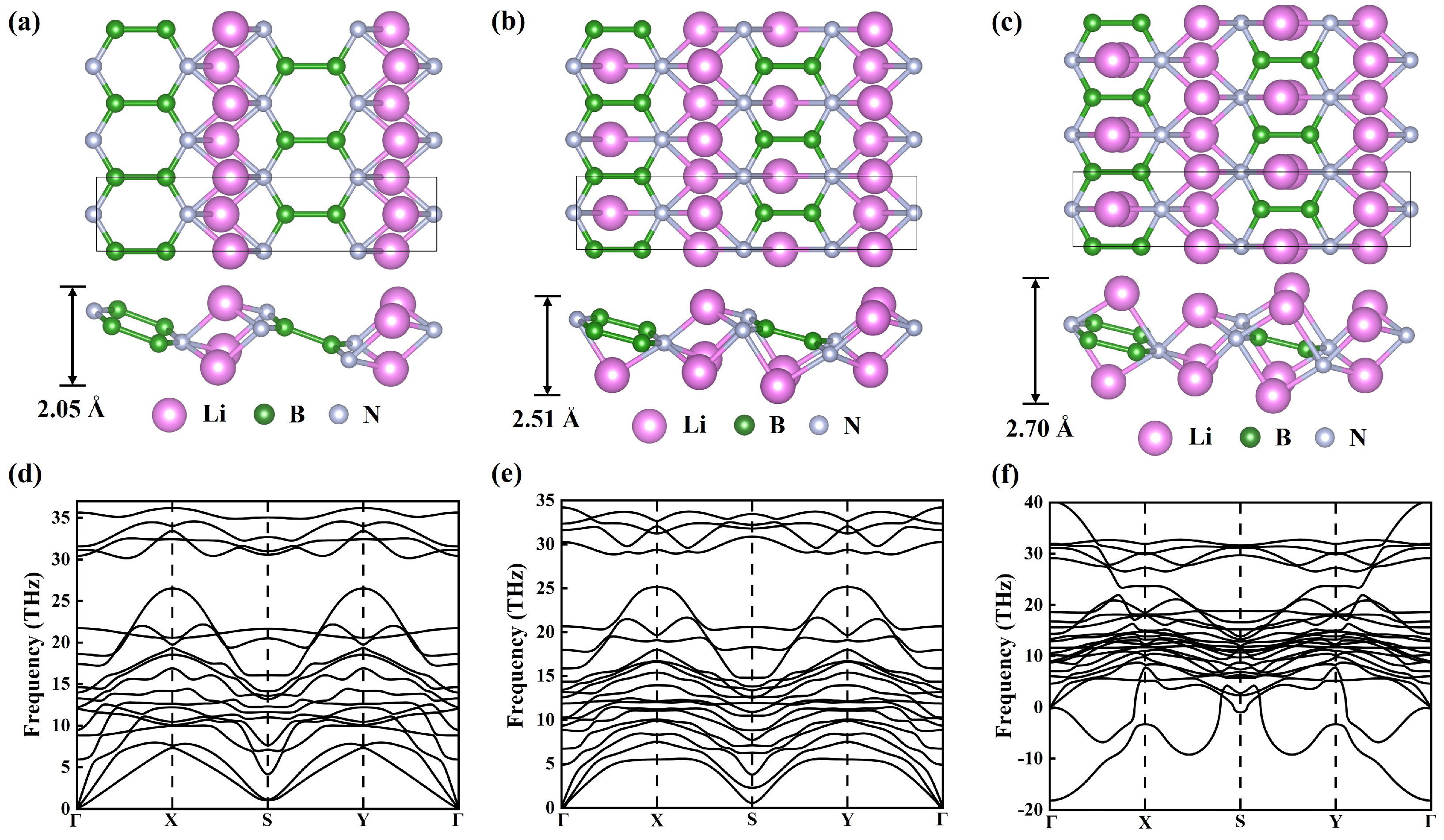
Figure 1a–c present the optimized crystal structures of Li2B2N2, Li3B2N2, and Li4B2N2 monolayers, as identified from global structure searches. Li2B2N2 and Li4B2N2 crystallize in the C2/m space group, whereas Li3B2N2 adopts the Cm space group. All three monolayers exhibit a similar layered structural motif, in which B and N atoms form a central framework composed of two hexagonal-ring chains, while Li atoms are distributed on the outer layers. In this framework, the B–B bond lengths (1.73–1.75 Å) are notably longer than the B–N bond lengths (1.47–1.50 Å). For Li2B2N2, the Li atoms bridge the two hexagonal-ring chains in an interleaved manner, giving rise to a stable monolayer with a thickness of 2.05 Å. Each Li atom is threefold coordinated by N atoms, with an average Li–N bond length of 2.01 Å. With increasing Li content, the hexagonal B–N framework remains nearly unchanged, while the additional Li atoms occupy the hollow sites located directly above and below the centers of the B4N2 hexagonal rings. In these positions, each added Li atom is twofold coordinated by N atoms, with an average Li–N bond length of 2.26 Å. As a result, the thickness of the Li n B2N2 ( n = 2 –4) monolayers increases monotonically with Li content, reaching 2.51 Å for Li3B2N2 and 2.70 Å for Li4B2N2. Meanwhile, the progressively increased number of exposed Li sites is expected to be favorable for hydrogen adsorption.
However, excessive Li incorporation reduces the structural stability. As shown in Figure 1d–f, the phonon spectra indicate that Li2B2N2 and Li3B2N2 monolayers are dynamically stable, as no imaginary phonon modes appear throughout the Brillouin zone, whereas Li4B2N2 exhibits pronounced imaginary modes, indicating its dynamical instability. This instability is likely associated with the excessive incorporation of Li atoms. Specifically, the additional Li atoms occupy hollow sites with lower coordination numbers and longer Li–N bond lengths, indicating weaker binding to the B–N framework. Together with the enhanced electrostatic repulsion among Li cations and the increased out-of-plane structural expansion, these factors may soften low-frequency phonon modes and eventually drive the dynamical instability of Li4B2N2.
Next, the thermal stability of Li2B2N2 and Li3B2N2 monolayers was further examined by ab initio molecular dynamics (AIMD) simulations, as shown in Figure S1. It is found that both the total energy and temperature exhibit only small fluctuations throughout the 10 ps simulation at 300 K. Moreover, no obvious atomic displacement or structural degradation is observed. These results confirm that both Li2B2N2 and Li3B2N2 monolayers possess good thermal stability.
To further evaluate the experimental feasibility of Li2B2N2 and Li3B2N2 monolayers, we calculated their cohesive energies ( E coh ), which are defined as the energy differences between the monolayers and their constituent isolated Li, B, and N atoms. The cohesive energy is expressedas
E coh = E Li n B 2 N 2 n E Li 2 E B 2 E N n + 4 ,
where E Li n B 2 N 2 denotes the total energy of the Li n B2N2 monolayer, E Li , E B , and E N are the energies of isolated Li, B, and N atoms, respectively, and n is the number of Li atoms. The calculated cohesive energies of Li2B2N2 and Li3B2N2 are 6.22 and 5.59 eV/atom, respectively. These values are comparable to those of experimentally synthesized two-dimensional materials, such as borophene ( 5.99 eV/atom) [57], silicene ( 4.57 eV/atom) [58], h-BN ( 7.91 eV/atom) [59], and MoS2 ( 6.25 eV/atom) [60], indicating their favorable energetic stability and potential experimental feasibility.

3.2. Electronic Properties of Li2B2N2 and Li3B2N2 Monolayers

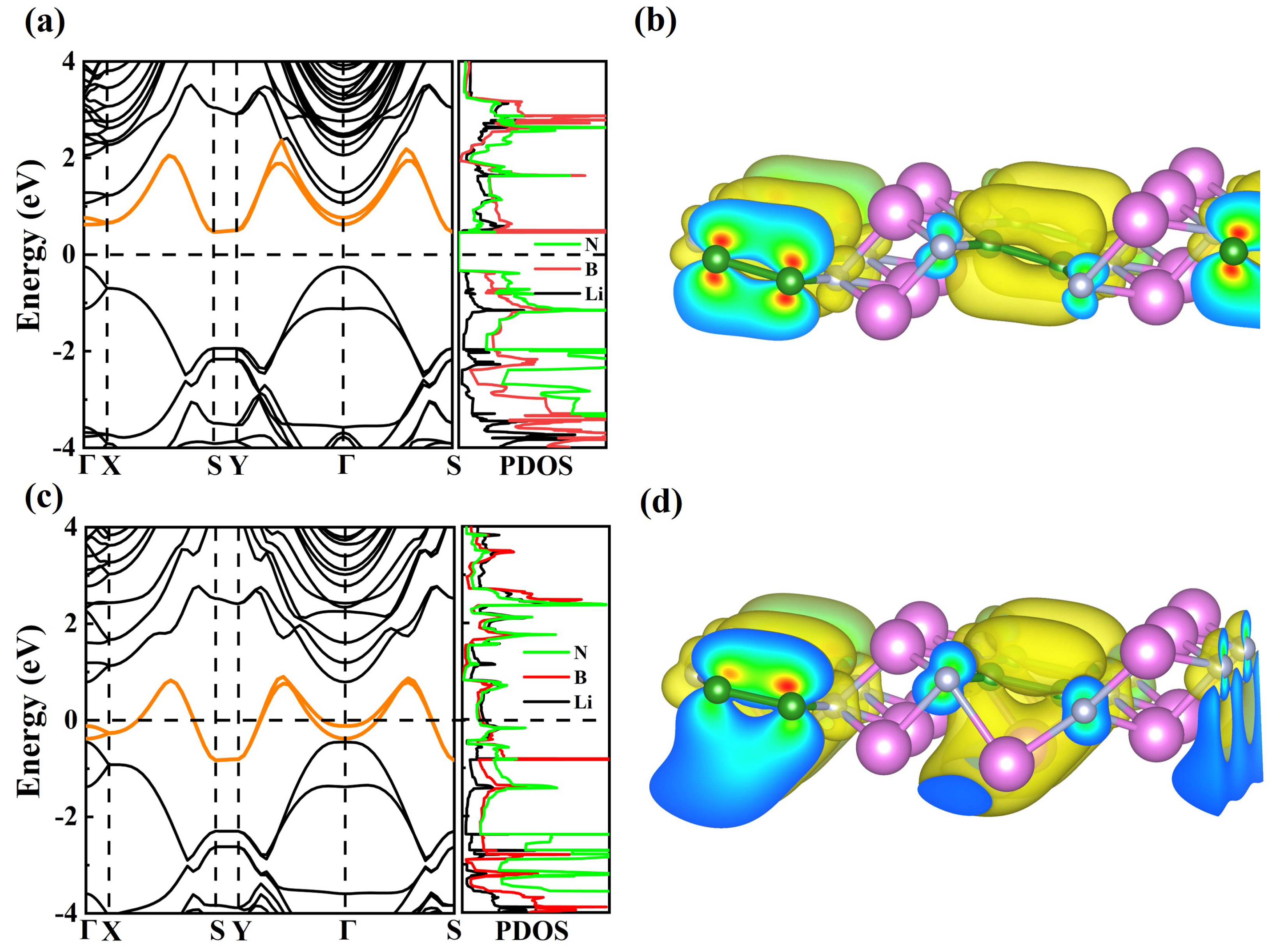
The electronic properties of Li2B2N2 and Li3B2N2 monolayers are elucidated by the band structures, partial density of states (PDOS), and band-decomposed charge densities shown in Figure 2. As can be seen, Li2B2N2 is a semiconductor with a small band gap of 0.72 eV, whereas Li3B2N2 exhibits intrinsic metallic behavior, with two bands highlighted in orange crossing the Fermi level ( E F ). The different electronic characters of Li2B2N2 and Li3B2N2 mainly originate from their distinct electron filling. In Li2B2N2, charge transfer from Li to the B–N framework is insufficient to occupy the conduction-band states, leading to semiconducting behavior. In contrast, the additional Li atom in Li3B2N2 provides extra electrons, which partially occupy the B-related π * states associated with the B–B bonds [Figure 2b,d]. As a result, the Fermi level is shifted upward into the conduction band, giving rise to intrinsic metallic behavior. The PDOS of both systems shows significant overlapping features among Li, B, and N states, indicating appreciable orbital hybridization and strong interatomic interactions. Given its intrinsic metallicity with a Li-rich surface and stronger local surface electrostatic field, both of which are favorable for polarizing and adsorbing H2 molecules, Li3B2N2 is selected for the following investigation of hydrogen storage performance.

3.3. Hydrogen Adsorption Behavior of the Li3B2N2 Monolayer

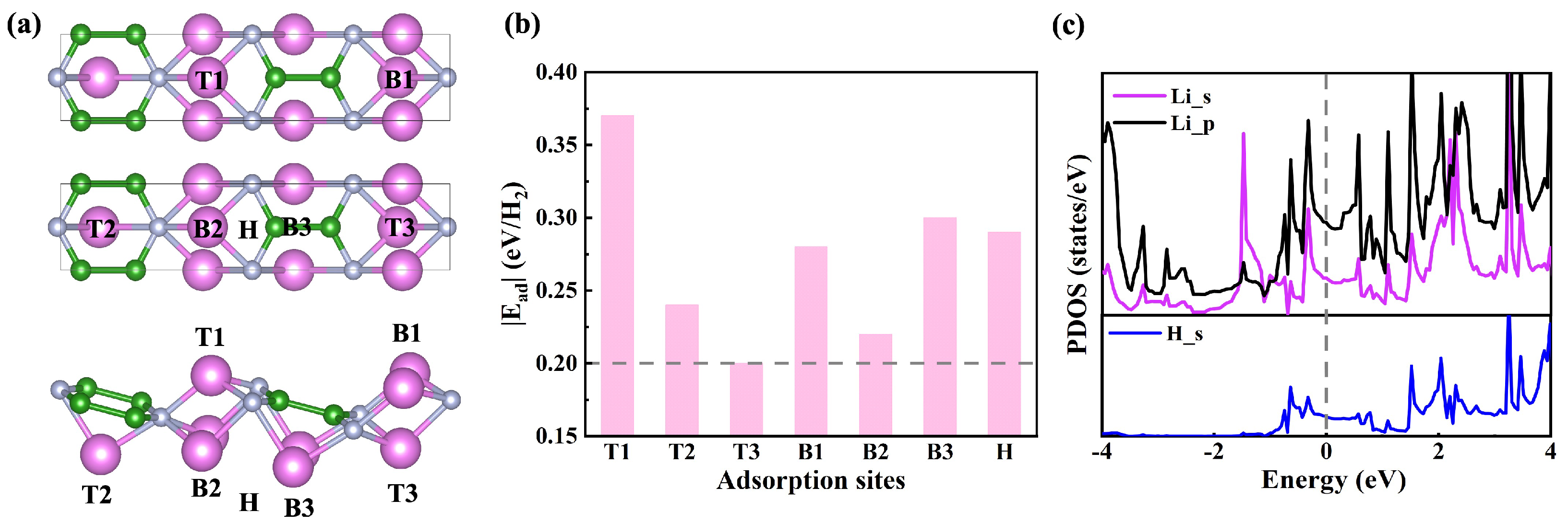
We next examine the adsorption behavior of a single H2 molecule on the Li3B2N2 monolayer. As shown in Figure 3a, seven possible adsorption sites are considered, including three top sites above Li atoms (T1, T2, and T3), three bridge sites above the midpoints of Li–Li bonds (B1, B2, and B3), and one hollow site above the center of the triangle (H). These sites cover the main high-symmetry adsorption positions on the monolayer surface. The optimized structures of H2@Li3B2N2 are shown in Figure S2.
The hydrogen adsorption energy, E ad , is calculated as
E ad = E n H 2 @ Li 3 B 2 N 2 E Li 3 B 2 N 2 n E H 2 n ,
where E n H 2 @ Li 3 B 2 N 2 , E Li 3 B 2 N 2 , and E H 2 denote the total energies of nH2@Li3B2N2 system, pristine Li3B2N2 monolayer, and an isolated H2 molecule, respectively, and n is the number of adsorbed H2 molecules.
The calculated absolute value of adsorption energies | E ad | for a single H2 molecule at these sites are summarized in Figure 3b. All adsorption configurations are energetically favorable, with adsorption energies | E ad | ranging from 0.20 to 0.37 eV/H2. Among them, the T1 site gives the highest adsorption energy of 0.37 eV/H2, whereas the T3 site shows the weakest adsorption, with an adsorption energy of 0.20 eV/H2. The B1, B3, and H sites exhibit adsorption energies of 0.28, 0.30, and 0.29 eV/H2, respectively, while the T2 and B2 sites give slightly smaller values of 0.24 and 0.22 eV/H2. Notably, all these values fall within or very close to the desirable adsorption-energy window of 0.2–0.6 eV/H2 for reversible hydrogen storage under ambient conditions, as suggested by the U.S. Department of Energy (DOE) [6]. Although the T1 site shows a slightly higher adsorption energy, adsorption at this site induces noticeable structural distortion (Figure S2). Therefore, the B3 site is identified as the most favorable adsorption configuration, with an adsorption energy of 0.30 eV/H2 without inducing obvious structural distortion, which is favorable for reversible hydrogen storage under near-ambient conditions.
To further understand the adsorption mechanism, we analyze the projected density of states (PDOS) of the B3 adsorption configuration, as shown in Figure 3c. Clear overlap between the H-s state and the Li- s , p states can be observed in several energy regions, indicating noticeable interaction between the adsorbed H2 molecule and the Li sites. This result suggests that H2 adsorption on Li3B2N2 is not governed solely by van der Waals interaction, but also involves weak orbital hybridization. The positively charged Li atoms on the surface create a strong local electrostatic field, which can polarize the H2 molecule. At the same time, weak orbital hybridization also contributes to the interaction. Therefore, the adsorption of H2 arises from the combined effects of electrostatic polarization and orbital hybridization.

3.4. Hydrogen Storage Capacity of the Li3B2N2 Monolayer

To further evaluate the hydrogen storage capacity of the Li3B2N2 monolayer, we gradually increased the number of adsorbed H2 molecules on the 1 × 3 × 1 supercell. A 1 × 3 × 1 supercell was adopted in the subsequent calculations, because the supercell-size convergence test shows that the adsorption energy is already well converged at this size. As shown in Figure S3, the adsorption energy remains nearly unchanged when the supercell is further enlarged from 1 × 3 × 1 to 1 × 5 × 1 , indicating that the interaction between periodically repeated H2 molecules is negligible. Therefore, the 1 × 3 × 1 supercell provides a reliable and computationally efficient model.
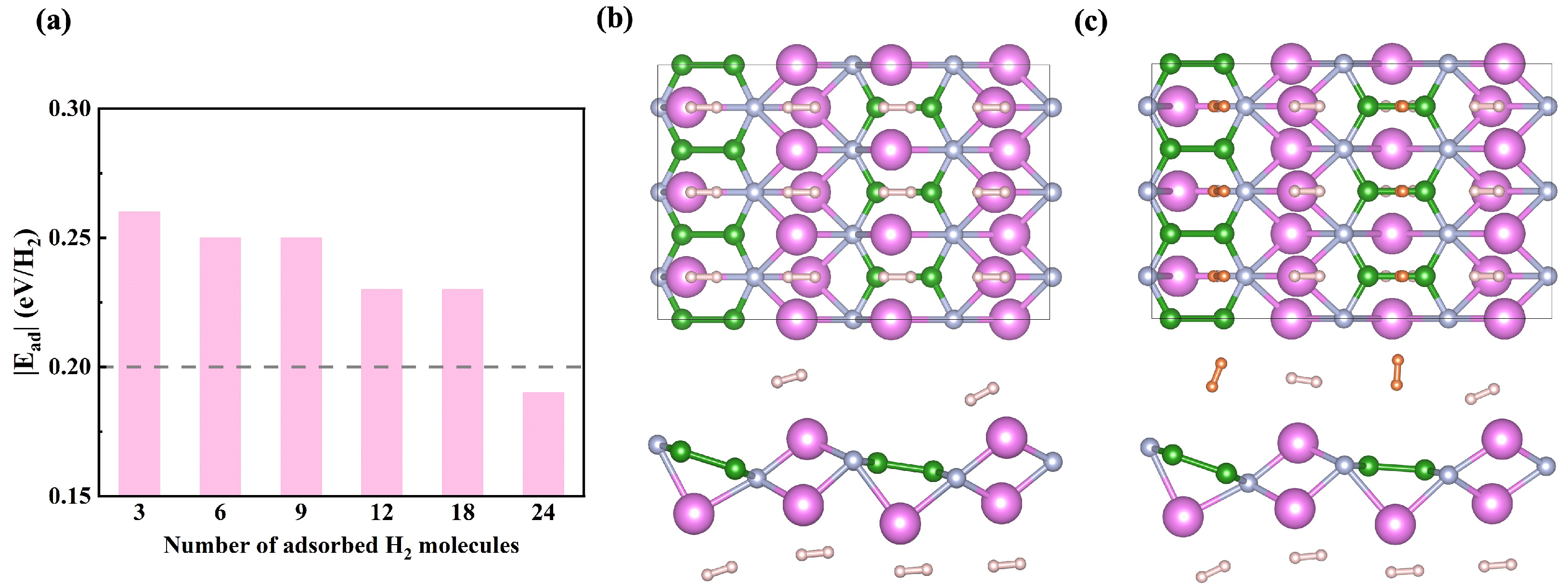
As shown in Figure 4a, the average adsorption energy | E ad | remains within the favorable range when the number of adsorbed H2 molecules increases from 3 to 18, with values of 0.23–0.26 eV/H2. This indicates that the Li3B2N2 monolayer can maintain moderate and reversible interactions with multiple H2 molecules. When the number of H2 molecules further increases to 24, the average adsorption energy decreases to 0.19 eV/H2, slightly below the lower bound of the desirable adsorption-energy window. The optimized structures in Figure 4b,c further show that all 18 H2 molecules remain stably adsorbed, whereas six H2 molecules (highlighted in orange) desorb from the surface in the 24 H2 configuration. This behavior can be attributed to the steric hindrance and intermolecular repulsion between adjacent H2 molecules at high coverage. The optimized structures of the remaining H2 adsorption configurations are shown in Figure S4. These results indicate that the maximum stable adsorption capacity of the Li3B2N2 monolayer is 18 H2 molecules per 1 × 3 × 1 supercell.
In 18H2@Li18B12N12 structure, the adsorbed H2 molecules retain H–H bond lengths of 0.757–0.812 Å, close to the isolated-H2 value of 0.750 Å. Bader charge analysis shows that each adsorbed H2 molecule obtained 0.155 e, consistent with the charge density difference map shown in Figure S5a, suggesting a weak interaction between H2 molecule and substrate. The reduced density gradient (RDG) analysis [shown in Figure S5b] further confirm the weak interaction (electrostatic polarization and weak van der Waals interactions) dominated molecular adsorption of H2.
The hydrogen storage capacity was calculated as
G C ( wt . % ) = n H 2 w H 2 n Li w Li + n B w B + n N w N + n H 2 w H 2 × 100 % ,
where n H 2 , n Li , n B , and n N are the numbers of H2 molecules, Li, B, and N atoms, respectively, while w H 2 , w Li , w B , and w N denote the corresponding molecular or atomic weights. Therefore, 18 H2 molecules adsorbed on the 1 × 3 × 1 supercell represent the maximum stable adsorption capacity of the Li3B2N2 monolayer, corresponding to a gravimetric hydrogen storage capacity of 7.8 wt.%.
As summarized in Table 1, we compare the adsorption energy and gravimetric hydrogen storage capacity of Li3B2N2 with those of representative two-dimensional hydrogen storage materials. Pristine 2D materials, such as graphene and h-BN, generally exhibit weak H2 adsorption energy and limited storage capacity, while metal-decorated systems, such as Li@Irida-graphene, Li@BC2N, and Li@AsC5, show improved hydrogen-storage performance. Li3B2N2 exhibits a competitive hydrogen storage capacity of 7.8 wt.% with a moderate adsorption energy of 0.23 eV/H2, comparable to these recently reported metal-decorated 2D materials. Notably, this performance on Li3B2N2 is achieved by intrinsic Li-rich adsorption sites without external metal decoration, underscoring Li3B2N2 as a promising metal-decoration-free 2D hydrogen storage material.

3.5. Desorption Capacity of the H2 Molecule on the Li3B2N2 Monolayer

Beyond achieving a high hydrogen storage capacity, an onboard hydrogen storage system must also remain stable under practical operating conditions, namely, it should be able to reversibly adsorb and release hydrogen at room temperature and moderate pressures (0.2∼12 MPa). Therefore, the effects of temperature and pressure on the structural stability were evaluated based on the relative energy E r , defined as
E r = E n H 2 @ Li 3 B 2 N 2 E Li 3 B 2 N 2 n [ E H 2 + μ H 2 ( T , P ) ] ,
where E n H 2 @ Li 3 B 2 N 2 , E Li 3 B 2 N 2 , E H 2 , and n have the same meanings as those in Equation (2). μ H 2 ( T , P ) is the chemical potential of hydrogen at temperature T and pressure P, which can be expressed as
μ H 2 ( T , P ) = Δ H T Δ S + k B T ln P P 0 ,
where P 0 is the standard pressure of 0.1 MPa, k B is the Boltzmann constant, and Δ H ( T ) and Δ S ( T ) are the enthalpy and entropy changes of gas-phase H2 from 0 K to the target temperature at ambient pressure. The values of Δ H T Δ S were taken from the thermochemical tables [63] and are listed in Table 2.
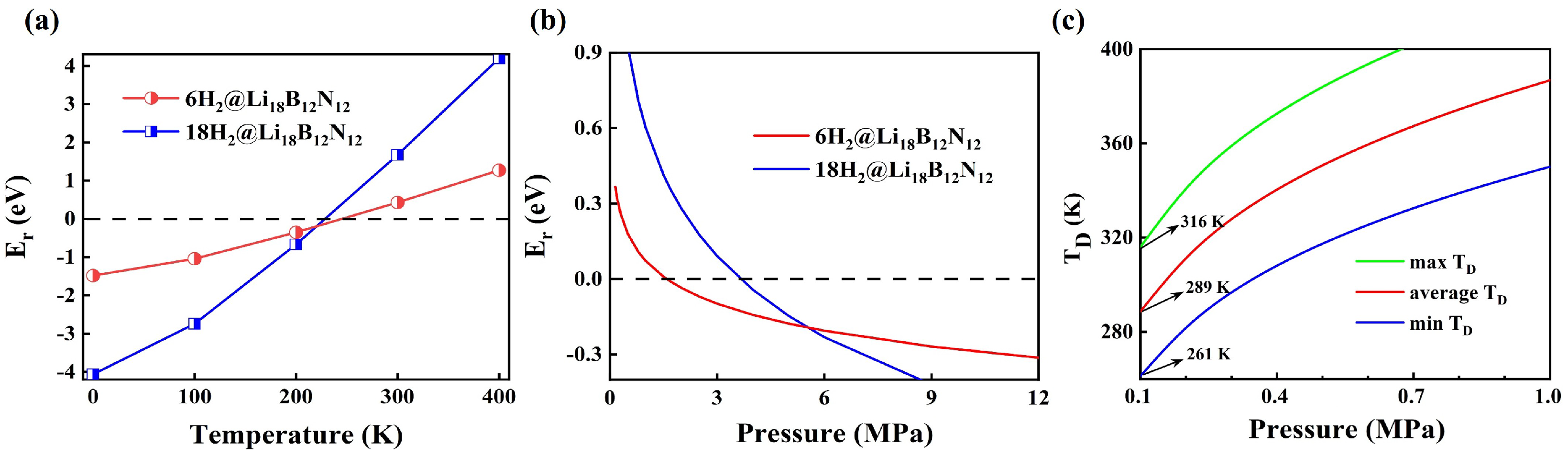
Figure 5a shows the relative energies ( E r ) of 6H2@Li18B12N12 and 18H2@Li18B12N12 as a function of temperature at standard atmospheric pressure. At 0 K, both 6H2@Li18B12N12 and 18H2@Li18B12N12 have negative relative energies, indicating that these adsorption structures are thermodynamically stable. As the temperature increases, the relative energies gradually increase and reach zero at about 245 K for 6H2@Li18B12N12 and 229 K for 18H2@Li18B12N12. Above these temperatures, the adsorbed H2 molecules become thermodynamically unfavorable and tend to desorb spontaneously. Figure 5b presents the relative energies of 6H2@Li18B12N12 and 18H2@Li18B12N12 as a function of pressure at 300 K. The minimum equilibrium pressures are estimated to be about 1.6 MPa for 6H2@Li18B12N12 and 3.7 MPa for 18H2@Li18B12N12. These results indicate that the Li3B2N2 monolayer can achieve reversible hydrogen storage through external pressure control, that is, hydrogen adsorption can be realized at pressures above 3.7 MPa.
The desorption temperature ( T D ) of the Li3B2N2-based hydrogen storage system was further estimated using the van’t Hoff equation:
T D = E ad k B [ ( Δ S / R ) ln p ] 1 .
Here, E ad is the hydrogen adsorption energy, k B is the Boltzmann constant, Δ S is the entropy change from gaseous hydrogen to adsorbed hydrogen, which is approximately equal to the standard entropy of hydrogen gas, 130 J/(K·mol), R is the gas constant ( R = 8.31 J/(K·mol)), and p is the equilibrium pressure.
Here, the minimum and maximum desorption temperatures are approximately estimated from representative adsorption energies at different H2 coverages. The 24 H2 configuration, with relatively weaker adsorption at high coverage, is taken to describe the onset of H2 desorption, whereas the 9 H2 configuration, with stronger adsorption at lower coverage, is used to represent the final stage of hydrogen release. The 18 H2 configuration, corresponding to the maximum stable loading, is adopted to evaluate the average desorption temperature. The pressure-dependent desorption-temperature curves at the minimum, average, and maximum T D values are shown in Figure 5c. At standard atmospheric pressure (∼0.1 MPa), the maximum, average, and minimum desorption temperatures are 316, 289, and 261 K, respectively. Increasing the pressure further raises the desorption temperature. Furthermore, the H2 occupation analysis for 18H2@Li18B12N12 based on a simplified grand-canonical thermodynamic model [25,26,64,65], presented in the Supplementary Materials, shows a consistent temperature- and pressure-dependent trend. Therefore, these thermodynamic results show that H2 adsorption and desorption on Li3B2N2 can be reversibly controlled by temperature and pressure. The predicted desorption near-room-temperature range of 261–316 K at 0.1 MPa is highly favorable for fuel-cell applications, highlighting Li3B2N2 as a promising candidate for reversible hydrogen storage under near-ambient conditions.

4. Conclusions

In summary, based on crystal structure prediction and first-principles calculations, we have identified Li3B2N2 as a promising intrinsically Li-rich two-dimensional material for reversible hydrogen storage. Structural analysis shows that Li2B2N2 and Li3B2N2 monolayers are both dynamically and thermally stable, whereas excessive Li incorporation leads to the dynamical instability of Li4B2N2. Electronic structure calculations reveal that Li3B2N2 exhibits intrinsic metallic behavior and an enhanced local surface electrostatic field, both of which are favorable for hydrogen adsorption. The adsorption energies of a single H2 molecule on Li3B2N2 range from 0.20 to 0.37 eV/H2, which fall within the desirable window for reversible hydrogen storage. The adsorption mechanism is mainly governed by the combined effects of electrostatic polarization and weak orbital hybridization. Further calculations show that the Li3B2N2 monolayer can accommodate up to 18 H2 molecules in a 1 × 3 × 1 supercell, corresponding to a hydrogen storage capacity of 7.8 wt.%. Furthermore, thermodynamic analysis demonstrates that H2 adsorption and desorption can be regulated by temperature and pressure, and the predicted desorption temperature range of 261–316 K at 0.1 MPa suggests favorable reversibility under near-ambient conditions. These results demonstrate that Li3B2N2 is a highly promising intrinsic 2D material for high-capacity and reversible hydrogen storage, and provide a useful design strategy for developing next-generation metal-decoration-free hydrogen storage materials.

Supplementary Materials

The following supporting information can be downloaded at: https://www.mdpi.com/article/10.3390/nano16110654/s1, Figure S1: Energy fluctuations during MD simulations at 300 K of (a) Li2B2N2 and (b) Li3B2N2 monolayers. The insets in (a) and (b) display the side and top view of the structural snapshots at the end of the 10 ps simulations; Figure S2: Optimized structures of H2 adsorbed at different adsorption sites on the Li3B2N2 monolayer, shown in top and side views. The deep pink, green, gray, and light pink spheres denote Li, B, N, and H atoms, respectively; Figure S3: (a) Convergence of the hydrogen adsorption energy ( | E ad | ) with respect to the supercell size for Li3B2N2 with one adsorbed H2 molecule. (b) Top and side views of the optimized 1 × 3 × 1 Li3B2N2 supercell with one H2 molecule adsorbed at the B3 site; Figure S4: Optimized structures of (a) three, (b) six, (c) nine, and (d) twelve H2 molecules absorbed on the 1 × 3 × 1 supercell of the Li3B2N2 monolayer; Figure S5: (a) Charge density difference map with an isosurface value of 0.0016 e / Å 3 and (b) reduced density gradient (RDG) analyses of the 18H2@Li18B12N12 adsorption configuration; Table S1: The optimized structural parameters of the Li3B2N2 and Li2B2N2; Table S2: Comparison of H2 adsorption energies E ad calculated using different van der Waals correction schemes; Table S3: The H2 occupation θ of 18H2@Li18B12N12 as a function of temperature under standard atmospheric pressure (P = 0.1 MPa); Table S4: The H2 occupation θ of 18H2@Li18B12N12 as a function of pressure at 300 K.

Author Contributions

Conceptualization, C.N. and M.X.; methodology, M.X.; software, Y.L.; validation, J.H., C.N. and M.X.; formal analysis, M.X.; investigation, H.Y.; resources, M.X.; data curation, C.N.; writing—original draft preparation, H.Y. and C.N.; writing—review and editing, M.X.; visualization, J.C.; supervision, M.X.; project administration, Y.L.; funding acquisition, C.N., M.X. and Y.L. All authors have read and agreed to the published version of the manuscript.

Funding

This work was supported by the National Natural Science Foundation of China (Grants No. 12404015, No. 12374010, No. 12474012, National College Students’ Innovation Program Project (Grants No. 2372), the Six Talent Peaks Project, the 333 High-level Talents Project of Jiangsu Province, and the Natural Science Foundation of Colleges and Universities in Jiangsu Province (Grant No. 24KJB140010). Computational resources were provided by the High-performance Computing Center of the School of Physics and Electronic Engineering of Jiangsu Normal University.

Data Availability Statement

The original contributions presented in this study are included in the article/Supplementary Materials. Further inquiries can be directed to the corresponding author.

Conflicts of Interest

The authors declare no conflicts of interest.

References

  1. Abe, J.O.; Popoola, A.; Ajenifuja, E.; Popoola, O.M. Hydrogen energy, economy and storage: Review and recommendation. Int. J. Hydrogen Energy 2019, 44, 15072–15086. [Google Scholar] [CrossRef]
  2. Winter, C.J. Hydrogen energy—Abundant, efficient, clean: A debate over the energy-system-of-change. Int. J. Hydrogen Energy 2009, 34, S1–S52. [Google Scholar] [CrossRef]
  3. Coluci, V.R.; Braga, S.; Baughman, R.; Galvao, D. Prediction of the hydrogen storage capacity of carbon nanoscrolls. Phys. Rev. B Condens. Matter Mater. Phys. 2007, 75, 125404. [Google Scholar] [CrossRef]
  4. Schlapbach, L.; Züttel, A. Hydrogen-storage materials for mobile applications. Nature 2001, 414, 353–358. [Google Scholar] [CrossRef]
  5. Mekonnin, A.; Wacławiak, K.; Humayun, M.; Zhang, S.; Ullah, H. Hydrogen storage technology, and its challenges: A review. Catalysts 2025, 15, 260. [Google Scholar] [CrossRef]
  6. U.S. Office of Energy Efficiency & Renewable Energy. Hydrogen Storage. Available online: http://energy.gov/eere/fuelcells/hydrogen-storage (accessed on 22 March 2026).
  7. Kim, Y.H.; Zhao, Y.; Williamson, A.; Heben, M.J.; Zhang, S. Nondissociative adsorption of H2 molecules in light-element-doped fullerenes. Phys. Rev. Lett. 2006, 96, 016102. [Google Scholar] [CrossRef]
  8. Ma, L.P.; Wu, Z.S.; Li, J.; Wu, E.D.; Ren, W.C.; Cheng, H.M. Hydrogen adsorption behavior of graphene above critical temperature. Int. J. Hydrogen Energy 2009, 34, 2329–2332. [Google Scholar] [CrossRef]
  9. Fu, P.; Wang, J.; Jia, R.; Bibi, S.; Eglitis, R.I.; Zhang, H.X. Theoretical study on hydrogen storage capacity of expanded h-BN systems. Comput. Mater. Sci. 2017, 139, 335–340. [Google Scholar] [CrossRef]
  10. Cao, J.; Zhou, J.; Zhang, Y.; Liu, X. Theoretical study of H2 adsorbed on monolayer MoS2 doped with N, Si, P. Microelectron. Eng. 2018, 190, 63–67. [Google Scholar] [CrossRef]
  11. Evro, S.; Jain, I. MXenes for hydrogen energy systems: Advances in production, storage, fuel cells, and safety applications. Int. J. Hydrogen Energy 2025, 145, 147–168. [Google Scholar] [CrossRef]
  12. Yadav, A.; Dashora, A.; Patel, N.; Miotello, A.; Press, M.; Kothari, D. Study of 2D MXene Cr2C material for hydrogen storage using density functional theory. Appl. Surf. Sci. 2016, 389, 88–95. [Google Scholar] [CrossRef]
  13. Cheng, Y.; Ma, X.; Huang, C.; Yuan, G.; Liao, J. The effect of functional groups (O, F, or OH) on reversible hydrogen storage properties of Ti2X (X = C or N) monolayer. Int. J. Hydrogen Energy 2022, 47, 28969–28977. [Google Scholar] [CrossRef]
  14. Züttel, A.; Sudan, P.; Mauron, P.; Kiyobayashi, T.; Emmenegger, C.; Schlapbach, L. Hydrogen storage in carbon nanostructures. Int. J. Hydrogen Energy 2002, 27, 203–212. [Google Scholar] [CrossRef]
  15. Mohan, M.; Sharma, V.K.; Kumar, E.A.; Gayathri, V. Hydrogen storage in carbon materials—A review. Energy Storage 2019, 1, e35. [Google Scholar] [CrossRef]
  16. Deng, W.Q.; Xu, X.; Goddard, W.A. New alkali doped pillared carbon materials designed to achieve practical reversible hydrogen storage for transportation. Phys. Rev. Lett. 2004, 92, 166103. [Google Scholar] [CrossRef] [PubMed]
  17. Wang, Y.; Wu, Q.; Mao, J.; Deng, S.; Ma, R.; Shi, J.; Ge, J.; Huang, X.; Bi, L.; Yin, J.; et al. Lithium and calcium decorated triphenylene-graphdiyne as potential high-capacity hydrogen storage medium: A first-principles prediction. Appl. Surf. Sci. 2019, 494, 763–770. [Google Scholar] [CrossRef]
  18. Kuang, L.; Gan, W.; Zhe, J.; Li, Y.; Ao, K.; Tao, Z.; Du, A.; Tang, Y.; Cai, J.; Yan, C. First-principles investigation of Li-decorated Be2C monolayers for reversible hydrogen storage. Appl. Surf. Sci. 2026, 732, 166504. [Google Scholar] [CrossRef]
  19. Feng, W.; Pan, K.; Ren, Y.; Ju, W.; Zhou, Q. A study on the hydrogen storage properties of B2SSe doped with alkali (Li, Na, K) and transition (Ti, Fe, Co) metals. Appl. Surf. Sci. 2026, 725, 165793. [Google Scholar] [CrossRef]
  20. Rahali, S.; Belhocine, Y.; Ben Said, R.; Abdullah, Y.Z.; Hussein, T.I.; Mustafa, B. Metal decorated B4N4 nanocages quantum dots for hydrogen storage: A comprehensive density functional theory approach. Nanomaterials 2026, 16, 499. [Google Scholar] [CrossRef]
  21. Rahali, S.; Said, R.B.; Belhocine, Y.; Makawi, S.; Mustafa, B. Metal-Decorated C8 quantum dots as lightweight hydrogen storage materials: A comprehensive DFT study. Nanomaterials 2026, 16, 286. [Google Scholar] [CrossRef] [PubMed]
  22. Ataca, C.; Aktürk, E.; Ciraci, S.; Ustunel, H. High-capacity hydrogen storage by metallized graphene. Appl. Phys. Lett. 2008, 93, 043123. [Google Scholar] [CrossRef]
  23. Zhang, Y.F.; Guo, J. Li-decorated 2d irida-graphene as a potential hydrogen storage material: A dispersion-corrected density functional theory calculations. Int. J. Hydrogen Energy 2024, 50, 1004–1014. [Google Scholar] [CrossRef]
  24. Tian, W.; Li, Z.; Cheng, C.; Li, W.; Chen, Z.; Xin, F. Hydrogen storage performance of γ-graphdiyne doped Li based on first principles for micro/nano. Micromachines 2022, 13, 547. [Google Scholar] [CrossRef]
  25. Vaidyanathan, A.; Wagh, V.; Chakraborty, B. Enhancing hydrogen storage efficiency: Computational insights into scandium-decorated 2D polyaramid. J. Power Sources 2024, 624, 235546. [Google Scholar] [CrossRef]
  26. Vaidyanathan, A.; Mane, P.; Wagh, V.; Chakraborty, B. Computational design for enhanced hydrogen storage on the newly synthesized 2D polyaramid via titanium and zirconium decoration. ACS Appl. Mater. Interfaces 2024, 16, 8589–8602. [Google Scholar] [CrossRef] [PubMed]
  27. Banerjee, P.; Pathak, B.; Ahuja, R.; Das, G. First principles design of Li functionalized hydrogenated h-BN nanosheet for hydrogen storage. Int. J. Hydrogen Energy 2016, 41, 14437–14446. [Google Scholar] [CrossRef]
  28. Yong, Y.; Hou, Q.; Yuan, X.; Cui, H.; Li, X.; Li, X. Ultrahigh capacity and reversible hydrogen storage media based on Li-decorated T-BN monolayers. J. Energy Storage 2023, 72, 108169. [Google Scholar] [CrossRef]
  29. Alhameedi, K.; Karton, A.; Jayatilaka, D.; Hussain, T. Metal functionalized inorganic nano-sheets as promising materials for clean energy storage. Appl. Surf. Sci. 2019, 471, 887–892. [Google Scholar] [CrossRef]
  30. Qiu, Z.; Guo, J.; Wang, Q.; Wang, H.; Tan, X. Reversible hydrogen storage and release mechanism of a B2N monolayer: A first-principles insight. Phys. Chem. Chem. Phys. 2024, 26, 22240–22251. [Google Scholar] [CrossRef]
  31. Shi, Y.; Ren, J.; Tang, H.; Chen, X. Li decorated penta-BCN as a competitive reversible hydrogen storage media: A first-principles study. Langmuir 2024, 40, 3577–3585. [Google Scholar] [CrossRef]
  32. Wang, J.; Chen, D.; Xiao, S.; Zhang, X.; Xiao, B. Novel two-dimensional Li-functionalized porous BC2N monolayer for efficient hydrogen storage. J. Energy Storage 2026, 145, 119942. [Google Scholar] [CrossRef]
  33. Chen, X.; Wang, J.; Martins, N.F.; Sambrano, J.R.; Laranjeira, J.A.S. Penta-octa B4C2N3: A new 2D material for high-performance energy applications. Langmuir 2025, 41, 5477–5487. [Google Scholar] [CrossRef]
  34. Gencer, A.; Aydin, S.; Surucu, O.; Wang, X.; Deligoz, E.; Surucu, G. Enhanced hydrogen storage of a functional material: Hf2CF2 MXene with Li decoration. Appl. Surf. Sci. 2021, 551, 149484. [Google Scholar] [CrossRef]
  35. Venkataramanan, N.S.; Belosludov, R.V.; Note, R.; Sahara, R.; Mizuseki, H.; Kawazoe, Y. Theoretical investigation on the alkali-metal doped BN fullerene as a material for hydrogen storage. Chem. Phys. 2010, 377, 54–59. [Google Scholar] [CrossRef]
  36. Li, J.; Chen, Y.; Gong, N.; Huang, X.; Yang, Z.; Weng, Y. Magnetic and electronic properties of La-doped hexagonal 4H-SrMnO3. Chin. Phys. 2024, 33, 017502. [Google Scholar] [CrossRef]
  37. Zhao, Y.; Kim, Y.H.; Dillon, A.; Heben, M.; Zhang, S. Hydrogen storage in novel organometallic buckyballs. Phys. Rev. Lett. 2005, 94, 155504. [Google Scholar] [CrossRef] [PubMed]
  38. Ma, J.; Xue, Z.; Wei, G.; Li, P.; Wang, L.; Xiang, J.; Yuan, L.; Du, X. Experimental and theoretical investigation on hydrogen storage performance of titanium decorated hexagonal boron nitride. Appl. Surf. Sci. 2026, 728, 166154. [Google Scholar] [CrossRef]
  39. Lyu, J.; Kudiiarov, V.; Lider, A. An overview of the recent progress in modifications of carbon nanotubes for hydrogen adsorption. Nanomaterials 2020, 10, 255. [Google Scholar] [CrossRef] [PubMed]
  40. Xiang, Y.; Xin, L.; Hu, J.; Li, C.; Qi, J.; Hou, Y.; Wei, X. Advances in the applications of graphene-based nanocomposites in clean energy materials. Crystals 2021, 11, 47. [Google Scholar] [CrossRef]
  41. Chen, J.; Lin, S.; Xu, M.; Wang, F.; Shao, Y.; Hao, J.; Li, Y. Metal-decoration-free Li3C2 monolayer with heptacoordinate carbons as a promising hydrogen storage medium. ACS Mater. Lett. 2022, 4, 1402–1410. [Google Scholar] [CrossRef]
  42. Wang, Y.; Lv, J.; Zhu, L.; Ma, Y. Crystal structure prediction via particle-swarm optimization. Phys. Rev. 2010, 82, 094116. [Google Scholar] [CrossRef]
  43. Wang, Y.; Miao, M.; Lv, J.; Zhu, L.; Yin, K.; Liu, H.; Ma, Y. An effective structure prediction method for layered materials based on 2D particle swarm optimization algorithm. J. Chem. Phys. 2012, 137, 224108. [Google Scholar] [CrossRef]
  44. Gao, B.; Gao, P.; Lu, S.; Lv, J.; Wang, Y.; Ma, Y. Interface structure prediction via CALYPSO method. Sci. Bull. 2019, 64, 301–309. [Google Scholar] [CrossRef] [PubMed]
  45. Shao, X.; Lv, J.; Liu, P.; Shao, S.; Gao, P.; Liu, H.; Wang, Y.; Ma, Y. A symmetry-orientated divide-and-conquer method for crystal structure prediction. J. Chem. Phys. 2022, 156, 014105. [Google Scholar] [CrossRef]
  46. Kresse, G.; Furthmüller, J. Efficient iterative schemes for ab initio total-energy calculations using a plane-wave basis set. Phys. Rev. 1996, 54, 11169. [Google Scholar] [CrossRef] [PubMed]
  47. Kresse, G.; Furthmüller, J. Efficiency of ab-initio total energy calculations for metals and semiconductors using a plane-wave basis set. Comput. Mater. Sci. 1996, 6, 15–50. [Google Scholar] [CrossRef]
  48. Perdew, J.P.; Burke, K.; Ernzerhof, M. Generalized gradient approximation made simple. Phys. Rev. Lett. 1996, 77, 3865. [Google Scholar] [CrossRef]
  49. Blöchl, P.E. Projector augmented-wave method. Phys. Rev. 1994, 50, 17953. [Google Scholar] [CrossRef]
  50. Monkhorst, H.J.; Pack, J.D. Special points for Brillouin-zone integrations. Phys. Rev. 1976, 13, 5188. [Google Scholar] [CrossRef]
  51. Grimme, S. Semiempirical GGA-type density functional constructed with a long-range dispersion correction. J. Comput. Chem. 2006, 27, 1787–1799. [Google Scholar] [CrossRef]
  52. Grimme, S.; Antony, J.; Ehrlich, S.; Krieg, H. A consistent and accurate ab initio parametrization of density functional dispersion correction (DFT-D) for the 94 elements H–Pu. J. Chem. Phys. 2010, 132, 154104. [Google Scholar] [CrossRef]
  53. Caldeweyher, E.; Ehlert, S.; Hansen, A.; Neugebauer, H.; Spicher, S.; Bannwarth, C.; Grimme, S. A generally applicable atomic-charge dependent London dispersion correction. J. Chem. Phys. 2019, 150, 154122. [Google Scholar] [CrossRef]
  54. Togo, A.; Tanaka, I. First principles phonon calculations in materials science. Scr. Mater. 2015, 108, 1–5. [Google Scholar] [CrossRef]
  55. Nosé, S. A unified formulation of the constant temperature molecular dynamics methods. J. Chem. Phys. 1984, 81, 511–519. [Google Scholar] [CrossRef]
  56. Hoover, W.G. Canonical dynamics: Equilibrium phase-space distributions. Phys. Rev. 1985, 31, 1695. [Google Scholar] [CrossRef]
  57. Peng, B.; Zhang, H.; Shao, H.; Xu, Y.; Zhang, R.; Zhu, H. The electronic, optical, and thermodynamic properties of borophene from first-principles calculations. J. Mater. Chem. 2016, 4, 3592–3598. [Google Scholar] [CrossRef]
  58. Drummond, N.D.; Zólyomi, V.; Fal’ko, V.I. Electrically tunable band gap in silicene. Phys. Rev. 2012, 85, 075423. [Google Scholar] [CrossRef]
  59. Kaloni, T.P.; Mukherjee, S. Comparative study of electronic properties of graphite and hexagonal boron nitride (h-BN) using pseudopotential plane wave method. Mod. Phys. Lett. 2011, 25, 1855–1866. [Google Scholar] [CrossRef]
  60. Ding, Y.; Wang, Y.; Ni, J.; Shi, L.; Shi, S.; Tang, W. First principles study of structural, vibrational and electronic properties of graphene-like MX2 (M = Mo, Nb, W, Ta; X = S, Se, Te) monolayers. Phys. Condens. Matter 2011, 406, 2254–2260. [Google Scholar] [CrossRef]
  61. Lu, Q.; Zhang, B.; Zhang, L.; Zhu, Y.; Gong, W. Monolayer AsC5 as the promising hydrogen storage material for clean energy applications. Nanomaterials 2023, 13, 1553. [Google Scholar] [CrossRef]
  62. Zyane, M.S.; Rghioui, H.; Achahbar, A.; Boujibar, O.; Van, F.T.; Zanouni, M.; Marjaoui, A. A novel lithium-decorated GeC5 monolayer for promising hydrogen storage: A DFT study. Int. J. Hydrogen Energy 2025, 114, 131–141. [Google Scholar] [CrossRef]
  63. Chase, M.W. NIST-JANAF Thermochemical Tables, 4th ed.; (pt. 1.: Al-Co); American Institute of Physics: College Park, MD, USA, 1998; Available online: https://library.naist.jp/opac/en/book/19856 (accessed on 28 June 2022).
  64. Lee, H.; Choi, W.I.; Ihm, J. Combinatorial search for optimal hydrogen-storage nanomaterials based on polymers. Phys. Rev. Lett. 2006, 97, 056104. [Google Scholar] [CrossRef]
  65. Beniwal, P.; Sagar, S.; Dange, D.; Dhilip Kumar, T.J. Li doping in two-dimensional holey biphenylene framework for efficient molecular hydrogen storage: A first-Principles insight. Energy Fuels 2025, 39, 22083–22094. [Google Scholar] [CrossRef]
Figure 1. Top and side views of the crystal structures of (a) Li2B2N2, (b) Li3B2N2, and (c) Li4B2N2 monolayers. The pink spheres denote Li atoms at the outer layers, while the green and gray spheres represent B and N atoms in the middle layer, respectively. Phonon dispersion curves of (d) Li2B2N2, (e) Li3B2N2, and (f) Li4B2N2 monolayers.
Nanomaterials 16 00654 g001
Figure 2. Electronic band structures and the corresponding partial density of states (PDOS) of (a) Li2B2N2 and (c) Li3B2N2 monolayers. The Fermi level is set to zero. Panels (b,d) present the band-decomposed charge densities of the orange-highlighted bands near the Fermi level for Li2B2N2 and Li3B2N2, respectively.
Nanomaterials 16 00654 g002
Figure 3. (a) Schematic illustration of the possible hydrogen adsorption sites (T, B, and H) on the Li3B2N2 monolayer, corresponding to the top sites above Li atoms, the bridge sites above the midpoints of Li–Li bonds, and the hollow site above the center of the triangle, respectively. (b) Calculated hydrogen adsorption energies ( | E ad | ) for a single H2 molecule adsorbed at different sites on the Li3B2N2 monolayer. The gray dashed line marks the lower bound of the optimal adsorption-energy window. (c) Projected density of states (PDOS) of the Li3B2N2 monolayer with one H2 molecule adsorbed at the B3 site. The Fermi level ( E F ) is set to zero.
Nanomaterials 16 00654 g003
Figure 4. (a) Average adsorption energies ( | E ad | ) of H2 molecules as a function of the number of adsorbed H2 molecules on the 1 × 3 × 1 supercell of the Li3B2N2 monolayer. The gray dashed line marks the lower bound of the optimal adsorption-energy window. Optimized structures of (b) 18H2@Li18B12N12 and (c) 24H2@Li18B12N12. The desorbed H2 molecules are highlighted in orange.
Nanomaterials 16 00654 g004
Figure 5. (a) Relative energies ( E r ) of 6H2@Li18B12N12 and 18H2@Li18B12N12 as functions of temperature under standard atmospheric pressure ( p = 0.1 MPa). (b) Relative energies ( E r ) of 6H2@Li18B12N12 and 18H2@Li18B12N12 as functions of pressure at 300 K. (c) Desorption temperature ( T D ) as a function of atmosphere pressure. The green, red, and blue curves represent the maximum, average, and minimum T D values, respectively.
Nanomaterials 16 00654 g005
Table 1. Summary of the hydrogen adsorption Energies ( | E ad | ), hydrogen storage capacities, and desorption temperature ( T D ) of common 2D materials and Li decorated 2D materials.
Compound | E ad | [eV/H2]Storage Capacity [wt.%] T D Refs.
Li3B2N20.237.8261–316 K/0.1 MPaThis work
graphene0.477 K/100 kPa[8]
h-BN2.96243 K/10 MPa[9]
Li@graphene0.5612.8[22]
Li@Irida-graphene0.23–0.287.06353 K/0.1 MPa[23]
Li-doped γ -graphdiyne0.21–0.2314.66[24]
Li@T-BN0.25–0.3212.31180–232.6 K/1 atm[28]
Li@B2N0.19–0.2711.1<200 K/0.1 MPa[30]
Li@penta-BCN0.167.44[31]
Li@BC2N0.18–0.3011.10360 K/1 atm[32]
Li@POG-B4C2N30.19–0.358.35[33]
Li@AsC5∼0.199.7243–357 K/1 atm[61]
Li@GeC50.227.62281.1 K/1 atm[62]
Table 2. Values of Δ H T Δ S obtained from the thermochemical tables.
T [K] Δ S ( T ) [J/(mol · K)] Δ H ( T ) [kJ/mol] Δ H ( T ) T Δ S ( T ) [eV/H2]
0000
100100.733.00−0.073
200119.415.69−0.189
300130.868.52−0.319
400139.21611.43−0.459
Disclaimer/Publisher’s Note: The statements, opinions and data contained in all publications are solely those of the individual author(s) and contributor(s) and not of MDPI and/or the editor(s). MDPI and/or the editor(s) disclaim responsibility for any injury to people or property resulting from any ideas, methods, instructions or products referred to in the content.