Nickel Coarsening and Mass Transfer Performance Prediction in Direct Internal Reforming Solid Oxide Fuel Cells


Abstract
1. Introduction
2. Model Development
2.1. Porous Anode Mode Development
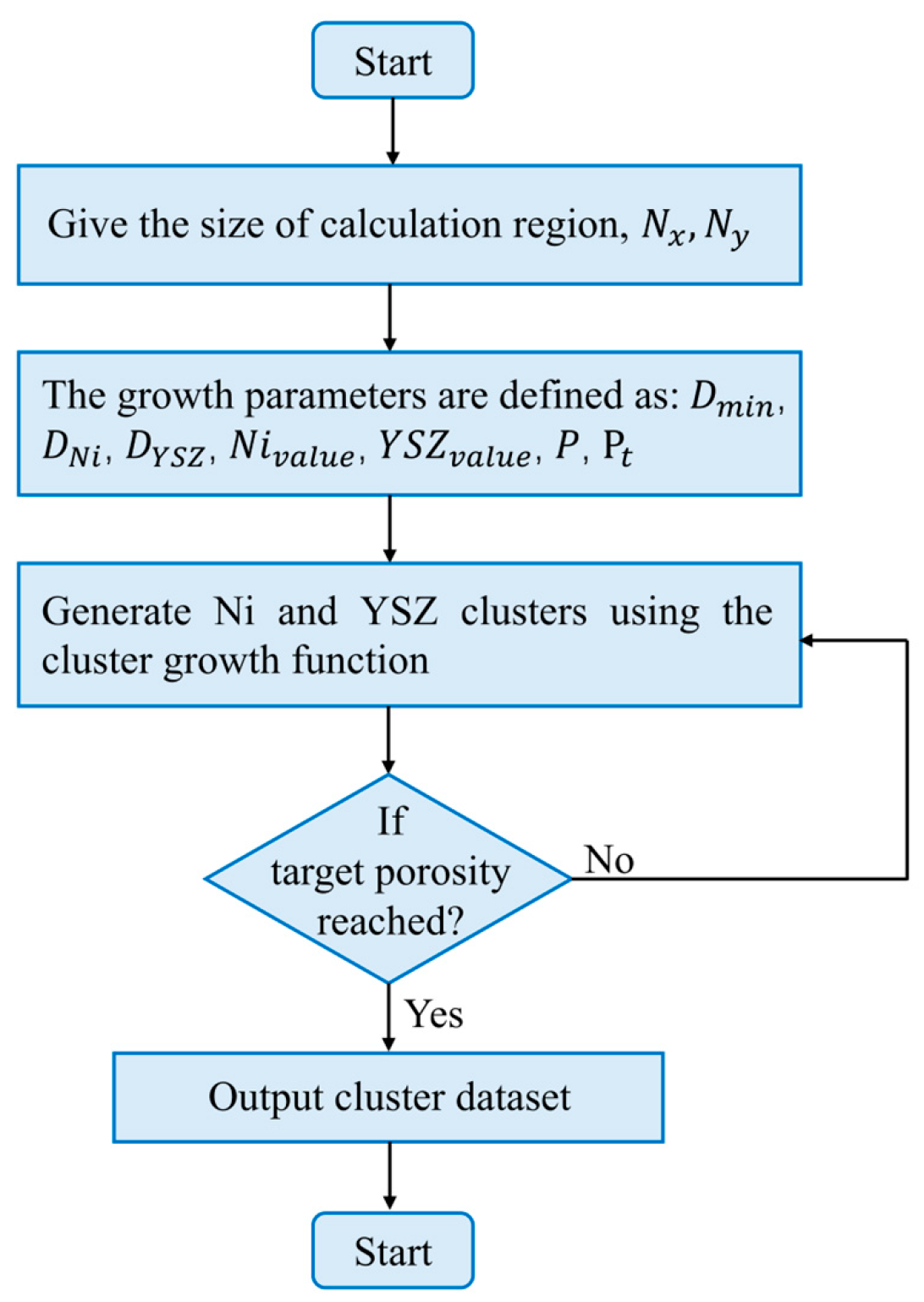
2.2. Phase Field Model for Ni Coarsening
2.3. Lattice Boltzmann Model for Mass Transfer
2.4. Model Verification
3. Results and Discussion
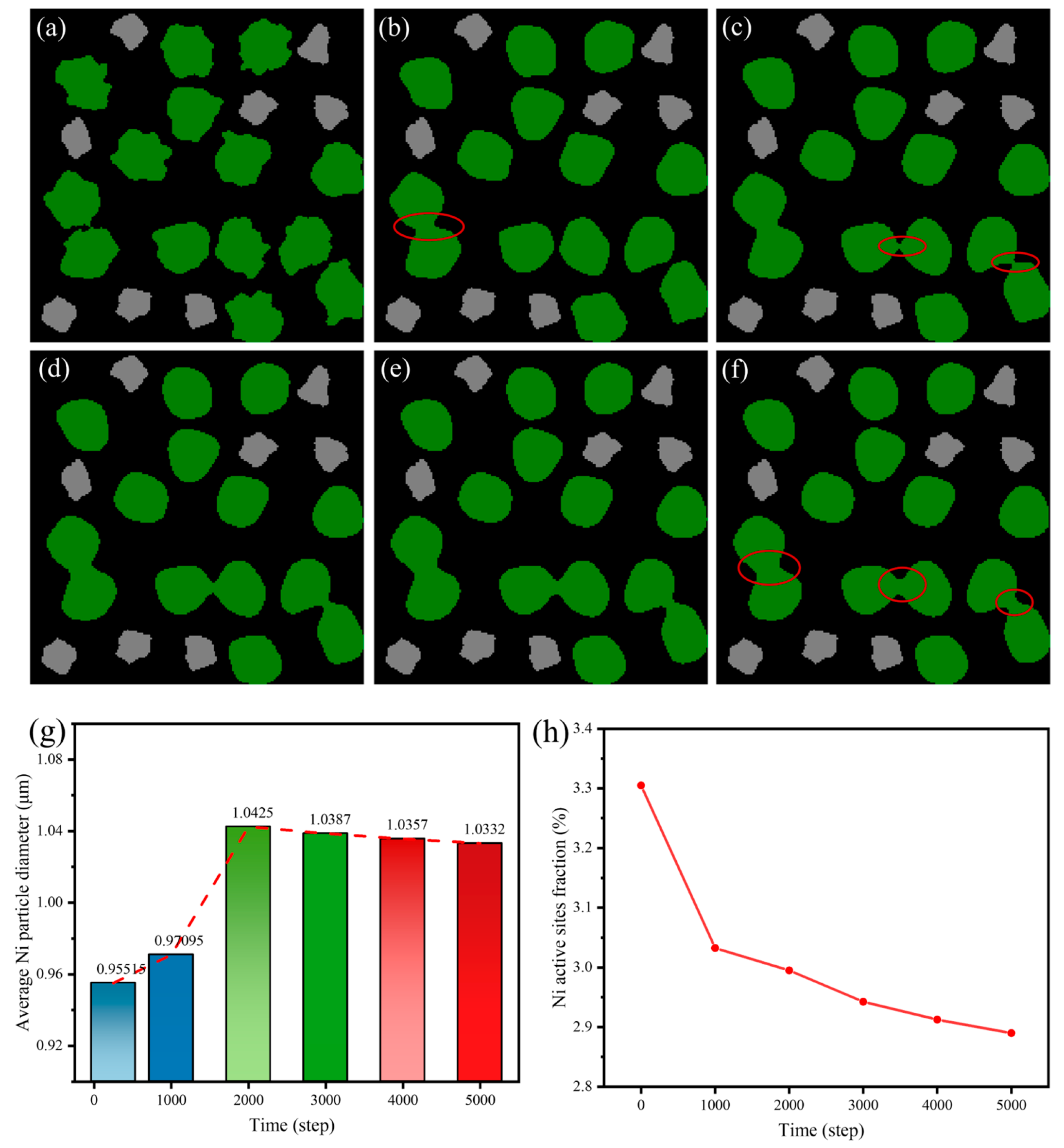
3.1. Evolution of Ni Coarsening
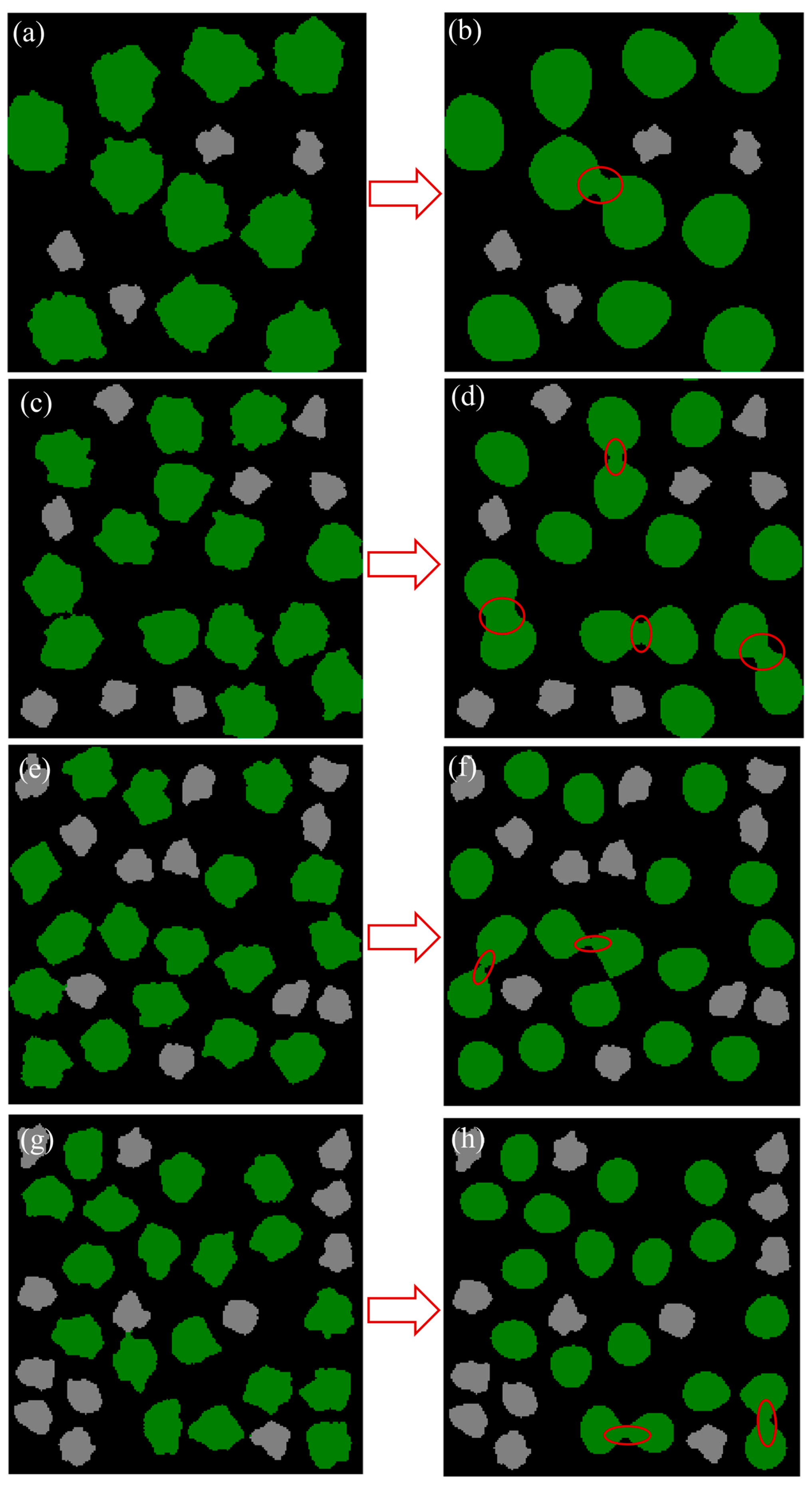
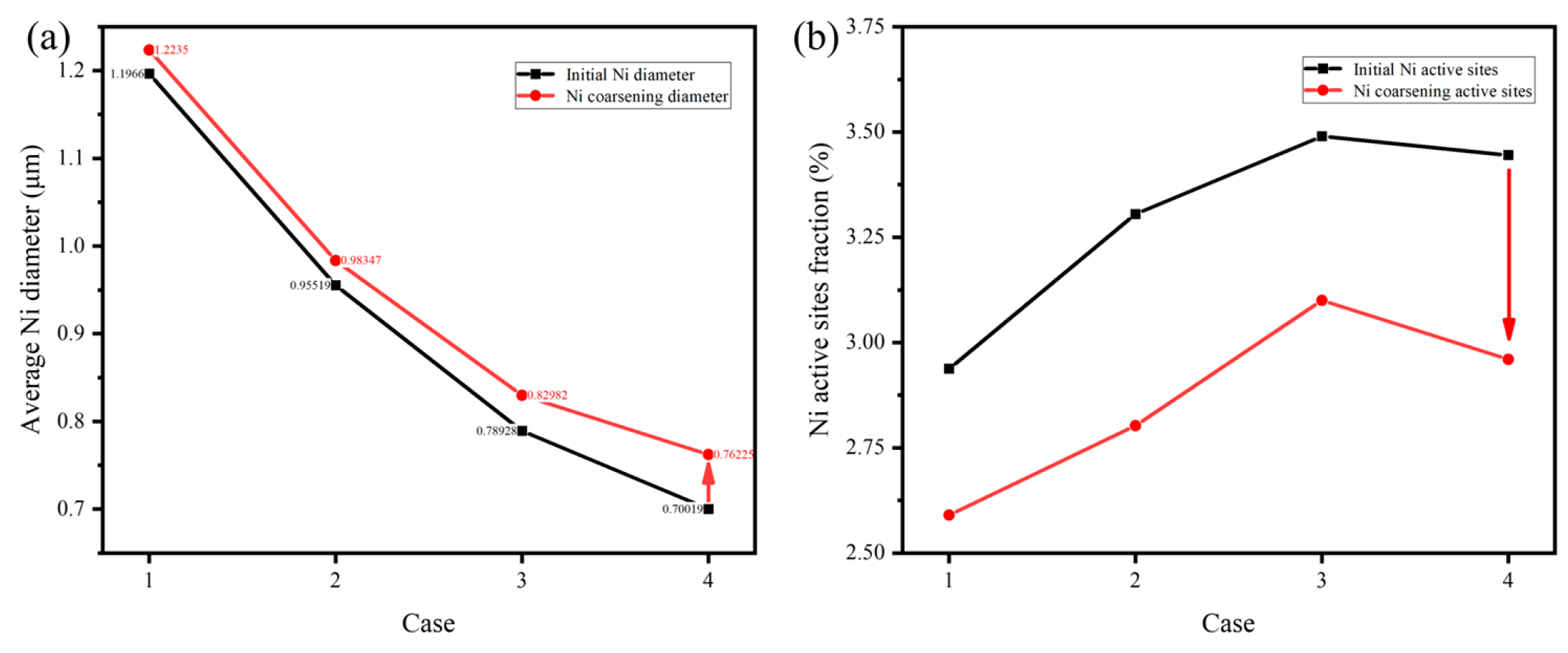
3.2. Effect of Ni Particle Diameter on Coarsening
3.3. Effect of Ni Coarsening on Gas-Phase Mass Transfer
4. Conclusions
- (1)
- The phase-field simulations demonstrate that Ni particles undergo rapid agglomeration in the early stages (0–2000 steps), forming larger clusters with necking structures, leading to a stable microstructure in later stages (3000–5000 steps). The average Ni particle diameter increases from approximately 0.956 μm to 1.03 μm, with a maximum reaching 1.04 μm, consistent with Ostwald ripening driven by surface energy minimization. This coarsening reduces the fraction of active sites from 3.45% to 2.96%, highlighting a significant loss in electrochemical reaction sites due to decreased surface-to-volume ratio.
- (2)
- The effect of initial Ni particle diameter on coarsening reveals that smaller diameters (e.g., 0.79 μm or 0.70 μm) accelerate agglomeration, resulting in pronounced merging and network formation. In comparison, larger diameters (e.g., 1.20 μm) suppress coarsening, maintaining more dispersed morphologies. Intermediate diameters (e.g., 0.96 μm) exhibit balanced kinetics, with moderate reductions in active site fraction (~14.1% after 10,000 steps). This indicates that the initial particle size governs the coarsening rate through diffusion-limited processes and YSZ constraints, offering insights for tailoring anode microstructures to mitigate degradation.
- (3)
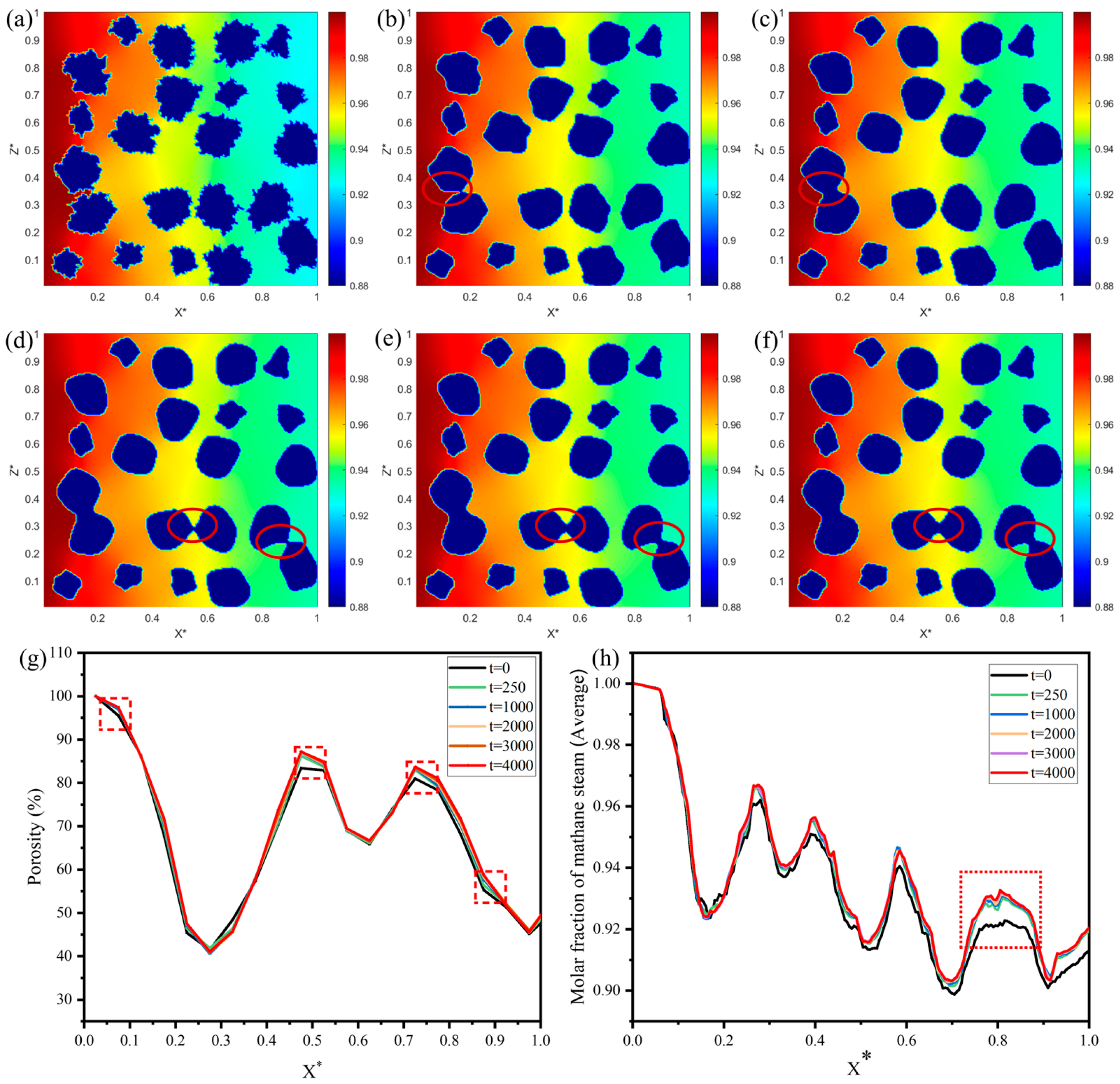
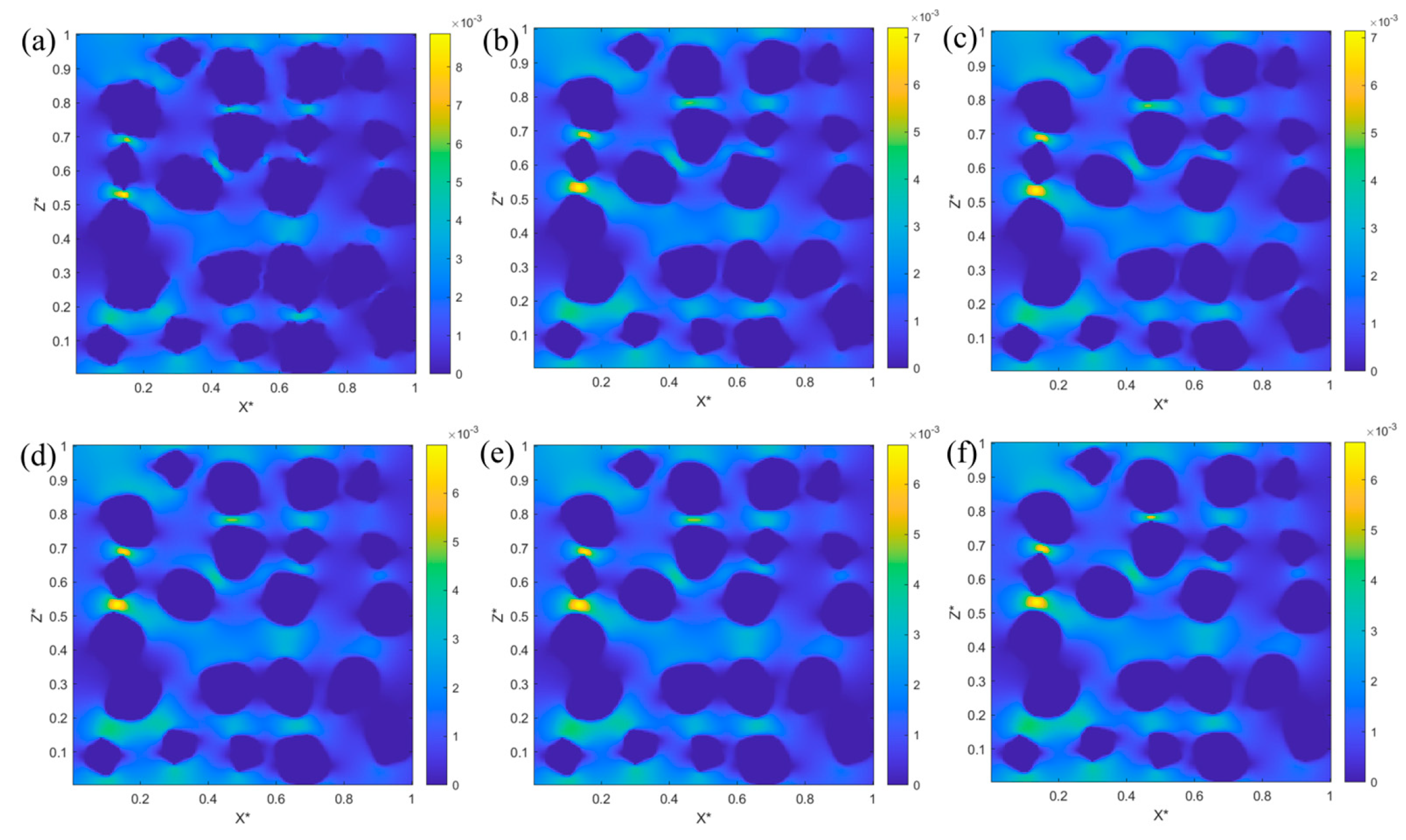
- Ni coarsening impacts mass transport by altering pore connectivity, as evidenced by methane-steam concentration and velocity distributions. In unaggregated states, uniform high-concentration regions support efficient diffusion. However, aggregation introduces localized blockages in necking areas, reducing velocity to near zero and causing heterogeneous flow fields. The local porosity rises from 60% to 62.36% as Ni contraction releases localized space, potentially enhancing overall transport efficiency within macroscopic channels. However, localized blockages in necking regions ultimately compromise anode performance by impeding mass transport.
Author Contributions
Funding
Data Availability Statement
Conflicts of Interest
References
- Hepburn, C.; Qi, Y.; Stern, N.; Ward, B.; Xie, C.; Zenghelis, D. Towards carbon neutrality and China’s 14th Five-Year Plan: Clean energy transition, sustainable urban development, and investment priorities. Environ. Sci. Ecotechnol. 2021, 8, 100130. [Google Scholar] [CrossRef]
- Choudhury, A.; Chandra, H.; Arora, A. Application of solid oxide fuel cell technology for power generation—A review. Renew. Sustain. Energy Rev. 2013, 20, 430–442. [Google Scholar] [CrossRef]
- Subotić, V.; Hochenauer, C. Analysis of solid oxide fuel and electrolysis cells operated in a real-system environment: State-of-the-health diagnostic, failure modes, degradation mitigation and performance regeneration. Prog. Energy Combust. Sci. 2022, 93, 101011. [Google Scholar] [CrossRef]
- De Angelis, S.; Jørgensen, P.S.; Tsai, E.H.R.; Holler, M.; Kreka, K.; Bowen, J.R. Three dimensional characterization of nickel coarsening in solid oxide cells via ex-situ ptychographic nano-tomography. J. Power Sources 2018, 383, 72–79. [Google Scholar] [CrossRef]
- De Angelis, S.; Villanova, J.; Jørgensen, P.S.; Esposito, V.; Bowen, J.R. Elucidating nickel oxide reduction in a Ni-YSZ solid oxide cell via in-situ X-ray nano holo-tomography. Acta Mater. 2024, 273, 119965. [Google Scholar] [CrossRef]
- Triviño-Peláez, Á.; Cademartori, D.; Hubert, M.; Rorato, L.; Prioux, M.; Laurencin, J. Modelling the impact of Ni migration and coarsening on the Ni-YSZ electrodes performances based on three-dimensional microstructures. Electrochim. Acta 2025, 520, 145791. [Google Scholar] [CrossRef]
- Koch, S.; Hendriksen, P.V.; Mogensen, M.; Liu, Y.-L.; Dekker, N.; Rietveld, B.; de Haart, B.; Tietz, F. Solid Oxide Fuel Cell Performance under Severe Operating Conditions. Fuel Cells 2006, 6, 130–136. [Google Scholar] [CrossRef]
- Prasad, D.H.; Park, S.Y.; Ji, H.; Kim, H.-R.; Son, J.-W.; Kim, B.-K.; Lee, H.-W.; Lee, J.-H. Effect of steam content on nickel nano-particle sintering and methane reforming activity of Ni–CZO anode cermets for internal reforming SOFCs. Appl. Catal. A Gen. 2012, 411–412, 160–169. [Google Scholar] [CrossRef]
- Hubert, M.; Laurencin, J.; Cloetens, P.; Mougin, J.; Ferreira Sanchez, D.; Pylypko, S.; Morales, M.; Morata, A.; Morel, B.; Montinaro, D.; et al. Solid Oxide Cell Degradation Operated in Fuel Cell and Electrolysis Modes: A Comparative Study on Ni Agglomeration and LSCF Destabilization. ECS Trans. 2017, 78, 3167–3177. [Google Scholar] [CrossRef]
- Hubert, M.; Laurencin, J.; Cloetens, P.; Morel, B.; Montinaro, D.; Lefebvre-Joud, F. Impact of nickel agglomeration on solid oxide cell operated in fuel cell and electrolysis modes. J. Power Sources 2018, 397, 240–251. [Google Scholar] [CrossRef]
- Holzer, L.; Iwanschitz, B.; Hocker, T.; Münch, B.; Prestat, M.; Wiedenmann, D.; Vogt, U.; Holtappels, P.; Sfeir, J.; Mai, A.; et al. Microstructure degradation of cermet anodes for solid oxide fuel cells: Quantification of nickel grain growth in dry and in humid atmospheres. J. Power Sources 2011, 196, 1279–1294. [Google Scholar] [CrossRef]
- Cui, T.; Lyu, Z.; Han, M.; Sun, K.; Liu, Y.; Ni, M. Performance evolution analysis of a solid oxide cell operated in fuel-cell, electrolysis and cycle modes. Energy Convers. Manag. 2022, 262, 115657. [Google Scholar] [CrossRef]
- Mantz, Y.A.; Lei, Y.; Saidi, W.A.; Abernathy, H.W.; Wen, Y. Toward a Better Understanding of Ni Coarsening in Solid Oxide Cells: NiH on Ni (111) Examined Using a Combined Theoretical Approach. J. Phys. Chem. C 2025, 129, 8004–8010. [Google Scholar] [CrossRef]
- Mogensen, M.B.; Hauch, A.; Sun, X.; Chen, M.; Tao, Y.; Ebbesen, S.D.; Hansen, K.V.; Hendriksen, P.V. Relation between Ni particle shape change and Ni migration in Ni–YSZ electrodes—A hypothesis. Fuel Cells 2017, 17, 434–441. [Google Scholar] [CrossRef]
- Simwonis, D. Nickel coarsening in annealed Ni/8YSZ anode substrates for solid oxide fuel cells. Solid State Ion. 2000, 132, 241–251. [Google Scholar] [CrossRef]
- Jiao, Z.; Shikazono, N. Simulation of nickel morphological and crystal structures evolution in solid oxide fuel cell anode using phase field method. J. Electrochem. Soc. 2014, 161, F577–F582. [Google Scholar] [CrossRef]
- Vassen, R.; Simwonis, D.; Stöver, D. Modelling of the agglomeration of Ni-particles in anodes of solid oxide fuel cells. J. Mater. Sci. 2001, 36, 147–151. [Google Scholar] [CrossRef]
- Chen, H.-Y.; Yu, H.-C.; Scott Cronin, J.; Wilson, J.R.; Barnett, S.A.; Thornton, K. Simulation of coarsening in three-phase solid oxide fuel cell anodes. J. Power Sources 2011, 196, 1333–1337. [Google Scholar] [CrossRef]
- Li, Q.; Liang, L.; Gerdes, K.; Chen, L.-Q. Phase-field modeling of three-phase electrode microstructures in solid oxide fuel cells. Appl. Phys. Lett. 2012, 101, 033909. [Google Scholar] [CrossRef]
- Kim, J.H.; Liu, W.K.; Lee, C. Multi-scale solid oxide fuel cell materials modeling. Comput. Mech. 2009, 44, 683–703. [Google Scholar] [CrossRef]
- Xue, M.; Yi, M. Phase-Field Simulation of Sintering Process: A Review. Comput. Model. Eng. Sci. 2024, 140, 1165–1204. [Google Scholar] [CrossRef]
- Cai, T.-T.; Xu, Y.-X.; Zhang, Z.; Zhang, S.; Huang, H.-H.; Hu, C.-C. The application of phase-field method in magnetoelastic functional materials. Microstructures 2025, 5, 2025059. [Google Scholar] [CrossRef]
- Lei, Y.; Mantz, Y.A.; Saidi, W.A.; Abernathy, H.W.; Wen, Y. Ni coarsening under humid atmosphere in the electrode of solid oxide cells: A combined study of density-functional theory and phase-field modeling. J. Power Sources 2024, 613, 234778. [Google Scholar] [CrossRef]
- Trini, M.; De Angelis, S.; Jørgensen, P.S.; Hendriksen, P.V.; Thornton, K.; Chen, M. Towards the Validation of a Phase Field Model for Ni Coarsening in Solid Oxide Cells. Acta Mater. 2021, 212, 116887. [Google Scholar] [CrossRef]
- Zhu, P.; Wu, Z.; Wang, H.; Yan, H.; Li, B.; Yang, F.; Zhang, Z. Ni coarsening and performance attenuation prediction of biomass syngas fueled SOFC by combining multi-physics field modeling and artificial neural network. Appl. Energy 2022, 322, 119508. [Google Scholar] [CrossRef]
- Da, Y.; Xiao, Y.; Zhong, Z.; Pan, Z.; Jiao, Z. Predictions on conductivity and mechanical property evolutions of yttria-stabilized zirconia in solid oxide fuel cells based on phase-field modeling of cubic-tetragonal phase transformation. J. Eur. Ceram. Soc. 2022, 42, 3489–3499. [Google Scholar] [CrossRef]
- Sun, M.; Li, A.; Zhang, X.; Fei, Y.; Zhu, L.; Huang, Z. Influence of operating conditions on the fuel electrode degradation of solid oxide electrolysis cell investigated by phase field model with wettability analysis. J. Power Sources 2023, 587, 233700. [Google Scholar] [CrossRef]
- Wilson, J.R.; Kobsiriphat, W.; Mendoza, R.; Chen, H.-Y.; Hiller, J.M.; Miller, D.J.; Thornton, K.; Voorhees, P.W.; Adler, S.B.; Barnett, S.A. Three-dimensional reconstruction of a solid-oxide fuel-cell anode. Nat. Mater. 2006, 5, 541–544. [Google Scholar] [CrossRef]
- Wang, M.; Wang, J.; Pan, N.; Chen, S. Mesoscopic predictions of the effective thermal conductivity for microscale random porous media. Phys. Rev. E 2007, 75, 36702. [Google Scholar] [CrossRef]
- Grew, K.N.; Peracchio, A.A.; Chiu, W.K.S. Characterization and analysis methods for the examination of the heterogeneous solid oxide fuel cell electrode microstructure: Part 2. Quantitative measurement of the microstructure and contributions to transport losses. J. Power Sources 2010, 195, 7943–7958. [Google Scholar] [CrossRef]
- Cai, Q.; Adjiman, C.S.; Brandon, N.P. Modelling the 3D microstructure and performance of solid oxide fuel cell electrodes: Computational parameters. Electrochim. Acta 2011, 56, 5804–5814. [Google Scholar] [CrossRef]
- Hussain, M.; Tian, E.; Cao, T.-F.; Tao, W.-Q. Pore-scale modeling of effective diffusion coefficient of building materials. Int. J. Heat. Mass. Transf. 2015, 90, 1266–1274. [Google Scholar] [CrossRef]
- Xu, H.; Dang, Z. Lattice boltzmann modeling of carbon deposition in porous anode of a solid oxide fuel cell with internal reforming. Appl. Energy 2016, 178, 294–307. [Google Scholar] [CrossRef]
- McCracken, M.E.; Abraham, J. Lattice Boltzmann methods for binary mixtures with different molecular weights. Phys. Rev. E 2005, 71, 046704. [Google Scholar] [CrossRef]
- Madhavan, J.; Das, M.K.; De, A. Lattice Boltzmann Simulations of anode supported solid oxide fuel cell. AIP Conf. Proc. 2019, 2134, 30009. [Google Scholar] [CrossRef]
- Lourenço, R.G.C.; Friggo, J.R.; Constantino, P.H.; Tavares, F.W. The lattice Boltzmann method for mass transfer of miscible multicomponent mixtures: A review. Phys. Fluids 2024, 36, 61302. [Google Scholar] [CrossRef]
- Wang, Q.; Li, Y.; Ye, L.; Wang, M.; Tian, W.; Qiu, S.; Su, G. LBM study on the heat and mass transfer characteristics of the droplet in pressurizer. Prog. Nucl. Energy 2024, 169, 105112. [Google Scholar] [CrossRef]
- Yang, X.; Yang, G.; Li, S.; Shen, Q.; Yuan, J.; Miao, H.; Jiang, Z.; Liao, J.; Sun, H.; Sun, Y.; et al. Numerical study on the impact of carbon deposition on methane/steam mass transport in solid oxide fuel cell porous anode using lattice Boltzmann modeling. Mater. Today Commun. 2024, 38, 107998. [Google Scholar] [CrossRef]
- Yang, X.; Yang, G.; Wang, H.; Xu, Z.; Ji, S.; Sun, H.; Miao, H.; Yuan, J. Pore-scale investigation of methane steam transport in porous anodes of solid oxide fuel cells with varying structures. J. Power Sources 2025, 628, 235881. [Google Scholar] [CrossRef]
- Grew, K.N.; Chu, Y.S.; Yi, J.; Peracchio, A.A.; Izzo, J.R.; Hwu, Y.; De Carlo, F.; Chiu, W.K.S. Nondestructive Nanoscale 3D Elemental Mapping and Analysis of a Solid Oxide Fuel Cell Anode. J. Electrochem. Soc. 2010, 157, B783. [Google Scholar] [CrossRef]
- Ma, Q.; Chen, Z. Lattice Boltzmann simulation of multicomponent noncontinuum diffusion in fractal porous structures. Phys. Rev. E 2015, 92, 013025. [Google Scholar] [CrossRef]



| Ni-YSZ Region Size | Diameter Ni | Diameter YSZ | Ni Ratio |
|---|---|---|---|
| 6 μm × 6 μm × 6 μm | 1 μm | 0.6 μm | 1/6 |
| 200 × 200 | 40 | 20 | 1/5 |
| 200 × 200 | 33 | 20 | 1/6 |
| 200 × 200 | 29 | 20 | 1/7 |
| 200 × 200 | 25 | 20 | 1/8 |
Disclaimer/Publisher’s Note: The statements, opinions and data contained in all publications are solely those of the individual author(s) and contributor(s) and not of MDPI and/or the editor(s). MDPI and/or the editor(s) disclaim responsibility for any injury to people or property resulting from any ideas, methods, instructions or products referred to in the content. |
© 2026 by the authors. Licensee MDPI, Basel, Switzerland. This article is an open access article distributed under the terms and conditions of the Creative Commons Attribution (CC BY) license.
Share and Cite
Yang, X.; Yang, G.; Wang, H.; Sun, H.; Xu, Z.; Ji, S. Nickel Coarsening and Mass Transfer Performance Prediction in Direct Internal Reforming Solid Oxide Fuel Cells. Nanomaterials 2026, 16, 633. https://doi.org/10.3390/nano16100633
Yang X, Yang G, Wang H, Sun H, Xu Z, Ji S. Nickel Coarsening and Mass Transfer Performance Prediction in Direct Internal Reforming Solid Oxide Fuel Cells. Nanomaterials. 2026; 16(10):633. https://doi.org/10.3390/nano16100633
Chicago/Turabian StyleYang, Xiaoxing, Guogang Yang, Hao Wang, Han Sun, Zhuangzhuang Xu, and Shengzheng Ji. 2026. "Nickel Coarsening and Mass Transfer Performance Prediction in Direct Internal Reforming Solid Oxide Fuel Cells" Nanomaterials 16, no. 10: 633. https://doi.org/10.3390/nano16100633
APA StyleYang, X., Yang, G., Wang, H., Sun, H., Xu, Z., & Ji, S. (2026). Nickel Coarsening and Mass Transfer Performance Prediction in Direct Internal Reforming Solid Oxide Fuel Cells. Nanomaterials, 16(10), 633. https://doi.org/10.3390/nano16100633