Article

Room Temperature Ferromagnetism Engineered in Two-Dimensional Metallic Magnets via Metal–Insulator–Semiconductor Structures

Zhejiang Key Laboratory of Energy Conversion Materials for Advanced Motor, Institute of Advanced Magnetic Materials, College of Materials and Environmental Engineering, Hangzhou Dianzi University, Hangzhou 310018, China
*
Authors to whom correspondence should be addressed.
Nanomaterials 2026, 16(10), 596; https://doi.org/10.3390/nano16100596 (registering DOI)
Submission received: 17 April 2026 / Revised: 8 May 2026 / Accepted: 11 May 2026 / Published: 13 May 2026

Abstract

The development of novel information-functional devices based on emergent physical phenomena is crucial for integrated circuit technology in the post-Moore era. Two-dimensional magnetic materials present an ideal platform for spintronic devices; however, regulating their room temperature magnetism poses significant challenges. Traditional methods like ionic liquid gating and strain control face issues such as poor stability and complex processes, complicating compatibility with standard silicon technology. Here, we demonstrate a straightforward and robust approach for dielectric layer-engineered room temperature ferromagnetism in 2D metallic magnets by leveraging metal–insulator–semiconductor (MIS) structures. Using surface-oxidized Fe3GeTe2 as a model system, we systematically investigate how SiOx dielectric layer thickness (50–300 nm) modulates magnetic properties. Thin dielectric layers significantly enhance room temperature ferromagnetism through boosted interfacial charge transfer, whereas thick layers maintain the material near its intrinsic state due to dielectric screening effects. Furthermore, reversible optical modulation of magnetism is achieved under ultraviolet illumination, with photoresponse capability diminishing as dielectric thickness increases. This work establishes a scalable, silicon-compatible strategy for controlling 2D magnetism and provides critical insights for developing optically tunable spintronic devices and non-volatile memory applications.

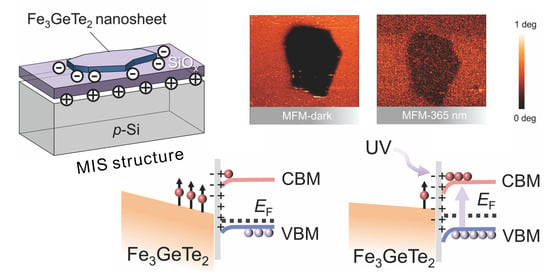
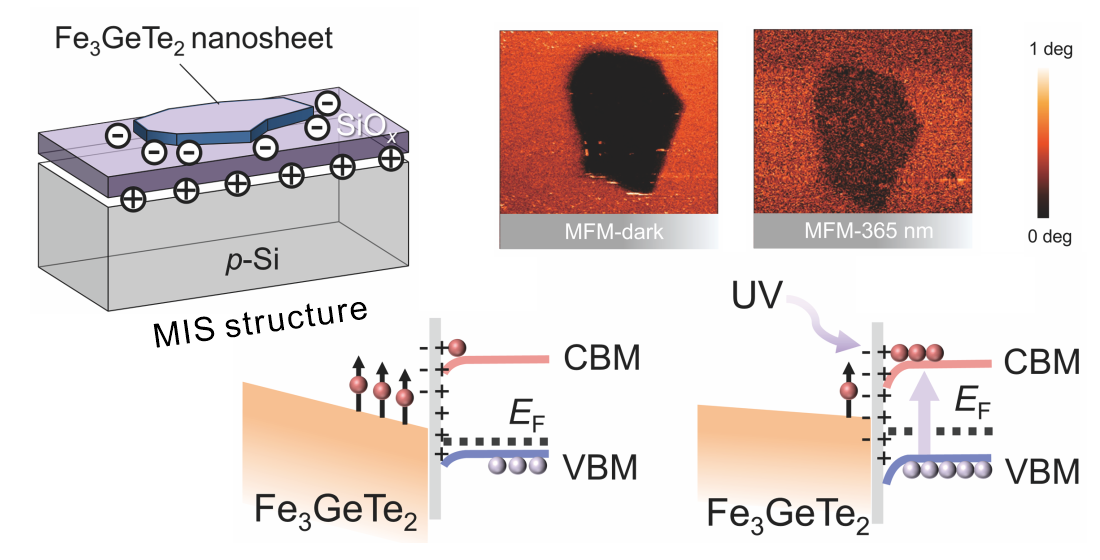
Graphical Abstract

1. Introduction

In recent years, two-dimensional (2D) magnetic materials have emerged as a novel platform for developing innovative low-dimensional spintronic devices thanks to their atomic-scale long-range magnetic order [1,2,3]. Among these materials, the van der Waals compound Fe3GeTe2 has attracted considerable attention because of its relatively high bulk Curie temperature (TC ≈ 220 K [4]), stable layered structure [5], and adjustable out-of-plane magnetic anisotropy [6,7,8]; its robust ferromagnetic ordering below TC stems from the double-exchange interaction between Fe species mediated by Ge and Te atoms. Electrical [4,9,10], mechanical [11,12,13], and optical [14,15,16,17,18,19] methods can effectively enhance and modulate the magnetic properties of Fe3GeTe2, particularly improving TC. However, these methods often require continuous external energy supply or complex device structures, in terms of applying external mechanical strain (~4.7%) or high-density charge polarization (~6.9 × 10¹⁴/cm2) to boost perpendicular magnetic anisotropy [9,11]. Alternatively, interface coupling via the proximity effect offers a promising and efficient approach for magnetic regulation [20,21,22,23]. For example, constructing Fe3GeTe2/FePSe3 [16], Fe3GeTe2/FePS3 [24], and Fe3GeTe2/MnPS3 [25] heterojunctions has been shown to significantly enhance the HC of Fe3GeTe2. Nonetheless, these methods have consistently failed to optimize the TC of Fe3GeTe2 to room temperature. At 300 K, intrinsic Fe3GeTe2 becomes paramagnetic because the temperature exceeds its intrinsic TC (~220 K). Rather than inducing ferromagnetism in a non-magnetic material, a more promising route is to enhance and sustain the pre-existing ferromagnetic correlations through interfacial charge engineering [26,27], so that the magnetic signal can persist beyond the bulk TC.
Integrating 2D magnetic materials with established silicon-based semiconductor processes is a pivotal strategy for tackling computational power and energy efficiency issues in the post-Moore Law era [4,28,29,30,31,32]. In this context, designing and enhancing the magnetic properties of 2D magnetic materials on silicon substrates is vital for advancing silicon-based 2D spintronic devices [4,33,34,35,36]. Previous research has shown that leveraging work function differences between materials to create built-in electric fields at heterointerfaces can effectively modulate carrier concentrations [16,18,24,37,38,39,40,41] and enable efficient electric field modulation of magnetism [24,33,42]. Further studies suggest that illumination can also influence charge transfer directions [14,18,43,44], providing insights for developing light-controlled magnetic devices. However, in the traditional Si/SiOx substrate system, the SiOx layer has typically been viewed as a passivating dielectric layer [45]. The coupling mechanism between Si/SiOx and 2D magnetic materials and its effect on magnetic properties is not well understood. It remains unclear how factors such as SiOx thickness and interfacial state distribution affect magnetic exchange interactions among itinerant electrons in Fe3GeTe2, which impedes effective control of magnetic properties in this system.
The SiOx layer contains significant fixed parasitic charges, which notably affect the spin–charge distribution in Fe3GeTe2 [46,47,48,49], especially when the SiOx layer is very thin. These surface-pinned states and parasitic charges have a considerable impact on the carrier distribution and spin ordering in the overlying 2D metallic magnet [26,27,34,50]. The study here proposes a method to effectively regulate the room temperature magnetism of surface-oxidized Fe3GeTe2 by controlling the thickness of the SiOx dielectric layer. When the critical thickness of the dielectric layer is below 300 nm, a pronounced room temperature magnetic force microscope (MFM) signal is observed in moderately thin Fe3GeTe2 (15–20 nm) nanosheets obtained through mechanical exfoliation and transfer procedure. This ferromagnetic signal is strongly correlated with the SiOx layer thickness, with thinner layers showing enhanced magnetic properties. Through ultraviolet (UV) irradiation experiments, we confirm that this magnetization enhancement is closely linked to interfacial charge transfer, a process described by the proximity polarization effect in the metal–insulator–semiconductor (MIS) structure [8,24,25,51,52,53]. This discovery not only uncovers a novel 2D magnetism regulation mechanism compatible with silicon-based industry but also provides a crucial foundation for developing Fe3GeTe2-based spintronic devices capable of operating at room temperature.

2. Materials and Methods

2.1. Sample Preparation

Fe3GeTe2 single crystal (99.99%, SixCarbon Technology, Shenzhen, China) was mechanically exfoliated using a commercial blue membrane (Nitto, SPV-224R, Osaka, Japan) in an Ar-filled glove box with water and oxygen concentration below 0.1 ppm. Utilizing van der Waals forces between polydimethylsiloxane (PDMS, Zhongke Experimental Materials, Hefei, China), a few nanosheets adhered to the blue membrane were transferred onto the PDMS stamp. This stamp was then applied to Si/SiOx wafers with different oxide layer thicknesses and heated to 60 °C for 10 min by a micromanipulator (METATEST, E1-G, Nanjing, China). This heating process weakened the van der Waals forces between the stamp and the nanosheets, facilitating their transfer onto the Si/SiOx surfaces. Given that the SiOx layer thickness is closely linked to its charge polarization and UV light (λ = 365 nm) modulation capacities for Fe3GeTe2 magnetism, we selected dielectric layers of varying thicknesses (50–300 nm) to examine thickness-dependent effects. The specific SiOx thickness values in single-sided polished Si/SiOx wafers (PrMat Technology, Shanghai, China) were 50 nm, 100 nm, 200 nm, and 300 nm, respectively, with p-Si(100) resistivity below 0.01 Ω cm.

2.2. Characterization

The quality of Fe3GeTe2 single crystal was characterized using an X-ray diffractometer (XRD, Rigaku, SmartLab, Tokyo, Japan). Fundamental magnetic properties were measured using a superconducting quantum interference device (SQUID, Quantum Design, MPMS-7T, San Diego, CA, USA) under zero-field-cooling (ZFC)/field-cooling (FC) modes. The hysteresis loops at 300 K for Fe3GeTe2 nanosheets dispersed on Si/SiOx substrates were quantified using a polar magneto-optical Kerr microscope (MOKE, Truth Instruments, KMP-L, Qingdao, China). To investigate the interfacial quality between Fe3GeTe2 and SiOx layers, cross-sectional high-angle annular dark-field scanning transmission electron microscopy (HAADF-STEM, FEI, Talos F200S, Hillsboro, OR, USA) and energy-dispersive X-ray spectroscopy (EDS) line-scan analysis were performed.
Atomic force microscopy (AFM, JPK Instruments, NanoWizard 4-NanoScience, Berlin, Germany) was employed to analyze the thickness of exfoliated Fe3GeTe2 samples. And its Kelvin probe force (KPFM) and magnetic force (MFM) modes are utilized to determine the contact potential difference (CPD) and shifted lock-in phase angles between the sample surface and the Pt/Ir- (NanoSensors, PPP-EFM, Neuchatel, Switzerland) and Co/Cr-coated probe (NanoSensors, PPP-LC-MFMR), respectively. Raman spectra were recorded in a confocal microscopic Raman spectrometer (METATEST, MStarter 100, Najing, China) with an excitation wavelength of 532 nm. The MFM lock-in phase and KPFM surface potential values were extracted using a standardized protocol to ensure reproducibility. For each nanosheet, a rectangular region of interest (ROI) of ~2 × 2 μm2 was defined in the central area, avoiding edges and topographic defects. The substrate background was determined by averaging signals from adjacent bare SiOx regions (~3 μm from the nanosheet edge) and subtracted from the nanosheet ROI. Pixel values within the ROI were averaged after applying a Gaussian smoothing filter (3 × 3 kernel) to suppress high-frequency noise. Dark and illumination measurements were performed on identical ROIs, with tip position verified by AFM topography. Error bars originate from the standard deviation from 5–6 spatial measurements across the nanosheet.

3. Results and Discussion

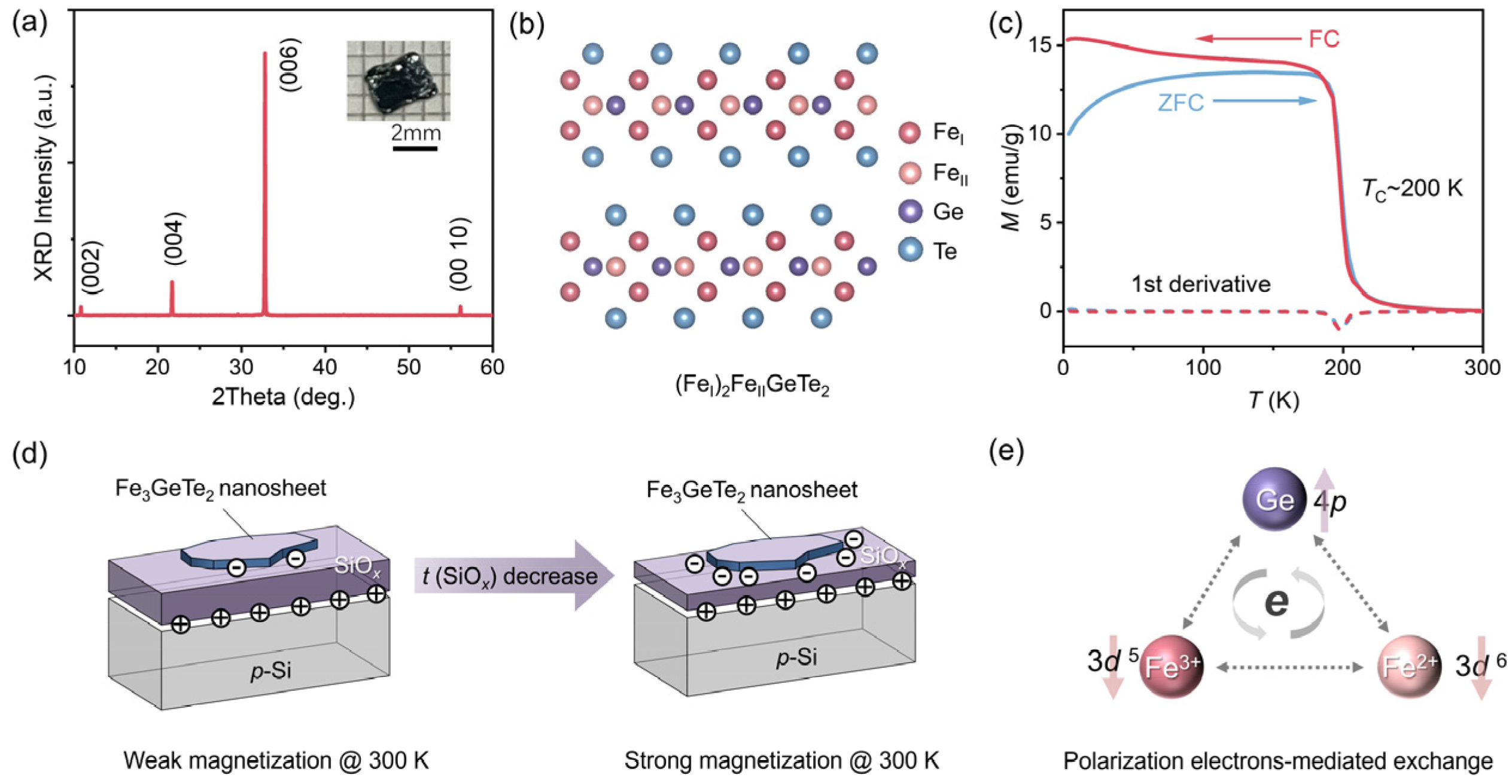
As depicted in Figure 1a, the XRD pattern reveals sharp (00L) crystal plane peaks, confirming that the material has a hexagonal crystal structure with the P63/mmc space group and good crystalline quality [26], with no impurity phases other than Fe3GeTe2 observed. The crystal structure schematic diagram in Figure 1b further shows that the structure consists of covalently bonded Fe-Ge layers sandwiched between two Te atomic layers, with a van der Waals interlayer gap of approximately 2.95 Å [4]. There are two inequivalent Fe sites (FeI and FeII, referring to Fe3+ and Fe2+ species, respectively), together contributing to a superexchange process with the aid of Ge and Te atoms. Due to the weak interlayer binding force, thinning the bulk along the c-axis is relatively easy, a structural feature that enables the acquisition of nanosheets via mechanical exfoliation. Fe3GeTe2 is an itinerant ferromagnetic metal, where each layer exhibits ferromagnetic spin alignment and significant perpendicular anisotropy. The spin alignment between layers can be either parallel (ferromagnetic) or antiparallel (antiferromagnetic) [54]. Generally, the ferromagnetic superexchange interaction via Fe-Te-Fe and Fe-Ge-Fe is stronger than the antiferromagnetic direct exchange between Fe-Fe, resulting in overall ferromagnetic order in bulk Fe3GeTe2 below TC. To verify the intrinsic ferromagnetism of Fe3GeTe2, we measured its fundamental magnetic properties. As shown in Figure 1c, the abrupt change in the ZFC and FC curves and the characteristic peak in the first derivative together determine TC ≈ 200 K, indicating the magnetic phase transition from ferromagnetism to paramagnetism. This magnetic transition temperature coincides with most reported values and is closely dependent on the stoichiometric ratio of Fe atoms [9]. Since the magnetism of Fe3GeTe2 can be regulated by electrons [41], we chose heavily doped p-type Si as the semiconductor layer and the SiOx layer as the insulator layer to construct a classic metal–insulator–semiconductor (MIS) regulation structure. When the SiOx layer is thin enough, a high density of adsorbed states is present in the surface region of SiOx for filling positively charged traps. In this regard, polarized electrons are accumulated on the SiOx side in the MIS structure. When Fe3GeTe2 is placed on the SiOx surface, the nanosheets acquire these induced surface electrons and become spin-polarized. Figure 1d shows that placing Fe3GeTe2 nanosheets with proper thickness (15–20 nm) onto Si/SiOx substrates with varying dielectric layer thicknesses demonstrates that modulating the SiOx layer thickness alters charge doping efficiency. This, in turn, regulates the neighboring polarization intensity applied to Fe3GeTe2, enabling effective and non-volatile control of its room temperature ferromagnetism. This approach provides a viable pathway for silicon-based integration of 2D magnetic materials.
Before presenting the thickness-dependent results, we clarify the rationale for selecting Fe3GeTe2 nanosheets with a thickness of 15–20 nm. This range represents an optimal compromise for observing the interfacial charge polarization effect: nanosheets thinner than ~15 nm are challenging to transfer intact and tend to exhibit structural degradation during the thermal transfer process, whereas thicker nanosheets (>20 nm) reduce the surface-to-volume ratio and weaken the interfacial charge transfer efficiency. We note that the induced charges primarily reside in the outermost layers near the Fe3GeTe2/SiOx interface; consequently, thinner nanosheets would exhibit stronger modulation due to higher charge density per unit volume, but their mechanical instability limits practical use. The 15–20 nm range ensures both sufficient signal contrast for reliable detection and structural integrity of the samples. Figure 1e illustrates the key ferromagnetic exchange mechanism in this material: the spin-majority electrons in Fe3+ and Fe2+ atoms undergo indirect exchange with the spin-minority electrons of the Ge atom, promoting majority spins to hop in an antiparallel configuration to the Ge 4p orbital, and subsequently, driven by thermal fluctuations, occupy the empty 3d orbitals of Fe2+, thereby establishing a robust ferromagnetic state.
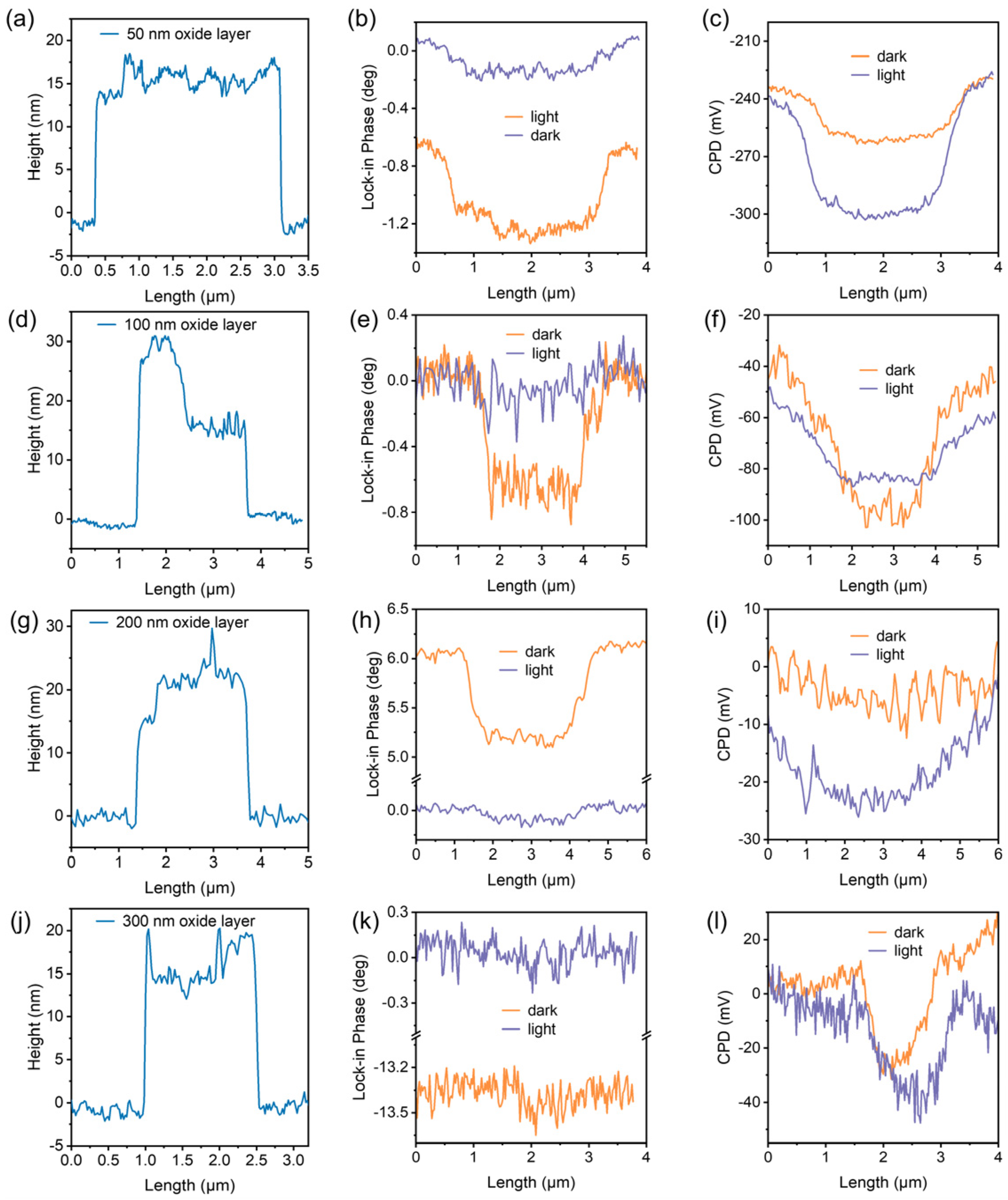
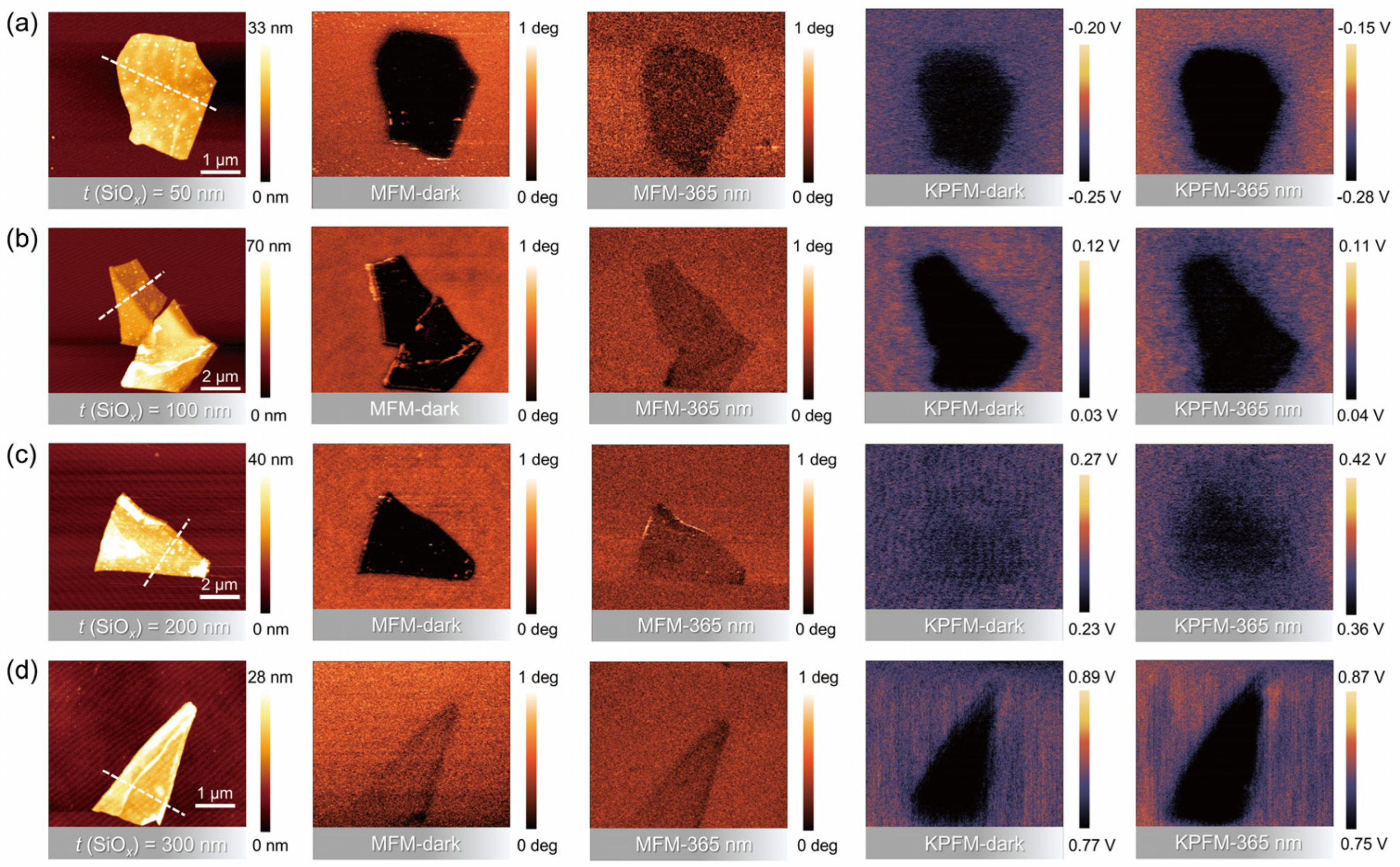
Given the sensitivity of Fe3GeTe2 magnetism to its thickness, we chose nanosheets with a thickness of about 15–20 nm (for details, see later) for the next study because such a thickness easily induces a considerable proximity effect. Under dark conditions (see “MFM-dark” panel in Figure 2a), we observed marked darkening of MFM lock-in phase contrast in Fe3GeTe2 nanosheets, indicating a magnetically attractive force between the sample surface and probe tip. There is a maximum phase contrast difference of approximately 0.71° compared to the diamagnetic Si/SiOx substrate, which corresponds to the case of a 50 nm dielectric layer thickness. It is noteworthy that the MFM measurements were implemented at room temperature (300 K), which suggests an enhanced magnetization effect, as Fe3GeTe2 typically only exhibits ferromagnetism at low temperatures. This emerging weak ferromagnetism might stem from the strain coupling or the charge doping effect. However, the occurrence of room temperature ferromagnetism in Fe3GeTe2 by means of strain application requires at least a 2% strain level, which is impossible for flat silicon substrates through mild thermal transfer. Considering the presence of a high density of charge pinning states on the surface of the SiOx layer, unintentional doping of electrons from the Si/SiOx substrate will become a key factor that cannot be overlooked. We further exposed the sample to 365 nm UV light, as shown in the “MFM-365 nm” panel of Figure 2. The black region in the MFM image noticeably diminished, and the phase contrast difference decreased to about 0.19° (see Figure 3b). This change is reversible when the UV illumination is switched off, indicating that the origin of magnetism might be closely correlated with a light-sensitive charge transfer process.
To further elucidate this charge transfer behavior of Fe3GeTe2 on 50 nm SiOx-coated silicon wafers, we characterized the surface potential under dark and light conditions using KPFM, as shown in the “KPFM-dark” and “KPFM-365 nm” panels in Figure 2a. The contact potential difference (CPD) between the AFM tip and the sample surface can be expressed as VCPD = (ΦtipΦsample)/e, where Φtip and Φsample are the work functions of the tip and sample, respectively. Hence, the work function difference between the Fe3GeTe2 nanosheet and the SiOx surface can be expressed as ΔΦ = ΦnanosheetΦSiOx = e [VCPD-nanosheetVCPD-SiOx] = eΔVCPD. Considering VCPD-nanosheet < VCPD-SiOx, Φnanosheet becomes smaller than ΦSiOx. Under dark conditions, VCPD is approximately −30 mV (averaged from the central ROI with background subtraction; see Methods), which is a very small difference (0.03 eV) in Fermi level (EF), indicating that the SiOx surface possesses abundant fixed positively charged traps that can gain electrons from adsorbed molecules or groups and elevate surface EF. According to the plane-parallel capacitor principle, some of the polarization-induced electrons are involved/doped into nanosheets and eventually result in a weak ferromagnetic state. Under UV illumination, ΔVCPD shifts to approximately –60 mV. The absolute difference in ΔVCPD before and after illumination is about 30 mV, suggesting that illumination can drive a significant charge transfer between Fe3GeTe2 and Si/SiOx and induce the room temperature optical demagnetization in MFM.
As the dielectric layer thickness increases, for instance, for the Fe3GeTe2 nanosheet on the Si/SiOx substrate with a 100 nm oxide layer, the MFM contrast in dark differed from the substrate by approximately 0.66° (see Figure 3e), which is slightly lower than that observed for the sample on the substrate with a 50 nm oxide layer. This reveals that the polarization capability is accordingly reduced. Upon UV irradiation, the magnetic contrast further weakened to approximately 0.05° (see Figure 3e), leaving the sample in a slightly magnetic state. The corresponding KPFM results in Figure 3f demonstrate that the absolute change in ΔVCPD before and after illumination is approximately 23 mV, which is also smaller than the case of 50 nm thickness. As for the Fe3GeTe2 nanosheet attached to the SiOx layer with a thickness of 200 nm, the phase contrast difference in dark-field MFM is about 0.52° and further decreases to 0.04° after UV irradiation (see Figure 3h). The absolute value of ΔVCPD measured by KPFM is also reduced to 10 mV, as shown in Figure 3i. This demonstrates a consistent charge transfer-type optical demagnetization mechanism, with the polarization capability gradually decreasing with increasing dielectric layer thickness. Ultimately, we examined the case of 300 nm oxide-coated silicon wafers (the most commonly observed specification in the commercial market). Figure 3j displays a similar Fe3GeTe2 thickness of approximately 16 nm. Under dark-field conditions (Figure 3k), its magnetic phase contrast is only about 0.06°, which is near the noise magnetic signal level and significantly lower than that in other dielectric layer thicknesses. It can be expected that, when the dielectric layer exceeds a certain critical thickness, the number of induced electrons significantly decreases and the proximity polarization effect becomes weak due to the dielectric screening effect. In this regard, despite light irradiation, the contrast change is minimal. The KPFM in Figure 3l also reveals extremely similar potential differences under dark and light fields, indicating that there is almost no charge transfer between Fe3GeTe2 and the Si/SiOx substrate, maintaining a near-intrinsic state. The above observations collectively demonstrate that charge transfer decreases significantly with increasing dielectric layer thickness. A thick dielectric layer effectively shields against electric fields from fixed charges and weakens the proximity polarization effect. Therefore, for applications aiming to preserve the intrinsic magnetism of Fe3GeTe2, thicker dielectric layers or other inert substrates (e.g., h-BN) are recommended. Conversely, for devices pursuing electrically/optically controlled magnetic modulation, thin dielectric layers should be employed to construct MIS structures, enabling efficient charge doping and room temperature magnetic control.
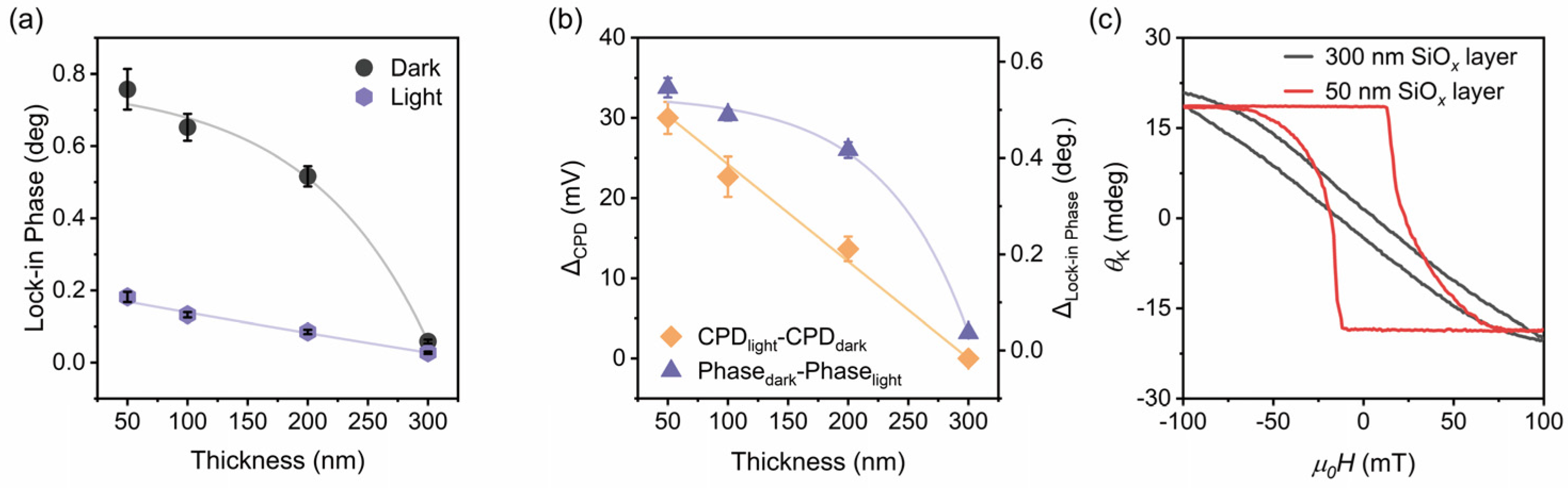
Figure 4 summarizes the thickness-dependent evolution of the MFM lock-in phase and KPFM surface potential in Fe3GeTe2 nanosheets. As shown in Figure 4a, both the dark-state phase (black circles) and the illumination-state phase (purple hexagons) exhibit monotonic decreases with increasing SiOx thickness, with error bars confirming the reproducibility of spatial measurements. Notably, the dark-state phase decreases from ~0.75° at 50 nm to ~0.06° at 300 nm, approaching the instrumental noise floor (~0.02°), while the illumination-state phase similarly decreases from ~0.18° to ~0.02°. This consistent thickness dependence strongly correlates with the dielectric screening-modulated magnetic proximity effect.
Figure 4b further reveals that both the CPD difference (CPDlight − CPDdark, orange diamonds) and the lock-in phase difference (Phasedark − Phaselight, purple triangles) decrease monotonically with dielectric thickness. The CPD difference decreases from ~30 mV at 50 nm to near zero at 300 nm, while the phase difference decreases from ~0.55° to ~0.04°. The close correlation between these two independent measurements, both showing similar decay trends, further validates the pivotal role of interfacial charge transfer in the light-controlled magnetization process. The non-zero error bars at each thickness point reflect the spatial inhomogeneity of interfacial charge distribution, which is more pronounced at thinner dielectric layers due to stronger field penetration. The fixed charge at the interface may act as a built-in gate voltage and then estimate the surface density of charge (Δn) transferred to the Fe3GeTe2 using the MIS capacitor formula. Assuming fixed charge Qf = 3 × 1012 cm−2 (typical value for thermal oxidation silicon) and dielectric layer thickness d = 50 nm, |VFB| ≈ Qf d/εoxε0 ≈ 4.4 V, where εox and ε0 denote the permittivity of SiOx and vacuum, respectively. Thereby, the induced Δn can be estimated as Δn = Cox |VFB|/e ≈ 1.9 × 1013 cm−2, very close to the critical threshold for activating room temperature ferromagnetism in Fe3GeTe2 [9]. These statistical findings quantitatively reveal how dielectric layer thickness continuously modulates the room temperature magnetism and optical demagnetization behavior of Fe3GeTe2. The observation here provides clear guidance for optimizing the dielectric layer design in silicon-based spintronic devices.
The error bars in Figure 4 warrant further discussion. The relatively larger error bars at 50 nm and 100 nm dielectric thicknesses (particularly for CPD measurements) reflect the stronger spatial variation of interfacial charge trapping at thin dielectrics, where the electric field penetration is more sensitive to local defect distribution. In contrast, the smaller error bars at 200 nm and 300 nm indicate more uniform charge distribution due to effective dielectric screening. This thickness-dependent error bar behavior is consistent with the physical picture of MIS-mediated charge transfer and further supports the reliability of our conclusions.
To directly correlate the interfacial charge transfer inferred from KPFM with macroscopic magnetic order, we performed polar MOKE measurements on Fe3GeTe2 nanosheets on Si/SiOx substrates with 50 nm and 300 nm oxide thicknesses. As shown in Figure 4c, the 50 nm sample exhibits a distinct asymmetric hysteresis loop with a large coercive field (HC ≈ 200 Oe) and a pronounced loop shift, while the 300 nm sample shows a nearly symmetric loop with a much smaller HC ≈ 90 Oe. The ~5 nm interfacial oxidation layer (denoted as O-Fe3GeTe2), formed through natural surface oxidation upon exposure to the ambient environment, exhibits amorphous antiferromagnetic insulating characteristics [55,56,57]. Naturally oxidized Fe3GeTe2 shows clear antiferromagnetic ordering, producing significant exchange bias effects at the FM/AFM interface [55]. The O-Fe3GeTe2 phase is an antiferromagnetic insulator because oxygen incorporation induces negative spin polarization via spin–orbit coupling, mediating antiferromagnetic interlayer coupling [57,58]. In the Fe3GeTe2 nanosheet on the Si/SiOx substrate with a 50 nm oxide layer, the strong built-in electric field from the thin SiOx layer penetrates through the O-Fe3GeTe2 interlayer, enhancing the interfacial magnetic anisotropy [8]. This enhanced anisotropy stabilizes the exchange bias effect at the ferromagnetic Fe3GeTe2/antiferromagnetic O-Fe3GeTe2 interface, which in turn produces the asymmetric hysteresis loop and enhanced coercivity [55,56,57]. In contrast, in the Fe3GeTe2 nanosheet on the Si/SiOx substrate with a 300 nm oxide layer, dielectric screening suppresses this field penetration; although the O-Fe3GeTe2 layer remains structurally similar, the built-in electric field cannot effectively polarize, resulting in a near-intrinsic weak ferromagnetic state. For Fe3GeTe2 with an ultrathin surface dielectric layer (typical thickness ~5 nm), the observed SiOx thickness-dependent magnetic responses indicate that the thickness of the composite dielectric layer composed of SiOx and O-Fe3GeTe2 governs the charge transfer efficiency across the interface, which in turn determines the magnetic behavior. The O-Fe3GeTe2 layer functions as an antiferromagnetic charge mediation bridge whose polarization efficiency is controlled by the underlying SiOx thickness, rather than acting as an independent magnetic source.
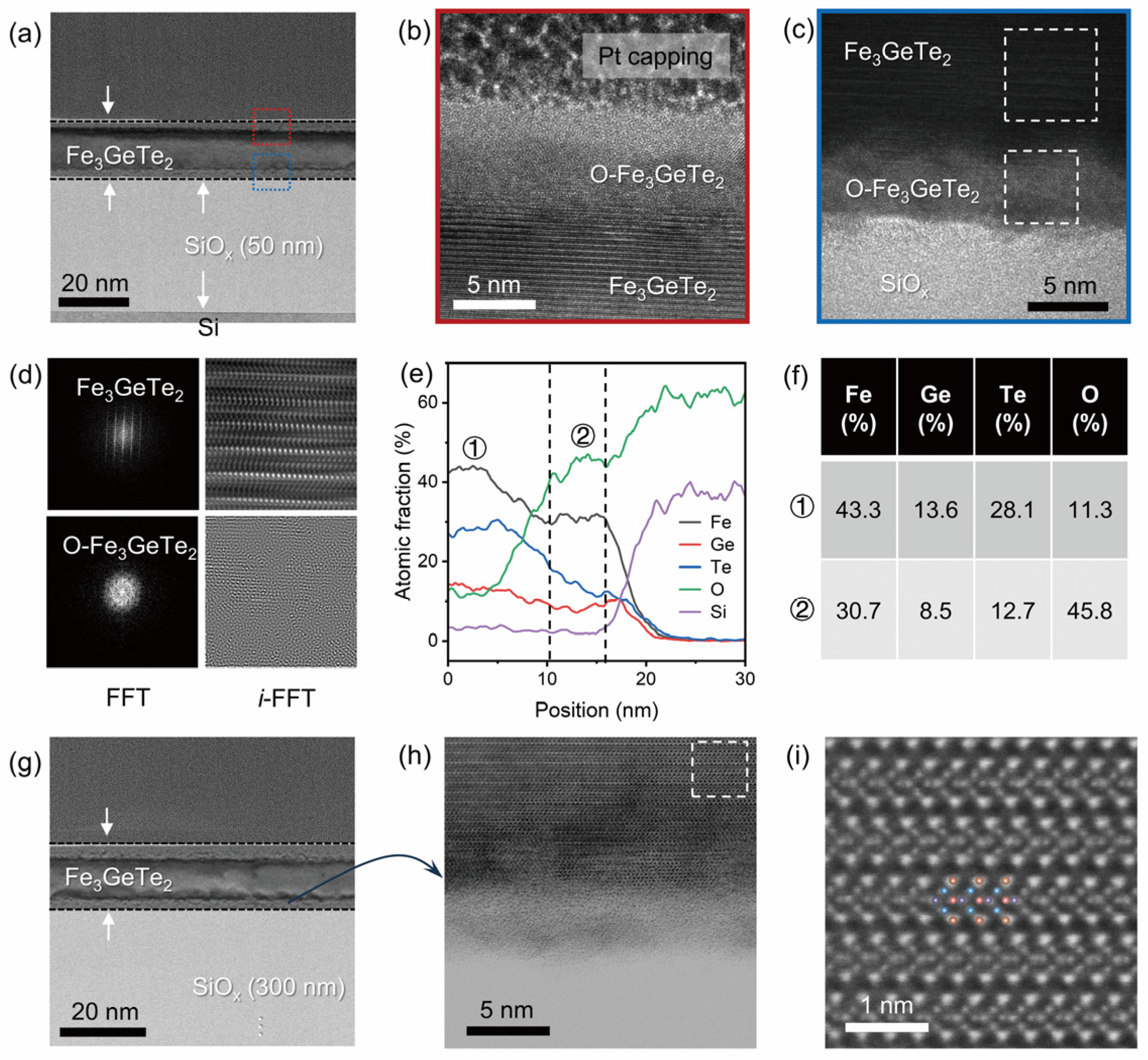
To gain insight into the interfacial structure between Fe3GeTe2 and the SiOx layer, we performed cross-sectional HAADF-STEM characterization on Fe3GeTe2 nanosheets on Si/SiOx substrates with 50 nm and 300 nm oxide layers. As shown in Figure 5a, the low-magnification TEM overview image of the nanosheet on the substrate with a 50 nm SiOx layer clearly reveals a sandwich structure composed of a Pt capping layer, the surface O-Fe3GeTe2 layer, and the Fe3GeTe2 layer. Figure 5b, a magnified TEM image of the red-boxed region in Figure 5a, further reveals a ~5 nm amorphous O-Fe3GeTe2 oxidation layer between the Pt protective capping layer and the crystalline Fe3GeTe2. This oxidation layer exhibits diffuse spot contrast, in sharp contrast to the clear lattice fringes of the underlying Fe3GeTe2. Figure 5c, a magnified TEM image of the blue-boxed region in Figure 5a, shows a similar ~5 nm O-Fe3GeTe2 oxidation layer between Fe3GeTe2 and SiOx, further confirming the existence and spatial continuity of this interfacial oxidation layer. To verify the structural characteristics of the oxidation layer, we performed FFT analysis on both the crystalline Fe3GeTe2 region and the O-Fe3GeTe2 oxidation layer (Figure 5d). The first row shows that the crystalline Fe3GeTe2 region exhibits periodic crystalline diffraction spots, and the i-FFT image displays a clear layered atomic arrangement. The second row shows that the FFT of the O-Fe3GeTe2 oxidation layer presents a diffuse ring pattern, and the i-FFT image shows no discernible atomic number contrast, confirming the amorphous nature of this oxidation layer. EDS elemental line scanning (Figure 5e) quantitatively reveals the elemental distribution across the interface. Region ① corresponds to the crystalline Fe3GeTe2 region, where Fe, Ge, and Te elements maintain relatively stable atomic fractions. Region ② corresponds to the O-Fe3GeTe2 interfacial oxidation layer, where the O content rises sharply to a peak while Fe, Ge, and Te gradually decrease but remain coexistent. The gradual elemental transition indicates partial surface oxidation rather than complete phase decomposition. Quantitative EDS analysis (Figure 5f) further shows that the atomic composition of region ① is Fe 43.3%, Ge 13.6%, Te 28.1%, and O 11.3%, close to the stoichiometric ratio of Fe3GeTe2; region ② has a composition of Fe 30.7%, Ge 8.5%, Te 12.7%, and O 45.8%, where oxygen is dominant but the stoichiometric ratio of Fe, Ge, and Te is largely maintained.
To verify the universality of the interfacial structure, we performed the same cross-sectional characterization on the Fe3GeTe2 nanosheet on the Si/SiOx substrate with a 300 nm oxide layer. As shown in Figure 5g, the nanosheet on the substrate with a 300 nm SiOx layer clearly reveals a sandwich structure, with a distinct O-Fe3GeTe2 interfacial layer formed between the Fe3GeTe2 layer and the SiOx layer. The aberration-corrected HAADF-STEM-magnified image (Figure 5h) reveals similar amorphous characteristics at the interface region. The atomic-resolution TEM image (Figure 5i) displays the clear atomic arrangement in the Fe3GeTe2 crystalline region, with colored overlays of the fitted atomic framework model matching well with the experimental image, confirming the structural integrity of surface-oxidized Fe3GeTe2 on the 300 nm SiOx layer.
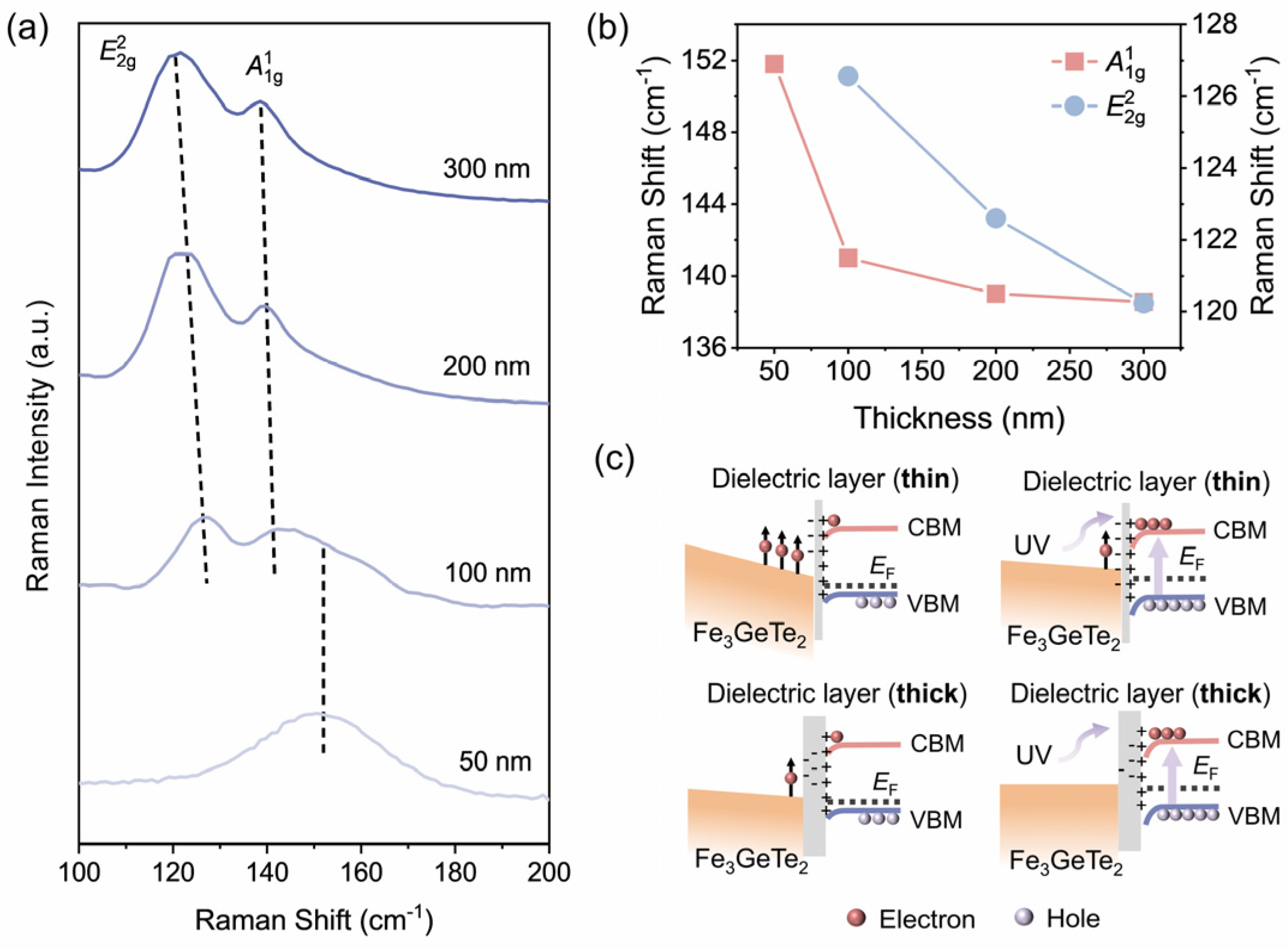
Figure 6 further reveals the interfacial regulation mechanism of different SiOx thicknesses on Fe3GeTe2 from the perspectives of lattice vibrations and electronic structure. As depicted in Figure 6a, the systematic changes in the Raman spectra clearly reflect the influence of interfacial coupling on lattice vibrations. As the dielectric layer thickness increases from 50 nm to 300 nm, the intensity ratio between the A 1 g 1 peak (representing out-of-plane vibration of Te-Te bonds, around 142.6 cm−1 [54]) and the E 2 g 2 peak (representing in-plane vibration of Fe-Ge bonds, around 125.3 cm−1 [9]) changes significantly. Particularly noteworthy is the complete disappearance of the E 2 g 2 peak in the 50 nm thin dielectric layer, while the A 1 g 1 peak shows a significant red shift, Δω = 13.27 cm−1. This phenomenon indicates that interfacial charge transfer can effectively modulate lattice vibration through electron–phonon coupling [59]. Further analysis of the Raman peak position, as clearly shown in Figure 6b, reveals that with increasing dielectric layer thickness, both peaks gradually have a red shift. This thickness-dependent phonon softening behavior is highly consistent with the aforementioned interfacial coupling theory, indicating weakened charge transfer with increasing dielectric layer thickness. The band structure in Figure 6c provides a possible explanation for this regulation mechanism. For the thin dielectric layers, fixed charge traps can generate a built-in electric field towards the Fe3GeTe2 side and induce the band bending upward from the interface to the bulk region. The generated electronic pocket accumulates enough electrons to polarize high-temperature ferromagnetic exchange interaction in Fe3GeTe2. Optically excited carriers can screen trap states and eventually weaken interfacial charge transfer between Fe3GeTe2 and the dielectric layer, which provides a theoretical explanation for the observed photo-induced demagnetization phenomenon. In contrast, a thick dielectric layer effectively shields against electric fields from fixed charges and weakens the proximity polarization effect, enabling the band structure close to the intrinsic state. To sum up, the above discussion collectively demonstrates that the dielectric layer thickness not only regulates the magnetism of Fe3GeTe2 through interfacial charge transfer but also affects its lattice dynamics through electron–phonon coupling. In addition, the systematic red shift of the Raman peaks also reflects the lattice strain induced by interfacial interactions, while the synergy of the charge and strain may offer a complete microscopic physical picture for understanding these effects. This discovery establishes an internal link between phonon behavior, electronic structure, and magnetic properties, providing a multi-physics coupling research perspective for regulating 2D magnetic materials through dielectric environment design.
The distinct responses of the E 2 g 2 and A 1 g 1 modes to interfacial charge transfer warrant further mechanistic clarification. The E 2 g 2 mode (~125.3 cm−1) corresponds to in-plane vibration of Fe-Ge bonds and is highly sensitive to in-plane lattice strain and interfacial charge doping [54,59]. In the Fe3GeTe2 nanosheet on the Si/SiOx substrate with a 50 nm SiOx layer, strong electron–phonon coupling induced by interfacial charge transfer substantially softens this mode, and the accumulated electrons in Fe 3d orbitals weaken the Fe-Ge in-plane bonding sufficiently to suppress the E 2 g 2 peak below the detection limit. This is consistent with theoretical predictions that heavy charge doping can drive structural instabilities in 2D ferromagnets [9,41]. In contrast, the A 1 g 1 mode (~142.6 cm−1) represents out-of-plane vibration of Te-Te bonds, which is mechanically decoupled from the in-plane Fe-Ge bonding network [54]. The weak van der Waals interlayer coupling (~2.95 Å gap) provides structural compliance that buffers the out-of-plane vibration against in-plane strain perturbations. Consequently, despite a large red shift (Δω ≈ 13.27 cm−1) reflecting phonon softening via electron–phonon coupling, the A 1 g 1 mode remains observable because the interlayer Te-Te bonding is not directly broken by the interfacial charge transfer. The red shift itself evidences the long-range Coulomb interaction between the charged interface and the Te layers, while the persistence of the mode confirms the structural integrity of the van der Waals stacking. As the dielectric layer increases to 100–300 nm, the gradual re-emergence of the E 2 g 2 mode and the diminishing red shift of A 1 g 1 (Figure 6b) collectively confirm that the Raman responses are governed by the degree of interfacial charge transfer, which is modulated by dielectric screening. This thickness-dependent phonon behavior establishes an intrinsic link between interfacial charge doping, lattice dynamics, and magnetic properties in the MIS structure.

4. Conclusions

Control room temperature magnetism in Fe3GeTe2 is effectively achieved by adjusting the thickness of the SiOx dielectric layer. Cross-sectional TEM characterization further reveals a ~5 nm interfacial O-Fe3GeTe2 oxidation layer that functions as a charge mediation bridge, enhancing the proximity polarization effect particularly for thin dielectric layers where electric field penetration is strong. A thin dielectric layer (50 nm) significantly enhances room temperature ferromagnetism through increased interfacial charge transfer. In contrast, a thick dielectric layer (300 nm) keeps the material nearly intrinsic due to dielectric shielding effects. The study also demonstrates reversible regulation of Fe3GeTe2 magnetism under UV light irradiation. When exposed to 365 nm UV irradiation, all samples showed varying levels of demagnetization, with the thinnest dielectric layer exhibiting the strongest photoresponse. This light-controlled magnetism is attributed to charge redistribution from photo-generated carriers, suggesting potential for light-controlled spintronic devices. Raman spectroscopy revealed that interfacial coupling affects lattice vibrations. As the dielectric layer thickness increased, the A 1 g 1 and E 2 g 2 modes exhibited pronounced red shifts, indicating that proximity polarization affects not only the electronic structure but also lattice dynamics through electron–phonon coupling. The correlation model linking dielectric layer thickness, interfacial charge transfer, and magnetic response enhances our understanding of charge–spin coupling in 2D magnetic materials and provides a theoretical basis for designing next-generation silicon-based spintronic devices. Thick dielectric layers are recommended for applications preserving intrinsic material properties, while thin layers are ideal for applications requiring efficient electrically controlled magnetic properties. These findings offer clear guidance for integrating two-dimensional magnetic materials with silicon-based technologies.

Author Contributions

Conceptualization, L.H. and L.L.; methodology, Y.M.; validation, Y.M., Y.H., H.X. and S.W.; formal analysis, Y.M.; investigation, Y.M., Y.H., H.X. and S.W.; resources, L.H. and L.L.; data curation, Y.M. and S.W.; writing—original draft preparation, Y.M.; writing—review and editing, L.H. and L.L.; visualization, Y.M.; supervision, L.H. and L.L.; project administration, L.H.; funding acquisition, L.H. and L.L. All authors have read and agreed to the published version of the manuscript.

Funding

This work was supported by the Funds of the Natural Science Foundation of Hangzhou (Grant Nos. 2025SZRJJ1477 and 2024SZRYBF050002), the Fundamental Research Funds for the Provincial Universities of Zhejiang (Grant No. GK259909299001-002), the National Natural Science Foundation of China (Grant Nos. 62274050 and 62574069), and the Zhejiang Provincial Natural Science Foundation of China (Grant No. LZ21E020002).

Data Availability Statement

The original contributions presented in this study are included in the article. Further inquiries can be directed to the corresponding author(s).

Acknowledgments

The authors thank the relevant laboratories for their technical support and for material characterization and measurements. We also acknowledge administrative support from the affiliated institution during the preparation of this work.

Conflicts of Interest

The authors declare no conflicts of interest.

Abbreviations

The following abbreviations are used in this manuscript:
2DTwo-dimensional
AFMAtomic force microscopy
MFMMagnetic force microscopy
KPFMKelvin probe force microscopy
XRDX-ray diffraction
UVUltraviolet
MISMetal–insulator–semiconductor

References

  1. Huang, B.; Clark, G.; Navarro-Moratalla, E.; Klein, D.R.; Cheng, R.; Seyler, K.L.; Zhong, D.; Schmidgall, E.; McGuire, M.A.; Cobden, D.H.; et al. Layer-dependent ferromagnetism in a van der Waals crystal down to the monolayer limit. Nature 2017, 546, 270–273. [Google Scholar] [CrossRef]
  2. Lin, X.; Yang, W.; Wang, K.L.; Zhao, W. Two-dimensional spintronics for low-power electronics. Nat. Electron. 2019, 2, 274–283. [Google Scholar] [CrossRef]
  3. Avsar, A.; Ochoa, H.; Guinea, F.; Özyilmaz, B.; van Wees, B.J.; Vera-Marun, I.J. Colloquium: Spintronics in graphene and other two-dimensional materials. Rev. Mod. Phys. 2020, 92, 021003. [Google Scholar] [CrossRef]
  4. Deng, Y.; Yu, Y.; Song, Y.; Zhang, J.; Wang, N.Z.; Sun, Z.; Yi, Y.; Wu, Y.Z.; Wu, S.; Zhu, J.; et al. Gate-tunable room-temperature ferromagnetism in two-dimensional Fe3GeTe2. Nature 2018, 563, 94–99. [Google Scholar] [CrossRef]
  5. May, A.F.; Ovchinnikov, D.; Zheng, Q.; Hermann, R.; Calder, S.; Huang, B.; Fei, Z.; Liu, Y.; Xu, X.; McGuire, M.A. Ferromagnetism Near Room Temperature in the Cleavable van der Waals Crystal Fe5GeTe2. ACS Nano 2019, 13, 4436–4442. [Google Scholar] [CrossRef]
  6. Deiseroth, H.J.; Aleksandrov, K.; Reiner, C.; Kienle, L.; Kremer, R.K. Fe3GeTe2 and Ni3GeTe2—Two New Layered Transition-Metal Compounds: Crystal Structures, HRTEM Investigations, and Magnetic and Electrical Properties. Eur. J. Inorg. Chem. 2006, 2006, 1561–1567. [Google Scholar] [CrossRef]
  7. Chen, B.; Yang, J.; Wang, H.; Imai, M.; Ohta, H.; Michioka, C.; Yoshimura, K.; Fang, M. Magnetic Properties of Layered Itinerant Electron Ferromagnet Fe3GeTe2. J. Phys. Soc. Jpn. 2013, 82, 124711. [Google Scholar] [CrossRef]
  8. Kim, S.J.; Choi, D.; Kim, K.-W.; Lee, K.-Y.; Kim, D.-H.; Hong, S.; Suh, J.; Lee, C.; Kim, S.K.; Park, T.-E.; et al. Interface Engineering of Magnetic Anisotropy in van der Waals Ferromagnet-based Heterostructures. ACS Nano 2021, 15, 16395–16403. [Google Scholar] [CrossRef]
  9. Hu, L.; Yang, B.; Hou, Z.; Lu, Y.; Su, W.; Li, L. Unlocking the charge doping effect in softly intercalated ultrathin ferromagnetic superlattice. eScience 2023, 3, 100117. [Google Scholar] [CrossRef]
  10. Wang, Y.-P.; Chen, X.-Y.; Long, M.-Q. Modifications of magnetic anisotropy of Fe3GeTe2 by the electric field effect. Appl. Phys. Lett. 2020, 116, 092404. [Google Scholar] [CrossRef]
  11. Hu, L.; Zhou, J.; Hou, Z.; Su, W.; Yang, B.; Li, L.; Yan, M. Polymer-buried van der Waals magnets for promising wearable room-temperature spintronics. Mater. Horiz. 2021, 8, 3306–3314. [Google Scholar] [CrossRef]
  12. Song, T.; Fei, Z.; Yankowitz, M.; Lin, Z.; Jiang, Q.; Hwangbo, K.; Zhang, Q.; Sun, B.; Taniguchi, T.; Watanabe, K.; et al. Switching 2D magnetic states via pressure tuning of layer stacking. Nat. Mater. 2019, 18, 1298–1302. [Google Scholar] [CrossRef]
  13. Fujita, R.; Gurung, G.; Mawass, M.A.; Smekhova, A.; Kronast, F.; Toh, A.K.J.; Soumyanarayanan, A.; Ho, P.; Singh, A.; Heppell, E.; et al. Strain-Modulated Ferromagnetism at an Intrinsic van der Waals Heterojunction. Adv. Funct. Mater. 2024, 34, 2400552. [Google Scholar] [CrossRef]
  14. Hu, L.; Liu, F.; Quan, Q.; Lu, C.; Yu, S.; Li, L. Strained van der Waals Metallic Magnet for Photomagnetic Modulation and Spin Photodiode Application. Adv. Funct. Mater. 2024, 34, 2409085. [Google Scholar] [CrossRef]
  15. Liu, B.; Liu, S.; Yang, L.; Chen, Z.; Zhang, E.; Li, Z.; Wu, J.; Ruan, X.; Xiu, F.; Liu, W.; et al. Light-Tunable Ferromagnetism in Atomically Thin Fe3GeTe2 Driven by Femtosecond Laser Pulse. Phys. Rev. Lett. 2020, 125, 267205. [Google Scholar] [CrossRef]
  16. Huang, X.; Zhang, L.; Tong, L.; Li, Z.; Peng, Z.; Lin, R.; Shi, W.; Xue, K.-H.; Dai, H.; Cheng, H.; et al. Manipulating exchange bias in 2D magnetic heterojunction for high-performance robust memory applications. Nat. Commun. 2023, 14, 2190. [Google Scholar] [CrossRef]
  17. Wu, N.; Zhang, S.; Chen, D.; Wang, Y.; Meng, S. Three-stage ultrafast demagnetization dynamics in a monolayer ferromagnet. Nat. Commun. 2024, 15, 2804. [Google Scholar] [CrossRef]
  18. He, J.; Li, S.; Bandyopadhyay, A.; Frauenheim, T. Unravelling Photoinduced Interlayer Spin Transfer Dynamics in Two-Dimensional Nonmagnetic-Ferromagnetic van der Waals Heterostructures. Nano Lett. 2021, 21, 3237–3244. [Google Scholar] [CrossRef]
  19. Zheng, J.; Zhang, Y.; Yu, H.; Wang, J.; Guo, H.; Qiu, Y.; Wang, X.; Feng, Y.; Liu, L.; Li, W.J. Tunable Optical Metamaterial Enables Steganography, Rewriting, and Multilevel Information Storage. Nano-Micro Lett. 2025, 18, 58. [Google Scholar] [CrossRef]
  20. Lazić, P.; Belashchenko, K.D.; Žutić, I. Effective gating and tunable magnetic proximity effects in two-dimensional heterostructures. Phys. Rev. B 2016, 93, 241401. [Google Scholar] [CrossRef]
  21. Singh, S.; Katoch, J.; Zhu, T.; Meng, K.-Y.; Liu, T.; Brangham, J.T.; Yang, F.; Flatté, M.E.; Kawakami, R.K. Strong Modulation of Spin Currents in Bilayer Graphene by Static and Fluctuating Proximity Exchange Fields. Phys. Rev. Lett. 2017, 118, 187201. [Google Scholar] [CrossRef] [PubMed]
  22. Maccherozzi, F.; Sperl, M.; Panaccione, G.; Minár, J.; Polesya, S.; Ebert, H.; Wurstbauer, U.; Hochstrasser, M.; Rossi, G.; Woltersdorf, G.; et al. Evidence for a Magnetic Proximity Effect up to Room Temperature atFe/(Ga,Mn)AsInterfaces. Phys. Rev. Lett. 2008, 101, 267201. [Google Scholar] [CrossRef]
  23. Bonilla, M.; Kolekar, S.; Ma, Y.; Diaz, H.C.; Kalappattil, V.; Das, R.; Eggers, T.; Gutierrez, H.R.; Phan, M.-H.; Batzill, M. Strong room-temperature ferromagnetism in VSe2 monolayers on van der Waals substrates. Nat. Nanotechnol. 2018, 13, 289–293. [Google Scholar] [CrossRef]
  24. Zhang, L.; Huang, X.; Dai, H.; Wang, M.; Cheng, H.; Tong, L.; Li, Z.; Han, X.; Wang, X.; Ye, L.; et al. Proximity-Coupling-Induced Significant Enhancement of Coercive Field and Curie Temperature in 2D van der Waals Heterostructures. Adv. Mater. 2020, 32, 2002032. [Google Scholar] [CrossRef]
  25. Dai, H.; Cai, M.; Hao, Q.; Liu, Q.; Xing, Y.; Chen, H.; Chen, X.; Wang, X.; Fu, H.-H.; Han, J. Nonlocal Manipulation of Magnetism in an Itinerant Two-Dimensional Ferromagnet. ACS Nano 2022, 16, 12437–12444. [Google Scholar] [CrossRef]
  26. May, A.F.; Calder, S.; Cantoni, C.; Cao, H.; McGuire, M.A. Magnetic structure and phase stability of the van der Waals bonded ferromagnetFe3−xGeTe2. Phys. Rev. B 2016, 93, 014411. [Google Scholar] [CrossRef]
  27. Chen, X.; Lin, Z.-Z.; Cheng, L.-R. Origin of itinerant ferromagnetism in two-dimensional Fe3GeTe2. Chin. Phys. B 2021, 30, 047502. [Google Scholar] [CrossRef]
  28. Novoselov, K.S.; Mishchenko, A.; Carvalho, A.; Castro Neto, A.H. 2D materials and van der Waals heterostructures. Science 2016, 353, aac9439. [Google Scholar] [CrossRef]
  29. Roemer, R.; Liu, C.; Zou, K. Robust ferromagnetism in wafer-scale monolayer and multilayer Fe3GeTe2. npj 2D Mater. Appl. 2020, 4, 33. [Google Scholar] [CrossRef]
  30. Zhang, K.; Han, S.; Lee, Y.; Coak, M.J.; Kim, J.; Hwang, I.; Son, S.; Shin, J.; Lim, M.; Jo, D.; et al. Gigantic Current Control of Coercive Field and Magnetic Memory Based on Nanometer-Thin Ferromagnetic van der Waals Fe3GeTe2. Adv. Mater. 2020, 33, 2004110. [Google Scholar] [CrossRef] [PubMed]
  31. Wang, H.; Liu, Y.; Wu, P.; Hou, W.; Jiang, Y.; Li, X.; Pandey, C.; Chen, D.; Yang, Q.; Wang, H.; et al. Above Room-Temperature Ferromagnetism in Wafer-Scale Two-Dimensional van der Waals Fe3GeTe2 Tailored by a Topological Insulator. ACS Nano 2020, 14, 10045–10053. [Google Scholar] [CrossRef] [PubMed]
  32. Song, X.; Zhang, J.; Qian, Y.; Xia, Z.; Chen, J.; Yin, H.; Liu, J.; Feng, L.; Liu, T.; Zhu, Z.; et al. Simultaneous resistance switching and rectifying effects in a single hybrid perovskite. InfoMat 2024, 6, e12562. [Google Scholar] [CrossRef]
  33. Zhang, L.; Song, L.; Dai, H.; Yuan, J.-H.; Wang, M.; Huang, X.; Qiao, L.; Cheng, H.; Wang, X.; Ren, W.; et al. Substrate-modulated ferromagnetism of two-dimensional Fe3GeTe2. Appl. Phys. Lett. 2020, 116, 042402. [Google Scholar] [CrossRef]
  34. Sun, Y.; Birch, M.T.; Finizio, S.; Powalla, L.; Satheesh, S.; Priessnitz, T.; Göring, E.; Knöckl, E.; Kastl, C.; Holleitner, A.; et al. Localized Spin Textures Stabilized by Geometry-Induced Strain in 2D Magnet Fe3GeTe2. Adv. Mater. 2025, 37, 2506279. [Google Scholar] [CrossRef]
  35. Fei, Z.; Huang, B.; Malinowski, P.; Wang, W.; Song, T.; Sanchez, J.; Yao, W.; Xiao, D.; Zhu, X.; May, A.F.; et al. Two-dimensional itinerant ferromagnetism in atomically thin Fe3GeTe2. Nat. Mater. 2018, 17, 778–782. [Google Scholar] [CrossRef]
  36. Li, Q.; Yang, M.; Gong, C.; Chopdekar, R.V.; N’Diaye, A.T.; Turner, J.; Chen, G.; Scholl, A.; Shafer, P.; Arenholz, E.; et al. Patterning-Induced Ferromagnetism of Fe3GeTe2 van der Waals Materials beyond Room Temperature. Nano Lett. 2018, 18, 5974–5980. [Google Scholar] [CrossRef]
  37. Huang, B.; Clark, G.; Klein, D.R.; MacNeill, D.; Navarro-Moratalla, E.; Seyler, K.L.; Wilson, N.; McGuire, M.A.; Cobden, D.H.; Xiao, D.; et al. Electrical control of 2D magnetism in bilayer CrI3. Nat. Nanotechnol. 2018, 13, 544–548. [Google Scholar] [CrossRef]
  38. Zhu, R.; Zhang, W.; Shen, W.; Wong, P.K.J.; Wang, Q.; Liang, Q.; Tian, Z.; Zhai, Y.; Qiu, C.-w.; Wee, A.T.S. Exchange Bias in van der Waals CrCl3/Fe3GeTe2 Heterostructures. Nano Lett. 2020, 20, 5030–5035. [Google Scholar] [CrossRef]
  39. Jo, J.; Calavalle, F.; Martín-García, B.; Tezze, D.; Casanova, F.; Chuvilin, A.; Hueso, L.E.; Gobbi, M. Exchange Bias in Molecule/Fe3GeTe2 van der Waals Heterostructures via Spinterface Effects. Adv. Mater. 2022, 34, 2200474. [Google Scholar] [CrossRef] [PubMed]
  40. Ma, S.; Li, G.; Li, Z.; Wang, T.; Zhang, Y.; Li, N.; Chen, H.; Zhang, N.; Liu, W.; Huang, Y. Negative Photoconductivity of Fe3GeTe2 Crystal with Native Heterostructure for Ultraviolet to Terahertz Ultra-Broadband Photodetection. Adv. Mater. 2024, 36, 2305709. [Google Scholar] [CrossRef]
  41. Shen, Z.-X.; Bo, X.; Cao, K.; Wan, X.; He, L. Magnetic ground state and electron-doping tuning of Curie temperature in Fe3GeTe2: First-principles studies. Phys. Rev. B 2021, 103, 085102. [Google Scholar] [CrossRef]
  42. Johansen, Ø.; Risinggård, V.; Sudbø, A.; Linder, J.; Brataas, A. Current Control of Magnetism in Two-Dimensional Fe3GeTe2. Phys. Rev. Lett. 2019, 122, 217203. [Google Scholar] [CrossRef]
  43. Ji, J.; Yu, S.; Cheng, M.; Mo, Y.; Huang, Y.; Liu, Y.; Su, W.; Lu, C.; Hu, L. Thermally-Strained Black Phosphorus Photovoltaics Toward Spatially-Resolved Biomimetic Vision Enhancement. Adv. Mater. 2026, 38, e17056. [Google Scholar] [CrossRef] [PubMed]
  44. Huang, Y.; Quan, Q.; Cheng, M.; Ji, J.; Mo, Y.; Liu, Y.; Yu, S.; Lu, C.; Hu, L. Unveiling Ionic Conductive Filaments Enhanced Photovoltaic Response Exceeding Ferroelectrics Dimensionality Limit. Adv. Funct. Mater. 2026, 36, e23973. [Google Scholar] [CrossRef]
  45. Wu, H.; Zheng, L.; Du, N.; Sun, B.; Ma, J.; Jiang, Y.; Gong, J.; Chen, H.; Wang, L. Constructing Densely Compacted Graphite/Si/SiO2 Ternary Composite Anodes for High-Performance Li-Ion Batteries. ACS Appl. Mater. Interfaces 2021, 13, 22323–22331. [Google Scholar] [CrossRef] [PubMed]
  46. Williams, J.R.; DiCarlo, L.; Marcus, C.M. Quantum Hall Effect in a Gate-Controlled p-n Junction of Graphene. Science 2007, 317, 638–641. [Google Scholar] [CrossRef]
  47. Xia, J.; Chen, F.; Li, J.; Tao, N. Measurement of the quantum capacitance of graphene. Nat. Nanotechnol. 2009, 4, 505–509. [Google Scholar] [CrossRef]
  48. Li, J.-X.; Li, W.-Q.; Hung, S.-H.; Chen, P.-L.; Yang, Y.-C.; Chang, T.-Y.; Chiu, P.-W.; Jeng, H.-T.; Liu, C.-H. Electric control of valley polarization in monolayer WSe2 using a van der Waals magnet. Nat. Nanotechnol. 2022, 17, 721–728. [Google Scholar] [CrossRef]
  49. Park, S.Y.; Kim, D.S.; Liu, Y.; Hwang, J.; Kim, Y.; Kim, W.; Kim, J.-Y.; Petrovic, C.; Hwang, C.; Mo, S.-K.; et al. Controlling the Magnetic Anisotropy of the van der Waals Ferromagnet Fe3GeTe2 through Hole Doping. Nano Lett. 2019, 20, 95–100. [Google Scholar] [CrossRef]
  50. Jang, S.W.; Yoon, H.; Jeong, M.Y.; Ryee, S.; Kim, H.-S.; Han, M.J. Origin of ferromagnetism and the effect of doping on Fe3GeTe2. Nanoscale 2020, 12, 13501–13506. [Google Scholar] [CrossRef]
  51. Gong, C.; Li, L.; Li, Z.; Ji, H.; Stern, A.; Xia, Y.; Cao, T.; Bao, W.; Wang, C.; Wang, Y.; et al. Discovery of intrinsic ferromagnetism in two-dimensional van der Waals crystals. Nature 2017, 546, 265–269. [Google Scholar] [CrossRef]
  52. Yi, J.; Zhuang, H.; Zou, Q.; Wu, Z.; Cao, G.; Tang, S.; Calder, S.A.; Kent, P.R.C.; Mandrus, D.; Gai, Z. Competing antiferromagnetism in a quasi-2D itinerant ferromagnet: Fe3GeTe2. 2D Mater. 2016, 4, 011005. [Google Scholar] [CrossRef]
  53. Wang, H.; Wu, H.; Zhang, J.; Liu, Y.; Chen, D.; Pandey, C.; Yin, J.; Wei, D.; Lei, N.; Shi, S.; et al. Room temperature energy-efficient spin-orbit torque switching in two-dimensional van der Waals Fe3GeTe2 induced by topological insulators. Nat. Commun. 2023, 14, 5173. [Google Scholar] [CrossRef]
  54. Kong, X.; Berlijn, T.; Liang, L. Thickness and Spin Dependence of Raman Modes in Magnetic Layered Fe3GeTe2. Adv. Electron. Mater. 2021, 7, 2001159. [Google Scholar] [CrossRef]
  55. Gweon, H.K.; Lee, S.Y.; Kwon, H.Y.; Jeong, J.; Chang, H.J.; Kim, K.-W.; Qiu, Z.Q.; Ryu, H.; Jang, C.; Choi, J.W. Exchange Bias in Weakly Interlayer-Coupled van der Waals Magnet Fe3GeTe2. Nano Lett. 2021, 21, 1672–1678. [Google Scholar] [CrossRef]
  56. Ma, S.; Li, G.; Li, Z.; Zhang, Y.; Lu, H.; Gao, Z.; Wu, J.; Long, G.; Huang, Y. 2D Magnetic Semiconductor Fe3GeTe2 with Few and Single Layers with a Greatly Enhanced Intrinsic Exchange Bias by Liquid-Phase Exfoliation. ACS Nano 2022, 16, 19439–19450. [Google Scholar] [CrossRef] [PubMed]
  57. Wu, Q.; Zhang, Y.; Cui, Z.; Liu, P.; Xiang, B.; Li, Z.; Fu, Z.; Lu, Y. Giant and Nonvolatile Control of Exchange Bias in Fe3GeTe2/Irradiated Fe3GeTe2/MgO Heterostructure Through Ultralow Voltage. Adv. Funct. Mater. 2023, 33, 2214007. [Google Scholar] [CrossRef]
  58. Kim, D.; Park, S.; Lee, J.; Yoon, J.; Joo, S.; Kim, T.; Min, K.-j.; Park, S.-Y.; Kim, C.; Moon, K.-W.; et al. Antiferromagnetic coupling of van der Waals ferromagnetic Fe3GeTe2. Nanotechnology 2019, 30, 245701. [Google Scholar] [CrossRef] [PubMed]
  59. Du, L.; Tang, J.; Zhao, Y.; Li, X.; Yang, R.; Hu, X.; Bai, X.; Wang, X.; Watanabe, K.; Taniguchi, T.; et al. Lattice Dynamics, Phonon Chirality, and Spin–Phonon Coupling in 2D Itinerant Ferromagnet Fe3GeTe2. Adv. Funct. Mater. 2019, 29, 1904734. [Google Scholar] [CrossRef]
Figure 1. Structure, magnetic property, and proximity-polarized magnetization enhancement of Fe3GeTe2. (a) Indexed XRD pattern of Fe3GeTe2 single crystal. Inset is the digital photograph of a bulk crystal with a lateral size of around 3 mm. (b) Layered crystal structure of Fe3GeTe2 containing two inequivalent FeI and FeII species. (c) Temperature-dependent magnetization curves of Fe3GeTe2 single crystal under ZFC and FC conditions and their first derivative plots for determining TC. The applied field during FC measurement is set as 1000 Oe. (d) Schematic demonstration of the electron polarization phenomenon of an individual Fe3GeTe2 nanosheet on the Si/SiOx substrate with decreasing dielectric layer thickness. (e) Indirect double exchange process mediated by polarization electron hopping among FeI-Ge-FeII.
Nanomaterials 16 00596 g001
Figure 2. AFM morphology, MFM, and KPFM images of Fe3GeTe2 nanosheets on Si/SiOx substrates under dark and 365 nm UV illumination conditions. The SiOx layer thicknesses are (a) 50 nm, (b) 100 nm, (c) 200 nm, and (d) 300 nm, respectively.
Nanomaterials 16 00596 g002
Figure 3. Comparison of AFM thickness, MFM lock-in phase, and KPFM surface potential differences under dark and 365 nm UV illumination conditions. AFM height (a,d,g,j), MFM lock-in phase (b,e,h,k), and KPFM surface potential (c,f,i,l) images of samples with SiOx layer thicknesses of 50 nm (ac), 100 nm (df), 200 nm (gi), and 300 nm (jl). All the profile data are collected from the corresponding white dashed lines shown in Figure 2. The y-axis scales in panels (b,c,e,f,h,i,k,l) have been individually optimized to clearly visualize the illumination-induced changes, with explicit numerical annotations provided for dark and illumination values.
Nanomaterials 16 00596 g003
Figure 4. Scatter plots of differences against dielectric layer thickness under dark and 365 nm UV illumination conditions. (a) MFM lock-in phase; (b) KPFM surface potential. Error bars represent the standard deviation from multiple spatial measurements across the nanosheet. Solid curves are guides for the eye. (c) Polar MOKE hysteresis loops measured at 300 K for Fe3GeTe2 nanosheets on Si/SiOx substrates with 50 nm (red) and 300 nm (black) oxide thicknesses.
Nanomaterials 16 00596 g004
Figure 5. Cross-sectional HAADF-STEM characterization and interfacial structure comparison of surface-oxidized Fe3GeTe2 nanosheets on Si/SiOx substrates with 50 nm and 300 nm oxide thicknesses. (a) Low-magnification cross-sectional TEM overview image of the surface-oxidized Fe3GeTe2 nanosheets on Si/SiOx substrates with a 50 nm oxide layer. White arrows mark the interface positions, and red and blue boxes indicate the magnified regions in (b,c), respectively. (b) High-resolution TEM image of the red-boxed region in (a), showing from top to bottom the Pt capping layer, ~5 nm amorphous O-Fe3GeTe2 oxidation layer, and crystalline Fe3GeTe2. (c) High-resolution TEM image of the blue-boxed region in (a), with white dashed boxes marking the areas for Fast Fourier Transform (FFT) analysis. (d) Upper row: FFT diffraction pattern (exhibits periodic diffraction spots) and inverse FFT (i-FFT) image (clear atomic lattice) of the crystalline Fe3GeTe2 region. Lower row: FFT (diffuse ring pattern, confirming amorphous structure) and i-FFT image of the O-Fe3GeTe2 oxidation layer. (e) EDS elemental line-scan profiles, where region ① corresponds to the crystalline Fe3GeTe2 region and region ② corresponds to the O-Fe3GeTe2 interfacial oxidation layer. (f) Quantitative EDS atomic percentages for regions ① and ②, showing significantly increased oxygen content in the oxidation layer while the stoichiometric ratio of Fe, Ge, and Te is largely maintained. (g) Low-magnification cross-sectional TEM overview image of the Fe3GeTe2 nanosheet on the Si/SiOx substrate with a 300 nm oxide layer. (h) Aberration-corrected HAADF-STEM-magnified image, enlarged from the region indicated by the arrow in (g), with the white dashed box marking the magnified region in (i). (i) Atomic-resolution TEM image showing the atomic arrangement in the Fe3GeTe2 crystalline region, with colored overlays representing the fitted atomic framework model to demonstrate the match between the crystal structure and experimental image.
Nanomaterials 16 00596 g005
Figure 6. Phonon vibration analysis and proximity polarization mechanism of Fe3GeTe2 on Si/SiOx substrates with different dielectric layer thicknesses. (a) Raman spectral evolution of Fe3GeTe2 nanosheets, showing the complete disappearance of the in-plane E 2 g 2 mode (~125.3 cm−1) at 50 nm due to strong interfacial charge transfer, while the out-of-plane A 1 g 1 mode (~142.6 cm−1) persists with a large red shift. (b) Dielectric layer thickness-dependent peak position changes for the E 2 g 2 and A 1 g 1 modes. (c) Schematic of charge trap-driven surface energy band bending and magnetization enhancement in Fe3GeTe2. The distinct mode responses reflect the different sensitivities of in-plane (Fe-Ge) and out-of-plane (Te-Te) vibrations to interfacial charge doping.
Nanomaterials 16 00596 g006
Disclaimer/Publisher’s Note: The statements, opinions and data contained in all publications are solely those of the individual author(s) and contributor(s) and not of MDPI and/or the editor(s). MDPI and/or the editor(s) disclaim responsibility for any injury to people or property resulting from any ideas, methods, instructions or products referred to in the content.