Electrochemical Synthesis of Nanomaterials Using Deep Eutectic Solvents: A Comprehensive Review



Abstract
1. Introduction
2. Metal-Based Nanomaterials
2.1. Noble Metallic Nanostructures: Au, Ag, Pt, Pd and Ru
2.1.1. Gold Nanostructures
2.1.2. Silver Nanostructures
2.1.3. Platinum Nanostructures
2.1.4. Palladium Nanostructures
2.2. Other Metallic Nanostructures
2.2.1. Nickel Nanostructures
2.2.2. Copper Nanostructures
2.2.3. Iron Nanostructures
2.2.4. Bismuth Nanostructures
2.3. Key Conclusions for Metallic Nanostructures
3. Alloys Nanostructures
3.1. Nobel Metals Alloys: Au-Pt, Cu-Ag, Pd-Ag
3.1.1. AuPt Nanoflowers
3.1.2. Cu-Ag Nanostructures
3.1.3. Pd-Ag Alloy Nanoparticles
3.2. Lead Sulfide (PbS)
3.3. Cobalt-Based Alloys: Pd-Co and Co-Smh
3.4. Key Conclusions for Alloy Nanostructures
4. Non-Metallic Nanostructures
Selenium Nanorods
5. Oxide Nanostructures
5.1. Iron Oxide (Fe3O4) Nanostructures
5.2. Zinc Oxide (ZnO) Nanoparticles
5.3. Titanium Dioxide (TiO2) Nanostructures
5.4. Key Conclusions for Oxide Nanostructures
6. Carbon-Based Nanostructure Composites
6.1. Carbon Nanotube-Based Composites: Ag-MWCNTs
6.2. Cobal Nanoclusters on Graphite Sheets
6.3. Biomass-Derived Carbon-TiO2 Composites
6.4. Key Conclusions for Carbon-Based Nanostructured Composites
7. Fundamental Interplay Between DES Physicochemical Properties and the Thermodynamics and Kinetics of Nucleation and Growth
8. Conclusions and Future Perspectives

| System | DES Type | Electrochemical Parameters | Properties and Applications | Ref. |
|---|---|---|---|---|
| Metal-based nanostructures | ||||
| Au nanoflowers | ChCl-Urea (1:2) | Cyclic voltammetry on GC electrode | The density of AuNFs on GC increases with the temperature of the electrolyte. The AuNFs-modified electrode was used as sensor for DNA detection (M. Tuberculosis) | [61] |
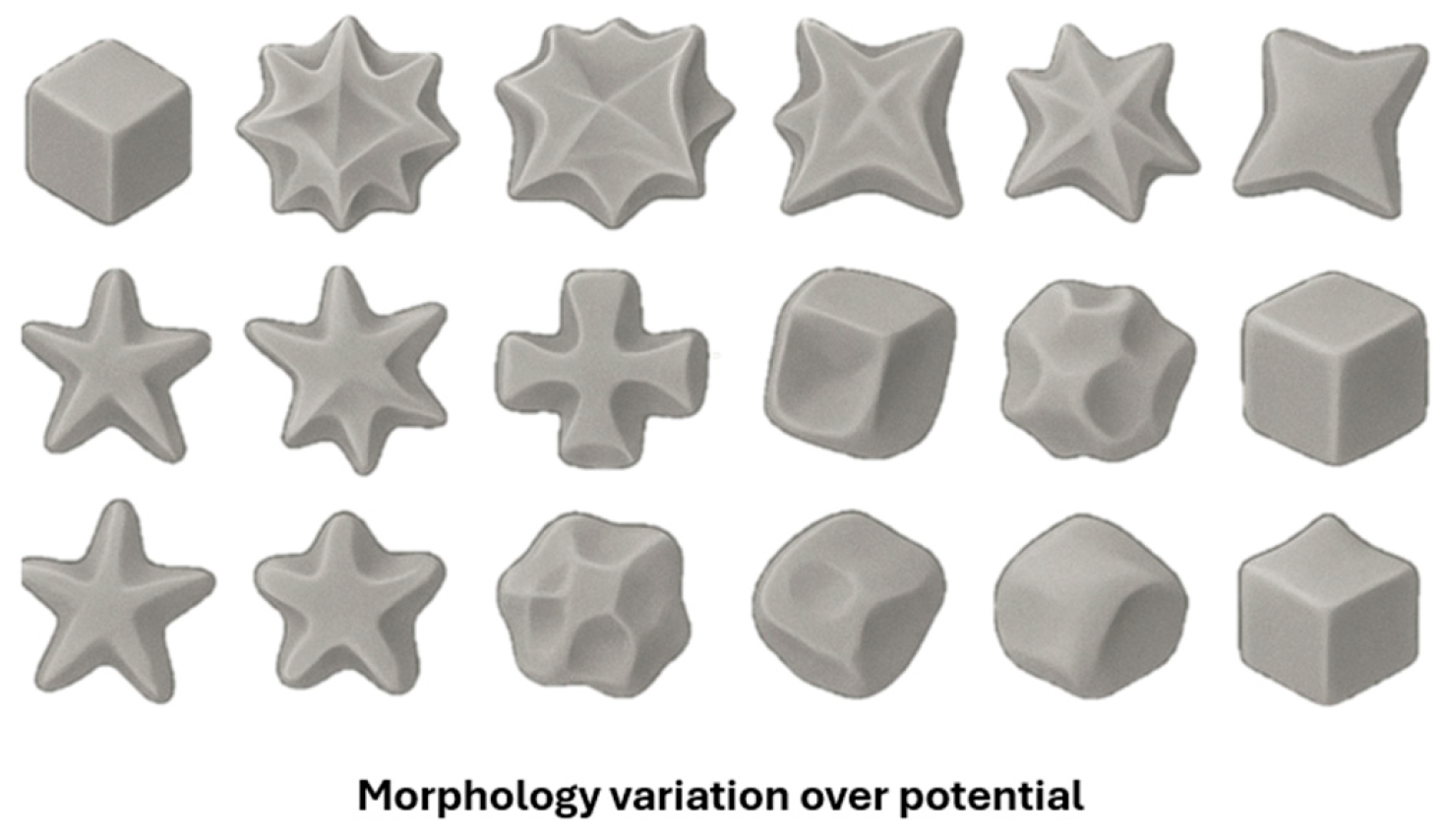
| Au nanocrystals | ChCl-Urea (1:2) | Electrodeposition on GC electrode at different potentials from −0.5 V to −0.95 V | Au NCs with different morphologies based on the applied potential from concave rhombic dodecahedra to concave cubes, octopods, cuboctahedral boxes, and finally, to hollow octahedra with application in D-glucose electrooxidation | [62] |
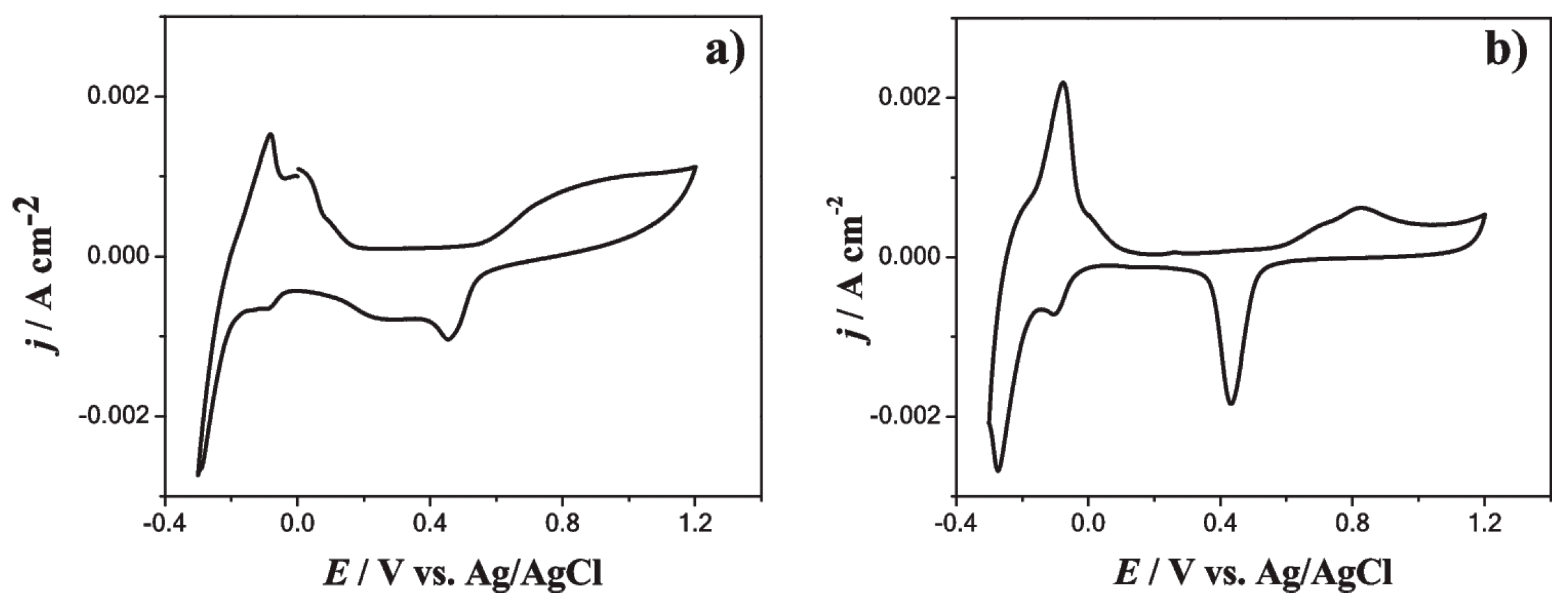
| Ag NPs | ChCl- Ethylene glycol (1:2) | Pulsed electrodeposition from 0.01 M AgCl at −0.5 V (vs. Ag/AgCl) | In situ approach describing the size and structural evolution of Ag NPs after pulse electrodeposition | [109] |
| ChCl-Urea-Glycerol (1:1:1) | Electrodeposition at peak potential | The incorporation of SDS surfactant into DES led to a homogeneous Ag particle distribution. The Ag-SDS-modified electrodes have a wide linear range and low LOD for nitrofurazone detection | [64] | |
| Au and Ag NPs on TiO2 nanotubes | ChCl-Urea (1:2) | Electrodeposition | Au and Ag NPs quasi-spherical with average size of 100 nm, uniformly distributed on TiO2 nanotubes | [65] |
| Pt nanoflowers | ChCl-Urea (1:2) | Cyclic voltammetry and constant potential deposition | Pt NFs with average size of 200 nm with enhanced electrocatalytic activity for ethanol oxidation | [66] |
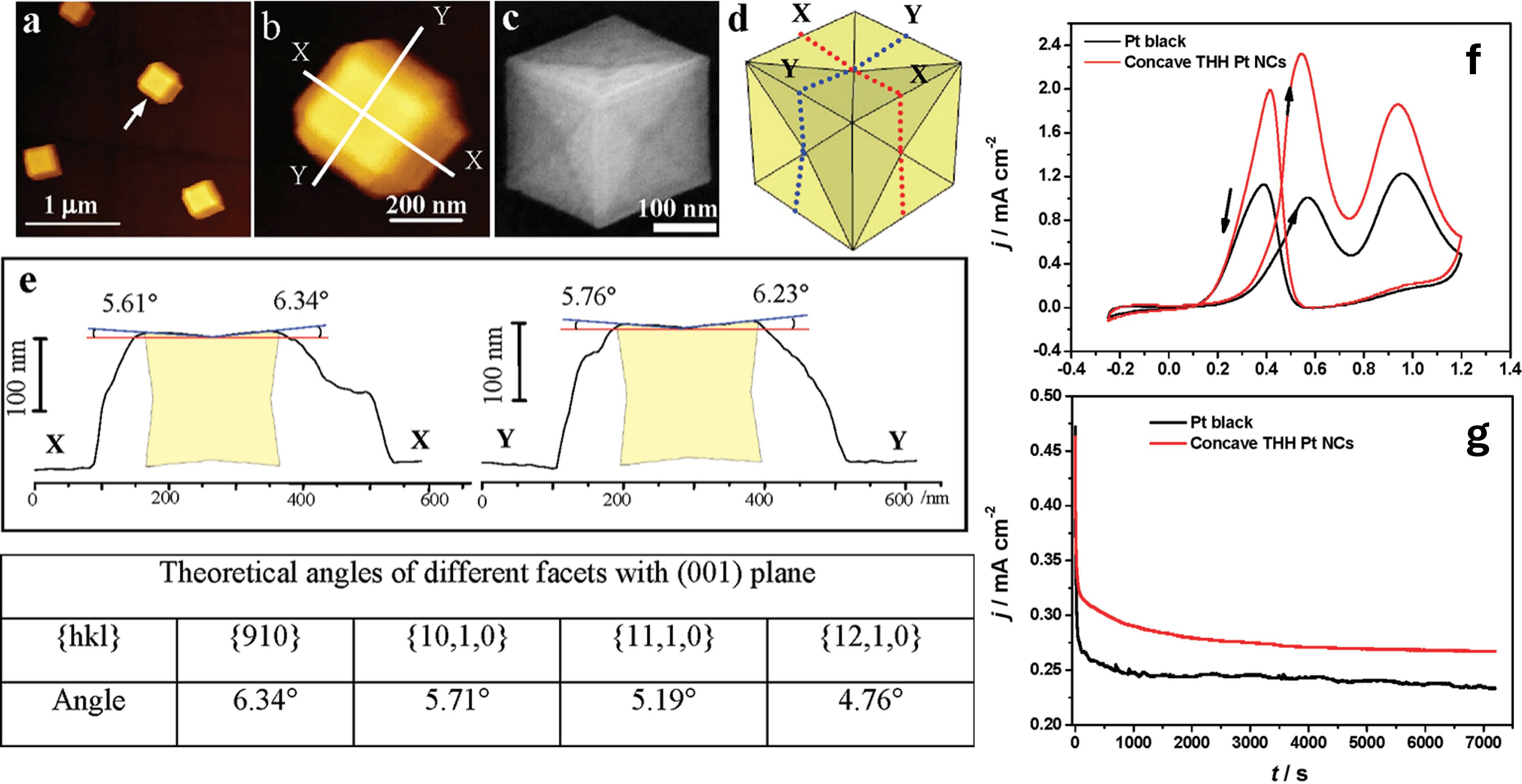
| Concave tetrahexahedral Pt nanocrystals (THH Pt NCs | ChCl-Urea (1:2) | Electrodeposition using a square-wave potential sequence | THH Pt NCs with sized range from 62.5 nm up to 370 nm with enhanced electrocatalytic activity for ethanol oxidation | [67] |
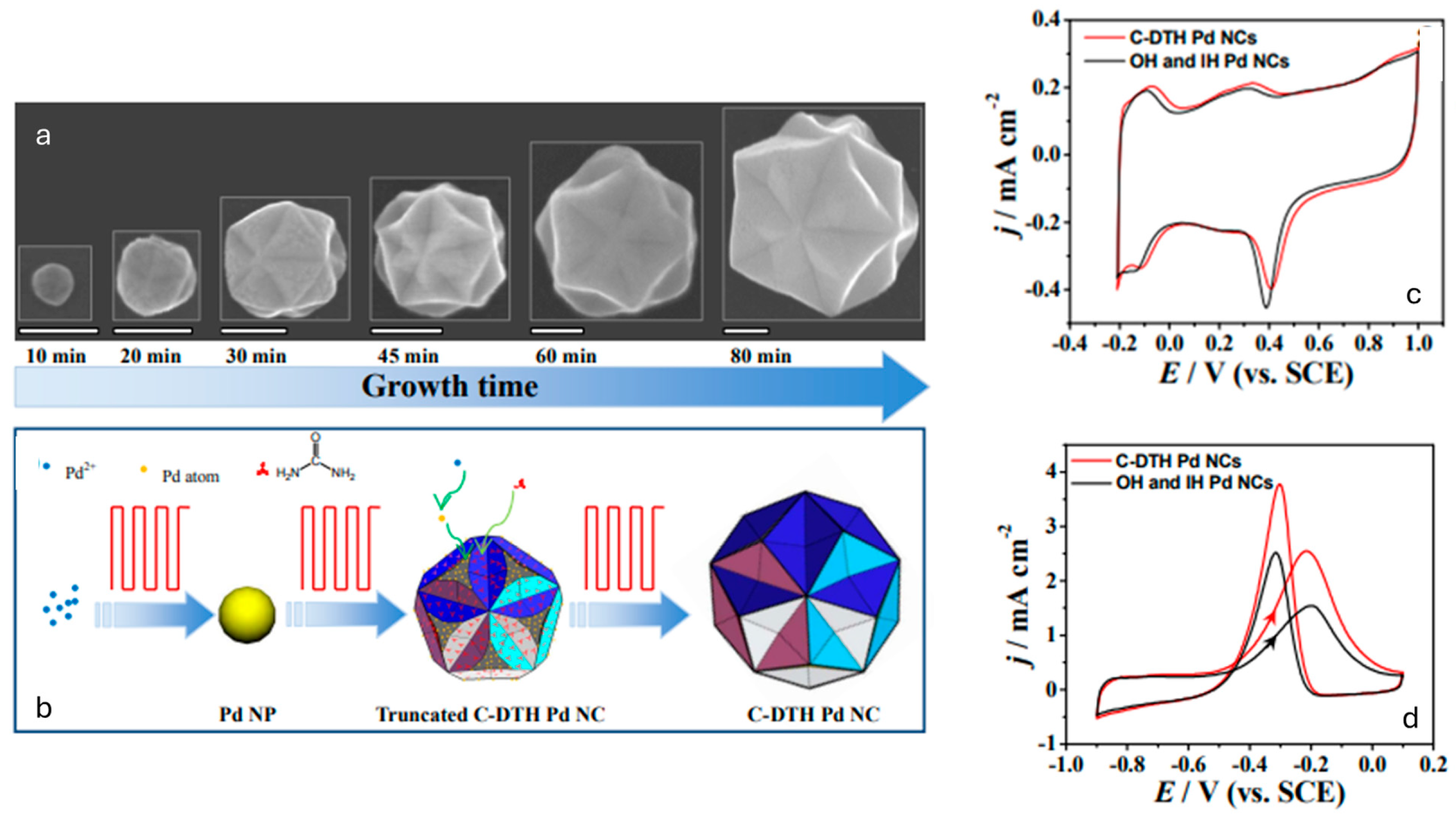
| Pd concave-disdyakis triacontahedral palladium nanocrystals (C-DTH Pd NCs) | ChCl-Urea (1:2) | Electrodeposition using a square-wave potential sequence | C-DTH Pd NCs electrochemically shape controlled with enhanced electrocatalytic activity for ethanol electrooxidation | [68] |
| Pd NPs | ChCl:urea (1:2) | Electrodeposition | In situ approach showing that DES stabilises the electrodeposited Pd NPs | [69] |
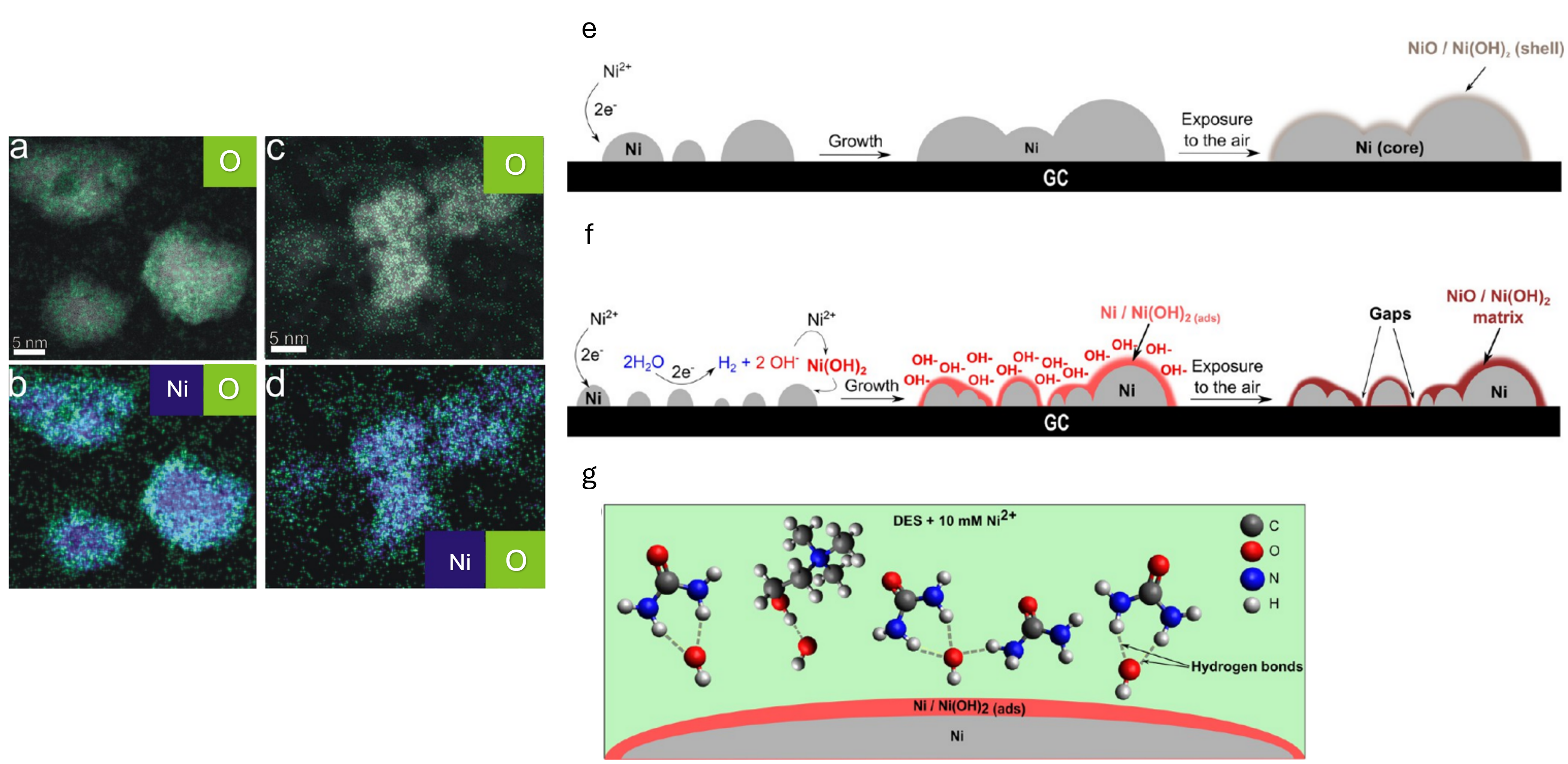
| ChCl:urea (1:2) | Electrodeposition on GC at two overpotentials | The deposition followed a 3D nucleation and diffusion growth with simultaneous reduction of water. PdNPs with Pd0 core and Pd(OH)2 shell. The material showed good electrocatalytic activity for methanol and formic acid oxidation reaction | [70,71,72] | |
| ChCl:Ethylen glycol (1:2) | Electrodeposition on GC | Uniform Pd NPs with sized of ~41 nm uniformly distributed on GC with activity for formic acid electrochemical oxidation | [73] | |
| Ni NPs | ChCl:urea (1:2) | Electrodeposition on GC under potentiostatic conditions | Uniformly distributed Ni NPs with nickel metallic core and a thin layer of Ni(OH)2 | [74,75] |
| Cu NPs | ChCl:urea (1:2) | Electrodeposition under constant potential on stainless steel from Cu2O precursor | The size of the Cu NPs depends on the applied potential, at 2.5 V, Cu NPs with 28 ± 7 nm are formed and at 2.2 V, 57 ± 6 nm | [76] |
| ChCl:urea (1:2) | Electrodeposition under constant potential on nickel foil from Cu2O precursor | Cu NPs with narrow size distribution are obtained at lower temperature (303 K) and large overpotential (−0.80 V). | [77] | |
| ChCl:urea (1:2) | CV and CA studies from CuCl2·2H2O precursor | The mechanism for Cu NPs includes two contributions: 3D nucleation and diffusion-controlled growth + adsorption | [78] | |
| Fe NPs | ChCl:urea (1:2) | CV and CA studies on HOPG | Fe NPs with cauliflower morphology and average size of 60 ± 8 nm. Core of Fe(0) and shell a mixture of FeO, Fe2O3 and Fe(OH)3 | [80] |
| Bi NWs | ChCl: oxalic acid (1:1) | Galvanostatic electrodeposition under DC on Cu substrate | Bi NWs with diameters of 100–120 nm and a 1–1.5 µm length were obtained and used for H2O2 detection | [81] |
| Alloys nanostructures | ||||
| PbS | ChCl-Ethylene glycol (1:2) | Electroreduction of PbS powders at 2.3–2.7 V, 353 K | Pb nanoparticles (160 nm–2 μm, tunable morphology); S NPs (30–65 nm); no SO2 emission; green metallurgy | [85] |
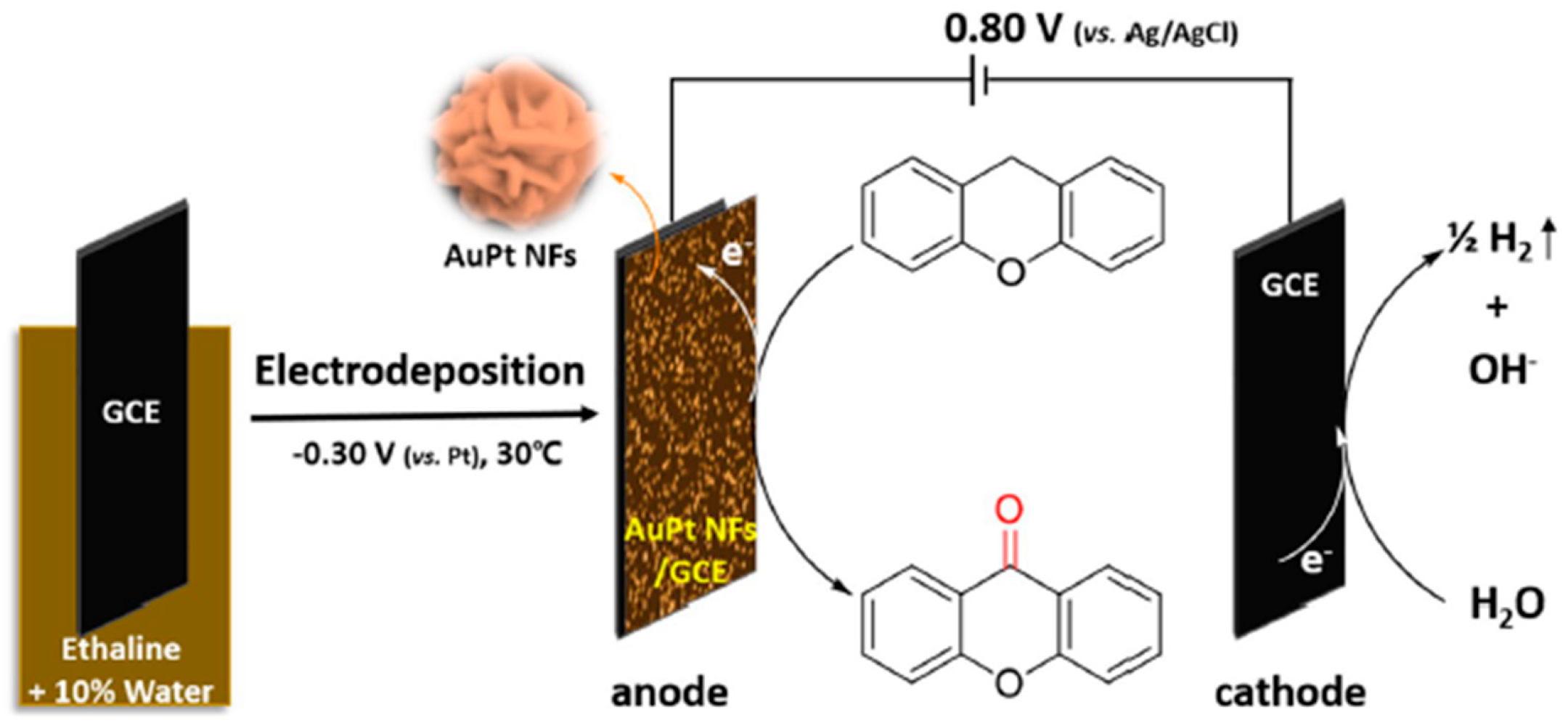
| Au-Pt nanoflowers | ChCl-Ethylene glycol (1:2) + 10% H2O | Electrodeposition at −0.3 V, 30 °C | Nanoflowers (~500 nm); catalytic xanthene oxidation; electroorganic synthesis | [82] |
| Cu-Ag NPs | ChCl-urea (1:2) | Co-deposition at −0.65 to −0.75 V | Porous/spiked nanostructures (200–500 nm); tunable Cu:Ag ratio; high roughness factor; CO2RR, ORR | [83]. |
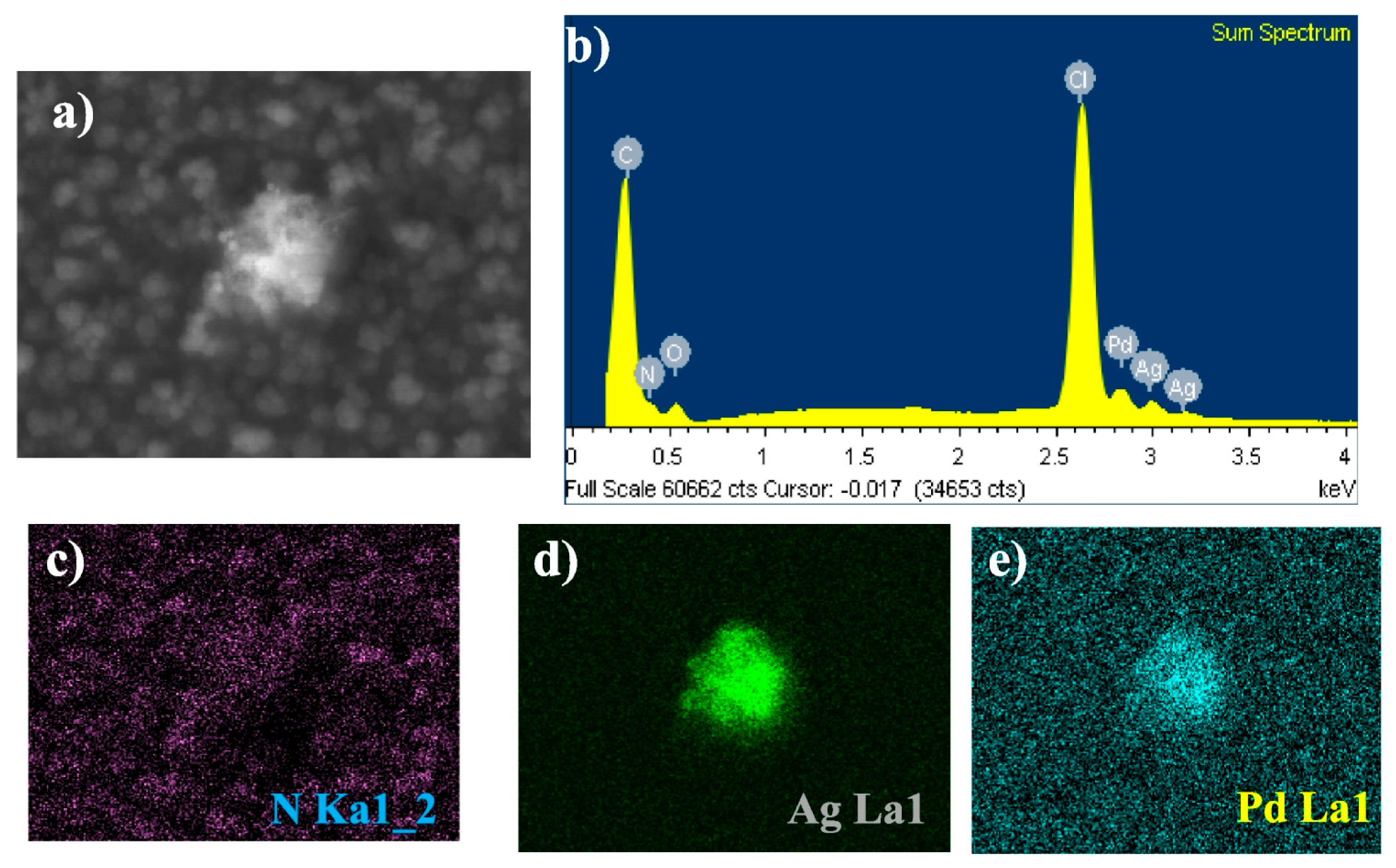
| Pd-Ag NPs | ChCl-Ethylene glycol (1:2) | Electrodeposition on GCE and GCE/Ppy; CV, CA | 50–60 nm alloy NPs; high activity for formic acid oxidation; reduced Pd usage; fuel cells | [84] |
| Pd-Co NPs | ChCl-urea (1:2) | Potentiostatic and potentiodynamic studies | 3D nucleation; alloy NPs; enhanced formic acid oxidation vs. Pd; clean DES synthesis | [86] |
| Sm-Co NWs | ChCl-Urea (1:2) | Galvanostatic electrodeposition on nanoporous alumina templates | Uniform SmCo NWs of 50 nm diameters with hexanonal phase and higher coercivity (350 Oe) | [87] |
| Non-metallic nanostructures | ||||
| Se nanoroads | ChCl-Urea (1:2) | Solid-state electrolysis route | Nanoroads with 157 nm diameters and 2.42 µm length | [88] |
| Oxide nanostructures | ||||
| Fe3O4 NPs | ChCl-Choline phosphate-Urea | Electrolysis of Fe electrodes in DES; radical-assisted nucleation | 6–9 nm γ-Fe2O3 NPs; amino-functionalized, stable > 600 days; magnetization 72 emu/g; MRI, drug delivery | [89] |
| ZnO NPs | ChCl-EG and ChCl-oxalic acid (emulsion DES) | Electrodeposition with aniline additive; CV and CA studies | 27–52 nm ZnO; bandgap 2.98–3.06 eV; improved dispersion; photocatalysis and sensing | [90] |
| ChCl: Urea | Anodic dissolution of Zn metallic strips | Spherical nanoparticles with sizes between 15 and 31 nm and crystalline hexagonal wurtzite structure | [91] | |
| TiO2 NPs | ChCl: Ethylene glycol and ChCl: Urea | Anodic dissolution of Ti metallic strip | Anatase TiO2 nanoparticles with diameters between 10 and 20 nm with application in the photodegradation of methyl orange II dye (95.5% efficiency in UV light) | [92] |
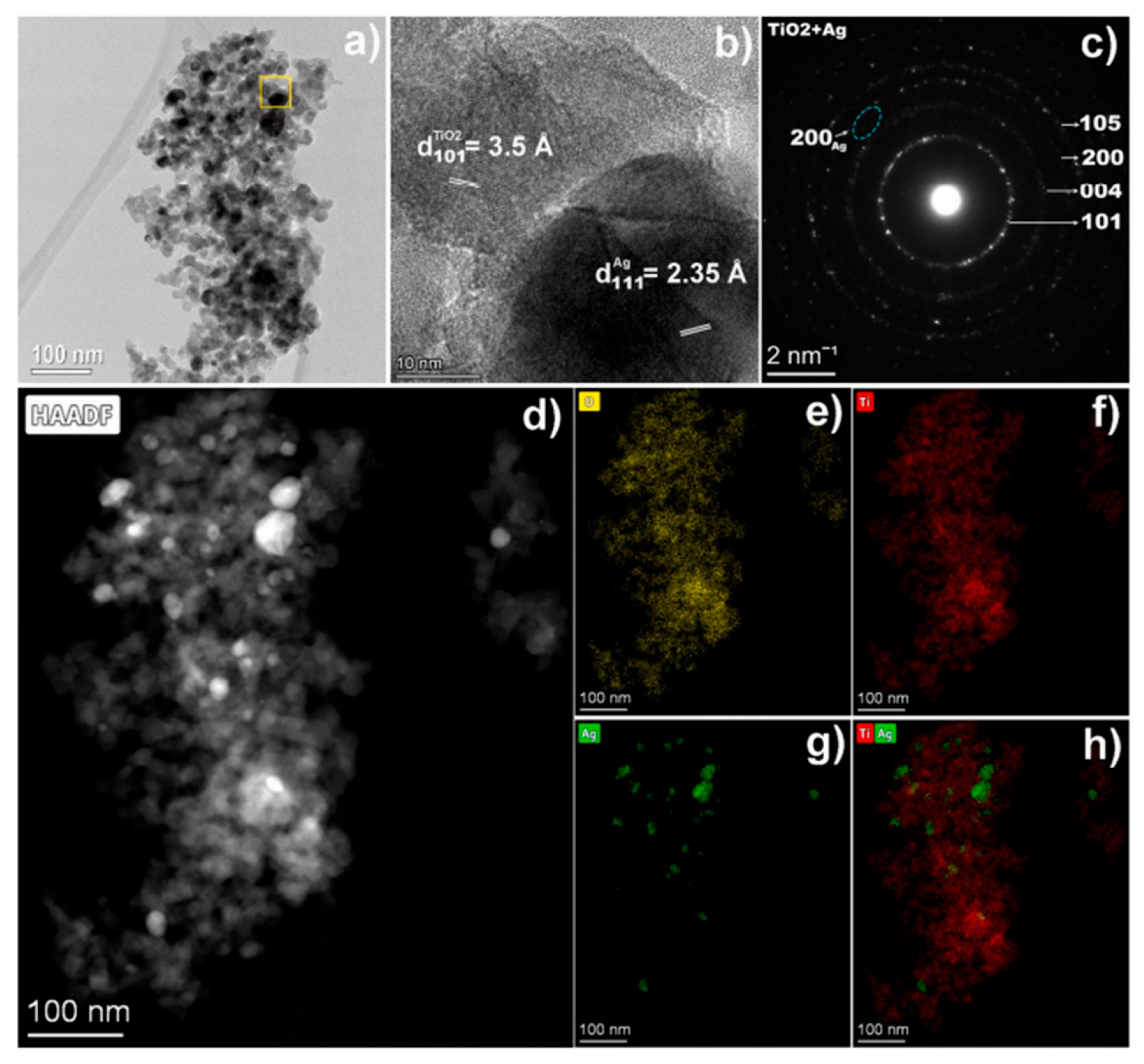
| Ag-TiO2 NPs | ChCl: Ethylene glycol (1:2) | Pulsed reverse current electrodeposition | Spherical Ag NPs with sizes 10–35 nm distributed on agglomerated TiO2 NPs, photodegradation efficiency for methyle orange dye (60.2 under visible light) and antibacterial activity against E. coli and B. subtilis | [93] |
| TiO2 nanotubular layers (TNT) | ChCl mixtures with ethylene glycol (1:2), urea (1:2) and malonic acid 1:1) | Electrochemical anodization of titanium plates in DES with NH4F (0.2–0.75 wt.%) and water (1.79 wt%) | Nanotubes with interpore distance between 65 and 110 nm, and wall thickness of 10 nm. The pore length depends on the electrolyte viscosities (2.1 to 2.6 µm) | [94] |
| TiO2 nanobamboos (NBs) | ChCl: succinic acid (1:1) | Electrochemical anodization of titanium foil in aqueous NH4F electrolyte with 2–10% DES | Nanotubes decorated with periodic exterior rings (NBs) with diameters of 40/65 nm (inner/outer), and rings width of 80 nm and thickness of 10 nm | [95] |
| Carbon-based nanostructure composites | ||||
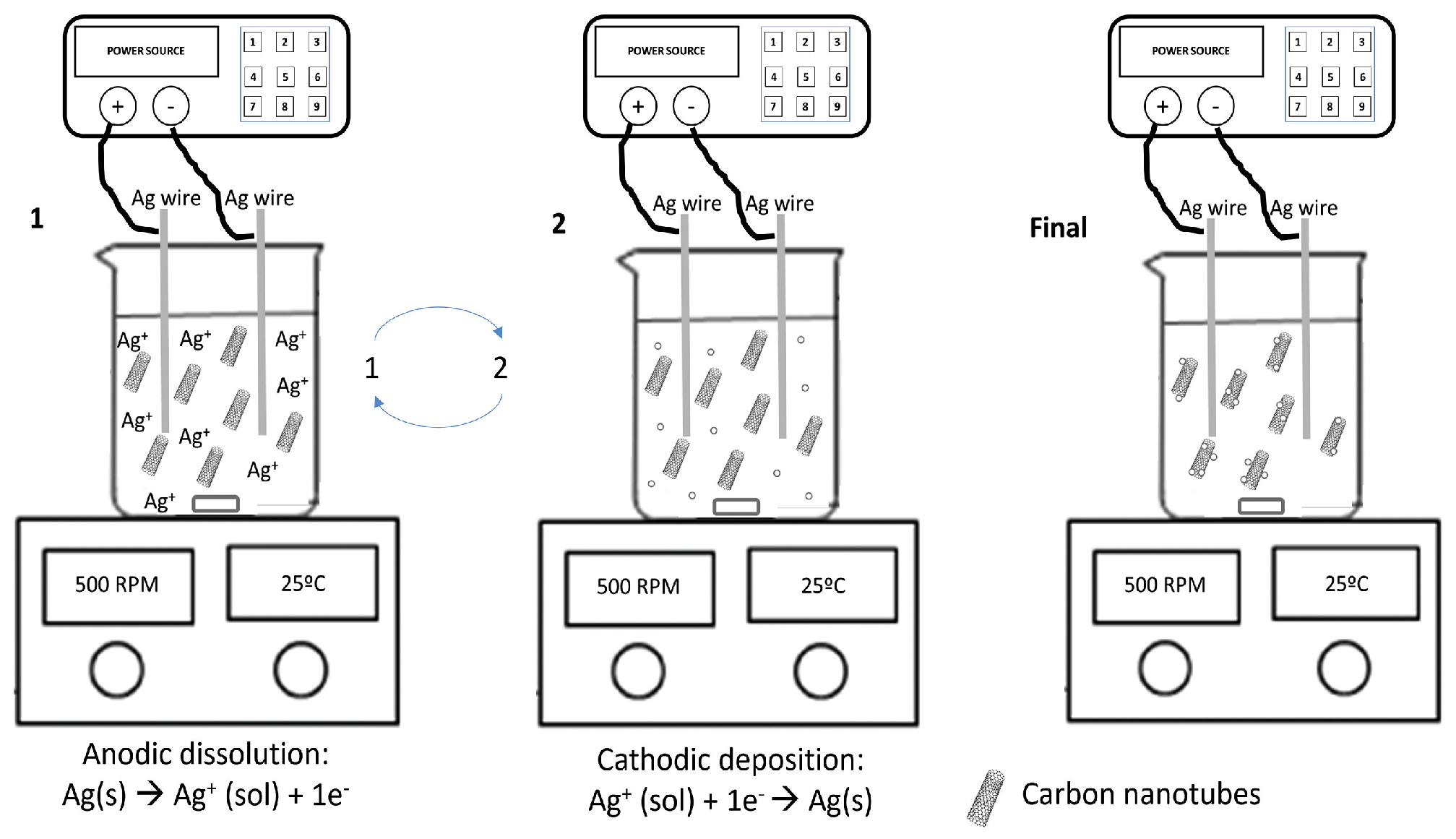
| Ag-MWCNT | ChCl-Glycerol (glyceline) | Pulse-reverse electrodeposition, Ag wire; CV, CA studies | Uniform Ag NP decoration; improved dispersion stability (25× vs. CNTs); capacitance 28.5 F/g; stable sensing and supercapacitor electrodes | [96] |
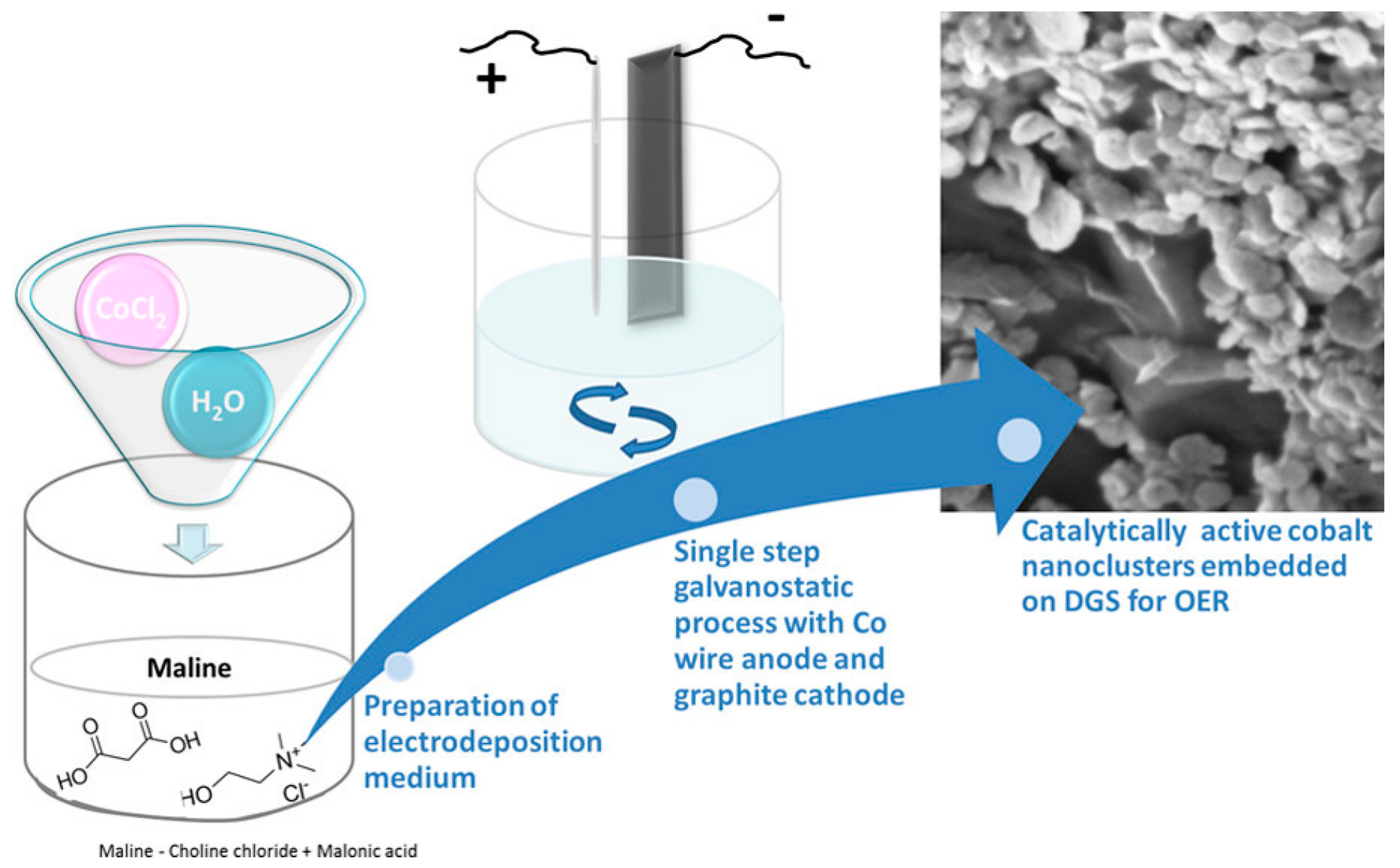
| Co nanoclusters on graphite sheets | ChCl: malonic acid (1:1) + water (20%) | Single-step galvanostatic electrodeposition with Co wire anode and graphite cathode | The presence of water in DES facilitates the formation of Co nanoparticle cluster from 20 to 90 nm; application in the oxygen evolution reaction (350 mV overpotential) | [99] |
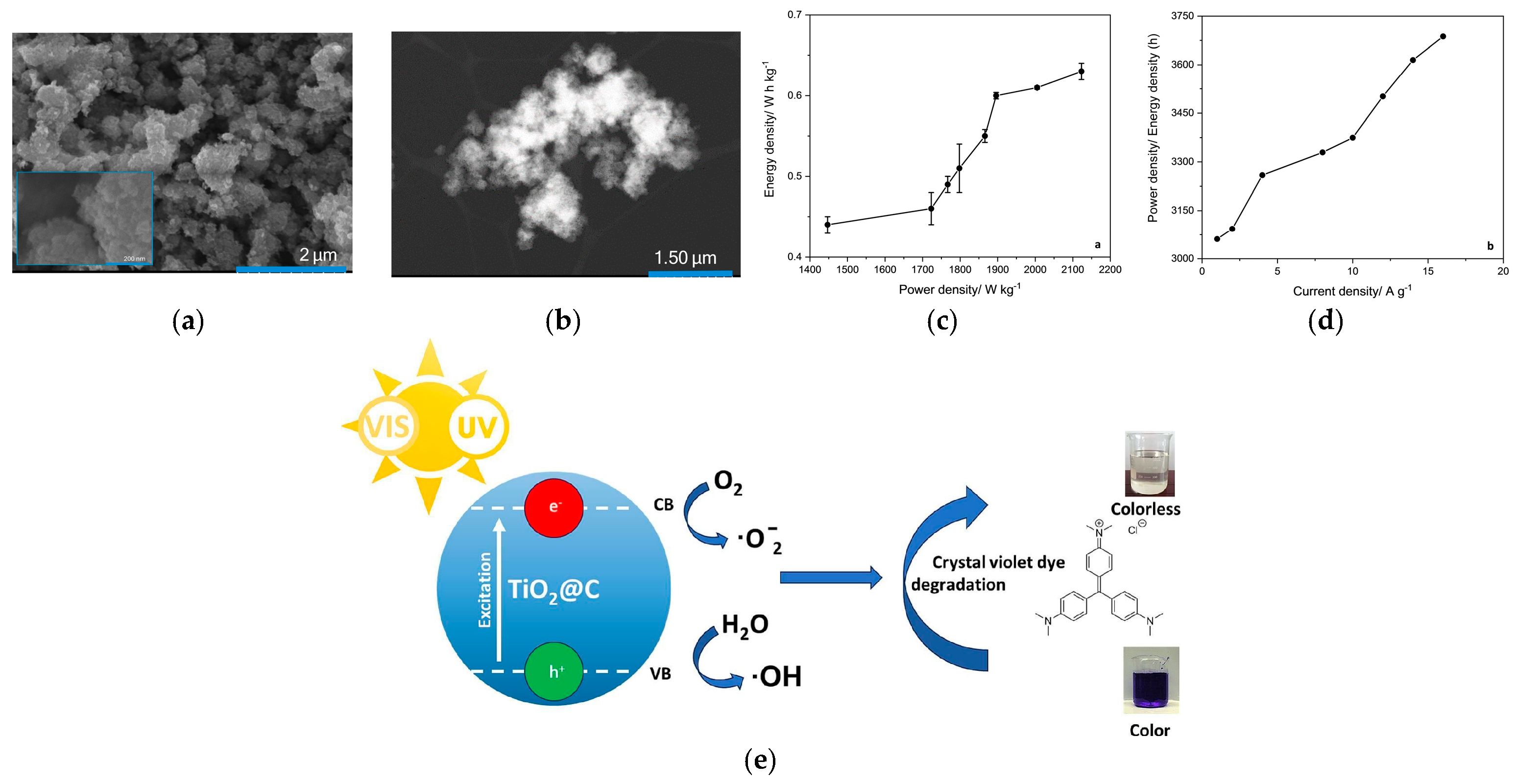
| TiO2-biomass-derived carbon | ChCl-Ethylene glycol (ethaline) | Anodization of Ti in DES; in situ vs. ex situ decoration on glycogen-derived carbon | High surface area (2214 m2/g); capacitance up to 1251 F/g; 98% dye degradation; supercapacitors and photocatalysis | [100] |
| ChCl: Urea | Anodic dissolution of Zn metallic strips | Spherical nanoparticles with sizes between 15 and 31 nm and crystalline hexagonal wurtzite structure | [91] | |
Author Contributions
Funding
Data Availability Statement
Conflicts of Interest
References
- Baig, N.; Kammakakam, I.; Falath, W. Nanomaterials: A Review of Synthesis Methods, Properties, Recent Progress, and Challenges. Mater. Adv. 2021, 2, 1821–1871. [Google Scholar] [CrossRef]
- Khan, W.U. Nanomaterials in Catalysis. In Handbook of Nanomaterials; Elsevier: Amsterdam, The Netherlands, 2024; Volume 1, pp. 393–420. [Google Scholar]
- Mohammed, H.; Mia, M.F.; Wiggins, J.; Desai, S. Nanomaterials for Energy Storage Systems—A Review. Molecules 2025, 30, 883. [Google Scholar] [CrossRef]
- Pomerantseva, E.; Bonaccorso, F.; Feng, X.; Cui, Y.; Gogotsi, Y. Energy Storage: The Future Enabled by Nanomaterials. Science 2019, 366, eaan8285. [Google Scholar] [CrossRef]
- Chauhan, S.; Tirkey, A.; Upadhyay, L.S.B. Nanomaterials in Biomedicine: Synthesis and Applications. In Advances in Nanotechnology-Based Drug Delivery Systems; Elsevier: Amsterdam, The Netherlands, 2022; pp. 585–604. [Google Scholar]
- Diez-Pascual, A.M.; Rahdar, A. Functional Nanomaterials in Biomedicine: Current Uses and Potential Applications. ChemMedChem 2022, 17, e202200142. [Google Scholar] [CrossRef]
- Guerra, F.D.; Attia, M.F.; Whitehead, D.C.; Alexis, F. Nanotechnology for Environmental Remediation: Materials and Applications. Molecules 2018, 23, 1760. [Google Scholar] [CrossRef]
- Roy, A.; Sharma, A.; Yadav, S.; Jule, L.T.; Krishnaraj, R. Nanomaterials for Remediation of Environmental Pollutants. Bioinorg. Chem. Appl. 2021, 2021, 1764647. [Google Scholar] [CrossRef]
- Hachem, K.; Ansari, M.J.; Saleh, R.O.; Kzar, H.H.; Al-Gazally, M.E.; Altimari, U.S.; Hussein, S.A.; Mohammed, H.T.; Hammid, A.T.; Kianfar, E. Methods of Chemical Synthesis in the Synthesis of Nanomaterial and Nanoparticles by the Chemical Deposition Method: A Review. Bionanoscience 2022, 12, 1032–1057. [Google Scholar] [CrossRef]
- Walden, P. Molecular Weights and Electrical Conductivity of Several Fused Salts. Bull. Acad. Imper. Sci. 1914, 8, 405–422. [Google Scholar]
- Lei, Z.; Chen, B.; Koo, Y.M.; Macfarlane, D.R. Introduction: Ionic Liquids. Chem. Rev. 2017, 117, 6633–6635. [Google Scholar] [CrossRef]
- Yata, V.K.; Ranjan, S.; Dasgupta, N.; Lichtfouse, E. Nano-Pharmaceuticals: Principles and Applications; Springer Nature: Cham, Switzerland, 2021; Volume 1, ISBN 9783540228608. [Google Scholar]
- Kianfar, E.; Mafi, S. Ionic Liquids: Properties, Application, and Synthesis. Fine Chem. Eng. 2020, 2, 21–29. [Google Scholar] [CrossRef]
- Mohammed, K.J.; Hadrawi, S.K.; Kianfar, E. Synthesis and Modification of Nanoparticles with Ionic Liquids: A Review. Bionanoscience 2023, 13, 760–783. [Google Scholar]
- Lebedeva, O.; Kultin, D.; Kustov, L. Electrochemical Synthesis of Unique Nanomaterials in Ionic Liquids. Nanomaterials 2021, 11, 3270. [Google Scholar] [CrossRef]
- Hammond, O.S.; Mudring, A.-V. Ionic Liquids and Deep Eutectics as a Transformative Platform for the Synthesis of Nanomaterials. Chem. Commun. 2022, 58, 3865–3892. [Google Scholar] [CrossRef]
- Corchero, R.; Rodil, R.; Soto, A.; Rodil, E. Nanomaterial Synthesis in Ionic Liquids and Their Use on the Photocatalytic Degradation of Emerging Pollutants. Nanomaterials 2021, 11, 411. [Google Scholar] [CrossRef]
- Richter, K.; Campbell, P.S.; Baecker, T.; Schimitzek, A.; Yaprak, D.; Mudring, A. Ionic Liquids for the Synthesis of Metal Nanoparticles. Phys. Status Solidi (B) 2013, 250, 1152–1164. [Google Scholar] [CrossRef]
- Simka, W.; Puszczyk, D.; Nawrat, G. Electrodeposition of Metals from Non-Aqueous Solutions. Electrochim. Acta 2009, 54, 5307–5319. [Google Scholar] [CrossRef]
- Andruch, V. Deep Eutectic Solvents vs Ionic Liquids: Similarities and Differences. Microchem. J. 2020, 159, 105539. [Google Scholar] [CrossRef]
- Bernasconi, R.; Panzeri, G.; Accogli, A.; Liberale, F.; Nobili, L.; Magagnin, L. Electrodeposition from Deep Eutectic Solvents. In Progress and Developments in Ionic Liquids; IntechOpen: London, UK, 2017; pp. 235–261. [Google Scholar] [CrossRef]
- Abbott, A.P.; Dalrymple, J.; Endres, F.; MacFarlane, D.R. Why Use Ionic Liquids for Electrodeposition? In Electrodeposition from Ionic Liquids; Wiley: Hoboken, NJ, USA, 2017; pp. 1–15. [Google Scholar] [CrossRef]
- van den Bruinhorst, A.; Corsini, C.; Depraetère, G.; Cam, N.; Pádua, A.; Costa Gomes, M. Deep Eutectic Solvents on a Tightrope: Balancing the Entropy and Enthalpy of Mixing. Faraday Discuss. 2024, 253, 273–288. [Google Scholar] [CrossRef]
- Xu, P.; Zheng, G.W.; Zong, M.H.; Li, N.; Lou, W.Y. Recent Progress on Deep Eutectic Solvents in Biocatalysis. Bioresour. Bioprocess 2017, 4, 34. [Google Scholar] [CrossRef]
- Khandelwal, S.; Tailor, Y.K.; Kumar, M. Deep Eutectic Solvents (DESs) as Eco-Friendly and Sustainable Solvent/Catalyst Systems in Organic Transformations. J. Mol. Liq. 2016, 215, 345–386. [Google Scholar] [CrossRef]
- Radošević, K.; Cvjetko Bubalo, M.; Gaurina Srček, V.; Grgas, D.; Landeka Dragičević, T.; Redovniković, R.I. Evaluation of Toxicity and Biodegradability of Choline Chloride Based Deep Eutectic Solvents. Ecotoxicol. Environ. Saf. 2015, 112, 46–53. [Google Scholar] [CrossRef]
- Juneidi, I.; Hayyan, M.; Mohd Ali, O. Toxicity Profile of Choline Chloride-Based Deep Eutectic Solvents for Fungi and Cyprinus Carpio Fish. Environ. Sci. Pollut. Res. 2016, 23, 7648–7659. [Google Scholar] [CrossRef]
- Hansen, B.B.; Spittle, S.; Chen, B.; Poe, D.; Zhang, Y.; Klein, J.M.; Horton, A.; Adhikari, L.; Zelovich, T.; Doherty, B.W.; et al. Deep Eutectic Solvents: A Review of Fundamentals and Applications. Chem. Rev. 2021, 121, 1232–1285. [Google Scholar] [CrossRef]
- Sharma, A.; Garg, A.; Li, L.; Chatterjee, I.; Lee, B.; Garg, A. Machine Learning for Deep Eutectic Solvents: Advances in Property Prediction and Molecular Design. J. Mol. Liq. 2025, 437, 128317. [Google Scholar] [CrossRef]
- Omar, K.A.; Sadeghi, R. Physicochemical Properties of Deep Eutectic Solvents: A Review. J. Mol. Liq. 2022, 360, 119524. [Google Scholar] [CrossRef]
- Han, K.N.; Kim, R.; Kim, J. Recent Advancements in Hydrometallurgy: Solubility and Separation. Trans. Indian Inst. Met. 2024, 77, 4241–4253. [Google Scholar] [CrossRef]
- Lide, D.R.; Baysinger, G.; Berger, L.I.; Goldberg, R.N.; Kehiaian, H.V.; Kuchitsu, K.; Roth, D.L.; Zwillinger, D. CRC Handbook of Chemistry and Physics; CRC Press: Boca Raton, FL, USA, 2016. [Google Scholar]
- Abbott, A.P.; Capper, G.; Davies, D.L.; Munro, H.L.; Rasheed, R.K. Preparation of Novel, Moisture-Stable, Lewis-Acidic Ionic Liquids Containing Quaternary Ammonium Salts with Functional Side Chains. Chem. Commun. 2011, 2010–2011. [Google Scholar] [CrossRef]
- Abbott, A.P.; Barron, J.C.; Ryder, K.S.; Wilson, D. Eutectic-Based Ionic Liquids with Metal-Containing Anions and Cations. Chem. A Eur. J. 2007, 13, 6495–6501. [Google Scholar] [CrossRef]
- Sugiarto, S.; Aloka Weerasinghe, U.; Kinyanjui Muiruri, J.; Yu Qing Chai, A.; Chee Chuan Yeo, J.; Wang, G.; Zhu, Q.; Jun Loh, X.; Li, Z.; Kai, D. Nanomaterial Synthesis in Deep Eutectic Solvents. Chem. Eng. J. 2024, 499, 156177. [Google Scholar] [CrossRef]
- Chiorcea-Paquim, A.-M.; Brett, C.M.A. Electrodeposition in Deep Eutectic Solvents: Perspectives towards Advanced Corrosion Protection. Appl. Mater. Today 2025, 44, 102746. [Google Scholar] [CrossRef]
- Abbott, A.P.; Capper, G.; Davies, D.L.; Rasheed, R.K.; Tambyrajah, V. Novel Solvent Properties of Choline Chloride/Urea Mixtures. Chem. Commun. 2003, 39, 70–71. [Google Scholar] [CrossRef]
- Abbott, A.P.; Boothby, D.; Capper, G.; Davies, D.L.; Rasheed, R.K. Deep Eutectic Solvents Formed between Choline Chloride and Carboxylic Acids: Versatile Alternatives to Ionic Liquids. J. Am. Chem. Soc. 2004, 126, 9142–9147. [Google Scholar] [CrossRef]
- Abbott, A.P.; Harris, R.C.; Hsieh, Y.T.; Ryder, K.S.; Sun, I.W. Aluminium Electrodeposition under Ambient Conditions. Phys. Chem. Chem. Phys. 2014, 16, 14675–14681. [Google Scholar] [CrossRef]
- Abbott, A.P.; Al-Barzinjy, A.A.; Abbott, P.D.; Frisch, G.; Harris, R.C.; Hartley, J.; Ryder, K.S. Speciation, Physical and Electrolytic Properties of Eutectic Mixtures Based on CrCl3·6H2O and Urea. Phys. Chem. Chem. Phys. 2014, 16, 9047–9055. [Google Scholar] [CrossRef]
- Zamora, L.; Benito, C.; Gutiérrez, A.; Alcalde, R.; Alomari, N.; Al Bodour, A.; Atilhan, M.; Aparicio, S. Nanostructuring and Macroscopic Behavior of Type V Deep Eutectic Solvents Based on Monoterpenoids. Phys. Chem. Chem. Phys. 2022, 24, 512–531. [Google Scholar] [CrossRef]
- Abranches, D.O.; Martins, M.A.R.; Silva, L.P.; Schaeffer, N.; Pinho, S.P.; Coutinho, J.A.P. Phenolic Hydrogen Bond Donors in the Formation of Non-Ionic Deep Eutectic Solvents: The Quest for Type V DES. Chem. Commun. 2019, 55, 10253–10256. [Google Scholar] [CrossRef]
- Liu, Y.; Friesen, J.B.; McAlpine, J.B.; Lankin, D.C.; Chen, S.-N.; Pauli, G.F. Natural Deep Eutectic Solvents: Properties, Applications, and Perspectives. J. Nat. Prod. 2018, 81, 679–690. [Google Scholar] [CrossRef]
- Chevé-Kools, E.; Choi, Y.H.; Roullier, C.; Ruprich-Robert, G.; Grougnet, R.; Chapeland-Leclerc, F.; Hollmann, F. Natural Deep Eutectic Solvents (NaDES): Green Solvents for Pharmaceutical Applications and Beyond. Green Chem. 2025, 27, 8360–8385. [Google Scholar] [CrossRef] [PubMed]
- Abdelquader, M.M.; Li, S.; Andrews, G.P.; Jones, D.S. Therapeutic Deep Eutectic Solvents: A Comprehensive Review of Their Thermodynamics, Microstructure and Drug Delivery Applications. Eur. J. Pharm. Biopharm. 2023, 186, 85–104. [Google Scholar] [CrossRef]
- Javed, S.; Mangla, B.; Sultan, M.H.; Almoshari, Y.; Sivadasan, D.; Alqahtani, S.S.; Madkhali, O.A.; Ahsan, W. Pharmaceutical Applications of Therapeutic Deep Eutectic Systems (THEDES) in Maximising Drug Delivery. Heliyon 2024, 10, e29783. [Google Scholar] [CrossRef]
- López-Salas, N.; Carriazo, D.; Gutiérrez, M.C.; Ferrer, M.L.; Ania, C.O.; Rubio, F.; Tamayo, A.; Fierro, J.L.G.; del Monte, F. Tailoring the Textural Properties of Hierarchical Porous Carbons Using Deep Eutectic Solvents. J. Mater. Chem. A Mater. 2016, 4, 9146–9159. [Google Scholar] [CrossRef]
- Azzouz, A.; Hayyan, M. Potential Applications of Deep Eutectic Solvents in Nanotechnology: Part II. Chem. Eng. J. 2023, 468, 143563. [Google Scholar] [CrossRef]
- Nam, N.N.; Do, H.D.K.; Trinh, K.T.L.; Lee, N.Y. Design Strategy and Application of Deep Eutectic Solvents for Green Synthesis of Nanomaterials. Nanomaterials 2023, 13, 1164. [Google Scholar] [CrossRef]
- Hammond, O.S.; Eslava, S.; Smith, A.J.; Zhang, J.; Edler, K.J. Microwave-Assisted Deep Eutectic-Solvothermal Preparation of Iron Oxide Nanoparticles for Photoelectrochemical Solar Water Splitting. J. Mater. Chem. A Mater. 2017, 5, 16189–16199. [Google Scholar] [CrossRef]
- Hammond, O.S.; Edler, K.J.; Bowron, D.T.; Torrente-Murciano, L. Deep Eutectic-Solvothermal Synthesis of Nanostructured Ceria. Nat. Commun. 2017, 8, 14150. [Google Scholar] [CrossRef]
- dos Santos, L.P.M.; Freire, R.M.; Michea, S.; Denardin, J.C.; Araújo, D.B.; Barros, E.B.; Correia, A.N.; de Lima-Neto, P. Electrodeposition of 1-D Tellurium Nanostructure on Gold Surface from Choline Chloride-Urea and Choline Chloride-Ethylene Glycol Mixtures. J. Mol. Liq. 2019, 288, 111038. [Google Scholar] [CrossRef]
- Iino, H.; Yamauchi, N.; Nakashima, K.; Watanabe, K.; Koda, H.; Kunigami, H.; Kunigami, H.; Kobayashi, Y. Electrolytic Synthesis of Metallic Zinc Nanoparticles. J. Nanoparticle Res. 2021, 23, 46. [Google Scholar] [CrossRef]
- Su, C.-J.; Hsieh, Y.-T.; Chen, C.-C.; Sun, I.-W. Electrodeposition of Aluminum Wires from the Lewis Acidic AlCl3/Trimethylamine Hydrochloride Ionic Liquid without Using a Template. Electrochem. Commun. 2013, 34, 170–173. [Google Scholar] [CrossRef]
- Prabhune, A.; Dey, R. Green and Sustainable Solvents of the Future: Deep Eutectic Solvents. J. Mol. Liq. 2023, 379, 121676. [Google Scholar] [CrossRef]
- Verma, S.; Saini, K.; Maken, S. Deep Eutectic Solvents: A Long–Term Approach to Chemical Synthesis and Separation. J. Mol. Liq. 2024, 393, 123605. [Google Scholar] [CrossRef]
- Smith, E.L.; Abbott, A.P.; Ryder, K.S. Deep Eutectic Solvents (DESs) and Their Applications. Chem. Rev. 2014, 114, 11060–11082. [Google Scholar] [CrossRef]
- Al-Esary, H. Influence of Additives on Electrodeposition of Metals from Deep Eutectic Solvents. Ph.D. Thesis, University of Leicester, Leicester, UK, 2017. [Google Scholar]
- Ponce, S.; Murillo, H.A.; Alexis, F.; Alvarez-Barreto, J.; Mora, J.R. Green Synthesis of Nanoparticles Mediated by Deep Eutectic Solvents and Their Applications in Water Treatment. Sustainability 2023, 15, 9703. [Google Scholar] [CrossRef]
- Długosz, O. Natural Deep Eutectic Solvents in the Synthesis of Inorganic Nanoparticles. Materials 2023, 16, 627. [Google Scholar] [CrossRef] [PubMed]
- Trang, N.T.K.; Phuong, T.D.V.; Nguyet, N.T.; Dien, N.D.; Van, H.N.; Van Thu, V.; Tran, M.T.; Pham Hung, V.; Tam, P.D. Deep Eutectic Solvent-Assisted Synthesis of Gold Nanoflowers Supported on Glassy Carbon Electrode for DNA Sensor Application. Curr. Appl. Phys. 2024, 63, 32–40. [Google Scholar] [CrossRef]
- Wei, L.; Lu, B.; Sun, M.; Tian, N.; Zhou, Z.; Xu, B.; Zhao, X.; Sun, S. Overpotential-Dependent Shape Evolution of Gold Nanocrystals Grown in a Deep Eutectic Solvent. Nano Res. 2016, 9, 3547–3557. [Google Scholar] [CrossRef]
- Cojocaru, A.; Brincoveanu, O.; Pantazi, A.G.; Balan, D.R.; Enachescu, M.; Visan, T.; Anicai, L. Electrochemical Preparation of Ag Nanoparticles Involving Choline Chloride—Glycerol Deep Eutectic Solvents. Bulg. Chem. Commun. 2017, 49, 194–204. [Google Scholar]
- Lu, Y.-S.; Pan, W.-Y.; Hung, T.-C.; Hsieh, Y.-T. Electrodeposition of Silver in a Ternary Deep Eutectic Solvent and the Electrochemical Sensing Ability of the Ag-Modified Electrode for Nitrofurazone. Langmuir 2020, 36, 11358–11365. [Google Scholar] [CrossRef]
- Morales-Gil, P.; de Oca-Yemha, M.G.M.; Pérez-Cruz, F.; Romero-Romo, M.; Ramírez-Silva, M.T.; Aldana-González, J.; Pardavé, M.P. Electrodeposition of Gold and Silver Nanoparticles onto TiO2 Nanotubes Anodically Formed on Ti Using Reline Deep Eutectic Solvent. J. Mol. Liq. 2023, 386, 122499. [Google Scholar] [CrossRef]
- Wei, L.; Fan, Y.-J.; Wang, H.-H.; Tian, N.; Zhou, Z.-Y.; Sun, S.-G. Electrochemically Shape-Controlled Synthesis in Deep Eutectic Solvents of Pt Nanoflowers with Enhanced Activity for Ethanol Oxidation. Electrochim. Acta 2012, 76, 468–474. [Google Scholar] [CrossRef]
- Wei, L.; Fan, Y.-J.; Tian, N.; Zhou, Z.-Y.; Zhao, X.-Q.; Mao, B.-W.; Sun, S.-G. Electrochemically Shape-Controlled Synthesis in Deep Eutectic Solvents—A New Route to Prepare Pt Nanocrystals Enclosed by High-Index Facets with High Catalytic Activity. J. Phys. Chem. C 2012, 116, 2040–2044. [Google Scholar] [CrossRef]
- Wei, L.; Xu, C.-D.; Huang, L.; Zhou, Z.-Y.; Chen, S.-P.; Sun, S.-G. Electrochemically Shape-Controlled Synthesis of Pd Concave-Disdyakis Triacontahedra in Deep Eutectic Solvent. J. Phys. Chem. C 2016, 120, 15569–15577. [Google Scholar] [CrossRef]
- Hammons, J.A.; Muselle, T.; Ustarroz, J.; Tzedaki, M.; Raes, M.; Hubin, A.; Terryn, H. Stability, Assembly, and Particle/Solvent Interactions of Pd Nanoparticles Electrodeposited from a Deep Eutectic Solvent. J. Phys. Chem. C 2013, 117, 14381–14389. [Google Scholar] [CrossRef]
- Juárez-Marmolejo, L.; Maldonado-Teodocio, B.; Montes de Oca-Yemha, M.G.; Romero-Romo, M.; Ramírez-Silva, M.T.; Arce-Estrada, E.M.; Morales-Gil, P.; Mostany, J.; Palomar-Pardavé, M. Mechanism and Kinetics of Palladium Nanoparticles Electrochemical Formation onto Glassy Carbon, from a Deep Eutectic Solvent (Reline). J. Phys. Chem. B 2020, 124, 3973–3983. [Google Scholar] [CrossRef]
- Juárez-Marmolejo, L.; Maldonado-Teodocio, B.; Montes de Oca-Yemha, M.G.; Romero-Romo, M.; Ramírez-Silva, M.T.; Arce-Estrada, E.M.; Morales-Gil, P.; Mostany, J.; Palomar-Pardavé, M. Electrochemical Deposition of Pd@Pd(OH)2 Core-Shell Nanoparticles onto Glassy Carbon from a Deep Eutectic Solvent (Reline) and Their Use as Electrocatalyst for the Methanol Oxidation Reaction. J. Electrochem. Soc. 2020, 167, 112509. [Google Scholar] [CrossRef]
- Juárez-Marmolejo, L.; Maldonado-Teodocio, B.; de Oca-Yemha, M.G.M.; Romero-Romo, M.; Arce-Estrada, E.M.; Ezeta-Mejía, A.; Ramírez-Silva, M.T.; Mostany, J.; Palomar-Pardavé, M. Electrocatalytic Oxidation of Formic Acid by Palladium Nanoparticles Electrochemically Synthesized from a Deep Eutectic Solvent. Catal. Today 2022, 394–396, 190–197. [Google Scholar] [CrossRef]
- Espino-López, I.E.; Romero-Romo, M.; de Oca-Yemha, M.G.M.; Morales-Gil, P.; Ramírez-Silva, M.T.; Mostany, J.; Palomar-Pardavé, M. Palladium Nanoparticles Electrodeposition onto Glassy Carbon from a Deep Eutectic Solvent at 298 K and Their Catalytic Performance toward Formic Acid Oxidation. J. Electrochem. Soc. 2019, 166, D3205. [Google Scholar] [CrossRef]
- Mernissi Cherigui, E.A.; Sentosun, K.; Bouckenooge, P.; Vanrompay, H.; Bals, S.; Terryn, H.; Ustarroz, J. Comprehensive Study of the Electrodeposition of Nickel Nanostructures from Deep Eutectic Solvents: Self-Limiting Growth by Electrolysis of Residual Water. J. Phys. Chem. C 2017, 121, 9337–9347. [Google Scholar] [CrossRef]
- Aldana-González, J.; Romero-Romo, M.; Robles-Peralta, J.; Morales-Gil, P.; Palacios-González, E.; Ramírez-Silva, M.T.; Mostany, J.; Palomar-Pardavé, M. On the Electrochemical Formation of Nickel Nanoparticles onto Glassy Carbon from a Deep Eutectic Solvent. Electrochim. Acta 2018, 276, 417–423. [Google Scholar] [CrossRef]
- Wang, R.; Hua, Y.; Zhang, Q. Electrochemical Preparation of Copper Nanoparticles in Choline Chloride-Urea Deep Eutectic Solvent. ECS Trans. 2014, 59, 505. [Google Scholar] [CrossRef]
- Zhang, Q.B.; Hua, Y.X. Electrochemical Synthesis of Copper Nanoparticles Using Cuprous Oxide as a Precursor in Choline Chloride–Urea Deep Eutectic Solvent: Nucleation and Growth Mechanism. Phys. Chem. Chem. Phys. 2014, 16, 27088–27095. [Google Scholar] [CrossRef]
- Phuong, T.D.V.; Phi, T.-L.; Phi, B.H.; Van Hieu, N.; Tang Nguyen, S.; Le Manh, T. Electrochemical Behavior and Electronucleation of Copper Nanoparticles from CuCl2·2H2O Using a Choline Chloride-Urea Eutectic Mixture. J. Nanomater. 2021, 2021, 9619256. [Google Scholar] [CrossRef]
- Mihai, G.; Roşoiu, S.; Costovici, Ş.; Anicăi, L.; Enăchescu, M. Synthesis of Cooper Nanowires Using Aqueous and Ionic Liquid Electrolytes for Electrochemical Detection. Sci. Bull. Ser. B 2019, 81, 1–16. [Google Scholar]
- Palomar-Pardavé, M.; Mostany, J.; Muñoz-Rizo, R.; Botello, L.E.; Aldana-González, J.; Arce-Estrada, E.M.; de Oca-Yemha, M.G.M.; Ramírez-Silva, M.T.; Romo, M.R. Electrochemical Study and Physicochemical Characterization of Iron Nanoparticles Electrodeposited onto HOPG from Fe(III) Ions Dissolved in the Choline Chloride-Urea Deep Eutectic Solvent. J. Electroanal. Chem. 2019, 851, 113453. [Google Scholar] [CrossRef]
- Cernat, A.; Petica, A.; Anastasoaie, V.; Lazar, O.; Györfi, S.J.; Irimes, M.-B.; Stefan, G.; Tertis, M.; Enachescu, M.; Anicăi, L.; et al. Detection of Hydrogen Peroxide Involving Bismuth Nanowires via Template-Free Electrochemical Synthesis Using Deep Eutectic Solvents. Electrochem. Commun. 2020, 121, 106869. [Google Scholar] [CrossRef]
- Li, A.; Duan, W.; Liu, J.; Zhuo, K.; Chen, Y.; Wang, J. Electrochemical Synthesis of AuPt Nanoflowers in Deep Eutectic Solvent at Low Temperature and Their Application in Organic Electro-Oxidation. Sci. Rep. 2018, 8, 13141. [Google Scholar] [CrossRef] [PubMed]
- Plaza-Mayoral, E.; Dalby, K.N.; Falsig, H.; Chorkendorff, I.; Sebastián-Pascual, P.; Escudero-Escribano, M. Preparation of Tunable Cu−Ag Nanostructures by Electrodeposition in a Deep Eutectic Solvent. ChemElectroChem 2024, 11, e202400094. [Google Scholar] [CrossRef]
- Ávalos-Huarte, E.; de Oca-Yemha, M.G.M.; Medina-Rojano, V.A.; Romero-Romo, M.; Ramírez, C.; Morales-Gil, P.; Palomar-Pardavé, M. Electrochemical Nucleation and Growth of Pd–Ag Alloy Nanoparticles onto a Bare and a Conducting Polymer-Modified Glassy Carbon Electrode from Ethaline Deep Eutectic Solvent. J. Solid State Electrochem. 2025, 1–15. [Google Scholar] [CrossRef]
- Ru, J.; Wang, Z.; Bu, J.; Hua, Y.; Wang, D. One-Step Electrochemical Preparation of Lead Powders and Sulfur Nanoparticles from Solid Lead Sulfide in Deep Eutectic Solvents without SO2 Gas. J. Electrochem. Soc. 2018, 165, D482. [Google Scholar] [CrossRef]
- Landa-Castro, M.; Romero-Romo, M.; Arce-Estrada, E.; Morales-Gil, P.; de Oca-Yemha, M.G.M.; Palomar-Pardavé, M. Electrochemical Nucleation and Growth of Pd-Co Alloy Nanoparticles from the Reline Deep Eutectic Solvent. J. Electrochem. Soc. 2022, 169, 092521. [Google Scholar] [CrossRef]
- Cojocaru, P.; Magagnin, L.; Gomez, E.; Vallés, E. Using Deep Eutectic Solvents to Electrodeposit CoSm Films and Nanowires. Mater. Lett. 2011, 65, 3597–3600. [Google Scholar] [CrossRef]
- Li, J.; Zhang, Q.; Yu, J.; Hua, Z.; Liu, H.; Kong, H.; He, S. Deep-Eutectic-Solvent-Based Electrochemical Engineering: Efficient Synthesis of Selenium Nanorods from Cu2Se. ACS Appl. Nano Mater. 2025, 8, 17268–17275. [Google Scholar] [CrossRef]
- Jia, H.; Sun, J.; Dong, M.; Dong, H.; Zhang, H.; Xie, X. Deep Eutectic Solvent Electrolysis for Preparing Water-Soluble Magnetic Iron Oxide Nanoparticles. Nanoscale 2021, 13, 19004–19011. [Google Scholar] [CrossRef]
- Al-Bassam, A.Z.M.; Alabdullah, S.S.M.; Fadhil, D.H. Electrochemical Preparation of Nanostructure Zinc Oxide in Emulsion Deep Eutectic Solvents Mixtures. Results Chem. 2023, 6, 101047. [Google Scholar] [CrossRef]
- Costovici, S.; Petica, A.; Dumitru, C.S.; Cojocaru, A.; Anicai, L. Electrochemical Synthesis of ZnO Nanopowder Involving Choline Chloride Based Ionic Liquids. Chem. Eng. Trans. 2014, 41, 343–348. [Google Scholar] [CrossRef]
- Anicai, L.; Petica, A.; Patroi, D.; Marinescu, V.; Prioteasa, P.; Costovici, S. Electrochemical Synthesis of Nanosized TiO2 Nanopowder Involving Choline Chloride Based Ionic Liquids. Mater. Sci. Eng. B Solid State Mater. Adv. Technol. 2015, 199, 87–95. [Google Scholar] [CrossRef]
- Petcu, I.-C.; Negrea, R.; Brandão, A.T.S.C.; Romanitan, C.; Brincoveanu, O.; Djourelov, N.; Mihalache, I.; Veca, L.M.; Isopencu, G.; Pereira, C.M.; et al. Pulsed Reverse Electrochemical Synthesis of Ag-TiO2 Composites from Deep Eutectic Solvents: Photocatalytic and Antibacterial Behaviour. Appl. Surf. Sci. Adv. 2025, 27, 100749. [Google Scholar] [CrossRef]
- Starykevich, M.; Maltanava, H.; Tedim, J.; Poznyak, S.K.; Ferreira, M.G.S. Electrosynthesis of Ordered TiO2 Nanotubular Layers in Deep Eutectic Solvents and Their Properties. J. Electrochem. Soc. 2019, 166, H377. [Google Scholar] [CrossRef]
- Chen, C.-Y.; Ozasa, K.; Kitamura, F.; Katsumata, K.; Maeda, M.; Okada, K.; Matsushita, N. Self-Organization of TiO2 Nanobamboos by Anodization with Deep Eutectic Solvent. Electrochim. Acta 2015, 153, 409–415. [Google Scholar] [CrossRef]
- Brandão, A.T.S.C.; Rosoiu, S.; Costa, R.; Lazar, O.A.; Silva, A.F.; Anicai, L.; Pereira, C.M.; Enachescu, M. Characterization and Electrochemical Studies of MWCNTs Decorated with Ag Nanoparticles through Pulse Reversed Current Electrodeposition Using a Deep Eutectic Solvent for Energy Storage Applications. J. Mater. Res. Technol. 2021, 15, 342–359. [Google Scholar] [CrossRef]
- Brandão, A.T.S.C.; Rosoiu, S.; Costa, R.; Silva, A.F.; Anicai, L.; Pereira, C.M.; Enachescu, M. Dispersion Stability of MWCNTs Decorated with Ag Nanoparticles through Pulse-Reversed Current Electrodeposition Using a Deep Eutectic Solvent. Mater. Proc. 2022, 9, 29. [Google Scholar]
- Brandão, A.T.S.C.; Rosoiu, S.; Costa, R.; Silva, A.F.; Anicai, L.; Enachescu, M.; Pereira, C.M. Characterization of Carbon Nanomaterials Dispersions: Can Metal Decoration of MWCNTs Improve Their Physicochemical Properties? Nanomaterials 2022, 12, 99. [Google Scholar] [CrossRef]
- Renjith, A.; Lakshminarayanan, V. Single-Step Electrochemical Synthesis of Cobalt Nanoclusters Embedded on Dense Graphite Sheets for Electrocatalysis of the Oxygen Evolution Reaction. ACS Appl. Nano Mater. 2020, 3, 2705–2712. [Google Scholar] [CrossRef]
- Silva Cardoso Brandão, A.T.; State, S.; Costa, R.; Enache, L.-B.; Mihai, G.V.; Potorac, P.; Invêncio, I.; Vázquez, J.; Valcarcel, J.; Silva, A.F.; et al. Boosting Supercapacitor Efficiency with Amorphous Biomass-Derived C@TiO2 Composites. ChemSusChem 2024, 17, e202301671. [Google Scholar] [CrossRef]
- Brandão, A.T.S.C.; Rosoiu-State, S.; Costa, R.; Enache, L.-B.; Mihai, G.V.; Vázquez, J.A.; Valcarcel, J.; Anicai, L.; Enachescu, M.; Pereira, C.M. Unlocking the Power of Amorphous TiO2-Decorated Biocarbon Composite: Enhanced Photocatalytic Performance for Crystal Violet Dye Degradation. J. Water Process Eng. 2025, 71, 107288. [Google Scholar] [CrossRef]
- Halder, A.K.; Haghbakhsh, R.; Voroshylova, I.V.; Duarte, A.R.C.; Cordeiro, M.N.D.S. Predicting the Surface Tension of Deep Eutectic Solvents: A Step Forward in the Use of Greener Solvents. Molecules 2022, 27, 4896. [Google Scholar] [CrossRef]
- Thorat, A.; Verma, A.K.; Chauhan, R.; Sartape, R.; Singh, M.R.; Shah, J.K. Identifying High Ionic Conductivity Compositions of Ionic Liquid Electrolytes Using Features of the Solvation Environment. J. Chem. Theory Comput. 2025, 21, 1929–1940. [Google Scholar] [CrossRef] [PubMed]
- Vicente, F.A.; Tkalec, N.; Likozar, B. Responsive Deep Eutectic Solvents: Mechanisms, Applications and Their Role in Sustainable Chemistry. Chem. Commun. 2024, 61, 1002–1013. [Google Scholar] [CrossRef]
- Vora, Y.; Prajapati, M.; Khokhar, V.; Zodape, S.P.; Kumar, K.; Pandey, S.; Kuperkar, K. Novel PEGylated Deep Eutectic Solvents: A Thermophysical and Photophysical Investigation. J. Mol. Liq. 2025, 423, 127052. [Google Scholar] [CrossRef]
- Gabriele, F.; Casieri, C.; Spreti, N. Natural Deep Eutectic Solvents as Rust Removal Agents from Lithic and Cellulosic Substrates. Molecules 2024, 29, 624. [Google Scholar] [CrossRef] [PubMed]
- Rente, D.; Cvjetko Bubalo, M.; Panić, M.; Paiva, A.; Caprin, B.; Radojčić Redovniković, I.; Duarte, A.R.C. Review of Deep Eutectic Systems from Laboratory to Industry, Taking the Application in the Cosmetics Industry as an Example. J. Clean. Prod. 2022, 380, 135147. [Google Scholar] [CrossRef]
- Green, T.A.; Roy, S. Challenges to the Adoption of Deep Eutectic Solvents in the Electrodeposition Industries. ECS Adv. 2025, 4, 023001. [Google Scholar] [CrossRef]
- Hammons, J.A.; Ustarroz, J.; Muselle, T.; Torriero, A.A.J.; Terryn, H.; Suthar, K.; Ilavsky, J. Supported Silver Nanoparticle and Near-Interface Solution Dynamics in a Deep Eutectic Solvent. J. Phys. Chem. C 2016, 120, 1534–1545. [Google Scholar] [CrossRef]


| Property | Water | Ionic Liquids | Deep Eutectic Solvents |
|---|---|---|---|
| Tunability | Limited | Unlimited range of cation-anion combinations | Unlimited range of HBA-HBD combinations |
| Solvation | Limited (polar species) | Strongly solvating | Broad solvation spectrum |
| Cost | Low | 2–100× cost of organic solvents | Less expensive than IL |
| Environmental concerns | Low | Often hazardous and non-biodegradable | Less toxic and more biodegradable |
| Polarity | Limited polarity variability | Moderate | Highly adjustable (hydrophilic → hydrophobic) |
| Catalytic ability | Limited | Common and tunable | Intrinsic |
| Thermal stability | Boiling point at 373 K | High (stable up to 673 K) | High (stable up to 473 K) |
| Melting point (K) | 273 | <373 | <343 |
| Density at 293 K (g/cm3) | 0.9982 | 1.05–1.64 | 1.1–1.3 |
| Viscosity at 298 K (cp) | 0.89 | 10–726 | 5–1000 |
| Vapour pressure at 298 K (Pa) | 3.17 × 10³ | <1 | <10 |
| Surface tension at 298 K (mN/m) | 71.99 | 30–60 | 35–75 |
| Specific heat capacity (J/mol K) | 75.3 | 400–1500 | 180–700 |
| Thermal conductivity (W/m K) | 0.598 | 0.1–0.2 | 0.15–0.25 |
| Ionic conductivity (mS/cm) | 0.2 | Usually, <10 | 1.5 to over 100 |
| Electrochemical window (V) | 1.23 | >3.5 | 2–3.5 |
Disclaimer/Publisher’s Note: The statements, opinions and data contained in all publications are solely those of the individual author(s) and contributor(s) and not of MDPI and/or the editor(s). MDPI and/or the editor(s) disclaim responsibility for any injury to people or property resulting from any ideas, methods, instructions or products referred to in the content. |
© 2025 by the authors. Licensee MDPI, Basel, Switzerland. This article is an open access article distributed under the terms and conditions of the Creative Commons Attribution (CC BY) license.
Share and Cite
Brandão, A.T.S.C.; State, S. Electrochemical Synthesis of Nanomaterials Using Deep Eutectic Solvents: A Comprehensive Review. Nanomaterials 2026, 16, 15. https://doi.org/10.3390/nano16010015
Brandão ATSC, State S. Electrochemical Synthesis of Nanomaterials Using Deep Eutectic Solvents: A Comprehensive Review. Nanomaterials. 2026; 16(1):15. https://doi.org/10.3390/nano16010015
Chicago/Turabian StyleBrandão, Ana T. S. C., and Sabrina State. 2026. "Electrochemical Synthesis of Nanomaterials Using Deep Eutectic Solvents: A Comprehensive Review" Nanomaterials 16, no. 1: 15. https://doi.org/10.3390/nano16010015
APA StyleBrandão, A. T. S. C., & State, S. (2026). Electrochemical Synthesis of Nanomaterials Using Deep Eutectic Solvents: A Comprehensive Review. Nanomaterials, 16(1), 15. https://doi.org/10.3390/nano16010015