Article

Syngas Production over Nanosized Multicomponent Co-Fe-Containing Catalysts
by
Kuralay T. Tilegen
1,2,
Sholpan S. Itkulova
1,2,*,
Makpal A. Zhumash
1,
Yerzhan A. Boleubayev
1 and
Arlan Z. Abilmagzhanov
1
1
D.V. Sokolsky Institute of Fuel, Catalysis and Electrochemistry, 142, Kunaev Str., Almaty 050010, Kazakhstan
2
School of Chemical Engineering, Kazakh British Technical University, Tole Bi Street, 59, Almaty 050000, Kazakhstan
*
Author to whom correspondence should be addressed.
Nanomaterials 2025, 15(23), 1814; https://doi.org/10.3390/nano15231814 (registering DOI)
Submission received: 31 October 2025 / Revised: 27 November 2025 / Accepted: 27 November 2025 / Published: 30 November 2025

Abstract

Carbon dioxide reforming of methane is a promising technology to recycle and reduce greenhouse gases (CH4, CO2) into valuable chemicals and fuels. The Co-Fe catalysts modified with a small amount of Pt and supported on alumina were designed to be explored in dry reforming (DRM) and combined CO2-steam reforming (bireforming, BRM) of methane to produce syngas. The catalysts were characterized by physico-chemical methods (i.e., BET, XRD, TEM, SEM, and TPR-H2). The synthesized catalysts are the X-ray amorphous nanosized materials with particle sizes of less than 30 nm. The processes were carried out using a feed of CH4/CO2/H2O = 1/1/0–0.5 at varying temperature (400–800 °C) at atmospheric pressure and GHSV = 1000 h−1. The combination of Co and Fe in varying ratios with Pt allowed for high activity and selectivity to be maintained. Extents of methane and CO2 conversion are varied within a range of 79.5–97.5 and 64.2–85.2%, respectively, at 700–800 °C, while the H2/CO ratio in the resulting syngas ranged from 0.98 to 1.30, depending on the catalyst and feed composition. Stability tests conducted for up to 80 h on stream showed no loss of activity of the 10%Co-Fe-Pt/Al2O3 catalysts in BRM. We believe that high activity of the synthesized catalysts occurs due to synergy in the Co-Fe-Pt system.

1. Introduction

There is a global shift toward renewable and sustainable energy sources driven by the depletion of fossil fuels and environmental concerns. In response to rising emissions, carbon capture, utilization, and storage (CCUS) technologies have gained growing attention. Methane, the main component of natural gas, is the second most potent greenhouse gas after CO2, with a much higher global warming potential despite its lower concentration. Catalytic methane conversion processes, such as dry reforming and bireforming, offer an efficient route for greenhouse gas utilization and CCUS advancement. To enable large-scale implementation, catalysts with high activity and economic feasibility must be developed [1].
Dry reforming of methane (DRM) and bireforming of methane (BRM or combined steam-dry reforming of methane) are promising technologies that recycle and reduce greenhouse gases (CH4, CO2) into valuable chemicals and fuels. DRM is extensively studied in the literature due to its scientific, technological, and industrial importance, and involves the production of hydrogen and carbon monoxide as primary reaction products. DRM, expressed in Equation (1), produces highly pure syngas with a ratio of H2/CO equal or less than 1. Syngas, when balanced with the right proportion of hydrogen to carbon dioxide, can serve as a valuable intermediary in methanol, dimethyl ether production, and hydroformylation processes [2]. Hydrogen, a product of DRM (Equation (1)), is a versatile fuel with the potential to replace fossil fuels in various sectors, and is thus highlighted as particularly promising.
CH4 + CO2 ↔ 2H2 + 2CO   ΔH = 247 kJ/mol
However, carbonaceous deposits on catalysts pose a significant challenge, reducing catalyst activity and blocking pores. It is crucial to adjust parameters to extend catalyst lifespan and enhance hydrogen production efficiency, potentially for industrial use. Modifications such as incorporating a second metal or selecting appropriate support materials are necessary. Emphasizing catalysts operable at low temperatures is vital, not only to mitigate coke deposition but also for safer and more economical reaction handling [3,4,5].
Many researchers worldwide are working diligently to improve the catalytic performance of catalysts, focusing particularly on enhancing their stability and activity. Catalyst efficiency is affected by various factors, such as the addition of noble metals to the transition metal catalysts, the selection of support material, the incorporation of promoters, catalyst thermal pre-treatment, and process conditions [6,7,8]. The noble metals exhibit the best catalytic activity and stability in DRM in the order Rh > Ru > Ir > Pt > Pd [9,10]. Ni-based catalysts showed good activity and economic viability [8]. Co-based catalysts have better resistance to coke formation than Ni catalysts, despite reports that they are less active in DRM [11]. The introduction of small amounts of noble metals into supported cobalt catalysts allows for a synergistic effect between Co and noble metals, which facilitates the reduction of cobalt oxides and slows down the temperature decrease, increasing the resistance to carbon deposition and sintering, thereby improving the overall performance of the catalyst.
Although iron is not an extensively studied transition metal in DRM due to its low activity, it is a promising cost-effective promoter with a positive effect on enhancing catalyst activity [12]. Table 1 highlights for comparison the characteristics of some Fe-containing catalysts in DRM found in the literature [12,13,14,15,16,17,18,19,20]. The effect of Fe loading on catalytic performance of Fe-HMS (iron Hexagonal Mesoporous Silicate) catalysts was studied by [21]. It was observed that increasing Fe content in the catalyst resulted in formulation of more synthesis gas. As reported in [12], 75Ni-25Fe/Al2O3 catalyst demonstrated enhanced catalytic activity and reduced deactivation, attributed to better resistance to coke deposition resulting from the modification of Ni’s electronic properties by Fe. It was established that the best catalytic activity in terms of high H2 (86–87%) and CO (85–88%) yields was shown by 5Ni3Fe/10ZrAl catalyst in 420 min of TOS (Time on Stream) due to an increase in reducible NiO and iron species, enhanced CO2 interaction over the catalyst surface, and lower coke formation [22].
Among the iron-modified 5Co/Al2O3 catalysts with varying iron loadings, the optimal iron content was found to be 0.8 wt% due to an improved hydrogen yield of nearly 45% and an H2/CO ratio exceeding 0.65. This enhancement is attributed to a decrease in Co3O4 particle size and a reduction in temperature, along with increased basicity resulting from Fe addition [13].
In combining Fe-Ni catalysts, Fe enhances stability and coke resistance by slowing carbon deposition and promoting coke gasification, which prevents catalyst deactivation. Fe segregates and forms FeOx, which can react with surface carbon, helping to remove it and improve the catalyst’s lifetime [23].
In our previous study we examined cobalt catalysts with a small amount of platinum supported on Al2O3–ZrO2 in dry reforming of methane and bireforming. The 5 wt% Co–Pt (95:5)/Al2O3–ZrO2 catalyst exhibited high stability with no sintering or coke formation during 100 h activity tests [24]. In [25], the effect of Pt additives to mesoporous alumina promoted with metal oxides like MgO, ZrO2, CeO2, and La2O3 was evaluated and good catalyst stability was reported under DRM conditions. The Pt/CeO2-Al2O3 catalysts exhibited the highest activity for DRM at 700 °C with the conversion results of X(CH4) = 90%, X(CO2) = 78%, and a high H2/CO ratio of 0.90. The catalytic performance was maintained for more than 24 h despite the formation of coke deposits.
Thus, the literature review demonstrates the following:
  • Co-based catalysts exhibit activity in DRM, although they are not as widely studied as nickel, and are characterized by greater resistance to coke formation [26,27].
  • Platinum enhances coke resistance and can be used in small amounts to improve catalyst stability [27,28].
  • Iron has been studied less extensively in DRM due to its relatively low catalytic performance. However, iron-based catalysts possess several advantages: they are resistant to coke formation at high temperatures, less expensive than other metals, and operate efficiently across a wide temperature range. In addition, the redox properties of iron compounds can enhance reducibility, further improving overall catalytic efficiency. That is why iron can be considered a promising and economically efficient promoter that positively influences coke resistance.
In this study, the new catalysts on a base Co and Fe with a small additive of Pt supported on alumina have been prepared, characterized, and tested in a dry and combined CO2-steam reaction (bireforming) of methane.

2. Materials and Methods

Polymetallic catalysts containing Co, Fe, and Pt were prepared by wet co-impregnation of alumina with aqueous solutions of the corresponding metal precursors: Co(NO3)2•6H2O, Fe(NO3)3•9H2O, and H2PtCl6•nH2O, and purity is 99% for all compounds. The support is γ-alumina granules in the form of balls with a diameter of 3–5 mm and a BET surface area of 140 m2/g (Novosibirsk, Russia, purity—99%). After drying, the catalysts were calcined at 400 °C for 3 h and then, prior to testing, were reduced by hydrogen at 400 °C for 1–3 h. The total amount of metals was 10 wt%. The Co/Fe ratio varied and was 7:3, 5:5, and 3:7. The amount of Pt was the same for all three catalysts and was equal to 0.2 wt%. This value corresponds to the composition of 9.8%Co-Fe(7:3)-0.2%Pt/Al2O3, 9.8%Co-Fe(5:5)-0.2%Pt/Al2O3, and 9.8%Co-Fe(3:7)-0.2%Pt/Al2O3 respectively. Element analysis provided by means of the scan electron microscope JSM 6610 LV (JEOL Ltd., Tokyo, Japan) showed a correlation between nominal and actual weight and deviation of no more than 2% on average for each element involved.
The synthesized catalyst was tested during the carbon dioxide reforming (DRM) and bireforming (BRM, when steam was added to CH4-CO2 feed) of methane. The DRM and BRM processes were carried out in a quartz flow reactor under atmospheric pressure; the CH4/CO2 ratio was 1:1, the gas hourly space velocity (GHSV) was 1000 h–1, and temperatures varied within a range of 400–800 °C. Volume of steam added to a feed of CH4/CO2 = 1:1 was 20 vol.%, corresponding to a volume ratio of CH4/CO2/H2O = 1:1:0.5. The initial and final reaction products were analyzed online using gas chromatography (GC).
The catalyst was characterized by using transmission electron microscopy (TEM), scanning electron microscopy (SEM), BET (Brunauer-Emmett-Teller), X-ray diffraction (XRD), and H2-TPR (hydrogen-Temperature Programmed Reduction) methods.
Physico-chemical analyses of the catalysts were undertaken prior to and after the reaction to understand the effects of the reaction feed and process conditions on the catalyst characteristics (i.e., specific surface area, reducibility of Co, particle morphology and size, element distribution, etc.).
The specific surface areas and average pore diameters were measured using the BET and BJH methods, respectively, with the help of a Thermo Scientific Surfer Gas Adsorption Porosimeter (Thermo Fisher Scientific, Italy) and the Advanced Data Processing program (Version 6.2). For sample preparation, the SURFER instrument is equipped with a GEFRAN 800P (Thermo Fisher Scientific, Italy) degassing unit. The sample was degassed by gradually increasing the temperature from 25 to 220 °C and holding at 220 °C for 120 minutes. The analysis consists of two parts: dead-space measurement with helium gas and adsorption–desorption measurements of the sample using nitrogen gas.
X-ray diffraction (XRD) measurements were performed with the fresh and used catalysts using the CuKα or CoKα radiation of a “Dron-4” powder diffractometer (Bourevestnik, Saint Petersburg, Russia) with CuKα radiation.
To determine the reducibility of metals, the temperature-programmed reduction (H2-TPR) was provided. TPR measurements were performed on SETARAM Instrumentation (Caluire, France) using a thermal conductivity detector (TCD) and a 5%H2/N2 mixture at a flow rate of 20 cm3/min. The catalyst samples were heated from ambient temperature to 900 °C with a heating rate of 5 °C/min.
Electron microscopy studies were provided with a JEM-100CX unit. Phase identification was performed with the help of the ASTM standards (American Society for Testing and Materials, Powder Diffraction File. International Centre for Diffraction Data: Swarthmore, PA, USA, 2004).
Scanning electron microscopy (SEM) images were taken using a Jeol JSM 6610 LV instrument using a secondary electron detector. The external surface of the entire catalyst granule as well as the inner surface of a catalyst granule divided in half have been scanned.

3. Results and Discussion

3.1. Catalyst Characterization

The BET specific surface areas were determined for the ‘fresh’ (before reaction) and ‘spent’ or used (after reaction) samples of the Co-Fe catalysts. For fresh samples, the specific surface area ranges from 168.3 to 190.8 m2/g (Table 2). The higher surface area of 190.8 m2/g corresponds to a higher Fe content, where the ratio of Co/Fe is 3:7. The specific surface area of all the studied spent catalysts in the DRM and BRM processes decreased notably, ranging from 60.6 to 111.7 m2/g. This is due to the potential accumulation of coke on the catalyst surface and its partial blocking of pores. This can substantially reduce the active surface area and lead to a decrease in catalytic activity. In fact, no significant decrease in catalyst activity was observed after 80 h of operation on stream. It should be noted that the spent samples were not subjected to post-reaction treatment; therefore, intermediate species formed during the reaction can remain on the surface of the catalyst, thereby reducing the surface area. For the same reason, there is some increase in the average pore diameter in the samples spent (Table 2).
The elemental composition (in normalized weight percent) of the fresh and spent catalysts obtained by Energy Dispersive X-ray is presented in Table 3. The main elements are O, Al (support—Al2O3), Fe, and Co (active metals). The nominal metal loadings are 2.9–6.9% Co, 2.9–6.9% Fe, and 0.2% Pt (by mass). The composition of the initial samples is quite close to the nominal value. Pt was not detected, likely due to its low concentration (0.2% of the total mass), which may be below the detection limit. Nevertheless, the improvement of catalytic behavior confirms its presence and effect. The surface elemental composition of the spent catalyst determined by SEM–EDX showed higher Fe and Co contents than the nominal values calculated. This discrepancy likely arises from surface enrichment with the metals under the reaction medium, which promotes migration of Co and Fe species toward the external surface of alumina. As SEM–EDX is a surface-sensitive technique, it reflects the surface rather than the bulk composition, and local heterogeneities or metal agglomerates can further increase the apparent surface concentration.
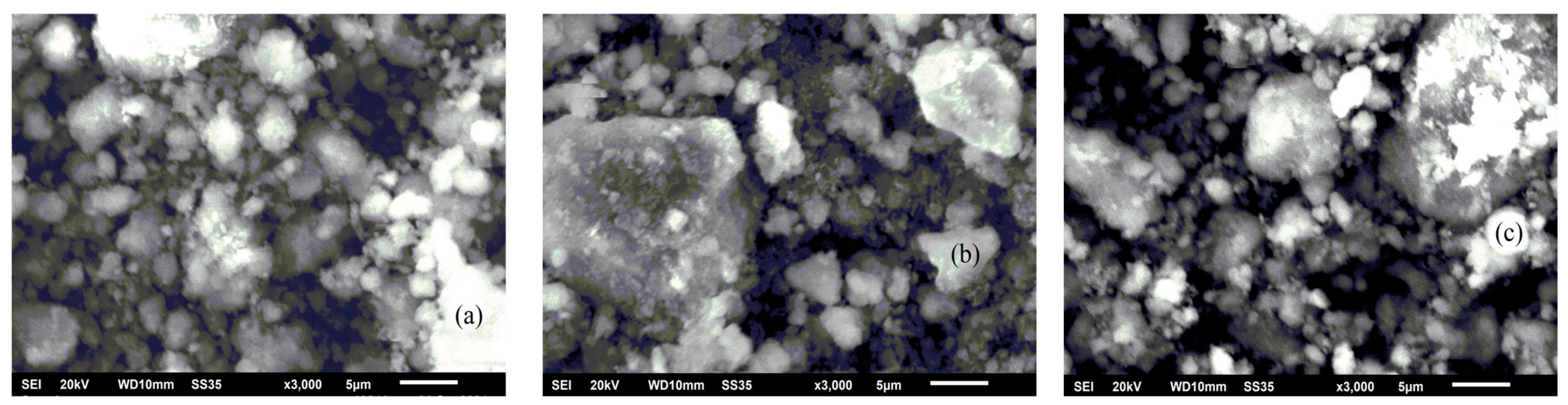
No changes in the catalyst morphology were observed by SEM. Figure 1, for example, shows a typical SEM image of the 9.8%Co-Fe(5:5)-0.2%Pt/Al2O3 catalyst. The SEM patterns of the catalysts after treatment in DRM (Figure 1b) and BRM (Figure 1c) are similar to those of the fresh sample (Figure 1a).
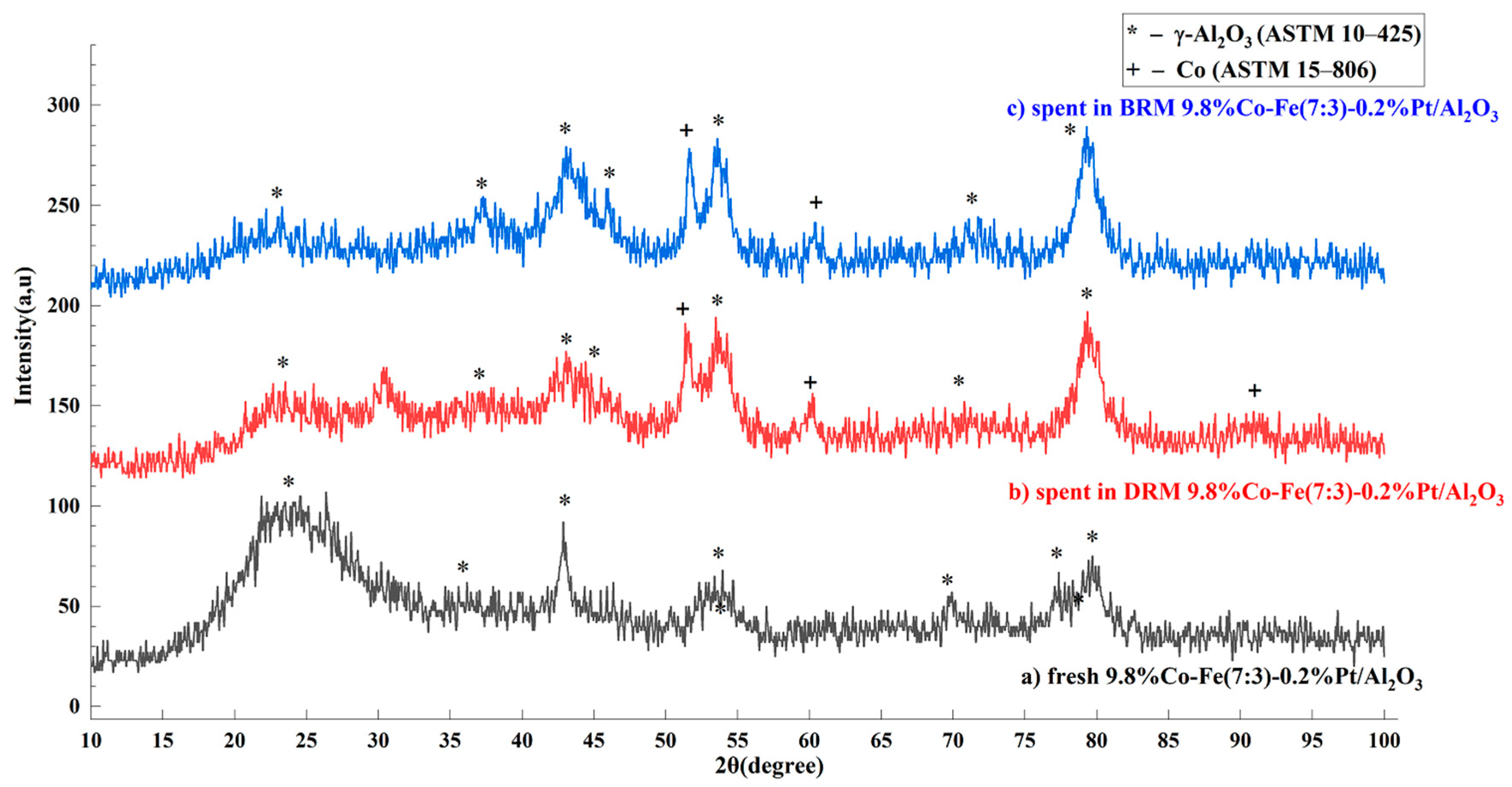
The catalysts before and after the reaction were examined by X-ray diffraction (XRD) to determine their crystal structure and phase composition. No phases other than alumina (JCPDS, 10–425) were detected in fresh samples. In catalysts with a high Co content (Co/Fe ratio = 7:3 and 5:5) after operation in DRM and BRM, only the Co phase (JCPDS, 15–806) was detected. The catalysts are X-ray amorphous due to their high dispersion. Typical X-ray diffraction patterns are shown in Figure 2 for the 9.8%Co-Fe(7:3)-0.2%Pt/Al2O3 catalyst.
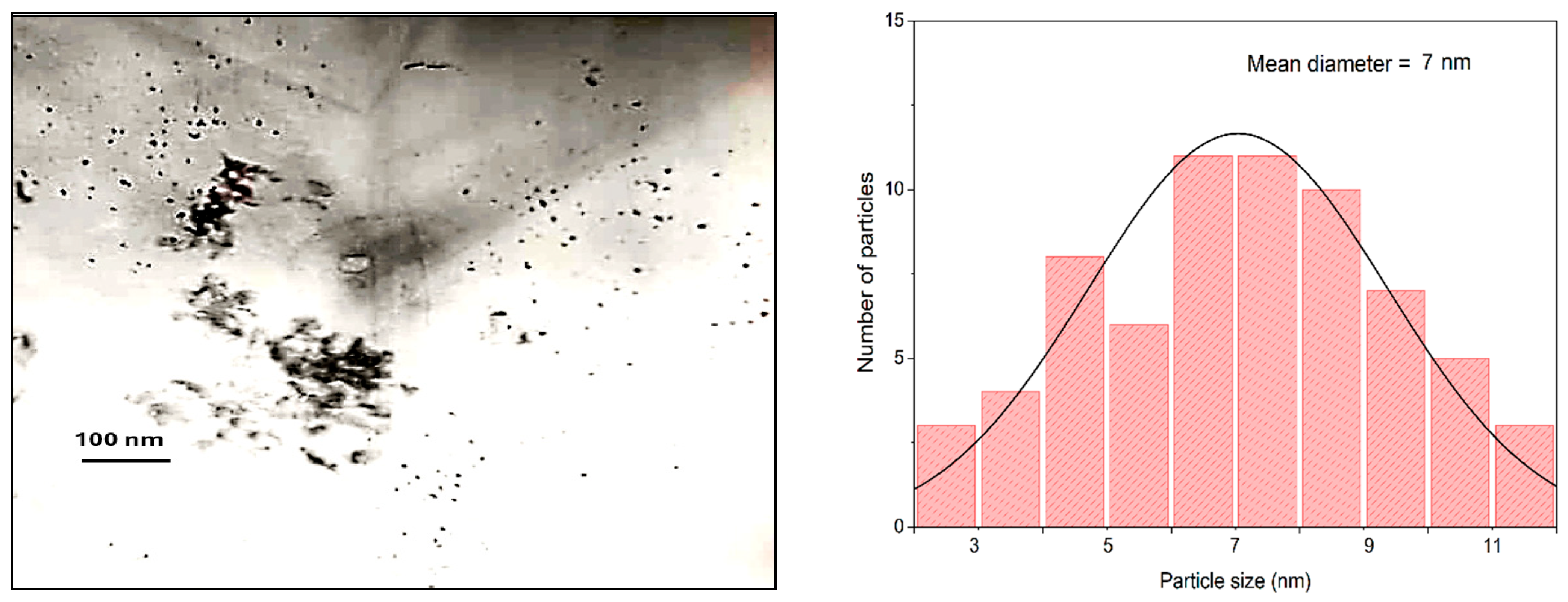
The TEM study confirms that the synthesized catalysts are the nanomaterials. In the fresh samples, the average size of spherical particles varies within a range of 5–10 nm (Figure 3).
The phases identified by microdiffraction in the fresh sample are attributed to CoO (ASTM, 9–402), Co (ASTM, 5–727), γ-Fe2O3 (ASTM, 24–81). The samples spent are X-ray amorphous that makes it difficult to identify the X-ray reflexes.
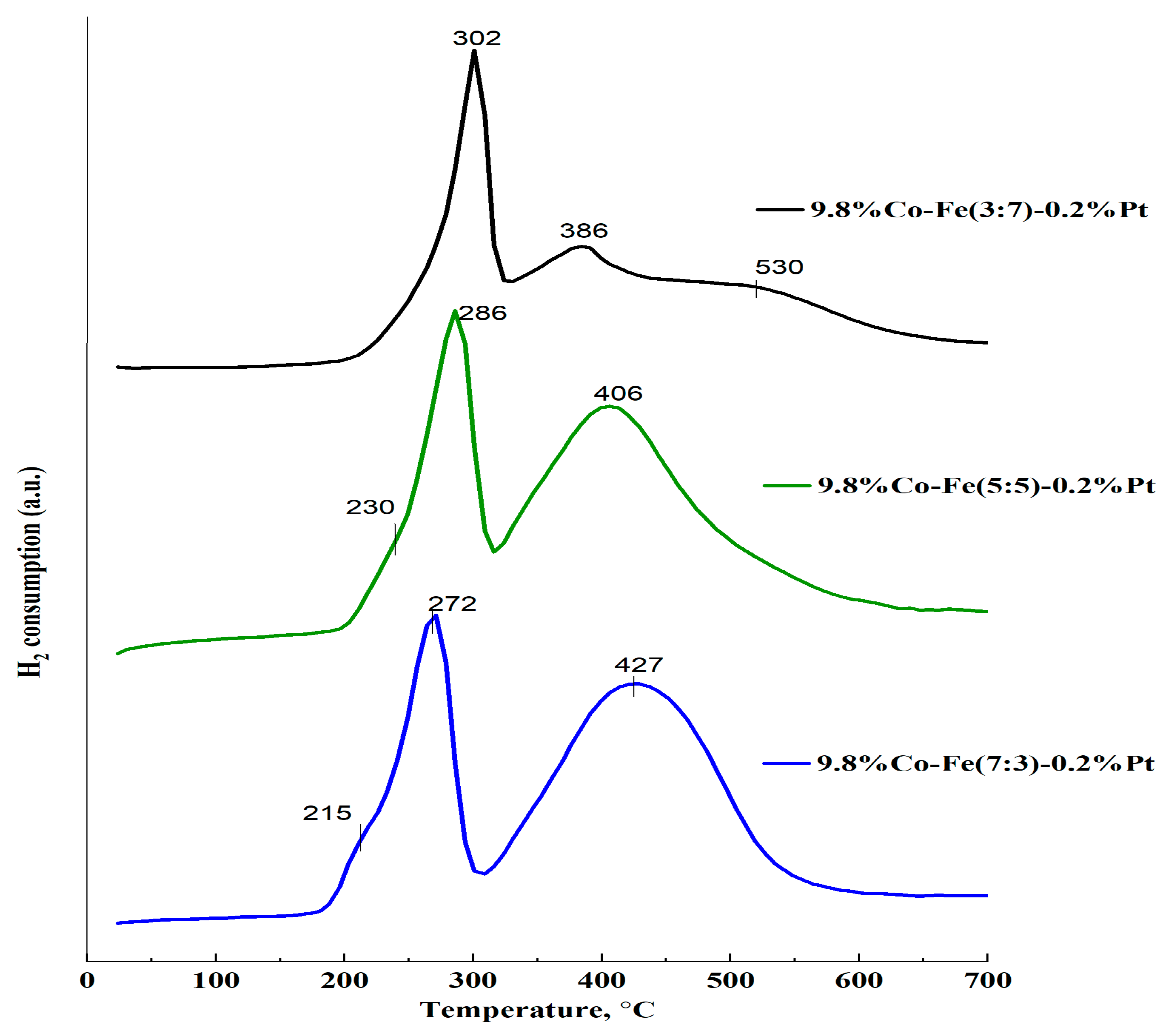
The TPR profiles of the trimetallic catalysts with the same amount of Pt and variable ratio of Co/Fe are generally similar, with the exception of the sample with a higher Fe content, Co/Fe = 3:7 (Figure 4). In the range of 200–600 °C, two intense peaks were observed for all three catalysts, corresponding to the stepwise reduction of iron [29] and cobalt oxides [30,31].
Based on a previous study conducted by us [32], in our H2-TPR study of 5% Co-Rh/Al2O3 catalysts with almost the same amount of noble metal Rh (0.25 wt%), two intensive peaks were observed: a low temperature peak at 258 °C, caused by the reduction of Co3O4 to CoO, and a broad peak at 420 °C, caused by the reduction of CoO to Co0. The same pattern was observed for the 5%Co-Pd/Al2O3 catalysts with 0.25 wt% Pd: two peaks at 230 and 410 °C [33]. Preliminarily, by analogy for the Co-Fe-Pt catalysts, the two-step reduction of Co oxides (Equation (2)) may be proposed.
Co3O4 → CoO → Co0
Regarding Fe oxides, it is known that generally Fe oxides are reduced at high temperatures, and the reduction of iron oxides is a multistage and stepwise process. If the reduction temperature is lower than 570 °C, reduction to Fe occurs stepwise from Fe2O3 to Fe3O4 and continues to Fe (Equation (3)) [34]. The intermediate oxide, Fe(1−x)O, is not stable at temperatures lower than 570 °C. At reduction temperatures higher than 570 °C, the reduction occurs from Fe2O3 via Fe3O4 to Fe(1−x)O and continues afterward to Fe (Equation (4)):
T < 570 °C  Fe2O3 → Fe3O4 → Fe0
T > 570 °C  Fe3O4 → FeO → Fe0
In the literature, the two- (Equation (3)) or three-step reduction of Fe2O3 (Equation (5)) is discussed. The process of Fe oxide reduction is strongly dependent on various factors such as Fe content, presence of promoters/supports, the H2O/H2 ratio, catalyst preparation method, and iron precursor during reduction [35].
Fe2O3 → Fe3O4 → FeO → Fe0
The reduction of monometallic Fe on carbon nanotubes was studied using TPR [36]. Three main groups of hydrogen consumption peaks were referred to the multistep reduction from hematite to metallic Fe: Fe2O3 → Fe3O4→ FeO → Fe (Equation (5). The first peak was related to the reduction of Fe2O3 to Fe3O4 (~250–420 °C), the second peak was ascribed to the reduction of Fe3O4 to FeO, and the third peak was assigned to the reduction of FeO to Fe0 (~600–700 °C).
The authors of [37] showed that when Fe was more than 45%, reduction happened to be a three-stage process (hematite Fe2O3 → magnetite Fe3O4 → wustite FeO → Fe) (Equation (5)); however, when Fe is less than 30%, it is reduced through a two-stage process (Equation (3)). The authors of [38] suggest that reduction of iron oxides in Fe/Al2O3 occurs in a two-step process, as shown in Equation (6). The first peak at 370–390 °C represents the reduction of Fe2O3 to Fe3O4, while the second peak at 450 °C is ascribed to the reduction of Fe3O4 to FeO. The authors hypothesize that it is most likely that the strong Fe–Al2O3 interaction results in the reduction of Fe2O3 to Fe3O4, causing a shift to higher temperatures, stabilization of the FeO phase, and further suppression of the transformation of FeO to Fe on the Fe/Al2O3 catalyst.
Fe2O3 → Fe3O4 → FeO
The final stage of reduction, from wüstite to metallic iron, is the slowest step and the one that constrains the whole process [39]. The XPS and TEM results showed no direct evidence of metallic elements, suggesting that the limited reducing power of gases containing high-concentration steam and CO2, which are weakly oxidative, is unable to further reduce the Fe2+ to Fe0 [40]. That is why the complete reduction of Fe2O3 to Fe0 may not occur, especially under DRM reaction conditions. It should be noted that forming FeOx during dry reforming is beneficial as it reduces the accumulation of surface carbon through interactions with FeOx lattice oxygen, producing CO [41].
Based on the above reasons, we suggest a two-stage reduction of both cobalt (Equation (2)) and iron (Equation (6)) oxides in 10% Co-Fe-Pt/Al2O3 catalysts as the most likely reaction.
To determine precisely which metal oxides are reduced at given temperatures is difficult due to possible peak overlaps and the identical temperature regions for the reduction of cobalt and iron oxides. We hypothesize that due to the similar temperature regions required for the reduction of Co and iron oxides, the superposition of hydrogen consumption peaks may take place. Thus, the sharp peak in the lower temperature region (so-called α-peak) in all three catalysts can likely represent the reduction of both Co3O4 to CoO and Fe2O3 to Fe3O4. The peaks are shifted to the right, in the following order: 272 °C → 286 °C → 302 °C, as Fe loadings increase in the order of 2.94 → 4.90 → 6.86 wt% (Figure 4).
In contrast, the high-temperature broad peak (so-called β-peak) shifts to the left, to the low temperature region, with increasing iron content. In this broad temperature region, both CoO and Fe3O4 may be reduced. Therefore, the second β-peaks at 406 and 427 °C may be assigned to the reduction of CoO to metallic Co and Fe3O4 to FeO for catalysts with Co/Fe ratios of 7:3 and 5:5, respectively.
For the catalyst with a higher Fe content, Co/Fe= 3:7, the third peak at 530 °C appears in the TPR profile. In this case, two separate individual peaks are observed at 386 and 530 °C, and are due to the overlap in catalysts with higher Co contents (Figure 3); hence, we suggest that these peaks can be assigned to the reduction of CoO → Co0 and Fe3O4 → FeO, respectively. These peaks are less intensive than the broad β-peak observed in the catalysts with higher Co contents.
In addition to the main peaks, a low-temperature shoulder at 215 and 230 °C was observed for the catalysts with higher Co contents, Co/Fe (7:3) and Co/Fe (5:5), respectively, and may be assigned to the reduction of platinum oxide. As the Fe content increases from 2.94 to 4.90, the Pt oxide reduction temperature shifts to higher temperatures of 215 → 230 °C. With a further increase in the Fe content to 6.86, the shoulder disappears, likely due to an additional shift to higher temperatures and overlapping with the Co oxide reduction peak.
Thus, the TPR-H2 analysis demonstrates a change in the oxidation state of Co-Fe-Pt catalysts depending on the Fe-Co ratio. The positive effect of Pt on the reducibility of Co oxides has been noted previously [24]. The present study shows that an increase in the Fe content leads to some difficulties in the reduction of the most oxidized state of Co, and this unexpectedly facilitates the reduction of the more reduced state of Co and Fe oxides. This indicates a synergistic effect due to the Co-Fe-interaction.

3.2. Catalyst Testing

3.2.1. Dry Reforming of Methane

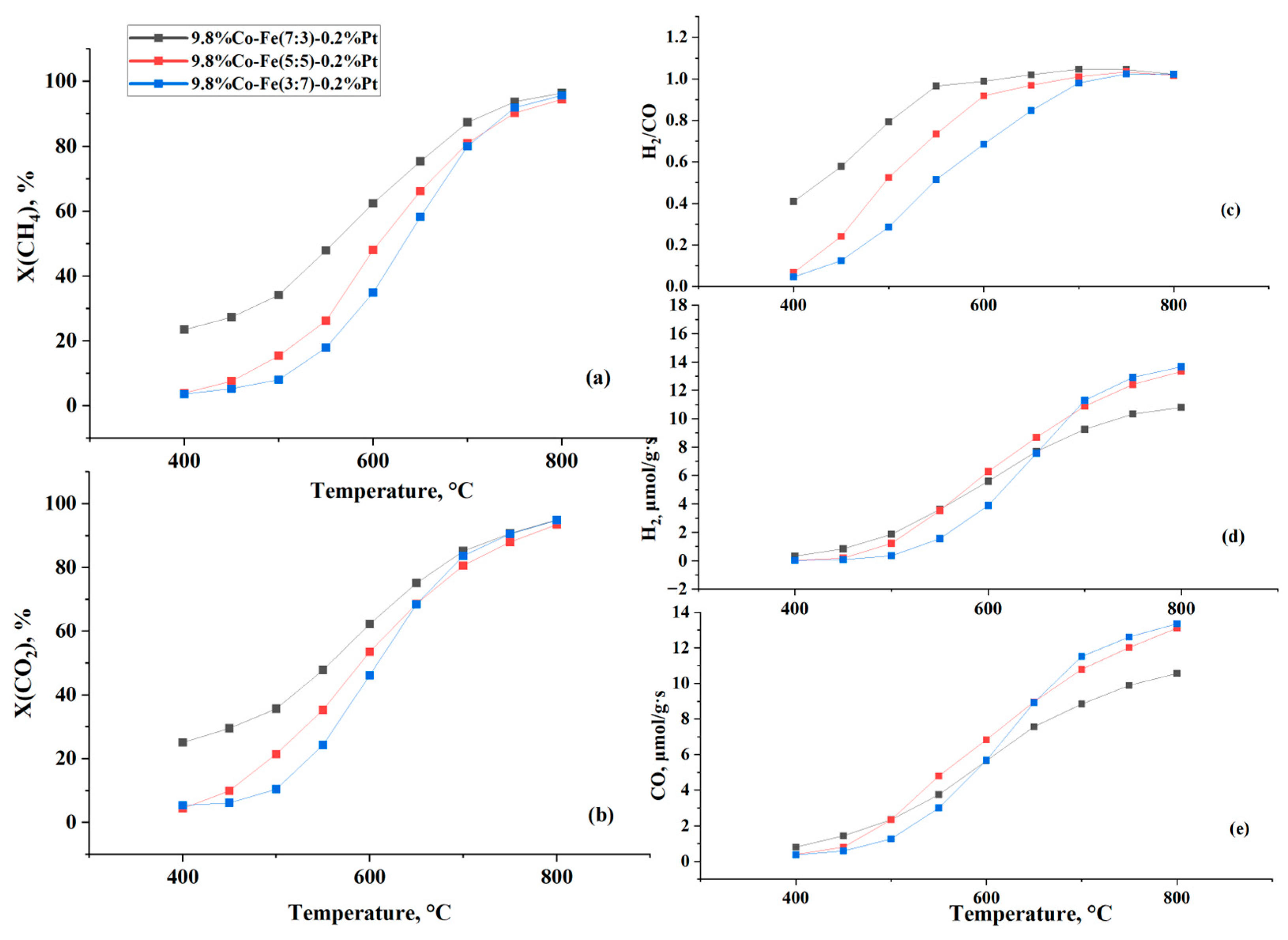
Figure 5 shows the catalytic performance of all trimetallic catalysts with different Co:Fe ratios in DRM over a temperature range of 400–800 °C. The reactant conversion and product yield gradually increased with increasing temperature.
At 800 °C, the extents of conversion of all three catalysts are almost the same: X(CH4) = 94.6–96.4% (Figure 5a) and X(CO2) = 93.5–94.9% (Figure 5b). The difference in activity between catalysts with different Co:Fe ratios were observed at lower temperature; the lower the temperature, the greater the differences. Thus, the catalyst with higher Co content (ratio of Co:Fe is 7:3) is the most active; at 400° C, the extents of conversion of methane and carbon dioxide are 23.5 and 25.1%. While the catalysts with Co:Fe = 5:5 and Co:Fe = 3:7 demonstrate much lower activity: X(CH4) = 3.6–3.9%, X(CO2) = 4.4–5.4% (Figure 5a,b).
The extent of conversion and yield were compared at 700 °C to evaluate the activity of the catalysts, depending on the ratio between Co and Fe. The catalyst with a lower iron content (2.94 wt% that corresponds to Co/Fe = 7:3) outperformed the others in terms of the extent of conversions of CH4 and CO2. As Figure 5 shows, the catalyst with a Co/Fe ratio of 7:3, containing more cobalt, demonstrated better catalytic activity for the conversion of feed gases to DRM. In contrast, the catalyst with a lower iron content and a higher iron content demonstrated slightly lower reactant conversions. In other words, increasing the iron content of the catalyst leads to a decrease in methane and carbon dioxide conversion. The catalyst with a lower iron content (2.94 wt%) (Co/Fe = 7:3) outperformed the others in CH4 and CO2 conversion.
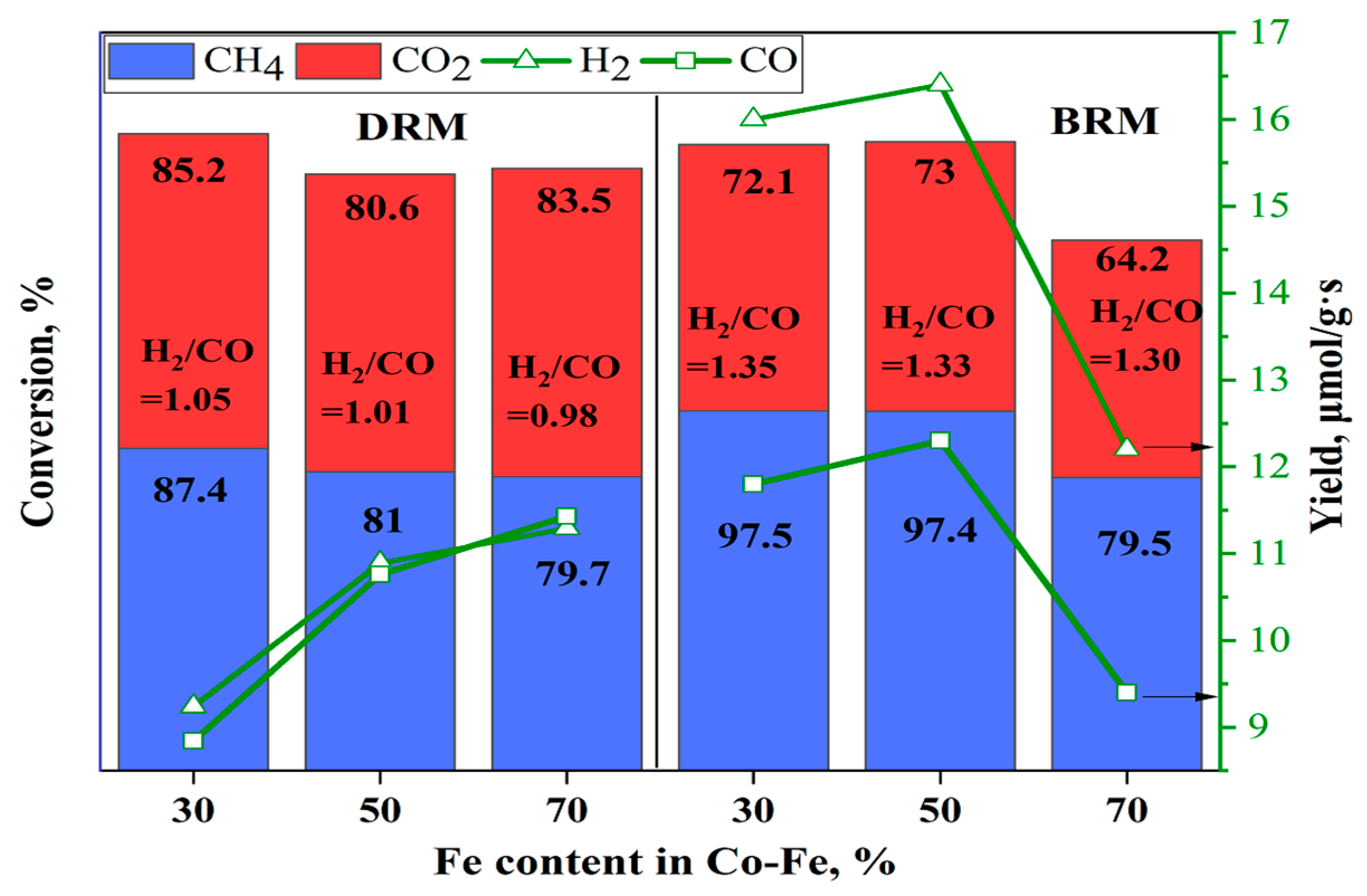
For instance, as the Fe content increased from 30 to 70%, conversions of CH4 and CO2 decreased from 87.4 to 79.7%, and from 85.2 to 83.5%, respectively. However, the opposite trend is observed in the yields of hydrogen and carbon monoxide. The H2 yield grows from 9.2 to 11.3 μmol/g × s while the CO yield rose from 8.8 to 11.4 μmol/g × s as iron content increased. While the decrease in conversion with increasing iron content was expected, as iron has the lowest activity among the Group 8 metals, the higher syngas yield requires an explanation. A probable cause for this may be the presence of an induction period, or so-called ‘catalyst surface development’ for the catalyst with a high iron content. High conversions of reactants, especially carbon dioxide, are observed in the initial period of the reaction, but no products are formed. Therefore, instead of describing this process as one that involves a high degree of conversion, it is more correct to say that it reflects the absorption of the initial reactants during the initial period. After saturation of the surface with adsorbed species, the catalyst reaches a steady-state regime. After that, the formation of products stabilizes, and their yield is higher due to the contribution of carbon dioxide- and methane-adsorbed species accumulated on the catalyst surface during the initial period.
However, it should be noted that the ratio of H2/CO slightly decreased from 1.05 to 0.98 as Fe content increased from 30% to 70%, indicating higher CO yields than H2. This suggests that a side reaction, such as the reverse water–gas shift reaction, which consumes H2, occurs simultaneously with the main reaction [22].

3.2.2. Bireforming of Methane

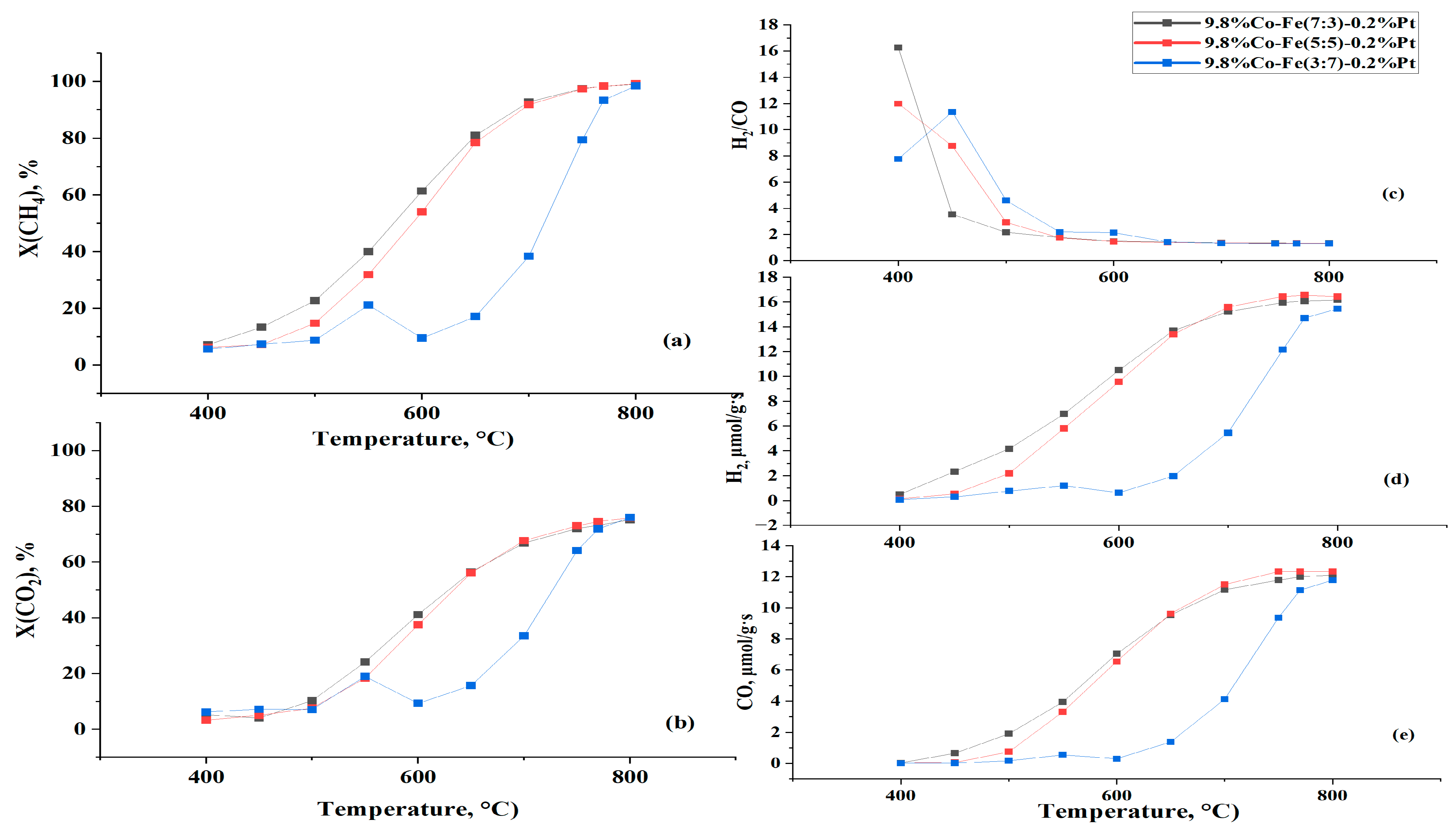
The bireforming of methane on the Co-Fe catalysts was conducted under the following conditions: CH4/CO2/H2O = 1/1/0.5, T = 400–800 °C, p = 1 atm, and GHSV = 1000 h−1. Figure 6 demonstrates the temperature profiles for reactant conversions and product yields. Both profiles increase simultaneously with rising temperature due to the strong endothermic nature of the reaction. Introducing 20 vol.% steam into the DRM enhanced CH4 conversion but had a negative effect on CO2 conversion. Methane conversion was substantially higher than CO2 conversion, which can be attributed to the occurrence of the water–gas shift reaction (WGSR) as a side reaction that forms CO2 and H2 [42]. Consequently, as CO was consumed by the WGSR, a marginal decrease in its yield was observed upon the addition of 20 vol.% steam to the DRM.
A study by [13] investigated 5%Co/Al2O3 catalysts with different Fe contents and found that the optimal iron loading was 0.8 wt%, which yielded a H2/CO ratio slightly above 0.65 at 700 °C. In our study, as a result of water addition, the H2/CO ratio increased and ranged between 1.31 and 1.34 at 800 °C. Therefore, it follows that the introduction of water into the DRM process will positively affect the H2/CO ratio, allowing it to be increased and varied for further use it as a feedstock in other processes, such as Fischer–Tropsch synthesis.
It is shown that catalysts with 30 and 50% iron content demonstrated equally high catalytic activity in the BRM process. Notably, the catalyst with a 50/50 ratio of Fe/Co showed higher yields of products (H2, CO). The conversion of CH4 exceeded 97%, while the CO2 conversion reached 73%. This superior performance may be attributed to the optimal balance between Co and Fe sites in the 50/50 catalyst, which provides sufficient active sites for CH4 activation (mainly by Co) and simultaneously promotes CO2 dissociation and oxygen removal (enhanced by Fe) [14]. Such a synergistic interaction between Co and Fe enhances both the reforming activity and syngas yield.
A comparison of the efficiency of DRM and BRM processes over the 10%Co-Fe-Pt/Al2O3 at p = 1 atm, CH4:CO2:H2O = 1:1:0.5, GHSV = 1000 h−1 is presented in Figure 7. In terms of a higher hydrogen yield, the BRM process is more effective than DRM. The extent of CH4 conversion is substantially increased in BRM. The optimal ratio of Co/Fe in terms of higher yield of syngas is equal to 1:1. This catalyst was selected for the stability test.
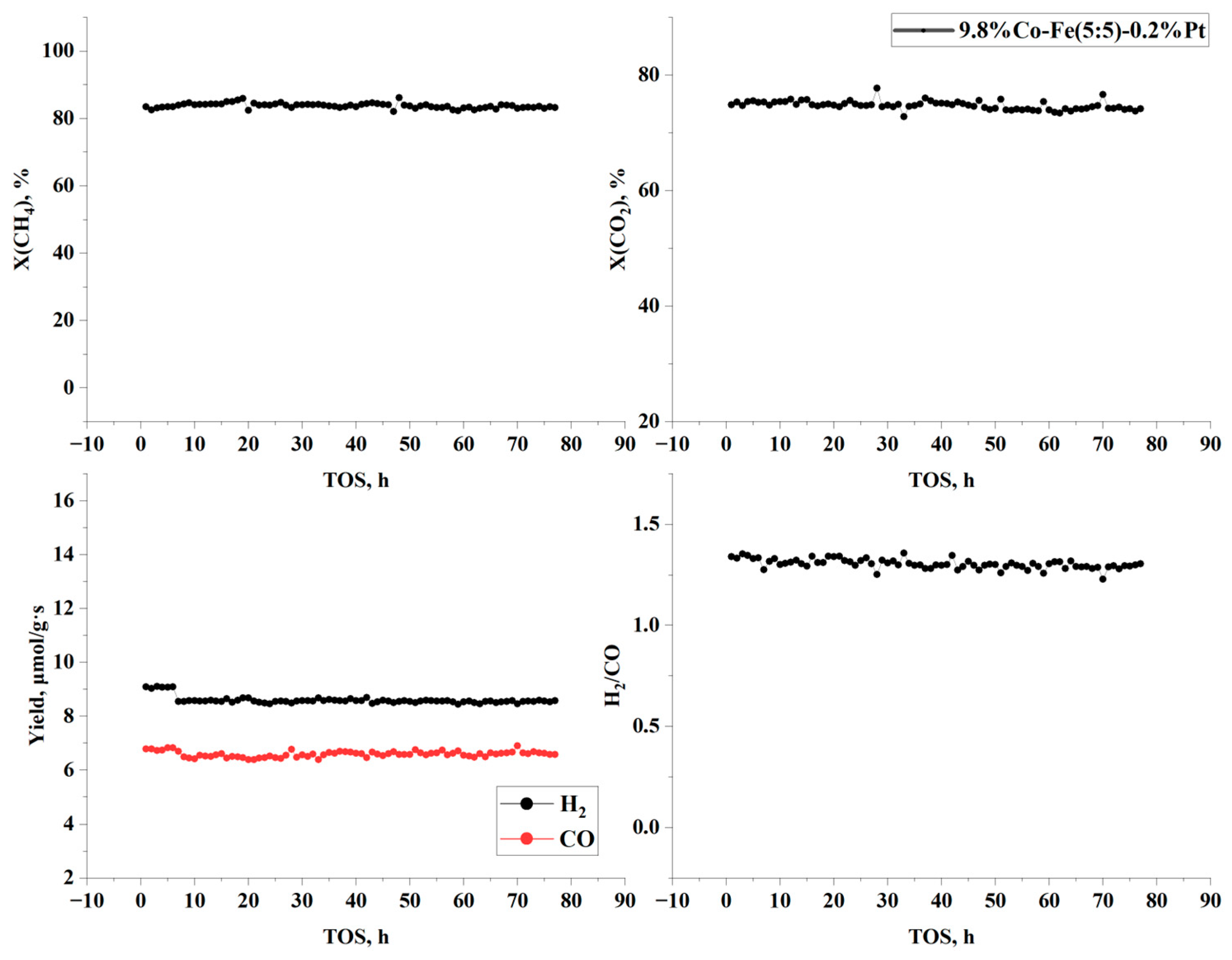
Stability testing was carried for the catalyst 9.8%Co-Fe(5:5)-0.2%Pt in BRM at 700 °C, 1 atm, 1000 h−1 for 86 h on stream (Figure 8). Initially, the profiles for the 9.8%Co-Fe(5:5)-0.2%Pt catalyst increased gradually during the first 10 h, before reaching a stable state. The catalyst exhibited stable catalytic performance and no visible coke formation.

4. Conclusions

The 10%Co-Fe-Pt/Al2O3 catalysts with various ratios of Co:Fe = 7:3, 5:5, and 3:7 and modified by 0.2 wt% of Pt were synthesized, characterized by a number of physicochemi-cal methods, and tested in DRM and BRM processes.
The catalysts are highly dispersed X-Ray amorphous material.
The TPR-H2 analysis demonstrates a change in the oxidation state of Co-Fe-Pt cata-lysts depending on the Fe-Co ratio. An increase in the Fe content leads to increase in the reduction temperature of the most oxidized state of Co and facilitates the reduction of the more reduced state of Co and Fe oxides. This indicates a synergistic effect due to the Co-Fe interaction. A two-stage reduction of both cobalt (Co3O4 → CoO → Co) and iron oxides (Fe2O3 → Fe3O4 → FeO) is proposed for the 10% Co-Fe-Pt/Al2O3 catalysts as the most proba-ble process. The formation of FeOx during dry reforming helps to prevent carbon deposition due to its removal by FeOx lattice oxygen, producing CO.
The synthesized Co-Fe-Pt alumina supported catalysts demonstrate the high activity and selectivity in syngas production by DRM and BRM. The extent of methane and CO2 conversion varied within the range of 79.5–97.5 and 64.2–85.2%, respectively, at 700–800 °C, while the H2/CO ratio in the resulting syngas ranged from 0.98 to 1.30, depending on the catalyst and feed composition. From the point of view of higher hydrogen yield, the BRM process is more effective than DRM. Also, the presence of water in the feed leads to de-creasing carbon accumulation on the catalyst surface due to the oxidation of surface car-bon by water with the formation of additional amounts of CO and H2.
Stability tests conducted for up to 80 h on stream showed no loss of activity in the 10%Co-Fe-Pt/Al2O3 catalysts in BRM. Preliminary stability tests showed stable operation for 80 h on stream. Methane was almost completely converted: X(CH4) = 97.4% at 750 °C.
The excellent catalytic performance of 10%Co-Fe-Pt/Al2O3 is caused by the synergetic effects of interactions within the Co-Fe-Pt system.

Author Contributions

Conceptualization, S.S.I.; methodology, S.S.I. and Y.A.B.; software, K.T.T., Y.A.B. and M.A.Z.; validation, K.T.T., Y.A.B. and M.A.Z.; formal analysis, S.S.I., K.T.T., Y.A.B. and M.A.Z.; investigation, K.T.T., Y.A.B. and M.A.Z.; resources, S.S.I., K.T.T., Y.A.B. and M.A.Z.; data curation, S.S.I. and K.T.T.; writing—original draft preparation, K.T.T.; writing—review and editing, S.S.I.; visualization, K.T.T., Y.A.B. and M.A.Z.; supervision, S.S.I.; project administration, A.Z.A.; funding acquisition, A.Z.A. All authors have read and agreed to the published version of the manuscript.

Funding

This research was funded by the Science Committee of the Ministry of Science and Higher Education of the Republic of Kazakhstan, Grant number BR24992995.

Data Availability Statement

The raw data supporting the conclusions of this article will be made available by the authors upon request.

Acknowledgments

The authors wish to thank the Laboratory of the Physico-Chemical Methods of the Catalyst Analysis of IFCE for providing the catalyst characterization.

Conflicts of Interest

The authors declare no conflicts of interest. The funders had no role in the design of the study; in the collection, analyses, or interpretation of data; in the writing of the manuscript; or in the decision to publish the results.

Abbreviations

The following abbreviations are used in this manuscript:
BETBrunauer–Emmett–Teller method to measure the specific surface area and porosity
BRMBireforming of Methane
CCUSCarbon Capture, Utilization, And Storage
DRMDry Reforming of Methane
GHSVGas Hourly Space Velocity
H2-TPRHydrogen Temperature-Programmed Reduction
SEMScanning Electron Microscopy
TEMTransmission Electron Microscopy
X(CH4)Extent of conversion of methane
X(CO2)Extent of conversion of carbon dioxide

References

  1. Chen, S.; Zaffran, J.; Yang, B. Dry reforming of methane over the cobalt catalyst: Theoretical insights into the reaction kinetics and mechanism for catalyst deactivation. Appl. Catal. B Environ. 2020, 270, 118859. [Google Scholar] [CrossRef]
  2. Liu, H.; Li, Y.; He, D. Recent progress of catalyst design for carbon dioxide reforming of methane to syngas. Energy Technol. 2020, 8, 1900493. [Google Scholar] [CrossRef]
  3. Al-Fatesh, A.S. A study on mono and mixed nano-supported Co-based catalysts for dry reforming of methane. Bull. Korean Chem. Soc. 2015, 36, 583–590. [Google Scholar] [CrossRef]
  4. Cunha, A.F.; Mata, T.M.; Caetano, N.S.; Martins, A.A.; Loureiro, J.M. Catalytic bi-reforming of methane for carbon dioxide ennoblement. Energy Rep. 2020, 6, 74–79. [Google Scholar] [CrossRef]
  5. Shah, M.; Ali, S.; Mahar, R.B.; Shah, A.H.; Memon, A.R. Smart designing of metal-support interface for imperishable dry reforming catalyst. Appl. Catal. A Gen. 2018, 556, 137–154. [Google Scholar] [CrossRef]
  6. Bhattar, S.; Abedin, M.A.; Kanitkar, S.; Spivey, J.J. A review on dry reforming of methane over perovskite-derived catalysts. Catal. Today 2021, 365, 2–23. [Google Scholar] [CrossRef]
  7. Tanios, C.; Labaki, M. Chapter 5—Catalytic reforming: A sustainable technology for hydrogen production. In Recent Advances in Renewable Energy Technologies; Jeguirim, M., Ed.; Academic Press: London, UK, 2022; pp. 199–247. [Google Scholar] [CrossRef]
  8. Ray, D.; Nepak, D.; Janampelli, S.; Goshal, P.; Challapalli, S. Dry reforming of Methane in DBD plasma over Ni-based catalysts: Influence of process conditions and support on performance and durability. Energy Technol. 2019, 7, 1801008. [Google Scholar] [CrossRef]
  9. de Medeiros, F.G.M.; Lopes, F.W.B.; Rego de Vasconcelos, B. Prospects and technical challenges in hydrogen production through dry reforming of methane. Catalysts 2022, 12, 363. [Google Scholar] [CrossRef]
  10. Agún, B.; Abánades, A. Comprehensive review on dry reforming of methane: Challenges and potential for greenhouse gas mitigation. Int. J. Hydrogen Energy 2025, 103, 395–414. [Google Scholar] [CrossRef]
  11. Wang, S.; Nabavi, S.A.; Clough, P.T. A review on bi/polymetallic catalysts for steam methane reforming. Int. J. Hydrogen Energy 2023, 48, 15879–15893. [Google Scholar] [CrossRef]
  12. Ray, K.; Sengupta, S.; Deo, G. Reforming and cracking of CH4 over Al2O3-supported Ni, Ni-Fe and Ni-Co catalysts. Fuel Process. Technol. 2017, 156, 195–203. [Google Scholar] [CrossRef]
  13. Le Phuong, D.H.; Alsaiari, M.; Pham, C.Q.; Hieu, N.H.; Pham, T.-P.T.; Rajamohan, N.; Pham, D.D.; Vo, D.-V.N.; Trinh, T.H.; Setiabudi, H.D.; et al. Carbon dioxide reforming of methane over modified iron–cobalt alumina catalyst: Role of promoter. J. Taiwan Inst. Chem. Eng. 2024, 155, 105253. [Google Scholar] [CrossRef]
  14. Kozonoe, C.E.; de Paiva Floro Bonfim, R.; Brito Alves, R.M.; Schmal, M. The Fe–Co–Cu supported on MWCNT as catalyst for the tri-reforming of methane—Investigating the structure changes of the catalysts. Fuel 2019, 256, 115917. [Google Scholar] [CrossRef]
  15. Rahmat, N.; Yaakob, Z.; Mat Hassan, N.S. Hydrogen-rich syngas from CO2 reforming of methane with steam catalyzed by facile fusion-impregnation of iron and cobalt loaded MgAl2O4 catalyst with minimal carbon deposits. J. Energy Inst. 2021, 96, 61–74. [Google Scholar] [CrossRef]
  16. Benrabaa, R.; Trentesaux, M.; Roussel, P.; Rubbens, A.; Vannier, R.-N.; Löfberg, A. NiAlxFe2−xO4 mixed oxide catalysts for methane reforming with CO2: Effect of Al vs Fe contents and precursor salts. J. CO2 Util. 2023, 67, 102319. [Google Scholar] [CrossRef]
  17. Fang, X.; Mao, L.; Xu, L.; Shen, J.; Xu, J.; Xu, X.; Wang, X. Ni-Fe/La2O3 bimetallic catalysts for methane dry reforming: Elucidating the role of Fe for improving Coke Resistance. Fuel 2024, 357, 129950. [Google Scholar] [CrossRef]
  18. Li, B.; Luo, Y.; Li, B.; Yuan, X.; Wang, X. Catalytic performance of iron-promoted nickel-based ordered mesoporous alumina FeNiAl catalysts in dry reforming of methane. Fuel Process. Technol. 2019, 193, 348–360. [Google Scholar] [CrossRef]
  19. Nguyen, D.L.; Le Phuong, D.H.; Pham, T.-P.T.; Cao, A.N.; Nguyen, T.M. Designing efficient methane dry reforming catalysts: Insights into the influence of calcium, iron, and manganese on cobalt-based systems. J. Ind. Eng. Chem. 2025; in press. [Google Scholar] [CrossRef]
  20. Jawad, A.; Rezaei, F.; Rownaghi, A.A. Highly efficient Pt/Mo-Fe/Ni-based Al2O3-CeO2 catalysts for dry reforming of methane. Catal. Today 2020, 350, 80–90. [Google Scholar] [CrossRef]
  21. Dikwa, J.; Philémon, Z.B.; Allawadi, A. Simulation of dry reforming of methane catalyzed by iron hexagonal mesoporous silicates (Fe-HMS) using ASPEN HYSYS. SSRN Electron. J. 2022, 10, 559–574. [Google Scholar] [CrossRef]
  22. Al-Fatesh, A.S.; Patel, N.; Srivastava, V.K.; Osman, A.I.; Rooney, D.W.; Fakeeha, A.H.; Abasaeed, A.E.; Alotibi, M.F.; Kumar, R. Iron-promoted zirconia-alumina supported Ni catalyst for highly efficient and cost-effective hydrogen production via dry reforming of methane. J. Environ. Sci. 2025, 148, 274–282. [Google Scholar] [CrossRef] [PubMed]
  23. Zhang, T.; Liu, Z.; Zhu, Y.-A.; Liu, Z.; Sui, Z.; Zhu, K.; Zhou, X. Dry reforming of methane on Ni-Fe-MgO catalysts: Influence of Fe on carbon-resistant property and kinetics. Appl. Catal. B Environ. 2020, 264, 118497. [Google Scholar] [CrossRef]
  24. Itkulova, S.S.; Nurmakanov, Y.Y.; Kussanova, S.K.; Boleubayev, Y.A. Production of a hydrogen-enriched syngas by combined CO2-steam reforming of methane over Co-based catalysts supported on alumina modified with zirconia. Catal. Today 2018, 299, 272–279. [Google Scholar] [CrossRef]
  25. Carvalho, D.C.; Soares, R.R.; Passos, F.B. A study on the modification of mesoporous mixed oxides supports for dry reforming of methane by Pt or Ru. Appl. Catal. A Gen. 2014, 473, 132–145. [Google Scholar] [CrossRef]
  26. Budiman, A.W.; Song, S.-H.; Chang, T.-S.; Shin, C.-H.; Choi, M.-J. Dry reforming of methane over cobalt catalysts: A literature review of catalyst development. Catal. Surv. Asia 2012, 16, 183–197. [Google Scholar] [CrossRef]
  27. Jang, W.-J.; Shim, J.-O.; Kim, H.-M.; Yoo, S.-Y.; Roh, H.-S. A review on dry reforming of methane in aspect of catalytic properties. Catal. Today 2019, 324, 15–26. [Google Scholar] [CrossRef]
  28. de Araújo Moreira, T.G.; de Carvalho Filho, J.F.S.; Carvalho, Y.; de Almeida, J.M.A.R.; Nothaft Romano, P.; Falabella Sousa-Aguiar, E. Highly stable low noble metal content rhodium-based catalyst for the dry reforming of methane. Fuel 2021, 287, 119536. [Google Scholar] [CrossRef]
  29. Jabbour, K.; El Hassan, N. Optimized conditions for reduction of iron (III) oxide into metallic form under hydrogen atmosphere: A thermodynamic approach. Chem. Eng. Sci. 2022, 252, 117297. [Google Scholar] [CrossRef]
  30. Nurmakanov, Y.Y.; McCue, A.J.; Anderson, J.A.; Itkulova, S.S.; Kussanova, S.K. Methane reforming by CO2 or CO2-H2O over Co-containing supported catalysts. News NAS RK. Ser. Chem. Technol. 2016, 5, 5–11. [Google Scholar]
  31. Jacobs, G.; Ji, Y.; Davis, B.; Cronauer, D.C.; Kropf, A.J.; Marshall, C.L. Fischer-Tropsch synthesis: Temperature programmed EXAFS/XANES investigation of the influence of support type, cobalt loading, and noble metal promoter addition to the reduction behavior of cobalt oxide particles. Appl. Catal. A Gen. 2007, 333, 177–191. [Google Scholar] [CrossRef]
  32. Itkulova, S.S.; Valishevskiy, K.A.; Boleubayev, Y.A. Bimetallic Co-Rh Systems as a Prospective Base for Design of CH4 Reforming Catalysts to Produce Syngas with a Controllable Composition. Catalysts 2022, 12, 105. [Google Scholar] [CrossRef]
  33. Boleubayev, Y.A.; Xiao, T.; Itkulova, S.S.; Valishevskiy, K.A.; Zhubanysheva, G.K. Bimetallic Co-Pd catalysts for dry and bireforming of methane. News NAS RK. Ser. Chem. Techn. 2020, 4, 112–119. [Google Scholar] [CrossRef]
  34. Spreitzer, D.; Schenk, J. Reduction of Iron Oxides with Hydrogen—A Review. Steel Res. Int. 2019, 90, 1900108. [Google Scholar] [CrossRef]
  35. Alvarez, P.; Araya, P.; Rojas, R.; Guerrero, S.; Aguila, G. Activity of alumina supported Fe catalysts for N2O decomposition: Effects of the iron content and thermal treatment. J. Chilean Chem. Soc. 2017, 62, 3752–3759. [Google Scholar] [CrossRef]
  36. Fellenberg, A.K.; Addad, A.; Hong, J.; Simon, P.; Kosto, Y.; Šmíd, B.; Gang Jib, G.; Andrei, Y.; Khodakov, A.Y. Iron and Copper Nanoparticles Inside and Outside Carbon Nanotubes: Nanoconfinement, Migration, Interaction and Catalytic Performance in Fischer-Tropsch Synthesis. J. Catal. 2021, 404, 306–323. [Google Scholar] [CrossRef]
  37. Kumar, A.; Malvi, B. Iron oxide based catalysts: A temperature programmed reduction study. Res. J. Chem. Sci. 2021, 11, 39–45. [Google Scholar]
  38. Wan, H.-J.; Wu, B.-S.; Zhang, C.-H.; Xiang, H.-W.; Li, Y.-W.; Xu, B.-F.; Yi, F. Study on Fe–Al2O3 interaction over precipitated iron catalyst for Fischer–Tropsch synthesis. Catal. Commun. 2007, 8, 1538–1545. [Google Scholar] [CrossRef]
  39. He, J.; Li, K.; Zhang, J.; Conejo, A.N. Reduction Kinetics of Compact Hematite with Hydrogen from 600 to 1050 °C. Metals 2023, 13, 464. [Google Scholar] [CrossRef]
  40. Sun, X.; Arvanitis, A.; Damma, D.; Alvarez, N.T.; Shanov, V.; Smirniotis, P.G.; Dong, J. Carbon Nanotube Formation on Cr-Doped Ferrite Catalyst during Water Gas Shift Membrane Reaction: Mechanistic Implications and Extended Studies on Dry Gas Conversions. Catalysts 2020, 10, 927. [Google Scholar] [CrossRef]
  41. Theofanidis, S.A.; Galvita, V.V.; Poelman, H.; Marin, G.B. Enhanced Carbon-Resistant Dry Reforming Fe-Ni Catalyst: Role of Fe. ACS Catal. 2015, 5, 3028–3039. [Google Scholar] [CrossRef]
  42. Parente, M.; Soria, M.A.; Madeira, L.M. Hydrogen and/or syngas production through combined dry and steam reforming of biogas in a membrane reactor: A thermodynamic study. Renew. Energy 2020, 157, 1254–1264. [Google Scholar] [CrossRef]
Figure 1. SEM images of the 9.8%Co-Fe(5:5)-0.2%Pt/Al2O3 catalyst when (a) fresh, (b) spent in DRM, and (c) spent in BRM.
Nanomaterials 15 01814 g001
Figure 2. XRD patterns of the 9.8%Co-Fe(7:3)-0.2%Pt/Al2O3 catalyst samples: fresh and spent in DRM and BRM.
Nanomaterials 15 01814 g002
Figure 3. TEM image of 9.8%Co-Fe(5:5)-0.2%Pt/Al2O3 catalyst.
Nanomaterials 15 01814 g003
Figure 4. TPR profiles of 10%Co-Fe-Pt/Al2O3 catalysts.
Nanomaterials 15 01814 g004
Figure 5. The effect of temperature on catalytic performance in DRM over the 10%Co-Fe-Pt/Al2O3 at p = 1 atm, CH4:CO2 = 1:1, GHSV = 1000 h−1: (a) methane conversion, (b) CO2 conversion, (c) H2/CO ratio, (d) hydrogen yield, and (e) CO yield.
Nanomaterials 15 01814 g005
Figure 6. The effect of temperature on catalytic performance in BRM over the 10%Co-Fe-Pt/Al2O3 at p = 1 atm, CH4:CO2:H2O = 1:1:0.5, and GHSV = 1000 h−1: (a) methane conversion, (b) CO2 conversion, (c) H2/CO ratio, (d) hydrogen yield, and (e) CO yield.
Nanomaterials 15 01814 g006
Figure 7. Comparison of Co-Fe-Pt catalysts with various Fe/Co ratios in DRM and BRM at T = 750 °C, 1 atm, 1000 h−1 (Fe contents of 30%, 50%, 70% correspond to 2.94, 4.9, 6.86 wt% of the catalyst, respectively).
Nanomaterials 15 01814 g007
Figure 8. Stability test of 9.8%Co-Fe(5:5)-0.2%Pt in BRM at T = 700 °C, 1 atm, 1000 h−1, CH4/CO2/H2O = 1/1/0.5.
Nanomaterials 15 01814 g008
Table 1. Comparative results for Fe-containing catalysts used in DRM.
CatalystReaction ConditionsX(CH4), %X(CO2), %H2/CORef.
75Ni-25Fe/Al2O3CH4:CO2:N2 = 1:1:3, 600 °C16240.44[12]
0.8Fe-5Co/Al2O3700 °C~50~83~0.65[13]
Fe@MWCNT/CoCH4:CO2:O2:He:H2O = 1:0.5:0.33:1.3:0.37, 800 °C, GHSV = 63,000 (mL/g.h)46360.5[14]
Fe/MgAl2O4CH4:CO2(1.5:1), 700 °C, GHSV = 11,706 h−17956-[15]
NiAlFeO4 (Cl)CH4:CO2:He:Ar = 20:20:10:50, 750 °C92~90~0.8[16]
6Ni-0.2Fe/La2O3CH4:CO2 = 1:1, WHSV = 18,000 mL h −1 gcat−1, 750 °C~70~78~0.92[17]
0.5-FeNiAlCH4:CO2 = 1:1, 700 °C~60~67~0.86[18]
0.3Fe-8Co/Al2O3700 °C, PCH4/PCO2 = 20/20 kPa/kPa, GHSV = 36 L gcat−1 h−1~68~94~0.8[19]
Fe/MgAl2O4CH4:CO2 = 1.5:1, 700 °C, p = 1 atm, GHSV = 11,706 h−1, 76.746.4-[15]
FeMo/Ni/CeO2-Al2O3CH4:CO2 = 1:1, 700 °C, p = 1 bar, WHSV = 12,000 mL gcat−1 h−178810.89[20]
Pt/FeMo/Ni/CeO2-Al2O3CH4:CO2 = 1:1, 700 °C, p = 1 bar, WHSV = 12,000 mL gcat−1 h−181860.91[20]
Table 2. BET results of Co-Fe catalysts.
CatalystsNominal Content, wt%BET Surface Area, m2/gAverage Pore Diameter, nm
CoFePtFreshSpent in DRMSpent in BRMFreshSpent in DRMSpent in BRM
9.8%Co-Fe(7:3)-0.2%Pt/Al2O36.862.940.2190.8101.3111.76.86.010.3
9.8%Co-Fe(5:5)-0.2%Pt/Al2O34.904.900.2168.3103.295.76.07.07.1
9.8%Co-Fe(3:7)-0.2%Pt/Al2O32.946.860.2171.9111.760.66.39.78.1
Table 3. Elemental composition of the catalysts determined by EDX.
CatalystSamplesCo (wt%)Fe (wt%)Pt (wt%)Al (wt%)O (wt%)
9.8%Co-Fe(7:3)-0.2%Pt/Al2O3 fresh7.733.39045.0743.81
spent9.13 a6.57 b3.74 a2.47 b0 a0 b51.83 a45.68 b35.30 a45.29 b
9.8%Co-Fe(5:5)-0.2%Pt/Al2O3 fresh5.215.05044.2445.21
spent5.93 a5.90 b6.06 a5.03 b0 a0 b49.70 a46.33 b38.30 a42.64 b
9.8%Co-Fe(3:7)-0.2%Pt/Al2O3 fresh3.377.04045.0944.33
spent3.69 a3.53 b7.65 a7.30 b0 a0 b49.58 a46.81 b39.08 a42.21 b
a spent in DRM b spent in BRM.
Disclaimer/Publisher’s Note: The statements, opinions and data contained in all publications are solely those of the individual author(s) and contributor(s) and not of MDPI and/or the editor(s). MDPI and/or the editor(s) disclaim responsibility for any injury to people or property resulting from any ideas, methods, instructions or products referred to in the content.