Design of Porous Aromatic Frameworks for Adsorptive Desulfurization: Synergistic Modulation via π-π Interactions and Mesopores


Abstract
1. Introduction
2. Experimental Section
2.1. Synthesis of Materials
2.2. Materials Characterization
2.3. Adsorption Measurements
3. Results and Discussion
3.1. Structural Characterization
3.2. Desulfurization Performance
3.3. Investigation of Adsorption Mechanism
4. Conclusions
Author Contributions
Funding
Data Availability Statement
Conflicts of Interest
References
- Zou, J.C.; Lin, Y.; Wu, S.H.; Zhong, Y.Y.; Yang, C.P. Molybdenum dioxide nanoparticles anchored on nitrogen-doped carbon nanotubes as oxidative desulfurization catalysts: Role of electron transfer in activity and reusability. Adv. Funct. Mater. 2021, 31, 2100442. [Google Scholar] [CrossRef]
- Xiong, J.; Li, J.Y.; Chen, C.; Jiang, W.; Zhu, W.S.; Li, H.M.; Di, J. Universal strategy engineering grain boundaries for catalytic oxidative desulfurization. Appl. Catal. B Environ. 2022, 317, 121714. [Google Scholar] [CrossRef]
- Kim, H.; Ko, K.J.; Mofarahi, M.; Kim, K.M.; Lee, C.H. Adsorption behavior and mechanism of ultra-low concentration sulfur compounds in natural gas on Cuimpregnated activated carbon. Chem. Eng. J. 2023, 470, 144274. [Google Scholar] [CrossRef]
- Chen, M.Y.; Wang, Z.Y.; Liu, Y.C.; Chen, J.; Liu, J.; Dong, G. Effect of ligands of functional magnetic MOF-199 composite on thiophene removal from model oil. J. Mater. Sci. 2021, 56, 2979–2993. [Google Scholar] [CrossRef]
- Thepwatee, S.; Song, C.S. Light-enhanced oxidative adsorption desulfurization of diesel fuel over TiO2-ZrO2 Mixed Oxides. Energy Fuels 2021, 35, 17512–17521. [Google Scholar] [CrossRef]
- Zheng, M.Q.; Hu, H.; Ye, Z.L.; Huang, Q.M.; Chen, X.H. Adsorption desulfurization performance and adsorption-diffusion study of B2O3 modified Ag-CeOx/TiO2-SiO2. J. Hazard. Mater. 2019, 362, 424–435. [Google Scholar] [CrossRef]
- Liu, J.; Fu, Z.; Tan, P.; Li, M.; Liu, X.Q.; Sun, L.B. Constructing light-insensitive Ag(I) sites by in situ integration of nanoheaters for efffcient adsorptive desulfurization. Chem. Eng. J. 2024, 484, 149717. [Google Scholar] [CrossRef]
- Qiu, S.; Du, J.H.; Xiao, Y.H.; Zhao, Q.D.; He, G.H. Hierarchical porous HKUST-1 fabricated by microwave-assisted synthesis with CTAB for enhanced adsorptive removal of benzothiophene from fuel. Sep. Purif. Technol. 2021, 271, 118868–118878. [Google Scholar] [CrossRef]
- Ganiyu, S.A.; Alhooshani, K.; Sulaiman, K.O.; Qamaruddin, M.; Bakare, I.A.; Tanimu, A.; Saleh, T.A. Influence of aluminium impregnation on activated carbon for enhanced desulfurization of DBT at ambient temperature: Role of surface acidity and textural properties. Chem. Eng. J. 2016, 303, 489–500. [Google Scholar] [CrossRef]
- Fu, W.Q.; Zhang, L.; Tang, T.D.; Ke, Q.P.; Wang, S.; Hu, J.B.; Fang, G.Y.; Li, J.X.; Xiao, F.S. Extraordinarily high activity in the hydrodesulfurization of 4,6-dimethyl dibenzothiophene over Pd supported on mesoporous zeolite Y. J. Am. Chem. Soc. 2011, 133, 15346–15349. [Google Scholar] [CrossRef]
- Cychosz, K.A.; Wong-Foy, A.G.; Matzger, A.J. Enabling cleaner fuels: Desulfurization by adsorption to microporous coordination polymers. J. Am. Chem. Soc. 2009, 131, 14538–14543. [Google Scholar] [CrossRef] [PubMed]
- Li, L.; Sun, J.; Ling, H.; Ju, F. Reactive adsorption desulfurization of FCC gasoline over self-sulfidation adsorbent. Sep. Purif. Technol. 2023, 318, 123989. [Google Scholar] [CrossRef]
- Zhou, X.Y.; Wang, T.Y.; Zhang, L.; Che, S.Y.; Liu, H.; Liu, S.X.; Wang, C.Y.; Su, D.W.; Teng, Z.Y. Highly efficient Ag2O/Na-g-C3N4 heterojunction for photocatalytic desulfurization of thiophene in fuel under ambient air conditions. Appl. Catal. B Environ. 2022, 316, 121614. [Google Scholar] [CrossRef]
- Guo, Y.P.; Xie, W.; Li, H.; Li, J.P.; Hu, J.; Liu, H.L. Construction of hydrophobic channels on Cu(I)-MOF surface to improve selective adsorption desulfurization performance in presence of water. Sep. Purif. Technol. 2022, 285, 120287. [Google Scholar] [CrossRef]
- Li, Y.X.; Shen, J.X.; Peng, S.S.; Zhang, J.K.; Wu, J.; Liu, X.Q.; Sun, L.B. Enhancing oxidation resistance of Cu(I) by tailoring microenvironment in zeolites for efficient adsorptive desulfurization. Nat. Commun. 2020, 11, 3206. [Google Scholar] [CrossRef]
- Li, Y.X.; Jin, M.M.; Shi, S.; Qi, S.C.; Liu, X.Q.; Sun, L.B. Adjusting accommodation microenvironment for Cu+ to enhance oxidation inhibition for thiophene capture. AIChE J. 2021, 67, 17368. [Google Scholar] [CrossRef]
- Zhang, C.Y.; Zhang, X.W.; Tao, Z.P.; Li, B.Z.; Zhao, D.F.; Gao, H.Y.; Zhu, Z.P.; Wang, G.; Shu, X.T. Defect engineering and post-synthetic reduction of Cu based metalorganic frameworks towards efficient adsorption desulfurization. Chem. Eng. J. 2023, 455, 140487. [Google Scholar] [CrossRef]
- Lu, P.; Yin, M.L.; Chen, J.; Wang, Q.L.; Ye, C.S.; Qiu, T. IF-8-derived P, N-Co-doped hierarchical carbon: Synergistic and high-efficiency desulfurization adsorbents. Chem. Eng. J. 2022, 429, 132458. [Google Scholar] [CrossRef]
- Xiao, Y.H.; Fu, J.H.; Zhu, H.Y.; Zhao, Q.D.; Zhou, L. Facile and controllable preparation of nanocrystalline ZSM-5 and Ag/ZSM-5 zeolite with enhanced performance of adsorptive desulfurization from fuel. Sep. Purif. Technol. 2022, 288, 120698. [Google Scholar] [CrossRef]
- Lee, K.X.; Crowl, T.B.; Sokol, H.J.; Morales-Acosta, M.D.; Valla, J.A. Understanding the Role of Rare Earths in Zeolite Y on the Removal of Sulfur from Hydrocarbon Fuels. J. Phys. Chem. C 2021, 125, 9107–9118. [Google Scholar] [CrossRef]
- Van de Voorde, B.; Boulhout, M.; Vermoortele, F.; Horcajada, P.; Cunha, D.; Lee, J.S.; Chang, J.S.; Gibson, E.; Daturi, M.; Lavalley, J.C.; et al. N/S-Heterocyclic contaminant removal from fuels by the mesoporous metalorganic framework MIL-100: The role of the metal ion. J. Am. Chem. Soc. 2013, 135, 9849–9856. [Google Scholar] [CrossRef]
- Li, W.L.; Liu, Q.F.; Xing, J.M.; Gao, H.S.; Xiong, X.C.; Li, Y.G.; Li, X.; Liu, H.Z. Highefficiency desulfurization by adsorption with mesoporous aluminosilicates. AIChE J. 2007, 53, 3263–3268. [Google Scholar] [CrossRef]
- Han, Z.Y.; Li, H.k.; Zhu, Q.Q.; Yuan, R.R.; He, H.M. An intriguing electrochemical impedance aptasensor based on a porous organic framework supported silver nanoparticles for ultrasensitively detecting theophylline. Chin. Chem. Lett. 2021, 9, 2865–2868. [Google Scholar] [CrossRef]
- Wang, W.; Ren, H.; Sun, F.X.; Cai, K.; Ma, H.P.; Du, J.S.; Zhao, H.J.; Zhu, G.S. Synthesis of porous aromatic framework with tuning porosity via ionothermal reaction. Dalton Trans. 2012, 41, 3933–3936. [Google Scholar] [CrossRef] [PubMed]
- Yuan, Y.; Sun, F.X.; Ren, H. Targeted synthesis of a porous aromatic framework with a high adsorption capacity for organic molecules. J. Mater. Chem. C 2011, 21, 13498–13502. [Google Scholar] [CrossRef]
- Li, Z.X.; Xiong, S.S.; Shao, L.; Zhao, X.C.; Huang, Q.S.; Huang, D.S.; Yue, G.Z. Simple biphenyl derived porous aromatic frameworks with attractive xenon/krypton separation. Chem. Phys. Lett. 2023, 820, 140462. [Google Scholar] [CrossRef]
- Zhao, S.; Bian, Z.; ZLiu, H.L.; Wang, Y.H.; Cui, F.C.; Wang, H.G.; Zhu, G.S. Bottom-Up Construction of Fluorene-Based Porous Aromatic Frameworks for Ultrahigh-Capacity and High-Rate Alkali Metal-Ion Batteries. Adv. Funct. Mater. 2022, 19, 2204539. [Google Scholar] [CrossRef]
- Dai, A.Q.; Li, S.L.; Wang, T.N.; Yang, Y.T.; Tian, Y.Y.; Jing, X.F.; Zhu, G.S. Frustrated Lewis pairs in situ formation in B-based porous aromatic frameworks for efficient o-phenylenediamine cyclization. Chin. Chem. Lett. 2022, 5, 107559. [Google Scholar] [CrossRef]
- Lee, S.; Jiwon, J.; Moon, J.; Kim, M.; Amarasinghe, K.V.L.; Chung, K.Y.; Lim, H.D.; Whang, D. Anionic three-dimensional porous aromatic framework for fast Li-in conduction. Chem. Eng. J. 2021, 424, 130527. [Google Scholar] [CrossRef]
- Jing, X.F.; Zou, D.L.; Cui, P.; Ren, H.; Zhu, G.S. Facile synthesis of cost-effective porous aromatic materials with enhanced carbon dioxide uptake. J. Mater. Chem. A 2013, 1, 13926–13931. [Google Scholar] [CrossRef]
- Yan, Z.J.; Yuan, Y.; Tian, Y.Y.; Zhang, D.M.; Zhu, G.S. Highly efficient enrichment of volatile Iodine by charged porous aromatic frameworks with three sorption sites. Angew. Chem. Int. Ed. 2015, 54, 12733–12737. [Google Scholar] [CrossRef]
- Shi, C.W.; Wu, Y.F.; Chen, W.Y.; Wu, W.J.; Bian, X.; Zhao, S.L.; Pei, M.Y. Synthesis and characteristics of Ce modified HY/SBA-15 and its desulfurization performance for simulated oil. J. Porous Mater. 2017, 24, 381–388. [Google Scholar] [CrossRef]
- Xiong, L.; Chen, F.X.; Yan, X.M.; Mei, P. The adsorption of dibenzothiophene using activated carbon loaded with cerium. J. Porous Mater. 2012, 19, 713–719. [Google Scholar] [CrossRef]
- Yang, L.M.; Wang, Y.J.; Luo, G.S.; Dai, Y.Y. Functionalization of SBA-15 mesoporous silica with thiol or sulfonic acid groups under the crystallization conditions. Microporous Mesoporous Mater. 2005, 84, 275–282. [Google Scholar] [CrossRef]
- He, G.S.; Sun, L.B.; Song, X.L.; Liu, X.Q.; Yin, Y.; Wang, Y.C. Adjusting host properties to promote cuprous chloride dispersion and adsorptive aesulfurization sites formation on SBA-15. Energy Fuels 2011, 25, 3506–3513. [Google Scholar] [CrossRef]
- Khan, N.A.; Kim, C.M.; Jhung, S.H. Adsorptive desulfurization using Cu-Ce/metal-organic framework: Improved performance based on synergy between Cu and Ce. Chem. Eng. J. 2017, 311, 20–27. [Google Scholar] [CrossRef]



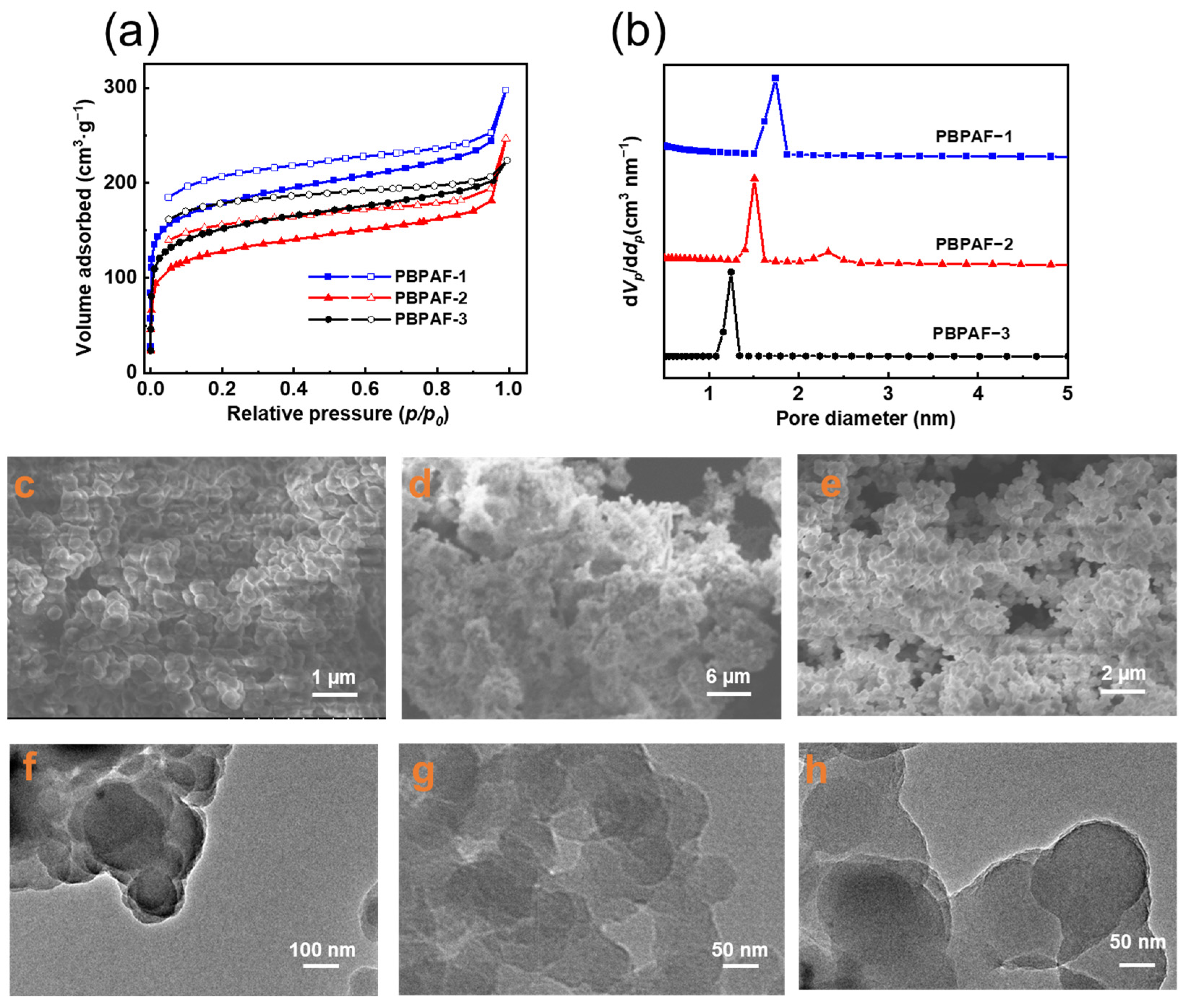
| Sample | SBET (m2·g−1) | Micropore Volume (cm3·g−1) | Mesopore Volume (cm3·g−1) | Pore Size (nm) |
|---|---|---|---|---|
| PBPAF−1 | 616 | 0.63 | - | 1.7 |
| PBPAF−2 | 463 | 0.44 | 0.08 | 1.51, 2.13 |
| PBPAF−3 | 554 | 0.59 | - | 1.24 |
| Sulfide | Chemical Formula | Structure | Molecular Size (Å) |
|---|---|---|---|
| BT | C8H6S |  | 6.5 × 8.9 |
| DBT | C12H8S |  | 6.07 × 9.81 |
| Adsorbent | Model Oil | T/°C | Adsorbate | Adsorption Capacity/mmol·g−1 | Ref. |
|---|---|---|---|---|---|
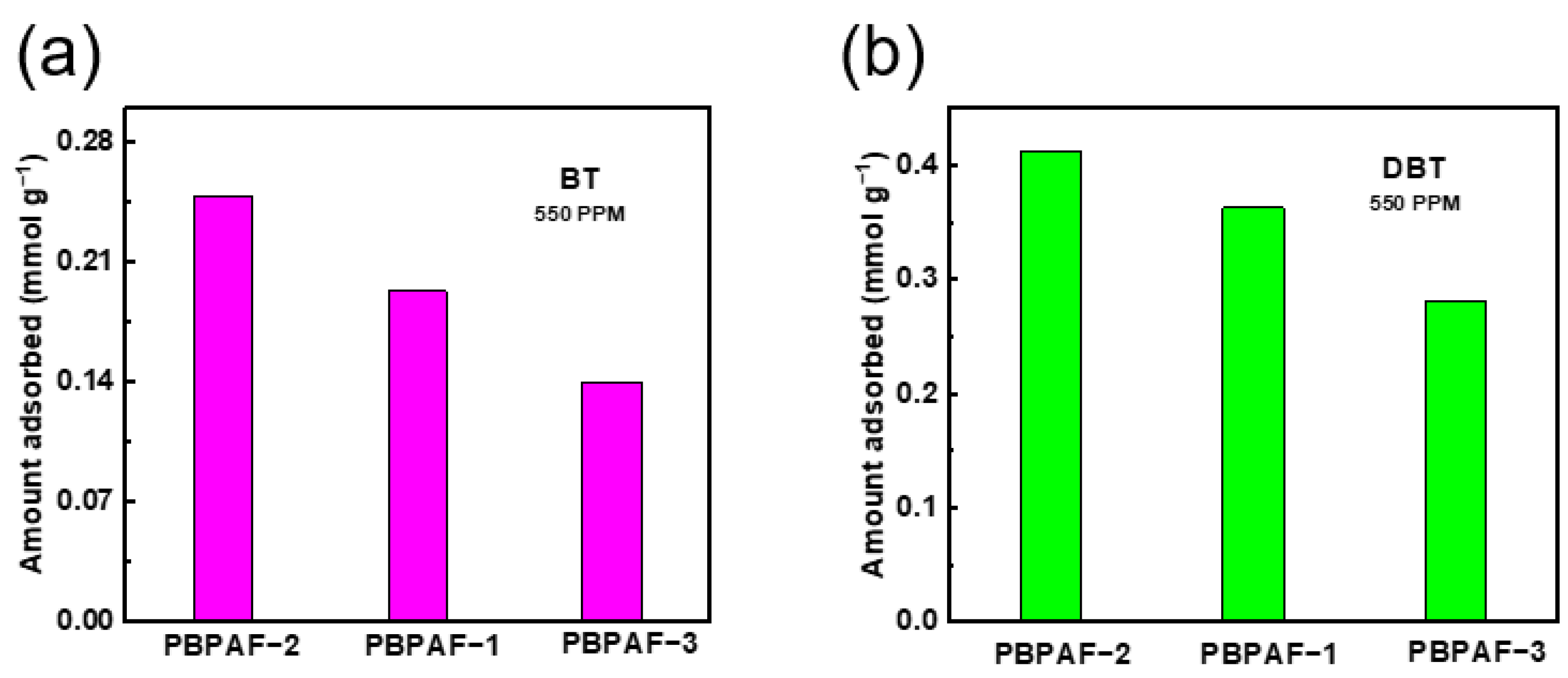
| PBPAF−2 | Isooctane | 25 °C | DBT | 0.41 | This work |
| PBPAF−2 | Isooctane | 25 °C | BT | 0.24 | This work |
| PBPAF−1 | Isooctane | 25 °C | DBT | 0.36 | This work |
| PBPAF−1 | Isooctane | 25 °C | BT | 0.19 | This work |
| PBPAF−3 | Isooctane | 25 °C | DBT | 0.28 | This work |
| PBPAF−3 | Isooctane | 25 °C | BT | 0.14 | This work |
| HY/SBA−15 | Nonane | 25 °C | TH | 0.09 | [32] |
| Ce-HY/SBA−15 | Nonane | 25 °C | TH | 0.16 | [32] |
| CTAB−H−0.3 | n-octane | 20 °C | BT | 0.42 | [8] |
| ACO | Petroleum ether | 30 °C | DBT | 0.22 | [33] |
| AgNO3-SBA−15 | n-Decane | 25 °C | DBT | 0.21 | [34] |
| CuCl/AS−10 | Isooctane | 25 °C | BT | 0.25 | [35] |
| Na/Y | Isooctane | 25 °C | DBT | 0.27 | [35] |
| Cu2O/MIL−101(Cr) | Isooctane | 25 °C | BT | 0.31 | [36] |
Disclaimer/Publisher’s Note: The statements, opinions and data contained in all publications are solely those of the individual author(s) and contributor(s) and not of MDPI and/or the editor(s). MDPI and/or the editor(s) disclaim responsibility for any injury to people or property resulting from any ideas, methods, instructions or products referred to in the content. |
© 2025 by the authors. Licensee MDPI, Basel, Switzerland. This article is an open access article distributed under the terms and conditions of the Creative Commons Attribution (CC BY) license (https://creativecommons.org/licenses/by/4.0/).
Share and Cite
Li, T.; Li, X.; Wu, H.; Shi, G.; Zeng, Y.; Xu, D.; Xue, D. Design of Porous Aromatic Frameworks for Adsorptive Desulfurization: Synergistic Modulation via π-π Interactions and Mesopores. Nanomaterials 2025, 15, 1815. https://doi.org/10.3390/nano15231815
Li T, Li X, Wu H, Shi G, Zeng Y, Xu D, Xue D. Design of Porous Aromatic Frameworks for Adsorptive Desulfurization: Synergistic Modulation via π-π Interactions and Mesopores. Nanomaterials. 2025; 15(23):1815. https://doi.org/10.3390/nano15231815
Chicago/Turabian StyleLi, Tiantian, Xiaowen Li, Hao Wu, Guangxia Shi, Yizhi Zeng, Dong Xu, and Dingming Xue. 2025. "Design of Porous Aromatic Frameworks for Adsorptive Desulfurization: Synergistic Modulation via π-π Interactions and Mesopores" Nanomaterials 15, no. 23: 1815. https://doi.org/10.3390/nano15231815
APA StyleLi, T., Li, X., Wu, H., Shi, G., Zeng, Y., Xu, D., & Xue, D. (2025). Design of Porous Aromatic Frameworks for Adsorptive Desulfurization: Synergistic Modulation via π-π Interactions and Mesopores. Nanomaterials, 15(23), 1815. https://doi.org/10.3390/nano15231815