Appendix A. Independent Channel Method
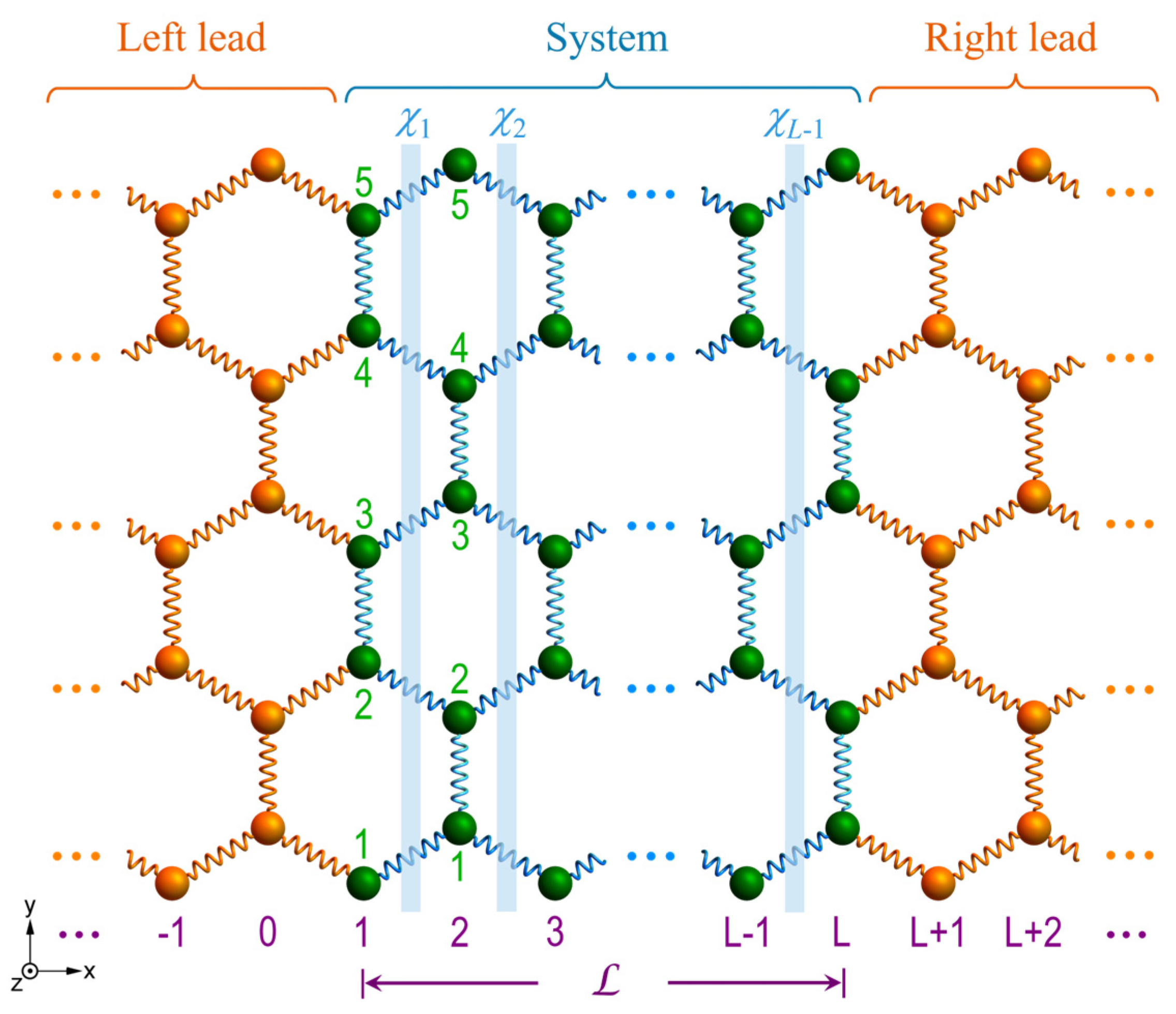
Let us consider a narrow zigzag-edged graphene ribbon of
L transverse lines, and a width of
atoms per line. This ribbon without corrugation is connected to two semi-infinite periodic leads at its longitudinal ends, as illustrated in
Figure A1.
Figure A1.
(Color online) Schematic representation of a zigzag-edged graphene ribbon (green spheres) with and an arbitrary number of transverse lines L, connected to two semi-infinite periodic leads (orange spheres).
Figure A1.
(Color online) Schematic representation of a zigzag-edged graphene ribbon (green spheres) with and an arbitrary number of transverse lines L, connected to two semi-infinite periodic leads (orange spheres).
For a graphene ribbon described by a nearest-neighbor Born–von Karman model, the interaction potential of Equation (1), replacing
and
, can be rewritten as [
17]
where
and
are, respectively, the in-plane and out-of-plane interatomic restoring force constants along line
l and between lines
l and
, while
is the displacement of atom
from its equilibrium position. The dynamical matrix
of the ribbon shown in
Figure A1 is
where
and
are, respectively, dynamical matrices for in-plane and out-of-plane vibrational modes with
M the mass of carbon atoms and
where
is the interaction matrix between transversal lines
l and
, being
the
identity matrix with
and
. In Equation (A3), the interaction matrices within
(odd) and
(even) numbered transverse lines, for
, are, respectively, in accordance with the numbering of atoms in
Figure A1,
where
and
.
Let us introduce a unitary transformation via matrix
given by
where for the case of
, the submatrix
with
(odd number) is
and for
(even number) is
being
and
, derived from a general expression given by
with
.
Applying this unitary transformation
to
of Equation (A3), we obtain
where
denotes the transpose matrix of
. The transformed submatrices
and
are given by
where
,
,
,
,
, and
. The three colors (red, green, and blue) in Equation (A10) indicate different conducting channels: the red one corresponds to a single channel, while the green and blue ones represent two independent dual channels. Reordering the matrix
into block-diagonal form yields
where
for
. In Equation (A12),
and
are 2 × 2 matrices given by
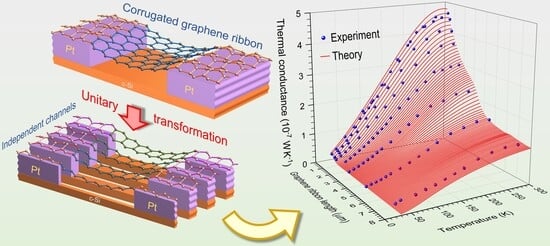
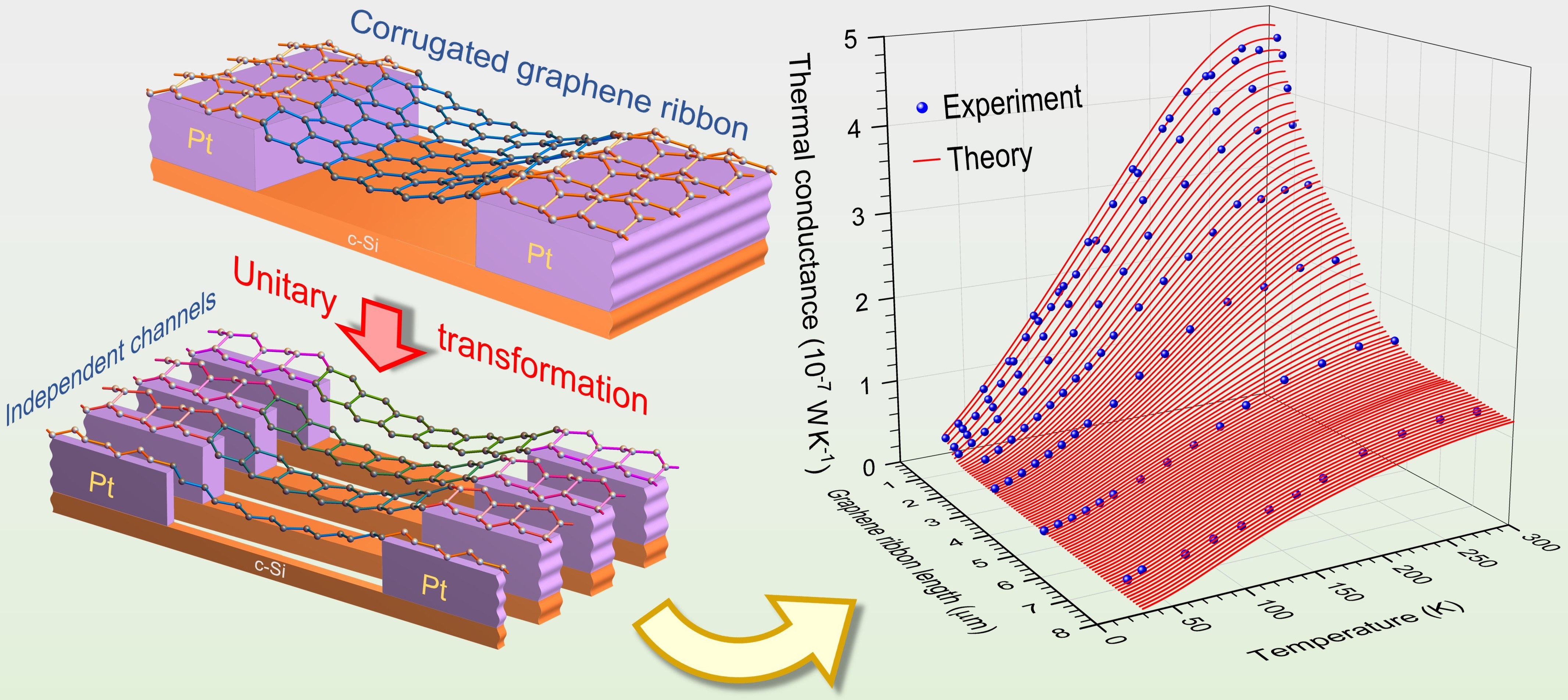
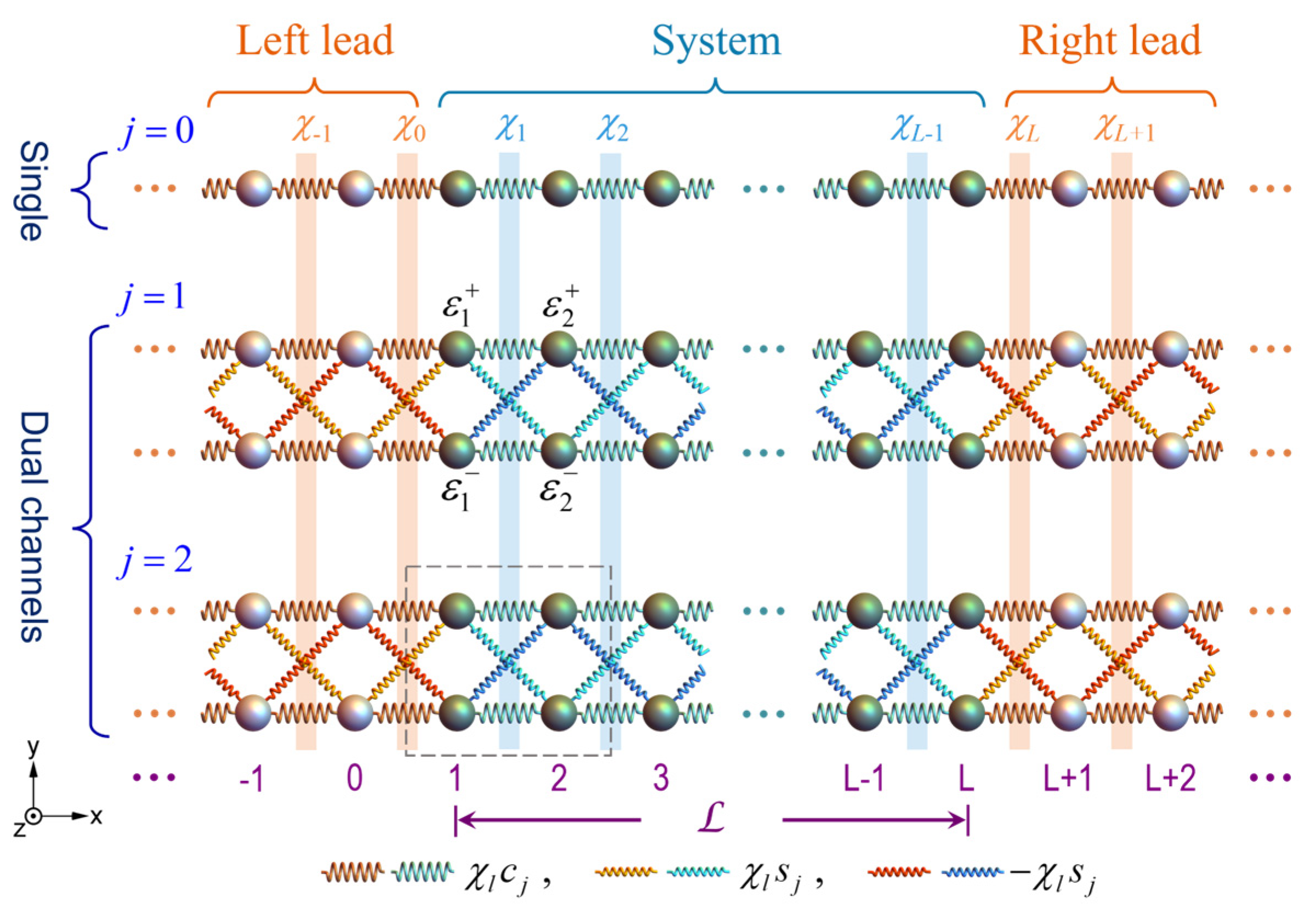
It is worth mentioning that dynamical matrix (A11) can be represented by three independent channels, i.e., one single channel and two dual channels, as schematically shown in
Figure A2.
Figure A2.
(Color online) Sketch of independent channels obtained from the zigzag-edged graphene ribbon shown in
Figure A1 through the unitary transformation
of Equation (A5). Green spheres denote atoms in the system, while light colored ones denote those in the leads.
Figure A2.
(Color online) Sketch of independent channels obtained from the zigzag-edged graphene ribbon shown in
Figure A1 through the unitary transformation
of Equation (A5). Green spheres denote atoms in the system, while light colored ones denote those in the leads.
In general, for an arbitrary zigzag-edged graphene ribbon with a length of
L transverse lines and a width of
W (odd number) atoms per line, the ribbon can be transformed into one single channel plus
independent dual channels. The elements of matrices
in Equation (A13), with
labeling the
n-th dual channel, are given by
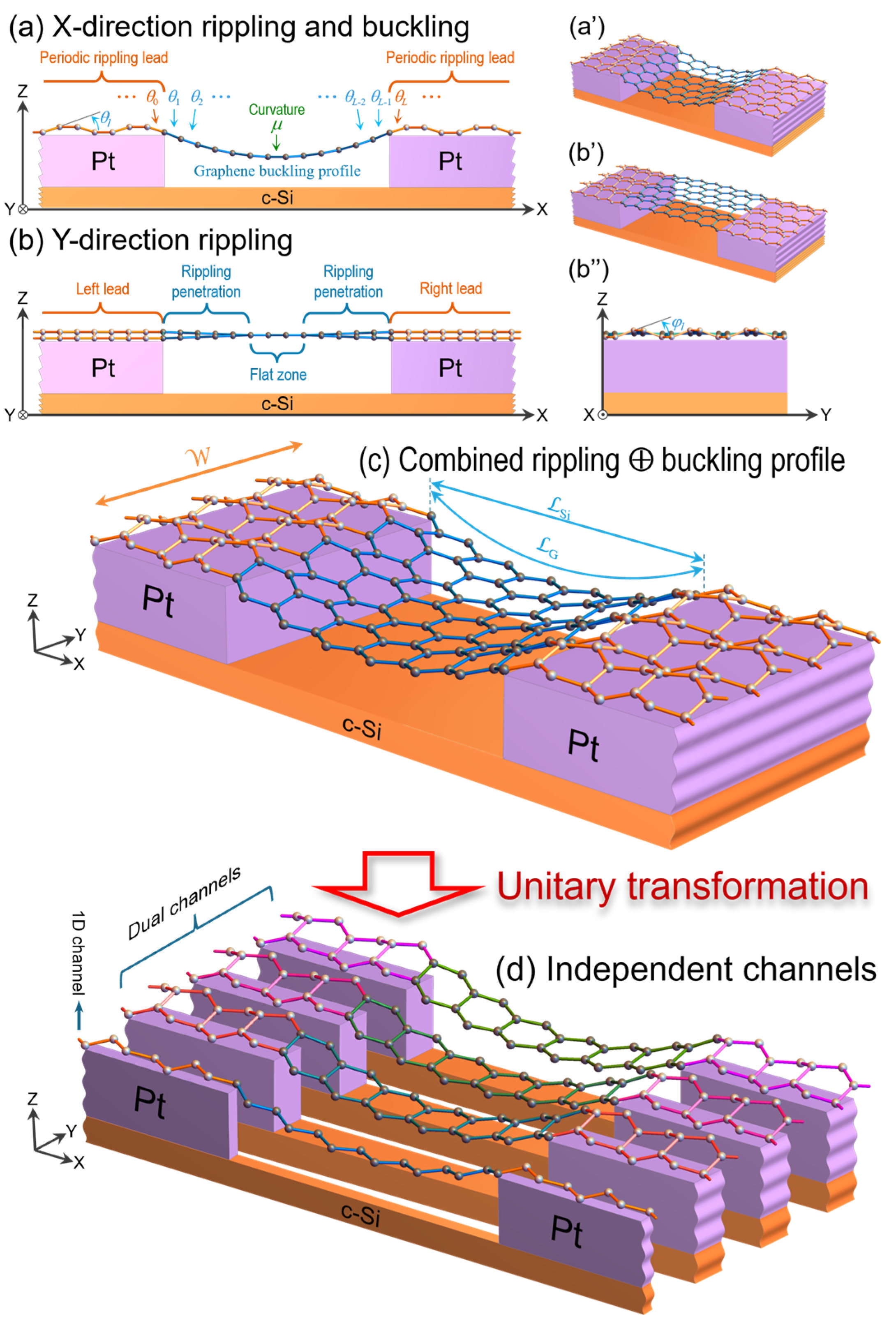
This independent-channel method developed for zigzag-edged graphene ribbons can be extended to include second-neighbor interactions and a buckling profile, both along the X-direction, as well as rippling distortions along the X- and Y-directions in the leads, based on a new unitary transformation given by Equation (A26). In this article, we consider two out-of-plane deformations, described below.
- (1)
Angles in the XZ subspace
The angle formed by the plane defined by two successive transverse lines
l and
l + 1, with respect to the X-axis, as illustrated in
Figure 2a, is
where
is the angle that generates the rippling pattern along the X direction in the left and right semi-infinite leads, being
the mismatch arising from the difference between the thermal expansion coefficient of graphene
and that of the platinum contacts
. For example, using the thermal expansion coefficients of Refs. [
30,
31] and assuming an initial annealing temperature of
and a final measuring temperature of
, the rippled angle in both leads
is obtained.
In Equation (A15), the suspended graphene ribbon adopts a catenary-shaped profile described by [
36]
where
is the interatomic distance in graphene, and
μ denotes the curvature at the lowest point
of the catenary (see
Figure 2a,a’), determined by
.
- (2)
Angles in the YZ subspace
The angle between the Y-axis and the bond oriented along the Y-direction that connects neighboring atoms (
l,
j) and (
l,
j + 1), as illustrated in
Figure 2b, is
where
is the out-of-plane bending angle of armchair bonds with respect to the Y-axis, and
is the rippling penetration depth into the suspended ribbon inspired by experimental observations in Ref. [
25], as shown in
Figure 2c. Analogously to
, the graphene–platinum lattice mismatch generates
. In this article, we use
.
From distortion angles
and
given by Equations (A15) and (A17), the atomic positions are
where
denotes the Heaviside step function,
and
with
,
,
, and
.
Hence, considering the interatomic potential and the bond-angle distribution, the dynamical matrix of a graphene ribbon with buckling and rippling corrugations can be written as
where the
submatrices
,
and
respectively describe intraline interactions within line
l, interline interactions between lines
l and
, and those between lines
l and
being
the Kronecker product,
the
identity matrix,
and
with
. In Equation (A21), matrices
for the case of
are
where
,
, and
Now, let us introduce a three-dimensional (3D) unitary transformation
for vibration modes along the X-, Y- and Z-directions, where
is the one-dimensional (1D) unitary transformation given in Equation (A5) and
is the three-dimensional identity matrix. Thus,
can be written as
where submatrices
for
and
(odd number) is
and for
and
(even number) is
with
and
obtained from a general expression given by Equation (A8). Applying this unitary transformation
Ξ to
Φ of Equation (A21), we obtain
where
,
, and
are given by
with
,
defined in Equation (A14), and
. In Equation (A30), the three colors (red, green, and blue) in analogy with Equation (A11) denote the single, first-dual, and second-dual conducting channels, respectively. Reordering the dynamical matrix
into block-diagonal form yields
where
corresponds to the single channel and
to the
j-th dual channel given by
being
and
3 × 3 matrices given in Equations (A22) and (A23),
Redefining each pair of transverse lines as a single “new line”, Equations (A32) and (A33) can be rewritten as
where
counts the new lines,
It is worth noting that and are 6 × 6 matrices, while and are 12 × 12 matrices.
In summary, as an example, in this Appendix we have mapped a narrow graphene ribbon of a width atoms into one single and two dual channels through unitary transformations, for both pristine and corrugated structures. In the next appendix, we resume and extend the transfer matrix method for single and dual channels, respectively.
Appendix B. Transfer Matrices for Single and Dual Channels
For the single channel, the equation of motion derived from Equation (A12) without corrugations is
where
,
,
, and
is the transpose of the displacement vector, being
M the atomic mass and
(
) the in-plane (out-of-plane) restoring force constant from Equation (4). The transfer matrix
derived from Equation (A37) is
where
. The global transfer matrix (
) connecting the left and right leads is
For a vibrational wave incident from the left lead, the displacements in both semi-infinite leads are
where
and
are, respectively, the reflection and transmission amplitudes,
k is the wave vector, and
with
the C-C bond length in graphene. Substituting Equations (A40) into (A39) yields
where
is a 2 × 2 matrix built by column eigenvectors
of the single-channel
k-space dynamical matrix
for a periodic lead with
, given by
Solving Equation (A41) for the reflectance (
) and transmittance (
) yields [
37]
and
where the phonon dispersion relation
has been used, with
k the wavevector along the X-direction.
For the
j-th dual channel, the equation of motion obtained from the matrix
of Equation (A12) without corrugations reads
where
is the displacement vector of
l-th transverse line in the
j-th dual channel for the vibrational mode
, as shown in
Figure A2.
From Equation (A45) we obtain
where
describes the interaction between transverse lines
l and
l + 1 in the
j-th dual channel, as given by Equation (A49). Equation (A46) can be rewritten using the 4 × 4 dual-channel transfer matrix
as
where
is the 2 × 2 identity matrix. Thus, the total transfer matrix for the
j-th dual channel is
, which connects the left lead to the right one and satisfies
The normal vibrational modes in the semi-infinite leads with
for
or
can be described by a
vector
with
the number of unit cells in the leads, satisfying the following eigenvalue equation [
38],
where the subscript
denote the acoustic or optical vibrational branches, respectively. The eigenfrequencies
are given by
whose corresponding eigenvectors are
being
and
.
In
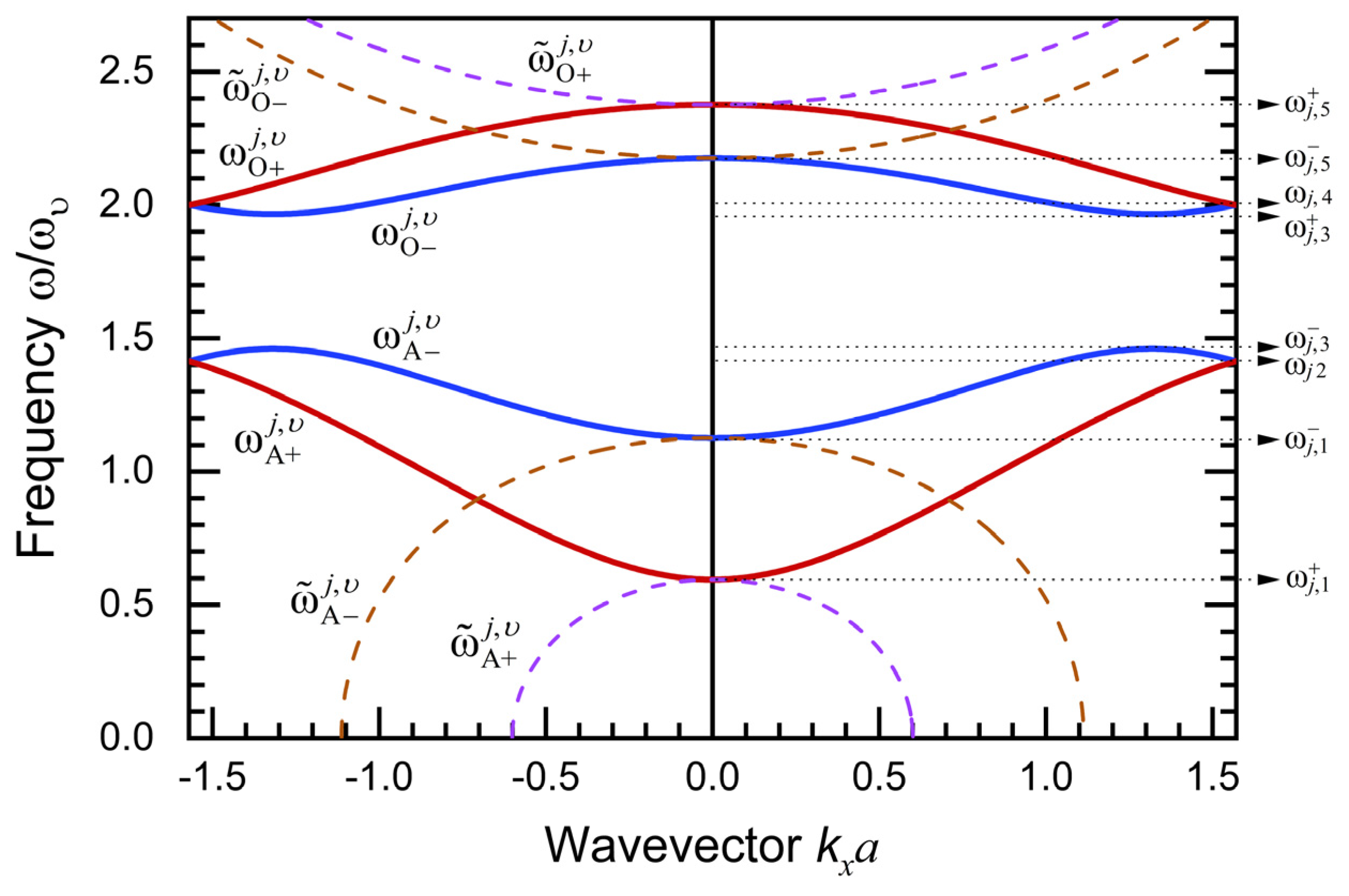
Figure A3, the dispersion relations
from Equation (A50) is plotted for the
j-th dual channel, where
,
,
,
, and
, with
.
Figure A3.
(Color online) Phonon dispersion relations (solid lines) of Equation (A50) for the j-th dual channel, including the evanescent modes (dashed lines) with .
Figure A3.
(Color online) Phonon dispersion relations (solid lines) of Equation (A50) for the j-th dual channel, including the evanescent modes (dashed lines) with .
In
Figure A3, observe evanescent vibrational modes in the interval
plotted as
(dashed lines) possessing an imaginary wave vector
and zero transmittance. Likewise, the evanescent modes
in the ranges
and
are also described by Equations (A49)–(A51) substituting
.
For a given frequency ω in
Figure A3, there are four associated wavevectors,
or
, which satisfy
, except for the forbidden frequency gap
. For the first case that ω lies in a region with four real eigenvectors, the displacements in both leads are
where subindices
denote
or
, depending on the frequency region of ω,
are given by Equation (A51), and
L is an even integer. For an incident vibrational wave with amplitudes
and
coming from the left, we have
,
and
in Equation (A52), where
and
are, respectively, the reflection and transmission amplitudes of the outgoing mode
from the incoming
.
To calculate the transmission (
) and reflection (
) matrices, we substitute Equation (A52) into Equation (A48), obtaining
where
and
are
submatrices, while
and
are the
identity and zero matrices. In Equation (A53),
with
, whose columns are the four eigenvectors, while
Solving Equation (A53) for
and
gives
The flux conservation law can be written as [
39]
which requires normalized transmission and reflection amplitudes given by [
40]
where
is the group velocity of
mode. Hence, the reflectance
and transmittance
for the
j-th dual channel with vibration mode
are
For the second case, two Bloch-type
and two evanescent
eigenvectors, Equation (A52) is replaced by
For an incident vibrational wave from the left with amplitude
, we set
,
and
, where
and
are the transmission and reflection coefficients. To remove exponential growth terms, we choose
. Substituting Equation (A59) into Equation (A48) yields
where
with
; subscripts B and E label Bloch or evanescent modes, respectively. The four coupled Equation (A60) determine
,
,
and
. Using the substitution method,
and
can be removed, giving
where
with
. Solving Equation (A61) we find
which yields the reflectance
and transmittance
.
Hence, combining the single-channel transmittance of Equation (A44) with the dual-channel ones of Equations (A58) or (A62), the total transmittance
for the mode
is
where
is the number of dual channels and
labels the single channel.
As an example, let us consider a small pristine zigzag-edged graphene ribbon (blue zone) of width
and length
, connected to two semi-infinite leads (orange zone), as sketched in
Figure A4c’. After applying the unitary transformation (A5) to the system dynamical matrix, which becomes block diagonal, consisting of a single channel (see
Figure A4a’) and a dual channel (see
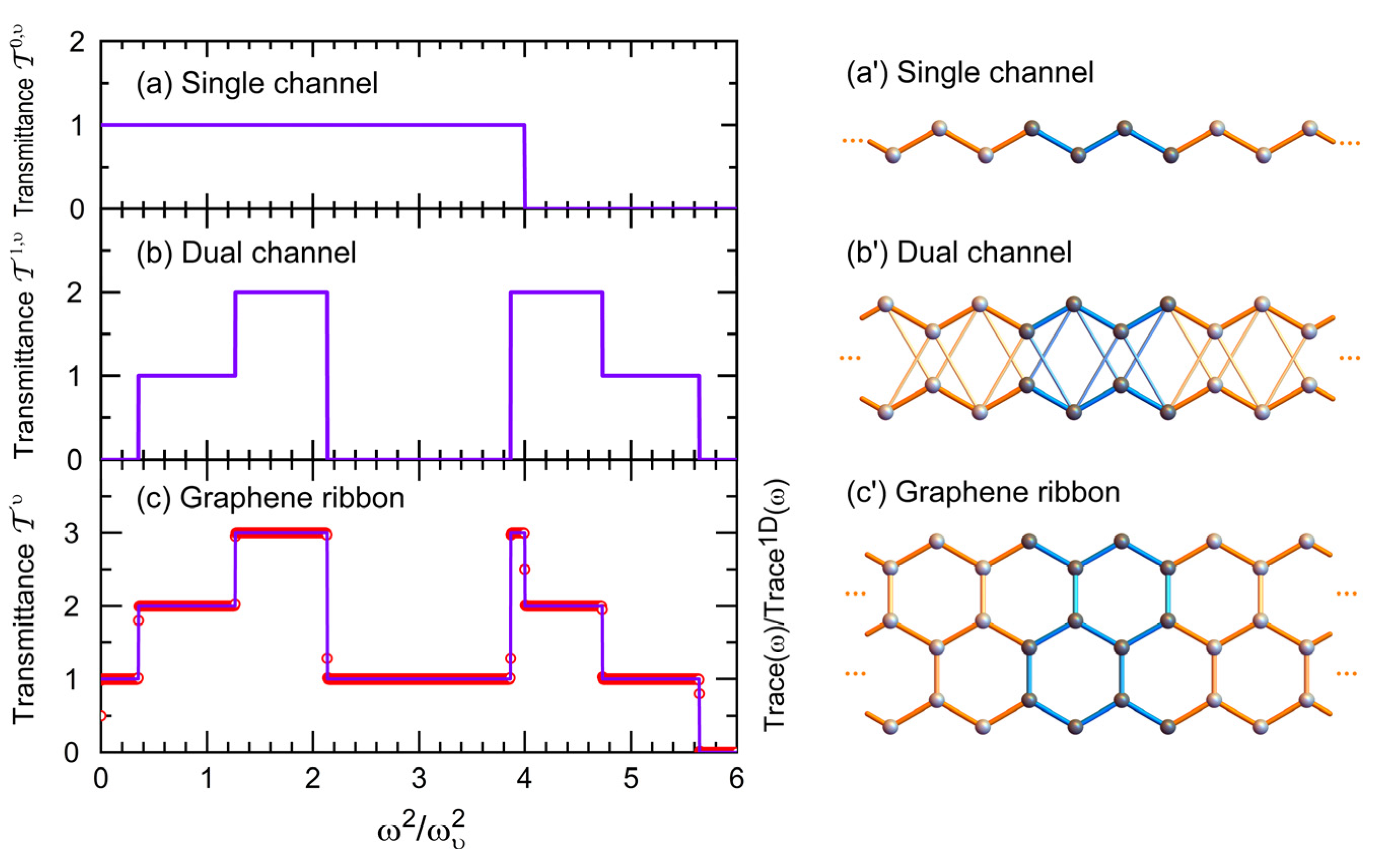
Figure A4b’), whose phonon transmittances (violet lines) versus
are, respectively, presented in
Figure A4a
and
Figure A4b
, where
. The total phonon transmittance
is plotted in
Figure A4c and compared with the normalized trace (red circles) obtained from the Kubo–Greenwood formula given by [
37,
41]
where
,
,
G is the phonon Green’s function determined by the Dyson equation
, with
given in Equation (A3). In
Figure A4c, the normalized trace of Equation (A64) was calculated without using the independent channel method, where a small imaginary part
was added to
, and two periodic graphene leads containing 15,000 atoms in each one were used.
Figure A4.
(Color online) Phonon transmittance (violet lines) of mode υ versus for (a) the single channel () sketched in (a’), (b) the dual channel () illustrated in (b’), and (c) the pristine graphene ribbon () drawn in (c’) with and (blue zone) connected to two semi-infinite leads (orange zones), in comparison with (red circles) obtained from the Kubo–Greenwood Equation (A64) with an imaginary part of added to .
Figure A4.
(Color online) Phonon transmittance (violet lines) of mode υ versus for (a) the single channel () sketched in (a’), (b) the dual channel () illustrated in (b’), and (c) the pristine graphene ribbon () drawn in (c’) with and (blue zone) connected to two semi-infinite leads (orange zones), in comparison with (red circles) obtained from the Kubo–Greenwood Equation (A64) with an imaginary part of added to .
Moreover, the spectral gap in
Figure A4b arises from two sites per transverse section in the dual channel, which produces an acoustic and an optical branch. Note the spectral symmetry about
in
Figure A4b), which is broken in the total transmittance spectrum shown in
Figure A4c due to the different coordination numbers of edge (two nearest neighbors) and interior atoms (three nearest neighbors) in graphene ribbons.
When buckling and rippling corrugations are introduced into the small graphene ribbon illustrated in
Figure A4c’, with
atoms and
suspended transverse lines, the new atomic positions in Cartesian coordinates X, Y and Z are, respectively, listed in
Table A1,
Table A2 and
Table A3 in the units of
, including two transverse lines of the left (
) and right (
) leads. The buckling profile of the system (3 × 4 atoms) is characterized by
, the X-direction rippling corrugation in both leads by
, and the Y-direction rippling in the ribbon and leads by
.
Table A1.
X-coordinates of carbon atoms in a suspended zigzag-edged graphene ribbon (light-blue highlighted zone) connected to corrugated leads represented by and .
Table A1.
X-coordinates of carbon atoms in a suspended zigzag-edged graphene ribbon (light-blue highlighted zone) connected to corrugated leads represented by and .
| In Units of | | | |
|---|
| ⁝ | ⁝ | ⁝ | ⁝ |
| | | |
| | | |
| 0 | 0 | 0 |
| | | |
| | | |
| | | |
| | | |
| | | |
| ⁝ | ⁝ | ⁝ | ⁝ |
Table A2.
Y-coordinates of carbon atoms in a suspended zigzag-edged graphene ribbon (light-blue highlighted zone) connected to corrugated leads represented by and .
Table A2.
Y-coordinates of carbon atoms in a suspended zigzag-edged graphene ribbon (light-blue highlighted zone) connected to corrugated leads represented by and .
| | | |
|---|
| ⁝ | ⁝ | ⁝ | ⁝ |
| | | |
| 0 | | |
| | | |
| 0 | | |
| | | |
| 0 | | |
| | | |
| 0 | | |
| ⁝ | ⁝ | ⁝ | ⁝ |
Table A3.
Z-coordinates of carbon atoms in a suspended zigzag-edged graphene ribbon (light-blue highlighted zone) connected to corrugated leads represented by and .
Table A3.
Z-coordinates of carbon atoms in a suspended zigzag-edged graphene ribbon (light-blue highlighted zone) connected to corrugated leads represented by and .
| | | |
|---|
| ⁝ | ⁝ | ⁝ | ⁝ |
| | | |
| | | |
| 0 | | 0 |
| | | |
| | | |
| 0 | | 0 |
| | | |
| | | |
| ⁝ | ⁝ | ⁝ | ⁝ |
To illustrate the independent channel method, let us consider an isolated, small zigzag-edged graphene ribbon of 3 × 4 atoms, with buckling and rippling corrugations as specified in
Table A1,
Table A2 and
Table A3. Using Equations (4) and (A22)–(A26) with
,
and
, the dynamical matrix of this ribbon without connecting to the leads is
where
, being
,
with
,
,
,
,
The unitary transformation of the independent channel method is
which applied to Equation (A65) as
yields
where
. Furthermore, we introduce a permutation matrix given by
which applied to Equation (A69) through
we obtain
where the single and dual channels are, respectively, described by 4 × 4 (red color) and 8 × 8 (blue color) independent block matrices. Hence, the final unitary transformation in the independent channel method is
, which maps a thin graphene ribbon with buckling and rippling corrugations onto decoupled single and dual channels, as illustrated in Equation (A71). Given that both
and
are independent of the corrugation angles
and
, the independent channel method can be applied to both the system and the leads, even when they exhibit different rippling and buckling disorders.
For a small corrugated graphene ribbon of width
and length
connected to two semi-infinite corrugated leads of the same width, the phonon transmittance (
) can be written as
where
N is the number of dual channels (here
), and
is the phonon transmittance of the
j-th channel given by
being
a 6 × 6 transmission-amplitude matrix for the single channel and
a 12 × 12 matrix for
. Using Equations (A34) and (A36), the double-line transfer matrices
take the form
for the single channel, and
for the
j-th dual channel, where
and
denote the 6 × 6 and 12 × 12 identity matrices, respectively.
It is important to note that the three vibrational modes
are not independent in corrugated graphene ribbons, and they should be studied in a correlated way, which produces larger transfer matrices as given in Equations (A74) and (A75). Extending Equation (A55), the elements of the transmission matrix
are
where
is the group velocity of the
s-th vibrational mode in the
j-th channel of a corrugated semi-infinite periodic lead. Analogous to Equation (A55),
is given by
where
and
are submatrices of the
j-th channel transfer matrix
that describes the phonon propagation from the left lead, through the system, and into the right lead. Here,
denotes the system transfer matrix, and
is built by the eigenvectors, in the same way as for the single channel case in Equation (A41) and the dual channel case after Equation (A53).
To calculate
and
in rippled leads with a four-line period, as shown in
Figure 2a,b”, the dynamical matrix of the single channel can be written in the reciprocal space as
where
and
and
.
The dynamical matrix of dual channels in the reciprocal space is
where
and
. Here,
and
are defined in Equation (A14), and
with
.
The equations of motion for the single and double channels with corrugations are, respectively,
Hence, the group velocity of s-th vibrational mode in the j-th channel is . For the single channel, the matrix of eigenvectors is and for the dual channels , where are the normalized eigenvectors.
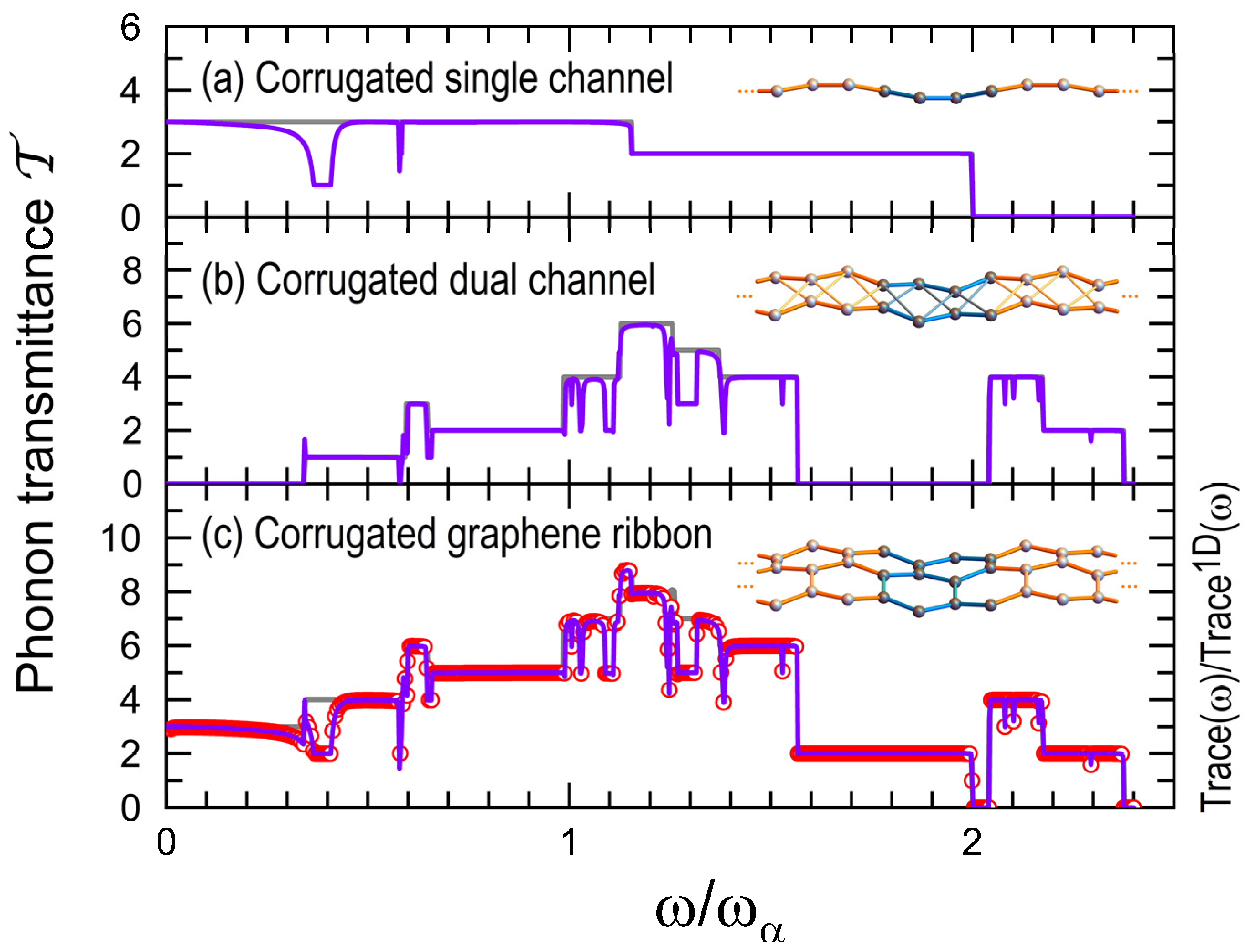
In
Figure A5, the transmittances of (a) single channel, (b) the dual channel, and (c) the graphene ribbon, obtained from Equations (A72) and (A73), are plotted versus the vibrational frequency (ω) for both pristine (gray lines) and corrugated (violet lines) narrow graphene ribbons, whose structures are sketched in their respective insets. The used rippling angles in both leads are
, while the buckling profile of the suspended region is characterized by two angles
and
. For the pristine case, we take
.
Figure A5.
(Color online) Phonon transmittances () of pristine (gray lines) and corrugated (violet lines) (a) single channel, (b) dual channel, and (c) graphene ribbon, plotted as a function of the normalized frequency , obtained from the Landauer formalism and compared with the corresponding normalized trace (red circles) of the Kubo–Greenwood formula, for a corrugated graphene ribbon (blue zone) connected to two semi-infinite leads (orange zone), as illustrated in their insets.
Figure A5.
(Color online) Phonon transmittances () of pristine (gray lines) and corrugated (violet lines) (a) single channel, (b) dual channel, and (c) graphene ribbon, plotted as a function of the normalized frequency , obtained from the Landauer formalism and compared with the corresponding normalized trace (red circles) of the Kubo–Greenwood formula, for a corrugated graphene ribbon (blue zone) connected to two semi-infinite leads (orange zone), as illustrated in their insets.
The normalized trace (red circles) from the Kubo–Greenwood formula in Equation (A64) is shown in
Figure A5c for the corrugated graphene ribbon consisting of 3 × 4 carbon atoms (red circles). These traces were calculated without the independent channel method, by adding an imaginary part
to
, and using two periodic graphene leads of 1,500,000 atoms in each of them.
Observe in
Figure A5c the excellent agreement between the phonon transmittance obtained from transfer matrices via the independent channel method and the normalized trace from the Kubo–Greenwood formula without using the independent channel transformation, even in the presence of corrugation. This agreement validates the reliability of the new independent channel method combined with the transfer-matrix method developed for dual channels.