Article

Influence of Interfacial Stress on the Structural Characteristics and Hydrogen Sensing Performance of WO3 Films


1
School of Physical Science and Technology, Suzhou University of Science and Technology, Suzhou 215000, China
2
School of Information and Communication, Harbin Institute of Technology, Harbin 150001, China
3
Advanced Microscopy and Instrumentation Research Center, Harbin Institute of Technology, Harbin 150080, China
4
School of Electronic and Information Engineering, Suzhou University of Science and Technology, Suzhou 215000, China
*
Authors to whom correspondence should be addressed.
Nanomaterials 2025, 15(23), 1785; https://doi.org/10.3390/nano15231785
Submission received: 16 October 2025 / Revised: 15 November 2025 / Accepted: 25 November 2025 / Published: 27 November 2025

Abstract

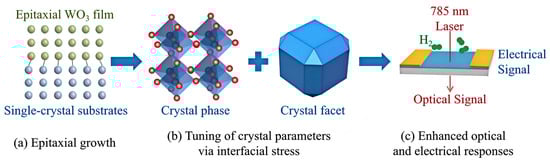
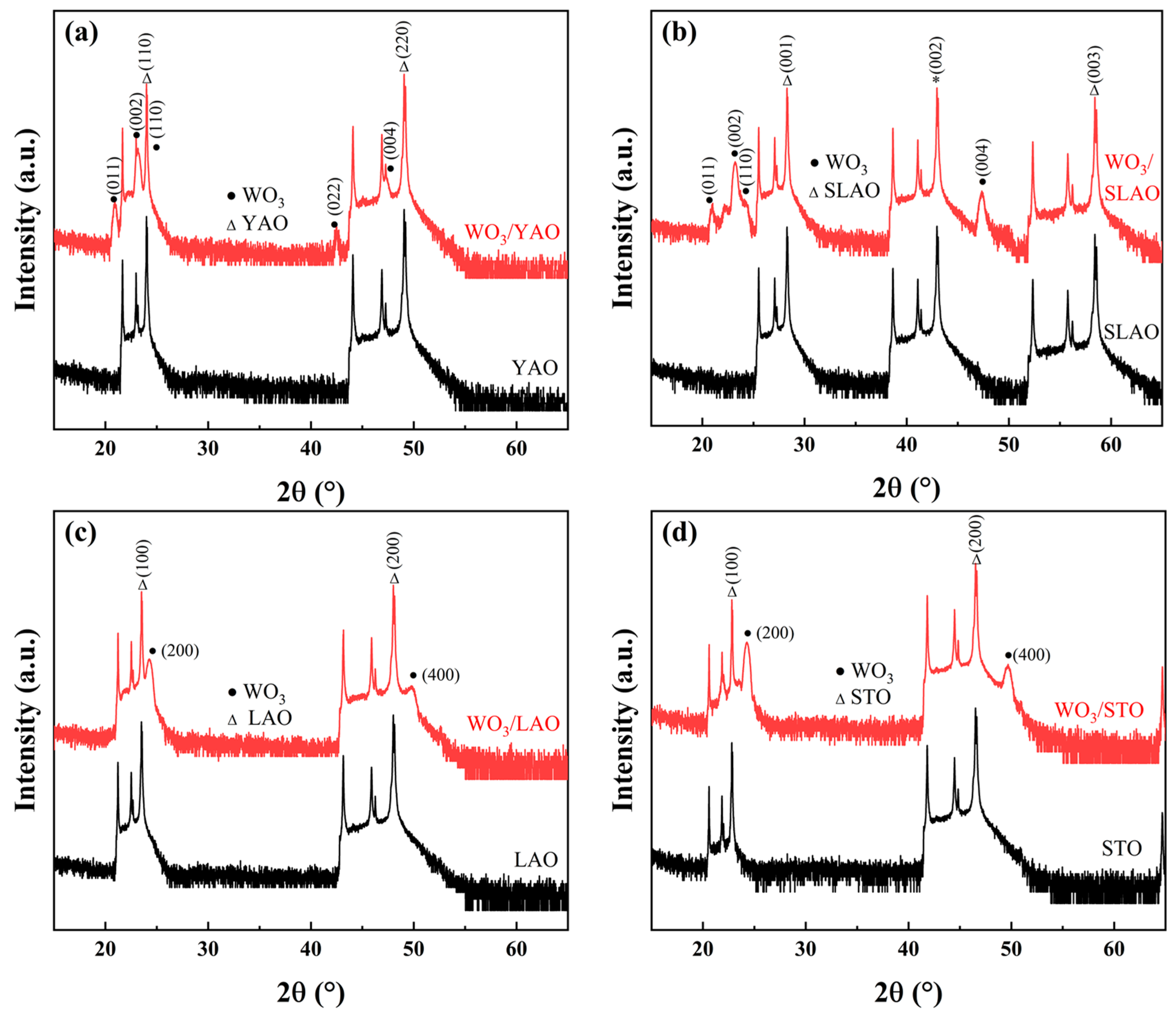
Tungsten trioxide (WO3) exhibits complementary optical and electrical responses toward hydrogen, yet the interplay between interfacial stress, crystal phase stabilization, and gasochromic/chemiresistive performance remains insufficiently understood. In this work, WO3 films were grown on four single-crystal oxide substrates to systematically tune interfacial stress and thereby modulate the resulting crystal phase, microstructure, and exposed facets. θ–2θ diffraction revealed that WO3 adopts a monoclinic phase on YAlO3 and SrLaAlO4, whereas a high-temperature orthorhombic phase is stabilized on LaAlO3 (LAO) and SrTiO3 due to stronger interfacial constraint. Compared with the amorphous quartz reference, the single-crystal substrates significantly enhanced both gasochromic and chemiresistive responses. In particular, the orthorhombic WO3/LAO film exhibited an electrical response of 1.97 × 10⁴ (Rair/RH2), an optical transmittance changed of 12.7%, and an electrical response time of 1 s toward 2% H2 at 80 °C, far exceeding the monoclinic and amorphous counterparts. The combined effects of stress-induced phase stabilization, film orientation, and hydrogen diffusion pathways are shown to govern the non-monotonic sensing trends among different substrates. These findings elucidate the structural origin of hydrogen sensitivity in WO3 and provide guidance for stress-engineered design of high-performance gasochromic and chemiresistive sensors.
Keywords: hydrogen sensor; optical and electrical responses; WO3 film; interfacial stress hydrogen sensor; optical and electrical responses; WO3 film; interfacial stress
Graphical Abstract