Article

Epitaxial Graphene/n-Si Photodiode with Ultralow Dark Current and High Responsivity
1
College of Information Science and Engineering, Northeastern University, Shenyang 110819, China
2
Shenyang National Laboratory for Materials Science, Institute of Metal Research, Chinese Academy of Sciences, 72 Wenhua Road, Shenyang 110016, China
3
School of Materials Science and Engineering, University of Science and Technology of China, 72 Wenhua Road, Shenyang 110016, China
*
Author to whom correspondence should be addressed.
These authors contributed equally to this work.
Nanomaterials 2025, 15(15), 1190; https://doi.org/10.3390/nano15151190
Submission received: 1 July 2025 / Revised: 23 July 2025 / Accepted: 1 August 2025 / Published: 3 August 2025
(This article belongs to the Section 2D and Carbon Nanomaterials)

Abstract

Graphene’s exceptional carrier mobility and broadband absorption make it promising for ultrafast photodetection. However, its low optical absorption limits responsivity, while the absence of a bandgap results in high dark current, constraining the signal-to-noise ratio and efficiency. Although silicon (Si) photodetectors normally offer fabrication compatibility, their performance is severely hindered by interface trap states and optical shading. To overcome these limitations, we demonstrate an epitaxial graphene/n-Si heterojunction photodiode. This device utilizes graphene epitaxially grown on germanium integrated with a transferred Si thin film, eliminating polymer residues and interface defects common in transferred graphene. As a result, the fabricated photodetector achieves an ultralow dark current of 1.2 × 10⁻⁹ A, a high responsivity of 1430 A/W, and self-powered operation at room temperature. This work provides a strategy for high-sensitivity and low-power photodetection and demonstrates the practical integration potential of graphene/Si heterostructures for advanced optoelectronics.

1. Introduction

Owing to its exceptional carrier mobility (up to 60,000 cm2/(V·s) on a substrate and at room temperature [1,2]) and broadband spectral response spanning ultraviolet (UV) to terahertz [2,3,4,5], graphene is widely regarded as a promising material for ultrafast and broadband photodetection [6,7,8,9,10,11,12,13,14,15,16]. To date, various graphene-based photodetector architectures (e.g., metal-graphene junctions [6,8,16], and graphene p-n junctions [17,18,19,20]) have been demonstrated. Relying on the unique electronic properties of graphene, these devices can achieve broadband detection with ultrafast response. However, two intrinsic limitations hinder the application of graphene-based photodetectors. First, the intrinsically low optical absorption of graphene (monolayer, ~2.3% [21]) severely limits the generation of photogenerated carriers, resulting in the responsivity typically on the order of mA/W [15], significantly lower than commercial standards [22]. On the other hand, the zero bandgap nature of graphene prevents effective suppression of the hot carriers, leading to high dark current [18,23]. Consequently, the elevated dark current degrades the signal-to-noise ratio (SNR) and reduces the energy conversion efficiency [24].
In contrast, silicon (Si)-based photodetectors have dominated the field of optoelectronics for decades due to their seamless integration with the complementary metal-oxide-semiconductor (CMOS)-compatible fabrication process [15,25]. However, as an indirect bandgap semiconductor, Si exhibits a relatively low intrinsic optical absorption coefficient, which significantly limits the photoelectric conversion efficiency of Si photodetectors [22]. To address this limitation, various Si micro/nanostructures, such as Si nanowire, micro/nanoporous Si, and micropyramid Si, have been developed to enhance light absorption [26,27,28,29]. These structures improve the optical path length and reduce the surface reflection, thereby improving the photoelectric energy conversion efficiency. Nevertheless, the conventional fabrication process of Si-based photodetectors still relies on the deposition of metal electrodes, which inevitably induces the optical shading and reduces the effective illumination area [22]. Moreover, the metal–silicon interface is susceptible to the formation of trap states, leading to pronounced carrier recombination and reduced responsivity [22].
To overcome these limitations, graphene has emerged as a promising transparent electrode material in Si-based photodetectors, enabling the formation of graphene/Si Schottky junctions [30,31,32]. Unlike conventional metal electrodes, graphene offers exceptional optical transmittance [21], high carrier mobility [1,2], and a tunable Fermi level [33]. These properties make it highly attractive for a wide range of applications, including photodetection, solar harvesting, and sensing. In particular, graphene/Si photodiodes demonstrate commercial-level responsivity across UV-visible spectra, while also offering advantages in scalability and simplified fabrication [34,35]. However, prevailing fabrication approaches for such photodiodes still suffer from critical issues, including polymer residues introduced during the wet transfer of graphene and surface/interface defects caused by micro/nanostructure etching [26]. These imperfections contribute to increased dark current, thereby significantly degrading device performance in terms of SNR, responsivity, and power efficiency [36].
To address these challenges, we reported a graphene/n-type silicon (n-Si) heterojunction photodiode via in situ growth of graphene on germanium (Ge) substrates [37], followed by the transfer of Si thin film onto the graphene/Ge stack. This fabrication strategy effectively eliminates interface defects and polymer residues typically introduced during conventional etching and transfer processes. As a result, the graphene/n-Si photodiode achieves an ultralow dark current of 1.2 × 10⁻⁹ A and a high responsivity of 1430 A/W. In addition, the device delivers a large short-circuit current of 5.6 × 10⁻⁶ A, enabling an efficient self-powered operation without external bias.

2. Methods

2.1. Graphene Grown Epitaxially on Ge

A CVD method was applied to grow the high-quality graphene on a 4-inch n-type <110> Ge substrate. The Ge substrate was placed in a 4-inch horizontal quartz tube with the vacuum degree about 0.1 Pa. After the quartz tube was heated to 916 °C and filled with high purity argon (700 sccm) and hydrogen (70 sccm), CH4 (2.2 sccm) was introduced to grow graphene on the Ge substrate. Finally, a 50 nm Ti/Au electrode was evaporated on top of the graphene by photolithography and electron beam evaporation.

2.2. Transfer of the n-Si Film

The n-Si film was achieved from a silicon-on-insulator (SOI) substrate with a 3 μm-thick top single-crystal Si layer (resistivity: 1–20 Ω cm), and a 0.5 μm-thick buried SiO2 layer. First, a 50 nm-thick Ti/Au electrode was deposited on the surface of top Si layer of SOI by electron beam evaporation. Then the Si layer with top electrode was patterned into 30 × 30 μm2 square-shaped film by RIE with the CF4 and O2. Next, 40 wt% concentrated HF was used to etch away the buried SiO2, leaving the patterned top Si film onto the SOI substrate. Finally, PDMS film was placed on the SOI substrate to retrieve the Si film and peeled away quickly. To release the Si film, the PDMS was then placed on the target substrate and peeled away slowly, leaving the Si membrane onto the graphene.

3. Characterization

The devices were characterized using an optical microscope (LV100ND, Nikon, Tokyo, Japan), an AFM (Bruker Dimension Icon, Bruker, Billerica, MA, USA), an SEM (ZEISS Sigma 300, Carl Zeiss AG, Oberkochen, Germany), and a micro-Raman analyzer (Jobin Yvon HR800, Horiba, Kyoto, Japan). The electrical and optoelectronic performances were measured using a semiconductor analyzer (Agilent B1500A, Agilent Technologies, Santa Clara, CA, USA), a probe station (Cascade M150, FormFactor, Livermore, CA, USA), and a laser diode controller (ITC4001, Thorlabs, Newton, MA, USA), using laser excitations of 405, 516, 638, and 800 nm in a dark room at room temperature.

4. Results

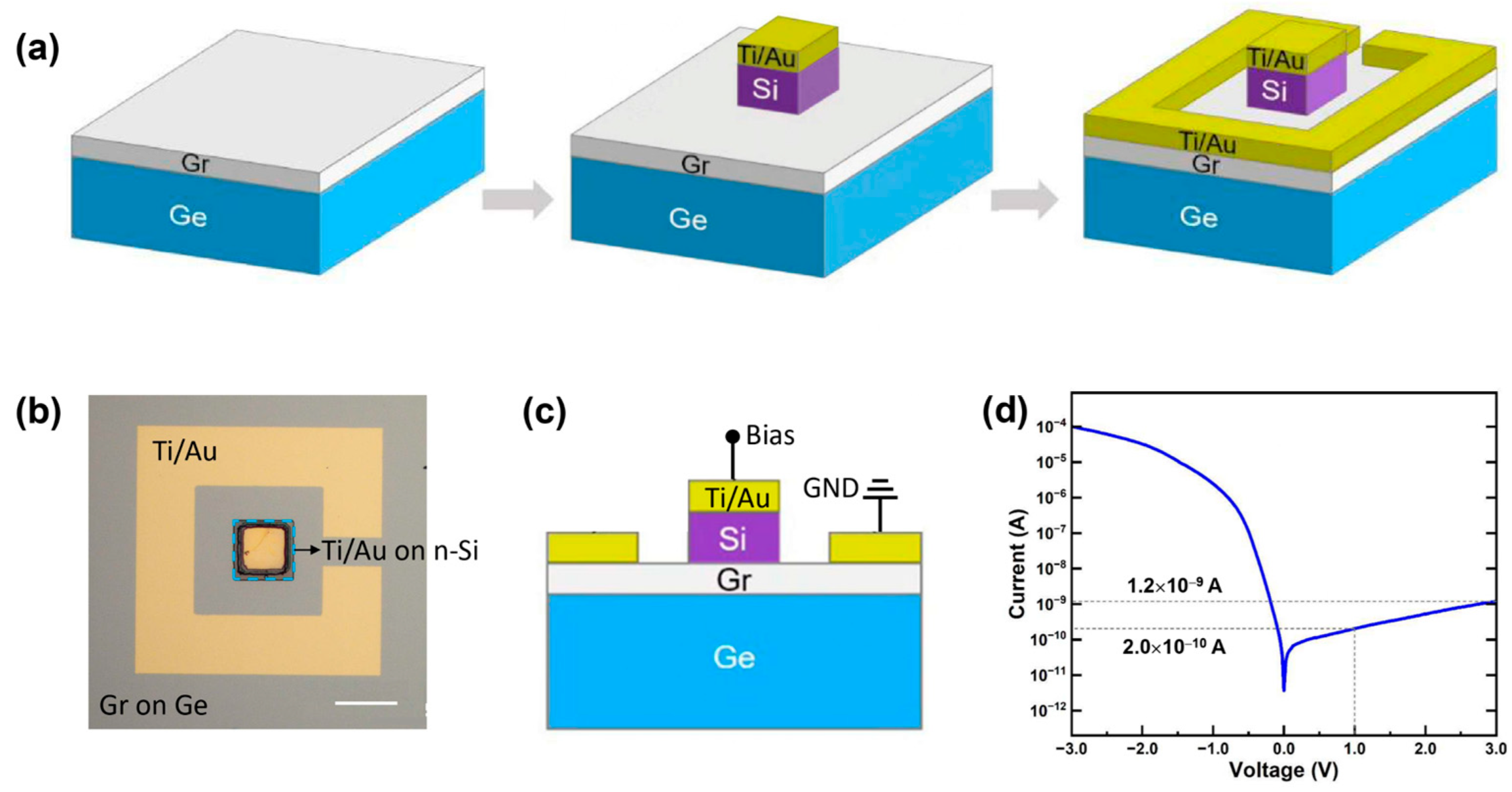
As illustrated in Figure 1a, the graphene/n-Si heterojunction photodetector consists of four primary components: gold (Au) electrodes, n-Si, graphene, and Ge substrate. The detailed fabrication process involved four sequential steps. The first step is the pretreatment of Ge substrate and the growth of graphene [37]. Specifically, the Ge substrate is sequentially cleaned by ultrasonic cleaning in acetone, isopropanol, and deionized water to remove surface contaminants. This is followed by oxide removal using a diluted hydrofluoric acid (HF) solution. Subsequently, high-quality single-crystal monolayer graphene is grown epitaxially on the Ge substrate via a chemical vapor deposition (CVD) process. The second step is patterning the n-Si film. This process begins with the photolithographic definition of electrode patterns on a SiO2/Si substrate, followed by the deposition of Ti/Au electrodes via electron beam evaporation. Subsequently, reactive ion etching (RIE) is employed to isolate the n-Si film region. The third step is the transfer of the n-Si film. This is accomplished by etching the SiO2 sacrificial layer using HF, followed by a solid polydimethylsiloxane (PDMS) assisted lift-off to transfer the n-Si film onto the graphene/Ge substrate. The final step is the fabrication of graphene electrode. In this step, photolithography is again employed to define a photoresist mask layer, exposing the desired electrode regions on the graphene layer. Ti/Au electrodes are then deposited via electron beam evaporation to complete the device structure.
Figure 1b shows the optical micrograph of the fabricated device, highlighting the 30 × 30 μm2 n-Si membrane. The cross-sectional schematic of this graphene/n-Si heterojunction structure is shown in Figure 1c, clearly illustrating the device architecture. The morphological and structural characterizations of devices are also shown in Figure S1. The scanning electron microscopy (SEM) image (Figure S1a) shows that the device surface is extremely clean, without visible contamination or residues, ensuring a pristine graphene/n-Si heterojunction interface. The atomic force microscopy (AFM) measurements (Figure S1b) indicate that the root-mean-square roughness (Ra) of the epitaxial graphene on Ge substrate is only 1.26 nm, confirming its high surface flatness and uniformity. Such smooth graphene morphology is beneficial for minimizing interface trap states and enhancing charge transport. While the Raman scattering spectra (Figure S1c) of epitaxial monolayer graphene on n-Ge exhibit two characteristic peaks, the G band at 1580 cm−1 and the 2D band at 2700 cm−1, the D band associated with defects is absent. All these results clearly demonstrate a high crystallinity and a low defect density of the epitaxial graphene on Ge.
To evaluate the rectifying behavior of the graphene/n-Si photodiode, the dark current–voltage (IV) curve was measured, which demonstrates an excellent diode-like rectification, achieving a rectification ratio up to 105 (Figure 1d). Notably, the dark current remains as low as 2.0 × 10¹⁰ A at a bias of 1 V and only increases to 1.2 × 10⁻⁹ A at 3 V, highlighting the ultralow dark current of the device.
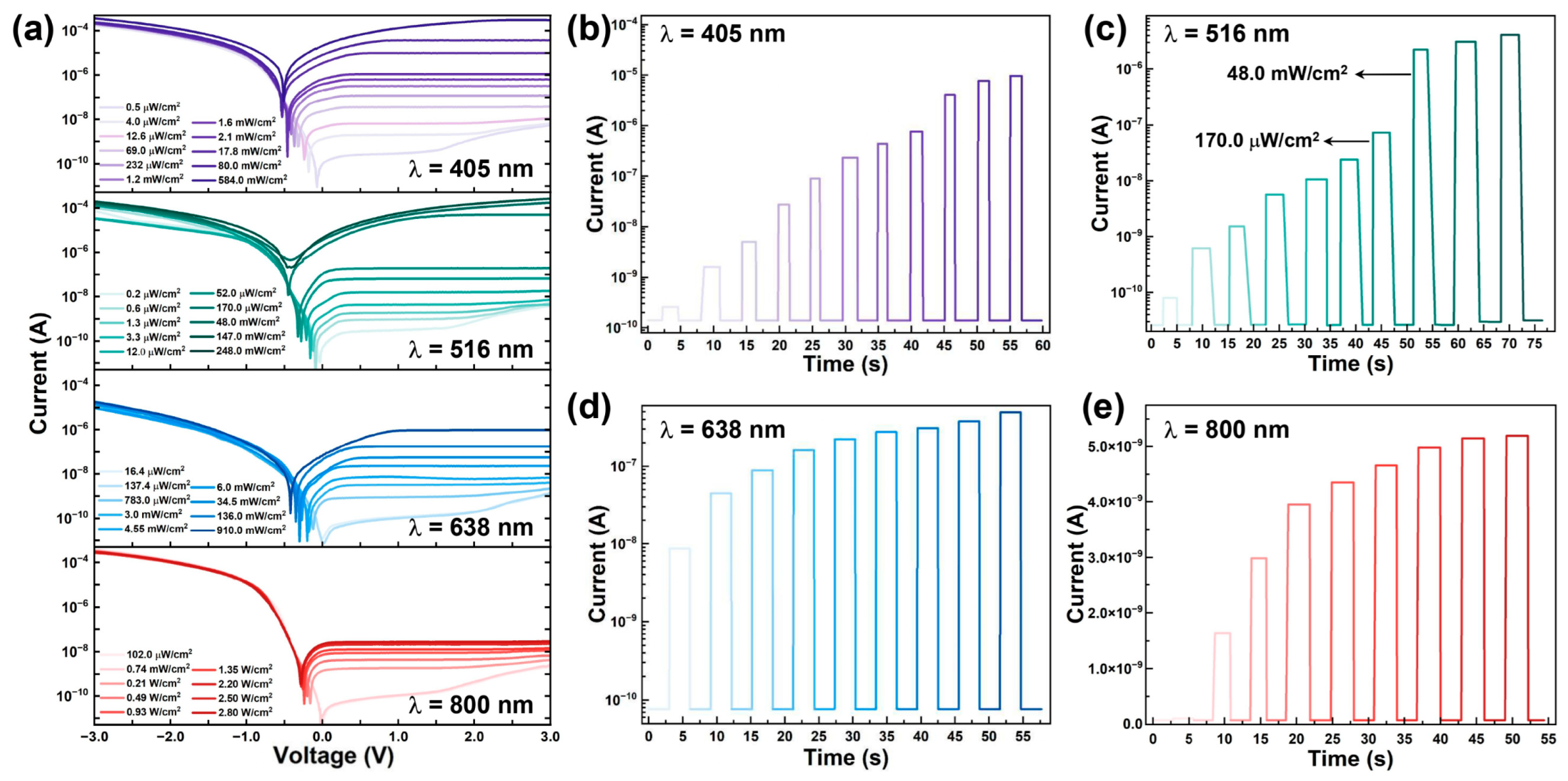
To systematically evaluate the photoelectric characteristics of the fabricated graphene/n-Si heterojunction photodetector across a broad spectral range, the device was illuminated with laser sources of varying wavelengths spanning from UV to near-infrared. Specifically, laser beams at 405 nm, 516 nm, 638 nm, and 800 nm wavelengths were employed to conduct IV measurements under different illumination intensities. As a result, according to the corresponding IV curves shown in Figure 2a, the graphene/n-Si photodiode exhibits significant photoresponse across all tested wavelengths, while the reverse current increases markedly with the incident light intensity, suggesting an efficient photogenerated carrier separation at the graphene/n-Si junction. In addition, as increasing the light intensity, the open-circuit voltage (VOC, defined as the bias at which the photogenerated current offsets the forward dark current in the IV curve) gradually shifts towards the forward bias direction, further confirming the enhancement of the built-in photovoltage.
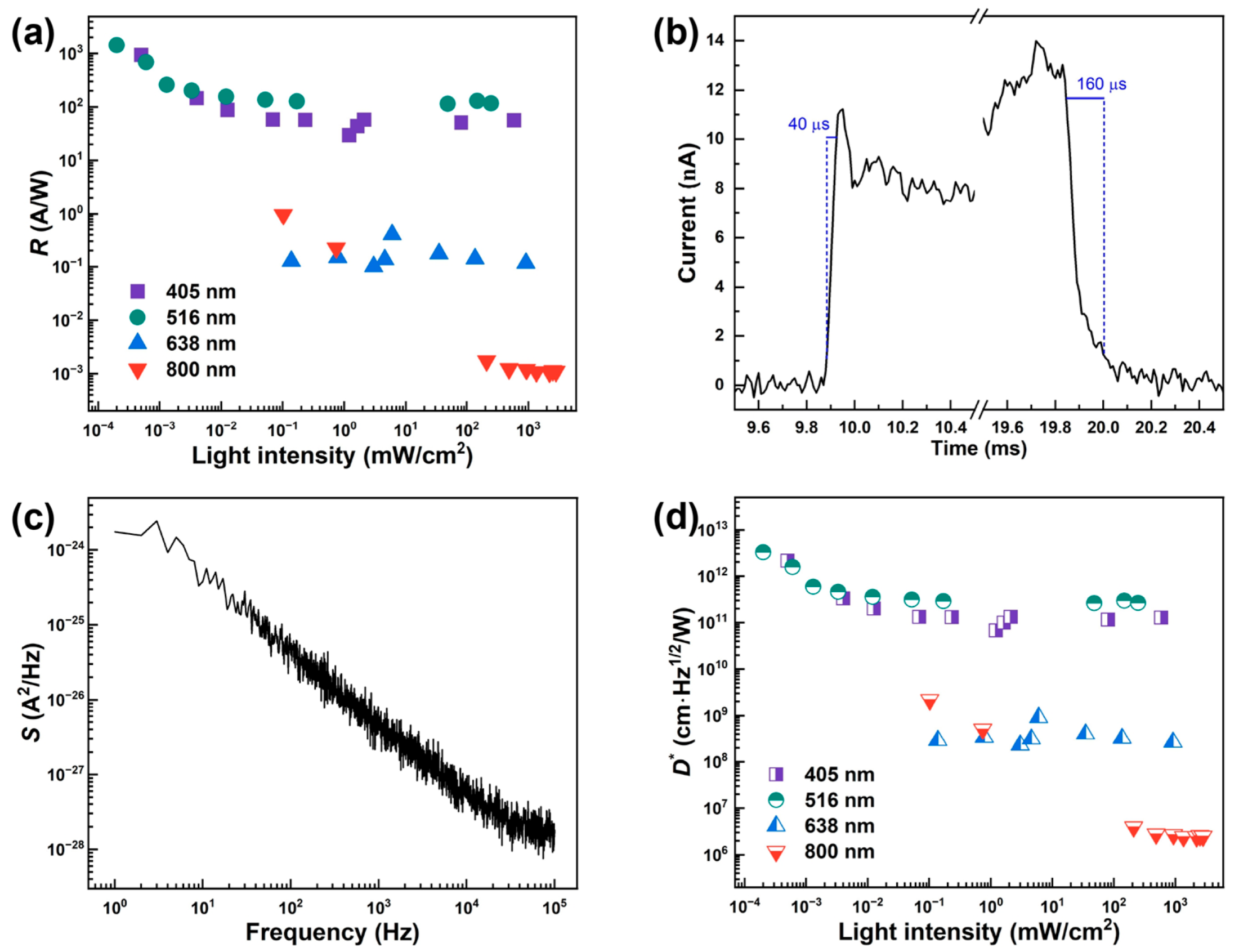
Furthermore, to evaluate the self-powered capability of the graphene/n-Si heterojunction photodiode, we conducted time-resolved photoresponse measurements under open-circuit conditions using pulsed laser sources with various wavelengths (405 nm, 516 nm, 638 nm, and 800 nm) and light intensities. As shown in Figure 2b–e, a 3 s light pulse was applied to trigger the device response, and the resulting photocurrent was recorded in real time. Consistent with the IV measurements, the device exhibits a clear intensity-dependent photoresponse across the full spectral range, reaffirming its excellent photocarrier generation and separation efficiency. Notably, under 516 nm laser illumination at an intensity of 450 mW/cm2, the graphene/n-Si photodiode achieves a peak self-powered photocurrent of 5.6 × 10⁻⁶ A (Figure 2c), corresponding to a responsivity up to 116 A/W (Figure 3a). In addition, the device demonstrates a fast photoresponse with a rise time of 40 μs and a fall time of 160 μs (Figure 3b), indicating a rapid carrier dynamics and the minimal trapping effects under zero bias conditions. These results demonstrated a robust response of the device under zero external bias, underscoring its potential for high-sensitivity, energy-efficient, and self-driven optoelectronic applications.
To quantitatively assess the photoresponse performance, we calculated the photoresponsivity (R) of the graphene/n-Si heterojunction photodiode under illumination with various laser wavelengths at a bias of 3 V. The photoresponsivity is defined as [38]
R = I l i g h t I d a r k P i n   ×   S
where I d a r k and I l i g h t represent the current in dark (Figure 1d) and under light illumination (Figure 2a), respectively, while P i n is the power intensity of incident light, and S is the effective illuminating area (30 × 30 μm2 for this device). As shown in Figure 3a, the graphene/n-Si photodiode exhibits high responsivity, reaching 939 A/W at 405 nm and 1430 A/W at 516 nm. This enhanced performance at shorter wavelengths can be attributed to the higher photon energy, which facilitates the generation of a greater density of electron–hole pairs within the Si absorber [39]. Owing to this advantage, the device shows great promise in application scenarios requiring high short-wavelength sensitivity, such as green-light hemoglobin detection and UV monitoring [40]. The wavelength-dependent responsivity of the fabricated graphene/n-Si photodiode is shown in Figure S2a. As the incident light shifts from the visible region to the near-infrared region, the device exhibits a pronounced decrease in responsivity. This reduction can be mainly attributed to the significantly lower optical absorption coefficient of silicon in the near-infrared range, which leads to fewer photogenerated carriers and thus weaker photocurrent. In order to demonstrate the device testing statistics, we have tested six more devices. As shown in Figure S2b, all these six devices (#1–6) exhibit a very consistent result for the responsivity (ranging from 47.5 to 95.2 A/W at 405 nm with a light intensity of 584 mW/cm2, well consistent with the value (56.2 A/W at 405 nm with a light intensity of 584 mW/cm2) presented in Figure 3a. Additionally, these six devices (#1–6) also exhibit a very similar behavior of the time-resolved photoresponse under zero bias upon illumination with a 405 nm laser at varying light intensities, as shown in Figure S3. These well-calibrated data further validate the superiority and excellent performance of the graphene/n-Si heterojunction photodiode fabricated in this work, demonstrating its fast response speed and high operational stability.
The noise spectral density as a function of frequency at an applied bias of 3 V is presented in Figure 3c. The low-noise spectrum exhibits a typical 1/f power dependence, which is the characteristic of high-quality photodiodes with minimal flicker noise. Based on the measured noise data and the responsivity, we further calculated the specific detectivity (D*) of the graphene/n-Si photodiode using the standard equation: D* = (AB)1/2R/S1/2, where A is the active area of 900 μm2, B is the bandwidth (1 Hz), R is the responsivity, and S is the noise spectral density of the device. The detectivity exhibits the same wavelength-dependent trend as the responsivity, reaching a maximum value of 3.26 × 1012 cm·Hz1/2/W under illumination with 516 nm laser, demonstrating the excellent photodetection performance of this graphene/n-Si device, which is comparable to or even higher than previously reported graphene/silicon photodiodes (Table 1).
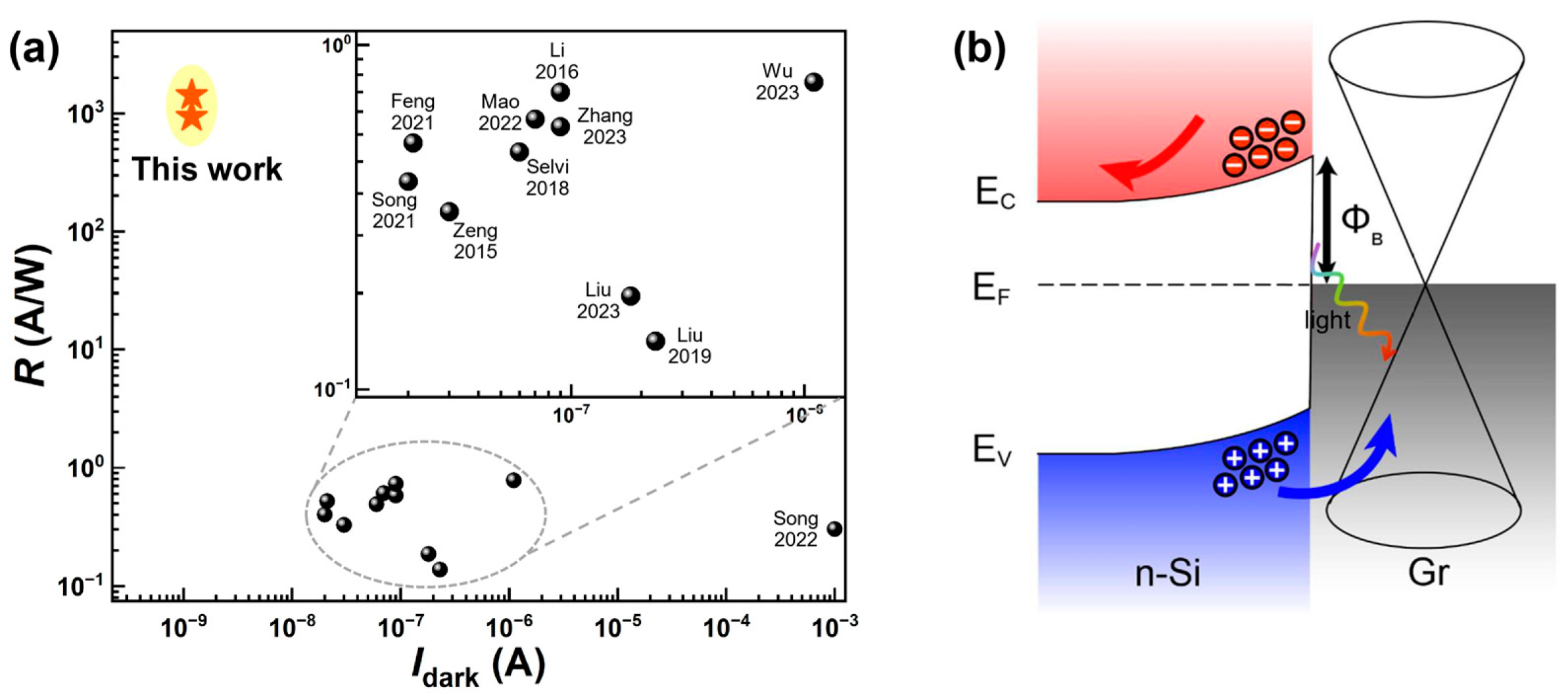
To further validate the performance of our device, we benchmarked it against other reported Si-based Schottky photodiodes (Figure 4a). As shown here, our device exhibits an ultralow dark current of 1.2 × 10⁻⁹ A at a forward bias of 3 V, substantially lower than comparable counterparts, underscoring its excellent power efficiency. Meanwhile, the responsivities of 939 A/W at 405 nm and 1430 A/W at 516 nm significantly exceed those of most existing devices, highlighting the superior photodetection capabilities of the proposed graphene/n-Si heterojunction photodiode. Compared with other reported Si-based photodiodes, the much higher performance of our graphene/n-Si device can be mainly ascribed to the direct utilization of epitaxial graphene grown on Ge substrate. As demonstrated by the morphological and structural characterizations (Figure S1), such an epitaxial graphene on Ge features high crystallinity and high surface flatness. In this case, high interface quality can be achieved between graphene and n-Si, thus leading to an extremely high photodetection performance of our graphene/n-Si device. In fact, based on epitaxial graphene on Ge, an atomically clean and sharp interface was observed between graphene and gold for the gold/graphene/germanium photodetector reported previously by our group [41], which more clearly demonstrates the significant advantages of our graphene/n-Si photodiode over previously reported Si-based devices.
Table 1. Performance of Si-based photodiodes.
Device StructureResponsivity (A/W)Specific Detectivity
(cm·Hz1/2/W)
IdarkReference
graphene0.78 1.1 µA at −1.0 V[29]
MoS2/Si0.61 70 nA at −1.0 V[26]
Si/In2Se30.58 90 nA at −3.0 V[38]
Graphene/n-Si0.73 90 nA at −0.4 V[32]
Ti3C2/Si0.4022.05 × 101320 nA at −1.0 V[47]
Bilayer-graphene/Si0.328 30 nA at −0.5 V[42]
Graphene/Au/Si0.1381.40 × 1010230 nA at −1.0 V[43]
Graphene/Si0.521.43 × 101321 nA at −0.4 V[44]
Ti3C2Tx/Si0.3025.40 × 10131.0 mA at −2.0 V[45]
V2CTx/n-Si0.1878.42 × 1011180 nA at −3.0 V[46]
Graphene/Si0.49 60 nA at +1.5 V[36]
Graphene/n-Si14303.26 × 10121.2 nA at +3.0 VThis work
The device structure, responsivity, and dark current of relevant counterparts are also summarized in Table 1.
Furthermore, to gain deeper insight into the photodetection behavior of the graphene/n-Si heterojunction, we analyzed its working mechanism based on band structure considerations. As shown in Figure 4b, the formation of the graphene/n-Si heterojunction induces an upward band bending in n-Si near the interface, leading to the creation of a depletion region with a built-in electric field. This built-in field facilitates the separation of photogenerated electron–hole pairs, even in the absence of external bias, forming the basis of the device’s self-powered photoresponse. Under forward bias, the depletion region narrows and the energy bands shift upward, effectively lowering the Schottky barrier height. This change enhances carrier injections across the junction, thereby increasing the current and enabling diode-like conduction. In contrast, applying a reverse bias widens the depletion region and shifts the bands downward, which raises the effective barrier height and restricts carrier transport. These behaviors are consistent with the IV curves presented in Figure 1d and Figure 2a.
Critically, epitaxial graphene growth on Ge substrate avoids transfer-induced defects, thereby forming a high-quality Schottky interface with reduced defect density and suppressed dark current. Upon illumination, photon absorption in n-Si generates electron–hole pairs. The built-in electric field within the depletion region efficiently separates carriers: photoexcited holes are swiftly injected into the graphene layer, while electrons are driven into the silicon bulk. In addition, holes generated in the quasi-neutral region of n-Si diffuse toward the depletion region and are subsequently swept into graphene by the electric field, further enhancing carrier separation efficiency. This dynamic leads to the accumulation of holes in graphene and electrons in silicon, respectively, thus establishing a photovoltage across the junction. When an external circuit is connected, electrons flow from the silicon side to recombine with holes in graphene, resulting in a net photocurrent directed from graphene to n-Si.

5. Conclusions

In conclusion, we reported a high-performance graphene/n-Si photodiode fabricated by transferring a Si film onto graphene epitaxially grown on Ge substrate. This approach enables the formation of an atomically clean heterojunction interface, effectively suppressing defects and impurity states, thereby minimizing reverse leakage current. As a result, this graphene/n-Si heterojunction photodetector exhibits three key advantages: (1) an ultralow dark current of 1.2 × 10⁻⁹ A at 3 V bias for exceptional power efficiency; (2) a high responsivity of 1430 A/W at 516 nm, surpassing most Si-based photodetectors; and (3) a substantial self-powered current of 5.6 × 10⁻⁶ A at 0 V bias, confirming reliable bias-free operation. Benefiting from the combination of low dark current, high responsivity, and self-powering capability, this graphene/n-Si heterojunction photodiode holds great promise for broadband, high-sensitivity photodetection, particularly in self-driven systems without power supply. Moreover, the fabrication process is highly compatible with standard Si-based chip manufacturing, offering a practical and scalable route toward next-generation integrated optoelectronic systems with low power consumption and high performance.

Supplementary Materials

The following supporting information can be downloaded at https://www.mdpi.com/article/10.3390/nano15151190/s1, Figure S1. The morphological and structural characterizations of the fabricated graphene/n-Si device, including the SEM image of the device and the AFM image and the Raman scattering spectra of epitaxial graphene on Ge substrate. Figure S2. The wavelength-dependent responsivity of the fabricated Gr/n-Si device and the responsivities of six fabricated Gr/n-Si devices (device #1–6) under 405 nm laser illumination at a light intensity of 584 mW/cm2. Figure S3. Time-resolved photoresponse of six devices (device #1–6) under zero bias upon illumination with 405 nm laser at ten varied light intensities.

Author Contributions

Conceptualization, all authors; methodology, all authors; validation, X.W. and S.F.; formal analysis, all authors; investigation, all authors; resources, S.F.; data curation, all authors; writing—original draft preparation, L.Y. and S.F.; writing—review and editing, all authors; visualization, L.Y. and X.W.; supervision, X.W. and S.F.; project administration, X.W. and S.F.; and funding acquisition, S.F. All authors have read and agreed to the published version of the manuscript.

Funding

This work was supported by the National Key Research and Development Program of China (2021YFA1200801), the National Natural Science Foundation of China (No. 62304226, 52188101, 62450124, 62125406), the China Postdoctoral Science Foundation (2024T170946, 2023M733574).

Data Availability Statement

The data presented in this study are available upon request.

Acknowledgments

The authors are thankful to Zhongying XUE and Zengfeng DI from the Shanghai Institute of Microsystem and Information Technology (SIMIT), the Chinese Academy of Sciences (CAS) for providing high-quality graphene on Ge substrate, and Yun SUN and Chi LIU from the Shenyang National Laboratory for Materials Science (SYNL), CAS for valuable discussions.

Conflicts of Interest

The authors declare no conflicts of interest.

References

  1. Dean, C.R.; Young, A.F.; Meric, I.; Lee, C.; Wang, L.; Sorgenfrei, S.; Watanabe, K.; Taniguchi, T.; Kim, P.; Shepard, K.L.; et al. Boron Nitride Substrates for High-Quality Graphene Electronics. Nat. Nanotechnol. 2010, 5, 722–726. [Google Scholar] [CrossRef] [PubMed]
  2. Zhang, Y.; Tan, Y.W.; Stormer, H.L.; Kim, P. Experimental Observation of the Quantum Hall Effect and Berry’s Phase in Graphene. Nature 2005, 438, 201–204. [Google Scholar] [CrossRef]
  3. Geim, A.K. Graphene: Status and Prospects. Science 2009, 324, 1530–1534. [Google Scholar] [CrossRef]
  4. Mak, K.F.; Ju, L.; Wang, F.; Heinz, T.F. Optical Spectroscopy of Graphene: From the Far Infrared to the Ultraviolet. Solid. State Commun. 2012, 152, 1341–1349. [Google Scholar] [CrossRef]
  5. Li, Z.Q.; Henriksen, E.A.; Jiang, Z.; Hao, Z.; Martin, M.C.; Kim, P.; Stormer, H.L.; Basov, D.N. Dirac Charge Dynamics in Graphene by Infrared Spectroscopy. Nat. Phys. 2008, 4, 532–535. [Google Scholar] [CrossRef]
  6. Xia, F.N.; Mueller, T.; Lin, Y.M.; Garcia, A.V.; Avouris, P. Ultrafast Graphene Photodetector. Nat. Nanotechnol. 2009, 4, 839–843. [Google Scholar] [CrossRef]
  7. Koppens, F.H.L.; Mueller, T.; Avouris, P.; Ferrari, A.C.; Vitiello, M.S.; Polini, M. Photodetectors Based on Graphene, Other Two-Dimensional Materials and Hybrid Systems. Nat. Nanotechnol. 2014, 9, 780–793. [Google Scholar] [CrossRef]
  8. Mueller, T.; Xia, F.N.; Avouris, P. Graphene Photodetectors for High-Speed Optical Communications. Nat. Photonics 2010, 4, 297–301. [Google Scholar] [CrossRef]
  9. Liu, C.H.; Chang, Y.C.; Norris, T.B.; Zhong, Z.H. Graphene Photodetectors with Ultra-Broadband and High Responsivity at Room Temperature. Nat. Nanotechnol. 2014, 9, 273–278. [Google Scholar] [CrossRef]
  10. Gan, X.T.; Shiue, R.J.; Gao, Y.D.; Meric, I.; Heinz, T.F.; Shepard, K.; Hone, J.; Assefa, S.; Englund, D. Chip-Integrated Ultrafast Graphene Photodetector with High Responsivity. Nat. Photonics 2013, 7, 883–887. [Google Scholar] [CrossRef]
  11. Zhang, Y.Z.; Liu, T.; Meng, B.; Li, X.H.; Liang, G.Z.; Hu, X.N.; Wang, Q.J. Broadband High Photoresponse from Pure Monolayer Graphene Photodetector. Nat. Commun. 2013, 4, 1811. [Google Scholar] [CrossRef]
  12. Tian, Y.; Liu, H.; Li, J.; Liu, B.D.; Liu, F. Recent Developments of Advanced Broadband Photodetectors Based on 2D Materials. Nanomaterials 2025, 15, 431. [Google Scholar] [CrossRef] [PubMed]
  13. Ye, X.L.; Du, Y.; Wang, M.Y.; Liu, B.Q.; Liu, J.W.; Jafri, S.H.M.; Liu, W.C.; Papakakis, R.; Zheng, X.X.; Li, H. Advances in the Field of Two-Dimensional Crystal-Based Photodetectors. Nanomaterials 2023, 13, 1379. [Google Scholar] [CrossRef] [PubMed]
  14. Wu, J.F.; Zhang, J.L.; Jiang, R.Q.; Wu, H.; Chen, S.H.; Zhang, X.L.; Wang, W.H.; Yu, Y.F.; Fu, Q.; Lin, R.; et al. High-Sensitivity, High-Speed, Broadband Mid-Infrared Photodetector Enabled by a Van Der Waals Heterostructure with a Vertical Transport Channel. Nat. Commun. 2025, 16, 564. [Google Scholar] [CrossRef] [PubMed]
  15. Pospischil, A.; Humer, M.; Furchi, M.M.; Bachmann, D.; Guider, R.; Fromherz, T.; Mueller, T. CMOS-Compatible Graphene Photodetector Covering All Optical Communication Bands. Nat. Photonics 2013, 7, 892–896. [Google Scholar] [CrossRef]
  16. Lee, E.J.H.; Balasubramanian, K.; Weitz, R.T.; Burghard, M.; Kern, K. Contact and Edge Effects in Graphene Devices. Nat. Nanotechnol. 2008, 3, 486–490. [Google Scholar] [CrossRef]
  17. Xu, X.D.; Gabor, N.M.; Alden, J.S.; Zande, A.M.V.D.; McEuen, P.L. Photo-Thermoelectric Effect at a Graphene Interface Junction. Nano Lett. 2009, 10, 562–566. [Google Scholar] [CrossRef]
  18. Gabor, N.M.; Song, J.C.W.; Ma, Q.; Nair, N.L.; Taychatanapat, T.; Watanabe, K.; Taniguchi, T.; Levitov, L.S.; Herrero, P.J. Hot Carrier-Assisted Intrinsic Photoresponse in Graphene. Science 2011, 334, 648–652. [Google Scholar] [CrossRef]
  19. Lemme, M.C.; Koppens, F.H.L.; Falk, A.L.; Rudner, M.S.; Park, H.K.; Levitov, L.S.; Marcus, C.M. Gate-Activated Photoresponse in a Graphene p-n Junction. Nano Lett. 2011, 11, 4134–4137. [Google Scholar] [CrossRef]
  20. Wang, G.; Zhang, M.; Chen, D.; Guo, Q.L.; Feng, X.F.; Niu, T.C.; Liu, X.S.; Li, A.; Lai, J.W.; Sun, D.; et al. Seamless Lateral Graphene p-n Junctions Formed by Selective in situ Doping for High-Performance Photodetectors. Nat. Commun. 2018, 9, 5168. [Google Scholar] [CrossRef]
  21. Nair, R.R.; Blake, P.; Grigorenko, A.N.; Novoselov, K.S.; Booth, T.J.; Stauber, T.; Peres, N.M.R.; Geim, A.K. Fine Structure Constant Defines Visual Transparency of Graphene. Science 2008, 320, 1308. [Google Scholar] [CrossRef]
  22. Rogalski, A. Infrared Detectors: An Overview. Infrared Phys. Techn. 2002, 43, 187–210. [Google Scholar] [CrossRef]
  23. Song, J.C.W.; Rudner, M.S.; Marcus, C.M.; Levitov, L.S. Hot Carrier Transport and Photocurrent Response in Graphene. Nano Lett. 2011, 11, 4688–4692. [Google Scholar] [CrossRef]
  24. Fang, Y.J.; Armin, A.; Meredith, P.; Huang, J.S. Accurate Characterization of Next-Generation Thin-Film Photodetectors. Nat. Photonics 2019, 13, 1–4. [Google Scholar] [CrossRef]
  25. Pasternak, I.; Wesolowski, M.; Jozwik, I.; Lukosius, M.; Lupina, G.; Dabrowski, P.; Baranowski, J.M.; Strupinski, W. Graphene Growth on Ge(100)/Si(100) Substrates by CVD Method. Sci. Rep. 2016, 6, 21773. [Google Scholar] [CrossRef] [PubMed]
  26. Mao, J.; Zhang, B.C.; Shi, Y.H.; Wu, X.F.; He, Y.Y.; Wu, D.; Jie, J.S.; Lee, C.S.; Zhang, X.H. Conformal MoS2/Silicon Nanowire Array Heterojunction with Enhanced Light Trapping and Effective Interface Passivation for Ultraweak Infrared Light Detection. Adv. Funct. Mater. 2022, 32, 2108174. [Google Scholar] [CrossRef]
  27. Zhang, C.; Wang, B.; Luo, R.Y.; Wu, C.Y.; Chen, S.R.; Hu, J.G.; Xie, C.; Luo, L.B. Enhanced Light Trapping in Conformal CuO/Si Microholes Array Heterojunction for Self-Powered Broadband Photodetection. IEEE Electron. Device Lett. 2021, 42, 883–886. [Google Scholar] [CrossRef]
  28. Xiao, P.; Mao, J.; Ding, K.; Luo, W.J.; Hu, W.D.; Zhang, X.J.; Zhang, X.H.; Jie, J.S. Solution-Processed 3D RGO-MoS2/Pyramid Si Heterojunction for Ultrahigh Detectivity and Ultra-Broadband Photodetection. Adv. Mater. 2018, 30, 1801729. [Google Scholar] [CrossRef]
  29. Wu, C.Y.; Guo, X.S.; Wu, X.; Gao, J.; Wang, J.; Yang, Y.Z.; Wang, L.; Zhou, Y.X.; Luo, L.B. Periodic Inverted Micropyramid-Si/Graphene Self-Powered Photodiode with Excellent Current Stability for Fourier Single-Pixel Imaging. IEEE Electron. Device Lett. 2023, 44, 1672–1675. [Google Scholar] [CrossRef]
  30. Pan, W.H.; Li, Z.W.; Wang, A.R.; Zhao, P.F.; Chen, H.; Zhang, Z.X.; Shi, Y.; Xu, Y.; Wang, F.Q. Bandwidth Characteristics of a Graphene/Silicon Schottky-Junction Photodetector. IEEE Photonic Technol. Lett. 2025, 37, 485–488. [Google Scholar] [CrossRef]
  31. Shao, Q.G.; Qi, H.; Li, C.; Cai, K.P.; Dong, J.X.; Liu, X.H.; Cao, N.; Zang, X.B. Recent Progress of Gr/Si Schottky Photodetectors. Electron. Mater. Lett. 2023, 19, 121–137. [Google Scholar] [CrossRef]
  32. Li, X.M.; Zhu, M.; Du, M.D.; Lv, Z.; Zhang, L.; Li, Y.C.; Yang, Y.; Yang, T.T.; Li, X.; Wang, K.L. High Detectivity Graphene-Silicon Heterojunction Photodetector. Small 2016, 12, 595–601. [Google Scholar] [CrossRef]
  33. Yu, Y.J.; Zhao, Y.; Ryu, S.; Brus, L.E.; Kim, K.S.; Kim, P. Tuning the Graphene Work Function by Electric Field Effect. Nano Lett. 2009, 9, 3430–3434. [Google Scholar] [CrossRef]
  34. An, X.H.; Liu, F.Z.; Jung, Y.J.; Kar, S. Tunable Graphene-Silicon Heterojunctions for Ultrasensitive Photodetection. Nano Lett. 2013, 13, 909–916. [Google Scholar] [CrossRef]
  35. Riazimehr, S.; Bablich, A.; Schneider, D.; Kataria, S.; Passi, V.; Yim, C.; Duesberg, G.S.; Lemme, M.C. Spectral Sensitivity of Graphene/Silicon Heterojunction Photodetectors. Solid-State Electron. 2016, 115, 207–212. [Google Scholar] [CrossRef]
  36. Selvi, H.; Unsuree, N.; Whittaker, E.; Halsall, M.P.; Hill, E.W.; Thomas, A.; Parkinson, P.; Echtermeyer, T.J. Towards Substrate Engineering of Graphene-Silicon Schottky Diode Photodetectors. Nanoscale 2018, 10, 3399–3409. [Google Scholar] [CrossRef]
  37. Zhao, M.H.; Xue, Z.Y.; Zhu, W.; Wang, G.; Tang, S.W.; Liu, Z.D.; Guo, Q.L.; Chen, D.; Chu, P.K.; Ding, G.Q.; et al. Interface Engineering-Assisted 3D-Graphene/Germanium Heterojunction for High-Performance Photodetectors. ACS Appl. Mater. Interfaces 2020, 12, 15606–15614. [Google Scholar] [CrossRef] [PubMed]
  38. Zhang, C.; Zhu, C.Y.; Yang, Z.; Lin, D.H.; Wu, C.Y.; Chen, S.R.; Yang, Y.Z.; Wang, L.; Zhou, Y.X.; Luo, L.B. Fabrication of a Periodic Inverse Micropyramid (PIMP) Si/In2Se3 Heterojunction Photodetector Array for RGB-IR Image Sensing Application. Adv. Mater. Technol. 2023, 8, 2200863. [Google Scholar] [CrossRef]
  39. Zuo, H.H.; Wang, Y.F.; Long, S.J.; Pan, Y.; Yang, X.P.; Wu, C.Y.; Wang, Y.; Luo, L.B.; Wang, L. Ultra-Sensitive Narrow-Band p-Si Schottky Photodetector with Good Wavelength Selectivity and Low Driving Voltage. IEEE Electron. Device Lett. 2023, 45, 68–71. [Google Scholar] [CrossRef]
  40. Huo, N.; Konstantatos, G. Recent Progress and Future Prospects of 2D-Based Photodetectors. Adv. Mater. 2018, 30, 1801164. [Google Scholar] [CrossRef]
  41. Jiang, H.Y.; Li, B.; Wei, Y.N.; Feng, S.; Di, Z.F.; Xue, Z.Y.; Sun, D.M.; Liu, C. High-Performance Gold/Graphene/Germanium Photodetector Based on a Graphene-on-Germanium Wafer. Nanotechnology 2022, 33, 345204. [Google Scholar] [CrossRef]
  42. Zeng, L.H.; Xie, C.; Tao, L.L.; Long, H.; Tang, C.Y.; Tsang, Y.H.; Jie, J.S. Bilayer Graphene Based Surface Passivation Enhanced Nano Structured Self-Powered Near-Infrared Photodetector. Opt. Express 2015, 23, 4839–4846. [Google Scholar] [CrossRef]
  43. Liu, X.Z.; Zhou, Q.; Luo, S.; Du, H.W.; Cao, Z.S.; Peng, X.Y.; Feng, W.L.; Shen, J.; Wei, D.P. Infrared Photodetector Based on the Photothermionic Effect of Graphene-Nanowall/Silicon Heterojunction. ACS Appl. Mater. Interfaces 2019, 11, 17663–17669. [Google Scholar] [CrossRef]
  44. Feng, B.; Pan, X.H.; Liu, T.; Tian, S.Q.; Wang, T.Y.; Chen, Y.F. A Broadband Photoelectronic Detector in a Silicon Nanopillar Array with High Detectivity Enhanced by a Monolayer Graphene. Nano Lett. 2021, 21, 5655–5662. [Google Scholar] [CrossRef] [PubMed]
  45. Song, L.M.; Xu, E.Z.; Yu, Y.Q.; Jie, J.Y.; Xia, Y.; Chen, S.R.; Jiang, Y.; Xu, G.B.; Li, D.C.; Jie, J.S. High-Barrier-Height Ti3C2Tx/Si Microstructure Schottky Junction-Based Self-Powered Photodetectors for Photoplethysmographic Monitoring. Adv. Mater. Technol. 2022, 7, 2200555. [Google Scholar] [CrossRef]
  46. Liu, J.Y.; Lu, M.X.; Cui, Y.H.; Sun, Y.M.; Guan, Q.T.; Ma, M.C.; Xu, G.B.; Yu, Y.Q. Low Dark-Current V2CTx/n-Si Van Der Waals Schottky Photodiode for Hadamard Single-pixel Imaging. IEEE Electron. Device Lett. 2023, 44, 285–288. [Google Scholar] [CrossRef]
  47. Song, W.; Liu, Q.; Chen, J.; Chen, Z.; He, X.; Zeng, Q.; Li, S.; He, L.; Chen, Z.; Fang, X.S. Interface Engineering Ti3C2 MXene/Silicon Self-Powered Photodetectors with High Responsivity and Detectivity for Weak Light Applications. Small 2021, 17, 2100439. [Google Scholar] [CrossRef] [PubMed]
Figure 1. Device structure and fabrication. (a) Illustration of the fabrication process of the graphene (Gr)/n-Si photodiode. (b) Optical image (scale bar: 50 μm) of the graphene/n-Si photodiode. (c) Cross-sectional schematic diagram of the device. (d) Current–voltage (IV) curve of the device in the dark. The dark current values at 1 V and 3 V are given.
Nanomaterials 15 01190 g001
Figure 2. Photoresponse characterization of the device. (a) –V curves of the device under illumination at different wavelengths (405 nm, 516 nm, 638 nm, and 800 nm) and various light intensities. Time-resolved photoresponse of the device under zero bias upon illumination with (b) 405 nm, (c) 516 nm, (d) 638 nm, and (e) 800 nm lasers at varied light intensities. The detailed light intensity values for the step-like change in current are explicitly given in (c) for better understanding.
Nanomaterials 15 01190 g002
Figure 3. Performance evaluation of the device. (a) Photoresponsivity (R) as a function of incident light intensity under four laser wavelengths (405, 516, 638, and 800 nm). (b) Time-resolved photoresponse of the Gr/n-Si photodetector. Rise and fall times are defined as the time required to switch between 10% and 90% of the maximum photocurrent. (c) Density spectral density (S) as a function of frequency. (d) Specific detectivity (D*) as a function of incident light intensity under four laser wavelengths (405, 516, 638, and 800 nm).
Nanomaterials 15 01190 g003
Figure 4. Benchmarking and mechanism analysis of the device. (a) Benchmark comparison of Si-based photodetectors plotted as photoresponsivity (R) versus dark current ( I d a r k ). The data of other reported Si-based photodiodes are cited from Mao 2022 [26], Wu 2023 [29], Li 2016 [32], Selvi 2018 [36], Zhang 2023 [38], Zeng 2015 [42], Liu 2019 [43], Feng 2021 [44], Song 2022 [45], Liu 2023 [46], and Song 2021 [47]. (b) Energy band diagrams of the graphene/n-Si heterojunction. EC and EV denote the conduction band and valence band of n-Si, EF denotes the Fermi level, ΦB denotes the Schottky barrier of the device. The red and blue arrows denote the transport paths of photogenerated electrons and holes, respectively. The black up-down arrow denotes the height of the Schottky barrier. The colorful crooked arrow illustrates the light illumination.
Nanomaterials 15 01190 g004
Disclaimer/Publisher’s Note: The statements, opinions and data contained in all publications are solely those of the individual author(s) and contributor(s) and not of MDPI and/or the editor(s). MDPI and/or the editor(s) disclaim responsibility for any injury to people or property resulting from any ideas, methods, instructions or products referred to in the content.