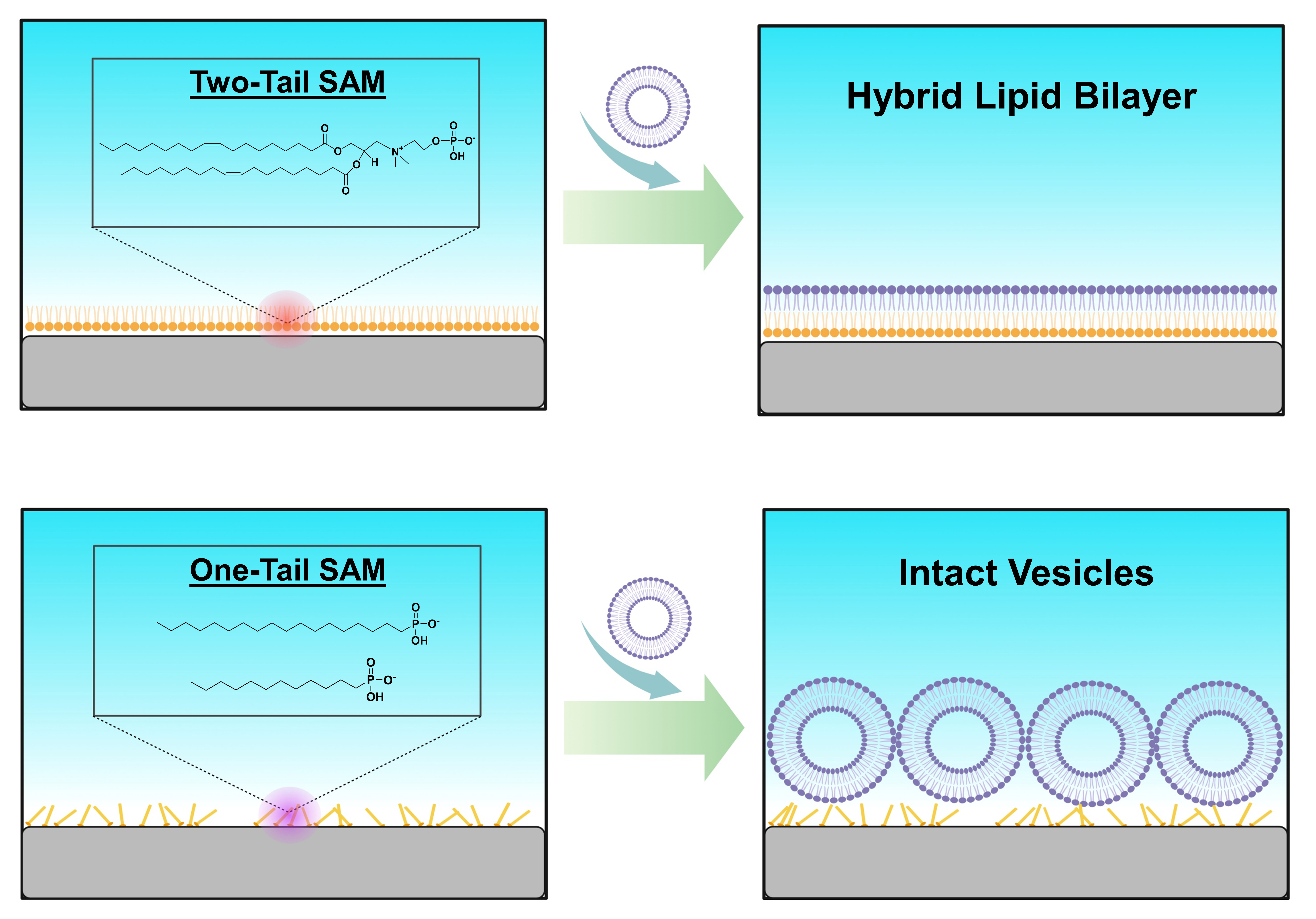
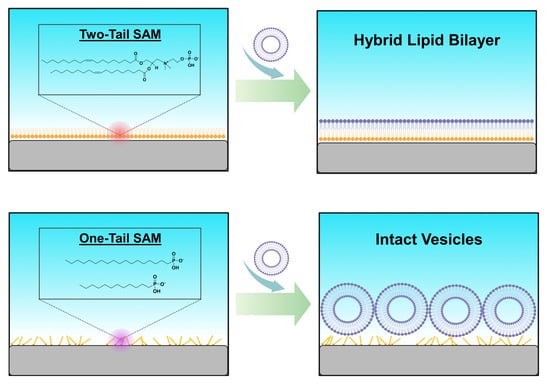
Streamlined Fabrication of Hybrid Lipid Bilayer Membranes on Titanium Oxide Surfaces: A Comparison of One- and Two-Tail SAM Molecules


 and
and 
Abstract
Share and Cite
Sut, T.N.; Tan, S.W.; Jeon, W.-Y.; Yoon, B.K.; Cho, N.-J.; Jackman, J.A. Streamlined Fabrication of Hybrid Lipid Bilayer Membranes on Titanium Oxide Surfaces: A Comparison of One- and Two-Tail SAM Molecules. Nanomaterials 2022, 12, 1153. https://doi.org/10.3390/nano12071153
Sut TN, Tan SW, Jeon W-Y, Yoon BK, Cho N-J, Jackman JA. Streamlined Fabrication of Hybrid Lipid Bilayer Membranes on Titanium Oxide Surfaces: A Comparison of One- and Two-Tail SAM Molecules. Nanomaterials. 2022; 12(7):1153. https://doi.org/10.3390/nano12071153
Chicago/Turabian StyleSut, Tun Naw, Sue Woon Tan, Won-Yong Jeon, Bo Kyeong Yoon, Nam-Joon Cho, and Joshua A. Jackman. 2022. "Streamlined Fabrication of Hybrid Lipid Bilayer Membranes on Titanium Oxide Surfaces: A Comparison of One- and Two-Tail SAM Molecules" Nanomaterials 12, no. 7: 1153. https://doi.org/10.3390/nano12071153
APA StyleSut, T. N., Tan, S. W., Jeon, W.-Y., Yoon, B. K., Cho, N.-J., & Jackman, J. A. (2022). Streamlined Fabrication of Hybrid Lipid Bilayer Membranes on Titanium Oxide Surfaces: A Comparison of One- and Two-Tail SAM Molecules. Nanomaterials, 12(7), 1153. https://doi.org/10.3390/nano12071153