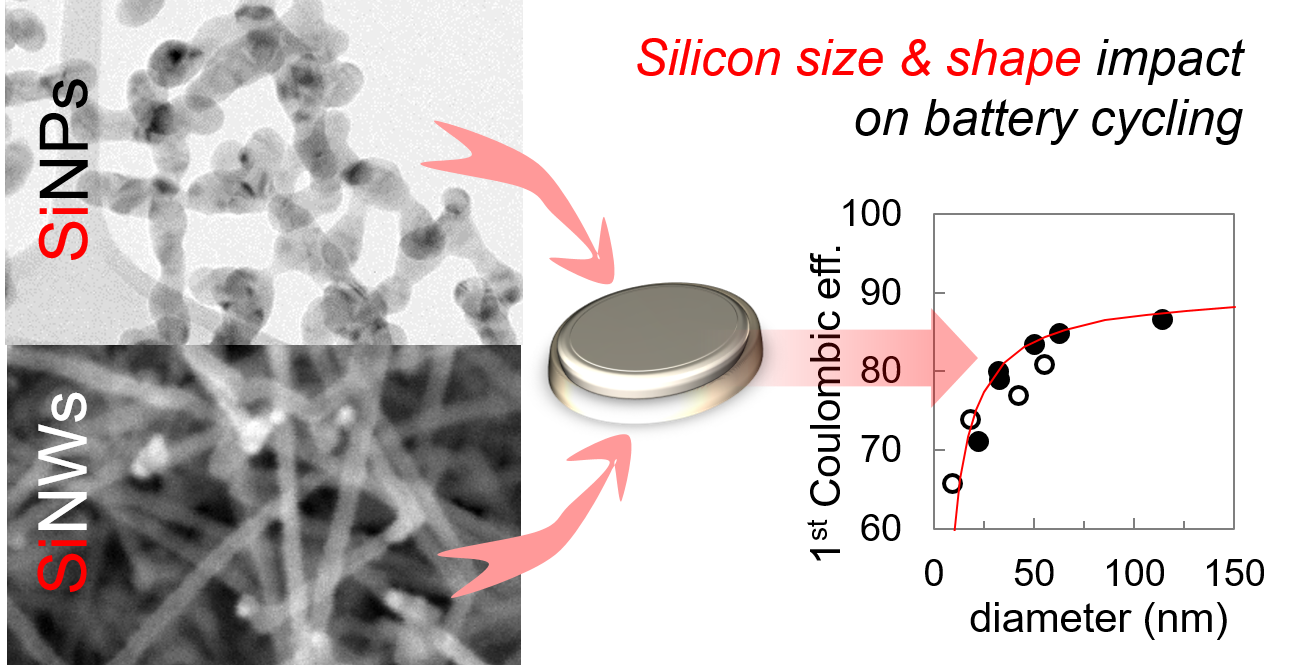

Effect of Size and Shape on Electrochemical Performance of Nano-Silicon-Based Lithium Battery
 , ,
, , Abstract
Share and Cite
Keller, C.; Desrues, A.; Karuppiah, S.; Martin, E.; Alper, J.P.; Boismain, F.; Villevieille, C.; Herlin-Boime, N.; Haon, C.; Chenevier, P. Effect of Size and Shape on Electrochemical Performance of Nano-Silicon-Based Lithium Battery. Nanomaterials 2021, 11, 307. https://doi.org/10.3390/nano11020307
Keller C, Desrues A, Karuppiah S, Martin E, Alper JP, Boismain F, Villevieille C, Herlin-Boime N, Haon C, Chenevier P. Effect of Size and Shape on Electrochemical Performance of Nano-Silicon-Based Lithium Battery. Nanomaterials. 2021; 11(2):307. https://doi.org/10.3390/nano11020307
Chicago/Turabian StyleKeller, Caroline, Antoine Desrues, Saravanan Karuppiah, Eléa Martin, John P. Alper, Florent Boismain, Claire Villevieille, Nathalie Herlin-Boime, Cédric Haon, and Pascale Chenevier. 2021. "Effect of Size and Shape on Electrochemical Performance of Nano-Silicon-Based Lithium Battery" Nanomaterials 11, no. 2: 307. https://doi.org/10.3390/nano11020307
APA StyleKeller, C., Desrues, A., Karuppiah, S., Martin, E., Alper, J. P., Boismain, F., Villevieille, C., Herlin-Boime, N., Haon, C., & Chenevier, P. (2021). Effect of Size and Shape on Electrochemical Performance of Nano-Silicon-Based Lithium Battery. Nanomaterials, 11(2), 307. https://doi.org/10.3390/nano11020307