
Perceptual Evaluation of 3D-Printed Typodont Teeth with Comparable Cutting Forces


Abstract
1. Introduction
2. Materials and Methods
2.1. Ethical Approval and Data Protection
2.2. The Geometry of the 3D-Printed Typodont Teeth
2.3. Production of the 3D-Printed Typodont Teeth
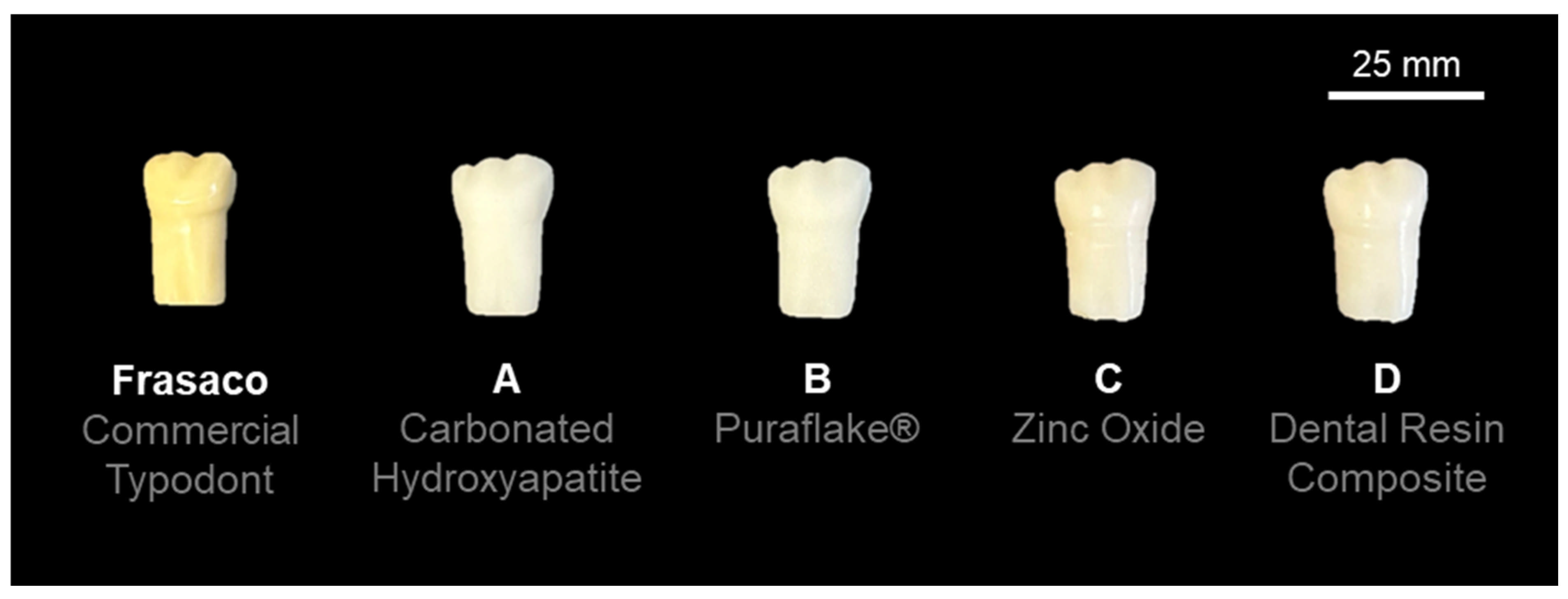
- A 15 wt.% carbonated hydroxyapatite, 85 wt.% photopolymer resin (Anycubic 405 nm Rapid Resin, Anycubic, Shenzhen, China). The carbonated hydroxyapatite was produced as outlined by Landi et al. [35].
- A 15 wt.% Puraflake® (Glassflake Ltd., Leeds, UK) and 85 wt.% photopolymer resin.
- A 15 wt.% zinc oxide (Merck, Darmstadt, Germany) and 85 wt.% photopolymer resin.
- Dental composite resin (adapted from Sa et al. [36]); 60 wt.% urethane dimethacrylate (UDMA), 35 wt.% triethylene glycol dimethacrylate (TEGDMA), 1 wt.% Lucirin, and 4 wt.% zinc oxide. All reagents were sourced from Merck (Darmstadt, Germany).
2.4. Haptic Response Measurements
2.5. Surface Characterisation
2.6. Questionnaire Design and Distribution
2.7. Open-Access Dissemination and Reproducibility
2.8. Statistical Analysis
3. Results
3.1. Haptic Response Measurements
3.2. Questionnaire Responses
3.3. Statistical Analysis of Questionnaire Responses
3.4. Surface Roughness Measurements
3.5. Free-Text Responses
4. Discussion
5. Conclusions
Supplementary Materials
Author Contributions
Funding
Institutional Review Board Statement
Informed Consent Statement
Data Availability Statement
Acknowledgments
Conflicts of Interest
Abbreviations
| CHAp | Carbonated hydroxyapatite |
| UDMA | Urethane dimethacrylate |
| TEGDMA | Triethylene glycol dimethacrylate |
| Ra | Surface roughness |
| SD | Standard deviation |
| IQR | Interquartile range |
References
- Al-Sudani, D.I.; Basudan, S.O. Students’ perceptions of pre-clinical endodontic training with artificial teeth compared to extracted human teeth. Eur. J. Dent. Educ. 2017, 21, e72–e75. [Google Scholar] [CrossRef] [Scilit]
- Lone, M.; McKenna, J.P.; Cryan, J.F.; Downer, E.J.; Toulouse, A. A Survey of tooth morphology teaching methods employed in the United Kingdom and Ireland. Eur. J. Dent. Educ. 2018, 22, e438–e443. [Google Scholar] [CrossRef] [Scilit]
- Brand, H.S.; van der Cammen, C.C.J.; Roorda, S.M.E.; Baart, J.A. Tooth extraction education at dental schools across Europe. BDJ Open 2015, 1, 15002. [Google Scholar] [CrossRef] [Scilit]
- Decurcio, D.A.; Lim, E.; Nagendrababu, V.; Estrela, C.; Rossi-Fedele, G. Difficulty levels of extracted human teeth used for pre-clinical training in endodontics in an Australian dental school. Aust. Endod. J. 2020, 46, 47–51. [Google Scholar] [CrossRef] [Scilit]
- Holden, A.C.L.; Dracopoulos, S.A. Owning the tooth: Exploring the ethical and legal issues relating to the use of extracted human teeth in dental education in Australia. Aust. Dent. J. 2017, 62, 146–151. [Google Scholar] [CrossRef] [Scilit]
- Deogade, S.C.; Mantri, S.S.; Saxena, S.; Sumathi, K. Awareness and Knowledge of Undergraduate Dental Students about Sterilization/Disinfection Methods of Extracted Human Teeth. Ann. Med. Health Sci. Res. 2016, 6, 348–355. [Google Scholar] [CrossRef] [Scilit]
- Bitter, K.; Gruner, D.; Wolf, O.; Schwendicke, F. Artificial Versus Natural Teeth for Preclinical Endodontic Training: A Randomized Controlled Trial. J. Endod. 2016, 42, 1212–1217. [Google Scholar] [CrossRef] [Scilit]
- Lee, B.; Kim, J.-E.; Shin, S.-H.; Kim, J.-H.; Park, J.-M.; Kim, K.-Y.; Kim, S.-Y.; Shim, J.-S. Dental students’ perceptions on a simulated practice using patient-based customised typodonts during the transition from preclinical to clinical education. Eur. J. Dent. Educ. 2022, 26, 55–65. [Google Scholar] [CrossRef] [Scilit]
- Park, K.; Asnashari, K.; Younan, R.; Becker, R.; Roggenkamp, C.; Oyoyo, U.; Kwon, S.R. Evaluating a method of creating artificial caries in typodont teeth for teaching Class III cavity preparations. J. Dent. Educ. 2024, 88, 1198–1205. [Google Scholar] [CrossRef] [Scilit]
- Kang, A.; Firth, F.A.; Antoun, J.; Mei, L.; Ali, A.; Farella, M. Three-dimensional digital assessment of typodont activations. Orthod. Craniofac. Res. 2023, 26, 285–296. [Google Scholar] [CrossRef] [Scilit]
- Goldschmidt, S.L.; Root Kustritz, M.V. Pilot Study Evaluating the Use of Typodonts (Dental Models) for Teaching Veterinary Dentistry as Part of the Core Veterinary Curriculum. J. Vet. Med. Educ. 2021, 49, 340–345. [Google Scholar] [CrossRef] [Scilit]
- Höhne, C.; Schmitter, M. 3D Printed Teeth for the Preclinical Education of Dental Students. J. Dent. Educ. 2019, 83, 1100–1106. [Google Scholar] [CrossRef] [Scilit]
- Höhne, C.; Schwarzbauer, R.; Schmitter, M. 3D Printed Teeth with Enamel and Dentin Layer for Educating Dental Students in Crown Preparation. J. Dent. Educ. 2019, 83, 1457–1463. [Google Scholar] [CrossRef] [Scilit]
- Cresswell-Boyes, A.J.; Barber, A.H.; Mills, D.; Tatla, A.; Davis, G.R. Approaches to 3D printing teeth from X-ray microtomography. J. Microsc. 2018, 272, 207–212. [Google Scholar] [CrossRef] [Scilit]
- Ramírez-Muñoz, A.; Escribano-Capdevila, M.; Navarrete, N.; Vieira, G.C.S.; Salamanca-Ramos, M.; Ortolani-Seltenerich, P.S.; Aranguren, J.; Pérez, A.R. Comparative Micro-CT Analysis of Minimally Invasive Endodontic Systems Using 3D-Printed Replicas and Natural Teeth. Materials 2024, 17, 5279. [Google Scholar] [CrossRef] [Scilit]
- Göksu, M.; Tosun, S.; Ertuğrul, I.F. Evaluation of the Use of 3D-Printed Tooth Models in Endodontic Practical Training. Lokman Hekim Health Sci. 2024, 6, 90–96. [Google Scholar] [CrossRef] [Scilit]
- Suresh Kumar, B.; Baskar, N.; Rajaguru, K. Drilling operation: A review. Mater. Today Proc. 2020, 21, 926–933. [Google Scholar] [CrossRef] [Scilit]
- Zhao, J.; Wu, D.; Liu, S.; Zhang, Z.; Zhao, J. Enamel cutting mechanism and performance of different dental burs: An in vitro study. Mater. Res. Express 2023, 10, 055401. [Google Scholar] [CrossRef] [Scilit]
- Wu, S.-X.; Li, K.-Q.; Zhu, W.-Z.; Wang, C.-Y.; Chen, W.-L. Machinability of high-speed enamel cutting with carbide bur. J. Mech. Behav. Biomed. Mater. 2020, 103, 103529. [Google Scholar] [CrossRef] [Scilit]
- Lee, B.; Hwang, J.; Lim, J.-H.; Kim, J.-E.; Shim, J.-S.; Shin, Y. Three-axis load analysis of high-speed handpiece on dental training teeth and computer-aided design/computer-aided manufacturing blocks. J. Mech. Behav. Biomed. Mater. 2024, 155, 106552. [Google Scholar] [CrossRef] [Scilit]
- Wang, J.; Zhang, J.; Feng, P.; Guo, P. Experimental and theoretical investigation on critical cutting force in rotary ultrasonic drilling of brittle materials and composites. Int. J. Mech. Sci. 2018, 135, 555–564. [Google Scholar] [CrossRef] [Scilit]
- Mishnaevsky, L.L. Investigation of the cutting of brittle materials. Int. J. Mach. Tools Manuf. 1994, 34, 499–505. [Google Scholar] [CrossRef] [Scilit]
- Liu, K.; Li, X.P.; Liang, S.Y. The mechanism of ductile chip formation in cutting of brittle materials. Int. J. Adv. Manuf. Technol. 2007, 33, 875–884. [Google Scholar] [CrossRef] [Scilit]
- Lei, Y.; Gao, J.; Xu, Z.; Guo, B.; Wang, M.; Zhong, W.; Zeng, W.; Xu, X. Study on the formation mechanism and morphology of edge burrs in radial fly-cutting of triangular pyramid microstructures. J. Mater. Res. Technol. 2025, 36, 727–735. [Google Scholar] [CrossRef] [Scilit]
- Tsao, C.C.; Hocheng, H. Evaluation of thrust force and surface roughness in drilling composite material using Taguchi analysis and neural network. J. Mater. Process. Technol. 2008, 203, 342–348. [Google Scholar] [CrossRef] [Scilit]
- Lin, T.R. Cutting Behaviour Using Variable Feed and Variable Speed when Drilling Stainless Steel with TiN-Coated Carbide Drills. Int. J. Adv. Manuf. Technol. 2002, 19, 629–636. [Google Scholar] [CrossRef] [Scilit]
- Priest, J.; Ghadbeigi, H.; Avar-Soberanis, S.; Gerardis, S. 3D finite element modelling of drilling: The effect of modelling method. CIRP J. Manuf. Sci. Technol. 2021, 35, 158–168. [Google Scholar] [CrossRef] [Scilit]
- Jarosz, K.; Zhang, Y.; Liu, R. Investigating the Role of Auditory Perception of Cutting Process Conditions in CNC Machining. In Proceedings of the ASME 2022 17th International Manufacturing Science and Engineering Conference, West Lafayette, IN, USA, 27 June–1 July 2022. [Google Scholar] [CrossRef] [Scilit]
- Kim, J.-B.; Lee, S.-J.; Park, Y.-P. Stable and efficient drilling process by active control of the thrust force. Mech. Syst. Signal Process. 1994, 8, 585–595. [Google Scholar] [CrossRef] [Scilit]
- Patil, S.; Bhandi, S.; Awan, K.H.; Licari, F.W.; Di Blasio, M.; Ronsivalle, V.; Cicciù, M.; Minervini, G. Effectiveness of haptic feedback devices in preclinical training of dental students-a systematic review. BMC Oral Health 2023, 23, 739. [Google Scholar] [CrossRef] [Scilit]
- Cresswell-Boyes, A.J.; Davis, G.R.; Krishnamoorthy, M.; Mills, D.; Barber, A.H. Composite 3D printing of biomimetic human teeth. Sci. Rep. 2022, 12, 7830. [Google Scholar] [CrossRef] [Scilit]
- Cresswell-Boyes, A.J.; Davis, G.R.; Barber, A.H.; Krishnamoorthy, M.; Nehete, S.R. An evaluation by dental clinicians of cutting characteristics and haptic perceptions in 3D-printed typodont teeth: A pilot study. J. Dent. Educ. 2025, 89, 567–577. [Google Scholar] [CrossRef] [Scilit]
- Cresswell-Boyes, A.J.; Davis, G.R.; Baysan, A. Students’ perceptions of endodontic typodont teeth with simulated canals printed from novel materials. Front. Dent. Med. 2024, 5, 1373922. [Google Scholar] [CrossRef] [Scilit]
- Davis, G.R.; Evershed, A.N.Z.; Mills, D. Quantitative high contrast X-ray microtomography for dental research. J. Dent. 2013, 41, 475–482. [Google Scholar] [CrossRef] [Scilit]
- Landi, E.; Celotti, G.; Logroscino, G.; Tampieri, A. Carbonated hydroxyapatite as bone substitute. J. Eur. Ceram. Soc. 2003, 23, 2931–2937. [Google Scholar] [CrossRef] [Scilit]
- Liu, S.; Li, K.W.; Chen, S.G.; Yang, J.Z.; Jia, Y.G.; Wang, L.; Ren, L. 3D printing dental composite resins with sustaining antibacterial ability. J. Mater. Sci. 2019, 54, 3309–3318. [Google Scholar] [CrossRef] [Scilit]
- Queen Mary University of London. TactiTooth. Available online: https://www.qmul.ac.uk/dentistry/tactitooth/ (accessed on 1 September 2026).

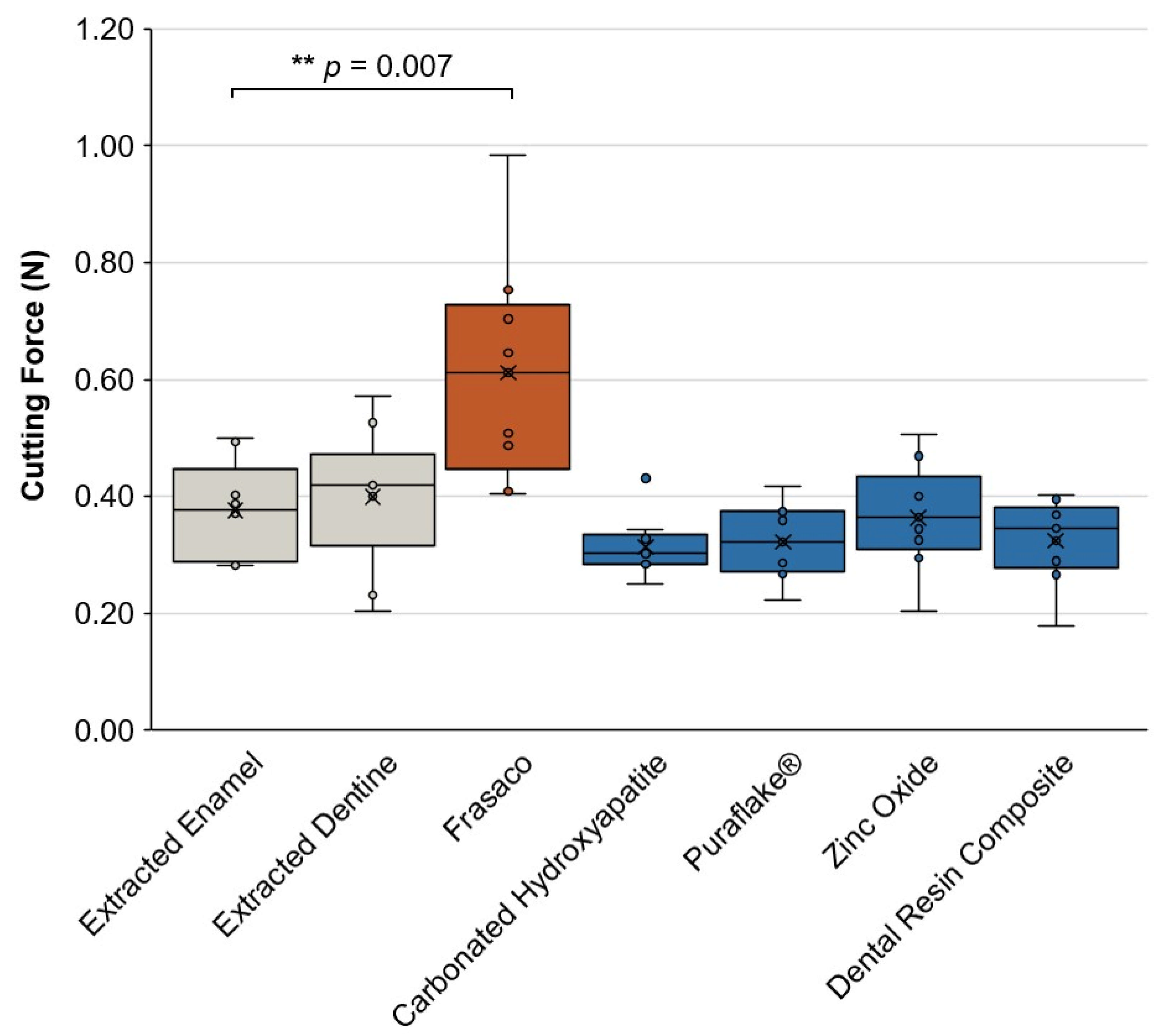


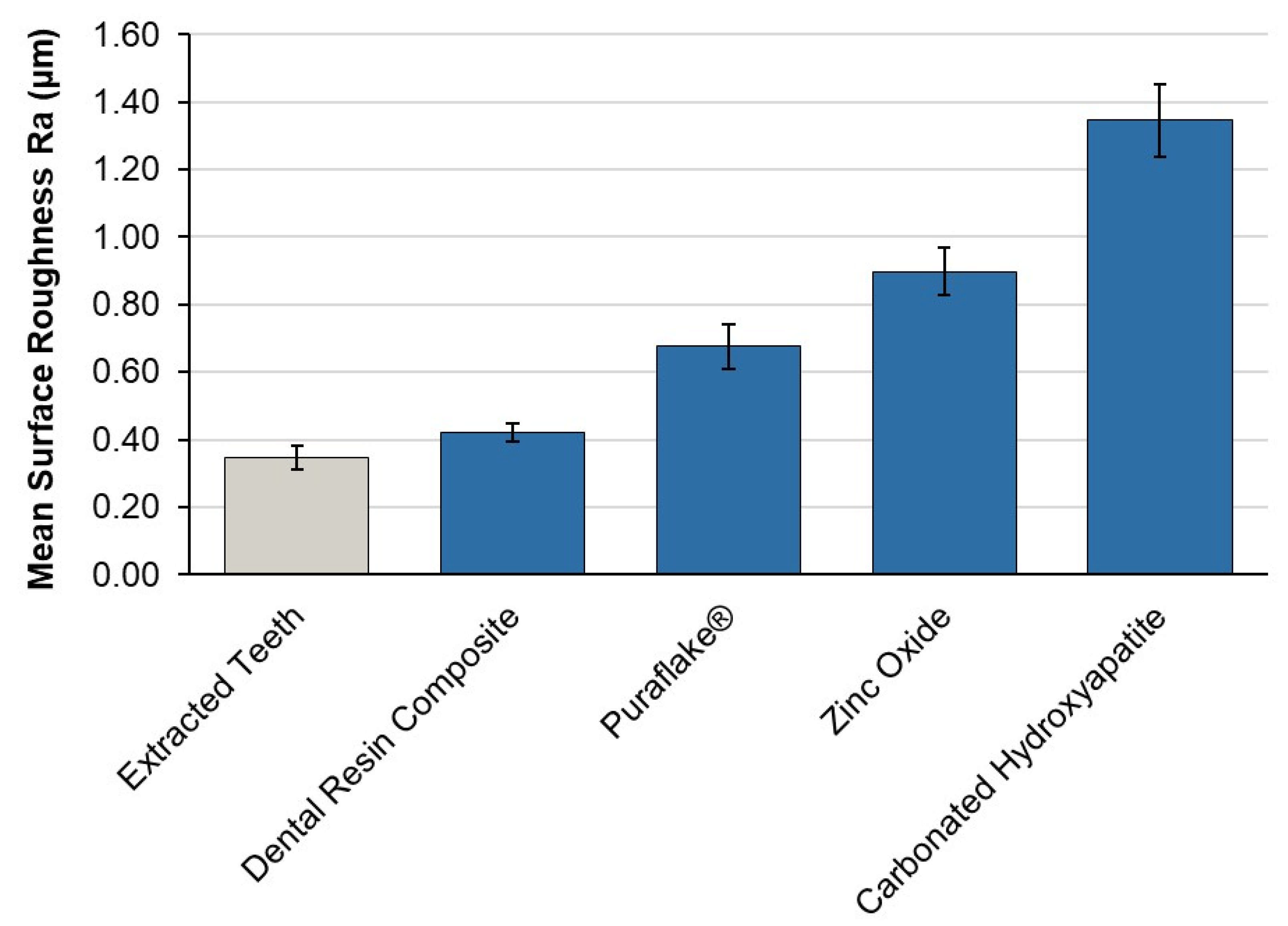


| Material | Mean (N) | SD | Range | vs. Enamel |
|---|---|---|---|---|
| Extracted enamel | 0.376 | 0.088 | 0.282–0.500 | — |
| Extracted dentine | 0.400 | 0.128 | 0.203–0.571 | ns |
| Frasaco (commercial) | 0.612 | 0.199 | 0.405–0.983 | p = 0.007 |
| Carbonated Hydroxyapatite | 0.314 | 0.055 | 0.251–0.431 | ns |
| Puraflake® | 0.322 | 0.068 | 0.223–0.418 | ns |
| Zinc Oxide | 0.364 | 0.097 | 0.203–0.507 | ns |
| Dental Resin | 0.324 | 0.075 | 0.179–0.402 | ns |
| Material | Mean | SD | Median | IQR |
|---|---|---|---|---|
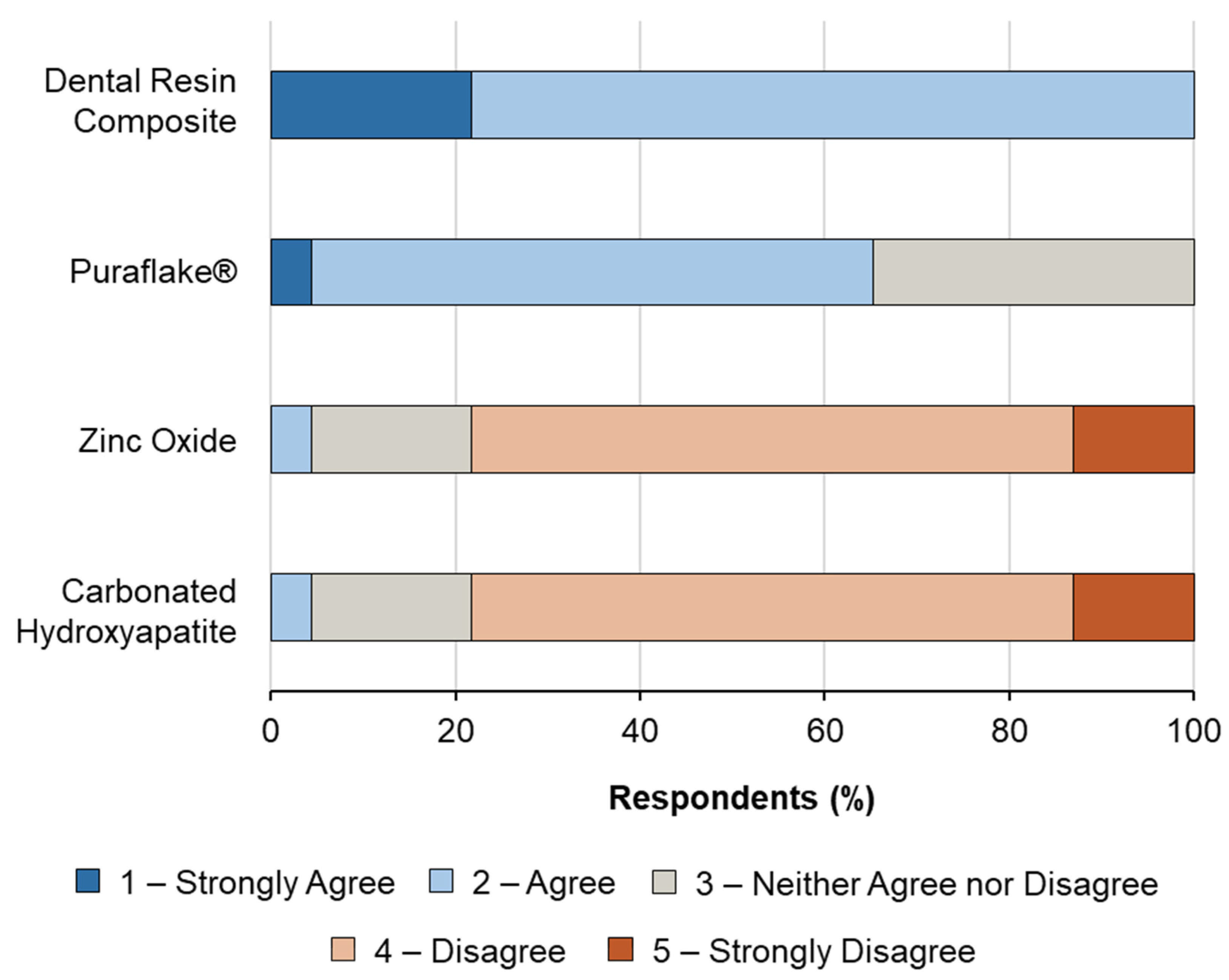
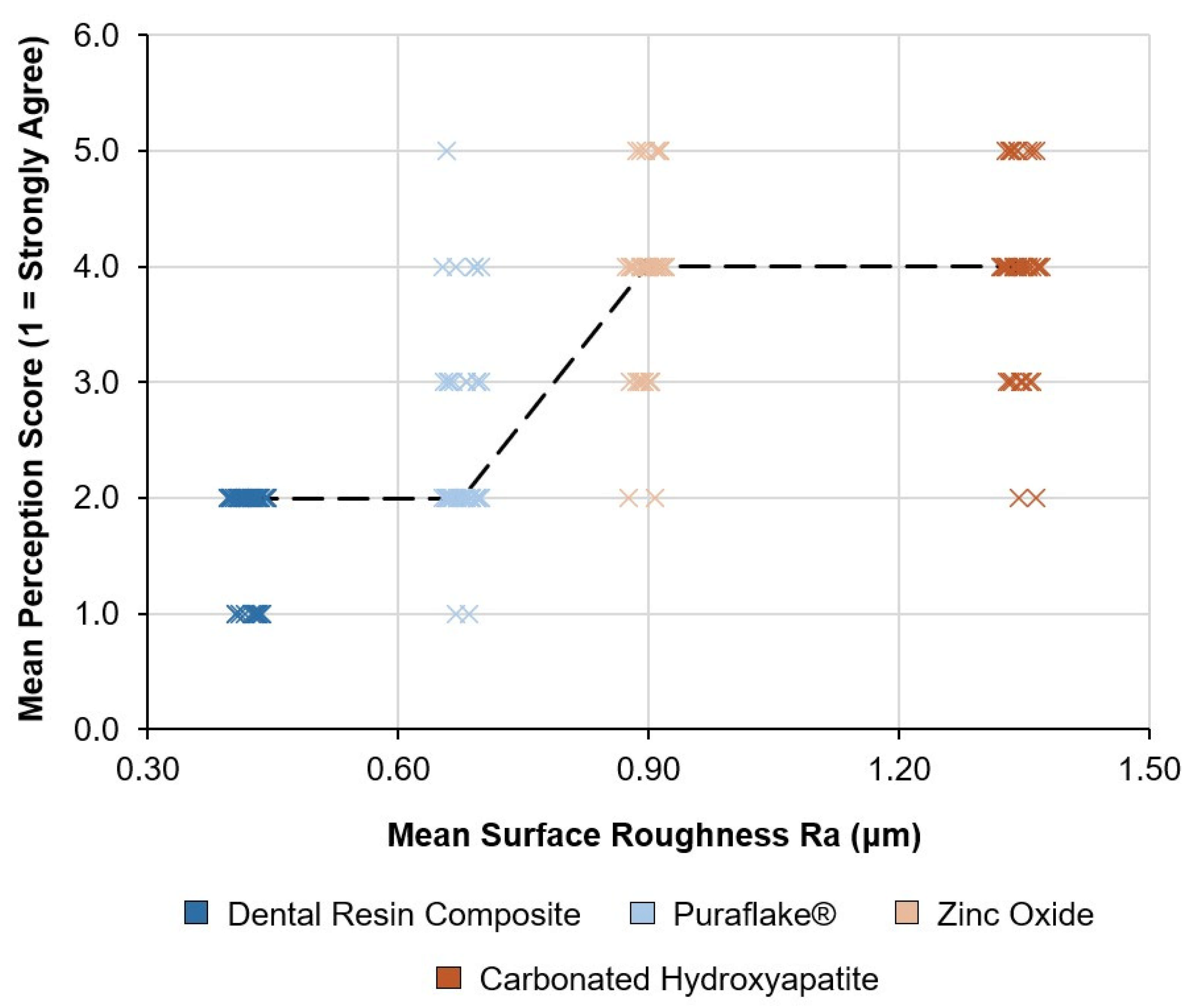
| Dental Resin Composite | 1.72 | 0.46 | 2.0 | 1.0–2.0 |
| Puraflake® | 2.46 | 0.84 | 2.0 | 2.0–3.0 |
| Zinc Oxide | 3.87 | 0.69 | 4.0 | 4.0–4.0 |
| Carbonated Hydroxyapatite | 3.96 | 0.76 | 4.0 | 4.0–4.0 |
| Post hoc pairwise comparisons (Wilcoxon signed-rank, Bonferroni corrected) | ||||
| Comparison | W | Non-zero pairs (of 46) | p (Bonferroni-adjusted) | Sig. |
| Dental Resin Composite vs. Puraflake® | 0 | 26 | 1.79 × 10⁻⁷ | *** |
| Dental Resin Composite vs. Zinc Oxide | 0 | 46 | 1.70 × 10⁻¹³ | *** |
| Dental Resin Composite vs. Carbonated Hydroxyapatite | 0 | 46 | 1.70 × 10⁻¹³ | *** |
| Puraflake® vs. Zinc Oxide | 0 | 40 | 1.09 × 10⁻¹¹ | *** |
| Puraflake® vs. Carbonated Hydroxyapatite | 0 | 40 | 1.09 × 10⁻¹¹ | *** |
| Zinc Oxide vs. Carbonated Hydroxyapatite | 7 | 7 | 1.000 | ns |
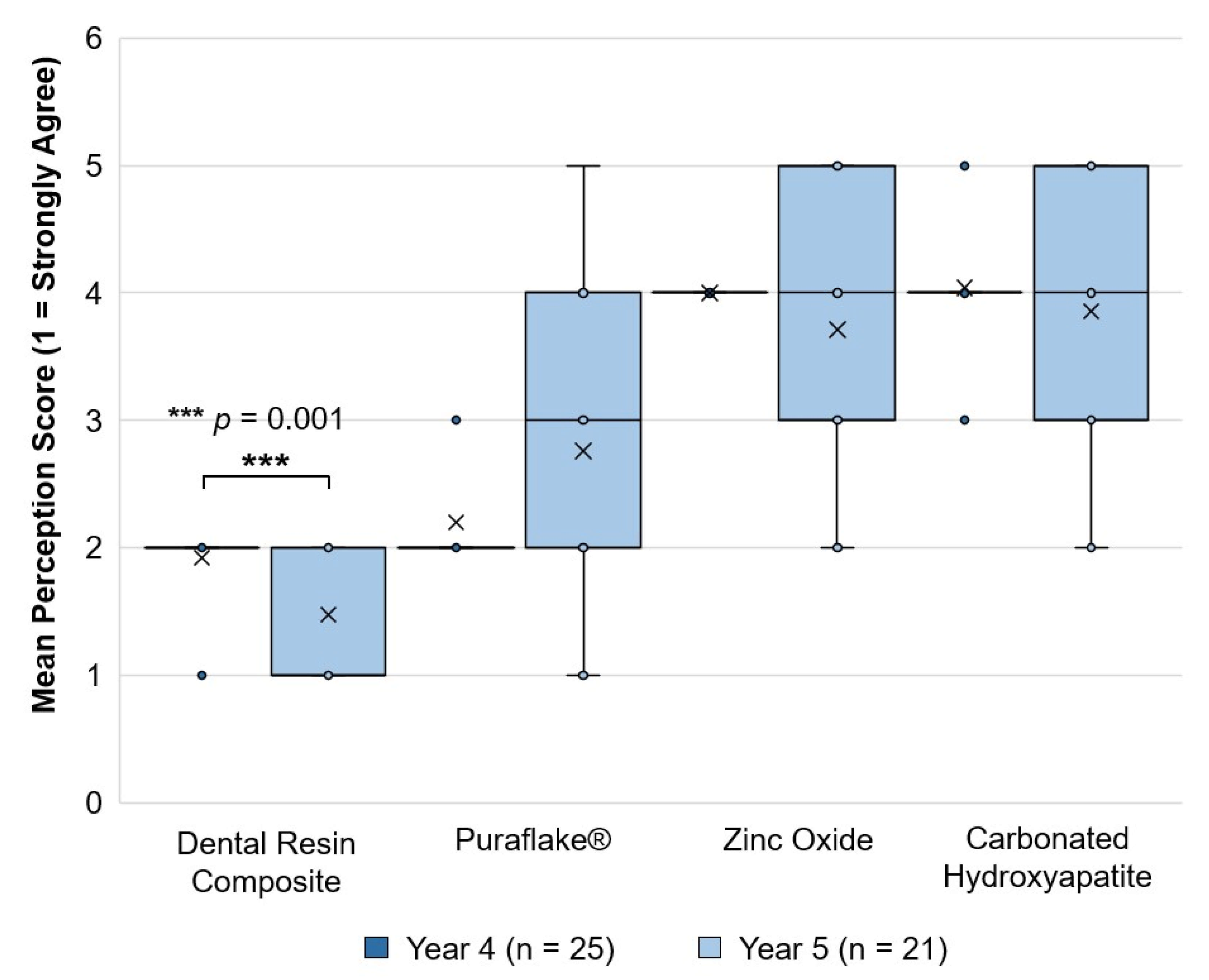
| Material | Year 4 Mean ± SD | Year 5 Mean ± SD | U | p | Rank-Biserial r |
|---|---|---|---|---|---|
| Dental Resin Composite | 1.92 ± 0.28 | 1.48 ± 0.51 | 379.0 | 0.001 | −0.44 |
| Puraflake® | 2.20 ± 0.41 | 2.76 ± 1.09 | 182.5 | 0.045 | 0.30 |
| Zinc Oxide | 4.00 ± 0.00 | 3.71 ± 1.01 | 312.5 | 0.197 | −0.19 |
| Carbonated Hydroxyapatite | 4.04 ± 0.45 | 3.86 ± 1.01 | 282.5 | 0.632 | −0.08 |
Disclaimer/Publisher’s Note: The statements, opinions and data contained in all publications are solely those of the individual author(s) and contributor(s) and not of MDPI and/or the editor(s). MDPI and/or the editor(s) disclaim responsibility for any injury to people or property resulting from any ideas, methods, instructions or products referred to in the content. |
© 2026 by the authors. Licensee MDPI, Basel, Switzerland. This article is an open access article distributed under the terms and conditions of the Creative Commons Attribution (CC BY) license.
Share and Cite
Cresswell-Boyes, A.J.; Baysan, A.; Davis, G.R. Perceptual Evaluation of 3D-Printed Typodont Teeth with Comparable Cutting Forces. J. Funct. Biomater. 2026, 17, 471. https://doi.org/10.3390/jfb17090471
Cresswell-Boyes AJ, Baysan A, Davis GR. Perceptual Evaluation of 3D-Printed Typodont Teeth with Comparable Cutting Forces. Journal of Functional Biomaterials. 2026; 17(9):471. https://doi.org/10.3390/jfb17090471
Chicago/Turabian StyleCresswell-Boyes, Alexander Jon, Aylin Baysan, and Graham Roy Davis. 2026. "Perceptual Evaluation of 3D-Printed Typodont Teeth with Comparable Cutting Forces" Journal of Functional Biomaterials 17, no. 9: 471. https://doi.org/10.3390/jfb17090471
APA StyleCresswell-Boyes, A. J., Baysan, A., & Davis, G. R. (2026). Perceptual Evaluation of 3D-Printed Typodont Teeth with Comparable Cutting Forces. Journal of Functional Biomaterials, 17(9), 471. https://doi.org/10.3390/jfb17090471