
Medial Malleolar Fracture Fixation with Stainless Steel, Titanium, Magnesium, and PLGA Screws: A Finite Element Analysis

 ,
,  , ,
, ,  ,
,  and
and
Abstract
1. Introduction
2. Materials and Methods
2.1. Study Design and Overview
2.2. Modeling of the Medial Malleolar Fracture
2.3. Material Properties
2.4. Contacts and Constraints
2.5. Boundary Conditions
2.6. FE Model Mesh Structure
2.7. Outcome Measures
2.8. Assumptions on Interfragmentary Micromotion and Fracture Healing
3. Results
4. Discussion
- Model generalizability: This study represents a single CT-derived ankle, a single fracture pattern (60° oblique medial malleolus), and a single fixation strategy (two parallel lag screws). Different fracture morphologies (e.g., vertical shear, comminution), bone quality, screw trajectories, or augmented constructs (e.g., buttress plate, washers, hybrid constructs) may alter the relative performance of materials.
- Loading conditions: Loading was limited to a static single-leg stance configuration. Real-world ankle mechanics include multiplanar forces (torsion/shear) and repetitive cyclic loading during gait; fatigue and high-demand events (e.g., stumble scenarios) were not modeled and could magnify material-dependent differences.
- Material/contact assumptions: Homogeneous, isotropic, literature-based material properties and idealized (though standardized) friction/contact definitions and preload assumptions were used. These simplifications cannot fully capture patient-specific variability in anisotropy, bone density, thread purchase, and biological evolution during healing.
- Time-dependent behavior not modeled: Only time-zero mechanics were evaluated. The progressive degradation/corrosion of magnesium and the hydrolytic degradation and creep of polymers—and the resulting changes in stiffness/strength over time—were not simulated.
- Lack of experimental validation: As with all FEA studies, predictions are sensitive to constitutive and modeling assumptions. Although mesh quality metrics were within accepted ranges, benchtop testing and prospective clinical data are still needed to validate and translate these findings [48,49,50].
5. Conclusions
Author Contributions
Funding
Institutional Review Board Statement
Informed Consent Statement
Data Availability Statement
Conflicts of Interest
Abbreviations
| AISI | American Iron and Steel Institute |
| ANSYS | ANSYS Workbench Structural Mechanics Module |
| ASTM | American Society for Testing and Materials |
| CT | Computerized tomography |
| FEA | Finite element analysis |
| MM | Medial malleolus |
| MPa | Megapascal |
| PLGA | Poly (lactic-co-glycolic acid) |
| Ti-6Al-4V | Titanium alloy with 6% Aluminum and 4% Vanadium (α–β alloy) |
| WE43A | Magnesium alloy containing Yttrium, Rare-Earth Elements, and Zirconium |
| 316LVM | Vacuum-melted low-carbon austenitic stainless steel (implant grade) |
| MgY4RE3Zr | Magnesium alloy with 4% Yttrium, 3% Rare-Earth Elements, and Zirconium |
References
- Bergh, C.; Wennergren, D.; Möller, M.; Brisby, H. Fracture incidence in adults in relation to age and gender: A study of 27,169 fractures in the Swedish Fracture Register in a well-defined catchment area. PLoS ONE 2020, 15, e0244291. [Google Scholar] [CrossRef]
- Elsoe, R.; Ostgaard, S.E.; Larsen, P. Population-based epidemiology of 9767 ankle fractures. Foot Ankle Surg. 2018, 24, 34–39. [Google Scholar] [CrossRef]
- Gundtoft, P.H.; Pedersen, A.B.; Viberg, B. Incidence, treatment, and mortality of ankle fractures: A Danish population-based cohort study. Acta Orthop. 2025, 96, 203–208. [Google Scholar] [CrossRef] [PubMed]
- Herscovici, D., Jr.; Scaduto, J.M.; Infante, A. Conservative treatment of isolated fractures of the medial malleolus. J. Bone Jt. Surg. 2007, 89, 89–93. [Google Scholar] [CrossRef] [PubMed]
- Patel, S.; Dionisopoulos, S.B. Current Concepts in Ankle Fracture Management. Clin. Podiatr. Med. Surg. 2024, 41, 519–534. [Google Scholar] [CrossRef]
- Hanhisuanto, S.; Kortekangas, T.; Pakarinen, H.; Flinkkilä, T.; Leskelä, H.V. The functional outcome and quality of life after treatment of isolated medial malleolar fractures. Foot Ankle Surg. 2017, 23, 225–229. [Google Scholar] [CrossRef] [PubMed]
- Lareau, C.R.; Bariteau, J.T.; Paller, D.J.; Koruprolu, S.C.; DiGiovanni, C.W. Contribution of the medial malleolus to tibiotalar joint contact characteristics. Foot Ankle Spec. 2015, 8, 23–28. [Google Scholar] [CrossRef]
- Chen, B.; Ye, Z.; Wu, J.; Wang, G.; Yu, T. The effect of early weight-bearing and later weight-bearing rehabilitation interventions on outcomes after ankle fracture surgery: A systematic review and meta-analysis of randomised controlled trials. J. Foot Ankle Res. 2024, 17, e12011. [Google Scholar] [CrossRef]
- Ebraheim, N.A.; Ludwig, T.; Weston, J.T.; Carroll, T.; Liu, J. Comparison of surgical techniques of 111 medial malleolar fractures classified by fracture geometry. Foot Ankle Int. 2014, 35, 471–477. [Google Scholar] [CrossRef]
- Kim, C.H.; Ma, D.S.; Yoon, Y.C. Tension band wiring versus screw fixation for the treatment of medial malleolar fractures: A systematic review and meta-analysis. Orthop. Traumatol. Surg. Res. 2023, 109, 103447. [Google Scholar] [CrossRef]
- Luo, B.; Wang, Y.; Wang, D. Effect of buttress plate in Herscovici type D vertical medial malleolar fractures and peripheral fractures: A retrospective comparative cohort study. J. Orthop. Surg. Res. 2023, 18, 411. [Google Scholar] [CrossRef] [PubMed]
- Kasai, T.; Matsumoto, T.; Iga, T.; Tanaka, S. Complications of implant removal in ankle fractures. J. Orthop. 2019, 16, 191–194. [Google Scholar] [CrossRef] [PubMed]
- Böstman, O.; Pihlajamäki, H. Routine implant removal after fracture surgery: A potentially reducible consumer of hospital resources in trauma units. J. Trauma 1996, 41, 846–849. [Google Scholar] [CrossRef] [PubMed]
- Brown, O.L.; Dirschl, D.R.; Obremskey, W.T. Incidence of hardware-related pain and its effect on functional outcomes after open reduction and internal fixation of ankle fractures. J. Orthop. Trauma 2001, 15, 271–274. [Google Scholar] [CrossRef]
- Happonen, V.; Kröger, H.; Sund, R. Complications After Ankle Fracture Surgery in Finland Between 1998 and 2020. J. Bone Jt. Surg. 2024, 106, 1212–1220. [Google Scholar] [CrossRef]
- Blackman, B.; Okunbor, S.; Sowa, A.M.; McDonnell, J.M.; Ross, T.D.; Rigney, B.; Darwish, S.; Butler, J.S. Bioabsorbable implants are a viable alternative to traditional metallic implants in orthopaedic surgery: A systematic review and meta-analysis. J. Orthop. 2025, 65, 257–269. [Google Scholar] [CrossRef]
- Sonnow, L.; Ziegler, A.; Pöhler, G.H.; Kirschner, M.H.; Richter, M.; Cetin, M.; Unal, M.; Kose, O. Alterations in magnetic resonance imaging characteristics of bioabsorbable magnesium screws over time in humans: A retrospective single center study. Innov. Surg. Sci. 2021, 6, 105–113. [Google Scholar] [CrossRef]
- May, H.; Alper Kati, Y.; Gumussuyu, G.; Yunus Emre, T.; Unal, M.; Kose, O. Bioabsorbable magnesium screw versus conventional titanium screw fixation for medial malleolar fractures. J. Orthop. Traumatol. 2020, 21, 9. [Google Scholar] [CrossRef]
- Acar, B.; Kose, O.; Turan, A.; Unal, M.; Kati, Y.A.; Guler, F. Comparison of Bioabsorbable Magnesium versus Titanium Screw Fixation for Modified Distal Chevron Osteotomy in Hallux Valgus. BioMed Res. Int. 2018, 2018, 5242806. [Google Scholar] [CrossRef]
- Kose, O.; Turan, A.; Unal, M.; Acar, B.; Guler, F. Fixation of medial malleolar fractures with magnesium bioabsorbable headless compression screws: Short-term clinical and radiological outcomes in eleven patients. Arch. Orthop. Trauma Surg. 2018, 138, 1069–1075. [Google Scholar] [CrossRef]
- Joukainen, A.; Partio, E.K.; Waris, P.; Joukainen, J.; Kröger, H.; Törmälä, P.; Rokkanen, P. Bioabsorbable screw fixation for the treatment of ankle fractures. J. Orthop. Sci. 2007, 12, 28–34. [Google Scholar] [CrossRef]
- Schönegg, D.; Koch, A.; Müller, G.T.; Blumer, M.; Wagner, M.E.H. Two-screw osteosynthesis of the mandibular condylar head with different screw materials: A finite element analysis. Comput. Methods Biomech. Biomed. Eng. 2024, 27, 878–882. [Google Scholar] [CrossRef]
- Lee, J.Y.; Lee, J.W.; Pang, K.M.; Kim, H.E.; Kim, S.M.; Lee, J.H. Biomechanical evaluation of magnesium-based resorbable metallic screw system in a bilateral sagittal split ramus osteotomy model using three-dimensional finite element analysis. J. Oral Maxillofac. Surg. 2014, 72, 402.e1–402.e13. [Google Scholar] [CrossRef]
- Levent, A.; Yapti, M.; Celik, H.K.; Ertan, M.B.; Kose, O. Comparison of Titanium, Magnesium, and Polymer-based Cortical Screw Fixation for Fulkerson Tibial Tubercle Osteotomy: A Finite Element Analysis. Eur. Arch. Med. Res. 2025, 41, 163–173. [Google Scholar] [CrossRef]
- Lu, Y.; Zhang, T.; Chen, K.; Canavese, F.; Huang, C.; Yang, H.; Shi, J.; He, W.; Zheng, Y.; Chen, S. Application of biodegradable implants in pediatric orthopedics: Shifting from absorbable polymers to biodegradable metals. Bioact. Mater. 2025, 50, 189–214. [Google Scholar] [CrossRef]
- Alonso-Rasgado, T.; Jimenez-Cruz, D.; Karski, M. 3-D computer modelling of malunited posterior malleolar fractures: Effect of fragment size and offset on ankle stability, contact pressure and pattern. J. Foot Ankle Res. 2017, 10, 13. [Google Scholar] [CrossRef] [PubMed]
- Anderson, D.D.; Goldsworthy, J.K.; Li, W.; James Rudert, M.; Tochigi, Y.; Brown, T.D. Physical validation of a patient-specific contact finite element model of the ankle. J. Biomech. 2007, 40, 1662–1669. [Google Scholar] [CrossRef] [PubMed]
- Zhu, Z.J.; Zhu, Y.; Liu, J.F.; Wang, Y.P.; Chen, G.; Xu, X.Y. Posterolateral ankle ligament injuries affect ankle stability: A finite element study. BMC Musculoskelet. Disord. 2016, 17, 96. [Google Scholar] [CrossRef][Green Version]
- Dong, X.N.; Acuna, R.L.; Luo, Q.; Wang, X. Orientation dependence of progressive post-yield behavior of human cortical bone in compression. J. Biomech. 2012, 45, 2829–2834. [Google Scholar] [CrossRef]
- Wang, X.; Nyman, J.S.; Dong, X.; Leng, H.; Reyes, M. Fundamental Biomechanics in Bone Tissue Engineering; Synthesis Lectures on Tissue Engineering; Springer Nature: Cham, Switzerland, 2010; Volume 2, pp. 1–225. [Google Scholar] [CrossRef]
- Kim, S.H.; Chang, S.H.; Jung, H.J. The finite element analysis of a fractured tibia applied by composite bone plates considering contact conditions and time-varying properties of curing tissues. Compos. Struct. 2010, 92, 2109–2118. [Google Scholar] [CrossRef]
- Klekiel, T.; Bedzinski, R. Finite element analysis of large deformation of articular cartilage in the upper ankle joint of occupants in military vehicles during explosion. Arch. Metall. Mater. 2015, 60, 2115–2121. [Google Scholar] [CrossRef][Green Version]
- Novitskaya, E.; Zin, C.; Chang, N.; Cory, E.; Chen, P.; D’Lima, D.; Sah, R.L.; McKittrick, J. Creep of trabecular bone from the human proximal tibia. Mater. Sci. Eng. C Mater. Biol. Appl. 2014, 40, 219–227. [Google Scholar] [CrossRef]
- Jensen, N.C.; Hvid, I.; Krøner, K. Strength pattern of cancellous bone at the ankle joint. Eng. Med. 1988, 17, 71–76. [Google Scholar] [CrossRef] [PubMed]
- Lu, Y.; Cheng, D.; Niu, B.; Wang, X.; Wu, X.; Wang, A. Properties of Poly (Lactic-co-Glycolic Acid) and Progress of Poly (Lactic-co-Glycolic Acid)-Based Biodegradable Materials in Biomedical Research. Pharmaceuticals 2023, 16, 454. [Google Scholar] [CrossRef]
- ANSYS, Inc. ANSYS Granta Selector (Version 2025.R1) [Computer Software]. ANSYS, Inc. 2025. Available online: https://www.ansys.com (accessed on 1 May 2025).
- Hayden, L.R.; Escaro, S.; Wilhite, D.R.; Hanson, R.R.; Jackson, R.L. A comparison of friction measurements of intact articular cartilage in contact with cartilage, glass, and metal. J. Biomim. Biomater. Biomed. Eng. 2019, 41, 23–35. [Google Scholar] [CrossRef]
- Gao, X.; Fraulob, M.; Haïat, G. Biomechanical behaviours of the bone-implant interface: A review. J. R. Soc. Interface 2019, 16, 20190259. [Google Scholar] [CrossRef] [PubMed]
- Hayes, W.C.; Perren, S.M. Plate-bone friction in the compression fixation of fractures. Clin. Orthop. Relat. Res. 1972, 89, 236–240. [Google Scholar] [CrossRef]
- Eberle, S.; Gerber, C.; von Oldenburg, G.; Högel, F.; Augat, P. A biomechanical evaluation of orthopaedic implants for hip fractures by finite element analysis and in-vitro tests. Proc. Inst. Mech. Eng. Part H 2010, 224, 1141–1152. [Google Scholar] [CrossRef] [PubMed]
- Marvan, J.; Horak, Z.; Vilimek, M.; Horny, L.; Kachlik, D.; Baca, V. Fixation of distal fibular fractures: A biomechanical study of plate fixation techniques. Acta Bioeng. Biomech. 2017, 19, 33–39. [Google Scholar] [CrossRef]
- Wang, Q.; Whittle, M.; Cunningham, J.; Kenwright, J. Fibula and its ligaments in load transmission and ankle joint stability. Clin. Orthop. Relat. Res. 1996, 330, 261–270. [Google Scholar] [CrossRef]
- ANSYS Product Doc. ANSYS Meshing User’s Guide: Skewness (Release 2019 R2); ANSYS Inc.: Canonsburg, PA, USA, 2019. [Google Scholar]
- Brys, G.; Hubert, M.; Struyf, A. A Robust Measure of Skewness. J. Comput. Graph. Stat. 2004, 13, 996–1017. [Google Scholar] [CrossRef]
- Shapiro, F. Cortical bone repair: The relationship of the lacunar-canalicular system and intercellular gap junctions to the repair process. J. Bone Jt. Surg. 1988, 70, 1067–1081. [Google Scholar] [CrossRef]
- Blecha, L.D.; Zambelli, P.Y.; Ramaniraka, N.A.; Bourban, P.E.; Månson, J.A.; Pioletti, D.P. How plate positioning impacts the biomechanics of the open wedge tibial osteotomy; a finite element analysis. Comput. Methods Biomech. Biomed. Eng. 2005, 8, 307–313. [Google Scholar] [CrossRef] [PubMed]
- Shimamura, Y.; Kaneko, K.; Kume, K.; Maeda, M.; Iwase, H. The initial safe range of motion of the ankle joint after three methods of internal fixation of simulated fractures of the medial malleolus. Clin. Biomech. 2006, 21, 617–622. [Google Scholar] [CrossRef]
- Söntgen, S.; Keilig, L.; Kabir, K.; Weber, A.; Reimann, S.; Welle, K.; Bourauel, C. Mechanical and numerical investigations of biodegradable magnesium alloy screws for fracture treatment. J. Biomed. Mater. Res. B Appl. Biomater. 2023, 111, 7–15. [Google Scholar] [CrossRef]
- Park, B.; Jung, B.T.; Kim, W.H.; Lee, J.H.; Kim, B.; Lee, J.H. The Stability of Hydroxyapatite/Poly-L-Lactide Fixation for Unilateral Angle Fracture of the Mandible Assessed Using a Finite Element Analysis Model. Materials 2020, 13, 228. [Google Scholar] [CrossRef] [PubMed]
- Ding, K.; Yang, W.; Zhu, J.; Cheng, X.; Wang, H.; Hao, D.; Yinuo, S.; Zhu, Y.; Zhang, Y.; Chen, W.; et al. Titanium alloy cannulated screws and biodegradable magnesium alloy bionic cannulated screws for treatment of femoral neck fractures: A finite element analysis. J. Orthop. Surg. Res. 2021, 16, 511. [Google Scholar] [CrossRef]
- Holweg, P.; Herber, V.; Ornig, M.; Hohenberger, G.; Donohue, N.; Puchwein, P.; Leithner, A.; Seibert, F. A lean bioabsorbable magnesium-zinc-calcium alloy ZX00 used for operative treatment of medial malleolus fractures: Early clinical results of a prospective non-randomized first in man study. Bone Jt. Res. 2020, 9, 477–483. [Google Scholar] [CrossRef]
- Labmayr, V.; Suljevic, O.; Sommer, N.G.; Schwarze, U.Y.; Marek, R.L.; Brcic, I.; Foessl, I.; Leithner, A.; Seibert, F.J.; Herber, V.; et al. Mg-Zn-Ca Alloy (ZX00) Screws Are Resorbed at a Mean of 2.5 Years After Medial Malleolar Fracture Fixation: Follow-up of a First-in-humans Application and Insights From a Sheep Model. Clin. Orthop. Relat. Res. 2024, 482, 184–197. [Google Scholar] [CrossRef]
- Nudelman, H.; Lőrincz, A.; Lamberti, A.G.; Varga, M.; Kassai, T.; Józsa, G. Management of Juvenile Osteochondral Fractures Utilising Absorbable PLGA Implants. J. Clin. Med. 2024, 13, 375. [Google Scholar] [CrossRef]
- Kirshner, W.D.; Bucholz, R.W. Polyglycolide bioabsorbable screws in the treatment of ankle fractures. Foot Ankle Int. 1997, 18, 128–131. [Google Scholar] [CrossRef]
- Nudelman, H.; Lőrincz, A.; Lamberti, A.G.; Varga, M.; Kassai, T.; Józsa, G. Management of pediatric ankle fractures: Comparison of biodegradable PLGA implants with traditional metal screws. Front. Pediatr. 2024, 12, 1410750. [Google Scholar] [CrossRef]
- Bucholz, R.W.; Henry, S.; Henley, M.B. Fixation with bioabsorbable screws for the treatment of fractures of the ankle. J. Bone Jt. Surg. 1994, 76, 319–324. [Google Scholar] [CrossRef] [PubMed]
- Perren, S.M. Fracture healing: Fracture healing understood as the result of a fascinating cascade of physical and biological interactions. Part II. Acta Chir. Orthop. Traumatol. Cechoslov. 2015, 82, 13–21. [Google Scholar] [CrossRef]
- Perren, S.M. Fracture healing: Fracture healing understood as the result of a fascinating cascade of physical and biological interactions. Part I. An Attempt to Integrate Observations from 30 Years AO Research. Acta Chir. Orthop. Traumatol. Cechoslov. 2014, 81, 355–364. [Google Scholar] [CrossRef]
- Barnes, H.; Cannada, L.K.; Watson, J.T. A clinical evaluation of alternative fixation techniques for medial malleolus fractures. Injury 2014, 45, 1365–1367. [Google Scholar] [CrossRef] [PubMed]
- Carter, T.H.; Duckworth, A.D.; White, T.O. Medial malleolar fractures: Current treatment concepts. Bone Jt. J. 2019, 101, 512–521. [Google Scholar] [CrossRef] [PubMed]
- Nudelman, H.; Molnár, T.; Józsa, G. Biodegradable (PLGA) Implants in Pediatric Trauma: A Brief Review. Children 2026, 13, 19. [Google Scholar] [CrossRef]
- Wi, J.; Choi, J.; Lee, S.H. PLA-Based Biodegradable Polymer from Synthesis to the Application. Polymers 2025, 18, 121. [Google Scholar] [CrossRef] [PubMed]



| Description of the FEA Scenarios | FEA Scenario Code | Screw Materials |
|---|---|---|
| 2 × M4 × 35 mm—Parallel malleolar screw fixation | FEA-001 | Ti-6Al-4V—(Titanium, alpha-beta alloy, cast) |
| FEA-002 | 18Cr-14Ni-2.5Mo—(Eq. to—SS steel, austenitic, AISI 316LVM, cold worked) | |
| FEA-003 | MgY4RE3Zr—(Magnesium Alloy, ASTM WE43A, cast) | |
| FEA-004 | PLGA (unfilled), Polylactic-glycolic acid—bioabsorbable polymer |
| Parameters | Cortical Bone | Trabecular Bone | Cartilage |
|---|---|---|---|
| Modulus of Elasticity (MPa) | 19,100 | 1000.61 | 12 |
| Yield Stress (MPa) | 111 | 8.50 | - |
| Ultimate Stress (MPa) | 124 | 11.20 | - |
| Poisson’s Ratio | 0.30 | 0.30 | 0.42 |
| Density (kg·m−3) | 1980 | 830 | 431 |
| Parameters | Fixation Screw (M4 × 35 mm) | |||
|---|---|---|---|---|
| Ti-6Al-4V * | 18Cr-14Ni-2.5Mo * | MgY4RE3Zr * | PLGA ** | |
| Modulus of Elasticity (MPa) | 113,800 | 187,500 | 44,600 | 1889 |
| Yield Stress (MPa) | 840 | 848 | 189.90 | 48 |
| Ultimate Stress (MPa) | 930 | 1034 | 252.50 | 48.20 |
| Poisson’s Ratio | 0.34 | 0.33 | 0.31 | 0.40 |
| Density (kg·m−3) | 4430 | 7990 | 1845 | 1348 |
| Tangent Modulus (MPa) | 1870 | 2000 | 1120 | - |
| Parameters | Components in Relation | Value |
|---|---|---|
| Coefficient of Friction between | Cartilage and Cartilage | 0.0164 |
| Bony Parts and Fixation Screw | 0.37 | |
| Bony Parts | 0.46 | |
| Fixation Screw Preload (N) | 2.5 | |
| Meshing Approach | Curvature Based | |||
|---|---|---|---|---|
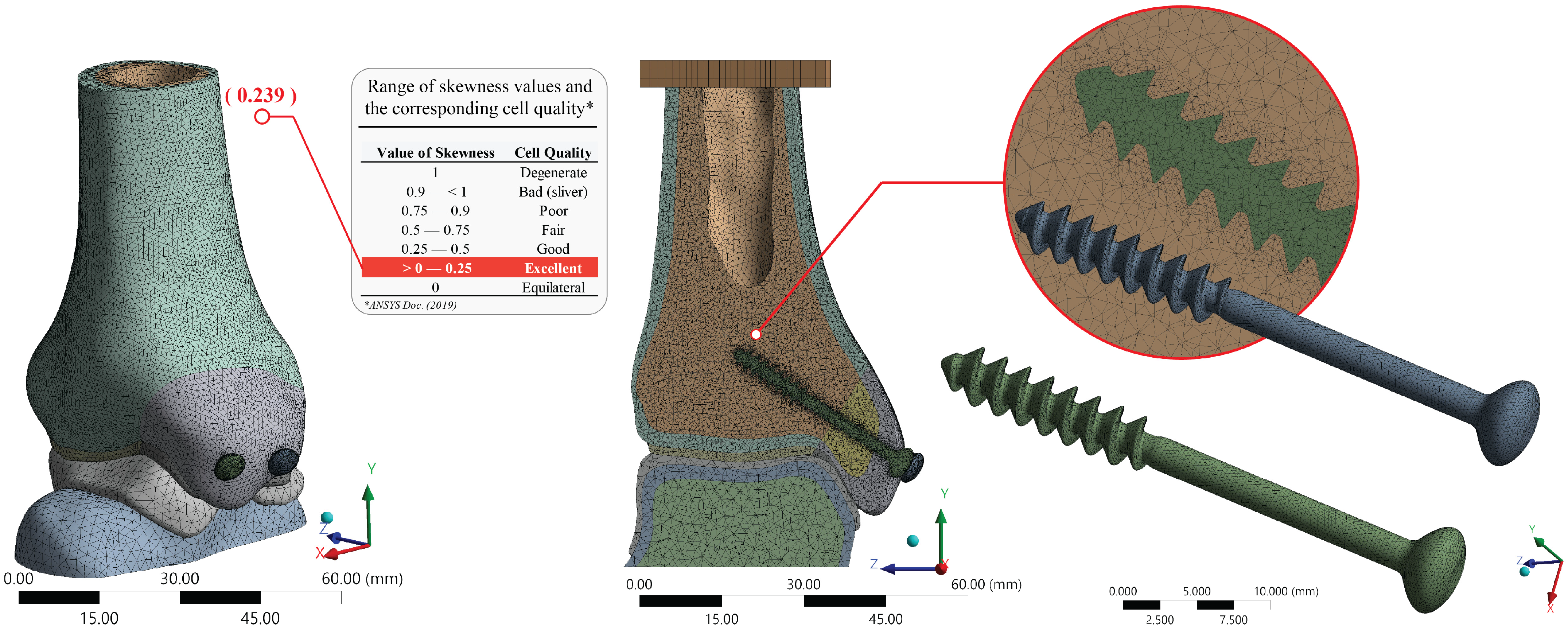
| Average Skewness Value/Quality Measure | 0.239 ± 0.01/Excellent | |||
| Element Types (ANSYS WB Code) | Tet10/Hex20/Wed15 | |||
| Max. Element Size (mm) | 6 | |||
| Min. Element Size (mm) | 1 1–2 2 | |||
| Fixation Screw Contact Surface Size (mm) | 0.30 | |||
| Defeature Size (mm) | 0.03 | |||
| Curvature Min. Size (mm) | 0.06 | |||
| Element Growth Rate | 1.50 | |||
| Cortical Bone | # of Elements | 259,317 | # of Nodes | 392,832 |
| Trabecular Bone | # of Elements | 495,796 | # of Nodes | 708,608 |
| Cartilage | # of Elements | 45,422 | # of Nodes | 25,821 |
| Screws | # of Elements | 110,452 | # of Nodes | 174,602 |
| Complete Model (Includes Compressive Plate) | # of Elements | 893,150 | # of Nodes | 1,330,577 |
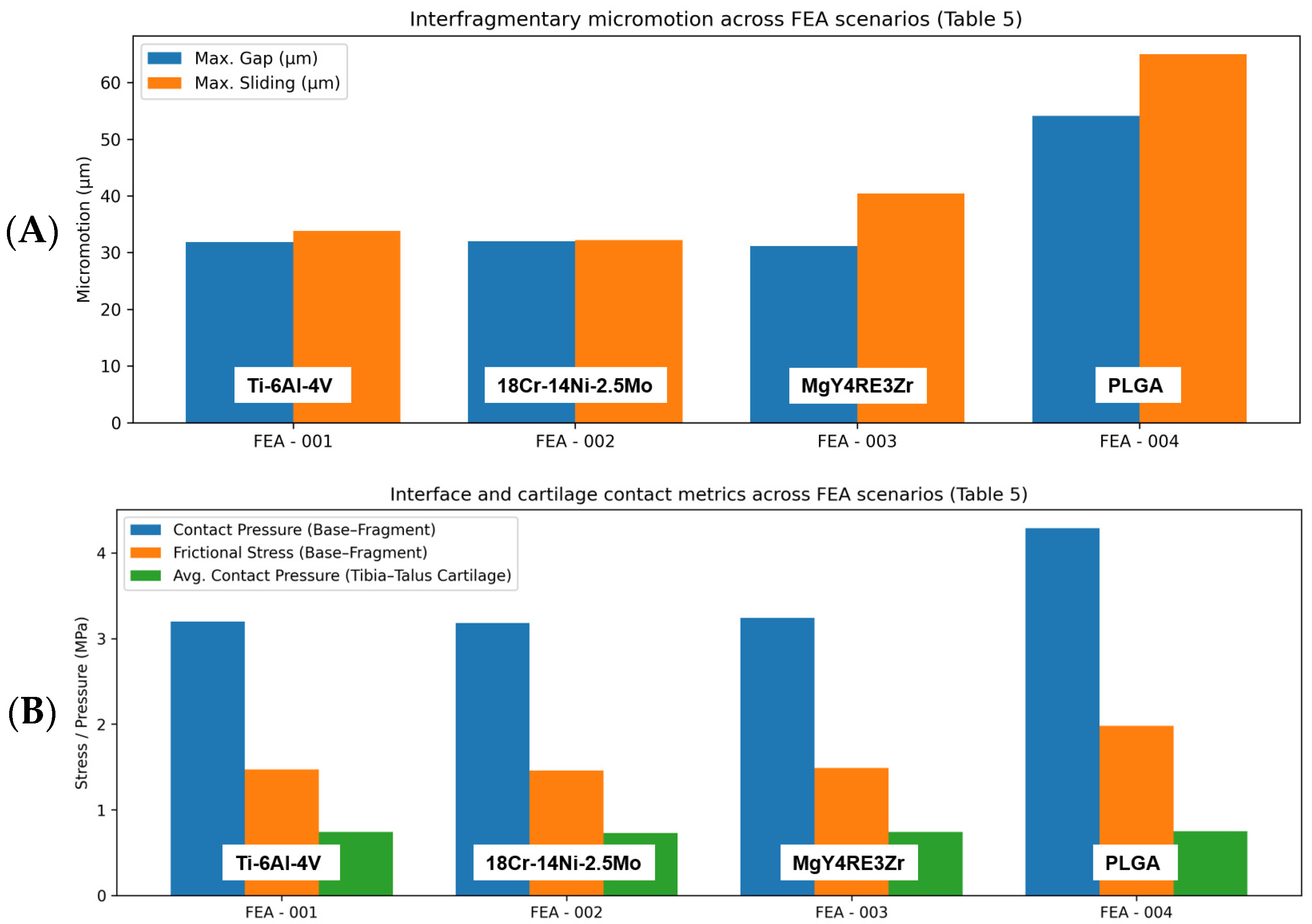
| FEA Code | Max. Separation (Gap) | Max. Sliding Distance | Contact Pressure Between Base and Fracture Fragment | Frictional Stress Between Base and Fracture Fragment | Average Contact Pressure on Cartilage Surface Between Tibia and Talus (Base Surface) |
|---|---|---|---|---|---|
| (µm) | (µm) | (MPa) | (MPa) | (MPa) | |
| FEA-001 | 31.88 | 33.84 | 3.20 | 1.47 | 0.74 |
| FEA-002 | 31.99 | 32.22 | 3.18 | 1.46 | 0.73 |
| FEA-003 | 31.19 | 40.44 | 3.24 | 1.49 | 0.74 |
| FEA-004 | 54.08 * | 64.97 * | 4.29 * | 1.98 * | 0.75 * |
| FEA Study Code | Max. Eq. Stress by Components | Max. Directional Displacement | |||||
|---|---|---|---|---|---|---|---|
| Tibia Cortical—Base Fragment | Tibia Cortical—Fracture Fragment | Tibia Trabecular—Base Fragment | Tibia Trabecular—Fracture Fragment | Tibia Cartilage—Base Fragment | Fixation Screws | Total (Y-Axis) | |
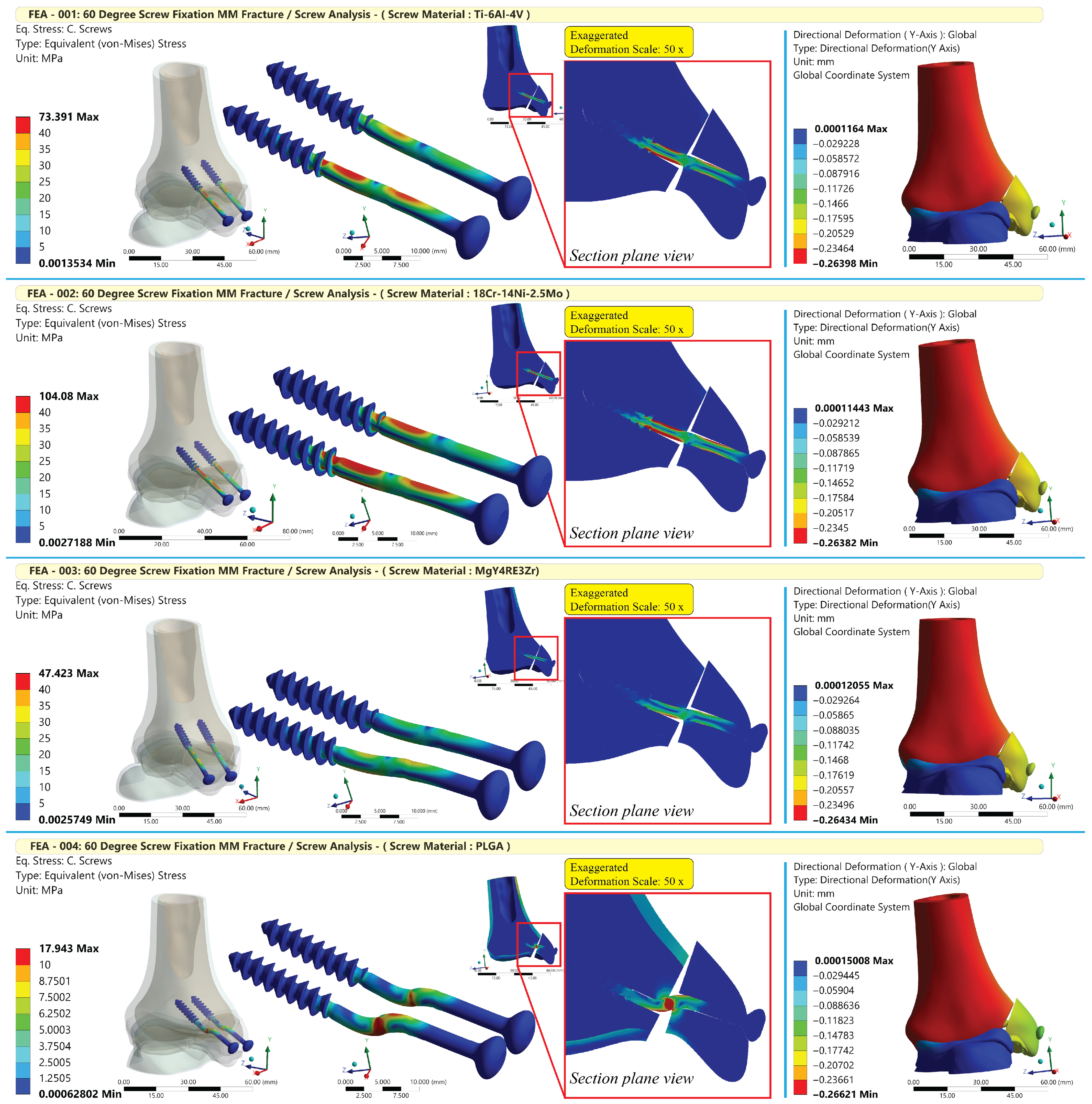
| (MPa) | (MPa) | (MPa) | (MPa) | (MPa) | (MPa) | (mm) | |
| FEA-001 | 17,900 | 11,440 | 12,390 | 8720 | 0.749 | 73,390 | 0.264 |
| FEA-002 | 17,960 | 13,110 | 11,570 | 7892 | 0.746 | 104,100 | 0.264 |
| FEA-003 | 17,750 | 8958 | 14,360 | 11,260 | 0.754 | 47,420 | 0.264 |
| FEA-004 | 16,840 | 5745 | 24,120 | 23,270 | 0.795 | 17,940 | 0.266 |
Disclaimer/Publisher’s Note: The statements, opinions and data contained in all publications are solely those of the individual author(s) and contributor(s) and not of MDPI and/or the editor(s). MDPI and/or the editor(s) disclaim responsibility for any injury to people or property resulting from any ideas, methods, instructions or products referred to in the content. |
© 2026 by the authors. Licensee MDPI, Basel, Switzerland. This article is an open access article distributed under the terms and conditions of the Creative Commons Attribution (CC BY) license.
Share and Cite
Asoglu, M.M.; Kızılkaya, V.; Levent, A.; Celik, H.K.; Kose, O.; Rennie, A.E.W. Medial Malleolar Fracture Fixation with Stainless Steel, Titanium, Magnesium, and PLGA Screws: A Finite Element Analysis. J. Funct. Biomater. 2026, 17, 59. https://doi.org/10.3390/jfb17020059
Asoglu MM, Kızılkaya V, Levent A, Celik HK, Kose O, Rennie AEW. Medial Malleolar Fracture Fixation with Stainless Steel, Titanium, Magnesium, and PLGA Screws: A Finite Element Analysis. Journal of Functional Biomaterials. 2026; 17(2):59. https://doi.org/10.3390/jfb17020059
Chicago/Turabian StyleAsoglu, Mehmet Melih, Volkan Kızılkaya, Ali Levent, Huseyin Kursat Celik, Ozkan Kose, and Allan E. W. Rennie. 2026. "Medial Malleolar Fracture Fixation with Stainless Steel, Titanium, Magnesium, and PLGA Screws: A Finite Element Analysis" Journal of Functional Biomaterials 17, no. 2: 59. https://doi.org/10.3390/jfb17020059
APA StyleAsoglu, M. M., Kızılkaya, V., Levent, A., Celik, H. K., Kose, O., & Rennie, A. E. W. (2026). Medial Malleolar Fracture Fixation with Stainless Steel, Titanium, Magnesium, and PLGA Screws: A Finite Element Analysis. Journal of Functional Biomaterials, 17(2), 59. https://doi.org/10.3390/jfb17020059