


Abstract
Zinc is known for its role in enhancing bone metabolism, cell proliferation, and tissue regeneration. Several studies proposed the incorporation of zinc into hydroxyapatite (HA) to produce biomaterials (ZnHA) that stimulate and accelerate bone healing. This systematic review aimed to understand the physicochemical characteristics of zinc-doped HA-based biomaterials and the evidence of their biological effects on osteoblastic cells. A comprehensive literature search was conducted from 2022 to 2024, covering all years of publications, in three databases (Web of Science, PUBMED, Scopus), retrieving 609 entries, with 36 articles included in the analysis according to the selection criteria. The selected studies provided data on the material’s physicochemical properties, the methods of zinc incorporation, and the biological effects of ZnHA on bone cells. The production of ZnHA typically involves the wet chemical synthesis of HA and ZnHA precursors, followed by deposition on substrates using processes such as liquid precursor plasma spraying (LPPS). Characterization techniques confirmed the successful incorporation of zinc into the HA lattice. The findings indicated that zinc incorporation into HA at low concentrations is non-cytotoxic and beneficial for bone cells. ZnHA was found to stimulate cell proliferation, adhesion, and the production of osteogenic factors, thereby promoting in vitro mineralization. However, the optimal zinc concentration for the desired effects varied across studies, making it challenging to establish a standardized concentration. ZnHA materials are biocompatible and enhance osteoblast proliferation and differentiation. However, the mechanisms of zinc release and the ideal concentrations for optimal tissue regeneration require further investigation. Standardizing these parameters is essential for the effective clinical application of ZnHA.
1. Introduction
In implant dentistry, chronic diseases or accidental damage to bone tissue can significantly impact patients’ quality of life, leading to extensive dental treatments, increased healthcare costs, and economic burdens [1]. Effective bone regeneration is crucial for the success of dental implants, which are often required due to tooth loss or severe periodontal diseases. Possible treatments with exogenous and autogenous grafts are employed to accelerate the regeneration of injured tissue [2]. However, even as a gold standard, exogenous grafts have limitations of use due to severe infections and rejections, whereas autogenous ones have limitations in donor tissue availability and complications related to a second surgery site for its removal [3]. In this context, alloplastic biomaterials still represent an alternative to achieving tissue repair because they are biocompatible and osteoconductive, enabling accelerated tissue regeneration and increased patient quality of life [4].
Several alloplastic materials can be used for bone repair, including metallic grafts, polymers, ceramics, and calcium phosphates (CaP). Hydroxyapatite (Ca10(PO4)6(OH)2 or HA) is the CaP most similar to the inorganic portion of bone tissue [5]. However, synthetic HA has high crystallinity and low resorption, making implant osteointegration difficult and increasing tissue regeneration time [6]. On the other hand, using ionic substitutions in the HA structure may enhance the material physicochemical properties, such as reduced crystallinity, increasing solubility [7]. Furthermore, bioresorbable materials may release biologically active incorporated ions, such as Sr2+, Mg2+, CO23−, and Zn2+. The release of these ions from a designed “smart material” is expected to stimulate important biological responses [8].
Even as a trace element in the body, zinc is vital for metalloproteinase enzyme activity and increases the expression of osteoblast differentiation-linked proteins such as the RUNX family transcription factor 2 (RUNX2), alkaline phosphatase (ALP), osteocalcin (OCN), and type I collagen (COL1), thus having an important role in bone metabolism [9,10]. Anti-inflammatory effects and antibacterial activity are also reported for this ion [11], while its deficiency is the genesis of various oromaxillary diseases [12]. Several studies investigated HA-based biomaterials incorporated or functionalized with zinc, identifying important biological responses in vitro and in vivo [13]. Developing zinc-doped biomaterials is often based on the beneficial effect of accelerating tissue regeneration, ensuring biological properties such as biocompatibility, osseointegration, and osteoconductivity [9]. However, in vivo studies on this theme remain controversial. While some studies reported no improvement in bone formation by the incorporation of zinc into HA [14], others indicate a good performance of hydroxyapatite substituted by zinc (ZnHA) in the filling of bone defects [15]. Furthermore, the impact of different zinc concentrations and the methods of substitution/incorporation for promoting bone regeneration remains unclear [13].
In this context, in vitro studies performed with osteoblasts, the main bone cells involved in bone regeneration, may provide evidence in controlled environments to understand the bone response to zinc-doped HA at a cellular level, and the mechanisms of action involved in ZnHA-mediated bone regeneration.
Therefore, the purpose of this systematic review was to assess the scientific literature and qualitatively evaluate the available in vitro evidence on the response of osteoblasts to biomaterials based on ZnHA, and the identified molecular mechanisms involved in bone tissue regeneration, providing insights for the development of advanced biomaterials for dental implants and regenerative medicine.
2. Materials and Methods
This systematic review was conducted according to the protocol registered at the Open Science Framework database, available at https://doi.org/10.17605/OSF.IO/948YC, and reported according to the PRISMA Statement (Supplementary Checklist) [16]. An electronic search was conducted from March 2022 to 9 May 2024, in three different databases: PubMed (MEDLINE), Scopus (Elsevier), and Web of Science (WoS, Claryvate Analytics). The search on PubMed was conducted with the search key (osteoblast* OR bone OR bone cell* OR MSC OR “mesenchymal stem cell”) AND (hydroxyapatite OR HA) AND (zinc (tiab) OR Zn (tiab)) AND (in vitro). The same search key was adapted for the other databases according to their syntax rules, without limits or filters applied, including no limits at the time of publishing. Google Scholar was also consulted as a source of grey literature, limited to complete studies with original results.
2.1. Eligibility Criteria
Eligibility criteria included articles in any language, following the PECOS modified criteria:
- P (population) = osteoblastic or bone cells;
- E (exposition) = direct or indirect exposure to calcium phosphates doped with zinc;
- C (comparison) = calcium phosphates not containing zinc;
- O (outcome) = biocompatibility, proliferation, differentiation, mineralization, and gene expression;
- S (setting) = in vitro tests.
The exclusion criteria applied to entries characterized as review articles, patent applications, book chapters, theses, articles using a mixture of ions other than zinc, performing only physicochemical, antibacterial, in vivo assessments, or assessing cell models not related to osteoblasts or mesenchymal stem cells. Some articles were considered off-topic because they did not relate to any of the topics researched; for example, non-ceramic biomaterials or pharmaceutical studies of zinc-containing drugs.
2.2. Selection of Articles
Initially, the titles and abstracts of the articles were analyzed, and those meeting the eligibility criteria were selected. Using tools from the Mendeley program (Elsevier Ltd., London, UK), duplicate articles with the same title and abstract were excluded. The remaining articles were fully read and analyzed according to the eligibility criteria. The screening was performed by two authors previously calibrated. Disagreements about the article’s eligibility were resolved by discussing the article’s relevance with a third author.
2.3. Quality Assessment of the Selected Studies
All selected articles were evaluated using the Toxicological Data Reliability Advisory Tool (ToxRTool, Brussels, Belgium), a standardized guide to the inherent quality of toxicity data. Eighteen criteria were considered, which describe fundamental points for the study, such as identification of test substance, test system, study design, and results analysis. Articles that totaled less than 11 points were characterized as unreliable, between 11 and 14 are reliable but with restrictions, and articles with scores above 15 points are considered reliable without restriction. Two previously calibrated authors performed the evaluation, with disagreements solved by discussions with a third author.
2.4. Data Extraction and Qualitative Synthesis
Data extraction was divided into two steps. The first considered the characteristics of the material used in the study, such as the material type, amount of zinc released in solution, and how much was used in titanium coating and biocomposites. The second stage evaluated the result of modifying the biomaterial’s extract and/or direct contact in a biological system. In this sense, data regarding the cell type used in the studies, type of test performed, and main obtained results compared to an experimental control were collected, tabulated in an Excel spreadsheet, and qualitatively evaluated for the main similarities and differences.
3. Results
3.1. Database Search
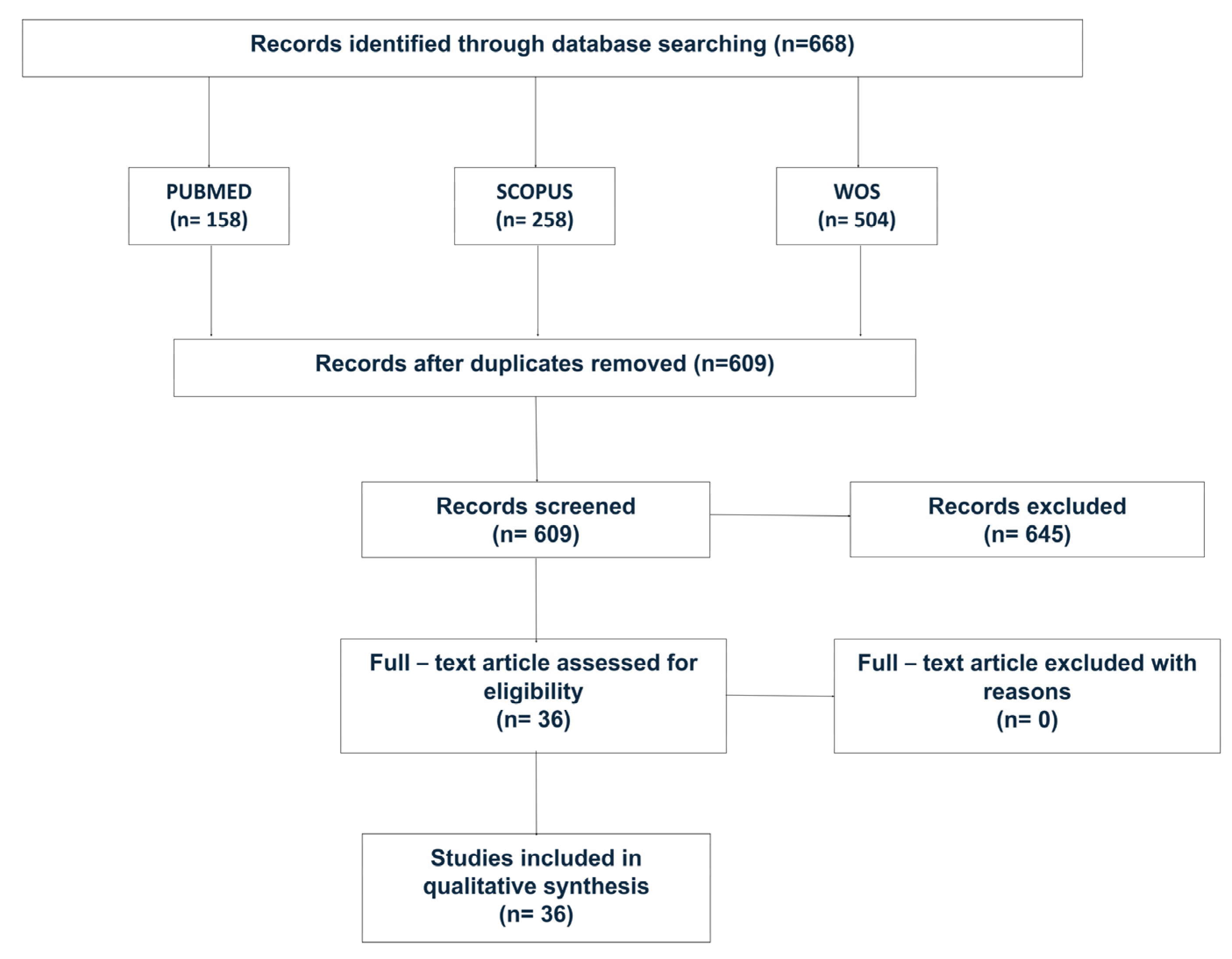
Using the search key (Figure 1), the entries were obtained in three databases, PubMed, Scopus, and WoS. Initially, 158 articles were selected from PubMed, 258 from Scopus, and 504 from WoS database, totaling 920 entries.
Figure 1.
PRISMA flowchart for the systematic review detailing the database searches, the number of abstracts screened, and the full texts selected for the analysis.
A total of 311 duplicate articles were excluded. Using the selection criteria, the remaining 609 articles were evaluated. Table 1 shows the number of excluded articles related to the evaluated criteria. Then, 36 articles were evaluated in detail and used to determine the results found in this review.
Table 1.
Relationship between eligibility criteria and the total number of excluded entries.
3.2. Quality Assessment
All selected articles passed the quality assessment and presented a good design, and they are all classified as reliable, even though eight articles presented some restrictions. Articles that quantified the concentration of zinc released and incorporated into the biomaterial highlighted the importance of zinc quantification on the biological effect (Table 2).
Table 2.
Quality assessment of the selected studies according to the Toxicological Data Reliability Advisory Tool (ToxRTool).
3.3. Characteristics of Selected Studies
The selected studies used different HA-doped zinc concentrations incorporated in different formulations of HA materials, including coatings, nanocomposites, nanoparticles, discs, powders, and granules, as shown in Table 3. Some studies evaluated the release of zinc in an aqueous medium to determine the dissolution potential.
Table 3.
Characteristics of biomaterials and chemical compounds in the selected studies.
Several studies reported changes in HA’s crystalline structure after zinc incorporation. The methods of analysis used by the authors are described in Table 3. X-ray diffraction (XRD) was the main technique used to study alterations of HA crystallinity after introducing Zn2+ (12 articles). As a complementary technique, the Rietveld powder structure refinement method was used to detail the characteristics of the crystal structure after replacements [56]. Other techniques, such as scanning electron microscope (SEM), selected area electron diffraction (SAED), and transmission electron microscope (TEM), were used; however, they do not guarantee the same comparison with standard materials [37,46,55].
Most authors performing XRD assessments identified crystalline changes from the incorporation of Zn2+. They observed the contraction in the crystal lattice, which promoted deformities in the crystallite, favoring solubility and altering the surface parameters of the materials (Table 4).
Table 4.
Physicochemical characterization of zinc incorporation in the selected studies.
Other parameters, such as chemical composition and degradation of biomaterial in aqueous solvents, were evaluated based on these changes. Many biological tests have been used to validate the effects of zinc doping on HA. Cytotoxicity was assessed using osteoblasts, pre-osteoblasts adipose, and mesenchymal stem cells from both human and animal origin, and mainly employing the 3-(4,5-dimethylthiazol-2-yl)-2,5 diphenyl tetrazolium bromide (MTT) test. Using this method, zinc at low concentrations showed no cytotoxic effect. Cell proliferation was also assessed in several studies, with an overall stimulation of osteoblast growth during exposure to zinc-containing biomaterials. However, only a few studies have investigated the effect of doped materials on the production of osteogenic proteins. Among those, ALP activity and its gene expression were the most represented, and other molecular factors, such as COL1, OCN, RUNX2, Osterix, and bone morphogenic protein 2 (BMP2), were also analyzed (Table 5).
Table 5.
In vitro evaluation of the biological effects of zinc incorporation in the selected studies.
4. Discussion
4.1. The Incorporation of Zinc into Hydroxyapatite
Although synthetic HA is similar to the organic composition of bone tissue, natural HA presents many different ions incorporated [57]. Zinc is one of the trace elements found in the bone matrix that, when incorporated into the HA structure, causes changes in its crystalline structure, modifying crystallinity, network organization, solubility, surface conditions, and ion leakage, with possible impact on the metabolism and behavior of osteoblasts that may improve osteoconduction and osteointegration [58].
In the present review, 25 studies incorporated Zn2+ into the HA structure with such intention. Most of them identified crystalline changes from the Zn2+ incorporation into the biomaterial (Table 3), allowing Zn2+ release in the periphery of the implant. The most common alteration on the crystalline structure occurs due to the Ca2+ substitution, promoting the contraction of the crystalline lattice, because Zn2+ presents a smaller atomic radius (134 pm) compared to Ca2+ (180 pm), resulting in the reduction of the ZnHA unit cell size [14]. According to Lala et al. [56], the increase in crystallinity is intensified with variations in the concentration of Zn2+ incorporated in the HA structure since the deformity of Ca2+ removal changes the crystallite plane c (height), thus reducing the unit cell crystallinity. In contrast, the ab (base) plane remains almost unaltered. The saturation of Zn2+ substitution is attained when its concentration reaches 15 mol%. In contrast, despite using the XRD technique, other studies did not find significant changes in material crystallinity [33,34,35,49,55]. Bhowmick et al. [20] did not observe changes in the crystal structure of HA after Zn incorporation. This is due to the presence of ZnO-shaped zinc, as Thian et al. [46] showed low incorporation of Zn2+ (1.6%) in the structure of HA.
This deformity in HA crystal structure alters other material parameters such as chemical composition, surface area, pore size, and pore volume [59]. As previously mentioned, stoichiometric synthetic HA shows Ca, P, and O at well-determined concentrations, giving a Ca/P ratio = 1.67. ZnHA is formed by replacing part of Ca2+ with Zn2+, which delays the nucleation of HA and renders the material calcium-deficient, as can be observed through the altered Ca/P ratio. Several of the identified studies from this review have described the assessment of the actual incorporated Zn2+ concentrations (Table 3). During the synthesis of the material, while theoretical Zn2+ concentrations are set from the calculation of reagent concentrations, the actual incorporation of Zn2+ in the samples tends to be lower than initially determined due to competition between Zn2+ and Ca2+ during nucleation. By quantifying the concentration of Zn2+ incorporated into HA, it is possible to decide on the actual concentration of Zn2+ included in the crystal network and monitor the release of this ion when in solution.
The main techniques used to identify the chemical composition of the elements in the selected articles were energy-dispersive X-ray spectroscopy (EDX), X-ray photoelectron spectroscopy (XPS), inductively coupled plasma optical emission spectroscopy (ICP-OES), atomic absorption spectroscopy (AAS), and X-ray fluorescence (XRF). The EDX and XPS techniques mainly analyze the surface chemical composition, which is ideal for evaluating ZnHA-coated materials but inefficient for total bulk quantification. In contrast, the ICP, XRF, and AAS techniques allow for quantifying ions present throughout the bulk of the material. As shown in Table 2, the concentrations of Zn2+ incorporated in the different materials ranged from 0.0009% to 2.9%. This information allows us to estimate and investigate the gradual release of Zn2+ in the implant and identify the dose/effect relationship of the zinc concentrations with the observed biological changes [41].
4.2. Solubility and the Release of Zn2+
According to the principles of regenerative medicine, to promote bone healing, a biomaterial should be simultaneously replaced by new bone tissue [15]. However, HA usually presents low solubility due to its high crystallinity. Ionic incorporations have been proposed as alternatives to solve this problem by inducing disorganization of the HA crystal lattice and making the material more soluble [60]. Considering bioactive innovative materials, substituting biologically active ions such as Zn2+ could theoretically combine the improved solubility with the induction of desired biological responses in bone metabolism, thus accelerating tissue regeneration [61]. Therefore, zinc-doped HA’s solubilization and release dynamics are essential factors to consider during in vitro and in vivo studies. However, only five selected studies verified the changes in Zn2+ content of the conditioned media before or during cell exposure. Several solutions were used for solubility tests, such as simulated body fluid (SBF), culture medium, Tris-HCl Buffer, and phosphate buffer-saline (PBS) [28,33,35,41,54]. De Lima et al. [35] showed that the ZnHA containing 1% Zn2+ released 1 ppm of this ion in cell culture media, modifying the ionic composition of the medium. This concentration is safe for cell viability, with no apoptotic effect on osteoblasts. Due to the different compositions of the studied solutions, it is difficult to identify whether the release of Zn2+ in various aqueous solutions will behave similarly. Gustavsson et al. [7] investigated the interaction of calcium phosphates in two media (DMEM and McCoy). They noted that the adsorption and desorption of Ca2+ and Pi ions are altered depending on the chemical composition of the aqueous medium and the exposure time.
4.3. Cell Adhesion into ZnHA Surfaces
Considering the difficulty of standardizing in vitro assays complementing these results, the systematic review by Cruz et al. [13] has shown controversy among authors considering a zinc-doped CaP (ZnCaP) bioreaction. Most studies have observed low resorption, but some authors have observed significant resorption in ZnCaP. This variation is related to the various implant types, shapes, sizes, and chemical composition, which can completely change the material structure and function, as observed in the present study (Table 2). It is essential to consider that the in vivo resorption process depends on material composition, biological fluid action for passive degradation, and osteoclast activity [62]. Animal model and implantation site variations may alter results as different cell types respond differently to biomaterials (Table 4).
Surface structures of biomaterials at the micro/nanoscale are often intentionally altered to modulate cellular behavior in parameters such as adhesion, morphology, differentiation, and migration. Modifications such as variation in roughness, porosity, cluster formation, and protein adsorption affect the biological response of osteoblastic cells [63]. These parameters directly influence the biological behavior of osteoblastic cells, promoting an adequate surface for cell adhesion that is intimately connected to the material osteoconductive properties necessary for graft integration to bone. The study from He et al. [28] observed that the more significant deposition of ZnHA on the substrate surface increases its roughness, which promotes more excellent cell adhesion. However, the biological effects of Zn2+ related to changes in porosity are controversial. Some studies reported more excellent cell adhesion in more porous samples [18], and the production of ZnHA aggregates with different concentrations of zinc increased cell adhesion [37,49,55]. In contrast, Li et al. [33,34] and De Lima et al. [35], while evaluating 1% ZnHA, observed more excellent cell adhesion without changes in porosity, attributing this to the biological effects of the released zinc in the culture media. Other studies found higher cell adhesion on materials with smaller grain sizes [24,51]. In contrast, incorporating Zn2+ into the HA structure did not change grain formation and, consequently, did not impact cell adhesion. Similarly, studies involving the adhesion of preosteoblasts onto 5% ZnHA nanostructured surfaces and MSCs seeded over macroporous chitosan–agarose scaffolds with Zn-doped nano-hydroxyapatite did not find effects for Zn2+ incorporation. In contrast, adhesion was significantly increased with doping with magnesium ions [32,47]. According to the authors, Mg2+ doping would be more efficient in supporting cell adhesion and spreading due to increased interactions with membrane-associated adhesion receptors like integrins [32].
In addition to surface properties playing an essential role in cell adhesion, studies showed that protein functionalization on the surface of materials improves cell adhesion. The main proteins and peptides tested were fetal bovine serum (FBS), RGD (Arg–Gly–Asp), albumin, laminin, denatured collagen, fibronectin, and vitronectin. Zhang [54] observed increased adhesion in ZnHA samples related to protein adsorption. These findings were corroborated by Ghorbania et al. [27], when testing FBS protein adsorption, finding a higher number of cells adhered to zinc-doped material, similar to Mavropoulos et al. [39] and Webster et al. [52]. Even with the incorporation of Zn2+ in the crystalline structure of HA, no change in the fundamental structure of the material was observed. Direct cell adhesion with doped-HA did not significantly improve the interaction of cells with the material. However, indirect factors such as Zn2+ release and surface protein adsorption contributed to cell adhesion. Surface modifications of ZnHA increase protein adsorption, which increases cell adhesion, a feature that can make the material more interactive with cells and make it more osteoconductive.
4.4. Effects on Cytocompatibility
Cytotoxicity assessment is a crucial first step in evaluating the effects of zinc-doped biomaterials, as it determines the biocompatibility and safety of the biomaterials intended for bone tissue engineering [64]. While Zn2+ is generally expected to promote cell proliferation and osteogenic differentiation, high concentrations of Zn2+ can potentially cause cell death. Controversies were found regarding the concentration of Zn2+ in doped HA that would maintain the material cytocompatibility. Lima et al. [35] observed the release of Zn2+ (0.8 ppm) from 1% ZnHA in conditioned media exposed to cells, relating the release of ions to increased cytocompatibility with primary human osteoblasts through a multiparametric method (XTT, Neutral Red, and CVDE). Bhowmick et al. [20] described that MG-63 cells in contact with ZnHA samples (5%, 10%, and 15%) showed a significant increase in cell viability compared to the undoped samples. On the other hand, cytotoxic effects were demonstrated by Luo et al. [37] and Li et al. [34], describing that high concentrations of Zn2+ (from 8 to 30%) may reduce cell proliferation and may be related to the cytotoxic effect of these concentrations. Similarly, Forte et al. [36] identified a significant reduction in osteoblast viability when indirectly exposed to 8% ZnHA. Still, this deleterious effect was counterposed by adding polyethyleneimine (PEI), producing a biocompatible, bi-functionalized material. More recently, Huang et al. [31] also identified cytotoxic effects of ZnHA in osteosarcoma cells (MG-63) but not in healthy MSCs and osteoblasts, suggesting an anticancer trait for this material. This ZnHA reduced the tumor size when implanted with a PCL scaffold on a murine in an in vivo model [31].
4.5. Effects on Cell Proliferation
Cell proliferation is the second step in establishing bone regeneration, supporting cell differentiation followed by forming new bone tissue, simultaneously with resorption of the biomaterial [65]. Most articles have confirmed the increase in cell density in HA with different concentrations of Zn2+ doping. Increased proliferation has been observed in several studies (Table 5). The presence of Zn2+ has been shown to benefit the proliferation of different cell types in the concentration range of 1% to 20%. Studies showed that ZnHA coverage on the titanium surface improved cell proliferation, and Zn2+ incorporation at concentrations from 0.0025 M to 0.56 M was promising [50,54]. From the ZnHA coating, Zn2+ release was observed in the 1% to 9% range [24,41], contributing to increased cell proliferation. Other materials, such as blocks, pellets, and biocomposites, have been shown to alter cell proliferation [18,53]. In contrast, polymers and collagen-associated materials seem to have masked the effect of doped biomaterial, not promoting proliferation [27,66]. The effect of Zn2+ concentration was dose-dependent, as shown by Zhong and Ma [55] and Wang et al. [50], as proliferation was increased in samples with a higher Zn2+ concentration (5% and 0.56 M, respectively). However, Okada et al. [42] have shown a dose-dependent reduction in murine pre-osteoblast proliferation when exposed to 15% ZnHA, suggesting once again harmful effects at higher Zn2+ incorporations.
4.6. Effects on Cell Differentiation and In Vitro Mineralization
Pre-osteoblast differentiation marks the beginning of new bone tissue formation [67]. Among the primary osteogenic markers are ALP, OCN, Col I, RUNX-2, Osterix, and BMP-2 [68]. Zn2+ plays a vital role in osteogenesis since this element’s absence delays the bone formation process [69]. Increased ALP activity is directly related to the ability of cells to activate signaling pathways favoring the formation of new bone tissue. Since this enzyme’s activity shows peaks of activity in the early periods of osteoblast cell differentiation, between the 14th and 21st day, varying according to cell line, most studies monitored the activity of this enzyme within this timeframe [22,28,29,30,37,38,44,49,50,51,53,55]. ALP activity was dose-dependent, as it gradually increased activity in samples with higher zinc concentration, according to Wang et al. [50]. ALP activity increased after exposure to materials doped with Zn2+ in the 5 to 20% concentration range. The studies by Zhong and Ma [55], Luo et al. [37], and Wang et al. [50], employing ZnHA coating on metallic matrices with their respective theoretical Zn2+ concentrations of 5%, 20%, and 0.56 M, observed an increase in ALP activity. The study by Zhong and Ma [55] observed a shift of the enzyme activity peak from the 14th to the 10th day after exposure, compared to the control. On the other hand, Hidalgo-Robatto et al. [29] identified no ALP activity in any of the Zn2+ concentrations evaluated, from 2.5% to 10%. The study by Maleki-Ghaleh et al. [38], employing a zinc-containing graphene/nanoHA, also identified strong positive effects in MSC proliferation and release of ALP, but the authors did not provide the ratio of Zn2+ incorporation. A similar association of ZnHA with graphene was developed by Chopra et al. [22], and the material osteoinductive property was confirmed by its ability to induce MSCs by in vitro mineralization, and expression of RUNX-2, ALP, BMP-2, Col-1, OCN, and osteopontin (OPN).
Molecular monitoring of RUNX-2, Osterix, OCN, Col-I, and BMP-2 transcription factors reveals more precisely the cell differentiation process and bone formation [70]. These molecules promote the modulation of new tissue construction by maturing the pre-osteoblasts in osteoblasts and matrix producers [68]. Few selected studies have investigated the optimal effect/concentration of Zn2+ on osteoblast differentiation pathways and the expression of osteogenic factors. Several studies [22,28,30,37,38,46,53] evaluated osteogenic markers involved in the differentiation of pre-osteoblasts in the presence of osteogenic medium to stimulate differentiation. OCN, a critical protein for calcium deposition in the organic matrix, was increased after exposure to zinc-doped samples (containing 5 to 20% Zn2+) [37,46,53], as well as OPN and osteoprotegerin (OPG) [30]. The study by Luo et al. [37], investigating coatings with high concentrations of Zn2+, has found an increase in the concentration of OCN, RUNX-2, and Osterix, as well as an increase in the expression of BMP-2 and Col-I after exposure to 20% ZnHA samples. On the other hand, the 30% ZnHA showed a reduction in the concentration of the tested proteins and the genes, most probably due to cytotoxic effects on higher Zn2+ doses. The results by Meng et al. [40] showed that Zn2+ substitution at 1–2% moderately promoted the MSC differentiation into the osteoblasts, as measured by the ALP/Col-I ratio and expression of OCN, and reduced the osteoclastic activity in co-culture, even with a release of Zn2+ at concentrations under 5 ppm. Adipose-derived MSCs also responded to 1% ZnHA on a bilayered hydrogel scaffold by increasing ALP, Col-I, and RUNX-2 expression and in vitro calcium deposition [21].
The deposition of calcium in the organic matrix and the formation of mineralization nodules reveal the complete differentiation of osteoblasts and establish the process of bone formation. The works by Webster et al. [51], He et al. [28], and Wang et al. [49] observed an increase in the deposition of hydroxyapatite by osteoblasts induced by 5% ZnHA, indicating that, at least in vitro, zinc-doped materials affect osteoblast metabolism resulting in increased deposition of mineralization nodules. These results are in accordance with Cuozzo et al. [23], which investigated nanostructured ZnHA/alginate microspheres with theoretical 5% Zn2+ content (0.5% final incorporation), which were biocompatible with murine pre-osteoblasts and induced an increase in newly formed bone on a rat calvaria defect in vivo model. Furthermore, these results could help to explain the findings summarized in a systematic review by Cruz et al. [13], where most studies reported that the presence of Zn2+ in calcium phosphates improves the production of new bone, even though it depends on the manufacturing process, zinc concentration, and solubility of the materials.
4.7. Other Biological Effects
Even though it was not in the scope of the search question of this review, several selected studies have also highlighted the significant antimicrobial effects of ZnHA composites, another trait that renders them promising materials for bone tissue engineering and implant applications in dentistry. Maleki-Ghaleh et al. [38] demonstrated that ZnHA nanoparticles effectively attack bacteria by damaging bacterial membranes, accumulating in the cytoplasm, and increasing reactive oxygen species (ROS) production, with Gram-negative bacteria susceptible. Such an antibacterial effect was also demonstrated for 15% ZnHA nanoparticles [42]. Cuozzo et al. [23] noted that ZnHA composites help prevent post-surgery infections, underscoring their antibacterial properties. Predoi et al. [43] further expanded on these findings by showing that ZnHA, when combined with chitosan and tarragon essential oil, exhibits potent antimicrobial activity against Escherichia coli, Staphylococcus aureus, and Candida albicans, with enhanced effects observed over a 72 h incubation period. Chopra et al. [22] found that incorporating reduced graphene oxide (rGO) with ZnHA significantly reduces bacterial colonies and biofilm formation due to increased ROS production and bacterial cell membrane damage. These studies underscore the potent antimicrobial properties of ZnHA composites, highlighting their potential to improve the safety and efficacy of bone-related medical applications by preventing infections.
The effects of ZnHA on osteoclasts and its relevance to bone regeneration are profound and multifaceted, involving complex interactions with both osteoclasts and osteoblasts. Even though the search strategy of this review focused only on mineralizing cells, some studies presented in vitro evidence of ZnHA influencing osteoclasts significantly, as it initially tends to inhibit osteoclastic activity. For instance, Meng et al. [40] demonstrated that Zn substitution in hydroxyapatite reduced osteoclastic activity in the early stages of co-culture with osteoblasts and osteoclast-like precursor cells. This early inhibition is likely due to the Zn2+ interfering with the differentiation pathways of osteoclast precursors, as evidenced by the decreased expression of TRAP5b and IL-1 during the initial phases of co-culture. However, the study also revealed that ZnHA promoted osteoclastic activity at later stages. This paradoxical effect was marked by significantly enhanced expressions of osteoclastic markers such as TRAP5b and IL-1 after prolonged co-culture. The formation of multinucleated osteoclasts was more pronounced in the presence of ZnHA, indicating that zinc plays a role in osteoclasts’ maturation and functional activity over time [40].
The study by Forte et al. [26] investigated the effects of zinc substitution in hydroxyapatite and its multifunctionalization on osteoclasts. It was found that zinc-substituted hydroxyapatite inhibited osteoclast proliferation and activity. The study also highlighted the importance of co-culture systems to mimic the human physiological environment and better understand the interactions between osteoblasts and osteoclasts. Cuozzo et al. [23] evaluated zinc-containing hydroxyapatite composite microspheres and found that zinc reduced bioabsorption rates, which was associated with decreased osteoclastic activity, thereby supporting bone regeneration and repair. The dual role of ZnHA in inhibiting and later stimulating osteoclastic activity is crucial for balanced bone remodeling. Initial inhibition of osteoclasts helps reduce excessive bone resorption immediately after implantation of ZnHA-based materials. Subsequent stimulation of osteoclastic activity ensures that bone resorption and formation are balanced, promoting the remodeling of the new matrix into a more similar structure to natural bone [71]. This dynamic modulation is essential for effective bone regeneration, as it supports the initial phase of new bone formation while preventing long-term deficiencies in bone resorption that could lead to abnormal bone accumulation and poor mechanical properties [72]. In conclusion, ZnHA’s effects on osteoclasts are time-dependent and highly influenced by the presence of osteoblasts, ensuring a balanced bone remodeling process.
4.8. Summary of Evidence and Limitations
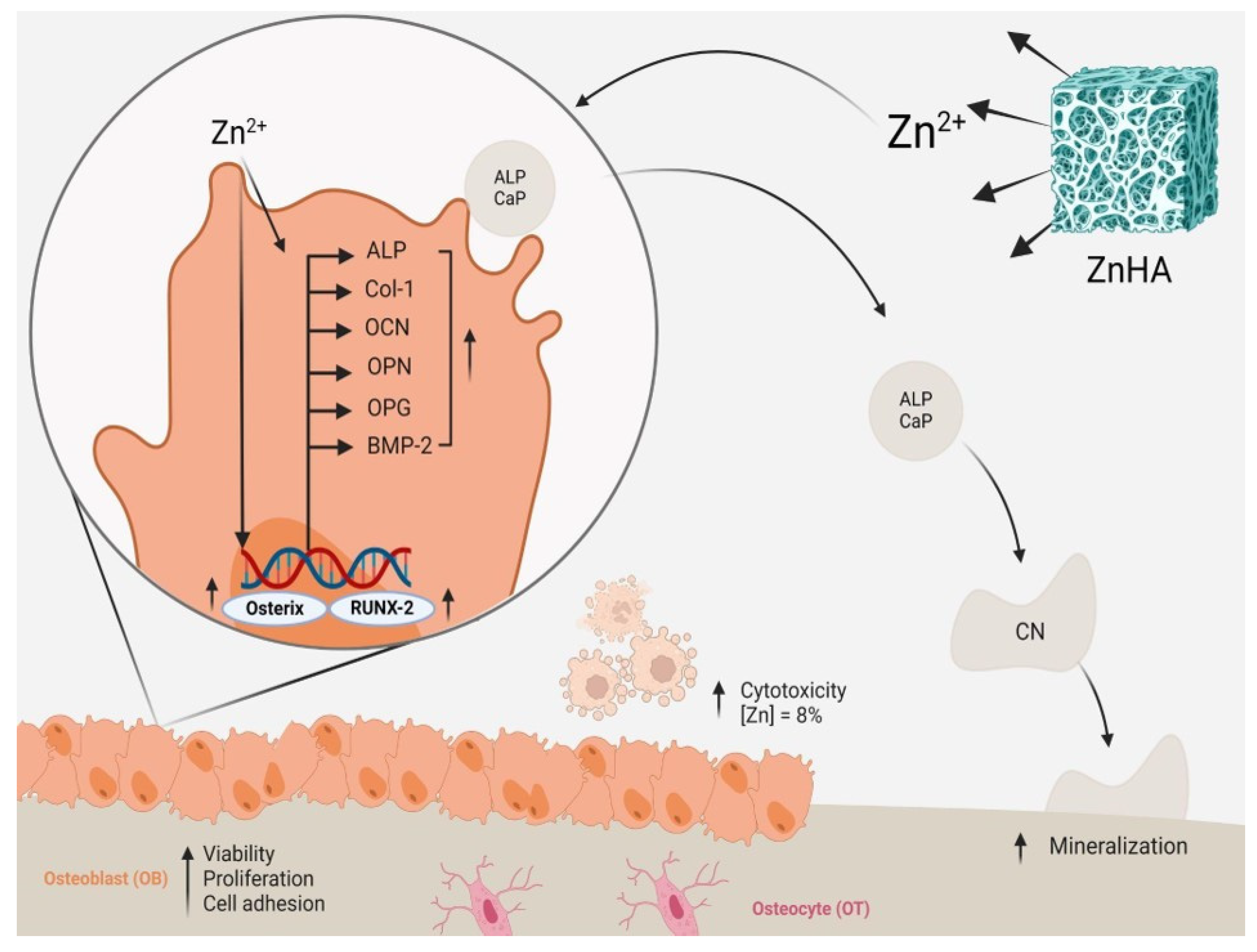
The literature describes in detail the production processes of synthetic HA by different methods, and the characterization of these materials is thoroughly described, making it possible to understand and reproduce these results. However, biological studies still have significant gaps in the ideal Zn2+ concentrations to be incorporated into the materials to stimulate specific biological effects on bone metabolism. The main limitation observed refers to the limited detection of the concentrations released during contact with the biological environment. Only a few studies indeed evaluated the released concentrations of Zn2+ in their studies. This gap prevents the complete understanding of the optimal concentrations to enhance the desired biological effects. It may be one of the primary sources of differences and controversies in related pre-clinical in vivo studies. While there is pre-clinical evidence of the positive impact of ZnHA on bone repair [13], the best manufacturing method and ideal Zn2+ concentration that can promote bioreaction and osteoconductivity could not yet be assertively determined from the in vitro evidence. Nevertheless, interesting evidence is already available from the identified in vitro studies that allow for tracing the main pathway of effects of zinc-doped HA on osteoblasts and MSCs, as summarized in Figure 2.
Figure 2.
A representative image shows the effects of zinc-doped hydroxyapatite (ZnHA) on osteoblasts and its role in bone regeneration. ZnHA can release Zn2+, which directly affects mesenchymal stem cells and osteoblasts, enhancing the expression of RUNX-2, a key transcription factor of osteogenesis. This up-regulation leads to increased levels of bone formation markers such as ALP (Alkaline Phosphatase), Col-1 (Collagen type I), OCN (Osteocalcin), and OP (Osteopontin). The resulting improved osteoblastic activity promotes bone regeneration. However, ZnHA containing zinc above 8% presented cytotoxicity to bone cells.
Bioresorption of biomaterials is fundamental for the formation of new bone tissue. However, limited data are also available to help understand the impact of biomaterials during osseointegration and biomineralization. Studies show that there are two significant pathways of osteoblast differentiation, WNT/β-catenin and RUNX-2 are both osteogenic activating genes responsible for pre-osteoblast maturation and expression of genes linked to bone differentiation such as BMP-2, Col I, ONC, and OPN [68]. However, there is a lack of evidence on the zinc dose/response of these differentiation pathways in the biological effects of Zn-doped materials. Therefore, further research efforts remain necessary to understand the influence of the level of incorporated zinc during these processes.
This systematic review presents, as its main limitation: (i) a restrictive search key that might have missed some studies related to other complex presentations of HA or ZnHA; (ii) the limitation to in vitro studies, aiming at molecular explanations at the cell level, but that may miss studies with interesting clinical correlations, and (iii) limitation to complete reports, possibly missing potentially interesting results from published abstracts. The search strategy avoided the inclusion of in vivo studies, which could greatly contribute to detecting the impacts of the osteoblast response to ZnHA on new bone formation, material resorption, inflammatory responses, as well as other effects. Nevertheless, the review by Cruz et al. [13] presents a comprehensive discussion of animal studies on the effects of ZnHA. Regardless of these limitations, this search strategy allowed us to conclude that incorporating zinc into hydroxyapatite significantly enhances the cellular response, promoting bone regeneration and osteointegration behaviors. This systematic review has identified in vitro evidence that ZnHA stimulates osteoblast proliferation, adhesion, and differentiation, which are critical for effective bone healing. Studies consistently show that ZnHA exhibits excellent biocompatibility despite presenting cytotoxicity at theoretical incorporations above 8% of zinc. This association stimulates ALP activity and the expression of bone growth factors in osteoblasts and MSCs on ranges from 5 to 20% of zinc theoretical incorporation. However, the notable variability in the concentrations of zinc used across different studies complicates the identification of an ideal doping level for clinical applications. Future research should focus on evaluating the zinc incorporation and release level to ensure consistent and effective outcomes in bone regeneration. Zinc-doped hydroxyapatite materials are promising candidates for bone repair and regeneration applications. The evidence supports their potential to improve osteoblast function and bone tissue integration, though further studies are necessary to optimize their formulation for safe and efficient clinical use.
Supplementary Materials
The following supporting information can be downloaded at: https://www.mdpi.com/article/10.3390/jfb15070178/s1.
Author Contributions
Conceptualization, J.D., C.F.M., and G.G.A.; methodology, J.D., G.D., A.R., A.P., N.D.P., T.R., C.F.M. and G.G.A.; software, J.D., T.R. and C.F.M.; validation, J.D., T.R., C.F.M. and G.G.A.; formal analysis, A.R., A.P., and N.D.P.; investigation, J.D., G.D., A.R., N.D.P., C.F.M. and G.G.A.; resources, J.D., C.F.M. and G.G.A.; data curation, J.D., G.D., A.R., T.R. and C.F.M.; writing—original draft preparation, J.D., G.D., A.R. and C.F.M.; writing—review and editing, T.R., C.F.M. and G.G.A.; visualization, A.P., N.D.P. and G.G.A.; supervision, J.D., C.F.M. and G.G.A.; project administration, J.D., C.F.M. and G.G.A. All authors have read and agreed to the published version of the manuscript.
Funding
This research received no external funding.
Data Availability Statement
The data are within the article and available to the corresponding authors upon request.
Acknowledgments
The authors would like to acknowledge FAPERJ, CAPES, and CNPq.
Conflicts of Interest
The authors declare no conflicts of interest.
References
- Peres, M.A.; Macpherson, L.M.; Weyant, R.J.; Daly, B.; Venturelli, R.; Mathur, M.R.; Listl, S.; Celeste, R.K.; Guarnizo-Herreño, C.C.; Kearns, C.; et al. Oral diseases: A global public health challenge. Lancet 2019, 394, 249–260. [Google Scholar] [CrossRef] [Scilit] [PubMed]
- Zhao, R.; Yang, R.; Cooper, P.R.; Khurshid, Z.; Shavandi, A.; Ratnayake, J. Bone Grafts and Substitutes in Dentistry: A Review of Current Trends and Developments. Molecules 2021, 26, 3007. [Google Scholar] [CrossRef] [Scilit] [PubMed]
- Schmidt, A.H. Autologous bone graft: Is it still the gold standard? Injury 2021, 52 (Suppl. S2), S18–S22. [Google Scholar] [CrossRef] [Scilit]
- Crist, T.E.; Mathew, P.J.; Plotsker, E.L.; Sevilla, A.C.; Thaller, S.R. Biomaterials in Craniomaxillofacial Reconstruction: Past, Present, and Future. J. Craniofac. Surg. 2021, 32, 535–540. [Google Scholar] [CrossRef] [Scilit]
- Fendi, F.; Abdullah, B.; Suryani, S.; Usman, A.N.; Tahir, D. Development and application of hydroxyapatite-based scaffolds for bone tissue regeneration: A systematic literature review. Bone 2024, 183, 117075. [Google Scholar] [CrossRef] [Scilit] [PubMed]
- Almeida, D.; Sartoretto, S.C.; Calasans-Maia, J.d.A.; Ghiraldini, B.; Bezerra, F.J.B.; Granjeiro, J.M.; Calasans-Maia, M.D. In vivo osseointegration evaluation of implants coated with nanostructured hydroxyapatite in low density bone. PLoS ONE 2023, 18, e0282067. [Google Scholar] [CrossRef] [Scilit] [PubMed]
- Gustavsson, J.; Ginebra, M.P.; Engel, E.; Planell, J. Ion reactivity of calcium-deficient hydroxyapatite in standard cell culture media. Acta Biomater. 2011, 7, 4242–4252. [Google Scholar] [CrossRef] [Scilit]
- Ressler, A.; Žužić, A.; Ivanišević, I.; Kamboj, N.; Ivanković, H. Ionic substituted hydroxyapatite for bone regeneration applications: A review. Open Ceram. 2021, 6, 100122. [Google Scholar] [CrossRef] [Scilit]
- Su, Y.; Cockerill, I.; Wang, Y.; Qin, Y.-X.; Chang, L.; Zheng, Y.; Zhu, D. Zinc-Based Biomaterials for Regeneration and Therapy. Trends Biotechnol. 2019, 37, 428–441. [Google Scholar] [CrossRef] [Scilit]
- Zastulka, A.; Clichici, S.; Tomoaia-Cotisel, M.; Mocanu, A.; Roman, C.; Olteanu, C.D.; Culic, B.; Mocan, T. Recent Trends in Hydroxyapatite Supplementation for Osteoregenerative Purposes. Materials 2023, 16, 1303. [Google Scholar] [CrossRef] [Scilit]
- Hoppe, A.; Güldal, N.S.; Boccaccini, A.R. A review of the biological response to ionic dissolution products from bioactive glasses and glass-ceramics. Biomaterials 2011, 32, 2757–2774. [Google Scholar] [CrossRef] [Scilit]
- Uwitonze, A.M.; Ojeh, N.; Murererehe, J.; Atfi, A.; Razzaque, M.S. Zinc Adequacy Is Essential for the Maintenance of Optimal Oral Health. Nutrients 2020, 12, 949. [Google Scholar] [CrossRef] [Scilit]
- Cruz, R.; Calasans-Maia, J.; Sartoretto, S.; Moraschini, V.; Rossi, A.M.; Louro, R.S.; Granjeiro, J.M.; Calasans-Maia, M.D. Does the incorporation of zinc into calcium phosphate improve bone repair? A systematic review. Ceram. Int. 2018, 44, 1240–1249. [Google Scholar] [CrossRef] [Scilit]
- Martinez-Zelaya, V.R.; Zarranz, L.; Herrera, E.Z.; Alves, A.T.; Uzeda, M.J.; Mavropoulos, E.; Rossi, A.L.; Mello, A.; Granjeiro, J.M.; Calasans-Maia, M.D.; et al. In vitro and in vivo evaluations of nanocrystalline Zn-doped carbonated hydroxyapatite/alginate microspheres: Zinc and calcium bioavailability and bone regeneration. Int. J. Nanomed. 2019, 14, 3471–3490. [Google Scholar] [CrossRef] [Scilit]
- Chou, J.; Komuro, M.; Hao, J.; Kuroda, S.; Hattori, Y.; Ben-Nissan, B.; Milthorpe, B.; Otsuka, M. Bioresorbable zinc hydroxyapatite guided bone regeneration membrane for bone regeneration. Clin. Oral Implant. Res. 2016, 27, 354–360. [Google Scholar] [CrossRef] [Scilit]
- Page, M.J.; McKenzie, J.E.; Bossuyt, P.M.; Boutron, I.; Hoffmann, T.C.; Mulrow, C.D.; Shamseer, L.; Tetzlaff, J.M.; Akl, E.A.; Brennan, S.E.; et al. The PRISMA 2020 statement: An updated guideline for reporting systematic reviews. BMJ 2021, 372, n71. [Google Scholar] [CrossRef] [Scilit] [PubMed]
- Bakhsheshi-Rad, H.R.; Hamzah, E.; Ismail, A.F.; Aziz, M.; Daroonparvar, M.; Saebnoori, E.; Chami, A. In vitro degradation behavior, antibacterial activity and cytotoxicity of TiO2-MAO/ZnHA composite coating on Mg alloy for orthopedic implants. Surf. Coat. Technol. 2018, 334, 450–460. [Google Scholar] [CrossRef] [Scilit]
- Begam, H.; Kundu, B.; Chanda, A.; Nandi, S.K. MG63 osteoblast cell response on Zn doped hydroxyapatite (HAp) with various surface features. Ceram. Int. 2017, 43, 3752–3760. [Google Scholar] [CrossRef] [Scilit]
- Bhattacharjee, A.; Bandyopadhyay, A.; Bose, S. Plasma sprayed fluoride and zinc doped hydroxyapatite coated titanium for load-bearing implants. Surf. Coat. Technol. 2022, 440, 128464. [Google Scholar] [CrossRef] [Scilit]
- Bhowmick, A.; Pramanik, N.; Manna, P.J.; Mitra, T.; Selvaraj, T.K.R.; Gnanamani, A.; Das, M.; Kundu, P.P. Development of porous and antimicrobial CTS–PEG–HAP–ZnO nano-composites for bone tissue engineering. RSC Adv. 2015, 5, 99385–99393. [Google Scholar] [CrossRef] [Scilit]
- Cao, Y.; Zhang, H.; Qiu, M.; Zheng, Y.; Shi, X.; Yang, J. Biomimetic injectable and bilayered hydrogel scaffold based on collagen and chondroitin sulfate for the repair of osteochondral defects. Int. J. Biol. Macromol. 2024, 257, 128593. [Google Scholar] [CrossRef] [Scilit] [PubMed]
- Chopra, V.; Thomas, J.; Sharma, A.; Panwar, V.; Kaushik, S.; Sharma, S.; Porwal, K.; Kulkarni, C.; Rajput, S.; Singh, H.; et al. Synthesis and Evaluation of a Zinc Eluting rGO/Hydroxyapatite Nanocomposite Optimized for Bone Augmentation. ACS Biomater. Sci. Eng. 2020, 6, 6710–6725. [Google Scholar] [CrossRef] [Scilit]
- Cuozzo, R.C.; Sartoretto, S.C.; Resende, R.F.B.; Alves, A.T.N.N.; Mavropoulos, E.; da Silva, M.H.P.; Calasans-Maia, M.D. Biological evaluation of zinc-containing calcium alginate-hydroxyapatite composite microspheres for bone regeneration. J. Biomed. Mater. Res. B Appl. Biomater. 2020, 108, 2610–2620. [Google Scholar] [CrossRef] [Scilit] [PubMed]
- Ding, Q.; Zhang, X.; Huang, Y.; Yan, Y.; Pang, X. In vitro cytocompatibility and corrosion resistance of zinc-doped hydroxyapatite coatings on a titanium substrate. J. Mater. Sci. 2015, 50, 189–202. [Google Scholar] [CrossRef] [Scilit]
- Dittler, M.L.; Unalan, I.; Grünewald, A.; Beltrán, A.M.; Grillo, C.A.; Destch, R.; Gonzalez, M.C.; Boccaccini, A.R. Bioactive glass (45S5)-based 3D scaffolds coated with magnesium and zinc-loaded hydroxyapatite nanoparticles for tissue engineering applications. Colloids Surf. B Biointerfaces 2019, 182, 110346. [Google Scholar] [CrossRef] [Scilit] [PubMed]
- Forte, L.; Sarda, S.; Torricelli, P.; Combes, C.; Brouillet, F.; Marsan, O.; Salamanna, F.; Fini, M.; Boanini, E.; Bigi, A. Multifunctionalization Modulates Hydroxyapatite Surface Interaction with Bisphosphonate: Antiosteoporotic and Antioxidative Stress Materials. ACS Biomater. Sci. Eng. 2019, 5, 3429–3439. [Google Scholar] [CrossRef] [Scilit]
- Ghorbani, F.M.; Kaffashi, B.; Shokrollahi, P.; Seyedjafari, E.; Ardeshirylajimi, A. PCL/chitosan/Zn-doped nHA electrospun nanocomposite scaffold promotes adipose derived stem cells adhesion and proliferation. Carbohydr. Polym. 2015, 118, 133–142. [Google Scholar] [CrossRef] [Scilit]
- He, M.; Chen, X.; Cheng, K.; Weng, W.; Wang, H. Enhanced Osteogenic Activity of TiO2 Nanorod Films with Microscaled Distribution of Zn-CaP. ACS Appl. Mater. Interfaces 2016, 8, 6944–6952. [Google Scholar] [CrossRef] [Scilit]
- Hidalgo-Robatto, B.; López-Álvarez, M.; Azevedo, A.; Dorado, J.; Serra, J.; Azevedo, N.; González, P. Pulsed laser deposition of copper and zinc doped hydroxyapatite coatings for biomedical applications. Surf. Coat. Technol. 2018, 333, 168–177. [Google Scholar] [CrossRef] [Scilit]
- Hou, H.H.; Lee, B.S.; Liu, Y.C.; Wang, Y.P.; Kuo, W.T.; Chen, I.H.; He, A.C.; Lai, C.H.; Tung, K.L.; Chen, Y.W. Vapor-Induced Pore-Forming Atmospheric-Plasma-Sprayed Zinc-, Strontium-, and Magnesium-Doped Hydroxyapatite Coatings on Titanium Implants Enhance New Bone Formation—An In Vivo and In Vitro Investigation. Int. J. Mol. Sci. 2023, 24, 4933. [Google Scholar] [CrossRef] [Scilit]
- Huang, H.; Qiang, L.; Fan, M.; Liu, Y.; Yang, A.; Chang, D.; Li, J.; Sun, T.; Wang, Y.; Guo, R.; et al. 3D-printed tri-element-doped hydroxyapatite/polycaprolactone composite scaffolds with antibacterial potential for osteosarcoma therapy and bone regeneration. Bioact. Mater. 2024, 31, 18–37. [Google Scholar] [CrossRef] [Scilit] [PubMed]
- Kazimierczak, P.; Kolmas, J.; Przekora, A. Biological Response to Macroporous Chitosan-Agarose Bone Scaffolds Comprising Mg- and Zn-Doped Nano-Hydroxyapatite. Int. J. Mol. Sci. 2019, 20, 3835. [Google Scholar] [CrossRef] [Scilit]
- Li, J.; Cai, S.; Xu, G.; Li, X.; Zhang, W.; Zhang, Z. In vitro biocompatibility study of calcium phosphate glass ceramic scaffolds with different trace element doping. Mater. Sci. Eng. C 2012, 32, 356–363. [Google Scholar] [CrossRef] [Scilit]
- Li, Y.; Shi, X.; Li, W. Zinc-Containing Hydroxyapatite Enhances Cold-Light-Activated Tooth Bleaching Treatment In Vitro. Biomed. Res. Int. 2017, 2017, 6261248. [Google Scholar] [CrossRef] [Scilit]
- de Lima, I.R.; Alves, G.G.; Soriano, C.A.; Campaneli, A.P.; Gasparoto, T.H.; Ramos, E.S.; de Sena, L.; Rossi, A.M.; Granjeiro, J.M. Understanding the impact of divalent cation substitution on hydroxyapatite: An in vitro multiparametric study on biocompatibility. J. Biomed. Mater. Res.—Part A 2011, 98, 351–358. [Google Scholar] [CrossRef] [Scilit] [PubMed]
- Liu, Y.-C.; Lee, Y.-T.; Huang, T.-C.; Lin, G.-S.; Chen, Y.-W.; Lee, B.-S.; Tung, K.-L. In Vitro Bioactivity and Antibacterial Activity of Strontium-, Magnesium-, and Zinc-Multidoped Hydroxyapatite Porous Coatings Applied via Atmospheric Plasma Spraying. ACS Appl. Bio Mater. 2021, 4, 2523–2533. [Google Scholar] [CrossRef] [Scilit]
- Luo, W.; Sun, Q.; Wang, X.; Guo, Y.; Guo, T.; Meng, X.; Zhou, Y.; Zhao, J. Osteoconductivity of Zinc-Doped Calcium Phosphate Coating on a 3D-Printed Porous Implant. J. Biomater. Tissue Eng. 2017, 7, 1085–1092. [Google Scholar] [CrossRef] [Scilit]
- Maleki-Ghaleh, H.; Siadati, M.H.; Fallah, A.; Koc, B.; Kavanlouei, M.; Khademi-Azandehi, P.; Moradpur-Tari, E.; Omidi, Y.; Barar, J.; Beygi-Khosrowshahi, Y.; et al. Antibacterial and Cellular Behaviors of Novel Zinc-Doped Hydroxyapatite/Graphene Nanocomposite for Bone Tissue Engineering. Int. J. Mol. Sci. 2021, 22, 9564. [Google Scholar] [CrossRef] [Scilit]
- Mavropoulos, E.; Hausen, M.; Costa, A.M.; Alves, G.; Mello, A.; Ospina, C.A.; Mir, M.; Granjeiro, J.M.; Rossi, A.M. The impact of the RGD peptide on osteoblast adhesion and spreading on zinc-substituted hydroxyapatite surface. J. Mater. Sci. Mater. Med. 2013, 24, 1271–1283. [Google Scholar] [CrossRef] [Scilit]
- Meng, G.; Wu, X.; Yao, R.; He, J.; Yao, W.; Wu, F. Effect of zinc substitution in hydroxyapatite coating on osteoblast and osteoclast differentiation under osteoblast/osteoclast co-culture. Regen. Biomater. 2019, 6, 349–359. [Google Scholar] [CrossRef] [Scilit]
- O’sullivan, C.; O’Hare, P.; O’Leary, N.D.; Crean, A.M.; Ryan, K.; Dobson, A.D.W.; O’Neill, L. Deposition of substituted apatites with anticolonizing properties onto titanium surfaces using a novel blasting process. J. Biomed. Mater. Res. B Appl. Biomater. 2010, 95, 141–149. [Google Scholar] [CrossRef] [Scilit]
- Okada, M.; Oshita, M.; Kataoka, M.; Azuma, Y.; Furuzono, T. Shareability of antibacterial and osteoblastic-proliferation activities of zinc-doped hydroxyapatite nanoparticles in vitro. J. Biomed. Mater. Res. B Appl. Biomater. 2022, 110, 799–805. [Google Scholar] [CrossRef] [Scilit]
- Predoi, D.; Iconaru, S.L.; Ciobanu, C.S.; Raita, M.S.; Ghegoiu, L.; Trusca, R.; Badea, M.L.; Cimpeanu, C. Studies of the Tarragon Essential Oil Effects on the Characteristics of Doped Hydroxyapatite/Chitosan Biocomposites. Polymers 2023, 15, 1908. [Google Scholar] [CrossRef] [Scilit] [PubMed]
- Santos, M.H.; Valerio, P.; Goes, A.M.; Leite, M.F.; Heneine, L.G.D.; Mansur, H.S. Biocompatibility evaluation of hydroxyapatite/collagen nanocomposites doped with Zn+2. Biomed. Mater. 2007, 2, 135. [Google Scholar] [CrossRef] [Scilit] [PubMed]
- Santos, M.H.; Heneine, L.G.D.; Mansur, H.S. Synthesis and characterization of calcium phosphate/collagen biocomposites doped with Zn2+. Mater. Sci. Eng. C 2008, 28, 563–571. [Google Scholar] [CrossRef] [Scilit]
- Thian, E.S.; Konishi, T.; Kawanobe, Y.; Lim, P.N.; Choong, C.; Ho, B.; Aizawa, M. Zinc-substituted hydroxyapatite: A biomaterial with enhanced bioactivity and antibacterial properties. J. Mater. Sci. Mater. Med. 2013, 24, 437–445. [Google Scholar] [CrossRef] [Scilit] [PubMed]
- Ullah, I.; Ali, S.; Ahmad, Z.; Khan, A.; Siddiqui, M.A.; Jiang, Y.; Li, H.; Shawish, I.; Bououdina, M.; Zuo, W. Physicochemical Properties and Simulation of Magnesium/Zinc Binary-Substituted Hydroxyapatite with Enhanced Biocompatibility and Antibacterial Ability. ACS Appl. Bio Mater. 2023, 6, 5349–5359. [Google Scholar] [CrossRef] [Scilit] [PubMed]
- Valarmathi, N.; Sumathi, S. Zinc substituted hydroxyapatite/silk fiber/methylcellulose nanocomposite for bone tissue engineering applications. Int. J. Biol. Macromol. 2022, 214, 324–337. [Google Scholar] [CrossRef] [Scilit] [PubMed]
- Wang, D.; Xuan, L.; Zhong, H.; Gong, Y.; Shi, X.; Ye, F.; Li, Y.; Jiang, Q. Incorporation of well-dispersed calcium phosphate nanoparticles into PLGA electrospun nanofibers to enhance the osteogenic induction potential. RSC Adv. 2017, 7, 23982–23993. [Google Scholar] [CrossRef] [Scilit]
- Wang, X.; Ito, A.; Sogo, Y.; Li, X.; Oyane, A. Zinc-containing apatite layers on external fixation rods promoting cell activity. Acta Biomater. 2010, 6, 962–968. [Google Scholar] [CrossRef] [Scilit]
- Webster, T.J.; Massa-Schlueter, E.A.; Smith, J.L.; Slamovich, E.B. Osteoblast response to hydroxyapatite doped with divalent and trivalent cations. Biomaterials 2004, 25, 2111–2121. [Google Scholar] [CrossRef] [Scilit]
- Webster, T.J.; Ergun, C.; Doremus, R.H.; Bizios, R. Hydroxylapatite with substituted magnesium, zinc, cadmium, and yttrium. II. Mechanisms of osteoblast adhesion. J. Biomed. Mater. Res. 2002, 59, 312–317. [Google Scholar] [CrossRef] [Scilit] [PubMed]
- Yang, F.; Dong, W.-J.; He, F.-M.; Wang, X.-X.; Zhao, S.-F.; Yang, G.-L. Osteoblast response to porous titanium surfaces coated with zinc-substituted hydroxyapatite. Oral Surg. Oral Med. Oral Pathol. Oral Radiol. 2012, 113, 313–318. [Google Scholar] [CrossRef] [Scilit] [PubMed]
- Zhang, J. Biocompatibility and Anti-Bacterial Activity of Zn-Containing HA/TiO2 Hybrid Coatings on Ti Substrate. J. Hard. Tissue Biol. 2013, 22, 311–318. [Google Scholar] [CrossRef] [Scilit]
- Zhong, Z.; Ma, J. Fabrication, characterization, and in vitro study of zinc substituted hydroxyapatite/silk fibroin composite coatings on titanium for biomedical applications. J. Biomater. Appl. 2017, 32, 399–409. [Google Scholar] [CrossRef] [Scilit] [PubMed]
- Lala, S.; Ghosh, M.; Das, P.K.; Das, D.; Kar, T.; Pradhan, S.K. Structural and microstructural interpretations of Zn-doped biocompatible bone-like carbonated hydroxyapatite synthesized by mechanical alloying. J. Appl. Crystallogr. 2015, 48, 138–148. [Google Scholar] [CrossRef] [Scilit]
- Ratnayake, J.T.B.; Mucalo, M.; Dias, G.J. Substituted hydroxyapatites for bone regeneration: A review of current trends. J. Biomed. Mater. Res. B Appl. Biomater. 2017, 105, 1285–1299. [Google Scholar] [CrossRef] [Scilit] [PubMed]
- Matos, M.; Terra, J.; Ellis, D.E. Mechanism of Zn stabilization in hydroxyapatite and hydrated (0 0 1) surfaces of hydroxyapatite. J. Phys. Condens. Matter. 2010, 22, 145502. [Google Scholar] [CrossRef] [Scilit] [PubMed]
- Diez-Escudero, A.; Espanol, M.; Beats, S.; Ginebra, M.P. In vitro degradation of calcium phosphates: Effect of multiscale porosity, textural properties and composition. Acta Biomater. 2017, 60, 81–92. [Google Scholar] [CrossRef] [Scilit]
- Calasans-Maia, M.D.; Granjeiro, J.M.; Rossi, A.M.; Alves, G.G. Cytocompatibility and biocompatibility of nanostructured carbonated hydroxyapatite spheres for bone repair. J. Appl. Oral Sci. 2015; ahead of print.
- Khan, F.; Tanaka, M. Designing Smart Biomaterials for Tissue Engineering. Int. J. Mol. Sci. 2017, 19, 17. [Google Scholar] [CrossRef] [Scilit]
- Heinemann, C.; Adam, J.; Kruppke, B.; Hintze, V.; Wiesmann, H.P.; Hanke, T. How to Get Them off? Assessment of Innovative Techniques for Generation and Detachment of Mature Osteoclasts for Biomaterial Resorption Studies. Int. J. Mol. Sci. 2021, 22, 1329. [Google Scholar] [CrossRef] [Scilit] [PubMed]
- Rüdrich, U.; Lasgorceix, M.; Champion, E.; Pascaud-Mathieu, P.; Damia, C.; Chartier, T.; Brie, J.; Magnaudeix, A. Pre-osteoblast cell colonization of porous silicon substituted hydroxyapatite bioceramics: Influence of microporosity and macropore design. Mater. Sci. Eng. C Mater. Biol. Appl. 2019, 97, 510–528. [Google Scholar] [CrossRef] [Scilit] [PubMed]
- Williams, D.F. A Paradigm for the Evaluation of Tissue-Engineering Biomaterials and Templates. Tissue Eng. Part C Methods 2017, 23, 926–937. [Google Scholar] [CrossRef] [Scilit] [PubMed]
- Bai, Y.; Wang, Z.; He, X.; Zhu, Y.; Xu, X.; Yang, H.; Mei, G.; Chen, S.; Ma, B.; Zhu, R. Application of Bioactive Materials for Osteogenic Function in Bone Tissue Engineering. Small Methods 2024, e2301283. [Google Scholar] [CrossRef] [Scilit] [PubMed]
- Popa, C.L.; Bartha, C.M.; Albu, M.; Guégan, R.; Motelica-Heino, M.; Chifiriuc, C.M.; Bleotu, C.; Badea, M.L.; Antohe, S. Synthesis, characterization and cytotoxicity evaluation on zinc doped hydroxyapatite in collagen matrix. Dig. J. Nanomater. Biostructures 2015, 10, 681–691. [Google Scholar]
- Lin, X.; Patil, S.; Gao, Y.G.; Qian, A. The Bone Extracellular Matrix in Bone Formation and Regeneration. Front. Pharmacol. 2020, 11, 757. [Google Scholar] [CrossRef] [Scilit] [PubMed]
- Carreira, A.C.; Alves, G.G.; Zambuzzi, W.F.; Sogayar, M.C.; Granjeiro, J.M. Bone Morphogenetic Proteins: Structure, biological function and therapeutic applications. Arch. Biochem. Biophys. 2014, 561, 64–73. [Google Scholar] [CrossRef] [Scilit] [PubMed]
- Molenda, M.; Kolmas, J. The Role of Zinc in Bone Tissue Health and Regeneration-a Review. Biol. Trace Elem. Res. 2023, 201, 5640–5651. [Google Scholar] [CrossRef] [Scilit] [PubMed]
- Sun, J.; Li, J.; Li, C.; Yu, Y. Role of bone morphogenetic protein-2 in osteogenic differentiation of mesenchymal stem cells. Mol. Med. Rep. 2015, 12, 4230–4237. [Google Scholar] [CrossRef] [Scilit] [PubMed]
- Krasnova, O.; Neganova, I. Assembling the Puzzle Pieces. Insights for in Vitro Bone Remodeling. Stem Cell Rev. Rep. 2023, 19, 1635–1658. [Google Scholar] [CrossRef] [Scilit]
- Wang, L.; You, X.; Zhang, L.; Zhang, C.; Zou, W. Mechanical regulation of bone remodeling. Bone Res. 2022, 10, 16. [Google Scholar] [CrossRef] [Scilit] [PubMed]



Disclaimer/Publisher’s Note: The statements, opinions and data contained in all publications are solely those of the individual author(s) and contributor(s) and not of MDPI and/or the editor(s). MDPI and/or the editor(s) disclaim responsibility for any injury to people or property resulting from any ideas, methods, instructions or products referred to in the content. |
© 2024 by the authors. Licensee MDPI, Basel, Switzerland. This article is an open access article distributed under the terms and conditions of the Creative Commons Attribution (CC BY) license (https://creativecommons.org/licenses/by/4.0/).