
Review

State-of-the-Art Overview of Smooth-Edged Material Distribution for Optimizing Topology (SEMDOT) Algorithm
Institute of Electronic Engineering, China Academy of Engineering Physics, Mianyang 621900, China
*
Author to whom correspondence should be addressed.
Computation 2026, 14(1), 27; https://doi.org/10.3390/computation14010027
Submission received: 10 December 2025 / Revised: 29 December 2025 / Accepted: 9 January 2026 / Published: 21 January 2026
(This article belongs to the Special Issue Advanced Topology Optimization: Methods and Applications)

Abstract

Topology optimization is a powerful and efficient design tool, but the structures obtained by element-based topology optimization methods are often limited by fuzzy or jagged boundaries. The smooth-edged material distribution for optimizing topology algorithm (SEMDOT) can effectively deal with this problem and promote the practical application of topology optimization structures. This review outlines the theoretical evolution of SEMDOT, including both penalty-based and non-penalty-based formulations, while also providing access to open access codes. SEMDOT’s applications cover diverse areas, including self-supporting structures, energy-efficient manufacturing, bone tissue scaffolds, heat transfer systems, and building parts, demonstrating the versatility of SEMDOT. While SEMDOT addresses boundary issues in topology optimization structures, further theoretical refinement is needed to develop it into a comprehensive platform. This work consolidates the advances in SEMDOT, highlights its interdisciplinary impact, and identifies future research and implementation directions.

1. Introduction

Topology optimization is a computational design method that allocates a certain amount of material within a given design domain to obtain the best structure that meets the design requirements [1,2]. Topology optimization does not rely on experience and trial and error, is highly efficient, and has been widely used in aerospace, automotive, construction, and medical fields [3,4,5,6,7].
Topology optimization methods can be divided into material description models (MDM) and boundary description models (BDM) according to the expression of the model. MDM discretizes the design domain into a series of density units, and the density in each design unit determines the presence or absence of material at the position in the design domain. The main topology optimization methods included in this classification are the homogenization method, solid isotropic microstructures with penalization (SIMP) [8], evolutionary structural optimization (ESO) [9], and bi-directional evolutionary structural optimization (BESO) [10].
The SIMP method has become one of the most widely used topology optimization methods due to its advantages such as clear concept, stable iteration, and easy combination with various filtering methods [11,12,13]. However, due to the definition of pseudo-density, the optimization results of this method usually retain the jagged boundaries between elements and there are gray elements with intermediate density, which may be detrimental to the subsequent simulation analysis and manufacturing research of the structure [14].
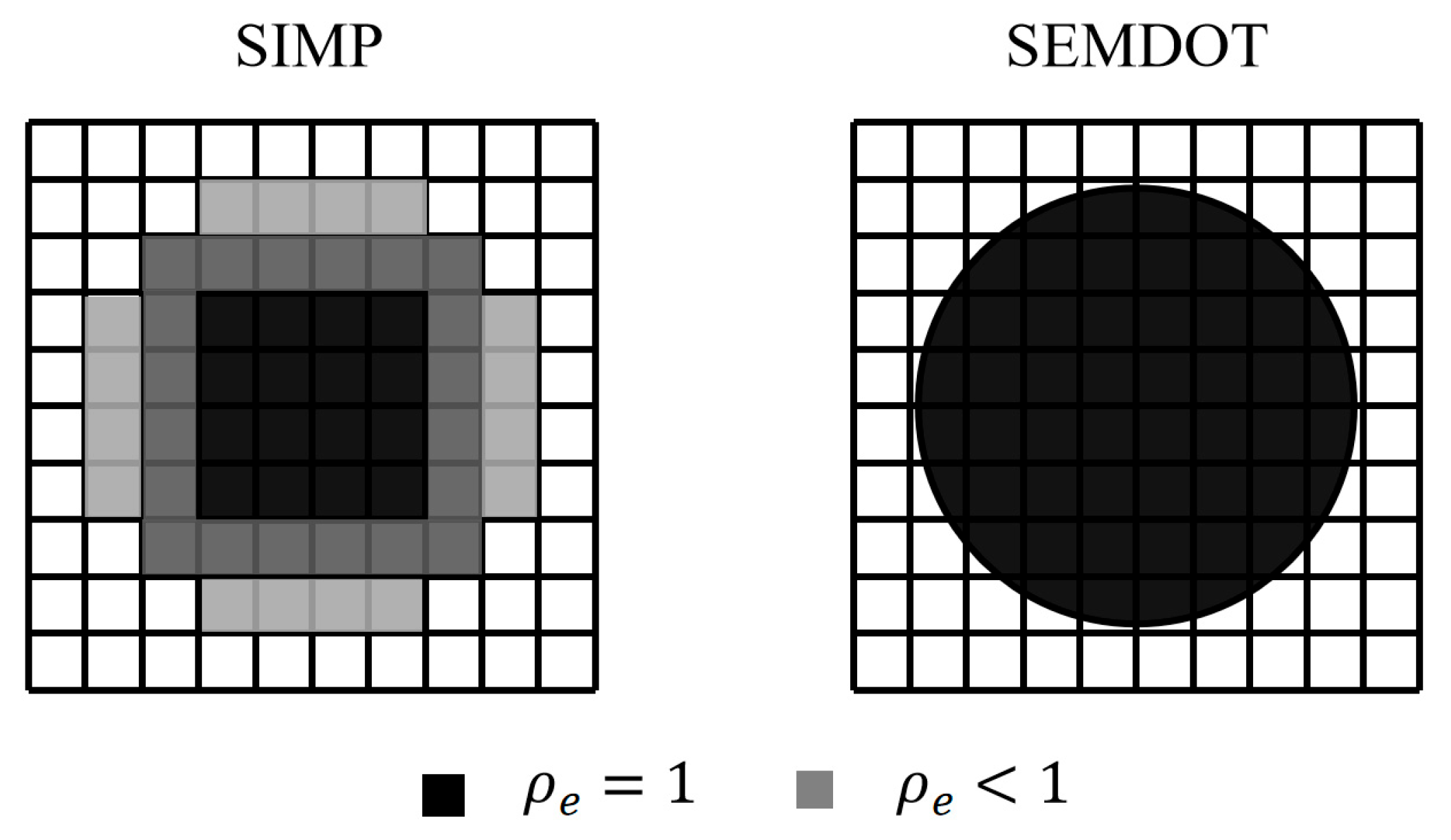
In order to avoid the influence of undesirable boundaries on the structure and promote the practical application of topology optimization methods based on element density, Fu et al. [15] proposed the SEMDOT algorithm in 2020. SEMDOT allows the generation of smooth and clear structural boundaries during the topology optimization process without the need for post-processing, such as shape optimization and iso-surface extraction, which effectively improves the design efficiency. Figure 1 illustrates the comparison of optimized structure boundaries using the SIMP method and the SEMDOT method. The SIMP method produces jagged and grayscale boundaries, while the SEMDOT method avoids this issue. The SEMDOT algorithm has released a theoretical framework and related codes for 2D and 3D optimization.
Therefore, this review mainly discusses the theoretical development of SEMDOT, shares the acquisition of open access codes, and investigates the applications of this method in different fields to further promote the development and application of this method.

2. Theoretical Development of SEMDOT

Currently, SEMDOT has developed two methods: one based on penalty and the other based on non-penalty. The concept of the penalty method originates from the SIMP method proposed by Sigmund [8]. In the topology optimization problem based on elements, the 0 or 1 distribution of element density is a discrete problem. By assuming the element density as a variable that can continuously vary between 0 and 1 and introducing a penalty factor to make the density value converge to 0 and 1, the discrete problem is transformed into a continuous optimization problem. The penalty method in SEMDOT is the same as SIMP. However, the penalty method changes the physical meaning of element density and increases the complexity of parameters. In the optimization results, the penalty factor cannot fully make the element density values converge to 0 and 1. Therefore, SEMDOT has been further improved and the non-penalty-based SEMDOT method has been developed, which will be introduced separately below.

2.1. Penalty-Based SEMDOT

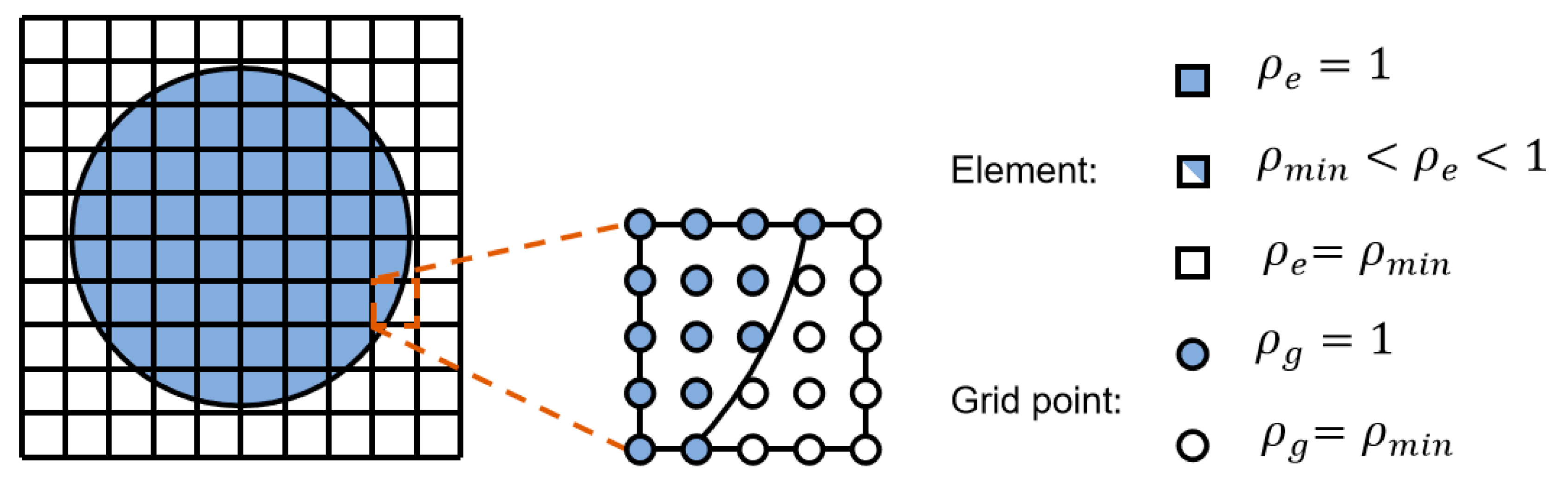
In the SEMDOT algorithm, the smooth boundary of the structure is realized based on the grid points. As shown in Figure 2, the grid points are introduced into the element, and the sum of the grid point density ρ e , g is the density of the element; finite element calculations are performed based on the assembled density of elements [16]. The grid point density is the actual design variable, and its material interpolation can be expressed as
E e ρ e , g = ρ e , g p E 1
where E e ρ e , g is the Young’s modulus function of the grid point density,   E 1 is the Young’s modulus of the base material, and p is the penalty factor.
In the SEMDOT method, the boundary elements are usually a heterogeneous combination of solid and void materials, and the properties of the boundary elements are calculated using the linear difference between these two phases. The element stiffness matrix can be expressed as Equation (2). The detailed calculation method can be found in reference [15].
K e X e = 1 X e K e 0 + X e K e 1 = 1 X e ρ m i n p K e 1 + X e K e 1
where K e X e is the stiffness matrix function, K e 0 is the stiffness matrix of the void element, K e 1 is the stiffness matrix of the solid element, and ρ m i n is the minimum density given to avoid calculation singularities.
Taking the minimum compliance problem as an example, the penalty-based sensitivity of boundary elements is shown in Equation (3). For more detailed derivation and calculation, please refer to reference [17].
C X e X e 1 X e C X e X e X e = ρ m i n + X e C X e X e X e = 1 = p 1 X e ρ m i n p 1 + X e u e T K e 1 u e
where u e is the load displacement vector of the eth element.

2.2. Non-Penalty-Based SEMDOT

Considering that the material penalty scheme changes the relationship between material properties and element values, Long et al. [17] further improved the SEMDOT algorithm using discrete variable sensitivity calculation and proposed a non-penalty scheme. Specifically, the calculation of the element stiffness also adopted linear interpolation of solid and void materials, as shown in Equation (4), but did not include the penalty factor p . Long et al. [17] have given a detailed theoretical derivation of this method. The non-penalty-based SEMDOT exhibits a more robust mathematical foundation compared to the penalty-based SEMDOT.
K e X e = 1 X e K e 0 + X e K e 1 = 1 X e ρ m i n K e 1 + X e K e 1
The non-penalty scheme calculates the discrete sensitivity of the optimization objective. Taking the minimum compliance problem as an example, the approximate calculation of the discrete sensitivity is shown in Equation (5). For more detailed derivation and calculation, please refer to reference [17].
C X e X e 1 X e C X e X e X e = ρ m i n + X e C X e X e X e = 1 = 1 X e ρ m i n + X e u e T K e 1 u e
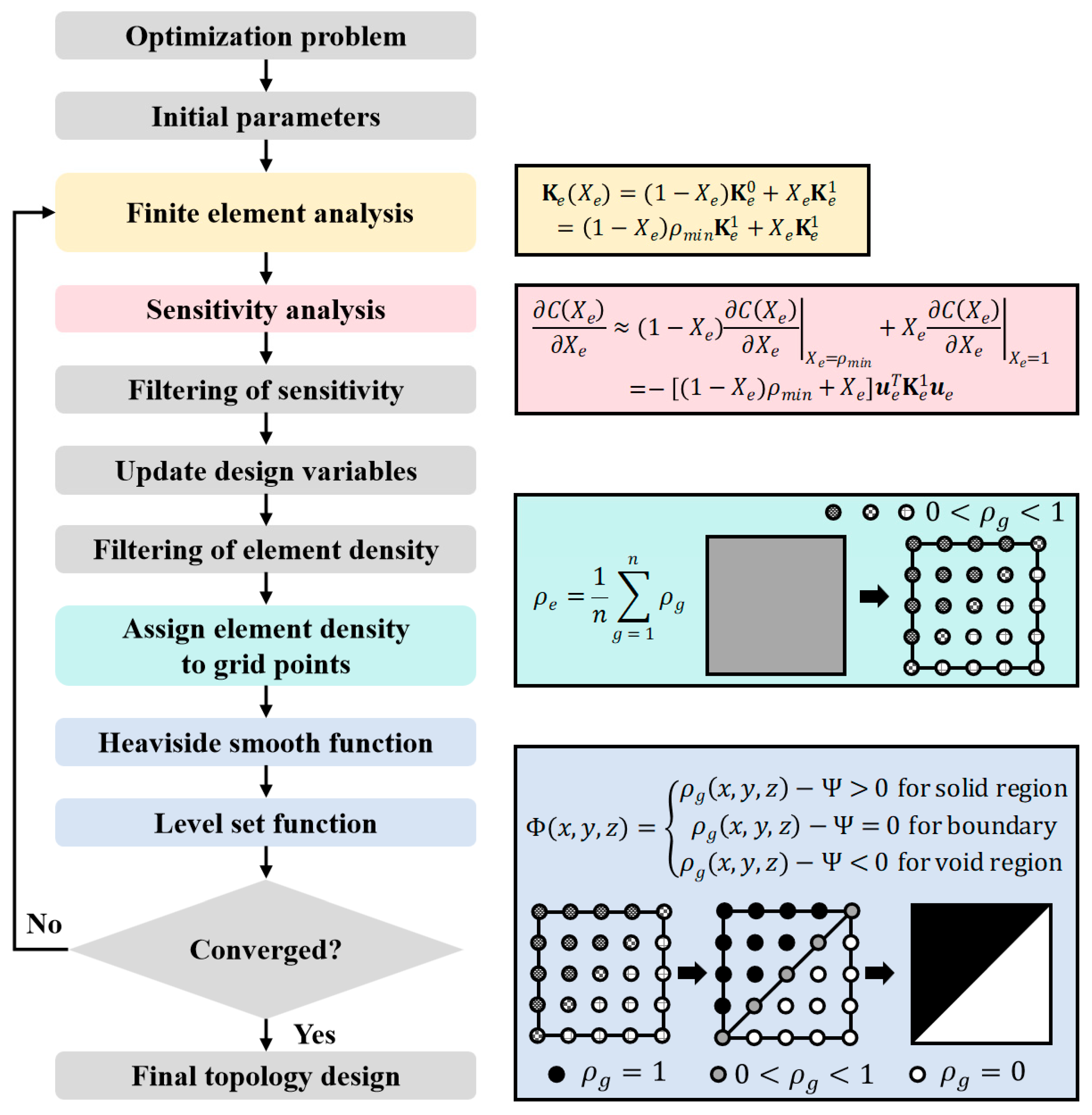
Taking the non-penalty-based SEMDOT method as an example, the flowchart for topology optimization is shown in Figure 3 and Table 1.

3. Open Access Code for SEMDOT

The penalty-based SEMDOT was open-sourced in 2020; please refer to [15] for details. The algorithm uses the method of moving asymptotes (MMA) proposed by Svanberg [18] to update the design variables. The objective function of the code is to minimize structural compliance while also investigating the influence of the projection function on convergence stability.
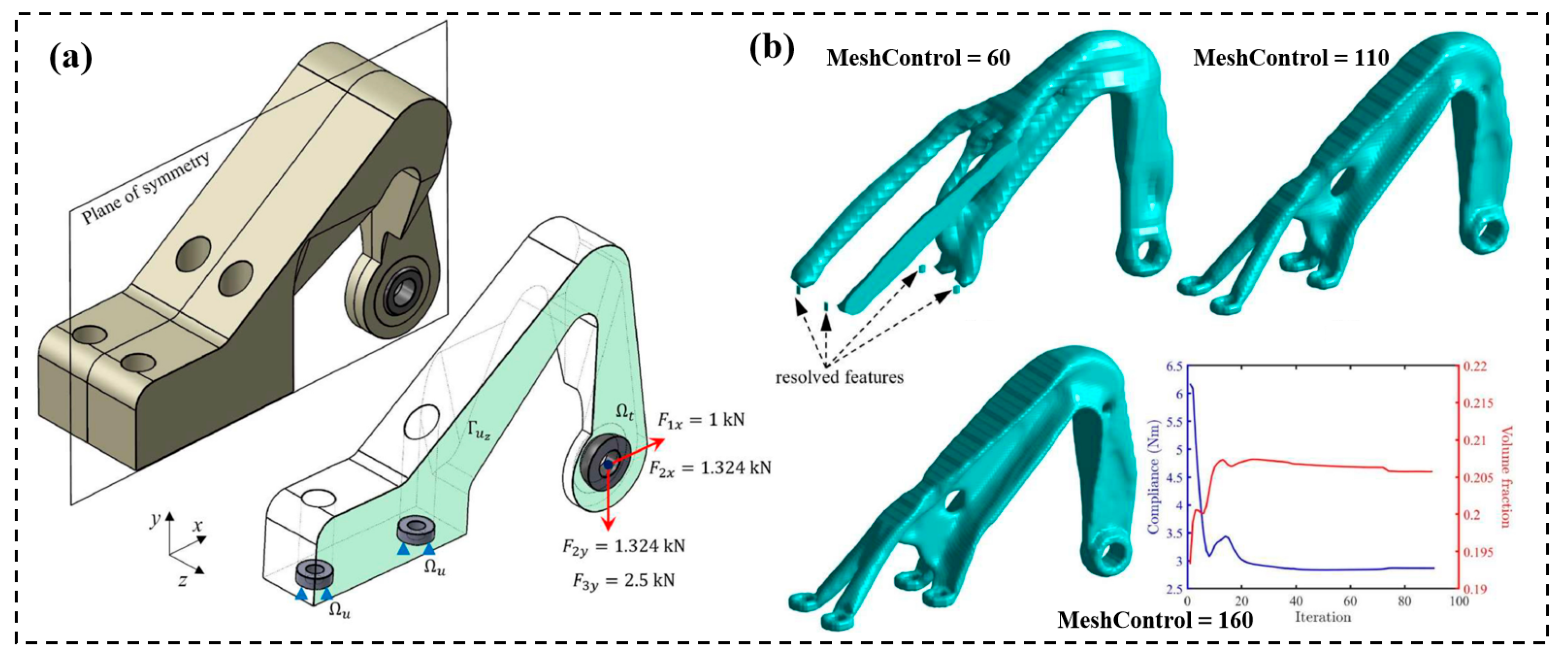
For 3D topology optimization, Ibhadode and Fu et al. [19] open-sourced the Freeform 3D topology optimization (FreeTO) code in 2024. As shown in Figure 4, FreeTO supports free-form initialization, and SEMDOT is used here to achieve smooth structure boundaries. The code is demonstrated through six practical design cases, showing its effectiveness in compliance minimization, compliant mechanisms, and self-supporting problems. For the self-support problem, which is a combination of topology optimization and additive manufacturing (AM), the code uses the AM filter proposed by Langelaar [20].
In addition to the two codes mentioned above, Fu and Rolfe [21] also open-sourced several codes in their book published in 2024, such as the computational framework combining SEMDOT with homogenization theory and the maximum stress minimization.

4. Applications of SEMDOT

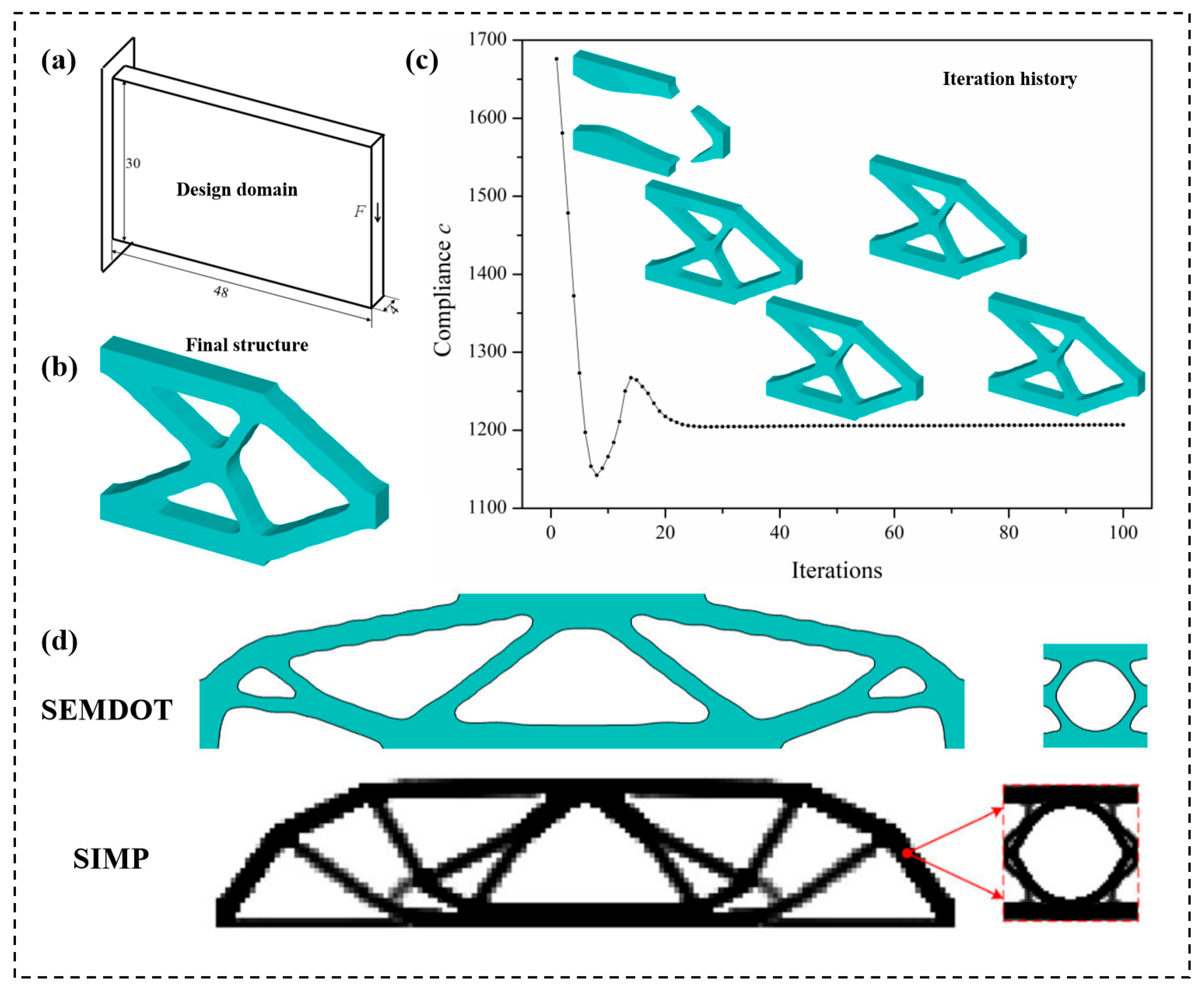
Recently, the SEMDOT method has been combined with different optimization frameworks and applied in different research fields, as shown in Table 2. Zhou et al. [22] validated the effectiveness of the SEMDOT algorithm by optimizing the Zhou–Rozvold (ZR) problem. Huang et al. [23] combined the non-penalization SEMDOT method with a meshless framework. In meshless analysis, non-overlapping cell variables are used instead of nodal or Gaussian-based variables to characterize the existence or absence of subregions. The optimization efficiency and applicability of this method are verified by 2D and 3D compliance minimization problems. As shown in Figure 5, the optimization results of the 3D cantilever beam are smooth and continuous enough without additional post-processing. Fu et al. [24] applied SEMDOT to optimize cellular structures. Moreover, Zhou et al. [25] established a multi-scale parallel computing method based on the non-penalized SEMDOT algorithm, as shown in Figure 5, introducing linear interpolation grid points for optimization at both scales to achieve a multi-scale system with smooth and clear boundaries.
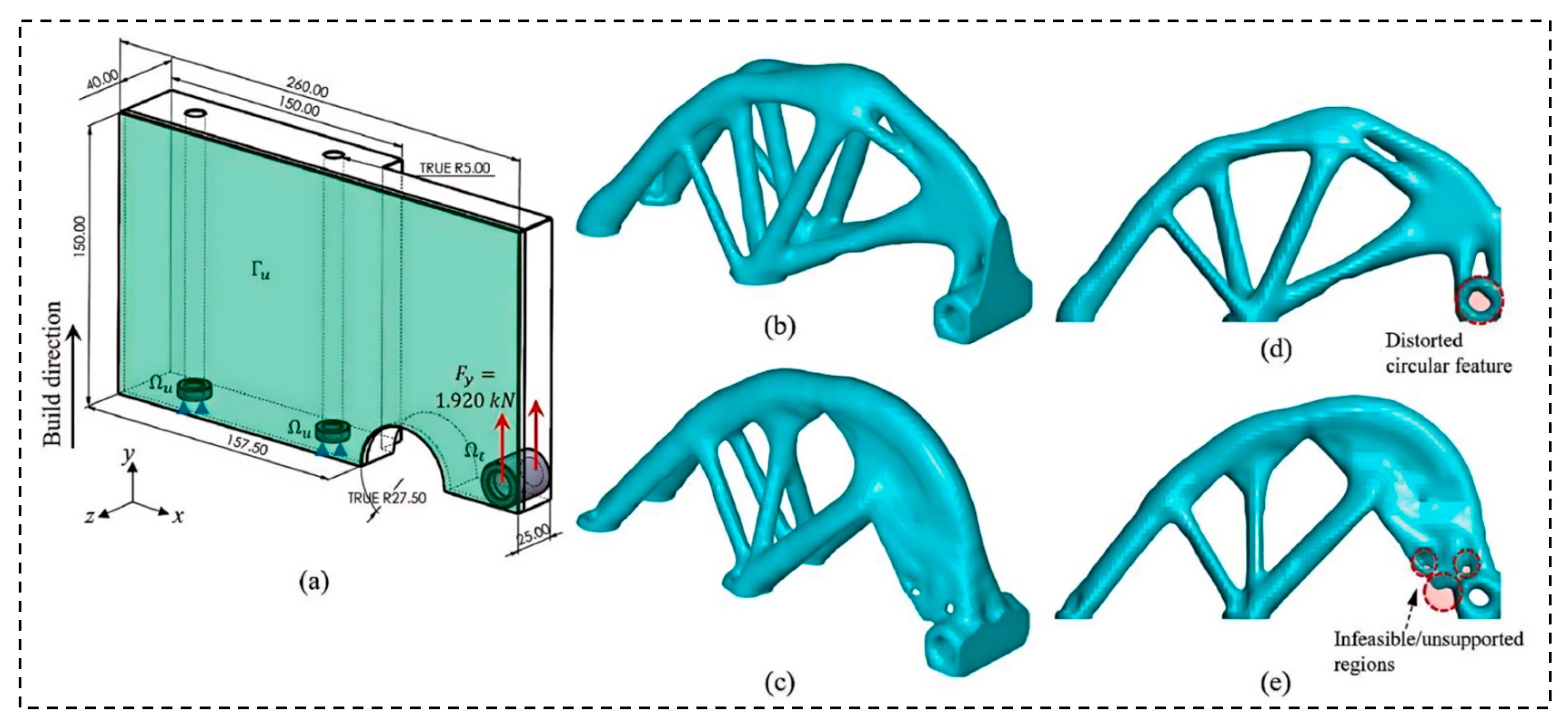
Regarding the combination of SEDMOT and AM, the industrial frame is optimized in the open source code paper mentioned above [19]. As shown in Figure 6, compared with the optimization results without considering self-support, the AM filter effectively ensures the self-support topology, with only a few unresolved features generated near the load position. Mohseni et al. [28] combined deep learning and transfer learning with SEMDOT to improve the design efficiency of complex parts and the manufacturability using additive manufacturing. Fu et al. [29] used SEMDOT and the AM filter to investigate the effects of different printing directions and critical overhang angles on the self-supporting topology. Numerical experiments demonstrate that the SEMDOT algorithm can be satisfactorily integrated with Langelaar’s AM filter, enabling the generation of highly printable structures across various printing orientations or critical overhang angles. Moreover, Fu et al. [38] also verified the manufacturability of the designed structure through 3D printing experiments, the structures without and with self-supporting constraints were manufactured by fused deposition modeling (FDM). This method is also applicable to selective laser melting (SLM) technology; please refer to [30] for details.In addition to focusing on manufacturability, Yi et al. [31,32] also considered the energy performance of AM in the design stage, taking tool path length as an equivalent indicator and establishing a design for AM (DfAM) framework. DfAM reduced energy consumption by about 6% in 2D optimization and by about 2% in 3D optimization.
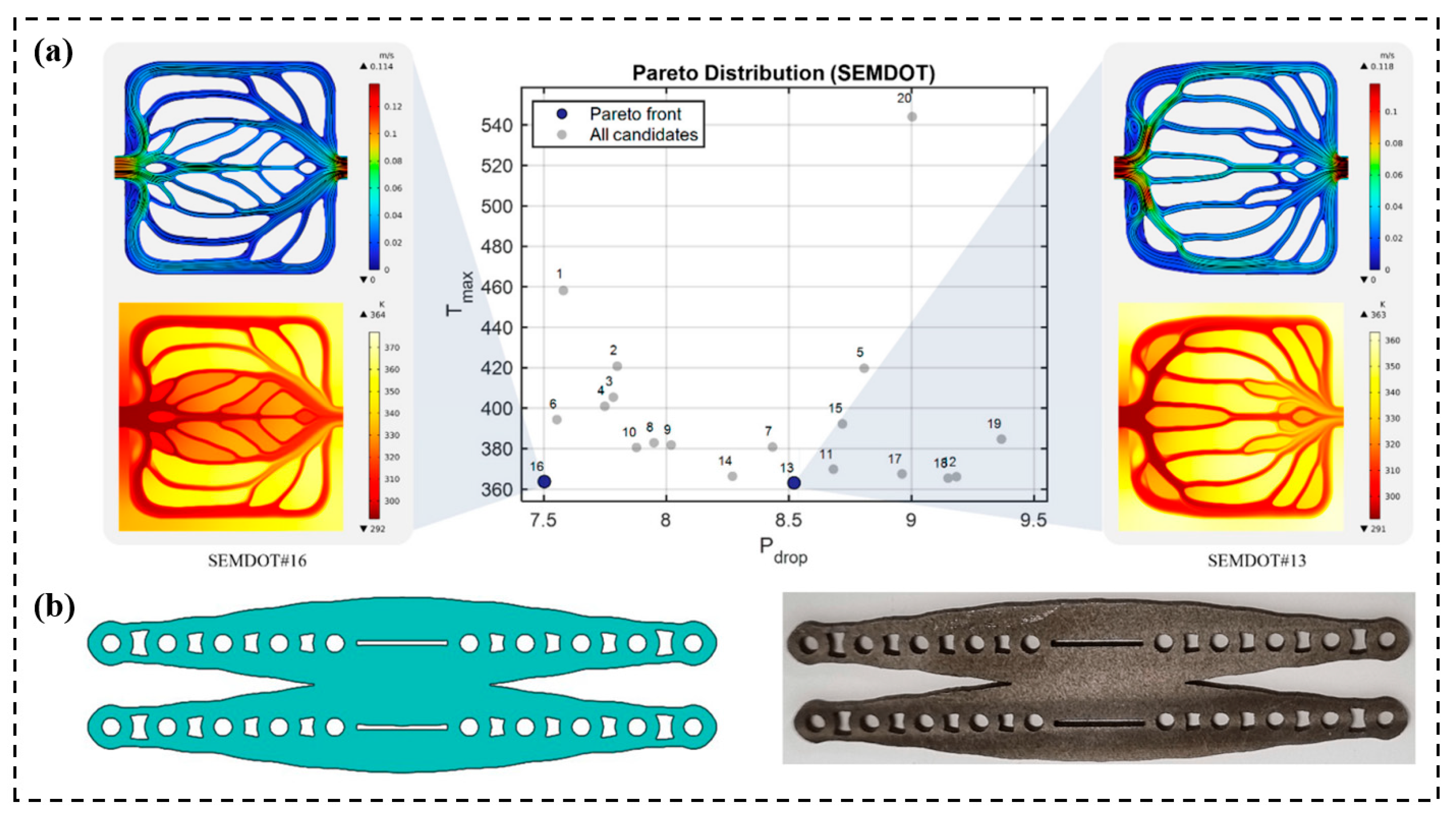
Topology optimization also has great application potential in the biomedical field. For example, the design of bone tissue engineering scaffolds needs to consider factors such as mechanics, diffusion, porosity, and connectivity. Liu et al. [33] designed a porous bone scaffold with anisotropic mechanical characteristics that can reduce stress shielding based on the SEMDOT method and homogenization theory. The smoothing effect of the SEMDOT algorithm on structural boundaries avoids grayscale elements without practical physical significance and troublesome jagged boundaries in subsequent finite element simulations. In terms of heat transfer, Zhang et al. [34] studied the topology optimization problem of natural convection heat transfer and used the SEMDOT method to generate accurate boundaries, providing guidance for practical manufacturing. As shown in Figure 7, Sun et al. [36] achieved topology design of thermal fluid devices through SEMDOT algorithm, and smooth and clear structural boundaries promoted robust CAD reconstruction and high fidelity verification. In the construction field, Ribeiro et al. [35] used the non-penalized SEMDOT algorithm to optimize the Sheikh-Ibrahim steel girder joint’s tension cover plate, which significantly improved the manufacturability through standard cutting techniques.
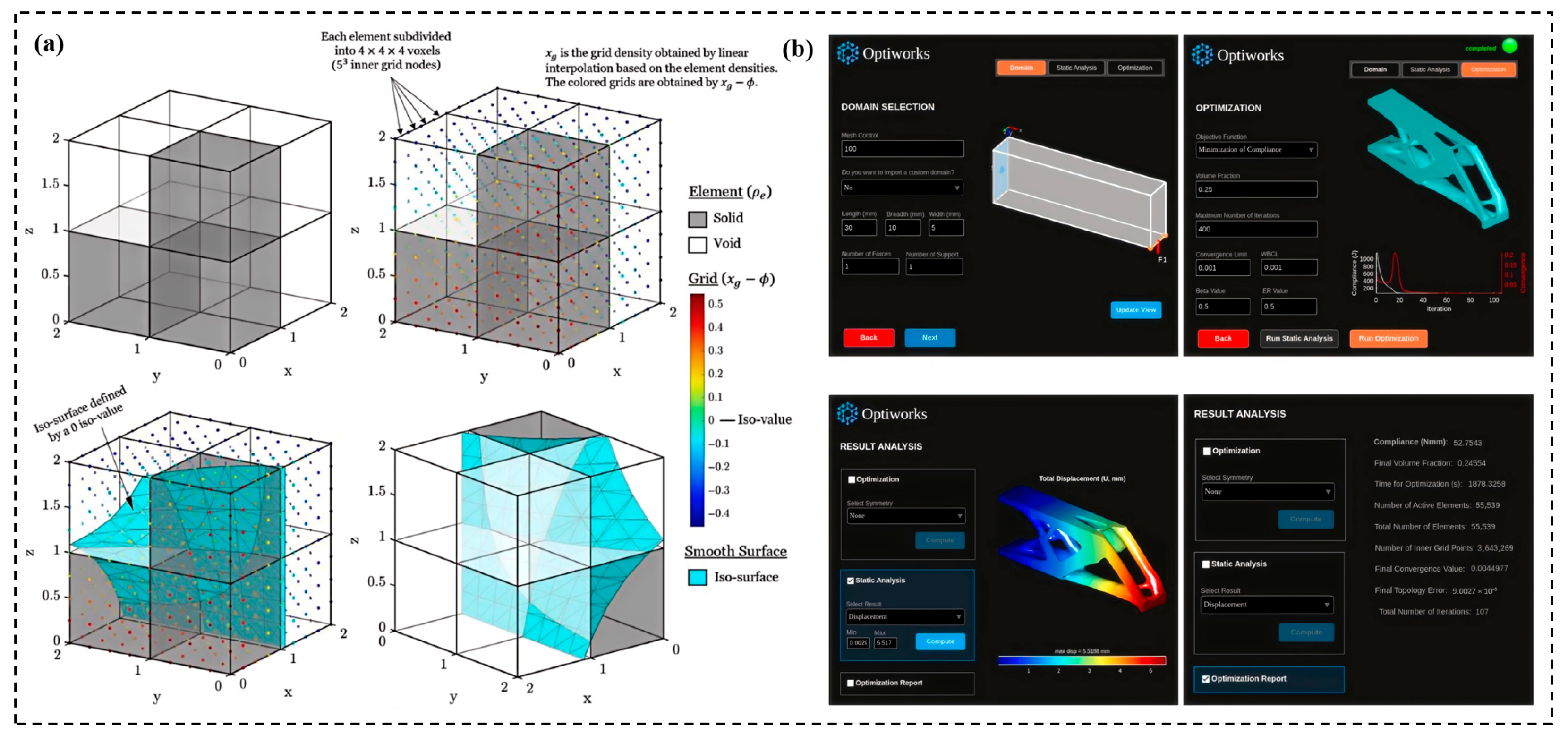
It is noteworthy that Ifediorah et al. [39] developed the Optiworks software based on the SEMDOT algorithm, which constitutes a human-centric framework for high-resolut ion topology optimization. The user interface is shown in Figure 8. Compared to commercial software tools, the lightweight architecture and faster computation time of Optiworks significantly reduce the computational effort required to solve complex optimization problems, further promoting the application of the SEMDOT algorithm.

5. Discussion

Currently, SEMDOT has two iterative versions. Compared with the penalty-based SEMDOT, the non-penalty-based SEMDOT algorithm uses discrete sensitivity and the impact of the penalty coefficient on the topological structure does not need to be discussed. In some applications, the non-penalty-based SEMDOT method can produce better solutions, better convergence, and more reasonable topological structures. It should be noted that, since the developers have a mechanical engineering background rather than a mathematical one, the SEMDOT algorithm may exhibit limitations in mathematical rigor.
In the related research on smoothing the boundaries of topological structures, Huang et al. [40,41] and Xu et al. [42] proposed floating projection topology optimization (FPTO) with a complete mathematical derivation, and Gao et al. [43,44] established isogeometric analysis (IGA). Da et al. [9] proposed an implicit smooth boundary representation based on nodal sensitivities for the ESO method. Li et al. [45] developed the boundary density evolution (BDE) method based on the SIMP method. These methods have also achieved satisfactory optimization results in different optimization cases. Compared with the above algorithms, the framework of SEMDOT is closer to the SIMP method, so the filtering or solving methods currently developed for SIMP can also be easily applied to SEMDOT, which can further enhance the applicability of SEMDOT in different optimization problems.
Regarding the comparison of different algorithms, it has been demonstrated in compliance minimization, compliant mechanism design, and heat conduction problems that using the non-penalty-based SEMDOT method can yield better solutions, stronger convergence, and a more reasonable topological structure compared to the penalty-based SEMDOT method [17]. Compared to the SIMP method, Liu et al.’s research on porous bone scaffolds indicates that the optimized results of SIMP using density filtering and Heaviside projection still exhibit certain differences from the target values in terms of the anisotropic elastic tensor when reaching the maximum iteration step. However, using the SEMDOT method can satisfy the convergence conditions at the maximum iteration step [33]. Fu et al.’s numerical experiments also demonstrate that SEMDOT converges faster than SIMP due to its distribution of intermediate elements exclusively along boundaries and the introduction of new termination criteria [15]. In terms of computational cost, although the SEMDOT method introduces the concept of grid point density within the element, the actual variables involved in finite element calculations are the element densities assembled from grid point densities, rather than the grid point densities themselves. Therefore, it does not significantly increase computational costs.
The application of topology optimization is becoming increasingly widespread. For instance, it has been used to optimize dynamic processes that change over time [46], or it has been applied in the engineering field by combining with additive manufacturing processes [47]. In addition to focusing on the structural boundary features, the current topology optimization methods also have the problem of high computational cost in practical applications. For optimization problems with high mesh resolution, it may take several hours or days of time cost [48]. Some scholars have proposed various acceleration and optimization strategies for this issue [49,50,51]. SEMDOT also needs to consider the computational cost issue in its application promotion. SEMDOT has been successfully combined with deep learning and transfer learning and applied in automated design for additive manufacturing (DfAM) [28]. It is worth emphasizing that manufacturing serves as a bridge connecting topology optimization design and application, but the manufacturing constraints and optimization problems considered in current research are still relatively simple [52,53]. The SEMDOT algorithm can generate smooth boundaries that are beneficial to manufacturing, but further consideration of more complex manufacturing constraints is needed in the future.

6. Conclusions

In conclusion, while topology optimization has matured into a powerful design paradigm, a significant amount of work remains to be conducted. SEMDOT is still some distance away from becoming a good platform; the authors hope that more researchers can contribute to the improvement and iterative of the algorithm. In the future, further research is needed for more complex manufacturing constraint optimization problems to promote the engineering application of topology optimization methods.

Author Contributions

Conceptualization, W.H. and X.G.; investigation, H.Z.; writing—original draft preparation, M.L.; writing—review and editing, M.L.; supervision, B.Z. All authors have read and agreed to the published version of the manuscript.

Funding

This research received no external funding.

Data Availability Statement

No new data were created or analyzed in this study. Data sharing is not applicable to this article.

Acknowledgments

The authors would like to thank Yun-Fei Fu from Shandong University of Science and Technology for his generous support throughout the writing, figure preparation, and publication of this manuscript.

Conflicts of Interest

The authors declare no conflicts of interest.

References

  1. Fu, Y.; Rolfe, B.; Chiu, L.N.S.; Huang, X. Topology Optimization of Continuum Structures Using Smooth Boundary Representation. In Proceedings of the 13th World Congress of Structural and Multidisciplinary Optimization, Beijing, China, 20–24 May 2019. [Google Scholar]
  2. Habashneh, M.; Cucuzza, R.; Aela, P.; Movahedi Rad, M. Reliability-Based Topology Optimization of Imperfect Structures Considering Uncertainty of Load Position. Structures 2024, 69, 107533. [Google Scholar] [CrossRef]
  3. Li, Z.; Xu, H.; Zhang, S. A Comprehensive Review of Explicit Topology Optimization Based on Moving Morphable Components (MMC) Method. Arch. Comput. Methods Eng. 2024, 31, 2507–2536. [Google Scholar] [CrossRef]
  4. Ma, C.; Li, M.; Liu, J.; Li, M.; He, J.; Totis, G.; Hua, C.; Wang, L.; Cui, G.; Xue, R.; et al. High-Efficiency Topology Optimization Method for Thermal-Fluid Problems in Cooling Jacket of High-Speed Motorized Spindle. Int. Commun. Heat Mass Transf. 2025, 169, 109533. [Google Scholar] [CrossRef]
  5. Li, Y.; Wu, H.; Xie, X.; Zhang, L.; Yuan, P.F.; Xie, Y.M. FloatArch: A Cable-Supported, Unreinforced, and Re-Assemblable 3D-Printed Concrete Structure Designed Using Multi-Material Topology Optimization. Addit. Manuf. 2024, 81, 104012. [Google Scholar] [CrossRef]
  6. Zeng, Q.; Duan, S.; Zhao, Z.; Wang, P.; Lei, H. Inverse Design of Energy-Absorbing Metamaterials by Topology Optimization. Adv. Sci. 2023, 10, 2204977. [Google Scholar] [CrossRef]
  7. Liu, Y.; Wang, Y.; Ren, H.; Meng, Z.; Chen, X.; Li, Z.; Wang, L.; Chen, W.; Wang, Y.; Du, J. Ultrastiff Metamaterials Generated through a Multilayer Strategy and Topology Optimization. Nat. Commun. 2024, 15, 2984. [Google Scholar] [CrossRef]
  8. Sigmund, O. A 99 Line Topology Optimization Code Written in Matlab. Struct. Multidiscip. Optim. 2001, 21, 120–127. [Google Scholar] [CrossRef]
  9. Da, D.; Xia, L.; Li, G.; Huang, X. Evolutionary Topology Optimization of Continuum Structures with Smooth Boundary Representation. Struct. Multidiscip. Optim. 2018, 57, 2143–2159. [Google Scholar] [CrossRef]
  10. Zhou, S.; Cadman, J.; Chen, Y.; Li, W.; Xie, Y.M.; Huang, X.; Appleyard, R.; Sun, G.; Li, Q. Design and Fabrication of Biphasic Cellular Materials with Transport Properties—A Modified Bidirectional Evolutionary Structural Optimization Procedure and MATLAB Program. Int. J. Heat Mass Transf. 2012, 55, 8149–8162. [Google Scholar] [CrossRef]
  11. Wang, Q.; Han, H.; Wang, C.; Liu, Z. Topological Control for 2D Minimum Compliance Topology Optimization Using SIMP Method. Struct. Multidiscip. Optim. 2022, 65, 38. [Google Scholar] [CrossRef]
  12. Costa, G.; Montemurro, M.; Pailhès, J. NURBS Hyper-Surfaces for 3D Topology Optimization Problems. Mech. Adv. Mater. Struct. 2021, 28, 665–684. [Google Scholar] [CrossRef]
  13. Xu, S.; Liu, J.; Zou, B.; Li, Q.; Ma, Y. Stress Constrained Multi-Material Topology Optimization with the Ordered SIMP Method. Comput. Methods Appl. Mech. Eng. 2021, 373, 113453. [Google Scholar] [CrossRef]
  14. Fu, Y.F. Recent Advances and Future Trends in Exploring Pareto-Optimal Topologies and Additive Manufacturing Oriented Topology Optimization. Math. Biosci. Eng. 2020, 17, 4631–4656. [Google Scholar] [CrossRef] [PubMed]
  15. Fu, Y.F.; Rolfe, B.; Chiu, L.N.S.; Wang, Y.; Huang, X.; Ghabraie, K. SEMDOT: Smooth-Edged Material Distribution for Optimizing Topology Algorithm. Adv. Eng. Softw. 2020, 150, 102921. [Google Scholar] [CrossRef]
  16. Zhou, J.; Wang, Y.; Chiu, L.N.S.; Ghabraie, K. On the Suitability of Simplified Sensitivity Estimation for Partial Elements in Topology Optimization. Eng. Optim. 2025, 1–23. [Google Scholar] [CrossRef]
  17. Long, K. On Non-Penalization SEMDOT Using Discrete Variable Sensitivities. J. Optim. Theory Appl. 2022, 198, 644–677. [Google Scholar] [CrossRef]
  18. Svanberg, K. The Method of Moving Asymptotes (MMA) with Some Extensions. Optim. Large Struct. Syst. 1993, 555–566. [Google Scholar] [CrossRef]
  19. Ibhadode, O.; Fu, Y.F.; Qureshi, A. FreeTO-Freeform 3D Topology Optimization Using a Structured Mesh with Smooth Boundaries in Matlab. Adv. Eng. Softw. 2024, 198, 103790. [Google Scholar] [CrossRef]
  20. Langelaar, M. An Additive Manufacturing Filter for Topology Optimization of Print-Ready Designs. Struct. Multidiscip. Optim. 2017, 55, 871–883. [Google Scholar] [CrossRef]
  21. Fu, Y.; Rolfe, B.N. Smooth Topological Design of Continuum Structures Yun-Fei Fu and Bernard Rolfe; CRC Press: Boca Raton, FL, USA, 2025. [Google Scholar]
  22. Zhou, J.; Fu, Y.F.; Ghabraie, K. Systematic Benchmarking of Topology Optimization Methods Using Both Binary and Relaxed Forms of the Zhou-Rozvany Problem. CMES-Comput. Model. Eng. Sci. 2025, 143, 3233–3251. [Google Scholar] [CrossRef]
  23. Huang, J.; Long, K.; Chen, Y.; Geng, R.; Saeed, A.; Zhang, H.; Tao, T. A Framework of the Meshless Method for Topology Optimization Using the Smooth-Edged Material Distribution for Optimizing Topology Method. Computation 2024, 13, 6. [Google Scholar] [CrossRef]
  24. Fu, Y.F.; Long, K.; Zolfagharian, A.; Bodaghi, M.; Rolfe, B. Topological Design of Cellular Structures for Maximum Shear Modulus Using Homogenization SEMDOT. Mater. Today Proc. 2023, 101, 38–42. [Google Scholar] [CrossRef]
  25. Zhou, J.; Wang, Y.; Chiu, L.N.S.; Ghabraie, K. Multiscale Design Based on Non-Penalization Smooth-Edged Material Distribution for Optimizing Topology (SEMDOT). IOP Conf. Ser. Mater. Sci. Eng. 2024, 1307, 012022. [Google Scholar] [CrossRef]
  26. Zhou, J.; Fu, Y.F.; Ghabraie, K. Multiscale Topology Design Based on Non-Penalisation Smooth-Edged Material Distribution for Optimising Topology (SEMDOT). Materials 2025, 18, 2394. [Google Scholar] [CrossRef]
  27. Gonçalves, M.; Andrade-Campos, A.; Barroqueiro, B. On the Design of Mechanical Heterogeneous Specimens Using Multilevel Topology Optimization. Adv. Eng. Softw. 2023, 175, 103314. [Google Scholar] [CrossRef]
  28. Mohseni, M.; Khodaygan, S. Design for Additive Manufacturing of Topology-Optimized Structures Based on Deep Learning and Transfer Learning. Rapid Prototyp. J. 2024, 30, 1411–1433. [Google Scholar] [CrossRef]
  29. Fu, Y.F.; Ghabraie, K.; Rolfe, B.; Wang, Y.; Chiu, L.N.S. Smooth Design of 3d Self-Supporting Topologies Using Additive Manufacturing Filter and Semdot. Appl. Sci. 2021, 11, 238. [Google Scholar] [CrossRef]
  30. Fu, Y.F.; Rolfe, B.; Chiu, L.N.S.; Wang, Y.; Huang, X.; Ghabraie, K. Parametric Studies and Manufacturability Experiments on Smooth Self-Supporting Topologies. Virtual Phys. Prototyp. 2020, 15, 22–34. [Google Scholar] [CrossRef]
  31. Yi, L.; Wu, X.; Glatt, M.; Ravani, B.; Aurich, J.C. Framework to Improve the Energy Performance During Design for Additive Manufacturing. In Proceedings of the 3rd Conference on Physical Modeling for Virtual Manufacturing Systems and Processes, Pacific Grove, CA, USA, 19–23 June 2023; pp. 213–232. [Google Scholar] [CrossRef]
  32. Yi, L.; Wu, X.; Nawaz, A.; Glatt, M.; Aurich, J.C. Improving Energy Performance in the Product Design for Additive Manufacturing Using a Multi-Player Competition Algorithm. J. Clean. Prod. 2023, 391, 136173. [Google Scholar] [CrossRef]
  33. Liu, M.; Wang, Y.; Wei, Q.; Ma, X.; Zhang, K.; Li, X.; Bao, C.; Du, B. Topology Optimization for Reducing Stress Shielding in Cancellous Bone Scaffold. Comput. Struct. 2023, 288, 107132. [Google Scholar] [CrossRef]
  34. Zhang, K.; Li, B.; Du, F.; Liu, H.; Hong, J. Topology Optimization of Natural Convection Heat Transfer Using SEMDOT Algorithm Based on the Reduced-Order Model. Int. Commun. Heat Mass Transf. 2021, 129, 105676. [Google Scholar] [CrossRef]
  35. Ribeiro, T.; Fu, Y.F.; Bernardo, L.; Rolfe, B. Topology Optimisation of Structural Steel with Non-Penalisation SEMDOT: Optimisation, Physical Nonlinear Analysis, and Benchmarking. Appl. Sci. 2023, 13, 11370. [Google Scholar] [CrossRef]
  36. Sun, Y.; Fu, Y.-F.; Xu, S.; Guo, Y. Multifidelity Topology Design for Thermal–Fluid Devices via SEMDOT Algorithm. Computation 2026, 14, 19. [Google Scholar] [CrossRef]
  37. Fu, Y.; Rolfe, B. Non-Penalization Topology Optimization for Maximizing Natural Frequency Using SEMDOT. 2023. Available online: https://www.ingentaconnect.com/contentone/iass/piass/2023/00002023/00000001/art00001 (accessed on 1 October 2023).
  38. Fu, Y.F.; Rolfe, B.; Chiu, L.N.S.; Wang, Y.; Huang, X.; Ghabraie, K. Design and Experimental Validation of Self-Supporting Topologies for Additive Manufacturing. Virtual Phys. Prototyp. 2019, 14, 382–394. [Google Scholar] [CrossRef]
  39. Ifediorah, C.; Ibhadode, O. Optiworks: A Human-Centric Framework for High-Resolution Topology Optimization. Digit. Eng. 2025, 4, 100041. [Google Scholar] [CrossRef]
  40. Huang, X. Smooth Topological Design of Structures Using the Floating Projection. Eng. Struct. 2020, 208, 110330. [Google Scholar] [CrossRef]
  41. Huang, X.; Li, W. Three-Field Floating Projection Topology Optimization of Continuum Structures. Comput. Methods Appl. Mech. Eng. 2022, 399, 115444. [Google Scholar] [CrossRef]
  42. Xu, T.; Huang, X.; Lin, X.; Xie, Y.M. Topology Optimization of Continuum Structures for Buckling Resistance Using a Floating Projection Method. Comput. Methods Appl. Mech. Eng. 2024, 429, 117204. [Google Scholar] [CrossRef]
  43. Gao, J.; Xue, H.; Gao, L.; Luo, Z. Topology Optimization for Auxetic Metamaterials Based on Isogeometric Analysis. Comput. Methods Appl. Mech. Eng. 2019, 352, 211–236. [Google Scholar] [CrossRef]
  44. Gao, J.; Gao, L.; Luo, Z.; Li, P. Isogeometric Topology Optimization for Continuum Structures Using Density Distribution Function. Int. J. Numer. Methods Eng. 2019, 119, 991–1017. [Google Scholar] [CrossRef]
  45. Li, X.; Qin, C.; Wei, P.; Su, C. A Boundary Density Evolutionary Topology Optimization of Continuum Structures with Smooth Boundaries. Int. J. Numer. Methods Eng. 2022, 123, 158–179. [Google Scholar] [CrossRef]
  46. Sardone, L.; Sotiropoulos, S.; Fiore, A. A CAD-Integrated Framework for Dynamic Structural Topology Optimisation via Visual Programming. Computation 2025, 13, 267. [Google Scholar] [CrossRef]
  47. Yap, Y.L.; Toh, W.; Giam, A.; Yong, F.R.; Chan, K.I.; Tay, J.W.S.; Teong, S.S.; Lin, R.; Ng, T.Y. Topology Optimization and 3D Printing of Micro-Drone: Numerical Design with Experimental Testing. Int. J. Mech. Sci. 2023, 237, 107771. [Google Scholar] [CrossRef]
  48. Shin, S.; Shin, D.; Kang, N. Topology Optimization via Machine Learning and Deep Learning: A Review. J. Comput. Des. Eng. 2023, 10, 1736–1766. [Google Scholar] [CrossRef]
  49. Limkilde, A.; Evgrafov, A.; Gravesen, J. On Reducing Computational Effort in Topology Optimization: We Can Go at Least This Far! Struct. Multidiscip. Optim. 2018, 58, 2481–2492. [Google Scholar] [CrossRef]
  50. Martínez-Frutos, J.; Martínez-Castejón, P.J.; Herrero-Pérez, D. Efficient Topology Optimization Using GPU Computing with Multilevel Granularity. Adv. Eng. Softw. 2017, 106, 47–62. [Google Scholar] [CrossRef]
  51. Li, H.; Knapik, S.; Li, Y.; Park, C.; Guo, J.; Mojumder, S.; Lu, Y.; Chen, W.; Apley, D.W.; Liu, W.K. Convolution Hierarchical Deep-Learning Neural Network Tensor Decomposition (C-HiDeNN-TD) for High-Resolution Topology Optimization. Comput. Mech. 2023, 72, 363–382. [Google Scholar] [CrossRef]
  52. Liu, S.; Li, Q.; Liu, J.; Chen, W.; Zhang, Y. A Realization Method for Transforming a Topology Optimization Design into Additive Manufacturing Structures. Engineering 2018, 4, 277–285. [Google Scholar] [CrossRef]
  53. Ranjan, R.; Samant, R.; Anand, S. Integration of Design for Manufacturing Methods with Topology Optimization in Additive Manufacturing. J. Manuf. Sci. Eng. Trans. ASME 2017, 139, 061007. [Google Scholar] [CrossRef]
Figure 1. Comparison of boundaries between optimization results of SIMP and SEMDOT methods.
Computation 14 00027 g001
Figure 2. Illustration of smooth-edged material distribution.
Computation 14 00027 g002
Figure 3. Flowchart for topology optimization using the SEMDOT algorithm.
Computation 14 00027 g003
Figure 4. Optimize an airplane bearing bracket using FreeTO (a) initial design of airplane bearing bracket with bolt connections and external load; (b) optimization results with different numbers of mesh and iteration history. Reprinted from [19], under the terms of the CC BY 4.0 license.
Computation 14 00027 g004
Figure 5. Optimization example using meshless framework: (a) design domain of 3D cantilever beam, where F is the external force along the negative Z-axis direction. Reprinted from [23], under the terms of the CC BY 4.0 license; (b) final optimization result. Reprinted from [23], under the terms of the CC BY 4.0 license; (c) iteration history and multi-scale method. Reprinted from [23], under the terms of the CC BY 4.0 license; (d) comparison of SEMODT and SIMP multi-scale optimization results. Reprinted from [25], under the terms of the CC BY 4.0 license.
Computation 14 00027 g005
Figure 6. The effect of self-supporting constraints on structures [19]: (a) The design domain of an industrial frame; (b) optimized structure without self-supporting constraints; (c) optimized structure with self-supporting design; (d) front-view of (b) showing a distorted circular feature; (e) front-view of (c) showing a few infeasible/unsupported features. Reprinted from [19], under the terms of the CC BY 4.0 license.
Computation 14 00027 g006
Figure 7. Application of SEMDOT in different fields: (a) thermal fluid devices. Reprinted from [36], under the terms of the CC BY 4.0 license; (b) Sheikh-Ibrahim steel girder joint’s tension cover plate. Reprinted from [35], under the terms of the CC BY 4.0 license.
Computation 14 00027 g007
Figure 8. The Optiworks software [39]: (a) smooth boundary algorithm; (b) the user interface of Optiworks. Reprinted from [39], under the terms of the CC BY 4.0 license.
Computation 14 00027 g008
Table 1. The focus of key steps in the optimization process.
StepHighlight
1Optimization problemDefine the objective function and constraint function
2Initial parametersSet material properties and initial element density distribution
3Finite element analysisAssemble stiffness matrix based on element density
4Sensitivity analysisCalculate the gradients of the objective function and constraint function with respect to the design variables
5Filtering of sensitivityReduce numerical instability
6Update design variablesthrough MMA algorithm
7Filtering of element densityReduce numerical instability
8Assign element density to grid pointsCalculate node density and grid point density based on element density
9Heaviside smooth functionProject the grid point density to 0 or 1
10Level set functionCharacterize smooth boundaries
Table 2. Applications of SEMDOT in different fields.
Application of SEMDOTReferences
Zhou–Rozvany problem[22]
Meshless framework[23]
Cellular structures[24]
Multi-scale optimization[25,26]
Multilevel topology optimization[27]
Self-support of AM[19,28,29,30]
Energy performance of AM [31,32]
Bone tissue engineering[33]
Heat transfer[34]
Construction industry[35,36]
Natural frequency[37]
Disclaimer/Publisher’s Note: The statements, opinions and data contained in all publications are solely those of the individual author(s) and contributor(s) and not of MDPI and/or the editor(s). MDPI and/or the editor(s) disclaim responsibility for any injury to people or property resulting from any ideas, methods, instructions or products referred to in the content.