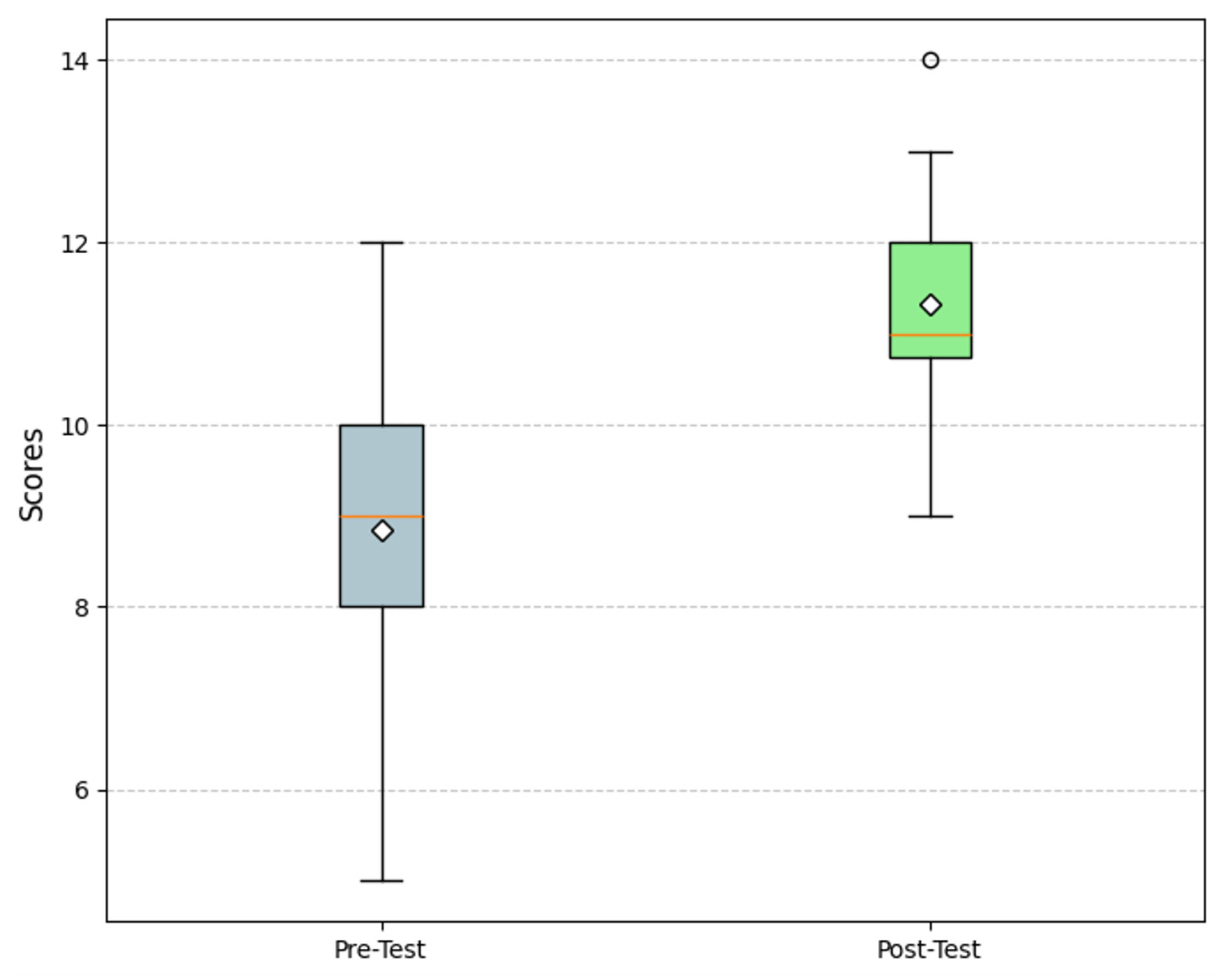
Evaluating an Augmented Reality Educational Application for Earthquake Preparedness Among International Visitors and Newly Arrived Foreign Residents in Japan †



Abstract
1. Introduction
2. Related Work
3. Materials and Methods
3.1. Development of the AR Educational Application
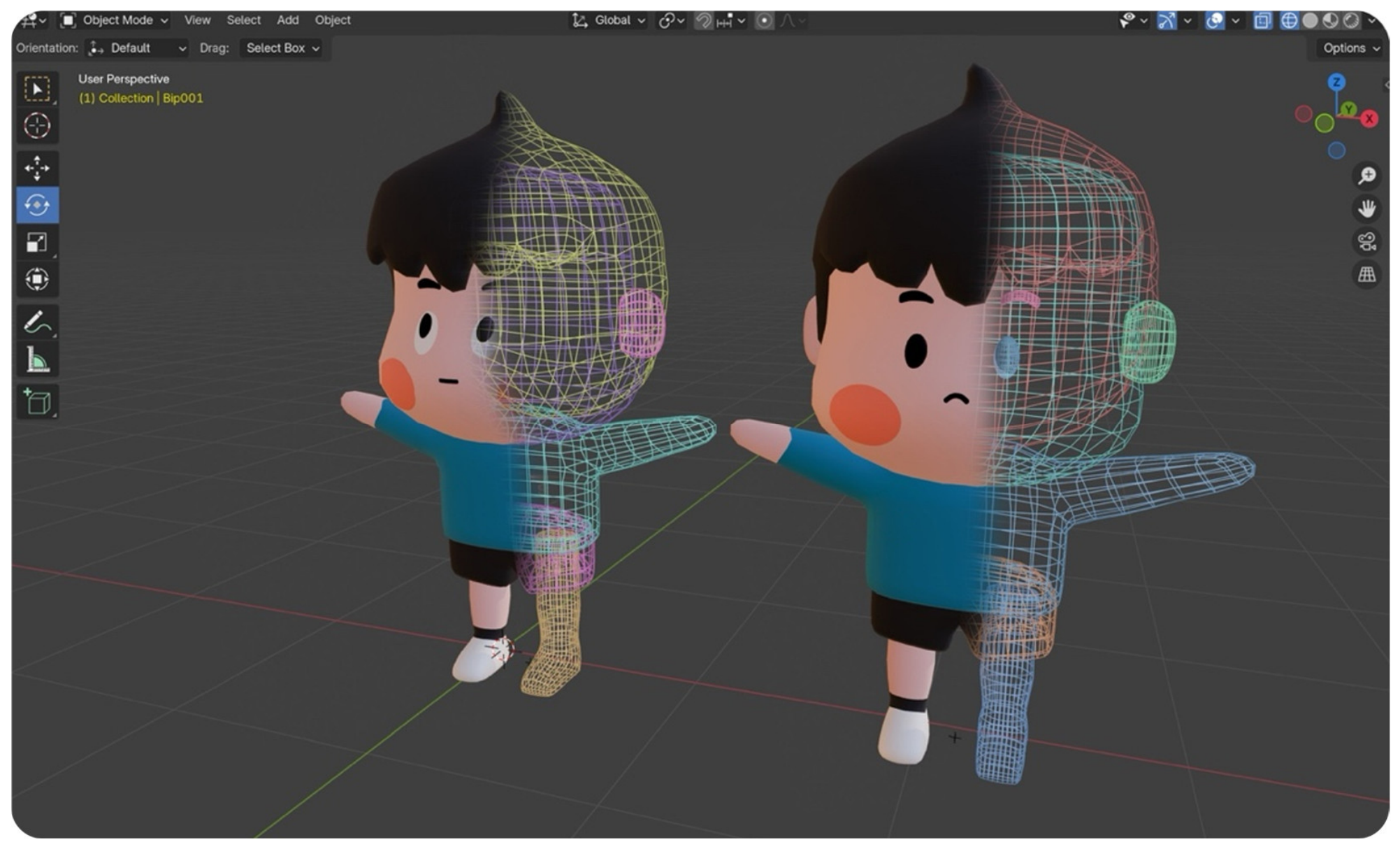
3.1.1. Model Creation
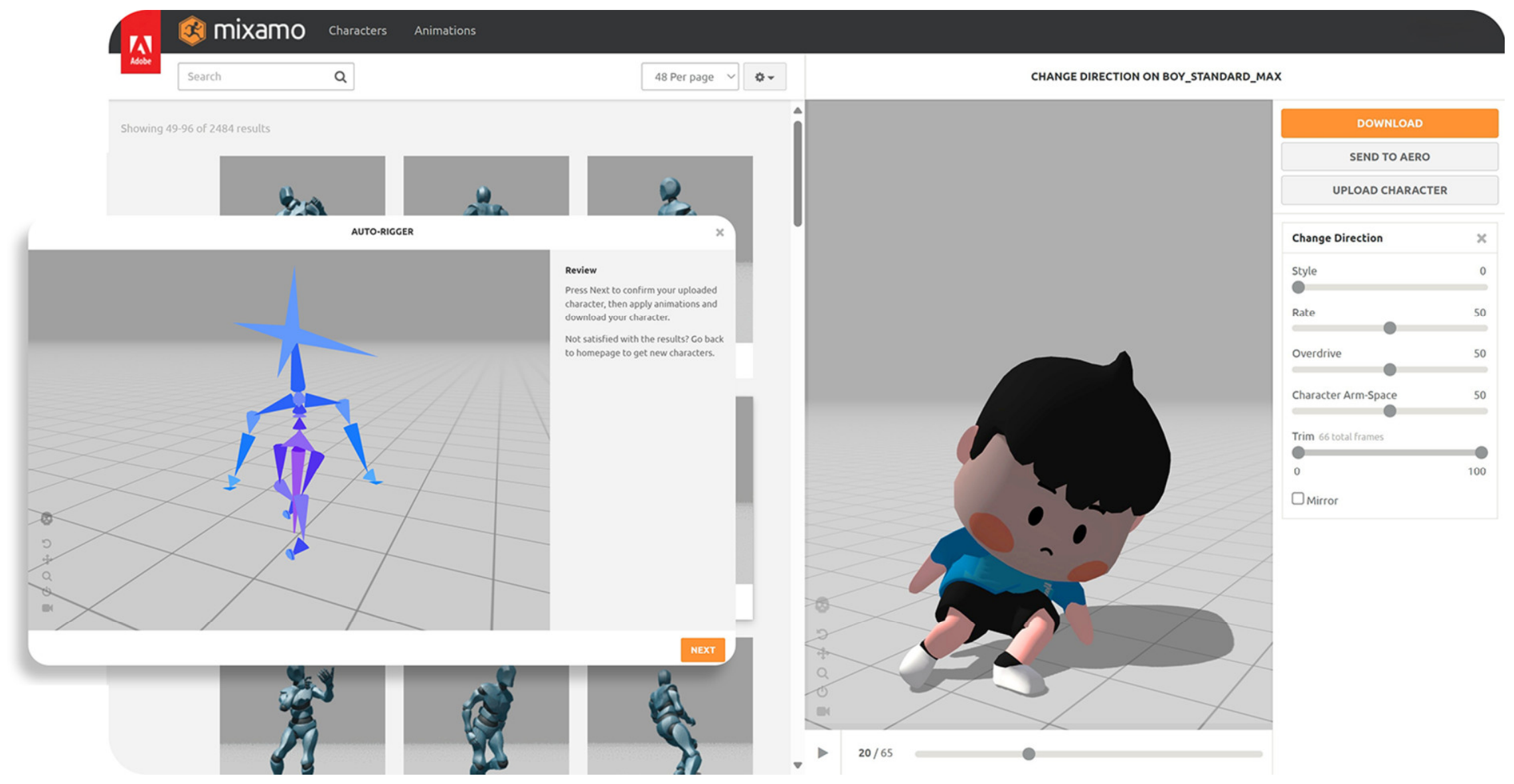
3.1.2. Animation Development
3.1.3. Image Target Creation and AR Integration
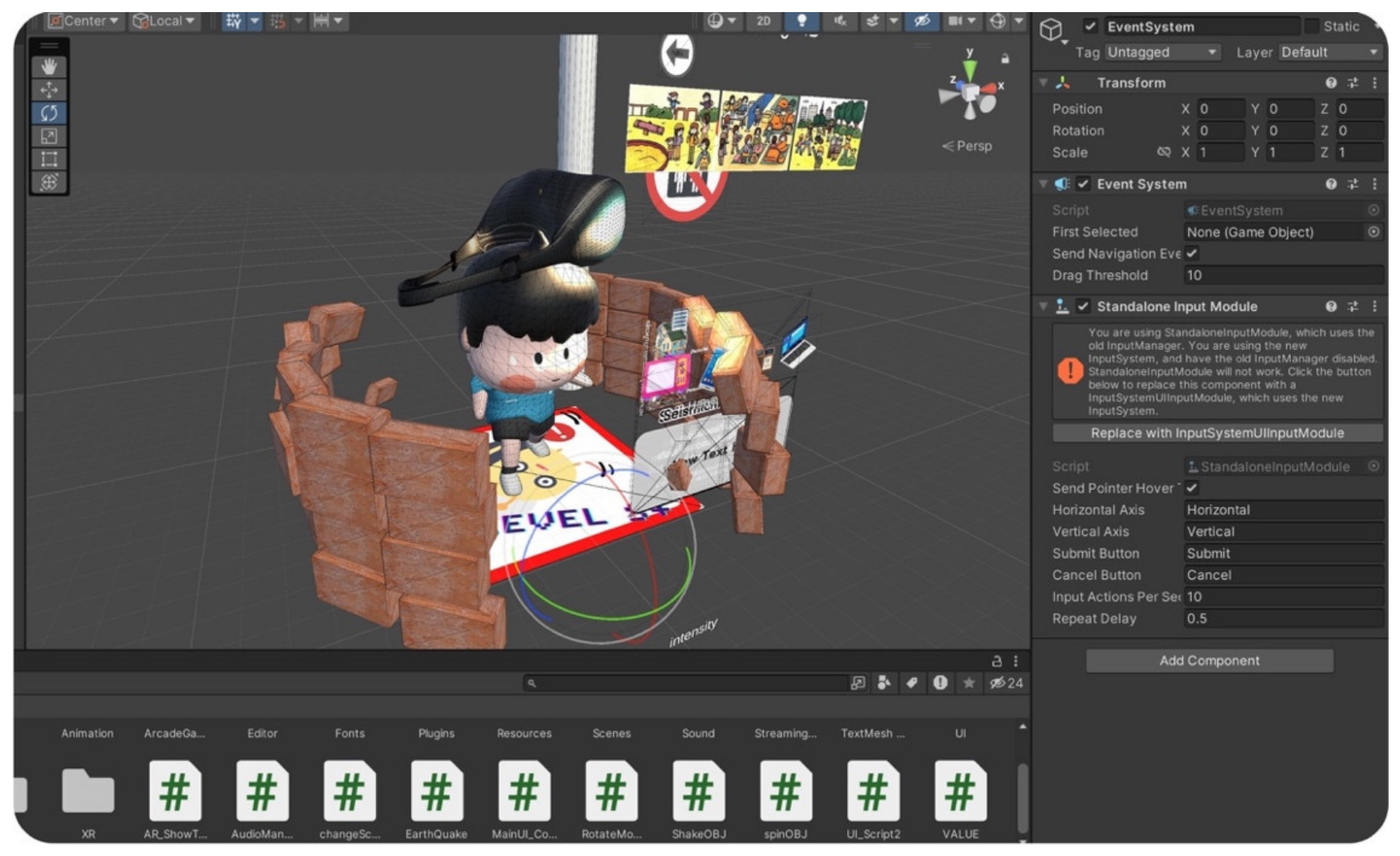
3.1.4. Unity Integration
3.1.5. Application Testing
3.2. Participants and Sampling
3.3. Research Instruments
3.3.1. Part 1: Demographic Information
3.3.2. Part 2: Knowledge Assessment (Pre-Test/Post-Test)
3.3.3. Part 3: User Satisfaction and Feedback Survey
3.4. Design and Validation of Research Instruments
3.4.1. Content Validity Assessment
3.4.2. Content Validity Results
- Part 1: Demographic Information. This part contained three questions used to collect participant demographic information. All items achieved an IOC value of 1.00, indicating excellent content validity and requiring no revision.
- Part 2: Knowledge Assessment. Initially, this part contained 15 multiple-choice questions intended to assess earthquake preparedness knowledge. During expert evaluation, some items were identified as redundant and did not satisfy the predefined acceptance criteria. Based on expert recommendations, one item was removed, resulting in a final set of 14 questions. All remaining items achieved an IOC value of 1.00, demonstrating excellent alignment with the study objectives.
- Part 3: User Satisfaction Survey. This part consisted of 14 items designed to evaluate user satisfaction with the AR application, including usability, content clarity, engagement, and overall experience. All items achieved an IOC value of 1.00, indicating excellent content validity. Therefore, no modifications were required.
3.5. Experimental Procedure and Data Collection
3.5.1. Experimental Procedure
- Step 1: Demographic Survey and Pre-Test. Participants first completed a demographic questionnaire that collected information including age, gender, and nationality. Subsequently, participants completed a pre-test consisting of 14 multiple-choice questions to assess their baseline knowledge of earthquake preparedness and survival strategies relevant to Japan.
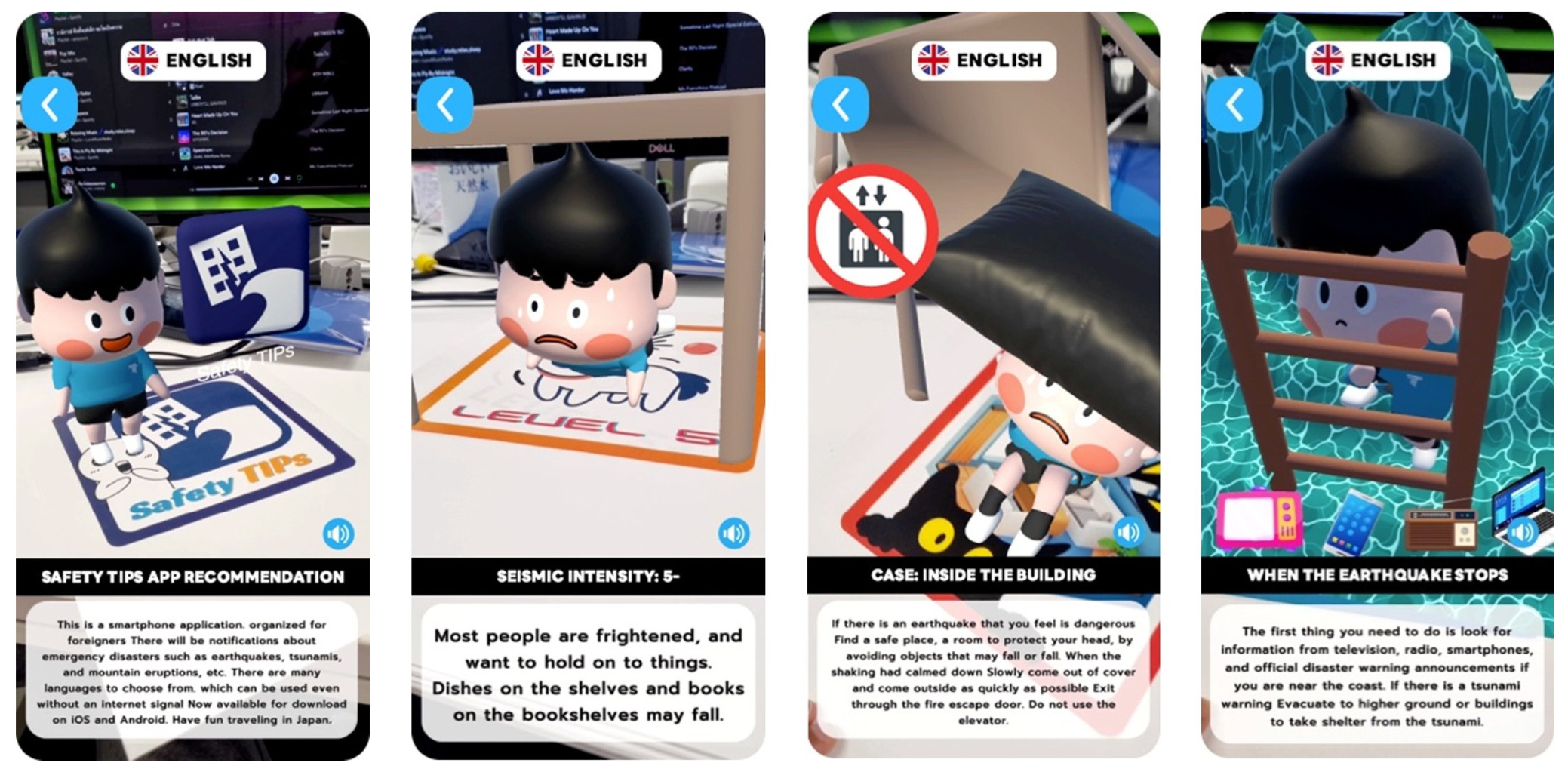
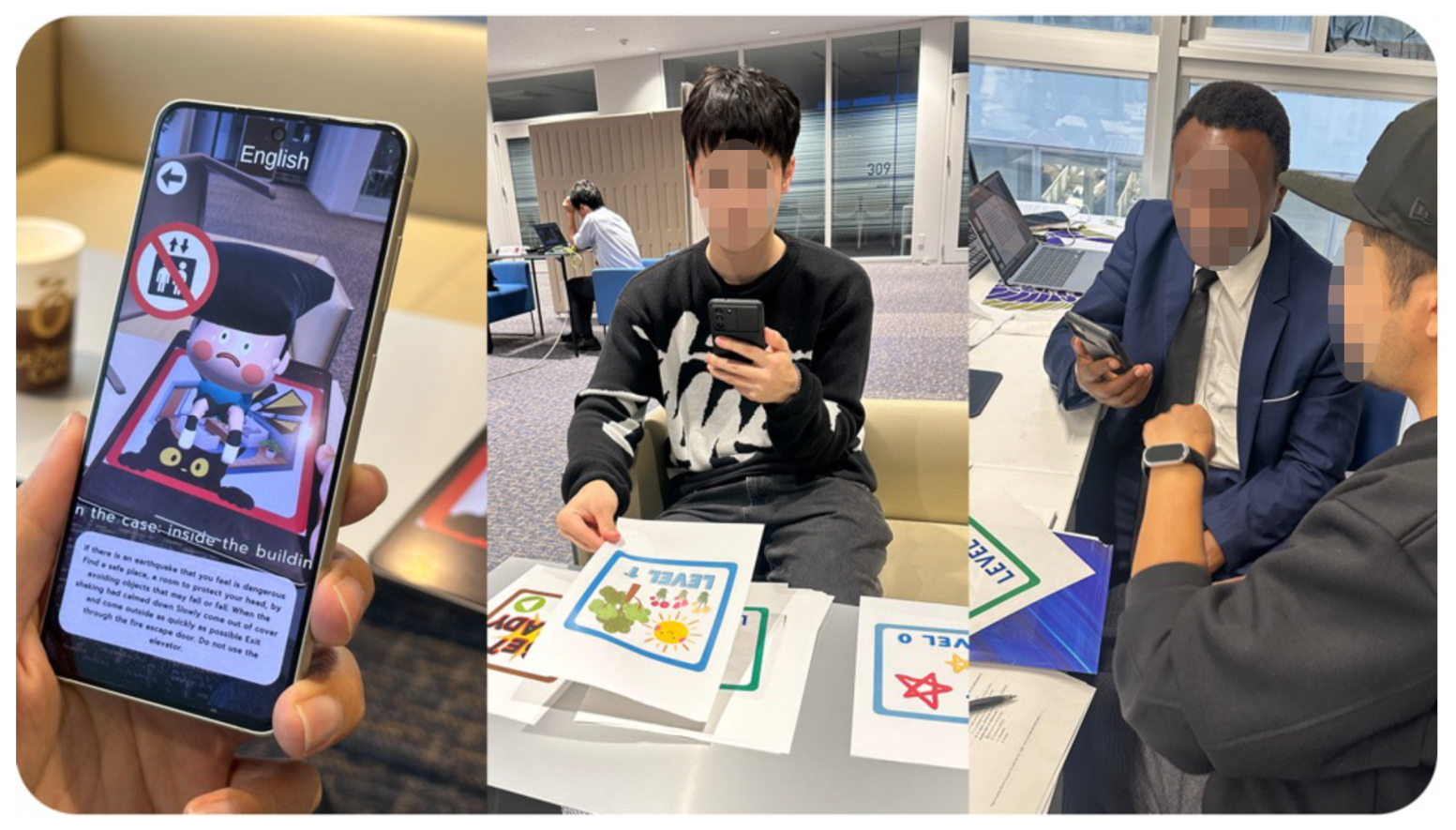
- Step 2: Interaction with the AR Application. After completing the pre-test, participants used the AR application developed in this study. The session was facilitated by the first author. Before using the application, participants received standardized instructions regarding the purpose of the application and its basic operation. They then accessed interactive educational content related to earthquake preparedness, including disaster awareness information and survival guidance. Participants were asked to complete the learning activities presented in the application in a predefined order. The session lasted approximately 10–15 min. The facilitator provided technical assistance only when necessary and did not provide explanations or hints related to the knowledge-test items. This procedure supported a flexible and interactive learning experience (Figure 6).
- Step 3: Post-Test. Following completion of the AR learning session, participants completed the same 14-item questionnaire as a post-test to measure changes in knowledge after interacting with the application.
- Step 4: Satisfaction Survey and Feedback Collection. Participants completed a satisfaction questionnaire consisting of 14 items based on a five-point Likert scale. The questionnaire evaluated aspects including usability, content clarity, engagement, accessibility, and overall user experience. Participants were also given the opportunity to provide optional qualitative comments and suggestions for future improvements to the application.
3.5.2. Completion and Participant Compensation
3.6. Data Analysis
3.6.1. Descriptive Statistics
3.6.2. Knowledge Assessment Analysis (Pre-Test and Post-Test Comparison)
3.6.3. Effect Size Analysis
4. Results
4.1. Pre-Test and Post-Test Analysis
4.2. Satisfaction Score Analysis
4.3. Summary
5. Discussion
6. Conclusions and Future Work
6.1. Conclusions
6.2. Future Work
- Multilingual Support: Expand language availability beyond the current implementation to support broader international accessibility, including languages suggested by participants.
- Interaction Improvements: Reduce dependence on physical AR markers and explore more seamless and continuous interaction methods.
- Content Expansion: Introduce additional disaster-related educational content, such as emergency preparedness kits and extended survival guidance.
- Personalization Features: Support avatar customization and adaptive presentation to accommodate diverse user preferences.
- Usability Enhancement: Improve interface accessibility through larger text, more natural voice narration, and enhanced animation quality.
- Long-Term and Large-Scale Evaluation: Conduct future studies with larger and more diverse participant populations and evaluate long-term knowledge retention.
Author Contributions
Funding
Institutional Review Board Statement
Informed Consent Statement
Data Availability Statement
Conflicts of Interest
References
- Shaw, R.; Shiwaku, K.; Kobayashi, H.; Kobayashi, M. Linking experience, education, perception and earthquake preparedness. Disaster Prev. Manag. 2004, 13, 39–49. [Google Scholar] [CrossRef] [Scilit]
- Gavari-Starkie, E.; Casado-Claro, M.-F.; Navarro-González, I. The Japanese Educational System as an International Model for Urban Resilience. Int. J. Environ. Res. Public Health 2021, 18, 5794. [Google Scholar] [CrossRef] [Scilit] [PubMed]
- Japan National Tourism Organization. Japan-Bound Statistics: Number of Foreign Visitors to Japan (December 2025 Estimates). Available online: https://www.jnto.go.jp/news/press/20260121_monthly.html (accessed on 13 July 2026).
- Immigration Services Agency of Japan. Number of Foreign Residents as of the End of 2025. Available online: https://www.moj.go.jp/isa/publications/press/13_00062.html (accessed on 13 July 2026).
- Adu-Gyamfi, B.; Shaw, R. Risk Awareness and Impediments to Disaster Preparedness of Foreign Residents in the Tokyo Metropolitan Area, Japan. Int. J. Environ. Res. Public Health 2022, 19, 11469. [Google Scholar] [CrossRef] [Scilit] [PubMed]
- Zhang, J.; Li, G.; Huang, Q.; Feng, Q.; Luo, H. Augmented Reality in K–12 Education: A Systematic Review and Meta-Analysis of the Literature from 2000 to 2020. Sustainability 2022, 14, 9725. [Google Scholar] [CrossRef] [Scilit]
- Chanaken, G.; Uchida, O. Design and Implementation of an Augmented Reality System for Raising Disaster Awareness Among Thai Tourists in Japan. In Proceedings of the 2024 5th International Conference on Computational Science & Information Management (ICoCSIM), Melbourne, Australia, 28–29 October 2024; pp. 72–77. [Google Scholar] [CrossRef] [Scilit]
- Akçayır, M.; Akçayır, G. Advantages and Challenges Associated with Augmented Reality for Education: A Systematic Review of the Literature. Educ. Res. Rev. 2017, 20, 1–11. [Google Scholar] [CrossRef] [Scilit]
- Garzón, J.; Pavón, J.; Baldiris, S. Systematic Review and Meta-Analysis of Augmented Reality in Educational Settings. Virtual Real. 2019, 23, 447–459. [Google Scholar] [CrossRef] [Scilit]
- Ibáñez, M.-B.; Delgado-Kloos, C. Augmented Reality for STEM Learning: A Systematic Review. Comput. Educ. 2018, 123, 109–123. [Google Scholar] [CrossRef] [Scilit]
- De León Aguilar, S.; Matsuda, Y.; Yasumoto, K. Mobile AR Interface for Instruction-Based Disaster Preparedness Guidelines. In Proceedings of the 2023 14th International Conference on Mobile Computing and Ubiquitous Network (ICMU), Kyoto, Japan, 29 November–1 December 2023; pp. 1–7. [Google Scholar] [CrossRef] [Scilit]
- Yamashita, N.; Taki, H.; Soga, M. A Learning Support Environment for Earthquake Disaster with a Simulation of Furniture Falling by Mobile AR. In Proceedings of the 2012 International Conference on Information Technology Based Higher Education and Training (ITHET), Istanbul, Turkey, 21–23 June 2012; pp. 1–5. [Google Scholar] [CrossRef] [Scilit]
- Manimegalai, R.; Arawind, S.; Sri Rajiv Jegan, G.V.; Gomathi, B. ARWeather: Weather Forecasting and Visualization using Augmented Reality. In Proceedings of the 2023 International Conference on Intelligent Systems for Communication, IoT and Security (ICISCoIS), Coimbatore, India, 9–11 February 2023; pp. 585–590. [Google Scholar] [CrossRef] [Scilit]
- Mantoro, T.; Alamsyah, Z.; Ayu, M.A. Pathfinding for Disaster Emergency Route Using Sparse A* and Dijkstra Algorithm with Augmented Reality. In Proceedings of the 2021 7th International Conference on Computing, Engineering and Design (ICCED), Sukabumi, Indonesia, 5–6 August 2021; pp. 1–6. [Google Scholar] [CrossRef] [Scilit]
- Mannuru, N.R.; Kanumuru, M.; Sharma, S. Mobile AR Application for Navigation and Emergency Response. In Proceedings of the 2022 International Conference on Computational Science and Computational Intelligence (CSCI), Las Vegas, NV, USA, 14–16 December 2022; pp. 1137–1142. [Google Scholar] [CrossRef] [Scilit]
- Ahn, J.; Han, R. RescueMe: An Indoor Mobile Augmented-Reality Evacuation System by Personalized Pedometry. In Proceedings of the 2011 IEEE Asia-Pacific Services Computing Conference (APSCC), Jeju, Republic of Korea, 12–15 December 2011; pp. 70–77. [Google Scholar] [CrossRef] [Scilit]
- Papanastasiou, G.; Drigas, A.; Skianis, C.; Lytras, M.; Papanastasiou, E. Virtual and Augmented Reality Effects on K-12, Higher and Tertiary Education Students’ Twenty-First Century Skills. Virtual Real. 2019, 23, 425–436. [Google Scholar] [CrossRef] [Scilit]
- Bhookan, N.S.; Murde, M.S.; Thakur, D.P.; Jadhav, H.B. Disaster Survival Training Using Virtual Reality. In Proceedings of the 2020 5th International Conference on Computing, Communication and Security (ICCCS), Patna, India, 14–16 October 2020; pp. 1–4. [Google Scholar] [CrossRef] [Scilit]
- Orji, J.; Hernandez, A.; Selema, B.; Orji, R. Virtual and Augmented Reality Applications for Promoting Safety and Security: A Systematic Review. In Proceedings of the 2022 IEEE 10th International Conference on Serious Games and Applications for Health (SeGAH), Sydney, Australia, 10–12 August 2022; pp. 1–7. [Google Scholar] [CrossRef] [Scilit]
- Patel, M.; Amin, H.; Pandey, G.; Wadmare, G. Enhancing Disaster Response Training through Immersive AR/VR Simulations. In Proceedings of the 2023 6th International Conference on Advances in Science and Technology (ICAST), Mumbai, India, 8–9 December 2023; pp. 69–74. [Google Scholar] [CrossRef] [Scilit]
- Romagnoli, L.; Proietti Mattia, G.; Beraldi, R. A Study on Energy Efficiency in Edge-assisted VR Applications with Meta Quest 2 for Disaster Management. In Proceedings of the 2023 International Conference on Information and Communication Technologies for Disaster Management (ICT-DM), Cosenza, Italy, 13–15 September 2023; pp. 1–7. [Google Scholar] [CrossRef] [Scilit]
- Leedy, P.D.; Ormrod, J.E. Practical Research: Planning and Design, 12th ed.; Pearson: New York, NY, USA, 2019. [Google Scholar]
- Etikan, I.; Musa, S.A.; Alkassim, R.S. Comparison of Convenience Sampling and Purposive Sampling. Am. J. Theor. Appl. Stat. 2015, 5, 1–4. [Google Scholar] [CrossRef] [Scilit]
- Rovinelli, R.J.; Hambleton, R.K. On the Use of Content Specialists in the Assessment of Criterion-Referenced Test Item Validity. Tijdschr. Onderwijsres. Dutch J. Educ. Res. 1977, 2, 49–60. [Google Scholar]
- Dimitrov, D.M.; Rumrill, P.D., Jr. Pretest–Posttest Designs and Measurement of Change. Work 2003, 20, 159–165. [Google Scholar] [CrossRef] [Scilit]
- Kusmaryono, I.; Wijayanti, D.; Maharani, H.R. Number of Response Options, Reliability, Validity, and Potential Bias in the Use of the Likert Scale in Education and Social Science Research: A Literature Review. Int. J. Educ. Methodol. 2022, 8, 625–637. [Google Scholar] [CrossRef] [Scilit]
- Tuckman, B.W. Conducting Educational Research, 5th ed.; Harcourt Brace College Publishers: Fort Worth, TX, USA, 1999. [Google Scholar]
- Cohen, J. Statistical Power Analysis for the Behavioral Sciences, 2nd ed.; Lawrence Erlbaum Associates: Hillsdale, NJ, USA, 1988. [Google Scholar]
- Di Serio, Á.; Ibáñez, M.B.; Delgado-Kloos, C. Impact of an Augmented Reality System on Students’ Motivation for a Visual Art Course. Comput. Educ. 2013, 68, 586–596. [Google Scholar] [CrossRef] [Scilit]






| Level | Meaning |
|---|---|
| 5 | Very Satisfied |
| 4 | Satisfied |
| 3 | Neutral |
| 2 | Dissatisfied |
| 1 | Very Dissatisfied |
| Rate | Meaning |
|---|---|
| +1 | The question is congruent with the research objectives. |
| 0 | The question’s congruence with the research objectives is uncertain. |
| −1 | The question is not congruent with the research objectives. |
| Question | Pre-Test n (%) | Post-Test n (%) | Change (%pt) |
|---|---|---|---|
| 1. Do you know what Seismic Intensity means? | 27 (67.5) | 33 (82.5) | +15.0 |
| 2. Which level of seismic intensity is the highest intensity level? | 8 (20.0) | 26 (65.0) | +45.0 |
| 3. Which level of seismic intensity is the lowest intensity level? | 11 (27.5) | 15 (37.5) | +10.0 |
| 4. How many levels are there in Seismic Intensity? | 18 (45.0) | 31 (77.5) | +32.5 |
| 5. At which Seismic Intensity level might people feel shaking but without any damage? | 37 (92.5) | 40 (100.0) | +7.5 |
| 6. What should you do first when an earthquake occurs? | 27 (67.5) | 33 (82.5) | +15.0 |
| 7. What should you avoid being close to during an earthquake? | 33 (82.5) | 34 (85.0) | +2.5 |
| 8. What should an emergency kit for earthquakes include? | 18 (45.0) | 22 (55.0) | +10.0 |
| 9. What should you do if you are outdoors when an earthquake occurs? | 33 (82.5) | 37 (92.5) | +10.0 |
| 10. What should you do if you are in a hazardous area after an earthquake? | 24 (60.0) | 27 (67.5) | +7.5 |
| 11. If you encounter injuries during an earthquake in Japan, which number should you contact? | 20 (50.0) | 40 (100.0) | +50.0 |
| 12. Which app can provide disaster alerts in Japan and is designed for foreigners? | 22 (55.0) | 38 (95.0) | +40.0 |
| 13. What should shelter locations after an earthquake in Japan be like? | 36 (90.0) | 38 (95.0) | +5.0 |
| 14. What should shelter locations after an earthquake in Japan be like? | 39 (97.5) | 40 (100.0) | +2.5 |
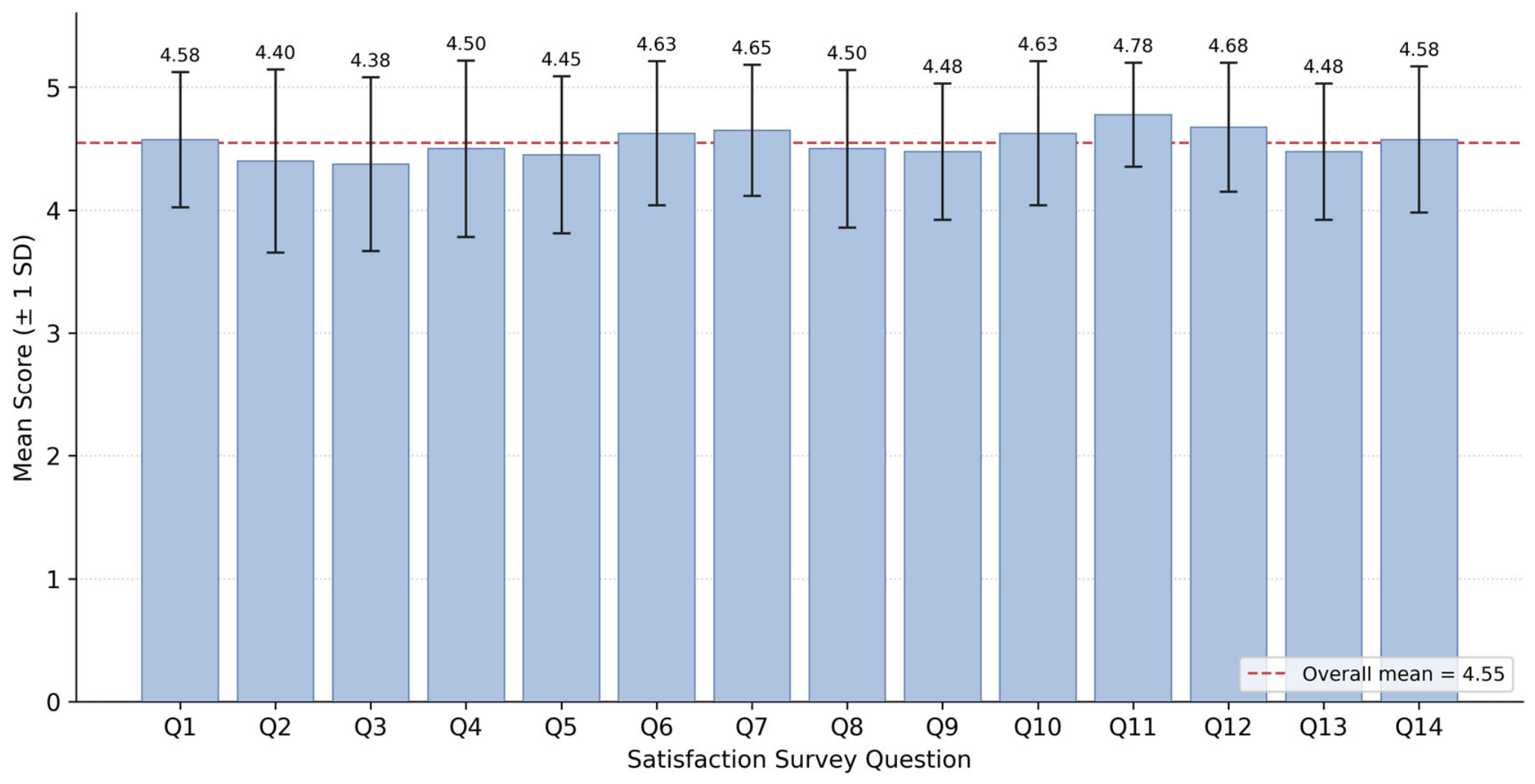
| Question | Mean | SD | Min | Max |
|---|---|---|---|---|
| 1. Ease of use and navigation | 4.58 | 0.55 | 3 | 5 |
| 2. Accessibility of various functions | 4.40 | 0.74 | 2 | 5 |
| 3. Speed of data loading and AR display | 4.38 | 0.70 | 3 | 5 |
| 4. English and Thai language support | 4.50 | 0.72 | 3 | 5 |
| 5. The process of scanning AR markers | 4.45 | 0.64 | 3 | 5 |
| 6. Three-dimensional character animations and gestures | 4.63 | 0.59 | 3 | 5 |
| 7. Clarity and quality of audio narration | 4.65 | 0.53 | 3 | 5 |
| 8. Visual quality of text and information | 4.50 | 0.64 | 3 | 5 |
| 9. Realism of AR technology used | 4.48 | 0.55 | 3 | 5 |
| 10. Usefulness and accuracy of earthquake info | 4.63 | 0.59 | 3 | 5 |
| 11. Helps you understand safety procedures | 4.78 | 0.42 | 4 | 5 |
| 12. Helps you feel more prepared for disasters | 4.68 | 0.53 | 3 | 5 |
| 13. Overall satisfaction with the application | 4.48 | 0.55 | 3 | 5 |
| 14. Recommending this app to others | 4.58 | 0.59 | 3 | 5 |
| Overall | 4.55 | 0.61 | 2 | 5 |
Disclaimer/Publisher’s Note: The statements, opinions and data contained in all publications are solely those of the individual author(s) and contributor(s) and not of MDPI and/or the editor(s). MDPI and/or the editor(s) disclaim responsibility for any injury to people or property resulting from any ideas, methods, instructions or products referred to in the content. |
© 2026 by the authors. Licensee MDPI, Basel, Switzerland. This article is an open access article distributed under the terms and conditions of the Creative Commons Attribution (CC BY) license.
Share and Cite
Chanaken, G.; Uchida, O. Evaluating an Augmented Reality Educational Application for Earthquake Preparedness Among International Visitors and Newly Arrived Foreign Residents in Japan. Information 2026, 17, 716. https://doi.org/10.3390/info17080716
Chanaken G, Uchida O. Evaluating an Augmented Reality Educational Application for Earthquake Preparedness Among International Visitors and Newly Arrived Foreign Residents in Japan. Information. 2026; 17(8):716. https://doi.org/10.3390/info17080716
Chicago/Turabian StyleChanaken, Gowit, and Osamu Uchida. 2026. "Evaluating an Augmented Reality Educational Application for Earthquake Preparedness Among International Visitors and Newly Arrived Foreign Residents in Japan" Information 17, no. 8: 716. https://doi.org/10.3390/info17080716
APA StyleChanaken, G., & Uchida, O. (2026). Evaluating an Augmented Reality Educational Application for Earthquake Preparedness Among International Visitors and Newly Arrived Foreign Residents in Japan. Information, 17(8), 716. https://doi.org/10.3390/info17080716