1. Introduction
Within China’s rule-of-law framework, mediation has been elevated to a strategic position for resolving social conflicts and advancing the modernization of the national governance system and governance capacity, and has become a core principle guiding judicial practice and grassroots governance. Under this policy context, a large-scale mediation system has been established, ranging from court-led pre-litigation mediation to community-based people’s mediation organizations distributed across both urban and rural areas. The effective functioning of this system relies heavily on mediators’ professional judgment and communication strategies.
Such a nationwide system places exceptionally high demands on the strategic decision-making and communicative intervention capabilities of millions of full-time and part-time mediators when handling complex disputes. Consequently, systematic analysis and evaluation of mediation strategies hold substantial practical value and application potential for enhancing the effectiveness of grassroots governance in China.
However, mediation is inherently a dynamic and unstructured process of interpersonal strategic interaction. Effective mediation strategies often manifest as tacit knowledge that is difficult to articulate and formalize. This tacit expertise encompasses macro-level awareness of procedural stages, the application of micro-level intervention tactics, and nuanced assessments of disputants’ psychological states. As a result, the large-scale replication and transmission of such expertise remain highly challenging.
With the emergence of Large Language Models (LLMs), the development of professional legal agents has become increasingly feasible. Existing legal foundation models, represented by LawGP [
1] and ChatLaw [
2], primarily focus on tasks involving explicit legal knowledge processing, such as legal information retrieval, summarization, and application. Although these systems demonstrate strong performance in document drafting and legal consultation, mediation, as a multi-party and high-level social cognitive activity, requires far more than legal expertise alone. It demands sophisticated strategic planning, empathy, and conflict resolution capabilities.
To address this complexity, recent research has begun exploring Multi-Agent systems to replicate the mediation process. However, existing multi-agent frameworks—whether simple role-playing-based social simulations or collaboration-oriented architectures such as CAMEL [
3] and MetaGPT [
4] designed for task decomposition—remain difficult to directly apply to legal mediation. When confronted with long-horizon and high-conflict negotiation scenarios, these approaches exhibit pronounced structural cognitive limitations.
Specifically, three key deficiencies can be observed. First, a lack of process awareness: models often fail to maintain macro-level control over mediation stages and easily lose track of long-term objectives during extended multi-turn interactions. Second, insufficient professional intervention capabilities: when facing negotiation deadlocks, they struggle to proactively employ structured strategies comparable to those used by human experts. Third, limited theory-of-mind reasoning: they lack explicit modeling of opponents’ intentions and beliefs during strategic interactions. Simply scaling up model parameters proves insufficient to overcome these higher-order social–cognitive bottlenecks. In this study, these limitations are operationally summarized as cognitive shallowness and strategic drift in long-horizon mediation interactions. Strategic drift refers to the tendency of LLM agents to gradually deviate from the original mediation objective, negotiation strategy, or settlement goal as the dialogue proceeds, often resulting in inconsistent intervention choices, weakened procedural control, or premature convergence to unstable proposals. Cognitive shallowness refers to the tendency of agents to rely primarily on local turn-level responses without maintaining sufficient process awareness, executable intervention planning, or persistent opponent-state tracking. In legal mediation, these issues are particularly problematic because effective dispute resolution requires sustained coordination across procedural stages, strategic intervention at negotiation deadlocks, and continuous assessment of each party’s goals, constraints, and willingness to compromise.
To address the aforementioned challenges, this study proposes CogMed, a cognitively inspired multi-agent simulation framework designed to move beyond the simplistic assumption of “LLM-as-agent”. Instead, CogMed embeds LLMs within an explicit cognitive architecture jointly constrained by process control, professional action mechanisms, and belief modeling. In this manner, high-level strategic reasoning and structured decision-making are achieved through architectural design rather than relying solely on raw model capacity.
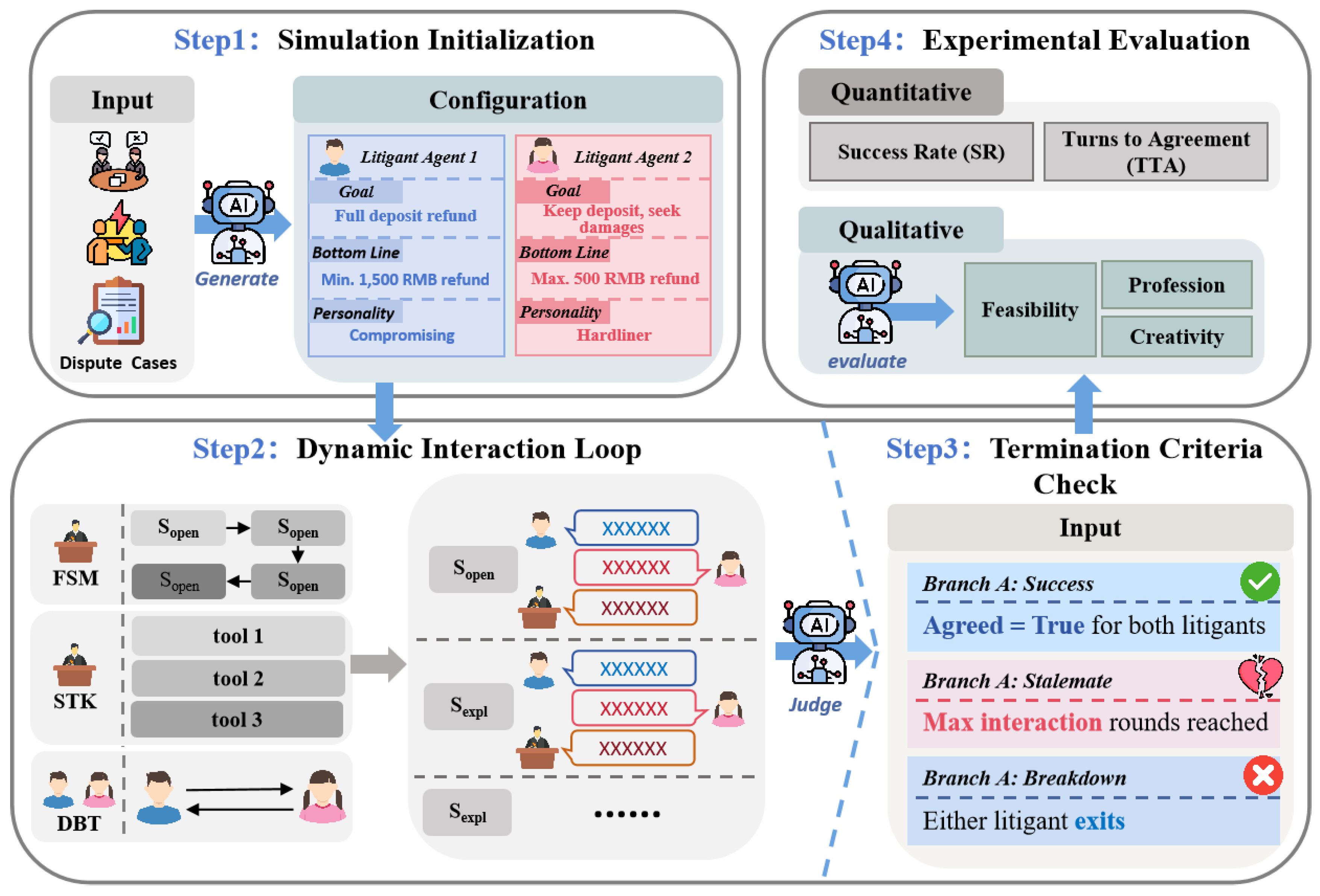
Figure 1 illustrates the complete workflow of the CogMed framework, spanning from parameterized scenario configuration to automated evaluation.
Specifically, CogMed enhances the cognitive capabilities of the underlying LLMs through three key modules. First, a Finite State Machine (FSM) is employed to model mediation stages, enabling the system to emulate how human experts switch strategic objectives across different phases of the mediation process and thereby maintain macro-level procedural awareness. Second, a Strategic Toolkit (STK)–based decision action space is constructed, which transforms professional intervention experience into computable strategy primitives. This design grounds abstract expertise in executable operations and supports structured, targeted interventions during negotiation. Third, Dynamic Belief Tracking (DBT) is introduced to equip party agents with theory-of-mind capabilities. By continuously inferring opponents’ intentions and beliefs in real time, agents are able to engage in more realistic and strategically informed interactions that better approximate human behavioral patterns.
To comprehensively evaluate the effectiveness of the proposed framework, systematic experiments were conducted on a real-world civil case dataset. A hybrid evaluation protocol was adopted, combining a quantitative metric—mediation success rate—with qualitative comprehensive scoring based on an LLM-as-a-Judge paradigm.
Experimental results show that CogMed consistently improves both mediation success rates and the quality of negotiated outcomes. More importantly, the findings reveal a key insight: framework intelligence exhibits a compensatory effect with respect to model scale. In particular, a lightweight model empowered by an advanced cognitive framework can achieve professional performance comparable to, or even surpassing, that of a substantially larger model operating without explicit architectural guidance. This result highlights the critical role of structured cognitive design beyond mere parameter scaling. The purpose of CogMed is not to propose a new general-purpose foundation model, nor to claim that FSM, STK, or DBT are entirely new mechanisms in isolation. Rather, the contribution lies in the task-specific coordination of these mechanisms for legal mediation simulation. Although the individual components are inspired by general agent-system design principles, they are instantiated here with distinct operational roles in the mediation process: FSM provides stage-level procedural control, STK provides executable mediation interventions, and DBT provides dynamic opponent-state tracking for litigant agents. Their integration forms a controlled mediation-oriented interaction architecture designed to address long-horizon strategic drift and cognitive shallowness in simulated legal dispute resolution. In summary, the main contribution of this work is not the introduction of entirely novel individual modules, but the construction of a cognitively coordinated multi-agent mediation architecture tailored for long-horizon adversarial legal negotiation scenarios. Specifically, the proposed framework integrates process-level stage control, executable strategic intervention mechanisms, and temporally persistent belief modeling into a unified mediation-oriented interaction system.
Within this architecture, FSM provides explicit procedural coordination for maintaining long-horizon strategic consistency, STK operationalizes mediation expertise into executable intervention primitives, and DBT enables temporally coherent opponent modeling during adversarial negotiation. Through this cognitively constrained integration, the framework aims to improve controllability, strategic coherence, and negotiation stability in legal mediation simulations.
Accordingly, the contributions of this work can be summarized as follows:
- (1)
A mediation-oriented multi-agent framework, CogMed, is proposed to coordinate procedural control, strategic intervention, and opponent-state tracking in long-horizon legal mediation simulations.
- (2)
A structured interaction mechanism integrating FSM, STK, and DBT is developed to transform selected mediation practices into controllable and executable simulation components.
- (3)
Controlled experiments and ablation analyses are conducted to provide preliminary empirical evidence on how structured cognitive coordination affects mediation success, agreement quality, and interaction stability under the current experimental setting.
3. CogMed Framework Design
CogMed is designed to address the problem of cognitive shallowness commonly observed in existing multi-agent systems when simulating complex human social interactions. Such systems often lack stable capabilities for process control, action selection, and opponent modeling during long-horizon interactions, resulting in inconsistent strategies and degraded performance over extended negotiations.
Unlike conventional paradigms that treat LLMs as monolithic black-box agents, CogMed adopts a hybrid cognitive architecture. Rather than relying solely on the implicit reasoning ability of large models, the proposed framework explicitly integrates structured process management, strategic action mechanisms, and belief modeling to provide systematic cognitive support for mediation-oriented decision making.
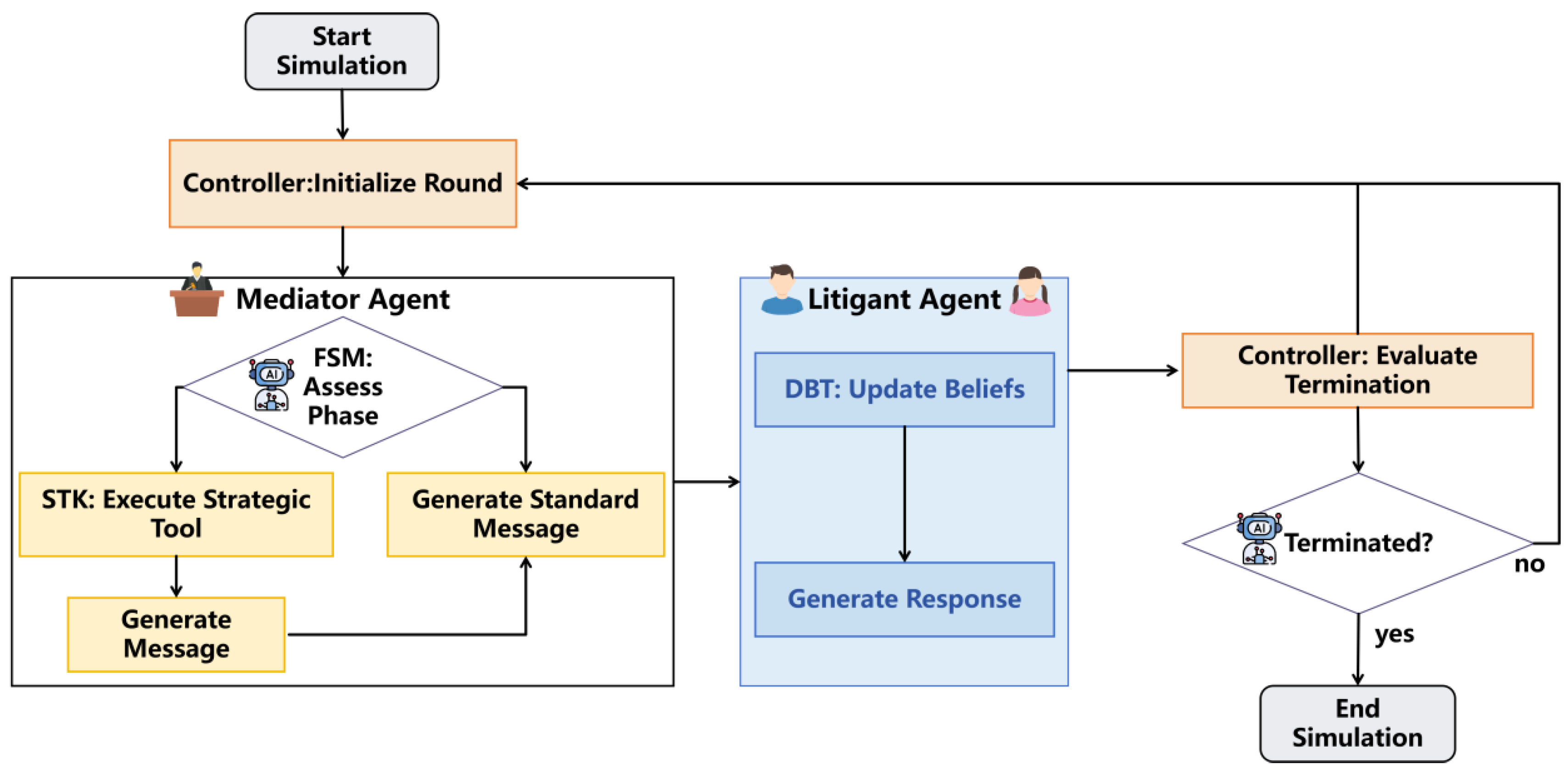
As illustrated in
Figure 2, the proposed architecture presents a structured multi-agent interaction loop driven by a central Controller. The entire simulation process is organized as a closed-loop workflow to ensure stable process management and coordinated decision-making across agents.
The simulation begins with round initialization by the Controller. The Mediator Agent, guided at a macro level by a Finite State Machine (FSM), first evaluates the current mediation stage and determines the appropriate course of action. Based on this assessment, it either invokes the Strategic Toolkit (STK) to execute targeted professional interventions or generates standard conversational messages.
Meanwhile, the Litigant Agent, upon receiving incoming information, activates the Dynamic Belief Tracking (DBT) module to update its internal cognitive state and subsequently produces a response that reflects its inferred beliefs and intentions.
At the end of each interaction round, the Controller evaluates whether predefined termination conditions have been satisfied. Depending on the outcome, the simulation either concludes or proceeds to the next round.
By introducing explicit process- and strategy-level constraint modules to guide and regulate the implicit reasoning of LLMs, the proposed mechanism ensures both high fidelity and controllability in legal mediation simulation. This design enables agent behaviors to remain aligned with structured procedural objectives while preserving the generative flexibility of large language models.
The following sections provide a detailed description of the key components of the proposed architecture.
3.2. Mediator: Dual-Layer Cognitive Augmentation Architecture
General-purpose LLMs frequently exhibit strategic drift in long-horizon mediation scenarios, where objectives become inconsistent and decision-making degrades over extended interactions. To address this limitation, the Mediator Agent is equipped with a dual-layer cognitive architecture inspired by hierarchical cognition.
Specifically, the proposed design decomposes the mediator’s reasoning process into two complementary levels: macro-level planning and micro-level execution. This hierarchical structure enables the agent to maintain a stable strategic direction at the global level while performing flexible, context-sensitive interventions at the local level.
When handling long-horizon mediation tasks, general-purpose LLMs often suffer from strategy drift caused by the sliding nature of the context window, gradually losing track of overarching objectives as the dialogue progresses. To mitigate this issue, CogMed introduces an explicit stage-based representation of the mediation process using a Finite State Machine (FSM).
Specifically, the mediation workflow is modeled over a discrete state space , corresponding to four key phases: opening, exploration, negotiation, and agreement drafting.
The module operates through an evaluation–execution loop. Prior to each interaction round, a dedicated lightweight evaluator is invoked to approximate the state transition function , where the current dialogue history is analyzed to determine whether the mediation should transition to the next stage. The resulting state is then used to dynamically reconstruct the mediator’s system prompt, effectively adapting its macro-level strategy according to procedural progress.
For instance, during the exploration stage (), the agent is softly constrained to prioritize information gathering, whereas in the negotiation stage (), more assertive intervention strategies are enabled. By explicitly coupling strategic behavior with procedural states, the mediator’s decision-making remains aligned with stage-specific objectives.
This mechanism effectively addresses the loss of focus commonly observed in extended conversations. The explicit stage modeling ensures orderly transitions between potentially conflicting goals—such as information collection and compromise facilitation—thereby maintaining strategic coherence throughout long-horizon negotiations.
- 2.
Micro-Level: strategic toolkit as executable action primitives
To move beyond pure language generation and equip the mediator with professional intervention capabilities, we abstract the tacit expertise of experienced mediators into a Strategic Toolkit (STK). The STK serves as a set of executable action primitives that enable structured and goal-directed interventions, transforming implicit professional know-how into explicit, callable operations.
Specifically, the toolkit consists of the following actions:
- (1)
summarize_and_clarify ():
This tool invokes the LLM to perform neutral information compression and key-point extraction over recent dialogue history. It is designed to mitigate information overload and topic drift, both of which are common in long-horizon negotiations. By reframing emotionally charged exchanges into concise, fact-oriented summaries, the conversation is re-anchored to a rational and constructive basis.
- (2)
perform_reality_check (, issue):
This tool emulates the perspective of an experienced legal professional by leveraging the model’s internal legal knowledge to conduct an objective assessment of risks and costs associated with a litigant’s rigid claims. Through this analysis, it corrects overconfidence biases and encourages the party to recalibrate expectations based on a more realistic Best Alternative to a Negotiated Agreement (BATNA), thereby steering the negotiation back toward feasible compromise.
- (3)
propose_bridging_solution (, Interests(A, B)):
This tool employs higher-order Chain-of-Thought reasoning to shift from surface-level positions to deeper underlying interests. Based on this cognitive reframing, it generates creative and integrative proposals aimed at breaking negotiation deadlocks and advancing the mediation process toward constructive solution selection.
Collectively, these tools constitute a finite set of callable action primitives available to the mediator. By explicitly encoding complex professional interventions into controllable decision options, the STK enables structured, reliable, and reproducible strategy execution within the mediation process.
3.3. Litigant: Explicit Theory-of-Mind-Driven Cognitive Modeling
Authentic strategic interaction is driven not only by the maximization of one’s own interests, but also by the anticipation of an opponent’s intentions. However, general-purpose LLMs typically lack stable Theory-of-Mind (ToM) capabilities, often reacting myopically to local context rather than forming persistent beliefs about their counterparts. As a result, their behaviors in adversarial settings tend to be short-sighted and strategically inconsistent.
To address this limitation, CogMed introduces a Dynamic Belief Tracking (DBT) mechanism that explicitly models the temporal inference process through which disputants reason about their opponents’ intentions. Concretely, each litigant agent is required to maintain an explicit belief state , representing its current estimation of the opposing party’s goals, constraints, and likely strategies.
Upon receiving a message at time step t, the agent first triggers a belief-update procedure. Importantly, this update process does not aim to perfectly reconstruct the opponent’s true psychological state. Instead, its primary purpose is to impose temporal consistency and strategic stability on the agent’s behavior. By maintaining a coherent and continuously evolving belief model, the agent’s decisions become grounded in accumulated interaction history rather than isolated utterances.
Through this mechanism, DBT enables agents to engage in more realistic and strategically informed negotiations, better approximating the sequential reasoning patterns observed in human adversarial interactions.
Rather than relying on a formally defined analytical update rule, the current DBT mechanism performs opponent-state updating through structured LLM prompting conditioned on the dialogue history, current interaction context, and previously estimated negotiation attributes. At each interaction round, the mediator agent re-evaluates several dynamically evolving attributes of the opposing party, including perceived goals, emotional tendencies, and flexibility estimates, in order to support subsequent strategic coordination during mediation.
The DBT model explicitly tracks three key latent attributes of the opponent: perceived goal, emotional valence, and flexibility score. Together, these variables characterize not only what the opponent aims to achieve but also their affective stance and willingness to compromise, thereby providing a compact yet expressive representation of their evolving strategic posture.
This belief state is updated recursively as new interaction evidence becomes available, enabling agents to continuously refine their inferences over time. Such a recursive modeling mechanism equips litigant agents with deeper strategic reasoning capabilities, allowing them to adopt more sophisticated countermeasures—such as strategic concession, calibrated signaling of weakness, or tactical bluffing—rather than relying on purely reactive responses.
By grounding decision-making in an explicit and temporally coherent belief model, DBT enhances both the realism and complexity of simulated negotiations, producing behaviors that more closely resemble the adaptive strategies observed in real-world adversarial games.
4. Experimental Setup
4.4. Evaluation Metrics
To comprehensively assess mediation performance, we adopt a hybrid evaluation framework that integrates both quantitative and qualitative criteria, enabling joint measurement of effectiveness, efficiency, and solution quality.
First, Success Rate (SR) is defined as the proportion of simulations in which both litigant agents reach an agreed = True state within the predefined maximum number of interaction rounds (10 rounds). This metric serves as the primary outcome-oriented indicator, reflecting the framework’s ability to successfully guide negotiations toward consensus.
Second, Turns to Agreement (TTA) measures the average number of dialogue rounds required to reach an agreement, computed only over successful cases. This metric captures mediation efficiency by quantifying how quickly consensus can be achieved.
Third, Overall Quality Score (OQS) is introduced to evaluate the substantive quality of mediation outcomes. Following the LLM-as-a-Judge paradigm, an expert-level model—Qwen-Plus—is employed as a neutral evaluator. The judge semantically compares the generated settlement agreements with the corresponding ground-truth agreements from the official case repository of the Supreme People’s Court of the People’s Republic of China. Performance is assessed across three dimensions: solution feasibility, procedural professionalism, and strategic creativity. Each case is rated on a 1–10 scale, and the final OQS is computed as the average of these scores, providing a comparative reference for assessing the relative quality and consistency of generated mediation outcomes across different experimental configurations.
Together, these metrics offer a balanced evaluation of whether the framework not only reaches agreements, but does so efficiently and with high-quality, legally sound solutions.
It should be noted that the LLM-as-a-Judge protocol adopted in this study is intended as a scalable auxiliary evaluation approach rather than an authoritative substitute for professional legal experts. Although such automatic evaluation methods provide useful comparative signals under standardized experimental settings, they may not fully capture the nuanced legal reasoning, procedural fairness, and practical mediation expertise required in real-world judicial contexts. Therefore, future work will further incorporate evaluations conducted by professional mediators and legal practitioners to validate the consistency and reliability of the proposed evaluation framework. In addition, the current study primarily relies on a single-model-family LLM-as-a-Judge evaluation protocol, which may introduce potential evaluation preference bias. Although this approach provides scalable comparative assessment under controlled simulation settings, future work will incorporate independent judge models, inter-judge agreement analysis, and professional human expert evaluation to further improve evaluation robustness and practical validity.
5. Results and Analysis
5.1. Main Results: Framework Effectiveness
To comprehensively evaluate the effectiveness of the proposed CogMed framework, we conducted a series of controlled comparative experiments across three backbone models of different scales. In total, 15 configurations (3 × 5) were evaluated, corresponding to three model sizes and five architectural settings. Each configuration was tested on 50 standardized mediation cases, resulting in 750 complete simulation runs overall.
Table 1 summarizes the core performance metrics of each backbone model before and after integrating the CogMed framework, providing a direct comparison of baseline and cognitively enhanced agents.
From the results reported in
Table 1, it can be clearly observed that the CogMed-Full configuration consistently achieves higher success rates (SR) than the corresponding baselines across all backbone model scales, demonstrating the potential effectiveness of the proposed cognitive architecture under the current controlled experimental settings. This trend can be observed not only for high-capacity models but also for lightweight settings, indicating that the benefits of structured cognitive design generalize well across different computational regimes.
It is worth noting that the observed increase in Turns to Agreement (TTA) should not be interpreted as reduced efficiency. Instead, the longer interaction horizon reflects a behavioral shift from premature or rapid failures toward more sustained and constructive negotiation processes. In other words, agents engage in deeper deliberation and extended bargaining before reaching consensus, which ultimately contributes to higher agreement rates and improved solution quality rather than slower performance.
Building upon the quantitative results in
Table 1, several key observations can be further highlighted.
First, improvements in SR. For the smaller and mid-scale models, the full CogMed framework yields substantial absolute gains of +30% and +26% for the 8B and 32B backbones, respectively, markedly enhancing their practical usability in real-world mediation tasks. Notably, even for the already strong Qwen-Plus model, the framework continues to provide additional benefits, pushing the success rate to a high level of 78%, which indicates that cognitive augmentation remains effective beyond mere parameter scaling.
Second, improvements in OQS and stability. CogMed also enhances the professional quality of generated agreements for small- and medium-scale models, with OQS increases of +1.20 and +0.75, respectively. More importantly, a reduction in performance variance is observed for the 32B and Plus models, where the standard deviation decreases to ±0.40 and ±0.28. This reduction suggests that the framework not only improves average performance but also produces more stable and consistent outcomes. Such stabilization indicates that explicit cognitive constraints help regulate agent behavior, leading to more controllable and reliable mediation services.
It should be noted that the current experimental results are primarily intended to provide comparative empirical observations under controlled simulation settings. Due to the stochastic nature of large language model inference, the reported performance differences may still be affected by sampling variability. Although standard deviations are reported to partially reflect output stability, more comprehensive statistical analyses, including repeated experiments with multiple random seeds, confidence interval estimation, significance testing, and sensitivity analysis, will be further explored in future work to strengthen the robustness evaluation of the proposed framework.
5.3. Ablation Analysis: Deconstructing the Cognitive Modules of CogMed
The ablation analysis was designed to provide a controlled examination of how each architectural component contributes to mediation performance. Specifically, FSM, STK, and DBT were individually removed from the full CogMed configuration while all other settings remained unchanged. This design allows the observed performance changes to be interpreted as preliminary evidence of the functional role of each component within the current architecture. To precisely quantify the independent contributions of the three core components—FSM, DBT, and STK—we conducted a comprehensive ablation study. By systematically removing each module from the full framework while keeping all other factors constant, the resulting performance variations can be directly attributed to the corresponding cognitive capability.
The experimental results (see
Table 2) reveal scale-dependent patterns in cognitive reliance, indicating that models of different sizes exhibit heterogeneous dependencies on specific cognitive mechanisms. This analysis provides deeper insight into how each module contributes to overall mediation performance and clarifies the functional roles of process control, belief modeling, and strategic intervention within the CogMed architecture.
The cross-model comparison further uncovers several important cognitive mechanisms underlying the effectiveness of CogMed. Across all backbone models, the ablation results consistently identify the Strategic Toolkit (STK) as the most decisive component. Removing STK leads to substantial and systematic performance degradation, with success rates dropping by 40% and 30% for Qwen3-32B and Qwen-Plus, respectively. This pattern highlights a fundamental principle in professional negotiation tasks: possessing strong reasoning capabilities does not necessarily translate into effective outcomes. In complex adversarial settings, knowing what to do is not equivalent to being able to execute it successfully. By encapsulating expert interventions—such as Best Alternative to a Negotiated Agreement (BATNA) analysis—into atomic and executable actions, STK bridges the gap between high-level strategy generation and concrete operational behavior, thereby converting abstract intent into reliable and actionable decisions. It should also be noted that the ablation results should not be interpreted as proving that the three modules contribute independently in a strictly additive manner. In particular, the noSTK configuration indicates that executable intervention actions may function as an enabling component for the interaction between FSM-based procedural control and DBT-based opponent-state tracking. Without STK, the system may still maintain procedural stages and belief updates, but lack concrete mediation actions to advance the negotiation, which can lead to repetitive or stalled interaction patterns.
At the same time, Dynamic Belief Tracking (DBT) functions as a general-purpose stabilizer of social cognition rather than a model-specific enhancement. Although its quantitative impact appears most pronounced for the medium-scale model (with an approximate 20% performance drop upon removal), disabling DBT consistently increases conversational instability across all settings, frequently manifesting as abrupt negotiation breakdowns. This observation suggests that explicit Theory-of-Mind modeling plays a crucial role in maintaining temporal coherence and strategic stability in long-horizon, non-cooperative interactions, enabling agents to reason about opponents in a more persistent and structured manner.
Finally, an intriguing scale–structure trade-off emerges. As backbone model size increases, the marginal gains introduced by the cognitive architecture gradually diminish and may even exhibit mild antagonistic effects on certain indicators. This phenomenon does not contradict the general advantages of large-scale models; rather, it underscores that, for process-intensive and strategically constrained professional tasks, structured cognitive design is often more critical for behavioral controllability than further parameter expansion. Together, these findings reinforce the view that architectural intelligence, rather than sheer scale alone, constitutes the primary driver of robust performance in complex mediation environments.
With respect to the Overall Quality Score (OQS), a differentiated trend can be observed across model scales. The lightweight Qwen3-8B exhibits a substantial improvement of +1.27, while the mid-scale Qwen3-32B also benefits from a clear gain of +0.77, indicating that the cognitive architecture consistently enhances the professionalism and coherence of solutions generated by small- and medium-capacity models. In contrast, the large-scale Qwen-Plus shows a slight fluctuation after integration of the framework, with OQS decreasing marginally from 5.42 to 5.35. This phenomenon reflects an inherent trade-off between structural constraints and generative flexibility: for highly capable foundation models, enforced procedural control via FSM and predefined STK actions may modestly restrict the upper bound of free-form generation, leading to a small reduction in subjective quality scores.
Nevertheless, this minor trade-off does not undermine the overall benefit of the framework. By imposing explicit strategic structure on the interaction process, CogMed still robustly improves the Success Rate (SR) of the large model from 62% to 78%, demonstrating more reliable and goal-directed outcomes. These findings suggest that, in the era of large-scale models, the role of cognitive architectures gradually shifts from capability augmentation to behavioral regulation. Rather than compensating for insufficient reasoning capacity, the framework primarily serves to stabilize, constrain, and guide decision-making, ensuring consistent performance in complex, long-horizon mediation tasks.
5.4. Qualitative Case Analysis
To intuitively demonstrate how the CogMed framework converts the tacit knowledge embedded in legal mediation into explicit and actionable interventions, this section presents an in-depth analysis of a representative case from the experimental set, namely the private lending dispute between Jing, Zhang, and Meng.
- (1)
Scenario configuration
① Case focus
The dispute concerns the recovery of an outstanding principal of RMB 120,000 together with an additional RMB 79,000 in accrued interest, while the guarantor, Meng, refuses to assume liability by declining to sign the agreement.
② Party positions
Jing insists on a monthly interest rate of 1.5% and demands joint and several liability, whereas Zhang, citing financial hardship, requests a full interest waiver and proposes repayment over 40 installments.
③ Negotiation status
By the end of the third interaction round, both parties remain firmly entrenched in their positions. Disagreements persist over the repayment term (24 vs. 40 installments) and the degree of interest reduction, causing the dialogue to fall into a repetitive and stagnant loop.
- (2)
Mediation process trace
As shown in
Table 3, the state transitions and intervention effects of the CogMed framework throughout the complete simulation cycle. It records how the mediation process evolves across different procedural stages and illustrates how the mediator dynamically applies structured cognitive modules—such as FSM-guided stage control, STK-based strategic interventions, and DBT-driven belief updates—to regulate negotiation progress and resolve deadlocks.
- (3)
Mediation outcome analysis
At the early stage of the mediation, both parties exhibited severe positional confrontation. The lender, Jing, insisted on a monthly interest rate of 1.5% and demanded that Meng assume joint and several liability, whereas the borrower, Zhang, citing financial hardship, requested a complete interest waiver together with an extended repayment schedule. Under such polarized demands, the DBT (Dynamic Belief Tracking) module of the litigant agents recorded a low level of perceived flexibility on both sides, indicating limited willingness to compromise and a high risk of negotiation breakdown.
Guided by the FSM (Finite State Machine), the mediator first entered the exploration stage to stabilize the interaction. Rather than responding reactively to emotional accusations, the mediator proactively elicited detailed information regarding Zhang’s financial capacity and Jing’s minimum acceptable terms. This structured information-gathering process prevented the dialogue from devolving into affect-driven exchanges and instead anchored the discussion to two negotiable core variables—repayment feasibility and interest standards—thereby laying a rational foundation for subsequent bargaining.
The turning point of the mediation emerged in Round 4. Confronted with the deadlock over the repayment schedule (24 versus 40 installments) and guarantor liability, the mediator invoked the propose_bridging_solution module from the Strategic Toolkit (STK). Instead of passively waiting for unilateral concessions, the mediator proactively introduced a creative compromise by proposing the use of vehicle collateral to replace the guarantor’s responsibility, while suggesting that historical interest be settled at 60%. This intervention effectively expanded the solution space beyond the parties’ original positions, transforming the negotiation from a rigid distributive conflict into a more flexible, integrative bargaining process.
Subsequently, the mediator employed perform_reality_check to guide both parties in reassessing litigation risks, expected recovery time, and potential legal costs. This structured reality-based evaluation encouraged more rational expectations and directly facilitated updates in the agents’ belief states, as reflected in the DBT module’s increased flexibility scores.
Finally, under the guidance of the FSM-controlled agreement drafting stage, the system detected convergence in the parties’ intentions and stabilized the negotiation toward commitment. An agreement was reached in Round 6, achieving a smooth transition from positional confrontation to interest alignment. This trajectory clearly illustrates how explicit cognitive interventions can transform an initially adversarial stalemate into a cooperative and mutually acceptable settlement.
- (4)
Summary
Under the guidance of the cognitive framework, the mediator demonstrates markedly stronger strategic coherence than a baseline LLM, exhibiting consistent improvements in reasoning stability, intervention effectiveness, and long-horizon control.
① From positions to interests
Through the DBT module’s continuous tracking of each party’s perceived risks and intentions, the mediator is able to identify shifts in flexibility and strategically apply perform_reality_check to recalibrate expectations. This mechanism steers the parties away from rigid positional bargaining and back toward an interest-based negotiation space grounded in realistic assessments.
② Structured intervention capability
The STK transforms tacit judicial expertise—such as debt substitution, collateralization, and other practical mediation tactics—into explicit, executable Chain-of-Thought (CoT) reasoning procedures. By operationalizing these professional strategies as callable actions, the framework resolves a key limitation of baseline models, which often “know that mediation is needed” but lack concrete means to break deadlocks.
③ Stage-level coherence
The FSM mechanism maintains macro-level procedural consistency throughout multi-round interactions, ensuring that the mediator persistently advances toward agreement formation. This explicit process control effectively mitigates the common issue of strategy drift in long-context dialogues and preserves goal-directed behavior across the entire negotiation trajectory.
Collectively, these effects demonstrate that structured cognitive constraints not only enhance decision quality but also provide stable and controllable mediation dynamics, highlighting the practical value of architectural guidance beyond raw language modeling capacity.
Although the proposed framework generally improves mediation stability, several failure patterns can still be observed in complex scenarios involving persistent adversarial behaviors, emotional escalation, or ambiguous compromise spaces. In such cases, agents may exhibit repetitive strategic loops, ineffective intervention sequences, or prolonged deadlock states, further reflecting the limitations discussed in
Section 8.
6. Ethical and Legal Considerations
Because legal mediation involves sensitive social conflicts and potentially consequential legal interests, the ethical and legal implications of automated mediation systems require careful consideration. First, although the cases used in this study are public and anonymized, case repositories may still reflect institutional, regional, or historical biases. Models trained or evaluated on such data may therefore reproduce biased assumptions regarding dispute types, settlement preferences, or acceptable compromise patterns.
Second, the proposed framework should not be interpreted as an autonomous legal decision-making system. CogMed is intended to support simulation, training, and decision assistance rather than replace qualified mediators, lawyers, or judges. Final mediation decisions should remain under human professional supervision, especially when legal rights, vulnerable parties, or high-stakes disputes are involved.
It is also important to distinguish AI-generated mediation simulations from real mediation practice. The dialogues, intervention strategies, and settlement proposals generated by CogMed should be understood as hypothetical simulation outputs rather than verified legal facts, binding mediation records, or authoritative legal recommendations. Because large language models may generate plausible but factually inaccurate or legally unsupported content, there is a risk that AI-generated mediation processes may create an illusion of procedural validity while containing fabricated reasoning, incomplete evidence assessment, or misleading settlement logic.
In addition, historical mediation data may contain unequal bargaining patterns, institutional preferences, or socially biased assumptions. If such patterns are directly reproduced by an automated system, the model may cascade biased or inequitable practices by normalizing compromise outcomes that disadvantage weaker parties. For example, an AI mediator may overemphasize settlement efficiency, pressure vulnerable parties to accept unfair concessions, or treat historically common but normatively problematic outcomes as desirable references. Therefore, mediation success should not be evaluated solely by agreement formation, but also by procedural fairness, voluntariness, transparency, and protection of legitimate rights.
To mitigate these risks, any practical use of CogMed should incorporate strict safeguards, including human professional review, verification of factual claims, independent legal assessment of proposed settlements, transparency regarding AI involvement, traceability of generated recommendations, and bias-oriented auditing of mediation outcomes. The system should not be allowed to independently determine legal responsibility, pressure parties into settlement, or replace qualified mediators. Its outputs should remain subject to human oversight and institutional accountability.
Third, transparency is essential for responsible use. Users should be informed when AI-generated mediation suggestions are involved, and the reasoning process, data sources, and limitations of the system should be made clear. In addition, human mediators should retain the authority to review, reject, or revise any system-generated recommendation.
Fourth, potential misuse should be carefully prevented. Automated mediation tools may be misused to pressure parties into settlement, generate biased negotiation strategies, or create an illusion of legal authority. Therefore, deployment of such systems should be accompanied by clear accountability mechanisms, professional oversight, data governance procedures, and safeguards against coercive or deceptive use.
Overall, the proposed framework should be regarded as a research-oriented, human-in-the-loop mediation simulation and decision-support tool. Its outputs should not be treated as real mediation records, legal advice, or binding settlement recommendations. Any transition from controlled simulation to real-world legal practice would require professional validation, ethical review, bias auditing, and institutional regulation.
7. Application Scenarios and Future Prospects
Targeting the inherently complex and unstructured strategic nature of legal mediation, this study proposes CogMed, a cognitively enhanced multi-agent simulation framework. By integrating explicit process control, structured interventions, and belief modeling into LLM-driven agents, the framework demonstrates substantial generalizability beyond the experimental setting. Both its architectural design philosophy and modular technical components exhibit broad practical potential, particularly in the context of the ongoing digital transformation of judicial systems and grassroots governance. In these domains, CogMed offers a scalable and intelligent solution for supporting diverse mediation tasks and improving the consistency, efficiency, and professionalism of dispute resolution services.
Specifically, the potential application scenarios of CogMed include, but are not limited to, the following four categories:
- (1)
Judicial pre-litigation mediation assistance and training
In court-led pre-litigation mediation settings, the CogMed framework may provide a conceptual reference for future integration into intelligent judicial mediation support systems as an auxiliary virtual mediation support tool, working alongside human judges or mediators rather than replacing them. By simulating the dynamic strategic interactions between disputing parties, the system can rapidly generate multiple potential negotiation trajectories and breakthrough solutions, enabling mediators to anticipate likely deadlocks, identify underlying interests, and select appropriate intervention strategies—such as reality checks or bridging proposals—at critical moments.
Beyond real-time assistance, the framework also holds significant value for professional training. Through high-fidelity case replay and structured strategy simulation, CogMed can serve as a practical sandbox environment for novice mediators, allowing them to experiment with different tactics, observe negotiation consequences, and internalize expert decision-making patterns. Such experiential learning accelerates the accumulation and formalization of tacit knowledge, thereby shortening the learning curve and improving the overall quality and consistency of mediation practice.
- (2)
Intelligent pre-resolution of grassroots disputes
Within grassroots mediation settings—such as neighborhood offices, community service centers, and local people’s mediation committees—practitioners frequently confront heavy caseloads, diverse dispute types, and uneven professional expertise. In such environments, CogMed can be deployed as a lightweight, localized system capable of operating efficiently on small- and medium-scale backbone models, such as Qwen3-8B and Qwen3-32B. This deployment strategy aligns closely with the framework’s experimentally validated compensation effect, whereby structured cognitive design offsets limited model capacity while maintaining strong performance.
By inputting the basic facts and key points of contention, the system can conduct multi-round negotiation simulations and automatically generate preliminary mediation strategies, risk assessments, and communication guidance. Such decision support empowers frontline mediators to handle disputes more efficiently and consistently, improving both response speed and solution quality. This capability is particularly valuable for high-frequency community conflicts, including neighborhood disputes, property management disagreements, and family or marital issues, where rapid and pragmatic resolution is essential for maintaining local social stability.
- (3)
Negotiation simulation and strategy optimization for commercial disputes
In the domain of commercial mediation, enterprises frequently encounter complex strategic conflicts, including contract breaches, equity disputes, and intellectual property controversies, all of which involve prolonged negotiations and high economic stakes. In such scenarios, the Dynamic Belief Tracking (DBT) and Strategic Toolkit (STK) modules of CogMed can provide corporate legal teams and negotiation units with a dedicated sandbox environment for scenario-based rehearsal and strategy testing.
By explicitly modeling opponents’ potential strategies, intentions, and psychological states, the system enables multi-round simulation of negotiation dynamics under varying assumptions. As a decision-support tool, CogMed allows teams to preview negotiation trajectories, evaluate the likely outcomes of different intervention tactics, and stress-test alternative settlement plans before entering real discussions. This process facilitates more informed and data-driven decision-making, helping organizations refine their bargaining strategies and increasing the probability of achieving favorable and sustainable agreements.
- (4)
Strategy adaptation for cross-cultural and cross-jurisdictional disputes
In international commercial mediation and cross-border civil disputes, where parties often operate under different cultural norms and legal systems, successful resolution frequently depends on accurately accounting for variations in communication styles, legal expectations, and decision-making conventions. In such contexts, CogMed provides a flexible and extensible framework for strategy adaptation across heterogeneous environments.
Specifically, the architecture supports the incorporation of cultural dimensions and jurisdictional characteristics through the expansion of agents’ personality priors and belief models. By parameterizing these factors, the system can simulate culturally grounded behavioral patterns, potential misunderstandings, and divergent legal interpretations that may arise during negotiation. This capability enables mediators to anticipate cross-cultural friction points and proactively tailor intervention strategies to local expectations. As a result, CogMed assists practitioners in designing solutions that are both culturally sensitive and legally compatible, thereby reducing the likelihood of negotiation breakdowns caused by cognitive or normative mismatches.
In summary, the proposed CogMed multi-agent simulation framework operationalizes a hybrid cognitive architecture composed of Finite State Machines (FSMs), Strategic Toolkits (STK), and Dynamic Belief Tracking (DBT), through which the tacit expertise of human mediators is systematically transformed into explicit and computable modules. By embedding structured process control, executable interventions, and belief modeling into LLM-driven agents, CogMed bridges the gap between intuitive professional judgment and algorithmic decision-making, enabling complex mediation strategies to be replicated in a stable and reproducible manner.
Extensive empirical evaluations not only demonstrate consistent improvements in mediation success rates and solution quality, but also uncover a key phenomenon referred to as the framework intelligence compensation effect: carefully designed cognitive architectures can enable small- and medium-scale models to match or even surpass the performance of substantially larger models in specialized mediation tasks. This finding underscores that architectural design, rather than sheer parameter scaling alone, plays a decisive role in professional, long-horizon negotiation settings.
Taken together, these results provide both theoretical justification and practical guidance for the low-cost, high-efficiency deployment of legal AI systems in resource-constrained grassroots judicial environments, offering a scalable pathway toward intelligent and trustworthy digital mediation services.
8. Limitations and Future Directions
Although CogMed demonstrates strong performance in simulating legal mediation, several limitations remain, particularly in handling highly irrational behaviors and adapting across heterogeneous legal systems. The current framework is primarily grounded in a bounded rationality paradigm, where agents are modeled as strategic decision-makers operating under structured incentives and logical reasoning. While this assumption aligns well with most institutional mediation settings, it may limit simulation fidelity in cases dominated by extreme emotional reactions or non-logical, stochastic behaviors. In such scenarios, where decisions are driven more by impulsive or affective factors than by strategic calculation, the current modeling approach may not fully capture the complexity of real-world dynamics. Incorporating richer psychological or affective models therefore constitutes an important direction for future work.
In addition, the experimental evaluation in this study is largely conducted within the context of the Chinese civil law system. As a result, the generalizability of the proposed strategies to other legal traditions—such as common law jurisdictions—and to multilingual or cross-cultural environments remains to be systematically validated. Future research should leverage larger and more diverse international case repositories to examine the transferability and robustness of the framework across different legal norms, procedural practices, and communication styles, thereby ensuring broader applicability and practical relevance.
In addition, the deployment of AI-driven mediation systems raises profound challenges related to legal ethics, algorithmic transparency, and accountability. As such systems transition from controlled simulation environments to real-world judicial assistance, critical questions emerge regarding how to ensure that AI-generated intervention strategies remain unbiased and procedurally fair, and how responsibility should be attributed when mediation outcomes result in inequitable or adverse consequences. These concerns extend beyond technical performance and directly touch upon the normative foundations of justice and due process.
Future research will therefore place greater emphasis on establishing comprehensive ethical governance and oversight mechanisms. This includes the development of transparent auditing procedures, interpretable decision processes, and clearly defined responsibility frameworks, as well as the incorporation of a human-in-the-loop evaluation paradigm to maintain meaningful human supervision over critical decisions. By balancing cognitive augmentation with institutional safeguards, the goal is to enhance mediation effectiveness while ensuring that technological deployment remains firmly aligned with the principles of judicial fairness and legal integrity. In addition, the current study remains primarily grounded in controlled simulation settings and standardized experimental configurations. Although the proposed framework demonstrates promising performance in simulated legal mediation tasks, the reported findings should be interpreted within the scope of the experimental environment rather than as definitive evidence of real-world deployment readiness. Several important challenges therefore remain open, including statistical robustness under stochastic LLM inference, broader comparisons against advanced multi-agent frameworks, validation through professional human experts, and adaptation to more diverse legal-cultural contexts.
Future work will further investigate dynamically reconfigurable strategy generation, richer emotional-social cognition modeling, repeated multi-seed experimental evaluation, human-centered assessment protocols, and broader real-world validation under heterogeneous mediation environments. By integrating cognitive augmentation with ethical governance and institutional safeguards, future research aims to improve both the practical reliability and responsible deployment of AI-assisted mediation systems. Future work will also investigate cross-model evaluation consistency and multi-judge assessment protocols to reduce potential model-family bias in automatic mediation quality evaluation. Future work will further incorporate broader comparative evaluation against role-playing multi-agent systems, memory-augmented negotiation agents, legal-domain mediation frameworks, and advanced prompt-engineering baselines to more comprehensively evaluate the generality and robustness of the proposed architecture.