

Systematic Review

Systematic Review of Privacy Preservation in Federated Learning for Secured Healthcare Applications
Department of Computer Science and Engineering, Noorul Islam Centre for Higher Education, Thucklay 629180, Tamilnadu, India
*
Author to whom correspondence should be addressed.
Information 2026, 17(7), 647; https://doi.org/10.3390/info17070647
Submission received: 4 April 2026 / Revised: 17 June 2026 / Accepted: 18 June 2026 / Published: 2 July 2026

Abstract

The quick transition of the healthcare industry to digital during the era of the Internet of Medical Things and Artificial Intelligence has ignited the demand for frameworks for data sharing while retaining safety and patient privacy. Centralized learning models place potentially sensitive patient data at risk of leakage, regulatory violation, and cyber-attacks which undermine receptivity and responsible ownership of big medical data. Federated learning is a novel paradigm that allows patients from various healthcare entities to train machine learning models while maintaining the ability to leverage their data without sharing their direct data. This study proposes a systematic literature review of approaches of privacy-preserving federated learning frameworks in healthcare applications. Following PRISMA guidelines, searches were conducted across Web of Science, Scopus, IEEE Xplore, ScienceDirect, PubMed, and ACM Digital Library with predefined query strings, explicit inclusion/exclusion criteria, and quality appraisal procedures. A total of 80 peer-reviewed studies, published from January 2015 to December 2025, were included in this systematic review, which examined cryptographic, architectural and algorithmic methods including differential privacy, homomorphic encryption, and Secure Multi-Party Computation, along with integrations using blockchain to enhance trust and confidence in distributed healthcare systems. The findings indicate a gradual shift towards hybrid privacy-preserving federated learning architectures which combined multiple security mechanisms to improve trust, confidentiality and robustness. Although significant progress has been achieved, the real-world deployment of such systems is heavily affected due to the challenges in communication efficiency, non-IID data distribution, adversarial attacks, and regulatory requirements. This research highlights future research directions for scalable, explainable and interoperable federated architectures that strike an optimal balance of privacy, utility and system performance for next-gen health intelligence. Trial registration: PROSPERO (CRD420261401073).

1. Introduction

The rapid evolution of healthcare data exchange has created significant opportunities to enhance patient care, improve clinical decision-making, and accelerate medical research [1]. Conventional healthcare infrastructure is transforming into smart healthcare infrastructure with the integration of Internet of Medical Things (IoMTs) technologies, smart electronic devices, and communication technologies [2,3,4,5,6]. Promising opportunities of using Artificial Intelligence and machine learning tools for data-driven healthcare services, healthcare data exchange through images, disease prediction, and monitoring of patients have emerged recently [7,8,9,10,11,12,13]. However, it has also generated major problems related to privacy, security, and regulations due to the centralization of collecting sensitive information in the context of healthcare. The regulatory demands of such systems make it a challenge to share data between organizations in the case of hospitals, for instance. This is a major challenge for several systems, such as the GDPR and HIPAA [14,15,16,17,18]. On the other side, federated learning (FL) has been mentioned as a promising advancement to support the usage of distributed learning in such a way that different organizations can contribute to the effective training of the models without sharing the information of the patients [19,20,21,22,23]. It enables the training of the models by collecting the electronic health records (EHRs) from different devices and IoMTs.
In spite of the benefits of using federated learning, it can be anticipated that there can be technical and security issues with the implementation of federated learning in the health domain. Traditional aggregation mechanisms of federated learning are vulnerable to model poisoning attacks, inference attacks, and participant behaviors that are unreliable; this would affect the global model accuracy of the federated learning system [24,25,26,27,28,29,30]. Additionally, health domains require latency, high availability, fault tolerance, and participant persistency requirements that are challenging to satisfy in cloud infrastructures, especially in a decentralized network [31,32,33,34,35].
Variations in institutional infrastructure, legal constraints, and willingness-to-participate further complicate collaborative healthcare analytics across regions. Although recent advances attempt to address these issues through improved aggregation strategies and partial decentralization, many existing FL frameworks lack production-ready deployment support and robust security guarantees [36,37,38,39,40]. Consequently, ensuring the integrity, legitimacy, and resilience of federated learning systems remains a critical research challenge in smart healthcare applications [41,42,43,44,45].
To overcome these limitations, recent studies have explored a wide range of complementary solutions that strengthen the reliability and trustworthiness of federated learning environments which includes advanced cryptographic techniques, decentralized trust management mechanisms, secured model aggregation strategies and privacy aware data processing frameworks [46,47,48]. Recent studies have also explored the technologies capable of enhancing trust, transparency, fault tolerance, auditability and long-term security in collaborative healthcare environments [49,50,51,52,53,54,55,56]. Furthermore, privacy-preserving data mining, adaptive cybersecurity techniques, and analytics frameworks, on top of encrypted data, have been proposed for enabling secure AI-driven personalization without compromising performance [57,58].
Despite the growing research in the domain, existing research remains fragmented across different technologies, application domains and threat models [59,60]. Many studies focus on specific privacy-preserving techniques without assessing their effectiveness, limitations and deployment challenges. Subsequently, there is a need for a systematic analysis of current research to understand the state of privacy-preserving federated learning in healthcare. Motivated by this, this research study conducts a PRISMA-guided systematic literature review to evaluate existing frameworks, categorize dominant research trends, examine unresolved challenges, and highlight future directions for secure and trustworthy healthcare intelligence systems.

1.1. Objectives of This Study

  • The basic goal of federated learning is to save unprocessed patient data locally on devices without ever disclosing it to a central server or other participants.
  • To defend against sophisticated attacks, which aim to reconstruct private information from changes made to the model, using secure multi-party computing, homomorphic encryption, or noise injection approaches.
  • To take into account the healthcare data storage and privacy laws in each of your clients’ jurisdictions (e.g., HIPAA, GDPR; or similar) to ensure that patient data is used in your solutions in an ethical and legal manner.
  • Trade-offs between data privacy and model performance accuracy are also required since data security strategies may negatively impact the performance accuracy of the final machine learning model, which is essential in the healthcare sector.
  • The capacity to work together across several healthcare facilities to train a single, more reliable model without jeopardizing the confidentiality of each patient’s data.

1.2. Problem Statement

Although there has been extensive research conducted concerning the field, and various security and privacy-preserving techniques and their applications in healthcare services, the literature still blends and portrays fragmented views on the subject matter. Moreover, other issues concerned with the field and its applications—for example, regulatory compliance, system scalability, and adversarial robustness, as well as post-quantum security—are addressed as independent entities within the literature. Consequently, there is the absence of consolidated understanding concerning the issues and effectiveness linked to the research and applications concerning federated learning and associated healthcare services for privacy-preservation systems.

1.3. Previous Reviews

Several surveys and review articles have explored aspects of federated learning and data privacy. The surveys and reviews of existing articles have covered various issues, including the review of federated learning, efficiency of communication in federated learning, and various security issues concerning data privacy through the use of machine learning, among others. There are also reviews and surveys of existing articles concerning security issues and models in federated learning systems. Another one reviewed and postulated issues concerning cryptography in federated learning.
However, most prior reviews suffer from notable limitations. First, reviews generally do not offer a systematic approach but rather a narrative description. Second, reviews usually have a generic nature, failing to take into consideration unique issues faced by the healthcare system, like regulation and medical data management concerns. Third, reviews on emerging considerations, like integration with technologies like blockchain for aspects of trust management, systems conformity, and quantum computing security, have either not been discussed or have not been appropriately addressed. Thus, a systematic review to date has not been conducted, focusing on a discussion of federated learning-based privacy/security mechanisms, specific to the healthcare system domain.

1.4. Rationale for the Study

Given the rapid evolution of healthcare technologies, increasing deployment of IoMTs devices, and tightening data protection regulations, an updated and comprehensive systematic literature review is both timely and necessary. During the last few years, more research has been conducted on innovative developments of sophisticated privacy-preserving techniques, blockchain technology, federated systems, and quantum-proof cryptographic suites, specifically for healthcare scenarios. Still, due to the absence of comprehensive synthesization, it is very hard for researchers to track trends and identify areas yet to be addressed.
This study aims to bridge this gap by conducting a rigorous systematic literature review that consolidates recent advances in federated learning-based privacy-preserving healthcare systems. By strictly adhering to scientific and transparent literature review methodologies akin to PRISMA, this study provides a systematic overview of the current concepts while presenting new research challenges and avenues in the development of futuristic secure, compliant, and quantum-resistant healthcare systems.

1.5. Research Questions

RQ1: How may methods like homomorphic encryption and differential privacy be used in healthcare applications that use non-IID data to maximize the trade-off between privacy and model utility?
RQ2: To guarantee adherence to laws such as GDPR and HIPAA, how can privacy-preserving measures both new and old be systematically reviewed and compared within a centralized FL framework?
RQ3: What are the most reliable and scalable protection mechanisms against the new threat models and adversarial assaults that FL systems in the healthcare industry need to ward against, especially with regard to model poisoning and data reconstruction?
RQ4: When working with heterogeneous data from many sources, what are the best practices for reliably aggregating local models that are resistant to model poisoning assaults while preserving good model performance and convergence?
The remainder of this systematic literature review is organized as follows. The structure for the rest of this systematic literature study is as follows: Section 2 details the literature review, classifying it into different application domains. Section 3 of the systematic literature study will elaborate on the methodology adopted throughout this study according to the PRISMA protocol guidelines. Section 4 will be reserved for the descriptive results which include decision model typologies, disciplines used, and literature trends. Section 5 includes the findings of the research in regard to four research questions posed throughout the study, implications of the study, research limitations, and guidelines for future research. Section 6 provides the conclusion for the study and its major contributions.

2. Literature Review

2.1. Privacy-Preserving Techniques in Federated Learning

Several research studies have created basic privacy-preserving methods for federated learning, including safe aggregation, homomorphic encryption, differential privacy (DP), and secure multi-party computing (SMPC). To avoid data breaches and maintain user-level privacy during model updates, DP approaches were developed for FL by Xu et al. [61], Truex et al. [62], Choudhury et al. [63], Geyer and et al. [64], and Pfohl et al. [65]. Bonawitz et al. [66], and Hardy et al. [67] examined secure aggregation processes and privacy-preserving computations related to vertically partitioned data using homomorphic encryption techniques. Additionally, Gade and Vaidya [68] and Bhowmick et al. [69] investigated stochastic gradient obfuscation and protection mechanisms against reconstruction attacks that increased resistance to inference by adversaries. Xu et al. [70] and Hao et al. [71] created secure verifiable FL frameworks for protecting model integrity and confidentiality of data. Liu et al. [72] and Mandal and Gong [73] introduced privacy-preserving boosting and regression algorithms for efficient computations over high-dimensional data. Furthermore, Li et al. [74] offered another asynchronous FL framework with DP (in general) for protecting privacy in edge intelligence. Additionally, a number of studies investigated advanced cryptographic and SMPC-based frameworks; Ryffel et al. [75] and Çatak [76] and Mugunthan et al. [77] all investigated secure model training using SMPC without exchanging data. Privacy-preserving methods for distributed linear regression on high-dimensional datasets were created by Gascón et al. [78], and Huang et al. [79] studied the secure and private transfer and analysis of medical data in wireless health systems. Overall, these papers provide cryptographic and algorithmic building blocks for achieving strong privacy guarantees in federated learning environments.

2.2. Blockchain and Decentralized Architectures for Privacy and Trust

A new area of research involves using federated learning with blockchain technology to provide decentralized trust, accountability, and auditability while also enhancing privacy and security in dispersed situations. Taking advantage of distributed ledgers’ transparency and immutability, Kuo and Ohno-Machado [80], Zhao et al. [81], Lu et al. [82], Zhu et al. [83], and Bao et al. [84] introduced distributed ledger systems to facilitate safe data sharing and decentralized federated training in a blockchain setting. Passerat-Palmbach et al. [85] and Majeed and Hong [86] extended these concepts to healthcare and mobile edge computing (MEC) to promote collaborative learning among untrusted entities with no central authority. In the same vein, Awan et al. [87] and Nagar [88] demonstrated reliable and accountable frameworks that integrate both blockchain and FL to ensure verifiable model updates and participant integrity. Toyoda and Zhang [89] demonstrated an incentive-aware blockchain platform for FL that provided rewards for participation in order to enhance trust and collaboration among learning groups. In their work, Macron [90] and Sareddy and Hemnath [91] explored several use cases of FL models with blockchain integration in the contexts of 5G IoTs and cybersecurity, assessing both secure coordination and distributed intelligence. Furthermore, Ryffel et al. [75], Arellano et al. [92], and Mo and Haddadi [93] considered hybrid blockchain-FL architectures that employed secure enclaves, as well as privacy-aware FL models to improve system robustness. All of the blockchain-FL frameworks examined improved the features of traceability, auditability, and decentralization, which are necessary to preserve privacy and data integrity in sensitive computer areas including healthcare networks, industrial systems, and the Internet of Things.

2.3. Applications of Privacy-Preserving Federated Learning in Sensitive Domains

The application of privacy-preserving federated learning is growing in sensitive domains including healthcare, edge computing, and the Internet of Things. This is because privacy is critical in many domains, which creates pressure to comply with regulations and increase data protection. In the case of health, for example, Lee et al. [62], Ma et al. [94], Hahn and Lee [95], and Fioretto and Van Hentenryck [96] each worked on FL frameworks that safeguarded medical and clinical data analysis through secure collaborative model training with regard to patient privacy. Likewise, Dai et al. [97], Damiani et al. [98], Yigzaw et al. [99], and Sophia [100] studied distributed computation approaches to preserving data privacy across healthcare datasets within institutions. Further, Arellano et al. [92] built on these studies by examining existing technology and policy surrounding privacy for biomedical data in health, thereby offering regulatory and ethical compliance for technical organizational implementations of FL. Furthermore, concerning IoTs and edge computing, Aïvodji et al. [101], Zhao et al. [81], and Das and Brunschwiler [102] developed FL frameworks in the smart home and device settings for privacy-preserving FL, while Qian et al. [103] deployed FL optimization techniques relating to service placement in the field of mobile edge computing. Lu et al. [82] and Liu et al. [104] strengthened secure data sharing in IoT through blockchain-based and sketch-based compression methods, complemented by Mandal and Gong [73] and Xu et al. [105] having efficient and privacy-preserving frameworks based on mobile environments and resource constraints. More specifically, Gao et al. [106], Sharma and Apthorpe [107], and Peterson et al. [108] developed federated transfer learning mechanisms to protect privacy in heterogeneous contexts, while Triastcyn and Faltings [109] also presented federated generation models that preserve privacy for data synthesis. Mondal et al. [110], Singh et al. [111], Gupta et al. [112] and Waseem et al. [113] developed FL with quantum computing for privacy preservation in the healthcare domain. Finally, Chandiramani et al. [114] compared both distributed and federated learning methods, including privacy vs. performance trade-offs. Taken together, the papers demonstrate the flexibility and significance of privacy-preserving FL approaches in a variety of sensitive applications especially where secure, collaborative intelligence will be delivered in deference to privacy sovereignty.

2.4. Comparative Analysis and Trade-Off of Privacy-Preserving Technologies in Healthcare Federated Learning

Existing PPFL methods in healthcare are designed with multiple security mechanisms like DP, HE, SMPC, blockchain-based federated learning and hybrid cryptographic methods. Here, DP is the widely used privacy-preserving mechanism with lightweight computational and scalability in distributed healthcare environments. DP provides controlled statistical noise into local model updates before aggregation and reduces the risk of patient data reconstruction and membership inference attacks. In addition, DP-based methods are applicable for large-scale cross-silo healthcare systems and IoMTs-enabled monitoring applications that have communication efficiency and low-latency processing as significant criterion. Still, the introduction of excessive noise degrades model convergence and clinical prediction accuracy while considering the highly sensitive healthcare applications. In addition, DP models face challenges like privacy–utility trade-off in heterogeneous non-IID healthcare datasets.
The HE models provide the secure computation directly over encrypted model parameters without exposing sensitive information to aggregation servers and provide mathematical confidentiality against honest-but-curious adversaries. HE-based approaches are widely utilized in multi-hospital federated learning systems that maintain information confidentiality in collaborative model training. Still, the review of existing methods demonstrated high computational overhead, encryption latency and communication complexity. These limitations provide the challenges for deploying the model in resource-constrained IoMTs devices, wearable sensors and edge healthcare infrastructures requiring real-time processing. In addition, the fully HE methods are computationally expensive for large-scale deep learning applications with high-dimensional medical datasets.
We consider SMPC, which provides collaborative federated learning by distributing computations among the multiple participants using secret-sharing protocols. Here, the SMPC model provides strong protection against inference attacks and secure aggregation threats because no single participant gains access to complete intermediate information during model training. Still, synchronization requirements and communication overhead increase with the increase in number of participating healthcare institutions, which degrades the performance.
The blockchain-enabled federated learning provides decentralized trust management, immutable audit trails, participant verification and secure transaction. In addition, blockchain eliminates the single points of failure and improves transparency, and is applicable in cross-institutional healthcare environments requiring traceability, secure medical record exchange, regulatory auditing and decentralized governance. Still, blockchain-based federated learning possesses challenges due to its consensus latency, storage overhead and energy consumption.
The Quantum computing-based FL models are capable of providing quantum-resistant secure communication. Quantum Key Distribution (QKD)-based security enables theoretical, secure cryptographic key exchange using quantum communication principles like photon polarization and quantum state measurement. QKD provides highly secure communication channels and practical deployment in healthcare systems is constrained by infrastructure requirements, communication distance limitations and hardware complexity. The post-quantum cryptographic (PQC) mechanism was designed to be resistant against attacks from quantum computers. In the healthcare federated learning scenario, the PQC mechanism strengthens the secure aggregation, participant authentication, encrypted communication and blockchain validation against future quantum threats.
Hybrid privacy-preserving architectures combining DP, HE, SMPC and blockchain mechanisms have emerged and provided promising outcomes for healthcare federated learning systems. The hybrid model with DP and HE reduces the gradient leakage by preserving acceptable model utility. The hybrid model with blockchain-integrated SMPC model improved the participant accountability and resistance against malicious model updates. Still, the increase architectural complexity, computation cost, communication latency and deployment overhead limit the practical adoption in real-time healthcare systems.
Thus, future research needs to prioritize clinically validated, scalable and resource-efficient privacy-preserving federated learning models with the capability to balance security guarantees, computational feasibility and clinical usability within real-world healthcare ecosystems. Table 1 summarizes the key tradeoffs among major PPFL techniques across critical dimensions.

3. Review Methodology

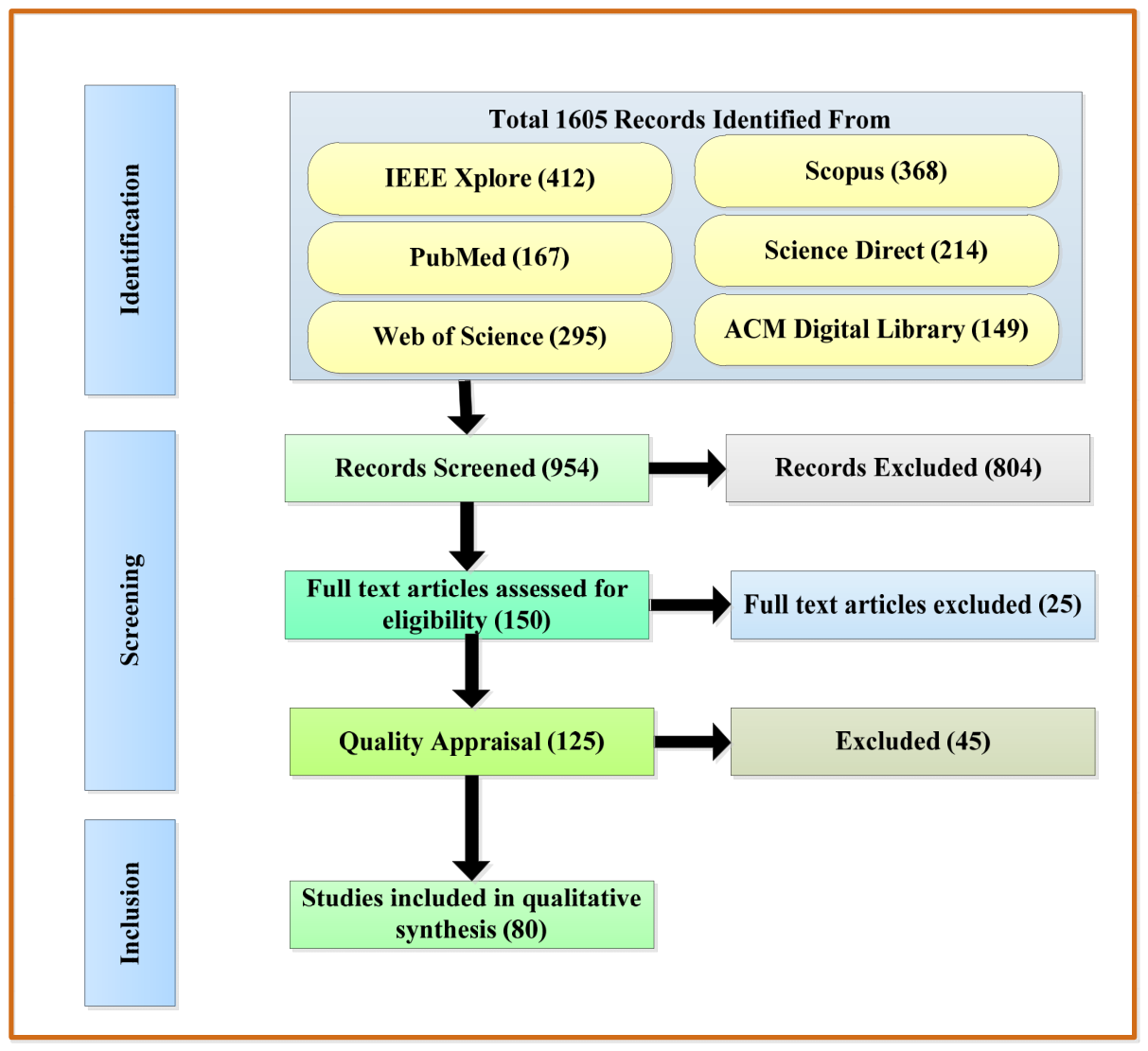
To ensure scientific rigor, transparency, replicability, and erudition, the study methodology employs a Systematic Literature Review strategy in accordance with the PRISMA criteria. This approach is comparable to several previous systematic reviews of the healthcare literature. The review specifically searched for academic research on privacy-preserving federated learning techniques or technologies in healthcare systems. The process was implemented over five phases: (i) research planning, which includes the identification of review objectives and research questions; (ii) identification, which includes searching relevant electronic databases using pre-defined keywords, as well as searching using Boolean operators; (iii) screening, which involves the removal of duplicates and other studies based on criteria; (iv) eligibility, which involves reviewing complete, full-text articles against inclusion and exclusion criteria; and (v) inclusion for synthesis, where only the highest quality studies meeting the research standards for inclusion are included. In terms of methodology, a systematic, multi-phase procedure was used to guarantee that only the most pertinent and reliable scientific research was reviewed. In addition, the PRISMA framework in Figure 1 provided a visual display of the selection flow to enable transparency in the review and traceability of the studies through the review process.

3.1. Search Strategy

To locate the literature on privacy protection strategies in healthcare federated learning, using databases from the Web of Science, ScienceDirect, Scopus, IEEE Xplore, PubMed, and ACM Digital Library, a PRISMA-based search strategy was created. Using Boolean operators, keywords like federated learning, privacy, security, healthcare, and medical, the search technique restricts results to peer-reviewed English-language sources in certain subject areas published between January 2015 and December 2025.
Search Query:
(“federated learning” OR “federated machine learning”) AND
(“privacy” OR “privacy-preserving” OR “security”) AND
(“healthcare” OR “medical”)
This query was adapted to the syntax requirements of Web of Science, Scopus, IEEE Xplore, ScienceDirect, PubMed, and ACM Digital Library.

3.2. Inclusion and Exclusion Criteria

Studies focusing on privacy-preserving federated learning (PPFL) or security techniques applied to healthcare applications; employing FL-based approaches such as homomorphic encryption, differential privacy, blockchain, Secure Multi-Party Computation, quantum cryptography, GDPR, or HIPAA; specifically related to healthcare; peer-reviewed; and published in English between 2015 and 2025 were considered eligible. The database search identified 1605 records with 412 manuscripts from IEEE Xplore, 368 manuscripts from Scopus, 295 manuscripts from Web of Science, 214 manuscripts from ScienceDirect, 167 manuscripts from PubMed and 149 manuscripts from ACM Digital Library. After removing 651 duplicate records, 954 manuscripts are utilized for title and abstract screening. At this stage, 804 records were excluded due to being out of the review scope and, hence, 150 full-text articles were assessed for eligibility. Then, for the full-text evaluation, 25 articles were excluded due to non-healthcare applications, insufficient empirical evidence, the full text being unavailable, or failure to satisfy the inclusion criteria. Then, 125 studies satisfied the eligibility criteria and were employed for quality assessment. Finally, 45 studies were excluded in the quality appraisal because of insufficient methodological rigidity or inadequate description of privacy-preserving mechanisms, resulting in 80 studies included in the final qualitative synthesis. The summary of inclusion and exclusion criteria used is shown in Table 2.

3.3. Screening and Selection

The study selection followed the PRISMA 2020 workflow. Initially, 1605 records are retrieved from six electronic databases. After removing 651 duplicate publications, 954 unique articles are utilized for title and abstract screening. In the screening process, 804 records are excluded because of being unrelated to domains like federated learning, privacy preservation, and healthcare applications, or failing to satisfy the predefined eligibility criteria. The remaining 150 full-text articles are independently assessed based on eligibility; 25 articles are excluded due to the lack of sufficient empirical validation. For the remaining 125 studies, methodological quality appraisal is employed using the structured checklist evaluating relevance, methodological rigor, reproducibility, clarity of privacy mechanisms and completeness of experimental evaluation. In the quality assessment, 45 studies are excluded and 80 high-quality studies included in the qualitative synthesis.

3.4. Data Extraction

Data was extracted independently by two reviewers using a data extraction form which included publication year, healthcare domain, federated learning architecture, privacy-preserving techniques, datasets, threat models, evaluation metrics, regulatory considerations, key findings, and reported limitations. Disagreements were resolved through discussion until consensus was reached. Other variables extracted included country/region, study type, computational overhead, communication cost, and future research recommendations. Each study was later assessed using a quality assessment checklist adopted from established SLR guidelines and grouped according to the application domain, security threats, regulatory considerations and technology. Due to the methodological heterogeneity among studies and the qualitative nature of the review, no quantitative effect measures or meta-analysis were conducted. Potential reporting bias may exist as this study includes only peer-reviewed English-language publications. Gray literature, technical reports, dissertations, and non-English studies were excluded. Certainty-of-evidence assessment methods like GRADE were not applied because the review synthesized technological studies rather than clinical outcomes.
Each included study was coded independently by two reviewers into thematic categories (e.g., privacy-preserving method, application domain, research focus) using a predefined coding sheet. A study could be assigned to multiple categories when applicable. Inter-rater agreement was 92%, and disagreements were resolved by consensus.

4. Result and Discussion

To locate the best studies on privacy-preserving federated learning in healthcare, the SLR was carried out in accordance with PRISMA principles in Web of Science, Scopus, ScienceDirect, and IEEE Xplore. The search strategy includes keywords such as federated learning, privacy, security, healthcare, and medical combined with Boolean operators, and limits results to peer-reviewed English language sources from 2015 to 2025 in specified subject areas. Table 3 shows the distribution of the reference papers by year of publication.

4.1. Key Insights

According to the systematic review, in the age of digital transformation, privacy-preserving federated learning (PPFL) is now a crucial component for safe healthcare data analysis. Scholars have shown across the literature that federated learning (FL) allows collaborative data analysis using data collected at multiple institutions without exchanging raw patient data, improving confidentiality and regulatory adherence to well-known international privacy legislation like GDPR and HIPAA. In addition to novel distributed trust techniques based on blockchain technology, new cryptographic techniques make use of Secure Multi-Party Computation (SMPC), homomorphic encryption (HE), and differential privacy (DP), which also further the transparency and resilience of healthcare AI models. Hybrid FL designs integrating edge, cloud, and IoMTs nodes have progressed healthcare 4.0 applications in domains including medical imaging, illness prediction, continuous patient monitoring. The data presented a gradual increasing interest and attention for the topic of PPFL from 2020 onward, indicating an increased worldwide emphasis on high-quality, secure, explainable, interoperable AI for healthcare intelligence.

4.2. Research Gaps and Limitations

There are still a number of gaps in the current literature, even with substantial progress. Most frameworks have been validated using either controlled simulation, or a single-institution dataset, lacking information on end-use, real-world deployment and evaluation on a large-scale with diverse, non-IID datasets. The majority of the reviewed studies emphasize algorithmic innovation, but neglect regulatory compliance across jurisdictions, long-term scalability, and the energy efficiency of IoMTs devices. Considerations of privacy–utility trade-offs are seldom quantified with clinical metrics, and the lack of explainability impedes medical interpretability. Also, there is a lack of standard benchmarks, comparative performance metrics, and unified evaluation protocols to assess reproducibility and make objective comparisons between studies. There are also very few studies that take a multi-faceted approach concerning security (e.g., cryptography, blockchain, and trusted hardware) towards a cohesive framework. While considering the healthcare domain, non-consideration of multimodal data like hospital information systems, electronic health records, radiology infrastructures and pathology systems degrades the model convergence and reduces generalizability among federated healthcare participants. There are issues concerning the resource challenges existing within the utilization of wearable devices, implantable sensors, mobile healthcare platforms and remote patient monitoring systems that require energy, memory and communication constraints. These gaps inhibit the translation of PPFL research from ideas to practice in the clinical environment.

4.3. Future Research Directions

Future research into privacy-preserving federated learning in healthcare should aim to explore scalable/layered designs across silos of heterogeneous data and multimodal medical data (e.g., electronic health records, diagnostic imaging, and IoMTs sensor streams). The frameworks should facilitate hierarchical aggregation and personalization/engagement layers in order to dynamically engage client populations and a non-IID data distribution. An additional future direction of research includes developing lightweight, permissioned blockchain systems for logging model updates and transaction/meta data for verifiable auditing trails while not incurring high computational and network overhead. Researchers also should examine the potential use of differential privacy together with homomorphic encryption to simultaneously provide both privacy mechanisms: homomorphic encryption for secure computation, and differential privacy for noise injection at the output level to mitigate gradient leakage, while protecting clinical accuracy. Optimizing Secure Multi-Party Computation protocols is also an important area to maximize low-latency energy efficient computing on IoTs and edge devices which are often constrained in resources. In addition, the design of lightweight post-quantum cryptographic mechanisms, hybrid secure aggregation architectures and clinically validated quantum-resistant federated healthcare systems needs to be considered for balancing long-term security protection and practical deployment feasibility. Host energy-aware federated algorithms, model compression, and asynchronous aggregation will aid in further research and scalability, responsiveness, and other considerations for near real-time patient monitoring applications.
A new area on the horizon is the use of reinforcement learning and deep anomaly detection algorithms to detect and mitigate adversarial threats (e.g., data poisoning, back-door insertion, and gradient inference attacks) in real time. Lastly, as we are transitioning into a new era of quantum computing, future researchers will also need to address the issues around lattice-based cryptographic primitives and post-quantum key-exchange protocols to ensure all elements of the federated healthcare system are secured for the long term. Additionally, privacy compliance must evolve from an after-the-fact consideration to a principle of “compliance-by-design,” which requires embedding technologies for auditable consent management and explainable AI (XAI) into the system architecture. Finally, collaborative frameworks between institutions must use standardized APIs and interoperability protocols that can ensure the trust, privacy, and transparency of collaboration between hospitals and research organizations worldwide. By engaging with and prioritizing these research directions, the development of AI federated learning ecosystems that are trustworthy, efficient, clinically validated, and able to guarantee patient privacy while promoting data informed medical innovation can now be pursued.

4.4. SWOT Analysis of Privacy-Preserving Federated Learning in Healthcare

A SWOT analysis as shown in Table 4 is presented to aid in strategic decisions for the implementation and integration of privacy-preserving federated learning technology. The SWOT analysis for PPFL is perceived to offer significant insights to the health community and the authorities for the implementation of PPFL systems in real-world health environments.

4.5. Technical and Conceptual Challenges with Possible Solutions

Adopting privacy-preserving federated learning (PPFL) in healthcare is still plagued by technical and conceptual challenges that slow its uptake in the market. The first and arguably greatest hurdle is that medical data is multidimensional, heterogeneous, and often non-IID across locations, which causes a bias in the convergence of the models and limits generalizability. Future modeling approaches should be informed by clustered or personalized federated learning and other methods, such as domain adaptation, that align the feature space across institutions. The ability to fine-tune the privacy–utility tradeoff is another challenge, as improved privacy guarantees through differential privacy are often synonymous with reduced accuracy of a model. Future solutions may focus on adaptive-privacy noise mechanisms and hybrid solutions that utilize differential privacy together with homomorphic encryption, which would allow for the ability to modify the privacy level dynamically and according to the model sensitivity, to improve upon clinical utility while preserving confidentiality. High communication and computation overheads create an additional barrier against adoption in, for example, IoMTs and Edge devices with limited battery capacity and processing power. Lightweight schemes for encryption, model compression, gradient sparsification, and asynchronous aggregation are all promising methods for enhancing energy efficiency while maintaining privacy guarantees. Finally, security threats like model poisoning, backdoor attacks, or data reconstruction attacks continue to pose a threat to the reliability of federated models.

5. Synthesis of Results

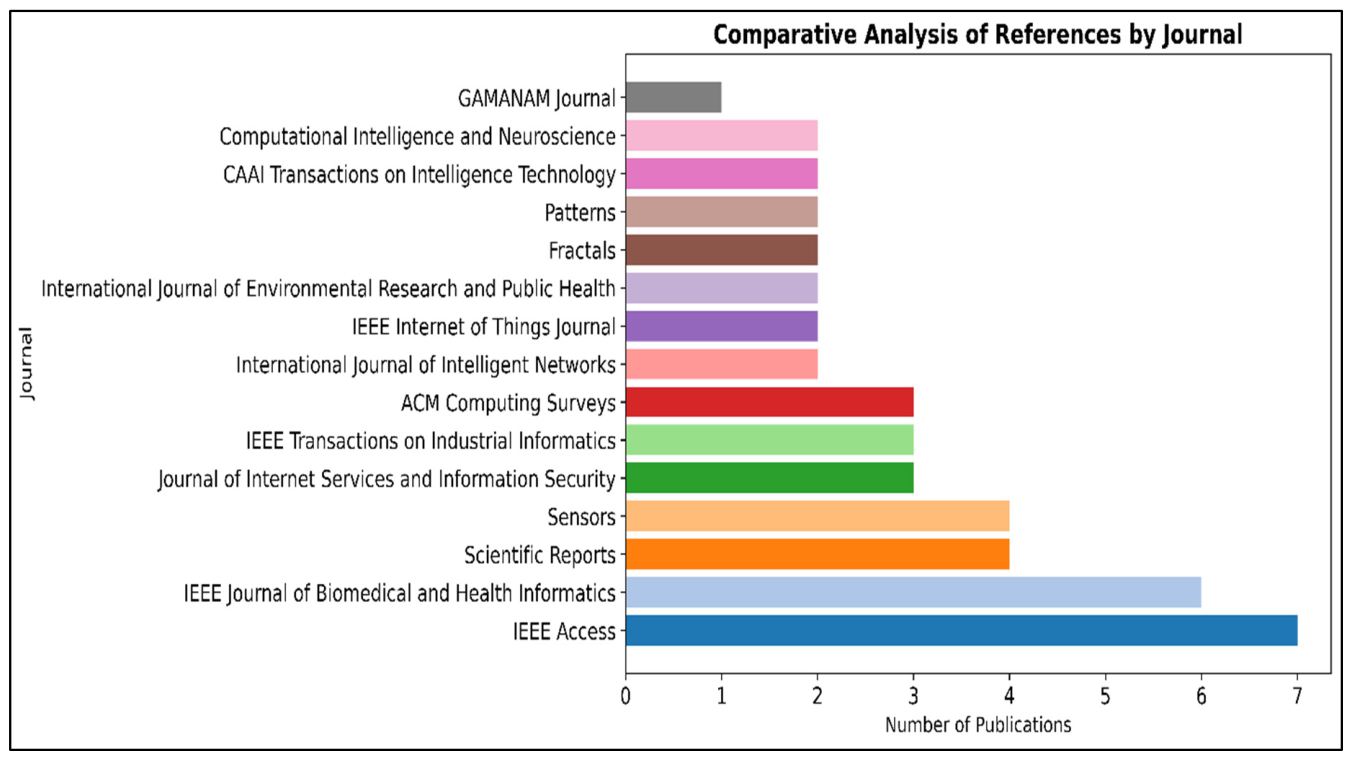
The comparison of references by journal sources is displayed in Figure 2. It points out that journals like IEEE Access, IEEE Journal of Biomedical and Health Informatics, and Sensors have the most contributions in terms of studies because they have been especially interested in research addressing FL, privacy, and security within the context of healthcare applications. This distribution draws attention to pertinent literature’s emphasis on leading sustainability and energy-focused periodicals.
Several reviewed studies reported quantitative metrics related to privacy, model performance, and system overhead. For differential privacy, the values of ε varied between low and moderate. However, the values of δ reported were mostly not clear. In relation to the performance of a system or model—as is the case for federated learning-based HCA—accuracy, AUC, or the F1 score, etc., is reported and found to be comparative and/or better and higher than 80% for classification-based models. The quantitative metrics reported in the reviewed PPFL healthcare studies is shown in Table 5.
The system-level cost was also mentioned, but less regularly. However, representative work exists regarding the cost of communication rounds, training runtime, and the cost of bandwidth. A high cost is also associated with more robust privacy features like homomorphic encryption and aggregation. The results will be offered descriptively, considering the differences in the data sets, threat models, and experiments.
On the basis of the bibliometric analysis of the publications, a more comprehensive study was carried out to verify the most often used methods and principal applications, among other contributions. A summary of the topics covered in the articles is provided in Table 6.
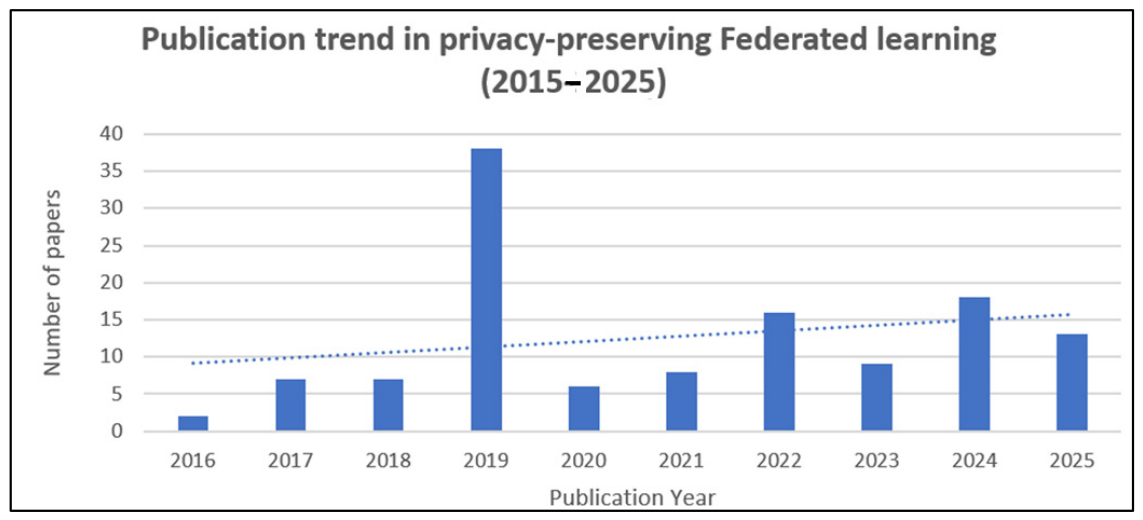
Figure 3 illustrates the anticipated yearly growth in publications on privacy-preserving federated learning site selection from 2015 to 2025. With a minimal production from 2015 to 2017 and a maximum in 2023, consistent rise is evident. The rapid expansion following 2020 indicates a fitting rise in global interest. Figure 3 was generated from the publication-year metadata of the included studies exported via Zotero (last search: February 2026); counts correspond exactly to Table 3. The recommended pathways for further studies and the relevant studies to build on is given in Table 7.
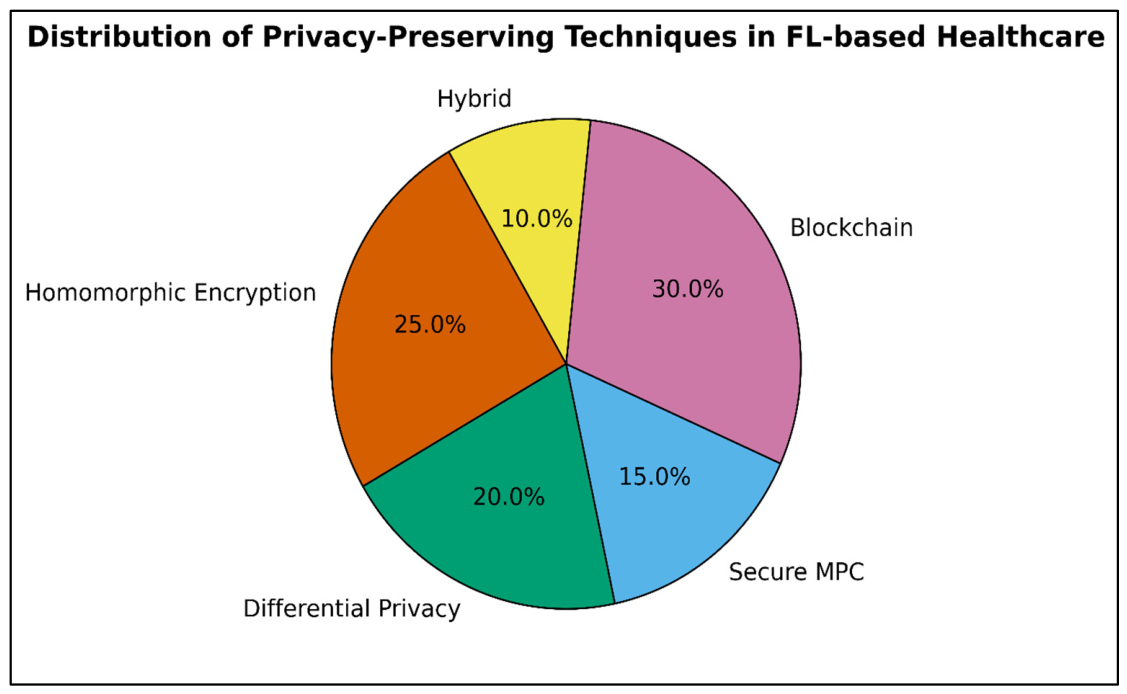
Figure 4 demonstrates the distribution of privacy-preserving methods applied in FL-based healthcare applications. The findings demonstrate that blockchain-based frameworks occupy largest share in the dataset at 30%. Homomorphic encryption is the next largest distribution at 25%. The area of differential privacy follows with 20%. SMPC techniques distributed to 15%, which show an interest in collaboration functions and usage while keeping the original data secured. The hybrid area made up of two or more methods to protect privacy category comprises 10%.
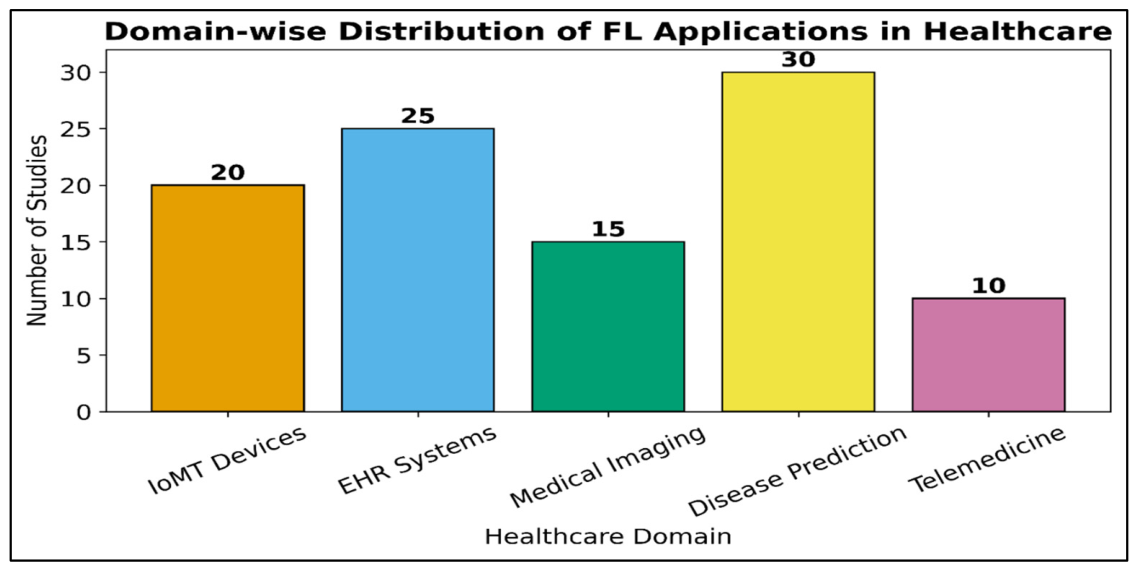
Figure 5 shows FL applications distributed by domain, in healthcare. FL is predominantly conducted in the disease prediction dominate with 30 studies. EHR systems follow with 25 studies. The trend is perhaps more apparent in applications based on IoMTs devices for 20 studies. Medical imaging applications illustrate a contribution of 15 studies. The literature includes 10 studies on telemedicine applications. Overall, the trend indicates there is a prime focus on both disease prediction, and EHR-based applications, creating a demand for secure derivation of clinical intelligence in a data-driven manner.
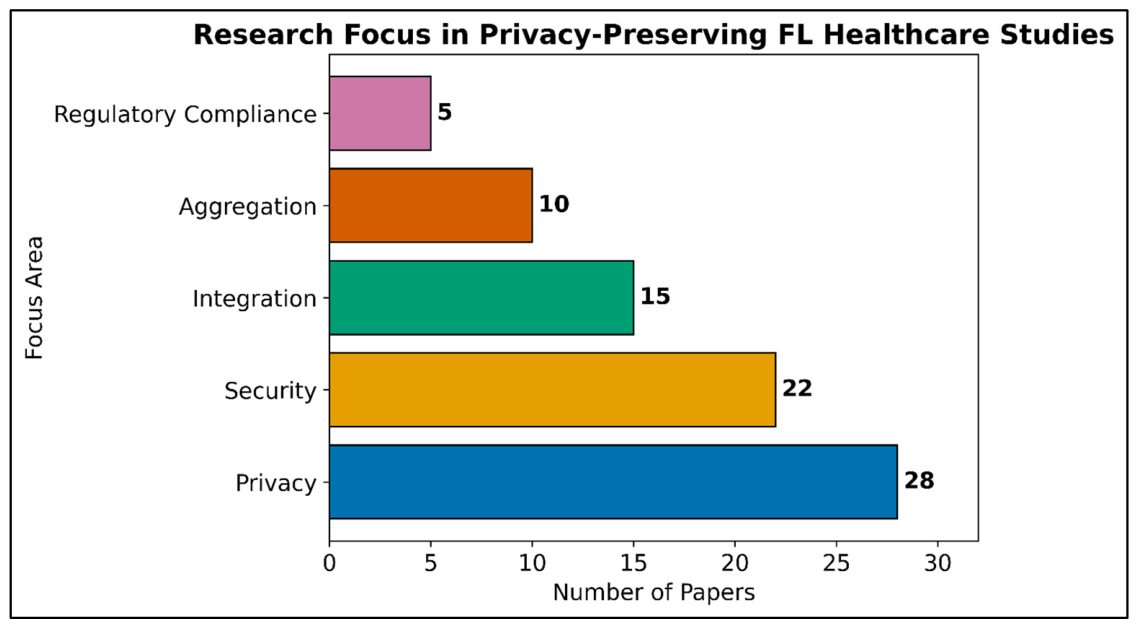
Figure 6 illustrates the focus of research on privacy-preserving federated learning (FL) studies in healthcare. Overall, participants are focusing their research on privacy (n = 28), contributing to the significance of privacy-preserving federated learning process in security management of data and protection of privacy. Security (n = 22) was the second category of emphasis on research focus, signaling that systematic and curated efforts are being put forth to secure at-risk safety from threats and attacks towards the model. The degree of integration in healthcare is illustrated in the 15 papers that considered co-usage components of FL and healthcare settings and systems, with the aggregated research category comprising 10 papers. The least amount of research focus and effort was on regulation compliance (n = 5) regarding the policies and legalities faced by healthcare organizations. Table 8 shows the frequency of the privacy and security methods used in reviewed studies.
Differential privacy and blockchain-based federated learning emerged as the most frequently adopted approaches in the reviewed studies, indicating a strong research focus on lightweight privacy preservation and decentralized trust management. In contrast, homomorphic encryption and Byzantine-robust aggregation methods were less commonly employed, primarily due to their computational overhead and deployment complexity in healthcare environments. Table 9 provides a overview of different threat models, privacy mechanisms, datasets, metrics and compliance considerations.

5.1. Complaince Mapping

Privacy-preserving federated learning models are designed to align with the major healthcare data protection regulations like the GDPR and HIPAA. Federated learning supports the data minimization principles by locally storing the data within the participating institutions. The differential privacy mechanisms support the anonymization and re-identification resistance requirements. Still, technical privacy preservation does not guarantee full regulatory compliance. Thus, GDPR requires lawful processing, explicit consent management, explainability, accountability, data portability and the right to erasure. In addition, HIPAA provides administrative safeguards, access control mechanisms, auditability, breach notification procedures and protected health information management standards for secure sensitive healthcare data processing. Table 10 illustrates concrete examples where technical privacy mechanisms alone do not satisfy legal requirements, and how each gap can be mitigated.
Table 10. Operational gaps and mitigations for PPFL techniques under GDPR and HIPAA.
Privacy-Preserving TechniqueTechnical ContributionGovernance and Institutional RequirementKey Regulatory GapSuggested Mitigation
Differential PrivacyProtects against inference attacks by adding statistical noiseConsent management, privacy governance, and data subject rights administrationDoes not inherently support GDPR right to erasure or access requestsIntegrate consent management systems and data deletion workflows
Homomorphic EncryptionEnables computation on encrypted healthcare dataSecure key lifecycle management, audit policies, and operational governanceLimited auditability of encrypted operationsCombine with secure logging and institutional auditing mechanisms
Secure Multi-Party Computation (SMPC)Enables collaborative computation without exposing local datasetsCross-institutional agreements, governance policies, and trusted collaboration proceduresComplex coordination among multiple healthcare organizationsStandardize governance frameworks and collaboration protocols
Secure AggregationProtects individual model updates during aggregationParticipant authentication, access control, and continuous monitoringMalicious participants may still compromise collaborative learningImplement role-based access control and participant verification mechanisms
Blockchain-based Federated LearningProvides auditability, integrity, accountability, and decentralized trustData governance policies, legal agreements, compliance oversight, and audit managementBlockchain immutability may conflict with GDPR right to erasureStore sensitive healthcare data off-chain while maintaining hashed references on-chain
Quantum Key Distribution (QKD)Provides information-theoretically secure cryptographic key exchangeSecurity policy integration, specialized infrastructure management, and interoperability planningLimited deployment maturity in healthcare environmentsHybrid deployment supported by institutional security policies
Post-Quantum Cryptography (PQC)Provides quantum-resistant encryption and authenticationCryptographic migration planning, compliance audits, policy updates, and long-term governanceOngoing algorithm standardization and migration challengesGradually adopt standardized PQC algorithms with backward-compatible migration strategies
Overall Regulatory ComplianceTechnical mechanisms strengthen privacy and securityInstitutional governance, legal compliance, ethical oversight, consent management, access control, audit procedures, incident response planning, staff training, and continuous regulatory monitoringTechnical safeguards alone cannot satisfy all GDPR and HIPAA obligationsIntegrate technical privacy mechanisms with comprehensive governance and regulatory compliance frameworks
The comparison table for the proposed review and the existing methods is presented in Table 11.
Table 11. Comparison of review methods.
CriteriaAli et al. [2] (2022)Nguyen et al. [21] (2022)Gu et al. [18] (2023)Myrzashova et al. [50] (2024)Rauniyar et al. [55]Bashir et al. [37]Pati et al. [3]Proposed Review
Healthcare FL Survey
Differential PrivacyPartialPartialPartial
Homomorphic EncryptionPartialPartialNoPartial
Secure Multi-Party ComputationPartialPartialNoNoPartial
Secure AggregationPartialNoPartialNoNoPartial
Blockchain IntegrationLimitedNoPartialNoNoLimited✓ (Auditability, Integrity, Decentralization)
Quantum Key Distribution (QKD)NoNoNoNoNoNoNoDiscussed as Emerging Secure Key Exchange Technology
Post-Quantum Cryptography (PQC)NoNoNoNoNoNoNoIncluded with Future Deployment Challenges
GDPR/HIPAA ComplianceComprehensiveLimitedNoNoNoLimitedNoComprehensive
Regulatory MappingPartialNoNoNoNoNoNoComprehensive
✓ represents the criteria is addressed by the corresponding paper.

5.2. Limitations of the Review

Despite the methodological rigor, some of the limitations of the study should be acknowledged. The inclusion of the studies published in English may have resulted in exclusion of relevant research reported in other languages. Though this study considers six major academic databases, potentially relevant studies indexed in other databases may not have been captured. Gray literature including dissertations, technical reports and white papers were excluded, which may have limited the comprehensiveness of the study. Heterogeneity among the included studies in terms of datasets, healthcare domains, privacy-preserving techniques, evaluation metrics prevented quantitative analysis and accommodated a qualitative synthesis approach. The search strategy is focused on the core concepts of federated learning, privacy, security, healthcare and medical domain. The studies describing privacy-preserving mechanisms based on technologies like blockchain, homomorphic encryption, Secure Multi-Party Computation, post-quantum cryptography, Quantum Key Distribution or secure aggregation without explicitly referring to the broader concepts of privacy or security may not have been retrieved in the initial database search. Several studies were identified using reference screening and citation chaining. Thus, the review provides the broad overview of privacy-preserving federated learning in healthcare.

6. Conclusions

To achieve collaborative intelligence without revealing patient information, the study carried out a thorough evaluation of privacy-preserving, federated learning frameworks in safe health contexts. The study conducted an analysis of 80 reviewed studies that are of high quality that occurred between 2015 and 2025, and concluded that there was a rapid movement toward privacy-preserving FL frameworks entailing blockchain, Secure multi-party computing (SMPC), homomorphic encryption, and differential privacy. The research indicates that FL is emerging as a promising enabler of healthcare 4.0 applications like: disease prediction, medical imaging, monitoring based on IoMTs, and EHR analytics all while attaining data privacy standards. The review also reveals that no single privacy-preserving model is sufficient to address all the security, privacy, scalability, and performance requirements of emerging healthcare environments. Recent research increasingly favors hybrid architectures that combines multiple complementing techniques to improve confidentiality, trust, and system resilience. Though these advancements have considerably advanced secure healthcare intelligence, challenges associated with communication costs, heterogeneous data distributions, adversarial threats, interoperability, and large-scale deployment remain open research problems.
Future investigation efforts need to design adaptive and cross-silo FL frameworks that will tackle heterogeneous medical data while supporting strong model convergence. Additional research is also required to improve interoperability, long-term security against evolving threats and practical deployment guidelines for real-world applications. Addressing these challenges will be essential towards building a trust-worthy next-generation healthcare system that can effectively balance privacy, performance and operational sustainability.

Author Contributions

Conceptualization, A.A. and N.N.; methodology, A.A.; software, A.A.; validation, A.A. and N.N.; formal analysis, A.A. and N.N.; investigation, A.A. and N.N.; resources, A.A. and N.N.; data curation, A.A.; writing—original draft preparation, A.A. and N.N.; writing—review and editing, A.A. and N.N.; visualization, A.A. and N.N.; supervision, A.A. and N.N.; project administration, A.A.; funding acquisition, A.A. All authors have read and agreed to the published version of the manuscript.

Funding

This research was self-funded by the authors.

Data Availability Statement

The data supporting the findings of this research study are available within the article. No new datasets were generated in this study.

Conflicts of Interest

The authors declare that they have no known competing financial or non-financial interests that could have appeared to influence the work reported in this paper.

References

  1. Abaoud, M.; Almuqrin, M.A.; Khan, M.F. Advancing federated learning through novel mechanism for privacy preservation in healthcare applications. IEEE Access 2023, 11, 83562–83579. [Google Scholar] [CrossRef]
  2. Ali, M.; Naeem, F.; Tariq, M.; Kaddoum, G. Federated learning for privacy preservation in smart healthcare systems: A comprehensive survey. IEEE J. Biomed. Health Inform. 2022, 27, 778–789. [Google Scholar] [CrossRef]
  3. Pati, S.; Kumar, S.; Varma, A.; Edwards, B.; Lu, C.; Qu, L.; Wang, J.J.; Lakshminarayanan, A.; Wang, S.H.; Sheller, M.J.; et al. Privacy preservation for federated learning in healthcare. Patterns 2024, 5, 100974. [Google Scholar] [CrossRef] [PubMed]
  4. Yazdinejad, A.; Dehghantanha, A.; Srivastava, G. AP2FL: Auditable privacy-preserving federated learning framework for electronics in healthcare. IEEE Trans. Consum. Electron. 2023, 70, 2527–2535. [Google Scholar] [CrossRef]
  5. Gadekallu, T.R.; Alazab, M.; Hemanth, J.; Wang, W. Guest editorial federated learning for privacy preservation of healthcare data in internet of medical things and patient monitoring. IEEE J. Biomed. Health Inform. 2023, 27, 648–651. [Google Scholar] [CrossRef]
  6. Lakhan, A.; Mohammed, M.A.; Nedoma, J.; Martinek, R.; Tiwari, P.; Vidyarthi, A.; Alkhayyat, A.; Wang, W. Federated-learning based privacy preservation and fraud-enabled blockchain IoMT system for healthcare. IEEE J. Biomed. Health Inform. 2022, 27, 664–672. [Google Scholar] [CrossRef]
  7. Rehman, A.; Razzak, I.; Xu, G. Federated learning for privacy preservation of healthcare data from smartphone-based side-channel attacks. IEEE J. Biomed. Health Inform. 2022, 27, 684–690. [Google Scholar] [CrossRef]
  8. Rahmadika, S.; Astillo, P.V.; Choudhary, G.; Duguma, D.G.; Sharma, V.; You, I. Blockchain-based privacy preservation scheme for misbehavior detection in lightweight IoMT devices. IEEE J. Biomed. Health Inform. 2022, 27, 710–721. [Google Scholar] [CrossRef]
  9. Singh, P.; Gaba, G.S.; Kaur, A.; Hedabou, M.; Gurtov, A. Dew-cloud-based hierarchical federated learning for intrusion detection in IoMT. IEEE J. Biomed. Health Inform. 2022, 27, 722–731. [Google Scholar] [CrossRef]
  10. Aouedi, O.; Sacco, A.; Piamrat, K.; Marchetto, G. Handling privacy-sensitive medical data with federated learning: Challenges and future directions. IEEE J. Biomed. Health Inform. 2022, 27, 790–803. [Google Scholar] [CrossRef]
  11. Han, B.; Jhaveri, R.H.; Wang, H.; Qiao, D.; Du, J. Application of robust zero-watermarking scheme based on federated learning for securing the healthcare data. IEEE J. Biomed. Health Inform. 2021, 27, 804–813. [Google Scholar] [CrossRef]
  12. Lian, Z.; Yang, Q.; Wang, W.; Zeng, Q.; Alazab, M.; Zhao, H.; Su, C. DEEP-FEL: Decentralized, efficient and privacy-enhanced federated edge learning for healthcare cyber physical systems. IEEE Trans. Netw. Sci. Eng. 2022, 9, 3558–3569. [Google Scholar] [CrossRef]
  13. Hao, H.; Xu, C.; Zhang, W.; Yang, S.; Muntean, G.M. Task-driven priority-aware computation offloading using deep reinforcement learning. IEEE Trans. Wirel. Commun. 2025, 24, 8114–8128. [Google Scholar] [CrossRef]
  14. Arikumar, K.S.; Prathiba, S.B.; Alazab, M.; Gadekallu, T.R.; Pandya, S.; Khan, J.M.; Moorthy, R.S. FL-PMI: Federated learning-based person movement identification through wearable devices in smart healthcare systems. Sensors 2022, 22, 1377. [Google Scholar] [CrossRef] [PubMed]
  15. Zhang, L.; Xu, J.; Vijayakumar, P.; Sharma, P.K.; Ghosh, U. Homomorphic encryption-based privacy-preserving federated learning in IoT-enabled healthcare system. IEEE Trans. Netw. Sci. Eng. 2022, 10, 2864–2880. [Google Scholar] [CrossRef]
  16. Stephanie, V.; Khalil, I.; Atiquzzaman, M.; Yi, X. Trustworthy privacy-preserving hierarchical ensemble and federated learning in healthcare 4.0 with blockchain. IEEE Trans. Ind. Inform. 2022, 19, 7936–7945. [Google Scholar] [CrossRef]
  17. Kalejaiye, A.N.; Shallom, K.; Chukwuani, E.N. Implementing federated learning with privacy-preserving encryption to secure patient-derived imaging and sequencing data from cyber intrusions. Int. J. Sci. Res. Arch. 2025, 16, 1126–1145. [Google Scholar] [CrossRef]
  18. Gu, X.; Sabrina, F.; Fan, Z.; Sohail, S. A review of privacy enhancement methods for federated learning in healthcare systems. Int. J. Environ. Res. Public Health 2023, 20, 6539. [Google Scholar] [CrossRef] [PubMed]
  19. Sindhusaranya, B.; Yamini, R.; Manimekalai, M.A.P.; Geetha, K. Federated learning and blockchain-enabled privacy-preserving healthcare 5.0 system: A comprehensive approach to fraud prevention and security in iomt. J. Internet Serv. Inf. Secur. 2023, 13, 199–209. [Google Scholar] [CrossRef]
  20. Maurya, A.; Haripriya, R.; Pandey, M.; Choudhary, J.; Singh, D.P.; Solanki, S.; Sharma, D. Federated Learning for Privacy-Preserving Severity Classification in Healthcare: A Secure Edge-Aggregated Approach. IEEE Access 2025, 13, 102339–102358. [Google Scholar] [CrossRef]
  21. Nguyen, D.C.; Pham, Q.V.; Pathirana, P.N.; Ding, M.; Seneviratne, A.; Lin, Z.; Dobre, O.; Hwang, W.J. Federated learning for smart healthcare: A survey. ACM Comput. Surv. (Csur) 2022, 55, 1–37. [Google Scholar] [CrossRef]
  22. Gajendran, S.; Muthusamy, R.; Ravi, K.; Chandraumakantham, O.; Marappan, S. Elliptic crypt with secured blockchain assisted federated Q-learning framework for smart healthcare. IEEE Access 2024, 12, 45923–45935. [Google Scholar] [CrossRef]
  23. Alkhalifa, A.K.; Alanazi, M.H.; Mahmood, K.; Almukadi, W.S.; Qurashi, M.A.; Alshehri, A.H.; Alanazi, F.; Mohamed, A.A. Harnessing Privacy-Preserving Federated Learning with Blockchain for Secure Iomt Applications in Smart Healthcare Systems. Fractals 2024, 32, 2540020. [Google Scholar] [CrossRef]
  24. Grama, M.; Musat, M.; Muñoz-González, L.; Passerat-Palmbach, J.; Rueckert, D.; Alansary, A. Robust aggregation for adaptive privacy preserving federated learning in healthcare. arXiv 2020, arXiv:2009.08294. [Google Scholar]
  25. Kuliha, M.; Verma, S. Secure internet of medical things based electronic health records scheme in trust decentralized loop federated learning consensus blockchain. Int. J. Intell. Netw. 2024, 5, 161–174. [Google Scholar] [CrossRef]
  26. Dhasaratha, C.; Hasan, M.K.; Islam, S.; Khapre, S.; Abdullah, S.; Ghazal, T.M.; Alzahrani, A.I.; Alalwan, N.; Vo, N.; Akhtaruzzaman, M. Data privacy model using blockchain reinforcement federated learning approach for scalable internet of medical things. CAAI Trans. Intell. Technol. 2024, 1–16. [Google Scholar] [CrossRef]
  27. Akande, O. Integrating Blockchain with Federated Learning for Privacy-Preserving Data Analytics Across Decentralized Governmental Health Information Systems. Int. J. Comput. Appl. Technol. Res. 2022, 11, 622–637. [Google Scholar]
  28. Alsamhi, S.H.; Myrzashova, R.; Hawbani, A.; Kumar, S.; Srivastava, S.; Zhao, L.; Wei, X.; Guizan, M.; Curry, E. Federated learning meets blockchain in decentralized data sharing: Healthcare use case. IEEE Internet Things J. 2024, 11, 19602–19615. [Google Scholar] [CrossRef]
  29. Xu, X.; Peng, H.; Bhuiyan, M.Z.A.; Hao, Z.; Liu, L.; Sun, L.; He, L. Privacy-preserving federated depression detection from multisource mobile health data. IEEE Trans. Ind. Inform. 2021, 18, 4788–4797. [Google Scholar] [CrossRef]
  30. Krishnaprasath, V.T.; Pamisetty, V.; Sharma, V.; Nayak, M.; Baalakumar, N.N.; Aravindh, S. Federated Learning Based Artificial Intelligence Systems with Blockchain Security for Global Healthcare Collaboration and Patient Centric Data Privacy. In Proceedings of the International Conference on Sustainability Innovation in Computing and Engineering (ICSICE 2024); Atlantis Press: Dordrecht, The Netherlands, 2025; pp. 1277–1290. [Google Scholar]
  31. Bhattacharya, P.; Gupta, S.K.; Midhun, D. Decentralized Federated Learning Framework for Secure Healthcare Networks: Decentralized Federated Learning with Privacy Preservation in Healthcare. SGS-Eng. Sci. 2025, 1. Available online: https://spast.org/techrep/article/view/5307 (accessed on 30 November 2025).
  32. Bhasker, B.; Rao, P.M.; Saraswathi, P.; Patro, S.G.K.; Bhutto, J.K.; Islam, S.; Kareemullah, M.; Emma, A.F. Blockchain framework with IoT device using federated learning for sustainable healthcare systems. Sci. Rep. 2025, 15, 26736. [Google Scholar] [CrossRef] [PubMed]
  33. Almogadwy, B.; Alqarafi, A. Fused federated learning framework for secure and decentralized patient monitoring in healthcare 5.0 using IoMT. Sci. Rep. 2025, 15, 24263. [Google Scholar] [CrossRef] [PubMed]
  34. Silva, S.; Altmann, A.; Gutman, B.; Lorenzi, M. Fed-biomed: A general open-source frontend framework for federated learning in healthcare. In MICCAI Workshop on Domain Adaptation and Representation Transfer; Springer International Publishing: Cham, Switzerland, 2020; pp. 201–210. [Google Scholar]
  35. Yang, Y.; He, D.; Wang, J.; Feng, Q.; Luo, M. Epdr: An efficient and privacy-preserving disease research system with horizontal federated learning in the internet of medical things. Hum.-Centric Comput. Inf. Sci. 2024, 14, 1–19. [Google Scholar]
  36. Shrimali, B.; Gajjar, J. EnDuSecFed: An Ensemble approach for Privacy Preserving Federated Learning with Dual-security Framework for Healthcare. Front. Big Data 2026, 8, 1659026. [Google Scholar] [PubMed]
  37. Bashir, A.K.; Victor, N.; Bhattacharya, S.; Huynh-The, T.; Chengoden, R.; Yenduri, G.; Maddikunta, P.K.R.; Pham, Q.-V.; Gadekallu, T.R.; Liyanage, M. A survey on federated learning for the healthcare metaverse: Concepts, applications, challenges, and future directions. arXiv 2023, arXiv:2304.00524. [Google Scholar]
  38. Rani, S.; Kataria, A.; Kumar, S.; Tiwari, P. Federated learning for secure IoMT-applications in smart healthcare systems: A comprehensive review. Knowl.-Based Syst. 2023, 274, 110658. [Google Scholar]
  39. Lim, W.Y.B.; Garg, S.; Xiong, Z.; Niyato, D.; Leung, C.; Miao, C.; Guizani, M. Dynamic contract design for federated learning in smart healthcare applications. IEEE Internet Things J. 2020, 8, 16853–16862. [Google Scholar] [CrossRef]
  40. Qayyum, A.; Ahmad, K.; Ahsan, M.A.; Al-Fuqaha, A.; Qadir, J. Collaborative federated learning for healthcare: Multi-modal covid-19 diagnosis at the edge. IEEE Open J. Comput. Soc. 2022, 3, 172–184. [Google Scholar] [CrossRef]
  41. Kalapaaking, A.P.; Khalil, I.; Yi, X. Blockchain-based federated learning with SMPC model verification against poisoning attack for healthcare systems. IEEE Trans. Emerg. Top. Comput. 2023, 12, 269–280. [Google Scholar] [CrossRef]
  42. Panahi, O. Secure IoT for healthcare. Eur. J. Innov. Stud. Sustain. 2025, 1, 17–23. [Google Scholar] [CrossRef]
  43. Chang, Y.; Fang, C.; Sun, W. A Blockchain-Based Federated Learning Method for Smart Healthcare. Comput. Intell. Neurosci. 2021, 2021, 4376418. [Google Scholar] [CrossRef] [PubMed]
  44. Oyegoke, O. Transformers on encrypted federated datasets anchored by blockchain zero-knowledge proofs for privacy-preserving multilingual healthcare diagnostics and equity. Int. J. Res. Publ. Rev. 2024, 5, 6112–6128. [Google Scholar]
  45. Babu, K.M.; Bhavitha, E.; Mythri, M.; Anusha, A.; Chandana, B.S.; Gazala Akhtar, C. Privacy-Preserving Federated Learning for Healthcare: A Synergistic Approach using Differential Privacy and Homomorphic Encryption. SSRN Electron. J. 2025. [Google Scholar] [CrossRef]
  46. Gupta, D.; Kayode, O.; Bhatt, S.; Gupta, M.; Tosun, A.S. Hierarchical federated learning-based anomaly detection using digital twins for smart healthcare. In Proceedings of the 2021 IEEE 7th International Conference on Collaboration and Internet Computing (CIC); IEEE: New York, NY, USA, 2021; pp. 16–25. [Google Scholar]
  47. Ruvunangiza, J.; Valderrama, C. A Unified Framework for Secure Healthcare Data Sharing: Integrating Federated Learning, Blockchain, and Quantum Cryptography. J. Biomed. Res. Environ. Sci. 2024, 5, 1081–1088. [Google Scholar]
  48. Liu, Z.; Chen, Y.; Zhao, Y.; Yu, H.; Liu, Y.; Bao, R.; Jiang, J.; Nie, Z.; Xu, Q.; Yang, Q. Contribution-aware federated learning for smart healthcare. Proc. AAAI Conf. Artif. Intell. 2022, 36, 12396–12404. [Google Scholar] [CrossRef]
  49. Jin, H.; Dai, X.; Xiao, J.; Li, B.; Li, H.; Zhang, Y. Cross-cluster federated learning and blockchain for internet of medical things. IEEE Internet Things J. 2021, 8, 15776–15784. [Google Scholar] [CrossRef]
  50. Myrzashova, R.; Alsamhi, S.H.; Shvetsov, A.V.; Hawbani, A.; Wei, X. Blockchain meets federated learning in healthcare: A systematic review with challenges and opportunities. IEEE Internet Things J. 2023, 10, 14418–14437. [Google Scholar] [CrossRef]
  51. Zhang, J.; Zhu, H.; Wang, F.; Zhao, J.; Xu, Q.; Li, H. Security and privacy threats to federated learning: Issues, methods, and challenges. Secur. Commun. Netw. 2022, 2022, 2886795. [Google Scholar] [CrossRef]
  52. Sravanthi, D.B.; Krishna, P.V. Development of Federated Blockchain-IoT Public Health Network with Privacy-Preserving Analytics. GAMANAM Glob. Adv. Multidiscip. Appl. Next-Gen Mod. Technol. 2025, 1, 188–198. [Google Scholar]
  53. Akintan Favour, R.U.; Halili, F.; Fernando, C.A.; Hapuarachch, A.S.; Sharma, K. Privacy-Preserving Data Mining in AI-Driven Healthcare Applications. 2025. Available online: https://www.researchgate.net/publication/393254236_Privacy-Preserving_Data_Mining_in_AI-Driven_Healthcare_Applications (accessed on 30 November 2025).
  54. Patel, V.A.; Bhattacharya, P.; Tanwar, S.; Gupta, R.; Sharma, G.; Bokoro, P.N.; Sharma, R. Adoption of federated learning for healthcare informatics: Emerging applications and future directions. IEEE Access 2022, 10, 90792–90826. [Google Scholar] [CrossRef]
  55. Rauniyar, A.; Hagos, D.H.; Jha, D.; Håkegård, J.E.; Bagci, U.; Rawat, D.B.; Vlassov, V. Federated learning for medical applications: A taxonomy, current trends, challenges, and future research directions. IEEE Internet Things J. 2023, 11, 7374–7398. [Google Scholar] [CrossRef]
  56. Zhang, J.; He, M.; Yiu, S.M. Privacy-preserving elastic net for data encrypted by different keys-with an application on biomarker discovery. In Proceedings of the IFIP Annual Conference on Data and Applications Security and Privacy; Springer International Publishing: Cham, Switzerland, 2017; pp. 185–204. [Google Scholar]
  57. Khurana, R.; Kaul, D. Dynamic cybersecurity strategies for ai-enhanced ecommerce: A federated learning approach to data privacy. Appl. Res. Artif. Intell. Cloud Comput. 2019, 2, 32–43. [Google Scholar]
  58. Jiang, Y.; Wang, C.; Wu, Z.; Du, X.; Wang, S. Privacy-preserving biomedical data dissemination via a hybrid approach. AMIA Annu. Symp. Proc. 2018, 2018, 1176. [Google Scholar] [PubMed]
  59. Lazrig, I.; Moataz, T.; Ray, I.; Ray, I.; Ong, T.; Kahn, M.; Cuppens, F.; Cuppens, N. Privacy preserving record matching using automated semi-trusted broker. In Proceedings of the IFIP Annual Conference on Data and Applications Security and Privacy; Springer International Publishing: Cham, Switzerland, 2015; pp. 103–118. [Google Scholar]
  60. Casino, F.; Patsakis, C. An efficient blockchain-based privacy-preserving collaborative filtering architecture. IEEE Trans. Eng. Manag. 2019, 67, 1501–1513. [Google Scholar]
  61. Truex, S.; Baracaldo, N.; Anwar, A.; Steinke, T.; Ludwig, H.; Zhang, R.; Zhou, Y. A hybrid approach to privacy-preserving federated learning. In Proceedings of the 12th ACM Workshop on Artificial Intelligence and Security; Association for Computing Machinery: New York, NY, USA, 2019; pp. 1–11. [Google Scholar] [CrossRef]
  62. Lee, J.; Sun, J.; Wang, F.; Wang, S.; Jun, C.H.; Jiang, X. Privacy-preserving patient similarity learning in a federated environment: Development and analysis. JMIR Med. Inform. 2018, 6, e7744. [Google Scholar] [CrossRef]
  63. Choudhury, O.; Gkoulalas-Divanis, A.; Salonidis, T.; Sylla, I.; Park, Y.; Hsu, G.; Das, A. Differential privacy-enabled federated learning for sensitive health data. arXiv 2019, arXiv:1910.02578. [Google Scholar]
  64. Geyer, R.C.; Klein, T.; Nabi, M. Differentially private federated learning: A client level perspective. arXiv 2017, arXiv:1712.07557. [Google Scholar]
  65. Pfohl, S.R.; Dai, A.M.; Heller, K. Federated and differentially private learning for electronic health records. arXiv 2019, arXiv:1911.05861. [Google Scholar]
  66. Bonawitz, K.; Ivanov, V.; Kreuter, B.; Marcedone, A.; McMahan, H.B.; Patel, S.; Ramage, D.; Segal, A.; Seth, K. Practical secure aggregation for privacy-preserving machine learning. In Proceedings of the 2017 ACM SIGSAC Conference on Computer and Communications Security; Association for Computing Machinery: New York, NY, USA, 2017; pp. 1175–1191. [Google Scholar]
  67. Hardy, S.; Henecka, W.; Ivey-Law, H.; Nock, R.; Patrini, G.; Smith, G.; Thorne, B. Private federated learning on vertically partitioned data via entity resolution and additively homomorphic encryption. arXiv 2017, arXiv:1711.10677. [Google Scholar]
  68. Gade, S.; Vaidya, N.H. Privacy-preserving distributed learning via obfuscated stochastic gradients. In Proceedings of the 2018 IEEE Conference on Decision and Control (CDC); IEEE: New York, NY, USA, 2018; pp. 184–191. [Google Scholar]
  69. Bhowmick, A.; Duchi, J.; Freudiger, J.; Kapoor, G.; Rogers, R. Protection against reconstruction and its applications in private federated learning. arXiv 2018, arXiv:1812.00984. [Google Scholar]
  70. Xu, G.; Li, H.; Liu, S.; Yang, K.; Lin, X. VerifyNet: Secure and verifiable federated learning. IEEE Trans. Inf. Forensics Secur. 2019, 15, 911–926. [Google Scholar] [CrossRef]
  71. Hao, M.; Li, H.; Xu, G.; Liu, S.; Yang, H. Towards efficient and privacy-preserving federated deep learning. In Proceedings of the ICC 2019—2019 IEEE International Conference on Communications (ICC); IEEE: New York, NY, USA, 2019; pp. 1–6. [Google Scholar]
  72. Liu, Y.; Ma, Z.; Liu, X.; Ma, S.; Nepal, S.; Deng, R. Boosting privately: Privacy-preserving federated extreme boosting for mobile crowdsensing. arXiv 2019, arXiv:1907.10218. [Google Scholar]
  73. Mandal, K.; Gong, G. PrivFL: Practical privacy-preserving federated regressions on high-dimensional data over mobile networks. In Proceedings of the 2019 ACM SIGSAC Conference on Cloud Computing Security Workshop; Association for Computing Machinery: New York, NY, USA, 2019; pp. 57–68. [Google Scholar]
  74. Li, Y.; Yang, S.; Ren, X.; Zhao, C. Asynchronous federated learning with differential privacy for edge intelligence. arXiv 2019, arXiv:1912.07902. [Google Scholar]
  75. Ryffel, T.; Trask, A.; Dahl, M.; Wagner, B.; Mancuso, J.; Rueckert, D.; Passerat-Palmbach, J. A generic framework for privacy preserving deep learning. arXiv 2018, arXiv:1811.04017. [Google Scholar]
  76. Çatak, F.Ö. Secure multi-party computation-based privacy preserving extreme learning machine algorithm over vertically distributed data. In Proceedings of the International Conference on Neural Information Processing; Springer International Publishing: Cham, Switzerland, 2015; pp. 337–345. [Google Scholar]
  77. Mugunthan, V.; Polychroniadou, A.; Byrd, D.; Balch, T.H. Smpai: Secure multi-party computation for federated learning. In Proceedings of the NeurIPS 2019 Workshop on Robust AI in Financial Services; MIT Press: Cambridge, MA, USA, 2019; Volume 21. [Google Scholar]
  78. Gascón, A.; Schoppmann, P.; Balle, B.; Raykova, M.; Doerner, J.; Zahur, S.; Evans, D. Privacy-preserving distributed linear regression on high-dimensional data. Proc. Priv. Enhancing Technol. 2016, 2017, 345–364. [Google Scholar]
  79. Huang, H.; Gong, T.; Ye, N.; Wang, R.; Dou, Y. Private and secured medical data transmission and analysis for wireless sensing healthcare system. IEEE Trans. Ind. Inform. 2017, 13, 1227–1237. [Google Scholar] [CrossRef]
  80. Kuo, T.T.; Ohno-Machado, L. Model chain: Decentralized privacy-preserving healthcare predictive modeling framework on private blockchain networks. arXiv 2018, arXiv:1802.01746. [Google Scholar]
  81. Zhao, Y.; Zhao, J.; Jiang, L.; Tan, R.; Niyato, D. Mobile edge computing, blockchain and reputation-based crowdsourcing iot federated learning: A secure, decentralized and privacy-preserving system. arXiv 2019, arXiv:1906.10893. [Google Scholar]
  82. Lu, Y.; Huang, X.; Dai, Y.; Maharjan, S.; Zhang, Y. Blockchain and federated learning for privacy-preserved data sharing in industrial IoT. IEEE Trans. Ind. Inform. 2019, 16, 4177–4186. [Google Scholar] [CrossRef]
  83. Zhu, X.; Li, H.; Yu, Y. Blockchain-based privacy preserving deep learning. In Proceedings of the International Conference on Information Security and Cryptology; Springer International Publishing: Cham, Switzerland, 2018; pp. 370–383. [Google Scholar]
  84. Bao, X.; Su, C.; Xiong, Y.; Huang, W.; Hu, Y. Flchain: A blockchain for auditable federated learning with trust and incentive. In Proceedings of the 2019 5th International Conference on Big Data Computing and Communications (BIGCOM); IEEE: New York, NY, USA, 2019; pp. 151–159. [Google Scholar]
  85. Passerat-Palmbach, J.; Farnan, T.; Miller, R.; Gross, M.S.; Flannery, H.L.; Gleim, B. A blockchain-orchestrated federated learning architecture for healthcare consortia. arXiv 2019, arXiv:1910.12603. [Google Scholar]
  86. Majeed, U.; Hong, C.S. FLchain: Federated learning via MEC-enabled blockchain network. In Proceedings of the 2019 20th Asia-Pacific Network Operations and Management Symposium (APNOMS); IEEE: New York, NY, USA, 2019; pp. 1–4. [Google Scholar]
  87. Awan, S.; Li, F.; Luo, B.; Liu, M. Poster: A reliable and accountable privacy-preserving federated learning framework using the blockchain. In Proceedings of the 2019 ACM SIGSAC Conference on Computer and Communications Security; Association for Computing Machinery: New York, NY, USA, 2019; pp. 2561–2563. [Google Scholar]
  88. Nagar, A. Privacy-preserving blockchain based federated learning with differential data sharing. arXiv 2019, arXiv:1912.04859. [Google Scholar]
  89. Toyoda, K.; Zhang, A.N. Mechanism design for an incentive-aware blockchain-enabled federated learning platform. In Proceedings of the 2019 IEEE International Conference on Big Data (Big Data); IEEE: New York, NY, USA, 2019; pp. 395–403. [Google Scholar]
  90. Macron, T. Federated Learning and Blockchain for Privacy-Preserving Medical Image Segmentation in 5G IoT Environments. 2019. Available online: https://www.researchgate.net/publication/389677301_Federated_Learning_and_Blockchain_for_Privacy-Preserving_Medical_Image_Segmentation_in_5G_IoT_Environments (accessed on 30 November 2025).
  91. Sareddy, M.R.; Hemnath, R. Optimized federated learning for cybersecurity: Integrating split learning, graph neural networks, and hashgraph technology. Int. J. HRM Organ. Behav. 2019, 7, 43–54. [Google Scholar]
  92. Arellano, A.M.; Dai, W.; Wang, S.; Jiang, X.; Ohno-Machado, L. Privacy policy and technology in biomedical data science. Annu. Rev. Biomed. Data Sci. 2018, 1, 115–129. [Google Scholar] [CrossRef] [PubMed]
  93. Mo, F.; Haddadi, H. Efficient and private federated learning using tee. In Proceedings of the EuroSys Conference, Dresden, Germany, 25–28 March 2019; Association for Computing Machinery: New York, NY, USA, 2019; p. 1. [Google Scholar]
  94. Ma, J.; Zhang, Q.; Lou, J.; Ho, J.C.; Xiong, L.; Jiang, X. Privacy-preserving tensor factorization for collaborative health data analysis. In Proceedings of the 28th ACM International Conference on Information and Knowledge Management; Association for Computing Machinery: New York, NY, USA, 2019; pp. 1291–1300. [Google Scholar]
  95. Hahn, S.J.; Lee, J. Privacy-preserving federated bayesian learning of a generative model for imbalanced classification of clinical data. arXiv 2019, arXiv:1910.08489. [Google Scholar]
  96. Fioretto, F.; Van Hentenryck, P. Privacy-preserving federated data sharing. In Proceedings of the 18th International Conference on Autonomous Agents and Multiagent Systems; International Foundation for Autonomous Agents and Multiagent Systems: Richland, SC, USA, 2019; pp. 638–646. [Google Scholar]
  97. Dai, W.; Wang, S.; Xiong, H.; Jiang, X. Privacy preserving federated big data analysis. In Guide to Big Data Applications; Springer International Publishing: Cham, Switzerland, 2017; pp. 49–82. [Google Scholar]
  98. Damiani, A.; Masciocchi, C.; Boldrini, L.; Gatta, R.; Dinapoli, N.; Lenkowicz, J.; Chiloiro, G.; Gambacorta, M.A.; Tagliaferri, L.; Autorino, R.; et al. Preliminary data analysis in healthcare multicentric data mining: A privacy-preserving distributed approach. J. e-Learn. Knowl. Soc. 2018, 14. Available online: https://www.je-lks.org/ojs/index.php/Je-LKS_EN/article/view/1454/837 (accessed on 30 November 2025).
  99. Yigzaw, K.Y.; Michalas, A.; Bellika, J.G. Secure and scalable deduplication of horizontally partitioned health data for privacy-preserving distributed statistical computation. BMC Med. Inform. Decis. Mak. 2017, 17, 1. [Google Scholar] [CrossRef] [PubMed]
  100. Sophia, C. Federated Learning for Privacy-Preserving AI in Healthcare Applications. Statistic 2017, 1273, 1282. [Google Scholar]
  101. Aïvodji, U.M.; Gambs, S.; Martin, A. IOTFLA: A secured and privacy-preserving smart home architecture implementing federated learning. In Proceedings of the 2019 IEEE Security and Privacy Workshops (SPW); IEEE: New York, NY, USA, 2019; pp. 175–180. [Google Scholar]
  102. Das, A.; Brunschwiler, T. Privacy is what we care about: Experimental investigation of federated learning on edge devices. In Proceedings of the First International Workshop on Challenges in Artificial Intelligence and Machine Learning for Internet of Things; Association for Computing Machinery: New York, NY, USA, 2019; pp. 39–42. [Google Scholar]
  103. Qian, Y.; Hu, L.; Chen, J.; Guan, X.; Hassan, M.M.; Alelaiwi, A. Privacy-aware service placement for mobile edge computing via federated learning. Inf. Sci. 2019, 505, 562–570. [Google Scholar] [CrossRef]
  104. Liu, Z.; Li, T.; Smith, V.; Sekar, V. Enhancing the privacy of federated learning with sketching. arXiv 2019, arXiv:1911.01812. [Google Scholar]
  105. Xu, R.; Baracaldo, N.; Zhou, Y.; Anwar, A.; Ludwig, H. Hybrid alpha: An efficient approach for privacy-preserving federated learning. In Proceedings of the 12th ACM Workshop on Artificial Intelligence and Security; Association for Computing Machinery: New York, NY, USA, 2019; pp. 13–23. [Google Scholar] [CrossRef]
  106. Gao, D.; Liu, Y.; Huang, A.; Ju, C.; Yu, H.; Yang, Q. Privacy-preserving heterogeneous federated transfer learning. In Proceedings of the 2019 IEEE International Conference on Big Data (Big Data); IEEE: New York, NY, USA, 2019; pp. 2552–2559. [Google Scholar]
  107. Sharma, S.; Xing, C.; Liu, Y.; Kang, Y. Secure and efficient federated transfer learning. In Proceedings of the 2019 IEEE International Conference on Big Data (Big Data); IEEE: New York, NY, USA, 2019; pp. 2569–2576. [Google Scholar]
  108. Peterson, D.; Kanani, P.; Marathe, V.J. Private federated learning with domain adaptation. arXiv 2019, arXiv:1912.06733. [Google Scholar]
  109. Triastcyn, A.; Faltings, B. Federated generative privacy. arXiv 2019, arXiv:1910.08385. [Google Scholar]
  110. Mondal, S.; Das, S.; Golder, S.S.; Bose, R.; Sutradhar, S.; Mondal, H. AI-driven big data analytics for personalized medicine in healthcare: Integrating federated learning, blockchain, and quantum computing. In Proceedings of the 2024 International Conference on Artificial Intelligence and Quantum Computation-Based Sensor Application (ICAIQSA); IEEE: New York, NY, USA, 2024; pp. 1–6. [Google Scholar]
  111. Singh Bhatia, A.; Bernal Neira, D.E. Federated learning with tensor networks: A quantum AI framework for healthcare. Mach. Learn. Sci. Technol. 2024, 5, 045035. [Google Scholar] [CrossRef]
  112. Gupta, A.; Maurya, M.K.; Dhere, K.; Chaurasiya, V.K. Privacy-preserving hybrid federated learning framework for mental healthcare applications: Clustered and quantum approaches. IEEE Access 2024, 12, 145054–145068. [Google Scholar] [CrossRef]
  113. Waseem, H.M.; Epiphaniou, G.; Maple, C. Quantum-Assisted Optimization and Security for Trustworthy AI-Driven Healthcare. IEEE Trans. Quantum Eng. 2026, 7, 1–25. [Google Scholar]
  114. Chandiramani, K.; Garg, D.; Maheswari, N. Performance analysis of distributed and federated learning models on private data. Procedia Comput. Sci. 2019, 165, 349–355. [Google Scholar] [CrossRef]
  115. Mohit, M. Federated Learning: An Intrusion Detection Privacy Preserving Approach to Decentralized AI Model Training for IOT Security. Int. J. Adv. Res. Electr. Electron. Instrum. Eng. 2018, 7. [Google Scholar] [CrossRef]
  116. Wang, Z.; Song, M.; Zhang, Z.; Song, Y.; Wang, Q.; Qi, H. Beyond inferring class representatives: User-level privacy leakage from federated learning. In Proceedings of the IEEE INFOCOM 2019—IEEE Conference on Computer Communications; IEEE: New York, NY, USA, 2019; pp. 2512–2520. [Google Scholar]
  117. Ammad-Ud-Din, M.; Ivannikova, E.; Khan, S.A.; Oyomno, W.; Fu, Q.; Tan, K.E.; Flanagan, A. Federated collaborative filtering for privacy-preserving personalized recommendation system. arXiv 2019, arXiv:1901.09888. [Google Scholar]
  118. Shao, R.; Liu, H.; Liu, D. Privacy preserving stochastic channel-based federated learning with neural network pruning. arXiv 2019, arXiv:1910.02115. [Google Scholar]
  119. Nimmagadda, V.S.P. Federated Learning for Secure and Privacy-Preserving Data Sharing in Insurance Consortia. J. Artif. Intell. Mach. Learn. Stud. 2019, 3, 276–314. [Google Scholar]
  120. Zhou, P.; Wang, K.; Guo, L.; Gong, S.; Zheng, B. A privacy-preserving distributed contextual federated online learning framework with big data support in social recommender systems. IEEE Trans. Knowl. Data Eng. 2019, 33, 824–838. [Google Scholar]
  121. Malikireddy, S.K.R.; Algubelli, B.R. Multidimensional privacy preservation in distributed computing and big data systems: Hybrid frameworks and emerging paradigms. Int. J. Sci. Res. Sci. Technol. 2017, 3, 2395–2602. [Google Scholar] [CrossRef]
  122. Konečný, J.; McMahan, H.B.; Yu, F.X.; Richtárik, P.; Suresh, A.T.; Bacon, D. Federated learning: Strategies for improving communication efficiency. arXiv 2016, arXiv:1610.05492. [Google Scholar]
Figure 1. PRISMA flow diagram.
Information 17 00647 g001
Figure 2. Comparative analysis based on journals.
Information 17 00647 g002
Figure 3. Annual publication growth.
Information 17 00647 g003
Figure 4. Distribution of privacy-preserving methods in FL-based healthcare.
Information 17 00647 g004
Figure 5. Domain-wise distribution of FL applications in healthcare.
Information 17 00647 g005
Figure 6. Research focus in privacy-preserving FL healthcare studies.
Information 17 00647 g006
Table 1. Cross-comparison of privacy-preserving federated learning techniques for healthcare.
TechniquePrimary ContributionPrivacy GuaranteeAdditional Benefit
Differential PrivacyStatistical privacyYesProtects against inference attacks
Homomorphic EncryptionComputation on encrypted dataYesConfidential model aggregation
SMPCSecret-shared computationYesSecure collaborative computation
BlockchainAuditability, integrity, decentralizationNo (indirectly)Traceability, accountability, tamper resistance
Hybrid ArchitecturesCombined mechanismsStrongBalanced privacy and trust
Table 2. Summary of inclusion and exclusion criteria.
Criteria CategoryInclusionExclusion
Topical FocusStudies specifically addressing FL, privacy, and security within the context of healthcare applications. This includes research focusing on techniques such as differential privacy, homomorphic encryption, Secure Multi-Party Computation, or blockchain to protect data in FL for healthcare.Studies on FL applications not related to healthcare. Studies on privacy-preservation techniques that are not integrated with FL or not applied to healthcare data. Studies that focus solely on traditional, centralized machine learning approaches.
Decision ComponentStudies that propose or evaluate specific privacy-preserving techniques, models, or comparative analyses.Studies that did not propose or evaluate a specific privacy-preserving technique.
LanguageEnglish.Non-English publication.
Publication DatePublished between 2015 and 2025.Published before 2015.
Publication TypePeer-reviewed journal articles and peer-reviewed conference proceedings.Technical reports, theses, dissertations, white papers, preprints, and other gray literature.
Methodological RigorStudies with a clearly described methodology, reproducible empirical/experimental evaluation, and well-defined privacy or security mechanisms.Opinion articles, superficial evaluations, or anecdotal discussions.
Table 3. Comparative analysis based on years.
YearsReference Papers
2025[17,20,30,31,32,33,36,42,44,45,47,52,53].
2024[3,22,23,25,26,35,38,44,45,47,48,55,75,83,94,106,115,116].
2023[1,5,18,19,27,28,37,41,50].
2022[2,6,7,8,9,10,12,14,15,16,21,40,49,51,54].
2021[11,29,43,46,57,71,79,96].
2020[24,34,39,59,80,100].
2019[57,60,61,62,68,69,70,72,73,74,82,84,85,86,87,88,89,90,91,93,95,96,101,102,103,104,105,106,107,108,109,114,116,117,118,119,120].
2018[58,69,75,80,83,92,98].
2017[56,64,66,67,79,121].
2016[78,122].
2015[59,76].
Table 4. SWOT analysis of federated learning in healthcare.
AspectDescription
StrengthsEnables collaborative model training without data sharing; aligns with privacy regulations (HIPAA, GDPR); improves model generalization and trust through decentralized training.
WeaknessesHigh computational and communication overhead; poor handling of non-IID and heterogeneous data; limited real-world validation and lack of standardized benchmarks.
OpportunitiesExpansion to global healthcare consortia; development of privacy-preserving multi-modal diagnostics; new opportunities for AI-driven personalized medicine and telehealth.
ThreatsPotential for model poisoning and adversarial attacks; evolving cyber threats; legal fragmentation across jurisdictions; emerging quantum computing risks that may compromise current cryptography.
Table 5. Quantitative metrics reported in reviewed PPFL healthcare studies.
CategoryMetrics
Privacy guaranteesε, δ (DP)—limited reporting
Model performanceAccuracy, AUC, F1-score
Communication costNumber of rounds, message size
Runtime/computeTraining time, CPU/GPU cost
BandwidthData transmitted per round
Table 6. Thematic classification of privacy-preserving federated learning applications in healthcare.
Applications/ThemesOccurrencesReferences
Federated Learning Frameworks for Healthcare15[1,2,3,6,12,20,21,25,26,32,33,35,41,43,49]
Blockchain-Enabled Privacy Preservation12[6,8,9,19,22,23,25,28,41,43,47,52]
Differential Privacy and Homomorphic Encryption10[15,16,45,48,51,56,58,59,64,74]
Secure Multi-Party Computation (SMPC)7[41,56,59,68,77,101,106]
IoMTs (Internet of Medical Things) Integration11[6,8,9,12,16,19,22,23,25,35,43]
Edge and Cloud Computing-Based FL9[12,20,21,40,46,49,61,71,86]
Privacy-Preserving Data Mining and Analytics8[27,29,45,47,53,54,55,92]
Security Threats and Adversarial Attacks in FL10[35,36,37,41,51,57,70,81,109,116]
Quantum Cryptography and Hybrid Security Models5[47,50,56,58,59]
Model Aggregation and Optimization Techniques6[24,31,35,48,61,106]
Cross-Institutional Data Sharing and Collaboration8[17,19,20,23,28,47,52,54]
Patient Data Protection and Anonymization7[1,3,7,15,16,42,54]
Healthcare AI Applications (Diagnostics and Prediction)9[10,14,16,17,20,30,43,49,55]
Regulatory Compliance (GDPR, HIPAA)4[21,27,45,53]
Decentralized and Collaborative Learning Networks6[25,28,31,33,49,82]
Table 7. Recommended pathways for future studies.
Focus AreaKey ActionsRelevant Studies to Build Upon
Advanced Federated Learning ModelsCreate cross-silo federated learning architectures that are flexible and capable of handling non-IID medical data, multi-modal features, and dynamic participation of healthcare nodes.[1,3,20,21,25,35,41,49,55,71]
Blockchain-FL IntegrationDesign hybrid blockchain frameworks for transparent aggregation, secure authentication, and decentralized trust management in healthcare data sharing.[6,8,19,22,23,25,28,41,43,52]
Differential Privacy and Encryption SynergyReduce gradient leaking without compromising model utility by using safe aggregation, homomorphic encryption, and differential privacy.[15,16,45,48,51,56,58,59,64,74]
Secure Multi-Party Computation (SMPC) in Healthcare FLImplement lightweight SMPC protocols optimized for low-latency edge devices to enhance privacy guarantees in collaborative healthcare networks.[41,56,59,68,77,101,106]
Internet of Medical Things (IoMTs) and Edge IntegrationIntegrate IoMTs sensor networks with edge-cloud federated learning to support real-time patient monitoring and anomaly detection.[6,8,9,12,16,19,22,23,25,35]
AI-Driven Privacy PreservationApply reinforcement learning and deep anomaly detection to identify, predict, and mitigate data poisoning or model inversion attacks.[35,36,37,51,57,70,81,109,116]
Cross-Institutional Data Collaboration FrameworksDevelop standardized APIs and interoperability protocols for multi-hospital collaboration under privacy-preserving federated systems.[17,19,20,23,28,47,52,54]
Quantum-Resistant and Post-Quantum Security ModelsExplore quantum cryptography and lattice-based techniques to secure future medical data exchanges in federated ecosystems.[47,50,56,58,59]
Ethical and Regulatory ComplianceMap federated architectures to privacy regulations (GDPR, HIPAA) and develop explainable AI models ensuring ethical transparency.[21,27,45,53]
Decentralized Healthcare Ecosystem DesignConstruct fully decentralized frameworks combining blockchain, FL, and IoMTs to eliminate single points of failure and central authority.[25,28,31,33,49,82]
Model Optimization and Energy EfficiencyDevelop lightweight federated aggregation algorithms that reduce computational overhead for wearable and mobile devices.[12,20,40,46,49,61,71,86]
Privacy-Preserving Data Analytics and Knowledge SharingBuild scalable AI models that allow secure analytics and pattern discovery from distributed EHRs without raw data exposure.[27,29,45,47,53,54,55,92]
Table 8. Frequency of privacy and security methods used in reviewed studies.
MethodNumber of Studies
Differential Privacy18
Blockchain-based FL15
Secure Multi-Party Computation10
Homomorphic Encryption9
Secure Aggregation12
Byzantine-robust Methods7
Table 9. Overview of threat models, privacy mechanisms, datasets, metrics, and compliance considerations.
Threat ModelPrivacy
Mechanism
Dataset TypeEvaluation MetricsCompliance Consideration
Poisoning, inference, gradient leakageDifferential Privacy, HE, SMPCPublic medical
datasets, private
hospital data
Accuracy, Precision, Recall, AUCGDPR, HIPAA (conceptual)
Byzantine and malicious clientsSecure aggregation, blockchain-based FLIoMTs and EHR
datasets
Communication overhead, latencyRegulatory awareness
Honest-but-curious serverDP-based
perturbation
Simulated
healthcare data
Model
convergence, loss
Not explicitly addressed
Disclaimer/Publisher’s Note: The statements, opinions and data contained in all publications are solely those of the individual author(s) and contributor(s) and not of MDPI and/or the editor(s). MDPI and/or the editor(s) disclaim responsibility for any injury to people or property resulting from any ideas, methods, instructions or products referred to in the content.