

A Novel Enterprise AI Classification Framework for Business Transformation: A Structured Literature Review and Integration of AI Types and Autonomy Levels



Abstract
1. Introduction
1.1. The Business Risk of AI Transformation Without Adequate Classification
1.2. Research Questions
- RQ1.
- Which AI classification frameworks and approaches are available for AI-driven enterprise transformation?
- RQ2.
- What are the current research gaps in AI classification frameworks for AI-driven enterprise transformation?
- RQ3.
- Which new AI classification framework can address the identified gaps to support AI-driven enterprise transformation?
1.3. Contribution and Structure of This Paper
2. Structured Literature Review
2.1. Stream A: Automation and Autonomy Foundations
2.2. Stream B: AI Taxonomies and Capability Classifications
2.3. Stream C: Enterprise and Generative AI Frameworks
2.4. Section Signpost
3. Methodology
3.1. Review Scope and Selection Criteria
- Information Sources and Search Dates.
- Search strategy.
- Eligibility criteria.
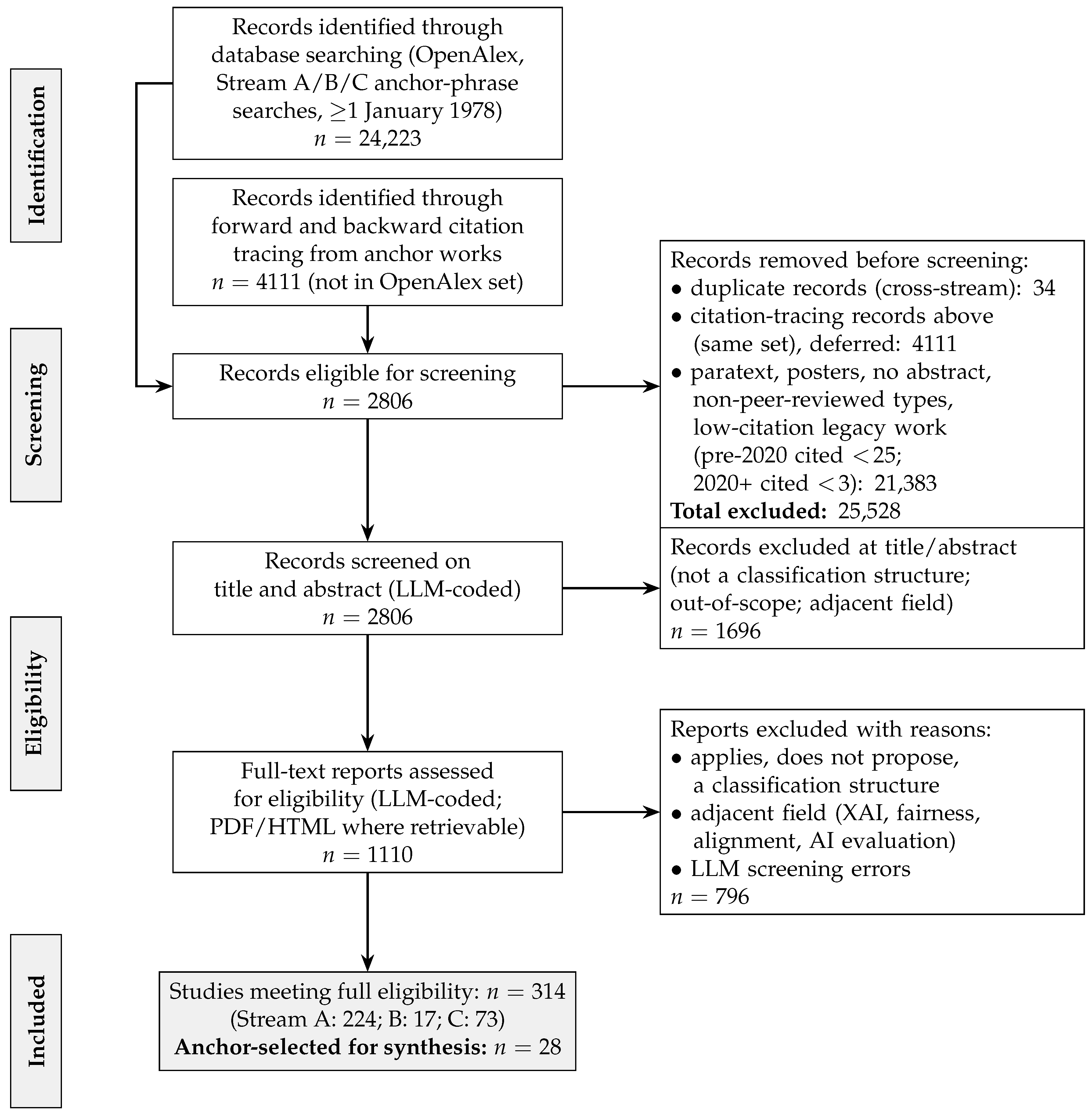
- Screening and selection.

- Quality appraisal.

| Publisher (OpenAlex Proxy for) | Stream A | Stream B | Stream C | Combined | % of All |
|---|---|---|---|---|---|
| IEEE (IEEE Xplore) | 297 | 1 | 78 | 376 | 1.6% |
| ACM (ACM Digital Library) | 45 | 0 | 11 | 56 | 0.2% |
| Elsevier BV (ScienceDirect) | 1361 | 5 | 174 | 1540 | 6.4% |
| Springer Nature | 216 | 1 | 37 | 254 | 1.0% |
| Wiley | 386 | 1 | 33 | 420 | 1.7% |
| MIT Press | 3 | 0 | 2 | 5 | 0.0% |
| Six commercial publishers, sum | 2308 | 8 | 335 | 2651 | 10.9% |
| All venues (OpenAlex) | 15,805 | 75 | 8343 | 24,223 | 100.0% |
- Synthesis approach.
3.2. Framework Construction Approach
3.2.1. Methodological Lineage
3.2.2. Design Objectives (DSR Step: Define Objectives of a Solution)
- DO1—Integration. The framework must integrate the two dimensions that the literature addresses separately but not jointly: AI technology types and operational autonomy levels.
- DO2—Deployment-level granularity. Each axis must be defined at the granularity at which enterprises actually identify, procure, deploy, and manage AI, rather than at the granularity of system-internal cognitive processing (as in Parasuraman et al. [24]) or capability-development trajectories (as in Morris et al. [26]).
- DO3—Shared-taxonomy tractability. The classification must be tractable as a shared taxonomy across the heterogeneous stakeholders responsible for AI transformation, including boards, functional leaders, enterprise architects, technical teams, and risk and compliance officers.
3.2.3. Taxonomy Development Using the Nickerson Method
- Iteration 2 (E2C, types axis). Candidate types were applied to a working set of contemporary enterprise AI deployments observed across industry. Three candidate types collapsed (audition into conversational; recommendation into predictive; robotic automation absorbed into physical AI as a deployment context), yielding the six retained types T1–T6.
- Iteration 3 (C2E, levels axis). The levels-of-autonomy tradition of Stream A (Sheridan and Verplank [23], Parasuraman et al. [24], Morris et al. [26], Feng et al. [27], Porter et al. [28]) and the SAE J3016 driving-automation scale [29] were synthesised and re-projected from the individual-system unit of analysis onto the enterprise deployment unit of analysis (DO2). The synthesis yielded six levels L1–L5 with an additional L6 representing multi-system orchestration; the L5–L6 transition is non-ordinal, a property explicitly acknowledged in Section 4.3.2.
- Iteration 4 (E2C, full matrix). The matrix was applied during construction to enterprise AI deployments across supply chain, marketing, customer service, manufacturing, and finance. The application demonstrated that the matrix accommodates concurrent occupation of multiple cells by a single enterprise function. No deployment in the working set required a new type or level; the taxonomy met the conciseness and comprehensiveness ending conditions for the working set examined. The populated function-level matrices produced during construction are reserved for the empirical follow-up study described in Section 7.
3.2.4. Evaluation Against Nickerson’s Ending Conditions
- Objectiveness. Each axis is defined by a single dimension (technology function for the types axis; division of authority for the levels axis), and each cell is uniquely located by its (type, level) coordinates.
- Conciseness. The framework consists of two axes of six categories each, falling within Miller’s heuristic that Nickerson recommends as a conciseness anchor. The 36-cell matrix is large enough to discriminate but small enough to be held in working memory by a stakeholder.
- Robustness. Different deployments of the same technology occupy different cells (e.g., a predictive AI system at L2 in credit approval vs. L4 in dynamic pricing), evidencing the discriminative capacity of the matrix.
- Comprehensiveness. The four-iteration application across six enterprise functions did not surface a deployment that required a new type or level; the working set examined is bounded, and a wider corpus is examined in the computational pilot study (Section 5).
- Extendibility. The matrix admits sub-typing within types (e.g., predictive AI → classification, regression, recommendation) and sub-levelling within levels (e.g., L4 → parameter ranges by risk tier) without disturbing the principal axes.
- Explanatoriness. Each cell carries a statement of the division of function between human and AI, providing a directly readable description of the deployment regime to a non-technical reader.
4. Results
4.1. Analysis of the Literature Reviewed
4.2. Gap Analysis Across the Three Research Streams
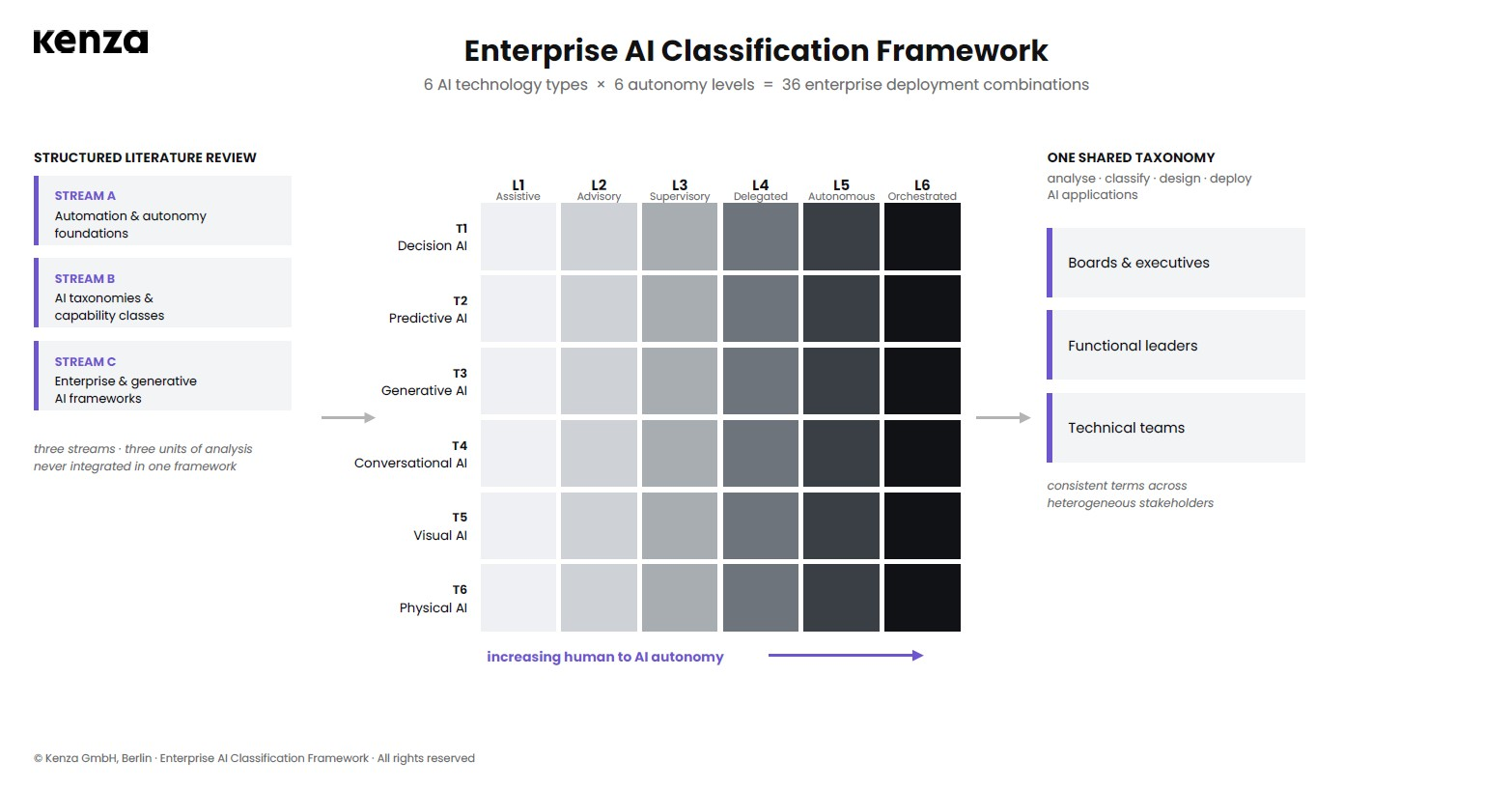
4.3. The Enterprise AI Classification Framework
4.3.1. Six AI Types
- T1 Decision AI.
- T2 Predictive AI.
- T3 Generative AI.
- T4 Conversational AI.
- T5 Visual AI.
- T6 Physical AI.
4.3.2. Six Levels of Human–AI Authority and Coordination
- L1 Assistive.
- L2 Advisory.
- L3 Supervisory.
- L4 Delegated.
- L5 Autonomous.
- L6 Orchestrated.
4.3.3. The 36-Combination Types × Levels Matrix
4.3.4. Framework Application Logic
4.3.5. Locating Agentic AI on the Framework
4.4. Comparison with Prior Frameworks
5. Computational Pilot Study
5.1. Study A: Case-Based Coding Validation
5.1.1. Design
5.1.2. Coding Protocol
5.1.3. Hypotheses and Metrics
- H1 Coverage. The proportion of corpus cases assigned a non-unclassifiable code under the framework exceeds the proportion under each of the four baselines by at least 10 percentage points.
- H2 Reliability. Krippendorff’s for the framework’s type and level axes is at least 0.70 and is at least as high as the corresponding for each baseline’s classification axes.
- H3 Discriminative power. The Shannon entropy of the empirical case distribution across occupied cells of the framework, normalised by of the number of occupied cells, exceeds the corresponding normalised entropy for each baseline.
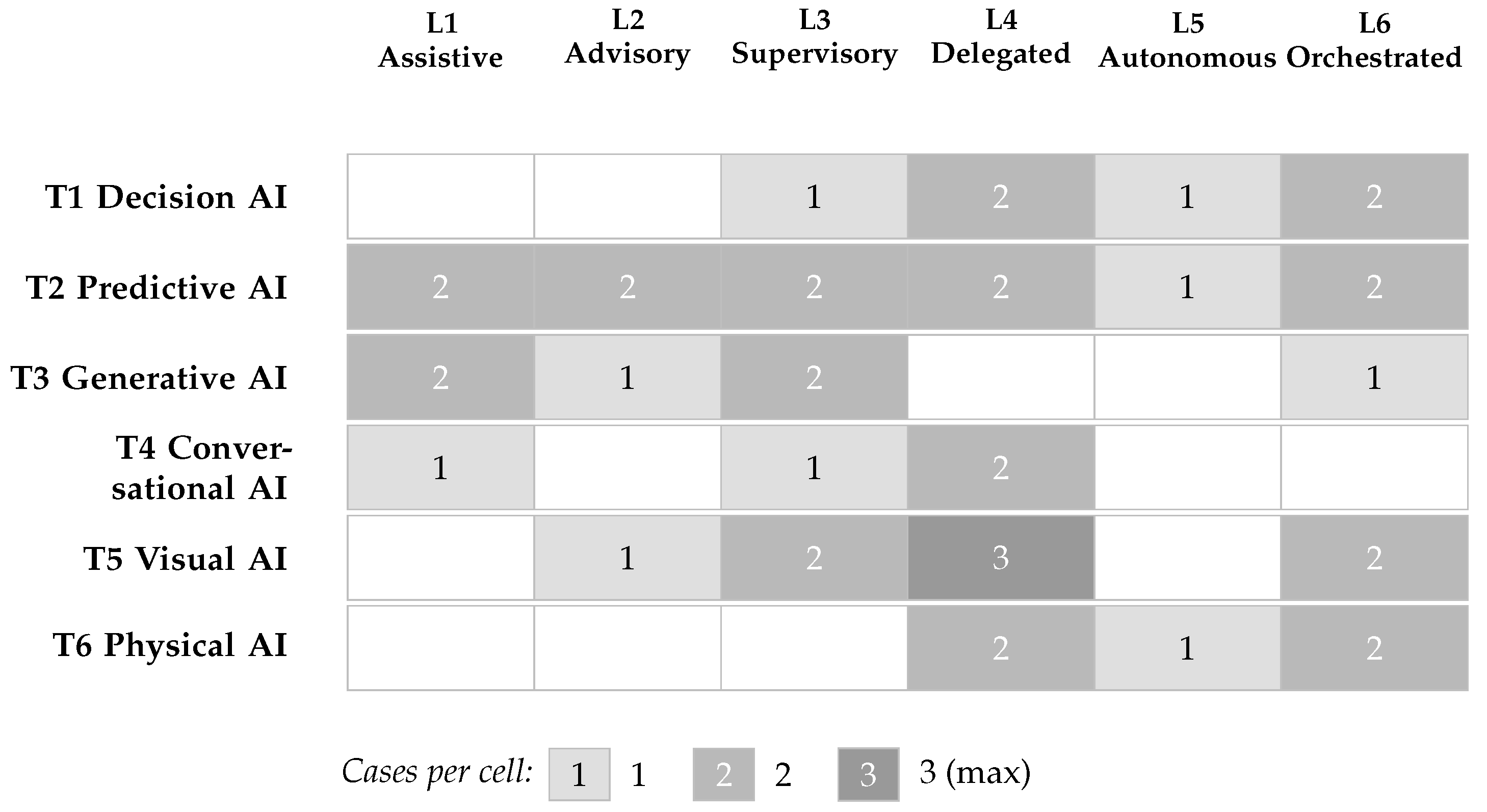
- H4 Heatmap. The empirical density of cases across the framework’s matrix is reported as a heatmap, separately by industry on the full corpus, as the principal empirical artefact of Study A. Figure 2 reports the heatmap for the pilot corpus; the per-industry panels are produced from the full corpus in the empirical follow-up study.
5.2. Study B: Multi-Persona Classification Stress Test
5.3. Pilot Results
5.4. Limitations of the Synthetic Evaluation
6. Discussion
6.1. Theoretical and Practical Contributions
6.2. Practical Implications and Intended Beneficiaries
- Boards and senior executives gain a portfolio-level instrument for AI investment governance. By locating every enterprise AI initiative on the matrix, a board can see at a glance where its AI spend is concentrated, whether the portfolio is skewed toward low-autonomy assistive deployments or toward higher-risk autonomous ones, and where investment is missing. The practical value is a defensible basis for capital-allocation and risk-appetite decisions that the value-gap evidence [12,13] shows are otherwise made without a structured view.
- Functional and business-unit leaders gain a planning instrument for their own function. By instantiating the matrix for, say, supply chain or customer service, a functional leader can plan the progression of a deployment from advisory toward delegated or autonomous operation as confidence and controls mature, and can benchmark that progression against peers.
- Enterprise architects gain a mapping notation. The matrix provides a consistent vocabulary for documenting the AI estate, identifying redundancy and integration opportunities, and recording the multi-cell footprint of agentic and multi-agent systems (Section 4.3.5).
- Risk, compliance, and security officers gain a categorisation aid for regulatory exposure. The type-and-level coordinates map naturally onto the risk-tiering logic of the EU AI Act and comparable regimes, supporting the categorised, auditable deployment inventory those regimes require; the framework interoperates with, rather than replaces, the governance instruments reviewed in Section 1.1 and [21,22].
- AI vendors and consultancies gain a positioning vocabulary, able to describe an offering by the cells of the matrix it occupies and the autonomy transitions it enables, rather than by marketing category.
- Policymakers and standards bodies gain a common reference structure that bridges the system-level autonomy standards of Stream A and the capability taxonomies of Stream B at the enterprise unit of analysis where deployment, and therefore regulation, actually bites.
- Researchers gain an empirical instrument: the matrix is the coding scheme for the computational pilot study (Section 5) and the planned 250-interview validation, and is reusable as a measurement frame for future enterprise AI studies.
6.3. International Comparison of Findings
6.4. Limitations
7. Conclusions
Author Contributions
Funding
Institutional Review Board Statement
Informed Consent Statement
Data Availability Statement
Acknowledgments
Conflicts of Interest
Abbreviations
| AGI | Artificial General Intelligence |
| AI | Artificial Intelligence |
| AI Act | EU Artificial Intelligence Act (Regulation (EU) 2024/1689) |
| CISR | Center for Information Systems Research (MIT) |
| DSR | Design Science Research |
| EIT | European Institute of Innovation and Technology |
| EU | European Union |
| FYP | Five-Year Plan |
| GenAI | Generative Artificial Intelligence |
| INSYTE | Intelligent Systems classification framework [28] |
| JRC | Joint Research Centre (European Commission) |
| KIC | Knowledge and Innovation Community (EIT) |
| L1–L6 | Autonomy Levels (Assistive, Advisory, Supervisory, Delegated, Autonomous, Orchestrated) |
| MIT | Massachusetts Institute of Technology |
| NANDA | Networked Agents and Decentralized Architecture (MIT) |
| NIST | National Institute of Standards and Technology (United States) |
| NPC | National People’s Congress (China) |
| OSF | Open Science Framework |
| PRISMA | Preferred Reporting Items for Systematic Reviews and Meta-Analyses |
| RQ | Research Question |
| SEAI | Strategic Enterprise Artificial Intelligence [38] |
| SLR | Systematic Literature Review |
| SME | Small and Medium-Sized Enterprise |
| T1–T6 | AI Types (Decision, Predictive, Generative, Conversational, Visual, Physical AI) |
References
- National People’s Congress of the People’s Republic of China. Outline of the 15th Five-Year Plan for National Economic and Social Development of the People’s Republic of China (2026–2030). Adopted by the Fourth Session of the Fourteenth National People’s Congress on 12 March 2026. On the “AI+” Action Plan Referenced Therein, See Also: State Council of the People’s Republic of China, Guideline on Deeply Implementing the “AI Plus” Initiative. 26 August 2025. Available online: https://english.www.gov.cn/policies/latestreleases/202508/27/content_WS68ae7976c6d0868f4e8f51a0.html (accessed on 25 June 2026).
- European Parliament; Council of the European Union. Regulation (EU) 2024/1689 of the European Parliament and of the Council of 13 June 2024 Laying down Harmonised Rules on Artificial Intelligence (Artificial Intelligence Act). Official Journal of the European Union, OJ L, 2024/1689, 12.7.2024, 2024. Available online: https://eur-lex.europa.eu/eli/reg/2024/1689/oj (accessed on 25 June 2026).
- European Commission. EU Launches InvestAI Initiative to Mobilise €200 Billion of Investment in Artificial Intelligence. Press Release IP/25/467, 2025. Available online: https://ec.europa.eu/commission/presscorner/detail/en/ip_25_467 (accessed on 25 June 2026).
- European Commission. The AI Continent Action Plan. COM(2025) 165, 2025. Available online: https://digital-strategy.ec.europa.eu/en/library/ai-continent-action-plan (accessed on 25 June 2026).
- European Commission. Apply AI Strategy. COM(2025) 723 Final, 2025. Available online: https://eur-lex.europa.eu/legal-content/EN/TXT/HTML/?uri=CELEX:52025DC0723 (accessed on 25 June 2026).
- Présidence de la République française. Clôture de la Première Journée du Sommet Pour l’Action sur l’IA. Sommet Pour l’Action sur l’Intelligence Artificielle, Grand Palais, Paris, 2025. Available online: https://www.elysee.fr/emmanuel-macron/2025/02/10/cloture-de-la-premiere-journee-du-sommet-pour-laction-sur-lia (accessed on 25 June 2026).
- Challapally, A.; Pease, C.; Raskar, R.; Chari, P. The GenAI Divide: State of AI in Business 2025; Technical Report; MIT Project NANDA: Cambridge, MA, USA, 2025. [Google Scholar]
- Gartner. Gartner Predicts Over 40% of Agentic AI Projects Will Be Canceled by End of 2027. Press Release. 2025. Available online: https://www.gartner.com/en/newsroom/press-releases/2025-06-25-gartner-predicts-over-40-percent-of-agentic-ai-projects-will-be-canceled-by-end-of-2027 (accessed on 25 June 2026).
- Singla, A.; Sukharevsky, A.; Hall, B.; Yee, L.; Chui, M.; Balakrishnan, T. The State of AI in 2025: Agents, Innovation, and Transformation; Technical report; McKinsey & Company: New York, NY, USA, 2025. [Google Scholar]
- Weill, P.; Woerner, S.L.; Sebastian, I.M. Building Enterprise AI Maturity; MIT CISR Research Briefing Vol. XXIV, No. 12; MIT Center for Information Systems Research: Cambridge, MA, USA, 2024. [Google Scholar]
- Sadiq, R.B.; Safie, N.; Abd Rahman, A.H.; Goudarzi, S. Artificial Intelligence Maturity Model: A Systematic Literature Review. PeerJ Comput. Sci. 2021, 7, e661. [Google Scholar] [CrossRef] [PubMed]
- Enholm, I.M.; Papagiannidis, E.; Mikalef, P.; Krogstie, J. Artificial Intelligence and Business Value: A Literature Review. Inf. Syst. Front. 2022, 24, 1709–1734. [Google Scholar] [CrossRef]
- Mikalef, P.; Gupta, M. Artificial Intelligence Capability: Conceptualization, Measurement Calibration, and Empirical Study on Its Impact on Organizational Creativity and Firm Performance. Inf. Manag. 2021, 58, 103434. [Google Scholar] [CrossRef]
- Noy, S.; Zhang, W. Experimental Evidence on the Productivity Effects of Generative Artificial Intelligence. Science 2023, 381, 187–192. [Google Scholar] [CrossRef] [PubMed]
- Brynjolfsson, E.; Li, D.; Raymond, L.R. Generative AI at Work. Q. J. Econ. 2025, 140, 889–942. [Google Scholar] [CrossRef]
- Eloundou, T.; Manning, S.; Mishkin, P.; Rock, D. GPTs Are GPTs: Labor Market Impact Potential of LLMs. Science 2024, 384, 1306–1308. [Google Scholar] [CrossRef] [PubMed]
- Collins, C.; Dennehy, D.; Conboy, K.; Mikalef, P. Artificial Intelligence in Information Systems Research: A Systematic Literature Review and Research Agenda. Int. J. Inf. Manag. 2021, 60, 102383. [Google Scholar] [CrossRef]
- Newman, J. A Taxonomy of Trustworthiness for Artificial Intelligence: Connecting Properties of Trustworthiness with Risk Management and the AI Lifecycle; Cltc white paper series; UC Berkeley Center for Long-Term Cybersecurity: Berkeley, CA, USA, 2023. [Google Scholar]
- Abercrombie, G.; Benbouzid, D.; Giudici, P.; Golpayegani, D.; Hernandez, J.; Noro, P.; Pandit, H.; Paraschou, E.; Pownall, C.; Prajapati, J.; et al. A Collaborative, Human-Centred Taxonomy of AI, Algorithmic, and Automation Harms. arXiv 2024, arXiv:2407.01294. [Google Scholar]
- Bagehorn, F.; Brimijoin, K.; Daly, E.M.; He, J.; Hind, M.; Garcés-Erice, L.; Giblin, C.; Giurgiu, I.; Martino, J.; Nair, R.; et al. AI Risk Atlas: Taxonomy and Tooling for Navigating AI Risks and Resources. arXiv 2025, arXiv:2503.05780. [Google Scholar]
- Mäntymäki, M.; Minkkinen, M.; Birkstedt, T.; Viljanen, M. Defining Organizational AI Governance. AI Ethics 2022, 2, 603–609. [Google Scholar] [CrossRef]
- Birkstedt, T.; Minkkinen, M.; Tandon, A.; Mäntymäki, M. AI Governance: Themes, Knowledge Gaps and Future Agendas. Internet Res. 2023, 33, 133–167. [Google Scholar] [CrossRef]
- Sheridan, T.B.; Verplank, W.L. Human and Computer Control of Undersea Teleoperators; Technical Report; Massachusetts Institute of Technology, Man–Machine Systems Laboratory: Cambridge, MA, USA, 1978. [Google Scholar]
- Parasuraman, R.; Sheridan, T.B.; Wickens, C.D. A Model for Types and Levels of Human Interaction with Automation. IEEE Trans. Syst. Man. Cybern. Part A Syst. Hum. 2000, 30, 286–297. [Google Scholar] [CrossRef]
- Dellermann, D.; Ebel, P.; Söllner, M.; Leimeister, J.M. Hybrid Intelligence. Bus. Inf. Syst. Eng. 2019, 61, 637–643. [Google Scholar] [CrossRef]
- Morris, M.R.; Sohl-Dickstein, J.; Fiedel, N.; Warkentin, T.; Dafoe, A.; Faust, A.; Farabet, C.; Legg, S. Position: Levels of AGI for Operationalizing Progress on the Path to AGI. In Proceedings of the Forty-First International Conference on Machine Learning (ICML 2024), Vienna, Austria, 21–27 July 2024; Volume 235. [Google Scholar]
- Feng, K.J.K.; McDonald, D.W.; Zhang, A.X. Levels of Autonomy for AI Agents. arXiv 2025, arXiv:2506.12469. [Google Scholar]
- Porter, Z.; Calinescu, R.; Lim, E.; Hodge, V.; Ryan, P.; Burton, S.; Habli, I.; Lawton, T.; McDermid, J.; Molloy, J.; et al. INSYTE: A Classification Framework for Traditional to Agentic AI Systems. ACM Trans. Auton. Adapt. Syst. 2025, 20, 15. [Google Scholar] [CrossRef]
- SAE Standard J3016_202104; Taxonomy and Definitions for Terms Related to Driving Automation Systems for On-Road Motor Vehicles. SAE International: Warrendale, PA, USA, 2021. [CrossRef]
- EIT Climate-KIC. Creation of a Taxonomy for the European AI Ecosystem; Cross-Kic Activity “Innovation Impact Artificial Intelligence”; European Institute of Innovation and Technology: Budapest, Hungary, 2020.
- Samoili, S.; López Cobo, M.; Delipetrev, B.; Martínez-Plumed, F.; Gómez, E.; De Prato, G. AI Watch. Defining Artificial Intelligence 2.0: Towards an Operational Definition and Taxonomy for the AI Landscape; Jrc Technical Report eur 30873 en; Publications Office of the European Union: Luxembourg, 2021. [CrossRef] [PubMed]
- Theofanos, M.; Choong, Y.Y.; Jensen, T. AI Use Taxonomy: A Human-Centered Approach; Nist ai 200-1; National Institute of Standards and Technology: Gaithersburg, MD, USA, 2024. [CrossRef]
- Davenport, T.H.; Ronanki, R. Artificial Intelligence for the Real World. Harv. Bus. Rev. 2018, 96, 108–116. [Google Scholar]
- Davenport, T.H. The AI Advantage: How to Put the Artificial Intelligence Revolution to Work; MIT Press: Cambridge, MA, USA, 2018. [Google Scholar]
- Brynjolfsson, E.; Mitchell, T. What Can Machine Learning Do? Workforce Implications. Science 2017, 358, 1530–1534. [Google Scholar] [CrossRef] [PubMed]
- Brynjolfsson, E.; Mitchell, T.; Rock, D. What Can Machines Learn, and What Does It Mean for Occupations and the Economy? AEA Pap. Proc. 2018, 108, 43–47. [Google Scholar] [CrossRef]
- Herrmann, H. The Arcanum of Artificial Intelligence in Enterprise Applications: Toward a Unified Framework. J. Eng. Technol. Manag. 2022, 66, 101716. [Google Scholar] [CrossRef]
- Bashir, J. Strategic Enterprise Artificial Intelligence (The Conceptual Hierarchical Framework). Int. J. Bus. Manag. Stud. 2024, 5, 131–138. [Google Scholar] [CrossRef]
- Stein, H. Toward a Taxonomy of Generative AI Use Cases in Business Contexts: Integrating Complexity, Risk, and Strategy. J. Comput. Sci. 2026, 96, 102826. [Google Scholar] [CrossRef]
- Sapkota, R.; Roumeliotis, K.I.; Karkee, M. AI Agents vs. Agentic AI: A Conceptual Taxonomy, Applications and Challenges. Inf. Fusion 2026, 126, 103599. [Google Scholar] [CrossRef]
- Panigrahy, S. Multi-Agentic AI Systems: A Comprehensive Framework for Enterprise Digital Transformation. J. Comput. Sci. Technol. Stud. 2025, 7, 86–96. [Google Scholar] [CrossRef]
- Arunkumar, V.; Gangadharan, G.R.; Buyya, R. Agentic Artificial Intelligence (AI): Architectures, Taxonomies, and Evaluation of Large Language Model Agents. arXiv 2026, arXiv:2601.12560. [Google Scholar]
- Fornasiero, R.; Kiebler, L.; Falsafi, M.; Sardesai, S. Proposing a Maturity Model for Assessing Artificial Intelligence and Big Data in the Process Industry. Int. J. Prod. Res. 2025, 63, 1235–1255. [Google Scholar] [CrossRef]
- Iansiti, M.; Lakhani, K.R. Competing in the Age of AI: Strategy and Leadership When Algorithms and Networks Run the World; Harvard Business Review Press: Boston, MA, USA, 2020. [Google Scholar]
- Acemoglu, D.; Restrepo, P. Automation and New Tasks: How Technology Displaces and Reinstates Labor. J. Econ. Perspect. 2019, 33, 3–30. [Google Scholar] [CrossRef]
- ISO/IEC 42001:2023; Information Technology—Artificial Intelligence—Management System. International Organization for Standardization: Geneva, Switzerland, 2023.
- National Institute of Standards and Technology. Artificial Intelligence Risk Management Framework (AI RMF 1.0); Nist ai 100-1; National Institute of Standards and Technology: Gaithersburg, MD, USA, 2023. [CrossRef]
- Boston Consulting Group. The AI Maturity Matrix: Which Economies Are Ready for AI? Technical Report; BCG X/Boston Consulting Group: Boston, MA, USA, 2024. [Google Scholar]
- Boston Consulting Group. From Potential to Profit: Closing the AI Impact Gap; Technical Report; Boston Consulting Group: Boston, MA, USA, 2025. [Google Scholar]
- Deloitte. The State of Generative AI in the Enterprise: Now Decides Next; Technical Report; Deloitte AI Institute: New York, NY, USA, 2024; Quarterly Survey Series; Fourth-Wave Report 2024. [Google Scholar]
- Accenture. Technology Vision 2024: Human by Design—How AI Unleashes the Next Level of Human Potential; Technical Report; Accenture Research: Dublin, Ireland, 2024. [Google Scholar]
- Kanbach, D.K.; Heiduk, L.; Blüher, G.; Schreiter, M.; Lahmann, A. The GenAI Is Out of the Bottle: Generative Artificial Intelligence from a Business Model Innovation Perspective. Rev. Manag. Sci. 2024, 18, 1189–1220. [Google Scholar] [CrossRef]
- Page, M.J.; McKenzie, J.E.; Bossuyt, P.M.; Boutron, I.; Hoffmann, T.C.; Mulrow, C.D.; Shamseer, L.; Tetzlaff, J.M.; Akl, E.A.; Brennan, S.E.; et al. The PRISMA 2020 statement: An updated guideline for reporting systematic reviews. BMJ 2021, 372, n71. [Google Scholar] [CrossRef] [PubMed]
- Shea, B.J.; Reeves, B.C.; Wells, G.; Thuku, M.; Hamel, C.; Moran, J.; Moher, D.; Tugwell, P.; Welch, V.; Kristjansson, E.; et al. AMSTAR 2: A Critical Appraisal Tool for Systematic Reviews That Include Randomised or Non-Randomised Studies of Healthcare Interventions, or Both. BMJ 2017, 358, j4008. [Google Scholar] [CrossRef] [PubMed]
- Whiting, P.; Savović, J.; Higgins, J.P.T.; Caldwell, D.M.; Reeves, B.C.; Shea, B.; Davies, P.; Kleijnen, J.; Churchill, R. ROBIS: A New Tool to Assess Risk of Bias in Systematic Reviews Was Developed. J. Clin. Epidemiol. 2016, 69, 225–234. [Google Scholar] [CrossRef] [PubMed]
- Haddaway, N.R.; Grainger, M.J.; Gray, C.T. Citationchaser: A Tool for Transparent and Efficient Forward and Backward Citation Chasing in Systematic Searching. Res. Synth. Methods 2022, 13, 533–545. [Google Scholar] [CrossRef] [PubMed]
- Hevner, A.R.; March, S.T.; Park, J.; Ram, S. Design Science in Information Systems Research. MIS Q. 2004, 28, 75–105. [Google Scholar] [CrossRef]
- Peffers, K.; Tuunanen, T.; Rothenberger, M.A.; Chatterjee, S. A Design Science Research Methodology for Information Systems Research. J. Manag. Inf. Syst. 2007, 24, 45–77. [Google Scholar] [CrossRef]
- Nickerson, R.C.; Varshney, U.; Muntermann, J. A Method for Taxonomy Development and Its Application in Information Systems. Eur. J. Inf. Syst. 2013, 22, 336–359. [Google Scholar] [CrossRef]
- Drljevic, N.; Arias Aranda, D.; Stantchev, V. An Integrated Adoption Model to Manage Blockchain-Driven Business Innovation in a Sustainable Way. Sustainability 2022, 14, 2873. [Google Scholar] [CrossRef]
- Eurostat. Use of Artificial Intelligence in Enterprises; Eurostat Statistics Explained, 2024 Survey Results; Eurostat: Luxembourg, 2025.
- Arroyabe, M.F.; Arranz, C.F.A.; Fernandez De Arroyabe, I.; Fernandez de Arroyabe, J.C. Analyzing AI Adoption in European SMEs: A Study of Digital Capabilities, Innovation, and External Environment. Technol. Soc. 2024, 79, 102733. [Google Scholar] [CrossRef]

| Stream | Search String (Boolean) |
|---|---|
| A | (“levels of autonomy” OR “levels of automation” OR “autonomy framework” OR “human–AI authority” OR “levels of AGI”) AND (“classification” OR “taxonomy” OR “framework”) |
| B | (“AI taxonomy” OR “AI classification” OR “AI capability taxonomy” OR “AI use taxonomy”) AND (“operational definition” OR “policy” OR “capability categories”) |
| C | (“enterprise AI” OR “AI maturity” OR “generative AI taxonomy” OR “agentic AI” OR “multi-agent system”) AND (“framework” OR “classification” OR “maturity model” OR “business transformation”) |
| L1 Assistive | L2 Advisory | L3 Supervisory | L4 Delegated | L5 Autonomous | L6 Orchestrated | |
|---|---|---|---|---|---|---|
| T1 Decision AI | Surfaces resource and option information for the planner | Recommends plan or allocation options for human selection | Produces plan or allocation; human approves before execution | Plans and re-plans within bounded parameters; human monitors | Runs planning and allocation autonomously | Decision AIs coordinate planning across functions or networks |
| T2 Predictive AI | Displays forecasts or risk patterns for human review | Recommends classifications or actions; human decides | Produces classification or scoring; human approves before action | Triggers actions within defined thresholds; human monitors | Runs forecast- and-act cycles end-to-end | Predictive AIs share inferences across networked partners |
| T3 Generative AI | Drafts content for human authoring | Suggests content variants; human selects | Produces content artefact; human reviews and approves | Publishes content within approved templates; human monitors | Produces and releases content end-to-end | Generative AIs coordinate content across channels |
| T4 Conversational AI | Suggests responses for human agents | Recommends dialogue options; human selects | Handles dialogue; human approves binding actions | Resolves interactions within defined intents; human monitors | Conducts dialogue lifecycle without intervention | Coordinates across channels and back-office systems |
| T5 Visual AI | Highlights regions of interest for human review | Recommends visual classifications; human selects | Produces classification decision; human confirms | Executes visual classification within thresholds | Runs continuous recognition or inspection end-to-end | Visual AIs share recognition across distributed nodes |
| T6 Physical AI | Augments human physical work | Suggests motion paths or actions; human executes | Executes physical task; human approves before motion | Operates within defined zones; human monitors | Operates in physical environment end-to-end | Physical AI fleets coordinate operations |
| Framework | AI Types | Autonomy Levels | Both Axes Integrated | Enterprise Focus |
|---|---|---|---|---|
| Sheridan and Verplank [23] | No | Yes (unidimensional scale) | No | No |
| Parasuraman et al. [24] | Partial (cognitive processing stages) | Yes | Yes (cognitive types × levels) | No |
| Dellermann et al. [25] | No | No (configurational) | No | Partial |
| Morris et al. [26] | Partial (capability dimensions) | Yes | Partial | No |
| Feng et al. [27] | No | Yes (user-role focused) | No | No |
| Porter et al. INSYTE [28] | No (functional rather than typological) | Yes (two sub-dimensions under Operational Independence: Intervention and Oversight) | No (no types × levels integration) | No |
| EIT Cross-KIC [30] | Yes (multi-dimensional structural taxonomy: five dimensions including AI Capabilities and Enterprise Functions) | No | No (no autonomy axis) | No |
| Samoili et al. JRC AI Watch [31] | Yes (operational AI domain/subdomain taxonomy) | No | No | No |
| Theofanos et al. NIST AI 200-1 [32] | Yes (activity categories) | No | No | No |
| Davenport and Ronanki [33,34] | Yes (three cognitive task categories: process automation, cognitive insight, cognitive engagement) | No | No | Partial (management-oriented) |
| Brynjolfsson and Mitchell [35,36] | No (task-suitability criteria, not AI categorisation) | No | No | No (labour economics unit of analysis) |
| Herrmann [37] | Yes (Euler diagram of fields and subfields) | No | No | Yes |
| Bashir [38] | No | No (single-axis SEAI hierarchy) | No | Yes |
| Stein [39] | Partial (genAI only) | Partial (technical autonomy as one of five perspectives) | No | Yes |
| Sapkota et al. [40] | Partial (agentic AI only) | Partial | No | Partial |
| Weill, Woerner, and Sebastian [10] | No | No (single-axis maturity) | No | Yes |
| Enterprise AI Classification Framework | Yes (six AI technology types) | Yes (six autonomy levels) | Yes ( matrix) | Yes |
| Metric | Value | 95% CI | Target | Verdict |
|---|---|---|---|---|
| primary cell type, nominal | 0.809 | ≥ | H2 met (point) | |
| primary cell level, ordinal | 0.802 | ≥ | H2 met (point) | |
| primary cell T + L pair, nominal | 0.628 | ≥ | close, below | |
| Cell-set agreement (full equality) | 12/20 (60%) | — | — | |
| Framework coverage, Coder A | 100% | — | — | |
| Framework coverage, Coder B | 100% | — | — | |
| SEAI baseline coverage, Coder A | 70% | — | — | |
| SEAI baseline coverage, Coder B | 0% | — | strict v1.0 rule applied | |
| MIT CISR baseline coverage, Coder A | 70% | — | — | |
| MIT CISR baseline coverage, Coder B | 0% | — | strict v1.0 rule applied | |
| Multi-cell occupation rate, both coders | 40% | — | matches design | |
| L6 attribution rate, Coder A/Coder B | 15%/10% | 10–15% | in design band | |
| Disagreements adjudicated | 8 of 20 | — | — |
Disclaimer/Publisher’s Note: The statements, opinions and data contained in all publications are solely those of the individual author(s) and contributor(s) and not of MDPI and/or the editor(s). MDPI and/or the editor(s) disclaim responsibility for any injury to people or property resulting from any ideas, methods, instructions or products referred to in the content. |
© 2026 by the authors. Licensee MDPI, Basel, Switzerland. This article is an open access article distributed under the terms and conditions of the Creative Commons Attribution (CC BY) license.
Share and Cite
Borovac, N.; Stantchev, V. A Novel Enterprise AI Classification Framework for Business Transformation: A Structured Literature Review and Integration of AI Types and Autonomy Levels. Information 2026, 17, 646. https://doi.org/10.3390/info17070646
Borovac N, Stantchev V. A Novel Enterprise AI Classification Framework for Business Transformation: A Structured Literature Review and Integration of AI Types and Autonomy Levels. Information. 2026; 17(7):646. https://doi.org/10.3390/info17070646
Chicago/Turabian StyleBorovac, Nusi, and Vladimir Stantchev. 2026. "A Novel Enterprise AI Classification Framework for Business Transformation: A Structured Literature Review and Integration of AI Types and Autonomy Levels" Information 17, no. 7: 646. https://doi.org/10.3390/info17070646
APA StyleBorovac, N., & Stantchev, V. (2026). A Novel Enterprise AI Classification Framework for Business Transformation: A Structured Literature Review and Integration of AI Types and Autonomy Levels. Information, 17(7), 646. https://doi.org/10.3390/info17070646